- Analytics
- News and Tools
- Market News
CFD Markets News and Forecasts — 20-12-2021
- Gold consolidates recent losses after consecutive two-day declines.
- Omicron woes escalate as WHO, Imperial College of London and US CDC support market fears.
- Deadlock over US President Biden’s BBB, US-China tussles and Fed’s rate-hike concerns also favor risk-off mood.
Gold (XAU/USD) licks its wounds near $1,790 during Tuesday’s Asian session, after declining from two consecutive days from the monthly high.
The yellow metal’s latest weakness could be linked to the market’s fresh fears over the South African covid variant, dubbed as Omicron. Adding to the risk-aversion are the chatters surrounding the US Federal Reserve’s (Fed) rate hike, deadlock over US President Joe Biden’s Build Back Better (BBB) plan and the Sino-American tussles.
After an initial rejection of the Omicron fears, global leaders are all worried over the COVID-19 variant that pushes some of the leading economics, like the UK and Europe, to recall strict activity restrictions during the holiday season.
The fears of Omicron were recently backed by the World Health Organization (WHO) while saying, “The Omicron variant of the coronavirus is spreading faster than the Delta variant and is causing infections in people already vaccinated or who have recovered from the COVID-19 disease,” per Reuters. On the same line were the Researchers at Imperial College London and the US Centers for Disease Control and Prevention (CDC). The UK scientists said, per Reuters, Infections caused by the Omicron variant of the coronavirus do not appear to be less severe than infections from Delta. On the other hand, Reuters said that Omicron is now the most common coronavirus variant in the US, accounting for nearly three-quarters of COVID-19 cases, per US CDC.
US President Joe Biden’s much-awaited BBB stimulus plan gets a rejection from Senator Joe Manchin, making it hard to cross the House considering the Republicans’ readiness to avoid favoring the plan and Democrats’ wafer-thin majority. Even so, House Speaker Nancy Pelosi and US President Biden stay hopeful of getting the aid package through during early 2022.
Adding to the risk-off catalysts are the US-China tussles that escalated of late. On Monday, Chinese foreign minister Wang Yi said, per Reuters, "If there is confrontation, then (China) will not fear it, and will fight to the finish." China’s Wang Yi adds, "There is no harm in competition but it should be ‘positive’”. On the same line were fears of the Fed rate-hike, backed by Fed Board of Governors member Christopher Waller
Against this backdrop, the US Treasury yields posted 2.3 basis points (bps) of an upside to 1.42% after declining to the monthly lows. Further, the Wall Street benchmarks also posted losses but the S&P 500 Future print mild gains by the press time.
Looking forward, a light calendar will restrict gold’s short-term moves but risk catalysts can keep the bears hopeful until the yields keep the latest rebound.
Technical analysis
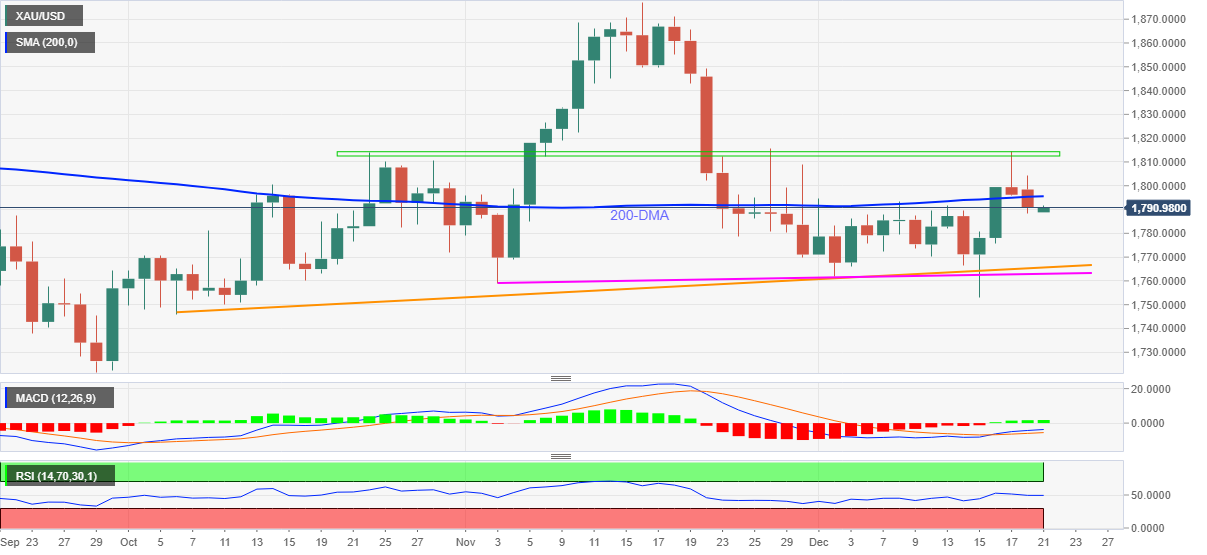
Failures to cross a two-month-old horizontal resistance area precede the metal’s latest break of the 200-DMA, around $1,795, to keep gold sellers hopeful.
That said, an ascending support line from early October, close to $1,765 will be challenging the bears, a break of which will have another support line from early November, near $1,760, to challenge the gold bears.
In a case where the gold prices decline below $1,760, September’s bottom surrounding $1,721 should become their favorite.
On the contrary, a clear upside break of the stated horizontal hurdle around $1,813-15, will aim for tops marked during July and September near $1,834 and then to multiple lows marked during mid-November close to $1,845.
In a case where gold buyers successfully cross the $1,845 resistance, November’s peak of $1,877 and the $1,900 round figure will be in focus.
Gold: Daily chart
Trend: Further weakness expected
- The British pound falls amid a risk-off environment, down some 0.31%.
- On Monday, US equities fell amid risk-aversion, which gains follow-through as the Asian session begins.
- GBP/JPY Technical Outlook: Bearish bias as long as it persists below 152.30.
At the time of writing, cable edges slightly downas the Asian Pacific session begin, trading at 150.09 during the day. Risk aversion in the financial markets continues, as Asian equity futures are in the red, led by the Hang-Seng down almost 2%, following US stocks indices footsteps, which ended the session with losses.
In the overnight session, the British pound dipped to 149.52. However, as the European session opened, it bounced off the daily lows towards the 200-hour simple moving average (SMA), stalling the upward move, hovering around the Tuesday central daily pivot at 150.02.
GBP/JPY Price Forecast: Technical outlook
The GBP/JPY daily chart depicts that the cross-currency pair has a downward bias, as shown by the daily moving averages (DMAs) residing 200-pips above the spot price. Additionally, the price action from December 15 to December 17 formed a candlestick pattern called an evening star. This bearish signal could propel the GBP/JPY towards the most recent swing low, the December 3 daily low at 148.96.
In the event of accomplishing the abovementioned, the next support would be the July 20 daily low at 148.45, followed by the February 26 at 147.40.
On the flip side, the first resistance would be the December 20 high at 150.55. The breach of the latter would open the door for further gains. The following resistance would be the December 17 daily high at 151.71, followed by 152.00, and the confluence of the 100 and the 200-DMA around the 152.30-50.
-637756389472443383.png)
One-month risk reversal on USD/CAD, a measure of the spread between call and put prices, prints the highest level in December for Monday per data source Reuters.
A call option gives the holder the right but not obligation to buy the underlying asset at a predetermined price on or before a specific date. A put option represents a right to sell.
That being said, the daily difference between them snaps a two-day downtrend to rise to +0.138 at the latest.
The options market scenario matches the USD/CAD price rally that refreshed 2021 top the previous day, mainly on the downbeat performance of Canada’s key export item WTI crude oil. It’s worth noting that the Loonie pair grinds higher around 1.2940 by the press time of the early Asian session on Tuesday.
Read: USD/CAD hits annual highs in 1.2960s as crude oil tanks amid Omicron concerns
- EUR/USD struggles to keep the previous day’s corrective pullback.
- Seven-week-old descending trend line, 200-SMA restrict immediate recovery.
- Channel support, yearly low test short-term declines before 61.8% FE level.
- Steady RSI line keeps sellers hopeful, bulls have a bumpy road to return.
EUR/USD grinds lower around 1.1280 amid the initial Asian session on Tuesday, despite the week-start rebound.
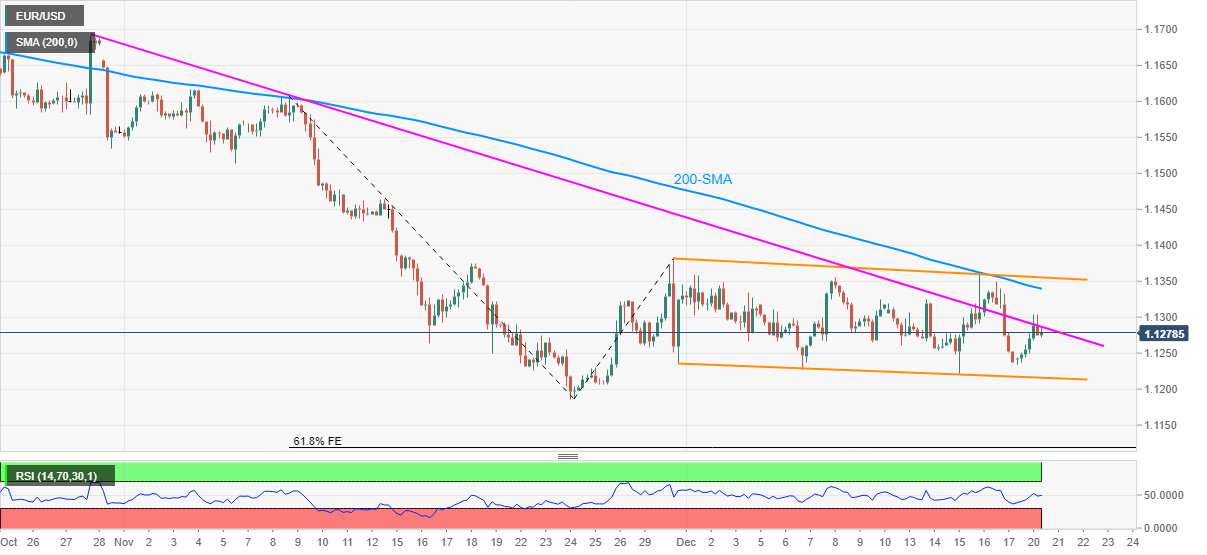
In doing so, the major currency pair stays inside a three-week-old downward sloping trend channel, needless to mention about trading below the 200-DMA and a descending resistance line from late October. Given the steady RSI conditions, the EUR/USD pair’s weakness is likely to prevail.
The same gradually directs the pair prices towards the stated channel’s support line, around 1.1215 by the press time.
Should the EUR/USD sellers reject stepping back from 1.1215, the yearly low near 1.1185 will be in focus ahead of the 61.8% Fibonacci retracement level of November 09-30 moves near 1.1120.
On the flip side, the stated resistance line restricts immediate advances near 1.1290, a break of which will challenge the 200-SMA and the channel’s upper line, respectively around 1.1340 and 1.1355.
Even if the EUR/USD bulls cross the 1.1355 hurdle, 1.1375, the 1.1400 threshold and mid-November peak close to 1.1465 should flash on their radars.
EUR/USD: Four-hour chart
Trend: Further weakness expected
- NZD/USD remains pressured around yearly low, recently sidelined.
- Risk sentiment remains sour as virus variant spread fears of fresh activity measures during holiday season.
- Delay in US stimulus, Sino-American tussles add to risk-off mood, PBOC fails to placate fears.
- Light calendar ahead, qualitative catalysts are crucial for fresh impulse.
NZD/USD defends 0.6700 threshold, teasing the yearly low while retreating to 0.6710 during early Tuesday morning in Asia. The kiwi pair dropped for the second consecutive day on Monday as fears over the South African covid variant, Omicron, escalated while the deadlock over the US Build Back Better (BBB) plan adds to the risk-aversion, weighing on the Antipodeans.
After an initial rejection of the Omicron fears, global leaders are all worried over the COVID-19 variant that pushes some of the leading economics, like the UK and Europe, to recall strict activity restrictions during the holiday season. The fears of Omicron were recently backed by the World Health Organization (WHO) while saying, “The Omicron variant of the coronavirus is spreading faster than the Delta variant and is causing infections in people already vaccinated or who have recovered from the COVID-19 disease,” per Reuters.
In New Zealand, the weather conditions are a bit favorable but the cases are gradually rising. “As of Monday there were 22 cases of Omicron in MIQ in New Zealand,” said NZ Herald. The Pacific nation targets Australia’s 90% vaccination rate to battle the virus strain.
Elsewhere, US President Joe Biden’s much-awaited BBB stimulus plan gets a rejection from Senator Joe Manchin, making it hard to cross the House considering the Republicans’ readiness to avoid favoring the plan and Democrats’ wafer-thin majority. Even so, House Speaker Nancy Pelosi and US President Biden stay hopeful of getting the aid package through during early 2022.
It’s worth noting that the US-China tussles escalated and offer another negative for the NZD/USD prices, considering New Zealand’s close trade ties with Beijing. Recently, Chinese foreign minister Wang Yi said, per Reuters, "If there is confrontation, then (China) will not fear it, and will fight to the finish." China’s Wang Yi adds, "There is no harm in competition but it should be ‘positive’”. On the same line were fears of the Fed rate-hike, backed by Fed Board of Governors member Christopher Waller, also weigh on the NZD/USD.
Amid these plays, US Treasury yields posted 2.3 basis points (bps) of an upside after declining to the monthly lows. Further, the Wall Street benchmarks also posted losses but the commodities traded mixed, with oil down and gold up.
Looking forward, New Zealand’s Credit Card Spending for November, expected -2.1% YoY versus -5.6% prior, will entertain NZD/USD traders but major attention will be given to risk catalysts for clear direction.
Technical analysis
NZD/USD pullback from 100-EMA joins bearish MACD signal and downbeat RSI line, not oversold, to keep sellers hopeful of refreshing the yearly bottom, currently around 0.6700.
In doing so, 61.8% Fibonacci Expansion (FE) of November 23 to December 16 moves, around 0.6670, will offer an intermediate halt during the likely slump towards November 2020 low near 0.6590.
Meanwhile, an upside clearance of the 100-EMA level of 0.6800 isn’t a green pass to the NZD/USD bulls as a one-month-old horizontal line near 0.6860 and the 200-EMA close to 0.6870 will be crucial hurdles before welcoming the bulls.
- GBP/USD is on the way to test daily resistance and eye son 1.3250.
- The bears will need to see a break below 1.3150.
GBP/USD, for the most part, is consolidating. There is little prospect of a breakout, one way or another until the parameters of the sideways price action are broken. The following illustrates the outlook from a long=term to a nearer-term perspective.
GBP/USD daily chart
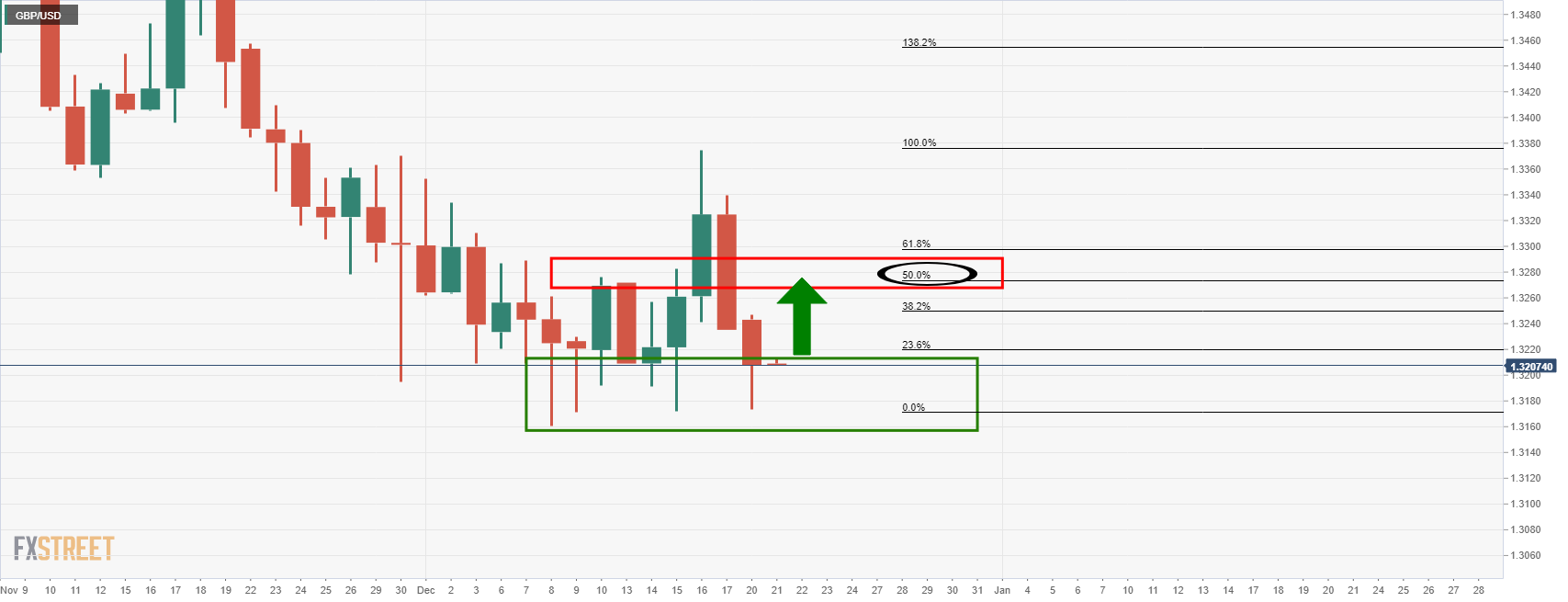
The price is stalling in support and there is the potential for it to climb back to a 50% mean reversion level in the coming sessions if the bulls commit.
There are bearish headwinds from the fundamental side, so a quick recovery in the absence of positive news on the Brexit or Omricon front will be unlikely. With that being said, holiday then markets can go either way, so traders will be wary of the potential for volatility.
Moving down to the hourly chart, there is certainly an upside bias:
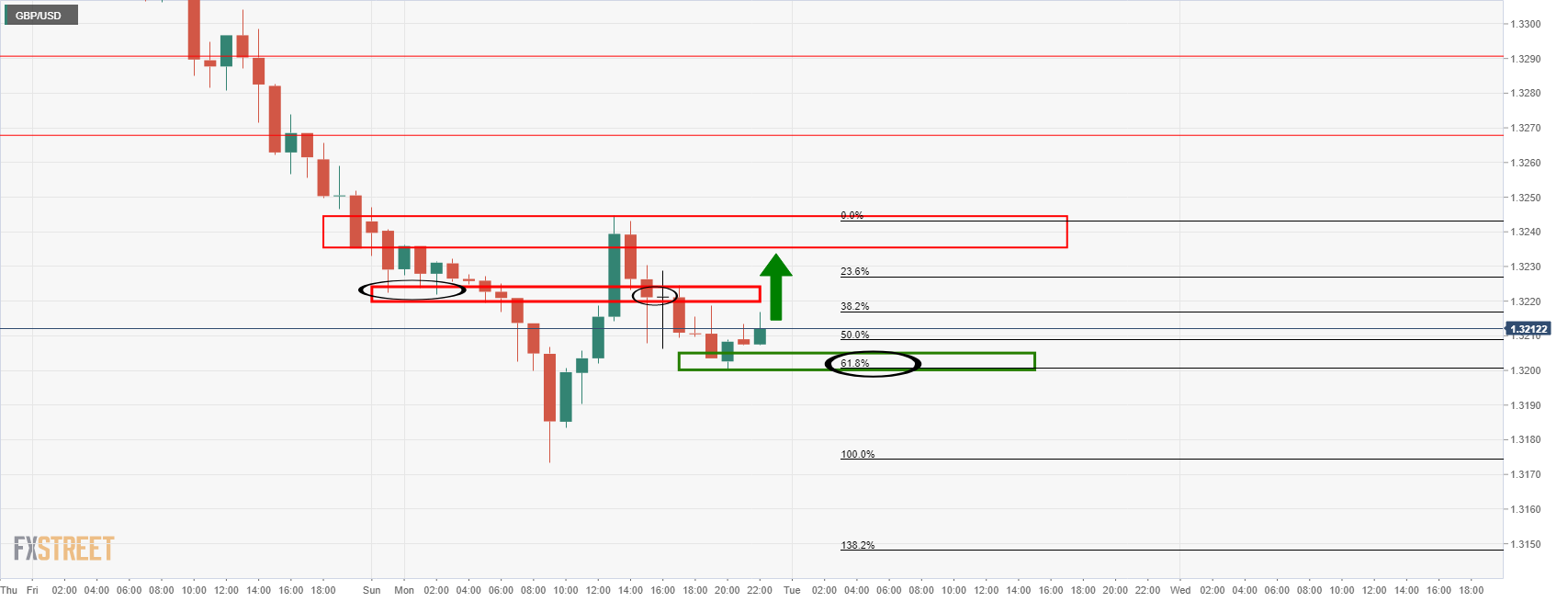
The 61.8% Fibonacci was hit and the bulls have moved in. The question now is whether they can stay the course and penetrate 1.3220 resistance? In doing so, then the daily 1.3240/50s will be a target.
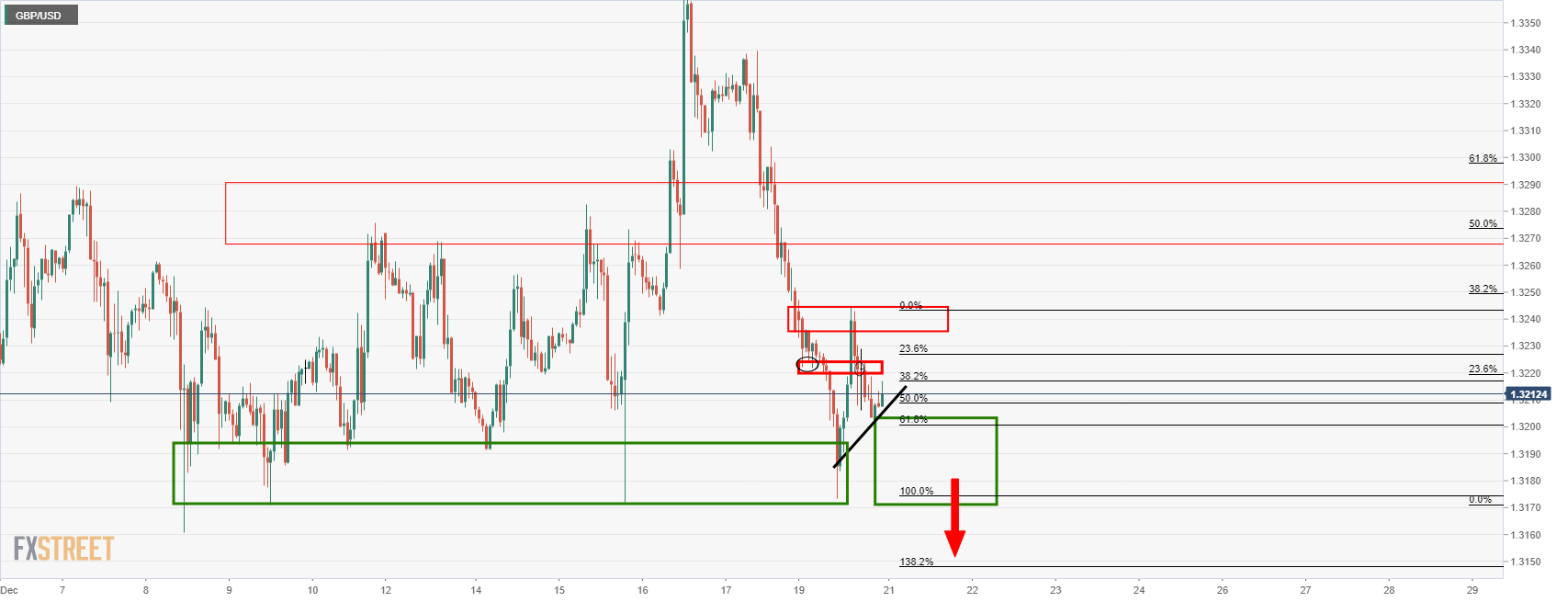
Should the support of the dynamic trendline give out, then there is a risk of a test of the daily support and a run to 1.3150 and below.
GBP/USD weekly chart
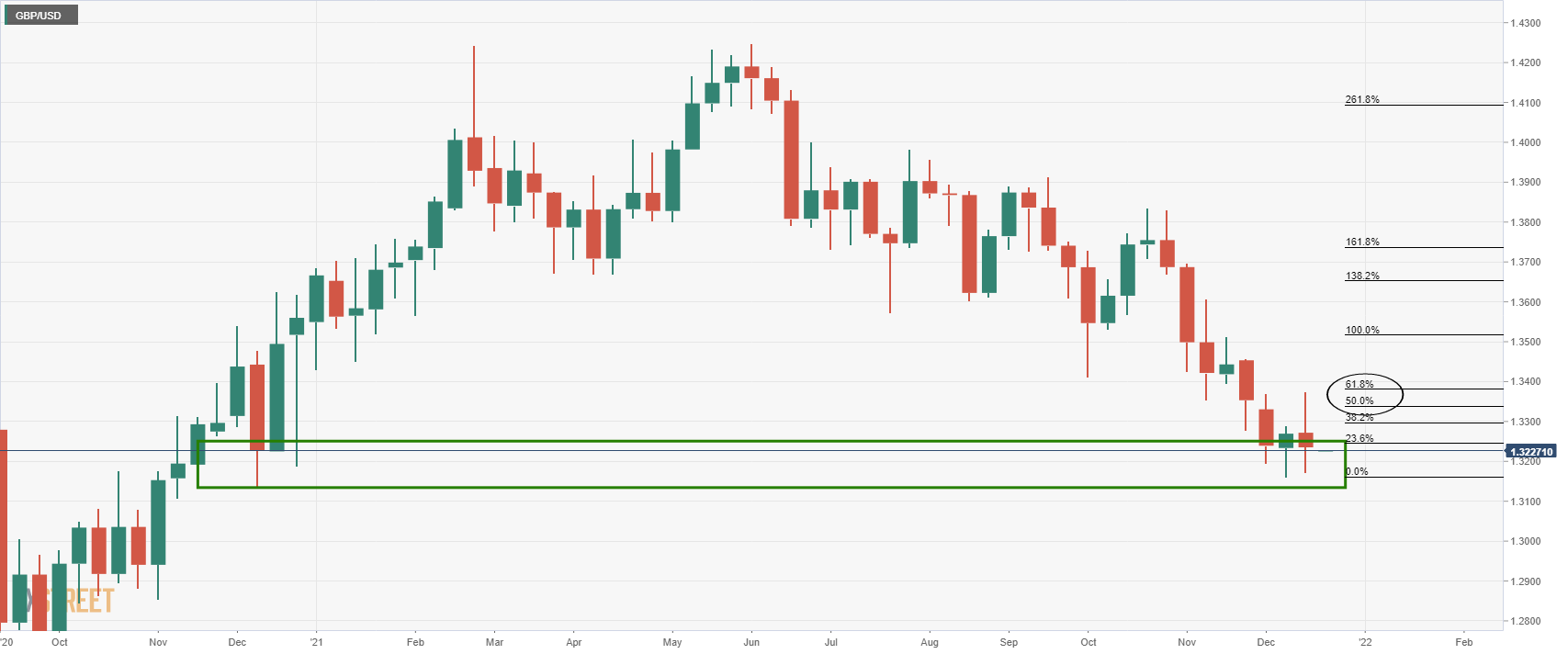
As illustrated, below 1.3200 and 1.3100, there is an imbalance in price towards 1.2850 where the market could fall into should the support structure give out.
- The NZD/JPY edges lower some 0.42% during the day.
- Market sentiment dynamics and commodity prices linked to the kiwi would be the drivers for the pair.
- NZD/JPY Technical Outlook: Bearish in the near term, as market sentiment has remained downbeat in the last three days.
The NZD/JPY continues its free-fall as the year’s end looms, trading at 76.31 as the Wall Street session ends at the time of writing. Wall Street closed in the red, with US equity indices posting losses between 1.10% and 1.55%. Asian equity futures point to a lower open, thus weighing on risk-sensitive currencies like the NZD, in benefit of the safe-haven status of the Japanese yen.
Monday's session gainers were the low yielders EUR, CHF, and JPY, while the NZD lost 0.22% during the day against its counterpart, the USD dollar.
On Monday, the New Zealand economic docket reported Exports, Imports, and the Trade Balance for November. Exports and Imports on a monthly basis were higher than the previous figure, came at $5.86 Billion and $6.73 Billion, respectively. Meanwhile, the Trade Balance on an annual basis came at $-6.04B, lower than the $-6.047B estimated.
That said, the NZD/JPY pair would lie in the dynamics of market sentiment. Any risk-aversion in the financial markets would witness Japanese yen strength, in turn, drops in the NZD/JPY pair. On the other hand, any rallies in stocks would favor risk-sensitive currencies like the NZD, the GBP, and the AUD.
NZD/JPY Price Forecast: Technical outlook
The NZD/JPY daily chart shows that the pair re-tested the December 3 daily low at 75.95, but the downward move stalled, bouncing back above the 76.00 figure.
The bias in the cross-currency pair is bearish, as shown by the daily moving averages (DMAs) residing well above the spot price, despite the fact of being almost horizontal and would be crucial resistance levels, in the event of the NZD/JPY breaking to the upside.
That said, the first support would be the December 3 swing low at 75.95. A decisive breach of the latter would open the door for further losses. The next line of defense downwards would be the July 20 swing low at 75.25, followed by the August 19 low at 74.55
-637756353213974068.png)
What you need to know on Friday, December 21:
On a broadly risk off day that would normally be expected to benefit the traditional forex safe havens like USD and JPY, the euro was the standout performer. EUR/USD rallied 0.4% after bouncing at support in the form of recent lows, though was not able to hold to the north of the 1.1300 level. CHF also performed well, rallying 0.3% versus the buck, while USD/JPY was about 0.1% lower but remained close to the 113.50 level.
As a result of the strong euro and modestly stronger yen, the DXY was lackluster, dropping 0.1% on the day, though remaining close to 96.50 and recent highs. But losses in risk and commodity-sensitive currencies (as a result of risk-off conditions) cushioned the DXY somewhat.
The Canadian dollar was the worst performer of these amid selling pressure and choppiness in crude oil markets and dropped 0.4% on the day versus the dollar. USD/CAD even managed to print fresh annual highs in the 1.2960s, surpassing the previous annual high set back in August close to 1.2950, though has since pulled back to consolidate in the 1.2940 area.
AUD/USD, meanwhile, was down about 0.1% on the session and content to spend most of it consolidating just to the north of the 0.7100 level. Aussie traders will be looking ahead to the release of the minutes of the last RBA meeting at 0030GMT on Tuesday, with traders are on notice for further hints from the RBA that it will pivot in a hawkish direction.
It seems to be a fairly consensus view now that the RBA will completely axe its QE programme in February in wake of last week’s much stronger than expected Australia November labour market report. The timing of rate hike is also a key theme, with markets expecting the RBA at some point to indicate that a first post-pandemic hike might come as soon as 2022 rather than the current 2023 guidance.
NZD/USD, meanwhile, was down 0.3% after probing, but ultimately remaining supported above, support in the form of annual lows at the 0.6700 level, whilst GBP was down about 0.2% on the day versus the buck. GBP/USD again found support at recent monthly lows in the 1.3170s area and closed out US trade slightly to the north of 1.3200 as speculation intensifies about impending UK lockdowns to stem the rising Omicron tide. It seems a lockdown this side of Christmas (on Saturday) is unlikely, but after that, anything goes and UK PM Boris Johnson in a speech earlier in the day made clear nothing was off the table.
Finally, in emerging market FX, the standout currency was the Turkish lira, which saw an immense 25% intra-day pull back from session highs in the 18.30s to end the US session around 13.50. The rapid appreciation of the currency was prompted as President Recep Erdogan announced unorthodox new policies to alleviate the impact of exchange rate volatility on Turkish savers.
Most importantly, the President announced that the government would offset losses to domestic TRY accounts as a result of the depreciation of the TRY/USD exchange rate. Some analysts and traders have said that these anti-dollarisation measures amount to a “hidden” interest rate hike, funded via the public purse.
- EUR/JPY is at risk of a downside correction should 128.10 give way to bearish pressures.
- 127.90 guards a deeper resumption of the dominant bear trend.
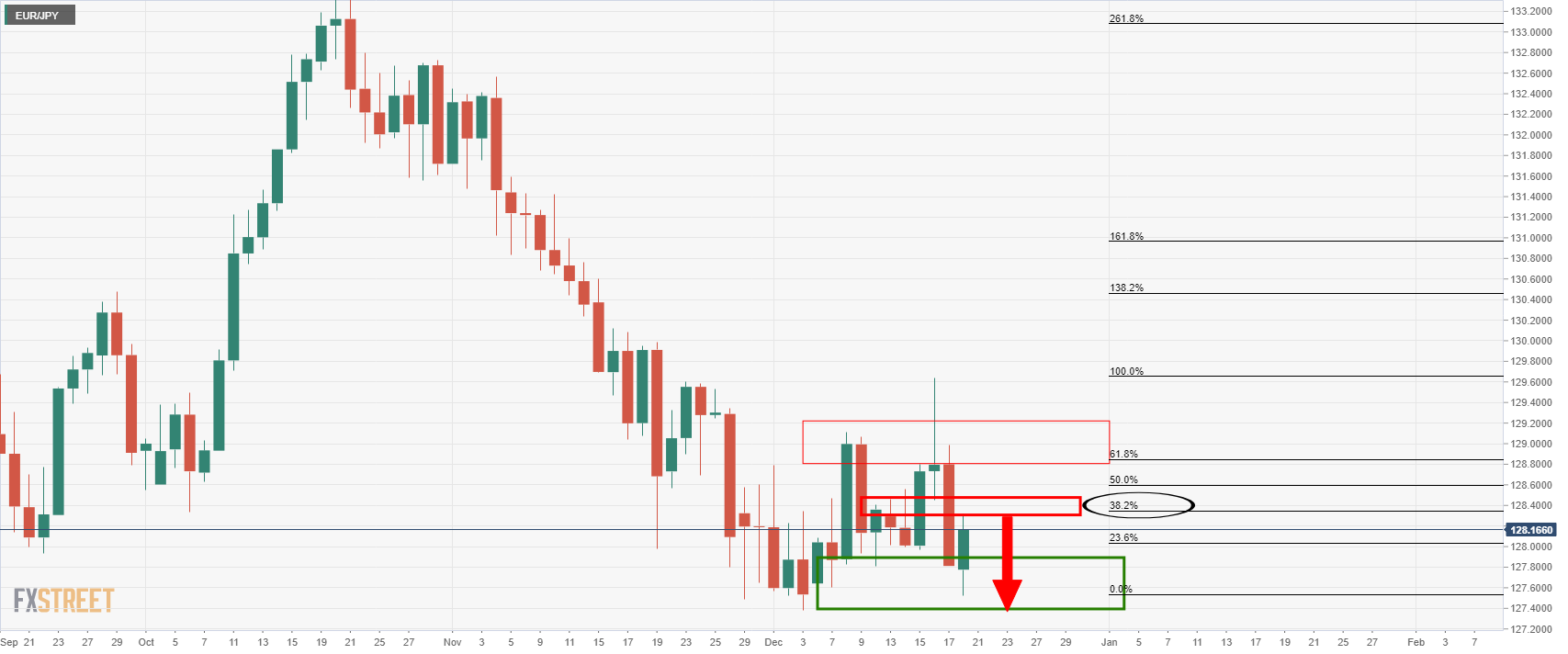
The daily chart shows that the price is consolidating and has reached a 38.2% Fibonacci retracement level. This would be expected to hold on to initial tests and then potentially lead to a downside test of support once again.
The following illustrates the market's structure and the downside bias from both a daily and shorter-term perspective:
EUR/JPY daily chart
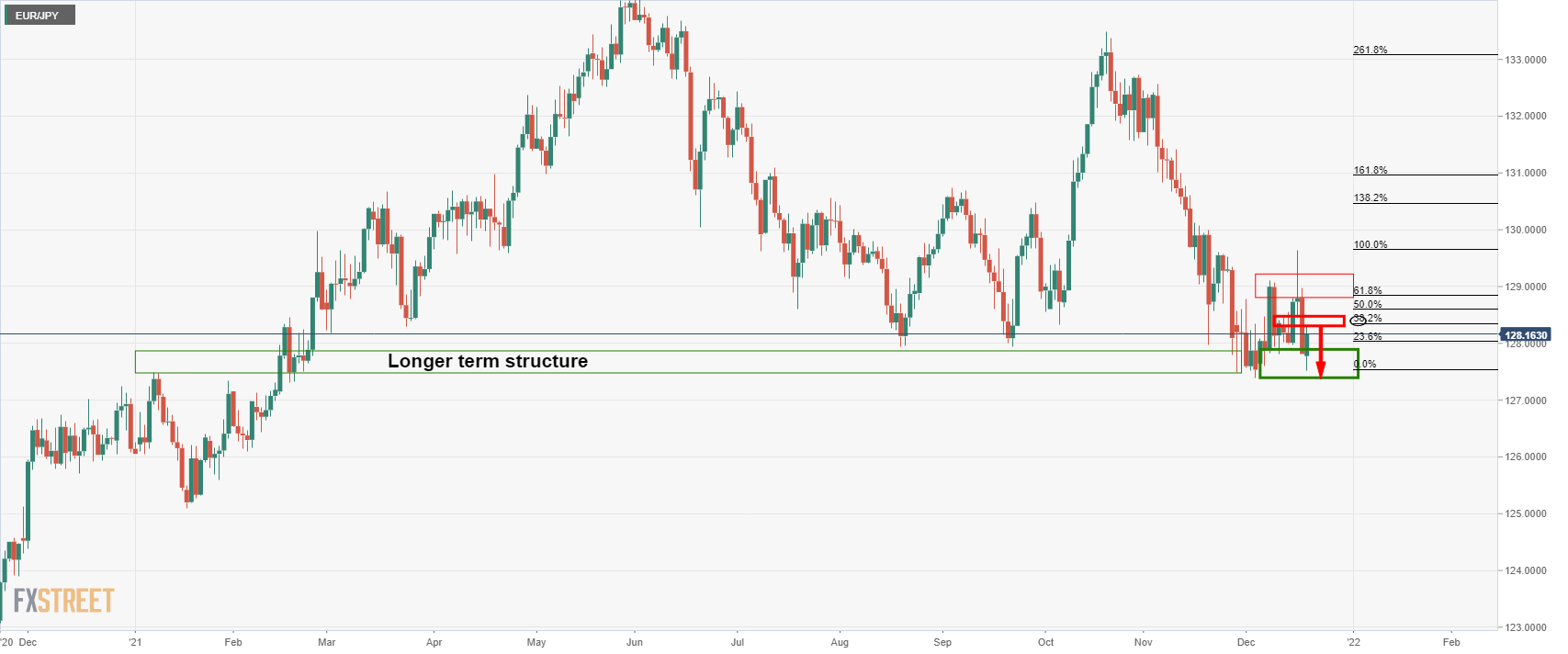
EUR/JPY H1 chart
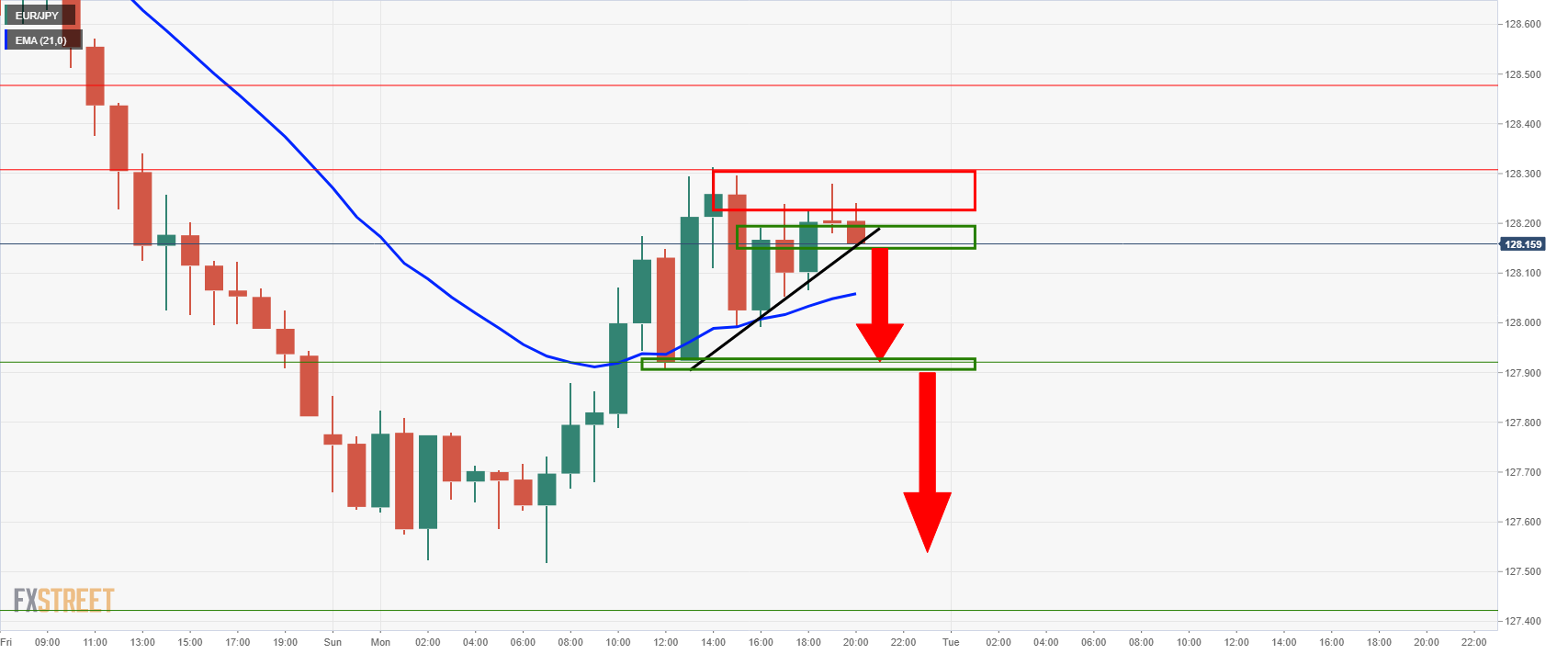
From this hourly perspective, we can see that the price is struggling at a meanwhile resistance and given the temperament of the market, that is to say consolidative with a risk-off tone, the bias is to the downside. A break of the current trendline opens risk to test the prior hourly support near 127.90. If this were to give, then the daily support will be vulnerable near to 127.50.
- Erdogan announced an unorthodox new policy to compensate losses on domestic TRY accounts due to TRY/USD depreciation.
- Traders said the policy amounted to “hidden” rate hikes, funded via the public purse, and USD/TRY crashed 25% from highs.
- The pair is now trading in the 13.50 area having been as high as the 18.30s earlier in the session.
The Turkish lira underwent a jaw-dropping recovery on Monday after Turkish President Recep Erdogan announced unorthodox new policies to alleviate the impact of exchange rate volatility on Turkish savers. The President announced a raft of new economic measures, but the one that got the most attention was a mechanism where the government will offset losses to domestic TRY accounts as a result of the depreciation of the TRY/USD exchange rate. Some analysts and traders have said that these anti-dollarisation measures amount to a “hidden” interest rate hike, funded via the public purse.
According to Bloomberg, the USD/TRY spot rate is currently at 13.50 a staggering near 20% decline from last Friday’s closing levels around 16.40. The decline is even more impressive given that USD/TRY was at one point trading in the 18.30s. That means the lira has gained 25% in value from its intraday lows.
Judging by the market reaction, President Erdogan appears to have pulled a rabbit out of the hat with his latest policy of essentially paying additional interest to Turkish savers via the public purse. But Turkey is very much in unprecedented territory when it comes to monetary policy right now. The government has taken on a potentially huge liability in promising to insure savers against exchange rate losses and analysts will be wondering how this impacts the government’s fiscal position going forward. Some have pointed out that the Turkish government has now exposed itself to a vicious cycle where, if the value of the lira falls too much, they will have to borrow ever more of it to fund the losses of investors.
- The Australian dollar drops as the Wall Street session approaches the end, down 0.14%.
- The US 10-year Treasury yield reclaims the 1.40% threshold, underpins the greenback.
- AUD/USD Technical Outlook: It has a downward bias, though upside risks remain.
During the New York session, the AUD/USD edges lower, trading at 0.7111 at the time of writing. The market sentiment remains downbeat, spurred by the Omicron outbreak worldwide. The UK and some European countries reimpose social restrictions as health government offices scramble to contain the fourth wave.
In the meantime, the US Dollar Index recovers some of its losses, almost flat at 96.55, as US Treasury yields with the 10-year benchmark note, reclaim the 1.40% threshold, up to two basis points, sitting at 1.423%.
An absent economic docket leaves the AUD/USD pair at the mercy of market sentiment and greenback’s dynamics, including political domestic developments and demand for US Treasuries.
AUD/USD Price Forecast: Technical outlook
The AUD/USD daily chart depicts that the pair has a downward bias. The double-top formed in the month, still in play as long as the 0.7186 December swing high is decisively broken to the upside. Nevertheless, despite Australian dollar weakness across the board, Monday’s price action pierced the “neckline” around the December 14 swing low at 0.7090. However, it failed to gain follow-through, pushing the AUD/USD around 0.7111.
If USD bulls achieve to break clearly below the neckline, the first support would be the 0.7000 figure, followed by the 0.6900, and then the June 12, 2020 pivot low at 0.6799.
To the upside, the first resistance would be the December 17 daily high at 0.7184. A sustained break above that level could pave the way for further gains, with the 0.7200 figure as the next resistance, followed by the confluence of the 50 and the 100-day moving averages (DMAs) at 0.7290-0.7300 area.
- EUR/USD rebounded strongly to near 1.1300 on Tuesday, with the euro outperforming in the G10 space.
- Technical buying after the pair bounced from the bottom of its recent ranges in the 1.1220-1.1230 area likely played a role.
Its not quite clear why the euro has been the best performing G10 currency on the session so far this Monday but regardless, robust demand for the single currency has been enough to lift EUR/USD about 50 pips from earlier session lows in the 1.1230s to current levels near 1.1280. The pair, which momentarily went above 1.1300 earlier in the session, has been consolidating in the upper 1.1200s amid quiet markets characterised by slow newsflow and with the 21-day moving average (at 1.12846) acting as a magnet.
In terms of fundamentals, amid a lack of any major economic data releases or Fed speak, the main driver in markets on Monday has been 1) concerns about the spread of Omicron and 2) worries that the Biden administration will fail to pass its economic agenda. Perhaps this latter concern, which presents a downside risk to US economic growth in 2022 and subsequent years, is one factor lifting the pair. Some may also point to very vocal hawks on the ECB governing council as lifting EUR/USD.
Pierre Wunsch of the Belgium central bank said the ECB is not sufficiently recognising upside inflation risks and Robert Holzmann of the Austrian central bank said over the weekend that the ECB is ready to adjust its policy if inflation doesn’t fall. But the hawks remain in the minority at the ECB. ECB President Christine Lagarde and Chief Economist Philip Lane are the better bellwethers for where sentiment/consensus thinking at the bank resides.
Technical buying is an alternative reason why EUR/USD may have bounced. The 1.1220-1.1230 area has been a key zone of support for the pair in recent weeks, just as the upper 1.1300s (the 1.1350-1.1380 area) has been a key area of resistance. Monday’s price action could purely be a reflection of the fact that traders were not prepared to force a break to the south of recent ranges, especially at the start of a week expected to be characterised by thin pre-holiday liquidity conditions.
- The USD/CHF falls some 0.32% during the day, underpinned by the US Dollar Index, losing 0.09%.
- USD/CHF Technical Outlook: It has a neutral bias, remains range-bound amid the lack of a catalyst.
At the time of writing, the USD/CHF drops during the New York session, trading at 0.9213. Risk-aversion in the financial market, spurred by the Omicron outbreak and US domestic political issues, boosted the safe-haven status of the Swiss franc, weighing on the greenback.
In the meantime, the US Dollar Index, which tracks the buck’s value versus six rivals, drops 0.09%, sitting at 96.48, undermined by falling US bond yields, with the 10-year unmoved at 1.40% in the last couple of hours.
During the overnight session, the USD/CHF began the trading week around the daily highs of the day at 0.9250. Nevertheless, as the American session got underway, the price collapsed through the 200, the 100, and the 50-hour simple moving averages (SMAs) towards the S1 daily pivot at 0.9196.
As of the last couple of hours, the pair jumped as US Treasury yields recovered some ground, but it faces resistance at the 50-hour SMA at 0.9214.
USD/CHF Price Forecast: Technical outlook
The USD/CHF daily chart depicts that the pair have remained in consolidation for the last 16 trading days, in the 0.9160-0.9265 range, sometimes piercing through price extremes, like the December 15 high at 0.9293. At press time, the USD/CHF pair has a neutral bias.
To the upside, the first support would be 0.9290. A clear break of that level would expose the 78.6% Fibonacci retracement at 0.9327, followed by the November 24 high at 0.9373.
On the flip side, the confluence of the 50 and the 100-day moving averages (DMAs) around the 0.9205-15 range would be the first demand area. A sustained breach of the latter would expose the 0.9200 figure, immediately followed by the 200-DMA at 0.9176.
-637756223698239254.png)
- EUR/GBP price action is at the hands of the omicron variant.
- The UK is facing the worst wave but UK's PM Boris Johnson says that there will be no new restrictions, for now.
Since a month ago when the World Health Organization (WHO) announced that Europe was once again "at the epicentre" of the Covid pandemic as cases soared across the continent, the UK, France and many other nations are still at the peak of their infection curves.
In response, Europe’s biggest countries are introducing more curbs to fight the surges in Covid-19 infections as the highly-transmissible omicron variant slams already weary populations. Germany, which is reported to be 67% of the peak of its infection curve, designated the UK as a virus variant area from Monday, the highest risk category.
As omicron cases surge in the UK, the country faces the politically perilous decision of whether to tighten restrictions. Total Covid infections rose by about 50% in a week to touch a record 93,000 on Friday. However, on the day where the UK reported its second-highest daily covid tally, the UK's PM Boris Johnson says that there will be no new restrictions in England for now. On the other hand, he said that ''we have to reserve the possibility of taking further action on covid.''
The markets are of the mind that new restrictions are inevitable. Plan B is argued by some as not enough to control the spread of Omicron. SAGE is advocating for new stricter measures as soon as possible as they forecast that hospital admissions would likely reach 3,000-10,000 per day with Plan B restrictions (peak in Jan-2021 was 4,500).
However, regardless of new restrictions, if implemented. voluntary social distancing could have a similar effect, with fewer people travelling or using public services, eating out in restaurants and so forth. This is already happening in London for example.
''In a best-case scenario where no new restrictions are introduced and Omicron causes far fewer hospital admissions than Delta, the models estimate that UK GDP will fall around 0.6% by January,'' analysts at TD Securities explained. ''In a worst-case scenario with strict restrictions and high hospital admissions, GDP is estimated to fall around 5.8%.''
Meanwhile, European nations have taken a varied approach to counter the winter Covid wave. The Dutch have imposed the strictest of lockdowns which mean schools and non-essential shops are closed and fewer visitors will be allowed in households.
Germany, France and Cyrpus are imposing stricter rules for travellers from Britain from outright banning to 14-quarantine upon arrival. France is curbing outdoor revelry on New Year's Eve and is turning up the pressure on people to get vaccinated whereby immunized people will be able to get a health pass that gives access to bars, restaurants, medical facilities and cultural venues.
''French Labor Minister Elisabeth Borne will meet with business and labour leaders Monday to discuss the possibility of requiring health passes at work. Unions say such a move would effectively make vaccines mandatory in France,'' Bloomberg reported. Spain and Italy's governments will convene will hold emergency meetings to analyze their own nation's epidemics and the evolution of the disease to determine their own call to action and adaptations of new measures to curb the spread.
It's muddy waters for now with regards to EUR/GBP's direction. It has been stuck in the weekly range since March of this year between a peak of around 0.8720 and a low of 0.8380 and there are little signs of a breakout one way or the other. There was a strong weekly bearish bar printed in the middle of November but that was met by an equally strong recovery from the lows of the weekly range. 0.8450 and 0.8600 looks to be the parameters for the near future.
EUR/GBP technical analysis
The daily chart is leaving a W-formation as follows:
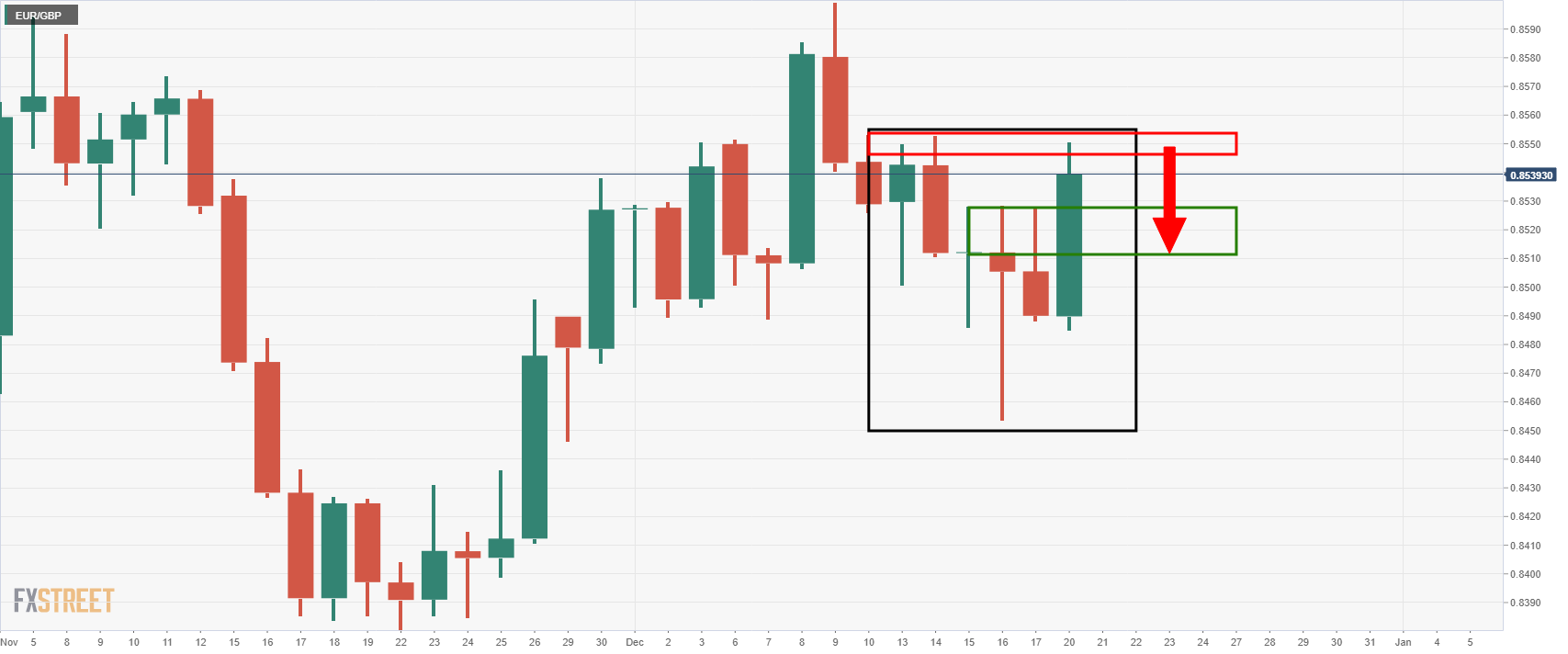
The daily chart's W-formation is a reversion pattern and the price would be expected to revert back to test the neckline support of the pattern in due course. This is a price action that would be anticipated to evolve on a bearish hourly chart in the coming sessions.
- The US Dollar Index edges down some 0.21% as US bond yields fall.
- The US 10-year Treasury yield losses some two basis points at 1.388%.
- DXY Technical outlook: An upside break above an ascending triangle target 98.00.
The US Dollar Index, also known as DXY, which measures the greenback’s performance against a basket of six rivals, drops some 0.33%, sitting at 96.48 during the day as the New York session at the time of writing. The market sentiment is downbeat, with major US equities falling between 1.51% and 2.86%.
Factors like US President Biden’s failure to get his $2 trillion tax-and-spend backed by Democrat Senator Joe Manchin dampened the prospects of the greenback, among falling US bond yields. That said, Goldman Sachs reduced US economic growth forecasts after Senator Manchin’s decision.
In the US bond market, the Treasury yields fall with 2s, 5s, and 10s dropping between one and four basis points, sitting at 0.6155%, 1.1391%, and 1.388%. The long maturity of the yield curve, with the 20s, and 30s, fluctuate. The 20s are flat at 1.8585%, while the 30-year rise is almost one basis point, at 1.823%
Last week, the main event for the US dollar was the Federal Reserve monetary policy decision. The US central bank kept their interest rates unchanged at the 0 to 0.25% range while increasing the speed of the bond taper, from the $15 Billion agreed initially up to $30 Billion, beginning in mid-January of 2022.
Additionally, it released its Summary of Economic Projections, also known as SEP. Inside of that report lies the “famous” dot-plot, which displays the 18 Federal Reserve Board members’ projections for the Federal Fund Rates (FFR) in the current year, and subsequent ones. In this report, the US central bank policymakers expect three rate hikes by the end of 2022, projecting the FFR at 0.90%.
US Dollar Index (DXY) Price Forecast: Technical outlook
The US Dollar Index daily chart depicts the strong dollar narrative keeps in place. The price is above the central Pitchfork’s uptrend channel, which confluences with the ascending triangle on an uptrend. At press time, the DXY is testing the top-trendline of the ascending triangle on an uptrend, though earlier pierced the abovementioned reaching a daily low at 96.33.
To the upside, the first resistance would be the figure at 97.00. A breach of the latter would expose the June 30 high at 97.80, followed by the ascending triangle target at 98.00.
-637756187254922205.png)
- USD/CAD hit fresh annual highs on Monday, spiking above the August high at 1.2949 and reaching as high as 1.2964.
- The pair has since dropped back to the 1.2940s area, but still trades with gains of about 0.4% on the day.
- CAD is underperforming amid steep downside in crude oil amid a broadly risk-off market feel.
USD/CAD hit fresh annual highs on Monday, spiking above the 20 August high at 1.2949 and reaching as far as 1.2964, before backing off to the 1.2940 area. That means the pair is currently trading higher on the day by about 0.4%, reflective of a sharp deterioration in the market’s broader appetite for risk and substantial losses in crude oil markets. Concerns about the rapid spread of Omicron in Europe and moves being taken by nations there to tighten restrictions have triggered fears the US may be only a few weeks behind. Traders are also disappointed by fading US fiscal stimulus hopes are moderate Senate Democrat Joe Manchin nuked the Biden administration's flagship $1.75T Build Back Better spending package by announcing he would not support it.
These factors have combined to send the S&P 500 nearly 2.0% lower on the day and to send WTI more than $3.0 lower to the low-$67.00s. That oil’s worst one-day performance since the 26 November $10.00 drop on the initial Omicron news. In that regard, it is perhaps surprising that USD/CAD’s gains are even more. But traders will note that the pair has come a long way in recent sessions (the pair is up over 2.5% since the December lows near 1.2600) and is currently probing a key area of resistance.
Aside from the potential for them to be buffetted by broader shifts in risk appetite, FX markets were supposed to have a calm week this week, and yet still may. Given the proximity to Christmas and year-end holidays, FX volumes will be thinner than usual with many market players away. The only notable US economic event in November Core PCE on Thursday. It's already expected to be high and the Fed is known to be concerned about inflation, so isnt likely to move markets much unless there is a big miss/beat on expectations. In terms of Canadian events, the most notable are October Retail Sales on Tuesday followed by October GDP numbers on Thursday. Otherwise, the pair will follow broader risk appetite, which will be driven by Omicron news.
The pound will likely weaken in the near future as market participants expect too much from the Bank of England (BoE) according to analysts at CIBC. They forecast GBP/USD at 1.31 by the end of Q1 and at 1.29 by Q2 of next year.
Key Quotes:
“The labour market data met the conditions for tightening, and the Bank felt it prudent to hike, in large part in order to preclude inflationary pressures from becoming deanchored. The BoE was clearly spooked by outsized and broadening CPI pressures. The MPC has now conceded that CPI looks set to test 6% into spring. As a consequence, the Bank clearly felt the need to act now to show its colours. But in reality, the 15bps move was largely symbolic, and aimed at sending a signal to dampen inflation expectations, as only around 25% of mortgage holders will be immediately impacted by an increase in floating mortgage rates.”
“While the Bank has clearly underlined its determination to adhere to its CPI mandate, we would not expect a material degree of 2022 policy tightening. Moderating growth, and a topping out in energy prices, should limit the inflation upside, and preclude the BoE from being pressed to aggressively tighten in the year ahead.”
“The combination of a moderating growth backdrop, ongoing UK/EU trade frictions, and a less aggressive UK rate cycle than that currently discounted, underlines scope for Sterling headwinds to persist.”
UK Prime Minister Boris Johnson said on Monday that we have to reserve the possibility of taking further action on Covid-19. We will rule out nothing in the fight against Covid-19, he said, adding that we will go further if we need to.
Additional Takeaways:
"Nobody wanted things to go this way but Omicron has exploded so fast."
"The situation is extremely difficult, arguments are finely balanced."
"Omicron hospitalisations are rising steeply in London."
"In view of the balance of risks/uncertainties on Omicron hospitalisations, we agreed to keep the data under constant review, hour by hour."
"We're looking at all kinds of things to keep omicron under control."
"We regret the impact on the economy."
"Important we look after the hospitality industry and other sectors."
"We will keep the economic side of this under constant review."
Market Reaction
GBP has not seen any reaction to the latest remarks, with sterling traders on notice for a potential tightening of lockdown curbs before the end of the year.
Turkish President Recep Erdogan said on Monday that he would introduce a new financial instrument to ease the burden from volatile forex rates. The financial fluctuations and price hikes, he said, have no basis in economic fundamentals and Turkey will not bow to attacks and plots against it.
Citizens would not have to convert lira savings into foreign exchange due to volatility, he reassured, adding that he would encourage saving in the lira. Erdogan added that he was planning a 1.0% cut in corporation taxes and that credits would be given to support employment. There is no need to turn back from free market economy rules, Erdogan added, saying that in a few months, interest rate cuts would bring about a fall in inflation.
Market Reaction
In recent trade, USD/TRY has accelerated to the north of the 18.00 level, where it trades higher by nearly 10% on the day. Erdogan has been doubling down as of late on his assistance on the fact that there is "no going back" on his new economic agenda, which is characterised by attempts to lower inflation by lowering interest rates rather than hiking them.
Many view this policy as misguided (economists are near-unanimous in their agreement that rates need to be lifted to reign in inflation, not lowered) and putting the Turkish economy at risk of hyperinflation and financial crisis. The YoY CPI rate is already above 20% as of November. Speaking of rate cuts, that is exactly what the CBRT did last week. The bank lowered interest rates to 14.0% from 15.0% in a move that has, along with Erdogan's rhetoric, weighed heavily on the lira in recent sessions.
- After probing 0.6700 earlier in the session, NZD/USD has stabilised spent the last few hours ranging in the 0.6710-0.6730 area.
- Sentiment is weighed by concerns about Omicron, a significant setback to US President Joe Biden’s economic agenda and Fed hawkishness.
After probing the 0.6700 level earlier in the session, NZD/USD has stabilised and has spent the last few hours going sideways within the 0.6710-0.6730 area. Seemingly, last Wednesday’s post-Fed low at bang on 0.6700 has offered sufficient support for now. At current levels around 0.6715, the pair is trading lower by about 0.3% on the day, meaning it is one of the worse, though not the worst, performing G10 currencies on the day (CAD is the worst down 0.5%). NZD’s underperformance has everything to do with the fact that it is a risk-sensitive currency and thus its appeal is being undermined by the very much risk-off market tone that is prevailing on Monday.
Long story short, global equity markets, though the losses are worst in the US at present (S&P 500 -2.0%), are being pummeled by a cocktail of negatives. These include negative news about the pandemic in Europe, where countries are locking down (Netherlands) or on the cusp of tightening restrictions (the UK, Italy, Germany, France) as Omicron cases surge. US market participants fear that the US is just a few weeks behind. Elsewhere, moderate Senate Democrat Joe Manchin, whose vote is crucial for any piece of Democrat legislation to pass if there is no bipartisan support, appeared to nuke the flagship legislation of the Biden administration. Manchin announced on Sunday he wouldn’t support the $1.75T Build Back Better (BBB) bill, though some think negotiations will continue in January on a slimmed-down version.
If Congress fails to pass BBB, this is being taken as a negative for US growth prospects over the coming years. Some are also citing fears about the fact that, despite the above, the Fed looks set to press ahead with the removal of easy monetary policy. Recall last week that the Fed doubled the pace of its QE taper, which Fed member Christopher Waller said on Friday indicated that the March meeting was live for a rate hike. The Fed’s new dot plot pointed to three rate hikes in 2022, so support for a March lift-off is unlikely to be far from the bank’s consensus view.
Whilst it is debatable as to the degree that the theme of a hawkish Fed is weighing on sentiment, it has clearly support the US dollar in recent days, hence the retracement lower in NZD/USD since last Thursday’s highs just shy of the 21-day moving average at the time in the 0.6830s. The roughly 120 pip drop amounts to about a 1.8% decline in NZD/USD from these levels in just two sessions, which is quite something and shows that the bears remain in control (in the short to medium-term) in the pair. If that remains the case, the 0.6700 level is vulnerable. If the pair were to dip below this level, that would mark fresh lows since early November 2020. The medium-term bears would be eyeing a move back down to the 0.6500 area, amid a lack of any notable support in the interim.
Analysts at CIBC forecast the USD/JPY pair at 115 by the end of the first quarter and at 116 by the end of the second quarter. They see the Bank of Japan (BoJ) as a limitation for the yen.
Key Quotes:
“Contingent to the unwind in JPY shorts and rebound in Yen valuations has proved to be the correction in USTJGB spreads. Beyond external risk sentiment which risks influencing risk barometers such as AUD/JPY, we would continue to view UST-JGB dynamics as remaining integral to USD/JPY performance.”
“We do not anticipate that the unwind in foreign asset purchasing appetite will persist. Indeed, we expect continued interest in exporting capital across the year ahead, omicron risks notwithstanding.”
“We expect the BoJ, in line with the ECB and SNB, to remain as a policy laggard. Indeed, it seems increasingly likely that rates will remain at current levels through 2023. While the BoJ stand ready to do more in terms of stimulus, in reality the onus for stimulus is more likely to fall on fiscal action from the new Kishida administration. Look for the government to approve a new JPY 36trn supplementary fiscal budget in the current Parliamentary session. Those measures should provide at least some support against external headwinds, but are unlikely to be sufficient to boost JPY valuations.”
According to analysts from Danske Bank, Turkish President Erdogan needs to either tighten monetary policy or close its capital account through capital controls in order to stop the rally of USD/TRY. They think Erdogan will be persistent this time around and not easily persuaded, but there are some potential game-changers: pressure from business community, emerging signs of a bank run and the threat of a snap election.
Key Quotes:
“With limited buffers, the CBRT’s recent interventions are nothing short of a sign of desperation and, hence, more likely to undermine their credibility rather than halt lira’s slide. More extreme measures, such as capital controls, cannot be ruled out.”
“For now, there are no signs of a policy reversal, and unless Erdogan is deterred by the threat of a bank run or a snap election, we think lower real rates, weakening fundamentals and tighter global financial conditions will drive lira further down.”
“Basically President Erdogan is trying to fight the “impossible trinity” which states that a small open economy like Turkey’s cannot run an independent monetary policy with an open capital account and also have a stable exchange rate. So unless Erdogan wants to see the USD/TRY keep rising (generating higher or even hyperinflation) Turkey needs to either tighten monetary policy i.e. abandon its independent monetary policy or close its capital account through capital controls (or implement price controls, which would lead to goods shortage in the economy).”
- The white-metal falls some 0.54% at press time during the New York session.
- Falling US Treasury yields and US domestic political issues undermine the US dollar.
- XAG/USD Price Forecast: Neutral-bearish bias, as long as it remains below the December 13 high at $22.40.
Silver (XAG/USD) is failing to capitalize on falling US bond yields, retreating below the December 17 daily low, trading at $22.26 during the New York session at the time of writing. An hour after Wall Street’s opening, the market sentiment is downbeat, as depicted by US stock indices falling. At the same time, the Build Back Better US President Biden agenda got torpedoed by Democrat Senator Joe Munchin, backpedaling his support of a $2 trillion tax-and-spending package as year’s end looms, pushing discussion towards next year.
That said, US Treasuries are losing during the day, with the 10-year Treasury yield dropping 1.7 basis points, currently at 1.385%, weighing on the US Dollar Index, falling 0.24%, sitting at 96.34.
Despite the abovementioned, XAG/USD failed to capitalize an upward move, which could be attributed to a technical move, as the white-metal faced strong resistance around $22.60.
XAG/USD Price Forecast: Technical outlook
Silver 1-hour chart depicts the non-yielding metal has a neutral-bearish bias, as long as it remains below the December 13 swing high at $22.40, even though it faced support around the confluence of the 100 and 200-hour simple moving averages (SMAs) around the $22.18-20 region. The last 1-hour candle attempted a break above the December 17 swing at $22.34, fading the move and retreating below the S1 daily pivot.
The lack of a catalyst would keep XAG/USD subdued in the $22.18-35 range. In the event of further downside, the first support would be the 200-hour SMA at $22.20. A decisive breach of the latter would open the door towards $22.00, followed by a challenge of the S3 daily pivot at $21.93.
-637756133710924264.png)
- US indices are lower across the board on Monday, with each down more than 1.5% on the session.
- Sentiment is weighed by concerns about Omicron, a significant setback to US President Joe Biden’s economic agenda and Fed hawkishness.
US equities are lower across the board on the first trading day of the new week. The S&P 500, Nasdaq 100 and Dow all down more than 1.0% on the session, amid concerns about the rapid spread of the Omicron variant in Europe, a significant setback to US President Joe Biden’s economic agenda and a hawkish Fed. The S&P 500 gapped below the 4600 level on Monday and has since dropped all the way below the 4550 mark where it trades lower on the day by about 1.8%.
Equity bears will be eyeing a test of monthly lows in the 4500 area if things continue as is. The next major support below that would be the October lows all the way down under 4300, another nearly 6.0% below current levels. A drop back to these lows would mark a near-10% pullback from the November record intra-day highs close to 4750. A pullback from highs of over 10% in US equities is seen as a “correction”.
Looking at the other major indices; the Nasdaq 100 gapped below 15.6K at the open and is now flirting with monthly lows in the mid-15.5K area, where it trades about 1.6% lower on the day. The Dow, meanwhile, has slumped all the way towards the 34.7K area from opening levels closer to 35.25K, where it trades lower by about 1.9% on the session. Amid the surge in selling, the S&P 500 CBOE Volatility Index (often referred to as the VIX) spiked back above 25.00, up more than 4.0 points on the day and at two-week highs.
Driving the day
On of the key drivers of risk-off on Monday has been an escalation of the Covid-19 situation in Europe. In a surprise move, the Netherlands on Sunday announced a full lockdown. As speculation swirls elsewhere on the continent, other countries are expected to follow suit straight after Christmas (as cancelling people’s Christmas plans is politically untenable in many countries). The UK is rumoured to be planning a lockdown from 27 December.
US markets are clearly worried that the US is headed in the same direction as Europe when it comes to the pandemic and is just a few weeks behind. According to analysts at Independent Advisor Alliance, "typically what happens in Europe is a bit of a preview for what we see in the United States. So, if we see a lot more infections in the U.S., it could stress hospitals, make people less reluctant to get out, spend, and partake in the economy. That's definitely a cause of concern."
Sentiment in the US was dealt a further blow by news over the weekend that moderate Democrat Senator Joe Manchin would oppose the Biden administration’s $1.75T Build Back Better (BBB) social spending package, the flagship policy of his economic agenda. There is speculation that negotiations on a further stripped-down version of BBB will continue in the new year, with some interpreting Manchin’s “no” as a negotiating tactic. But it has nonetheless dented confidence in US growth prospects, reflected in Monday’s underperformance of the S&P 500 GICS materials, financials, energy and industrials sectors, each of which are lower by more than 2.0% on the day.
Another factor being cited as weighing on sentiment is the hawkish signals sent from the Fed in recent days. Recall last week that the Fed doubled the pace of its QE taper, which Fed member Christopher Waller said on Friday indicated that the March meeting was live for a rate hike. The Fed’s new dot plot pointed to three rate hikes in 2022, so support for a March lift-off is unlikely to be far from the bank’s consensus view.
Some traders expressed hope on Monday that if Omicron gets really bad in the US and more Congress fails to pass further fiscal stimulus, the Fed might delay their tapering plans. But the Fed seems very much focused on combatting elevated inflation now that the labour market has made good recovery. If Omicron causes further inflationary pressures, this would likely make the Fed more hawkish rather than anything else.
The EUR/SUD pair will likely trade to the downside during the next months according to analysts at CIBC. They forecast EUR/USD at 1.11 by the end of the first quarter and at 1.10 by the end of the second quarter of next year.
Key Quotes:
“Despite the moderation in bond purchases, ongoing balance sheet expansion underlines that the doves remain in the ascendancy at the ECB. The new ECB staff forecasts, reaching out to 2024 for the first time, show a materially firmer inflation profile compared to the September estimates.”
“The market is currently pricing nearly 10bp of tightening in Q4 2022, which appears mispriced and prone to correct if, as we expect, growth and inflation results in 2022 leave the ECB on hold.”
“Unless fiscal policy proves significantly more expansive than anticipated, a long period of ECB policy inertia, set against firming expectations for Fed hawkishness, underlines our bias for the EUR to remain on the defensive in 2022.”
- Turkish lira continues to tumble, down 9% on Monday.
- USD/TRY holds near recent highs, likely to trigger more inflation ahead and caos.
The Turkish lira is unable to find a pause and continues to slide. The USD/TRY reached at 17.95, a fresh record high. It is hovering around 17.85, up 9% for the day. In a week, the dollar rose almost 30%, creating a currency crisis in Turkey.
Turkey’s President Erdogan continued to support his policy during the weekend of cutting interest rates. The Turkish lira opened with declines, and it accelerated the sell-off during the last hours. USD/TRY opened the day below 16.50 and now is looking at 18.00.
The sharp devaluation of the currency will likely boost inflation and could lead even to a major macroeconomic crisis. The current administration is holding onto its speech that is adding fuel to the USD/TRY rally.
“Even a shock rate hike of 10 percentage points or so is unlikely to turn sentiment around near-term. What Turkey needs now is an IMF to help stabilize sentiment but will not happen until things get even worse. As we know all too well, a currency crisis can quickly morph into a solvency crisis as external debt becomes impossible to service”, mentioned analysts at Brown Brothers Harriman.
Domestic factors drive the moves in USD/TRY. Emerging market currencies are posting mixed results as the Turkish crisis so far remains contained.
- The GBP/USD is trading at 1.3225 at the time of writing.
- Brexit UK’s top negotiator David Frost resign unexpectedly on Saturday in the middle of negotiations.
- Political domestic issues in the US propel some USD weakness, as Democrat Senator Munching back-off supporting US President Biden’s agenda.
- GBP/USD Technical Outlook: Neutral-bearish, but a gravestone-doji in the daily chart, could propel the pound towards 1.3400.
The British pound recovers from earlier losses reclaim 1.3200 amid global concerns on the Omicron variant, and surprising resignations over negotiations with the EU, as British negotiator David Frost unexpectedly stepped down, blaming the direction of PM Boris Johnson party. Further, per the political editor at the Sun, UK Boris Johnson is not preparing to announce further Covid-19 this Monday, despite that the UK reported 82,886 new coronavirus cases.
Additionally, USD weakness prevails on the back of lower US T-bond yields, amid domestic political issues, with Democrat Senator Joe Manchin rejecting the US President Biden Build Back Better program. According to Bloomberg, the White House called the senator’s decision “sudden and inexplicable reversal.” As year-end looms, negotiations would re-start at the beginning of the following year, before the midterm elections.
In the meantime, as Wall Street opens, the US 10-year T-bond benchmark note drops one and a half basis points, sitting at 1.388%, undermining the US Dollar Index, which measures the greenback’s value against its peers, losing 0.18%, down to 96.39 at the time of writing.
The UK economic docket featured the Rightmove House Price Index for December in the European session. On a monthly basis shrank to 0.7%, more than 0.6% on the previous read, while the yearly basis stood at 6.3%, unchanged.
GBP/USD Price Forecast: Technical outlook
After dipping to 1.3174, cable trimmed some overnight losses, reclaiming the 1.3200 figure despite the coronavirus outbreak in the UK, as US Senator Manchin rejected President Biden’s agenda. That said, at press time, the GBP/USD daily chart depicts a gravestone doji, a bullish signal, that could propel the prospects of Sterling. However, a daily break above 1.3289 resistance is needed to challenge the 1.3400 figure before the year’s end.
If GBP bulls reclaim 1.3289, the next resistance would be December’s 17 daily high at 1.3339. A clear break of that level could witness a jump towards December’s 16 daily pivot high at 1.3374, followed by 1.3400.
- Spot gold is struggling to make use of risk-averse market conditions on Monday and remains subdued under $1800.
- An on-the-day rise in real yields is the main reason why gold is struggling.
Despite a broadly risk-off market tone and an underperforming US dollar, spot gold (XAU/USD) prices are struggling to make headway on Monday. Prices are currently flat on the session but have slipped back from earlier session highs in the $1805 area to current levels around $1797 in recent trade. The 50-day moving average at $1795 provided support earlier in the session, but if this level goes, XAU/USD is likely to slip back to test early/mid-December highs and the 200DMA in the $1790 area.
Gold’s lackluster performance on Monday owes itself to the fact that real yields in the US have been advancing. 10-year TIPS yields, to which gold is very sensitive, are up about 2bps on the day and back to the north of the -1.0% level. But that still leaves the 10-year TIPS yield well within recent late-November/December ranges of about -1.1% to -0.9%. 5-year TIPS yields are current up about 4bps but are also within recent week’s ranges. Whether the most recent rally in real yields can build into a broader move higher is the key question – that of course would be bad for gold. Remember that as real yields rise, the opportunity cost of holding non-yielding gold also rises.
The recent hawkish shift on the Fed has some strategists betting on a move higher in real yields. Recall last week that the Fed doubled the pace of its QE taper, which Fed member Christopher Waller said indicated that the March meeting was live for a rate hike, and recall that the bank pointed to three rate hikes in 2022. Longer-term nominal yields have remained subdued in recent weeks despite this hawkish shift amid concerns for the longer-term outlook for growth. It only takes inflation expectations to fall at a greater rate than long-term growth expectations for this to cause real yields to rise (something a hawkish Fed could trigger). Gold traders should thus be on notice that market conditions could turn increasingly bearish for the precious metal in 2022.
According to the Political Editor at The Sun, UK PM Boris Johnson is not preparing to announce any further Covid-19 restrictions this Monday. Johnson is at present hosting a meeting with his Cabinet. He is under pressure from scientific advisors to tighten restrictions with immediate effect, though there is significant political pushback against further measures from within the Cabinet and Conservative Party.
However, a journalist at the UK's Daily Mirror recent tweeted that the UK PM is considering a return to "Step Two" measures from 27 December.
Market Reaction
GBP hasn't seen much of a reaction given that there was already plenty of speculation about further restrictions swirling.
- Oil prices are lower on Monday, with WTI down over $2.50 as traders cite worries about Omicron and associated lockdowns/restrictions.
- The next notable area of support is the early December lows in the $62.00s.
Oil prices are substantially lower on the first day of the week, with front-month WTI futures currently trading lower by more than $2.50 as traders cite worries about the spread of Omicron and associated lockdowns/restrictions. During Asia Pacific trade, WTI fell below the $70.00 level and a key area of support from last week in the mid-$69.00s. The selling pressure has since continued to cascade with WTI recently dipping as low as beneath $67.00, though the US benchmark for sweet light crude oil has since stabilised slightly below $68.00.
The Netherlands announced a return to lockdown on Sunday, putting pressure on its European peers to follow suit. Local newspapers in Italy reported that new restrictions are possible there as well and there is plenty of chatter in the UK about the possibility of further restrictions as government officials refuse to rule anything out. Meanwhile, in the US, health officials are urging Americans to get booster shots, wear masks and reconsider holiday travel plans. The fear is that greater restrictions on people movement, either placed by governments or imposed by individuals on themselves out of caution, will restrict near-term crude oil demand.
Crude oil-specific newsflow hasn’t exactly been supportive either, with the US Baker Hughes weekly rig count number (released on Friday) reaching its highest since April 2020, a lead indicator of higher US output in the coming months. This seems to be contributing to concerns that oil markets will quickly revert to being in a supply surplus versus the supply deficit that supported prices so much over the last year.
From a technical standpoint, things arent very reassuring. The next notable area of support is really just the early December lows in the $62.00s, a further $5.0 or roughly 7.5% drop from current levels. There are a few lows in the $64.00-$66.00 area that could offer some support. But if the bears really want it, there isn't much to prevent a retest of monthly lows. Much will depend on Omicron/lockdown developments over the coming weeks. Politically, countries in Europe, North America and elsewhere in the developed culturally Christian world may find it difficult to lockdown ahead of Christmas on Saturday. But after Christmas day has been and gone, a broad international tightening of lockdowns may soon follow. Monday’s price action seems to reflect this elevated risk.
- AUD/USD has managed to recover from earlier session lows in the 0.7080s to back above 0.7100.
- But the pair remains lower on the day amid risk-off due to Omicron worries, which will be a key driver this week.
- Traders will be watching the release of RBA minutes on Tuesday.
AUD/USD continues to trade on the back foot on the day, with the pair currently down about 0.2%, though has managed to bounce from earlier session lows in the 0.7080s back to the north of the 0.7100 level in recent trade. The 0.7100 area has been a decent zone of support over the last few weeks and a break below it this week could open the door to a run lower towards annual lows in the 0.7000 area.
Worries about the economic impact of the fast-spreading Omicron Covid-19 variant amid news of lockdowns in Europe (the Netherlands announced a full lockdown and other countries may follow suit) has been weighing on sentiment and commodity prices are decisively lower, which is a double whammy for the risk/commodity-sensitive Aussie. The theme of Omicron and lockdowns will remain the major driver of risk appetite for the remainder of the week (and year), amid thinned liquidity conditions owing to the proximity of Christmas and New Year holiday celebrations. Subsequently, there will be a lack of key macro data releases until the new year, though traders would do well to keep an eye on Tuesday’s RBA minutes and Thursday’s US Core PCE inflation data for November.
Regarding the former, traders are on notice for further hints from the RBA that it will pivot in a hawkish direction. It seems to be a fairly consensus view now that the bank will completely axe its QE programme in February in wake of last week’s much stronger than expected Australia November labour market report. The timing of rate hike is also a key theme, with markets expecting the RBA at some point to indicate that a first post-pandemic hike might come as soon as 2022 rather than the current 2023 guidance.
Regarding this week’s Core PCE inflation data, which is the Fed’s favoured guage of inflation faced by US consumers, should confirm that inflationary pressures rose in November, as the Consumer Price Inflation report indicated the week before last. One factor weighing on AUD/USD on Friday was hawkish remarks from Fed Board of Governors member Christopher Waller, who said that the March meeting was “live” for a first rate hike.
European Central Bank governing council member Mario Centeno said on Monday that there is uncertainty about inflation that must be monitored, but played down the idea that new Covid-19 restrictions in Europe would lead to an increase in inflation. The economic and financial consequences of the Covid-19 pandemic will only manifest themselves later, he added.
His comments come after sources on Monday told Reuters that some ECB policymakers had been pushing at last week's meeting for the bank to acknowledge greater upside risks to its inflation forecast, but were shot down by ECB Cheif Economist Philip Lane.
Market Reaction
The euro has not reacted to Centeno's latest comments.
- USD/CAD is trading in the positive territory above 1.2900 on Monday.
- Crude oil prices are falling sharply amid worsening demand outlook.
- US Dollar Index consolidates Friday's losses around 96.50.
Following Friday's upsurge, the USD/CAD pair started the new week on a firm footing and came within a couple of pips of the multi-month high it set at 1.2938 last week. As of writing, the pair was up 0.25% on a daily basis at 1.2917.
Slumping oil prices hurt CAD
The sharp decline witnessed in crude oil prices seems to be weighing on the commodity-sensitive loonie on Monday. The barrel of West Texas Intermediate was last seen losing nearly 3% on the day at $68,35 as investors are pricing a worsening energy demand outlook amid the surging number of Omicron cases and tighter restrictions globally.
On the other hand, the US Dollar Index, which gained 0.7% on Friday, is consolidating its gains around 96.50, limiting USD/CAD's upside for the time being.
In the second half of the day, investors will remain focused on risk perception and crude oil prices as the North American economic docket won't be featuring and high-tier data releases.
Meanwhile, Wall Street's main indexes look to open sharply lower with S&P Futures losing more than 1% ahead of the opening bell. In case markets remain risk-averse, USD/CAD should not have a hard time holding in the positive territory.
Technical levels to watch for
Arjen van Dijkhuizen, Senior Economist at ABN AMRO, notes that Chinese banks unexpectedly cut the 1-year loan prime rate by 5bps, to 3.80%, for the first time since the initial covid-19 shock in early 2020.
Key quotes
"This will imply a marginal reduction in funding costs for Chinese corporates, as the 1-year loan prime rate functions as a benchmark for the bulk of corporate loans. The 5-year loan prime rate – a benchmark for mortgage rates – was left unchanged, at 4.65%."
"This mini cut fits within our expectation of a further piecemeal policy easing to stabilise growth. Given remaining risks from real estate and covid-19 policy/omicron, policy inaction would mean that full-year growth in 2022 would fall below Beijing’s preferred trajectory."
"We expect further targeted mini cuts of 1-year loan prime rate and some other policy interest rates in early 2022 and have pencilled in another 50bp RRR cut for next year as well. We also expect Beijing to take further measures to contain the drags from real estate."
- USD/JPY is trading in a tight range on Monday.
- Safe-haven flows dominate the financial markets at the start of the week.
- Wall Street's main indexes remain on track to open deep in the negative territory.
Despite the renewed dollar strength, the USD/JPY pair closed flat on Friday and started the new week in a calm manner. With safe-haven flows dominating the financial markets on Monday, the pair is having a tough time gaining traction as it continues to move in a tight range around 113.50.
Global equity indexes plunge
The Nikkei 225 Index lost more than 2% on Monday as investors remain increasingly concerned that the Coronavirus Omicron variant could weigh on the global economic activity by forcing strict restrictions.
On the flip side, Japan's parliament approved a $317 billion budget, which will include cash payouts for families with children, to support the economy. This development seems to be limiting the JPY's gains despite the fact that the currency's safe-haven status.
The US economic calendar won't be featuring and high-tier data releases in the remainder of the day and investors will pay close attention to the performance of US stocks. Currently, S&P 500 Futures are down 1.75% on the day, suggesting that risk-off flows will dominate the markets in the second half of the day.
In the meantime, the benchmark 10-year US Treasury bond yield is down more than 1% and additional losses in yields could cause USD/JPY to come under renewed bearish pressure in the American session.
Technical levels to watch for
"The explosive spread of the Omicron-variant of COVID is raising the risks of more severe restrictions," note Societe Generale Analysts. "These would once again depress economic activity, but much depends on how many people develop severe symptoms."
Key quotes
"Reliable evidence will take some weeks to emerge. That said, what is evident is that in the face of rampant inflation and the clear evidence that successive waves of restrictions have less and less of an impact on the economy, many central banks have finally woken up."
"The resulting pattern is increasingly looking like the most abrupt policy shift in monetary policy history - from outright easing to outright tightening in a single moment. The data calendar is thin, but not without stars such as US income and consumption data and durable goods orders - both of which are likely to be firm."
"The FOMC meeting results were in line with expectations and very much so with policy forecasts for the next few years. Ultimately, however, realized policy depends on the course of the economy. Household spending is recovering but confidence remains weak, and normalisation looks distant."
- EUR/USD trades in the positive territory early Monday.
- Major European equity indexes are suffering heavy losses.
- Investors eye Omicron headlines in the absence of high-tier data releases.
The EUR/USD pair is staging a technical recovery after falling sharply on Friday and was last seen posting small daily gains at 1.1265. Modest dollar weakness during the European trading hours seems to be helping the pair edge higher ahead of the American session.
Market mood sours on Monday
The risk-averse market environment at the start of the week is causing US Treasury bond yields to push lower and making it difficult for the greenback to preserve its strength. The US Dollar Index was last seen losing 0.12% on a daily basis at 96.55.
Meanwhile, Germany's DAX Index is losing more than 2% and the Euro Stoxx 50 Index is losing 1.7% after the opening bell on Monday as investors seek refuge amid the surging number of confirmed coronavirus cases in Europe. Following the Netherlands' decision to go into another lockdown ahead of the Christmas holiday, market participants remain concerned over the potential impact of additional restrictions on the economic activity.
In the second half of the day, the risk perception is likely to remain the primary driver of financial markets. Even if US T-bond yields continue to fall, a selloff in US stocks could help the dollar limit its losses.
Technical levels to watch for
The European Central Bank (ECB) policymakers wanted explicit acknowledgment of upside risks to inflation in the policy meeting last week but were rebuffed by Chief Economist Phillip Lane, Reuters reports, citing sources close to the debate.
Additional takeaways
"Quite a few wanted to acknowledge the upside risks but Philip (Lane) pushed back hard.”
"After a lengthy debate we appeared to agree on a 'small upside risks', but even that was nowhere to be found in the statement."
The closest ECB President Christine Lagarde came to such an acknowledgment was when she said "there is possibly an upside risk" in response to a reporter's question.
"The statement didn't quite give back the flavor of our debate."
“Several people questioned the quality of the ECB's forecasts, which have been subject to large revisions for years.”
Market reaction
EUR/USD has quickly pulled back from daily highs of 1.1274, now trading at 1.1263, up 0.22% so far.
- GBP/USD extends losses, with 1.3200 at risk amid intensifying risk-off trades.
- Uncertainties around Omicron restrictions in the UK pound the pound.
- USD fails to benefit from risk-off flows, as Treasury yields sink across the curve.
GBP/USD is trading close to 1.3200, meandering near daily lows, as the sentiment around the pound remains weighed down by the growing uncertainties surrounding the Omicron covid variant-induced restrictions in the UK.
The latest selling wave was triggered by the comments from the UK Deputy Prime Minister Dominic Raab, citing that he cannot guarantee further restrictions, as the Kingdom nears the festive period.
Meanwhile, Germany and France have already imposed border control for travelers from the UK. Britain reported 82,886 new coronavirus cases, bringing the total number of coronavirus cases in the country to 11,361,387. Out of these 82,886 cases, 12,133 were Omicron infections.
British Health Secretary Sajid Javid is expected to announce on Monday whether social mixing will be curtailed over the Christmas period.
On the latest Brexit update, UK Foreign Secretary Liz Truss is likely to take over negotiations with the EU on the Northern Ireland Protocol following the dramatic resignation of David Frost. Frost stepped down, blaming the “current direction of travel” of the PM’s party.
Looking ahead, the Omicron stats from the UK will continue to impact the GBP valuation amid a sparse calendar. Meanwhile, the risk-off flows will continue to boost the US Treasuries while weighing heavily on the yields, which will eventually cap the dollar’s bullish potential. Although, Javid’s announcement and Brexit news will play a bigger role on cable’s trades on Monday.
GBP/USD: Technical levels to consider
- Gold price underpinned by the risk-off mood as US’ Manchin rejects BBB.
- Treasury yields keep falling, caps the US dollar’s upside despite risk-aversion.
- Gold price set to retest key $1,815 supply zone amid risk-aversion.
Gold price is off the three-week highs but remains buoyed by the risk-off market profile. Uncertainties surrounding the Omicron covid variant sap investors’ confidence. Meanwhile, US Senator Joe Manchin left Democrats hanging with Biden Bill rejection, jeopardizing the $1.75 fiscal sending plan. Falling Treasury yields continue to undermine the US dollar, offering additional support to gold. Amid a light calendar, the broader market sentiment will continue to play a pivotal role in gold’s price action.
Read: Gold 2022 Outlook: Correlation with US T-bond yields to drive yellow metal
Gold Price: Key levels to watch
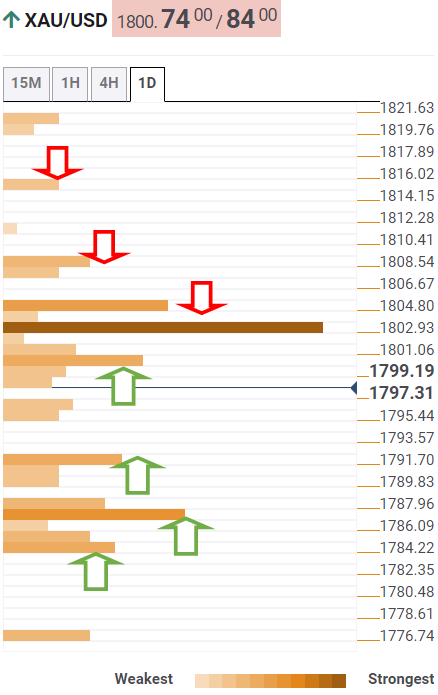
The Technical Confluences Detector shows that the gold price seems to have found some support at $1,797, the convergence of the SMA50 one-day, SMA5 four-hour and Fibonacci 23.6% one-week.
A failure to resist above the latter will trigger a drop towards $1,791, where the Fibonacci 38.2% one-week coincides with the SMA100 one-day.
Further south, strong support awaits at $1,787, the intersection of the SMA5 one-day and Fibonacci 23.6% one-month.
The last line of defense for gold buyers is seen at $1,783. At that point, the SMA10 one-day meets with the pivot point one-day S2.
Alternatively, fresh buying opportunities will arise only on a sustained break above $1,803-$1,804 supply zone, which is the confluence of the Fibonacci 38.2% one-month, Fibonacci 38.2% one-day and previous high four-hour.
The Fibonacci 61.8 one-day at $1,807 will offer powerful resistance on the upside. The previous day’s high of $1,814 will be next on the buyers’ radars.
Here is how it looks on the tool
About Technical Confluences Detector
The TCD (Technical Confluences Detector) is a tool to locate and point out those price levels where there is a congestion of indicators, moving averages, Fibonacci levels, Pivot Points, etc. If you are a short-term trader, you will find entry points for counter-trend strategies and hunt a few points at a time. If you are a medium-to-long-term trader, this tool will allow you to know in advance the price levels where a medium-to-long-term trend may stop and rest, where to unwind positions, or where to increase your position size.
UK Deputy Prime Minister Dominic Raab said on Monday that he cannot guarantee further restrictions.
Health Secretary Sajid Javid is expected to announce whether social mixing will be curtailed over the Christmas period.
Javid said, “We are assessing the situation; it’s very fast-moving.”
Meanwhile, Politico tweeted out, earlier on, “Boris Johnson is stuck between his scientific advisers and an increasingly disaffected Conservative Party over the seismic decision of whether to bring in new COVID measures over the Christmas Period.”
In an interview with Expansion, European Central Bank (ECB) Governing Council member and Spanish central bank chief Pablo Hernandez de Cos said that rate hikes are unlikely in 2022.
Additional quotes
"There are no conditions to raise rates in 2022."
“Support the decision to end the pandemic stimuli.”
“Ensure that monetary policy will continue to be expansionary.”
Market reaction
EUR/USD keeps its range around 1.1250 on these comments, adding 0.08% on a daily basis.
Here is what you need to know on Monday, December 20:
With central bank meetings out of the way, risk perception is dominating the financial markets at the start of the week. The surging number of Omicron cases globally and heightened concerns over tightened restrictions triggered a flight to safety on Monday. There won't be any high-impact data releases featured in the economic calendar for the remainder of the day and market participants will keep a close eye on headlines surrounding the coronavirus.
Over the weekend, the Netherlands has announced that it will go into a strict lockdown for four weeks to limit the spread of the Omicron variant. On Sunday, British Health Secretary Sajid Javid told the BBC that tougher restrictions could not be ruled out before Christmas. Similarly, Germany’s Economy Minister Habeck noted that a full lockdown would not be required in Germany but they will need to impose additional restriction measures.
Meanwhile, Democratic US Senator Joe Manchin announced that he will not vote for US President Biden's Build Back Better Act, ending negotiations on the current version of the legislation.
Reflecting the risk-averse market environment, China's Shanghai Composite Index lost more than 1%, the Nikkei 225 Index erased 2.13% and US stocks futures are down more than 1% in the early European session. The benchmark 10-year US Treasury bond yield is falling 2.8% at 1.366 and making it difficult for the greenback to build on Friday's gains. The US Dollar Index was last seen trading flat on the day at 96.62.
EUR/USD is moving sideways around 1.1250 on Monday. Last week, the pair fell 90 pips on Friday erased all of its weekly gains.
GBP/USD is trading in the negative territory early Monday and stays within a touching distance of 1.3200.
USD/JPY remains on the back foot as the JPY capitalizes on safe-haven flows.
The barrel of West Texas Intermediate (WTI) is down more than 3% at $68.20 amid the worsening demand outlook.
Gold rose sharply on Friday and registered its largest one-week gains since early November. As of writing, XAU/USD was consolidating its gains around $1,800.
Bitcoin continues to fluctuate in a descending trading channel and trades near $46,000. Ethereum is down more than 2% on Monday after failing to hold above $4,000 over the weekend.
- AUD/USD remains vulnerable as risk-off remains at full steam.
- Escalating fears over the Omicron covid variant contagion hits the aussie.
- The pair is charting a rising wedge breakdown on the daily sticks.
AUD/USD is pressuring lows below 0.7100, breaking the Asian consolidative mode to the downside, as sellers keep complete control amid a risk-off market profile.
Despite the Australian Prime Minister Scott Morrison dismissing talks of lockdowns over the rapid spread of the Omicron covid variant, the aussie remains undermined, as the virus concerns across the Pacific continue to haunt the market.
Adding to the investors’ woes, US Senator Joe Manchin withdrew support for $1.75 trillion fiscal spending, which sent the stocks tumbling alongside the other high-beta assets such as the aussie.
Looking at AUD/USD’s daily chart, the pair is extending Friday’s steep losses after closing the previous week below the critical bearish 21-Daily Moving Average (DMA), now at 0.7137.
The 14-Day Relative Strength Index (RSI) is pointing south, well below the midline, suggesting that there is more room to decline for the major.
The next relevant support is seen at the 0.7050 psychological level, below which the December 6 lows of 0.7036 could get challenged.
AUD/USD: Daily chart
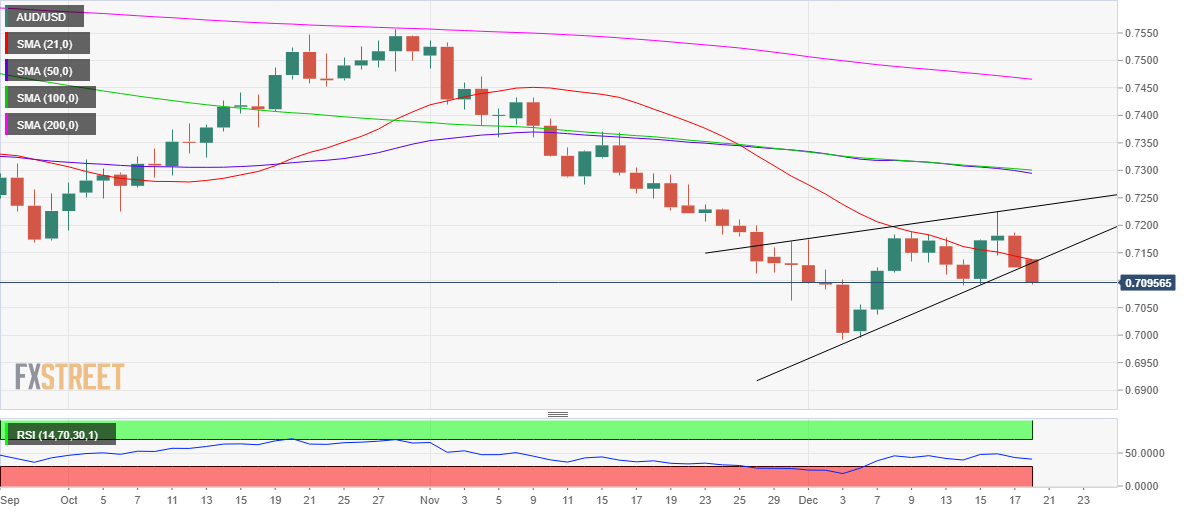
On the flip side, any recovery will need validation on a daily closing above the strong barrier, pegged around 0.7135, which is the confluence of the 21-DMA and the rising trendline resistance. Friday’s high at 0.7187 will then test the bullish commitments.
It’s worth drawing attention that the pair is teasing a rising wedge breakdown, with a daily closing below the abovementioned rising trendline resistance eyed to confirm the bearish continuation pattern.
AUD/USD: Additional levels to consider
One-month risk reversal (RR) of silver (XAG/USD) extends Friday’s rebound, suggesting a bullish bias of the options market participants. That said, the spread between call and put prices rises the most since December 01, +0.250 at the latest, during early Monday morning in Europe.
It’s worth noting, however, that the XAG/USD prices differ from the RR signals as the commodity keeps Friday’s pullback moves from early December’s tops near $22.35 by the press time.
Above all, risk-off mood weigh on the quote but softer US Treasury yields and the US dollar challenge momentum traders amid a light calendar.
The sour sentiment takes clues from the escalating concerns over the covid variant linked to South Africa, namely Omicron, as well as fresh fears of a Fed rate hike in early 2022. Adding to the bearish catalysts is the indecision over President Joe Biden’s Build Back Better (BBB) stimulus.
A surprise rate cut from the People’s Bank of China (PBOC) and chatters over Kaisa, the troubled firm based in Beijing, fail to recall the silver buyers.
Read: Gold Price Forecast: XAU/EUR pierces €1,600 to refresh monthly top on softer yields
- USD/CAD picks up bids to extend Friday’s gain around monthly top.
- RSI conditions can challenge bulls around upper line of short-term rising wedge.
- 61.8% FE restricts immediate downside, sellers will wait for 200-SMA before taking fresh entries.
USD/CAD remains on the front foot around 1.2915, up 0.15% intraday heading into Monday’s European session. In doing so, the Loonie pair extends Friday’s recovery moves beyond 61.8% Fibonacci Expansion (FE) level of November 10 to December 08 moves amid firmer RSI conditions.
Given the clear break of the key FE and firmer RSI, USD/CAD prices are likely to stay firmer. However, there prevails a minor gap before the RSI line turns overbought and hints at a pullback, which in turn requires the pair buyers to remain cautious.
That said, the monthly high of 1.2936, also the highest since August, lures the pair buyers of late.
However, the upper line of a short-term rising wedge bearish chart pattern and 78.6% FE level, respectively around 1.2965 and 1.2975, will challenge the quote before directing the USD/CAD bulls to the 1.3000 psychological magnet.
On the contrary, pullback moves may initially target the 61.8% FE level of 1.2900 before challenging the rising wedge’s support line, around 1.2800 at the latest.
It’s worth noting that a clear downside break of 1.2800 won’t be enough for the USD/CAD bears as 50-SMA and 200-SMA become the key supports around 1.2780 and 1.2670 to challenge the Loonie pair’s further weakness.
USD/CAD: Four-hour chart
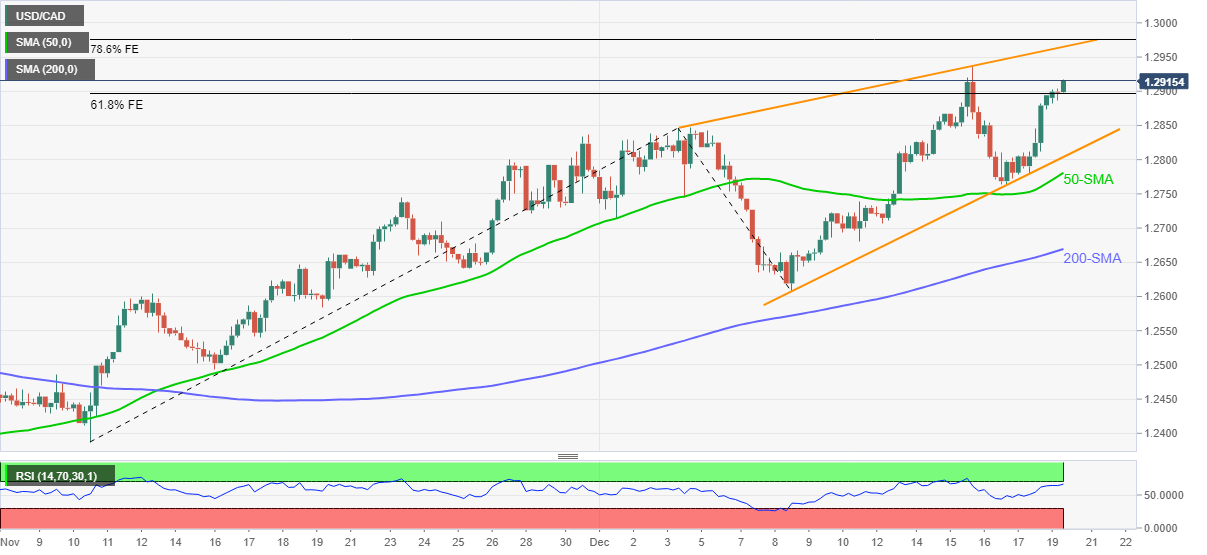
Trend: Further upside expected
Germany’s Economy Minister Habeck said on Monday that the country won't require a lockdown but it will need some tougher restrictions.
This comes after the country’s public health authority tightened restrictions on travel from the UK on Saturday.
Market reaction
EUR/USD is unfazed around 1.1250, up 0.13% on the day, as of writing.
- WTI takes offers to refresh two-week low, extends Friday’s losses.
- Covid woes renew fears of fresh travel restrictions ahead of holiday period.
- Iran conducts air defense practice, Baker Hughes highest rig count since April 2020.
- Indecision over US stimulus, Fed rate-hike fears adds to the bearish bias.
WTI crude oil bears attack $68.00, down 3.20% intraday during early Monday morning in Europe. In doing so, the black gold declines to the lowest level since December 06 as concerns over oil demand renew amid the virus-led risk-aversion.
Covid woes escalate in the West and challenge the holiday mood, as well as travel plans and hopes of energy demand linked to that. The reports a 52% jump in the weekly covid count and a virus-led death of a New Zealand resident who took Pfizer vaccine were the main catalysts favoring the virus-led risk-aversion. Additionally, New York Times said, “Dr. Anthony S. Fauci, the nation’s top infectious disease expert, warned on Sunday that the extraordinarily contagious Omicron variant of the coronavirus was raging worldwide and that it was likely to cause another major surge in the United States, especially among the unvaccinated.”
On a different page, the absence of the much-awaited US Build Back Better (BBB) stimulus, backed by US President Joe Biden, also weighs on the sentiment. US Senator Joe Manchin refused to vote in favor of the bill during the weekend, making it harder for the stimulus to progress in the remainder of 2021. However, US House Speaker Pelosi stays hopeful of reaching an agreement over BBB in 2022.
It should be observed that the hopes of a Fed’s rate-hike in early 2022 also weigh on the risk appetite and oil prices. The rate-hike chatters were latest fuelled by Fed Board of Governors member Christopher Waller who said, per Reuters, “The ‘whole point’ of the Fed's decision to accelerate the pace of its QE taper was to make the March Fed meeting ‘live’ for a first rate hike.”
Alternatively, a surprise rate cut from the People’s Bank of China (PBOC) and chatters over Kaisa, the troubled firm based in Beijing, join Iran’s aid defense activity to challenge the oil bears, but fail.
On Friday, US Baker Hughes weekly data suggested an increase of three rigs to 597 level, the highest mark last reported in April 2020, per Reuters. The news also said, “Lower exports are expected from Russia with exports and transit of oil from the country planned at 56.05 million tonnes in the first quarter of 2022 versus 58.3 million tonnes in the fourth quarter of 2021, a quarterly export schedule seen by Reuters showed on Friday.”
Given the absence of major data/events, crude oil traders will need to pay attention to the risk catalysts for fresh impulse.
Technical analysis
Failures to bounce off a weekly support line direct WTI crude oil prices towards monthly horizontal support near $65.50. However, oversold RSI conditions on the four-hour play challenge the bears. Even so, recovery moves remain elusive below the 50-DMA level of $71.15.
- Gold prices grind higher around multi-day peak, up for fourth consecutive day.
- US 10-year Treasury yields drop to three-week low as Omicron fears escalate.
- Fed rate-hike concern, US stimulus chatters add to risk-off mood amid quiet session.
Gold (XAU/EUR) refreshes monthly high near €1,603 heading into Monday’s European session. In doing so, the yellow metal cheers downbeat US Treasury yields to renew multi-day top.
That said, the US 10-year Treasury yields drop four basis points (bps) to 1.36%, down for the third consecutive day to poke the monthly low marked on December 03 at the latest as market sentiment sours.
The risk-off mood could be linked to the market’s rush towards the traditional safe-havens, like the US Treasury bonds and gold. The sour sentiment takes clues from the escalating concerns over the covid variant linked to South Africa, namely Omicron, as well as fresh fears of a Fed rate hike in early 2022. Adding to the bearish catalysts is the indecision over President Joe Biden’s Build Back Better (BBB) stimulus.
Covid woes escalate in the West and challenge the holiday mood. A 52% jump in the UK’s weekly covid cases and a virus-led death of a New Zealand resident who took Pfizer vaccine were the main catalysts favoring the virus-led risk-aversion. Additionally, New York Times said, “Dr. Anthony S. Fauci, the nation’s top infectious disease expert, warned on Sunday that the extraordinarily contagious Omicron variant of the coronavirus was raging worldwide and that it was likely to cause another major surge in the United States, especially among the unvaccinated.”
On a different page, US Senator Joe Manchin refused to vote in favor of President Biden’s Build Back Better (BBB) plan during the weekend. The news pushed back previous hopes of getting the stimulus through the house in 2021. However, US House Speaker Pelosi stays hopeful of reaching an agreement over BBB in 2022.
It’s worth noting that the hopes of a Fed’s rate-hike in early 2022 also weigh on the risk appetite. The sentiment grew after Fed Board of Governors member Christopher Waller said, per Reuters, “The ‘whole point’ of the Fed's decision to accelerate the pace of its QE taper was to make the March Fed meeting ‘live’ for a first rate hike.”
It’s worth noting that a surprise rate cut from the People’s Bank of China (PBOC) and chatters over Kaisa, the troubled firm based in Beijing, fail to challenge the market’s pessimism amid a light calendar.
Moving on, risk catalysts remain in the driver’s seat as an absence of major data/events and already announced monetary policy meetings dim the importance of the economic calendar.
Technical analysis
A clear upside break of the 21-DMA joins the first bullish MACD signal in a month to favor Gold (XAU/EUR) buyers.
The latest upside momentum eyes the 23.6% Fibonacci retracement (Fibo.) level of September-November advances, near €1,613, a break of which will need validation from €1,635 before challenging the yearly peak of €1,654.
In a case where XAU/EUR bulls keep reins past €1,654, the September 2020 peak of €1,664 will act as an additional upside filter before the €1,700 round figure.
Alternatively, 21-DMA restricts the commodity’s immediate downside to around €1,582.
Also acting as the key downside filters is an ascending support line from late September and 50-DMA, respectively around $1,577 and $1,574.
To sum up, XAU/EUR has further upside room before hitting the short-term cap.
Gold: Daily chart
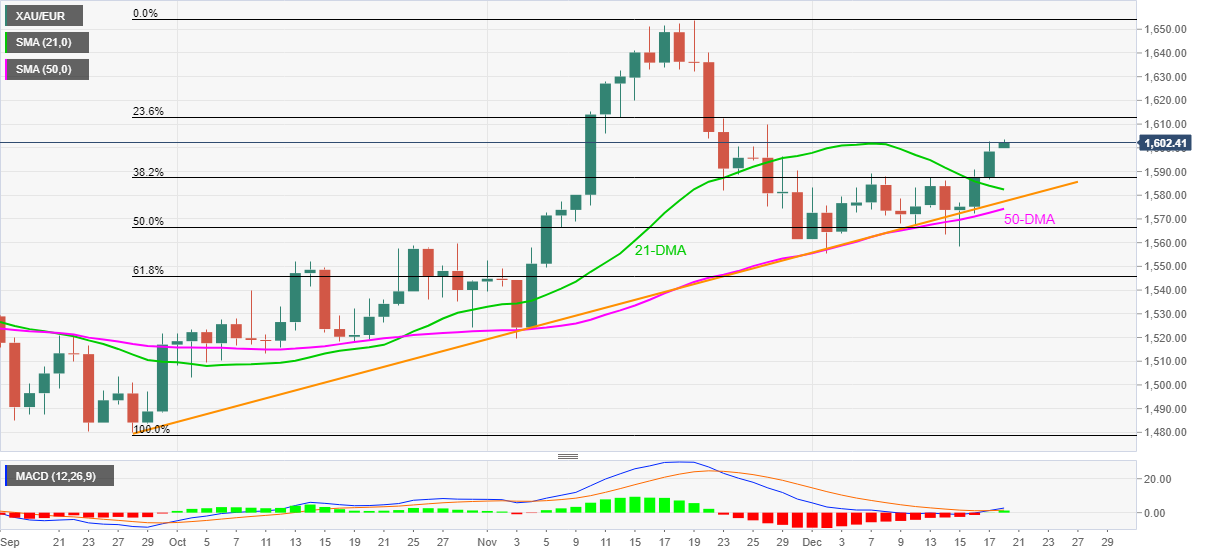
Trend: Further upside expected
- USD/INR retreats from intraday high, after declining the most in six weeks the previous day.
- 20-SMA guards further upside but bears will wait for monthly support break for fresh entry.
- Bulls need 76.30 breakout to aim for 77.00, 200-SMA will lure sellers during their dominance.
USD/INR eases from an intraday high of 76.18 to 76.05 during early Monday morning in Europe. In doing so, the Indian rupee (INR) pair steps back from 20-SMA while consolidating the biggest daily loss since early November.
Although steady RSI favors the pair’s pullback moves, upward sloping trend lines from December 02 and November 24, respectively around 76.00 and 75.85 in that order, challenge the USD/INR bears.
Should the quote drop below 75.85, its fall towards the 200-SMA level of 74.93 is more likely. However, the late November’s swing high near 75.20 may offer an intermediate halt during the anticipated fall.
Meanwhile, further upside need not only cross the 20-SMA level of 76.16 but should also stay beyond the 76.30 multiple tops marked during the last Thursday to keep the USD/INR buyers hopeful.
Following that, the latest high around 76.60 and the 77.00 round figure will gain the market’s attention.
USD/INR: Four-hour chart
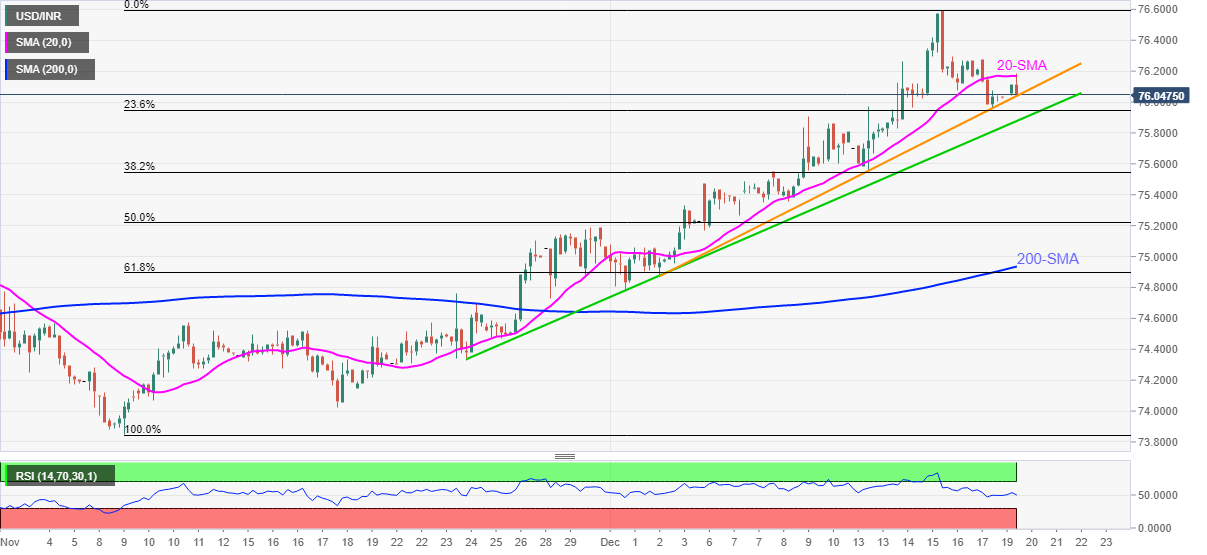
Trend: Bullish
- EUR/USD consolidates the biggest daily losses since late October inside 15-pip trading range.
- Market sentiment sours amid virus woes, disappointment over US stimulus and Fed rate-hike concerns.
- ECB policymakers jostle over inflation fears, Fed’s Waller favor rate hike calls.
- US Treasury yields refresh two-week low to weigh on DXY amid light-calendar-day.
EUR/USD treads water inside an immediate trading range surrounding 1.1250, up 0.10% heading into Monday’s European session. In doing so, the major currency pair cheers the broad US dollar weakness amid fears emanating from Omicron, Fed’s rate-hike and indecision over the US President Joe Biden’s Build Back Better (BBB) stimulus plan.
The week starts with a risk aversion wave and weighs on the US Treasury yields, which in turn heavy the US Dollar Index (DXY). However, mixed concerns over the ECB v/s Fed battle and a light calendar restrict the EUR/USD pair’s corrective pullback.
US 10-year Treasury yields drop three basis points (bps) to 1.37%, down for the third consecutive day to poke the monthly low marked on December 06 at the latest. In doing so, the T-bond coupons also heavy the DXY, down 0.08% intraday around 96.65 by the press time.
A 52% jump in the UK’s covid cases and fears of fresh covid-linked restrictions during the Christmas celebrations join chatters over a virus-led death of a New Zealand resident who took Pfizer vaccine. Additionally, New York Times said, “Dr. Anthony S. Fauci, the nation’s top infectious disease expert, warned on Sunday that the extraordinarily contagious Omicron variant of the coronavirus was raging worldwide and that it was likely to cause another major surge in the United States, especially among the unvaccinated.”
Elsewhere, US Senator Joe Manchin refused to vote in favor of President Biden’s Build Back Better (BBB) plan during the weekend. The news pushed back previous hopes of getting the stimulus through the house in 2021. Even so, US House Speaker Pelosi stays hopeful of reaching an agreement over BBB in 2022.
On Friday, Fed Board of Governors member Christopher Waller renewed the Fed rate-hike concerns while saying, per Reuters, “The ‘whole point’ of the Fed's decision to accelerate the pace of its QE taper was to make the March Fed meeting ‘live’ for a first rate hike.” At home, the European Central Bank (ECB) Governing Council Member Olli Rehn and Madis Muller cited possibilities of a rate hike but Bank of France Head Francois Villeroy de Galhau conveyed hopes of a peak in inflation.
To sum up, the risk-off mood favors the EUR/USD sellers even as DXY and Treasury yields trigger intermediate bounces. However, an absence of major data/events requires the pair traders to watch risk catalysts for clear direction.
Technical analysis
Unless rising beyond the 1.1385 horizontal hurdle, comprising tops marked since November 16, EUR/USD prices remain vulnerable to refresh yearly low of 1.1186.
- Asia-Pacific shares print losses despite PBOC’s surprise rate cut, Australia’s vaccine optimism.
- Omicron woes join US stimulus chatters, Fed rate-hike concerns to weigh on the sentiment.
- Light calendar keeps risk catalysts in the spotlight.
Asian markets portray risk-off mood during early Monday morning in Asia as covid fears join disappointment over US stimulus and Fed rate hike concerns. In doing so, investors reject cheering a surprise rate cut by the People’s Bank of China (PBOC) and Australia’s optimism to defeat the coronavirus with its 90% vaccination rate.
To portray the mood, MSCI’s index of Asia ex-Japan shares drops 1.60% whereas Japan’s Nikkei 225 marked over 2.0% of intraday losses at the latest.
Stocks in China drown Australia’s ASX 200 while NZX 50 bucks the trend with 0.90% intraday gains by the press time. Hong Kong, South Korea, Indonesia and India were all in the red as market sentiment sours.
The main risk catalysts are the fears of the South African covid variant, dubbed as Omicron, joined by the US Democrats’ disappointment over President Joe Biden’s stimulus plan and the Fed rate-hike calls.
A 52% jump in the UK’s covid cases and fears of fresh covid-linked restrictions during the Christmas celebrations join chatters over a virus-led death of a New Zealand resident who took Pfizer vaccine. Additionally, New York Times said, “Dr. Anthony S. Fauci, the nation’s top infectious disease expert, warned on Sunday that the extraordinarily contagious Omicron variant of the coronavirus was raging worldwide and that it was likely to cause another major surge in the United States, especially among the unvaccinated.”
It’s worth noting that US Senator Joe Manchin refused to vote in favor of President Biden’s Build Back Better (BBB) plan during the weekend. The news pushed back previous hopes of getting the stimulus through the house in 2021. Even so, US House Speaker Pelosi stays hopeful of reaching an agreement over BBB in 2022.
Elsewhere, Fed Board of Governors member Christopher Waller renewed the Fed rate-hike concerns on Friday while saying, per Reuters, “The ‘whole point’ of the Fed's decision to accelerate the pace of its QE taper was to make the March Fed meeting ‘live’ for a first rate hike.”
Alternatively, China’s troubled firm Kaisa tries to renew market optimism, but fails, while filing for resumption of trading of the company’s shares.
Against this backdrop, S&P 500 Futures drop 0.95% intraday whereas the US 10-year Treasury yields drop three basis points (bps) to 1.37%, down for the third consecutive day at the latest.
Moving on, a light calendar will join the year-end holiday mood to restrict the market moves. However, risk catalysts are in the driver’s seat.
Read: US Treasury yields remain pressured, S&P 500 Futures drop half a percent on sour sentiment
Having witnessed a disappointment from Democratic Senator Joe Manchin, over President Joe Biden’s Build Back Better (BBB) plan, US House Speaker Nancy Pelosi writes a letter, per the Financial Times (FT) analyst James Politi.
The writer tweets that US House Speaker Pelosi wrote, "While it is disappointing that we may not have a law by the end of the year, we are hopeful that we will soon reach an agreement so that this vital legislation can pass as soon as possible next year".
Earlier in the day, Reuters came out with the news saying, “West Virginia's Joe Manchin appeared to deal a fatal blow to President Joe Biden's signature domestic policy bill, known as Build Back Better, which also aims to expand the social safety net and tackle climate change.”
FX reaction
The news fails to push back the market pessimism as the US Treasury yields remain pressured near the lowest levels since December 06 while the S&P 500 Futures drop around 1.0% by the press time.
Read: US Treasury yields remain pressured, S&P 500 Futures drop half a percent on sour sentiment
- USD/CHF consolidates the biggest daily gains in two weeks.
- Descending Momentum line, multiple failures to cross 20-DMA tease sellers.
- 200-DMA, seven-week-old support line restrict short-term downside.
- Two-month-old horizontal area offers extra challenge for bulls.
USD/CHF treads water around 0.9235-40, down 0.10% intraday heading into Monday’s European session. In doing so, the Swiss currency (CHF) pair marks another failure to cross the 20-DMA.
In addition to the pullback from the short-term moving average, around 0.9240 by the press time, the downward sloping Momentum line also favors the pair sellers.
However, 200-DMA and an ascending support line from early November, respectively around 0.9180-75, become a tough nut to crack for the USD/CHF sellers.
Should the quote drop below 0.9175 support, a bit broader support line from August, close to 0.9125, will be on the bear’s radar.
Alternatively, a clear upside break of the 20-DMA level of 0.9240 isn’t a green pass to the USD/CHF buyers as multiple tops marked since October 18 challenge the pair’s further advances near 0.9275.
If at all the pair buyers keep reins past 0.9275, the 0.9300 threshold and November’s peak of 0.9373 will be in focus.
USD/CHF: Daily chart
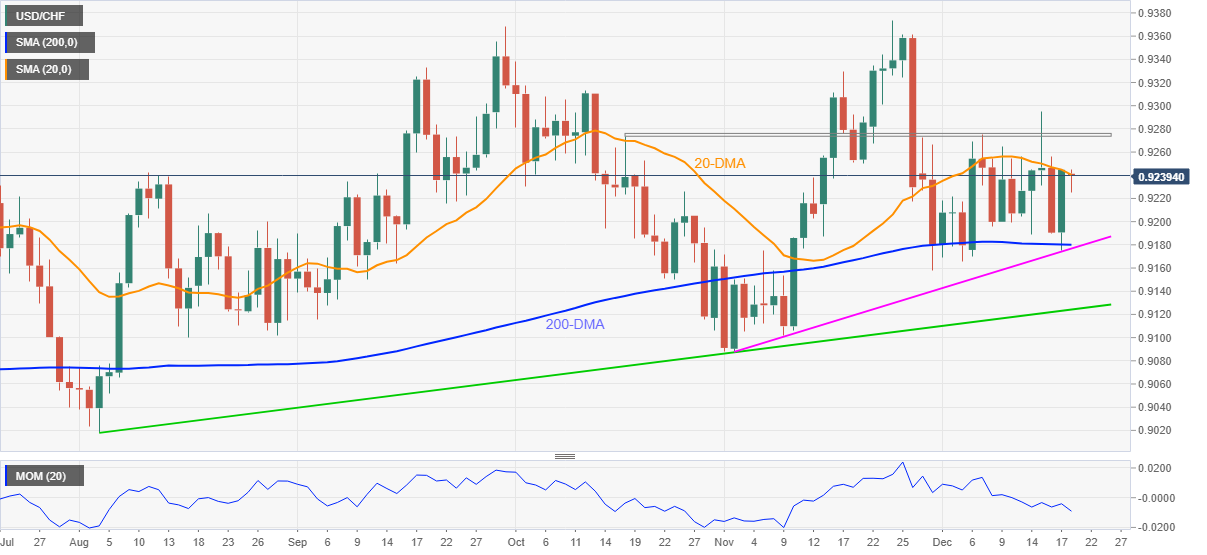
Trend: Pullback expected
- USD/TRY stays firmer around record top during five- day uptrend.
- Turkey’s President Erdogan says economic problems are not due to lowering of rates.
- Omicron, US stimulus updates weigh on yields and DXY but no rescue for pair sellers.
- Risk catalysts are the key amid a light calendar.
USD/TRY prints 1.70% intraday gains while staying around record top, recently picking up bids to $16.80 during early Monday morning in Europe.
In doing so, the Turkish lira (TRY) pair shrugs of President Recep Tayyip Erdogan’s hawkish comments that defended the Central Bank of the Republic of Turkey (CBRT) rate cuts.
“President Tayyip Erdogan said he had lowered Turkey's inflation, currently above 21%, to around 4% before and that he will do it again soon,” said Reuters. “The new policy model based on low interest rates was part of an ‘economic independent war’,” adds Erdogan per the news.
While stepping forward in defense of the CBRT rate cuts, Erdogan said, per Reuters, “Recent problems in the economy were not caused by his push to lower interest rates, but rather by attacks on Turkey's economy.”
Reuters also said, “Speaking at an awards ceremony, Erdogan dismissed the idea of capital controls as ‘ridiculous’ and said Turkey would continue to operate within the free-market economy.”
Elsewhere, risk-off mood weighs on the stock futures in the West as well as the US Treasury yields. The main risk catalysts are the fears of the South African covid variant, dubbed as Omicron, joined by the US Democrats’ disappointment over stimulus and the Fed rate-hike calls.
Amid these plays, S&P 500 Futures drop 0.95% intraday whereas the US 10-year Treasury yields drop three basis points (bps) to 1.37%, down for the third consecutive day at the latest.
Although a light calendar and downbeat Treasury yields may test the USD/TRY bulls, the trend change is out of the question. For the short-term, risk catalysts are the key to follow for fresh impulse.
Technical analysis
Unless declining back below the previous resistance line from late November, around $15.20, USD/TRY bulls are on the way to $20.00 psychological magnet.
- AUD/JPY bears stay in charge in risk-off markets conditions.
- The forex space's risk barometer is heading lower by some 0.3%.
AUD/JPY is sinking at the start of the week as risk-off tones continue to reverberate following Friday's sell-off on Wallstreet. At the time of writing, AUD/JPY is down some 0.3% and has fallen from within a range of between 80.73 and 81.04.
US stocks sank on Friday following news of the latest spike in COVID-19 cases which weighed on the economic outlook. The S&P 500 fell 1% to 4,620.64, finishing 1.9% below last Friday's record close and the futures are off by the same amount in Asia.
Covid risks weigh on risk sentiment
The Omicron variant is "spreading at lightning speed" in Europe and medical experts have warned of an Omicron-fueled “viral blizzard” sweeping the US also. US president Joe Biden has spoken of a “winter of severe illness and death” among the unvaccinated.
The Omicron variant of Covid-19 has “extraordinary spreading capabilities”, the top US infectious diseases expert said on Sunday, and promises to bring a bleak winter as it continues “raging through the world”.
A new single-day record for New York state was reported of just over 21,000 new COVID-19 cases on Friday. Additionally, the consumer response to omicron's spread in the UK suggests the US services sector is going to be for a poor time as well despite the holiday season.
Besides the covid risks, a hawkish Federal Reserve and central banks could also be weighing on risk sentiment and this week's US inflation data will be watched. ''We expect slowing ahead, but core PCE prices likely rose strongly again, albeit by less than the core CPI (0.42% vs 0.53%),'' analysts at TD Securities said.
- USD/CNH steps back from 50-DMA, seven-week-old resistance line.
- Sustained break of previous resistance line from September, bullish MACD favor buyers.
- 23.6% Fibonacci retracement level adds to downside filters, late October’s top also challenge buyers.
USD/CNH struggles to justify the People’s Bank of China’s (PBOC) surprise rate cut during early Monday morning in Europe.
Although the offshore Chinese currency (CNH) pair snaps a three-day uptrend to ease from a monthly high, it does keep Friday’s break of a descending trend line from September 21 to underpin bullish bias. Also favoring the USD/CNH bulls are the upbeat MACD signals and the risk-off mood, not to forget covid and financial risks for China.
That said, the 50-DMA and a seven-week-old resistance line challenge short-term buyers around $6.3900 and $6.3920 respectively.
Even if the quote rises past $6.3920, the October 29 peak of $6.4104 will act as an extra hurdle to the north before directing USD/CNH buyers to 61.8% Fibonacci retracement (Fibo.) of September-December downside, near $6.4285.
Meanwhile, pullback moves remain elusive until staying beyond the resistance-turned-support line from September, around $6.3850.
Also challenging the USD/CNH bears is the 23.6% Fibo. level near $6.3675 and November’s low surrounding $6.3615.
USD/CNH: Daily chart
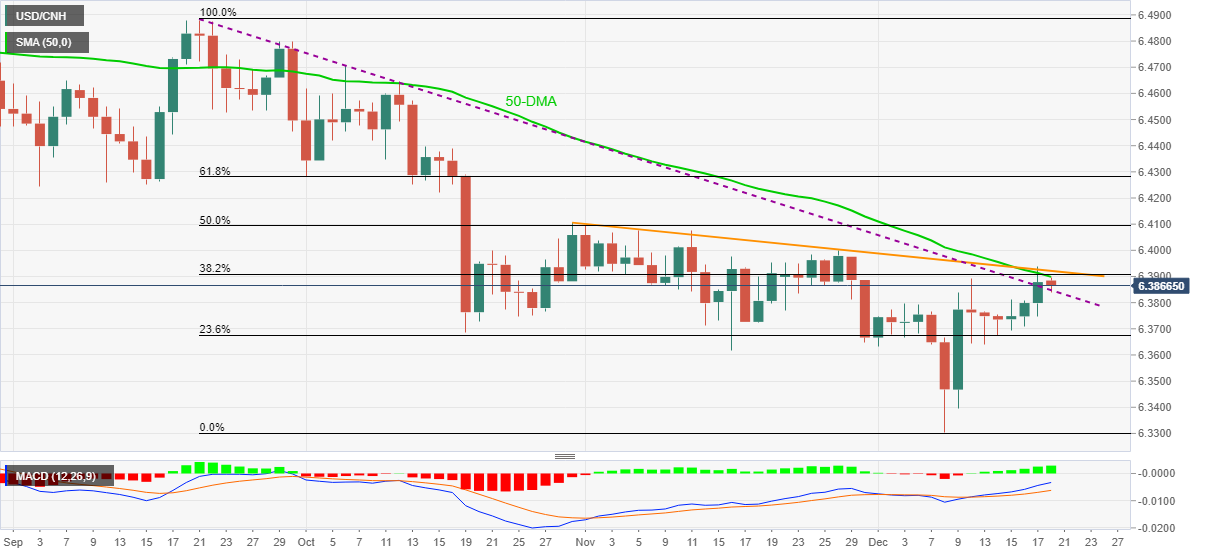
Trend: Further upside expected
- GBP/USD bearish outlook in the process of being confirmed on the daily chart.
- The bears will be seeking a break of 1.3200 and 1.3100 in the weekly support structure.
GBP/USD is still reeling from Friday's sharp drop and tests the bull's commitments are a critical area of support on the weekly chart.
The following is a top-down analysis that arrives at a bearish bias on a break below 1.32 the figure which opens the significant risk of plenty of downside to come in the final stages o the year and start of the new year.
GBP/USD weekly chart
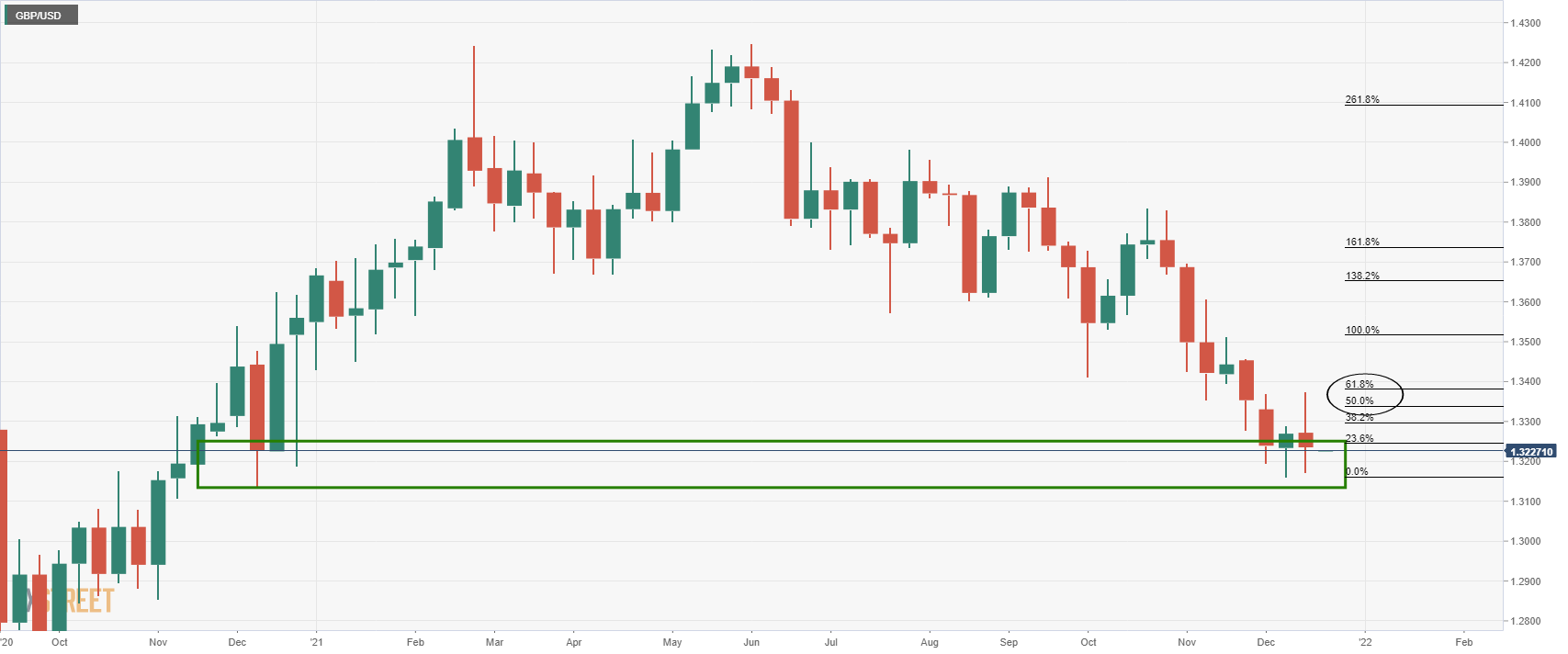
As illustrated, below 1.3200 and 1.3100, there is an imbalance in price towards 1.2850 where the market could fall into should the support structure give out.
GBP/USD daily chart
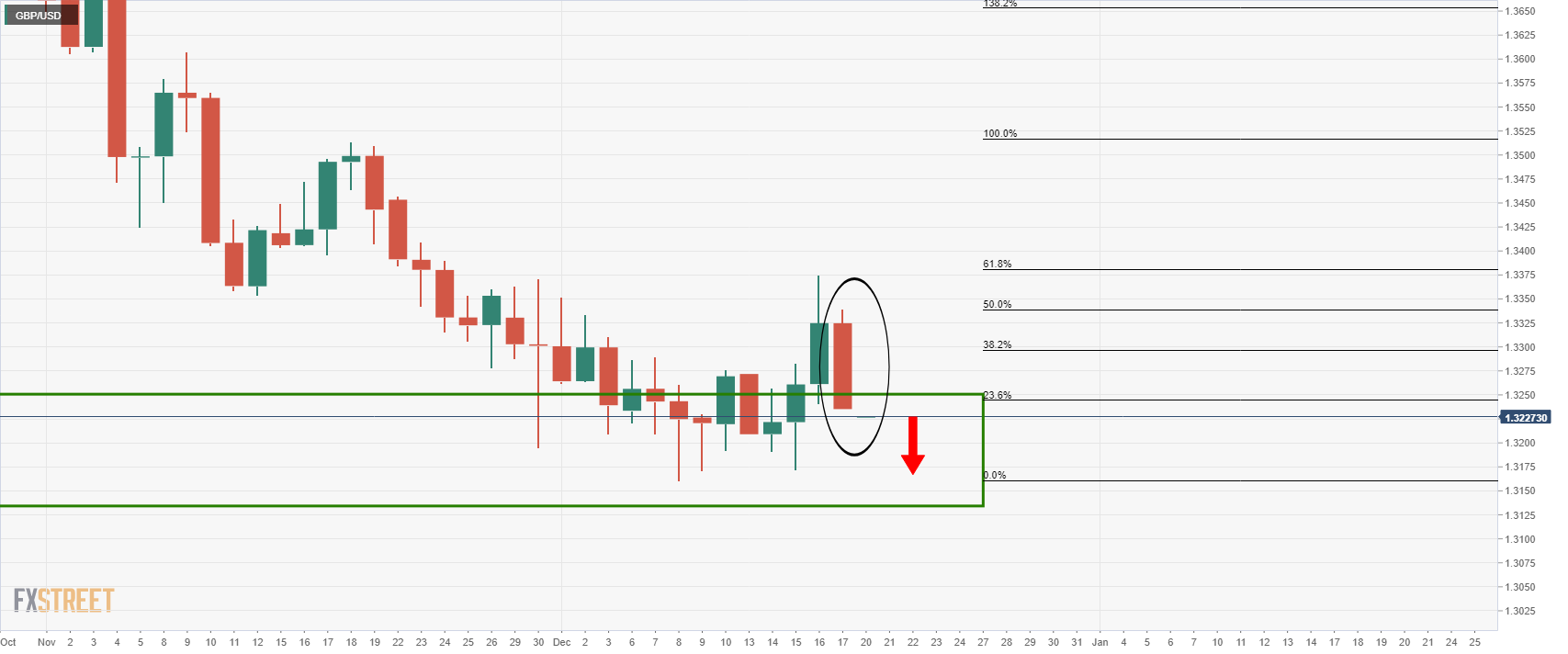
Should the bearish engulfing candle be followed by a confirming subsequent bearish candle, or two, then the bias will most certainly mount into the bear's hands for the following days ahead.
| Raw materials | Closed | Change, % |
|---|---|---|
| Brent | 73.17 | -1.85 |
| Silver | 22.376 | -0.39 |
| Gold | 1797.353 | -0.06 |
| Palladium | 1778.86 | 3.03 |
- US 10-year Treasury yields seesaw around fortnight low.
- S&P 500 Futures drop 0.60%, Asia-Pacific shares trade mixed.
- PBOC announced rate cut, Omicron fears escalate ahead of holiday season.
- Fed’s Waller renewed rate-hike calls, US Senator Manchin poured cold water on the face of BBB hopes.
Having witnessed a roller-coaster week filled with the central bankers’ actions, global markets stay depressed during early Monday.
While portraying the mood, US 10-year Treasury yields dropped 1.5 basis points (bps) to 1.38%, down for the third consecutive day while S&P 500 Futures drop 0.60% at the latest. Further, Australia’s ASX 200 dropped 0.30% by the press time even as stocks in China traded mixed.
The reason could be linked to the escalating concerns over the covid variant linked to South Africa, namely Omicron, as well as fresh fears of a Fed rate hike in early 2022. Adding to the bearish catalysts is the latest disappointment for the US Democratic Party members after Joe Manchin rejected the push to vote for President Joe Biden’s Build Back Better (BBB) stimulus.
A 52% jump in the UK’s covid cases and fears of fresh covid-linked restrictions during the Christmas celebrations join chatters over a virus-led death of a New Zealand resident who took Pfizer vaccine. Additionally, New York Times said, “Dr. Anthony S. Fauci, the nation’s top infectious disease expert, warned on Sunday that the extraordinarily contagious Omicron variant of the coronavirus was raging worldwide and that it was likely to cause another major surge in the United States, especially among the unvaccinated.”
Elsewhere, US Senator Manchin’s step back rejects odds for any fruitful discussion on the much-awaited US stimulus during 2021 as Democrats needed all the party votes to progress on the BBB. “West Virginia's Joe Manchin appeared to deal a fatal blow to President Joe Biden's signature domestic policy bill, known as Build Back Better, which also aims to expand the social safety net and tackle climate change,” said Reuters.
On the same line were fresh talks over the Fed rate hike in early 2022, triggered on Friday by Fed Board of Governors member Christopher Waller. The policymaker said, per Reuters, “The ‘whole point’ of the Fed's decision to accelerate the pace of its QE taper was to make the March Fed meeting ‘live’ for a first rate-hike.”
Against this backdrop, the US Dollar Index (DXY) struggles around 96.65, after posting the highest daily close in 2021 the previous day. The risk-aversion wave favors gold prices but weighs on the oil at the latest.
It’s worth noting that a light calendar and holiday mood may restrict market moves looking forward.
There are reports circulating of the death of a man related to the Pfizer covid-19 vaccine.
The coroner is investigating after an autopsy links a Dunedin man's death to a 'very rare' side effect of the Pfizer vaccine. The death is supposedly consistent with vaccine-related myocarditis”.
Vaccinologist Dr Helen Petousis-Harris said although vaccine-related myocarditis did happen, it was “very rare” and the risks of the vaccine were greatly outweighed by the risk of contracting Covid-19.
“These cases are almost exclusively quite mild. We don't have a whole lot of people dying from vaccine-related myocarditis around the world,” she said.
“A death would be particularly extraordinary.”
- NZD/USD grinds lower around intraday low following PBOC rate cut.
- PBOC cuts 1-year LPR to 3.80%, keeps 5-year rate unchanged.
- Failures to cross 21-DMA, downbeat oscillators favor sellers.
NZD/USD remains pressured inside a 15-pip trading range around 0.6730 during early Monday. In doing so, the Kiwi pair justifies a surprise rate-cut announcement from New Zealand’s key customer China.
The PBOC announced a five basis points (bps) of a cut to the benchmark one-year Loan Prime Rate (LPR) top 3.80% while keeping the five-year rate intact around 4.65%.
Technically, the pair’s failure to cross the 21-DMA hurdle during the last week’s corrective pullback joins downbeat MACD and RSI conditions to weigh on the quote.
That said, the NZD/USD prices decline towards the retest of a descending support line from March, around 0.6700.
However, oversold RSI conditions hint at a bounce from the stated support line, a break of which will open doors for a downward trajectory towards the late 2020 bottom near 0.6590.
On the contrary, a clear upside break of 21-DMA level of 0.6820 will need validation from September’s low close to 0.6860 before recalling the NZD/USD bulls.
In a case where the pair remains firmer past 0.6860, odds of its run-up to early October swing high near 0.6985 can’t be ruled out.
NZD/USD: Daily chart
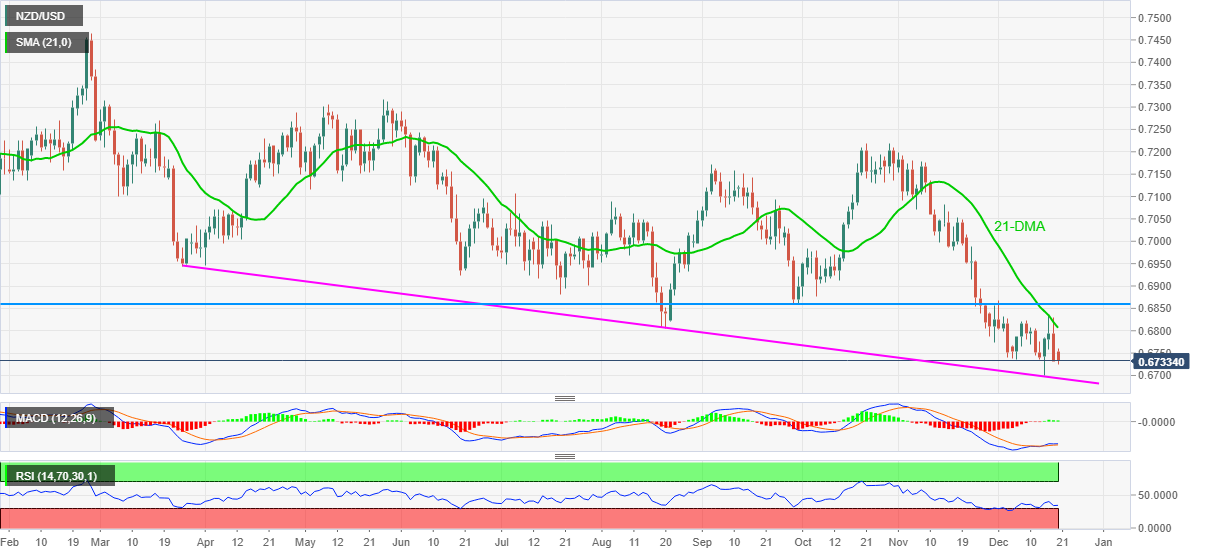
Trend: Further downside expected
- AUD/USD retreats towards intraday low after PBOC rate cut.
- PBOC lowers 1-year LPR by five bps, keeps 5-year rate unchanged.
- Yields, stock futures and Asia-Pacific stocks portray risk-off mood.
- Omicron, US stimulus and Fed concerns weigh on sentiment, China’s Kaisa struggles to defend buyers.
AUD/USD remains on the back foot for the second consecutive day, down 0.10% around 0.7115 during early Monday morning in Europe.
The Aussie pair recently dropped on the People’s Bank of China’s (PBOC) surprise rate cut. Also weighing the risk-barometer pair is the sour sentiment in the markets.
The PBOC announced a five basis points (bps) of a cut to the benchmark one-year Loan Prime Rate (LPR) top 3.80% while keeping the five-year rate intact around 4.65%. The same highlights the economic woes at Australia’s largest customer.
Even so, China’s troubled firm Kaisa tries to renew market optimism, but fails, while filing for resumption of trading of the company’s shares. Also on the positive side was news from Reuters saying, “It has not received any notice from bondholders to accelerate repayments yet as the embattled Chinese property developer has not repaid a $400 million bond, or interest on notes due in 2023 and 2025.”
It’s worth noting that disappointment over US President Joe Biden’s Build Back Better (BBB) plan, after the key Senator refused to back the stimulus, also weighs on the market sentiment. On the same line were the latest fears over the South African covid variant, namely Omicron, even as Australian policymakers cheer 90% vaccination rates to turn down the virus fears and shrug off chances of fresh activity restrictions on Christmas.
That said, DXY jumped the most in six weeks the previous day after comments from Fed Board of Governors member Christopher Waller renewed the Fed rate-hike concerns and weighed on the AUD/USD prices. “The ‘whole point’ of the Fed's decision to accelerate the pace of its QE taper was to make the March Fed meeting ‘live’ for a first rate-hike,” said the policymaker per Reuters.
Against this backdrop, S&P 500 Futures drop 0.50% whereas the US 10-year Treasury yields drop 1.5 basis points (bps) to 1.38%, down for the third consecutive day at the latest. Further, Australia’s ASX 200 dropped 0.30% by the press time even as stocks in China traded mixed.
Looking forward, risk catalysts are likely to be the main drivers of the AUD/USD amid a lack of major data/events.
Technical analysis
A confirmation of the rising wedge bearish chart pattern favors AUD/USD sellers to aim for the 0.7030 and the 0.7000 threshold until the quote stays below the convergence of the stated wedge’s resistance line and 200-SMA, around 0.7220.
China loan rates for one-year are now at 3.80% after being cut from 3.85% and the five-year remains unchanged at 4.65%.
The move comes in the wake of renewed economic risks relating to the spread of the covid-19 variant and due to the headwinds that face the economy due to the nation’s property-market downturn.
The cut was well telegraphed following announcements from the PBoC earlier in the month where the central bank said that it will reduce most banks’ reserve requirement ratios by 0.5 percentage points, releasing 1.2 trillion yuan ($188 billion) of liquidity. Premier Li Keqiang has said that China has room for a variety of monetary policy tools, including cutting the RRR.
President Xi Jinping has pledged to stabilize the economy in 2022 amid a liquidity crunch among developers that’s roiled the nation’s bond market.
USD/CNH has fallen within the 6.3897 / 6.3838 range on the day.
| Time | Country | Event | Period | Previous value | Forecast |
|---|---|---|---|---|---|
| 09:00 (GMT) | Eurozone | Current account, unadjusted, bln | October | 26.9 | |
| 11:00 (GMT) | Germany | Bundesbank Monthly Report | |||
| 11:00 (GMT) | United Kingdom | CBI industrial order books balance | December | 26 | |
| 15:00 (GMT) | U.S. | Leading Indicators | November | 0.9% | 0.9% |
- WTI remains pressured around fortnight low, extends Friday’s losses.
- 50-DMA guards corrective pullback inside Megaphone broadening pattern.
- Short-term support line tests immediate downside amid oversold RSI conditions.
WTI crude oil traders lick their wounds near $69.20, down 1.55% intraday after refreshing the two-week low during early Monday.
In doing so, the black gold trades inside a Megaphone chart formation while justifying failures to stay beyond the 50-SMA.
Even so, oversold RSI conditions may trigger the quote’s bounce from the support line of the state Megaphone, near $68.25.
Should the quote fail to recover from $68.25, it becomes vulnerable to test monthly horizontal support near $65.50.
Alternatively, recovery moves remain elusive below the 50-DMA level of $71.15, a break of which will direct WTI buyers to challenge the Megaphone’s upper line near $72.00.
During the commodity’s upside past $72.00, the 61.8% Fibonacci retracement level of November 24 to December 02 downside, near $72.70, will act as an additional upside filter before recalling the bulls.
WTI: Four-hour chart
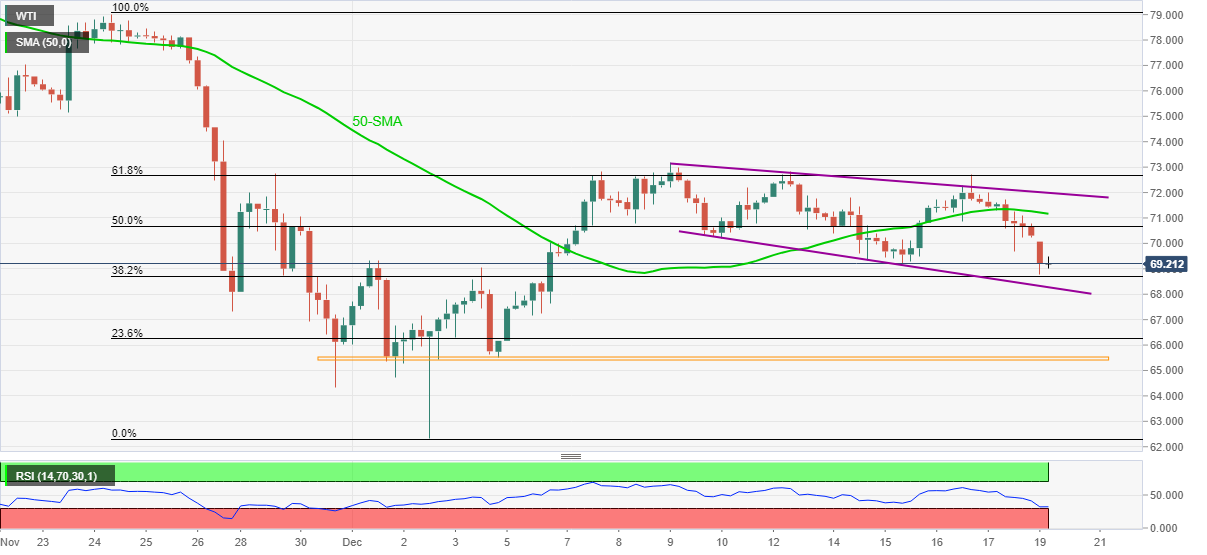
Trend: Further weakness expected
In recent trade today, the People’s Bank of China (PBOC) set the yuan (CNY) at 6.3933 vs the estimated 6.3880 and the previous 6.3651.
About the fix
China maintains strict control of the yuan’s rate on the mainland.
The onshore yuan (CNY) differs from the offshore one (CNH) in trading restrictions, this last one is not as tightly controlled.
Each morning, the People’s Bank of China (PBOC) sets a so-called daily midpoint fix, based on the yuan’s previous day closing level and quotations taken from the inter-bank dealer.
- USD/CAD grinds higher following the highest daily close in 2021.
- Risk appetite sours amid Omicron fears, Fed rate-hike concern, as well as US stimulus issues.
- WTI crude oil dropped over 1.5% to refresh two-week low.
- Qualitative factors will direct short-term market moves amid a light calendar.
USD/CAD seesaws near 1.2900 during Monday’s Asian session, following the strong daily jump in three weeks to print the highest daily closing in 2021.
The Loonie pair buyers seem to cheer downbeat prices of Canada’s key export item, namely WTI crude oil. However, the risk-aversion wave and mixed updates amid a light calendar seem to challenge the bulls around the key resistance line of late.
WTI drops 1.55% to $69.20 by the press time, after refreshing the fortnight low of $68.79. In doing so, the black gold seems to bear the burden of the strong US Dollar Index (DXY) and sour sentiment.
That said, DXY jumped the most in six weeks the previous day after comments from Fed Board of Governors member Christopher Waller renewed Fed rate-hike concerns. “The ‘whole point’ of the Fed's decision to accelerate the pace of its QE taper was to make the March Fed meeting ‘live’ for a first rate hike,” said the policymaker per Reuters.
It’s worth noting that a jump in the covid cases in Canada, recently by 4,177, recalled the capacity limits and gather caps in Ontario. Fears of the South African covid variant, dubbed as Omicron, escalate in other developed countries as well. The UK marked the biggest run-up in daily COVID-19 infections the previous day while the weekly count also spiked 52%. Further, Senior US Medical Expert Anthony Fauci fears more measures to curb the COVID-19 cases.
On a different page, disappointment over US President Joe Biden’s Build Back Better (BBB) plan, after the key Senator refused to back the stimulus, also weigh on the market sentiment. . “West Virginia's Joe Manchin appeared to deal a fatal blow to President Joe Biden's signature domestic policy bill, known as Build Back Better, which also aims to expand the social safety net and tackle climate change,” said Reuters.
Alternatively, China’s troubled firm Kaisa files for resumption of trading of the company’s shares while also saying, per Reuters, “ It has not received any notice from bondholders to accelerate repayments yet as the embattled Chinese property developer has not repaid a $400 million bond, or interest on notes due in 2023 and 2025.”
Amid these plays, S&P 500 Futures drop 0.40% whereas the US 10-year Treasury yields drop 1.3 basis points (bps) to 1.38%, down for the third consecutive day at the latest.
Given the latest risk-off mood and a light calendar, sentiment-related headlines are the key to fresh impulse.
Technical analysis
A five-month-old ascending resistance line near 1.2910 appears a tough nut to crack for the USD/CAD bulls. Alternatively, the 10-DMA level of 1.2780 restricts short-term pullback moves.
- DXY crossed monthly horizontal resistance, firmer of late.
- Sustained trading beyond key SMAs, bullish MACD signals favor buyers.
- Multiple bottoms around 95.85 add to the downside filters.
US Dollar Index (DXY) stays firmer, keeping Friday’s bullish breakout of monthly resistance near 96.70 during Monday’s Asian session.
In addition to the previous resistance breakout, bullish MACD signals and firmer RSI line, not overbought, also signal the greenback gauge’s further advances.
However, the 96.80 and the 97.00 levels may offer intermediate halts during the quote’s anticipated rally towards the 97.55 mark comprising 61.8% Fibonacci Expansion (FE) of November 09-30 moves.
Meanwhile, corrective pullback remains elusive until the quote stays beyond the resistance-turned-support near 96.60, a break of which will direct DXY towards a 100-SMA level of 96.25.
It should be noted, however, that a horizontal line from December 08 and 200-SMA, respectively near 95.85 and 95.70, will test the US Dollar Index bears afterward.
To sum up, DXY crossed the key hurdle to refresh the yearly top but further gains need validation.
DXY: Four-hour chart
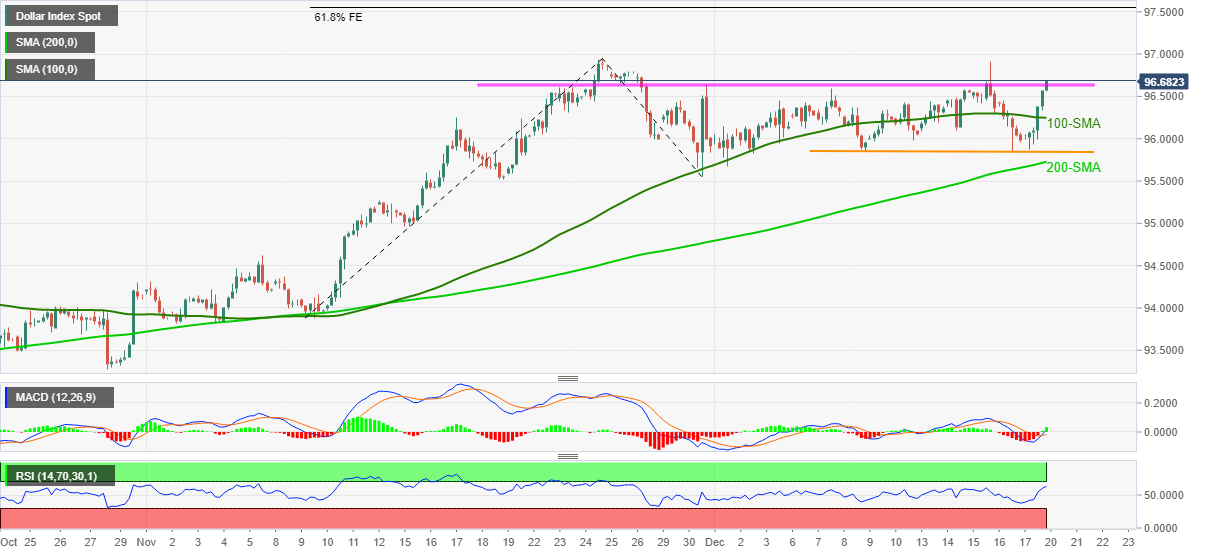
Trend: Further upside expected
- USD/JPY fails to extend Friday’s corrective pullback, refreshes intraday low.
- Coronavirus woes join Fed rate-hike chatters, disappointment over US stimulus to weigh on risk appetite.
- US Treasury yields drop for third consecutive day, stock futures are down too.
- Risk catalysts are in the driver’s seat amid light calendar.
USD/JPY refreshes intraday low to 113.50, down 0.20% on a day on Monday’s Tokyo open.
The yen pair portrays the risk-off mood in the market, following the US Treasury yields and equity futures, amid fears emanating from the South African covid variant, dubbed as Omicron, as well as concerning US stimulus and Fed-rate-hike calls.
Omicron cases are on a spike in the West, especially in Europe and the UK, which in turn challenges the holiday spirit and calls for further activity restrictions. The UK reported a 52% jump in the covid cases while Senior US Medical Expert Anthony Fauci fears more measures to curb the COVID-19 cases. “Dr. Anthony S. Fauci, the nation’s top infectious disease expert, warned on Sunday that the extraordinarily contagious Omicron variant of the coronavirus was raging worldwide and that it was likely to cause another major surge in the United States, especially among the unvaccinated,” per the New York Times.
On a different page, US Democrats seem on the brink of failure to push for voting on the Build Back Better (BBB) plan after the key Senator refused to back the stimulus. “West Virginia's Joe Manchin appeared to deal a fatal blow to President Joe Biden's signature domestic policy bill, known as Build Back Better, which also aims to expand the social safety net and tackle climate change,” said Reuters.
It’s worth noting that Friday’s comments from Fed Board of Governors member Christopher Waller renewed the call for the Fed-rate-hike and propelled the US dollar. “The ‘whole point’ of the Fed's decision to accelerate the pace of its QE taper was to make the March Fed meeting "live" for a first rate hike,” the policymaker said per Reuters.
That said, the US 10-year Treasury yields dropped 2.4 basis points (bps) to 1.378% while the S&P 500 Futures declined 0.70% intraday by the press time. Also portraying the risk-off mood is a 1.0% fall in Japan’s Nikkei 225.
Moving on, a light calendar and year-end holiday mood may restrict USD/JPY moves. However, risk catalysts may offer intermediate directions to the pair traders.
Technical analysis
Repeated failures to cross the 50-DMA, around 113.85 by the press time, direct USD/JPY prices towards the monthly low surrounding 112.55.
| Pare | Closed | Change, % |
|---|---|---|
| AUDUSD | 0.71295 | -0.73 |
| EURJPY | 127.861 | -0.65 |
| EURUSD | 1.12448 | -0.69 |
| GBPJPY | 150.554 | -0.52 |
| GBPUSD | 1.32407 | -0.58 |
| NZDUSD | 0.67347 | -0.95 |
| USDCAD | 1.28876 | 0.92 |
| USDCHF | 0.92388 | 0.53 |
| USDJPY | 113.708 | 0.04 |







© 2000-2026. All rights reserved.
This site is managed by Teletrade D.J. LLC 2351 LLC 2022 (Euro House, Richmond Hill Road, Kingstown, VC0100, St. Vincent and the Grenadines).
The information on this website is for informational purposes only and does not constitute any investment advice.
The company does not serve or provide services to customers who are residents of the US, Canada, Iran, The Democratic People's Republic of Korea, Yemen and FATF blacklisted countries.
Making transactions on financial markets with marginal financial instruments opens up wide possibilities and allows investors who are willing to take risks to earn high profits, carrying a potentially high risk of losses at the same time. Therefore you should responsibly approach the issue of choosing the appropriate investment strategy, taking the available resources into account, before starting trading.
Use of the information: full or partial use of materials from this website must always be referenced to TeleTrade as the source of information. Use of the materials on the Internet must be accompanied by a hyperlink to teletrade.org. Automatic import of materials and information from this website is prohibited.
Please contact our PR department if you have any questions or need assistance at pr@teletrade.global.


 Bank
Bank transfers


