- Analytics
- News and Tools
- Market News
CFD Markets News and Forecasts — 23-12-2021
- EUR/USD stays below a confluence of 200-EMA, monthly triangle’s resistance line.
- Downbeat Momentum line hints at a pullback, 100-EMA restricts immediate declines.
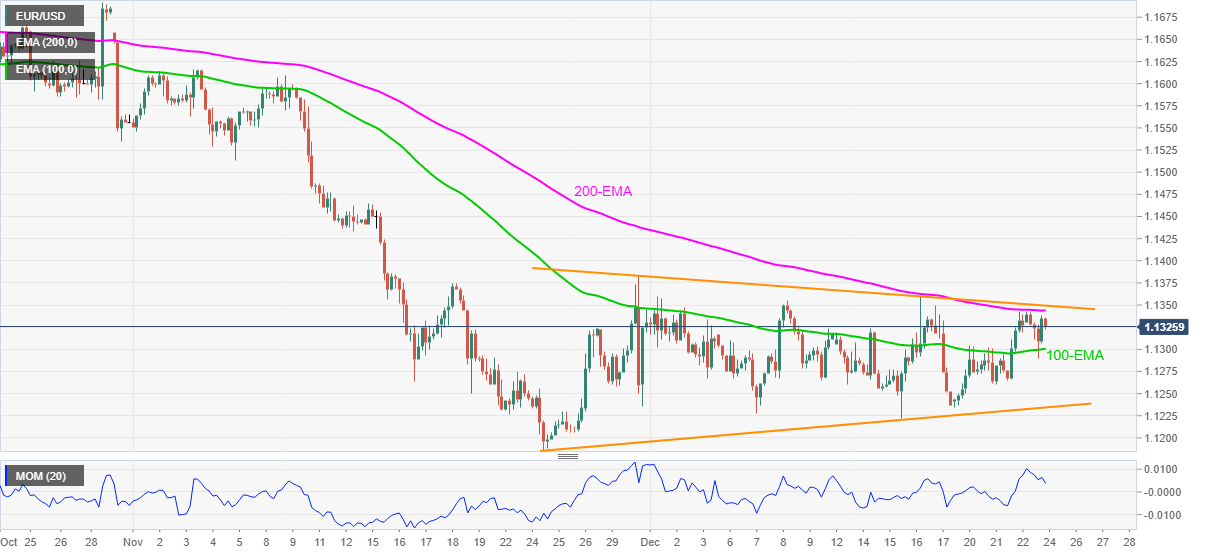
EUR/USD holds onto the monthly trading range, around the upper end of a symmetrical triangle during Friday’s quiet Asian session. That said, the quote eases to 1.1323 by the press time.
In doing so, the major currency pair steps back from 200-EMA and the stated monthly triangle’s resistance line, while also justifying the pullback in the Momentum line.
However, the 100-EMA level of 1.1300 is likely to challenge the immediate downside, if not then a subsequent fall towards 1.1270 becomes imminent.
Following that, the stated triangle’s support line and the yearly low, respectively around 1.1235 and 1.1185, will be in focus.
Alternatively, an upside clearance of 1.1350 will aim for late November’s peak around 1.1385.
In a case where the EUR/USD prices remain firmer past 1.1385, November 15 top of 1.1465 and early November’s low near 1.1515 should return to the chart.
EUR/USD: Four-hour chart
Trend: Sideways
- The GBP/JPY continued its rally in the week, up some 2.54%.
- The market sentiment is upbeat, increasing demand in the FX market for risk-sensitive currencies like the British pound.
- GBP/JPY Price Forecast: Bullish biased, though it would need GBP bulls to hold the spot above the 200-DMA.
As the Asian session begins, the GBP/JPY rises some 0.66%, trading at 153.42 during the day at the time of writing. The market sentiment is upbeat, triggering demand for risk-sensitive currencies. Covid-19 news from the UK Health Secretary saying that people infected with the newly discovered Omicron strain were 50% to 70% less likely to require hospitalization, improved the market mood. Additionally, the US Food and Drug Administration (FDA) approved Pfizer and Merck Covid-19 treatment pills, which could be used in high-risk patients.
That increased market participants’ demand for riskier assets. In the FX market, appetite for AUD, NZD, GBP, and CAD, increased, as all are part of risk-sensitive currencies. The laggards of the session are the safe-haven and low-yielders like the USD, the CHF, and the JPY.
In the last three days, the British pound has appreciated some 2.45% against the Japanese yen, breaking on its upward move, crucial resistance levels, like the 200, the 100 and the 50-day moving averages (DMAs), which were previous resistance levels, now turned support, once the spot price is above them.
GBP/JPY Price Forecast: Technical outlook
Now that the GBP/JPY is trading above the 200-DMA, the pair is bullish biased, though downside risks remain. Nevertheless, the break of a downslope trendline on December 21, around the 150.00 area, gave GBP bulls enough strength to challenge the DMA’s above the spot price.
To the upside, the first resistance would be the psychological 154.00 level. A decisive break of that level would send the GBP/JPY pair upwards, with the November 17 swing high at 154.75, followed by the November 4 daily high at 156.25.
On the flip side, the GBP/JPY first support would be the psychological 153.00. The breach of the latter would expose crucial support levels like the December 16 daily high, previous resistance-turned-support at 152.63, followed by the December 22 daily low at 151.10.
-637758980834653758.png)
US inflation expectations, as measured by the 10-year breakeven inflation rate per the St. Louis Federal Reserve (FRED) data, reprinted the 2.47% figure on Thursday, as per the official source.
In doing so, the inflation gauge seems to run out of steam to extend the last week’s rebound from a two-month low, taking rounds to the highest level since December 09.
It’s worth noting that the latest US data concerning the PCE Personal Consumption and Durable Goods Orders favored the last hawkish comments from the Fed policymaker, namely Christopher Waller.
Read: Forex Today: Risk appetite undermines demand for the greenback
That said, the latest pick-up in the inflation expectations and firmer US data may help the US Treasury yields to stay firmer, which in turn could challenge riskier assets like AUD/USD. However, holiday mood and thin volume could restrict the market moves.
Read: AUD/USD: Bulls battle monthly resistance around 0.7250 amid upbeat sentiment
- Silver buyers seem running out of steam inside a bearish chart pattern.
- Nearly overbought RSI also teases sellers for entry.
- 100-SMA, 23.6% Fibonacci retracement level becomes short-term key support, 200-SMA adds to the upside filters.
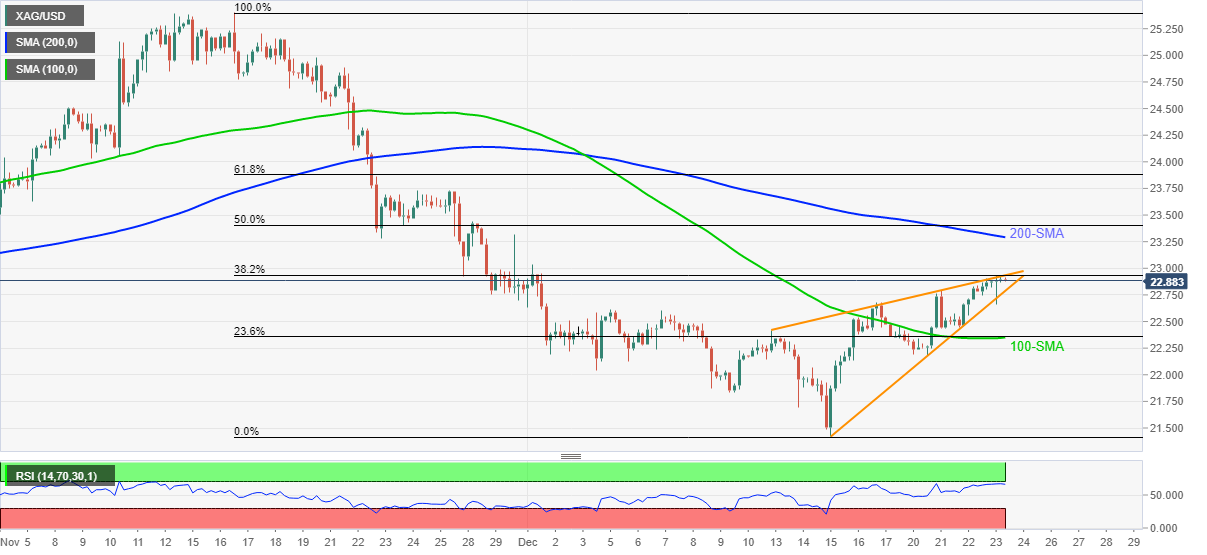
Silver (XAG/USD) prices grind higher around $22.90, near the monthly top, during Friday’s Asian session.
In doing so, the bright metal funnels down to the breaking point of a two-week-old ascending triangle bearish chart pattern.
Other than the failures to stay firmer and bearish formation, nearly overbought RSI conditions also signal the silver seller’s arrival. However, a clear downside break of $22.78 becomes necessary for that.
Even so, a convergence of the 100-SMA and 23.6% Fibonacci retracement (Fibo.) level near $22.35 and $22.00 threshold can test the XAG/USD bears before directing them to the monthly low around $21.40.
Meanwhile, the 38.2% Fibo. and the upper line of the stated triangle, near $22.95, restricts short-term advances of the metal.
Also acting as an upside filter is the $23.00 threshold and 200-SMA level of $23.30.
Silver: Four-hour chart
Trend: Pullback expected
Australia finally matched market expectations of shortening the gap between two vaccine doses and a booster, after staying silent over the move in Wednesday’s cabinet meeting.
Australia Health Minister Greg Hunt took the honor to announce the same on early Friday morning in the Asia-Pacific zone. It’s worth noting that the previous gap between the two shots of covid vaccines and booster dose was five months. ABC News first shared the comments as follows.
Key quotes
On the basis of advice of the Australian Technical Advisory Group on Immunisation (ATAGI), it's no surprise we will be bringing forward the eligibility for the booster dose to four months as of 4 January.
The planning behind that is that will open up a new cohort.
Currently that means that we will go from about 3.2 million people who are eligible today to approximately 7.5 million who will be eligible as 4 January. That means that the cohort has expanded.
It will be expanded again on the 31st of January to three months and that will take it out to 16 million Australians who will be eligible at that point in time.
192,000 booster doses were administered yesterday.
FX reaction
Despite the upbeat news, AUD/USD keeps taking round to the monthly ascending resistance line, near December’s high of 0.7253, amid a quiet session.
Read: AUD/USD: Bulls battle monthly resistance around 0.7250 amid upbeat sentiment
- AUD/USD seesaws near the highest level in December, bulls seem to have run out of steam.
- Market’s mood remains brighter as Omicron linked updates are positive.
- Strong US data favored yields but stocks stayed firmer.
- No major data, holiday season to restrict momentum.
AUD/USD prices have likely switched to the Christmas mood in advance, after refreshing the monthly high with 0.7253. That said, the Aussie pair seesaws around an upward sloping trend line from November 30 while taking rounds to 0.7250 during early Friday morning in Asia.
Positive updates concerning the milder fears from the South African covid variant, dubbed as Omicron, join upbeat signs of medical cure to the stated virus variant to favor the risk appetite. Adding to the firmer sentiment are the hopes of US stimulus, despite short-term bleak at the White House.
After approving Pfizer’s pill to battle the Omicron on Wednesday, the US Food and Drug Administration (FDA) also approved Merck's Covid-19 pill on Thursday. Earlier in the week, US Military also conveyed news of developing a single cure for covid and all variants. Also on the positive side were the studies showing Omicron has lesser scope hospitalization.
It should be noted, however, that French cancellation of orders for Merck’s pill, citing notably lesser effect than promoted, joins a steady rise in Omicron cases to challenge the market optimism.
On a different page, US President Joe Biden and House Speaker Nancy Pelosi remain hopeful of getting the Build Back Better (BBB) plan through the House even as Senator Joe Manchin opposes the bill. As per the latest news from CNN, “Sen. Joe Manchin effectively put an end to negotiations over the current version of the Build Back Better Act, in part over concerns that some provisions might exacerbate inflation. But many economists believe its effect on inflation would be marginal.”
Macroeconomics had little success in directing short-term AUD/USD moves. That said, firmer prints of US Durable Goods Orders and PCE Price Index for November couldn’t reverse the previous run-up of equities and riskier assets despite fuelling the US Treasury yields to a two-week high of 1.50% after the release. At home, Private Sector Credit grew more-than-prior in November.
Looking forward, an early close in Aussie markets and an off in the US, coupled with the light calendar and holiday mood, may restrict the AUD/USD pair’s moves. However, any surprises over Omicron covid variant or US stimulus, not to forget those from China, still can move the pair.
Technical analysis
Although a clear upside break of 20-DMA and bullish MACD signals favor AUD/USD bulls, an upward sloping trend line from November 30, around 0.7250, challenges the immediate advances.
Alternatively, pullback moves may initially aim for the 0.7200 round figure before challenging September’s low near 0.7170.
- The AUD/JPY appreciates during the day, on the back of an improvement in risk appetite.
- Covid-19: Positive news on the Omicron-related front, easied investors worries of a possible lockdown which could spur an economic slowdown.
- AUD/JPY Price Forecast: AUD bulls will need to hold the spot above the 200-DMA so that they can challenge 83.00.
On Thursday, the Australian dollar rallies for the third consecutive day, trading at 82.87 as Wall Street heads for a large weekend at the time of writing. Positive news in the Covid-19 front spurred demand for risk-sensitive currencies, like the AUD. In the UK, the Health Secretary reported that people infected with the Omicron variant were 50% to 70% less susceptible to requiring hospitalization. Additionally, in the last couple of days, the US Food and Drug Administration (FDA) approved Pfizer and Merck Covid-19 treatment pills, which could be used in high-risk patients, with the effectivity of 89% and 50%, each.
In the FX market, spurred demand for AUD, NZD, GBP, and CAD, all part of risk-linked currencies. The laggards of the session are the safe-haven and low-yielders like the USD, the CHF, and the JPY.
In the meantime, in the last three days, the AUD/JPY has enjoyed a 280-pip rally since Tuesday of this week. Of note, Thursday’s price action, punch-through the 200-daily moving average (DMA) lying at 82.65, though the upward move stalled at the 50-DMA at 82.93.
AUD/JPY Price Forecast: Technical outlook
That said, the AUD/JPY has an upward bias, though it would need that AUD bulls hold the spot above the 200-DMA. Nevertheless, in that event, the AUD/JPY would face crucial resistance levels to overcome, like the 61.8% Fibonacci retracement at 83.27. A breach of the latter would expose the November 16 swing high at 84.16, followed by the 78.6% Fibonacci retracement at 84.50.
On the flip side, the first support would be the 200-DMA at 82.65. A decisive break under that level would expose the 50% Fibonacci retracement at 82.42, followed by the 100-DMA at 81.80.
-637758940601080403.png)
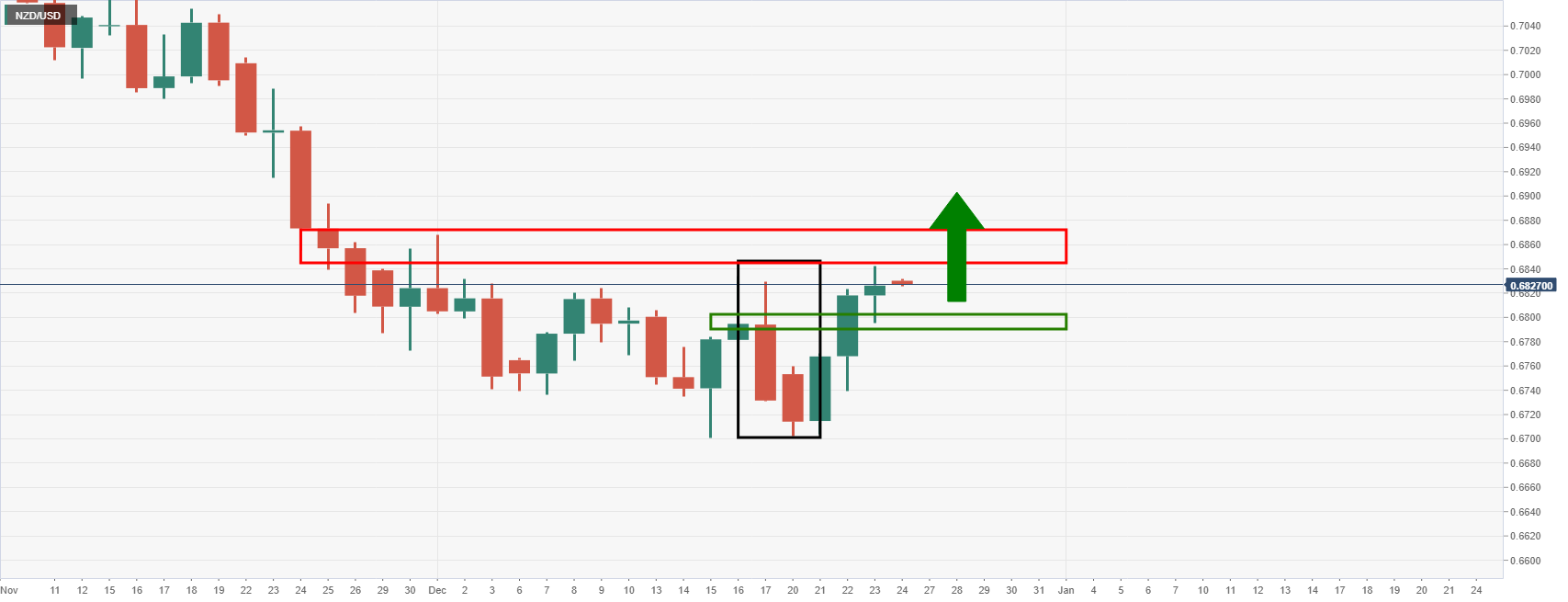
- NZD/USD bulls stepping in to take on daily resistance.
- Risk-on sentiment prevailed into the closing bell on Wall Street.
NZD/USD is holding in positive territory on Thursday with the bulls in charge in the main as we move over to the early Asian session in holiday thin markets. At the time of writing, NZD/USD is trading at 0.6828 and up 0.32% on the day following a rally from 0.6795 and reaching a high of 0.6842.
Risk sentiment has been on solid footing in the remaining days before Christmas, sending the greenback lower and away from the 97 figure, (as per DXY index), territory that was last seen mid-December when the index reached 96.90. The DXY is an index that measures the US dollar vs 6 major currencies. The kiwi is not one of them, but it tends to track the Aussie which has been performing well this week so far.
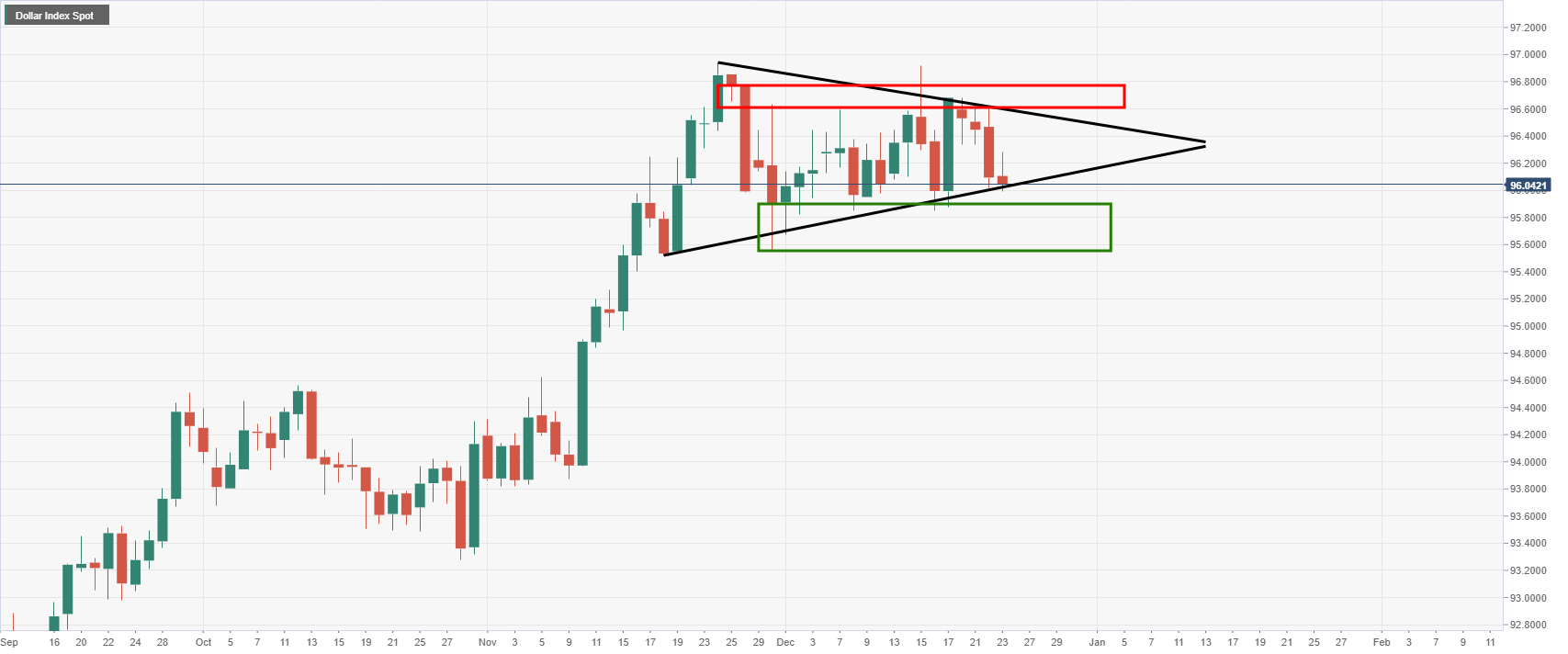
The US dollar, as measured by the DXY index, is losing ground as the day progresses into late trade in North America. The index made a low of 95.99 from a high of 96.277 within the sideways channel/daily wedge formation:
DXY daily chart
The recent covid-variant news has lifted investors' spirits where otherwise, markets have been worried by a combination of virus fears, tighter policy, and a bleak outlook for US fiscal stimulus.
Santa Claus rally plays out
US stocks, fuelled by more drug makers announcing that their COVID-19 preventives retained protection against the omicron variant, were closing all-time closing highs in the S&P 500.
The S&P rose 0.6% to 4,725.78, up 2.3% in the holiday-shortened week marking three straight daily gains reversing losses in three prior sessions. The Nasdaq Composite advanced 0.9% to 15,653.37 and the Dow Jones Industrial Average gained 0.6% to 35,950.63, but those indices remained below record highs set in November.
Meanwhile, the 10-year US Treasury yield rose to 1.50% on the last full day of trade in the bonds and stocks before Xmas Eve, (the bond market was to close at 2 pm ET ahead of a market holiday Friday, while the stock market was slated to remain open until 4 as usual but it seems it will be closed in observation of Xmas day that falls on a Saturday).
NZD/USD technical analysis
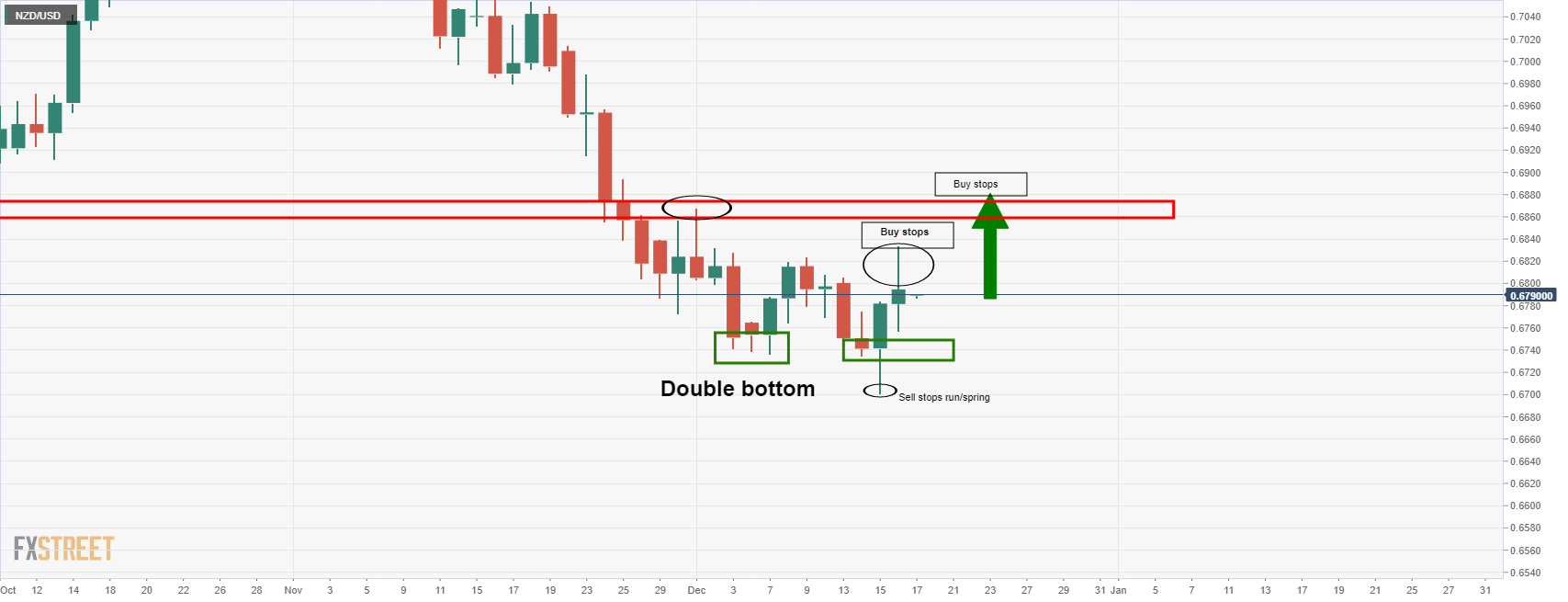
As per the prior analysis above, the daily chart is taking the shape of a Wycoff consolidation. It is yets t be seen if this is accumulation or redistribution, but we have seen further manipulation of the lows as follows:
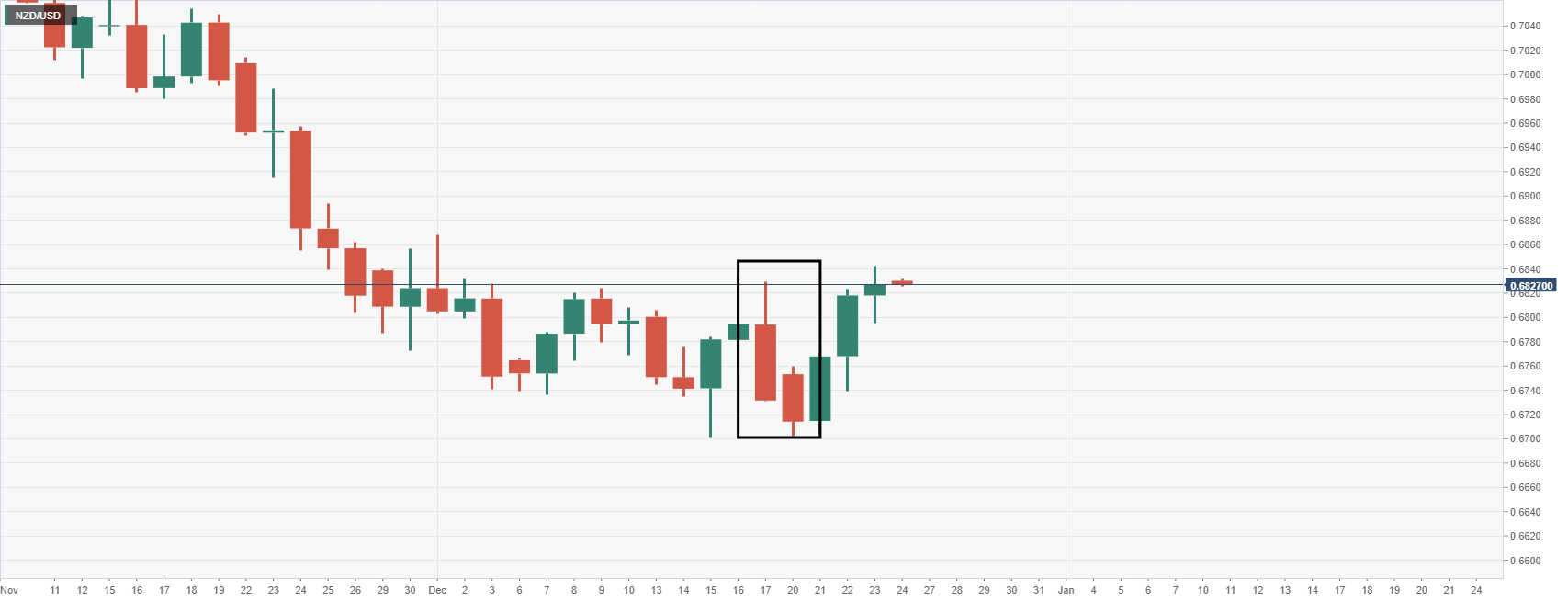
This was followed by three higher closing candles which indicate that there are strong hands on the buy-side and there are expectations of a breakout:
- EUR/JPY printed fresh monthly highs above 129.70 on Thursday, supported by further improvements in broader risk appetite.
- FX market trade is likely to be subdued/low volume over the coming weeks amid year-end holidays.
EUR/JPY hit fresh monthly highs on Thursday, eclipsing the previous highs hit back on 16 December at 129.64 to momentarily trade above 129.70. The 129.60-70 area has been a significant area of resistance going all the way back to 23 November and if EUR/JPY can’t break above it on Thursday, further gains may have to wait until 2022. That’s because FX market trade on Friday will be very quiet/low volume given that it is Christmas Eve and liquidity conditions will be marred next week as well given the proximity to year-end celebrations.
If the 129.60-70 zone was convincingly broken to the upside, that would bring into focus the psychologically important 130.00 level, which happens to also coincide with EUR/JPY’s 50-day moving average. In the context of the more than 200 pip (or roughly 1.7%) rally from weekly lows at 127.50, another 30-40 pips doesn’t seem like too much of an ask, especially amid the backdrop of significantly improved risk appetite as the Omicron newsflow turned more positive.
After last week’s flurry of central bank activity, central bank policy divergence has taken a back seat as an FX market driver this week. But it is notable that a growing throng of ECB policymakers are calling for greater recognition of upside risks to the bank’s inflation forecasts. In 2022, EUR/JPY traders should recognise the upside risks that a hawkish ECB pivot (perhaps towards rate hikes in as little as 12 months and a sooner than anticipated end to QE) presents to EUR/JPY. Japan, by comparison, is not dealing with anything like the levels of inflation being witnessed in the Eurozone and no one expects the BoJ to alter its ultra-dovish monetary stance any time soon.
| Time | Country | Event | Period | Previous value | Forecast |
|---|---|---|---|---|---|
| 05:00 (GMT) | Japan | Construction Orders, y/y | November | 2.1% | |
| 05:00 (GMT) | Japan | Housing Starts, y/y | November | 10.4% | 7.1% |
- EUR/CHF has been trading subdued on Thursday, at one point dipping under 1.0400, but subsequently recovering back above the big figure.
- Over the next few sessions, EUR/CHF will likely stick well within recent 1.0370-1.0470ish ranges amid the end of year holiday lull.
Having found resistance at its 21-day moving average at 1.0422 earlier in the session, EUR/CHF dipped back briefly under the 1.0400 level but in more recent trade, has recovered to just above the big figure. Market participants suspect the SNB has become more active in propping up the pair in recent weeks amid a pick-up in Swiss sight deposits over the last two weeks. That likely rules out any move under recent monthly lows in the 1.0370 area for the time being.
Recent selling pressure is somewhat surprising in light of the drastic improvement in the market’s appetite for risk over the course of the week. Positive updates from the scientific community that Omicron, as hoped, is significantly less likely to cause severe disease versus the delta variant, reducing the pressure on European governments to lockdown as aggressively, has been the main driver of the improvement in risk appetite. But on the week, EUR/CHF is only up about 0.2%.
Still, in light of the eleven weeks straight of negative returns seen between September and the end of November, that saw the pair drop from above 1.0900 to near current levels in around 1.0400, the EUR/CHF bulls should likely be thankful that the selling pressure in December has abated. Over the next couple of sessions, subdued trade that keeps EUR/CHF well within recent 1.0370-1.0470ish ranges is likely to continue amid the end of year holiday lull.
When 2022 kicks off and markets return to normal trading conditions, the big question for EUR/CHF will be whether improvements in global risk appetite as Omicron fears ease and the ECB’s comparatively hawkish stance versus the SNB will be enough to trigger a sustained rebound in the pair. Alternatively, inflation differentials between the Eurozone and Switzerland that continue to erode the purchasing power of the euro faster than the Swiss franc may continue to put downwards pressure on the pair.
- The DXY slides some 0.07% but stays above the 96.00 figure as the New York session winds down.
- Omicron-related positive news improved market mood weakened the greenback.
- US Dollar Index (DXY) Price Forecast: Upward bias, though testing the bottom-trendline of the ascending triangle.
The US Dollar Index (DXY), which measures the greenback’s performance against a basket of six peers, edges lower sone 0.07%, sitting at 96.02 during the New York session at the time of writing. Improvement in the market sentiment, spurred by positive news on the Covid-19 Omicron-related front, increased the appetite for riskier assets to the detriment of the US dollar safe-haven status.
In the last couple of days, the US Food and Drug Administration (FDA) approved Pfizer and Merck Covid-19 treatment pills, which would help the health system treat the disease on high-risk patients at home. Furthermore, a study in South Africa showed that people infected with the Omicron variant would be 80% less susceptible to requiring hospitalization. In the UK, the Health Security Agency reported that 50-70% of people testing positive for the Omicron strain would not need to be hospitalized.
That said, with two countries spreading positive news about the newly predominant Omicron variant, investors worries about possible economic slowdown ease.
In the meantime, the US T-bond 10-year benchmark note raises some three and a half basis points, sitting at 1.494%, closing to the 1.50% threshold.
The US macroeconomic docket featured a large bulk of data. The Fed’s favorite gauge of inflation the Core Personal Consumer Expenditure (PCE), increased some 4.7%, higher than the 4.5% expected, justifying the US central bank’s faster bond-taper decision revealed on its last meeting. In the labor market, Initial Jobless Claims for the week ending on December 17 rose to 205K in line with expectations.
Additionally, consumer confidence increased, with the UoM Consumer Sentiment Index for December at 70.6, higher than the 70.4 foreseen. At the same time, Durable Good Orders for November rose by 2.5%, higher than the 1.6% estimated.
US Dollar Index (DXY) Price Forecast: Technical outlook
The US Dollar Index daily chart depicts the strong dollar narrative keeps in place. The DXY broke below the central Pitchfork’s uptrend channel, which confluences with the ascending triangle on an uptrend.
At the time of writing, the DXY is testing the bottom-trendline of the ascending triangle on an uptrend, threatening to break to the downside, which would invalidate the triangle formation sending the DX tumbling towards November 30, 95.55.
To the upside, the first resistance would be the figure at 97.00. A breach of the latter would expose the June 30 high at 97.80, followed by the ascending triangle target at 98.00.
-637758880559643826.png)
- Gold is holding in positive territory above $1,800 as the USD slides into the red.
- Wall Street positive Xmas vibes are fuelled by data and the risks of covid variants abating.
- The bulls are embarking on an upside extension with $1,830/50 eyed.
Risk sentiment is firm and the US dollar is on the backfoot, giving the yellow metal room to breath above water following the prior day's rally. Investors are betting that the latest COVID variants will not disrupt global development and this has given the bulls on Wall Street the shot in the arm they needed at this time of year.
In turn, this has promoted a bid in gold despite regulators' concerns about the spread of the new variant, Omicron. At the time of writing, gold is trading at $1,809 and is higher by some 0.35% on the day so far after travelling from a low of $1,798.91 to a high of $1,810.74.
Santa Claus rally underway
Looking around elsewhere on Wall Street, US stocks are on pace to close at new record highs, fuelled by more drug makers announcing that their COVID-19 preventives retained protection against the omicron variant. The S&P 500 rose 0.85% to 4737 the highs printed in the last hour of trade. The Nasdaq Composite advanced 0.97% to 16,343, and the Dow Jones Industrial Average gained 0.78% to print a high of 36,051 with still time to go until the close.
Meanwhile, the 10-year US Treasury yield rose to 2.47% on the last full day of trade in the bonds and stocks before Xmas Eve, (the bond market was to close at 2 pm ET ahead of a market holiday Friday, while the stock market was slated to remain open until 4 as usual but it seems it will be closed in observation of Xmas day that falls on a Saturday).
The US dollar, as measured by the DXY index is losing ground as the day progresses into late trade in North America. The index is now down some 0.11% and has moved from a flat position that was otherwise maintained in earlier trade. DXY is currently trading at 96.017 and has breached the figure to score a low of 95.99 from a high of 96.277 within the sideways channel/daily wedge formation:
DXY daily chart
The recent covid-variant news is a breath of fresh air for investors that have otherwise been concerned by a combination of virus fears, tighter policy, and a bleak outlook for US fiscal stimulus.
However, analysts at TD securities warn that ''the yellow metal could begin to lose steam so long as Fed expectations remain as status quo. In this sense, omicron fears and their potential impact on the economy will be a key focus in the near-term, and we would likely need to see economic weakness generate doubts that the Fed will be able to deliver on their hawkish stance for the yellow metal to maintain the recent momentum.''
''Indeed, prices will need to hold north of the $1,800/oz to prevent a hasty liquidation of a portion of the recently acquired length,'' analysts at TDS said.
US data fuelling positive Xmas vibes
Additionally, US data has shown that personal income and spending rose, with Consumer Sentiment improving and Jobless Claims keeping near recent lows.
The US Initial Jobless Claims totalled 205,000 during the week ended Dec. 18, in line with market expectations. Personal Consumption Expenditure Inflation rose 0.6% on a monthly basis in November and 5.7% annually, in line with market forecasts. However, excluding volatile food and energy costs, the measure was up 4.7% year-over-year, the most since 1989 which have helped to keep yield elevated and the US dollar supported.
Meanwhile, personal income rose 0.4% in November versus market expectations for a gain of 0.5%, while spending grew 0.6% in line with estimates. Lastly, the University of Michigan consumer sentiment index was revised up slightly Thursday to a reading of 70.6 for December from the 70.4 preliminary estimates.
Gold technical analysis
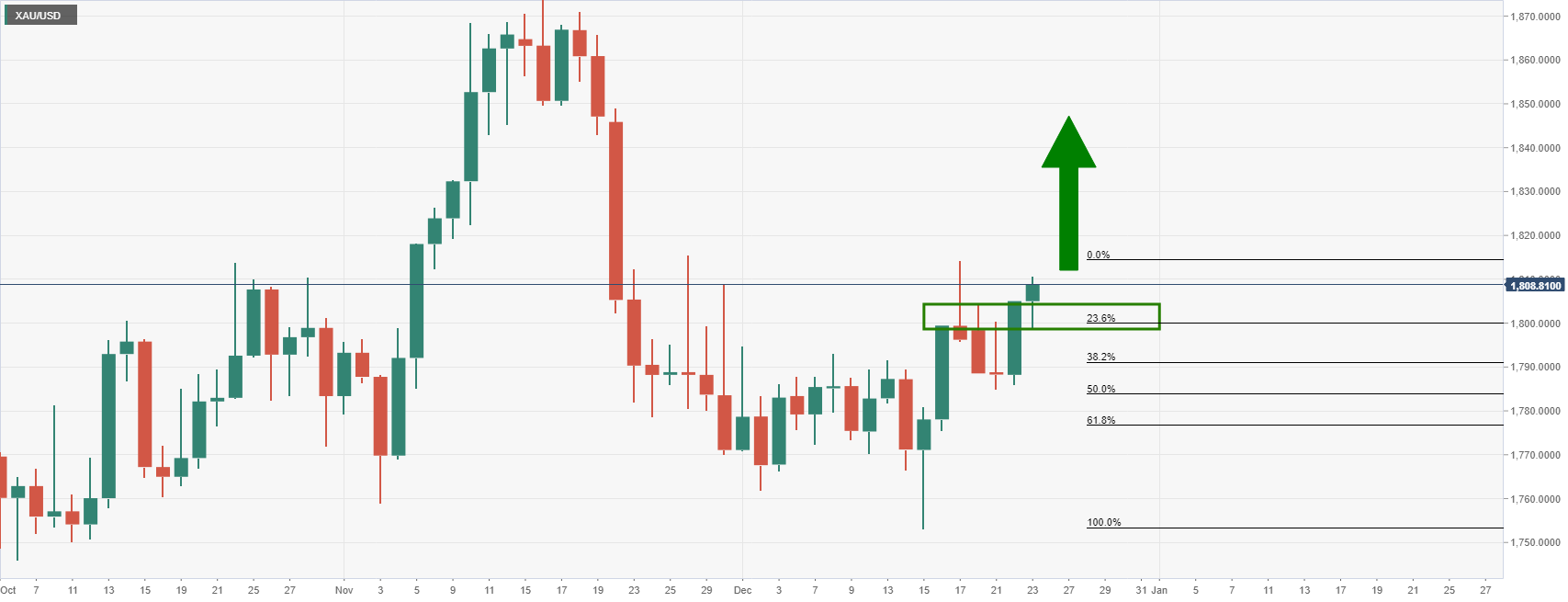
Following the correction to $1,785. The bulls are embarking on an upside extension with $1,830/50 eyed.
What you need to know on Friday, December 24:
The dollar edged lower amid a positive market’s mood with all global indexes posting daily gains. The exception was USD/JPY, as the pair edged higher and settled at 114.45, nearing its yearly high.
US Treasury yields advanced, with the 10-year note currently hovering near its daily high of 1.501%. The advance followed US inflation-related figures, as the core PCE Price Index jumped to 4.7% in November from 4.2% previously and above the 4.5% expected.
Other US macroeconomic figures were also encouraging, as November Durable Goods Orders, which rose 2.5%, beating expectations. Initial Jobless Claims for the week ended December 17 printed at 205K as expected. Also, the December Michigan Consumer Sentiment Index was upwardly revised to 70.6 from 70.4.
In the COVID-19 front, news indicated that the US Food and Drug Administration authorized a second medication, a Merck drug named Molnupiravir, to treat covid at home after clearing the Pfizer poll on Wednesday. However, Merck’s pill is less effective and carries more risks than the Pfizer one. The mood was underpinned by a research conducted in South Africa, which found that it is a milder strain than Delta.
The EUR is among the dollar’s weakest rivals, confined to familiar levels. The pair currently trades around 1.1330, after briefly piercing the 1.1300 level. The GBP/USD pair peaked at 1.3437, a fresh December high, retaining the 1.3400 level at the end of the day. The Pound kept rallying on the back of upbeat UK growth figures released on Wednesday.
Higher stocks backed underpinned commodity-linked currencies. AUD/USD hit 0.7250, while USD/CAD ell to 1.2797, both holding nearby at the end of the day.
Japan will operate normally, although other Asian markets are due to early closes. Most American and European markets will remain closed on Friday amid the Christmas Holiday.
Volatility is expected to remain subdued in the next few days, with chances of sudden short-lived movements in between.
Gold trades near an intraday high of $1,810 a troy ounce, poised to extend gains once beyond the 1,815 resistance. Crude oil prices maintained their positive tone, with WTI posting a modest advance and settling at $73.75 a barrel.
Cardano hidden reversal gives ADA longs early buy opportunity before $2
Like this article? Help us with some feedback by answering this survey:
- WTI hit fresh monthly highs at $73.78 on Thursday, eclipsing the prior monthly highs at $73.30.
- Optimism that the hit to demand from Omicron won’t be as bad as initially feared continues to support prices.
Oil prices hit fresh monthly highs on Thursday, with front-month WTI futures rallying above prior monthly highs at $73.30 to reach $73.78, before backing off slightly to the $73.50 area. At current levels, WTI is up slightly more than 50 cents on the session putting it one course for a third consecutive positive close. If WTI does close out Thursday trade around $73.50, that would mean it has rallied a staggering $7.30 from earlier weekly lows just above $66.00.
As has been well documented at this point, the rally over the past three sessions has been spurred by positive Omicron/pandemic developments, including studies showing the new variant to be less severe and the US FDA approving highly effective Covid-19 treatment pills. The former development, coupled with a slowdown in the acceleration of the transmission rate in parts of Europe including the UK, has taken the pressure off of authorities to implement tougher economic restrictions.
Crude oil-specific factors have also helped; US inventories were revealed to have seen much larger than expected stock drawdowns last week. In other crude oil news that got less attention, the weekly US Baker Hughes rig count was released one day earlier than usual given tomorrow is a US market holiday. Oil and gas rigs rose to their highest level since April 2020 last week, a leading indicator of increased US output in the coming months.
- The white metal extends its rally to three consecutive days, up 3.33% in the week.
- Good news on the Covid-19 Omicron variant narrative, increased demand for riskier assets.
- XAG/USD Price Forecast: In the near term, XAG/USD is upward, but it will need to break above $23,00 to open the door for further gains.
Silver (XAG/USD) has continued rallying in the last three days, climbing some 0.31%, trading at $22.89 during the New York session at the time of writing. A risk-on market mood prevails in the financial markets, as positive Covid-19 related news has crossed the wires in the last couple of days.
Summarizing the aforementioned, South Africa reported in a study that people infected with the Covid-19 Omicron strain are 80% less susceptible to being hospitalized. Furthermore, the US Food and Drug Administration (FDA) approved Pfizer and Merck Covid-19 treatment pills, which would help the health system treat the disease on high-risk patients at home. That said, market participants, scramble towards riskier assets as the Santa Rally continues.
In the meantime, the US T-bond 10-year benchmark note raises some three and a half basis points, sitting at 1.494%, closing to the 1.50% threshold, though failing to underpin the greenback, as the non-yielding metal appreciates some 0.57%, versus the buck.
The US macroeconomic docket featured a large bulk of data before Christmas. Durable Good Orders for November rose by 2.5%, higher than the 1.6% estimated. The Fed’s favorite gauge of inflation, the Core Personal Consumer Expenditure (PCE), increased some 4.7%, higher than the 4.5% expected, sounding the bells on the Fed and justifying the increase of QE’s speed reduction.
At the same time, Initial Jobless Claims for the week ending on December 17 rose to 205K in line with expectations, showing some consolidation in the labor market. Furthermore, at press time, the University of Michigan revealed its Consumer Sentiment Index for December, which came at 70.6 higher than the 70.4 estimated.
XAG/USD Price Forecast: Technical outlook
Silver (XAG/USD) daily chart shows that the white metal has a downward bias, confirmed by the daily moving averages (DMAs) located well above the spot price. Nevertheless, the short-term price action, after reaching a YTD low around the $21.50s, XAG/USD is closing to the $23.00 figure, as the Relative Strength Index (RSI) broke above the 50-midline, triggering a bullish signal.
To the upside, XAG/USD resistance levels would be the psychological $23.00 figure. A decisive break of that level would expose the 100 and the 50-DMAs at $23.39 and $23.50, respectively.
On the flip side, silver first support would be December’s 22 daily low at $22.40, followed by the December 21 cycle low at 22.18, and the $22.00 figure.
-637758828720451408.png)
- USD/CAD falls to fresh daily lows on the positive sentiment in markets.
- The covid-19 variants are now hoped to be less severe than first anticipated.
The commodity complex is bid on the day and oil prices are higher which is a supporting factor for the Canadian dollar. At the time of writing, USD/CAD is down some 0.2% and hovers around 1.128 the figure. The pair fell to a low of 1.2797 from a high of 1.2853 on the day for far.
Risk sentiment is solid as investors are betting that the latest COVID type will not disrupt global development. This in turn has promoted a bid in oil despite regulators' concerns about its spread. In recent news, a trio of studies suggested that Omicron may be less likely to land people in the hospital than Delta. Additionally, antiviral medicines and booster shots are becoming more widely available.
All in all, this is a positive backdrop for the markets and the Santa Claus rally is starting to take shape on Wall Street. It is a breath of fresh air for investors that have otherwise been concerned by a combination of virus fears, tighter policy, and a bleak outlook for US fiscal stimulus.
Consequently, US stocks are on pace to close at new record highs, fuelled more drug makers announcing that their COVID-19 preventives retained protection against the omicron variant. Additionally, US data has shown that personal income and spending rose, with Consumer Sentiment improving and Jobless Claims keeping near recent lows.
The S&P 500 rose 0.7% to 4733 the highs. The Nasdaq Composite advanced 0.9% to 16,339, and the Dow Jones Industrial Average gained 0.65% to print a high of 36,006 with still time to go until the close and last full day of trade in the bonds before Xmas Eve, (the bond market was to close at 2 pm ET ahead of a market holiday Friday, while the stock market was slated to remain open until 4 as usual).
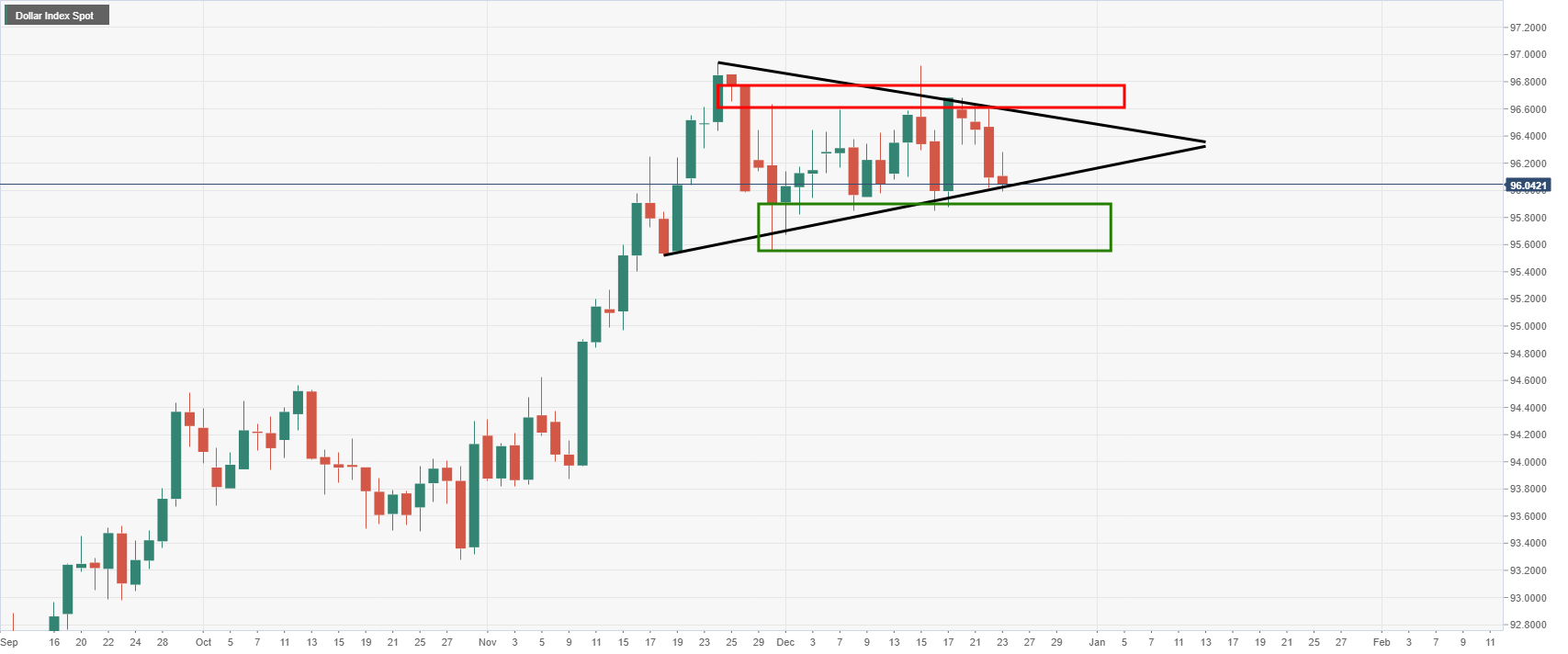
Meanwhile, the 10-year US Treasury yield rose to 2.47%. DXY is around flat on the day but remains under pressure within the sideways channel/daily wedge formation:
DXY daily chart
In news on Thursday, AstraZeneca (ANZ) said its Evusheld preventive antibody retained its neutralizing activity against the omicron variant in clinical trials conducted by Oxford University in the UK and the University of Washington in the US.
US data keeps the bid going on wall Street
As for the data, the US Initial Jobless Claims totalled 205,000 during the week ended Dec. 18, in line with market expectations. Personal Consumption Expenditure Inflation rose 0.6% on a monthly basis in November and 5.7% annually, in line with market forecasts. However, excluding volatile food and energy costs, the measure was up 4.7% year-over-year, the most since 1989 which have helped to keep yield elevated and the US dollar supported.
Meanwhile, personal income rose 0.4% in November versus market expectations for a gain of 0.5%, while spending grew 0.6% in line with estimates. Lastly, the University of Michigan consumer sentiment index was revised up slightly Thursday to a reading of 70.6 for December from the 70.4 preliminary estimates.
- GBP/JPY recovered back to its pre-Omicron levels on Thursday, surging from around 152.50.
- That marks a more than 2.5% recovery from earlier weekly lows under 150.00.
GBP/JPY impressive turnaround from earlier weekly lows under the psychologically important 150.00 level kicked up a gear on Thursday, with the pair bursting above the key 152.50 balance area early during European trade to advance as high as the 153.50 area. On the day, that translates into gains of about 0.8%, meaning the pair is now up roughly 2.0% on the week and more than 2.5% versus Monday’s lows.
The pickup in volatility is surprising from a seasonal standpoint – typically in the last few weeks of December, volumes and volatility are lower than usual due to the Christmas and New Year’s holidays in Europe, the Americans and elsewhere. But given the backdrop of the Omicron wave currently engulfing the world, the volatility is not so surprising. From that perspective, Thursday’s move high is significant in that it saw GBP/JPY recover back to its pre-Omicron levels (in the mid-153.00s). The stunning recovery of the past three sessions is a reflection of positive Omicron developments including 1) numerous studies showing it to be significantly milder than the delta variant and 2) momentum swinging against the imposition of lockdown measures in the UK.
The fact that (at the moment) it looks unlikely that the UK government will implement tougher restrictions in England reduces economic uncertainty and perhaps allows markets to become a little more confident that the BoE will deliver further successive rate hikes in 2022. In other words, now that Omicron uncertainty in the UK is lessening, it seems as though GBP is finally benefitting from the recent hawkish pivot from the BoE. Recall that, last week, GBP was unable to sustain its post-surprise BoE rate hike gains.
- EUR/USD has fended off an earlier test of the 1.1300 level and is back to trading in the 1.1330s.
- The pair is eyeing a test of weekly highs just above 1.1340, though trade on Friday will be subdued.
It’s been a choppier session than some might have expected on the eve of Christmas eve. Having dipped to sub-1.1300 levels at one point earlier on during US trading hours, EUR/USD has now recovered back to the 1.1330s and is eyeing a test of weekly highs just to the north of 1.1340. The drop under 1.1300 was likely spurred by the release of a batch of broadly strong US data at 1330GMT.
To recap quickly; the November Core PCE report was hotter than expected at 4.7%, Durable Goods Orders saw solid MoM growth November and Personal Income and Spending both saw healthy MoM gains (though were slightly negative when adjusted for inflation). Meanwhile, the latest weekly jobless claims report showed initial claims remaining close to 200K, a level consistent with full employment. Thursday’s strong data came on the back of a stronger than expected Consumer Confidence release for December on Wednesday.
At current levels, the EUR/USD trades broadly flat on the day and conditions are likely to be subdued on Friday given expectations for very low market volumes and a complete lack of any notable data releases. But FX strategists are warning that this week’s dollar weakness, which saw EUR/USD rally above 1.1300 from earlier lows under 1.1250, may ultimately prove short-lived. The Fed’s hawkish pivot in December has opened the door for a potential rate hike in March, which leaves the Fed on course to outpace the ECB when it comes to monetary normalisation by a significant margin.
This means the dollar could well resume its gradual upwards march during Q1 2022. That would be bad news for EUR/USD bulls. In the meantime and until the end of 2022, a break out of recent 1.1240-1.1360ish ranges for the pair seems unlikely. If EUR/USD can push above recent monthly highs (a few other G10/USD pairs have managed it in recent days), then a test of 1.1400 would be on the cards. But it will be difficult for the pair to sustain any such rallies, given the above.
- The Swiss franc appreciates some 0.15% vs. the greenback, despite the risk-on mood in the markets.
- Covid-19 positive news flowing through wires, maintain the Santa Rally alive, to the detriment of the safe-haven status of the greenback.
- USD/CHF Price Forecast: Upward move stalled at the 50 and the 100-DMA intersection, bears eye the 200-DMA.
The USD/CHF fall continues for the second consecutive day, trading at 0.9177 during the New York session at the time of writing. The Santa Rally arrived, as shown by US equities gaining between 0.69% and 0.85%, as market mood improved. Since Wednesday, investors’ confidence rose when South Africa reported that people infected with the Omicron variant are 80% less likely to be hospitalized. Additionally, the US Food and Drug Administration (FDA) approved Covid-19 emergency treatments to Pfizer and Merck in the last two days, spurring another leg up in stocks.
Risk-sensitive currencies are the day’s gainers in the FX market, led by GBP, the AUD, and the NZD, while the laggards are the greenback and the JPY.
In the meantime, the US Dollar Index, which tracks the greenback’s performance against a basket of six rivals, falls 0.05%, down to 96.03.
USD/CHF Price Forecast: Technical outlook
The USD/CHF stills range-bound, even though it broke below the confluence of the 50 and the 100-day moving averages (DMAs) but so far has been unable to break below the 200-DMA at 0.9175.
On the downside, if the USD/CHF extends its declines, the first support would be the 200-DMA at 0.9176. the breach of the latter would expose the November 30 daily low at 0.9157, followed by a test of the 0.9100 figure.
To the upside, the USD/CHF first resistance would be 0.9200. A decisive break above that level could pave the way for further upside. The next resistance would be 0.9250, followed by the December 15 swing high at 0.9294 and the 0.9300 figure.
-637758797584560903.png)
- GBP/USD is meeting a weekly area of resistance.
- The bears are engaging as seen on the lower term time frames.
GBP/USD has rallied into a weekly order block from where some meanwhile consolidation would be expected to unfold in the coming sessions. The following illustrates the W-formation that has been left on the weekly chart which is a reversion pattern. The neckline of the W-formation would be expected to be retested.
GBP/USD weekly chart
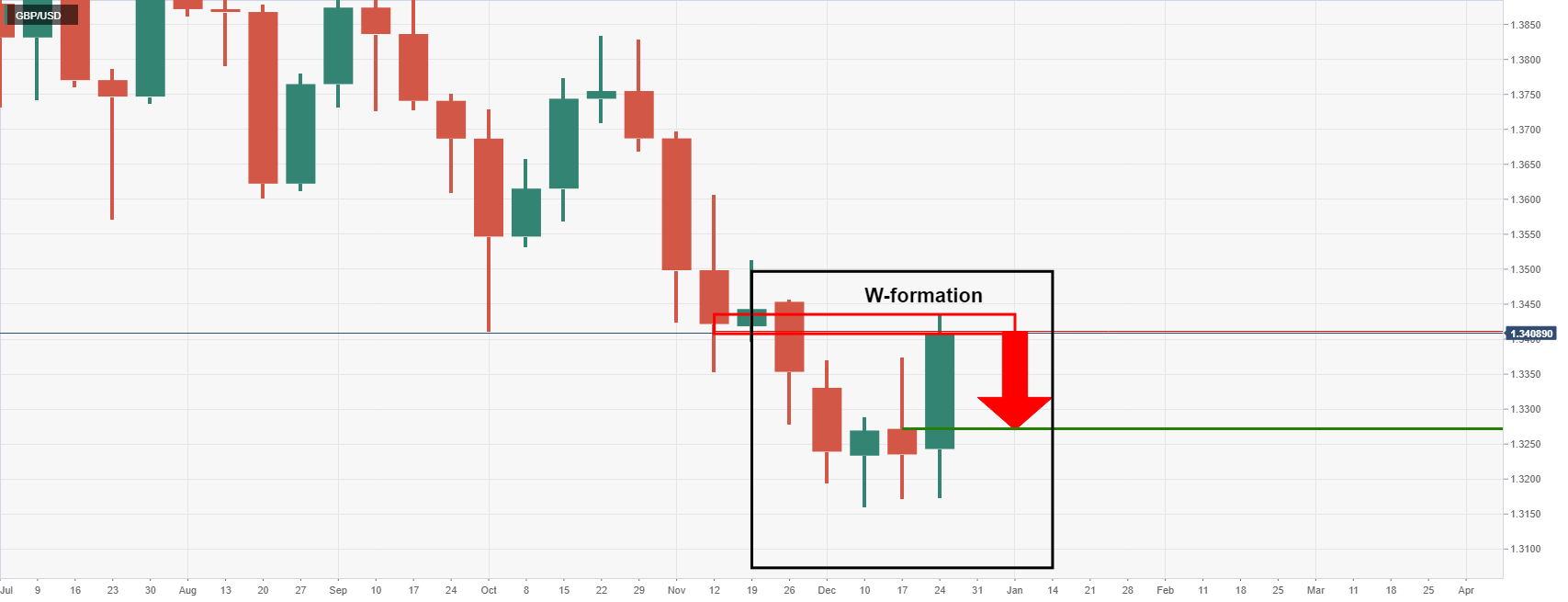
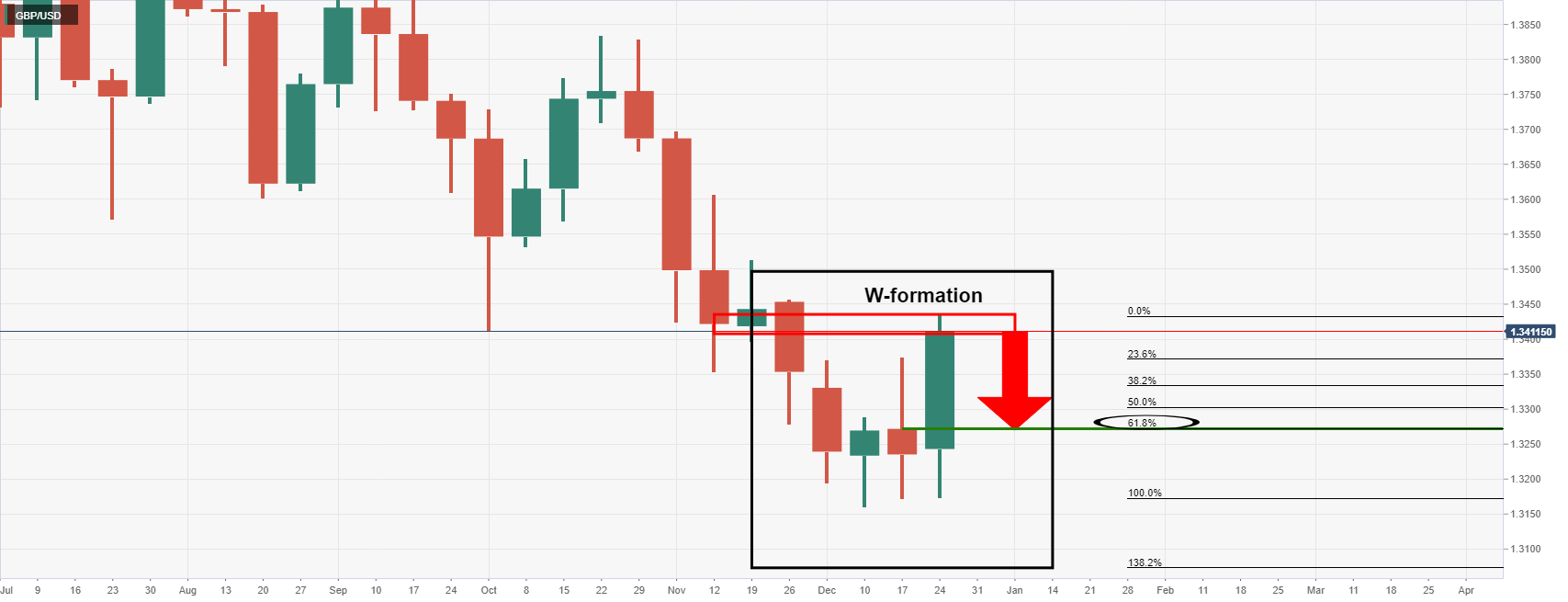
Drawing the Fibonaccis and measuring the bullish impulse, the 61.8% Fibo aligns with the neckline which offers a confluence for which traders will note:
GBP/USD daily chart
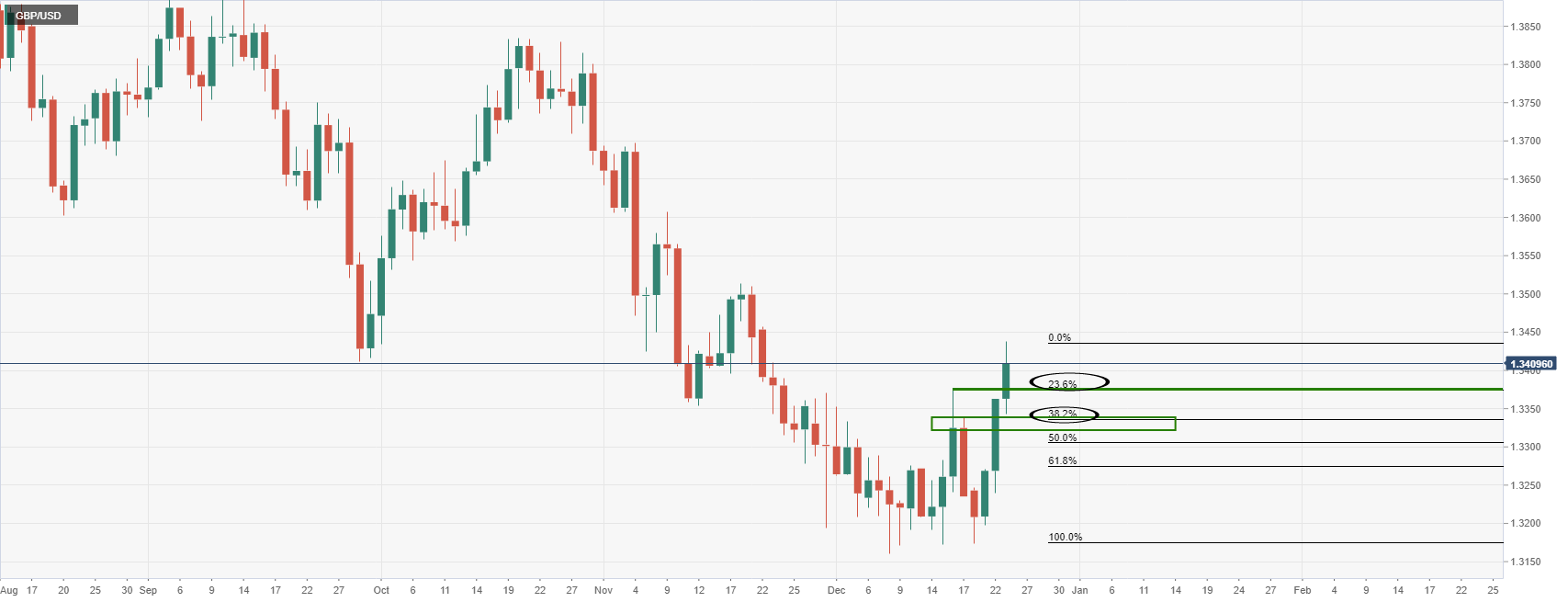
The price on the daily chart, however, provides a structure that would be expected to act as support higher up the Fibo scale. For instance, there is a bullish spike, the true top of the W-formation's neckline, located at 1.3375. This aligns with the 23.6% Fibo. Lower, the next level of resistance 1.3320/35 aligns near to the 38.2% Fibo and structure, as illustrated above.
GBP/USD H1 chart
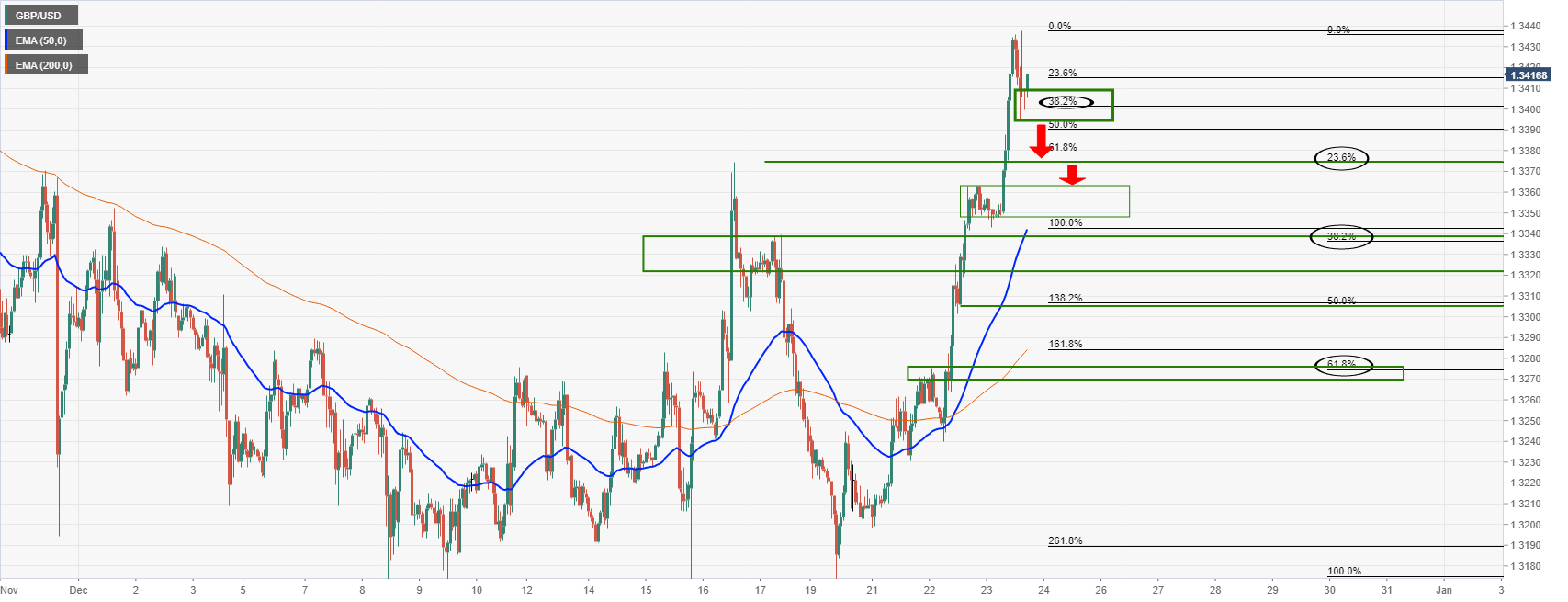
The hourly chart is full of various structures on the downside. In regular market conditions, these areas would be expected to act as support on the way to a test of the 50-EMA or on towards the 200-EMA, both of which align with the weekly chart's W-formation's structure and the daily chart's supports.
- The US dollar advances 0.59% in the week vs. the Japanese yen.
- Higher US T-bond yields rise three basis points to close to 1.50%.
- USD/JPY Price Forecast: It has an upward bias, though accelerating the trend would need a break above 114.70.
The US dollar extends its rally against the Japanese yen, advancing for the third consecutive day, trading at 114.36 during the New York session at press time. Positive news on the Covid-19 Omicron-variant front is cheered by investors as the Santa Rally finally kicked in. European equity indices rise between 0.93% and 1.42%, while US stock indices advance between 0.62% and 0.70%.
The US Food and Drug Administration (FDA) has authorized Covid-19 treatments in the last two days. On Wednesday, it approved Pfizer’s Plaxovid, treatment for high-risk patients. By Thursday, Molnupravir, a treatment pill developed by Merck, received the green light from the FDA. Both treatments would help to curb rising infections from overwhelming hospitals.
US T-bond yields rallied on the news, with the 10-year US Treasury yield rising three basis points, closing at 1.50%, and underpining the USD/JPY. In the meantime, the US Dollar Index, which tracks the buck’s performance against a basket of six rivals, is barely up 0.03%, at 96.10.
USD/JPY Price Forecast: Technical outlook
The USD/JPY daily chart depicts the pair has having an upside bias, supported by the daily moving averages (DMAs) residing below the spot price. Additionally, an upslope trendline drawn from the September swing lows towards the late November lows stalled sell-offs moves three times.
To the upside, the USD/JPY's first line of resistance would be the October 20 cycle high at 114.70. A breach of the latter could pave the way for further USD/JPY gains. The next resistance would be the psychological 115.00 figure, followed by the November 24 cycle high and YTD high at 115.52.
On the flip side, the USD/JPY's first demand zone would be the 50-DMA at 113.87. A break beneath that support would open the door for a test of the upsloping trendline around the 113.60-75 range, followed by the December 17 pivot low at 113.14.
-637758749278709639.png)
Regarding the Federal Reserve, analysts at Wells Fargo, in line with market consensus see a cumulative 125 bps of rate hikes during 2022 and 2023. They expect an initial 25 bps rate hike during the third quarter and a cumulative 125 bps of rate hikes being completed by the third quarter of 2023.
Key Quotes:
“The Federal Reserve has become increasing concerned about persistently high inflation pressures and, as a result, has initiated and accelerated the tapering of its bond purchases, as well as accelerating its rate hike intentions. For the December month, the Fed's overall bond purchases will amount to $90 billion. Consistent with its December announcement, we forecast the Federal Reserve will lower its bond purchases by $30 billion in each of January, February and March next year, bringing its quantitative easing to end by March 2022. In addition, we expect the Federal Reserve to begin raising interest rates by the second half of 2022, and we forecast a cumulative 125 bps of rate increase, in increments of 25 bps per quarter, starting in Q3-2022 through until Q3-2023.”
“The outlook for a steady, and quite timely, removal of monetary policy accommodation stems from ongoing above-trend GDP growth and continued improvement in the labor market. For U.S. GDP, we see growth of 5.7% in 2021, 4.4% in 2022, and 3.0% in 2023—though even that 2023 forecast is above the potential growth rate of the economy.”
“We expect PCE inflation and core PCE inflation—the Fed's preferred measured—to remain at or above the Fed's 2% target right up until late 2023. The combination of above-trend growth and above-target inflation underlies our outlook for the steady removal of monetary policy accommodation.”
Data released on Thursday showed GDP rose in Canada 0.8% in October. Analysts at RBC Capital Markets expect the Canadian economy to grow at a 6.5% rate during the fourth quarter.
Key Quotes:
“GDP in Canada rose 0.8% in October as supply chain disruptions eased, at least temporarily. Motor vehicle and parts manufacturing jumped 19% after falling sharply in September, but was still almost a quarter below levels in October a year ago with the global chip shortage restraining output.”
“Preliminary estimate that output grew another 0.3% in November, despite significant disruptions from flooding in BC.”
“The impact of the new Omicron variant on the economic outlook remains highly uncertain. The re-imposition of some restrictions to hospitality and travel industries will limit growth in the near-term. And health-related concerns might dampen services demand. But how long these restrictions last and how stringent they become are difficult to predict. Still, high rates of vaccination, extended government benefits and accelerated booster rollouts are all expected to help curb the threat. We continue to expect downward but at this time limited impact to our Q4 GDP growth tracking of 6.5%.”
- AUD/USD has run out of momentum at resistance in the 0.7250s but continues to trade higher on the day.
- Indeed, the risk-on market tone this week has powered the pair to a gain of more than 1.5%.
Since rebounding from the 0.7200 level during Asia Pacific trade, AUD/USD has advanced, though in recent hours, has been going sideways in the 0.7230s area, after running into resistance ahead of the 0.7250 mark. At current levels, the pair trades higher by about 0.3% on the session, taking its on-the-week gains to about 1.6%. That’s an impressive move higher given that the final week before Christmas is typically characterised by low volumes and volatility.
A pick-up in optimism that the Omicron variant won’t derail the global economic recovery amid indications it is significantly milder than Delta and the approval of two new pills in the US for at-home Covid-19 infection treatment have been the main factors driving risk appetite and helping to drive the Aussie higher this week. Iron ore prices have also been rising in China (a major Australian export) in recent weeks as Chinese authorities take steps to support the slowing economy there, which should support Australia's balance of payments going forward.
But many FX strategists and analysts suspect that the weakness seen in the US dollar this week (mostly due to risk-on) is set to be short-lived. According to analysts at MUFG, “while the recent improvement in risk sentiment on the back of reduced Omicron fears is currently weighing on the U.S. dollar, we expect the correction lower to prove shortlived”. “Hawkish comments from Fed officials over the past week including from Fed Governor Waller and San Francisco Fed President Daly have signalled that they are considering raising rates as soon as the March FOMC meeting” the bank noted.
Thursday’s hotter than expected November Core PCE inflation numbers, coupled with strong weekly jobless claims data (which shows how tight the labour market is), strong November Durable Goods Orders and strong December Consumer Confidence all point to a US economy with excellent underlying momentum. The fact that the DXY, though lower on the week, continues to trade comfortably within its December ranges and remains on course for substantial on-the-year gains of nearly 7.0% suggests that, from a technical perspective, long-term bullish momentum remains solid. In the absence of a hawkish pivot from the RBA, Fed hawkishness amid a hot economy could see AUD/USD slip back towards December lows in the 0.7000 next January.
- Emerging market currencies gain ground amid risk appetite.
- USD/MXN points further to the downside, particularly under 20.65.
- Data shows no surprises in the US and Mexico's highest inflation in decades.
The USD/MXN is trading around 20.65, at the lowest level in a month. A weaker greenback across the board and the risk-on tone across financial markets are supporting the Mexican peso.
The pair is testing levels under 20.70 and is on its way to the lowest close since November 27. A consolidation below 20.65 would point to more losses with the next strong support at 20.45/50. A recovery above 20.70 should alleviate the bearish tone, while on above 20.90, the US dollar could strengthen.
Data from Mexico and US
In the US, many economic reports were released. Personal spending rose 0.6% in November, in line with market consensus while the core PCE advanced to an annual rate of 4.7% above the 4.5% expected. The Labor Department reported Initial Jobless Claims came in at 205K, unchanged from the week before. The November Durable Goods Orders' preliminary reading showed a larger-than-expected gain of 2.5%. The University of Michigan’s December reading of Consumer Sentiment (final) came in at 70.6. New Home Sales soared 12.4% in November, recovering from a 8.4% decline in October.
The key number in Mexico was positive as the mid-December Consumer Price Index showed a lower-than-expected reading at 7.45% (annual), below the 7.70% of market consensus but still the highest in twenty years. The higher inflation pushed the Bank of Mexico to hike rates by 50bps last week.
“Next policy meeting is February 10 and another 50 bp hike to 6.0% seems likely if price pressures remain high. Swaps market sees the policy rate peaking at 7.50% by the end-2022 before falling slightly in 2023. This may understate Banxico’s need to tighten”, mentioned analysts at Brown Brother Harriman.
Technical levels
- The S&P 500 is up another 0.6% and now more than 4.0% up from Monday lows.
- The index was given a further boost as the FDA approved Merck’s Covid-19 treatment pill.
Just before the open of US equity market trade, the US Food and Drug Administration announced that it had approved a second Covid-19 treatment pill for at-home use. Early trials suggest that Merck’s molnupiravir could reduce mortality and hospitalisation rates in at-home patients by as much as 50%. The news comes after the FDA announced on Wednesday that they had approved Pfizer’s paxlovid pill, which early trails showed to have a superior up to 90% efficacy in preventing hospitalisation and death in at-risk patients.
Just as the news of the Pfizer approval helped stoke risk appetite on Wednesday, the announcement prior to the equity open was likely contributed to the S&P 500’s post-open surge. The index, which had moved a tad higher in pre-market trade (according to index futures) and managed to reclaim the 4700 level, opened at 4706 but has since surged into the 4720s. That means the index is up 0.6% on Wednesday’s close in the 4690s and trades just 0.4% below intraday highs printed back on 22 November in the 4740s.
The Nasdaq 100 index is up about 0.5% and the Dow is up about 0.6%, showing that the gains in equity markets are broad-based. The S&P 500 CBOE volatility index (or VIX) fell another half a point and trades at monthly lows close to 18.00. Alongside the news of the recent approval of two at-home Covid-19 treatment pills, risk appetite in US equities has been boosted in recent days by the release of three separate studies (from South Africa, Scotland and London) which all showed Omicron to be significantly milder than Delta.
The news has eased pressure on European authorities to lockdown their economies in order to curb transmission. The S&P 500 index is now more than 4.0% up versus Monday’s lows in the 4530s. If the S&P 500 closes at current levels, that would mark a record closing high just in time for Christmas – bear in mind that US equity markets are shut on Friday. After a bumpy, volatile December, where the S&P 500 index was at one point as much as 5.0% below recent record highs, the “Santa Rally” has finally arrived to save the day.
- Gold advances some 0.03% during the New York session, despite US T-bond yields rise.
- The 10-year benchmark note meanders around the 1.50% threshold.
- XAU/USD Price Forecast: In the near term, it is neutral-bullish, though it will need a decisive break above $1814 to extend its gains.
As the New York session begins, gold (XAU/USD) advances some 0.03%, trading at $1,805.65 at the time of writing. Global equity markets continue advancing during the week, as shown by the MSCI Asia Pacific Index up 0.9%, while European equities gain between 0.26% and 3.06%. Increased optimism over the Omicron Covid-19 variant spurred an appetite for riskier assets as the year-end approached. At the same time, the yellow metal finally broke above the $1,800 figure for the second time in the week.
In the US Treasuries complex, US T-bond yields are rising four basis points, with the 10-year Treasury yield at 1.499%, falling to weigh on the precious metal, with which it has a strong inverse correlation.
Macroeconomic data-wise, US Durable Good Orders rose by 2.5%, more than the 1.6% foreseen on a monthly basis. Meanwhile, the Fed’s favorite gauge of inflation, the Core Personal Consumer Expenditure (PCE), increased by 4.7%, higher than the 4.5%, justifying the Fed’s faster bond taper while opening the door for higher rates sooner than later.
At the same time, Initial Jobless Claims for the week ending on December 17 rose to 205K in line with expectations, showing some consolidation in the labor market. Furthermore, at press time, the University of Michigan revealed its Consumer Sentiment Index for December, which came at 70.6 higher than the 70.4 estimated.
XAU/USD Price Forecast: Technical outlook
The XAU/USD daily chart depicts that the yellow metal has a neutral-bullish bias in the near term, as the spot price is above the daily moving averages (DMAs), which are “flat” almost horizontal, acting as support levels. Furthermore, the break of a downslope trendline, drawn from mid-November to December 17 swing high, is being tested, that once broke, could pave the way for further gains.
To the upside, the XAU/USD first resistance would be the December 17 cycle high at $1,814. A breach of the latter would expose the September 3 cycle high at $1,834, followed by November’s 22 high at $1,849.
On the flip side, gold’s first support would be the 50-DMA at $1,799.50. A break beneath that level would expose the 200-DMA at $1,791, followed by the 100-DMA at $1,788.
-637758698100063281.png)
- EUR/JPY breaking range, looks to test 129.50 and 129.70/80.
- Slide back under 129.00 should alleviate the bullish pressure.
The EUR/JPY is rising for the fourth consecutive day on Thursday and is testing the 129.50 area. Technical indicators still point to the upside, favoring more gains ahead. Still, the euro needs to break and hold above 129.50 in order to open the doors to more gains.
On the upside, the next resistance stands at 129.70/80 (100-day simple moving average) followed by 130.10. The 20-day moving average is turning to the upside, supporting the euro.
The strong bullish tone will ease if EUR/JPY drops under 129.00 in the short term. The next support stands at 128.50, followed by 128.30 (20-day SMA). A slide below should negate the positive tone, exposing the next support at 127.85.
The rebound from 127.50 continues and is becoming a potential double bottom that could anticipate strength ahead. With the neckline at 129.00, the target of the pattern is 130.50.
EUR/JPY daily chart
-637758695257094558.png)
NZD/USD has rebounded strongly from support at 0.6703/6697. As analysts at Credit Suisse note, 0.6835/38 needs to cap into the close to avoid a base and to keep the risks directly lower.
Broader risks still seen lower
“With medium-term momentum still negative and the market holding well below falling medium-term moving averages, we still identify the market as in a clear downtrend and expect the 0.6823/38 resistances to cap for an eventual break below 0.6703/6697, which would open up a move to our core objective at 0.6511/6467.”
“A closing break above 0.6823/38 would signal a potentially important low and trigger an intraday base, particularly as it is occurring on the back of another hold above 0.6703/6697, with next resistance at 0.6869/72, then 0.6895/6900.”
The encouraging news about the severity of the new Omicron strain has been partly offset in Europe by the further spike higher in energy prices over the holiday period. Furthermore, the sour relationship between the West and Russia adds downside risks for European currencies, as reported by economists at MUFG Bank.
Natural gas prices continue to surge higher in Europe
“Recent price action has reinforced our view that the energy price shock will hit the European economies harder than the US and further boosts the relative appeal of the US dollar heading into early next year.”
“The upward pressure on European gas prices reflects in part the risk of disruption to supplies from Russia in response to risk of another invasion of the Ukraine.”
“It was reported yesterday by Reuters that the US is mulling imposing strict export controls on Russia which resemble Iran sanctions should they invade the Ukraine. It remains to be seen whether the risk of more severe sanctions proves sufficient to discourage Russia. The developments continue to pose downside risks for the rouble and other European currencies relative to the US dollar in the near-term.”
- New Home Sales surged 12.4% in November after October's 8.4% drop.
- The US dollar did not seem to react to the latest US data.
Following a hefty 8.4% decline (which was downwardly revised from a 0.4% gain) in sales in October, New Home Sales in the US surged by 12.4% in November, data published by the US Commerce Department showed on Wednesday.
Given the hefty downwards revision to the October figure and despite the solid 12.4% surge in sales in November, instead of rising to 770K, the number of New Home Sales over the past 12 months rose to just 744K in November. The number of New Home Sales over the past 12 months in October was revised lower to 662K from 745K.
Market Reaction
The dollar did not seem to react to the latest US data.
- The UoM's final Consumer Sentiment index rose to 70.6 in December from the 70.4 flash reading.
- The US dollar did not seem to react to the latest US data.
The University of Michigan's (UoM) final estimate of the Consumer Sentiment Index came in at 70.6 in December, slightly above the flash estimate of 70.4 released earlier in the month, and above November's reading of 67.4, which was the weakest reading since 2011 at the time.
The Current Conditions Index rose to 74.2, lower than the flash estimate of 74.6 but higher than last month's 73.6, while the Consumer Expectations Index rose to 68.3 from the flash estimate of 67.8, above last month's 63.5.
Market Reaction
The dollar did not seem to react to the latest US data.
USD/CAD has seen an initial rejection from the major band of resistance at 1.2950/3030. However, 1.2781/63 is expected to floor the market, according to the Credit Suisse analyst team.
Upside bias while above 1.2781/63
“USD/CAD has seen an initial rejection from very important medium-term resistance levels at 1.2950/1.3030. However, whilst the market holds above 1.2781/63, we lean towards a breakout above this zone, given that medium-term momentum remains firmly bullish and given that medium-term moving averages are all now rising.”
“Above 1.3030 would confirm that the medium-term risks are turning higher, with the next notable resistance at 1.3172 and eventually 1.3337 if a breakout is confirmed.”
“Near-term support stays at 1.2781/63, which we now look to hold to maintain the upward pressure. In contrast, a closing break below 1.2614/08 would turn the risks back lower within the range, however, this is not our base case.”
The S&P 500 extends its strong recovery. If the index breaks above 4744/50, analysts at Credit Suisse would look for a substantial rise 4970/75.
Price action looks like a bullish “triangle” continuation pattern
“The close above the top of the price gap from Monday morning at 4667/69 adds weight to the view we are seeing the formation of a potential bullish ‘triangle’ continuation pattern. We thus look for a test of the top of the range at 4728/32, beyond which is needed to suggest the consolidation phase is in the process of being resolved higher, for a test of the 4744/50 highs.”
“Beyond the 4744/50 highs should reinforce the ‘triangle’ and break higher with resistance seen next at 4768 ahead of 4782 and then 4800. Big picture, the ‘measured triangle objective’ (if confirmed) would be seen at 4970/75.”
“Support is seen at 4672 initially, with 4649/46 now ideally holding to keep the immediate risk higher. A break can see a fall back to key gap and 63-day average support at 4587/68.”
- GBP/USD has pulled back from monthly highs near 1.3440 printed earlier in the session and is trading around 1.3400.
- Strong US data has weighed on the pair recently after UK Omicron news earlier in the session supported sterling.
GBP/USD has pulled back a little in recent trade from earlier session highs close to 1.3440 and recently dipped back under the 1.3400 level. A raft of strong US data releases, including a hotter than expected November Core PCE report, a stronger than expected November Durable Goods Orders report and a solid weekly initial jobless claims number seem to have injected some strength into the buck, weighing on cable. But the pair still trades with gains of about 0.4% on the day and is still up about 1.7% from earlier weekly lows around 1.3170.
Sterling rallied shortly before Thursday’s European open after a broadly flat Asia Pacific session on the news that the UK was unlikely to implement tougher Covid-19 curbs after Christmas, as had been hinted at earlier in the week. It appears that following the recent string of positive Omicron studies released mid-week that showed the variant to be significantly milder than the Delta variant, and amid a plateauing of the Omicron transmission rate in London, developments have swung in favour of those in the government arguing against lockdown.
Looking ahead, the focus will return to US data at 1500GMT with the release of the final version of the University of Michigan December Consumer Sentiment survey and November New Home Sales figures. Thereafter, focus will return to pandemic developments. But it is likely that trading conditions become increasingly subdued given the proximity of Christmas and the New Year holidays.
According to analysts at ING, the couple of weeks either side of Christmas day usually see low volatility for currencies, though they caution that “this year some seasonal tendencies will be mixed with the Omicron variant threatening to force new restrictions and markets still processing a week full of key central bank decisions”. As far as GBP/USD is concerned, it may thus be a struggle for the pair to push on past the monthly highs near 1.3440 it printed earlier in the session.
AUD/USD surged back higher on Wednesday. However, whilst below 0.7292/7309, analysts at Credit Suisse view any strength as corrective.
Break below 0.7089/82 to confirm a resumption of the downtrend
“AUD/USD is now breaking above its recent corrective price high at 0.7225. This sharply increases the risk of a correction up to 0.7292/7309, with only a closing break above here negating the major recently highlighted top. However, our base case is that the market will find a cap below here and turn back lower.”
“With the broader downside risks in mind, an eventual break below the recent corrective price low at 0.7089/82 would confirm a resumption of the downtrend and a retest of next support at 0.6992/91.”
“Below 0.6992/91 would then open up 0.6806/02, with the size of the top suggesting a move to 0.6758 is easily achievable over the medium-term.”
USD/CAD falls towards 1.28 as crude continues to inch higher. In the view of economists at Scotiabank, it will take a break below 1.2760 – last week’s low – to drive the pair more convincingly lower from a chart perspective.
Resistance is seen at the 1.2840/50 zone
“The writing – in the form of the bearish, daily RSI divergence and the solid resistance above 1.29 in place all year – had been on the wall for the USD’s push higher so we are not too surprised to see USD/CAD weaken. But we need to see a break under 1.2760 in the next day in order to see losses extend towards 1.2600/10.”
“Resistance is 1.2840/50.”
The pound outperforms with markets pricing in four more Bank of England (BoE) hikes next year. This outlook is set to keep the EUR/GBP pair below 0.86 but a dive under 0.83 is not likely, in the view of economists at Scotiabank.
Markets are pricing in four 25bps BoE rate increases over the next twelve months
“Markets are pricing in four 25bps BoE rate increases over the next twelve months (in Feb, May, Aug, Nov/Dec, roughly) to take the bank’s terminal rate to 1.25% as they expect a slight overshooting to rein in inflation.”
“While the BoE’s tightening cycle will act as a key driver for GBP strength against the EUR over the medium-term, to keep the cross under 0.86, it may not provide much more ammunition for a move below 0.83 with markets already fully pricing in the feasible maximum of BoE hikes next year.”
As the Federal Reserve and foreign central banks become more active over the next several quarters, economists at Wells Fargo believe monetary policy differences will become increasingly important for currency performance during that period. Subsequently, they forecast EUR/USD at 1.05 and USD/JPY at 123.00 by early 2023.
Monetary policy divergence to be very consequential for the euro and the yen
“The ECB so far it sees that uptick in prices as temporary and has expressed less concern about inflation pressures than most other major central banks. That is reflected in the ECB's December monetary policy announcement, where it also gave no indication policy rates would rise any time soon. This divergence between the outlook for ECB policy and a faster acting Federal Reserve underpins our forecast for a weaker euro and for the EUR/USD to fall to 1.05 by early 2023.”
“We expect Bank of Japan monetary policy to remain on hold for the foreseeable future. As the Fed tightens policy and US bond yields rise over time, we target a USD/JPY exchange rate of 123.00 by early 2023.”
- USD/CAD edged lower for the third successive day on Thursday and dropped to a fresh weekly low.
- Rebounding US bond yields, the Fed’s hawkish outlook underpinned the USD and extended support.
- An intraday bounce in oil prices benefitted the loonie and continued capping the upside for the pair.
- The pair had a rather muted reaction to the top-tier US macro data and monthly Canadian GDP print.
The USD/CAD pair remained on the defensive near the 1.2825-30 region, just a few pips above the weekly low touched earlier this Thursday and moved little post-US/Canadian macro data.
The pair extended its retracement slide from the 1.2965 area, or the YTD high touched earlier this week and edged lower for the third successive day, though the slide lacked bearish conviction. Against the backdrop of the Fed's hawkish outlook, a modest pickup in the US Treasury bond yields helped revive the US dollar demand and acted as a tailwind for the USD/CAD pair.
That said, the prevalent risk-on environment kept a lid on any meaningful gains for the safe-haven greenback. Apart from this, an intraday uptick in crude oil prices underpinned the commodity-linked loonie and exerted some pressure on the USD/CAD pair. Traders reacted little to mostly upbeat US economic releases and largely shrugged off the Canadian monthly GDP report.
The US Census Bureau reported that the headline US Durable Goods Orders rose by 2.5% MoM in November, surpassing consensus estimates pointing to a 1.6% rise. Adding to this, the previous month's reading was also revised higher to show a modest 0.1% growth as against the 0.5% fall reported previously. Moreover, Core Durable Goods Orders rose 0.8% MoM as against the 0.6% rise anticipated.
Separately, data published by the US Department of Labor (DOL) revealed that Weekly Initial Jobless Claims held steady at 205,000 during the week ending December 18, matching expectations. Meanwhile, the US Personal Income rose by 0.4% MoM and the US Personal Spending recorded a growth of 0.6% in November, both marking a slight moderation from the previous months' readings.
From Canada, the monthly GDP print matched market expectations and showed a strong 0.8% MoM growth in November. The data, however, did little to provide any meaningful impetus to the USD/CAD pair as investors now seemed reluctant amid thin liquidity ahead into the year-end holiday. This, in turn, warrants some caution before placing aggressive directional bets.
Technical levels to watch
- Personal Income rose 0.4% MoM in November and Personal Spending rose 0.6%, both in line with forecasts.
- The dollar did not seem to react to broadly solid US macro data.
According to a report released on Thursday by the Bureau of Economic Analysis and Department of Commerce, US Personal Income rose by 0.4% MoM in November, in line with consensus forecasts for a 0.4% MoM rise. That marks a slight moderation in income growth rates since October's 0.5% reading.
Meanwhile, US Personal Spending rose by 0.6% MoM in November, also in line with consensus estimates for a MoM growth rate of 0.6% and following October's (upwardly revised from 1.3%) 1.4% MoM increase.
Market reaction
The dollar did not seem to react to the latest strong raft of US macro data.
- Canadian economy expanded by 0.8% on a monthly basis in October as expected.
- USD/CAD continues to move sideways above 1.2800 after the data.
Canada's Real Gross Domestic Product (GDP) expanded at a monthly rate of 0.8% in October following September's growth of 0.2%, the data published by Statistics Canada showed on Thursday. This reading came in line with the market expectation.
Further details of the report revealed that the flash estimate for November's monthly growth was left virtually unchanged at 0.3%.
"Leading the growth were accommodation and food services, wholesale trade, construction and the arts and entertainment sectors, while the mining, quarrying, and oil and gas extraction sector offset some of the gains," the publication read.
Market reaction
The USD/CAD pair showed no immediate reaction to these figures and was last seen trading flat on the day at 1.2830.
- US Durable Goods Orders rose 2.5% MoM in November, above expectations for 1.6%.
- The dollar did not seem to react to the latest strong raft of US macro data.
According to the latest release by the US Census Bureau, US Durable Goods Orders rose by 2.5% MoM in November compared to market expectations for a solid 1.6% rise in sales. It also marked an acceleration in the MoM growth rate of sales after October's 0.1% MoM reading, which was upwardly revised from -0.4%.
Core Durable Goods Orders rose by 0.8% MoM in November versus consensus forecasts for a 0.6% rise.
Market Reaction
The dollar did not seem to react to the latest strong raft of US macro data.
- Weekly Initial Jobless Claims in US stayed unchanged at 205K.
- US Dollar Index continues to move sideways above 96.00.
There were 205,000 initial claims for unemployment benefits in the US during the week ending December 18, the data published by the US Department of Labor (DOL) revealed on Thursday. This reading matched the market consensus.
Market reaction
This report doesn't seem to be having a significant impact on the dollar's market valuation. The US Dollar Index was last seen posting small daily gains at 96.15.
Key takeaways
"The 4-week moving average was 206,250, an increase of 2,750 from the previous week's revised average."
"The advance seasonally adjusted insured unemployment rate was 1.4% for the week ending December 11."
"The advance number for seasonally adjusted insured unemployment during the week ending December 11 was 1,859,000, a decrease of 8,000 from the previous week's revised level."
Inflation in the US, as measured by the Personal Consumption Expenditures (PCE) Price Index, rose to 4.7% YoY in November, the US Bureau of Economic Analysis reported on Thursday. That was above the consensus forecast for an inflation rate of 4.5% and marked a substantial acceleration from October's inflation rate of 4.2%, which was upwardly revised from 4.1%
MoM, the Core PCE Price Index rose at a pace of 0.5% versus expectations for a 0.4% MoM growth rate and following October's 0.5% reading, which was upwardly revised from 0.4%.
Market Reaction
Despite hotter than expected November PCE figures and better than expected MoM growth in Durable Goods Orders, as well as still very solid growth in US Personal Income and Spending and another very low weekly initial jobless claims number, the DXY has not yet reacted to the latest US data release. But the data is broadly bullish for the dollar and strengthens the case for the Fed's increasingly hawkish stance.
- USD/TRY remained under intense selling pressure for the fourth successive day on Thursday.
- The recent measures announced by the Turkish government continued lending support to the lira.
- Extremely overstretched conditions prompted intraday short-covering move amid thin liquidity.
The USD/TRY pair extended its dramatic turnaround from a record high touched earlier this week and continued losing ground through the mid-European session on Thursday. This marked the fourth successive day of a negative move and dragged spot prices to a six-week low, around the 10.20 region in the last hour. The pair, however, found some support at lower levels and quickly bounced back above the 11.00 round-figure mark.
The Turkish lira's recent strong gains came after the government announced extraordinary measures on Monday, which include the introduction of a new program to protect savings from currency fluctuations. Adding to this, President Recep Tayyip Erdogan said the government and the Central Bank of the Republic of Turkey (CBRT) would guarantee certain local currency deposits against FX depreciation losses.
Erdoğan also reassured that citizens would not have to convert lira savings into foreign exchange due to volatility and emphasized that Turkey is committed to the free market economy. The President further underlined that Turkey is adamant about its new economic model and stuck to his unconventional policy to use lower interest rates to combat inflation.
Nevertheless, the lira remains on track to record its best weekly gains ever, around 40% and seemed rather unaffected by a modest pickup in the US dollar demand. That said, extremely overstretched conditions prompted some short-covering amid relatively thin liquidity conditions ahead of the year-end holiday season.
Aside from a brief move higher in late summer, EUR/CHF has been trending lower since March. Nonetheless, economists at Rabobank expect the pair to lurch higher towards 1.06 in the coming months.
Inflation to provide some interest for SNB watchers
“While inflation data in Switzerland may be a little more interesting in 2022 than it has been for some years, it would be a leap to assume that any SNB policy changes are likely.”
“We expect EUR/CHF to edge higher on a three-month month view towards 1.06. This is built around the indication of various central banks including the SNB and the ECB that Omicron is unlikely to derail the recovery.”
USD/JPY looks to be stabilizing above resistance at 113.96. With a major base in place, economists at Credit Suisse maintain their core bullish outlook for a move back to 115.52/62.
USD/JPY look for a resumption of the core bull trend
“We look for a sustained hold above resistance at 113.96 to suggest the recent consolidation is over and core uptrend resumed. If confirmed we will then look for strength back to 115.52/62 initially, ahead of the long-term downtrend from April 1990, now seen at 116.85.”
“Whilst we would expect to see a fresh phase of consolidation to emerge at 116.85, we look for a break higher post this for a challenge on the 118.61/66 highs of late 2016 and 2017.”
“Near-term support moves to 113.95, then 113.55, with a break below 113.15 needed to reassert a downward bias again for a retest of the 112.53/45 late November low and 38.2% retracement of the rally from April.”
- WTI is trading fairly subdued but remains well supported above $73.00 after dipping as low as the $72.20s earlier.
- Positive pandemic news has driven this week’s recovery from $66.00 lows, but prices are likely to remain twitchy on headlines.
Oil prices have been fairly subdued on Thursday, with holiday-thinned liquidity conditions taking their toll and squashing volatility. Front-month WTI futures currently trade just above the $73.00 level and are looking to challenge $73.25 highs printed during Asia Pacific trade. These highs were only just below the monthly high setback on 9 December at $73.30. Recent price action suggests that markets remain broadly bullish, with an earlier dip as low as the $72.20s having been bought.
Thursday’s calm marks the belated arrival of the typical pre-Christmas/New Year celebration lull, with oil prices having whipsawed in recent session amid the ever-evolving Omicron global situation. Oil prices have staged an incredible recovery this week from Monday’s lows, with WTI rallying nearly $7.0 from lows near $66.00 per barrel. Positive news on Omicron has been the main driver of the rally, with successive studies out of South Africa, Scotland and London all showing the new variant is associated with a significantly reduced risk of hospitalisations. This eases the pressure on governments to implement economically harmful/fuel demand hurting restrictions.
Strong US data also helped contribute to the market’s risk-on mode which lifted crude in recent days, meaning eyes will be on further upcoming US macro releases at 1330GMT and 1500GMT on Thursday. Traders are also citing a much larger than expected draws on US crude oil stocks, as revealed by EIA data on Wednesday, as supporting prices. But Omicron related news is set to remain the major driver of risk appetite and, though volumes are expected to thin out as the session progress, oil prices are likely to remain twitchy on headlines.
- EUR/USD is on course to snap a three-day win streak as it drops back towards 1.1300.
- One source of potential volatility later in the session could be the release of a raft of US data.
EUR/USD looks on course to snap a three-day win streak on Thursday as downwards dollar momentum subsides. The pair probed Wednesday’s weekly highs above 1.1340 during Asia Pacific trade but has since dropped back towards the 1.1300 level, where is now trades lower by a modest 0.2% on the session. That still leaves the pair up about 0.6% on the week, but EUR/USD has unsurprisingly faltered before testing December highs in the 1.1360 area. Analysts and FX strategists had been expecting that in the run up to Christmas and New Year’s holidays, amid thinned liquidity conditions, the pair, as with of FX majors, would struggle to break out of recent ranges.
For now, this seems to have been the case and trading volumes for EUR/USD have been much lower than on a usual session thus far this Thursday. One source of potential volatility later in the session could be the release of a raft of US data. November Durable Goods Orders, November Core PCE (the Fed’s favoured inflation guage), November Personal Income and Spending and the latest weekly initial jobless claims report are all out at 1330GMT. Then, the final version of the University of Michigan’s December Consumer Sentiment survey is released at 1500GMT alongside November New Home Sales numbers.
According to analysts at MUFG, “while the recent improvement in risk sentiment on the back of reduced Omicron fears is currently weighing on the U.S. dollar, we expect the correction lower to prove shortlived”. “Hawkish comments from Fed officials over the past week including from Fed Governor Waller and San Francisco Fed President Daly have signaled that they are considering raising rates as soon as the March FOMC meeting” the bank noted.
Indeed, expectations that the dollar will regain some poise and push higher in the new year amid an increasingly hawkish Fed and underlying strength in the US economy seems to be a consensus viewpoint amongst FX strategists right now. The fact that the DXY, though lower on the week, continues to trade comfortably within its December ranges and remains on course for substantial on-the-year gains of nearly 7.0% suggests that, from a technical perspective, long-term bullish momentum remains solid.
US PCE Price Index Overview
Thursday's US economic docket highlights the release of the November Personal Consumption Expenditure (PCE) Price Index, scheduled later during the early North American session at 13:30 GMT. The headline gauge is expected to match the previous month's reading and hold steady at 0.6%, while the yearly rate is seen rising to 5.6% from 5% in October. The core reading is forecast to come in at 0.4% in November and jump 4.5% YoY from 4.1% in October.
Being the Fed's preferred measure of inflation, the PCE Price Index will draw the market attention. Investors will also look out for any signs of a slowdown in spending amid the continuous rise in prices. This, in turn, will influence expectations about an eventual Fed liftoff and infuse some volatility in the markets.
How Could it Affect EUR/USD?
A strong than expected reading will boost bets for a possible Fed rate hike move in March and push the US dollar higher. Conversely, a big miss – though seems unlikely – would be enough to exert some additional pressure on the greenback, which, recently has been weighed down by the risk-on mood in the markets. That said, any immediate market reaction could turn out to be short-lived amid relatively thin liquidity conditions heading into the year-end holiday season.
Meanwhile, Eren Sengezer, Editor at FXStreet, offered a brief technical outlook for the major: “EUR/USD is trading above the 200-period SMA on the four-hour chart for the first time since late October. Additionally, the Relative Strength Index (RSI) indicator on the same chart is staying below 70, suggesting that the pair has more room on the upside before it becomes technically overbought.”
Eren also outlined important technical levels to trade the EUR/USD pair: “1.1360 (post-ECB high) aligns as the first technical resistance before 1.1380 (Nov. 30 high) and 1.1400 (psychological level). On the downside, additional corrective losses toward 1.1300 (psychological level, 100-period SMA) and 1.1280 (50-period SMA) could be witnessed if a four-hour candle closes below 1.1320 (200-period SMA).”
Key Notes
• EUR/USD Forecast: Additional recovery gains likely if 1.1320 support holds
• EUR/USD: Risk reversal jumps the most in two weeks
• EUR/USD: Risk stays seen lower for another test of 1.12 – Scotiabank
About the US PCE Price Index
The Personal Spending released by the Bureau of Economic Analysis, Department of Commerce is an indicator that measures the total expenditure by individuals. The level of spending can be used as an indicator of consumer optimism. It is also considered as a measure of economic growth: While Personal spending stimulates inflationary pressures, it could lead to raise interest rates. A high reading is positive (or Bullish) for the USD.
- A combination of factors pushed GBP/JPY higher for the third successive day on Thursday.
- Receding Omicron fears turned out to be a key factor behind the sterling’s outperformance.
- The risk-on mood undermined the safe-haven JPY and remained supportive of the move up.
The GBP/JPY cross continued scaling higher through the first half of the European session and shot to a near one-month high, around the 153.45 region in the last hour.
A combination of factors assisted the GBP/JPY cross to build on this week's solid rebound from mid-149.00s and gain strong positive traction for the third successive day on Thursday. The British pound's relative outperformance comes amid receding concerns that the fast-spreading Omicron variant could derail the economic recovery.
Reports indicated that the current vaccines may be more effective than first thought in fighting the new COVID-19 variant. Moreover, a South African study suggested reduced risks of hospitalisation and severe disease in people infected with Omicron compared with the Delta strain. This helped offset worries about surging COVID-19 cases in the UK.
In fact, Britain reported 106,122 new cases on Wednesday, the highest since the pandemic began. The UK Prime Minister Boris Johnson, however, had ruled out the possibility of imposing further restrictions before Christmas. Johnson further added that the Omicron variant related data will be kept under review to see if stricter measures are needed next week.
Nevertheless, the GBP/JPY cross has been gaining strong positive traction and was further supported by the prevalent risk-on mood, which tends to undermine the safe-haven Japanese yen. This, along with some technical buying on a sustained breakthrough the very important 200-day SMA, further contributed to the ongoing momentum to the highest level since November 26.
In the absence of any major market-moving economic releases from the UK, developments surrounding the coronavirus saga will play a key role in influencing the GBP. Traders will further take cues from the broader market risk sentiment, which will drive demand for the safe-haven JPY and produce some short-term opportunities around the GBP/JPY cross.
Technical levels to watch
- EUR/GBP remained under heavy selling pressure for the third successive day on Thursday.
- Receding Omicron fears turned out to be a key factor behind the sterling’s outperformance.
- Brexit-related uncertainties might hold back bearish traders and help limit any further losses.
The EUR/GBP cross witnessed aggressive selling since the early European session and dived to a four-week low, below mid-0.8400s in the last hour.
The cross struggled to capitalize on its early positive move and faced rejection near the key 0.8500 psychological mark on Thursday. The sharp fall for the third successive day was exclusively sponsored by a strong follow-through buying around the British pound.
Worries about surging COVID-19 cases in the UK were offset by the optimism led by reports that the current vaccines may be more effective than first thought in fighting the new variant. This, in turn, was seen as a key factor behind the sterling's outperformance.
On the other hand, the shared currency was weighed down by a modest US dollar strength, which further contributed to the EUR/GBP pair's sharp intraday slide. That said, the UK-EU impasse over the Northern Ireland Protocol could act as a headwind for the GBP and limit losses.
The UK Foreign Minister Liz Truss – now in charge of Brexit negotiations – said that their position on the Northern Ireland Protocol remains unchanged. Truss reiterated that the UK remains prepared to trigger Article 16 if the role of the ECJ as a final arbiter is not ended.
From a technical perspective, the recent pullback from a downward sloping trend-line and repeated failures to find acceptance above the very important 200-day SMA supports prospects further losses. Hence, any attempted recovery runs the risk of fizzling out rather quickly.
That said, relatively thin liquidity conditions heading into the end-of-year holiday season might hold back traders from placing aggressive bearish bets amid absent relevant market-moving economic data. Nevertheless, the bias remains tilted firmly in favour of bearish traders.
Technical levels to watch
- USD/CAD witnessed some selling for the third successive day and refreshed weekly low on Thursday.
- Retreating crude oil prices undermined the loonie and helped limit losses amid a modest USD strength.
- Investors now look forward to Canadian GDP/US macro releases for some meaningful trading impetus.
The USD/CAD pair edged lower through the first half of the European session and dropped to a fresh weekly low, around the 1.2820-15 region in the last hour.
Following an early uptick to the 1.2855 area, the USD/CAD pair met with a fresh supply on Thursday and drifted into the negative territory for the third successive day. The downtick dragged the pair further away from the YTD low touched earlier this week, though a combination of factors helped limit any deeper losses.
Crude oil prices struggled to capitalize on this week's solid rebound from the $68.00 neighbourhood and witnessed a modest pullback from the vicinity of the monthly high. This, in turn, undermined the commodity-linked loonie and extended some support to the USD/CAD pair amid a modest pickup in demand for the US dollar.
The greenback drew some support from an uptick in the US Treasury bond yields and the Fed's hawkish Fed outlook. It is worth recalling that the so-called dot-plot indicated that the Fed could hike interest rates at least three times next year. That said, the risk-on mood acted as a headwind for the safe-haven buck.
The global risk sentiment remained well supported by the recent optimism led by reports that the current vaccines may be more effective than first thought in fighting the new variant. Adding to this, a South African study suggested reduced risks of hospitalisation and severe disease in people infected with Omicron compared with the Delta strain. This further boosted investors' appetite for perceived riskier assets.
Market participants now look forward to the US economic docket – highlighting the release of Core PCE Price Index and Durable Goods Orders data later during the early North American session. This, along with the broader market risk sentiment, will drive the USD demand and provide some impetus to the USD/CAD pair.
Traders will further take cues from the release of the monthly Canadian GDP print for November. Apart from this, oil price dynamics will influence the Canadian dollar and produce some short-term trading opportunities around the USD/CAD pair heading into the end-of-year holiday season.
Technical levels to watch
- Gold price extends the rebound towards December highs of $1,814.
- The US dollar weakens amid Omicron optimism, ahead of Christmas.
- Is the Santa rally shaping out for gold? Technical setup tilts bullish.
Has Santa come to the rescue gold price finally? Yes, it seems so this Thursday, as gold price extends Wednesday’s comeback above the $1,800 mark. Encouraging studies on the new Omicron covid variant is boosting risk appetite, capping the renewed upside in the safe-haven US dollar. However, it remains to be seen if the bright metal can maintain its recovery momentum amid pre-Christmas light trading, year-end flows and ahead of the critical US economic releases.
Read: Gold 2022 Outlook: Correlation with US T-bond yields to drive yellow metal
Gold Price: Key levels to watch
The Technical Confluences Detector shows that the gold price is trying hard to surpass the SMA200 four-hour hurdle at $1,809, which is also the daily high.
A firm break above that level will put the focus back on the December month highs of $1,814. Ahead of that the pivot point one-day R1 at $1,811 will get tested.
Acceptance above the monthly peak will call for a test of the pivot point one-day R2 at $1,817. Bulls will then gear up for a rally towards the pivot point one-week R1 at $1,824.
Alternatively, sellers need to crack a fierce cap at $1,803 to reverse the uptrend. That level is the confluence of the SMA5 four-hour and Bollinger Band one-day Upper.
The $1,800 mark could then save the day for gold bulls, where the SMA50 one-day coincides with the Fibonacci 23.6% one-week.
Further south, the intersection of the SMA200 one-day, SMA5 one-day and SMA10 four-hour at $1,796 will once again test the bullish commitments.
The last line of defense for XAU bulls is seen at $1,792, where the Fibonacci 61.8% one-day meets with the Fibonacci 38.2% one-week.
Here is how it looks on the tool
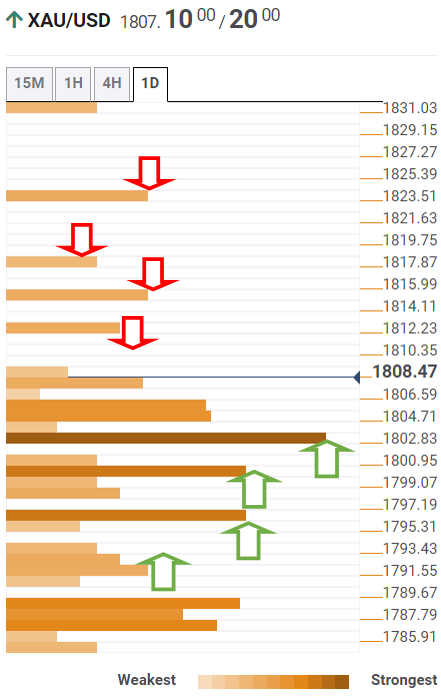
About Technical Confluences Detector
The TCD (Technical Confluences Detector) is a tool to locate and point out those price levels where there is a congestion of indicators, moving averages, Fibonacci levels, Pivot Points, etc. If you are a short-term trader, you will find entry points for counter-trend strategies and hunt a few points at a time. If you are a medium-to-long-term trader, this tool will allow you to know in advance the price levels where a medium-to-long-term trend may stop and rest, where to unwind positions, or where to increase your position size.
GBP/USD has extended rally to a fresh monthly high. According to FXStreet’s Eren Sengezer, the cable could stage a correction before the next leg higher.
Buyers look to remain in control while above 1.3330
“On the four-hour chart, the Relative Strength Index (RSI) indicator climbed above 70 for the first time since October 19, showing overbought conditions. The last time that happened, GBP/USD staged a correction before regaining its traction and a similar action could be expected.”
“The 200-period SMA forms the first support at 1.3330 and as long as the pair holds above that level, buyers could look to remain in control. 1.3400 (psychological level) aligns as the first target before 1.3440 (static level) and 1.3470 (static level).”
“Below 1.3330, 1.3300 (psychological level) is the next support before 1.3260 (100-period SMA, 50-period SMA).”
- GBP/USD gained strong positive traction for the third successive day on Thursday.
- Receding Omicron fears turned out to be a key factor that benefitted the sterling.
- A modest USD strength could keep a lid on any further gains ahead of the US data.
The GBP/USD pair broke out of its intraday consolidative trading range and shot to a near one-month high, around the 1.3385 region during the early part of the European session.
The pair prolonged this week's solid rebound from the vicinity of the YTD low, around the 1.3175 region and gained strong follow-through traction for the third successive day on Thursday. The latest optimism led by reports that the current vaccines may be more effective than first thought in fighting the new variant helped offset worries about surging COVID-19 cases in the UK. This was seen as a key factor that acted as a tailwind for the British pound.
Meanwhile, a South African study suggested reduced risks of hospitalisation and severe disease in people infected with Omicron compared with the Delta strain. The news added to the optimistic market mood, which, in turn, undermined the greenback's safe-haven status. That said, an uptick in the US Treasury bond yields, along with the Fed's hawkish outlook helped limit the USD losses. This, along with Brexit uncertainties, could cap gains for the GBP/USD pair.
the UK Foreign Minister Liz Truss – now in charge of Brexit negotiations – said that their position on the Northern Ireland Protocol remains unchanged. Truss reiterated that we must end the role of the European Court of Justice as a final arbiter in the arrangement and that the UK remains prepared to trigger Article 16 if this does not happen. Conversely, the Irish Prime Minister was noted saying that talks between the EU and the UK were on track for progress.
Nevertheless, the GBP/USD pair, so far, has managed to preserve its strong intraday gains and a move beyond the post-BoE swing high might have already set the stage for additional gains. There isn't any major market-moving economic data due for release from the UK. Hence, the USD price dynamics will continue to play a key role in influencing the pair. Later during the early North American session, traders will take cues from the US macro releases.
The US economic docket highlights the release of Core PCE Price Index and Durable Goods Orders data. This, along with the development surrounding the coronavirus saga and the broader market risk sentiment, will drive the USD demand and provide some impetus to the GBP/USD pair. Apart from this, traders will further take cues from the incoming Brexit-related headlines to grab some short-term opportunities.
Technical levels to watch
Speaking at an online press conference on Friday, Gao Feng, China’s Commerce Ministry spokesman said that Beijing “hopes that the US can create good conditions for both sides to expand trade cooperation” when asked about the latest in the implementation of the Phase 1 trade deal.
“China and the US trade teams are maintaining normal communication,” Gao added.
Market reaction
Amid risk-on market profile, the AUID/USD pair is finding some support from these comments, as it rises 0.28% on the day to trade at 0.7231, as of writing.
Japanese Prime Minister Fumio Kishida said on Thursday, he hopes the Bank of Japan (BOJ) continues to make efforts to achieve the 2% price goal based on the understanding laid out in the 2013 joint statement with the government.
Additional quotes
“Important for BOJ, govt to work closely together on economic policy. “
“Japan's economy can be revitalised when BOJ’s monetary policy, govt's fiscal and economic policy work hand in hand.”
Market reaction
USD/JPY is trading near-daily highs of 114.31, adding 0.165 on the day. Encouraging Omicron headlines are driving the risk-on mood, pushing the spot northwards.
EUR/NOK has continued to move higher since the beginning of November. Economists at Danske Bank continue to expect EUR/NOK to move higher going into 2022.
NOK vulnerable to negative news
“In our base case, we are moving into a period that will be characterised by weaker growth, tighter economic policy, tighter liquidity conditions, a stronger USD and shakier risk appetite. In that environment, NOK rarely performs and we emphasise the fading tailwind to NOK from NB’s NOK purchases.”
“We lift our forecast profile to 10.20 in 1M (from 10.10) but otherwise leave our profile unchanged. Forecast: 10.30 (3M), 10.40 (6M), 10.40 (12M).”
“The biggest risks to our forecasts lies in the global investment environment. If we return to an environment in which both global growth and inflation accelerate, we would expect a stronger NOK. Conversely, a sharp setback to risk leaves topside risk to our EUR/NOK forecast.”
2021 has been a quiet year for markets; despite the recent increase in volatility, the S&P 500 is down less than 3% from its all-time high. Should we expect a year-end correction? While that is not JP Morgan’s base case, even if they do, the fundamentals still point to above-trend growth in 2022.
Three key drivers of economic growth in 2022
“Significant restrictions are not our base case for the US, and omicron seems to have had a limited impact on aggregate mobility thus far.”
“As we look ahead to 2022, case growth should slow, economic growth should remain solid, and Fed policy should become less easy, but not necessarily tight.”
“We continue to view any material pullback as a buying opportunity, and do not believe investors should meaningfully deviate from their current asset allocation.”
- NZD/USD gained follow-through traction for the third successive day on Thursday.
- Receding Omicron fears continued acting as a tailwind for the perceived riskier kiwi.
- Subdued USD demand remained supportive of the move ahead of the US macro data.
The NZD/USD pair edged higher through the early European session and climbed to a one-week high, around the 0.6825 region in the last hour.
The pair built on its goodish recovery move from the 0.6700 round-figure mark, or the YTD low touched earlier this week and gained positive traction for the third successive day on Thursday. Investors turned optimistic amid receding fears that the new fast-spreading COVID-19 variant could derail the economic recovery. This was evident from a generally positive tone around the equity markets, which acted as a tailwind for the perceived riskier kiwi.
Reports indicated that the current vaccines may be more effective than first thought in fighting the Omicron variant. Moreover, news from a South African study suggested reduced risks of hospitalisation and severe disease in people infected with Omicron compared with the Delta strain, which further boosted the risk sentiment. The upbeat market mood undermined the safe-haven US dollar and provided an additional boost to the NZD/USD pair.
Apart from this, the uptick could also be attributed to some technical buying on a sustained strength above the 0.6800 round-figure mark. Hence, a subsequent strength back towards testing the monthly swing high, around the 0.6865-70 region, remains a distinct possibility. Some follow-through buying will be seen as a fresh trigger for bullish traders and set the stage for an extension of the ongoing recovery move for the NZD/USD pair.
Market participants now look forward to the US economic docket – highlighting the release of Core PCE Price Index and Durable Goods Orders data later during the early North American session. This, along with developments surrounding the coronavirus saga, will influence the USD price dynamics and provide some impetus to the NZD/USD pair. Traders will further take cues from the broader market risk sentiment to grab some short-term opportunities.
Technical levels to watch
EUR/USD capitalized on broad-based dollar weakness and climbed toward the upper limit of its December trading range around mid-1.1300s late Wednesday before going into a consolidation phase on Thursday. Additional recovery gains are likely if 1.1320 support holds, FXStreet’s Eren Sengezer reports.
The Personal Consumption Expenditures (PCE) Price Index data will be featured in the US economic docket
“Investors expect the Core PCE inflation to rise to 4.5% on a yearly basis in November from 4.1% in October. A stronger-than-expected print could revive inflation fears and cause the risk rally to lose steam. On the flip side, a soft inflation reading is likely to limit a potential recovery in the DXY.”
“1.1360 (post-ECB high) aligns as the first technical resistance before 1.1380 (Nov. 30 high) and 1.1400 (psychological level).”
“Additional corrective losses toward 1.1300 (psychological level, 100-period SMA) and 1.1280 (50-period SMA) could be witnessed if a four-hour candle closes below 1.1320 (200-period SMA).”
The Chinese yuan continues to trade strongly relative to other currencies. But a clear divergence of monetary policies in the US and China should eventually underpin the USD/CNY pair, economists at Danske bank report.
Uncertainty is high and risks are two-way
“We expect the resilience of CNY to continue as long as US consumers buy great amounts of goods from China. However, this effect should ease during 2022 and monetary policy divergence (PBoC easing, the Fed tightening) and a stronger USD outlook normally points to a higher USD/CNY.”
“We stick to our forecast of higher USD/CNY. Our forecast is unchanged at 6.45 in 3M, 6.55 in 6M and 6.80 in 12M.”
“We look for EUR/CNY to be broadly flat in the short-term before moving move towards 7.48 on 12M.”
“Uncertainty is high and risks are two-way. A continued high trade surplus could strengthen CNY further. However, the depreciation pressure once the Fed starts hiking could also be stronger than projected.”
No one currently sees the European Central Bank (ECB) abruptly exiting its expansionary monetary policy. But some observers are starting to talk about an abrupt move by the Federal Reserve. But analysts at Natixis do not believe at all in this scenario of an abrupt tightening of US monetary policy.
A cautious Fed should remain the scenario
“It is out of the question that the ECB will abruptly shift to a more restrictive monetary policy. But some observers are arguing that the Fed could do so, given the momentum of inflation in the US. We believe there is no chance also of the Fed abruptly switching to a more restrictive monetary policy, given the levels of debt ratios and asset prices.”
“The central scenario remains a scenario of cautious monetary policy adjustment by the Fed, leading to a slow rise in long-term interest rates and to continued negative real long-term interest rates.”
Oil prices have rallied along with the rest of the energy space and in the bigger picture the broad commodity space. Strategists at Danske Bank keep unchanged their forecast and still expect Brent to average $75 next year.
Brent seen rising towards $80 in 2023
“Demand may be nearing a peak since central banks are likely to contemplate to tighten monetary policy next year.”
“Medium-term past years’ of lower investment will keep prices elevated.”
“We expect Brent to average $75bbl in 2022 and $80/bbl in 2023.”
USD/INR has been stable between 72 and 77 since the COVID-19 pandemic outbreak. In the view of analysts at DBS Bank, the pair is likely to remain so in 2022-2023.
One downside risk for the rupee is the trade deficit
“Barring unforeseen shocks, especially the new Omicron COVID-19 variant, we expect the same trading range to be intact in 2022 and 2023.”
“In 2022, we expect the USD to strengthen worldwide into the two Fed hikes we forecast for 4Q22. However, upward pressure on USD/INR should be mitigated by two rate hikes from the Reserve Bank of India, one in 3Q22 to 4.25% and another in 4Q22 to 4.50%.”
“One downside risk for the INR is the trade deficit which has widened to USD139 B in January-October vs USD95 B in calendar 2020. The current account surplus in FY21 will reverse into deficits in FY22 and FY23 but they will be benign at 1.5% and 1.6% of GDP respectively.”
“Another risk comes from Fitch placing India’s ‘BBB minus’ long-term foreign currency debt rating on negative watch.”
The two rates hikes expected from the Federal Reserve (Fed) are the main reason to expect a stronger US dollar next year, in the view of economists at DBS Bank. In 2023, the greenback is set to weaken due to a more bening US growth below 3%.
USD to depreciate as US GDP growth turns more benign in 2023
“In 2022, we expect the USD to strengthen worldwide into the two Fed hikes we forecast for 4Q22. The Fed has dropped the “transitory” tag for inflation and opened the door to accelerate the tapering of asset purchases and to bring forward rate hikes next year. The story for the USD would change if the Fed loses credibility in reining in inflation.”
“Although we expect the USD to be stronger a year from today, the ascent will be bumpier compared to 2021. Expect more market rotation from the Fed and other central banks taking turns to normalize monetary policies. EUR, the most significant component of the USD Index (DXY), could become more volatile from Germany pushing to reduce public debt levels across EU nations in order to free the European Central Bank to fight inflation.”
“A reversal in the USD’s uptrend will be difficult to achieve without a healthy and synchronized global recovery. Under the worst-case scenario, Omicron turns out to be deadly and existing vaccines are less effective against the new variants. Given China’s covid-zero policy and plans to lower banks’ required reserve ratios, CNY is considered too strong at a six-year year high against a basket of currencies.”
“In 2023, we expect the USD to depreciate as US GDP growth turns more benign below 3%. The Fed should wrap up its last hike in 2Q23 from signs of US inflation slowing towards its 2% target again. Once again, this would depend on a more constructive global economy preferably one where growth is led by Asia.”
- USD/JPY regained positive traction on Thursday amid easing Omicron concerns.
- Subdued USD demand, weaker US bond yields kept a lid on any meaningful gains.
- Investors look forward to the US macro data for some short-term trading impetus.
The USD/JPY pair traded with a positive bias through the early European session and was last seen hovering near the daily top, around the 114.20 region.
Following the previous day's pullback from the monthly high, the USD/JPY pair regained positive traction on Thursday and was supported by the underlying positive tone in the markets. Receding fears that the new fast-spreading COVID-19 variant could derail the economic recovery undermined the safe-haven Japanese yen and acted as a tailwind for the major.
Investors turned optimistic after reports indicated that the current vaccines may be more effective than first thought in fighting the Omicron variant. Moreover, news from a South African study suggested reduced risks of hospitalisation and severe disease in people infected with Omicron compared with the Delta strain, which further boosted the risk sentiment.
Meanwhile, the uptick lacked bullish conviction amid subdued US dollar demand and a softer tone surrounding the US Treasury bond yields. This, in turn, warrants caution for bullish traders amid relatively thin liquidity conditions heading into the year-end holiday season. Hence, it will be prudent to wait for a strong follow-through buying before positioning for any further gains.
Market participants now look forward to the US economic docket – highlighting the release of Core PCE Price Index and Durable Goods Orders data. This, along with the US bond yields, will influence the USD price dynamics and provide some impetus to the USD/JPY pair. Traders will further take cues from the broader market risk sentiment to grab some short-term opportunities.
Technical levels to watch
Here is what you need to know on Thursday, December 23:
The dollar continued to suffer losses against its major rivals on Wednesday with risk flows staying in control of financial markets. Later in the session, the US Bureau of Economic Analysis will release the November Personal Consumption Expenditures (PCE) Price Index data, the Fed's preferred gauge of inflation, alongside the monthly Personal Income and Personal Spending figures. The weekly Initial Jobless Claims, November New Home Sales and the University of Michigan's Consumer Sentiment Index for December will also be featured in the US economic docket ahead of the Christmas holiday.
On Wednesday, the S&P 500 Index rose more than 1% on reports suggesting that the Omicron variant is not as dangerous as feared. The BBC reported that early evidence from a Scottish study showed fewer people were getting hospitalized when compared to previous variants. Moreover, research conducted in South Africa found that Omicron was a milder variant than Delta. Reflecting the positive shift in risk sentiment, the Shanghai Composite Index rose 0.5% and the Nikkei 225 Index gained more than 0.8%. In the early Europen session, US stocks futures are trading flat.
EUR/USD capitalized on broad-based dollar weakness and climbed toward the upper limit of its December trading range around mid-1.1300s late Wednesday before going into a consolidation phase on Thursday.
GBP/USD rose sharply on easing concerns over the Omicron variant causing tighter restrictions and even lockdowns in the UK. The pair is trading in a tight range around 1.3350 and stays within a touching distance of the post-BOE top it set at 1.3375.
USD/JPY stretched higher despite the greenback weakness as the yen struggled to find demand as a safe haven. The 10-year US Treasury bond yield is posting small daily gains around 1.46%, helping the pair stay afloat in the positive territory.
After spending the majority of the day in a tight range near $1,790 on Wednesday, gold regained its traction and seems to have settled above $1,800 for the time being. Rising US T-bond yields seem to be limiting XAU/USD's upside for the time being.
USD/CAD fell sharply and lost nearly 100 pips on Wednesday with rising crude oil prices providing a boost to the commodity-related loonie. The pair is holding above 1.2800 early Wednesday and the barrel of West Texas Intermediate (WTI), which rose more than 2%, is consolidating its gains a little below $73.
Bitcoin continues to trade in a narrow range below $50,000 after failing to break above that level on Wednesday. Ethereum struggled to attract buyers after rising above $4,000 and trades in the positive territory around $3,900 early Thursday.
- EUR/JPY refreshes the highest level in a week during four-day uptrend.
- Bullish MACD favors further upside towards short-term key resistance line.
- 100-DMA adds to the upside filters, previous resistance from November stops seller’s entry.
EUR/JPY takes the bids to refresh weekly top around 129.52, up 0.13% intraday ahead of Thursday’s European session.
The cross-currency pair rises for the second consecutive day after crossing a one-month-old resistance line, now support around 128.55.
Given the bullish MACD signals and a sustained break of the key resistance line, EUR/JPY bulls are heading towards another important hurdle, a downward sloping trend line from October 20, near 129.65.
Also acting as upside filters are the levels comprising 100-DMA and 200-DMA, respectively around 129.80 and 130.55.
Meanwhile, pullback moves remain less important until staying beyond the resistance-turned-support line, near 128.55.
Following that, multiple supports around 127.50 and the monthly low near 127.35-40, also the lowest since February, will be in focus.
EUR/JPY: Daily chart
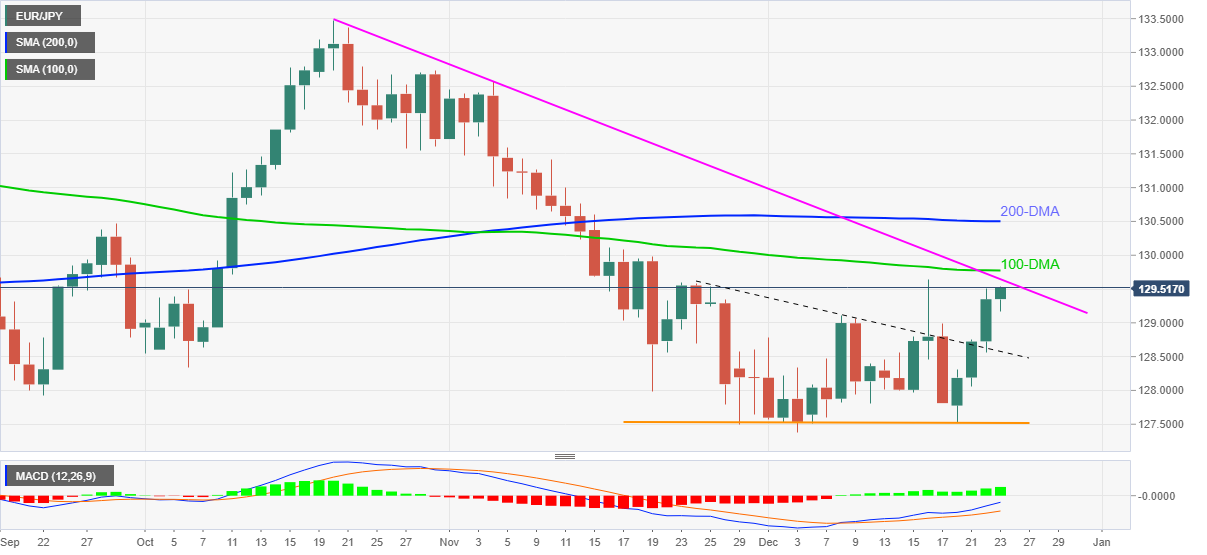
Trend: Further upside expected
Gold price recaptured the $1,800 threshold and finished Wednesday nearly multi-day tops of $1,805. In the view of FXStreet’s Dhwani Mehta, XAU/USD looks to retest December highs amid bullish technical setup.
Is the Santa rally shaping out for XAU/USD?
“Wednesday’s sharp gains have helped XAU/USD recapture all the major Daily Moving Averages (DMA), underpinning the bullish sentiment.”
“Gold bulls could retest the daily highs at $1,809, above which a fresh advance will kick in towards the December highs of $1,814. The next critical target for bulls is seen at the $1,820 round number.”
“The 50-DMA at $1,800 is the immediate line of defense for gold buyers, below which hopes are stacked up at the 200-DMA of $1,796. If the sellers remain in complete control, then the additional downside could open up towards the 100-DMA at $1,788, which will be the line in the sand for gold optimists.”
- A combination of factors assisted AUD/USD to reverse an early dip to the 0.7185 area.
- Easing Omicron fears benefitted the perceived riskier aussie amid subdued USD demand.
- The Fed’s hawkish outlook should limit the USD losses and cap the upside for the major.
The AUD/USD pair reversed an early dip and was last seen trading near the monthly top, around the 0.7215-20 region heading into the European session.
The pair attracted fresh buying near the 0.7185 region on Thursday and is now looking to build on this week's goodish rebound from the 0.7080 area, or the lowest level since December 7. Easing concerns that the new fast-spreading variant could derail the economic recovery turned out to be a key factor that acted as a tailwind for the perceived riskier aussie. This, along with subdued US dollar demand, extended some support to the AUD/USD pair.
Investors turned optimistic after reports indicated that the current vaccines may be more effective than first thought in fighting the new COVID-19 variant. Moreover, news from a South African study suggested reduced risks of hospitalisation and severe disease in people infected with Omicron compared with the Delta strain. This, in turn, led to a fresh wave of a risk-on trade in the equity markets, which undermined the safe-haven greenback.
That said, the Fed's hawkish outlook should help limit any meaningful downside for the USD and cap the upside for the AUD/USD pair, at least for the time being. It is worth recalling that the so-called dot-plot indicated that the Fed could hike interest rates at least three times next year. The mixed fundamental backdrop might hold back traders from placing fresh bullish bets around the AUD/USD pair amid thin liquidity ahead of the year-end holiday season.
Market participants now look forward to the US economic docket – highlighting the release of Core PCE Price Index and Durable Goods Orders data later during the early North American session. This, along with developments surrounding the coronavirus saga, will drive the USD demand and provide some impetus to the AUD/USD pair. Traders will further take cues from the broader market risk sentiment to grab some short-term opportunities.
Technical levels to watch
China’s Premier Li Keqiang crossed wires, via Reuters, during early Thursday morning in Asia.
The Chinese leaders emphasized the need for a stable yuan exchange rate to support trade.
China’s Li also showed readiness to roll out more policies to help exporters and ease the pressure of international logistics.
FX reaction
Following the news, USD/CNH picked up bids from the intraday low to $6.3755, down 0.03% on a day. However, inactive markets restrict immediate pair moves.
Read: Treasury yields, S&P 500 Futures portray market’s indecision, US economics awaited
- Gold grinds higher around weekly top, rises for the second consecutive day.
- Optimism over US stimulus, Omicron studies favor bulls.
- Cautious mood ahead of US Durable Goods Orders, PCE Inflation for November joins China, White House updates to probe upside.
Gold (XAU/USD) stays mildly bid around the weekly top of $1,808 heading into Thursday’s European session. The yellow cheers US dollar weakness amid a sluggish Asian session filled with mixed risk catalysts and a lack of major data/events.
That said, the US Dollar Index (DXY) grinds lower around the week’s low of 96.02 during the four-day downtrend. The greenback’s weakness could be linked to the market’s preparation for the one last shot before the key US data.
Also challenging the greenback is the optimism after multiple studies showed that infection with Omicron is significantly less likely to result in hospitalization. Furthermore, positive updates over US President Joe Biden's Build Back Better (BBB) stimulus plan also weigh on the US dollar and favor the gold prices. "We believe that Senator Manchin has been engaging with us over the course of time and months in good faith," White House spokeswoman Jen Psaki told reporters, per Reuters.
Meanwhile, China’s biggest-ever lockdown, of around 13 million residents in Xi’an as stated by the Wall Street Journal (WSJ) challenges the optimists. Additionally, doubts over the availability of Pfizer’s pill, joined by French rejection to Merck’s COVID drug, also weigh on the risk appetite.
It’s worth noting that the US Treasury yields and stock futures remain quiet and a light calendar in Asia also acts as extra filters for gold traders.
That said, gold traders may remain divided as traders approach Christmas Eve amid light volume. However, the US PCE inflation and Durable Goods Orders for November can entertain the momentum traders. Also important are the aforementioned risk catalysts.
Technical analysis
Gold justifies Tuesday’s bullish Doji while crossing the 50-DMA level surrounding $1,800. However, sluggish MACD and steady RSI may challenge the commodity buyers around a two-month-old horizontal area near $1,813-16.
It should be noted that the gold’s upside past $1,816 enables the bulls to aim for the tops marked in July and September around $1,834 whereas $1,850 and November’s peak of $1,877 could challenge further upside.
Alternatively, $1,780 and an upward sloping trend line from August, around $1,775, restrict short-term declines. However, a clear downside break of the $1,775 will welcome gold bears.
To sum up, gold prices remain inside a tight range amid the holiday-thin liquidity. Though, bulls have multiple challenges than bears.
Gold: Daily chart
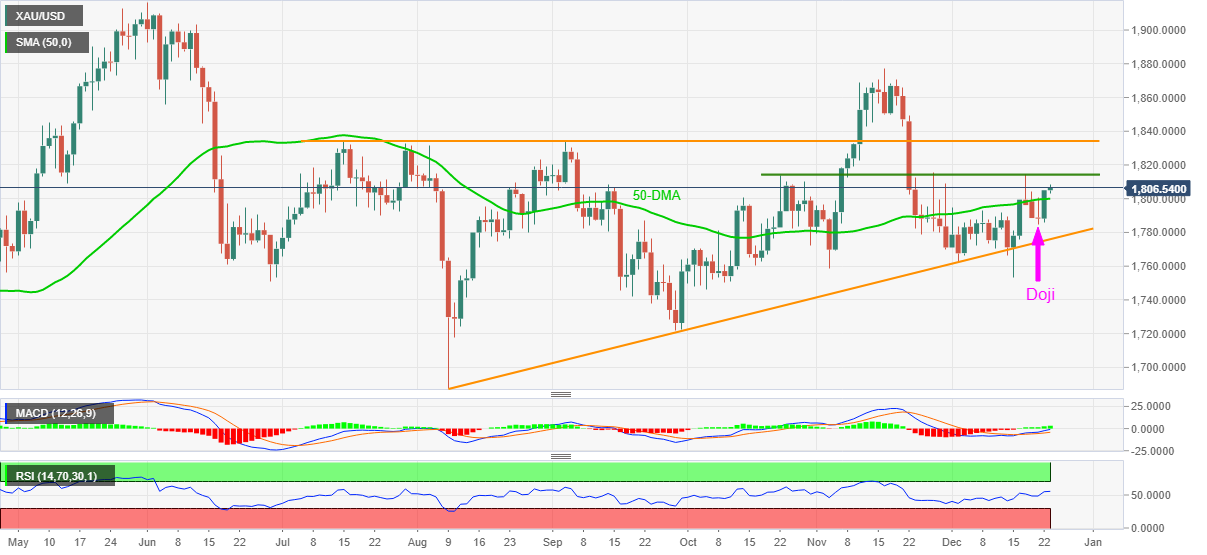
Trend: Limited upside expected
Germany’s Health Minister Karl Lauterbach added to the market’s risk-on mood during early Thursday morning in Asia.
The diplomat said, “Lockdown isn't ruled out, but it's not needed right now.”
““But we're not ruling anything out. So if the number of cases actually developed in such a way that a hard lockdown also had to be discussed, then there would be no red lines," adds German Health Minister.
“As a scientist, I would personally assume that a fourth vaccination will be necessary,” said Germany’s Lauterbach while speaking per Berlin Kurier.
FX reaction
Although the German diplomat ruled out looming lockdown, challenges to risk appetite prevail on the table, mainly emanating from China and the White House, which in turn keep the EUR/USD prices chopped around the weekly top near 1.1340.
Read: EUR/USD clings to weekly top near 1.1350 as yields dwindle ahead of US PCE Inflation
- Asian shares trade mixed amid a sluggish session.
- China, White House poke bulls ahead of the key US data.
- Hopes of recovery from Omicron, optimism over US BBB reject bears.
- US Durable Goods Orders, PCE Inflation for November will decorate calendar as the last key data of the week.
Having witnessed consecutive two days of positive momentum, Asian equities track global peers during an inactive Thursday morning in Europe. That said, the MSCI’s index of Asia-Pacific shares ex-Japan gains 0.60% whereas Japan’s Nikkei 225 rises 0.55% by the press time.
Early in Asia, Reuters revealed the Bank of Japan’s (BOJ) bond issuance plan while also conveying the passage of a budget with $943 billion in spending for the fiscal year beginning in next April. On the same line were Japan’s upward revisions to GDP and dovish comments from BOJ Governor Kuroda, which all favored Japanese equity buyers.
However, China’s biggest-ever lockdown, of around 13 million residents in Xi’an as stated by the Wall Street Journal (WSJ) challenges the optimists. Additionally, doubts over the availability of Pfizer’s pill, joined by French rejection to Merck’s COVID drug, also weigh on the risk appetite.
Even so, optimism concerning US President Joe Biden's Build Back Better (BBB) stimulus plan and studies showing that infection with Omicron is significantly less likely to result in hospitalization keep the buyers hopeful.
Amid these plays, US 10-year Treasury yields seesaw around 1.457% after declining for the first time in three days on Wednesday whereas the S&P 500 Futures struggle to copy the Wall Street’s gains, up 0.05% around 4,687 by the press time. That said, the US Dollar Index (DXY) grinds lower during the four-day downtrend.
That said, stocks in Australia print mild gains but those from New Zealand are down 0.30% after the inability to trace the latest Omicron cases. On the other hand, China’s equities print mixed performance while those from Indonesia, India and South Korea post smaller losses by the press time.
Looking forward, Asia-Pacific markets may remain divided as traders approach Christmas Eve amid light volume. However, the US PCE inflation and Durable Goods Orders for November can entertain the momentum traders. Also important are the aforementioned risk catalysts.
- AUD/JPY snaps two-day uptrend, prints mild losses around monthly top.
- Overbought RSI conditions, 50% mean reversion challenge buyers.
- 200-SMA, ascending trend channel keeps bulls hopeful.
AUD/JPY struggles to extend two-day advances, easing to 82.30 during early Friday morning in Europe.
The cross-currency pair refreshed the monthly peak before easing from 82.47. In doing so, the quote steps back from 50% Fibonacci retracement level (also known as mean reversion) of November-December downside amid overbought RSI conditions.
Even so, the AUD/JPY prices remain above 200-SMA and inside a three-week-old ascending trend channel bullish chart formation.
Hence, the pair’s latest pullback remains elusive beyond the stated SMA level of 81.85, a break of which should recall the 81.00 threshold to the chart. However, the support line of the immediate channel, around 80.65, will test the AUD/JPY bears afterward.
Meanwhile, a clear run-up beyond the nearby hurdle of 82.45 will aim for the aforementioned channel’s upper line, around 83.00 by the press time.
If at all AUD/JPY buyers refrain from stepping back around 83.00, the 61.8% Fibonacci retracement level of 83.30 will be important to watch.
AUD/JPY: Four-hour chart
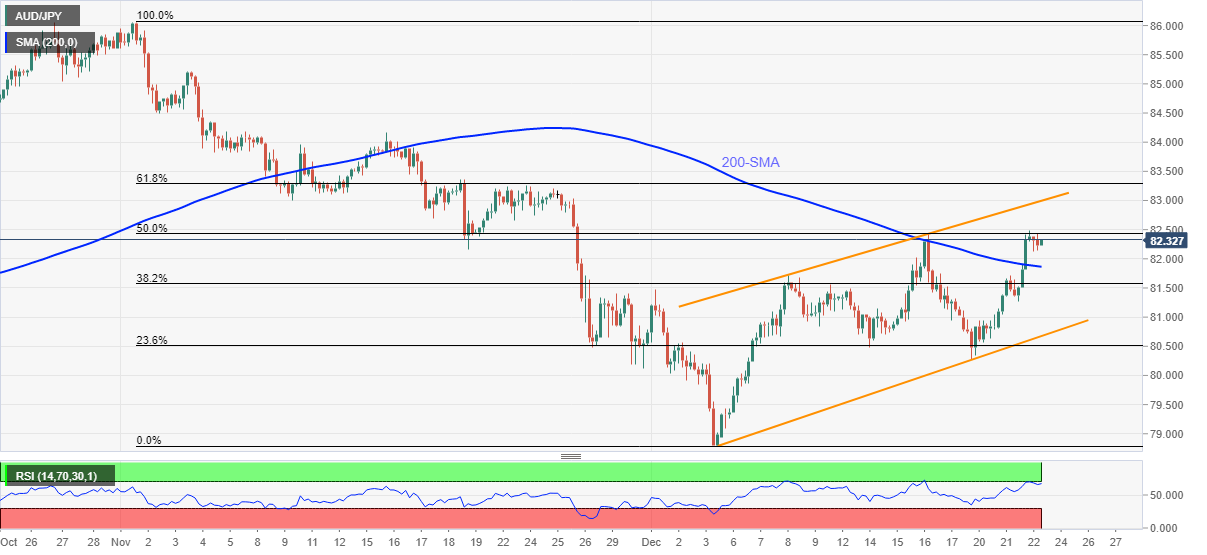
Trend: Further recovery expected
Early Thursday morning in Europe, Bank of Japan (BOJ) Governor Haruhiko Kuroda crossed wires via Reuters. The policymakers initially defended the Japanese central bank’s currency monetary policy while citing inflation concerns.
BOJ’s Kuroda then stated, per Reuters, “Japan's economic recovery to accelerate next year.”
more to come
- EUR/USD struggles to extend four-day uptrend, grinds higher near weekly high.
- Sluggish markets, cautious mood before the key US data test buyers.
- Holiday mood, Omicron fears act as immediate challenges, Fed v/s ECB battle stays on the top.
EUR/USD remains indecisive around 1.1340 after a three-day uptrend to refresh the weekly top. In doing so, the major currency pair portrays the market’s mood during early Thursday morning in Europe.
In addition to the mixed concerns over the South African covid variant, dubbed as Omicron, a light calendar and “wait-and-see” mode ahead of the key US data also weigh on the EUR/USD prices of late. Adding to the trading filters is the lack of market volume amid the year-end holiday season.
Among the positives are firmer German 10-year Treasury yields that refreshed monthly top amid optimism over the Omicron vaccines/pills and the market’s lack of reaction to the firmer US data. Further, positive updates concerning the US President Joe Biden's Build Back Better (BBB) stimulus plan and studies showing that infection with Omicron is significantly less likely to result in hospitalization also keep the EUR/USD buyers hopeful.
Alternatively, China’s biggest-ever lockdown in Xi’an and the White House doubts over the availability of Pfizer’s pill, joined by French rejection to Merck’s drug, challenge the market sentiment and the pair buyers. On the same line is the ECB policymakers’ comparatively less hawkish outlook towards the 2022 moves than the Fed members.
Amid these plays, US 10-year Treasury yields seesaw around 1.457% after declining for the first time in three days on Wednesday whereas the S&P 500 Futures struggle to copy the Wall Street’s gains, up 0.05% around 4,687 by the press time. That said, the US Dollar Index (DXY) grinds lower during the four-day downtrend.
Given the scheduled releases of the US PCE inflation and Durable Goods Orders for November, EUR/USD traders may witness a sluggish session ahead of the data unless any surprises from Omicron and US stimulus erupt, which are less likely.
Technical analysis
EUR/USD bulls need a daily closing beyond the descending resistance line from November 30, at 1.1350 by the press time, to keep the reins. Otherwise, a pullback towards 1.1230 can’t be ruled out.
- USD/CAD struggles to defend the bounce from weekly low around 10-DMA.
- Steady Momentum line, clear break of two-week-old rising trend line favor sellers.
- Bulls may aim for monthly resistance line beyond 1.2865.
USD/CAD snaps a two-day pullback from the yearly top, up 0.09% intraday despite recently easing to 1.2840 ahead of Thursday’s European session.
Although 10-DMA challenges the Loonie pair’s immediate downside, a sustained break of the ascending trend line from December 08 keeps the USD/CAD sellers hopeful amid a steady Momentum line.
Even if the quote rises past the nearby support-turned-resistance line close to 1.2865, the 1.2900 threshold and the latest peak of 1.2965 may lure the bulls ahead of an ascending resistance line from November 30, near the 1.3000 psychological magnet.
Alternatively, the quote’s fresh weakness will aim for November 23 swing high near 1.2745 before targeting the six-week-old support line near 1.2730.
In a case where USD/CAD bears keep reins past 1.2730, a two-month-long support line, close to 1.2600 will be crucial to watch.
USD/CAD: Daily chart
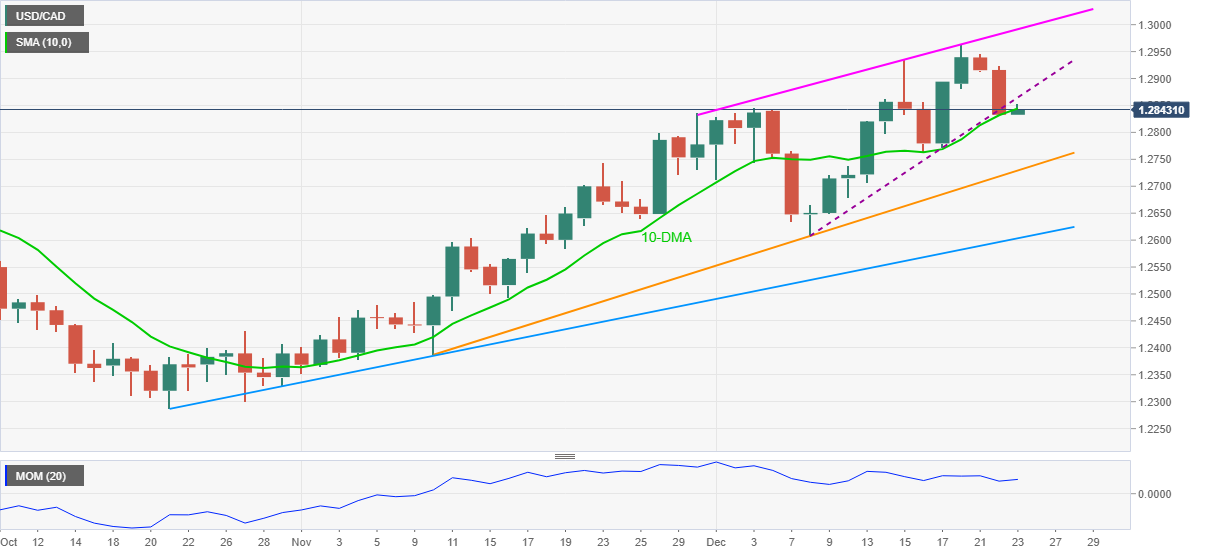
Trend: Pullback expected
- NZD/USD bulls stay in charge as the bearish trend stalls and shows prospects of a correction.
- A 38.2% Fibo retracement puts the 0.69 areas in focus for the New Year.
NZD/USD has rallied this week so far and is showing little signs of retreating at this juncture. should the bull stay in control into the holidays, it will leave a bullish foundation for the New year. The following illustrates a bullish bias from a weekly perspective:
NZD/USD weekly chart
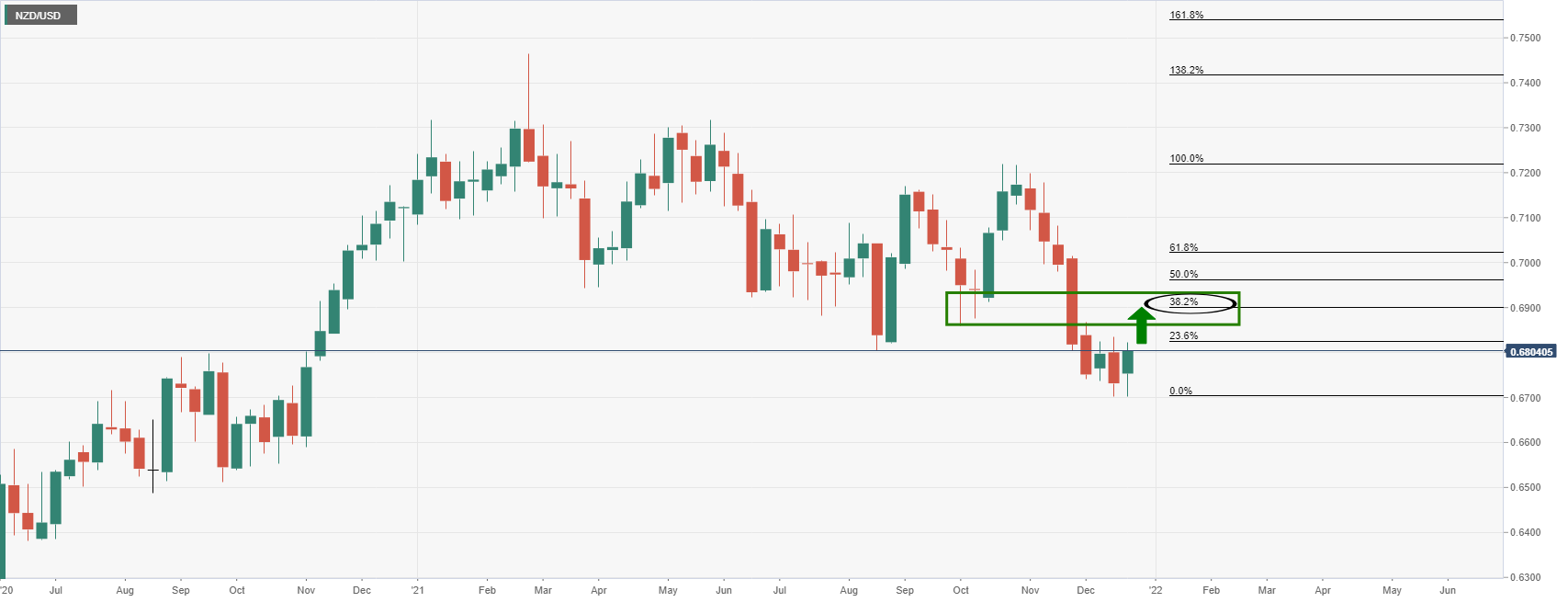
NZD/USD's bear trend is showing signs of weakness and could be on the verge of a meaningful correction with the 38.2% Fibonacci aligned with the prior support between September and October. This puts the 0.69 areas back into focus for the weeks ahead.
- USD/INR stays pressured at the lowest level in two weeks.
- Dashing hopes of further easy money policies from RBI, comparatively better virus conditions favor INR bulls.
- Global markets remain mixed after the recent risk-on mood.
- India PM Modi to unveil Omicron battle plan, US Durable Goods Orders, PCE Inflation for November will decorate calendar.
USD/INR pauses four-day downtrend around a fortnight low near 75.45 during early Thursday. The Indian rupee (INR) pair’s latest inaction could be linked to the mixed market sentiment and cautious mood ahead of the key US data, as well as a speech from Indian Prime Minister (PM) Narendra Modi.
Risk appetite grew stronger the previous day amid optimism concerning US President Joe Biden's Build Back Better (BBB) stimulus plan and studies showing that infection with Omicron is significantly less likely to result in hospitalization keep the buyers hopeful.
Also negative for the USD/INR prices were comments from Reserve Bank of India's (RBI) Monetary Policy Committee member Jayanth Varma. "I believe that monetary policy is no longer the right instrument to deal with the Covid-19 pandemic whose economic effects (as opposed to its health effects) have diminished greatly and become more concentrated in narrow pockets of the economy," Varma said at the MPC meeting, according to minutes of the meet released by the RBI, shared by Reuters.
On the same line were hawkish forecasts from Nomura which expect 100 basis points (bps) of repo and reverse repo rate hikes in 2022, as well as a 25 bps repo hike in April policy.
However, China’s biggest-ever lockdown in Xi’an and the White House doubts over the availability of Pfizer’s pill, joined by French rejection to Merck’s COVID-19 drug, challenge the market sentiment.
It’s worth noting that a light calendar and cautious mood before the aforementioned catalysts also probe the mood and restrict USD/INR moves.
Against this backdrop, US 10-year Treasury yields seesaw around 1.457% after declining for the first time in three days on Wednesday whereas the S&P 500 Futures struggle to copy the Wall Street’s gains, up 0.05% around 4,687 by the press time.
Moving on, comments from India PM Modi are likely to boost the market confidence and can exert additional downside pressure on the USD/INR. However, firmer US data and fresh challenges to the market’s risk appetite may help the pair to consolidate recent losses.
Technical analysis
In addition to a clear downside break of 75.65-60 support-turned-resistance area comprising tops marked in April and October, a daily closing below 20-DMA level of 75.54 also favors USD/INR bears to aim for tops marked in November around 75.20.
- USD/TRY is stabilizing following a volatile week.
- Bulls are moving in vs a strong sell-off from the highest levels since the 1980s.
USD/TRY is stabilising following three consecutive days of falling prices that have wiped out the November rally. At the time of writing, USD/TRY is trading at 12.0354 and in between an 11.9655 and 12.0828 range so far.
President Recep Tayyip Erdoğan ordered the Turkish central bank to start reducing interest rates earlier in the year which led to the currency falling around 50% since September. Inflation rose 21.31% in November compared to the same period last year. On a monthly basis inflation rose 3.51% compared to October. The president insisted on four interest rate cuts over the four months despite surging inflation and the market responded in kind.
However, on Monday 20 December the TRY weakened significantly when President Erdoğan said in a televised speech that he will continue cutting interest rates after rates were cut by 100 basis points. This took the rate to -6%, the lowest in the world and the TRY to the weakest level since the 1980s. However, there was a dramatic comeback in the currency when the government announced a series of measures to support the currency on Monday.
Amongst other measures, including direct FX forward contracts from the central bank for companies heading overseas business, Erdoğan explained that the government will protect lira deposits by making up for the losses incurred. TRY has rallied, and the plan is working, so far. However, if the president is intent on cutting rates in an inflationary environment, then the lira will be left vulnerable to further weakness.
USD/TRY technical analysis
-637758268015718545.png)
Technicals are futile under such fundamental drivers and wild price action as this, but nevertheless, if there is to be stability, then the range between structures can be outlined as above.
- USD/CHF is stuck in a daily range as covid risks abate.
- Markets will, however, keep a watchful eye on the value of the CHF and the SNB.
USD/CJHF is trading at 0.9133 and flat in the day. The pair is in a daily consolidation between the 0.9190 and 0.9250s as risk appetite bounced back. Risk appetite remained strong on Wednesday as Omicron concerns continued to fade, lifting global equities.
This is leaving the USD and CHF on the sidelines as investors move into riskier asset classes and away from safe-havens. Early evidence suggests fewer people are needing hospital treatment than with other variants - with estimates ranging from a 30% to a 70% reduction, the BBC reported. The S&P 500 gained 1% to 4,696.56, the Nasdaq Composite rallied 1.2% to 15,521.89 and the Dow Jones Industrial Average gained 0.7% to 35,753.89. Pfizer rose after the FDA approved the covid-19 tablet for emergency use in the US.
However, as uncertainties prevail, there could be a reversal in the mood and this would be expected to support the swiss franc due to Its role as the quintessential risk hedge to European risk. With that being said, the Swiss National Bank looks set to keep intervening in the FX market to curb CHF appreciation.
Eyes on the SNB
The Swiss National Bank stuck to its ultra-loose monetary policy this month, diverging from the tightening path being taken by a growing number of central banks such as the Federal Reserve and despite higher inflation and a surge in the value of the safe-haven Swiss franc. Although inflation is rising in the nation, the SNB regards it as being comparatively modest to the rate of 1.5% in November. SNB Chairman Thomas Jordan said he thought inflation had peaked at this level and would decline during 2022.
The Swiss franc has appreciated 3% more in nominal since the SNB's last meeting and trade-weighted terms and by some 6% since the beginning of the pandemic, Jordan told a press conference.
"The nominal appreciation ..does not entail an appreciation to the same extent in real terms," Jordan explained.
"The real trade-weighted Swiss franc exchange rate – which takes into account the inflation rate differential with other countries – has hardly changed since the beginning of the pandemic," he said. "There is thus no change in our assessment that the Swiss franc remains highly valued."
| Raw materials | Closed | Change, % |
|---|---|---|
| Brent | 75.52 | 1.79 |
| Silver | 22.797 | 1.34 |
| Gold | 1803.582 | 0.81 |
| Palladium | 1869.23 | 4.91 |
- US 10-year Treasury yields hesitate to extend recent pullback, S&P 500 Futures stay sluggish despite upbeat Wall Street closing.
- Doubts over availability, effectiveness of vaccines/pills join China lockdown to weigh on risk appetite, stimulus hopes prevail.
- US Durable Goods Orders, PCE Inflation for November will be crucial for near-term direction.
- Omicron updates, US BBB news are important as well.
Following two consecutive days of risk-on, market sentiment dwindles during early Thursday.
While portraying the mood, the US 10-year Treasury yields seesaw around 1.457% after declining for the first time in three days on Wednesday whereas the S&P 500 Futures struggle to copy the Wall Street’s gains, up 0.05% around 4,687 by the press time.
It’s worth noting that fresh challenges to the previously positive risk catalysts and cautious mood ahead of the key US data seem to test the optimists amid a light calendar.
Among the negatives, China’s biggest-ever lockdown, of around 13 million residents in Xi’an as stated by the Wall Street Journal (WSJ) gains major attention. On the same line are the White House fears over the availability of Pfizer’s pill to battle the Omicron that recently got the US Food and Drug Administration (FDA) approval. Additionally, the Financial Times (FT) news stating, “France on Wednesday canceled its order of Merck’s drug after data showed it resulted in a reduction of only 30% in the risk of hospitalization and death, significantly lower than earlier expectations,” also challenge the previously upbeat market mood.
It’s worth observing, however, that the White House optimism over US President Joe Biden's Build Back Better (BBB) stimulus plan is likely battling the bears. Additionally, Japan’s positive GDP revision and push for a record budget joins US Military’s progress over having a single cure for all covid and variant, not to forget studies showing Omicron has lesser scope hospitalization, to keep the bulls hopeful.
Moving on, markets are likely to remain divided as traders approach Christmas Eve amid light volume. However, the US PCE inflation and Durable Goods Orders for November can entertain the momentum traders. Also important are the aforementioned risk catalysts like Omicron news and US stimulus updates.
Read: Dollar falls broadly as risk sentiment returns on rise in US equities
- GBP/JPY is meeting daily resistance and focus is on a correction.
- GBP/JPY bears can target the old resistance and counter trendline.
The daily charts illustrate the price meets prior support established in the middle of November. Should the market pull-back, then there are prospects of a restest of the counter trendline and horizontal support. This meets the 38.2% Fibonacci retracement level near 151.40.
GBP/JPY daily chart
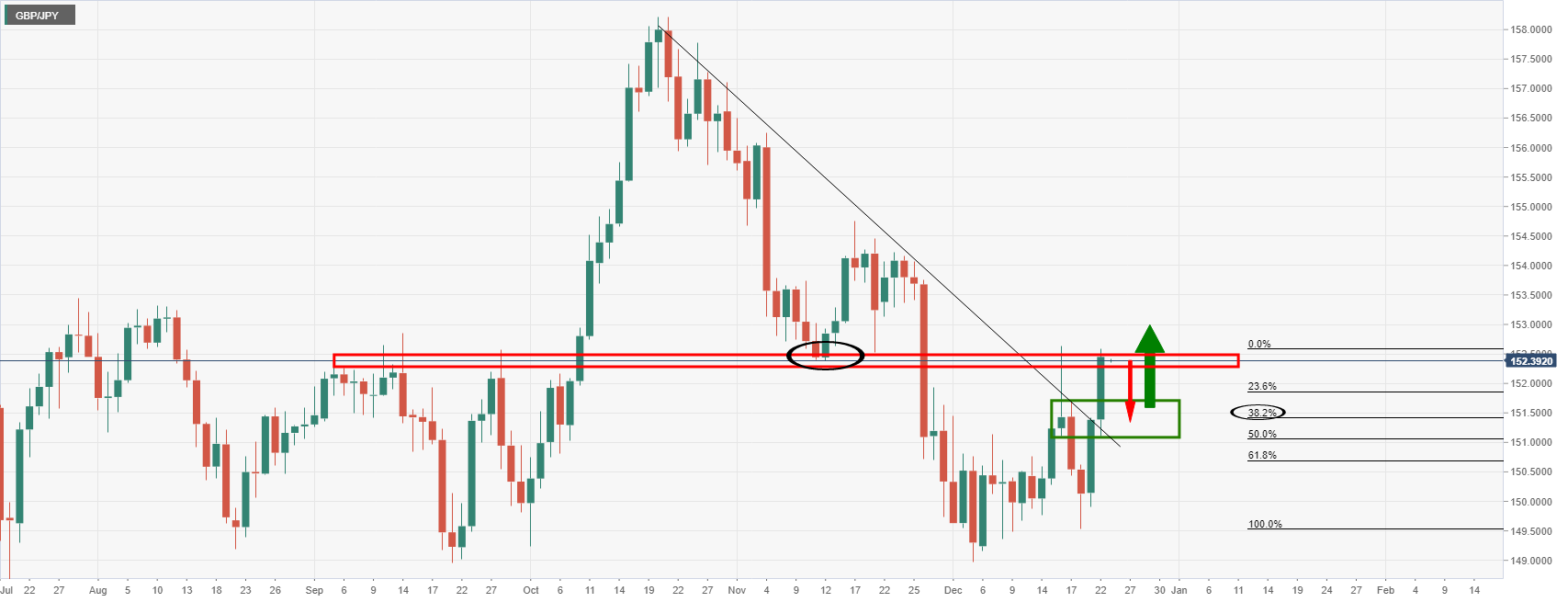
GBP/JPY H4 chart
The 4-hour chart shows that the price is starting to correct. There will be prospects of a 61.8% Fibonacci retracement towards 151.50 and the daily support structure should the bears commit over the coming sessions.
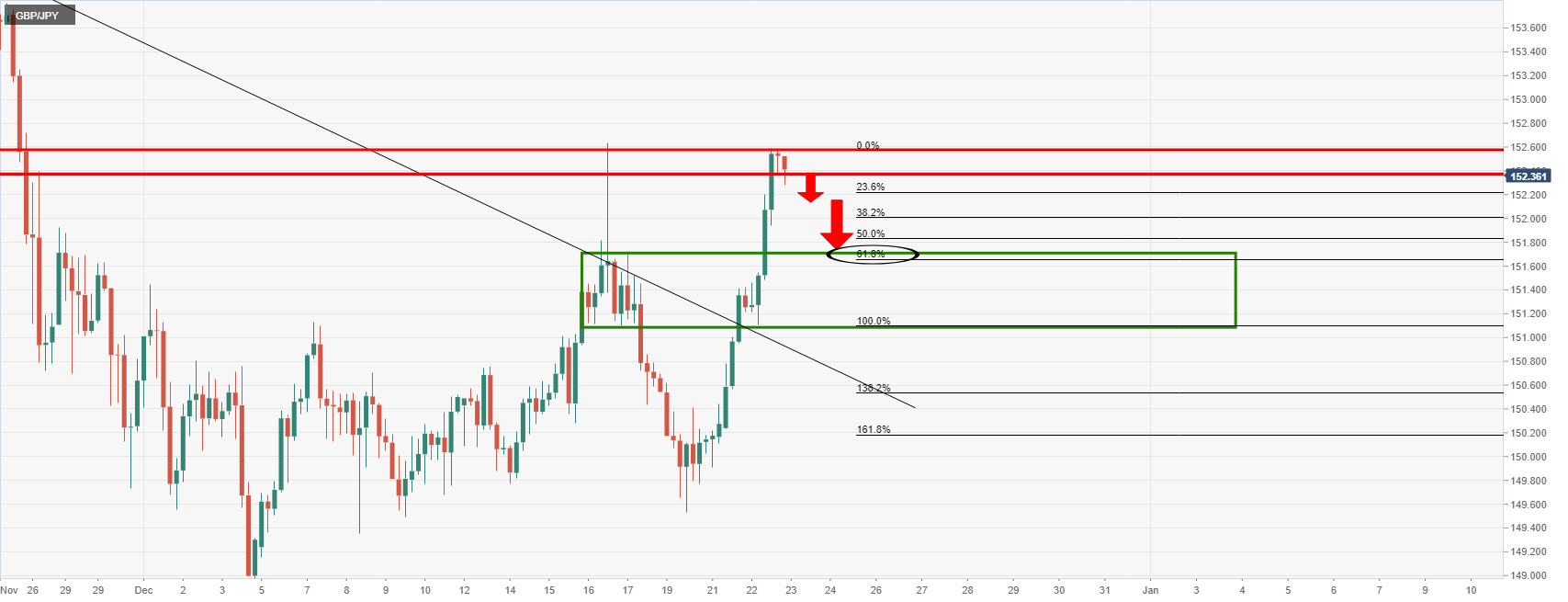
- GBP/USD prints first daily negative in three, bears attack intraday low with mild losses at the latest.
- UK-EU approaches fisheries agreement on 2022 stocks, DUP to push Brexit Minister Truss towards Article 16.
- UK’s covid infections jump past 100K for the first time on record, optimism over virus pills, vaccines also fade.
- US Durable Goods Orders, PCE Inflation to decorate calendar, risk catalysts are critical.
GBP/USD consolidates recent gains around the weekly top, down 0.10% intraday around 1.3350 during early Thursday.
In doing so, the cable pair portrays the market’s indecision amid mixed concerns over Brexit and Omicron. The same challenges the quote’s previous two-day uptrend based on optimism concerning a cure to the South African covid variant, dubbed as Omicron, as well as positive updates over US President Joe Biden's Build Back Better (BBB) stimulus plan.
Starting with the Brexit, the Independent came out with a story saying, “Britain has agreed new fisheries deal with the European Union over how to divide up shared stocks in the year ahead.” The details, however, also cite the agreement as, “a separate affair from the row over fishing licenses which has sparked threats of a trade war and prompted French trawlers to blockade the Channel.”
Elsewhere, the Daily Telegraph mentioned that Democratic Unionist Party (DUP) is up for pushing Brexit Minister Liz truss towards a bumpy road. “Unionists want Article 16 of the Northern Ireland Protocol triggered before Stormont elections in May,” the news said.
On a different page, the UK continues to witness downbeat covid numbers with the latest figures of 106,122 daily infections per the BBC. The news also mentioned the figure as, “The eight highest daily case figures since the pandemic began have all come since 15 December.”
It’s worth noting that the White House fears over the availability of Pfizer’s pill to battle the Omicron that recently got the US Food and Drug Administration (FDA) approval challenge the earlier risk-on mood and weigh on the GBP/USD prices. On the same line is China’s biggest-ever lockdown, of around 13 million residents in Xi’an as stated by the Wall Street Journal (WSJ).
However, hopes of the US stimulus and firmer data challenge the pair buyers. White House spokeswoman Jen Psaki said, per Reuters, “We believe that Senator Manchin has been engaging with us over the course of time and months in good faith."
Talking about the data, the US Q3 GDP rose past the 2.1% forecast to 2.3% whereas the CB Consumer Confidence for December came in better than upwardly revised 111.9 prior to 115.8. On the contrary, the UK Q3 GDP eased below 1.3% to 1.1%.
Against this backdrop, the S&P 500 Futures struggle to copy the Wall Street’s gains while the US 10-year Treasury yields seesaw around 1.45% after declining for the first time in three days on Wednesday.
Moving on, GBP/USD traders will pay attention to the US PCE inflation and Durable Goods Orders for November for fresh impulse while keeping their eyes on the Brexit and Omicron news.
Technical analysis
A clear upside break of the five-week-old descending trend line, at 1.3335 by the press time, favors GBP/USD bulls to aim for a fresh monthly high, currently around 1.3275.
| Time | Country | Event | Period | Previous value | Forecast |
|---|---|---|---|---|---|
| 00:00 (GMT) | Japan | BOJ Governor Haruhiko Kuroda Speaks | |||
| 00:01 (GMT) | United Kingdom | Gfk Consumer Confidence | December | -14 | |
| 00:30 (GMT) | Australia | Private Sector Credit, y/y | November | 5.7% | |
| 00:30 (GMT) | Australia | Private Sector Credit, m/m | November | 0.5% | |
| 05:00 (GMT) | Japan | Leading Economic Index | October | 100.2 | |
| 05:00 (GMT) | Japan | Coincident Index | October | 88.7 | |
| 13:30 (GMT) | U.S. | Continuing Jobless Claims | December | 1845 | 1820 |
| 13:30 (GMT) | U.S. | Personal spending | November | 1.3% | 0.6% |
| 13:30 (GMT) | Canada | GDP (m/m) | October | 0.1% | 0.8% |
| 13:30 (GMT) | U.S. | Durable Goods Orders | November | -0.5% | 1.6% |
| 13:30 (GMT) | U.S. | Durable Goods Orders ex Transportation | November | 0.5% | 0.6% |
| 13:30 (GMT) | U.S. | Durable goods orders ex defense | November | 0.8% | |
| 13:30 (GMT) | U.S. | PCE price index ex food, energy, Y/Y | November | 4.1% | 4.5% |
| 13:30 (GMT) | U.S. | PCE price index ex food, energy, m/m | November | 0.4% | 0.4% |
| 13:30 (GMT) | U.S. | Personal Income, m/m | November | 0.5% | 0.4% |
| 13:30 (GMT) | U.S. | Initial Jobless Claims | December | 206 | 205 |
| 14:00 (GMT) | Belgium | Business Climate | December | 4.2 | |
| 15:00 (GMT) | U.S. | Reuters/Michigan Consumer Sentiment Index | December | 67.4 | 70.4 |
| 15:00 (GMT) | U.S. | New Home Sales | November | 0.745 | 0.77 |
| 18:00 (GMT) | U.S. | Baker Hughes Oil Rig Count | December | 475 | |
| 23:30 (GMT) | Japan | National CPI Ex-Fresh Food, y/y | November | 0.1% | 0.4% |
| 23:30 (GMT) | Japan | National Consumer Price Index, y/y | November | 0.1% |
In recent trade today, the People’s Bank of China (PBOC) set the yuan (CNY) at 6.3651 vs the estimated 6.3570 and the previous 6.3703.
About the fix
China maintains strict control of the yuan’s rate on the mainland.
The onshore yuan (CNY) differs from the offshore one (CNH) in trading restrictions, this last one is not as tightly controlled.
Each morning, the People’s Bank of China (PBOC) sets a so-called daily midpoint fix, based on the yuan’s previous day closing level and quotations taken from the inter-bank dealer.
- AUD/USD sellers attack intraday low, snaps two-day uptrend.
- Overbought RSI, failure to refresh monthly top hints at a further weakness.
- Sellers remain cautious above 200-SMA, six-week-old horizontal area can lure bulls past-0.7225.
AUD/USD consolidates recent gains around 0.7200, down 0.20% intraday after rising for two consecutive days. In doing so, the Aussie pair eases from the highest levels in a fortnight, also from an inch lower to the monthly peak.
In addition to refreshing the multi-day top, overbought RSI conditions also favor the AUD/USD pair’s pullback moves.
However, the previous resistance line from November 30 and 200-HMA restricts the pair’s immediate downside above 0.7190.
Following that, AUD/USD sellers will brace for the horizontal support line close to 0.7090, a break of which will recall the 0.7030 and the yearly bottom surrounding 0.6990 to the chart.
On the flip side, a clear upside break of the monthly high near 0.7225 will propel the AUD/USD prices towards a horizontal area stretched from November 11 near 0.7295-7300.
In a case where the pair buyers keep reins past 0.7300, the mid-November swing high close to 0.7370 will be in focus.
AUD/USD: Four-hour chart
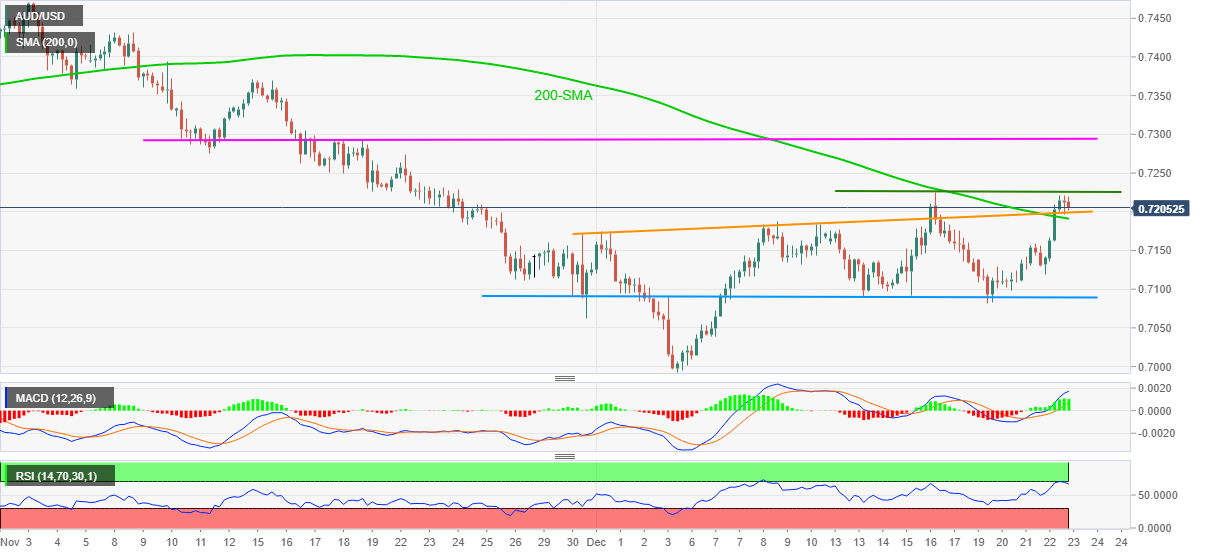
Trend: Pullback expected
The Santa Claus may be upon us after all. Markets thrive on the optimism that the wave of Omicron appears to be milder. The reports came out over a series of days and the upbeat sentiment was rehashed on Wednesday of news of preliminary studies published in the UK and South Africa.
Early evidence suggests fewer people are needing hospital treatment than with other variants - with estimates ranging from a 30% to a 70% reduction, the BBC reported.
However, the spread of the disease could overwhelm hospitals, the article warns as it notes that more than 100,000 cases have been reported in the UK in a single day for the first time.
Also, cases of omicron are doubling about every two days. In the past week, the percentage of omicron cases in the United States rose from 13 percent to 73 percent.
"The major question for everyone right now isn't whether omicron is going to hit their area. It will," said Dr. Michael Saag, an infectious disease expert and associate dean for global health at the University of Alabama at Birmingham.
"The question," he said, "is how much disease will it cause?"
The BBC wrote, ''a deeper understanding of the severity of Omicron will help countries decide how to respond to the virus.''
''The study in Scotland has been tracking coronavirus and the number of people ending up in hospital.
It said that if Omicron behaved the same as Delta, they would expect about 47 people to have been admitted to hospital already. At the moment there are only 15.
The researchers said they were seeing a roughly two-thirds reduction in the number needing hospital care, but there were very few cases and few at-risk elderly people in the study.''
Meanwhile, though much remains unknown about omicron, experts say the variant could lead to long Covid, even with a mild case. This means that patients with long-term symptoms can experience crushing fatigue, irregular heart rhythms and other issues months after their initial Covid infection.
Nonetheless, experts continue to urge people to get vaccinated and get a booster shot to reduce the risk for severe illness. Markets are of the opinion that vaccinations will contain the spread and US stocks closed near session highs.
The S&P 500 gained 1% to 4,696.56, the Nasdaq Composite rallied 1.2% to 15,521.89 and the Dow Jones Industrial Average gained 0.7% to 35,753.89. Pfizer rose after the FDA approved the covid-19 tablet for emergency use in the US.
One-month risk reversal on EUR/USD, a measure of the spread between call and put prices, prints the highest level since December 08 for Wednesday per data source Reuters.
A call option gives the holder the right but not obligation to buy the underlying asset at a predetermined price on or before a specific date. A put option represents a right to sell.
That being said, the daily difference between them rose to +0.038 at the latest, per Reuters.
It’s worth noting that the options market’s optimism could be witnessed in the EUR/USD price moves that rose the most in two weeks. However, the latest challenges to the risk appetite seem to test the pair buyers ahead of the key US data.
Read: EUR/USD Price Analysis: Bulls moving in on critical daily resistance area
- DXY pauses three-day downtrend, seesaws around weekly low.
- Break of 100, 200 HMAs favored bears earlier.
- Oversold RSI conditions may trigger corrective pullback, monthly support line also challenge further declines.
US Dollar Index (DXY) struggles to extend the previous three-day declines, taking rounds to 96.10 during Thursday’s Asian session. In doing so, the greenback gauge justifies the oversold RSI conditions near an ascending support line from November 30.
While the corrective pullback may initially aim for 96.20, a convergence of the 100 and 200-HMA around 96.35 becomes a tough nut to crack for the DXY bulls.
Should the quote rises past 96.30, the optimists won’t hesitate to challenge the descending resistance line from mid-December, around 96.55, a break of which will propel prices towards the monthly high of 96.91.
Alternatively, a clear downside break of the stated support line, around 95.95 by the press time, will direct the quote to December 16 lows near 95.85.
Following that, the November-end bottom of 95.55 and November 18 low near 95.50 will be important to watch for the bears.
DXY: Hourly chart
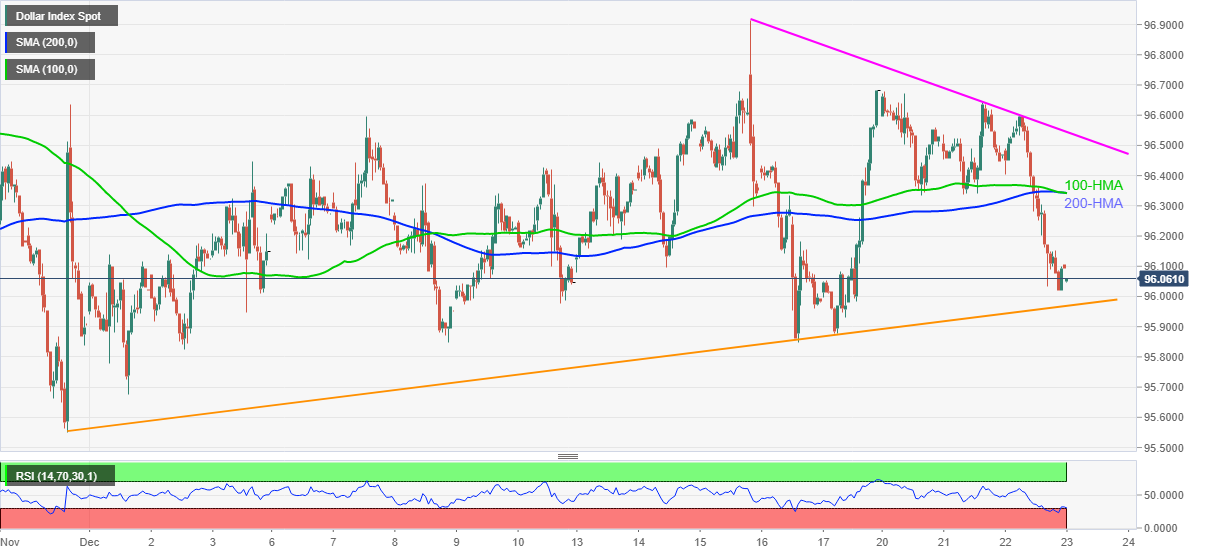
Trend: Corrective pullback expected
- USD/JPY picks up bids to reverse the previous day’s pullback from monthly high.
- US T-bond yields struggle to keep first daily loss in three, S&P 500 Futures fail to track Wall Street gains.
- Japan eyes $943 billion budget, 40-year bond issue despite targeting an overall reduction in JGB offers.
- Vaccine optimism fades with news from China, White House, US stimulus hopes prevail.
USD/JPY refreshes intraday top near 114.20 amid the initial hour of Thursday’s Tokyo open.
The yen pair failed to cheer risk-on mood the previous day amid the broad US dollar weakness. That said, the latest run-up could be linked to the market’s recheck of the previous sentiment-positive catalysts that test risk appetite ahead of the key US data. It’s worth noting that updates from Japan, mainly relating to the budget and bond issuance, have also been favoring the USD/JPY prices of late.
“Japan's government is set to unveil on Friday its largest-ever annual budget with $943 billion in spending for the fiscal year beginning in next April, further straining the industrial world's heaviest debt,” said Reuters while spotting a draft seen. On the same line were news stating, “Japan plans to issue 4.2 trillion yen ($37 billion) of 40-year government bonds in the new fiscal year, a 17% increase that comes even as the government plans to cut its bond issuance overall.”
Elsewhere, the White House fears over the availability of Pfizer’s pill to battle the Omicron that recently got the US Food and Drug Administration (FDA) approval challenge the earlier risk-on mood and probes US Treasury bond buyers, underpinning the USD/JPY upside. It’s worth noting that China’s biggest-ever lockdown, of around 13 million residents in Xi’an as stated by the Wall Street Journal (WSJ), also probes the previous decline of the US Treasury yields.
However, hopes of the US stimulus and firmer data challenge the pair buyers. White House spokeswoman Jen Psaki said, per Reuters, “We believe that Senator Manchin has been engaging with us over the course of time and months in good faith." On the other hand, US Q3 GDP rose past the 2.1% forecast to 2.3% whereas the CB Consumer Confidence for December came in better than upwardly revised 111.9 prior to 115.8.
Amid these plays, the S&P 500 Futures struggle to copy the Wall Street’s gains while the US 10-year Treasury yields seesaw around 1.457% after declining for the first time in three days on Wednesday.
Looking forward, USD/JPY traders may pay attention to the US PCE inflation and Durable Goods Orders for November but the key for fresh impulse will be risk catalysts.
Technical analysis
Wednesday’s Doji candlestick hints at a pullback towards the 50-DMA level surrounding 113.85. Even so, USD/JPY bulls remain hopeful until the quote stays beyond a three-week-old ascending support line, near 113.35.
- USD/CAD consolidates recent losses around one-week low, picks up bids of late.
- Market sentiment dwindles after initial risk-on mood, WTI crude oil struggles around two-week top.
- Omicron updates, US stimulus news to join November’s US Durable Goods Orders, PCE Inflation fresh impulse.
USD/CAD licks its wounds around 1.2850, after a two-day pullback from the yearly top. In doing so, the Loonie pair rise 0.12% intraday during Thursday’s Asian session.
The quote’s previous declines could be linked to the firmer prices of Canada’s main export item WTI crude oil, as well as risk-on mood. However, the latest challenges to the sentiment seem to have favored the USD/CAD consolidation.
That said, the WTI crude oil seesaws around $73.00 after rising in the last two days to refresh a fortnight peak.
After an initial optimism over the drug discovery and approval concerning the cure of Omicron, White raised doubts over the availability of the cheered medicines, per Financial Times (FT), which in turn questions the optimists. On the same line was the FT news saying, “France on Wednesday canceled its order of Merck’s drug after data showed it resulted in a reduction of only 30% in the risk of hospitalization and death, significantly lower than earlier expectations.”
On Wednesday, the US US Army conveyed positive updates for a single vaccine to battle covid and all variants while the US Food and Drug Administration (FDA) approved a pill from Pfizer to treat Covid-19.
Additionally favoring the risk-on mood was Reuters news that quoted White House spokeswoman Jen Psaki while saying, “We believe that Senator Manchin has been engaging with us over the course of time and months in good faith." It’s worth noting that Joe Manchin poured cold water on the face of stimulus expectations by being the only Democrat to oppose the much-awaited aid package that needs all the party members’ support to get through the house.
Given the firmer oil prices and risk-on mood, USD/CAD paid a little heed to the firmer US data. The US Q3 GDP rose past the 2.1% forecast to 2.3% whereas the CB Consumer Confidence for December came in better than upwardly revised 111.9 prior to 115.8.
It’s worth noting that the S&P 500 Futures struggle to copy the Wall Street’s gains while the US 10-year Treasury yields seesaw around 1.457% after declining for the first time in three days on Wednesday.
Looking forward, the monthly reading of Canadian GDP for November, expected 0.8% versus 0.1% prior, may entertain USD/CAD traders. Also important are the US PCE inflation and Durable Goods Orders for November. Above all, Omicron updates and oil prices moves will be critical to follow for clear direction.
Technical analysis
Despite the latest corrective pullback, USD/CAD prices stay below the 21-DMA and previous support line from December 08, respectively around 1.2850 and 1.2870. The same joins downbeat MACD and RSI signals to favor sellers.
| Pare | Closed | Change, % |
|---|---|---|
| AUDUSD | 0.72142 | 0.87 |
| EURJPY | 129.274 | 0.44 |
| EURUSD | 1.13281 | 0.37 |
| GBPJPY | 152.398 | 0.8 |
| GBPUSD | 1.33548 | 0.73 |
| NZDUSD | 0.68117 | 0.81 |
| USDCAD | 1.28359 | -0.59 |
| USDCHF | 0.91947 | -0.38 |
| USDJPY | 114.114 | 0.02 |
- Gold moves in on daily resistance since correcting from support.
- US dollar is lower and stocks were on Omicron optimism.
- The bulls are embarking on an upside extension with $1,830/50 eyed.
Gold, (XAU/USD), is better-bid following the rally from support on the daily chart which has taken the yellow metal back into the $1,800s. At the time of writing, the yellow metal is trading at $1,804.57 and bulls have eyes on the $1,830s and then the $1,850s for the days/weeks ahead.
The US dollar was lower which helped to lift gold prices due to the optimism that the Omicron coronavirus variant will not disrupt the economic recovery. According to early results from three trials, the omicron strain may be less likely to send people to the hospital than the delta strain.
North American government bonds had a slightly mixed performance and the 10-year US yields were declining. DXY weakened by 0.4% vs most other FX. Subsequently, US stocks closed near session highs. The S&P 500 gained 1% to 4,696.56, the Nasdaq Composite rallied 1.2% to 15,521.89 and the Dow Jones Industrial Average gained 0.7% to 35,753.89. Pfizer rose after the FDA approved the covid-19 tablet for emergency use in the US.
Meanwhile, as for US data, in November, sales of previously owned homes surged for the third month in a row, while Consumer Confidence increased more than expected in December as Americans' outlook for employment and the economy improved.
Looking forward, the yellow metal could begin to lose steam so long as Fed expectations remain as status quo, analysts at TD Securities argued. ''In this sense, omicron fears and their potential impact on the economy will be a key focus in the near-term, and we would likely need to see economic weakness generate doubts that the Fed will be able to deliver on their hawkish stance for the yellow metal to maintain the recent momentum.''
However, the analysts at TDS also stated that due to the recent Fed speak indicating that March is live, they continue to think risk/reward favours respecting that outcome and hence supporting USD firmness in the new year.
Gold technical analysis
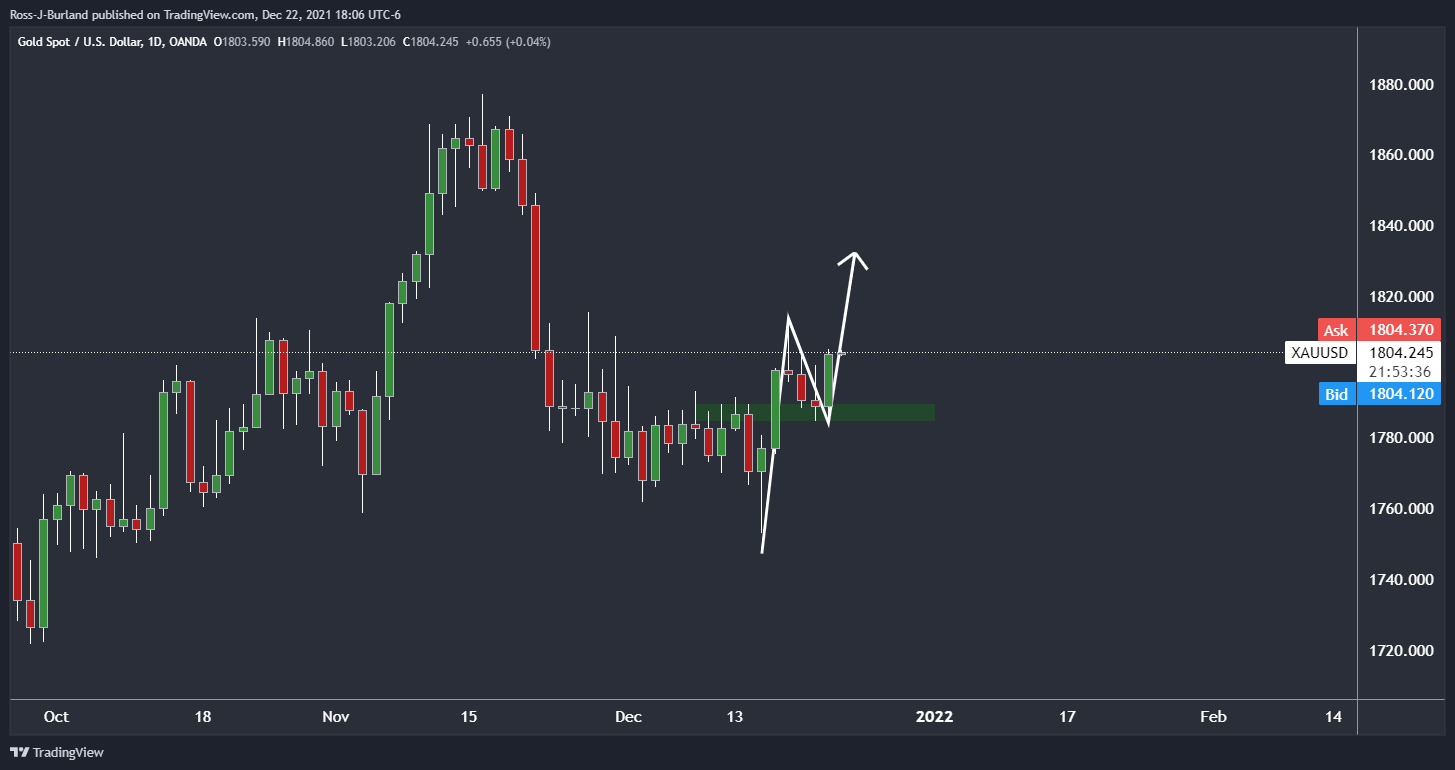
Following the correction to $1,785. The bulls are embarking on an upside extension with $1,830/50 eyed.







© 2000-2026. All rights reserved.
This site is managed by Teletrade D.J. LLC 2351 LLC 2022 (Euro House, Richmond Hill Road, Kingstown, VC0100, St. Vincent and the Grenadines).
The information on this website is for informational purposes only and does not constitute any investment advice.
The company does not serve or provide services to customers who are residents of the US, Canada, Iran, The Democratic People's Republic of Korea, Yemen and FATF blacklisted countries.
Making transactions on financial markets with marginal financial instruments opens up wide possibilities and allows investors who are willing to take risks to earn high profits, carrying a potentially high risk of losses at the same time. Therefore you should responsibly approach the issue of choosing the appropriate investment strategy, taking the available resources into account, before starting trading.
Use of the information: full or partial use of materials from this website must always be referenced to TeleTrade as the source of information. Use of the materials on the Internet must be accompanied by a hyperlink to teletrade.org. Automatic import of materials and information from this website is prohibited.
Please contact our PR department if you have any questions or need assistance at pr@teletrade.global.


 Bank
Bank transfers


