- Analytics
- News and Tools
- Market News
CFD Markets News and Forecasts — 19-07-2022
- AUD/USD is holding in bullish territory around 0.6900.
- RBA sentiment has boosted the Aussie this week so far.
AUD/USD has been consolidating around 0.6900 for the best part of New York day and in early Asia. The pair rallied on US dollar weakness on Tuesday but that came to a head at 0.6912 the high for the day.
Currently, the Reserve Bank of Australia's governor Phillip Lowe is speaking who says that there will be further increases to the cash rate for the months ahead. Traders are looking for any word of a 75bp hike from the governor but so far in the speech there has been no mention of such magnitude and AUD/USD is stuck around 0.6900.
The Aussie already climbed on Tuesday following the RBA's signal in its minutes that it is primed for further monetary tightening to add to its recent surprisingly large rate hike, as policymakers vowed to stay firm in their fight against soaring inflation. The board said the current level of interest rates "was still very low for an economy with a tight labour market and facing a period of higher inflation."
The governor touched on the recent Jobs data that was released last week. This showed net employment in Australia surged 88,400 in June from May, nearly thrice that of market forecasts of a 30,000 increase, while the Unemployment Rate dived to a 48-year low of 3.5%. Coupled with rising inflation risks on a global scale, the bias is on a firmer Aussie.
- The greenback bulls are facing barricades around 50% Fibo retracement at 0.9690.
- A death cross, represented by the 50- and 200-EMAs signal more downside ahead.
- The RSI (14) has shifted into the bearish range of 20.00-40.00.
The USD/CHF pair has moved gradually towards 0.9690 after an intraday low of 0.9673 in early Tokyo. The rebound seems less confident and may attract offers after experiencing momentum loss in a small timeframe. On Tuesday, the asset extended its losses after violating Tuesday’s low at 0.9731.
The availability of barricades around 50% Fibonacci retracement (which is placed from June 29 low 0.9495 to July 14 high at 0.9886) at 0.9690 indicates that a bearish reversal is highly confirmed. The pair extended its losses after slipping below 38.2% Fibo retracement placed at 0.9738.
A death cross, represented by the 50- and 200-period Exponential Moving Averages (EMAs) at 0.9765 adds to the downside filters.
Adding to that, the Relative Strength Index (RSI) (14) is oscillating in a bearish range of 20.00-40.00, which indicates more downside ahead.
A decisive move below Tuesday’s low at 0.9654 will further strengthen the Swiss franc bulls to drag the asset towards the round-level support at 0.9600, followed by July 4 low at 0.9562.
On the flip side, an upside move above July 13 low at 0.9758 will send the asset towards July 13 high at 0.9827. A breach of the latter will drive the asset towards July 14 high at 0.9886.
USD/CHF hourly chart
-637938705587378482.png)
Developing story
Reserve Bank of Australia's governor, Phillip Lowe, is speaking on topics related to Inflation, Productivity and the Future of Money. The event is ''The Australian Strategic Business Forum – Melbourne''.
The event can be listened to here.
Key comments so far
- Stronger productivity growth is likely to mean a higher neutral real interest rate.
- Recent trends in productivity growth have not been particularly encouraging.
- CPI for the june will show a further step-up in the inflation rate, another step-up is expected later this year.
- We don't need to return inflation to target immediately.
- Possible to do this, but the path ahead is a narrow one and it is clouded in uncertainty.
- Emphasise that the concept of the neutral rate is no more than one reference point for the board.
- Neutral is not the basis of a mechanical rule and we are not on a pre-set path to achieve any specific level of the cash rate
- Board expects that further increases will be required over the months ahead
Meanwhile, AUD/USD is a touch higher on the day so far by 0.15% and oscillates at around 0.6900.
- GBP/USD has recaptured the psychological resistance of 1.2000 amid a positive market mood.
- Lower earnings and higher inflation rates may create more hitches for the households in the UK.
- Declining inflation expectations in the US may hurt DXY further.
The GBP/USD pair has rebounded firmly after picking bids below 1.2000 in the early Tokyo session. The cable has remained in the grip of bulls amid a risk-on market impulse, which has improved the favorability of the risk-perceived assets.
The pound bulls have remained upbeat on Tuesday despite the release of the subdued UK employment data. The Unemployment Rate remained flat at 3.8%. However, the Claimant Count Change tumbled to 20K from the prior release of -34.7k.
The catalyst that is haunting the market participants is the downbeat Average Hourly Earnings, which plunged to 6.2% from the expectations of 6.9% and the prior release of 6.8%. The investing community is aware of the fact that the UK economy is facing the headwinds of higher price pressures led by higher energy bills and food prices. Lower earnings along with price pressures are going to hurt the sentiment of the market participants dramatically.
Meanwhile, the US dollar index (DXY) is likely to see more downside as inflation expectations to trim further amid vulnerable oil prices in July. This has trimmed expectations for a 1% rate hike by the Federal Reserve (Fed) in its July monetary policy meeting.
In today’s session, the release of the UK Consumer Price Index (CPI) will be of utmost importance. The economic data is seen at 9.3%, higher than the prior release of 9.1%. However, the core CPI that excludes oil and food may trim to 5.8% by 10 bps from its prior release.
- EURUSD price is juggling in an 11-pips range as bulls are gearing up for a further upside.
- Dollar sell-off is expected to continue further as inflation is expected to reach its full potential sooner.
- First-time rate hike by ECB in 11 years will trim the Fed-ECB policy divergence.
EURUSD price has turned sideways after a perpendicular upside move recorded on Tuesday from a low of 1.0119. The asset is displaying back and forth moves in a narrow range of 1.0222-1.0233 and is expected to resume the north-side move amid broader strength in the shared currency bulls. The pair has recorded a fresh weekly high at 1.0270 and may extend its gains after violation of the same.
Meanwhile, the US dollar index (DXY) has established below 107.00 comfortably. The DXY witnessed a steep fall on Tuesday after violating Monday’s low at 106.89. The asset has shifted into a consolidation phase and is displaying topsy-turvy moves in a range of 106.40-106.78. It is worth noting that the asset has registered a fall of more than 2.60% from its recent 19-year high of 109.30. Considering the downside momentum, more losses are on the table and the asset may find a cushion around 105.50.
Also Read: EUR/USD Forecast: Bears on pause ahead of the ECB

ECB President Christine Lagarde to elevate interest rates by 25 or 50 bps
Dollar sell-off to continue as inflation sees peak
The DXY is expected to continue its downside rush as the market participants are expecting that inflation has reached its potential. Oil prices have remained vulnerable in the month of July and lower valued ‘paychecks’ received by the households have forced them to drop their consumption quantity-wise. A slippage in overall demand and oil-driven inflation will result in a lower inflation rate.
Odds of a 1% rate hike by the Fed have tumbled
The chances of a 100 basis points (bps) rate hike announcement by the Federal Reserve (Fed) have tumbled as long-run inflation expectations have slipped to 2.8% from the June print of 3.1%. As per CME’s FedWatch Tool, the expectations of a rate hike by 1% were as high as 80% last week, which have trimmed to near 30%. This has been a major reason behind the firmer rally in the EURUSD price.
S&P Global PMI to remain in focus
Due to a light economic calendar this week, investors’ focus will remain on the release of the S&P Global PMI data. As per the market consensus, the economic catalysts are expected to deliver a weak performance. The Global Composite data is seen at 51.7, lower than the prior release of 52.3. The Manufacturing PMI may slip to 52 vs. 52.7 recorded earlier. While the Services PMI is expected to display a mild correction to 52.6 against the former figure of 52.7. This will keep the DXY on the back foot and may support the shared currency bulls.
-637938667011795607.png)
EURUSD price to benefit from hawkish ECB bets
EURUSD price is going to remain upbeat as investors are expecting a rate hike by the European Central Bank (ECB) on Thursday. The central bank is keeping a neutral stance on the interest rates for the past 11 years. A rate hike by 25 or 50 basis points (bps) is expected this time as investors believe that the ECB is left with no other alternative than to paddle up its borrowing rates in order to fix the inflation mess. A rate hike announcement by the ECB will trim the Fed-ECB policy divergence.
EURUSD technical analysis
EURUSD is forming a Bullish Flag on an hourly scale that signals an inventory distribution after a sheer upside move. The ongoing inventory distribution in a range of 1.0221-1.0268 is indicating the execution of longs by those market participants, which prefer to enter a trend after the establishment of a bullish bias.
Advancing 20- and 50-period Exponential Moving Averages (EMAs) at 1.0217 and 1.0173 respectively add to the upside filters.
Also, the Relative Strength Index (RSI) (14) is oscillating in the 60.00-80.00 range, which signals the continuation of a bullish momentum ahead.
A breach of Tuesday’s high at 1.0269 will drive the asset towards the round-level resistance at 1.0300, followed by July 1 low at 1.0366.
Alternatively, the greenback bulls could gain control if the asset drops below Monday’s low at 1.0081. An occurrence of the same will drag the asset towards the psychological support at 1.0000. A breach of the psychological support will expose the greenback bulls to recapture its two-year low at 0.9952.
EURUSD hourly chart
-637938665542055408.png)
Elliott Wave Trading Strategies: DAX 40, FTSE 100, STOXX 50, DXY, EUR/USD
- GBP/JPY extends its weekly rally for three consecutive days, up 0.90%.
- Positive UK economic data, alongside a break above Tuesday’s Asian high, exacerbated a test of the 166.00 figure.
- GBP/JPY Price Analysis: Approaches a break above a two-month-old downslope trendline; otherwise would fall towards the 20-day EMA around 164.40s.
The GBP/JPY rises for six straight days as Wednesday’s Asian Pacific session begins, with the GBP/JPY barely up by 0.06%, courtesy of positive UK economic data, to the detriment of the Japanese yen, pressured by an upbeat market mood, and higher US Treasury yields. At the time of writing, the GBP/JPY is trading at 165.80.
GBP/JPY Price Analysis: Technical outlook
GBP/JPY Tuesday’s price action depicts the pair opening near the daily pivot point at 165.00, followed by a fall below the 20-hour EMA, on the way to the daily low at 164.71, capping the fall just above the 50-hour EMA. Then, the GBP/JPY bounced off and rallied above 165.00, back above the 20-day EMA, and on its way up, hit a daily high at around 166.00 before easing towards current levels.
GBP/JPY Daily chart
The GBP/JPY depicts the pair as upward biased, with the daily moving averages (DMAs) below the exchange rate and about to break a two-month-old downslope trendline, above the 166.00 mark. Additionally, the GBP/JPY’s RSI at 58.29 suggests further upside, but its slope begins to shift almost horizontally, meaning buying pressure tempering ahead of the previously-mentioned trendline.
Using the above mentioned as a base case scenario, the GBP/JPY first resistance would be 166.00. A breach of the latter will expose June’s 28 high at 166.94. once cleared, the cross-currency will aim towards June’s 22 swing high at 167.85.
On the other hand, if GBP/JPY sellers step in, the first support would be the figure at 165.00. A decisive break will send the pair towards the 20-day EMA at 164.38, followed by the 50-day EMA at 163.25.
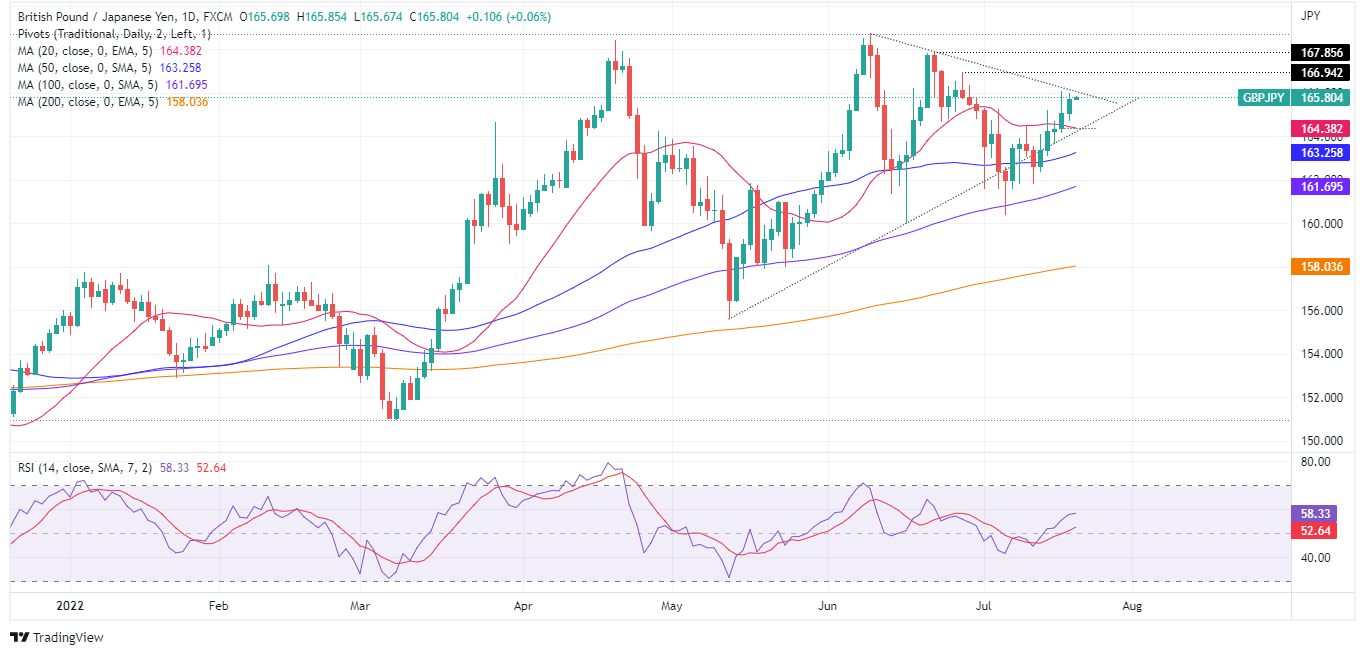
GBP/JPY Key Technical Levels
- The USD/JPY break below the rising wedge might open the door for additional losses.
- USD/JPY Price Analysis: A break below 138.00 could send the pair towards 133.21, just below the rising wedge’s target.
The USD/JPY snaps two consecutive days of losses and remains subdued, recording a minimal gain of 0.05%, amidst an upbeat market mood after investors shrugged off recession fears, as US companies reported earnings, which had shown some resilience, even though the Federal Reserve is hiking rates aggressively. At the time of writing, the USD/JPY is trading at 138.16.
USD/JPY Price Analysis: Technical outlook
The USD/JPY Tuesday’s price action witnessed the pair opening near the highs of the day at 138.12 but tumbled as risk appetite shifted sour towards the 200-hour EMA at 137.51, which also intersected around that area with the S2 pivot point. The major bounced off those lows and rose to the daily pivot point at 138.20.
USD/JPY Daily chart
From a technical perspective, the USD/JPY is upward biased, but a break below the rising wedge, achieved on Tuesday, might open the door for further downside. USD/JPY traders should be aware that the Relative Strength Index (RSI) exited from overbought conditions and is in bullish territory but crossed below the RSI’s 7-day SMA, meaning it has a bearish reading.
If the USD/JPY accelerates downwards and sellers break the 138.00 figure, that would open the door for further losses. That said, the USD/JPY first support would be the 20-day EMA at 136.60. Break below will send the pair sliding to the July 1 low at 134.74, followed by the 50-day EMA at 133.21.
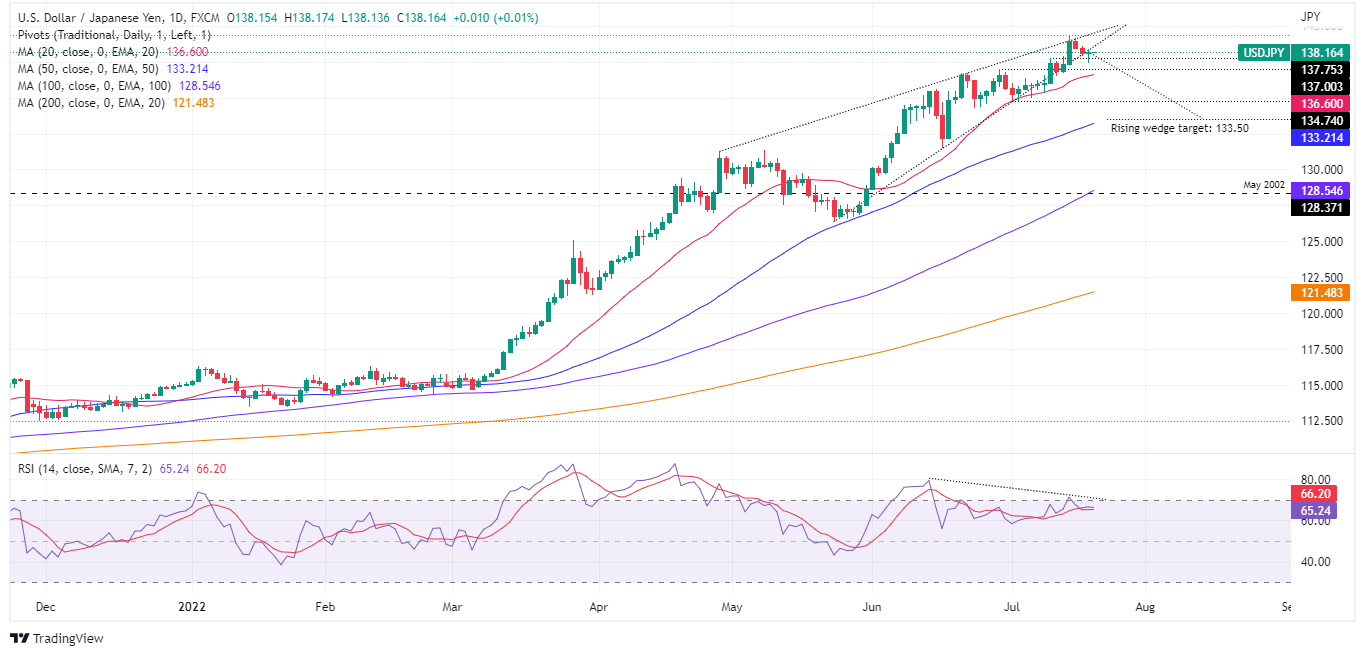
USD/JPY Traders Sentiment
Ahead of official government data on Wednesday, the privately surveyed oil stock data has been released:
Crude +1.860M vs. +1.4M barrels expected.
Gasoline +1.290M vs. +0.1M bbls expected.
Distillate -2.153M vs +1.2M expected.
Cushing +0.523M.
- NZD/USD holds in positive territory ahead of the RBNZ and Fed.
- The possibility that the RBNZ hikes by 75bps in August cannot be ruled out.
NZD/USD was a significant amount higher on Tuesday reaching its best level since around the 4th July US holidays. The pair rallied from 0.6114 to 0.6240 and traded into the Wall Street close some 1.15% higher.
''Markets trended higher overnight as investors now fear markets may have over-assessed the risk of recession,'' analysts at ANZ bank explained. This led to broad US dollar weakness with Fed speakers in the blackout period ahead of next week’s FOMC meeting and a growing consensus that the Fed may be priced too aggressively in money markets.
The US 10-year yield was up 1.24% to 3.026% turning higher into the final hours of North American trade as the S&P 500 burst into life for a close to 3% day in the green with high beta currencies, such as the kiwi, following in tow.
Meanwhile, it could be a quieter day in Asia with a lack of top-tier events scheduled. Still, if APAC equities take a leaf out of Wall Street, then that should be supportive for the antipodeans.
Meanwhile, the sentiment that surrounds the Reserve Bank of New Zealand that has been elevating the kiwi is here to stay. The Analysts at ANZ Bank who are anticipating a 50 bps hike said the possibility that the RBNZ hikes by 75bps in August cannot be ruled out. ''The second quarter labour market statistics on August 3 will be watched very closely.''
- WTI is advancing during the week and is erasing last week’s losses, gaining almost 7%.
- A risk-on impulse augmented the appetite for the black gold, which remained below $100 for three days.
- WTI Price Analysis: It is upward biased, and if buyers reclaim $104.00, that would open the door for further gains.
Western Texas Intermediate, also known as WTI, rallied sharply on Tuesday, almost 2% amidst an upbeat market mood, despite Monday’s Apple news that will halt hiring, viewed by investors as recession fears increasing amongst US companies. However, investors shrugged off those worries and are lifting US crude oil prices. At the time of writing, WTI is trading at $104.08 BPD.
Investors’ sentiment remains positive as US equities rise. A softer US Dollar and supply fears due to the Russian oil embargo bolstered the black gold. Oil markets have been trading volatile in recent weeks, as fears of a worldwide recession would diminish demand, but also weighed by a strong US Dollar.
In the meantime, US President Joe Biden’s visit to Saudi Arabia did not result as expected. Saudi ministers insisted that policy decisions would be taken according to supply and demand and within the OPEC+ members’ agreements.
In the meantime, a power outage at a pump station in South Dakota disrupted oil delivery from Canada to the US -via the Keystone pipeline-and propelled traders to bid up WTI price.
WTI Price Analysis: Technical outlook
From a technical perspective, WTI is upward biased, as shown by the daily chart. The US crude oil is trading within a $10.00 range, supported by the 200-day EMA at $94.41 on the downside, while on the upside, the 20-day EMA at $103.68, initially was resistance. However, a leg up towards the daily high at around $104.44 shifted the 20-day EMA from a resistance level to support.
Therefore, the WTI path of least resistance is headed upwards. That said, the WTI's first resistance would be the July 8 high at $105.21. Break above will expose the 100-day EMA at $107.62, followed by the 50-day EMA at $110.12.

What you need to take care of on Wednesday, July 20:
The American dollar remained under selling pressure, falling to fresh July lows against most major rivals. The dollar sell-off was coupled with some optimistic news coming from Europe.
The EUR/USD pair soared to 1.0268 on headlines suggesting the European Central Bank could discuss a 50 bps rate hike when it meets this week. Additionally, the European Commission has decided to ease some of the sanctions on Russian banks to allow food trade. Finally, headlines suggested that Russian gas giant Gazprom would resume its gas provision to the EU as planned on July 21. Overall, recession concerns cooled a bit, but the picture is still gloomy, and optimism may soon fade.
Bank of England Governor Bailed said that if they see signs of greater persistence of inflation, and price and wage setting are such signs, they would have to act “forcefully.” GBP/USD surged to 1.2045 but settled a few pips below the 1.2000 threshold. UK employment figures were generally positive, as the unemployment rate held steady at 3.8% while the number of people claiming unemployment benefits decreased to -20K.
The dollar edged lower vs the CHF, with the pair plunging to 0.9652. USD/JPY posted a modest advance and settled at 138.19. Commodity-linked currencies were firmly up on the day, with the AUD/USD pair trading around the 0.6900 figure and USD/CAD pressuring daily lows in the 1.2870 price zone.
Gold Price remained unchanged for a third consecutive day, trading around $1,710 a troy ounce. Oil prices were up, with WTI now at $100.60 a barrel.
Stocks posted substantial gains in Europe and the US, hinting at gains in their Asian counterparts.
The US Treasury yield curve, however, remains inverted.
Top 3 Price Prediction Bitcoin, Ethereum, Ripple: Making profit vs chasing profit
Like this article? Help us with some feedback by answering this survey:
- USD/CAD's broadening formation on the daily chart is compelling.
- USD/CAD could be on the verge of a significant move lower.
USD/CAD has moved in on a monthly price imbalance to fill the void which raises the prospects of a move lower according to lower time frame broadening formations as illustrated in the following charts:
USD/CAD monthly chart
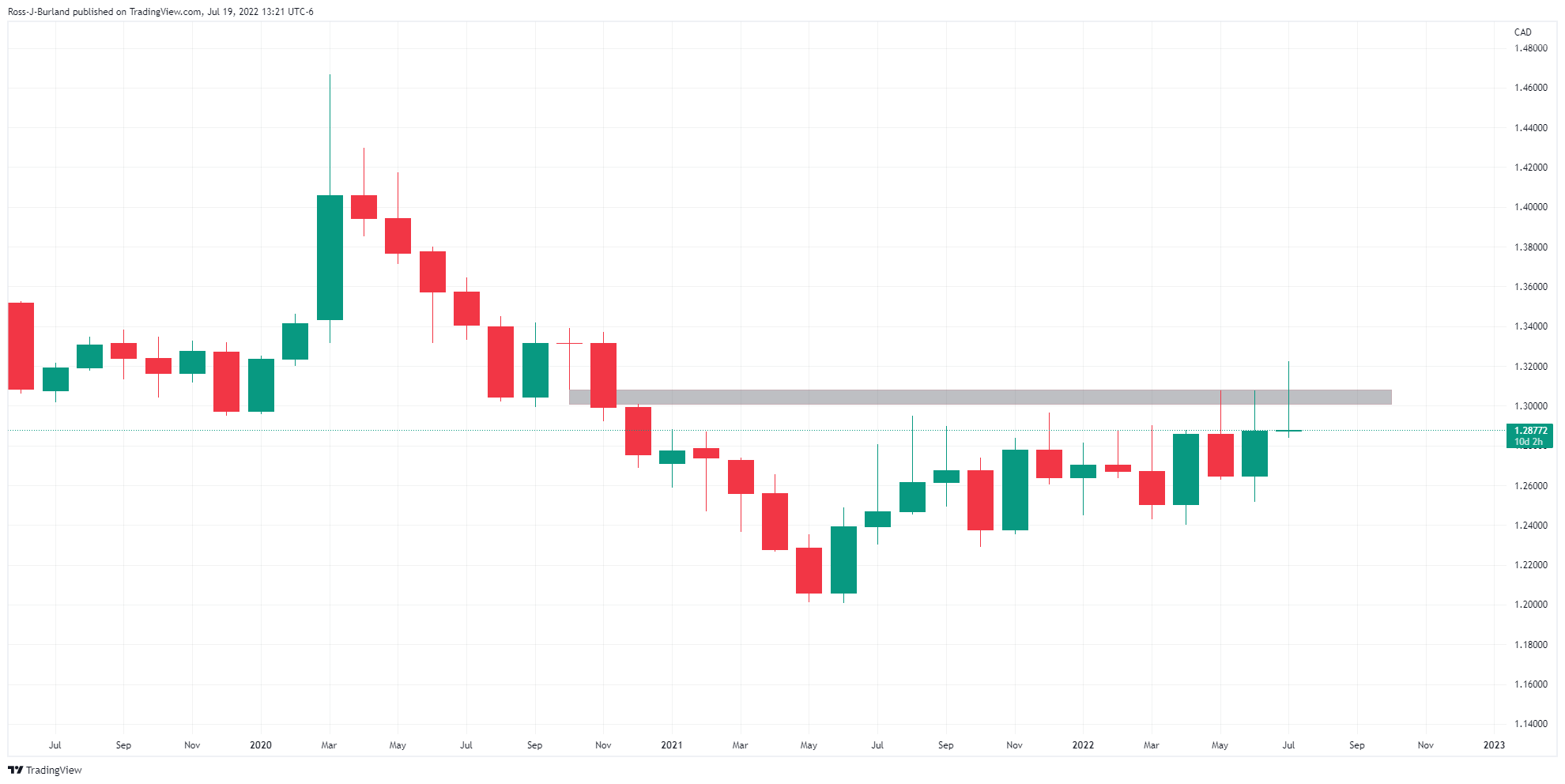
The wicks on the last few months not only represent a price extreme on lower time frames but have mitigated a price imbalance from the November 2020 supply. This leaves scope for a move to the downside for the foreseeable weeks and days ahead.
USD/CAD daily chart
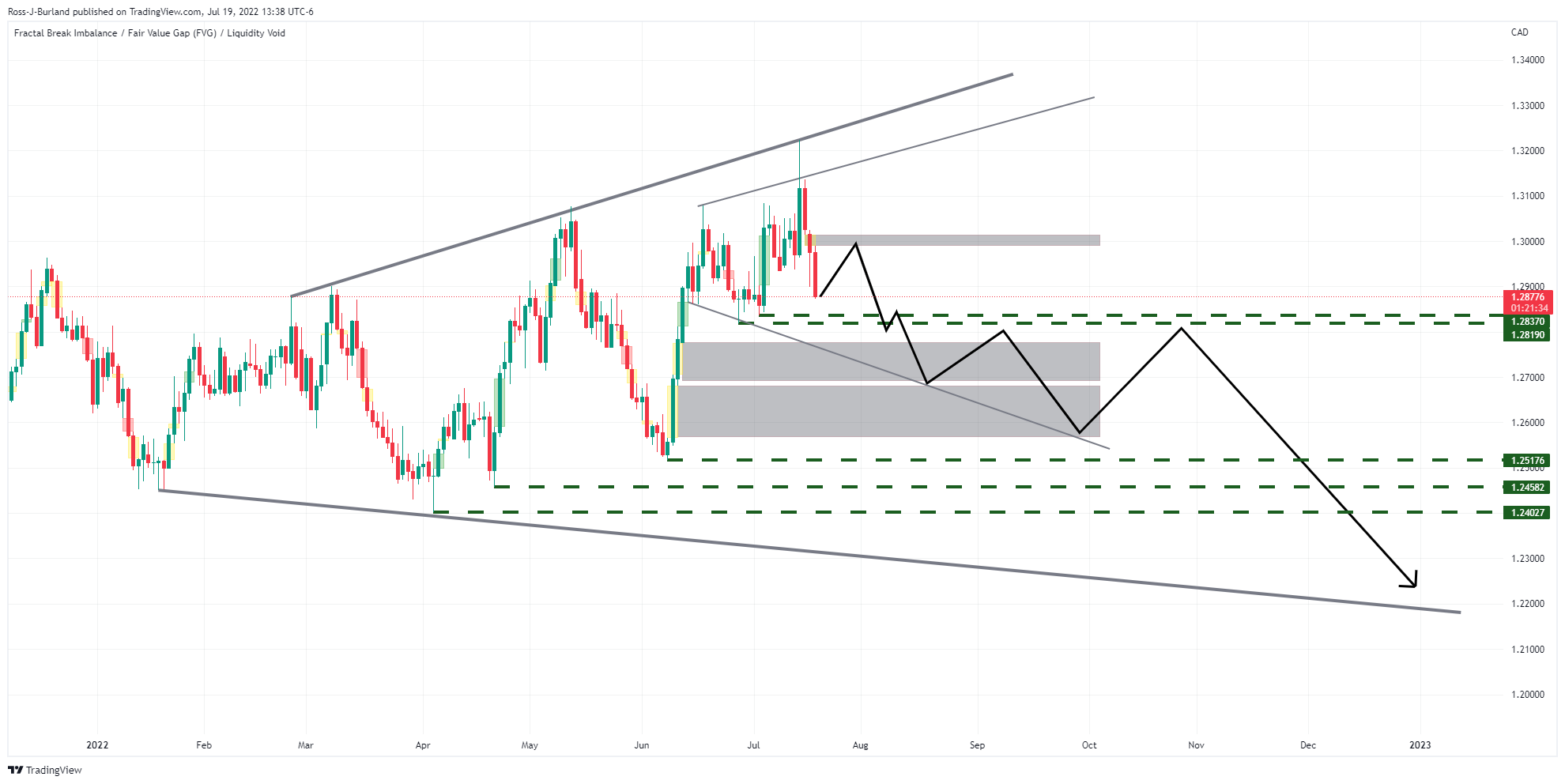
As illustrated above, the increasing price volatility can be shown as two diverging trend lines, one rising and one falling and here we have a broadening formation within another. The great areas are price imbalances that would be expected to be mitigated in time to come. The emphasis in the diagram above is to the downside with price exhaustion at the top of the expanding range and volatility and a void of price action to the downside.
The pivot points at 1.2837 and 1.2819 could be important for the days ahead. If they were to give way, then the focus will be on mitigation of the price imbalance from the bullish impulse. This leaves 1.26 the figure vulnerable for the days ahead. The pivots thereafter will be critical in defending against an expansion of the price below 1.2400.
- Gold Price is bid as bulls move in for the kill following extreme supply.
- A 50% mean reversion on the weekly chart is eyed.
- Federal Reserve sentiment, ECB and US data are all eyed as potential catalysts.
Gold price leans bullish with time frame continuity in the favour of the bulls as XAUUSD inches higher within a bullish correction of the recent leg of supply from $1,750 that took out the $1,700 level last week. However, in general, a pullback in the US dollar continues to support the gold price as investors move to the sidelines ahead of key central bank meetings.
US dollar pauses for breath below a 20-year peak
The US dollar rested on Tuesday below the 20-year highs, as per the DXY index, as it corrects towards a potential area of support in the longer-term time frames, an area that XAUUSD traders will be watching. The index, which measures the greenback vs. a basket of currencies has moved in on the 50% mean reversion level of the last weekly bullish impulse.
Read more: US Dollar Index outlook: Dollar remains at the back foot on calmer tones from Fed
From a daily perspective, the price is hovering over a void of offers that leaves 105.27 vulnerable should DXY bears continue to hit the bids. Gold traders will be keeping a close eye on price action at this juncture. As for catalysts that could tip the balance, the biggest risk to the US dollar and the gold price this week might well be the European Central Bank, ECB, on Thursday, although US PMI Surveys for July will be keenly watched ahead of the Federal Reserve meeting next week.
ECB and US PMI Surveys are key

ECB President, Christine Lagarde
The ECB and US PMI Surveys have the potential to kick start moves in the gold price. The ECB has firmly telegraphed a 25bps rate hike and while it is unlikely to surprise, the meeting will coincide with news related to the Nord Stream pipe. After a shutdown, gas is supposed to resume flowing. However, Berlin is growing concerned that Moscow may not resume the flow of gas as scheduled. Russia's Gazprom declared force majeure on gas supplies to Europe to at least one major customer, in a letter dated July 14 and seen by Reuters at the start of this week.
Heated inflation risks had already seen money markets punting for a half-point hike. The uncertainty is indeed a cloud over the ECB event. However, if the central bank goes ahead with a rate hike, be it 25 or 50bps, regardless, it will be the first time in more than a decade and the outcome of the event could have a material impact on the euro, US dollar and gold price.
As for US PMIs, analysts at TD Securities explained ''business surveys fell markedly in June, led by broad declines in the S&P Global PMIs. The mfg index, in particular, posted a large retreat to 52.7 from 57.0 in May.''
-637938532289769428.png)
''While we look for relief in the pace of declines in the mfg PMI, we still expect it to register a new drop in the flash estimate. Conversely, we expect a steady number for the services index after recent declines.''
Fed day looms
The Federal Reserve is around the corner. It will take place on July 26-27 and for the time being, ''gold prices are being supported by the markets' repricing for odds of a 100bp hike after Fedspeak from notable hawks has pushed back against this narrative, which is raising the risk of a near-term short-squeeze,'' analysts at TD Securities argued. ''Notwithstanding, this scenario would create the ideal set-up for additional downside in the yellow metal.''
Gold price technical analysis
Gold price, from a weekly perspective, the bull correction is underway. However, the monthly lows of $1,676.86, as illustrated on the chart below, could come within reach sooner than later:
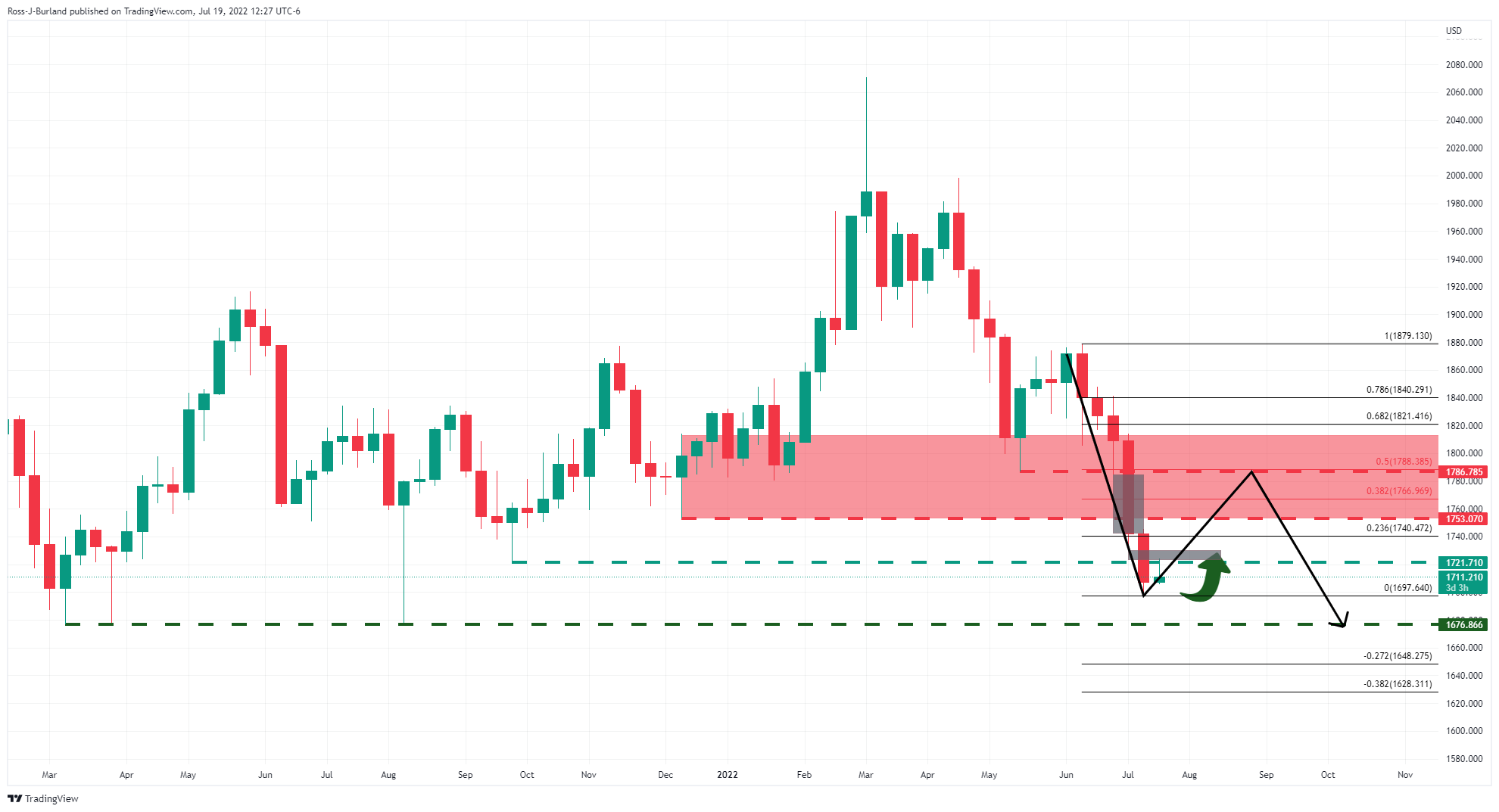
The grey areas on the chart above are void of bids which could draw in the gold price to test the commitments of bears in a 50% mean reversion. On the way there, however, we have a couple of major pivot points that could offer resistance at $1,721 and $1,753.
- Silver extends its gains to three straight days but remains beneath $19.00.
- The white metal remains on the defensive as US Treasury yields rise.
- Silver Price Forecast (XAGUSD): Buyers need to reclaim $20.46; otherwise, downside risks remain.
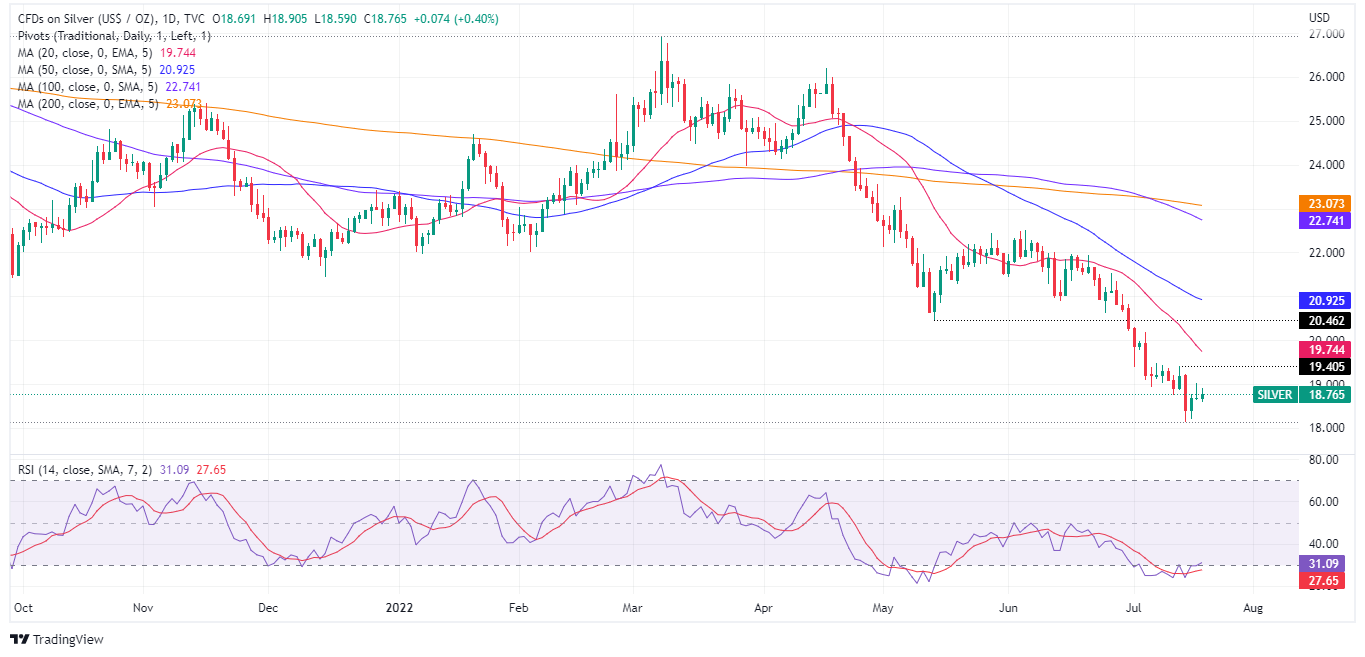
Silver (XAGUSD) seesaws around $18.76 amidst a risk-on impulse that kept the white metal almost unchanged, despite broad US dollar weakness, which usually lifts precious metal prices, but higher US Treasury yields put a lid on XAGUSD price. At the time of writing, XAG USD is trading at 18
XAGUSD began Tuesday’s trading session around $18.69 but dipped towards the daily low at $18.50 before bouncing off to the confluence of the 200-hour EMA and the R1 pivot daily high at around $18.90-95. Nevertheless, once the dust settled, the XAGUSD retreated to current levels. At the time of writing, XAGUSD is trading at $18.76.
XAGUSD is almost unchanged due to high US bond yields
Global equities are trading in positive territory, shrugging off Apple’s news that will slow hiring. US corporate earnings dominate the headlines, particularly what they are expressing in the earnings calls that could update businesses’ outlooks amidst a global central bank tightening. In the meantime, the US Dollar Index continues its nose-dive, losing 0.70%, sitting at106.662.
In the meantime, XAGUSD remains on the defensive due to US Treasury yields, led by the US 10-year benchmark note rate, which yields 3.012%, gaining three bps. Additionally, US Real yields, as depicted by the US 10-year TIPS, sit at 0.614%, up almost three bps.
Data-wise, the US economic docket featured US housing data, showing an ongoing slowdown in higher mortgage rates, sparked by the US Federal Reserve lifting rates. US Housing Starts shrank by 2% MoM in June, while Building Permits followed suit, contracting 0.6%. At the time of writing, a 30-year fixed-rate mortgage sits at 6%, up from 3.3% at the beginning of the year.
What to watch
In the week ahead, the US economic docket will feature Existing Home Sales expected to contract, in line with Housing Starts and Building Permits.
Silver Price Forecast (XAGUSD): Technical outlook
Silver (XAGUSD) remains downward biased. The daily EMAs above the spot price confirm the aforementioned. Furthermore, XAGUSD’s price action remaining below the May 13 cycle low at $20.46 keeps the white metal exposed to selling pressure unless XAGUSD buyers reclaim the previously mentioned price level.
IF XAGUSD would like to reclaim $20.46, first, they need to conquer the $19.00 figure. Once cleared, the next resistance would be the 20-day EMA at $19.74, followed by the $20.00 figure. A breach of the latter will send silver towards $20.46. Otherwise, XAGUSD’s first support would be YTD low at $18.14. Once cleared, the next support would be $18.00.
- GBP/USD is recording solid gains in the week of 1.19%.
- BoE’s Governor Bailey said that 50 bps rate hikes are on the table in the next meeting.
- GBP/USD Price Analysis: Upside pressure if buyers reclaim the 50-DMA, followed by 1.2400; otherwise, downside risks remain.
The GBPUSD grinds higher during the New York session, extending its rally to three straight days after falling close to 3.50% during the month, though the major trimmed some of its losses, thanks to a goodish UK employment report, a risk on impulse, and also to BoE’s Governor Andrew Bailey stating that 50 bps will be on the table for the next meeting.
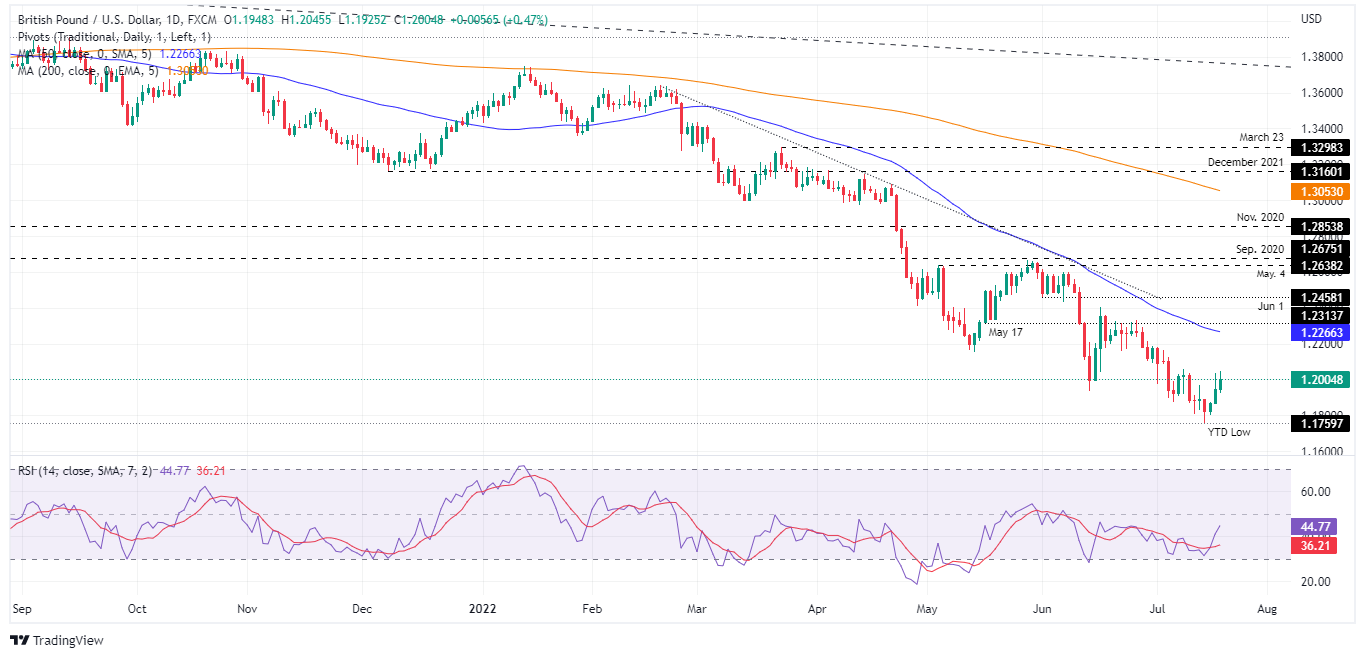
The GBP/USD opened near 1.1940s before sliding to the daily lows around 1.1920. However, the factors abovementioned lifted the pair towards its daily high at 1.2040 before retreating to current price levels. At the time of writing, the GBP/USD is trading at 1.2004, up 0.46%.
GBP/USD rises on upbeat UK data and a weaker US dollar
Global equities are taking advantage of risk appetite. The GBP/USD got boosted by the greenback, which remains heavy, as depicted by the US Dollar Index, stumbling below the 107.000 mark, down by 0.73%. US Treasuries followed suit, with the US 10-year Treasury yield rising above the 3% threshold, signaling that US bond sellers are in control.
On Tuesday, the Bank of England Governor Andrew Bailey said that a 50 bps rate increase would be among the choices while also commenting that the BoE Monetary Policy Committee (MPC) will begin to discuss a strategy to sell gilts in the Asset Purchase Facility (APF) portfolio.
In the meantime, during the European session, UK employment data was released. The Office for National Statistics (ONS) reported that 296K new jobs were added to the UK economy, exceeding expectations. At the same time, the Unemployment rate remained steady at around 3.8% YoY in the three-month average. Average earnings, including bonuses, rose less than estimated.
Elsewhere, the US economic docket featured June’s US Housing starts, which dropped 2% MoM showing signs of softening caused by an aggressive tightening of the Federal Reserve. Following suit was Building Permits, which shrank by 0.6% on its June reading,
What to watch
In the week ahead, the UK economic docket will feature inflation readings, namely consumer, producer, and retail price indices. On the US front, the calendar will be light, with the release of Existing Home Sales expected to contract, in line with Housing Starts and Building Permits.
GBP/USD Price Analysis: Technical outlook
The GBP/USD remains downward biased, despite recording a leg-up towards a fresh two-week high. The daily moving averages (DMAs) staying above the exchange rate, alongside an exchange rate below June 16 high at 1.2406, will keep the major vulnerable to selling pressure.
If GBP/USD buyers would like to regain control, they would need to reclaim the 50-day moving average (DMA) at 1.2266 to challenge the June 16 daily high at 1.2406. On the flip side, the GBP/USD first support would be 1.2000. Break below will expose the July 18 swing low at 1.1925, followed by a test of the 1.1900 figure.
The European Central Bank meeting on Thursday is grabbing more attention amid rising speculations about a 50 basis points rate hike. According to analysts from TD Securities, the EUR/USD is showing a buy-the-rumour, pattern and they warn this week could be a pretext to reinstate short positions from large investors.
Key Quotes:
“EURUSD is displaying classic signs of a buy-the-rumor/sell-the-fact dynamic. As we warned last week, we were wary of 'ECB sources' stories emerging ahead of the decision to help manage expectations. Given EUR's flirtation below parity, we thought a short-squeeze was likely.”
“Speculation has grown that the ECB may deliver 50bp hike instead of the 'intended' 25bp. Given how far behind the curve the ECB is, it is prudent to respect this 'surprise' scenario. It is the first line of defense to stave off a weak euro. But, it would pull forward the ECB's limitations to hike aggressively later in its cycle as energy constraints intensify. We think a pushback on 100bp hike by Fed officials was partially to offer relief to the euro. But, as we have noted recently, the implosion of the current account will be hard to ignore.”
“There is concern that the anti-fragmentation tool will not be ready this week. We think it must be to begin lifting rates, or else it risks peripheral spread widening. The ECB suffers from institutionalized dovishness, so this week could be a pretext to reinstate shorts. 1.0340-1.0400 in EURUSD as key lines in the sand.”
- US dollar consolidates daily losses for the third consecutive day.
- Risk appetite weighs on the greenback, S&P rises 1.97%.
- AUD/USD back above key SMA, breaks short-term downtrend line.
The AUD/USD climbed above 0.6800 for the first time in more than two weeks, supported by a weaker US dollar and as stocks rise 2% in Wall Street.
From RBA to risk appetite
Early on Tuesday, the Reserve Bank of Australia (RBA) released the minutes of its latest policy meeting. The central bank noted that the current level of the cash rate is well below the lower range of estimates for the nominal neutral rate. This suggests that further increases in interest rates will be needed to return inflation to the target over time.
“Given the rapid fire developments and stronger data outcomes, this implies that the RBA's forecast rate path is unlikely to resemble anything like 'business as usual' as the RBA Governor may have preferred. As such, we will watch for his replies on the possibility of a 75bps move at the August meeting”, explained analysts at TD Securities.
The minutes offered a modest impulse to the aussie that later received a stronger boost from a board-based dollar slide. The greenback continues to correct lower from multi-year highs as market sentiment improves further.
The AUD/USD peaked during the American session at 0.6908, reaching the highest level in twenty days.
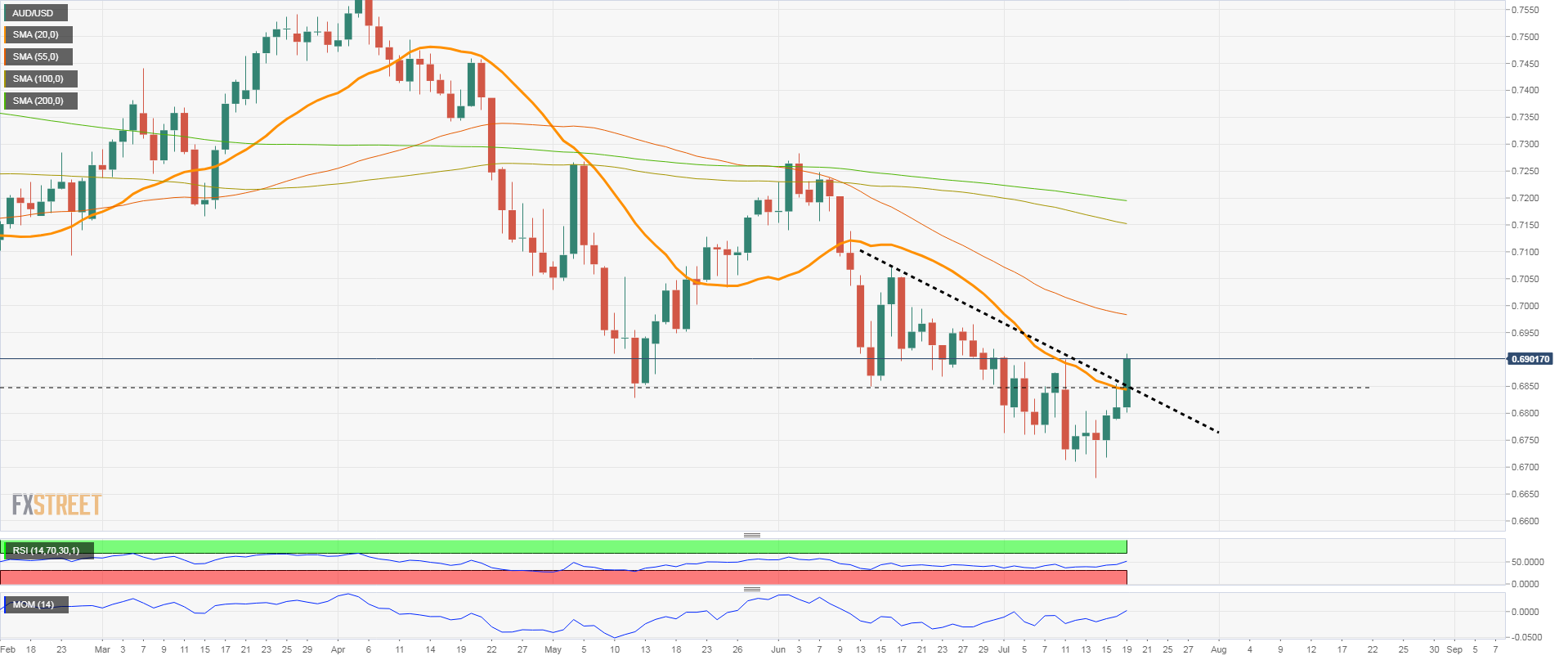
Back above the 20-day SMA
The current rally pushed the price above the 20-day Simple Moving Average and of a short-term downtrend line. While above 0.6840, the outlook seems positive for the aussie. A slide below would point to further weakness, possibly falling to 0.6760.
The daily chart shows the RSI and Momentum moving higher, supporting the current recovery from multi-year highs.
AUD/USD daily chart
- EURUSD climbs above the 1.0200 figure, extending its weekly gains to more than 1.50%.
- The Eurozone inflation rose by 8.6% YoY, in line with estimations and previous readings.
- The EURUSD got a boost by ECB sources commenting that policymakers might discuss 50 bps rate hikes.
EURUSD advances sharply, carrying out earlier sentiment during the European session, courtesy of a “leak” that the ECB might hike rates more than 25 bps in the July meeting, which caused a jump in the EURUSD from 1.0160 towards daily highs shy of the 1.0270 area. However, as the New York session began, the EURUSD sudden bounce retreated towards the 1.0240 area, up by almost 1%.
The EURUSD got bolstered by a risk-on impulse, as shown by worldwide equities climbing. The greenback remains on the backfoot, as demonstrated by the US Dollar Index (DXY), tumbling 0.82%, at 106.542, during the day. Worth noticing that once the DXY reached a fresh 24-year high, the index sank more than 2.50%, as safety outflows ignited a US Dollar selloff. In the meantime, the US 10-year Treasury yield ascends above the 3% threshold, up by three bps.
Also read:
- Eurozone final inflation confirmed at 0.8% MoM in June
- ECB policymakers to discuss rate hike worth 25 bps or 50 bps at Thursday’s meeting – Reuters
Eurozone inflation in line with estimations
EU Inflation rose by 8.6% annually based
Earlier in the European session, Eurostat reported the EU HICP for June, unveiling that inflation rose by 8.6% YoY, aligned with estimates and with May’s reading. The core figures showed an expansion of 3.7% YoY, signaling that for two consecutive months, HICP has stabilized. However, EURUSD traders should be aware that in the US, something similar happened before seeing a resumption of US inflation to the upside.
ECB sources leak a possible 50 bps rate hike
ECB sources "leaked" a 50 bps hike
In the meantime, Reuters reported that ECB policymakers might discuss a 25 of 50 bps rate hike. The money market future STIRs immediately have an 82% chance of the ECB increasing 50 bps while pricing in a 100% of 25 bps, something that EURUSD traders should be aware of. Alongside that, the ECB is preparing an anti-fragmentation tool for peripheral countries like Italy as the ECB scrambles to tighten the spreads between the German Bund and the BTPs.
EU’s energy crisis put a lid on the EURUSD rally
Financial analysts remain concerned regarding the ongoing energy crisis in the Euro area. The EU Commission was worried that flows from Russia in the Nord Stream 1 pipe would be halted, increasing the bloc’s chances of recession. Nevertheless, positive news emerged, as gas flows through the Nord Stream 1 will resume following the annual maintenance on July 21, but at reduced levels, according to Reuters. The news was positive for the EURUSD, easing recession tensions, which could trigger upside pressure on the major, which will benefit bulls, as USD buyers are still booking profits ahead of the ECB and Fed monetary policy meetings.
US recession fears remain as the US 2s-10s yield curve stays inverted
In the meantime, the US 2s-10-yield curve extends its inversion for the eleventh straight day, though less profound than on previous days. At the time of writing, the spread widened to -0.201%, as traders’ fears about recession remain. Nonetheless, unless Fed policymakers express concerns about economic growth, that would not deter them from aggressive tightening, which is negative news for EURUSD longs in the future.
ECB vs. Fed differentials will tighten if the ECB surprises the market
The ECB and the Federal Reserve will host their monetary policy meetings in July. Currently, the ECB’s deposit rate lies at minus 0.50%, while the US Federal Reserve’s Federal funds rate (FFR) is at 1.75%, bolstering the appetite for the greenback. With expectations of the ECB hiking 50 bps and the Fed to move at least by 75 bps, differentials would tighten further, to 0.00% (ECB) vs. 2.50% (Fed), meaning that the greenback would keep the upper hand. Nevertheless, sources leaking that the ECB might go 50 bps might open the door for further gains on the EURUSD.
EURUSD Price Technical outlook
EURUSD buyers have stepped in the major, which rallied above the 1.0250 mark for the first time since July 6. Nevertheless, the major remains downward biased, with the daily moving averages (DMAs) residing well above the spot price. However, the EURUSD bounce on Tuesday gave shorts a better entry price if the ECB fails to deliver a 50 bps rate hike. Additionally, the ECB meeting could be a “buy the rumor, sell the fact” event, in which either way the ECB goes, the EURUSD might fall further, as traders have discounted an ECB going 50.
That said, if the EURUSD aims upwards, it will find resistance at 1.0300, followed by the May 13 low at 1.0348 and then 1.0400. On the flip side, the EURUSD’s first support would be 1.0200. A breach of the latter will expose the 1.0100 figure, followed by the 20-year low at 0.9952.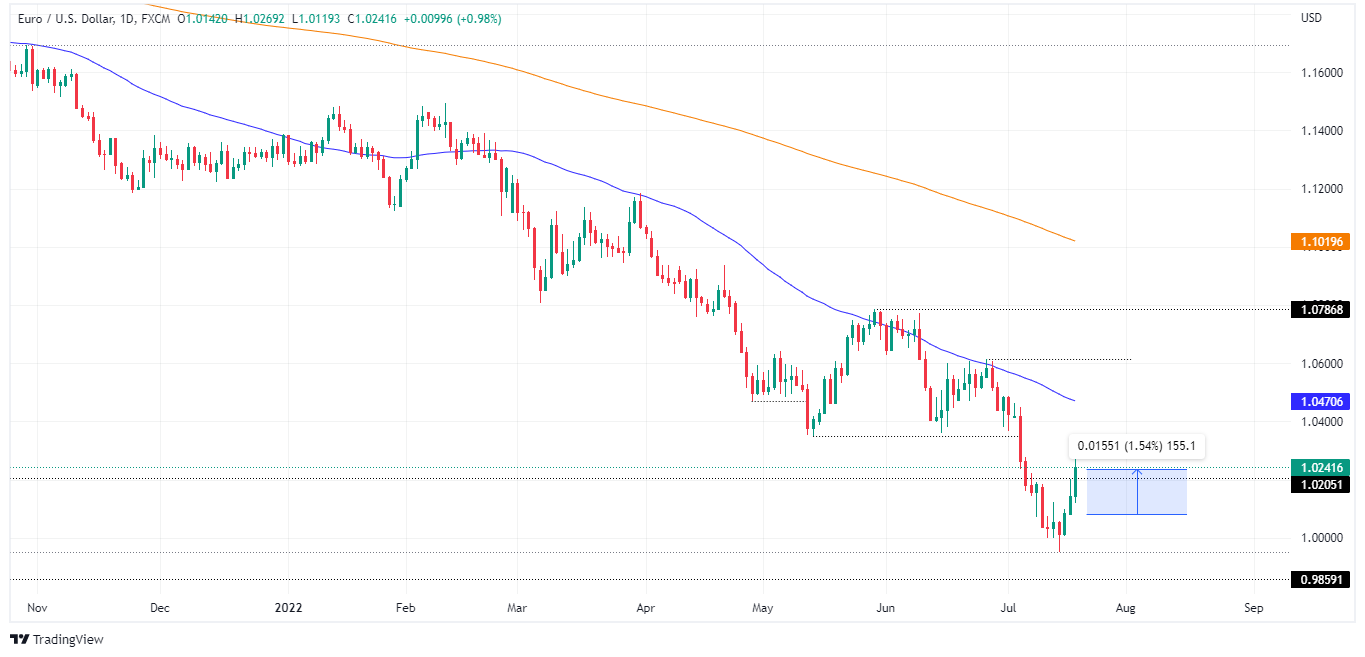
EURUSD price: reversal targeting 1.0340 monthly resistance
Bank of England (BOE) Governor Andrew Bailey said on Tuesday that a 50 basis points rate increase will be among the choices at the next policy meeting, as reported by Reuters.
Key takeaways
"Will publish more details on gilt sales in August."
"We have the option to commence a sales programme shortly after a confirmatory vote by the MPC, which could be as early as at our September meeting."
"50 bps hike is not locked in and anyone who predicts that is doing so based on their own view."
"We do not pre-announce bank rate decisions."
"If we see signs of greater persistence of inflation, and price and wage setting would be such signs, we will have to act forcefully."
"We recognise a trade-off in a situation of high inflation and weakening growth."
"We can already see the economy slowing."
"I would urge caution in interpreting the May GDP number as strong."
Market reaction
GBP/USD extended its daily rally and touched its highest level in more than 10 days at 1.2045. As of writing, the pair was up 0.67% on a daily basis at 1.2035.
According to the Federal Reserve Bank of Atlanta's GDPNow model, the US economy is expected to contract by 1.6% in the second quarter, down from the July 15 forecast of -1.5%.
"After this morning's housing starts report from the US Census Bureau, the nowcast of second-quarter real residential investment growth decreased from -8.8% to -10.1%," Atlanta Fed explained in its publication.
Market reaction
The greenback stays on the back foot following this report. The US Dollar Index, which tracks the dollar's performance against a basket of six major currencies, was last seen losing 0.75% on the day at 106.60.
- ECB meeting: speculations about a 50 bps rate hike boost the euro.
- Europe faces an energy crisis and political uncertainty in UK and Italy.
- EUR/GBP finds resistance at the 20 and 55-day SMA.
The euro is among the top performers on Tuesdays ahead of the European Central Bank meeting. The EUR/GBP cross rose to 0.8540, the highest level in 12 days.
ECB meets on Thursday
Reports on Tuesdays suggested that ECB officials will debate hiking interest rates by 50 basis points at the meeting this week and they are still negotiating the "antifragmentation" tool. The odds of a 50bps rose, boosting the euro. Still, market consensus is for 25bps.
The German 10-year yield is up 3% at 1.24% while the Italian reference is flat as it stands at 3.38%. Italy will face a crucial day on Wednesday. PM Mario Draghi will speak at the Parliament following his resignation. The outcome could be Draghi staying in power, or President Sergio Mattarella being forced to call early elections.
The euro also benefited after the European Union softened sanctions on Russian banks. More recently, Reuters informed that Russia is expected to restart Nord Stream 1 gas flows on Thursday as planned.
In the UK, economic data showed the unemployment rate remained at 3.8% in the three months ending in May. Average weekly earnings rose 6.2% from a year ago, below the 6.9% of market consensus. Inflation data will be released on Wednesday. The CPI June print will be a key input for the Bank of England. Analysts at TD Securities said that labor numbers “does not change anything for our overarching BoE call, and we still expect a strong June CPI print to push the Bank to hike Bank Rate by 50bps in August.”
Only three contenders remain at the Tory race leadership. Kemi Badenoch was eliminated in the fourth round with 59 votes. Rishi Sunak received 118 votes (+3 from Monday’s vote), Penny Mordaunt 92 (+10) and Liz Truss 86 (+15). On Wednesday, the two names of the final battle will be decided after another round.
EUR/GBP bullish, facing resistance at 0.8545
The EUR/GBP continues to recover after falling last week to the 0.8400 zone. Price is approaching the 20-day Simple Moving Average that stands at 0.8542; so far it failed to hold above the 55-day SMA at 0.8532. A daily close clearly above both lines should point to more strength for the euro. The bullish tone will likely remain in place in the short-term while above 0.8485.
Below 0.8460 a test of 0.8430 seems likely. A consolidation under 0.8430 should clear the way to more losses and for a new test of 0.8400.
Technical levels
Citing two sources familiar with the matter, Reuters reported on Tuesday that Russia is expected to restart Nord Stream 1 gas flows on Thursday as planned.
"The sources, speaking on condition of anonymity because of the sensitivity of the issue, told Reuters the pipeline was expected to resume operation on time, but at less than its capacity of some 160 million cubic metres (mcm) per day," the article read.
Market reaction
The market mood remains upbeat following this development and the S&P 500 Index was last seen rising 1.5% on a daily basis.
- USD/JPY witnessed selling for the third successive day amid broad-based USD weakness.
- Weakness below the 137.50-45 confluence would pave the way for a deeper correction.
- A sustained strength back above the 138.00 mark is needed to negate any negative bias.
The USD/JPY pair prolonged its corrective pullback from a 24-year high touched last week and continued losing ground for the third successive day on Tuesday. The downward trajectory dragged spot prices to a three-day low, around the 137.50-137.45 area during the early North American session and was sponsored by the prevalent US dollar selling bias.
Investors continue scaling back their bet for a 100 bps Fed rate hike move later this month, which, in turn, was seen as a key factor that exerted downward pressure on the USD/JPY pair. That said, the divergent Fed-Bank of Japan policy stance, along with the risk-on impulse, could undermine the safe-haven Japanese yen and help limit deeper losses.
From a technical perspective, the USD/JPY pair was seen flirting with confluence support comprising the 38.2% Fibonacci retracement level of the 134.25-139.39 rally and the 200-period SMA on the 1-hour chart. A convincing break below the said support might prompt aggressive technical selling and drag the pair further below the 137.00 round-figure mark.
The latter is closely followed by support marked by the 50% Fibo. level, around the 136.80 region. Some follow-through selling would be seen as a fresh trigger for bearish traders and set the stage for an extension of the downfall. Spot prices could then drop towards the next relevant support near the 61.8% Fibo. level, just ahead of the 136.00 mark.
On the flip side, the 138.00 round figure, nearing the 23.6% Fibo. level, now seems to act as an immediate hurdle. A sustained strength beyond would suggest that the corrective slide has run its course and allow the USD/JPY pair to reclaim the 139.00 mark. Bulls might eventually aim back to challenge the YTD peak, around the 139.40 region.
USD/JPY 1-hour chart
-637938356553791119.png)
Key levels to watch
- US dollar under pressure amid risk appetite.
- Crude oil prices correct on Tuesday, after rising sharply on Monday.
- USD/CAD reaffirms bearish bias after a brief rebound.
The USD/CAD is falling for the third consecutive day. After a brief rebound from the 1.2900 area toward 1.3000, the pair resumed the decline and it is hovering below 1.2930.
During the American session, USD/CAD trades at 1.2922 (fresh daily low) as it continues to move toward the 1.2900 zone, a critical area. The move lower is being driven by a weaker US dollar and risk appetite.
The DXY is seen at the lowest level in two weeks at 106.50, down 0.80%. It is falling for the third time, moving further away from multi-year highs. US yields show no clear direction on Tuesday. The US 10-year yield stands at 2.98% and the 30-year at 3.14%. Stocks in Wall Street are up 1% on average. Crude oil prices are falling around 1%, after a sharp rally on Monday. API inventory data is due later on Tuesday.
The combination of a weaker dollar and risk appetite weighs on USD/CAD. Other currencies, like the Australian dollar and the New Zealand dollar, are posting larger gains versus the greenback.
Economic data released on Tuesday showed Housing Starts dropped to 1.559K in June and Building Permits declined to 1.685K. In Canada, the key report of the week is the June CPI due on Wednesday. Market consensus is for an increase in the index of 0.9% (monthly) and for the annual rate to rise from 7.7% to 8.4%. “A slight disappointment on CPI adds to our belief that CAD outperformance is living on borrowed time”, warn analysts at TD Securities.
Technical levels
- Gold price struggled to gain any meaningful traction and remained confined in a range.
- The ongoing USD profit-taking slide continued lending some support to the commodity.
- Hawkish major central banks, the risk-on impulse acted as a headwind and capped gains.
Gold price attracted some dip-buying near the $1,705 region on Tuesday, though seemed to struggle to capitalize on the modest intraday gains. The XAUUSD, so far, has struggled to gain any meaningful traction and remained confined in a familiar trading range, just above the $1,700 round-figure mark.
Gold price drew support from sustained USD selling
The US dollar prolonged its retracement slide from a two-decade high touched last week, which, in turn, was seen as a key factor that offered some support to the dollar-denominated gold. In fact, the USD Index dropped to its lowest level since July 6 amid receding bets for a massive 100 bps rate hike move by the Federal Reserve in July. Several FOMC members signalled recently that they will likely stick to a 75 bps rate increase at the upcoming policy meeting on July 26-27.
US housing market data did little to impress USD bulls
The mixed US housing market data, meanwhile, did little to impress the USD bulls or provide any meaningful impetus to the gold price. The US Census Bureau reported that Housing Starts declined by 2% to a seasonally adjusted annual rate of 1,685,000, while Building Permits fell by 0.6% in the same period following the 7% contraction reported in May.
Aggressive tightening plans by major central banks acted as a headwind
That said, the prospects for a more aggressive move by major central banks continued acting as a headwind for the non-yielding yellow metal. The Fed is still expected to deliver a larger rate hike later this year to curb soaring inflation, which accelerated to a four-decade high in June. Adding to this, the European Central Bank (ECB) reportedly will discuss whether to raise interest rates by 25 bps or 50 bps to tame inflation at its upcoming policy meeting on Thursday.
Moreover, the minutes from the Reserve Bank of Australia policy meeting released earlier this Tuesday indicated that further increases in interest rate will be needed to return inflation to the target over time. This comes a day after Bank of England policymaker Michael Saunders said that the current tightening cycle may still have some way to go and the benchmark rate could reach 2% or higher next year.
Inflation fears
Risk-on impulse contributed to cap XAUUSD
This, along with a positive tone around the equity markets, further contributed to capping the upside for the safe-haven gold. Results from a number of major US banks generally have been solid. Apart from this, the recent decline in crude oil prices led to a modest rebound in investors' appetite for riskier assets.
Gold price technical outlook
-637938328771629400.png)
Gold price, so far, has struggled to register any meaningful recovery from a nearly one-year low touched last week, suggesting that the near-term risks remain skewed to the downside. Hence, any attempted recovery beyond the $1,725-$1,726 immediate resistance might still be seen as a selling opportunity. This, in turn, should cap the XAUUSD near the $1,734-$1,735 horizontal resistance. Some follow-through buying might trigger a bout of short-covering and lift the commodity towards the $1,749-$1,752 supply zone.
On the flip side, last week's swing low, around the $1,698-$1,697 area, might continue to act as immediate support. A convincing break below would make the XAUUSD vulnerable to testing September 2021 low, around the $1,787-$1,786 region. Gold price could extend the downward trajectory towards 2021 yearly low, near the $1,677-$1,676 area.
Gold price: Bearish risks still intact
- US Housing Starts fell by 2% on a monthly basis in June.
- US Dollar Index stays deep in negative territory below 107.00.
The data published by the US Census Bureau revealed on Tuesday that Housing Starts declined by 2% to a seasonally adjusted annual rate of 1,685,000. Building Permits fell by 0.6% in the same period following the 7% contraction reported in May.
"Privately‐owned housing completions in June were at a seasonally adjusted annual rate of 1,365,000," the publication further read. "This is 4.6% below the revised May estimate of 1,431,000, but is 4.6% above the June 2021 rate of 1,305,000."
Market reaction
The greenback stays under heavy bearish pressure following this report and the US Dollar Index was last seen losing 0.7% on a daily basis at 106.63.
- GBP/USD scaled higher for the third straight day and climbed to over a one-week high.
- Receding bets for more aggressive Fed rate hikes continued weighing on the greenback.
- Hawkish BoE expectations overshadowed mixed UK jobs data and remained supportive.
The GBP/USD pair gained traction for the third successive day on Tuesday and shot to a one-and-a-half-week high, around the 1.2040 region during the mid-European session. The momentum assisted spot prices to build on the recent recovery from the vicinity of mid-1.1700s, or the lowest level since March 2020 and was sponsored by broad-based US dollar weakness.
Investors continue scaling back their bet for a 100 bps Fed rate hike move later this month. Apart from this, the risk-on impulse dragged the safe-haven USD to its lowest level since July 6. The GBP bulls, meanwhile, seemed unaffected by the mixed UK jobs report, instead took cues from expectations for a further policy tightening by the Bank of England.
From a technical perspective, Tuesday's positive move validated the overnight breakout through a multi-week-old descending trend-channel resistance. The subsequent strength, however, struggled to find acceptance above the 100-period SMA on the 4-hour chart and stalled near the 50% Fibonacci retracement level of the 1.2332-1.1760 downfall.
The latter is pegged near the 1.2040-1.2045 region and should act as a pivotal point, which if cleared decisively would set the stage for a further near-term appreciating move. The GBP/USD pair might then aim to reclaim the 1.2100 mark, which coincides with the 61.8% Fibo. level, before eventually climbing to the 1.2155-1.2160 horizontal resistance.
On the flip side, the 38.2% Fibo. level, around the 1.1980 area, now seems to protect the immediate downside. Sustained weakness below might prompt some technical selling and accelerate the slide back towards the 1.1900 mark, or the 23.6% Fibo. level. Some follow-through selling would negate the near-term positive bias and make the GBP/USD pair vulnerable.
The next relevant support is pegged near the 1.1835-1.1830 region ahead of the 1.1800 round figure, below which the GBP/USD pair could aim to challenge the YTD low, around the 1.1760 region.
GBP/USD 4-hour chart
-637938292567098385.png)
Key levels to watch
International Monetary Fund (IMF) warned of heavy damage to the European economy from the Russian gas embargo, the Financial Times reported.
The IMF said that eastern Europe and Italy would likely suffer serious recessions unless countries managed to pool resources. In case Russia were to stop supplying gas to Europe, the economies of the Czech Republic, Hungary, Slovakia and Italy could contract by more than 5%, the IMF added.
Market reaction
Investors remain cautious after this headline and the Euro Stoxx Index was last seen losing 0.1% on a daily basis.
Previewing the Bank of Japan's (BoJ) upcoming policy meeting, Rabobank analysts said that they expect the BoJ to revise up its inflation forecasts and lower its growth expectations.
We see USD/JPY returning to the 130 area in Q2 next year
"If USD/JPY were to spike to 145 or beyond, the inflationary impact of the BoJ’s easy policy would become greater and market speculation that the BoJ may capitulate on its YCC policy would likely increase."
"In our view, the prospect of lower US yields and the JPY’s own safe haven credentials could allow USD/JPY to back away from the 140 area in the coming months. This would allow the BoJ further breathing space. It is possible that signs of wage inflation could allow the BoE to adjust its YCC policy as soon as this autumn, though the signs of slower global growth could strengthen the BoJ’s resolve to hold out on any policy adjustment until next year."
"We see USD/JPY holding around current levels on a 1 month view. We see USD/JPY returning to the 130 area in Q2 next year on the assumption the market may be then looking ahead to easier policy from the Fed."
The European Central Bank (ECB) is reportedly still negotiating the conditionality and the legal aspects of the new anti-fragmentation tool.
ECB President Lagarde is said to redoubling efforts to finalize a deal by this week's policy meeting.
Market reaction
The shared currency, which gathered bullish momentum on reports claiming that ECB policymakers were going to discuss a 50 basis points (bps) rate hike, preserves its strength following this headline. The EUR/USD pair was last seen trading at 1.0256, where it was up 1.15% on a daily basis.
The European Commission said on Tuesday that they are working on all scenarios regarding Nord Stream 1, including the possibility that the pipeline does not restrat after the planned maintenance is completed, as reported by Reuters.
Earlier in the day, citing European Budget Commissioner Johannes Hahn, the Wall Street Journal reported that the EU Commission was not expecting the pipeline to come back online.
Market reaction
Markets remain cautious following this headline and the Euro Stoxx 600 Index was last seen trading flat on the day.
According to Kit Juckes, Macro Strategist at Societe Generale, the euro rallied around 1% after a Reuters headline told us that the ECB will discuss the option of a 50 bps rate hike at their meeting this week.
Key Quotes
“The ECB has twisted itself into knots around its forward guidance. You could make a stronger case for a 50bp hike today (inflation) or for doing nothing (Russian gas) than for hiking by 25bp. Still, the headline has increased the pressure to cut euro shorts, and shorts across the European currency market, where HUF, PLN, SEK and NOK are leading the charge.”
According to Jan von Gerich, Chief Analyst at Nordea, the European Central Bank (ECB) is likely to start its rate hiking cycle with a 25bp move on Thursday despite clear signs of weakening growth momentum.
Focus will be on the anti-fragmentation tool
“With inflation much too high and price pressures broadening, the ECB has no room to soften its rhetoric at Thursday’s meeting – despite clearly weakening economic data. Even though some hawks have wanted to leave the door open for a bigger increase, and recent media stories have suggested the ECB will discuss also a bigger move this week, we think the ECB still follow its earlier guidance and hike rates by 25bp on Thursday.”
“On the anti-fragmentation tool, dubbed Transmission Protection Mechanism, we think the details will not convince markets. Even if they do, the ECB is unlikely to be willing to use the full firepower of the instrument, unless absolutely necessary. Many Governing Council members have emphasised the backstop nature of the tool, which will be used only if necessary.”
“Gold has not been living up to its reputation as an inflation hedge and safe haven in times of crisis of late,” Analysts at Commerzbank Research noted in their latest Commodities Update published on Tuesday.
Additional quotes
“Although inflation rates in the US and Europe are higher than they have been for decades, and have been rising further recently, the gold price has been under selling pressure for weeks.”
“Even the growing concerns about a recession, as evidenced by sharp falls on the stock markets and an inverse yield curve, have not benefited gold.”
“On the contrary, its price even dipped below the $1,700 per troy ounce mark at the end of last week, the first time this has happened in eleven months. What is more, gold has chalked up weekly losses in five consecutive weeks, which has also not been seen in nearly four years.”
“During these five weeks, gold shed almost 9% of its value. More and more disappointed investors are throwing in the towel and jettisoning their gold investments, thereby exerting additional pressure on the price.”
“This is especially visible in the case of gold ETFs: within the past nearly four weeks, 95 tons of gold have been withdrawn from the ETFs tracked by Bloomberg.”
“That’s almost twice as much as the net outflows seen in the entire second quarter. Around two-thirds of the outflows were registered by the world’s largest gold ETF, the SPDR Gold Trust, which is primarily used as an investment vehicle by institutional investors.”
- USD/CHF witnessed heavy selling on Tuesday and dropped to a nearly two-week low.
- The ongoing USD retracement slide from a two-decade high continued to exert pressure.
- Elevated US bond yields, the risk-on impulse could help limit deeper losses for the major.
The USD/CHF pair met with a fresh supply near the 0.9785 area on Tuesday and extended its retracement slide from a multi-week high touched last Thursday. The intraday selling picked up pace during the European session and dragged spot prices to sub-0.9700 levels, or a nearly two-week low.
The US dollar prolonged its profit-taking slide from a two-decade high amid receding bets for a massive 100 bps rate hike move by the Federal Reserve in July. In fact, several FOMC members said last week that they were not in favour of a bigger rate increase that the markets priced in following the release of red-hot US consumer inflation.
The USD was further pressured by a strong pickup in demand for the shared currency, bolstered by reports that the ECB will discuss whether to raise rates by 25 bps or 50 bps at its meeting on Thursday. This, in turn, continued exerting downward pressure on the USD/CHF pair, though a combination of factors might help limit any further losses.
The risk-on impulse - as depicted by a generally positive tone around the equity markets - could undermine the safe-haven Swiss franc and offer some support to the USD/CHF pair. Furthermore, investors seem convinced that the recent surge in US consumer inflation to a four-decade high would force the Fed to deliver a larger rate hike later in the year.
The speculations remained supportive of elevated US Treasury bond yields, which should act as a tailwind for the USD. The fundamental backdrop supports prospects for the emergence of some buying around the USD/CHF pair, warranting some caution for bearish traders and before positioning for any further depreciating move.
Market participants now look forward to the US housing market data - Building Permits and Housing Starts - due later during the early North American session. This, along with the US bond yields, might influence the USD. Traders will further take cues from the broader risk sentiment to grab short-term opportunities around the USD/CHF pair.
Technical levels to watch
Economists at TD Securities (TDS) take note of the significant US economic data due for release later this week.
Key quotes
“The focus this week will shift to activity indicators as market participants continue to contrast a high-inflation profile against signs of slowing economic activity. We look for the Philly Fed to register a rebound and for the PMIs to arrest their recent declines.”
“While business surveys might provide a glimmer of hope regarding the broad momentum of economic activity, the housing market is likely to continue offering signs of rolling over. In particular, we forecast existing home sales to have dropped markedly in June.”
“Jobless claims data are yet to show any signs of weakening in the labor market. We look for the data out this week to continue to lend credence to that view.”
Heading towards Thursday’s European Central Bank (ECB) interest rate decision, economists at ABN Amro believe that the bank will stick to its pre-commitment of a 25 bps rate hike.
Key quotes
“The ECB will almost certainly raise its key policy rates by 25bp this week. The Governing Council’s communication has not given it much flexibility in this respect. The two key issues that will receive a lot of focus are the future path of rate hikes and the announcement of the details of its new anti-fragmentation tool.”
“With regards to future interest rate hikes, the current guidance does build in optionality based on the way the outlook develops.”
“The ECB has signalled that the September move would be a 50bp step ‘If the medium-term inflation outlook persists or deteriorates’. Whereas ‘based on the current assessment’ after September it anticipates ‘a gradual but sustained path of further increases in interest rates’. This implies 25bp steps, but this depends on ‘the incoming data and how it assesses inflation to develop in the medium term’.”
European Union (EU) commissioner for budget and administration Johannes Hahn said on Tuesday, the European Commission doesn't expect gas supplies to Europe from Russia through the Nord Stream pipeline to restart from this Thursday, according to the Wall Street Journal (WSJ).
Hahn said: "We're working on the assumption that it doesn't return to operation.”
The reopening of Russia’s Nord Stream 1 pipeline is critical for the euro to sustain its recovery momentum. The Nord Stream 1 pipeline, Germany’s main source of Russian gas, is scheduled to be out of action until July 21 for routine work that the operator says includes “testing of mechanical elements and automation systems”.
But markets remain suspicious about Russia’s intentions, particularly after Russia’s Gazprom last month reduced the gas flow through Nord Stream 1 by 60%.
Should Russia delay the pipeline reopening, in response to the Ukraine crisis, it could escalate the dire gas situation in Europe, reviving the bearish interest in the shared currency.
At the time of writing, EURUSD price is trading 0.90% higher on the day at 1.0232, having hit two-week highs of 1.0253 on talks of a larger ECB rate hike this week.
- AUD/USD gained strong positive traction on Tuesday and shot to over a two-week high.
- The prevalent USD selling bias and hawkish RBA meeting minutes remained supportive.
- Descending trend-channel breakout supports prospects for additional near-term gains.
The AUD/USD pair caught aggressive bids on Tuesday and built on its recent recovery move from a two-year low, around the 0.6680 region touched last week. The momentum lifted spot prices to over a two-week high during the first half of the European session, with bulls now awaiting sustained strength beyond the 0.6900 mark.
The US dollar prolonged its corrective pullback from a two-decade high and continued losing ground for the third straight day. In fact, the USD Index dropped to its lowest level since July 6 amid receding bets for a 100 bps rate hike move by the Federal Reserve in July. This, in turn, was seen as a key factor that acted as a tailwind for the AUD/USD pair.
The Australian dollar drew additional support from the unsurprisingly hawkish Reserve Bank of Australia meeting minutes. The RBA noted that the current level of the cash rate is well below the lower range of estimates for the nominal neutral rate. This suggests that further increases in interest rates will be needed to return inflation to the target over time.
Apart from this, signs of stability in the financial markets further benefitted the risk-sensitive aussie. Tuesday's strong move up could further be attributed to some technical buying above the top boundary of a one-month-old descending trend channel. This might already have set the stage for a further near-term appreciating move for the AUD/USD pair.
That said, growing fears about a possible global recession might continue to weigh on investors' sentiment and limit any further losses for the safe-haven USD, at least for the time being. Apart from this, fresh COVID-19 restrictions in China warrant some caution before placing aggressive bullish bets around the China-proxy Australian dollar.
Market participants now look forward to the US housing market data - Building Permits and Housing Starts - due for release later during the early North American session. Traders would further take cues from the broader market risk sentiment, which could drive the USD demand and produce short-term opportunities around the AUD/USD pair.
Technical levels to watch
Saudi Arabian Foreign Minister Prince Faisal bin Farhan Al Saud comforted the oil market on Tuesday, as he said that there is no shortage of oil in the market but a lack of oil refining capacity.
Key quotes
"As of today, we don't see a lack of oil in the market. There is a lack of refining capacity, which is also an issue, so we need to invest more in refining capacity."
“Russia is an integral part of OPEC+.”
“Without OPEC+ cooperation as a collective it would be impossible to properly ensure adequate oil supplies.”
Market reaction
WTI is finding some support on the above headlines, currently trading at $98.40, down 0.31% on the day.
- Eurozone inflation arrives at 8.6% YoY in June, meets estimates.
- Monthly HICP in the bloc stands at 0.8% in June.
- EUR/USD preserves gains above 1.0200 on the expected Eurozone data.
Eurozone’s Inflation surged 8.6% in June, on an annualized basis, according to Eurostat’s final reading of the Eurozone Harmonised Index of Consumer Prices (HICP) report for the month.
The reading matched expectations of 8.6% while against the 8.6% previous. Core figures rose by 3.7%, meeting the 3.7% market estimates and 3.7% last.
The bloc’s HICP rose by 0.8% versus 0.8% expected and 0.8% first readout while the core HICP numbers came in at 0.2% versus 0.2% expected and 0.2% seen previously.
Key details (via Eurostat):
The lowest annual rates were registered in Malta (6.1%), France (6.5%) and Finland (8.1%). The highest annual rates were recorded in Estonia (22.0%), Lithuania (20.5%) and Latvia (19.2%).
Compared with May, annual inflation fell in two Member States and rose in twenty-five. In June, the highest contribution to the annual euro area inflation rate came from energy (+4.19 percentage points, pp), followed by food, alcohol & tobacco (+1.88 pp), services (+1.42 pp) and non-energy industrial goods (+1.15 pp).
FX implications:
At the press time, EUR/USD is trading at 1.0238, higher by 0.95% on the day.
- EURUSD price jumped to a nearly two-week high and was supported by a combination of factors.
- Receding bets for a more aggressive Fed rate hike in July continued exerting pressure on the USD.
- Reports that the ECB will discuss hiking rates by 50 bps provided an additional boost to the euro.
EURUSD price attracted fresh buying near the 1.0120 region on Tuesday and shot to a nearly two-week high during the early part of the European session. The pair was last seen trading around mid-1.0200s, up over 1.0% for the day.
Sustained USD selling continued lending support
The US dollar prolonged its corrective pullback from a two-decade high for the third straight day amid receding bets for a more aggressive rate hike by the Federal Reserve in July. In fact, several FOMC members said last week that they were not in favour of a bigger rate increase that the markets priced in following the release of red-hot US consumer inflation. This, in turn, dragged the USD to its lowest level since July 6 and offered some support to the EUR/USD pair.
50 bps ECB rate hike news boosted shared currency
The European Central Bank (ECB) reportedly will discuss whether to raise interest rates by 25 bps or 50 bps to tame inflation at its upcoming policy meeting on Thursday. A Reuters report added that policymakers were homing in on a deal to provide bond market assistance to countries like Italy if they stick to European Commission rules on reforms and budget discipline. The headlines pushed the European bond yields higher, alongside the euro. This was seen as another factor behind the latest leg of a sudden spike witnessed over the past hour or so.

Recession fears could act as a headwind for euro
Investors remain concerned that a halt to gas flows from Russia could trigger an energy crisis in the Eurozone. This could drag the region's economy faster and deeper into recession, curtailing the ECB's ability to raise interest rates any further. The economic risks could hold back bulls from placing aggressive bets around the shared currency and keep a lid on any further gains for the EURUSD price, at least for the time being.
Hawkish Fed expectations to limit USD losses
The Fed, on the other hand, is still expected to deliver a larger rate hike later in the year to tame inflation, which accelerated to a fresh four-decade high in June. The speculations remained supportive of elevated US Treasury bond yields and support prospects for the emergence of some dip-buying around the USD. This might further contribute to capping the upside for the EURUSD price. Hence, it will be prudent to wait for strong follow-through buying before positioning for an extension of the recent recovery from the 0.9950 area, or the lowest level since December 2002 touched last week.
Traders eye Eurozone CPI, US housing market data
Tuesday's economic docket features the release of the final Eurozone Harmonised Index of Consumer Prices (HICP) and the US housing market data - Building Permits and Housing Starts. This, along with the US bond yields, might influence the USD price dynamics and allow traders to grab short-term opportunities around the EURUSD pair.
EURUSD price technical outlook
-637938161372688607.png)
EURUSD price might now confront some resistance near the 1.0275-1.0280 region ahead of the 1.0300 mark. This is closely followed by the top boundary of a short-term descending channel extending from late May, currently around the 1.0320 area, which if cleared would be seen as a fresh trigger for bulls. The pair might then accelerate the momentum and aim to reclaim the 1.0400 round figure.
On the flip side, the 1.0200 level now seems to protect the immediate downside, which if broken could drag the EURUSD price back towards the 1.0155-1.0145 region. Some follow-through selling would negate any near-term positive bias and make the pair vulnerable to breaking below the 1.0100 mark. The subsequent downfall would expose the parity market and the YTD low, around the 0.9950 region.
EURUSD price: reversal targeting 1.0340 monthly resistance
- EURUSD price jumped to a nearly two-week high and was supported by a combination of factors.
- Receding bets for a more aggressive Fed rate hike in July continued exerting pressure on the USD.
- Reports that the ECB will discuss hiking rates by 50 bps provided an additional boost to the euro.
EURUSD price attracted fresh buying near the 1.0120 region on Tuesday and shot to a nearly two-week high during the early part of the European session. The pair was last seen trading around mid-1.0200s, up over 1.0% for the day.
Sustained USD selling continued lending support
The US dollar prolonged its corrective pullback from a two-decade high for the third straight day amid receding bets for a more aggressive rate hike by the Federal Reserve in July. In fact, several FOMC members said last week that they were not in favour of a bigger rate increase that the markets priced in following the release of red-hot US consumer inflation. This, in turn, dragged the USD to its lowest level since July 6 and offered some support to the EUR/USD pair.
50 bps ECB rate hike news boosted shared currency
The European Central Bank (ECB) reportedly will discuss whether to raise interest rates by 25 bps or 50 bps to tame inflation at its upcoming policy meeting on Thursday. A Reuters report added that policymakers were homing in on a deal to provide bond market assistance to countries like Italy if they stick to European Commission rules on reforms and budget discipline. The headlines pushed the European bond yields higher, alongside the euro. This was seen as another factor behind the latest leg of a sudden spike witnessed over the past hour or so.
Recession fears could act as a headwind for euro
Investors remain concerned that a halt to gas flows from Russia could trigger an energy crisis in the Eurozone. This could drag the region's economy faster and deeper into recession, curtailing the ECB's ability to raise interest rates any further. The economic risks could hold back bulls from placing aggressive bets around the shared currency and keep a lid on any further gains for the EURUSD price, at least for the time being.
Hawkish Fed expectations to limit USD losses
The Fed, on the other hand, is still expected to deliver a larger rate hike later in the year to tame inflation, which accelerated to a fresh four-decade high in June. The speculations remained supportive of elevated US Treasury bond yields and support prospects for the emergence of some dip-buying around the USD. This might further contribute to capping the upside for the EURUSD price. Hence, it will be prudent to wait for strong follow-through buying before positioning for an extension of the recent recovery from the 0.9950 area, or the lowest level since December 2002 touched last week.
Traders eye Eurozone CPI, US housing market data
Tuesday's economic docket features the release of the final Eurozone Harmonised Index of Consumer Prices (HICP) and the US housing market data - Building Permits and Housing Starts. This, along with the US bond yields, might influence the USD price dynamics and allow traders to grab short-term opportunities around the EURUSD pair.
EURUSD price technical outlook
EURUSD price might now confront some resistance near the 1.0275-1.0280 region ahead of the 1.0300 mark. This is closely followed by the top boundary of a short-term descending channel extending from late May, currently around the 1.0320 area, which if cleared would be seen as a fresh trigger for bulls. The pair might then accelerate the momentum and aim to reclaim the 1.0400 round figure.
On the flip side, the 1.0200 level now seems to protect the immediate downside, which if broken could drag the EURUSD price back towards the 1.0155-1.0145 region. Some follow-through selling would negate any near-term positive bias and make the pair vulnerable to breaking below the 1.0100 mark. The subsequent downfall would expose the parity market and the YTD low, around the 0.9950 region.
EURUSD price: reversal targeting 1.0340 monthly resistance
Here is what you need to know on Tuesday, July 19:
Following Monday's poor performance, the dollar continues to weaken against its major rivals on Tuesday with the US Dollar Index pushing lower toward 107.00 in the early European session. Eurostat will release its final revision of June inflation data. Later in the day, Housing Starts and Building Permits data from the US will be watched closely by market participants, especially after the NAHB reported on Monday that the Housing Market Index fell sharply to 55 in July from 67 in June.
Meanwhile, China reported 699 coronavirus cases on Monday, the highest daily tally since May 22, having reported over 1,000 infections over the weekend. The city of Lanzhou ordered a city-wide lockdown from Wednesday and Shanghai widened the mass testing to 12 of the city's 16 districts. Markets remain relatively cautious early Tuesday with US stock index futures posting small daily gains.
The Reserve Bank of Australia's (RBA) July meeting minutes showed earlier in the day that policymakers agreed that further increases in interest rate will be needed to return inflation to the target over time. AUD/USD gathered bullish momentum during the Asian session on Tuesday and extended its rally toward 0.6900.
EUR/USD surged above 1.0200 in the early European morning on reports claiming that the European Central Bank (ECB) policymakers were going to discuss whether they should hike the policy rate by 50 basis points on Thursday.
GBP/USD closed in positive territory on Monday and continued to push higher toward 1.2000 in the European session on Tuesday. The data published by the UK's Office for National Statistics (ONS) revealed that the ILO Unemployment Rate in the UK remained unchanged at 3.8% in May, as expected. Furthermore, the number of people claiming jobless benefits fell by 20K in June when compared to -34.7K booked previously.
USD/JPY registered small daily losses and failed to stage a rebound in the Asian session. The pair stays on the back foot and trades slightly below 138.00.
Gold failed to capitalize on the broad dollar weakness and closed the day virtually unchanged near $1,710 on Monday. XAUUSD continues to move sideways near that level on Tuesday as the benchmark 10-year US Treasury bond yield stays calm below 3%.
Bitcoin gained nearly 8% on Monday but reversed its direction after having met resistance near $23,000. Ethereum climbed to its highest level in more than a month above $1,600 during the Asian session on Tuesday but retreated to the $1,500 area during the European trading hours.
Citing sources familiar with the European Central Bank’s (ECB) thinking, Reuters reports that the ECB policymakers are likely to discuss a rate hike worth 25 bps or 50 bps at Thursday’s meeting.
“ECB policymakers home in on a deal to make new bond purchases conditional on next generation EU targets and fiscal rules,” the sources added.
The sources said, "these include the targets set by the Commission for securing money from the European Union Recovery and Resilience Facility as well as the Stability and Growth Pact, when it is reinstated next year after the pandemic break."
Market reaction
Eurozone bond yields rise, with Germany's two-year bond yield now up 6 bps on day at 0.58%.
The euro jumped in tandem after the source-based ECB story, last up 0.80% on the day at 1.0219. The pair spiked to the day's high of 1.0229 in an immediate reaction to the headlines.
So far this week, EUR/USD is consolidating a massive sell-off after reaching parity just before the Fed hikes interest rates by 75 bps on July 27. Should the ECB fail to narrow the gap with its US counterpart the pair is likely to fall further below parity once again.
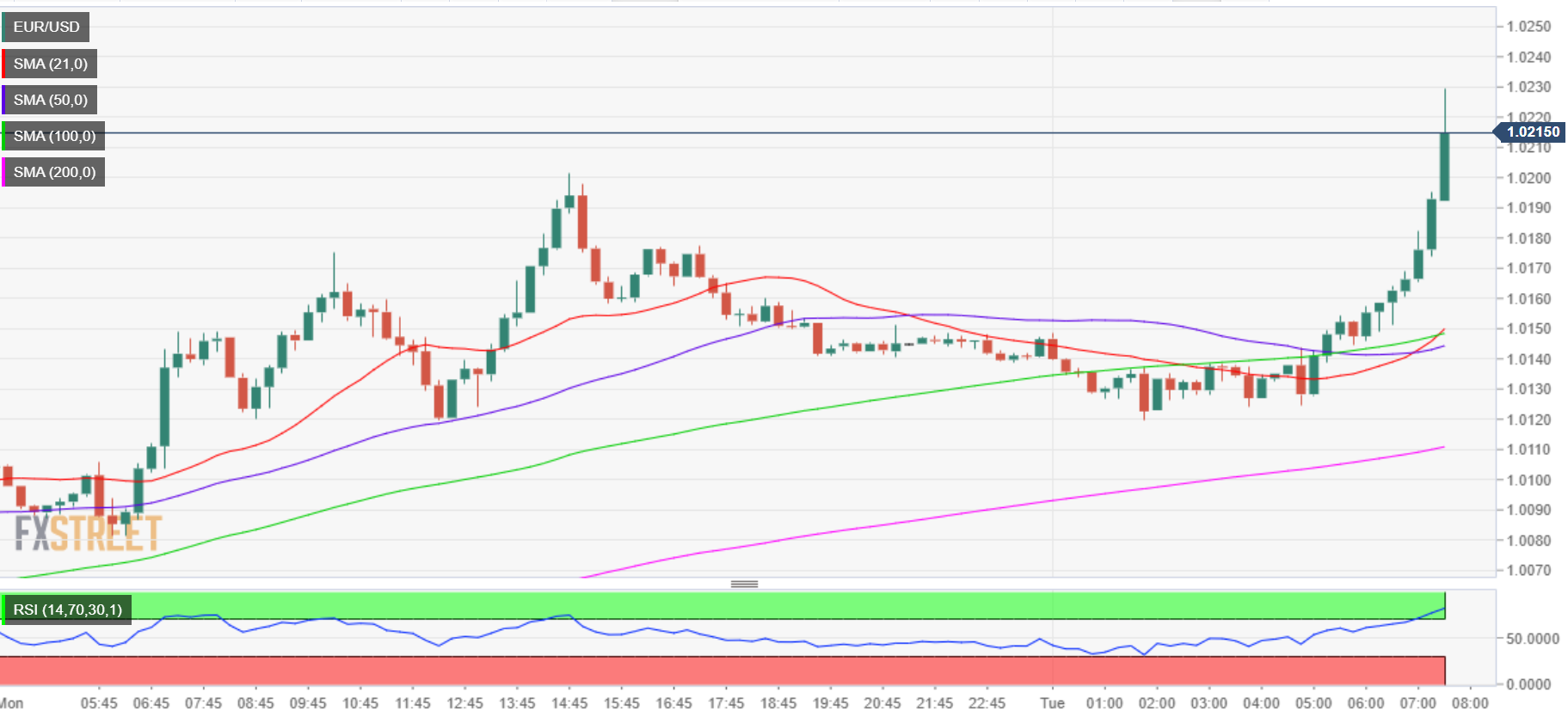
EURUSD Technical levels to watch
- The prevalent USD selling bias assisted NZD/USD to regain positive traction on Tuesday.
- Receding bets for a 100 bps Fed rate hike in July continued exerting pressure on the USD.
- Recession fears, elevated US bond yields should limit the USD losses and cap the major.
The NZD/USD pair attracted fresh buying near the 0.6140 region on Tuesday and climbed closer to over a one-week high touched the previous day. The pair maintained its bid through the early European session, with bulls still awaiting a sustained move beyond the 0.6200 mark.
The US dollar failed to capitalize on the overnight bounce from a one-week low and remained depressed for the third successive day amid diminishing odds for a 100 bps Fed rate hike move in July. In fact, several FOMC members said last week that they were not in favour of a bigger rate increase that the markets priced in following the release of red-hot US consumer inflation. This, in turn, was seen as a key factor that continued weighing on the greenback and offered some support to the NZD/USD pair.
Despite reduced bets for a more aggressive Fed, investors seem convinced that the recent surge in US consumer inflation would force the Fed to deliver a larger rate hike later in the year. This was reinforced by elevated US Treasury bond yields, which should act as a tailwind for the buck. Apart from this, growing fears about a global recession should limit any meaningful downside for the safe-haven greenback and cap gains for the risk-sensitive kiwi, warranting caution for aggressive bulls.
Hence, it would be prudent to wait for strong follow-through buying beyond the 0.6200 round figure before confirming that the NZD/USD pair has formed a near-term bottom. This, in turn, would set the stage for an extension of the recent bounce from the 0.6060 region, or over a two-year low touched last Thursday. Market participants now look forward to the US housing market data - Building Permits and Housing Starts - for a fresh trading impetus later during the early North American session.
Technical levels to watch
FX option expiries for July 19 NY cut at 10:00 Eastern Time, via DTCC, can be found below.
- EUR/USD: EUR amounts
- 1.0000 350m
- 1.0030 339m
- 1.0100 563m
- 1.0150 1.3b
- 1.0200 892m
- USD/JPY: USD amounts
- 135.00 1.2b
- 136.00 1.3b
- 136.50 390m
- 138.00 2.7b
- 138.15 352m
- 138.50 939m
- 138.75 555m
- 139.25 537m
- 140.00 1.5b
- GBP/USD: GBP amounts
- 1.1900 533m
- 1.2120 370m
- 1.2280 405m
- 1.2310 325m
- 1.2350 780m
- 1.2395 520m
- USD/CHF: USD amounts
- 0.9900 500m
- AUD/USD: AUD amounts
- 0.6750 797m
- USD/CAD: USD amounts
- 1.2800 405m
- 1.3100 380m
- EUR/GBP: EUR amounts
- 0.8715 234m
- A combination of factors dragged USD/CAD lower for the third successive day on Tuesday.
- Receding bets for a 100 bps Fed rate hike move in July kept the USD bulls on the defensive.
- The overnight rally in oil prices underpinned the loonie and contributed to the selling bias.
The USD/CAD pair struggled to capitalize on the overnight goodish rebound from sub-1.2900 levels, or a nearly two-week low and met with a fresh supply on Tuesday. The pair maintained its offered tone through the early European session and was seen trading near the daily low, around mid-1.2900s.
The US dollar languished just above a one-week low touched on Tuesday amid diminishing odds for a 100 bps rate hike by the Federal Reserve at the upcoming meeting on June 26-27. It is worth recalling that several FOMC members said last week that they were not in favour of a bigger rate increase that the markets priced in following the release of red-hot US consumer inflation.
Subdued USD price action, along with continued worries about tight global supply, assisted crude oil prices to preserve the overnight strong gains to a multi-day high. This, in turn, underpinned the commodity-linked loonie and dragged the USD/CAD pair lower for the third successive day. That said, a combination of factors might hold back bearish traders from placing aggressive bets.
Investors remain concerned that surging crude will feed into a demand-killing recession, which should act as a headwind for the black liquid. Furthermore, market participants seem convinced that the recent surge in US consumer inflation to a four-decade high in June would force the Fed to deliver a larger rate hike later in the year. This should limit the downside for the USD.
Even from a technical perspective, the emergence of fresh buying at lower levels adds credence to the near-term positive outlook. Hence, it will be prudent to wait for sustained weakness below the 1.2900 round-figure mark before confirming that the USD/CAD pair has topped out in the near term. This would set the stage for an extension of the recent pullback from the YTD peak.
Market participants now look forward to the US housing market data - Building Permits and Housing Starts - due later during the early North American session. The data might influence the USD demand, which along with oil price dynamics, should provide some impetus to the USD/CAD pair.
Technical levels to watch
- GBP/USD is displaying topsy-turvy moves after the release of the stable UK job data.
- The Unemployment Rate has remained flat at 3.8% while the Employment Change slips to -20K.
- The DXY has sensed barricades around 107.50 after a pullback.
The GBP/USD pair has remained mostly sideways as the UK Office for National Statistics has reported flat UK employment data. The Unemployment Rate has remained flat at 3.8%. However, the Claimant Count Change has tumbled to 20K from the prior release of -34.7k.
The economic catalyst which is going to hurt the pound bulls is the Average Hourly Earnings. The release of the earnings data on a lower note is not lucrative for the pound bulls. The households in the UK economy are facing the headwinds of higher price pressures, which have trimmed the value of their paychecks and henceforth the quantity of their total personal consumption expenditure.
Now, the Average Hourly Earnings have tumbled to 6.2% from the expectations of 6.9% and the prior release of 6.8%. Lower earnings along with price pressures are going to hurt the sentiment of the market participants dramatically.
Meanwhile, the US dollar index (DXY) has given a downside break of the balanced auction formed in a narrow range of 107.46-107.63 in the Asian session. The DXY has shifted into bearish territory for a short-term interval as odds of a 1% rate hike by the Federal Reserve (Fed) have trimmed significantly. The DXY bulls were performing stronger over the past few months as price pressures were soaring consecutively. Now, the market participants believe that the inflation rate will find its conclusion sooner and will start to return to mean reversion gradually.
- The Unemployment Rate in the UK steadied at 3.8% in May.
- UK Claimant Count Change arrived at -20K in June.
- The UK wages excluding bonuses rose by 4.3% YoY in May vs. 4.3% expected.
The Office for National Statistics (ONS) showed on Tuesday, the UK’s official jobless rate stood at 3.8% in May vs. the previous 3.8% and 3.8% expected while the claimant count change showed a drop last month.
The number of people claiming jobless benefits fell by 20K in June when compared to -34.7K booked previously.
The UK’s average weekly earnings, excluding bonuses, arrived at +4.3% 3Mo/YoY in May versus +4.2% last and +4.3% expected while the gauge including bonuses came in at +6.2% 3Mo/YoY in May versus +6.8% previous and +6.9% expected.
Key points (via ONS)
UK june flash employment estimate shows +31 payrolled employees vs may.
UK real total pay, using CPIH measure of inflation, fell by 0.9% YoY in three months to May.
UK real regular pay, using CPIH measure of inflation, fell by 2.8% YoY in three months to May.
GBP/USD reaction
GBP/USD is unfazed by the mixed UK employment data. The spot was last seen trading at 1.1965, up 0.11% on the day.
About UK jobs
The UK Average Earnings released by the Office for National Statistics (ONS) is a key short-term indicator of how levels of pay are changing within the UK economy. Generally speaking, the positive earnings growth anticipates positive (or bullish) for the GBP, whereas a low reading is seen as negative (or bearish).
- Asian indices are trading mixed as Chinese equities have tumbled ahead of PBOC rate decision.
- The DXY has failed to extend its recovery and may slip further on lower consensus for S&P PMI data.
- Oil prices are eying an establishment above $100.00 on renewed supply worries.
Markets in the Asian domain are displaying mixed auctions as Chinese indices have tumbled. Rising cases of Covid-19 in China have spurted the odds of lockdown. There is no denying the fact that the Chinese administration will resort to a zero Covid-19 policy to contain its spread. The resurgence of Covid-19 is recurring quickly and the economy is finding it hard to face the headwinds.
Apart from that, investors are awaiting the release of the interest rate decision by the People’s Bank of China (PBOC), which is due on Wednesday. A dovish stance is expected from PBOC policymakers as the central bank is committed to spurring economic activities in the economy.
At the press time, Japan’s Nikkei225 added 0.73%, Nifty50 gained 0.23% while Hang Seng surrendered 0.80%, and China A50 tumbled more than 1%.
The US dollar index (DXY) has witnessed a steep fall after failing to extend its pullback above 107.50 in the late Tokyo session. The DXY is expected to extend its losses after violating Monday’s low at 106.92. A slippage in expectations for a 100 basis point (bps) rate hike by the Federal Reserve (Fed) has sent the DXY into a negative trajectory. Going forward, the focus will remain on the S&P Purchase Managers Index (PMI) data, which is expected to display a weak performance.
On the oil front, oil prices are hovering around $100.00 and are focusing to recapture the same as supply worries have accelerated. The OPEC has not promised more oil supply in the visit of US President Joe Biden to Saudi Arabia. It looks like OPEC is less interested in escalating the total supply as the oil cartel is enjoying premium prices.
- USD/JPY edged lower for the third successive day on Tuesday amid subdued USD demand.
- Diminishing odds for a more aggressive Fed rate hike in July continued weighing on the buck.
- The Fed-BoJ policy divergence favours bullish traders and should help limit deeper losses.
The USD/JPY pair remained on the defensive for the third successive day on Tuesday and was seen trading with modest intraday losses, around the 138.00 mark during the early European session.
The US dollar struggled to gain any meaningful traction or capitalize on the overnight bounce from a one-week low amid diminishing odds for a more aggressive policy tightening by the Federal Reserve. In fact, several FOMC members last week pushed back against market bets for a supersized 100 bps rate hike at the upcoming meeting on July 26-27. This, in turn, continued acting as a headwind for the USD and weighed on the USD/JPY pair.
Market participants, however, seem convinced that the recent surge in US consumer inflation, to a four-decade high in June, warrants a larger Fed rate hike move later in the year. The expectations remained supportive of elevated US Treasury bond yields, which offered some support to the greenback. In contrast, the Bank of Japan has repeatedly said that it would stick to the ultra-loose monetary policy and ease further as necessary.
The divergent policy stance adopted by the Fed and the BoJ supports prospects for the emergence of some dip-buying around the USD/JPY pair and an extension of the recent strong bullish run. That said, traders preferred to wait on the sidelines and refrained from placing aggressive bets ahead of the BoJ decision on Thursday. Nevertheless, the fundamental backdrop still seems tilted firmly in favour of bearish traders.
Hence, it would be prudent to wait for strong follow-through selling before confirming that the USD/JPY pair has topped out and positioning for any meaningful corrective decline. Traders now look forward to the US housing market data - Building Permits and Housing Starts. This, along with the broader market risk sentiment and the USD price dynamics, might provide a fresh trading impetus to the USD/JPY pair.
Technical levels to watch
- Gold price is aiming to recapture its intraday high at $1,710.21 amid lackluster DXY.
- A slippage in odds of a 1% rate hike by the Fed has failed to support the gold bulls.
- Lower consensus for S&P PMI data may bring a sell-off in the DXY.
Gold Price (XAUUSD) has rebounded modestly after remaining subdued in the Asian session. The precious metal has picked bids after hitting a low of $1,705.55 and is hovering around an intraday high at $1,710.21. The bright metal has remained sideways from the past week, auctioning in a wide range of $1,697.64-1,723.83 amid the unavailability of any potential trigger, which could guide further direction.
Meanwhile, the US dollar index (DXY) is displaying exhaustion signals after a pullback move. The asset rebounded gradually after hitting a low of 106.92 on Tuesday. Till now, the sentiment of bearish Monday has not carry-forwarded on Tuesday, however, the downside seems warranted as the DXY is struggling in establishment above 107.50. A downside move below Monday’s low at 106.92 is likely to bring a sell-off in the asset.
Also Read: Gold Price Forecast: Bulls hesitate despite a better market mood

Fed may not opt for a rate hike by 1%
Gold Price struggles despite lower odds for a 1% rate hike by the Fed
The odds of a 1% rate hike by the Federal Reserve (Fed) have trimmed vigorously. As per CME’s FedWatch Tool, the expectations of a rate hike by 1% were as high as 80% last week, which have trimmed to near 30%. Gold bulls have failed to capitalize on similar information and are struggling to drive higher. Odds of a 100 basis point (bps) interest rate hike for the July interest rate decision have trimmed after the release of the long-run inflation expectations. The economic data landed at 2.8% lower than June’s print of 3.1%.
Inflation rate to find its peak sooner
Higher inflation rates have weighed pressure on the margins of the companies and have impacted the earnings of the households. However, the price pressures will soon find their peak as lower oil prices in June and lower demand for durable goods by the households will fix the imbalance in the demand-price mechanism. The upbeat Retail Sales and other demand indicators were more driven by firmer price pressures rather than the aggregate demand by the households. Therefore, lower demand on the grounds of quantity will bring the inflation rate lower.
Policy to tighten further by other Western leaders
Gold price is expected to face tremendous pressures this week as monetary policies announcement from the European Central Bank (ECB) and the Bank of Japan (BOJ) will remain focused. The market participants are expecting a rate hike by the ECB for the first time in 11 years. Taking into account the soaring inflation rate due to higher energy bills, ECB President Christine Lagarde will announce a rate hike this time. Also, the minutes from the Reserve Bank of Australia (RBA) remained hawkish for further guidance. Therefore, the broader environment of policy tightening by the Western leaders will keep gold prices in check.
However, the Bank of Japan (BOJ) will continue with its dovish tone and will discuss measures on flushing liquidity into the economy to spurt the aggregate demand.
S&P Global PMI to remain in focus
Due to a light economic calendar this week, investors’ focus will remain on the release of the S&P Global PMI data. As per the market consensus, the economic catalysts are expected to deliver a weak performance. The Global Composite data is seen at 51.7, lower than the prior release of 52.3. The Manufacturing PMI may slip to 52 vs. 52.7 recorded earlier. While the Services PMI is expected to display a mild correction to 52.6 against the former figure of 52.7. This will keep the DXY on the back foot and may support the gold bulls.
-637938045255671259.png)
Gold technical analysis
Gold price has remained vulnerable for the whole month after surrendering the psychological support of $1.800.00. The precious metal is auctioning in a Falling Channel that indicates a bounded downside move. The upper portion and lower portion of the above-mentioned chart pattern are placed from July 6 high and low at $1,771.89 and $1,732.27 respectively.
A failed attempt of bullish crossover by the 20- and 50-period Exponential Moving Averages (EMAs) at $1,714.20 adds to the downside filters.
Meanwhile, the Relative Strength Index (RSI) (14) is holding itself above 40.00, however, the gold prices will remain on the tenterhooks.
Gold hourly chart
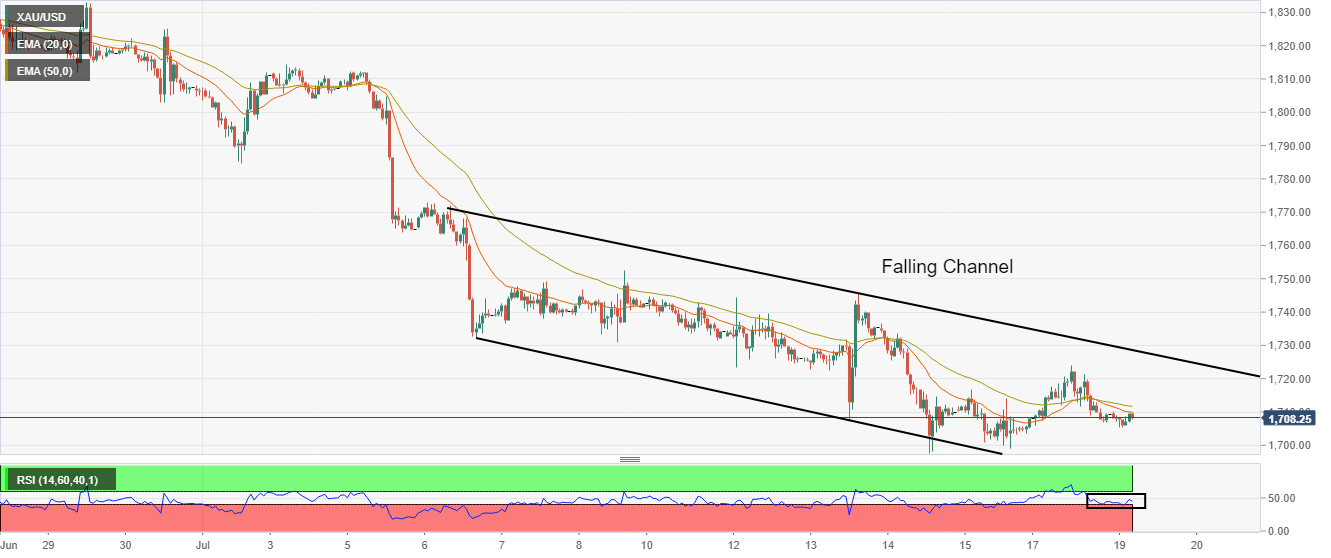
Gold halts decline, but bearish risks still intact
- AUDUSD bulls run into the 21 DMA hurdle on Tuesday yet again.
- Hawkish RBA minutes and Bullock’s commentary power the aussie.
- Daily close above 21 DMA needed to confirm a near-term bottom.
AUDUSD is consolidating the renewed upside above 0.6800, having met fresh offers just shy of the 0.6850 mark in the last hour.
AUD bulls could be biding time for the next push higher, as markets are now wagering odds of a 75 bps RBA rate hike in August after last week’s solid Australian employment report.
Additionally, hawkish July meeting minutes published by the RBA earlier on, suggested that the bank remains on track for further rate increases, as inflation control remains its priority. The aussie caught a fresh bid on the minutes release, bouncing from near 0.6800 to the 0.6830 region.
The further upside was fuelled by the hawkish comments from RBA Deputy Governor Michelle Bullock, as she affirmed that further rate increases will be needed in the months ahead.
However, it remains to be seen if the spot manages to find acceptance above the critical 21-Daily Moving Average (DMA) at 0.6847. Daily closing above the latter will put a near-term bottom in place for the aussie.
The next upside target is seen at 0.6900 the figure, which is also the July 11 high.
The 14-day Relative Strength Index (RSI) is marching higher to test the midline, justifying the recovery momentum.
AUD/USD: Daily chart
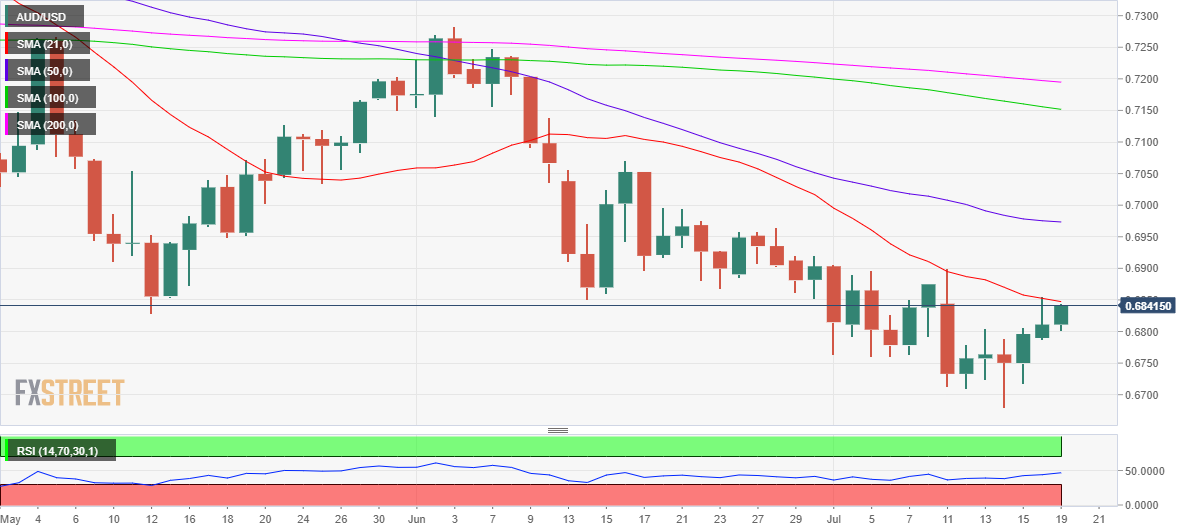
On the flip side, a rejection at the 21 DMA will recall sellers, opening up the downside once again towards the 0.6800 demand area.
The previous day’s low of 0.6787 will be back on their radars, with the last line of defense seen at 0.6750 – the psychological level.
AUD/USD: Additional levels to consider
- USD/INR is hopeful to recapture last week’s high at 80.20.
- The odds of a 1% rate hike by the Fed have trimmed vigorously.
- FIIs are returning to Dalal Street as Indian benchmarks are in a recovery mode.
The USD/INR pair is advancing to recapture its all-time high at 80.18, recorded last week. The greenback bulls are driving the asset higher despite the release of the long-run inflation expectations on a weak note. This indicates that the market participants are expecting a peak sooner in the price pressures.
The economic data landed at 2.8% lower than June’s print of 3.1%. This has trimmed the expectations of a 100 basis point (bps) interest rate hike by the Federal Reserve (Fed) for its July monetary policy meeting. As per CME’s FedWatch Tool, the expectations of a rate hike by 1% were as high as 80% last week, which have trimmed to near 30%.
Meanwhile, the US dollar index (DXY) is attempting a recovery after hitting a low of 107.00 on Monday. A sheer downside move is generally followed by a pullback but that doesn’t warrant a reversal for the asset.
On the Indian rupee front, price pressures are cooling off meaningfully amid vulnerable oil prices in July. The higher inflation rate in prior months was backed by soaring energy bills and food prices. Now, lower oil prices will scale down the fiscal deficit for the Indian economy. India’s Consumer Price Index (CPI) has landed at 7.01% for June and 7.04% for May, which indicates that the inflation rate in India is finding its peak levels. Also, a recovery in Indian indices has bolstered the return of Foreign Institutional Investors (FII), which will correct the India fiscal deficit further.
Reserve Bank of Australia (RBA) Deputy Governor Michele Bullock is speaking at a business lunch hosted by the Economic Society of Australia, in Brisbane.
Key quotes
Wages are starting to rise a little more quickly.
Need to get rates up to some sort of neutral level.
Neutral is a fair bit higher than where we are.
Also read: RBA’s Bullock: Further rate increases will be needed in the months ahead
Market reaction
The hawkish RBA commentary continues to add legs to the aussie’s upside. The AUD/USD pair is trading at 0.6841, up 0.40% on a daily basis.
Analysts at Societe Generale offer a sneak peek at what to expect from Thursday’s European Central Bank (ECB) interest rate decision due to be announced at 1215 GMT.
Also read: EURUSD Price remains depressed below 1.0150 amid damp mood
Key quotes
“First rate hike in 11 years (25 bps) to be announced.”
“Anti-fragmentation mechanism is to be launched, to support vulnerable countries.”
“While downside risks to growth have increased, for now, the guidance for a possible 50 bps hike in September is likely to remain in place, partly linked to the fact that the inflation forecast will need to be revised up again in September, at least with regard to the short-term.”
“No new staff forecasts will be presented, but an updated assessment is likely to point to high uncertainty, in particular over the energy supply situation. Risks to inflation remain to the upside, while risks to growth remain to the downside.”
Reserve Bank of Australia (RBA) Deputy Governor Michele Bullock is speaking at a business lunch hosted by the Economic Society of Australia, in Brisbane.
Key quotes
Further rate increases will be needed in the months ahead.
Financial stability risks from households "are a little elevated" but unlikely to be substantial.
Risks will be important in deciding size and timing of future interest rate rises.
Risks will be influenced by the future path of employment growth.
Current strong growth in employment means people will have jobs to service their mortgages.
Aggregate household balance sheets are in very good shape.
Households have saved a large amount of money since the onset of the pandemic.
Borrowers with the most debt also tend to have the highest liquidity refers to the extent of a financial instrument’s ability to be bought or sold without causing price fluctuations.
Household sector as whole has accumulated sizeable equity via higher housing prices.
House prices would have to fall a fair way for negative equity to become a systemic concern.
Much of the debt is held by high-income households that have the ability to service their debt.
Market reaction
AUD/USD is extending its latest upside on the above comments. The spot is currently trading at 0.6831, adding 0.29% so far.
- A recurring resurgence of lockdown worries in China has dented the manufacturing activities significantly.
- The arrival of monsoon in some provinces of China has added fuel to the fire.
- The Chinese economy is focusing more on converting the steel sectors in a more disciplined manner.
Steel prices have taken a hit as rising cases of Covid-19 in China and the arrival of the monsoon has trimmed the demand forecasts for steel. The steel mills producers in China have dropped their production as lower steel prices are eating their profit margins.
The China economy is failing to contain the spread of the pandemic. The recurring resurgence of Covid-19 in China has scaled down their manufacturing activities and henceforth the demand for steel. Despite the implementation of the zero-Covid policy, cases of Covid-19 are surging day by day. After reporting more than 1,200 new cases over the weekend, the economy reported almost 700 cases on Monday. The cases of the pandemic are increasing at an increasing rate, which may not only affect the production process but will also trim the personal demand.
The already weak steel market is facing headwinds from the arrival of the monsoon in many provinces of China and other parts of Asia. The monsoon season carries a negative relationship with the demand for steel. The arrival of monsoon results in a suspension of ongoing construction activities and postponement of infrastructure projects and real estate.
Meanwhile, the Chinese economy is focusing more on converting the steel sectors in a more disciplined manner. The economy is planning to set up a state-backed iron-ore company, which will oversee everything from massive mine investments in West Africa to buying steel products from global suppliers, as per Bloomberg. In order to manage the same more efficiently, a management team will be composed of top officials from major metal firms.
- EURUSD is trading pressured as the US dollar looks to extend its recovery.
- Risk sentiment remains in a weaker spot so far this Tuesday amid growth worries.
- ECB decision, Russia’s Nord Stream 1 restart holds the key for the euro.
EURUSD price is off the lows but remains in the hands of sellers below 1.0150, as we progress towards early European trading. The upside correction in the main currency pair lost traction at 1.0200 the figure, as the market optimism seems to have vapored on resurfacing concerns over global growth.
The latest leg down in the major has reversed half the previous recovery rally, as EUR bears snapped the three-day upswing from almost twenty-year lows of 0.9952 reached last Thursday. The shared currency breached the critical parity level against the US dollar, marking a historic momentum after two decades.
Also Read: EUR/USD Weekly Forecast: Gear up for a too conservative ECB meeting
Demand for safe-haven dollar returns
The US dollar is looking to extend its recovery after kicking off the week on the wrong footing. Investors eye for safety once again, as growth fears resurfaced after a report that Apple Inc. will slow its hiring and spending unnerved markets in the US last session. Additionally, growing covid outbreaks in China and Shanghai’s widening mass testing have added to the cautious market mood. In times of uncertainty and panic, markets resort to the most sought-after safety net in the US currency.
ECB Eurosystem
EURUSD Price vulnerable amid Fed-ECB policy divergence
The policy divergence between the Fed and the ECB remains one of the key factors undermining the euro. The contrast is only likely to widen further this Thursday when the ECB delivers on its pre-committed 25 bps rate hike, the first lift-off in 11 years. The Fed is set to increase the key rates by 75 bps next week, as it remains committed to fighting inflation head-on.
Russia’s Nord Stream 1 restart
Russia’s Nord Stream 1 pipeline restart is critical for the euro to sustain its recovery momentum. The Nord Stream 1 pipeline, Germany’s main source of Russian gas, is scheduled to be out of action until July 21 for routine work that the operator says includes “testing of mechanical elements and automation systems”. But markets remain suspicious about Russia’s intentions, particularly after Russia’s Gazprom last month reduced the gas flow through Nord Stream 1 by 60%. Should Russia delay the pipeline reopening, in response to the Ukraine crisis, it could escalate the dire gas situation in Europe, reviving the bearish interest in the shared currency.
EU, China to hold trade dialogue
The European Union (EU) and China will hold a high-level economic and trade dialogue on Tuesday amidst tensions over a number of issues including the war in Ukraine, Xinjiang and an as yet unratified investment agreement, per Reuters. "I look forward to co-chairing this important event together with China Vice-Premier Liu He,” Executive Vice President of the EU Commission, Valdis Dombrovskis tweeted out on Monday.
Eurozone final HICP
Eurozone final HICP (inflation) will be reported at 0900 GMT this Tuesday. The final revision will confirm the record high Eurozone inflation rate at 8.6% in June. Besides, the US will report the Building Permits and Housing Starts data for June.
EURUSD Price technical analysis
developing story ...
EUR/USD Price needs 1.0350 closes to confirm a bottom
| Raw materials | Closed | Change, % |
|---|---|---|
| Silver | 18.702 | -0.07 |
| Gold | 1708.94 | 0.12 |
| Palladium | 1855.5 | 1.13 |
China’s zero-Covid policy has done little to contain the covid flare-ups across the nation, with millions back under lockdown. The world’s second-largest economy reported 699 cases for Monday, the highest daily tally since May 22, having reported over 1,000 infections over the weekend.
The growing outbreaks have induced authorities to impose fresh restrictions and lockdowns in recent days. Lanzhou, the capital of northwestern Gansu province, ordered its 4.4 million residents to stay home starting on Wednesday, and a county in Anhui province went into lockdown from Friday. Beihai in the southern Guangxi region on Saturday also announced lockdowns in parts of two districts that are home to more than 800,000 people, per Dawn News.
Although the situation appears less dire in the country’s financial hub, Shanghai, the authorities have widened the mass testing in 12 of the city’s 16 districts that are home to around 20 million people. Shanghai reported 23 cases on Monday vs. Sunday’s 17.
Market reaction
Investors remain on a cautious footing so far this Tuesday’s Asian trading, despite the uptick in the S&P 500 futures. Growing China covid concerns coupled with persistent economic slowdown worries continue to sap the market’s confidence. The US dollar index is up 0.16% on the day at 107.54, at the time of writing.
- USD/JPY bears are in control as the price corrects the daily bullish impulse.
- The bulls are taking on the trendline resistance on the lower time frames.
USD/JPY has scored fresh highs in the latest bullish impulse within the bull cycle. However, a correction is taking place and the following illustrates the prospects of a deeper move prior to a move back to the upside in the coming week.
USD/JPY daily chart
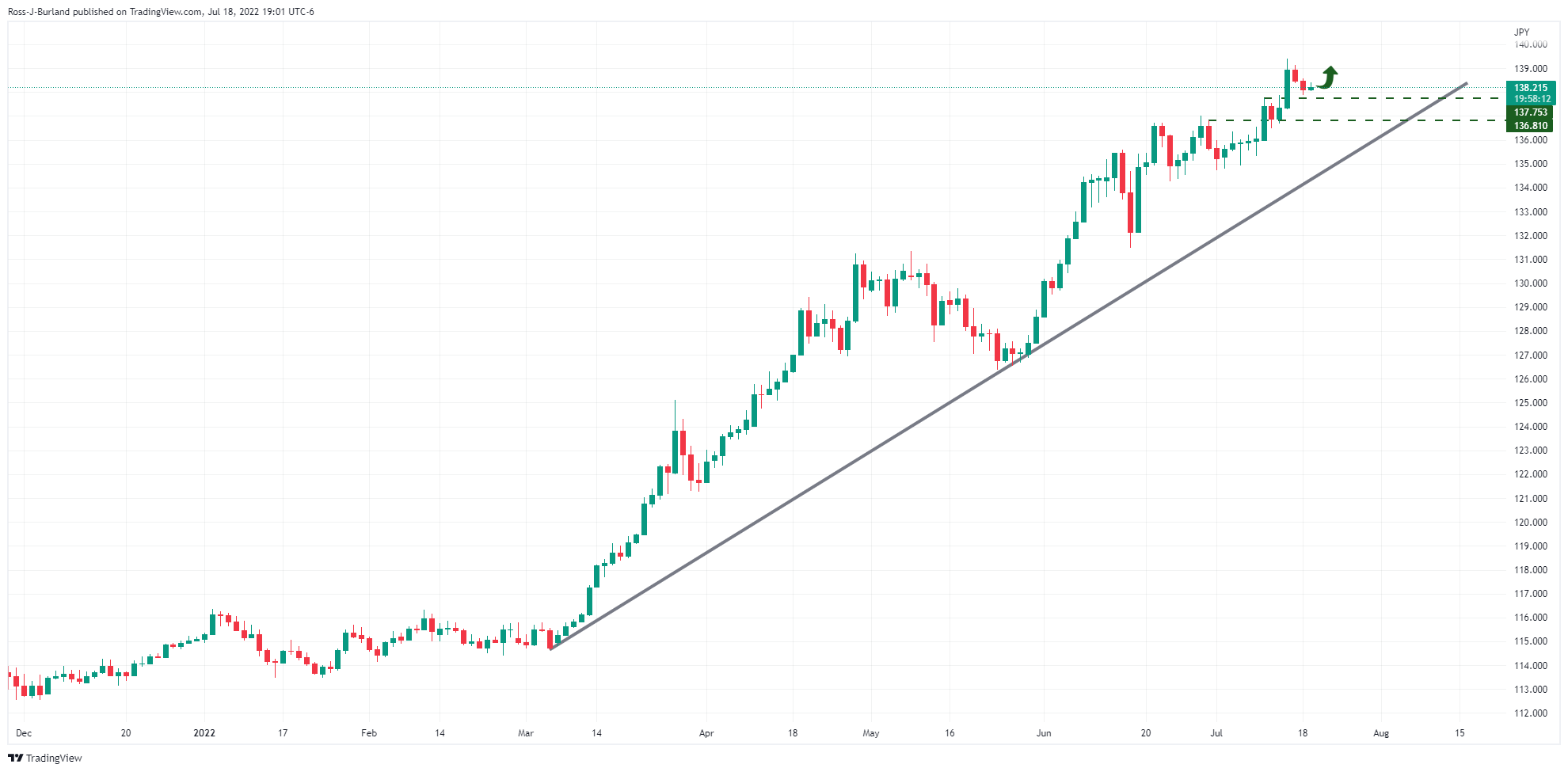
USD/JPY is in the hands of the bears in a correction of the latest bullish impulse on the daily chart.
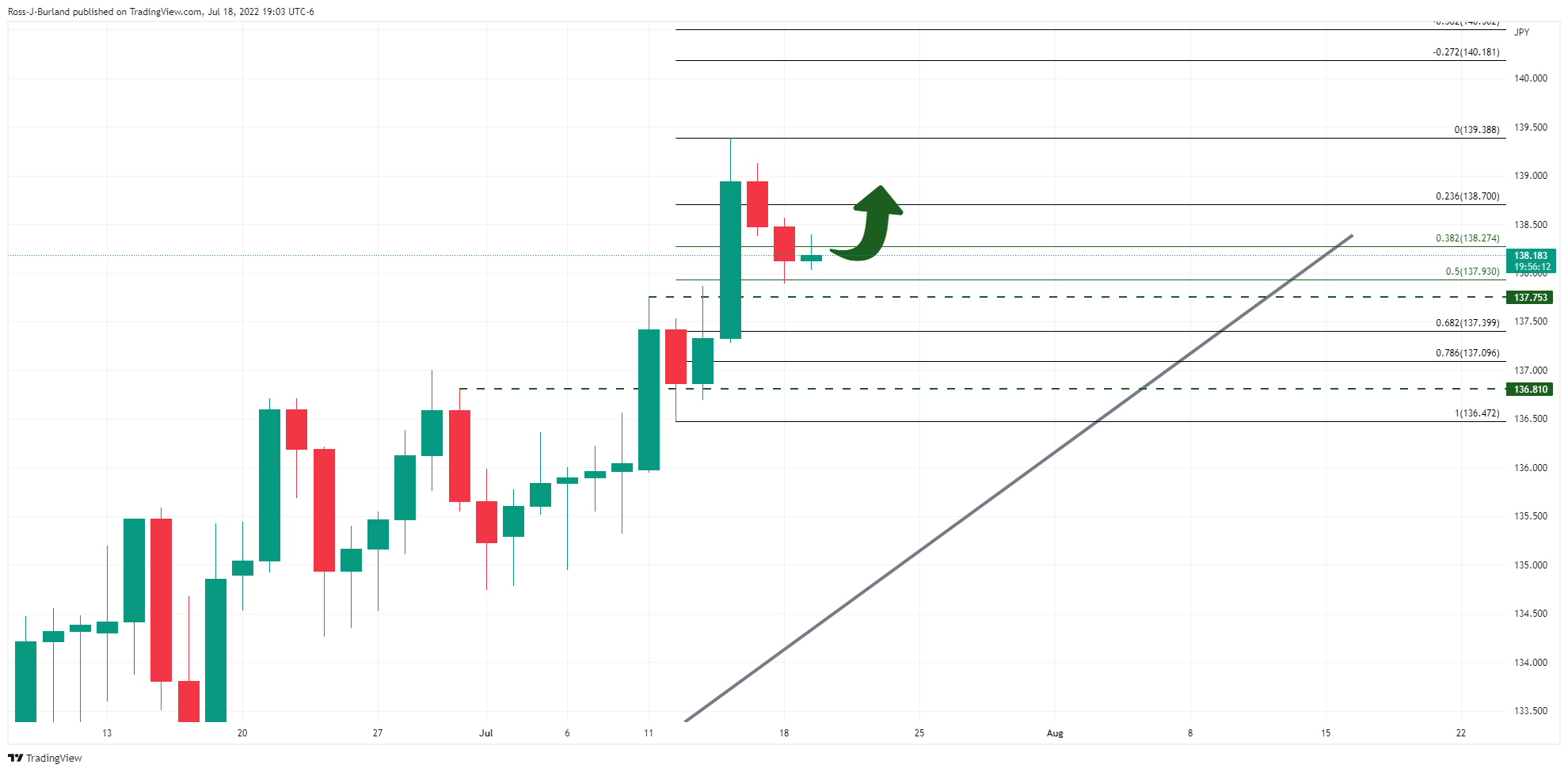
Zoomed in, the price is en route to a key area of support on the Fibonacci scale
USD/JPY H1 charts
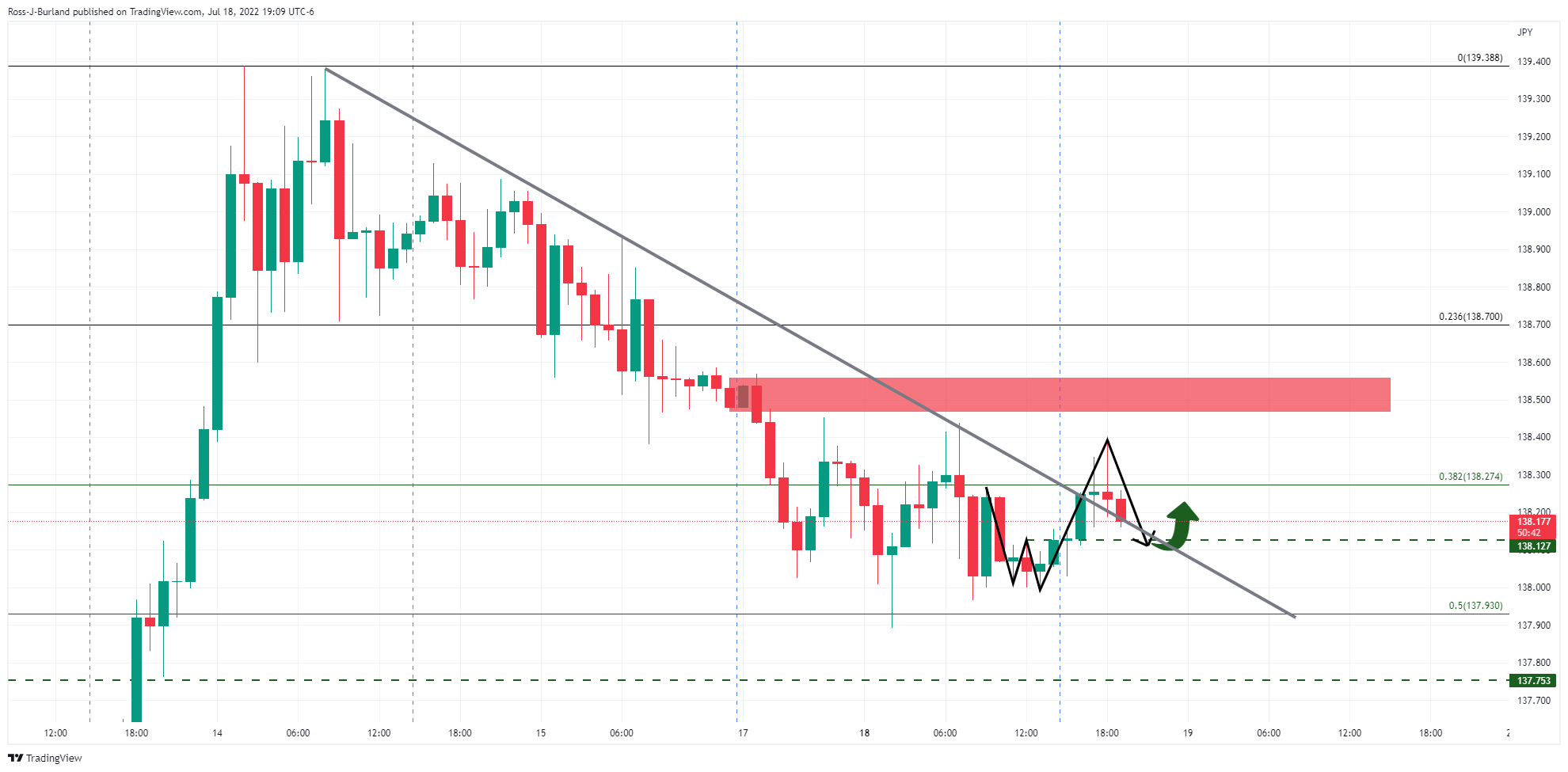
We have a reversion taking place on the hourly chart as the bulls attempt to move out beyond the trendline resistance.
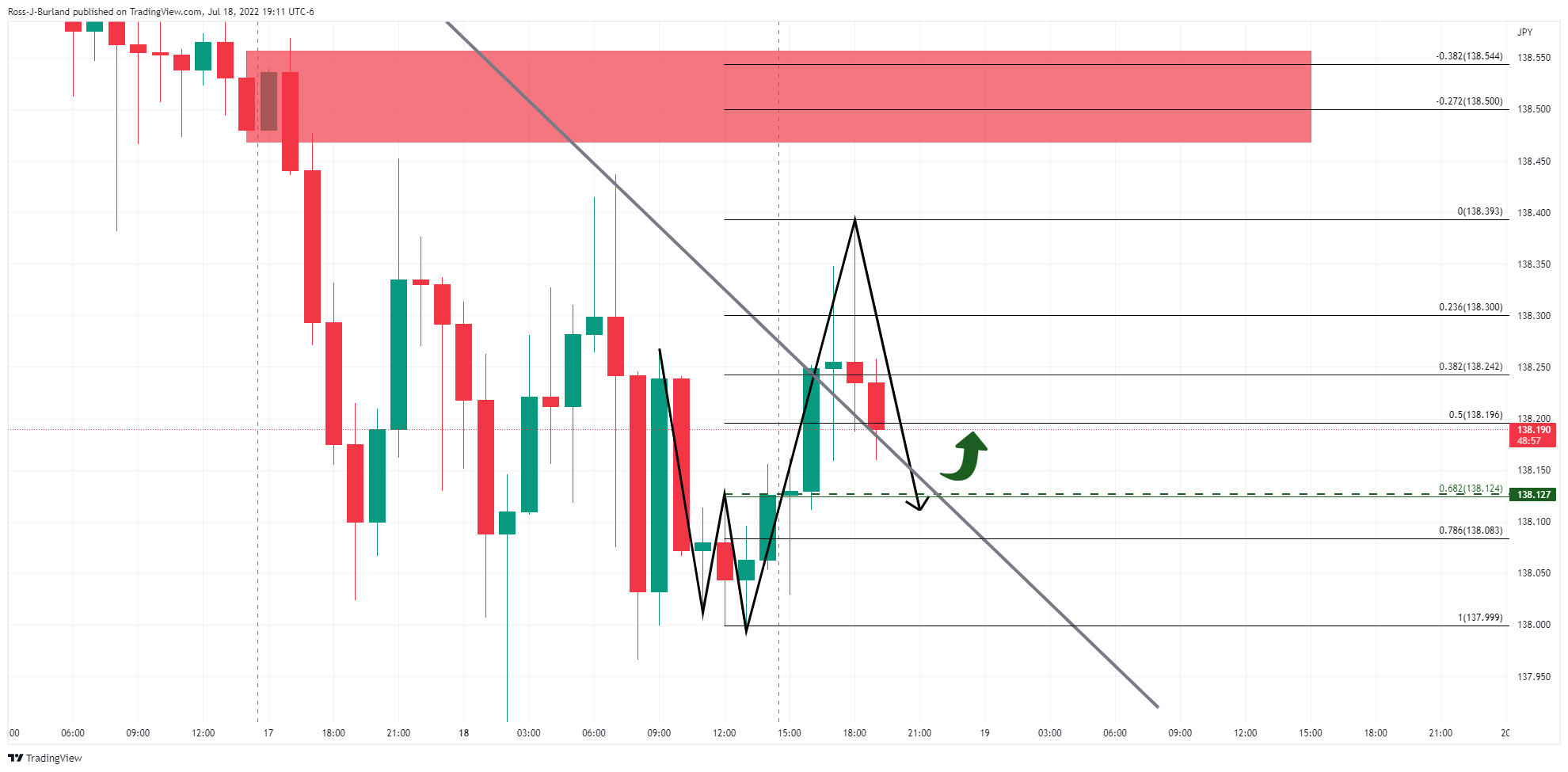
Zoomed in, the W formation's neckline aligns with the 61.8% Fibonacci of the bullish impulse which has pierced the trendline resistance.
USD/JPY 5-min chart
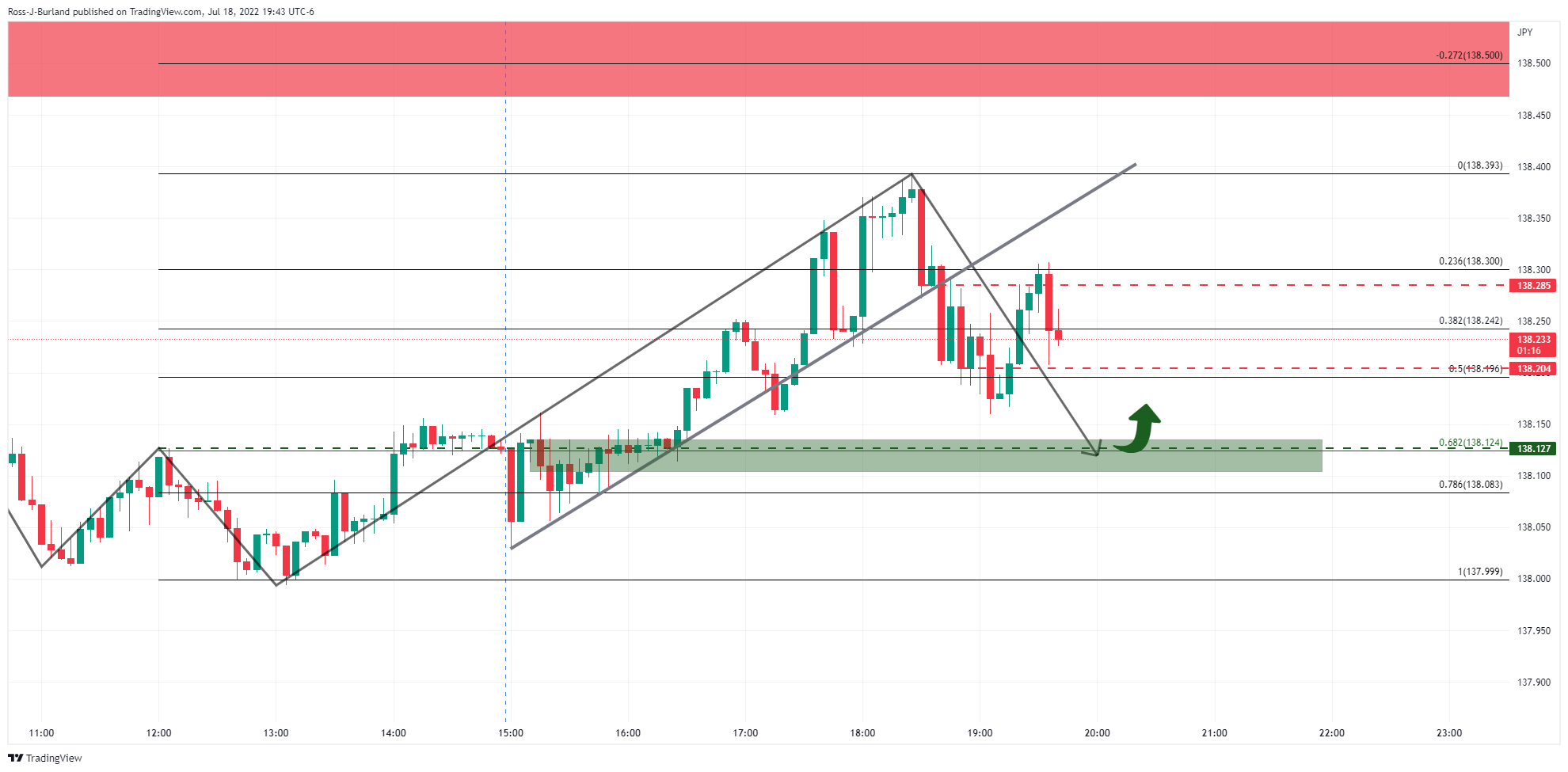
On the 5-min chart, the price has rallied into the order block area which could be the last stop before a move lower into 68.2% Fibonacci,
- AUD/USD is expected to surpass 0.6820 as RBA minutes dictate hawkish guidance.
- The RBA elevated its interest rates consecutively by 50 bps in July.
- A slippage in long-term inflation expectations has turned the DXY bearish broadly.
The AUD/USD pair is displaying topsy-turvy as the Reserve Bank of Australia (RBA) has released July monetary policy minutes. The pair is expected to advance towards 0.6820 as the minutes display hawkish guidance by RBA policymakers.
It is worth noting that the RBA elevated its Official Cash Rate (OCR) consecutively by 50 basis points (bps). Currently, the OCR stands at 1.35%. The inflation rate was recorded at 5.1% for the first quarter of CY2022. Price pressures have soared further extensively after the prior release of the inflation rate. Higher energy bills and food products are responsible for escalating price pressures. The households in the antipodean region are facing the headwinds of the inflation mess, which are impacting strongly on their paychecks.
Last week’s upbeat employment data by the Australian Bureau of Statistics favored aussie against the greenback. The jobless rate tumbled significantly to 3.5% from the prior release of 3.8%. Also, the economy added more than 88k jobs to the labor market.
On the dollar front, the US dollar index (DXY) is likely to remain lackluster amid a light calendar week. The DXY is facing minor barricades around 107.60 as odds of a rate hike by 100 basis points (bps) have trimmed. The Federal Reserve (Fed) was expected to follow the footprints of the bank of Canada (BOC) by accelerating its interest rates by 100 bps. However, a decent slippage in log-run inflation expectations has trimmed the forecast for a rate hike. The inflation indicator has landed at 2.8% from the prior print of 3.1%.
Developing story.
The Reserve Bank of Australia's minutes have been released as follows:
- Board remains committed to doing what is necessary to ensure that inflation in Australia returns to the target over time.
- Members agreed that further steps would need to be taken to normalise monetary conditions in Australia over the months ahead.
- Members noted that gauging the level of the neutral rate is challenging in practice because it cannot be directly observed.
- Members considered the possibility of raising interest rates by 25 basis points or 50 basis points.
- Level of interest rates was still very low for an economy with a tight labour market and facing a period of higher inflation.
- Members discussed three points, first that current cash rate is well below the lower range of estimates for the nominal neutral rate.
- Members viewed it as important that inflation expectations remained well anchored and that the period of higher inflation be temporary.
- This suggests that further increases in interest rate will be needed to return inflation to the target over time.
- Longer-term measures of inflation expectations were well anchored.
- Neutral rate framework indicates that if inflation expectations rise, level of nominal interest rates required to return inflation to the target will be higher than otherwise.
- Inflation is forecast to peak later in 2022 and then decline back towards the 2 to 3 per cent range in 2023.
- Higher interest rates will also help establish a more sustainable balance between the demand for and the supply of goods and services.
Meanwhile, there has been little to no reaction to the minutes in AUD/USD. The pair continues to consolidate in a flat position for the session near 0.6810.
About the RBA minutes
The minutes of the Reserve Bank of Australia meetings are published two weeks after the interest rate decision. The minutes give a full account of the policy discussion, including differences of view. They also record the votes of the individual members of the Committee. Generally speaking, if the RBA is hawkish about the inflationary outlook for the economy, then the markets see a higher possibility of a rate increase, and that is positive for the AUD.
In recent trade today, the People’s Bank of China (PBOC) set the yuan (CNY) at 6.7451 vs. the estimate of 6.7416 and the previous 6.7447.
About the fix
China maintains strict control of the yuan’s rate on the mainland.
The onshore yuan (CNY) differs from the offshore one (CNH) in trading restrictions, this last one is not as tightly controlled.
Each morning, the People’s Bank of China (PBOC) sets a so-called daily midpoint fix, based on the yuan’s previous day's closing level and quotations taken from the inter-bank dealer.
- GBP/USD has given a downside break of 1.1942-1.1957 on expectations of muted UK job data.
- Dismal Average Hourly Earnings will bring more pain for the pound bulls.
- The DXY has overstepped 107.50 comfortably despite a light calendar week.
The GBP/USD pair has slipped after displaying back and forth moves in a narrow range of 1.1942-1.1957 in the Asian session. The cable has delivered a downside break of the above-mentioned range as investors don’t see any outperformance in the UK employment data.
As per the market consensus, the Unemployment Rate is expected to remain stable at 3.8%. No downside deviation in the jobless rate is going to impact the sentiment of the market participants. The Bank of England (BOE) is bound to bring price stability and a stable jobless rate won’t allow the central bank to tighten policy further unhesitatingly.
Apart from that, the Average Hourly Earnings data will be of significant importance. The economic data is expected to improve minutely by 10 basis points above the prior print of 4.2%. In comparison with the responsiveness of the inflation rate, an improvement in earnings data by peanuts will dampen the market moods. The households will face more impact on their paychecks, which will escalate recession fears.
On the dollar front, the US dollar index (DXY) has established above 107.50 despite a light calendar week. The probability of a 100 basis point (bps) rate hike in July has dropped below 30% from nearly 90% earlier in the week. This has trimmed the inflation expectations significantly.
- The DXY has extended its recovery above 107.50 despite long-run inflation expectations having declined.
- Vulnerable oil prices in July and higher real income shocks may trim the inflation rate.
- A light economic calendar this week will keep the DXY on the sidelines.
The US dollar index (DXY) has given an upside break of the consolidation formed in a narrow range of 107.37-107.46. The DXY is aiming higher and may find resistance near the round-level resistance of 108.00. Earlier, the asset witnessed a steep fall after printing a fresh 19-year high of 109.30 last week. The DXY slipped heavily as the odds of a 100 basis point (bps) interest rate hike by the Federal Reserve (Fed) for its July monetary policy meeting trimmed.
Long-run inflation expectations trim
On Friday, the long-run inflation expectation component of the survey declined to 2.8% vs. 3.1% recorded in June's final print. Post the data, the probability of a 100 basis points rate hike in July dropped below 30% from nearly 90% earlier in the week.
Lower oil prices and large real income shock to reduce the inflation rate
Investors are expecting that the price pressures in the US economy are near their peak levels. The consensus is backed by vulnerable oil prices in July and likely lower aggregate demand. Expectations for slippage in the overall demand will shift the raw-material prices lower and therefore, result in a sigh of relief for the inflation rate.
Key data this week: Housing Starts, Initial Jobless Claims, S&P Global Purchase Managers Index (PMI).
Major events this week: Reserve Bank of Australia (RBA) minutes, People’s Bank of China (PBOC) monetary policy, European Central Bank (ECB) interest rate decision, and Bank of Japan (BOC) monetary policy.
| Index | Change, points | Closed | Change, % |
|---|---|---|---|
| Hang Seng | 548.46 | 20846.18 | 2.7 |
| KOSPI | 44.27 | 2375.25 | 1.9 |
| ASX 200 | 81.5 | 6687.1 | 1.23 |
| FTSE 100 | 64.24 | 7223.24 | 0.9 |
| DAX | 95.09 | 12959.81 | 0.74 |
| CAC 40 | 55.91 | 6091.91 | 0.93 |
| Dow Jones | -215.65 | 31072.61 | -0.69 |
| S&P 500 | -32.31 | 3830.85 | -0.84 |
| NASDAQ Composite | -92.37 | 11360.05 | -0.81 |
- Gold Price s correcting the weekly and daily impulses.
- The focus is on the US dollar and the path of the Federal Reserve.
- The 50% mean reversion and a 38.2% Fibonacci retracement are brought into focus.
At $1,078.50c, the Gold Price (XAU/USD) is flat in the Tokyo open, resting within a bullish correction of the recent supply. The US dollar has been under some pressure to start the week which is giving the bulls an opportunity in the yellow metal.
The greenback has suffered a rethinking in the Federal Reserve sentiment as markets dial back pricing of a 100-basis-point interest rate hike in the build-up to the upcoming meeting on July 26-27. Consequently, the greenback fell below 107 on Monday as per the DXY index which measures the greenback vs. a basket of major currencies. It was trading as high as 109.29 in a fresh bull cycle high last week.
Weighing up the Fed
A number of economic measures have contributed to the hawkish bias between federal Reserve speakers leading up to this month's meeting. For one, US inflation surprised once again to the upside in June, both headline and core measures, with annual inflation jumping to a new four-decade high of 9.1%, up from 8.6% in May. That and other data have been supporting global yields and sent the greenback higher within the bull cycle.
At the press conference post the June Federal Open Market Committee meeting, Chair Jerome Powell stated that he would need ‘compelling evidence’ that inflation is easing for the Fed to change course, which he defined as ‘a series of falling monthly inflation readings’. Since then, we have heard from Fed's Raphael Bostic who said “everything is in play” while Mester said there was no reason for a smaller hike. Mary Daly, CEO of San Francisco said 75 bp was her “most likely posture.”
Read more here: Central banks deliver hawkish surprises, what will the Fed do?
''There is no way around it, the Fed has an inflation problem on its hands and the USD will continue to remain king of FX,'' analysts at TD Securities argued.
Gold Price expectations from TD Securities
Gold Prices have crossed the threshold for a trend reversal, marking confirmation of a bear market trading regime in the yellow metal, for the time being, the analysts at TD Securities said. Their ChartVision Trend analytics highlighted that a break below the $1821/oz level by September would cement a downtrend in the yellow metal.
''With gold bugs falling like dominoes, prices have since slashed through various support levels on their way towards the $1600/oz-handle. With prices now challenging pre-pandemic levels, the largest speculative cohort in gold will start to feel the pain under a hawkish Fed regime as their entry levels are tested.''
Finally, the analysts argue that considering the latest CFTC report highlights that although a massive amount of longs was liquidated over the past week, the prop-trader cohort continues to hold an extremely large position size. Therefore, ''in a liquidation vacuum, these massive positions are most vulnerable, which suggests the yellow metal remains prone to further downside still.''
Gold Price technical analysis
From a weekly perspective, a bull correction could be on the cards and the Fibonacci retracement scale has been drawn on the chart above to illustrate the prospect of mitigation in the price imbalances as per the grey areas meeting the Fibs. However, the monthly lows of $1,676.86 as illustrated on the chart below could come within reach sooner than later:
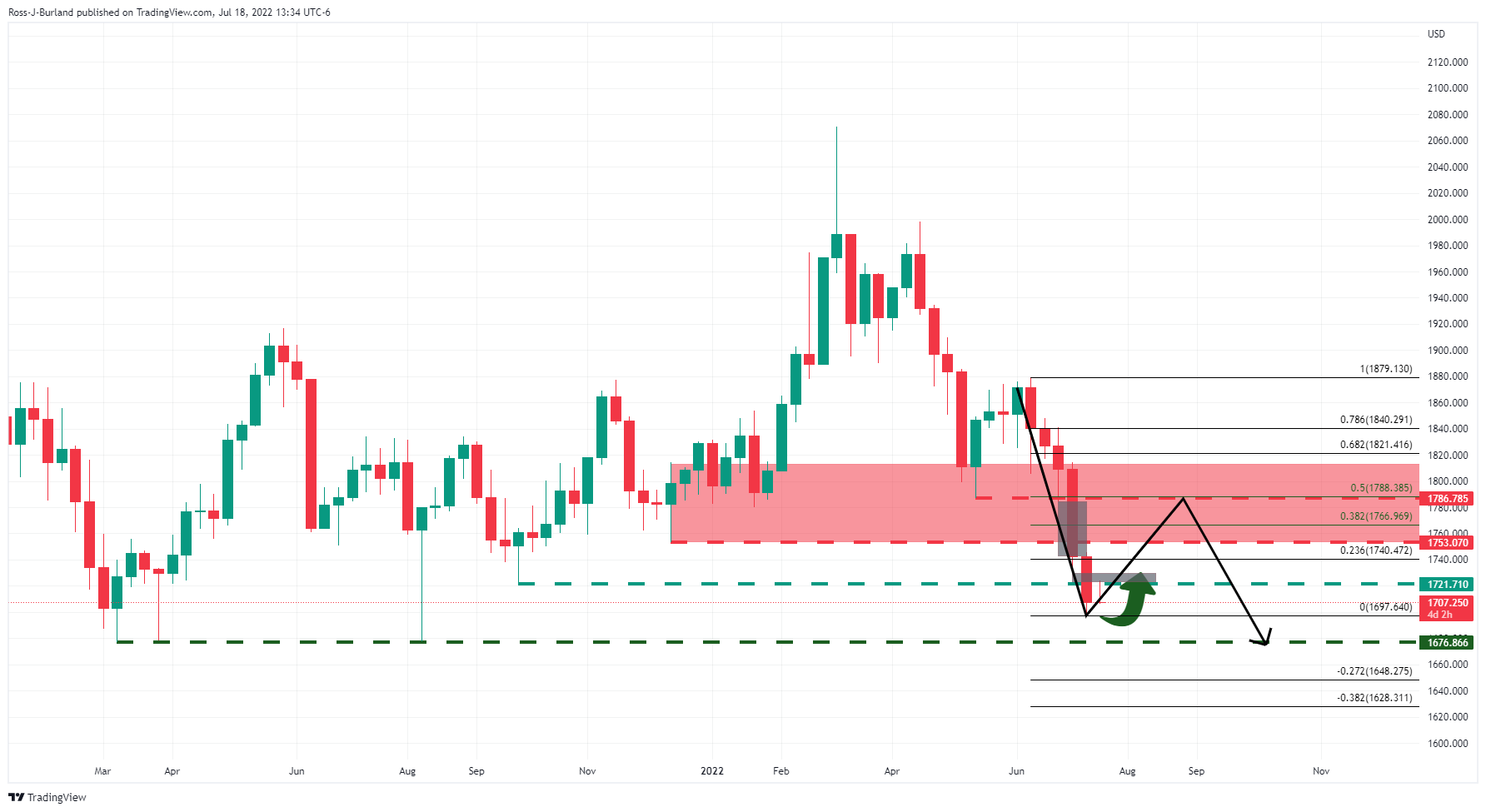
Gold analysis (XAU/USD) forecast [Video]
| Pare | Closed | Change, % |
|---|---|---|
| AUDUSD | 0.68122 | 0.28 |
| EURJPY | 140.106 | 0.29 |
| EURUSD | 1.0144 | 0.62 |
| GBPJPY | 165.034 | 0.38 |
| GBPUSD | 1.19495 | 0.71 |
| NZDUSD | 0.61519 | -0.03 |
| USDCAD | 1.29822 | -0.3 |
| USDCHF | 0.9769 | 0.05 |
| USDJPY | 138.122 | -0.32 |
- Signs of a bearish reversal escalate as asset challenges the 200-EMA.
- An initiative selling structure near 200-EMA adds to the downside filters.
- The RSI (14) has not turned bearish yet and is indicating a consolidation ahead.
The USD/CHF pair has turned sideways after displaying wild moves on Monday. The asset is facing barricades around 0.9780 and is expected to remain sideways until the volatility cools off. Broadly, the asset witnessed a steep fall after failing to reach the crucial resistance of 0.9900.
The formation of the Double Top chart-pattern after failing to sustain above Tuesday’s high at 0.9859 signaled a strong bearish reversal. Usually, the above-mentioned chart pattern indicates lower buying interest at elevated levels. Also, the formation of a selling tail near elevated levels has strengthened the odds of a bearish reversal.
The asset is forming an initiative selling structure after a double top formation, which indicates the entry of those investors who initiate shorts after the establishment of a bearish bias. The major is forming the initiative structure near the boundary of the 200-Exponential Moving Average (EMA) at 0.9767, which indicates that the market participants are respecting the critical EMA.
However, the Relative Strength Index (RSI) (14) has shifted into a range of 40.00-60.00, which signals a consolidation ahead.
A decisive downside below July 13 low at 0.9758 will drag the asset towards July 5 high at 0.9705. A breach of the latter will expose the asset to more downside towards July 1 high at 0.9642.
Alternatively, the greenback bulls could defend the double top formation after violation of Wednesday’s high at 0.9827. This will drive the asset towards Thursday’s high at 0.9886, followed by psychological resistance at 1.0000.
USD/CHF hourly chart
-637937862402619051.png)







© 2000-2026. All rights reserved.
This site is managed by Teletrade D.J. LLC 2351 LLC 2022 (Euro House, Richmond Hill Road, Kingstown, VC0100, St. Vincent and the Grenadines).
The information on this website is for informational purposes only and does not constitute any investment advice.
The company does not serve or provide services to customers who are residents of the US, Canada, Iran, The Democratic People's Republic of Korea, Yemen and FATF blacklisted countries.
Making transactions on financial markets with marginal financial instruments opens up wide possibilities and allows investors who are willing to take risks to earn high profits, carrying a potentially high risk of losses at the same time. Therefore you should responsibly approach the issue of choosing the appropriate investment strategy, taking the available resources into account, before starting trading.
Use of the information: full or partial use of materials from this website must always be referenced to TeleTrade as the source of information. Use of the materials on the Internet must be accompanied by a hyperlink to teletrade.org. Automatic import of materials and information from this website is prohibited.
Please contact our PR department if you have any questions or need assistance at pr@teletrade.global.


 Bank
Bank transfers


