- Analytics
- News and Tools
- Market News
CFD Markets News and Forecasts — 15-07-2022
- USD/JPY gained 1.80% in the week, extending its rally to the seventh consecutive week.
- USD/JPY Price Analysis: Divergence between price action and RSI spurred a pullback, though a daily close below 137.70 would tumble the USD/JPY towards 134.26.
The USD/JPY retreats from YTD highs at around 139.38, towards the middle of the 138.00-139.00 range on Friday, as Wall Street closes the week with gains between 1.83% and 2.15%, underpinned by upbeat data that could deter Federal Reserve members from hiking 100 bps in the July meeting.
The USD/JPY is trading at 138.48, down 0.33% after beginning Friday’s session around the 139.00 figure, nearly daily highs, to then slide to the daily’s central pivot point at 138.54, where the major stabilized, ahead into the weekend.
USD/JPY Price Analysis: Technical outlook
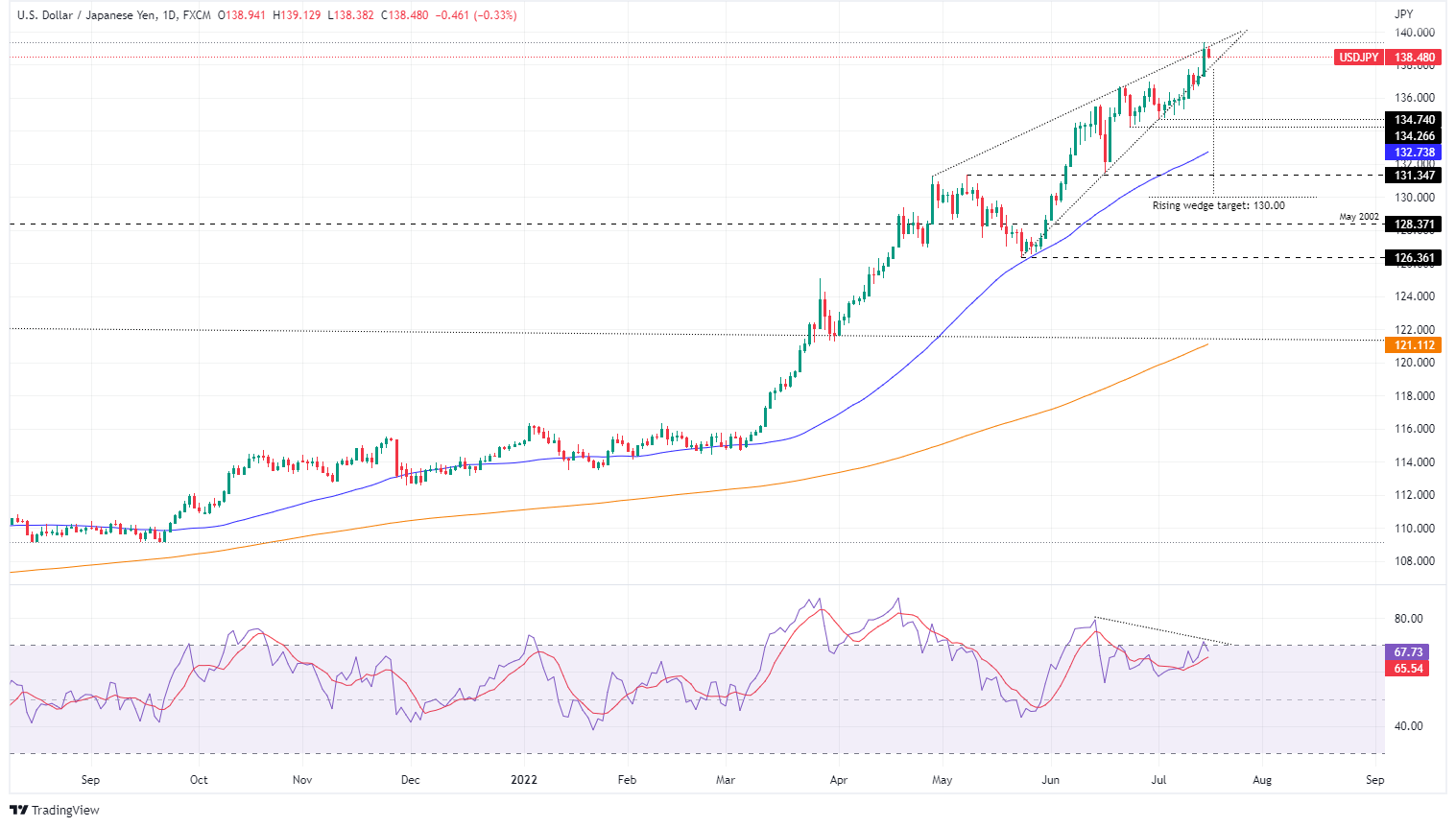
USD/JPY Daily Chart
The USD/JPY remains upward biased, but price action remains overextended. That means that USD/JPY still favors longs, but the Relative Strength Index (RSI) formed a negative divergence and exited from overbought conditions. That said, the USD/JPY could retrace from the YTD highs to its next support level at July 11 high-turned-support at 137.75.
If the above scenario plays out, the USD/JPY next support would be 137.00. The break below will expose the July 1 daily low at 134.74, followed by the June 23 low at 134.26. on the other hand, the USD/JPY’s first resistance would be the 139.00 figure. A breach of the latter would expose the YTD high at 139.38, followed by 140.00.
USD/JPY Key Technical Levels
- Silver climbs and pares some of its weekly losses, but not enough to end the week higher; it is losing 3.37% in the week.
- University of Michigan inflation expectations tempered from around 3.1% to 2.8%; San Francisco Fed President Daly noticed.
- Money market futures illustrates that traders expect a Fed 75 bps rate hike in July and are pricing an additional 80 bps by year-end.
Silver (XAGUSD) is trimming some of Thursday’s losses late in the North American session but remains short of reclaiming the $19.00 barrier on Friday, despite taking advantage of a weaker US dollar, sliding 0.50% as portrayed by the US Dollar Index at 108.093, despite upbeat US economic data.
XAGUSD exchanges hands at $18.66, up 1.36% on Friday, in a calm session that witnessed the white metal dipping to $18.17, a fresh daily low, followed by a jump towards the daily high at $18.77.
Silver climbs but falters to conquer $19.00
Global equities are trading with gains, despite that the narrative of high inflation and recession fears is unchanged. US Retail sales advanced by 1% YoY in June, beating forecasts of 0.&. May’s figures were at -0.3%, displaying consumer’s resilience. Later, the University of Michigan Consumer Sentiment for July hit 51.1, exceeding estimations of 49.9 and higher than June’s 50. The UoM survey highlighted that inflation expectations over a 5-year projection were lower from 3.1% to 2.8%.
XAGUSD has also been bolstered by falling US Treasury yields. The US 10-year benchmark note yields 2.934%, down by three bps. Meanwhile, the US 2s-10s yield curve remains inverted for the ninth consecutive trading day, illustrating that investors remain pessimistic and are discounting a US recession.
Elsewhere, Fed officials crossed newswires. The St. Louis Fed President James Bullard said it would not make any difference to hike 100 or 75 bps while adding that the pace could be adjusted for the rest of the year. Later, San Francisco’s Fed President Mary Daly said that inflation is too high, the US economy is strong, and the labor market remains solid. She added that the Univesity of Michigan inflation expectations were a “good thing” and that recession is not her base scenario.
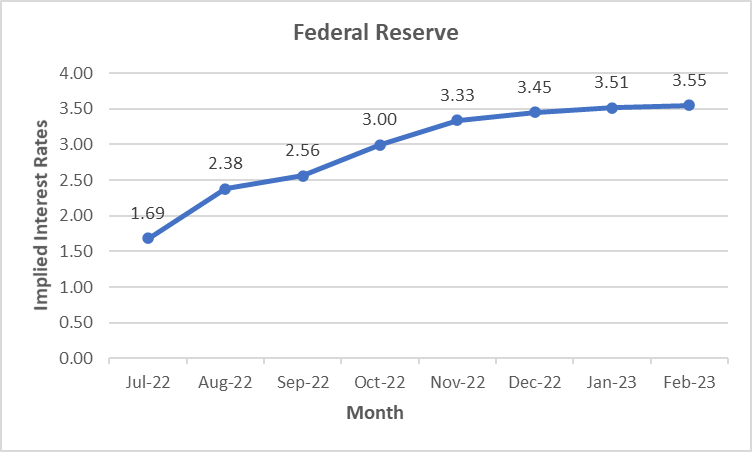
Federal fund rates expectations
30-Day Federal fund rates futures
At the time of writing, market participants expect a 75 bps rate hike, as shown by the 30-day Federal funds rate (FFR) futures, and foreseen it would end at around 3.45% by December of 2022.
What to watch
The week ahead, the Canadian docket will feature Housing Starts, Inflation data, and Retail sales. The calendar will be packed on the US front, Housing Starts, Building Permits, Existing Home Sales, Initial Jobless Claims, and July’s S&P Global PMIs.
Silver (XAGUSD) Key Technical Levels
- The USD/CHF retreats from 0.9886 in a volatile session, despite positive US data.
- The Swiss franc has gained almost 1% in the last two trading days.
- USD/CHF Price Analysis: Sellers are eyeing 0.9700, which would open the door for buyers to lift the pair towards 0.9800.
The USD/CHF dives after reaching a weekly high on Thursday, around 0.9900, and plunges towards the 0.9770s region on upbeat US data, which pared expectations of a Federal Reserve larger-than-expected rate hike, which was cheered by investors, as reflected by global equities rising.
The USD/CHF is trading at 0.9775, near the daily lows, after hitting a 0.9840 daily high, just above the daily pivot, which once broken, paved the way for a free fall below 0.9800, and further extending towards the S1 pivot area around 0.9773.
USD/CHF Price Analysis: Technical outlook
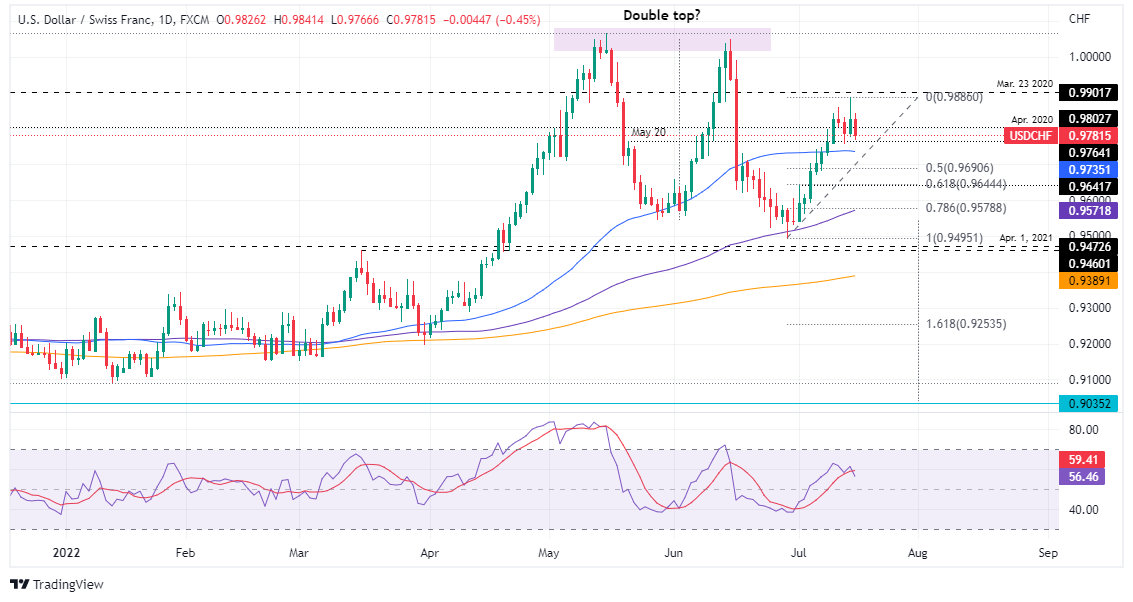
USD/CHF Daily chart
The USD/CHF daily chart shows that it is still favoring longs. The ongoing pullback from weekly highs near 0.9900 could be capped around the 50-day moving average (DMA) at 0.9735, though the Relative Strength Index (RSI) at 56.03 keeps pushing lower, which means that sellers might be eyeing the 50% Fibonacci retracement at around 0.9690, looking forward for an RSI’s uptick, that could give buyers a go, to re-enter USD/CHF longs.
If that scenario plays out, USD/CHF’s first resistance would be 0.9700, followed by 0.9735 and 0.9800. Otherwise, the USD/CHF pullback could continue its fall towards the 61.8% Fibonacci level at 0.9644, followed by the figure at 0.9600.
USD/CHF Key Technical Levels
- USD/CAD is set to end the week with solid gains of 0.76% after a volatile week.
- Positive US retail sales and UoM Consumer Sentiment easied Fed intentions of a larger-than 75 bps hike.
- USD/CAD Price Analysis: Daily close below 1.3076 might pave the way for a correction toward 1.2930s.
USD/CAD extends its decline from weekly highs around 1.3220s reached on Thursday, spurred by elevated US PPI data, which showed that inflation is far from peaking, triggering an uptick in expectations of a Fed 100 bps hike, which later easied as Fed policymakers pushed back against those assumptions.
The USD/CAD is exchanging hands at 1.3029, dropping almost 0.70%, on a day where the USD/CAD started trading around 1.3110s, near the daily highs, and plunged on a soft US dollar, hitting a daily low at around 1.3013, early in the North American session.
USD/CAD drops on risk-on, soft US dollar, and high oil prices
Global equities portray an upbeat market mood. Nevertheless, the market narrative stays the same, with high inflation, worldwide central banks hiking rates, and recession fears lingering in traders’ minds. The greenback remains heavy, down by almost 0.50%, as portrayed by the US Dollar Index, at 108.111. in the commodities space, US crude oil, namely WTI, rises 1.49%, at $97.90 PBD, a headwind for the USD/CAD, due to the close correlation between the Canadian dollar and oil prices.
On Friday, the US Department of Commerce reported that US Retail Sales rose by 1% YoY, beating the estimations of 0.8%, and also topped May’s dismal reading of -0.3%, a signal of consumers’ resilience and strength, despite Fed hikes. Additionally, the University of Michigan Consumer Sentiment at 51.1 vs. 49.9 estimated, exceeding forecasts, while inflation expectations tempered, with consumers seeing inflation at 2.8% over a 5-year horizon, lower than 3.1% in June.
On the Canadian side, the Friday docket was empty. However, the Bank of Canada’s decision to hike rates by 100 bps caught the markets by surprise and capped any further gains by the greenback. At the press conference, the BoC Governor Macklem said that front loading rate increases now would help avoid even higher rates in the future while adding that front-loaded cycles tend to be followed by softer landings.
What to watch
The week ahead, the Canadian docket will feature Housing Starts, Inflation data, and Retail sales. The calendar will be packed on the US front, Housing Starts, Building Permits, Existing Home Sales, Initial Jobless Claims, and July’s S&P Global PMIs.
Also read: USD/CAD trades volatile, after an unexpected BoC 1% rate hike, and US inflation above 9%
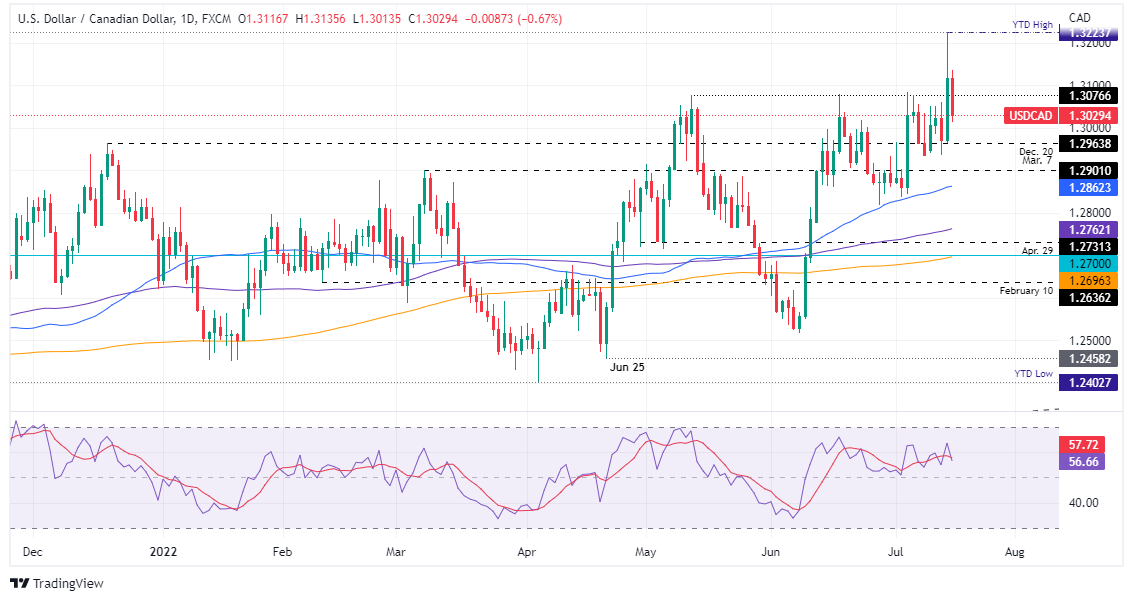
USD/CAD Price Analysis: Technical outlook
From a technical perspective, the USD/CAD favors longs, but a daily close below the May 12 high at 1.3076, might open the door for a pullback before resuming upwards. Also, traders should note that the Relative Strength Index (RSI) at 56.68 pierced below the RSI’s 7-day SMA, triggering a sell signal that a cross below the 50-mid line could further confirm.
Therefore, the USD/CAD first support will be 1.3000. A break below will send the pair sliding towards July 13 low at 1.2936, followed by a push lower to the 50-day moving average (DMA) at 1.2862.
According to the Federal Reserve Bank of Atlanta's GDPNow model, the US economy is expected to contract by 1.5% in the second quarter, down from the July 8 forecast of -1.2%.
"After recent releases from the US Bureau of Labor Statistics, the US Census Bureau, the Federal Reserve Board of Governors, and the US Department of the Treasury's Bureau of the Fiscal Service, the nowcast of second-quarter real personal consumption expenditures growth and real gross private domestic investment growth decreased from 1.9% and -13.7%, respectively, to 1.5% and -13.8%, respectively," Atlanta Fed explained in its publication.
Market reaction
The US Dollar Index showed no immediate reaction to this report and was last seen losing 0.5% on the day at 108.10.
University of Michigan’s Consumer Confidence preliminary July report showed an unexpected modest rebound in the main index. Analysts at Wells Fargo point out the main takeaway is that inflation expectations cooled. They explain that represents welcome news for Federal Reserve policymakers “and it makes the pressure to "go big" at the next meeting less intense after this week's scorching CPI report.”
Key Quotes:
“At 2.8%, consumer inflation expectations for the next 5-10 years are well within the past decades range, or what is considered well-anchored. This is welcome news after expectations rose to the top end of their recent range in the preliminary June release and raised concerns that expectations were becoming unhinged.”
“It also takes some of the heat off the fire for the Fed to hike rates a full 100 bps at its next policy meeting on July 27 and suggests the Fed may again opt instead for a still-large 75 bp hike. St. Louis Fed President James Bullard and Federal Reserve Governor Christopher Waller in separate public appearances on Thursday both backed raising rates by 75 basis points this month, and we expect this fresh data supports that view.”
“Anchored expectations are welcome news for the Fed, there's no doubt about it. But importantly, they have to remain anchored, and with prices set to decline only slowly, the Fed will continue to closely monitor expectations.”
Analysts at MUFG Bank still have a conviction that the EUR/USD pair will break decisively below parity. They point out energy supply fears in Europe are set to remain a heavy weight on the euro as the Federal Reserve sticks to hawkish rate hike plans. They add Italian politics to downside risks.
Key Quotes:
“We expect the EUR to remain under downward pressure in the near-term driven by ongoing fears over disruption to the euro-zone economy from energy supply constraints and fragmentation risks. Those fears are unlikely to ease in the coming weeks and will be tested by the re-opening of the NordStream 1 gas pipeline on 21st July.”
“The ECB also faces a key test in the week ahead when it is expected to announce details of their new anti-fragmentation policy tool. The pick-up in political risk in Italy in recent days has made it even more timely that the ECB steps up to the plate and delivers a credible response to contain fragmentation risks. If there is any disappointment amongst market participants over the new tool then it will reinforce EUR weakness in the near-term especially if an early election is called in Italy as well.”
“Fed’s job remains less complicated at this stage as they are free to focus on lifting rates to dampen inflation risks. The stronger US CPI report increases the risk of further large Fed hikes at upcoming policy meetings which is encouraging an even stronger USD.”
The USD/CLP jumped from 850 to record highs above 1050. According to analysts at Wells Fargo, the move could be identified as overshooting and the currency could be oversold. They see a potential appreciation ahead for the Chilean peso of around 6% in the short term.
Key Quotes:
“Our analysis reveals the Chilean peso may be oversold at current levels. In fairness, the Chilean peso has rightfully come under pressure. Copper prices have dropped significantly, and given Chile's reliance on copper, the drop in prices has spilled over onto the currency. In addition, Central Bank of Chile policymakers have underwhelmed markets on multiple occasions when it comes to monetary policy.”
“As depreciation pressure mounted, policymakers have resisted any form of FX intervention, and as of now, seem unwilling to use FX reserves to support the currency. This combination has the Chilean peso in free-fall and hitting new lows against the greenback on a daily basis. However, we believe the currency is oversold and now misaligned with country fundamentals.”
“From a technical perspective, we believe market participants will notice this imbalance and the peso can recover. In addition, we believe the recent selloff will force Central Bank of Chile policymakers to raise policy rates more aggressively and extend the tightening cycle, as well as intervene in FX markets and defend the currency.”
“As policymakers step up policy tightening and intervention efforts, the currency can rebound back toward the upper bound of its potential depreciation range. In that sense, we believe the Chilean peso can rally 6% in the short-term.”
The Canadian dollar is likely to be hurt more by intensifying global growth fears and from negative spill-over risks from higher rates, according to analysts at MUFG Bank. They see the USD/CAD moving higher in the short-term.
Key Quotes:
“CAD will weaken further in the near-term on the back of intensifying fears over a sharper slowdown in global growth. After testing resistance at the 1.3000-level, the pair finally broke decisively higher hitting a high of 1.3224 over the past week. The bullish price action supports our trade idea and points to further upside ahead.”
“The CAD weakened sharply even after the BoC hiked rates by a larger 100bps and signalled further hikes this year. Higher yields alone are not sufficient to prevent the CAD from weakening against the USD in the current environment. Support from higher yields has been more than offset by intensifying fears over global growth which has resulted in the price of Brent crude oil dropping sharply back below USD100/barrel.”
“There are building concerns that the BoC could be overdoing it in hiking rates so quickly so that it increases the risk of sharper domestic slowdown as well. The BoC already noted that the housing market activity is clearly slowing. We still expect the Fed to keep raising rates for longer than the BoC given Canada’s economy should prove sensitive to higher rates in our view.”
- EURUSD trades above 1.0060 and trims its weekly losses, now up 0.50% in the week.
- US Retail Sales and UoM Consumer sentiment exceed estimations, easing prospects of a 100 bps Fed hike.
- Interest rate differentials between the Fed and the ECB boost the EURUSD fall.
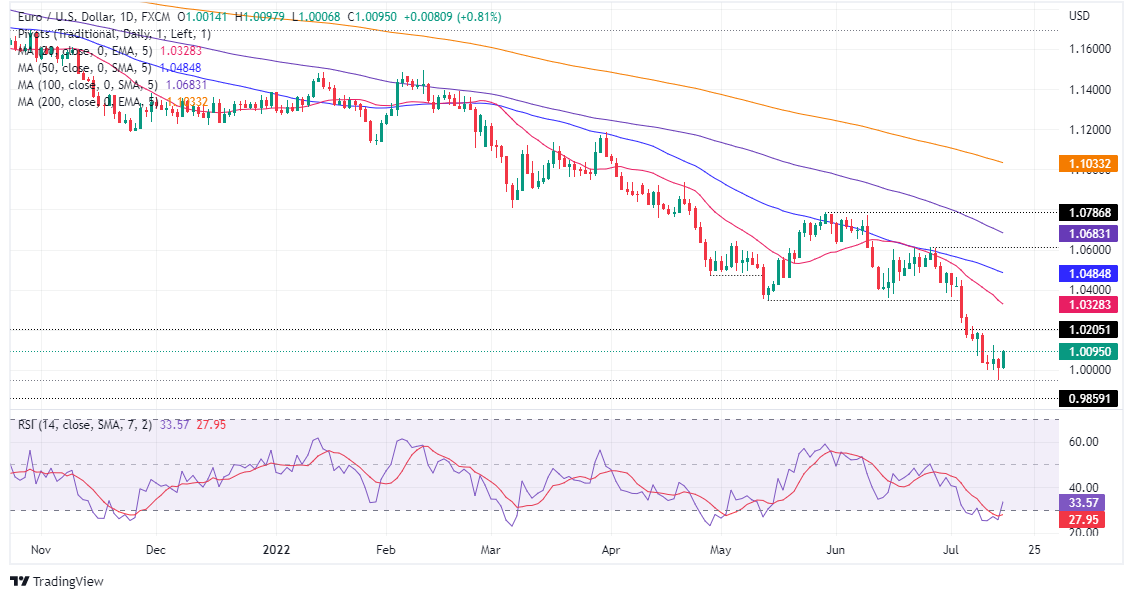
EURUSD buyers stepped in vigorously, defending the euro from falling below parity, with the major trading above the July 14 high 1.0058, though before dipped towards 1.0006, at the brink of the €1/$1 mark, but bounced off daily lows, and climbed towards current price levels. At the time of writing, the EURUSD is trading at 1.0095.
The financial markets narrative remains unchanged. Worries of higher inflation, central banks tightening, and recession jitters linger on investors’ minds. Nevertheless, global equities edge up in positive US economic data related to consumers, which would further cement the Fed’s case for a 75 bps hike. That said, the EURUSD will be at the mercy of interest rate differentials between the ECB and the Fed, which could favor the shared currency. However, the greenback recoils 0.52%, as shown by the US Dollar Index falling towards 108.070, a tailwind for the euro.
Also read: EUR/USD Forecast: Euro remains vulnerable despite reclaiming parity
US Inflation remains high
US Retail sales and UoM Consumer sentiment beat forecasts.
In the meantime, upbeat economic data give traders a respite, but not to USD buyers, which are booking profits ahead of the weekend. The US Department of Commerce reported that US Retail Sales rose by 1% YoY, exceeding expectations of 0.8%, and also left behind May’s dismal reading of -0.3%. Of late, the University of Michigan Consumer Sentiment came better than expected, with the index toping 51.1 vs. 49.9 estimated. The positive in the report is that inflation expectations tempered, with consumers seeing inflation at 2.8% over a 5-year horizon, lower than 3.1% in June. Although data is positive, that could boost the EURUSD because the data may ease Fed officials from hiking more than 75 bps.
US inflation remains high; additional Fed hikes ahead
Given that US inflation readings in the week remained higher, with the CPI and the PPI hitting 9.1% and 11.3% in year-over-year readings, EURUSD traders need to be aware of that. Further rate hikes from the Fed are expected, with money market futures STIRs portraying the Federal funds rate (FFR) at 3.55% by December, meaning that market participants expect at least 225 bps of tightening by the year’s end. Consequently, this would be a headwind for the EURUSD, despite the ECB’s guidance that it would begin raising rates for the first time in 11 years.
Fed speakers began to be vocal about rate hikes and emphasized that inflation is high
Elsewhere, Fed speakers have been entertaining EURUSD traders throughout the week. On Friday, the St. Louis Fed President James Bullard said it would not make any difference to hike 100 or 75 bps while adding that the pace could be adjusted for the rest of the year. Earlier in the week, Atlanta’s Fed President Raphael Bostic said everything is in play when asked about raising rates 100 bps in the July meeting. Later, the Cleveland Fed President Loretta Mester said they don’t need to decide on rates today but emphasized that inflation is “too high,” and the CPI report was uniformly negative. In the meantime, backing 75 bps is San Francisco’s Fed Mary Daly, but she also said that 100 bps is within the range of possibilities.
Recession fears remain as the US 2s-10s yield curve remains inverted
The US 2s-10-yield curve is still inverted for nine consecutive days, though less profound than in previous days- At the time of writing, the spread reduced to -0.189%, as traders’ fears about recession easied a tone. However, unless Fed officials express worries about economic growth, that would not deter them from aggressive tightening, which is negative news for EURUSD longs in the future.
ECB vs. Fed differentials, a headwind for the EURUSD
In July, both banks, the ECB and the Federal Reserve will host their monetary policy meetings. Currently, the ECB’s deposit rate lies at minus 0.50%, while the US Federal Reserve’s Federal funds rate (FFR) is at 1.75%, bolstering the appetite for the greenback. With expectations of the ECB hiking 25 bps and the Fed to move at least by 75 bps, differentials would widen further, to -0.25% (ECB) vs. 2.50% (Fed), meaning that the greenback would keep the upper hand, opening the door for further selling pressure on the EURUSD.
EURUSD Price Technical outlook
EURUSD remains heavy, as shown by the daily chart, with the daily moving averages (DMAs) residing well above the exchange rate. Wednesday’s correction offered EURUSD shorts a better entry price after hitting a daily high around 1.0122, but on Thursday, the major extended its losses, pushing below the parity. However, on Friday, the EURUSD buyers stepped in and kept the price above the July 14 high of 1.0058, meaning that achieving a daily close above it might open the door for a correction.
In the near term, the EURUSD is headed upwards. That said, the major’s first resistance would be 1.0100. Break above will expose the July 13 high at 1.0122, followed by July 11 daily high at 1.0183.
On the flip side, the EURUSD first support would be 1.0000. A breach of the latter will expose the fresh 20-year low at 0.9952. Once cleared, EURUSD sellers’ next challenge will be December 2002 lows around 0.9859.
EURUSD: Weekly forex analysis video: EUR/USD, GBP/USD, AUD/USD and more [Video]
Data released on Friday showed Retail Sales rose 1% in June, above the 0.8% of market consensus; May’s numbers were revised higher. The June retail sales report showed that consumers are still spending more but getting less, explained analysts at Wells Fargo. They warn the staying power of consumer goods spending is waning.
Key Quotes:
“The June retail sales report shows that people are paying more but getting less. The total dollar amount of retail sales grew 1.0%, which topped consensus estimates, but after applying our inflation adjustment, we estimate that real retail sales actually fell by 1.0%.”
“Our latest forecast has the FOMC raising rates by 100 bps at its policy meeting on July 27. St. Louis Fed President James Bullard and Federal Reserve Governor Christopher Waller in separate public appearances on Thursday both backed raising rates by 75 basis points this month, though Waller said, “If that data come in materially stronger than expected it would make me lean towards a larger hike at the July meeting.”
“Continued moderation in real goods consumption should help alleviate pressure on supply chains and contribute to a decline in goods inflation. Ultimately that is what the Fed is trying to achieve: slower demand to bring down inflation. But with real retail sales still more than 6% above pre-pandemic levels through June, we expect more tightening yet before demand meaningfully declines to facilitate a reprieve in goods prices.”
- US Dollar drops across the board, moves off multi-year highs.
- US economic data mostly above expectations.
- AUD/USD up on Friday, still heads for the lowest weekly close since May 2020.
The AUD/USD is rising more than 50 pips on Friday as it moves off the multi-year low it hit on Thursday at 0.6697. Recently the pair hit the highest level since Monday at 0.6805.
Near the end of the week, AUD/USD is hovering around 0.6800, far from the recent low but still in negative for the week. The weekly close could be the lowest since May 2020; however, the sharp rebound from 0.6700 is a positive sign for the Aussie.
Dollar correct lower amid risk appetite
The greenback is pulling back across the board as stocks in the US post strong gains. The Dow Jones is up by 2.00% and S&P 500 by 1.75%. US yields are modestly lower, unaffected by US economic data. The DXY is falling 0.62% on Friday, the worst performance in a month.
Data released on Friday showed Retail Sales rose above expectation in June, the Empire Manufacturing index climbed unexpectedly to 11.1 and the Consumer Confidence report also surpassed market consensus. The odds of a 100 basis points rate hike from the Federal Reserve at the July meeting rose after the numbers; and were partially offset by Fedspeak, suggesting a 75bps hike seems more likely.
Technical levels
San Francisco Fed President Mary Daly said on Friday that she is cont concerned above "over cooking things" on rate hikes, as reported by Reuters.
Additional takeaways
"Consumers continue to spend."
"Labor market remains strong."
"Inflation is too high."
"Fed is working on getting down inflation without stalling economy."
"Inflation has lasted longer than hoped, that's because covid is still rampant, and the war."
"Price of gas is a market-based price, based on supply and demand."
"We are dialing back support to economy."
"July meeting will be a good discussion."
"Bringing down inflation will help Americans."
"We're not talking about raising rates to extreme highs, more like in the 3% range."
"I don't expect mortgage rates to keep marching up as they have been."
"It's a little painful now, but better in the long run."
"This will cool the frothy housing market."
"We are starting to see signs that inflation is coming down."
"UOM data on consumer inflation expectations was a good thing."
"I want inflation to be less painful by end of the year than it is now."
"I don't have recession high on list of possible outcomes."
"Job market is very strong."
Market reaction
The US Dollar Index stays deep in negative territory near 108.10 following these comments.
Statistics New Zealand will release Q2 Consumer Price Index (CPI) inflation data on Sunday, July 17 at 22:45 GMT and as we get closer to the release time, here are forecasts from economists and researchers of four major banks regarding the upcoming growth data.
Economists expect the CPI to have jumped from 6.9% YoY to 7.1%. Meanwhile, the QoQ pace may have moderated to 1.5% from 1.8%.
ANZ
“We’re forecasting that annual CPI inflation hit 7.1% in Q2 – a slight increase from Q1’s already-strong 6.9% print. Uncertainty remains high, with global commodity prices being buffeted by geopolitical developments, and trading-partner inflation continuing to surge. Domestic inflation risks are firmly to the upside, given still-high inflation expectations and an extremely tight labour market. We expect annual non-tradables inflation remained high at 6.0%, while tradables are expected to have nudged up to 8.7% YoY (8.5% previously). The RBNZ is unlikely to find any comfort – and that should see another 50 bps hike delivered at the August MPS, despite downside growth risks piling up. If we were to see a non-negligible upside surprise to the CPI print, another 50 bps in October would be game on. The RBNZ has no leeway to take any chances on the inflation front.”
Westpac
“We expect the upcoming Consumers Price Index will show that New Zealand consumer prices rose by 1.4% in the June quarter. That would take annual inflation to 7.0%, up from 6.9% last quarter and the highest annual inflation rate in more than three decades. There have been particularly large increases in the prices of food, fuel and housing related costs. However, price pressures are bubbling over in every corner of the economy. Businesses are continuing to grapple with shortages of staff and supplies. But what has really lit a fire under consumer prices has been the strength of demand. Our forecast is in line with the RBNZ’s last set of published forecasts.”
Standard Chartered
“We expect YoY inflation to have remained elevated at 6.9%; however, on a QoQ basis, inflation likely moderated to 1.3% from 1.8% previously. Median house prices were down 3.4% QoQ in Q2, more than the 2.5% QoQ decline in Q1. Dubai oil prices rose at a slower pace of 12.3% QoQ in Q2 versus 24.9% QoQ in Q1. The NZD trade-weighted index depreciated by a slower pace of 0.7% QoQ in Q2 versus 2.2% QoQ in Q1. Finally, the food price index rose 1.4% QoQ in Q2 versus 3% QoQ in Q1. Our forecast is similar to the central bank’s forecast of 7.0% YoY in Q2.”
TDS
“The RBNZ expects CPI inflation to peak at 7.0% YoY in Q2'22 but we struggle with this optimistic view. We see further upside risks to NZ inflation from the passthrough of elevated PPIs to CPIs by offshore trading partners. We think another red-hot CPI print (we forecast 7.3% YoY) reinforces our call for a fourth consecutive 50 bps hike by the Bank at its August meeting.”
- UOM Consumer Confidence Index edged slightly higher in early July.
- US Dollar Index is pushing lower toward 108.00.
Consumer sentiment in the US improved slightly in early July with the University of Michigan's Consumer Confidence Index edging higher to 51.5 in July's flash estimate from 50 in June. This print came in slightly better than the market expectation of 49.9.
On a negative note, the Index of Consumer Expectations declined to its lowest level since May 1980 at 47.3.
"The median expected year-ahead inflation rate was 5.2%, little changed from the past five months," the publication further revealed. "Median long-run expectations fell to 2.8%, just below the 2.9-3.1% range seen in the preceding 11 months."
Market reaction
Pressured by falling long-term inflation expectations, the US Dollar Index edged lower and was last seen losing 0.5% on the day at 108.12.
St. Louis Federal Reserve Bank President James Bullard argued on Friday that it wouldn't make too much of a difference to do a 100 basis points (bps) or a 75 bps rate hike at the next meeting, as reported by Reuters.
Additional takeaways
"Inflation can come down relatively quickly down to 2% over the next 18 months if Fed plays its cards right."
"Base case is still that we can get a relatively soft landing."
"I am an advocate of frontloading rate hikes."
"Fed has been trying to not do too much at once."
"Our commitment to getting to 2% inflation is unconditional."
Market reaction
The US Dollar Index extended its recovery on these comments and was last seen losing 0.25% on a daily basis.
- Gold price oscillated in a range and consolidated the recent downfall to a nearly one-year low.
- The ongoing USD profit-taking slide from a 20-year low, weaker US bond yields offered support.
- Aggressive Fed rate hike bets, a positive risk tone acted as a headwind and capped the upside.
Gold price seesawed between tepid gains/minor losses on Friday and consolidated its recent decline to its lowest level since August 2021. The XAUUSD, however, managed to defend the $1,700 mark through the early North American session, though any meaningful recovery still seems elusive.
Gold price drew support from weaker USD
The US dollar extended the previous day's retracement slide from a two-decade high and edged lower on the last day of the week. Fed Governor Christopher Waller and St. Louis Fed President Jim Bullard - the two most hawkish FOMC members - said that they were not in favour of the bigger rate hike at the upcoming meeting in July. Adding to this, Atlanta Fed President Raphael Bostic noted that moving too dramatically could undermine positive aspects of the economy and add to the uncertainty. This, in turn, continued weighing on the USD and offered some support to the dollar-denominated gold.
Upbeat US macro data failed to impress USD bulls
The US Census Bureau reported that Retail Sales increased by 1% in June as against the 0.8% rise anticipated and the 0.1% fall in the previous month (revised higher from -0.3%). Excluding autos, core retail sales also surpassed estimates and climbed 1% during the reported month, up from the 0.5% increase in May. Separately, the New York Fed's Empire State Manufacturing Index rebounded sharply from -1.2 in June to 11.1 for the current month, beating expectations for a reading of -2. The upbeat data, however, failed to impress the USD bulls or provide any impetus to the gold price.
-637934890587383680.png)
US Retail Sales historic chart
Aggressive Fed rate hike bets capped XAUUSD
The odds for a 100 bps Fed rate hike move jumped following the release of stronger-than-expected US economic data. It is worth mentioning that Fed Governor Christopher Waller said on Thursday that his decision to back the case for an aggressive rate hike depends on incoming data and specifically cited retail sales as one of the key metrics. This, to a larger extent, helped offset a softer tone surrounding the US Treasury bond yields and continued acting as a headwind for the non-yielding gold.
Positive risk tone also weighed on gold price
A goodish recovery in the risk sentiment - as depicted by a generally positive tone around the equity markets - dented demand for traditional safe-haven assets. This was seen as another factor that contributed to capping the upside for gold price. That said, growing fears about a possible recession should keep a lid on any optimistic move in the markets. This, in turn, warrants some caution for aggressive bearish traders and before positioning for any further depreciating move for the metal.
Gold price technical outlook
Gold price, so far, has struggled to find acceptance below the $1,700 round-figure mark. That said, the metal’s inability to gain any meaningful traction suggests that the near-term selling bias might still be far from being over and risks remain skewed to the downside. Hence, any attempted recovery move is likely to confront resistance near the $1,725-$1,726 region. This is followed by the $1,734-$1,735 horizontal barrier, above which a bout of short-covering could lift the XAUUSD towards the $1,749-$1,752 supply zone.
On the flip side, weakness below the overnight swing low, around the $1,698-$1,697 area, would be seen as a fresh trigger for bearish traders and make the XAUUSD vulnerable. Gold price could then accelerate the fall towards September 2021 low, around the $1,787-$1,786 region. The downward trajectory could further get extended towards testing the 2021 yearly low, near the $1,677-$1,676 area.
-637934893697553696.png)
Gold price: Top-down analysis on XAUUSD
- The index loses further ground and revisits 108.00.
- US Retail Sales expanded more than expected in June.
- Flash Consumer Sentiment comes next in the NA session.
The US Dollar Index (DXY), which gauges the greenback vs. a bundle of its main competitors, drops further to 2-day lows near 108.00 at the end of the week.
US Dollar Index now looks to U-Mich index
The index keeps the bearish note well and sound on Friday, although it remains en route to close the third consecutive week with gains on Friday.
In the meantime, the greenback remained apathetic following comments from St. Louis Fed Bullard, who now left a 100 bps rate hike on the table (he almost ruled out it on Thursday) and added that a “relatively soft landing” remains his base case.
The corrective downside in the dollar comes in response to the improvement in the sentiment surrounding the risk complex, while the overbought condition of DXY also adds to the ongoing correction.
The leg lower in the buck also comes after US headline Retail Sales expanded at a monthly 1.0% in June as well as Core Sales. In addition, Industrial Production contracted 0.2% MoM in June and expanded 4.2% over the last twelve months.
Later in the session, the flash Consumer Sentiment figures are due along with Business Inventories.
What to look for around USD
The index pushed higher and clinched new cycle highs past 109.00 on Thursday. It is worth noting, however, that the recent sharp move in the dollar comes largely in response to the accelerated decline in the euro and persistent uncertainty around a potential recession in the old continent.
Further support for the dollar is expected to come from the Fed’s divergence vs. most of its G10 peers (especially the ECB) in combination with bouts of geopolitical effervescence and the re-emergence of the risk aversion among investors. On the flip side, market chatter of a potential US recession could temporarily undermine the uptrend trajectory of the dollar somewhat.
Key events in the US this week: Retail Sales, Industrial Production, Flash Consumer Sentiment, Business Inventories (Friday).
Eminent issues on the back boiler: Hard/soft/softish? landing of the US economy. Escalating geopolitical effervescence vs. Russia and China. Fed’s more aggressive rate path this year and 2023. US-China trade conflict. Future of Biden’s Build Back Better plan.
US Dollar Index relevant levels
Now, the index is down 0.31% at 108.29 and faces next contention at 107.47 (July 13) followed by 103.67 (weekly low June 27) and finally 103.41 (weekly low June 16). On the other hand, a break above 109.29 (2022 high July 15) would expose 109.77 (monthly high September 2002) and then 110.00 (round level).
GBP/USD managed a close above 1.18 on Thursday. Nevertheless, economists at Scotiabank expect cable to drift below the figure towards key support at 1.15.
Bank of England’s policy prospects remain a negative risk
“A more cautious BoE than traders are expecting underpins our expectation for a weaker GBP in the months ahead towards 1.15.”
“Intraday support after the 1.18 zone is 1.1775 and the Thu low of 1.1760.”
“Resistance past 1.18 is 1.1875/85 and the figure area followed by the mid-1.19s.”
EUR/USD rebounds from sub-par levels but headwinds remain. In the view of economists at Scotiabank, its steep break under parity marked a key development in the downtrend that signals further losses ahead.
Bearish price action in the near term
“The EUR is facing a multitude of headwinds that are bound to see it close under, and extend losses beyond, the parity mark.”
“The EUR has conveniently held in oversold territory over most of the week, which may be keeping it supported and preventing a sustained drop under 1.00. But the broader trend and limited gains through the mid-1.00s (aside from its short-lived push through 1.01 on Wed) are aligned for bearish price action in the near term.”
“Support past 1.0000/10 is 0.9985 and the Thu low of 0.9952.”
“Resistance is ~1.0050, 1.0074, and the 1.01 big figure zone.”
Gold Price struggles for clear directions above the $1,700 threshold. In the view of strategists at TD Securities, a liquidation event is simmering in the yellow metal.
Strong retail sales print and empire manufacturing data could spark fears of additional hikes
“With gold bugs falling like dominoes, prices are now challenging pre-pandemic levels raising risks that the largest speculative cohort in gold will start to feel the pain under a hawkish Fed regime.”
“The massive prop-trader longs appear to be complacent, but the average trader is still holding nearly twice their expected position size. Now, pressure is building towards a capitulation as prices start to challenge their pandemic-era entry levels. In a liquidation vacuum, these massive positions are most vulnerable, which suggests the yellow metal remains prone to further downside still.”
“Additional fedspeak could be expected ahead of tonight's blackout period, but the strong retail sales print combined with the strong empire manufacturing data could spark fears of additional hikes.”
- Industrial Production in the US unexpectedly contracted in June.
- US Dollar Index stays in negative territory below 108.50.
Industrial Production in the US contracted by 0.2% on a monthly basis in June, the US Federal Reserve reported on Friday. This reading came in weaker than the market expectation for an expansion of 0.1%.
"Manufacturing output declined 0.5% for a second consecutive month in June; even so, it rose at an annual rate of 4.2% in the second quarter," the Fed further added in its press release. "Capacity utilization decreased 0.3 percentage point in June to 80.0%, a rate that is 0.4 percentage point above its long-run (1972–2021) average."
Market reaction
The US Dollar Index stays in negative territory at around 108.20 after this report.
St. Louis Federal Reserve Bank President James Bullard said on Friday that he expects to see good employment reports through the second half of this year, as reported by Reuters.
Additional takeaways
"GDP number is likely currently misleading."
"GDI is a better measure at the moment."
"I don't think recession models are particularly accurate."
"The US economy is slowing to trend pace of growth."
"This week's inflation report was hot."
"Inflation has continued to surprise to the upside."
"Based on these inflation numbers, Core PEC inflation hasn't peaked yet."
"We have a ways to go on inflation."
"I think most recent inflation report means Fed should now target 3.75% policy rate by end of 2022."
"We could do more rates sooner, or spread out over the remaining meetings of the year."
"Inflation proving broader and more persistent; we must have a stronger path for Q2 accordingly."
Market reaction
These comments don't seem to be helping the dollar find demand. As of writing, the US Dollar Index was down 0.52% on a daily basis at 108.07.
Atlanta Fed President Raphael Bostic said on Friday that June's 75 basis points rate hike was a "big move" and added that the Fed wants policy transition to be orderly, as reported by Reuters.
Additional takeaways
"No historical context for what the US is facing today."
"Source of both higher aggregate demand and hiring, other supply difficulties, rooted in pandemic."
"Trying to get out of the business of looking too far ahead on policy, given the number of surprises on inflation, other data."
"Moving too dramatically could undermine positive aspects of the economy, add to the uncertainty."
"Approach Fed is taking now gives highest likelihood of success."
Market reaction
The US Dollar Index stays on the back foot after these comments and was last seen losing 0.5% on a daily basis at 108.12.
- GBP/USD gained some positive traction on Friday amid subdued USD price action.
- The USD bulls seemed rather unimpressed by stronger monthly US Retail Sales data.
- Weaker US bond yields, a positive risk tone undermined the safe-haven greenback.
The GBP/USD pair held on to its modest intraday gains, below the 1.1850 region, through the early North American session and moved little in reaction to upbeat US macro data.
The US Census Bureau reported this Friday that Retail Sales rose 1% in June, better than estimates for a 0.8% increase. Adding to this, the previous month's reading was also revised higher to show a 0.1% decline as against the 0.3% fall reported earlier. Furthermore, excluding autos, core retail sales also surpassed expectations and climbed 1% in June, up from the 0.5% increase in the previous month.
Fed Governor Christopher Waller said on Thursday that his decision to back the case for an aggressive rate hike at the upcoming meeting depends on incoming data. Waller specifically cited retail sales and housing as two key metrics. Hence, the stronger data might have lifted bets for a 100 bps rate hike move on July 27, though failed to impress the US dollar bulls and provide any impetus to the GBP/USD pair.
A rather muted reaction in the money markets turned out to be a key factor that held back the US D bulls on the defensive. Apart from this, a goodish recovery in the global risk sentiment, as depicted by a generally positive tone around the equity markets, continued denting the greenback's safe-haven status. This, in turn, offered some support to the GBP/USD pair and remained supportive of the modest intraday gains.
Technical levels to watch
Retail Sales in the US increased by 1% on a monthly basis in June, the data published by the US Census Bureau showed on Friday.
Developing story...
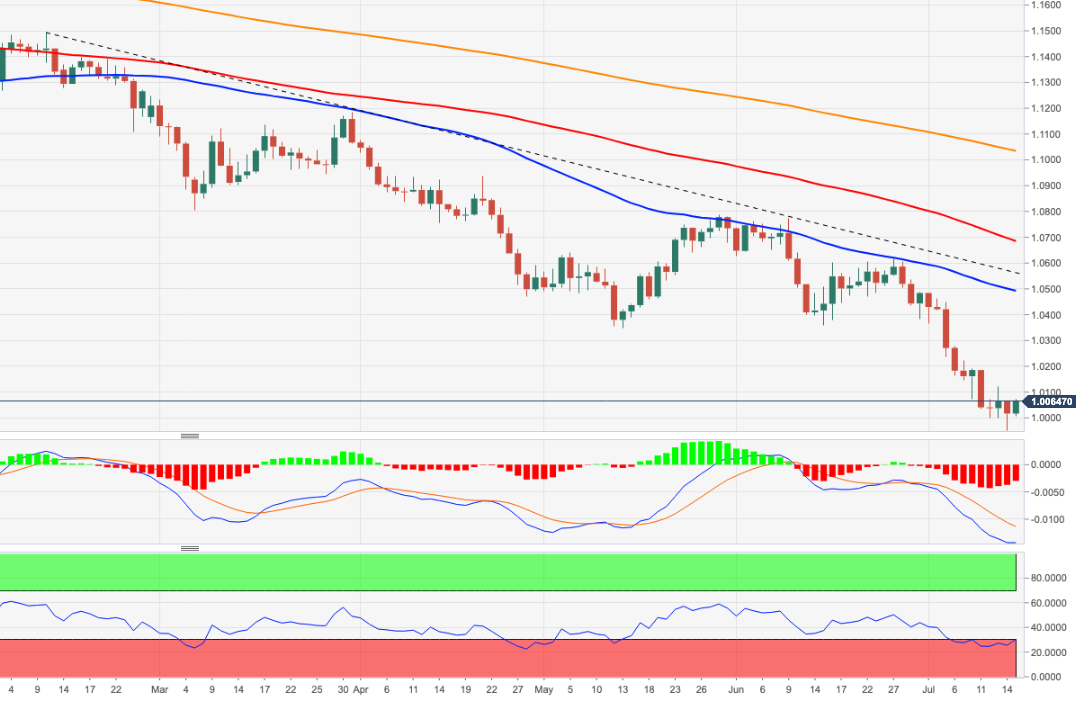
- EUR/USD regains some composure following new cycle lows.
- The breach of the 2022 low at 0.9952 should trigger extra losses.
EUR/USD attempts a bull run after dropping to the mid-0.9900s on Thursday, levels last seen in December 2002.
Despite the ongoing bounce, the pair’s bearish stance remains everything but abated for the time being. Against that, another convincing breakdown of the parity level should expose the YTD low at 0.9952 (July 14) ahead of the December 2002 low at 0.9859.
As long as the pair navigates below the 5-month support line around 1.0545, further losses remain in store.
In the longer run, the pair’s bearish view is expected to prevail as long as it trades below the 200-day SMA at 1.1033.
EUR/USD daily chart
The prospect that grains exports from Ukraine might be resumed has exerted noticeable pressure on wheat prices this week. If agreement were to be reached on resuming grains exports from Ukraine, wheat prices could fall further, strategists at Commerzbank report.
A lot of new supply is reaching the market
“According to Turkey, an agreement could be signed next week. It would apparently include joint controls for checking shipments in the ports and Turkey ensuring the safety of Black Sea export routes. Wheat would then become even cheaper.”
“If hopes are quashed yet again, wheat prices are likely to recoup only part of their losses. This is because harvesting is now underway in the major producing countries in the northern hemisphere, meaning that a lot of new supply is reaching the market.”
UOB Group’s Senior Economist Julia Goh and Economist Loke Siew Ting comment on the recent decision by the BSP to unexpectedly hike rates by 75 bps.
Key Takeaways
“In a regular but not scheduled monetary policy setting meeting this morning (14 Jul), Bangko Sentral ng Pilipinas (BSP) raised its overnight reverse repurchase (RRP) rate by 75bps to 3.25%. Likewise, both the overnight deposit and lending rates were also raised to 2.75% and 3.75% respectively. It was a rare move with the biggest rate hike since Oct 2000, and followed two back-to-back rate increases of 25bps each in May and Jun.”
“BSP saw an urgent need to get ahead of the inflationary threat and stressed that this urgent policy action is intended to help manage spillovers from other countries that could potentially disanchor inflation expectations. It also believes that favourable domestic economic conditions so far this year can accommodate a further tightening of monetary policy.”
“We believe that the latest large off-cycle rate hike will not mark the end of the BSP’s monetary policy normalisation as yet. In fact, we see the central bank hinting for more interest rate rises ahead, depending on the incoming domestic inflation and GDP data as well as global and regional central banks’ rate decision in the near term. Given that BSP has escalated its rate hike pace faster than we had anticipated for 2H22, we now bring forward our BSP rate hike projections for 1H23 to this year, taking the RRP rate back to the pre-pandemic level of 4.00% by the end of 2022.”
Brent has dipped noticeably below $100 per barrel this week. Economists at Commerzbank expect this trend to continue.
Few supply concerns, but many demand concerns
“Brent is likely to continue sliding given that the recession fears will presumably not abate for the time being.”
“Not only has the IEA downwardly revised its demand forecasts, but it is also more optimistic about supply.”
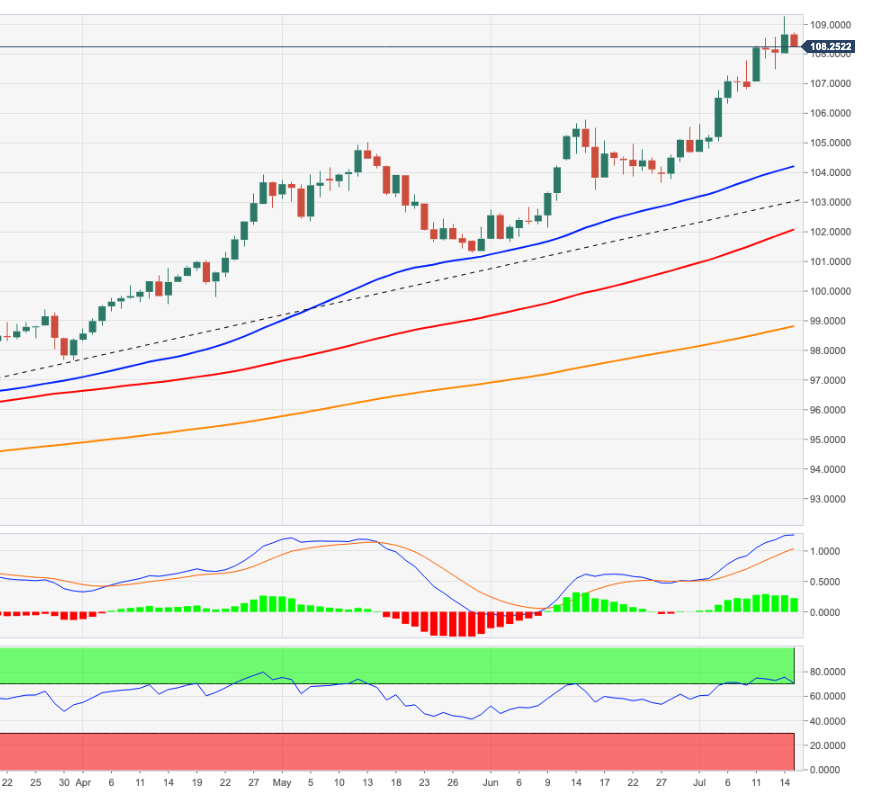
- DXY comes under pressure after hitting new highs on Thursday.
- Further decline could revisit the minor support at 107.47 (July 13).
DXY trades on the defensive as investors seem to be cashing up part of the recent strong gains in the dollar.
While further upside in the dollar remains in store in the short-term horizon, the current overbought condition carries the potential to meet an initial contention at 107.47 (low July 13) prior to the June top at 105.78 (June 15).
As long as the index trades above the 5-month line near 103.20, the near-term outlook for DXY should remain constructive.
In addition, the broader bullish view remains in place while above the 200-day SMA at 98.80.
DXY daily chart
- USD/JPY witnessed some selling on Friday and moved away from a 24-year high touched on Thursday.
- The overnight less hawkish remarks by Fed officials, falling US bond yields weighed on the greenback.
- The Fed-BoJ policy divergence helped limit losses as the focus now shifts to the key US macro releases.
The USD/JPY pair edged lower on Friday and eased further from a 24-year high, around the 139.35-139.40 area touched the previous day. The pair remained depressed heading into the North American session and was last seen trading around the 138.70-138.65 region, just a few pips above the daily low.
The US dollar extended the overnight retracement slide from a two-decade high amid diminishing odds for a more aggressive policy tightening by the Federal Reserve. This, in turn, was seen as a key factor that exerted some downward pressure on the USD/JPY pair, though any meaningful corrective pullback still seems elusive.
Fed Governor Christopher Waller and St. Louis Fed President Jim Bullard - two of the most hawkish FOMC members - pushed back against market expectations for a supersized, 100 bps rate hike in July. This led to a further decline in the US Treasury bond yields, which narrowed the US-Japan rate differential and underpinned the Japanese yen.
Despite the less hawkish remarks by Fed officials, a big divergence in the US central bank and Bank of Japan policy stance should cap gains for the JPY. Apart from this, a slight improvement in the global risk sentiment - as depicted by a positive tone around the equity markets - could further keep a lid on the safe-haven JPY.
The fundamental backdrop supports prospects for the emergence of some dip-buying around the USD/JPY pair. Traders, however, preferred to wait on the sidelines ahead of Friday's US macro releases - the monthly Retail Sales data, the Empire State Manufacturing Index, Industrial Production figures and Michigan Consumer Sentiment Index.
This, along with the US bond yields, should influence the USD price dynamics and provide some impetus to the USD/JPY pair. Apart from this, traders would take cues from the broader market risk sentiment to grab short-term opportunities on the last day of the week. Nevertheless, the pair remains on track to end the week with strong gains.
Technical levels to watch
There have been a lot of developments in factors that have driven both USD strength and EUR weakness. Thus, economists at Rabobank are minded to push their outlook for the EUR/USD pair further down.
Eurozone is likely to fall into recession this winter
“Not only do we see the EUR vulnerable to Eurozone recession risks, but we expect that the value of the USD is likely to remain elevated into 2023.”
“If the Nord Stream 1 natural gas pipeline is switched back on fully, in time next week after its scheduled maintenance, the EUR is likely to be granted a reprieve. However, politicians are fearing that the flow may be insufficient for Europe to fully strength their gas reserves ahead of the winter.”
“Natural gas flows will be instrument in guiding the outlook for the EUR in the months ahead. That said, even if the EUR is boosted, we expect USD strength to dominate into next year suggesting upside for EUR/USD could be limited even on good news regarding Nord Stream.”
The strong US dollar, which is the mirror opposite of the weak euro, is depressing the gold price. Nonetheless, economists at Commerzbank expect the yellow metal to recover in the coming months.
Upcoming recession in the US
“If it emerges from the ECB meeting that a more resolute approach to tackle inflation will be taken, gold could profit indirectly even though higher interest rates per se are bad news for gold as a non-interest-bearing investment.”
“Market participants increasingly appear to expect a recession in the US. Gold should really benefit from this as a safe haven. This is one reason why we anticipate higher gold prices in the coming months and quarters. That said, for this to happen the still strong ETF outflows would need to end and buying interest would need to return to the market.”
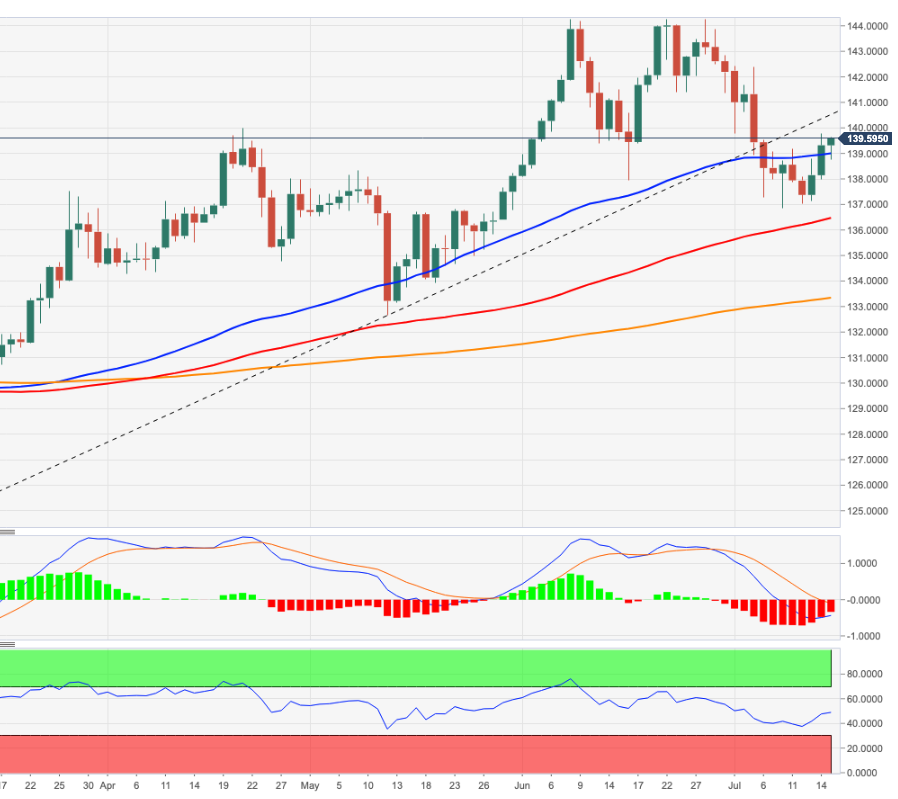
- EUR/JPY pushes higher and extends the weekly rebound near 140.00.
- Next on the upside comes the resistance line near 140.50.
EUR/JPY advances for the third session in a row and targets the 140.00 barrier on Friday.
Further upside should surpass the 4-month resistance line around 140.50 to allow for the continuation of the current move to, initially, the weekly high at 142.37 (July 5). Beyond the latter, the cross could attempt a visit to the 2022 top at 144.27 (June 28).
In the longer run, the constructive stance in the cross remains well propped up by the 200-day SMA at 133.31.
EUR/JPY daily chart
US Monthly Retail Sales Overview
Friday's US economic docket highlights the release of monthly Retail Sales figures for June, scheduled later during the early North American session at 12:30 GMT. The headline sales are estimated to grow by a seasonally adjusted 0.8% during the reported month as against the 0.3% fall recorded in May. Excluding autos, core retail sales probably climbed by 0.6% in June, up slightly from the 0.5% increase in the previous month.
Analysts at TD Securities, however, were slightly less optimistic about the report and explained: “We look for retail sales to recover in June (0.5%), following the series' first contraction this year in May. Spending was likely aided by another firm showing in gasoline station sales and a rebound in the auto segment. We also look for another gain in the eating/drinking segment as consumers continue to transition away from goods. That said, control group sales likely fell again (-0.5%).”
How Could it Affect EURUSD?
Fed Governor Christopher Waller said on Thursday that his decision to back the case for an aggressive rate hike at the upcoming FOMC meeting later this month depends on incoming data. Wallerspecifically cited retail sales and housing as two key metrics. Hence, a stronger-than-expected reading would lift bets for a supersized 100 bps Fed rate hike move on July 27 and boost the US dollar. Conversely, any disappointment would further add to worries about a possible recession, which should continue to weigh on investors' sentiment and benefit the greenback's safe-haven status.
Furthermore, investors remain concerned that a halt to gas flows from Russia could trigger an economic crisis in the Eurozone. This would curtail the European Central Bank’s ability to raise rates and act as a headwind for the shared currency. The fundamental backdrop suggests that the path of least resistance for the EURUSD pair is to the downside. Hence, any attempted recovery move might still be seen as a selling opportunity and runs the risk of fizzling out rather quickly.
Eren Sengezer, Editor at FXStreet, offered a brief technical outlook and wrote: “EUR/USD is moving sideways on the outside of the descending regression channel coming from late June. The Relative Strength Index (RSI) indicator on the four-hour chart, however, stays well below 50, suggesting that buyers remain on the sidelines.”
Eren also outlined important technical levels to trade the EUR/USD pair: “On the upside, 1.0050 (20-period SMA) aligns as immediate resistance ahead of 1.0080 (static level), 1.0100 (psychological level) and 1.0120 (50-period SMA). In case the pair returns within the descending channel below parity, it could target 0.9950 (static level, July 14 low) and 0.9900 (psychological level).”
Key Notes
• US June Retail Sales Preview: Has the consumer turning point arrived?
• US Retail Sales Preview: Forecasts from six major banks, slowing in core spending
• EUR/USD Forecast: Euro remains vulnerable despite reclaiming parity
About US Retail Sales
The Retail Sales released by the US Census Bureau measures the total receipts of retail stores. Monthly per cent changes reflect the rate of changes in such sales. Changes in Retail Sales are widely followed as an indicator of consumer spending. Generally speaking, a high reading is seen as positive (or bullish) for the USD, while a low reading is seen as negative (or bearish).
Economist at UOB Group Lee Sue Ann reviews the publication of the latest labour market report in Australia.
Key Takeaways
“Australia’s job market continues to tighten, with the latest figures showing the unemployment rate falling to 3.5% in Jun, the lowest level since Aug 1974. Seasonally adjusted employment growth was strong at 88,400 over the month, well above expectations for 30,000, and May’s reading of 60,600, making this the eighth consecutive monthly rise.”
“Overall, the labour market strength has given the green light for the Reserve Bank of Australia (RBA) to continue pushing interest rates higher, after delivering a 50bps hike earlier this month on 5 Jul. Indeed, in light of the RBA’s persistent reference to ensure that inflation in Australia returns to target over time; we believe the RBA is open to a third 50bps rise in Aug.”
“While financial markets have priced in aggressive tightening, with the expectation for OCR rising above 3.5% by 2Q23. we think the Australian economy does not require such aggressive tightening, and our view is also based on several uncertainties flagged by the RBA. The next RBA meeting is on 2 Aug, and 2Q22 CPI data, to be published on 27 Jul, will be a crucial update that comes a little less than a week prior to that meeting.”
The European Central Bank's Governing Council will likely raise its key interest rate by 0.25 percentage points next week and 0.5 percentage points in September, ECB Governing Council member Olli Rehn said on Friday, as reported by Reuters.
This comment is in line with a recently conducted Reuters poll on the ECB's rate outlook.
Reuters Poll: ECB forecast to raise deposit rate by 25 basis points in July.
Market reaction
The shared currency showed no immediate reaction to this comment and the EUR/USD pair was last seen rising 0.2% on a daily basis at 1.0040.
All but one of the 63 economists polled by Reuters expect the European Central Bank (ECB) to hike its policy rate by 25 basis points in July.
"A majority of economists in the poll forecast a 50 basis point hike in September, followed by a quarter-point rise in October and December, taking the deposit rate to 0.75%. It is expected to reach 1.50% in the third quarter of next year," Reuters wrote. "Poll medians showed a 45% chance of a recession within a year, much higher than the 34% in the previous poll."
Market reaction
The EUR/USD pair showed no immediate reaction to this article and was last seen posting modestly daily gains near 1.0050.
- USD/CAD extended the overnight pullback from a 20-month high and edged lower on Friday.
- The overnight less hawkish remarks by Fed officials weighed on the USD and exerted pressure.
- Bearish sentiment around oil prices could undermine the loonie and help limit the downside.
- Investors now look forward to important US macro data for short-term trading opportunities.
The USD/CAD pair attracted some selling near the 1.3135 region on Friday and retreated further from its highest level since November 2020 touched the previous day. The modest intraday downtick extended through the first half of the European session and dragged spot prices back below the 1.3100 mark, though lacked follow-through.
The US dollar extended the overnight pullback from a two-decade high and was pressured by diminishing odds for a more aggressive policy tightening by the Fed. On Thursday, two of the Federal Reserve's most policymakers pushed back against market expectations for a 100 bps rate hike later this month. This led to a further decline in the US Treasury bond yields, which, in turn, acted as a headwind for the USD and exerted some downward pressure on the USD/CAD pair.
Apart from this, a slight recovery in the global risk sentiment - as depicted by signs of stability in the equity markets - further dented the greenback's safe-haven status. That said, the worsening global economic outlook could keep a lid on any optimism and continue lending support to the buck. Investors remain concerned that rapidly rising borrowing costs, the ongoing Russia-Ukraine war and fresh COVID-19 curbs in China would pose challenges to global growth.
The fears were further fueled by the dismal Chinese Q2 GDP print released earlier this Friday. This comes after Bank of America economists forecast a “mild recession” in the US this year. This, in turn, has raised concerns about the fuel demand outlook and capped the attempted recovery in oil prices from a five-month low touched on Thursday. The bearish sentiment surrounding the black liquid might undermine the commodity-linked loonie and further lend support to the USD/CAD pair.
Traders might also be reluctant to place aggressive bets and prefer to wait on the sidelines ahead of key US macro data. Friday's US economic docket features the monthly Retail Sales, the Empire State Manufacturing Index, Industrial Production and Michigan Consumer Sentiment Index. This, along with the US bond yields and the broader market risk sentiment, will influence the USD. Apart from this, oil price dynamics should provide a fresh impetus to the USD/CAD pair.
Technical levels to watch
- AUD/USD struggled to gain any meaningful traction on Friday despite subdued USD demand.
- Dismal Chinese GDP fueled recession fears and capped the upside for the risk-sensitive aussie.
- Investors now look forward to important US macro data for short-term trading opportunities.
The AUD/USD pair failed to capitalize on the previous day's modest rebound from over a two-year low and attracted fresh selling near the 0.6765 region on Friday. The pair remained on the defensive through the first half of the European session, though has managed to hold its neck comfortably above the 0.6700 mark.
Following the previous day's pullback from a fresh 20-year high, the US dollar witnessed a subdued price move amid reduced bets for a more aggressive policy tightening by the Fed. Fed Governor Christopher Waller and St. Louis Fed President Jim Bullard - two of the most hawkish FOMC members - pushed back against market expectations for a 100 bps rate hike later this month. This, in turn, led to a further decline in the US Treasury bond yields, which acted as a headwind for the USD and offered some support to the AUD/USD pair.
That said, growing fears about a possible global recession helped limit the downside for the safe-haven buck and continued weighing on the risk-sensitive aussie. Investors remain concerned that rapidly rising borrowing costs, along with the ongoing Russia-Ukraine war and fresh COVID-19 curbs in China, would pose challenges to global economic growth. The fears were further fueled by the dismal Chinese Q2 GDP print released on Friday. The fundamental backdrop supports prospects for additional losses for the AUD/USD pair.
Bearish traders, however, seemed reluctant to place aggressive bets ahead of important US macro data. Friday's US economic docket features the monthly Retail Sales, the Empire State Manufacturing Index, Industrial Production and Michigan Consumer Sentiment Index. This, along with the US bond yields and the broader market risk sentiment, will influence the USD price dynamics and provide some impetus to the AUD/USD pair.
Technical levels to watch
- USD/CHF moved further away from a multi-week high amid subdued USD price action.
- Less hawkish remarks by Fed officials, declining US bond yields weighed on the USD.
- The downside seems cushioned as traders await US macro data for a fresh impetus.
The USD/CHF pair extended the previous day's late pullback from the 0.9885 region, or a multi-week high and witnessed some follow-through selling on Friday. The steady descent extended through the early European session and dragged spot prices to the 0.9800 round-figure mark.
The US dollar was seen consolidating below a two-decade high touched on Thursday, which, in turn, was seen as a key factor exerting downward pressure on the USD/CHF pair. Two of the Federal Reserve's most hawkish policymakers said on Thursday they favoured another 75 bps rate hike late this month, rather than an even bigger move priced in the markets and prompted some USD profit-taking.
In fact, investors raised their bets for a supersized Fed rate hike move after data released on Wednesday showed that the US consumer inflation in June accelerated to a four-decade high. The less hawkish remarks by Fed Governor Christopher Waller and St. Louis Fed President Jim Bullard, however, forced investors to scale back their expectations for a more aggressive policy tightening.
Apart from this, a further decline in the US Treasury bond yields was seen as another factor that kept the USD bulls on the defensive. The downside, however, remains cushioned as investors preferred to wait on the sidelines ahead of the key US macro releases - the monthly Retail Sales data, Empire State Manufacturing Index, Industrial Production data and Michigan Consumer Sentiment Index.
Hence, it will be prudent to wait for strong follow-through selling before confirming that the recent strong rebound from sub-0.9500 levels has run out of steam. Nevertheless, the USD/CHF pair remains on track to end in the green for the third straight week, though would need to find acceptance above the 0.9855-0.9860 area before traders start positioning for any further gains.
Technical levels to watch
- EUR/USD puts some distance from Thursday’s sub-parity lows.
- The dollar now appears offered following recent cycle highs.
- US Retail Sales, flash Consumer Sentiment take centre stage later.
EUR/USD regains a small smile and advances to the 1.0020 region at the end of the week.
EUR/USD up on USD-selling
EUR/USD manages to reclaim some ground lost after bottoming out in new cycle lows in the mid-0.9900s on Thursday, an area last seen back in December 2002.
Renewed selling bias in the greenback allows the current small recovery in spot, all following diminished bets for a 100 bps interest rate hike by the Fed at its meeting later in the month. Indeed, prospects for such a scenario were talked down by FOMC’s Waller and Bullard on Thursday.
In the domestic calendar, EMU Balance of Trade will be the sole release later in the session, whereas Retail Sales, Industrial Production, Business Inventories and the flash U-Mich Index are all due across the pond.
What to look for around EUR
Despite the current bounce, EUR/USD remains under pressure near the parity level.
The ongoing technical rebound in the pair follows current oversold conditions, although it is unlikely to gather serious traction in this context, and especially before the ECB gathering due next week.
In the meantime, the price action around the single currency continues to follow increasing speculation of a probable recession in the euro area, dollar dynamics, geopolitical concerns, fragmentation worries and the Fed-ECB divergence.
Key events in the euro area this week: EMU Balance of Trade (Friday).
Eminent issues on the back boiler: Fragmentation risks. Kickstart of the ECB hiking cycle in July? Asymmetric economic recovery post-pandemic in the euro bloc. Impact of the war in Ukraine on the region’s growth prospects and inflation.
EUR/USD levels to watch
So far, spot is up 0.12% at 1.0026 and a breakout of 1.0489 (55-day SMA) would target 1.0615 (weekly high June 27) en route to 1.0773 (monthly high June 9). On the flip side, the next contention emerges at 0.0052 (2022 low July 14) seconded by 0.9859 (low December 2002) and finally 0.9685 (low October 2002).
The EUR/USD break of parity was more compelling yesterday with a low of 0.9952 before recovering quickly. As economists at MUFG Bank note, EUR sentiment remains poor and political uncertainty in Italy is now set to reinforce that negative sentiment.
Italy and China add to EUR woes
“The 10-year BTP/Bund spread widened out by about 7 bps only but we could see further widening into the weekend which will only add to EUR downside pressure.”
“The developments in Italy only underline the importance of the periphery bonds buying support program that the ECB intends to announce the details of next week. Given the likely increased BTP selling pressures, the risk next week could well be one of disappointment given the probable divisions within the Governing Council over the scale of the support program.”
“EUR sentiment today will not be helped by the data released from China earlier. Real GDP slowed sharply in Q2 to 0.4% QoQ, much weaker than the consensus 1.2%. The 5.5% GDP growth target for 2022 is now out of reach and even getting a print of 4.0% will prove challenging. Global growth recession fears will remain elevated which will keep EUR/USD under downward pressure.”
FX Strategists at UOB Group Lee Sue Ann and Quek Ser Leang see USD/CNH advancing further with the next target at 6.8000 in the short-term.
Key Quotes
24-hour view: “Our expectations for USD to ‘trade in a choppy manner between 6.7130 and 6.7430’ turned out to be incorrect as USD surged to high of 6.7910 before pulling back sharply. Despite the pullback, upward momentum still appears to be firm and USD could retest the 6.7900 level. For today, the chance for USD to move to the major resistance at 6.8000 is not high. Support is at 6.7460 followed by 6.7330.”
Next 1-3 weeks: “We turned positive USD on Tuesday (12 Jul, spot at 6.7255). On Wednesday (13 Jul, spot at 6.7400), we highlighted that USD could consolidate for 1 to 2 days first before moving higher to 6.7700. Yesterday (14 Jul), USD surged past 6.7700 and rose to 6.7910 before pulling back. The improved upward momentum suggests that USD is likely to advance further. The next level to monitor is at 6.8000. Overall, the positive outlook for USD is intact as long as it does not move below 6.7190 (‘strong support’ level was at 6.7050 yesterday). Looking ahead, if USD breaks above 6.8000, it would increase the risk of a move towards the May’s high near 6.8390.”
- NZD/USD reversed modest intraday losses amid subdued USD price action on Friday.
- The overnight less hawkish remarks by Fed officials kept the USD bulls on the defensive.
- Recession fears might limit losses for the safe-haven buck and cap the risk-sensitive kiwi.
The NZD/USD pair attracted some dip-buying on Friday and climbed back above the 0.6100 mark during the early European session. The pair was last seen trading near the daily high, around the 0.6130-0.6135 area and might now be looking to build on the overnight late rebound from over a two-year low.
Thursday's less hawkish remarks by Fed Governor Christopher Waller and St. Louis Fed President Jim Bullard forced investors to scale back bets for a supersized 100 bps rate hike on July 27. Both Waller and Bullard - the biggest Fed hawks - said they were not in favour of the bigger rate hike that the markets priced in following the release of red-hot US consumer inflation on Wednesday. This, along with a further decline in the US Treasury bond yields, kept the US dollar below a 20-year high touched the previous day and offered some support to the NZD/USD pair.
That said, any meaningful upside still seems elusive amid growing worries about a possible global recession. Investors remain concerned that rapidly rising borrowing costs, along with the ongoing Russia-Ukraine war and fresh COVID-19 curbs in China, would pose challenges to global economic growth. The fears were further fueled by Friday's disappointing release of the Chinese Q2 GDP print. This, in turn, should act as a tailwind for the safe-haven USD and keep a lid on any meaningful upside for the risk-sensitive kiwi, at least for the time being.
Investors might also refrain from placing aggressive bets and prefer to wait for important US macro data. Friday's US economic docket features the Empire State Manufacturing Index, Industrial Production figures and Michigan Consumer Sentiment Index later during the early North American session. Apart from this, a scheduled speech by Atlanta Fed President Raphael Bostic, the US bond yields and the broader market risk sentiment will influence the USD price dynamics. This, in turn, should allow traders to grab short-term opportunities around the NZD/USD pair.
Technical levels to watch
- The index comes down after hitting cycle peaks on Thursday.
- US yields resume the downside across the curve.
- Retail Sales, Industrial Production, Consumer Sentiment next on tap.
The greenback, when measured by the US Dollar Index (DXY), appears offered in the 108.50 region at the end of the week.
US Dollar Index looks to data, Fed
After hitting nearly 20-year peaks north of the 109.00 mark on Thursday, the index comes under some selling pressure and hovers around the 108.50 zone on Friday.
The pullback from almost 2-decade highs in the dollar comes as Fed’s rate-setters dialled down the probability of a full point interest rate hike at the July 27 gathering. Indeed, Fed’s Waller and Bullard – both hawks – favoured on Thursday a 75 bps raise at the upcoming meeting, adding that markets appear to have overreacted to higher-than-expected inflation figures in June.
On this, and according to FedWatch Tool by CME Group, the probability of a 100 bps hike now retreated to around 46% from over 80% on Thursday. A 75 bps hike now looks favoured by almost 54%.
Interesting session in the US calendar on Friday, as Retail Sales are due in the first turn seconded by Industrial Production, Business Inventories and the advanced prints of the Consumer Sentiment for the current month.
What to look for around USD
The index pushed higher and clinched new cycle highs past 109.00 on Thursday. It is worth noting, however, that the recent sharp move in the dollar comes largely in response to the accelerated decline in the euro and persistent uncertainty around a potential recession in the old continent.
Further support for the dollar is expected to come from the Fed’s divergence vs. most of its G10 peers (especially the ECB) in combination with bouts of geopolitical effervescence and the re-emergence of the risk aversion among investors. On the flip side, market chatter of a potential US recession could temporarily undermine the uptrend trajectory of the dollar somewhat.
Key events in the US this week: Retail Sales, Industrial Production, Flash Consumer Sentiment, Business Inventories (Friday).
Eminent issues on the back boiler: Hard/soft/softish? landing of the US economy. Escalating geopolitical effervescence vs. Russia and China. Fed’s more aggressive rate path this year and 2023. US-China trade conflict. Future of Biden’s Build Back Better plan.
US Dollar Index relevant levels
Now, the index is down 0.12% at 108.50 and faces next contention at 107.47 (July 13) followed by 103.67 (weekly low June 27) and finally 103.41 (weekly low June 16). On the other hand, a break above 109.29 (2022 high July 15) would expose 109.77 (monthly high September 2002) and then 110.00 (round level).
Here is what you need to know on Friday, July 15:
The dollar rally that was fueled by the hot inflation data on Wednesday extended further on Thursday and the US Dollar Index reached its strongest level in nearly two decades at 109.29. Dovish Fed commentary, however, caused the greenback to lose interest ahead of the key Retail Sales data from the US. Additionally, the Fed will release its Index of Common Inflation Expectations (CIE) for the second quarter and the University of Michigan will publish the Consumer Sentiment Survey for July. Meanwhile, the European economic docket will feature the May Trade Balance data.
Federal Reserve Governor Christopher Waller argued on Thursday that markets may have gotten ahead of themselves by pricing a 100 basis points (bps) rate hike in July. Waller also added that he is in favour of a 75 bps hike in July but noted that he could lean toward a bigger rate increase if retail sales and housing data come in stronger than expected. According to the CME Group FedWatch Tool, markets are now pricing a 50% probability of a 100 bps rate hike in July, compared to 80% during the European session on Thursday.
US June Retail Sales Preview: Has the consumer turning point arrived?
Earlier in the day, the data from China showed that the Gross Domestic Product (GDP) contracted by 2.6% on a quarterly basis in the second quarter. This reading came in worse than analysts' estimate for a contraction of 1.5%. On a positive note, Retail Sales in China expanded by 3.7% on a yearly basis in June. Markets remain cautious in the European morning with US stock index futures losing between 0.25% and 0.3% on a daily basis.
EUR/USD plunged to its lowest level in nearly twenty years at 0.9952 on Thursday but managed to recover above parity.
GBP/USD fluctuates in a relatively tight range above 1.1800 on Friday following Thursday's selloff. On a weekly basis, the pair is down nearly 200 pips.
USD/JPY jumped to fresh multi-decade highs above 139.00 on Thursday but lost its bullish momentum. The benchmark 10-year US Treasury bond yield is down more than 1% on a daily basis, not allowing the pair to gain traction.
Gold fell below $1,700 for the first time in nearly a year on Thursday. Although XAUUSD rose above that level on falling yields, it is having a difficult time finding demand early Friday.
Bitcoin closed the second straight day in positive territory on Thursday and started to push higher toward $21,000 early Friday. Ethereum is up nearly 2% in the early European session, trading above $1,200.
Global risk sentiment continues to be challenged. Economists at ING expect the US Dollar Index (DXY) to stabilize and see limited scope for a correction.
Balance of risks tilted to upside
“With fears of global recession adding pessimism to the overall picture, we struggle to see a material recovery in sentiment for now.”
“Equity instability may continue to put a limit to any dollar correction for now, and further upside risks to the greenback may come from a further repricing higher in Fed’s rate expectations.”
“A stabilisation in the dollar around current levels is possible today, but we continue to highlight: a) limited scope for a correction; b) a balance of risks still tilted to the upside in the near term.”
The Australian dollar is currently looking at a significant divergence between internal and external drivers. Economists at ING expect the AUD/USD to extend its slide towards the 0.66 level over the coming days.
Big divergence between external and internal drivers
“The latest jobs numbers data came in very strong, as unemployment dropped to the lowest on record (3.5%) thanks to a sharp increase (88K) in employment. The RBA takes the labour market into consideration a lot, and we think the latest numbers might pave the way for even larger than 50 bps rate hikes.”
“China (Australia’s number one export market) may face new lockdowns, and the latest data showed a larger-than-expected slowdown. That out shadowed the positive news that Beijing may end its ban on Australian coal. At the same time, iron ore prices continued to be under significant pressure, having now dropped below $100 on demand concerns.”
“When adding a still strong USD and unstable risk appetite, we struggle to see an imminent rebound in AUD/USD. We could instead see a further drop to the 0.6600 mark over the coming days.”
GBP/USD surrenders intraday gains. Economists at ING see the pair at risk of falling to the 1.17-1.16 area in the coming days.
TV debate for Tory candidates
“It will be interesting to see the first TV debate between the remaining five candidates in the Tory leadership contest today, mainly to start gauging what positions on policy and Brexit can be associated with each contender.”
“Cable looks at risk of moving to 1.1600-1.1700 in the coming days on the back of USD strength, while EUR/GBP may keep hovering in the 0.8400-0.8500 area for longer – unless EUR-specific woes trigger another break lower.”
Silver has confirmed a top already and is approaching the $18.65 key support. Economists at Credit Suisse expect to see further falls in the next couple of months.
$18.65 to prove at least a temporary floor
“Silver has already completed a large top and keeps approaching the crucial 61.8% retracement support of the whole 2020/21 upmove at $18.65. We would expect this to prove at least a temporary floor. However, as momentum keeps deteriorating, further weakness towards the $17.92 support seems plausible during the next 1-2 months.”
“Only above the 55-day average, currently seen at $21.33, would stabilize the precious metal more meaningfully from a technical perspective.”
Further upside momentum could lift USD/JPY to the 140.00 region in the next weeks, commented FX Strategists at UOB Group Lee Sue Ann and Quek Ser Leang.
Key Quotes
24-hour view: “While we expected USD to strengthen yesterday, we were of the view ‘a sustained rise above 138.00 is unlikely’. We did not anticipate that sharp upward acceleration as USD surged to a high 139.39. While overbought, the rapid rise is not showing signs of weakening just yet. In other words, USD could continue to advance to 139.50. The major resistance at 140.00 is unlikely to come into the picture for now. Support is at 138.60 followed by 138.30.”
Next 1-3 weeks: “We turned positive USD 3 days ago (12 Jul, spot at 137.20) and we indicated that USD could advance further to 138.00, as high 138.50. While our view for a higher USD was not wrong, we did not quite expect the rapid manner by which it surged past both 138.00 and 138.50 yesterday and rocketed to a high of 139.39. The boost in upward momentum suggests further USD strength is likely. The next levels to focus on are at 139.50 followed by the major round-number level of 140.00. On the downside, a break of 137.50 (‘strong support’ level was at 136.30 yesterday) would indicate that the current strong upward pressure has eased.”
Copper remains under pressure and is hovering only marginally above the previous YTD low. Strategists at Credit Suisse expect the metal to find a solid floor at the $6,844 mark.
Key resistance zone remains seen at $8,570/8,740
“We would expect the 61.8% retracement at $6,844 to floor the market at least temporarily, with the industrial metal hovering only marginally above the $7,291 previous established YTD low.”
“Key resistances remain seen at the recent breakdown point at $8,570/8,740.”
S&P 500 remains under pressure. The near-term risk over the next 2-4 weeks stays seen lower still, but with major support still expected at 3522/05, economists at Credit Suisse report.
Break above resistance at 3946 needed stage a deeper recovery
“A break below 3637 would likely trigger further weakness over the next 2-4 weeks to next support at 3522/05, which is the 50% retracement and 200-week average. Our bias would be to try and look for at least a floor here if reached, particularly given the tiring medium-term momentum.”
“Below 3505 though and we would see support next at the 3394 high of Q1 2020.”
“Above resistance at 3946 is needed to see the downtrend from April break to suggest the market can stage a deeper recovery with resistance seen next at the 63-day average, currently seen at 4028.”
Considering preliminary readings from CME Group for natural gas futures markets, open interest remained choppy and shrank by around 1.7K contracts on Thursday. On the other hand, volume resumed the upside following the previous day drop, this time by around 3.3K contracts.
Natural Gas now targets $7.00
Prices of natural gas posted marginal gains amidst an inconclusive session on Thursday, all against the backdrop of diminishing open interest. That said, further upside should not be ruled out in the very near term, and with the immediate target at the $7.00 mark per MMBtu.
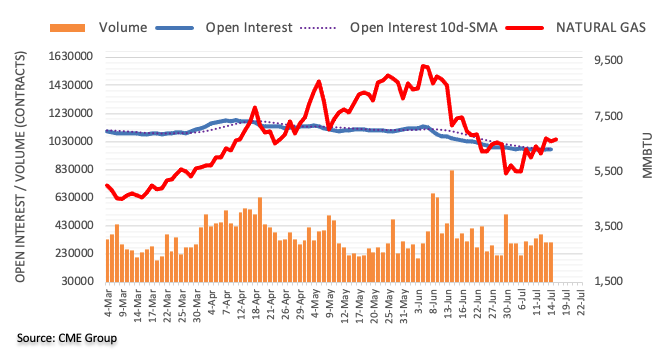
USD/NOK has broken above 10.1365 and analysts at Credit Suisse look further strength to 10.8085/11.2751. Meanwhile, USD/SEK has confirmed a move above 10.4793, which opens the door to the high of 2001 at 11.0480.
Krone and krona to lose ground against the dollar
“USD/NOK has broken above the 50% retracement of the 2020/21 downtrend at 10.1365 and we expect further upside to develop from here. We thus look for a move to the 61.8% retracement at 10.6063 initially, above which would open the door to the April 2020 high at 10.8085 and eventually to the 78.6% retracement at 11.2751.”
“With the 200-day and 55-week moving averages rising as well as with weekly MACD staying outright positive, we look for further USD/SEK upside all the way to a major resistance zone at the peak of 2001 at 11.0480, where we expect at least a temporary pause, prior to a potentially deeper move higher.”
- GBP/USD failed to preserve its modest intraday gains despite subdued USD price action.
- The overnight less hawkish remarks by Fed officials kept the USD bulls on the defensive.
- Recession fears acted as a tailwind for the USD and capped the upside for the major.
- Traders now look forward to key US macro releases for some meaningful opportunities.
The GBP/USD pair struggled to capitalize on its modest intraday gains and attracted some selling near the 1.1850 region on Friday. The pair retreated to the lower end of its daily range during the early European session and was last seen trading just above the 1.1800 mark.
Fed Governor Christopher Waller and St. Louis Fed President Jim Bullard - the biggest Fed hawks - tried to push back against market bets for a 100 bps rate hike move later this month. In fact, the implied odds for a supersized increase on July 27 have fallen drastically. This was evident from a further decline in the US Treasury bond yields, which kept the US dollar bulls on the defensive and offered some support to the GBP/USD pair.
The uptick, however, lacked bullish conviction amid growing recession fears, which continued weighing on investors' sentiment and acted as a tailwind for the safe-haven greenback. Apart from this, the UK political uncertainty, along with Brexit woes, overshadowed the prospects for a further tightening by the Bank of England and undermined the British pound. The combination of factors contributed to cap gains for the GBP/USD pair.
The fundamental backdrop supports prospects for additional losses, through bearish traders seemed reluctant to place aggressive bets around the GBP/USD pair ahead of the key US macro data. Friday's US economic docket features the release of the Empire State Manufacturing Index, Industrial Production and Michigan Consumer Sentiment Index.
Apart from this, Atlanta Fed President Raphael Bostic's speech and the US bond yields will influence the USD price dynamics. Traders will further take cues from the broader market risk sentiment to grab short-term opportunities around the GBP/USD pair on the last day of the week.
Technical levels to watch
The USD/JPY uptrend is losing momentum. Nonetheless, analysts at Credit Suisse maintain their core positive outlook for 147.62/153.01.
USD/JPY is losing momentum
“The USD/JPY uptrend is showing signs of slowing but for now we still look for the immediate risk to stay higher and with a multi-year ‘secular’ base in place, we maintain our long-held bullish view and look for a sustained break above the 137.21 high of 1998 for a move to our core long-term objective at 147.62/153.01 – the 38.2% retracement of the entire fall from 1982 and price high of 1998.”
“Support is seen at 135.93 initially, then 134.96 with more important support seen at the 55-day average, currently at 132.20.”
What are key drivers for gold prices? Aggressive monetary policy tightening and a stronger US dollar will keep the yellow metal under pressure. On the other hand, increasing recession fears in developed markets and geopolitical risk could provide support to gold’s haven demand, economists at ANZ Bank report.
Bearish sentiment dominates
“US inflation hit a 41-year high of 9.1% in June, but gold’s status as a hedge against inflation was not enough to offset concerns of faster monetary tightening by central banks. If the Fed raises rates by 75 bps in the next two meetings, interest rates would rise to 2.25% by the end of July and 3% by end of September. Such a steep trajectory will be bearish for gold prices. This bearishness could be offset by the weakening economic outlook.”
“The inversion of the 2s/10syield curve has deepened, which would usually indicate impending recession. Rising geopolitical risks and an equity market sell-off could also provide support.”
“The US dollar is also likely to lose steam towards the end of the year, providing some tailwind for gold.”
“We expect the gold price to find a floor near $1,700.”
- EUR/JPY snaps two-day uptrend while reversing from weekly high.
- Bearish MACD signals, steady RSI adds strength to the pullback moves.
- 61.8% Fibonacci retracement lures sellers, 50-DMA restricts immediate upside.
EUR/JPY takes offers to refresh intraday low around 139.00 heading into Friday’s European session. In doing so, the cross-currency pair extends the early Asian session pullback from a 13-day-old resistance line.
The quote’s weakness also takes clues from bearish MACD signals and steady RSI, not to forget failure to cross the 50-DMA, to keep sellers hopeful.
That said, the pair currently drops towards the 50% Fibonacci retracement (Fibo.) level of May-June upside, near 138.45.
However, the 61.8% Fibo. surrounding 137.10 and the 137.00 could challenge the EUR/JPY bears afterward.
Even if the pair declines below 137.00, the 100-DMA close to 136.45 could offer the last chance to buyers.
On the contrary, the 50-DMA and aforementioned resistance line, respectively around 139.20 and 139.35, could restrict EUR/JPY recovery.
Following that, the 38.2% Fibonacci retracement level of 139.85 could act as a buffer during the pair’s likely run-up towards the late June swing low around 141.40. it should be noted that the 140.00 psychological magnet also acts as the upside filter.
EUR/JPY: Daily chart

Trend: Further weakness expected
GBP/USD has seen a clear break of the 78.6% retracement of the 2020/2021 uptrend at 1.2017 and then the 1.1936 prior recent low. Therefore, cable stays seen on course for an eventual move to support at 1.1500/1.1409, in the view of analysts at Credit Suisse.
Resistance at 1.2057 set to cap
“We maintain our immediate negative outlook for an extension of the core downtrend to the bottom of the six-year range at the low of 2020 at 1.15/1409.”
“Resistance at 1.2057 ideally caps to keep the immediate risk lower.”
EUR/CHF has reached 0.9839/30 and analysts at Credit Suisse look for a short pause here. However, they stay bearish from a technical perspective and look for a move to 0.9600 in due course.
Scope to reach 0.9475 on a breach of 0.9609/00
“EUR/CHF has deteriorated further and has reached our long-held objective at 0.9839/30. We look for a short pause here.”
“With the 55-day, 200-day and 55-week moving averages in a strong downtrend and with weekly MACD momentum staying outright negative, we expect further downside to 0.9609/00, where we think at least another temporary consolidation is likely to take place.”
“Should 0.9609/00 be breached though, we would see scope to reach next significant support at 0.9475.”
Trendline support of $1,760/oz was broken, with gold prices hitting an 11-month low recently. Downside support level sits at $1,675. If this level breaks, XAUUSD could fall to $1,600, analysts at ANZ report.
Gold price action is bearish
“Market sentiment is growing bearish as the price heads towards $1,675. We expect it to hold this support level, if not it could fall to the $1,600 zone. A Fibonacci retracement from the September 2018 low to this year’s high suggests the next support levels are $1,614 and $1,500.”
There is no sign of reversal of trend now, while immediate resistance could be seen at $1,744”
“The downtrend looks intact until prices break above $1,800.”
FX option expiries for July 15 NY cut at 10:00 Eastern Time, via DTCC, can be found below.
- EUR/USD: EUR amounts
- 0.9950 553m
- 1.0070 200m
- 1.0100 404m
- 1.0150 813m
- 1.0200 1.08b
- GBP/USD: GBP amounts
- 1.1900 694m
- USD/JPY: USD amounts
- 137.00 360m
- 137.50 440m
- AUD/USD: AUD amounts
- 0.6800-10 515m
- 0.6900 1.08b
- USD/CAD: USD amounts
- 1.3000-05 1.3b
- 1.3075 510m
- 1.3100 1.15b
- 1.3150 751m
- 1.3180 470m
- EUR/JPY: EUR amounts
- 138.00 351m
EUR/USD has fallen to parity/0.99. Analysts at Credit Suisse look for a break below here post a consolidation pause which would open up support next at 0.9609/9592.
Resistance for recovery is seen at 1.0185/92
“We continue to look for 0.99 to hold for now and for a consolidation phase to emerge over the next few weeks.”
“Resistance for recovery is seen at 1.0185/92 initially with tougher resistance seen starting at 1.0341/50.”
“Post a consolidation phase our bias though remains for an eventual break of 0.99 for a resumption of the core downtrend to the next major support at 0.9609/0.9592.”
Despite the surprisingly notable rate hike on the part of the Bank of Canada (BoC) yesterday, the CAD eased strongly against USD. In the view of economists at Commerzbank, the USD/CAD pair is set to trade comfortably above the 1.30 level.
External factors to remain in control for now
“The BoC made it clear once again yesterday that the fight against inflation takes top priority. There is little potential for surprises on that front. And for that reason, external factors are likely to remain in control for now.”
“CAD is likely to struggle to appreciate well below the 1.30 mark against USD.”
- Gold Price struggles to extend corrective pullback from yearly low.
- Yields, Fedspeak probes XAUUSD sellers ahead of the key US consumer-centric data.
- Updates from China, recession fears underpin bearish bias.
Gold Price (XAUUSD) fades corrective pullback from YTD low as traders struggle for clear directions above the $1,700 threshold, down 0.10% intraday around $1,710 heading into Friday’s European session. The precious metal recently fades recovery moves as traders turn cautious ahead of the key US Retail Sales for June and preliminary readings of the Michigan Consumer Sentiment Index (CSI) for July.
The XAUUSD corrective bounce, however, has roots inside the reduction in the hawkish Fed bets and easing of the inversion gap of the key US Treasury yield curves, namely between 2-year and 10-year bonds, which previously favored the risk-off mood. Also probing the gold sellers were the Fed policymakers’ attempts to talk down a 100 bps rate hike.
Also read: Gold Price Forecast: XAUUSD struggles near YTD low, further downside remains on the cards
Gold Price bears the burden of firmer DXY
US Dollar Index (DXY) reverses the previous day’s pullback from a two-decade top amid a sluggish Asian session, picking up bids to refresh the intraday high around 108.68 by the press time. In doing so, the greenback gauge portrays an inverse relationship with the Gold Price as it braces for the third consecutive weekly fall while pushing the precious metal towards the first consecutive negative week around the lowest levels in 11 months.
Easing yield curve inversion keeps XAUUSD buyers hopeful
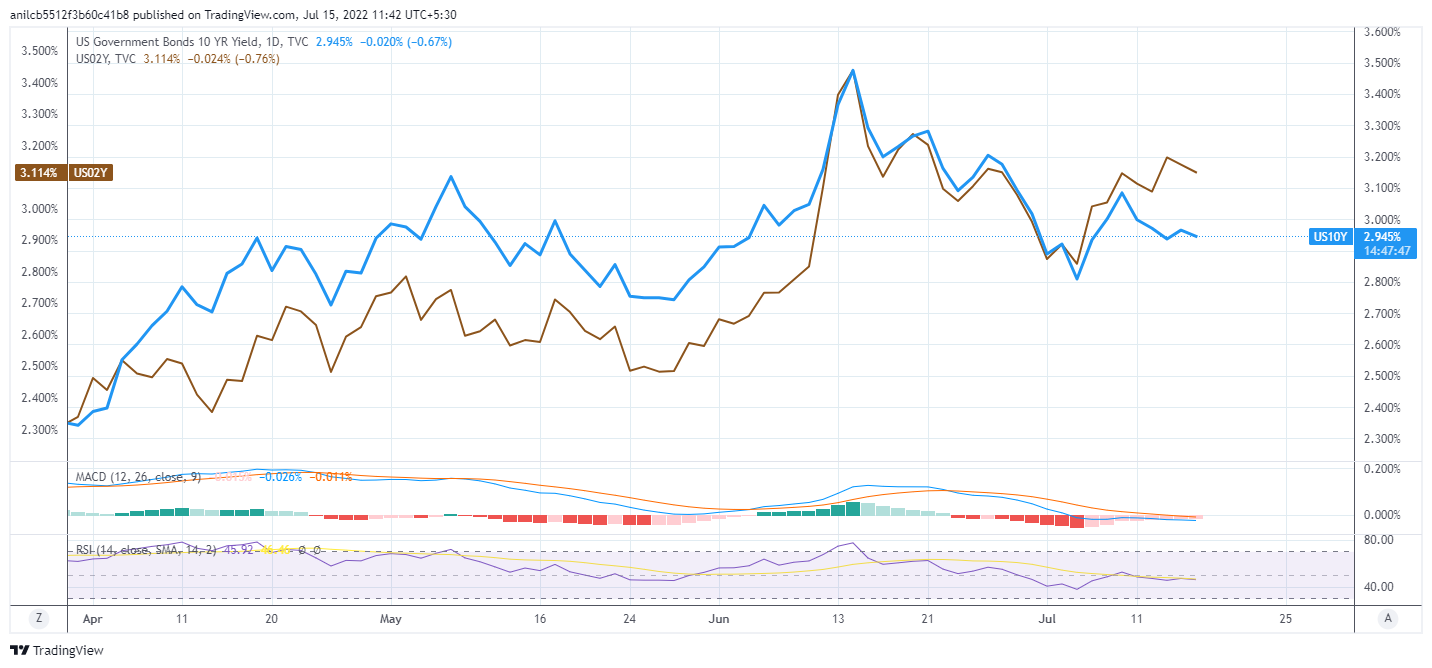
US10-year, 2-year Treasury yield curve
The recently flatlined US Treasury Yield curve appears important for Gold Price to aim for a corrective pullback. That said, US 10-year Treasury yields ended Thursday around 2.95%, up 0.95% intraday, whereas the 2-year bond coupon dropped 0.75% to 3.12% at the latest. With this, the difference between the near-term and the longer-term bond coupons declined to 17 basis points (bps) versus 23 bps inversion on Tuesday. Given the easing difference between the 2-year and the 10-year US Treasury yields, the market’s fears of recession appear abating of late, which in turn allowed the US dollar bulls to take a breather. It’s worth noting that the US 10-year Treasury yields flash 2.947% level while the 2-year bond coupon seesaws around 3.118% by the press time.
Fed speakers favored corrective pullback
Receding hawkish bias of the Fed policymakers, known as Fedspeak, appears to have recently tamed the risk-aversion wave. Among the key hurdles for the hawks were comments from St. Louis Federal Reserve President James Bullard and Federal Reserve Governor Christopher Waller. That said, Fed’s Bullard said, "So far, we've framed this mostly as 50 versus 75 at this meeting." On the same line, Fed’s Waller mentioned that markets may have gotten ahead of themselves by pricing a 100 basis points rate hike in July, as reported by Reuters. It should be noted that the Fed policymakers head to a blackout period from this weekend ahead of late July Federal Open Market Committee (FOMC).
Updates from China recall sellers
Chinese data has been mixed and recalled the gold sellers after an initial struggle. China’s Q2 Gross Domestic Product (GDP) shrank more than -1.5% expected to -2.6% QoQ, versus 1.4% prior. Further, the Industrial Production also eased but Retail Sales improved in June. Fears of covid-led lockdowns also exert downside pressure on Gold Price due to China’s status as one of the world’s biggest bullion consumers.
US data eyed for fresh impulse
Having seen firmer inflation numbers, US consumer-centric data will be important for Gold Price ahead of the Fed’s silence period before the FOMC. That said, the US Retail Sales, expected 0.8% MoM in June from -0.3% marked in May, will precede preliminary readings of the Michigan Consumer Sentiment Index (CSI) for July, expected 49.9 versus 50.0 prior, could direct intraday traders. Ahead of the release analysts at the Australia and New Zealand Banking Group said, “A strong retail sales number would be illustrative of strong demand and the need for the FOMC to maintain, and possibly intensify, its hawkish guidance.”
Gold Price technical outlook
Although the oversold RSI (14) triggered Gold Price rebound from the yearly low, the XAUUSD is yet to overcome October 2021 low, around $1,722, which holds the key to the short-term upside of the metal.
Also acting as the key resistance for Gold Price is the 50% Fibonacci retracement of March-August 2020 upside, near $1,763. In a case where the metal rises past $1,763, May’s bottom surrounding $1,787 could act as the last defense of bears before welcoming the XAUUSD buyers.
Alternatively, a convergence of the 200-week EMA, 61.8% Fibonacci retracement level and an ascending support line from June 2020 constitutes $1,685 as a tough nut to crack for gold sellers.
Should the Gold Price provide a weekly closing below $1,685, the June 2020 swing low near $1,670 can offer a checking point for the bears targeting the sub-$1,600 area.
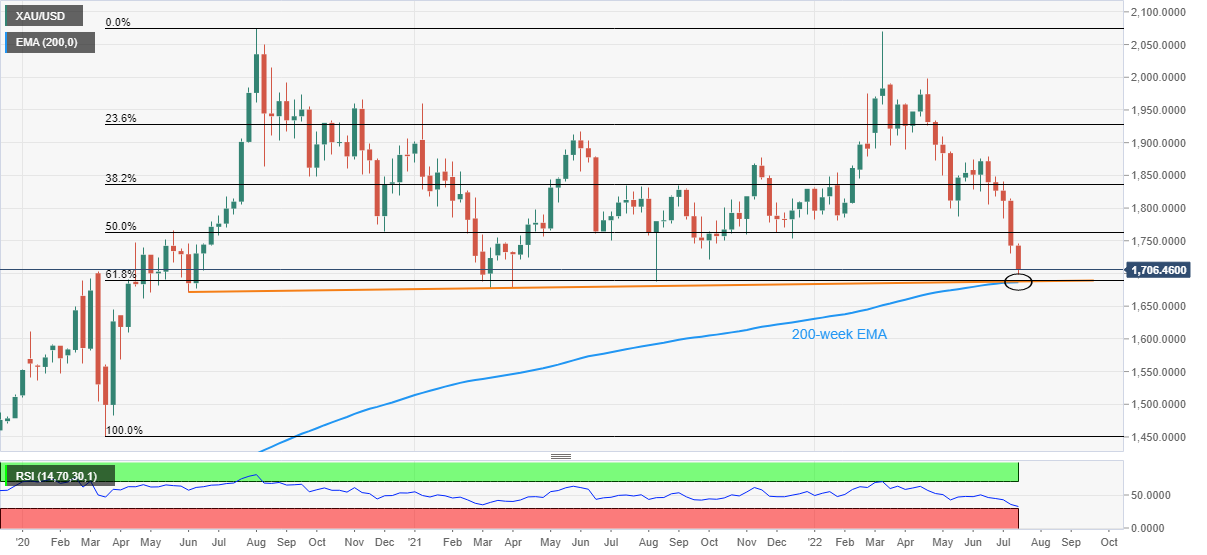
Are gold gains likley to be limited?
The US Dollar Index (DXY) is seen closing in on the next key resistance at 109.25/110.25 which analysts at Credit Suisse look to cap at first.
Support for a pullback is seen at 106.55
“DXY remains strong. We would look for a fresh and concerted pause at the next major resistance at September 2002 high and the 78.6% retracement of the 2001/2008 downtrend at 109.25/110.25, especially as the market is at the top of its typical extreme zone again.”
“Support for a pullback is seen at 106.55 initially, then 105.79.”
In the opinion of FX Strategists at UOB Group Lee Sue Ann and Quek Ser Leang, further weakness remains in the pipeline for AUD/USD in the next few weeks.
Key Quotes
24-hour view: “We highlighted yesterday that AUD ‘could edge lower from here but is unlikely to threaten the major support at 0.6700’. The subsequent weakness exceeded our expectations as AUD plummeted briefly to 0.6683 before rebounding strongly. Oversold conditions coupled with early signs of slowing momentum suggest AUD is unlikely to weaken much further. For today, AUD is more likely to trade between 0.6700 and 0.6780.”
Next 1-3 weeks: “On Tuesday (12 Jul, spot at 0.6740), we held the view that AUD could drop below 0.6700 but the chance for a break of the next support at 0.6650 is not high. Yesterday (14 Jul), AUD cracked 0.6700 and dropped to 0.6683 before rebounding. While downward momentum has improved slightly, the odds for a break of 0.6650 have not increased by much. All in, only a break of 0.6815 (‘strong resistance’ level was at 0.6835 yesterday) would indicate that the downside risk has dissipated. Looking ahead, if there is a clear break of 0.6650, the next level to monitor is at 0.6600.”
CME Group’s flash data for crude oil futures markets noted traders added around 8.6K contracts on Thursday, reaching the second consecutive daily build. Volume followed suit and rose by more than 174K contracts, leaving behind the previous daily drop.
WTI faces decent contention near $90.00
Prices of the WTI dropped to fresh lows near the $90.00 mark per barrel on Thursday, although they managed to end the session with marginal gains above the $96.00 region. Thursday’s volatile session was amidst rising open interest and volume and supports further range bound in crude oil prices in the very near term.
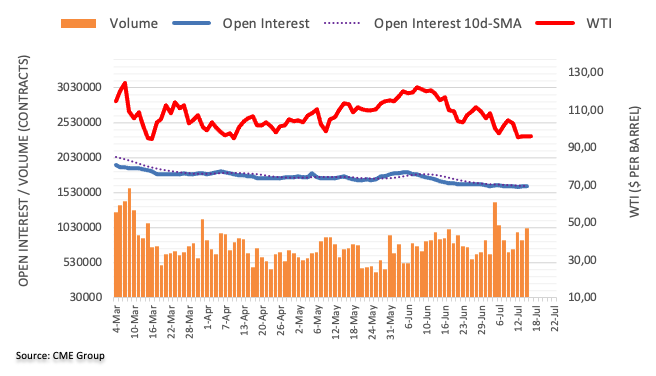
The environment remains difficult for the Swedish krona. Economists at Commerzbank expect SEK to struggle to gain some ground against the euro.
SEK is struggling
“High inflation levels with low-interest rates are putting pressure on SEK. If Riksbank were to sound notably more hawkish that does not necessarily have to be positive for krona, as we have already pointed out in connection with other central banks and currencies: rising interest rates entail the risk of a strong economic downturn.”
“Krona is susceptible to high-risk aversion. And as fears of a recession are unlikely to ease suddenly, risk aversion in the financial markets is likely to remain high. SEK is therefore likely to struggle with a further recovery against EUR.”
EUR/USD stays above parity. However, the pair is set to eventually fall below the 1.00 level, economists at Commerzbank report.
The news flow remains challenging for the euro
“In an extreme case, the market might assume that a significant widening of spreads, for example in Italian bonds, might cause the ECB to tighten monetary policy more carefully than previously signalled. That means that the news of a government crisis in Italy and spread widening could have had a negative effect on EUR.”
“The news flow remains challenging for the euro though and it, therefore, seems a matter of time when the final straw will then cause EUR/USD to ease below parity.”
Gold, so far, has struggled to find acceptance below the $1,700 mark. That said, the metal’s inability to gain any meaningful traction suggests that risks remain skewed to the downside, FXStreet’s Haresh Menghani reports.
Near-term selling bias might still be far from being over
“Any attempted recovery move is likely to confront resistance near the $1,725-$1,726 region. This is followed by the $1,734-$1,735 horizontal barrier, above which a bout of short-covering could lift the XAUUSD towards the $1,749-$1,752 supply zone.”
“Weakness below the overnight swing low, around the $1,698-$1,697 area, would be seen as a fresh trigger for bearish traders and make the XAUUSD vulnerable. Gold could then accelerate the fall towards September 2021 low, around the $1,787-$1,786 region. The downward trajectory could further get extended towards testing the 2021 yearly low, near the $1,677-$1,676 area.”
Prospects for further weakness remain in place for GBP/USD, although a visit to the 1.1700 region appears out of favour for the time being, suggested FX Strategists at UOB Group Lee Sue Ann and Quek Ser Leang.
Key Quotes
24-hour view: “While we expected GBP to weaken yesterday, we were of the view that ‘a break of the major support at 1.1800 appears unlikely’. The anticipated weakness exceeded our expectations as GBP dropped to 1.1761 before rebounding. Downward momentum appears to be slowing and this coupled with oversold conditions suggests that GBP is unlikely to weaken much further. For today, GBP is more likely to trade between 1.1750 and 1.1885.”
Next 1-3 weeks: “Our latest narrative was from two days ago (13 Jul, spot at 1.1880) where we highlighted that while downward momentum has not improved by much, the chance for GBP to break 1.1800 has increased. We added, “a break of 1.1800 would shift the focus to 1.1750”. Yesterday (14 Jul), GBP cracked 1.1800 and dropped to 1.1761 before rebounding. Downward momentum still appears to be a bit lackluster but as long as the ‘strong resistance’ level at 1.1940 (level was at 1.1980 yesterday) is not breached, GBP could continue to weaken. That said, the next major support at 1.1700 may not come into the picture so soon.”
- USD/JPY is going through an initiative buying structure that will extend its gains further.
- Solid fuel prices and CPI figures are strengthening the odds of higher US Retail Sales.
- The BOJ needs to step up the wage price index to keep the inflation rate above 2%.
The USD/JPY pair is displaying back and forth moves in a narrow range of 138.77-139.12 in the early European session. The asset has turned sideways after a vertical upside move and more upside looks likely as the US dollar index (DXY) is attempting a rebound after a corrective move. The DXY is expected to move higher strongly after overstepping the round-level resistance of 109.00.
Investors are channelizing liquidity into the greenback on expectations for higher US Retail Sales, which will release in the New York session. As per the market forecast, investors should brace for a higher reading at 0.8% than the prior release of -0.3%.
The investing community acknowledged with the upbeat fuel prices in June and higher energy bills would have driven the Retail Sales in a similar manner. Also, the improved Consumer Price Index (CPI) and Producer Price Index (PPI) reports adding to the upside filters.
However, upbeat Retail Sales data could be lucrative for the DXY but not for the economy as the data is not driven higher quantity-wise. Downbeat sales numbers for durable goods may also put pressure on the demand forecasts.
On the Tokyo front, yen bulls will remain weaker as a continuation of an ultra-loose monetary policy by the Bank of Japan (BOJ) will widen the Federal Reserve (Fed)-BOJ policy divergence. The BOJ is highly required to maintain its inflation rate above 2% and in order to address the same, it needs to paddle up the wage-price level meaningfully.
Open interest in gold futures markets resumed the upside and went up by around 16.7K contracts on Thursday according to advanced prints from CME Group. Volume, instead, shrank by around 68.1K contracts after two consecutive daily drops.
Gold remains supported by $1,700
Prices of gold extended the leg lower and briefly visited the area below $1,700 on Thursday. The move was amidst rising open interest, which exposes the continuation of the downtrend in the very near term at least. The $1,700 area, in the meantime, continues to offer solid contention for the time being.
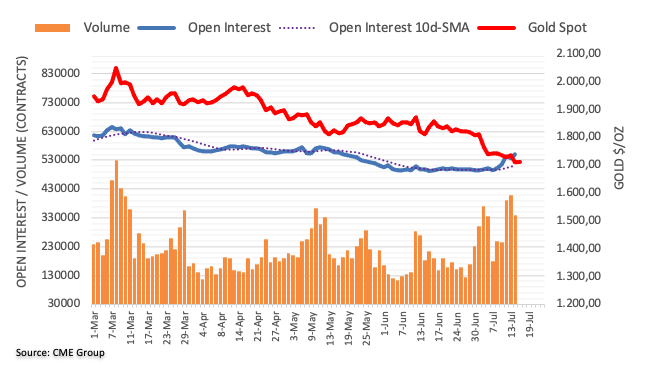
- Asia-Pacific equities remain pressured amid economic slowdown fears.
- China prints downbeat GDP growth, G20 meeting highlights risks for poor economies.
- Easing yields, mixed Fedspeak couldn’t impress equity bulls.
- US consumer-central data, last round of Fedspeak before FOMC awaited for clear directions.
Markets in the Asia-Pacific region remain depressed on Friday, despite mildly bid US stock futures and sluggish Treasury yields. The reason could be linked to the downbeat economic signals from China and the Group of 20 key nations’ (G20) meeting in Indonesia.
China’s Q2 Gross Domestic Product (GDP) shrank more than -1.5% expected to -2.6% QoQ, versus 1.4% prior. Further, the Industrial Production also eased but Retail Sales improved in June.
On the other hand, “Indonesian Finance Minister Sri Mulyani Indrawati said on Friday failure by G20 finance chiefs meeting in Bali to reach consensus could be catastrophic for low-income countries amid soaring food and energy prices exacerbated by the war in Ukraine,” reported Reuters.
Against this backdrop, MSCI’s index of Asia-Pacific shares ex-Japan drops 0.30% intraday while poking a two-month low. On the other hand, Japan’s Nikkei 225 rises 0.55% on a day heading into the European session.
Reuters mentioned the Bank of Japan’s (BOJ) dovish bias to back the Nikkei 225’s mildly positive performance. “The Bank of Japan (BOJ) is expected to reiterate its resolve next week to keep monetary policy ultra-loose and remain a dovish outlier as many other central banks raise interest rates, a commitment that could lead to further falls in the yen,” said the news.
It should be noted that Australia’s ASX 200 fails to cheer likely improving relations between Canberra and Beijing, by posting nearly 1.0% daily loss, whereas New Zealand’s NZX 50 also declines 0.95% at the latest amid economic fears.
Elsewhere, Indonesia’s IDX Composite appears to cheer upbeat trade numbers while posting 0.30% intraday gains. However, India’s BSE Sensex struggles to overcome weekly losses, up 0.15% intraday around 53,500 by the press time.
On a broader front, the reduction in the hawkish Fed bets and easing of the inversion gap of the key US Treasury yield curves, namely between 2-year and 10-year bonds, appears to have previously favored the market sentiment amid Fed policymakers’ attempt to talk down a 100 bps rate hike. The same could be witnessed in mild gains of the S&P 500 Futures.
Moving on, the US Retail Sales, expected 0.8% MoM in June from -0.3% marked in May, will precede preliminary readings of the Michigan Consumer Sentiment Index (CSI) for July, expected 49.9 versus 50.0 prior, could direct intraday traders. Also important will be the Fedspeak and updates from the meeting of the Group of 20 key nations (G20) in Indonesia.
FX Strategists at UOB Group Lee Sue Ann and Quek Ser Leang noted that a sustained breach of 0.9920 in EUR/USD looks unlikely for the time being.
Key Quotes
24-hour view: “We expected EUR to ‘trade in a choppy manner between 1.0000 and 1.0100’ yesterday. However, EUR plummeted to a low of 0.9950 before rebounding quickly. Despite the relatively sharp drop, downward momentum has not improved by much. That said, there is scope for EUR to retest the 0.9950 level (minor support is at 0.9980) before the risk of a stronger rebound would increase. The next support at 0.9920 is unlikely to come under threat. Resistance is at 1.0050 followed by 1.0075.”
Next 1-3 weeks: “We have held a negative EUR view for more than 2 weeks now. As EUR plummeted, in our latest narrative from two days ago (13 Jul, spot at 1.0035), we indicated that EUR is still weak and the next levels to focus on are at 0.9960 and 0.9920. Yesterday (14 Jul), EUR cracked 0.9960 before rebounding sharply from 0.9950. Despite breaching 0.9960, downward momentum has not improved by much. However, the weak phase is still intact as long as EUR does not move above 1.0120 (‘strong resistance’ level was at 1.0150 yesterday). As long as the ‘strong resistance’ level is not breached, EUR could continue to weaken even though the pace of any decline is likely to be slower. Overall, while there is room for EUR to drop to the next support at 0.9920 but at this stage, the odds for further sustained decline below this level are not high.”
- EURUSD seems less confident above 1.0000 as investors expected higher US Retail Sales.
- A subdued US Michigan CSI data may put some pressure on the DXY.
- Testing waters approach by the ECB may widen Fed-ECB policy divergence.
EURUSD price is displaying topsy-turvy moves in the Asian session. The pair has auctioned in a narrow range of 1.0011-1.0041 as investors are awaiting the release of the US Retail Sales and Michigan Consumer Sentiment Index (CSI). On Thursday, the asset rebounded strongly after surrendering the magical figure of 1.0000. The parity of the shared currency and the greenback is expected to keep the bears active.
The US dollar index (DXY) is attempting a rebound after a steep fall on Thursday. The DXY tumbled after printing a fresh 19-year high of 109.26 as profit-booking kicked in. It is worth noting that the asset is continuously refreshing its highs, which displays the strength of the DXY bulls on a broader basis. The DXY is expected to turn its corrective phase into a bullish impulsive wave after violating the round-level resistance of 109.00.
Also Read: EURUSD Forecast: Is today the day buyers give up on parity?

ECB should not delay the rate hike this time
Higher CPI and PPI advocate a 1% rate hike by the Fed
The release of the improved Consumer Price Index (CPI) and Producer Price Index (PPI) report this week has bolstered the odds of a 1% rate hike by the Federal Reserve (Fed) in its upcoming monetary policy meeting later this month. The plain-vanilla CPI landed at 9.1% much higher than the estimates of 8.8% and the prior release of 8.6%. Also, the PPI data that excludes oil and food prices have landed at 8.2%, minutely higher than the estimates of 8.1% but remained lower than the prior release of 8.5%. This will put more pressure on the shared currency bulls.
Full percent rate hike soars recession fears
There is no denying the fact that persistent price pressures and advancing interest rates were already strengthening the chances of recession. Now, the latest inflation figures have soared further as a full percent rate hike by the Fed will squeeze liquidity from the economy extensively.
Fed policymakers are delivering hawkish commentary to the fullest as the upbeat employment data and sold demand forecasts have empowered them to sound hawkish unhesitatingly. Quick expansion in the interest rates will scale down the investments, which will impact the banking sector and construction activities significantly. And eventually, will accelerate the jobless rates along with trimming the Nonfarm Payrolls (NFP). The occurrence of the same will pause the Fed from aggressive policy tightening and may weaken the greenback.
Higher energy bills to drive US Retail Sales
In today’s session, the release of the US Retail Sales will guide investors for a further direction. A preliminary estimate for the economic data is 0.8% for June, higher than the prior release of -0.3%. This may infuse fresh blood into the DXY. Fuel prices have shifted into bearish territory now but remained extremely solid in June. Therefore, higher energy bills must have been responsible for the higher consensus for the economic data. Also, the improved Consumer Price Index (CPI) report released on Wednesday is sufficient to support higher forecasts for Retail Sales.
-637934592081931298.png)
Michigan CSI to remain subdued
As per the market consensus, the Michigan CSI is expected to remain subdued. The economic data is seen at 49.9, minutely lower than the prior release of 50. Investors should note that the prior release of 50 was the lowest in the past 15 years. The catalyst indicates the confidence of the consumers in the financial prospects of the country. A slippage in the economic data dictates a drop in the buying conditions for real estate and durable goods in the economy. No doubt, the persistent price rise has trimmed the demand for durable goods and higher interest rates are becoming a nightmare for home buyers.
-637934592261547000.png)
Divergence to get wider in ECB-Fed policy
The Harmonized Index of Consumer Prices (HICP) numbers have remained majorly stable in the eurozone. However, this doesn’t warrant no rate hike announcement by the European Central Bank (ECB). The ECB has not elevated its interest rates yet like the other Western central banks, which have hiked their rates at a quicker pace. The rate hike announcement by the ECB is highly expected, however, ECB President Christine Lagarde may prefer to test the waters first and will announce higher rate hikes in later stages. While the Fed is seen to hike its rates by 1%. This may widen the policy divergence between ECB and Fed further.
EURUSD technical analysis
On an hourly scale, EURUSD price is displaying strong buying tails near Thursday’s low of 0.9953 which signals the presence of marquee investors. The shared currency bulls have driven the asset above the psychological support of 1.0000.
The 20- and 50-period Exponential moving Averages (EMAs) at 1.0025 and 1.0032 have turned sideways, which indicates a short-term consolidation ahead.
Also, the Relative Strength Index (RSI) (14) is oscillating in the 40.00-60.00 range, which indicates that investors are awaiting a potential trigger for a decisive move.
EURUSD hourly chart
-637934590775289978.png)
Elliott Wave trading strategies: DAX 40, FTSE 100, STOXX 50, Dollar Index, EUR/USD
- AUD/USD renews daily bottom, extends pullback from weekly resistance line.
- Downbeat RSI, bearish channel keep sellers hopeful to revisit yearly low.
- Bulls need validation from 100-SMA, August 2019 low lures sellers.
AUD/USD takes offers to refresh intrday low around 0.6730 as it extends pullback from the one-week-old resistance line during early Friday morning in Europe.
The Aussie pair’s pullback, however, is likely to struggle around a one-month-long descending support line near 0.6695. The short-term downside also takes clues from the downward sloping but not oversold RSI (14).
In a case where AUD/USD bears keep reins past 0.6695, a fortnight-long support line near 0.6680 and the August 2019 low near 0.6670 will gain the market’s attention.
Alternatively, recovery remains elusive until the quote stays below the 0.6765 level comprising the weekly resistance line.
Even so, a two-week-long descending resistance line around 0.6830 could challenge the pair’s recovery. Also acting as an upside filter is the 100-SMA hurdle surrounding 0.6840.
Should AUD/USD bulls manage to cross the 0.6840, the 0.6900 threshold may act as the last defense of the bears before directing the quote towards the late June swing high surrounding 0.7070.
Overall, AUD/USD is likely to decline further but the downside room appears limited.
AUD/USD: Four-hour chart
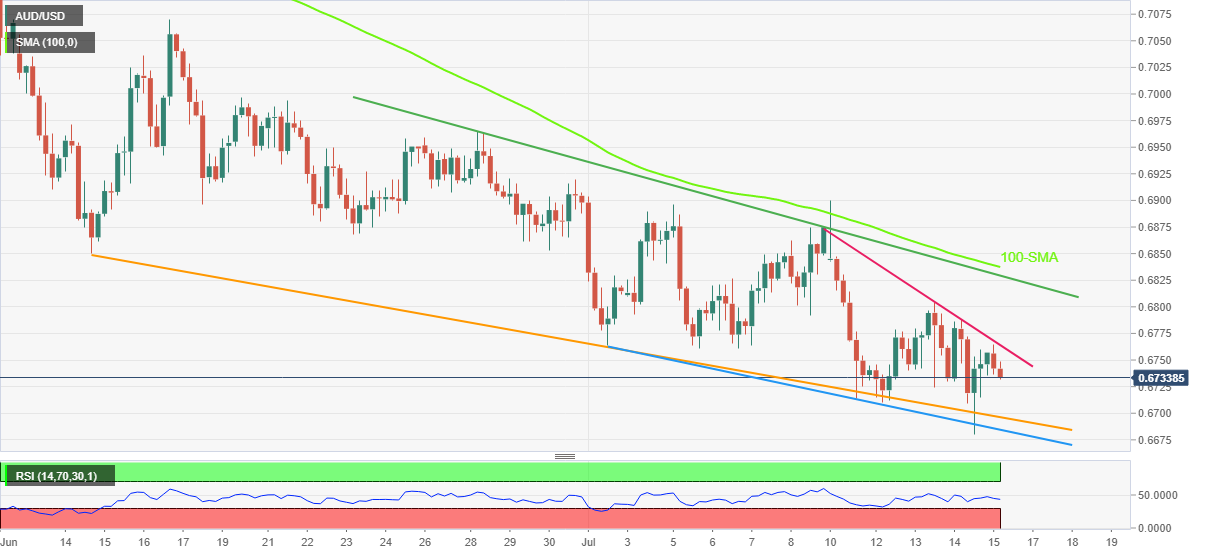
Trend: Bearish
“The European Central Bank (ECB) will unveil an unlimited bond-buying tool next week to help markets better adjust to steeper and faster interest-rate increases than previously thought,” as per Bloomberg’s latest survey of economists published on Friday.
Key findings
Almost 80% predict the instrument, known as the Transmission Protection Mechanism, will carry light conditions for governments it’s used to help.
Nearly all expect the liquidity its purchases create to be reabsorbed in a process called sterilization.
As already-record inflation approaches double digits, economists see the ECB accelerating rate hikes following liftoff on July 21. But they still consider it behind the curve, with the Federal Reserve kicking off monetary tightening back in March and now weighing a historic 100 basis-point move this month.
Economists see the deposit rate, currently at -0.5%, rising by a quarter-point this month and by twice that amount in September, followed by smaller steps at each subsequent meeting until March. It’s expected to peak at 1.25%.
Also read: EURUSD Price clings to the 1.000 parity level with eyes on US Retail Sales
- Steel Price drops near 5.0% on a day to refresh YTD low amid pessimism surrounding global growth.
- China released softer Q2 GDP, marked contraction in crude steel output for June.
- Bad weather, covid joins doubts over Chinese stimulus to renew growth optimism to weigh on metal prices.
Steel Price remains on the back foot around 2022 bottom as metal traders fail to cheer the US dollar pullback, as well as a reduction in Chinese output amid fears of economic slowdown. That said, steel rebar prices on Shanghai Futures Exchange (SFE) remain pressured near 3,680 yuan per tonne ($545), down around 5.0% by the press time of early Friday morning in Europe.
China’s Q2 Gross Domestic Product (GDP) shrank more than -1.5% expected to -2.6% QoQ, versus 1.4% prior. Further, the Industrial Production also eased but Retail Sales improved in June.
On the other hand, Reuters came out with the news saying that China's crude steel output fell 3.3% in June compared with a year earlier, and was down 6% from May.
The news also mentioned, “Several mills in China have idled blast furnaces or placed them under maintenance earlier than usual due to weak margins and high inventories, and it remains uncertain when these facilities will be restarted.” It’s worth noting that covid-led lockdowns and bad weather recently affected Chinese metal producers. The output was also reduced as manufacturers had little motivation with downbeat prices.
Elsewhere, the reduction in the hawkish Fed bets and easing of the inversion gap of the key US Treasury yield curves, namely between 2-year and 10-year bonds, appears to have favored the market sentiment amid Fed policymakers’ attempt to talk down a 100 bps rate hike.
Moving on, US Retail Sales, expected 0.8% MoM in June from -0.3% marked in May, will precede preliminary readings of the Michigan Consumer Sentiment Index (CSI) for July, expected 49.9 versus 50.0 prior, to direct intraday moves of the USD/INR. Also important will be the Fedspeak and updates from the meeting of the Group of 20 key nations (G20) in Indonesia.
Also read: US June Retail Sales Preview: Has the consumer turning point arrived?
- USD/INR remains on the front foot around all-time high amid recession fears, rebound in oil prices.
- Fedspeak, yield curves test pair buyers amid downbeat China data, sluggish session.
- US Retail Sales, Michigan Consumer Sentiment Index eyed for fresh impulse.
USD/INR stays on the bull’s radar as it rises to 79.93 to refresh its intraday high during the initial hour of Friday’s Indian trading session. In doing so, the Indian rupee (INR) ignores sluggish US dollar moves amid firmer oil prices, as well as fears of recession.
That said, the US Dollar Index (DXY) steadies around 108.60 after refreshing the two-decade high of 109.28 level the previous day. That said, the greenback’s previous pullback from the multi-year top could be linked to the Fed policymakers’ attempts to talk down the expectations surrounding a 100 bps rate hike in July. Further, mixed US data and easing yields curve inversion also probed the DXY buyers the previous day.
St. Louis Federal Reserve President James Bullard and Federal Reserve Governor Christopher Waller were among the key Fed speakers who tried to talk down the odds of higher rates. That said, Fed’s Bullard said, "So far, we've framed this mostly as 50 versus 75 at this meeting." On the same line, Fed’s Waller mentioned that markets may have gotten ahead of themselves by pricing a 100 basis points rate hike in July, as reported by Reuters. It should be noted that the Fed policymakers head to a blackout period from this weekend ahead of late July Federal Open Market Committee (FOMC).
On the data front, the US Bureau of Labor Statistics mentioned that the Producer Price Index (PPI) for final demand in the US climbed to 11.3% on a yearly basis in June from 10.9% in May. This print surpassed the market expectation of 10.7%. Additionally, there were 244,000 Initial Jobless Claims in the week ending July 9 versus the previous week's print of 235,000 and market expectation of 235,000. The Weekly Jobless Claims were the highest in five months.
Elsewhere, the US 10-year Treasury yields ended Thursday around 2.95%, up 0.95% intraday, whereas the 2-year bond coupon dropped 0.75% to 3.12% at the latest. With this, the difference between the near-term and the longer-term bond coupons declined to 17 basis points (bps) versus 23 bps inversion on Tuesday. Given the easing difference between the 2-year and the 10-year US Treasury yields, the market’s fears of recession appear abating of late, which in turn allowed the US dollar bulls to take a breather. It’s worth noting that the US 10-year Treasury yields flash 2.947% level while the 2-year bond coupon seesaws around 3.118% by the press time.
It should be noted that WTI crude oil struggles to extend the previous day’s rebound from the lowest levels since February, down 0.45% around $93.45 by the press time. Furthermore, China’s Q2 Gross Domestic Product (GDP) shrank more than -1.5% expected to -2.6% QoQ, versus 1.4% prior. Further, the Industrial Production also eased but Retail Sales improved in June.
Amid these plays, S&P 500 Futures print mild gains to portray cautious optimism in the market, which in turn probe the USD/INR bulls.
Looking forward, US Retail Sales, expected 0.8% MoM in June from -0.3% marked in May, will precede preliminary readings of the Michigan Consumer Sentiment Index (CSI) for July, expected 49.9 versus 50.0 prior, to direct intraday moves of the USD/INR. Also important will be the Fedspeak and updates from the meeting of the Group of 20 key nations (G20) in Indonesia.
Technical analysis
The monthly resistance line joins overbought RSI (14) to probe USD/INR bulls around 80.15. Pullback moves, however, need validation from a one-week-old support line, close to 79.70 at the latest.
- GBP/USD has picked offers around 1.1850 as the DXY is attempting a rebound ahead of US Retail Sales.
- A preliminary estimate for the US Retail Sales is 0.8% vs. -0.3% released earlier.
- Political instability and recession fears have shifted the pound bulls on the tenterhooks.
The GBP/USD pair has slipped to near 1.1830 after facing hurdles modestly above 1.1850 in the Asian session. The cable has displayed a subdued performance after a less confident rebound from Thursday’s low at 1.1760. Generally, a soft rebound turns quickly into a downside move as the market participants consider that trade a bargain sell.
The cable is expected to witness a steep fall after slipping below the intermittent support of 1.1820 as the US dollar index (DXY) is set to rebound after a modest correction. The DXY witnessed a steep fall on Thursday after printing a fresh 19-year high of 109.26. A rebound is expected amid higher consensus for US Retail Sales.
The US Retail Sales are seen at 0.8% for June, higher than the prior release of -0.3%. Fuel prices have shifted into bearish territory now but remained extremely solid in June. Therefore, higher energy bills must have been responsible for the higher consensus for the economic data. Also, higher Consumer Price Index (CPI) data released on Wednesday is sufficient to support higher forecasts for Retail Sales.
On the pound front, political instability and recession fears have shifted the pound bulls on the tenterhooks. The resignation of UK PM Boris Johnson has trimmed the confidence of the households in the growth prospects of the economy. Also, the scorching inflation rate has triggered recession fears. More rate hikes from the Bank of England (BOE) will remain on the cards and it would be interesting to note whether the economic catalysts would support BOE for policy tightening unhesitatingly.
- Gold Price struggles around YTD low as hawkish Fed bets, recession fears ebb.
- US dollar bulls take a breather at a multi-year high as traders await important consumer-centric data.
- XAUUSD appears lucrative for short-term buying until staying beyond $1,705.
Gold Price (XAUUSD) stays defensive at around $1,700, consolidating recent losses near the lowest levels in 11 months as risk-aversion fades ahead of the key US data. Also contributing to the corrective pullback could be the reduction in the hawkish Fed bets and easing the inversion gap of the key US Treasury yield curves, namely between 2-year and 10-year bonds. It’s worth noting, however, that the firmer US Producer Price Index (PPI) and downbeat economics from China keep gold sellers hopeful as they await US Retail Sales for June and preliminary readings of the Michigan Consumer Sentiment Index (CSI) for July.
Also read: Gold Price aims to recapture $1,700 as DXY hopes for a rebound, US Michigan CSI eyed
Gold Price: Key levels to watch
The Technical Confluence Detector shows that Gold Price is in its nascent stage of recovery as it recently crossed the $1,713 hurdle comprising the previous hour on four-hour and Fibonacci 38.2% on one-day.
Also keeping the XAUUSD buyers hopeful is the metal sustained trading beyond the key resistance-turned-support around $1,705, including Pivot Point S3 one-month and lower band of the Bollinger on one-hour.
It’s worth noting that the gold seller’s dominance past $1,705 needs validation from the $1,700 threshold that coincides lower band of the Bollinger on one-day, as well as the previous daily bottom.
That said, the gold buyers are all set to poke the $1,724 resistance mark where Fibonacci 61.8% one-day joins 50-HMA and SMA-10 in four-hour.
Should the metal prices remain firmer past $1,724, the odds of witnessing a run-up towards $1,732, including the previous weekly low and Pivot Point R1 on one-day, can’t be ruled out.
Overall, Gold Price lures intraday buyers but the bearish trend is yet to be rejected.
Here is how it looks on the tool
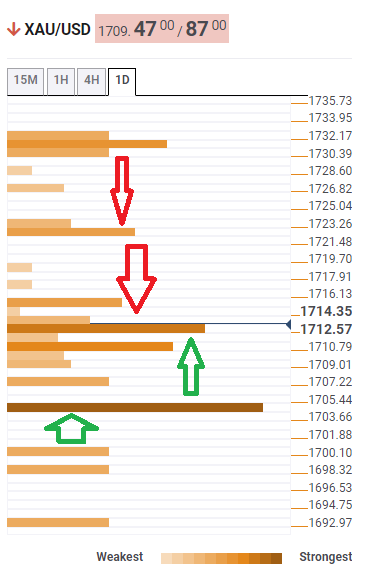
About Technical Confluences Detector
The TCD (Technical Confluences Detector) is a tool to locate and point out those price levels where there is a congestion of indicators, moving averages, Fibonacci levels, Pivot Points, etc. If you are a short-term trader, you will find entry points for counter-trend strategies and hunt a few points at a time. If you are a medium-to-long-term trader, this tool will allow you to know in advance the price levels where a medium-to-long-term trend may stop and rest, where to unwind positions, or where to increase your position size.
- Profit-booking has dragged the asset to near 1.3100 after a fresh yearly high at 1.3223.
- Advancing 20-and 50-period EMAs add to the upside filters.
- The RSI (14) is oscillating in a bullish range of 60.00-80.00 which indicates more upside ahead.
The USD/CAD pair is auctioning in a range of 1.3093-1.3141 from Thursday after meeting with long liquidations by the market participants. The asset witnessed correction after printing a fresh yearly high of 1.3223.
The approach of profit-booking after the asset turned extremely overbought has dragged the greenback bulls to near the horizontal support which is placed from July 5 high at 1.3084. The asset is hovering around the discussed support and is expected to turn bullish again after testing the waters.
The 20- and 50-period Exponential Moving Averages (EMAs) at 1.3042 and 1.3006 respectively are scaling higher, which adds to the upside filters.
Also, the Relative Strength Index (RSI) (14) is oscillating in the bullish range of 60.00-80.00, which indicates more upside ahead.
A breach of the yearly high at 1.3223 will drive the asset towards the 4 November 2020 high at 1.3300, followed by a 2 November 2020 high at 1.3370.
Alternatively, a slippage below July 8 low at 1.2936 will drag the asset towards June 28 low at 1.2819. A slippage below the latter will expose the asset to more downside towards May 5 low at 1.2713.
USD/CAD four-hour chart
-637934519265725291.png)
Canadian Finance Minister Chrystia Freeland told the G20 session that Russia’s war against Ukraine is the 'single biggest threat to the global economy right now', Reuters reported, citing a Western official.
She told the Russian delegation at R20 that she holds them personally responsible for 'war crimes', Reuters added.
Market reaction
USD/CAD was last seen trading at 1.3100, down 0.11% on the day.
- AUD/JPY is marching towards its weekly high at 94.26 despite downbeat China’s GDP.
- The headwinds of the resurgence of Covid-19 have brought a slump in the Chinese economy.
- Lower Wage rates in Japan are responsible for the subdued Durable goods sales.
The AUD/JPY pair has refreshed its intraday high at 94.00 after the release of the mixed Chinese economic data. The Chinese economy is facing the headwinds of the resurgence of Covid-19 that has grown fears of lockdown curbs by the Chinese administration to contain the pandemic. Therefore, an outperformance was not expected by the market participants.
China's Gross Domestic Product (GDP) has remained vulnerable in the second quarter of CY2022. The quarterly GDP has landed at -2.6%, lower than the prior release of 1.3% and the expectations of -1.5%. Also, the annual figure has tumbled to 0.4% from the consensus and the former figure of 1% and 4.8% respectively. However, the Industrial Production data has improved to 3.9% vs. 0.7% reported previously but remains lower than the estimates of 4.1%.
And lastly, the Retail Sales data remains upbeat. The economic data has landed at 3.1% much higher than the forecast of 0% and the prior print of -6.7%. It is worth noting that Australia is a leading exporter to China and the latter’s economic data carries a significant impact on the Australian dollar.
The aussie bulls are performing stronger against yen after the release of the upbeat Australian employment data. The labor market in Australia has remained tight in June and the economy has reported an outperformance in employment generation. Also, the Unemployment Rate has slipped significantly to 3.5%.
On the Tokyo front, the economy is worried over its inability to drive the inflation rate higher. The plain-vanilla inflation rate has crossed 2%, however, the core Consumer Price Index (CPI) is extremely poor, which indicates that the demand for durable goods is subdued. Apart from that, lower wage rates may trim the inflation rate back below 2%.
- NZD/USD picks up bids to refresh intraday high despite unimpressive China data.
- China GDP eased in Q2, Retail Sales rose in June but Industrial Production growth declined.
- 200-HMA, weekly resistance line challenge buyers, multiple levels to challenge bears around 0.6100.
NZD/USD extends corrective pullback from two-year low as it renews intraday high near 0.6145 during Friday’s mid-Asian session.
In doing so, the Kiwi pair ignores mixed outcomes of China’s key economic numbers. That said, China’s Q2 Gross Domestic Product (GDP) shrank more than -1.5% expected to -2.6% QoQ, versus 1.4% prior (revised). Further, the Industrial Production also eased but Retail Sales improved in June.
Also read: China’s GDP contracts 2.6% YoY in Q2 2022 vs. -1.5% expected, AUD/USD unfazed
Technically, NZD/USD pair’s successful trading above the weekly horizontal resistance-turned-support area joins bullish MACD signals to keep buyers hopeful.
However, a convergence of the 200-HMA and a one-week-old descending trend line near 0.6150 appears the key challenge.
Should the quote rises past 0.6150, it can aim for last Friday’s peak of 0.6222. It’s worth noting that the 61.8% Fibonacci retracement of June 30 to July 14 downside, near 0.6180, may offer an intermediate halt during the anticipated rally.
Alternatively, pullback moves could aim for the previous resistance area surrounding 0.6100 before directing NZD/USD bears towards the multi-month low near 6060.
In a case where the quote remains bearish past 0.6060, its south-run to the 0.6000 psychological magnet can’t be ruled out.
NZD/USD: Hourly chart

Trend: Limited upside expected
| Raw materials | Closed | Change, % |
|---|---|---|
| Silver | 18.431 | -4.09 |
| Gold | 1710.6 | -1.46 |
| Palladium | 1905.75 | -3.69 |
Following the release of the June activity numbers, China’s National Bureau of Statistics (NBS) released a statement, via Reuters, expressing their take on the economy.
Key headlines
Impact of COVID outbreak on the economy has not yet been completely eliminated.
Economic base for long-term recovery is not stable.
Stagflation risks are increasing globally.
China is confronting falling demand, a supply shock also.
Chinese economy faces structural and cyclical issues.
Related reads
- AUD/USD buyers approach 0.6800 despite mixed China data, focus on US Retail Sales
- China's Foreign Minister Wang: Willing to recalibrate relations with Australia
- GBP/JPY bulls have stepped back in to take out session highs.
- The bulls have their eyes set on daily highs.
GBP/JPY is on the march in Tokyo after a clear out on the downside in the open. The price is elevated and moving higher on the daily time frame with the prior highs eyed for another test. However, the W-formation is a bearish reversion pattern that could draw in the price to the neckline at any time.
GBP/JPY daily chart

GBP/JPY H1 chart

The bullish inverse head and shoulders are promising for the upside prospects.
GBP/JPY M15 charts
A bullish scenario is illustrated in the following analysis in the 15-minute chart:

The price has moved in on the M-formation's neckline but has established a potential level of support of around 164.35. If this were to hold, then the price could attract further demand for a surge beyond the session highs printed in the opening hour of Tokyo.
On the other hand, the price has yet to revisit the prior order block from where the rally took off, so there is a possibility that once the price fulfils the meanwhile objective to the upside, a reversal could take shape and the following illustrates a potential price trajectory/ in such a case:

- AUD/USD extends corrective pullback from two-year low even as China data came in mixed.
- China Q2 GDP dropped more than expected, Retail Sales rose but Industrial Production ease in June.
- Beijing’s shift towards cordial approach for Australia also underpins recovery moves.
- US Retail Sales, Michigan CSI could entertain traders, G20, Fedspeak will also be important for fresh impulse.
AUD/USD picks up bids to refresh intraday high around 0.6760 despite economic troubles at the biggest customer China. That said, the Aussie pair appears to cheer the risk-on mood during Friday’s Asian session while portraying a corrective pullback from a two-year low.
That said, China’s Q2 Gross Domestic Product (GDP) shrank more than -1.5% expected to -2.6% QoQ, versus 1.4% prior. Further, the Industrial Production also eased but Retail Sales improved in June.
Also read: China’s GDP contracts 2.6% YoY in Q2 2022 vs. -1.5% expected, AUD/USD unfazed
Apart from the data, trade-positive comments from China also favor the AUD/USD prices of late.
Recently, China’s Foreign Minister Wang Yi said that the relations between Beijing and Canberra face challenges and opportunities currently. The diplomat also added, “China is willing to recalibrate relations in a spirit of mutual respect.” It should be noted that rumors surrounding China’s reversing of its unofficial ban on Australian coal imports in August or September favored the Aussie prices earlier in the day.
Above all, receding market fears of the Fed’s 100 bps rate hike joins an easing difference between the US 10-year Treasury yields and its 2-year counterpart to favor the AUD/USD pair’s latest rebound. Beneath the same could be the previous day’s mixed US data and Fed policymakers’ attempt to talk down fears of aggressive actions.
That said, St. Louis Federal Reserve President James Bullard and Federal Reserve Governor Christopher Waller were among the key Fed speakers who tried to talk down the odds of higher rates. That said, Fed’s Bullard said, "So far, we've framed this mostly as 50 versus 75 at this meeting." On the same line, Fed’s Waller mentioned that markets may have gotten ahead of themselves by pricing a 100 basis points rate hike in July, as reported by Reuters. It should be noted that the Fed policymakers head to a blackout period from this weekend ahead of late July Federal Open Market Committee (FOMC).
On the other hand, the US Producer Price Index (PPI) climbed to 11.3% YoY in June from 10.9% in May, versus the market expectation of 10.7%. However, Weekly Jobless Claims were the highest in five months, rising 244K versus 235K prior and market forecasts.
Moving on, US Retail Sales, expected 0.8% MoM in June from -0.3% marked in May, will precede preliminary readings of the Michigan Consumer Sentiment Index (CSI) for July, expected 49.9 versus 50.0 prior, to direct short-term AUD/USD moves. Also important will be the Fedspeak and updates from the meeting of the Group of 20 key nations (G20) in Indonesia.
Technical analysis
Despite the latest rebound, AUD/USD keeps its weekly trading pattern of taking rounds to a downward sloping support line from January 2022 despite marking volatile sessions and refreshing multi-day lows of late. It’s worth noting that the RSI (14) remains mostly stable, above the oversold territory, which in turn allows the bears to keep reins.
That said, the quote’s fresh weakness needs a sustained closing below the stated support line, near 0.6740 by the press time. Alternatively, recovery moves could aim for the 0.6800 threshold before challenging the 0.6855 resistance confluence including the 21-DMA and the aforementioned wedge’s upper line.
China's annualized GDP figures for the second quarter of 2022 arrived at 0.4% vs. 1.0% expected and 4.8% previous, with the QoQ reading coming in at -2.6% vs. -1.5% expected and 1.4% previous.
With regard to Retail Sales YoY for June, the number was 3.1% vs. 0% expected and -6.7% previous while Industrial Output YoY came in at 3.9% and 4.1% expected and 0.7% prior.
Meanwhile, the Fixed Asset Investment YoY stood at 6.1% in the reported month vs. 6.0% expected and 6.2% last.
Additional details
China H1 GDP +2.5% YoY.
China June nationwide survey-based jobless rate at 5.5%.
China June survey-based jobless rate in 31 major cities at 5.8%.
China's economy created 6.54 mln new urban jobs in H1.
Market reaction
The mixed data had little to no impact on the Australian Dollar, with the AUD/USD pair keeping its range above 0.6750.
The spot was last seen trading at 0.6755, up 0.16% on the day.
- USD/CHF retreats from one-month high, takes offers to refresh intraday low.
- RSI weakness, not oversold, hints at the quote’s further declines towards short-term support line.
- Convergence of 200-SMA, 38.2% Fibonacci retracement appears key support, bulls need validation from 0.9870.
USD/CHF consolidates the biggest daily gains in three days while dropping back from a one-month high. That said, the Swiss currency pair (CHF) refreshes its intraday low to 0.9815 during Friday’s Asian session.
USD/CHF bears cheer the RSI retreat, as well as the pair’s inability to cross an upward sloping resistance line from June 17. Also keeping the sellers hopeful is the recent weakness below the 61.8% Fibonacci retracement (Fibo.) level of June 15-29 declines.
With this, the quote is likely to drop further towards a 12-day-old support line near 0.9800.
However, a confluence of the 200-SMA and 38.2% Fibo. near 0.9705 will be important for the USD/CHF bears to break to retake control.
On the flip side, the 61.8% Fibonacci retracement level and monthly resistance line, respectively around 0.9840 and 0.9870, could restrict short-term advances of the pair.
In a case where USD/CHF prices rally beyond 0.9870, the odds of witnessing a run-up towards the mid-June peak of 1.0050 can’t be ruled out.
USD/CHF: Four-hour chart
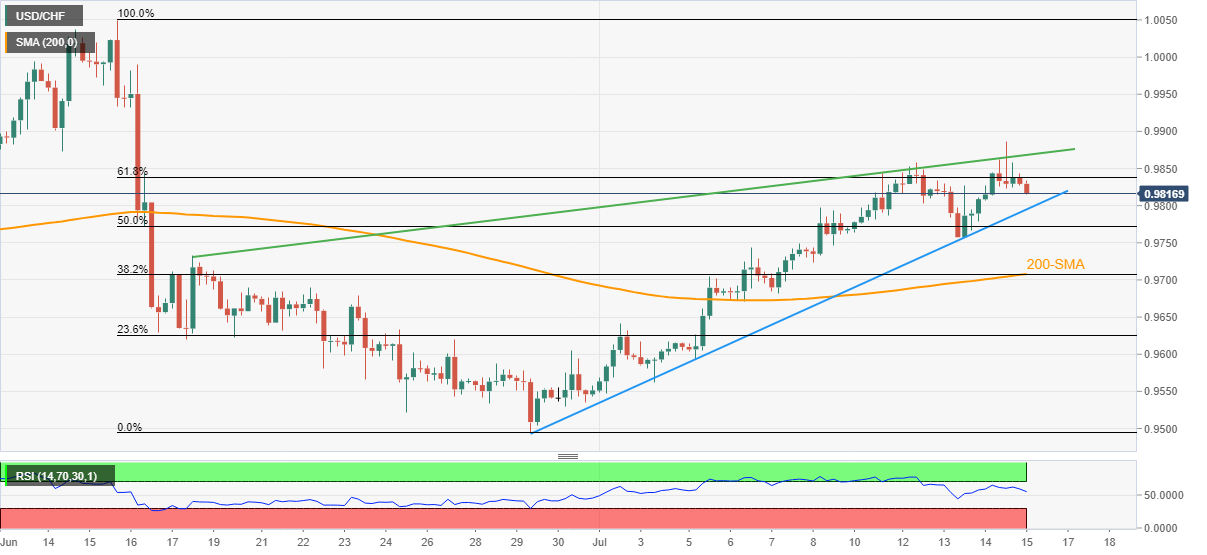
Trend: Limited downside expected
China’s Foreign Minister Wang Yi said on Friday that the relations between Beijing and Canberra face challenges and opportunities currently.
Wang added that “China is willing to recalibrate relations in a spirit of mutual respect.”
Earlier in the day, chatters were doing the rounds that China may be preparing to reverse its unofficial ban on Australian coal imports in August or September.
Market reaction
AUD/USD is catching a fresh bid on expectations of a thaw in the China-Australia conflict. The spot is now trading at 0.6755, up 0.13% on the day.
- USD/JPY consolidates the biggest daily gains in a month around the highest levels since September 1998.
- Yield ease amid mixed US data, Fedspeak as traders await fresh clues.
- G20, US Retail Sales and Michigan CSI are the key catalysts for the day.
- Fed policymakers could also entertain traders ahead of blackout period.
USD/JPY takes offers to refresh intraday low around 138.80 while extending the late Thursday’s pullback from a multi-year high to Friday’s initial Asian session. The yen pair’s latest weakness could be linked to the market’s inaction, as well as softer yields, not to forget the cautious mood ahead of the key US data.
That said, the US 10-year Treasury yields ended Thursday around 2.95%, up 0.95% intraday, whereas the 2-year bond coupon dropped 0.75% to 3.12% at the latest. With this, the difference between the near-term and the longer-term bond coupons declined to 17 basis points (bps) versus 23 bps inversion on Tuesday. Given the easing difference between the 2-year and the 10-year US Treasury yields, the market’s fears of recession appear abating of late, which in turn allowed the US dollar bulls to take a breather. It’s worth noting that the US 10-year Treasury yields flash 2.945% level while the 2-year bond coupon seesaws around 3.12% by the press time.
Elsewhere, Fed policymaker’s efforts to tame 100 bps rate hike talks and mixed US data also helped the USD/JPY sellers to step in.
St. Louis Federal Reserve President James Bullard and Federal Reserve Governor Christopher Waller were among the key Fed speakers who tried to talk down the odds of higher rates. That said, Fed’s Bullard said, "So far, we've framed this mostly as 50 versus 75 at this meeting." On the same line, Fed’s Waller mentioned that markets may have gotten ahead of themselves by pricing a 100 basis points rate hike in July, as reported by Reuters. It should be noted that the Fed policymakers head to a blackout period from this weekend ahead of late July Federal Open Market Committee (FOMC).
Talking about data, the US Bureau of Labor Statistics mentioned that the Producer Price Index (PPI) for final demand in the US climbed to 11.3% on a yearly basis in June from 10.9% in May. This print surpassed the market expectation of 10.7%. Additionally, there were 244,000 Initial Jobless Claims in the week ending July 9 versus the previous week's print of 235,000 and market expectation of 235,000. The Weekly Jobless Claims were the highest in five months.
Amid these plays, S&P 500 Futures rise 0.13% intraday to 3,800 at the latest, which in turn portrays the market’s cautious optimism.
It should be noted that the meeting of the Group of 20 key nations (G20) in Indonesia starts with US Treasury Secretary Janet Yellen’s criticism of Russia over its invasion of Ukraine. However, China’s readiness to ease tension with Australia seems to help the sentiment.
That said, USD/JPY traders should pay attention to the risk catalysts for immediate directions ahead of US Retail Sales, expected 0.8% MoM in June from -0.3% marked in May, which will precede preliminary readings of the Michigan Consumer Sentiment Index (CSI) for July, expected 49.9 versus 50.0 prior, not to forget the Fedspeak.
Technical analysis
While overbought RSI (14) challenges USD/JPY buyers targeting the 140.00 threshold, pullback remains elusive until the quote stays above the previous resistance line from June 21, close to 137.55 by the press time.
In recent trade today, the People’s Bank of China (PBOC) set the yuan (CNY) at 6.7503 vs. the last close of 6.7581. Today's fix was the weakest level since 15 June.
About the fix
China maintains strict control of the yuan’s rate on the mainland.
The onshore yuan (CNY) differs from the offshore one (CNH) in trading restrictions, this last one is not as tightly controlled.
Each morning, the People’s Bank of China (PBOC) sets a so-called daily midpoint fix, based on the yuan’s previous day's closing level and quotations taken from the inter-bank dealer.
- USD/CAD remains sidelined after rising to the highest levels since November 2020.
- Oil prices await China data, active markets for to extend corrective pullback from five-month low.
- Market sentiment improves on easing hawkish bias on Fed’s next move, mixed Fedspeak, data.
- G20 updates, US data will be important, Fedspeak shouldn’t be missed for clear directions.
USD/CAD treads water around 1.3120, after rising to a 20-month high, as traders await key data/events during Friday’s Asian session. The Loonie pair’s latest inaction could also be linked to the sluggish prices of WTI crude oil, Canada’s main export earner.
That said, WTI crude oil struggles to extend the previous day’s rebound from the lowest levels since February, down 0.45% around $93.45 by the press time.
Risk appetite improves amid receding fears of recession and mixed concerns surrounding the Fed’s aggressive rate hikes. On the same line could be the Fedspeak and US data that trigged USD/CAD pullback from the multi-month high.
St. Louis Federal Reserve President James Bullard and Federal Reserve Governor Christopher Waller were among the key Fed speakers who tried to talk down the odds of higher rates. That said, Fed’s Bullard said, "So far, we've framed this mostly as 50 versus 75 at this meeting." On the same line, Fed’s Waller mentioned that markets may have gotten ahead of themselves by pricing a 100 basis points rate hike in July, as reported by Reuters. It should be noted that the Fed policymakers head to a blackout period from this weekend ahead of late July Federal Open Market Committee (FOMC).
Talking about data, the US Bureau of Labor Statistics mentioned that the Producer Price Index (PPI) for final demand in the US climbed to 11.3% on a yearly basis in June from 10.9% in May. This print surpassed the market expectation of 10.7%. Additionally, there were 244,000 Initial Jobless Claims in the week ending July 9 versus the previous week's print of 235,000 and market expectation of 235,000. The Weekly Jobless Claims were the highest in five months.
On a different page, the receding difference between the 2-year and the 10-year US Treasury yields also probed the USD/CAD bulls the previous day. That said, the US 10-year Treasury yields ended Thursday around 2.95%, up 0.95% intraday, whereas the 2-year bond coupon dropped 0.75% to 3.12% at the latest. With this, the difference between the near-term and the longer-term bond coupons declined to 17 basis points (bps) versus 23 bps inversion on Tuesday.
Looking forward, US Retail Sales, expected 0.8% MoM in June from -0.3% marked in May, will precede preliminary readings of the Michigan Consumer Sentiment Index (CSI) for July, expected 49.9 versus 50.0 prior, to direct short-term USD/CAD moves. However, Fedspeak will be more important for the pair traders to watch.
Technical analysis
A successful daily break of the resistance-turned-support from May, around 1.3085 by the press time, keeps USD/CAD bulls hopeful to refresh the multi-month high, currently around 1.3225.
- Gold price is likely to resume the downside move amid a broader strength in the DXY.
- Inflation rate and lower earnings to trim demand for durable goods.
- The US Michigan CSI is likely to trim to 49.9 from the prior release of 50.
Gold Price (XAUUSD) is displaying a lackluster performance in the Asian session after witnessing a firmer rebound below the psychological support of $1,700.00 on Thursday. The precious metal is oscillating in a minute range after a responsive buying action. Usually, a responsive buying action dictates that the market participants are considering the asset a value bet and have infused significant bets. However, it doesn’t warrant a bullish reversal.
The US dollar index (DXY) is in a short-term correction phase after hitting a fresh 19-year high of 109.30 on Thursday. The asset is continuously refreshing its highs, which displays the strength of the DXY bulls. The DXY has slipped to near the crucial support of 108.60 and may resume its upward journey after reclaiming the round-level resistance of 109.00.
Also Read: Gold Price Forecast: Bears are not done as the global crisis is just starting
Fed chair Jerome Powel to sound extremely hawkish in July monetary policy
1% rate hike to hurt the growth prospects
The rumor that is buzzing in the investing community is the expectation of a 1% rate hike by the Federal Reserve (Fed), which could hurt the growth prospects of the US economy. The Fed is expected to make the historic move as an elevation of a rate hike by 100 basis points (bps) is not a usual event. There is no denying the fact that a rate hike by 100 bps will squeeze liquidity from the economy significantly. And, the corporate sector will be left with costly funds to cater to their investment opportunities. No doubt, the costly liquidity will force the corporate to use more filters while the scrutiny of the investment opportunities.
Labor market could be out of gas
It is not logical to deny that the upbeat labor market has supported the Fed to sound extremely hawkish unhesitatingly. The US economy has generated employment opportunities vigorously. Also, the Unemployment Rate has remained lower for a tad longer period. The achievement of full employment levels has been a major catalyst to support the Fed’s hawkish commentary. In case, the Fed elevates its interest rates by 100 bps in its July monetary policy, the burden will be shifted to the labor market, which could go out of gas if price pressures persist longer.
-637934436416144166.png)
Consensus for US Michigan CSI is 49.9
In today’s session, the entire focus will remain on the release of the US Michigan Consumer Sentiment Index (CSI) data. As per the market consensus, the economic data is seen at 49.9, minutely lower than the prior release of 50. It is worth noting that the prior release of 50 was the lowest in the past 15 years and even an expectation of a minute slippage this time may bolster the statements of critics.
The economic data resembles the confidence of the consumers in the financial prospects of the country. A slippage in the economic data dictates a drop in the buying conditions for real estate and durable goods in the economy. No doubt, the persistent price rise has trimmed the demand for durable goods and higher interest rates are becoming a nightmare for home buyers.
-637934435741758230.png)
Aggregate demand to suffer principally
Persistent price pressures, lower Consumer Confidence, and accelerating interest rates; all catalysts are indicating that the aggregate demand is likely to suffer principally. The US Bureau of Labor Statistics reported the annual inflation rate at 9.1%, higher than the prior release of 8.6% and the estimates of 8.8%. This is going to trim the value of ‘paychecks’ received by US households. A very large real income shock to the US households will display its multiplier effects on the aggregate demand and growth forecasts.
Apart from that, wages are not displaying upward signals, which may keep demand for durable goods lower. Last week, the Average Hourly Earnings slipped to 5.1% from the prior release of 5.3% on an annual basis.
Gold technical analysis
Gold prices are declining towards the demand zone, which is placed in a narrow range of $1,680.67-1,687.68 on the weekly scale. The sheer downside move on Thursday was expected to drag the precious metal further, however, the gold prices remained shy of the potential demand zone. The bright metal shifted into the bearish trajectory after failing to overstep the all-time highs at $2,075.32 and formed a textbook-copied Double Top.
It is worth noting that the 20- and 50-period Exponential Moving Averages (EMAs) are on the verge of displaying a bearish crossover at $1,840.36, which will weaken gold bulls further.
Also, the Relative Strength Index (RSI) (14) has tumbled into the bearish range of 20.00-40.00 for the first time after a period of 16 months, which adds to the downside filters. The momentum oscillator is not displaying any sign of divergence and oversold scenario.
Gold weekly chart
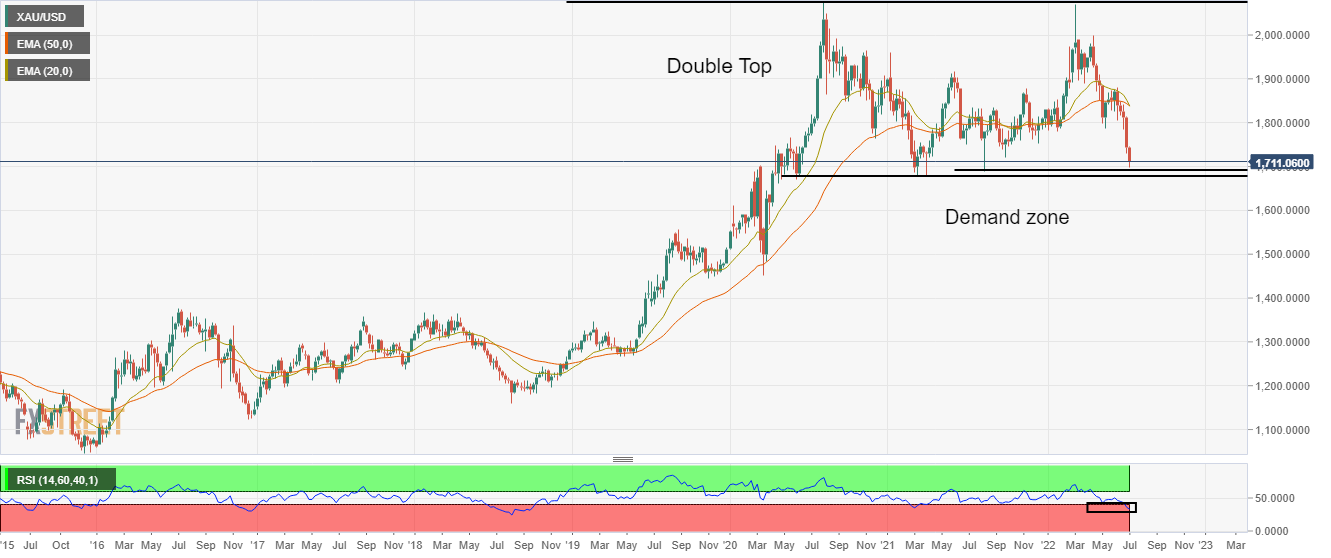
Can gold prices hold above $1700 as focus shifts to inflation data?
- AUD/USD fades bounce off two-year low, retreats from daily high.
- Descending trend line from January restricts immediate declines inside monthly falling wedge.
- 21-DMA adds strength to the upside hurdle, August 2019 low acts as additional support.
AUD/USD struggles to extend the previous day’s corrective pullback from a two-year low as it eases to 0.6743 during Friday’s Asian session.
In doing so, the Aussie pair keeps its weekly trading pattern of taking rounds to a downward sloping support line from January 2022 despite marking volatile sessions and refreshing multi-day lows of late.
It’s worth noting that the RSI (14) remains mostly stable, above the oversold territory, which in turn allows the bears to keep reins despite recent indecision.
That said, the quote’s fresh weakness needs a sustained closing below the stated support line, near 0.6740 by the press time.
Following that, the lower line of the one-month-old falling wedge bullish chart formation, close to 0.6690 at the latest, will be crucial to watch for the AUD/USD bears, a break of which could direct the quote towards the August 2019 low near 0.6670.
Alternatively, recovery moves could aim for the 0.6800 threshold before challenging the 0.6855 resistance confluence including the 21-DMA and the aforementioned wedge’s upper line.
If at all the AUD/USD trades successfully beyond 0.6855, the odds of witnessing a run-up towards June’s peak of 0.7283 can’t be ruled out.
AUD/USD: Daily chart
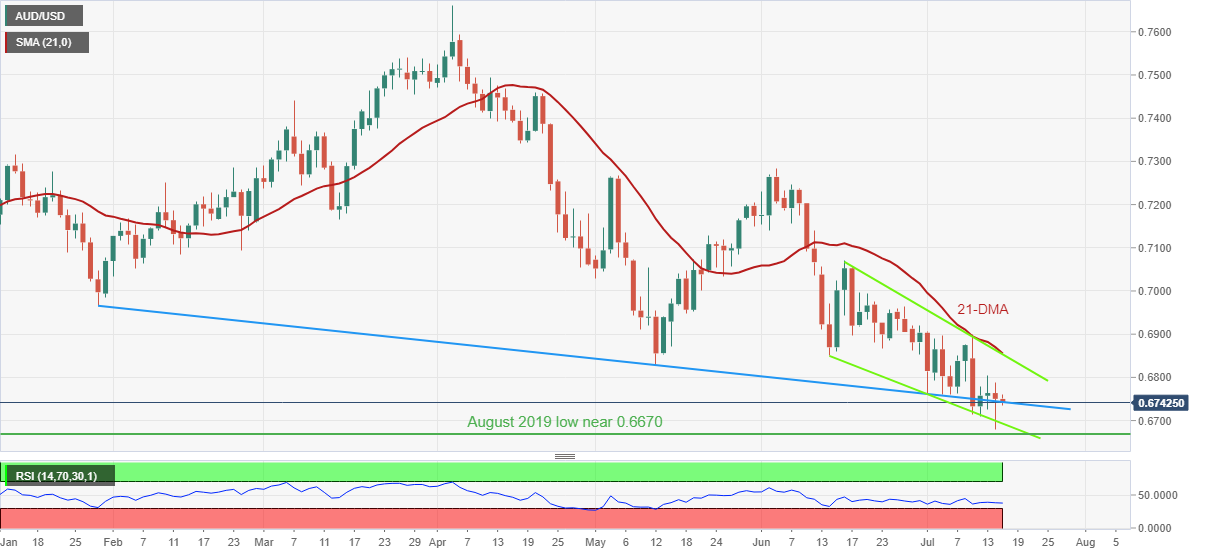
Trend: Further downside expected
- Oil is under pressure in Tokyo as markets switch risk-off.
- Energy demand growth is likely to remain positive on a year-on-year basis, analysts say.
The price of oil is above water in Asia by some 0.15% at the time of writing but is coming under pressure in a risk-off start to the Tokyo session. WTI is trading at $96.26 between a low of $96.15 and $96.73 bbls so far.
the price has been attempting to recover from levels not seen since Russia’s invasion of Ukraine as high inflation sparks concerns of tighter monetary policy slowing economic growth, as analysts at ANZ Bank explained. ''Sentiment hasn’t been helped by renewed COVID-19 outbreaks in China, which threaten to halt the recovery in demand. High prices also appear to have blunted demand for gasoline in the US. Nevertheless, the recession narrative is likely to overwhelm the fundamental tightness in physical markets. Both OPEC and IEA warned this week that supply shortages are likely to remain amid robust demand.''
Meanwhile, the talk of a global recession, which is as analysts at TD securities say, ''consistent with slowing demand growth'', could be overcooked in the price. ''Barring an extraordinarily hard-landing, energy demand growth is likely to remain positive on a year-on-year basis,'' the analysts argued.
''In line with this theme, our return decomposition framework highlights that markets continue to discount rising energy supply risks, shrugging off reports of a potentially very large increase in supply from Gulf nations. We don't fear a change in oil market trends, as little progress has been made towards solving structural supply challenges.''
- US Dollar Index eases from the highest levels since September 2002.
- Easing yield curve inversion, mixed Fedspeak and US data allowed bulls to take a breather.
- US Retail Sales will be important amid inflation woes.
- Fed policymakers’ comments should be watched carefully as they head to pre-FOMC blackout period.
US Dollar Index (DXY) bulls take a breather after refreshing the 19-year high, struggling to regain traction around 108.65 during Friday’s Asian session.
The greenback’s gauge versus the six major currencies rallied to the multi-year high amid fears of recession and concerns surrounding the Fed’s aggressive rate hikes. However, recently mixed Fedspeak and US data triggered the quote’s pullback the previous day.
Among the key Fed speakers who tried to talk down the odds of higher rates was St. Louis Federal Reserve President James Bullard and Federal Reserve Governor Christopher Waller. That said, Fed’s Bullard said, "So far, we've framed this mostly as 50 versus 75 at this meeting." On the same line, Fed’s Waller mentioned that markets may have gotten ahead of themselves by pricing a 100 basis points rate hike in July, as reported by Reuters. It should be noted that the Fed policymakers head to a blackout period from this weekend ahead of late July Federal Open Market Committee (FOMC).
Elsewhere, the US Bureau of Labor Statistics mentioned that the Producer Price Index (PPI) for final demand in the US climbed to 11.3% on a yearly basis in June from 10.9% in May. This print surpassed the market expectation of 10.7%. Additionally, there were 244,000 Initial Jobless Claims in the week ending July 9 versus the previous week's print of 235,000 and market expectation of 235,000. The Weekly Jobless Claims were the highest in five months.
It should be noted that the easing difference between the 2-year and the 10-year US Treasury yields also probed DXY bulls the previous day. That said, the US 10-year Treasury yields ended Thursday around 2.95%, up 0.95% intraday, whereas the 2-year bond coupon dropped 0.75% to 3.12% at the latest. With this, the difference between the near-term and the longer-term bond coupons declined to 17 basis points (bps) versus 23 bps inversion on Tuesday.
Amid these plays, the Wall Street benchmark closed mixed and the S&P 500 Futures also print mild gains by the press time.
Moving on, US Retail Sales, expected 0.8% MoM in June from -0.3% marked in May, will be important to watch while keeping eyes on the Fed speakers for fresh impulse. Following that, preliminary readings of the Michigan Consumer Sentiment Index (CSI) for July, expected 49.9 versus 50.0 prior, should also be eyed for clear directions.
Technical analysis
A fortnight-old bullish channel restricts short-term DXY moves between 108.30 and 109.80.
| Index | Change, points | Closed | Change, % |
|---|---|---|---|
| NIKKEI 225 | 164.62 | 26643.39 | 0.62 |
| Hang Seng | -46.74 | 20751.21 | -0.22 |
| KOSPI | -6.29 | 2322.32 | -0.27 |
| ASX 200 | 29 | 6650.6 | 0.44 |
| FTSE 100 | -116.59 | 7039.81 | -1.63 |
| DAX | -236.66 | 12519.66 | -1.86 |
| CAC 40 | -84.83 | 5915.41 | -1.41 |
| Dow Jones | -142.62 | 30630.17 | -0.46 |
| S&P 500 | -11.4 | 3790.38 | -0.3 |
| NASDAQ Composite | 3.61 | 11251.19 | 0.03 |
| Pare | Closed | Change, % |
|---|---|---|
| AUDUSD | 0.67444 | -0.19 |
| EURJPY | 139.232 | 0.78 |
| EURUSD | 1.00183 | -0.39 |
| GBPJPY | 164.289 | 0.59 |
| GBPUSD | 1.18235 | -0.57 |
| NZDUSD | 0.61234 | -0.09 |
| USDCAD | 1.31177 | 1.07 |
| USDCHF | 0.98307 | 0.46 |
| USDJPY | 138.976 | 1.19 |
- NZD/USD picks up bids to refresh intraday high, pares biggest losses around two-year low.
- New Zealand Business NZ PMI dropped to 49.7 in June, the lowest in 10 months.
- Market sentiment improves on receding hawkish Fed bets, recession fears.
- China’s Q2 GDP, US Retail Sales for June will decorate calendar, Fedspeak will also be important ahead of blackout period.
NZD/USD holds onto the late Thursday’s corrective pullback around 0.6130 during Friday’s initial Asian session. In doing so, the Kiwi pair cheers improvement in the market sentiment while ignoring downbeat data at home.
That said, New Zealand’s Business NZ PMI for June marked the lowest reading since August 2021 while flashing 49.7 figures. In doing so, the activity gauge dropped below 52.7 market forecast and 52.9 prior.
On the other hand, the S&P 500 Futures rise 0.35% intraday to portray the market’s cautious optimism ahead of the key data from China and the US. The recently easing risk-off mood could be linked to the mixed comments from the Fed speakers who tried to talk down the odds of the 100 bps rate hike. On the same line was the CME’s FedWatch tool that showed receding probabilities favoring the 75 basis points (bps) of Fed rate hike during July. Additionally, the receding difference between the 2-year and the 10-year US Treasury yields also helped the NZD/USD rebound.
Among important Fed speakers were St. Louis Federal Reserve President James Bullard and Federal Reserve Governor Christopher Waller. That said, Fed’s Bullard said, "So far, we've framed this mostly as 50 versus 75 at this meeting." On the same line, Fed’s Waller mentioned that markets may have gotten ahead of themselves by pricing a 100 basis points rate hike in July, as reported by Reuters. It should be noted that the Fed policymakers head to a blackout period from this weekend ahead of late July Federal Open Market Committee (FOMC).
Elsewhere, the US 10-year Treasury yields ended Thursday around 2.95%, up 0.95% intraday, whereas the 2-year bond coupon dropped 0.75% to 3.12% at the latest. With this, the difference between the near-term and the longer-term bond coupons declined, which in turn allowed NZD/USD bears to step back, mainly due to the reduction in the recession fears that previously favored the US dollar bulls.
On the same line is the CME’s FedWatch tool that signals a nearly 52% chance of the Fed’s 75 bps rate hike in July versus showing an almost certain case for the said rate lift the previous day.
Alternatively, mixed US data, mainly suggesting higher inflation, keep exerting downside pressure on the pair. On Thursday, the US Bureau of Labor Statistics mentioned that the Producer Price Index (PPI) for final demand in the US climbed to 11.3% on a yearly basis in June from 10.9% in May. This print surpassed the market expectation of 10.7%. Additionally, there were 244,000 Initial Jobless Claims in the week ending July 9 versus the previous week's print of 235,000 and market expectation of 235,000. The Weekly Jobless Claims were the highest in five months.
Looking forward, China’s economics will be crucial for the NZD/USD prices ahead of the US data. Above all, chatters surrounding recession and inflation will be the key to follow for fresh impulse. Forecasts suggest that China’s Q2 Gross Domestic Product (GDP) to drop to -1.5% QoQ versus 1.3% prior while the Retail Sales may print a 0.0% YoY figure for June compared to -6.7% previous reading. Further, the US Retail Sales is likely to rise to 0.8% MoM in June from -0.3% marked in May.
Also read: US June Retail Sales Preview: Has the consumer turning point arrived?
Technical analysis
A daily closing below the monthly support line, around 0.6085 by the press time, appears necessary for the NZD/USD bear’s conviction. Until then, the odds of witnessing a corrective pullback towards a downward sloping resistance line from June 16, near 0.6167 at the latest, can’t be ruled out.







© 2000-2026. All rights reserved.
This site is managed by Teletrade D.J. LLC 2351 LLC 2022 (Euro House, Richmond Hill Road, Kingstown, VC0100, St. Vincent and the Grenadines).
The information on this website is for informational purposes only and does not constitute any investment advice.
The company does not serve or provide services to customers who are residents of the US, Canada, Iran, The Democratic People's Republic of Korea, Yemen and FATF blacklisted countries.
Making transactions on financial markets with marginal financial instruments opens up wide possibilities and allows investors who are willing to take risks to earn high profits, carrying a potentially high risk of losses at the same time. Therefore you should responsibly approach the issue of choosing the appropriate investment strategy, taking the available resources into account, before starting trading.
Use of the information: full or partial use of materials from this website must always be referenced to TeleTrade as the source of information. Use of the materials on the Internet must be accompanied by a hyperlink to teletrade.org. Automatic import of materials and information from this website is prohibited.
Please contact our PR department if you have any questions or need assistance at pr@teletrade.global.


 Bank
Bank transfers


