- Analytics
- News and Tools
- Market News
CFD Markets News and Forecasts — 26-08-2020
| Time | Country | Event | Period | Previous value | Forecast |
|---|---|---|---|---|---|
| 01:30 | Australia | Private Capital Expenditure | Quarter II | -1.6% | -8.4% |
| 04:30 | Japan | All Industry Activity Index, m/m | June | -3.5% | |
| 05:45 | Switzerland | Gross Domestic Product (YoY) | Quarter II | -1.3% | -9.6% |
| 05:45 | Switzerland | Gross Domestic Product (QoQ) | Quarter II | -2.6% | -8.6% |
| 08:00 | Eurozone | Private Loans, Y/Y | July | 3% | |
| 08:00 | Eurozone | M3 money supply, adjusted y/y | July | 9.2% | 9.2% |
| 12:30 | U.S. | Continuing Jobless Claims | August | 14844 | 14450 |
| 12:30 | Canada | Current Account, bln | Quarter II | -11.1 | -12.2 |
| 12:30 | U.S. | PCE price index, q/q | Quarter II | 1.3% | |
| 12:30 | U.S. | PCE price index ex food, energy, q/q | Quarter II | 1.6% | -1.1% |
| 12:30 | U.S. | Initial Jobless Claims | August | 1106 | 1000 |
| 12:30 | U.S. | GDP, q/q | Quarter II | -5% | -32.5% |
| 13:10 | U.S. | Fed Chair Powell Speaks | |||
| 14:00 | U.S. | Pending Home Sales (MoM) | July | 16.6% | 1.5% |
| 15:00 | U.S. | Jackson Hole Symposium | |||
| 15:15 | Canada | BOC Gov Tiff Macklem Speaks | |||
| 23:30 | Japan | Tokyo CPI ex Fresh Food, y/y | August | 0.4% | 0.3% |
| 23:30 | Japan | Tokyo Consumer Price Index, y/y | August | 0.6% |
The U.S. Energy
Information Administration (EIA) revealed on Wednesday that crude inventories
fell by 4.689 million barrels in the week ended August 21. Economists had
forecast a decrease of 3.694 million barrels.
At the same
time, gasoline stocks dropped by 4.584 million barrels, while analysts had expected
a decline of 1.533 million barrels. Distillate stocks rose by 1.388 million
barrels, while analysts had forecast a drop of 0.726 million barrels.
Meanwhile, oil
production in the U.S. increased by 100,000 barrels a day to 10.800 million
barrels a day.
U.S. crude oil
imports averaged 5.9 million barrels per day last week, up by 185,000 barrels
per day from the previous week.
- Jobs in most sectors down 5% to 10%
- Services sector remains broadly depressed
- Big tech has done well in pandemic and is reflected in the stock market
- There clearly is some risk as valuations get elevated
- July's durable goods report was positive
- Pandemic reveals limits of BoC's monetary policy to solving all problems
- Review of alternative monetary policy options has identified some of strengths and weaknesses of different frameworks; but no single framework dominates on all margins
- Economic crisis has made it crystal clear that central banks are likely to run out of conventional firepower if we see an economic downturn in low-interest-rate world
- Another challenge is that long periods of low interest rates encourage investors to take on risk that may be excessive; we see that now with high levels of indebtedness
- We are running a horse race among alternative frameworks for monetary policy. These include average inflation targeting, price-level targeting, an employment-inflation dual mandate and nominal GDP growth and level targeting; another possibility is to raise the inflation target. We are evaluating these frameworks against a clear set of criteria
- We have a clear target -2 percent inflation - which means businesses and families know what we aim to achieve with our actions
- Our framework is flexible in terms of how fast we aim to return inflation to target
- Seeing unconventional monetary policy tools in action during COVID-19 has put renewed focus on how they’re impacting both asset prices and decisions on borrowing and lending
- Monetary policy is ill-equipped to deal with sector-specific issues; we need to take them into account in our monetary policy decisions, but our focus must be on the macroeconomy to support sustainable growth and price stability
FXStreet notes that oil consumption has started to recover as economies reopen while OPEC+ production cuts are doing their part in the rebalancing of supply and demand. Nonetheless, full commitment to cuts is yet to be made. All in all, strategists at Danske Bank see Brent trading at $40 the rest of the year while forecast the commodity to rise next year reaching $60 by end-2021.
“The return to more normal market conditions is a long uphill ride. The significant inventory overhang is limiting a swift recovery in US shale production. Drilling activity here remains subdued. Even when there comes room to increase output, it remains to be seen how easy it will be to turn on wells that have been shut-in.”
“OPEC+ stands committed on output cuts now, although compliance has yet to reach 100%. As the oil price recovers, the commitment may start to falter. On a medium to long-term horizon, low investment activity now may result in supply shortages.”
“The oil market should stay resilient, but short-term the rally might take a breather since high inventories have yet to be normalised and OPEC+ is still struggling with full compliance to output cuts.”
“We keep our forecasts for Brent and look for the black gold to average $40/bbl in Q3 and Q4, $45/bbl in Q1 and Q2 next year, $50/bbl in Q3 and $60/bbl in Q4.”

U.S. stock-index futures rose slightly on Wednesday, as market participants braced for the Federal Reserve Chair Jerome Powell's speech at the annual Jackson Hole Symposium on Thursday. Investors also assessed upbeat data on U.S. durable goods orders for July and quarterly earning reports from Salesforce (CRM; +15.3% in pre-market trading), Hewlett Packard Enterprise (HPE; +7.9%) and Nordstrom (JWN; -1.5%).
Global Stocks:
Index/commodity | Last | Today's Change, points | Today's Change, % |
Nikkei | 23,290.86 | -5.91 | -0.03% |
Hang Seng | 25,491.79 | +5.57 | +0.02% |
Shanghai | 3,329.74 | -43.84 | -1.30% |
S&P/ASX | 6,116.40 | -45.00 | -0.73% |
FTSE | 6,037.51 | +0.50 | +0.01% |
CAC | 5,024.09 | +15.82 | +0.32% |
DAX | 13,118.43 | +56.81 | +0.43% |
Crude oil | $43.21 | -0.32% | |
Gold | $1,912.70 | -0.54% |
(company / ticker / price / change ($/%) / volume)
3M Co | MMM | 162.64 | -0.46(-0.28%) | 3659 |
ALCOA INC. | AA | 15.1 | 0.05(0.33%) | 6762 |
ALTRIA GROUP INC. | MO | 43.5 | -0.02(-0.05%) | 8228 |
Amazon.com Inc., NASDAQ | AMZN | 3,349.00 | 2.51(0.08%) | 36479 |
American Express Co | AXP | 98.16 | -0.89(-0.90%) | 5181 |
Apple Inc. | AAPL | 503.24 | 3.94(0.79%) | 507494 |
AT&T Inc | T | 29.87 | -0.03(-0.10%) | 33054 |
Boeing Co | BA | 173.71 | -1.02(-0.58%) | 88725 |
Caterpillar Inc | CAT | 141 | -0.15(-0.11%) | 4918 |
Chevron Corp | CVX | 85.9 | -0.23(-0.27%) | 12947 |
Cisco Systems Inc | CSCO | 41.75 | -0.21(-0.50%) | 84036 |
Citigroup Inc., NYSE | C | 51.64 | -0.01(-0.02%) | 19130 |
E. I. du Pont de Nemours and Co | DD | 55.8 | -0.40(-0.71%) | 583 |
Exxon Mobil Corp | XOM | 40.8 | -0.08(-0.20%) | 81911 |
Facebook, Inc. | FB | 283.75 | 2.93(1.04%) | 241667 |
Ford Motor Co. | F | 6.95 | 0.01(0.14%) | 56170 |
Freeport-McMoRan Copper & Gold Inc., NYSE | FCX | 14.47 | 0.01(0.07%) | 35206 |
General Electric Co | GE | 6.6 | 0.01(0.15%) | 406645 |
General Motors Company, NYSE | GM | 29.88 | 0.19(0.66%) | 14308 |
Goldman Sachs | GS | 205.8 | -0.20(-0.10%) | 7475 |
Google Inc. | GOOG | 1,608.00 | -0.22(-0.01%) | 5185 |
Hewlett-Packard Co. | HPQ | 18.58 | 0.14(0.76%) | 15804 |
Home Depot Inc | HD | 286 | -0.13(-0.05%) | 5919 |
HONEYWELL INTERNATIONAL INC. | HON | 165.49 | 0.96(0.58%) | 7012 |
Intel Corp | INTC | 49.42 | -0.01(-0.01%) | 98182 |
International Business Machines Co... | IBM | 124.53 | -0.11(-0.09%) | 5396 |
International Paper Company | IP | 36.28 | 0.07(0.19%) | 206 |
Johnson & Johnson | JNJ | 152 | -0.06(-0.04%) | 5570 |
McDonald's Corp | MCD | 212.67 | 0.02(0.01%) | 6766 |
Merck & Co Inc | MRK | 85.75 | 0.07(0.08%) | 5404 |
Microsoft Corp | MSFT | 217.75 | 1.28(0.59%) | 209379 |
Nike | NKE | 111.39 | -0.12(-0.11%) | 6021 |
Pfizer Inc | PFE | 38.19 | -0.22(-0.57%) | 115052 |
Procter & Gamble Co | PG | 138.78 | -0.28(-0.20%) | 4100 |
Starbucks Corporation, NASDAQ | SBUX | 82.62 | -0.10(-0.12%) | 11932 |
Tesla Motors, Inc., NASDAQ | TSLA | 2,044.00 | 20.66(1.02%) | 189265 |
The Coca-Cola Co | KO | 47.78 | -0.13(-0.27%) | 11088 |
Travelers Companies Inc | TRV | 115.01 | -0.61(-0.53%) | 2873 |
Twitter, Inc., NYSE | TWTR | 40.46 | -0.09(-0.22%) | 23609 |
UnitedHealth Group Inc | UNH | 311.39 | -0.83(-0.27%) | 2139 |
Verizon Communications Inc | VZ | 59.4 | -0.02(-0.03%) | 9986 |
Visa | V | 207.86 | -0.24(-0.12%) | 6648 |
Walt Disney Co | DIS | 129.43 | -0.36(-0.28%) | 10928 |
Yandex N.V., NASDAQ | YNDX | 65.3 | -1.67(-2.49%) | 396299 |
Apple (AAPL) target raised to $600 from $515 at Wedbush
Tesla (TSLA) target raised to $2500 from $1200 at Jefferies
The U.S.
Commerce Department reported on Wednesday that the durable goods orders climbed
11.2 percent m-o-m in July, following a revised 7.7 percent m-o-m jump in June
(originally a 7.6 percent m-o-m surge).
Economists had
forecast a 4.3 percent m-o-m advance.
According to
the report, orders for durable goods excluding transportation rose 2.4 percent
m-o-m in July, following a revised 4.0 percent m-o-m increase in June
(originally a gain of 3.6 percent m-o-m), beating economists’ forecast of 2.0
percent m-o-m rise.
Meanwhile,
orders for non-defense capital goods excluding aircraft, a closely watched
proxy for business spending plans, increased 1.9 percent m-o-m in July after a revised
4.3 percent gain m-o-m in June (originally a 3.4 percent m-o-m increase).
Economists had called for a 1.9 percent m-o-m advance in core capital goods
orders in July.
FXStreet reports that the Credit Suisse analyst team notes that the S&P 500 has broken above the 3432/36 key resistance and a break above resistance at 3444/46 today would confirm the market has entered a more accelerated trend state, in line with the improvement in momentum and despite the narrowing breadth.
“S&P 500 moved sharply higher again on Tuesday, breaking above the key Fibonacci projection level at 3432/36, but closing just below the potential trend channel resistance at 3444/46. Whilst our ‘ideal’ roadmap is that this zone will prompt a correction lower, the break above the first and more important of these two resistances, with momentum confirming the move, suggests we may be entering a more accelerated phase, with a break above 3444/46 today confirming.”
“Next resistance is seen at 3456, then 3466, with the top of our typical extreme zone (i.e. 15% above the 200-day average) at 3539 expected to prove a tougher barrier.”
“Support stays at 3414/13 initially, with a break below the uptrend from late June at 3392 today and the 13-day exponential average at 3382/79 needed to remove the upside bias. Only below the 3355/54 recent low though would see a (small) price top established to confirm a more important near-term peak, with support then seen next at 3326.”
FXStreet notes that EUR/JPY has recovered sharply from key support at 124.50/33 as expected and analysts at Credit Suisse continue to look for signs of a base here for a resumption of the uptrend with resistance seen at 126.10.
“EUR/JPY has extended its defence of support at 124.50/33 – the early August low and uptrend from May – and we remain of the view weakness has been a corrective pullback only ahead of the core uptrend extending.”
“A sustained move above 126.10 is still needed though to add weight to this view, as well as curtail thoughts of a potential “head & shoulders” top, for a fresh look at the 126.76/84 highs, beyond which in due course can see the 127.52/57 high of 2019 and long -term downtrend from 2014.”
“Support at 125.35 now ideally holds to keep the immediate risk higher. Below can see a fall back to 124.90, but only below 124.50/33 would see the completion of a top for a more concerted corrective phase, with support seen next at trend support from early June at 124.19, then 123.91/84 – the 38.2% retracement of the rally from late June and 23.6% retracement of the entire rally from the May low.”
- Negative rates can have side effects on bank profitability, risk-taking behaviour
- Past few years suggest that positive effects have dominated
- Side effects are likely to become more relevant over time though
- The pandemic is a wake-up call for governments to foster innovation, growth
- There is considerable uncertainty with regards to precise level of 'reversal rate' and current estimates suggest that the ECB has not reached effective lower bound
| Time | Country | Event | Period | Previous value | Forecast | Actual |
|---|---|---|---|---|---|---|
| 06:45 | France | Consumer confidence | August | 94 | 94 | 94 |
| 08:00 | Switzerland | Credit Suisse ZEW Survey (Expectations) | August | 42.4 | 45.6 |
USD traded mixed against other major currencies in the European session on Wednesday as market participants braced for the Federal Reserve Chair Jerome Powell's speech at the annual Jackson Hole Symposium, a gathering of central bankers, leading economists, and financial institutions, on Thursday.
The U.S. currency rose against EUR and CHF, fell against JPY, AUD and NZD, and was little changed against CAD and GBP.
The U.S. Dollar Index (DXY), measuring the U.S. currency's value relative to a basket of foreign currencies, rose 0.11% to 93.12.
Jerome Powell is to address the conference via video. Investors will look for clues on further stimulus from the Fed and its views, where the U.S. economy is headed. Specifically, they will be looking for Powell’s remarks on inflation and its impact on the U.S. currency. Analysts expect that the Fed's Chair may signal an increased tolerance for higher inflation, with some predicting he will call for a move to "average inflation" targeting rather than the 2-percent target.
- Says recession that began in February could revisit economy if coronavirus pandemic intensifies
- Resurgence of Covid-19 is important risk to outlook
- But baseline is “we’ll continue to build growth”
- We’ll continue to monitor that carefully to see whether that [second leg of recession] plays out
The Mortgage
Bankers Association (MBA) reported on Wednesday the mortgage application volume
in the U.S. fell 6.5 percent in the week ended August 21, following a 3.3
percent drop in the previous week. This was the biggest weekly decline since the
week ended June 19th.
According to
the report, refinance applications plunged 10.2 percent, while applications to
purchase a home rose 0.4 percent.
Meanwhile, the
average fixed 30-year mortgage rate decreased to 3.11 percent from 3.13
percent.
FXStreet reports that economists at Danske Bank see near-term risks in EUR/SEK skewed on the upside and forecast the cross at 10.40 in one-to-three months.
“We see a high likelihood that the reflation story will backfire as data may no longer meet expectations at a point where global surprise indices are clearly in stretched territory. Political risks are piling up and the epidemiological risks seem to be mounting as well, and that is unlikely to pass unnoticed by either the real economy or financial markets. Against this less optimistic backdrop we see near-term risks in EUR/SEK being skewed to the upside.”
“We are lifting the one-to-three months forecast from 10.20 to 10.40. In 2021, the world should be closer to a vaccine/sustained recovery, which should support the krona. The Swedish inflation outlook remains a headwind for the SEK long-term. We lower the EUR/SEK six-to-twelve month forecast from 10.40 to 10.20.”
“Continued risk-on reflation and USD bashing would probably feed through into an even stronger SEK where USD/SEK may drop towards/below 8.00 and EUR/SEK towards/below 10.00. If risk sentiment turns nasty enough, EUR/SEK could go well beyond 10.40. We would probably need to see the SEK appreciation escalate further before the Riksbank steps in.”
FXStreet notes that the AUD/USD pair lacks any firm directional bias on Wednesday and remained confined in a range around the 0.7200-mark. Terence Wu, FX Strategist at OCBC Bank, expects the Aussie to remain between 0.7140-0.7220 range.
“The AUD/USD remains capped below the 0.7200/20 area even as risk sentiment ticked higher. Topside momentum looking increasingly exhausted.”
“Do not rule out the pair (together with NZD/USD) leading the way lower if risk and the recovery theme sours.”
“For now, expect the range between 0.7140 and 0.7220 to hold.”
- Government will do whatever it takes to host Tokyo Olympic games next year
- Government does not see a need to cut the sales tax rate from 10%
- More consolidation among regional banks necessary
- Very important for BoJ to work closely with government
- Must ensure economy doesn't worsen further
FXStreet reports that economists at Danske Bank forecast the USD/CAD pair trading at 1.32 on a one month view while expect the loonie to trade at 1.35 in twelve months.
“We generally like to consider USD/CAD as USD/NOK but with a lower beta to global risk sentiment and oil prices given the CAD’s close connection to the USD and the economies lower dependence on oil. Over the last months, broad USD weakness has more than offset the impact of higher oil prices leaving USD/NOK and USD/EUR relatively lower than USD/CAD. We expect this price relation to continue; i.e. broad USD weakness (or strength) should spill over to CAD in cross FX comparisons even if USD/CAD should be expected to move lower (higher).”
“Looking ahead, our call for a setback in EUR/USD suggests USD/CAD should move higher. The risk naturally is a continuation of reflation trade performance but for now, we decide on having a slight positive slope on the profile.”
“We forecast USD/CAD at 1.32 in one month (from 1.34), 1.33 in three months (1.34), 1.35 in six months (unchanged) and 1.35 in twelve months (unchanged).”
FXStreet reports that economists at Danske Bank still expect EUR/GBP to trade around 0.90 until a Brexit-deal is agreed but the latter is now in sight on a three-month horizon and they roll the forecast profile to target EUR/GBP towards 0.88 over the autumn.
“GBP remains caught in the middle of risk sentiment and Brexit with the latter set to get more attention near-term. We still expect EUR/GBP to trade around 0.90 until a deal is agreed – likely mid-late autumn – but the cross may go as high as 0.92 on setbacks in risk of Brexit.”
“Our base case remains a simple free trade agreement covering goods and we expect the cross to move lower to around 0.86 when a deal is in sight.”
“We lower our three-month forecast to 0.88 (prev 0.90) as this is now the horizon where a deal could land. We keep our six-to-twelve forecast at 0.86.”
Reuters reports that the euro zone economy is growing in line with the path the European Central Bank projected in June, and the bank's bond purchase scheme to help tackle the pandemic emergency is working as intended, ECB policymaker Peter Kazimir said on Wednesday.
Kazimir added that the ECB was not obligated to spend all of the 1.35 trillion euros ($1.6 trillion) set aside for debt purchases in the Pandemic Emergency Purchase Programme.
"I have said in the past that once we have an appropriate response from the fiscal side, then of course we are not obliged to use the whole (PEPP) envelope," Kazimir told reporters.
CNBC reports that an economic decoupling of the U.S. and China is “a long way away,” but moving away from a U.S.-centric system certainly appeals to Beijing, said Eswar Prasad, previously head of the International Monetary Fund’s China division.
“These two economies are still quite closely tied. After all, it’s very hard for the two largest economies in a way to stop bumping into each other in various dimensions,” said Prasad, who is now a trade professor at Cornell University.
However, “the desire to get away from the grasp of the U.S.-based or dollar-denominated international financial system is certainly something at the forefront of China’s mind,” said Prasad.
That is why the world’s second-largest economy has been pushing for greater use of the Chinese yuan in settling trade, he said.
China is also actively opening up its capital markets to foreign investors and liberalizing its exchange rate regime.
“That is going to be tied in with domestic capital market development which Chinese leaders know is going to be crucial for China’s sustained growth in the future,” said Prasad.
With tensions ratcheting, “the great power dynamics” between the U.S. and China are certainly getting more interesting, said Prasad.
While China appeared to have the upperhand earlier in the pandemic, it is now seeing some pushback against its political influence in countries like Australia, surprising the Chinese leadership, said Prasad.
Beijing thought “the political control and the economic control they had over much of Asia and other parts of the world would stand in good stead,” said Prasad.
But he explained that countries now seem to want to press the reset button.
“The difficulty for most other countries that want to get away from China’s grasp is that they don’t have an alternative that they can trust ,” said Prasad.
“The U.S. used to play that role, it doesn’t quite play that role anymore, so many countries are floundering in striking this delicate balance between maintaining good relations with China and the U.S., but we are certainly seeing a reset beginning to take place,” he added.
FXStreet reports that gold extends its consolidation after moving to $2075/80. Strategists at Credit Suisse remain of the view this is a pause in the core bull trend but that this phase could last a significant while and the yellow metal could yet see a test of support at $1867/37.
“Gold continues its expected consolidation following the move to our base case objective of $2075/80. Although we continue to see the core long-term trend higher, reinforced by falling US Real Yields and a falling USD, we suspect there is scope for a more protracted consolidation phase to unfold first.”
“At present, our bias remains for a cluster of supports at $1867/37 to ideally hold further weakness, which includes the 23.6% retracement of the rally from the 2018 low. Should weakness extend, we would see scope for a deeper setback to $1765, potentially $1726.”
“Post this phase we look for an eventual move above $2075 with resistance seen next at $2175, then $2300. Whilst we would look for a fresh consolidation at this latter level, a direct break can see potential trend resistance at $2417, with scope seen for $2700/20 over the longer-term.”
“It is worth noting that monthly RSI has reached its extreme levels seen in 2006 and 2008 adding weight to the view for a lengthier pause in the bull trend. Indeed, in the 2001/2011 bull market the two major consolidation phases (2006/2007 and 2008/2009) lasted 16 and 18-months respectively. A similar length of consolidation at this juncture though is not our base case for now.”
CNBC reports that China must make greater efforts to overcome trade disputes with its World Trade Organization (WTO) partners, Jesus Kuri, one of several candidates to be the new WTO chief, told.
China entered the WTO in 2001, after 15 years of negotiations. However, it has clashed with other WTO members on different occasions, including with the United States, which has often dubbed China’s trade practices as “unfair.” As a result, both nations engaged in a tit-for-tat tariff war until recently.
“There are issues with China that China needs to make a greater, clear contribution to resolve those issues between them and everybody else,” Jesus Seade Kuri, the Mexican nominee to replace Ricardo Azevedo as the WTO director general, told CNBC’s Julianna Tatelbaum.
He argued that there needs to be progress over a price mechanism and over technological differences, adding that in 19 years of membership, there have been 44 disputes initiated against China. “That’s a lot,” he said, although he noted that “at the same time, China has been very engaged in many other respects.”
Kuri, an economist, was Mexico’s chief negotiator for the U.S., Mexico and Canada Trade Agreement, known as USMCA. He is one of eight candidates in the race to replace Ricardo Azevedo at the Swiss-based institution, after the latter decided to leave the institution a year before the end of his mandate.
The change in leadership comes at a time when many question the future of the WTO as an advocate for, and arbiter of, international trade. The institution’s appellate body has been paralyzed since December, which has limited the WTO’s ability to rule on new trade disputes.
“The difficulties that we faced when we created (the) WTO, a quarter of a century ago, were every bit as great and as complex as they are now. But there was a basis of wanting to get things done, a basis of cooperation, of trust. This trust has been lost completely,” Kuri told CNBC.
“So what we need is to find a way to resume the path of negotiation to achieve things together,” he said.
FXStreet reports that USD/CNY continues its downmove, trading just above the 6.90 mark, and analysts at Credit Suisse remain biased lower within the broad range. They expect a dip towards 6.8406/8242.
“USD/CNY has continued its downmove since breaking below the 61.8% retracement of Q1 surge and July low at 6.9694/5 and in line with its inrange ‘head & shoulders’ top. The ‘measured objective’ to this top suggests we should see a move to the 2020 and July 2019 low as well as the 38.2% retracement of the 2018/2019 upmove at 6.8406/8242, where we expect the market to hold and shift into a broad range.”
“It is worth noting that a break below 6.8406/8242 at any stage would complete a much larger and more important ‘double top’.”
“We now look to hold below 6.9738 to maintain the downside pressure.”
| Time | Country | Event | Period | Previous value | Forecast | Actual |
|---|---|---|---|---|---|---|
| 01:30 | Australia | Construction Work Done | Quarter II | 0.7% | -5.8% | -0.7% |
| 05:00 | Japan | Leading Economic Index | June | 78.3 | 85.0 | 84.4 |
| 05:00 | Japan | Coincident Index | June | 72.9 | 76.4 | 76.6 |
| 06:45 | France | Consumer confidence | August | 94 | 94 | 94 |
In today's Asian trading, the US dollar rose against the euro after declining in the previous session.
The ICE index, which tracks the dynamics of the US dollar against six currencies (the euro, swiss franc, yen, canadian dollar, pound and swedish krona), rose 0.1% in trading on Tuesday.
Meanwhile, the dollar was trading steadily against the yen and the australian dollar.
Traders' attention is focused on the Federal reserve bank event in Kansas city starting on Thursday, where Federal reserve Chairman Jerome Powell is scheduled to speak. The symposium, organized by the Federal reserve bank of Kansas city, annually gathers the heads of world Central banks, finance ministers, academics and financial market participants in Jackson Hole. This year's event will be held online on August 27-28, with the theme "Moving into the next decade: consequences of monetary policy".
Powell is expected to talk in his speech about a long-running review of the Fed's strategy.
According to analysts, Powell's upcoming speech may determine which way the dollar will go, "standing at a fork in the road."
"His words can both attract "bears" and ensure the strengthening of the dollar for the next few weeks," according to AxiCorp analyst Stephen Innes
According to the report from Insee, in August 2020, households’ confidence in the economic situation has been stable: the synthetic index remains at 94, below its long-term average (100).
In August, the share of households considering it is a suitable time to make major purchases has decreased. The corresponding balance has lost 4 points compared to the previous month, and remains below its long-term average.
Households' opinion balance on their past financial situation has gained 1 point. It remains above its long-term average. The balance related to their future financial situation has been stable, and stays slightly below its long-term average.
In August, households’ opinion balance related to their expected saving capacity has decreased. It has lost 4 points but remains well above its long-term average. Similarly, households' balance of opinion on their current saving capacity has decreased by 2 points but remains well above its long-term average.
The share of households considering it is a suitable time to save has increased again. The corresponding balance has gained 1 point and stands well above its long-term average.
In August, the share of households considering that the standard of living in France has improved during the past twelve months has increased slightly. The corresponding balance has gained 2 points but remains far below its long-term average.
Households’ opinion balance about the future standard of living in France has been stable and remains well below its long-term average.
Households' fears about the unemployment trend have fallen in August, but remain at a high level. The corresponding balance has lost 6 points, but remains well above its average.
Reuters reports that China will speed up the release of special funds to local governments to support the economy, vice finance minister Xu Hongcai told reporters on Wednesday.
The government has said it would set up special transfer payments of 2 trillion yuan ($289.72 billion) from special treasury bonds and an increased budget deficit to local governments.
"The implementation of specific policies and measures will have a positive impact on investment, consumption as well as imports and exports," Xu told a briefing.
Of the 2 trillion yuan, 1.7 trillion yuan will be allocated to local governments after deducting 300 billion yuan for supporting tax and fee cuts this year, Xu said.
Local governments have spent 509.7 billion yuan, accounting for 30.5% of 1.674 trillion yuan in funds that have been actually allocated from the central government, he said.
Xu said he expected cities and counties that have already received the funds will speed up spending.
The authorities will punish officials who intercept and misappropriate the funds, or those who make false claims, Li Jinghui, a finance ministry official, told the same briefing.
China has set a 2020 budget deficit of at least 3.6% of GDP, up from last year's 2.8%. The government has finished issuing 1 trillion yuan in special treasury bonds.
China's economic recovery from the coronavirus crisis has been building up steam, thanks to pent-up demand, government stimulus and surprisingly resilient exports. But it lost some momentum in July.
FXStreet reports that a breakout of the 107.00 mark should allow USD/JPY to climb further in the near-term, suggested FX Strategists at UOB Group.
24-hour view: “Yesterday, we highlighted that USD ‘could edge higher towards 106.25’ but held the view that ‘a sustained advance above this level is not expected’. The subsequent pace and extent of USD strength exceeded our expectation as it soared to an overnight high of 106.57. While the rapid advance appears to be running ahead of itself yet, there is no sign of weakness just yet. From here, there is room for USD to test the major resistance at 106.70 but a clear break of this level is unlikely (next resistance is at 107.00). Support is at 106.15 followed by 105.90.”
Next 1-3 weeks: “We highlighted on Monday (24 Aug, spot at 105.80) that USD ‘is still in a consolidation phase and is expected to trade between 105.00 and 106.70’. Upward momentum is beginning to improve as USD rose to a high of 106.57 yesterday. While a move above 106.70 is not ruled out, further USD strength is likely only if it closes above the major resistance at 107.00. At this stage, the prospect for such a scenario is not high but it would increase as long as USD does not move below 105.60 within these few days.”
RTTNews reports that Australia's construction work done declined in the second quarter, data from the Australian Bureau of Statistics showed on Wednesday.
Total construction work done decreased 0.7 percent sequentially in the June quarter. The construction work was valued at A$50.128 billion.
Total building work done was down 3.9 percent, while engineering work done rose 3.8 percent.
Data showed that both residential and non-residential work done decreased 5.5 percent and 1.5 percent, respectively.
On a yearly basis, construction work done fell 2.2 percent in the second quarter.
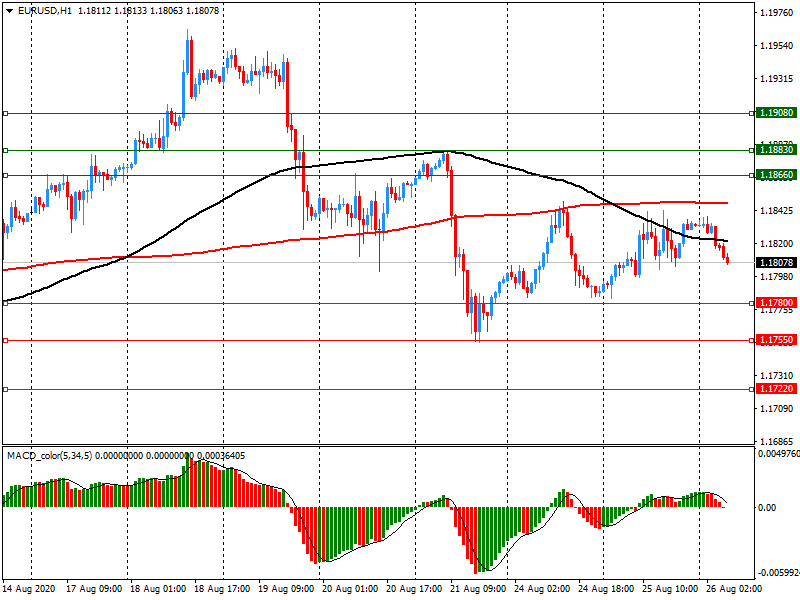
EUR/USD
Resistance levels (open interest**, contracts)
$1.1908 (2319)
$1.1883 (2300)
$1.1866 (1199)
Price at time of writing this review: $1.1808
Support levels (open interest**, contracts):
$1.1780 (1252)
$1.1755 (799)
$1.1722 (941)
Comments:
- Overall open interest on the CALL options and PUT options with the expiration date September, 4 is 93314 contracts (according to data from August, 25) with the maximum number of contracts with strike price $1,0500 (5007);
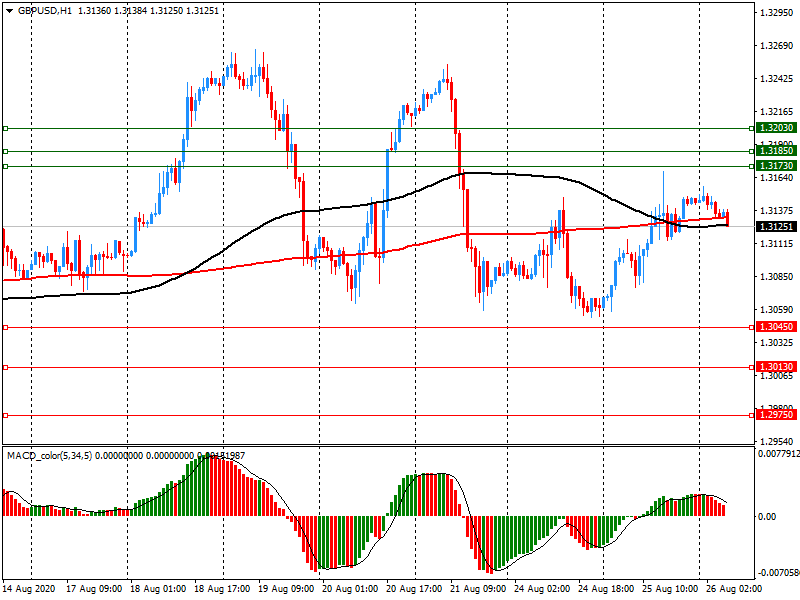
GBP/USD
Resistance levels (open interest**, contracts)
$1.3203 (820)
$1.3185 (833)
$1.3173 (1133)
Price at time of writing this review: $1.3125
Support levels (open interest**, contracts):
$1.3045 (567)
$1.3013 (561)
$1.2975 (1581)
Comments:
- Overall open interest on the CALL options with the expiration date September, 4 is 21720 contracts, with the maximum number of contracts with strike price $1,3800 (3394);
- Overall open interest on the PUT options with the expiration date September, 4 is 18915 contracts, with the maximum number of contracts with strike price $1,3000 (1581);
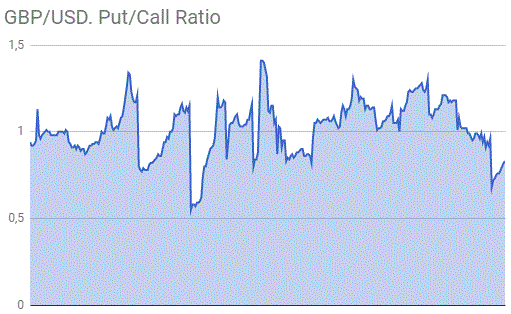
- The ratio of PUT/CALL was 0.87 versus 0.81 from the previous trading day according to data from August, 25
* - The Chicago Mercantile Exchange bulletin (CME) is used for the calculation.
** - Open interest takes into account the total number of option contracts that are open at the moment.
| Raw materials | Closed | Change, % |
|---|---|---|
| Brent | 45.9 | 2.11 |
| Silver | 26.48 | -0.38 |
| Gold | 1926.706 | -0.1 |
| Palladium | 2168.01 | 0.24 |
| Index | Change, points | Closed | Change, % |
|---|---|---|---|
| NIKKEI 225 | 311.26 | 23296.77 | 1.35 |
| Hang Seng | -65.36 | 25486.22 | -0.26 |
| KOSPI | 36.9 | 2366.73 | 1.58 |
| ASX 200 | 31.8 | 6161.4 | 0.52 |
| FTSE 100 | -67.72 | 6037.01 | -1.11 |
| DAX | -4.92 | 13061.62 | -0.04 |
| CAC 40 | 0.38 | 5008.27 | 0.01 |
| Dow Jones | -60.02 | 28248.44 | -0.21 |
| S&P 500 | 12.34 | 3443.62 | 0.36 |
| NASDAQ Composite | 86.75 | 11466.47 | 0.76 |
| Time | Country | Event | Period | Previous value | Forecast |
|---|---|---|---|---|---|
| 01:30 | Australia | Construction Work Done | Quarter II | -1% | -5.8% |
| 05:00 | Japan | Leading Economic Index | June | 78.4 | 85.0 |
| 05:00 | Japan | Coincident Index | June | 73.4 | 76.4 |
| 06:45 | France | Consumer confidence | August | 94 | 94 |
| 08:00 | Switzerland | Credit Suisse ZEW Survey (Expectations) | August | 42.4 | |
| 12:30 | U.S. | Durable goods orders ex defense | July | 9.2% | |
| 12:30 | U.S. | Durable Goods Orders ex Transportation | July | 3.3% | 2% |
| 12:30 | U.S. | Durable Goods Orders | July | 7.3% | 4.3% |
| 14:00 | Canada | Gov Council Member Wilkins Speaks | |||
| 14:30 | U.S. | Crude Oil Inventories | August | -1.632 | |
| 16:00 | United Kingdom | MPC Member Andy Haldane Speaks |
| Pare | Closed | Change, % |
|---|---|---|
| AUDUSD | 0.7193 | 0.43 |
| EURJPY | 125.878 | 0.76 |
| EURUSD | 1.18327 | 0.38 |
| GBPJPY | 139.82 | 1.02 |
| GBPUSD | 1.31443 | 0.64 |
| NZDUSD | 0.65448 | 0.23 |
| USDCAD | 1.31703 | -0.35 |
| USDCHF | 0.90705 | -0.45 |
| USDJPY | 106.372 | 0.39 |







© 2000-2026. All rights reserved.
This site is managed by Teletrade D.J. LLC 2351 LLC 2022 (Euro House, Richmond Hill Road, Kingstown, VC0100, St. Vincent and the Grenadines).
The information on this website is for informational purposes only and does not constitute any investment advice.
The company does not serve or provide services to customers who are residents of the US, Canada, Iran, The Democratic People's Republic of Korea, Yemen and FATF blacklisted countries.
Making transactions on financial markets with marginal financial instruments opens up wide possibilities and allows investors who are willing to take risks to earn high profits, carrying a potentially high risk of losses at the same time. Therefore you should responsibly approach the issue of choosing the appropriate investment strategy, taking the available resources into account, before starting trading.
Use of the information: full or partial use of materials from this website must always be referenced to TeleTrade as the source of information. Use of the materials on the Internet must be accompanied by a hyperlink to teletrade.org. Automatic import of materials and information from this website is prohibited.
Please contact our PR department if you have any questions or need assistance at pr@teletrade.global.


 Bank
Bank transfers


