- Analytics
- News and Tools
- Market News
CFD Markets News and Forecasts — 27-08-2020
| Time | Country | Event | Period | Previous value | Forecast |
|---|---|---|---|---|---|
| 06:00 | Germany | Gfk Consumer Confidence Survey | September | -0.3 | 1.2 |
| 06:45 | France | Consumer spending | July | 9% | 2% |
| 06:45 | France | CPI, m/m | August | 0.4% | |
| 06:45 | France | CPI, y/y | August | 0.8% | |
| 06:45 | France | GDP, q/q | Quarter II | -5.9% | -13.8% |
| 07:00 | Switzerland | KOF Leading Indicator | August | 85.7 | 90 |
| 09:00 | Eurozone | Industrial confidence | August | -16.2 | -14.3 |
| 09:00 | Eurozone | Consumer Confidence | August | -15 | -14.7 |
| 09:00 | Eurozone | Economic sentiment index | August | 82.3 | 85 |
| 12:30 | U.S. | Goods Trade Balance, $ bln. | July | -70.99 | |
| 12:30 | U.S. | Personal spending | July | 5.6% | 1.5% |
| 12:30 | Canada | GDP (m/m) | June | 4.5% | 5.6% |
| 12:30 | U.S. | PCE price index ex food, energy, Y/Y | July | 0.9% | 1.2% |
| 12:30 | U.S. | PCE price index ex food, energy, m/m | July | 0.2% | 0.5% |
| 12:30 | U.S. | Personal Income, m/m | July | -1.1% | -0.2% |
| 12:30 | Canada | GDP QoQ | Quarter II | -2.1% | |
| 12:30 | Canada | GDP (YoY) | Quarter II | -8.2% | -39.6% |
| 13:05 | United Kingdom | BOE Gov Bailey Speaks | |||
| 13:45 | U.S. | Chicago Purchasing Managers' Index | August | 51.9 | 52 |
| 14:00 | U.S. | Reuters/Michigan Consumer Sentiment Index | August | 72.5 | 72.8 |
| 15:00 | U.S. | Jackson Hole Symposium | |||
| 17:00 | U.S. | Baker Hughes Oil Rig Count | August | 183 |
According to ActionForex, analysts at TD Bank Financial Group note that the revision went in the right direction but the BEA’s second estimate of second-quarter real GDP still showed the biggest decline in the historical record at -31.7% annualized, slightly better than its advance estimate of 32.9%.
"The fall in activity was led by a 34.1% (annualized) decline in real personal consumption expenditures (-34.6% initially). Both goods and services were revised up relative to the advanced estimate, services to -43.1% (from -43.5%) and goods to -10.6% (from -11.3%)."
"Other components of GDP were mostly revised in a modestly positive direction but told broadly the same story as the advanced estimate."
"Despite the incredible decline in economic activity, disposable personal income rose 47% annualized (revised up from an initial estimate of 44.9%)."
"We’ve had some time to digest the unprecedented decline in economic activity that took place earlier this year. Attention is now on the pace of the comeback. While there are signs of slowing in activity through the summer months as the virus spread, the switching on of the economy in May and June will still show up in double-digit annualized growth (likely in the neighborhood of 25% to 30% annualized) in the third quarter."
"This will not be enough to make the economy whole and it will likely be well into 2021 and quite possibly later before the level of economic activity recaptures its pre-crisis level. Much will depend on the speed and effectiveness of a vaccine as well as the continuation of fiscal supports to bridge incomes until activity can return to normal."
"The awesome growth in disposable personal income reflects the swift delivery of those fiscal supports. While this gives households some buffer (reflected in a 26% personal saving rate), the reality is that unless unemployment benefits are topped up, consumption growth is likely to slow, delaying the return to economic normalcy."
The National
Association of Realtors (NAR) announced on Thursday its seasonally adjusted
pending home sales index (PHSI) climbed 5.9 percent m-o-m to 122.1 in July,
after a revised 15.8 percent m-o-m jump in June (originally a 16.6 percent
m-o-m surge).
Economists had
expected pending home sales to advance 1.5 percent m-o-m in July.
On y-o-y basis,
the index surged 15.5 percent after a 6.3 percent gain in June. This was the
biggest increase since April 2012.
According to
the report, all four regional indices recorded gains in contract activity on a m-o-m
basis in July. The Northeast PHSI climbed 25.2 percent m-o-m to 112.3 in July, 20.6
percent jump from a year ago. In
the Midwest, the index went up 3.3 percent m-o-m to 114.6 last month, up 15.4 percent
from July 2019. Pending home sales in the South rose 0.9 percent m-o-m to an
index of 142.0 in July, up 14.9 percent from July 2019. The index in the West
rose 6.8 advanced m-o-m in July to 106.4, up 13.2 percent from a year ago.
“We are
witnessing a true V-shaped sales recovery as homebuyers continue their strong
return to the housing market,” noted Lawrence Yun, NAR’s chief economist. “Home
sellers are seeing their homes go under contract in record time, with nine new
contracts for every 10 new listings.”
"Following an extensive review that included numerous public events across the country, the Federal Open Market Committee (FOMC) on Thursday announced the unanimous approval of updates to its Statement on Longer-Run Goals and Monetary Policy Strategy, which articulates its approach to monetary policy and serves as the foundation for its policy actions. The updates reflect changes in the economy over the past decade and how policymakers are taking these changes into account in conducting monetary policy. The updated statement is also intended to enhance the transparency, accountability and effectiveness of monetary policy"...
"Among the more significant changes to the framework document are:
- On maximum employment, the FOMC emphasized that maximum employment is a broad-based and inclusive goal and reports that its policy decision will be informed by its "assessments of the shortfalls of employment from its maximum level." The original document referred to "deviations from its maximum level."
- On price stability, the FOMC adjusted its strategy for achieving its longer-run inflation goal of 2 percent by noting that it "seeks to achieve inflation that averages 2 percent over time." To this end, the revised statement states that "following periods when inflation has been running persistently below 2 percent, appropriate monetary policy will likely aim to achieve inflation moderately above 2 percent for some time."
- The updates to the strategy statement explicitly acknowledge the challenges for monetary policy posed by a persistently low interest rate environment. Here in the United States and around the world, monetary policy interest rates are more likely to be constrained by their effective lower-bound than in the past."
Statistics
Canada reported on Thursday that the country’s current account (C/A) gap narrowed
by CAD4.6 billion to CAD8.6 billion in the second quarter of 2020 from an
upwardly revised CAD13.2 billion in the previous three-month period (originally
a gap of CAD11.1 billion).
Economists had
expected a CA12.2-billion shortfall.
According to
the report, the reduction in C/A deficit reflected a lower deficit in trade in
goods and services (-CAD5.3 billion to CAD7.9 billion in the second quarter) and
was moderated by a lower surplus for investment income (-CAD1.1 billion to CAD0.7 billion in the second quarter).
U.S. stock-index futures fell on Thursday, as market participants assessed the Federal Reserve Chair Jerome Powell's speech at the annual Jackson Hole Symposium.
Global Stocks:
Index/commodity | Last | Today's Change, points | Today's Change, % |
Nikkei | 23,208.86 | -82.00 | -0.35% |
Hang Seng | 25,281.15 | -210.64 | -0.83% |
Shanghai | 3,350.11 | +20.37 | +0.61% |
S&P/ASX | 6,126.20 | +9.80 | +0.16% |
FTSE | 6,048.18 | +2.58 | +0.04% |
CAC | 5,038.30 | -10.13 | -0.20% |
DAX | 13,168.40 | -21.75 | -0.16% |
Crude oil | $43.25 | -0.32% | |
Gold | 23,208.86 | -82.00 | -0.35% |
- Emphasizes that "maximum employment is a broad-based and inclusive goal"
- Shift motivated by underlying changes to the economy including lower potential growth and persistently lower interest rates and low inflation
- Fed likely to be constrained by its effective lower bound more frequently than in past
- Fed not tying itself to any particular method to define "average" inflation
- Says Fed will "not hesitate to act' if inflation rises "above levels consistent with our goal"
(company / ticker / price / change ($/%) / volume)
ALCOA INC. | AA | 15.1 | 0.03(0.20%) | 5879 |
ALTRIA GROUP INC. | MO | 43.3 | 0.10(0.23%) | 5432 |
Amazon.com Inc., NASDAQ | AMZN | 3,437.90 | -3.95(-0.11%) | 28476 |
American Express Co | AXP | 98.45 | 0.05(0.05%) | 2011 |
Apple Inc. | AAPL | 507.7 | 1.61(0.32%) | 505454 |
AT&T Inc | T | 29.99 | -0.00(-0.01%) | 20711 |
Boeing Co | BA | 173.1 | 1.20(0.70%) | 175486 |
Chevron Corp | CVX | 84.83 | 0.05(0.06%) | 5547 |
Cisco Systems Inc | CSCO | 42.15 | -0.10(-0.24%) | 29368 |
Citigroup Inc., NYSE | C | 50.95 | 0.10(0.20%) | 19659 |
E. I. du Pont de Nemours and Co | DD | 56.92 | 0.01(0.01%) | 429 |
Exxon Mobil Corp | XOM | 39.95 | -0.06(-0.15%) | 116004 |
Facebook, Inc. | FB | 302.05 | -1.86(-0.61%) | 232669 |
FedEx Corporation, NYSE | FDX | 214.81 | -0.97(-0.45%) | 732 |
Ford Motor Co. | F | 6.83 | 0.01(0.15%) | 59967 |
Freeport-McMoRan Copper & Gold Inc., NYSE | FCX | 14.99 | -0.02(-0.13%) | 20618 |
General Electric Co | GE | 6.49 | 0.01(0.15%) | 182591 |
General Motors Company, NYSE | GM | 29.43 | -0.05(-0.17%) | 6528 |
Goldman Sachs | GS | 207 | -0.22(-0.11%) | 1826 |
Google Inc. | GOOG | 1,645.00 | -7.38(-0.45%) | 4119 |
Hewlett-Packard Co. | HPQ | 18.49 | 0.16(0.87%) | 19354 |
Home Depot Inc | HD | 293.5 | 1.57(0.54%) | 17693 |
HONEYWELL INTERNATIONAL INC. | HON | 166 | 0.69(0.42%) | 743 |
International Business Machines Co... | IBM | 124.1 | -0.07(-0.06%) | 2056 |
International Paper Company | IP | 36.1 | -0.07(-0.19%) | 306 |
Johnson & Johnson | JNJ | 152 | -0.30(-0.20%) | 21964 |
JPMorgan Chase and Co | JPM | 99.16 | 0.07(0.07%) | 18091 |
McDonald's Corp | MCD | 213.65 | -0.11(-0.05%) | 912 |
Merck & Co Inc | MRK | 85.3 | -0.24(-0.28%) | 4367 |
Microsoft Corp | MSFT | 220.85 | -0.30(-0.14%) | 111028 |
Nike | NKE | 110.75 | -0.78(-0.70%) | 6029 |
Pfizer Inc | PFE | 37.9 | -0.15(-0.39%) | 91634 |
Procter & Gamble Co | PG | 138.3 | -0.09(-0.07%) | 1043 |
Tesla Motors, Inc., NASDAQ | TSLA | 2,178.01 | 24.84(1.15%) | 381522 |
Travelers Companies Inc | TRV | 113.39 | -0.15(-0.13%) | 1136 |
Twitter, Inc., NYSE | TWTR | 40.9 | -0.18(-0.44%) | 23764 |
UnitedHealth Group Inc | UNH | 307 | -1.82(-0.59%) | 1524 |
Verizon Communications Inc | VZ | 59.38 | -0.08(-0.13%) | 3681 |
Visa | V | 210.39 | 0.13(0.06%) | 13194 |
Wal-Mart Stores Inc | WMT | 130.68 | -0.02(-0.02%) | 12333 |
Walt Disney Co | DIS | 132.26 | 0.08(0.06%) | 21581 |
Yandex N.V., NASDAQ | YNDX | 65.55 | 0.04(0.06%) | 157875 |
MasterCard (MA) initiated with a Buy at Mizuho; target $400
Visa (V) initiated with a Buy at Mizuho; target $250
A report from
the Commerce Department showed on Thursday that the U.S. economy contracted less
than initially thought in the second quarter of 2020, as private inventory
investment and personal consumption expenditures (PCE) decreased less than
previously estimated.
According to
the second estimate, the U.S. gross domestic product (GDP) fell at a 31.7
percent annual rate in the second quarter, slower than a 32.9 percent drop
reported in the advance estimate.
Economists had
expected the decline rate to be revised to 32.5 percent, following the first
quarter's decrease of 5.0 percent.
The decrease in
real GDP in the second quarter reflected declines in PCE, exports,
nonresidential fixed investment, private inventory investment, residential
fixed investment, and state and local government spending that were partly
offset by an advance in federal government spending. Imports, which are a
subtraction in the calculation of GDP, dropped.
The data from
the Labor Department revealed on Thursday the number of applications for
unemployment decreased last week but remained above 1 million, as the U.S.
labor market is struggling to rebound from its biggest shock in history, caused
by the coronavirus pandemic.
According to
the report, the initial claims for unemployment benefits totaled 1,006,000 for
the week ended August 22. That brought the number of job losses over the past
twenty-three weeks (since the U.S. went into coronavirus lockdown in mid-March)
to near 58.4 million.
Economists had
expected 1,000,000 new claims last week.
Claims for the
prior week were revised upwardly to 1,104,000 from the initial estimate of 1,106,000.
Meanwhile, the
four-week moving average of claims fell to 1,068,750 from downwardly revised 1,175,250
in the previous week.
Continuing
claims decreased to 14,535,000 million from a downwardly revised 14,758,000 in
the previous week.
FXStreet reports that the Credit Suisse analyst team notes that the S&P 500 Index has entered a more accelerated trend state with a break with ease above resistances at 3432/46, with daily RSI momentum now above its June peak, reinforcing the move higher. The next major resistance is seen at the top of our typical extreme zone at 3541.
“S&P 500 moved sharply higher again on Wednesday, breaking clearly above our next key objective at the Fibonacci projection level at 3432/36 and the top of the potential trend channel resistance at 3444/46. This suggests the market has entered a more accelerated phase, with daily RSI momentum now above its June peak, reinforcing the break higher.”
“Next resistance is seen at the top of the weekly BollingerBand at 3500/03, then the top of our typical extreme zone (i.e. 15% above the 200-day average) at 3540/41, which is expected to prove a tougher barrier.”
“Support moves higher to 3466 initially, below which would complete a very small intraday top, however only a break below the uptrend from late and the 13-day exponential average at 3402/3394 would remove the upside bias.”
Bert Colijn, a Senior Eurozone Economist at ING, notes that the surge in money growth - mainly caused by increased deposits due to immediate liquidity needs during lockdown - has ended but continued uncertainty and significant stimulus continues to keep that growth elevated for now.
"The months of extraordinary money growth are behind us. Still, July saw an increase in M3 that was among the highest in the history of the eurozone, but at €121 billion well below the March peak of €328 billion. Monetary developments are usually portrayed in year-on-year growth rates, but since previous months have been so extraordinary in terms of monetary developments, month-on-month growth better reflects current developments."
"The annual growth rate increased from 9.2 to 10.2%, but this does not capture the current trend in money growth due to the large surge in March, April and May, as June and July were already more subdued. Thanks to the past few months of increased money growth, there is more money in the system due to emergency funding than would have been the case extrapolating the pre-coronavirus trend. One would normally point to higher inflation risk, but there are factors mitigating this. As increased borrowing has predominantly been for liquidity purposes, the money supply could see a correction once businesses start to pay back those loans, meaning that the upside risk to inflation remains limited."
"Household borrowing, which was negative during the first two months of lockdown, recovered to pre-crisis levels in May and June, which continued in July as growth in household borrowing was stable at around €18.5bn. While the real money supply is usually a good leading indicator of economic growth, it isn't right now as money growth mainly jumped for emergency liquidity reasons. While we do expect the economy to recover, basing that recovery on the behaviour of money supply would be like getting to the right answer in a maths problem with mistakes in your work."
| Time | Country | Event | Period | Previous value | Forecast | Actual |
|---|---|---|---|---|---|---|
| 08:00 | Eurozone | Private Loans, Y/Y | July | 3% | 3% | |
| 08:00 | Eurozone | M3 money supply, adjusted y/y | July | 9.2% | 9.2% | 10.2% |
USD rose against most other major currencies in the European session on Thursday as investors assessed the latest round of escalation U.S.-China tensions while waiting for the speech from Federal Reserve Chairman Jerome Powell. The U.S. Dollar Index (DXY), measuring the U.S. currency's value relative to a basket of foreign currencies, rose 0.11% to 93.11.
Powell is to address the Jackson Hole economic symposium, virtually this year, at 13:10 GMT. Investors will look for clues on further stimulus from the Fed and where the U.S. economy is headed. Specifically, they will be looking for Powell’s remarks on inflation and its impact on the U.S. currency. Analysts expect that the Fed's Chair may signal an increased tolerance for higher inflation, with some predicting he will call for a move to "average inflation" targeting rather than the 2-percent target.
The U.S. State Department imposed visa restrictions on a group of Chinese individuals, while the Commerce Department added 24 Chinese state-owned companies to its trade blacklist, citing their involvement in the construction of artificial islands in the disputed South China Sea. These sanctions are likely to ratchet up tensions between Washington and Beijing.
FXStreet notes that the December Gold contract has seen choppy trading action of late as prices have retreated from the high in August of $2,089 to levels around $1,940. Recent gains in the stock markets, the strengthening of the US dollar and developments in the treatment of COVD-19 have worked to curtail the bullish momentum of gold, per Charles Schwab.
“Stocks markets started the week on a positive tone as the FDA approved the use of convalescent plasma, which contains antibodies from recovered COVID-19 patients. Stock market bulls took the que to push the NASDAQ composite index and the S&P 500 to new record highs. Also bolstering stock market bulls is the generally improving trend in declining COVID-19 cases in the US. All to the detriment of gold bulls, as strength in the stock markets may lead to less demand for gold, a hedge used against the uncertainty created by the pandemic.”
“Those with a bullish view of gold have looked at weakness in the US dollar as a major catalyst for their case. Since the start of August the US Dollar Index has mostly stabilized and has seen sideways trading. Traders may want to look to a major break of resistance or support in the US Dollar Index to indicate the next move for gold.”
“Gold is seen as a hedge against inflation and Fed Chairman Jarome Powell is scheduled to deliver a speech at the virtual version of the Fed’s annual Jackson Hole conference on Thursday. In this speech Chairman Powell is expected to highlight the Fed’s approach to increasing rates as well as improving unemployment. Many analyst expect Powell to speak to ‘average inflation’ targeting meaning the Fed will allow rates to run higher if they have been lower for an extended time. A more dovish stance to interest rates by the Fed may give gold bulls a headwind.”
“Looking at the daily for December Gold (GCZ20), prices are under the 20-day simple moving average but above the 50-day SMA. Short-term support appears to be in the $1915 area and traders may want to also look to the 50 SMA at $1,895.60 as additional support. Resistance can be found at $1939.00 and $1950.00.”
FXStreet reports that in the latest note to clients, analysts at JP Morgan said that they believe the US Federal Reserve (Fed) Chairman Jerome Powell could unleash a new monetary policy framework during his address at the Jackson Hole Symposium due later on Thursday at 1310 GMT.
“It’s unlikely that Powell will not address the Fed's policy review before the September Fed meeting.
Average inflation targeting is a baseline expectation.
Expects the USD to come under more pressure if Powell effectively sets the stage for a roll-out of this framework at the September meeting, more so if he gives specifics and assurance that it's moving forward.
Clearly there's scope for disappointment if Powell avoids the subject or dismisses it, which would no doubt see the USD regain some of its recent losses.
No surprise FX options are pricing increased short-term USD-related volatility.”
FXStreet reports that the Credit Suisse analyst team notes that AUD/USD rallied strongly on Wednesday and broke above its 0.7216 mid-range highs to turn the focus onto the broader range highs at 0.7276/95.
“AUD/USD rose rapidly on Wednesday after holding key support at the 21-day exponential average at 0.7172 as expected. Although short-term momentum remains poor despite this recovery, which is a concern, we stay biased higher whilst above 0.7172, as this level has held since April. With this in mind, the break above near-term resistance at 0.7207/16 turns the focus onto the recent range high and 2019 highs at 0.7276/95.”
“Above 2019 highs at 0.7276/95 the aussie would reinforce the upmove and open up 0.7394, whilst our medium-term objective remains unchanged at a cluster of Fibonacci retracements at 0.7574/7638.”
“A closing break below 0.7172 would still turn our short term outlook lower, with a move below 0.7140/32 also completing a small intraday top for a move to 0.7109. A break below here would signal a move back to 0.7076/63.”
CNBC reports that investors have never had to deal with so much uncertainty as a result of the current health and economic crises, an economist told.
The coronavirus pandemic keeps spreading across the world. Even in certain European countries, where cases had fallen in recent months and their economies reopened, new regional outbreaks have emerged. As a result, predicting the economic consequences of the pandemic as well as the potential government response has become an unprecedented challenge.
“In the 30 years I have been an economist we have never had this much uncertainty about the effects of the shutdowns, the future of the shutdowns because of the pandemic, the policy response and people’s fear in a sense,” Erik Nielsen, group chief economist at UniCredit, told CNBC’s Squawk Box Europe.
“We are running in complete blindness right now, there is no way of being confident about the outlook,” he said.
Data released Tuesday showed U.S. consumer confidence falling to a more than six-year low in the month of August amid concerns about labor market prospects.
Stringent measures to contain the spread of Covid-19 have impacted businesses worldwide, with many forced to close their doors for months. As a result, unemployment levels are on the rise and there is a question mark about how many companies will manage to survive the ongoing shock.
“What we need is fiscal policy and then we need news on the pandemic that things are coming back to normal,” Nielsen said.
However, in the short-term, traders seem to be focused on an upcoming speech by Federal Reserve Chairman Jerome Powell, due Thursday.
Nielsen believes that central banks have done all they can to mitigate the current shock, telling CNBC that Jerome Powell has done all he can.
“Central banks are doing everything they can…but they cannot solve the problem,” he said.
Central bankers in most economies have announced large stimulus programs in the wake of the pandemic to avoid panic in the markets. That was later followed by some fiscal incentives by governments.
Lawmakers in the United States have been embroiled in discussions over further fiscal stimulus. However, their political differences are casting doubt over whether American citizens will receive further help.
FXStreet reports that FX Strategists at UOB Group noted the negative stance of USD/CNH, adding a potential move to the 6.8460 level in the next weeks.
24-hour view: “Yesterday, we held the view that USD ‘could dip below last week’s low at 6.8935 but the next support at 6.8850 is likely out of reach’. The subsequent weakness exceeded our expectation as USD plummeted to a low of 6.8801 before extending its decline this morning. Further weakness is not ruled out but oversold conditions suggest a more moderate pace of decline and the next support at 6.8650 may not come into the picture (minor support is at 6.8730). Resistance is at 6.8890 followed by 6.8980.”
Next 1-3 weeks: “After about a week, the 6.8850 level that we first indicated last Wednesday (19 Aug, spot at 6.9120) finally came into the picture as USD plummeted to a low of 6.8801 yesterday (26 Aug). The lackluster momentum over the past several days has perked up and as indicated in recent updates, the next support level of note below 6.8850 is at 6.8460. Overall, the current negative phase in USD is deemed as intact as long as USD stays below the 6.9180 (‘strong resistance’ level was previously at 6.9400).”
Reuters reports that the British public's expectations for inflation over the coming year fell in August after touching one of the highest levels since 2013 in July, a survey from bank Citi and polling firm YouGov showed on Thursday.
Year-ahead inflation expectations returned to 3.0% from 3.2% in July, back to their level in June.
Expectations for five to 10 years ahead fell to 3.2% from a one-year high of 3.3% in July.
The figures were based on a YouGov poll of 2,141 people conducted on Aug. 18 and 19.
FXStreet reports that USD/CAD is likely to hold to a 1.30-1.35 range into year’s end, though medium-term risks are building for a period of sub-1.30 trade as global prospects continue to firm, economists at Westpac apprise.
“And yet spec positioning remains resolutely negative (-33k net short contracts on the CFTC), despite record highs for US equities and resilient energy prices. That may well fuel some further near-term CAD upside, as will the persistently solid data run of late.”
“While high frequency mobility indicators show a levelling out in Canada’s recovery through August, traditional data continues to show the recovery gaining momentum. Canada also one of the few G10 economies that has so far managed to keep a second infection wave at bay.”
“USD/CAD is likely to hold to a 1.30-1.35 range into year’s end, though medium-term risks building for a period of sub-1.30 trade, a Fed shift to average inflation targeting likely to trigger another leg lower in the USD and global prospects continuing to firm.”
Reuters reports that Switzerland's COVID-19 battered economy will return to growth in the third quarter compared with the second quarter, a government economist told Reuters on Thursday, citing a better than expected recovery in recent weeks
"We can say so far, the lowest point is behind us, that was in April. Since then in May, June, July and August the economy was recovering. It is still recovering despite an increase in Covid-19 cases recently," said Ronald Indergand from the State Secretariat for Economic Affairs (SECO).
"The third quarter is going to be positive," he added, after SECO reported the biggest quarterly downturn on record with an 8.2% drop in GDP during the second quarter.
According to the report from European Central Bank, the annual growth rate of the broad monetary aggregate M3 increased to 10.2% in July 2020 from 9.2% in June, averaging 9.5% in the three months up to July. Economists had expected a 9.2% increase.
The components of M3 showed the following developments. The annual growth rate of the narrower aggregate M1, which comprises currency in circulation and overnight deposits, increased to 13.5% in July from 12.6% in June. The annual growth rate of short-term deposits other than overnight deposits (M2-M1) increased to 1.4% in July from 0.8% in June. The annual growth rate of marketable instruments (M3-M2) increased to 12.8% in July from 9.2% in June.
Annual growth rate of adjusted loans to households stood at 3.0% in July, unchanged from previous month
Annual growth rate of adjusted loans to non-financial corporations stood at 7.0% in July, compared with 7.1% in June
FXStreet reports that the Kiwi dollar is seen advancing to the 0.6690 vs. the greenback in the next weeks, in opinion of FX Strategists at UOB Group.
24-hour view: “We expected a stronger NZD yesterday but the ease by which it took out the strong resistance at 0.6600 came as a surprise. NZD closed on a strong note at 0.6625 and extended its gains after opening this morning. Momentum remains strong and NZD could advance further towards 0.6665. That said, the rapid rise is already overbought and the next resistance at 0.6690 could be just out of reach for now. On the downside, support is at 0.6600 followed by 0.6570. The 0.6544 low seen earlier yesterday is not expected to come into the picture.”
Next 1-3 weeks: “After trading in a relatively quiet manner for several days, NZD popped to a high of 0.6625 before extending its gains this morning. The sudden surge in momentum could lead to further NZD strength towards 0.6690. For now, the probability for a sustained advance above this level is not high. Note that last month’s top near 0.6715 is another solid resistance. Overall, NZD is expected to trade on a firm note as long as it does not move below the ‘strong support’ level at 0.6545 within these few days.”
According to the report from the Society of Motor Manufacturers and Traders (SMMT), UK car manufacturing output fell -20.8% in July as 85,696 units rolled off production lines. The month saw the ramp up of production continue, as global lockdown measures eased and nearly all factories reopened, however, social distancing measures and ongoing economic uncertainty still stifled output.
With almost all UK car showrooms able to open throughout July, production for the UK market improved compared with May and June. However, it still fell by a dramatic -37.1% year-on-year, with just 13,434 units leaving factory gates. Manufacturing for export also fell, but by a slightly less substantial -16.8% to total 72,262 units. Exports accounted for more than eight out of 10 vehicles built in July with buyers in overseas markets, including the EU, China and the US, attracted to the latest cutting-edge UK-built models.
In the year to date, the impact of the pandemic on key markets, including the UK, means that overall production remains down -39.7%, representing a year-on-year loss of 307,707 cars. Overseas shipments in the first seven months are now down -38.5% to 381,273 units, with production for the UK market falling -44.5% to 85,780.
Mike Hawes, SMMT chief executive, said: “As key global markets continue to re-open and UK car plants gradually get back to business, these figures are a marked improvement on the previous three months, but the outlook remains deeply uncertain. With the sector now battling economic recession as well as a global pandemic, it has neither the time nor capacity to deal with the further shock of a ‘no deal’ Brexit. The impact of tariffs on the sector and the hundreds of thousands of livelihoods it supports would be devastating, so we need negotiators on both sides to pull out all of the stops to ensure a comprehensive free trade deal is agreed and in place before the end of 2020”.
| Time | Country | Event | Period | Previous value | Forecast | Actual |
|---|---|---|---|---|---|---|
| 01:30 | Australia | Private Capital Expenditure | Quarter II | -2.1% | -8.4% | -5.9% |
| 04:30 | Japan | All Industry Activity Index, m/m | June | -4.1% | 6.1% | |
| 05:45 | Switzerland | Gross Domestic Product (YoY) | Quarter II | -0.7% | -9.6% | -9.3% |
| 05:45 | Switzerland | Gross Domestic Product (QoQ) | Quarter II | -2.5% | -8.6% | -8.2% |
In today's Asian trading, the US dollar did not show significant changes against major world currencies. Traders are waiting for the speech of Federal reserve Chairman Jerome Powell at the Federal reserve bank of Kansas city event starting today.
The Symposium, organized by the Federal reserve bank of Kansas city, annually gathers the heads of world Central banks, finance ministers, academics and financial market participants in Jackson hole. This year's event will be held online on August 27-28, with the theme "Moving into the next decade: consequences of monetary policy".
"Markets are focusing on Fed chief Powell's speech in Jackson Hole, which is expected to be very market-oriented," said AxiCorp expert Stephen Innes.
Investors are also monitoring developments in the development of coronavirus vaccines, while governments and central banks around the world continue to take measures to support economies. The number of people infected since the beginning of the COVID-19 pandemic in the world has reached 24 million 99 thousand 954 people, increasing by 210 thousand 804 per day, according to the American Johns Hopkins University.
The ICE index, which tracks the dynamics of the US dollar against six currencies (euro, swiss franc, yen, canadian dollar, pound and swedish krona), fell by 0.08% compared to the previous day.
FXStreet reports that FX Strategists at UOB Group noted EUR/USD is likely to navigate between 1.1740 and 1.1930 in the next weeks.
24-hour view: “Our expectation for EUR to ‘edge higher’ was incorrect as it dropped to 1.1770 before rebounding quickly and ended the day little changed at 1.1839 (-0.03%). The underlying tone has firmed somewhat and we see chance for EUR to grind higher towards 1.1865. The next resistance at 1.1895 is unlikely to come into the picture. Support is at 1.1810 followed by 1.1775.”
Next 1-3 weeks: “One week ago on Thursday (20 Aug, spot at 1.1845), we held the view that ‘the price action is viewed as the early stages of a consolidation phase’ and that EUR ‘is likely to trade between 1.1740 and 1.1950’. We subsequently detected a slight improvement in downward pressure and indicated that ‘risk of a break of the bottom of the range first is higher’. However, over the past few days, EUR traded sideways, roughly between 1.1770 and 1.1850. The price actions suggest that EUR is still in a consolidation phase. Only a daily closing out of the 1.1740/1.1930 range (narrowed by 1.1740/1.1950) would indicate that EUR is ready for a sustained directional move.”
RTTNews reports that China's industrial profits increased for the third straight month in July as the economy showed signs of recovery from the downturn caused by the coronavirus pandemic, data published by the National Bureau of Statistics showed Thursday.
Industrial profits advanced 19.6 percent on a yearly basis in July, following a 11.5 percent rise in June.
During January to July, industrial profits fell 8.1 percent from the same period last year.
In July, the equipment manufacturing industry showed notable growth in profits driven by higher production of automobiles and electronic goods. Profits of equipment manufacturing advanced 44.3 percent and that of high-tech manufacturing climbed 36.5 percent. Meanwhile, profits of mining industry declined sharply.
There is still a certain degree of uncertainty in future profit growth, Zhu Hong, a senior statistician at NBS said.
EUR/USD
Resistance levels (open interest**, contracts)
$1.1897 (2349)
$1.1870 (2310)
$1.1851 (1194)
Price at time of writing this review: $1.1827
Support levels (open interest**, contracts):
$1.1773 (1250)
$1.1749 (805)
$1.1719 (943)
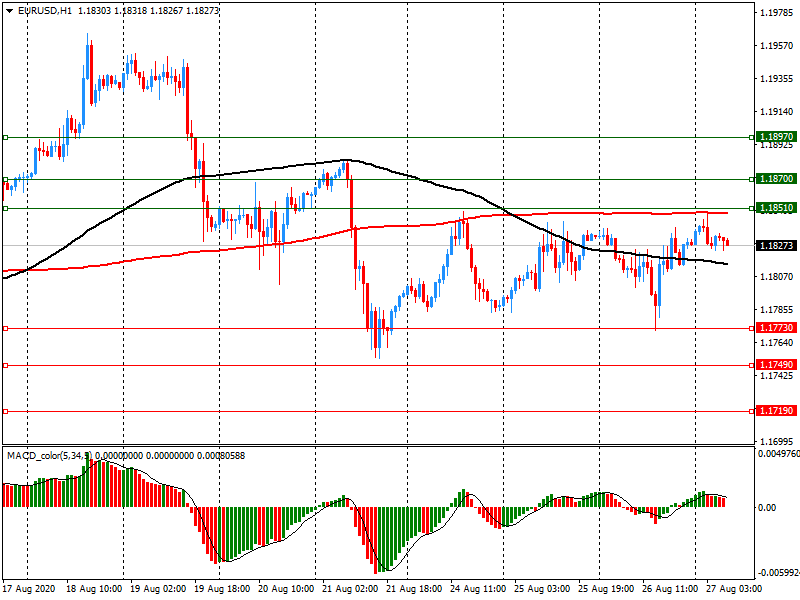
Comments:
- Overall open interest on the CALL options and PUT options with the expiration date September, 4 is 93615 contracts (according to data from August, 26) with the maximum number of contracts with strike price $1,0500 (5007);
GBP/USD
Resistance levels (open interest**, contracts)
$1.3297 (1500)
$1.3269 (1024)
$1.3246 (982)
Price at time of writing this review: $1.3202
Support levels (open interest**, contracts):
$1.3065 (526)
$1.3027 (562)
$1.2986 (1566)
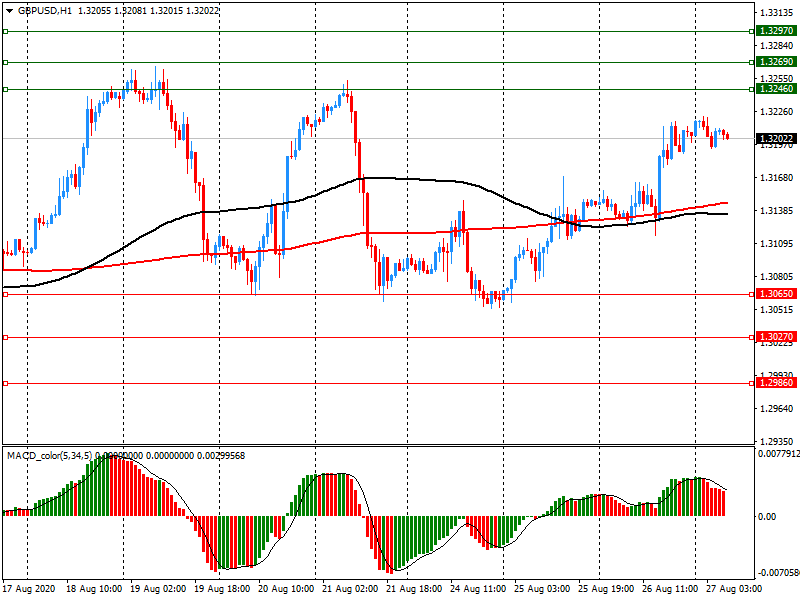
Comments:
- Overall open interest on the CALL options with the expiration date September, 4 is 21638 contracts, with the maximum number of contracts with strike price $1,3800 (3394);
- Overall open interest on the PUT options with the expiration date September, 4 is 19148 contracts, with the maximum number of contracts with strike price $1,3000 (1566);
- The ratio of PUT/CALL was 0.88 versus 0.87 from the previous trading day according to data from August, 26
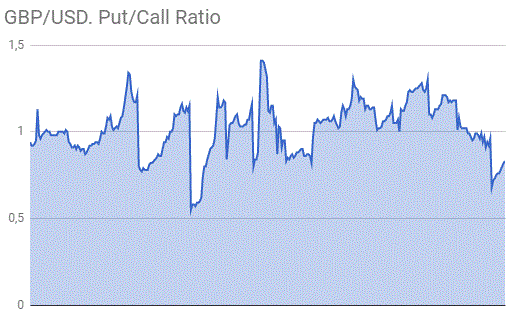
* - The Chicago Mercantile Exchange bulletin (CME) is used for the calculation.
** - Open interest takes into account the total number of option contracts that are open at the moment.
According to the report from Federal Statistical Office, Switzerland’s GDP fell by –8.2 % in the 2nd quarter of 2020, after decreasing by 2.5% (revised) in the previous quarter. Domestic economic activity was severely restricted in the wake of the pandemic and the measures taken to contain it. The global economy also plunged into a sharp recession. However, Switzerland’s GDP decline remained limited in an international comparison. In the 2nd quarter, Switzerland’s GDP suffered the biggest decline since records of quarterly data began in 1980. Compared to the situation in the 4th quarter of 2019, before the coronavirus crisis, GDP slumped by a total of –10.5 % in the first half of 2020. However, the industry structure of the domestic economy helped keep the decline relatively mild in comparison with other countries.
The sizeable pharmaceutical industry increased its turnover, thereby preventing an even steeper slump in the total for manufacturing (–9.0 %). Nevertheless, the sectors that are sensitive to the economic situation such as machinery and metals, as well as precision instruments and watchmaking, had to endure severe setbacks due to the international economic crisis. Exports of goods (–9.4 %) dropped sharply in line with this.
In the 2nd quarter, the service sector was hit hardest by the health policy measures taken to contain the pandemic – value added suffered a widespread slump. However, in this sector too, the Swiss industry structure had a stabilising effect when compared to other countries. For example, value added in accommodation and food services (–54.2 %) and transport and communications (–21.7 %) plummeted. However, tourism-related services have a smaller share of GDP in Switzerland than in most neighbouring countries. Trade ( 3.6 %) also reported a comparatively minor dip in value added due to considerable growth in merchanting and relatively robust development in retail, even in light of the closure of catering businesses and travel restrictions. Finally, the healthcare sector (–8.6 %) and business-related services (–8.6 %) posted a severe decline. Exports of services (–15.9 %) also saw a correspondingly steep drop.
The health policy containment measures limited private consumption (–8.6 %). As a result of shop, bar and restaurant closures and other restrictions, particularly in healthcare and travel, spending nosedived in most consumer sectors. Alternative sales channels such as online retail were only partially able to offset the losses. Investment in construction (–4.0 %) and investment in equipment (–11.7 %) also contracted significantly, while government consumption grew only slightly (+0.2 %). Overall, final domestic demand (–7.4 %) recorded a historic decline and imports of goods3 (–14.3 %) and services (–22.2 %) slumped accordingly.
| Raw materials | Closed | Change, % |
|---|---|---|
| Brent | 45.69 | -0.46 |
| Silver | 27.38 | 3.44 |
| Gold | 1952.975 | 1.35 |
| Palladium | 2182.58 | 0.69 |
| Index | Change, points | Closed | Change, % |
|---|---|---|---|
| NIKKEI 225 | -5.91 | 23290.86 | -0.03 |
| Hang Seng | 5.57 | 25491.79 | 0.02 |
| KOSPI | 2.59 | 2369.32 | 0.11 |
| ASX 200 | -45 | 6116.4 | -0.73 |
| FTSE 100 | 8.59 | 6045.6 | 0.14 |
| DAX | 128.53 | 13190.15 | 0.98 |
| CAC 40 | 40.16 | 5048.43 | 0.8 |
| Dow Jones | 83.48 | 28331.92 | 0.3 |
| S&P 500 | 35.11 | 3478.73 | 1.02 |
| NASDAQ Composite | 198.59 | 11665.06 | 1.73 |
| Time | Country | Event | Period | Previous value | Forecast |
|---|---|---|---|---|---|
| 01:30 | Australia | Private Capital Expenditure | Quarter II | -1.6% | -8.4% |
| 04:30 | Japan | All Industry Activity Index, m/m | June | -3.5% | |
| 05:45 | Switzerland | Gross Domestic Product (YoY) | Quarter II | -1.3% | -9.6% |
| 05:45 | Switzerland | Gross Domestic Product (QoQ) | Quarter II | -2.6% | -8.6% |
| 08:00 | Eurozone | Private Loans, Y/Y | July | 3% | |
| 08:00 | Eurozone | M3 money supply, adjusted y/y | July | 9.2% | 9.2% |
| 12:30 | U.S. | Continuing Jobless Claims | August | 14844 | 14450 |
| 12:30 | Canada | Current Account, bln | Quarter II | -11.1 | -12.2 |
| 12:30 | U.S. | PCE price index, q/q | Quarter II | 1.3% | |
| 12:30 | U.S. | PCE price index ex food, energy, q/q | Quarter II | 1.6% | -1.1% |
| 12:30 | U.S. | Initial Jobless Claims | August | 1106 | 1000 |
| 12:30 | U.S. | GDP, q/q | Quarter II | -5% | -32.5% |
| 13:10 | U.S. | Fed Chair Powell Speaks | |||
| 14:00 | U.S. | Pending Home Sales (MoM) | July | 16.6% | 1.5% |
| 15:00 | U.S. | Jackson Hole Symposium | |||
| 15:15 | Canada | BOC Gov Tiff Macklem Speaks | |||
| 23:30 | Japan | Tokyo CPI ex Fresh Food, y/y | August | 0.4% | 0.3% |
| 23:30 | Japan | Tokyo Consumer Price Index, y/y | August | 0.6% |
| Pare | Closed | Change, % |
|---|---|---|
| AUDUSD | 0.72307 | 0.53 |
| EURJPY | 125.366 | -0.41 |
| EURUSD | 1.18279 | -0.04 |
| GBPJPY | 139.947 | 0.08 |
| GBPUSD | 1.32049 | 0.46 |
| NZDUSD | 0.66138 | 1.06 |
| USDCAD | 1.31442 | -0.2 |
| USDCHF | 0.90755 | 0.06 |
| USDJPY | 105.973 | -0.38 |







© 2000-2026. All rights reserved.
This site is managed by Teletrade D.J. LLC 2351 LLC 2022 (Euro House, Richmond Hill Road, Kingstown, VC0100, St. Vincent and the Grenadines).
The information on this website is for informational purposes only and does not constitute any investment advice.
The company does not serve or provide services to customers who are residents of the US, Canada, Iran, The Democratic People's Republic of Korea, Yemen and FATF blacklisted countries.
Making transactions on financial markets with marginal financial instruments opens up wide possibilities and allows investors who are willing to take risks to earn high profits, carrying a potentially high risk of losses at the same time. Therefore you should responsibly approach the issue of choosing the appropriate investment strategy, taking the available resources into account, before starting trading.
Use of the information: full or partial use of materials from this website must always be referenced to TeleTrade as the source of information. Use of the materials on the Internet must be accompanied by a hyperlink to teletrade.org. Automatic import of materials and information from this website is prohibited.
Please contact our PR department if you have any questions or need assistance at pr@teletrade.global.


 Bank
Bank transfers


