- Analytics
- News and Tools
- Market News
CFD Markets News and Forecasts — 27-08-2021
On Monday, at 01:30 GMT, Australia will announce a change in the company gross profits for the 2nd quarter. At 09:00 GMT, the eurozone will release an index of economic sentiment, an index of consumer confidence and an index of business optimism in industry for August. At 12:00 GMT, Germany will present the consumer price index for August. At 12:30 GMT, Canada will report a change in the balance of payments for the 2nd quarter. At 14:00 GMT, the United States will announce a change in pending home sales for July. At 22:45 GMT, New Zealand will announce a change in the construction permits for July. At 23:30 GMT, Japan will report changes in the unemployment rate and industrial production for July.
On Tuesday, at 01:00 GMT, China will release the PMI index for the manufacturing sector and the index of activity in the non-manufacturing sector for August. Also at 01:00 GMT, New Zealand will present ANZ's business confidence indicator for August. At 01:30 GMT, Australia will report changes in the construction permits for July, the balance of payments for the 2nd quarter and the private sector credit for July. At 05:00 GMT, Japan will release an indicator of consumer confidence for August and announce a change in housing starts for July. At 06:00 GMT, Germany will announce the change in retail trade for July. At 06:45 GMT, France will report on the change in the volume of consumer spending for July and the volume of GDP for the 2nd and will present the consumer price index for August. At 07:00 GMT, Switzerland will release the KOF index of leading economic indicators for August. At 07:55 GMT, Germany will announce changes in the unemployment rate and the number of unemployed for August. At 08:30 GMT, Britain will announce changes in the volume of the M4 aggregate of the money supply, the number of approved applications for a mortgage loan and the volume of net loans to individuals for July. At 09:00 GMT, the eurozone will present the consumer price index for August. At 12:30 GMT, Canada will report on the change in GDP for June. At 13:00 GMT, the US will publish the S&P/Case-Shiller housing price index for June. At 13:45 GMT, the US will release the Chicago Purchasing Managers ' Index for August, and at 14:00 GMT - the consumer confidence indicator for August. At 22:30 GMT, Australia will present the index of activity in the manufacturing sector from AiG for August. At 23:50 GMT, Japan will report a change in the volume of capital expenditures for the 2nd quarter.
On Wednesday, at 00:30 GMT, Japan will release the manufacturing PMI for August. At 01:30 GMT, Australia will announce a change in GDP for the 2nd quarter. At 01:45 GMT, China will publish the PMI index for the manufacturing sector from Caixin for August. Then the focus will be on the PMI indices for the manufacturing sector from Markit for August: Switzerland will report at 07: 30 GMT, France at 07: 50 GMT, Germany at 07:55 GMT, the eurozone at 08:00 GMT, and Britain at 08:30 GMT. At 09:00 GMT, the eurozone will report a change in the unemployment rate for July. At 12:15 GMT, the US will announce a change in the number of employees from ADP for August. At 13:45 GMT, the US will release the index of business activity in the manufacturing sector for August, at 14: 00 GMT - the ISM manufacturing index for August. Also at 14: 00 GMT, the US will report on the change in the construction spending for July. At 14:30 GMT, the US will announce a change in oil reserves according to the Ministry of Energy. At 20:00 GMT, the United States will announce a change in total car sales for August. Also on Wednesday, an OPEC meeting will be held.
On Thursday, at 01:30 GMT, Australia will report a change in the foreign trade balance for July. At 06:30 GMT, Switzerland will release the consumer price index for August and announce the change in retail trade for July. At 07:00 GMT, Switzerland will announce a change in GDP for the 2nd quarter. At 09:00 GMT, the eurozone will present the producer price index for July. At 12:30 GMT, Canada will report a change in construction permits for July. Also at 12:30 GMT, Canada and the United States will announce a change in the foreign trade balance for July. In addition, at 12:30 GMT, the US will announce changes in the level of labor productivity in the non-manufacturing sector and the level of labor costs for the 2nd quarter, as well as the number of initial applications for unemployment benefits, At 14:00 GMT, the US will announce changes in production orders for July. At 22:30 GMT, Australia will release the AiG construction activity index for August.
On Friday, at 00:30 GMT, Japan will present the index of business activity in the services sector for August. At 01:45 GMT, China will publish the index of business activity in the services sector from Caixin for August. Then the focus will be on the PMI indices in the services sector from Markit for August: France will report at 07:50 GMT, Germany at 07:55 GMT, the eurozone at 08:00 GMT, and Britain at 08:30 GMT. At 09:00 GMT, the eurozone will report on the change in retail trade for July. At 12:30 GMT, Canada will announce a change in the level of labor productivity for the 2nd quarter. Also at 12: 30 GMT, the US will report changes in the unemployment rate and the nonfarm payrolls for August. At 13:45 GMT, the US will publish the PMI index for the services sector for August, and at 14:00 GMT - the ISM index of business activity in the services sector for August. At 17:00 GMT, in the United States, the Baker Hughes report on the number of active oil drilling rigs will be released.
eFXdata reports that analysts at MUFG Research discuss NZD outlook in the light of a lockdown extension in New Zealand.
"The main focus for the markets, therefore, remains the potential impediments to growth stemming from COVID and supply constraint uncertainties. In New Zealand today, PM Ardern announced a further extension to the Level 4 lockdown, which will now remain in place until midnight on 31st August. Ardern provided further guidance by stating that Auckland and the Northland region would remain at Level 4 for another two weeks but the rest of New Zealand could move to Level 3 from 1st September."
"AUD and NZD are both advancing modestly versus the US dollar today suggesting much of the economic bad news is priced now. Risks remain to the downside however given that COVID infections could still worsen further."
The
final reading for the August Reuters/Michigan index of consumer sentiment came
in at 70.3 compared to a preliminary reading of 70.2 and the July final reading
of 81.2. This was the lowest reading since December 2011.
Economists
had forecast the index to be revised to 70.7.
According
to the report, the index of consumer expectations tumbled 17.6 percent m-o-m to
65.1 from July’s final reading of 79.0, while the index of the current economic
conditions declined 7.1 percent m-o-m to 78.5 from July’s final reading of 84.5.
“There was no lessening in late August in the extent of the collapse in consumer sentiment recorded in the first half of the month. The Consumer Sentiment Index fell by 13.4% from July, recording the least favorable economic prospects in more than a decade,” noted Richard Curtin, Surveys of Consumers chief economist. “Consumers' extreme reactions were due to the surging Delta variant, higher inflation, slower wage growth, and smaller declines in unemployment.”
- At July meeting, I thought it could be appropriate to start taper this year. Since then there has been more progress on employment but also the further spread of the delta variant
- Outlook for labor market has brightened considerably in recent months
- Substantial further progress test has been met for inflation
- We have much ground to cover to reach maximum employment
- Time will tell whether we have reached 2% inflation on a sustainable basis
- Incoming data should provide more evidence that supply-demand imbalnaces are improving and more evidence of continued moderation in inflation
- If sustained higher inflation were to become a serious concern, Fed would certainly respond
- Inflation at these levels is a cause for concern but elevated inflation readings likely to prove transitory
- Little reason to think underlying disinflationary factors have suddenly reversed; they're likely to continue to weigh on inflation
- For now, I believe that policy is well positioned; as always, we are prepared to adjust policy as appropriate to achieve our goals
- Timing and pace of coming reduction in asset purchases will not be intended to carry a direct signal regarding timing of interest rate liftoff
- Even after our asset purchases end, our elevated holdings of longer-term securities will continue to support accommodative financial conditions
- Asset purchases don't have much value right now
- Fed is fine if inflation moderates quickly but we may need to put downward pressure on prices if inflation lasts longer
- Fed needs optionality in case that inflation doesn't moderate
- We're "basically there" on substantial further progress
- We've certainly made substantial further progress since December when policy guidance was put in place
- It is now question of communicating what policy stance is on tapering
- I'm comfortable if we begin to talk about a taper in September and start to taper before year-end
- There's no rush to taper
- Higher prices in some components will stay longer than Fed expected and could feed into inflation expectations
- Businesses are saying they thought supply issues would be resolved by now
- My baseline outlook is still that prices will fall back down but I think it's "up in the air" now about when that will be
- Says that if they complete taper by the middle of next year they'll have time to assess the potential timing of a hike
U.S. stock-index futures rose on Friday, as investors assessed the U.S. core PCE inflation reading, the Fed’s preferred inflation gauge, while awaiting the Fed Chair Powell's speech at Jackson Hole later this morning (due at 14:00 GMT), which might shed some light on the U.S. central bank's plans for its policy.
Global Stocks:
Index/commodity | Last | Today's Change, points | Today's Change, % |
Nikkei | 27,641.14 | -101.15 | -0.36% |
Hang Seng | 25,407.89 | -7.80 | -0.03% |
Shanghai | 3,522.16 | +20.49 | +0.59% |
S&P/ASX | 7,488.30 | -2.90 | -0.04% |
FTSE | 7,119.00 | -5.98 | -0.08% |
CAC | 6,651.56 | -14.47 | -0.22% |
DAX | 15,788.70 | -4.92 | -0.03% |
Crude oil | $68.91 | +2.21% | |
Gold | $1,800.30 | +0.28% |
(company / ticker / price / change ($/%) / volume)
ALCOA INC. | AA | 42.01 | 0.59(1.42%) | 45910 |
ALTRIA GROUP INC. | MO | 48.92 | 0.17(0.35%) | 18895 |
Amazon.com Inc., NASDAQ | AMZN | 3,330.00 | 14.00(0.42%) | 11602 |
American Express Co | AXP | 166.2 | 0.69(0.42%) | 3541 |
Apple Inc. | AAPL | 147.96 | 0.42(0.28%) | 444017 |
AT&T Inc | T | 27.06 | 0.04(0.15%) | 70782 |
Boeing Co | BA | 217.52 | 1.02(0.47%) | 52930 |
Caterpillar Inc | CAT | 212.5 | 1.26(0.60%) | 5310 |
Chevron Corp | CVX | 98.28 | 1.06(1.09%) | 10958 |
Cisco Systems Inc | CSCO | 59.21 | 0.01(0.02%) | 4967 |
Citigroup Inc., NYSE | C | 72.69 | 0.25(0.35%) | 21458 |
Deere & Company, NYSE | DE | 383.8 | 3.99(1.05%) | 2950 |
Exxon Mobil Corp | XOM | 55.3 | 0.59(1.08%) | 51907 |
Facebook, Inc. | FB | 365.3 | 0.92(0.25%) | 15991 |
FedEx Corporation, NYSE | FDX | 268 | 0.54(0.20%) | 760 |
Ford Motor Co. | F | 12.91 | 0.01(0.08%) | 371494 |
Freeport-McMoRan Copper & Gold Inc., NYSE | FCX | 34.98 | 0.44(1.27%) | 47993 |
General Electric Co | GE | 103.63 | 0.25(0.24%) | 6276 |
General Motors Company, NYSE | GM | 48.77 | 0.15(0.31%) | 33671 |
Goldman Sachs | GS | 412.92 | 0.51(0.12%) | 5126 |
Google Inc. | GOOG | 2,861.48 | 19.02(0.67%) | 2908 |
Hewlett-Packard Co. | HPQ | 27.52 | -1.58(-5.43%) | 154645 |
Home Depot Inc | HD | 322 | 0.52(0.16%) | 1248 |
HONEYWELL INTERNATIONAL INC. | HON | 231.22 | 0.34(0.15%) | 269 |
Intel Corp | INTC | 53.37 | 0.24(0.45%) | 41268 |
International Business Machines Co... | IBM | 138.64 | -0.14(-0.10%) | 1113 |
Johnson & Johnson | JNJ | 173.77 | 0.47(0.27%) | 14102 |
JPMorgan Chase and Co | JPM | 162.28 | 0.53(0.33%) | 8094 |
McDonald's Corp | MCD | 237.5 | 0.55(0.23%) | 8085 |
Merck & Co Inc | MRK | 76.73 | 0.16(0.21%) | 9352 |
Microsoft Corp | MSFT | 300.3 | 1.21(0.40%) | 78511 |
Pfizer Inc | PFE | 47.51 | 0.13(0.27%) | 142712 |
Starbucks Corporation, NASDAQ | SBUX | 114.54 | 0.22(0.19%) | 5278 |
Tesla Motors, Inc., NASDAQ | TSLA | 706.25 | 5.09(0.73%) | 117220 |
The Coca-Cola Co | KO | 55.65 | 0.11(0.20%) | 9762 |
Twitter, Inc., NYSE | TWTR | 62.79 | 0.18(0.29%) | 7905 |
Verizon Communications Inc | VZ | 54.66 | 0.06(0.11%) | 46405 |
Visa | V | 230.7 | 0.18(0.08%) | 5372 |
Wal-Mart Stores Inc | WMT | 147.46 | 0.11(0.08%) | 3801 |
Walt Disney Co | DIS | 176.8 | 0.24(0.14%) | 12225 |
Yandex N.V., NASDAQ | YNDX | 70.29 | -0.11(-0.16%) | 1271 |
HP (HPQ) downgraded to Equal-Weight from Overweight at Morgan Stanley; target lowered to $31
The
Commerce Department reported on Friday that consumer spending in the U.S. rose
0.3 percent m-o-m in July after a revised 1.1 percent m-o-m jump in June
(originally a 1.0 percent increase m-o-m). Economists
had forecast the reading to show a 0.3 percent m-o-m advance.
Meanwhile,
consumer income surged 1.1 percent m-o-m in July, following a revised 0.2
percent m-o-m rise in the previous month (originally a 0.1 percent m-o-m uptick). Economists had forecast a 0.2 percent
m-o-m increase.
The July
jump in personal income primarily reflected gains in government social benefits
and compensation of employees.
The
personal consumption expenditures (PCE) price index, excluding the volatile
categories of food and energy, which is the Fed's preferred inflation measure, rose
0.3 percent m-o-m in July, following a revised 0.5 percent m-o-m gain in June (originally
a 0.4 percent m-o-m growth). Economists had projected the index would advance
0.3 percent m-o-m. That was the second consecutive month that core PCE inflation shows signs of easing.
In the 12 months through July, the core PCE surged
3.6 percent, the same as a revised 3.6 percent in the 12 months through June (originally
a 3.5 percent climb). Economists had forecast a jump of 3.6 percent y-o-y.
- Says there is some evidence that inflation may not be transitory
- Economy has achieved inflation goal
- Unemployment is moving toward the Fed goal
- Current issues with economy involve supply not demand
- Thinks Delta variant and other variants are a risk
- Tapering should be finished before rates are increased
- Sees rate hikes in late 2022 early 2023
FXStreet reports that EUR/USD is trading above 1.1750. The Credit Suisse analyst team suggests that strength is ideally capped below 1.1806/31 for a fresh attempt to stage a conclusive break of major support at 1.1703/1.1695.
“Resistance is seen initially at 1.1781/85 ahead of 1.1806 – the recent reaction high and the 23.6% retracement of the May/August fall. With the falling 55-day average not far above 1.1831 we continue to look for a cap here for a retest of 1.1700 again.”
“A close above 1.1831 would reassert the broader sideways range and allow a deeper recovery to the 38.2% retracement and July high at 1.1894/1.1910.”
“Below 1.1726 is needed to see the immediate risk turn lower again with a sustained move below 1.1695 needed to confirm the completion of the large ‘head & shoulders’ top to mark an important change of trend lower.”
FXStreet reports that FX Strategists at UOB Group note that a sustainable move above 0.7010 remains out of favour in NZD/USD for the time being.
24-hour view: “Yesterday,... NZD traded sideways between 0.6942 and 0.6977 before settling on a soft note at 0.6948. Momentum indicators are turning neutral and NZD is likely to trade sideways for today, expected to be within a 0.6920/0.6965 range.”
Next 1-3 weeks: “On Wednesday (25 Aug, spot at 0.6985), we indicated that there is room for the rapid advance in NZD to extend but a sustained rise above 0.7010 appears unlikely for now. NZD snapped its winning streak yesterday (26 Aug) as it closed lower by -0.37% (0.6948). We continue to hold the same view for now but a break of 0.6900 (no change in ‘strong support’ level) would indicate that NZD is not ready to move above 0.7010 just yet.”
| Time | Country | Event | Period | Previous value | Forecast | Actual |
|---|---|---|---|---|---|---|
| 06:45 | France | Consumer confidence | August | 100 | 100 | 99 |
USD traded mixed and little changed against other major currencies in the European session on Friday, as investors awaited the Federal Reserve Chairman Jerome Powell’s address to the Jackson Hole economic symposium later today, which might shed some light on the U.S. central bank's plans for its stimulus.
The U.S. Dollar Index (DXY), measuring the U.S. currency's value relative to a basket of foreign currencies, edged down 0.03% to 93.03.
The Fed’s Chairman Jerome Powell will deliver his virtual speech to the participants of the symposium at 14:00 GMT. Markets will be listening closely, hoping to get clues on when the Fed might look to begin tapering its asset purchases.
Atlanta Fed president Raphael Bostic stated today that it would be “reasonable” for the U.S. central bank to start the bond-buying taper in October if job gain in August matches those in June and July. Several other Fed’s officials also have expressed similar views earlier this month.
Market participants also looked for the release of the U.S. core PCE inflation reading - the Fed’s preferred inflation gauge (due at 12:30 GMT), - which could determine the tone of Powell's Jackson Hole speech.
FXStreet reports that the rebound in GBP/USD has been capped at a cluster of resistances including its 200-day average (DMA) at 1.3802. The Credit Suisse analyst team suggests that subsequent completion of a bearish “reversal day” is expected to clear the way for a retest of key support at 1.3571/67.
“We think the recent strength has been corrective only. Indeed, below support at 1.3693, GBP/USD has seen a minor top complete and we look for a fall back to the recent low and potential trend support at 1.3608/01.”
“Bigger picture, key support remains seen at the July low and 23.6% retracement of the entire 2020/2021 uptrend at 1.3571/67 removal of which can establish a major top with support then seen next at 1.3520/14.”
“Near-term resistance moves to 1.3712, then 1.3736, with 1.3769/71 ideally now capping to keep the immediate risk lower.”
FXStreet reports that FX Strategists at UOB Group believe that further consolidation amidst a mixed outlook remains well in place for USD/CNH in the next weeks.
24-hour view: “USD subsequently traded within a 6.4708/6.4852 range before settling slightly higher at 6.4835 (+0.19%). The underlying tone has firmed somewhat and USD could edge higher to 6.4950 (minor resistance is at 6.4900). A sustained rise above this level appears unlikely. Support is at 6.4750 followed by 6.4680.”
Next 1-3 weeks: “We continue to hold the same view as from Tuesday (24 Aug, spot at 6.4790). As highlighted, the outlook is mixed and USD could trade between 6.4600 and 6.5050 for a period of time. Looking ahead, the downside risk appears to be greater but USD has to close below the major support at 6.4500 before a sustained decline can be expected.”
FXStreet notes that USD/CAD has found a floor as expected at the 38.2% retracement of the June/August rally, uptrend and the 200-day average (DMA) at 1.2546. Consequently, analysts at Credit Suisse look for the broader uptrend to resume from here.
“A floor has been found at the 200-DMA seen at 1.2546 as looked for and we continue to look for the broader risk to turn higher again.”
“Resistance is seen at 1.2711/21 initially, above which can keep the immediate risk higher with resistance seen next at 1.2748 and then 1.2779.”
“Near-term support moves to 1.2644, with 1.2592/79 now ideally holding. A break can see a fall to the 200-DMA at 1.2546, potentially the 55-DMA, now seen not far below here at 1.2502.”
HP (HPQ) reported Q3 FY 2021 earnings of $1.00 per share (versus $0.49 per share in Q3 FY 2020), beating analysts’ consensus estimate of $0.84 per share.
The company’s quarterly revenues amounted to $15.289 bln (+7.0% y/y), missing analysts’ consensus estimate of $15.915 bln.
HPQ fell to $28.24 (-2.96%) in pre-market trading.

- Thinks "substantial progress" benchmark to start bond-buying tapering would be met if August job gains match those in June and July
- Wants taper process to finish "as quickly as possible" once started
- Not objected to end tapering in Q1 2022
- Says outlook for the economy has not been changed in material way by Delta coronavirus variant
- Foundations of inflation are quite strong; reasonable measures show Fed has already met its goal of 2% inflation on average
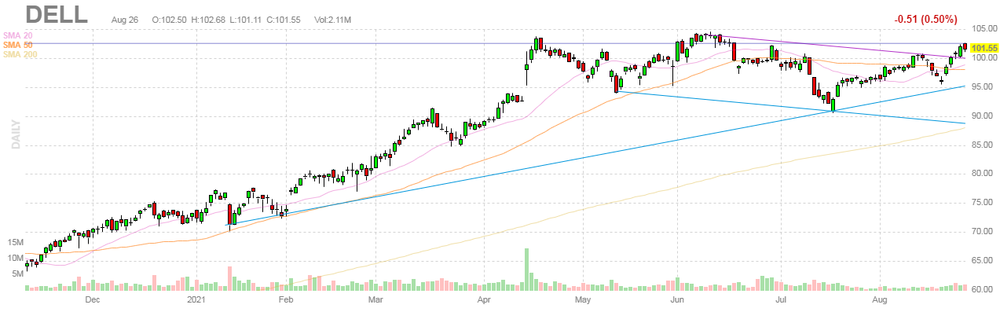
Dell (DELL) reported Q2 FY 2021 earnings of $2.24 per share (versus $1.92 per share in Q2 FY 2020), beating analysts’ consensus estimate of $2.04 per share.
The company’s quarterly revenues amounted to $26.122 bln (+14.9% y/y), beating analysts’ consensus estimate of $25.546 bln.
DELL fel to $100.00 (-1.53%) in pre-market trading.
FXStreet reports that economists at Credit Suisse discuss EUR/GBP prospects.
“Resistance is seen at 0.8595 initially, above which should neutralize the recent ‘outside day’ for strength to 0.8671 and then the top of the range, seen starting at 0.8700/03, also the location of the falling long-term 200-day average. We would look for a fresh top here.”
“A close above 0.8703 would be the first sign we may be seeing a more important turn higher. Support is seen at 0.8562 initially.”
eFXdata reports that ING Research maintains a bearish bias on AUD/NZD.
"AUD remains more exposed to downside risks than NZD in our view, considering: a) iron ore prices could fall again (they are still well above their 2020 average); b) the Covid crisis in Australia remains serious, with lockdowns likely to remain in place in September, while the exit from recent restrictions in New Zealand appears more imminent; c) AUD cannot count on a domestic monetary tightening prospects," ING adds.
Reuters reports that according to a person familiar with the matter, China is framing rules to ban internet companies whose data poses potential security risks from listing outside the country, including in the United States. The ban is also expected to be imposed on companies involved in ideology issues.
Beijing said last month it planned to strengthen supervision of all firms listed offshore. Under the rules being drafted, the China Securities Regulatory Commission (CSRC) plans to ban firms, which collect vast amount of data from users or create content, from overseas listings.
The plan is one of several proposals under consideration by Chinese regulators as Beijing has tightened its grip on the country's internet platforms in recent months, including looking to sharpen scrutiny of overseas listings.
FXStreet reports that economists at Société Générale discuss USD/CNY prospects.
“The high inverse correlation between USD/CNY and HK Tech index suggest that a return below 6,000 for the equity index would give USD/CNY a greater chance of settling above 6.50, barring PBoC intervention. USD/CNY crossed above the daily Ichimoku cloud recently and is now defending it. This denotes a short-term bounce is likely towards July high at 6.5300.” “Graphical levels of 6.4460 should cushion downside.”
CNBC reports that RBI central bank governor Shaktikanta Das said that the Reserve Bank of India may launch its first digital currency trial programs by December.
Central banks including those in China, Europe and the U.K. are exploring digital currencies that would be issued by them, either to commercial lenders or to the public directly.
“We are being extremely careful about it because it’s completely a new product, not just for RBI, but globally,” Das said.
The RBI is studying various aspects of a digital currency including its security, impact on India’s financial sector as well as how it would affect monetary policy and currency in circulation, according to the governor.
Das added that the central bank is also exploring the choice between having a centralized ledger for the digital currency or the so-called distributed ledger technology (DLT).
“I think by the end of the year, we should be able to — we would be in a position, perhaps — to start our first trials,” Das told CNBC.
His deputy, T Rabi Shankar, last month said the central bank was working toward a “phased implemental strategy” for a digital currency.
FXStreet reports that economists at Westpac confirm the key themes for a rising aussie, but have lowered their expectations.
“Our own central view is that while the starting point for the December quarter for AUD/USD might be even lower than our 0.72 forecast, we expect that Australia’s pandemic performance during the December quarter is likely to surprise markets to the upside.”
“Westpac is forecasting Australia’s growth rate to lift from 2.4% in 2021 (including the 2.6% contraction in the September quarter) to 5.0% in 2022.”
“We have lowered our world growth forecasts in 2021 from 5.7% to 5.5% and in 2022 from 4.7% to 4.5%. Those revisions still entail only a modest downward revision for growth in China. This increased uncertainty over the outlook has flattened and extended the profile for the AUD/USD from a 0.82 peak in 2022 to a peak in 2022 of 0.78.”
“But, as risks, specifically around the pandemic, dissipate further, including in less developed economies, in 2023, we expect AUD/USD to reach 0.80.”
eFXdata reports that Danske Research discusses its expectations for Fed Powell's Speech.
"With little actual news, EUR/USD remains largely unchanged and follows mostly risk sentiment. Nonetheless, we note the German IFO index posted a decline in line with many other activity indicators. This confirms a peak in the pace of expansion for the manufacturing cycle, at least for now. We continue to expect further evidence of such peak amid a more hawkish Fed will contribute to a stronger dollar over the coming year. Short-term, markets will focus on Powell speaking, although we do not expect him to make any major changes to policy signals," Danske adds.
FXStreet reports that economists at the National Bank of Canada expect the shared currency to gain some ground but remain cautious as there are some hurdles ahead.
“An executive board member of the ECB reiterated that they expect inflationary pressures to abate as of next year and current levels are not indicative of a change in stance on monetary policy. The statements are not supportive of significant euro appreciation.”
“Part of the depreciation in the euro follows the trend seen in other major currencies. We believe some of the fears arising from the Delta variant should subside in the US and the euro area appears to have a slower rise in new cases.”
“While the ECB should stay the course, for now, the Fed could take its time in order to see how the US deals with the latest rise in cases.”
“We expect some appreciation of the euro but remain wary of the aforementioned factors that could negatively impact the current account and the value of the currency.”
| Time | Country | Event | Period | Previous value | Forecast | Actual |
|---|---|---|---|---|---|---|
| 00:00 | U.S. | Jackson Hole Economic Symposium | ||||
| 01:30 | Australia | Retail Sales, M/M | July | -1.8% | -2.3% | -2.7% |
| 06:45 | France | Consumer confidence | August | 100 | 100 | 99 |
During today's Asian trading, the US dollar fell against the euro and the yen before the speech of the head of the Federal Reserve System (Fed) Jerome Powell at the economic symposium in Jackson Hole.
Hopes that Powell will announce the timing of the curtailment of the asset repurchase program in Jackson Hole have supported the US currency in recent days, but with the approach of his speech, traders ' hopes that the head of the Federal Reserve will make such a statement have decreased, and this weakened the dollar.
The ICE index, which tracks the dynamics of the dollar against six currencies (euro, swiss franc, yen, canadian dollar, pound sterling and swedish krona), fell by 0.13%.
The euro, the yen and the pound may weaken against the background of the likely closing of short positions on the dollar before Powell's speech, DBS experts believe.
"Market participants may think that they have hurried to expect nothing from the symposium in Jackson Hole," analysts note.
On the eve of the heads of the Federal Reserve Banks of St. Louis, Dallas and Kansas, James Ballard, Robert Kaplan and Esther George said that they are in favor of a rapid reduction in the volume of asset purchases by the Fed, despite the risks associated with the"delta".
According to the report from Insee, in August 2021, households’ confidence in the economic situation has fallen slightly. At 99, the indicator that summaries it has lost one point and is back below its long-term average (100).
In August, the households’ opinion balance related to their future financial situation has decreased by two points. The one relative to their personal past financial situation has lost one point. Both balances remain well above their long-term averages.
The share of households considering it is a suitable time to make major purchases has been stable, above its long term average.
In August, the share of households considering it is a suitable time to save has increased anew, after three consecutive months of decline. The corresponding balance has gained three points, and remains well above its average.
Households' fears about unemployment trend have been stable in August. The corresponding balance remains below its long-term average.
In August, households considering that prices were on the rise during the past twelve months have increased slightly. The corresponding balance has gained two points and is now above its average, which was crossed in July after a sharp rise.
Households considering that prices will be on the rise during the next twelve months have also been slightly more numerous in August. The corresponding balance has gained two points, and remains above its long-term average.
Bloomberg reports that China’s central bank (PBOC) signaled it may reduce the reserve requirement ratio for banks to spur rural finance, a targeted move that would help cushion the economy as it slows.
PBOC Governor Yi Gang earlier this week pledged to boost credit support to the economy and improve efforts to bring down real lending rates for businesses. Analysts said there could be an increase to credit supply soon and another reduction in the RRR following July’s surprise cut.
Zhou Hao, senior emerging market economist at Commerzbank AG in Singapore, said the PBOC’s comments have fueled speculation of a RRR cut as early as Friday. Lu Ting, chief China economist at Nomura Holdings Inc., sees more than 70% chance of a RRR cut in the next two months.
The PBOC has in the past cut the required reserve ratio for rural banks to encourage lending to the agricultural industry and small businesses. The last time it did so was in April 2020, when it lowered the RRR by 1 percentage point for rural financial institutions and regional commercial banks, unleashing 400 billion yuan ($61.7 billion) in liquidity.
Lu said any cut in the RRR will likely be targeted that injects less than 500 billion yuan of liquidity, given the effective RRR for small banks is already quite low at 5.5%.
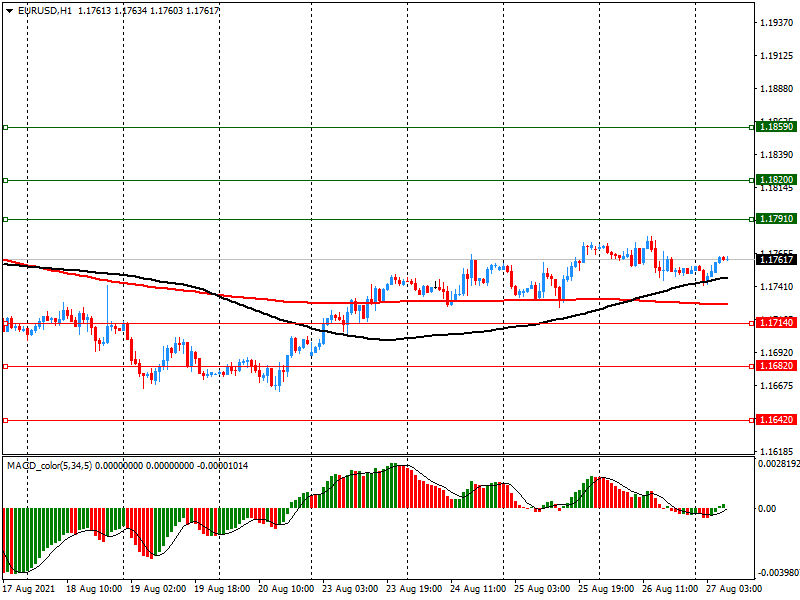
EUR/USD
Resistance levels (open interest**, contracts)
$1.1859 (1692)
$1.1820 (1814)
$1.1791 (988)
Price at time of writing this review: $1.1762
Support levels (open interest**, contracts):
$1.1714 (3741)
$1.1682 (5461)
$1.1642 (2886)
Comments:
- Overall open interest on the CALL options and PUT options with the expiration date September, 3 is 94930 contracts (according to data from August, 26) with the maximum number of contracts with strike price $1,2000 (8065);
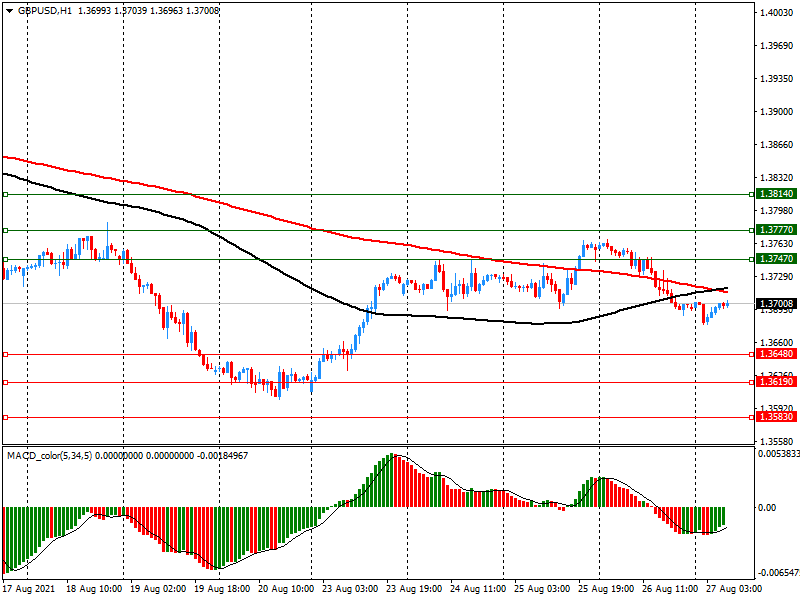
GBP/USD
$1.3814 (221)
$1.3777 (112)
$1.3747 (109)
Price at time of writing this review: $1.3701
Support levels (open interest**, contracts):
$1.3648 (924)
$1.3619 (1001)
$1.3583 (797)
Comments:
- Overall open interest on the CALL options with the expiration date September, 3 is 18223 contracts, with the maximum number of contracts with strike price $1,4300 (2171);
- Overall open interest on the PUT options with the expiration date September, 3 is 15598 contracts, with the maximum number of contracts with strike price $1,3550 (1334);
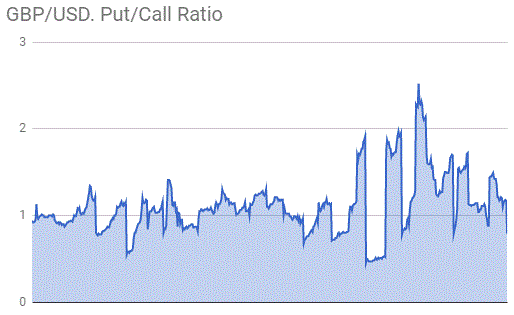
- The ratio of PUT/CALL was 0.86 versus 0.86 from the previous trading day according to data from August, 26
* - The Chicago Mercantile Exchange bulletin (CME) is used for the calculation.
** - Open interest takes into account the total number of option contracts that are open at the moment.
The Federal Statistical Office (Destatis) said that the index of import prices increased by 15.0% in July 2021 compared with the corresponding month of the preceding year. This has been the highest year-on-year-change since September 1981 (+17.4%). In June 2021 and in May 2021 the annual rates of change were +12.9% and +11.8%, respectively. From June 2021 to July 2021 the index rose by 2.2%.
In July 2021 energy imports were 89.6% more expensive than in July 2020. This high rate of annual change derives from the very low prices in July 2020. The largest influence on the year-on-year rate of energy price increase in July 2021 had natural gas with a plus of 170.5% and crude oil with a plus of 68.9%.
The index of import prices, excluding crude oil and mineral oil products, increased by 12.2% in July 2021 compared with July 2020 and in comparison with June 2021 it rose by 2.0%.
The index of export prices increased by 6.3% in July 2021 compared with the corresponding month of the preceding year. This has been the highest year-on-year-change since January 1982 (+6.6%). In June 2021 and in May 2021 the annual rates of change were +5.0% and +4.2%, respectively. From June 2021 to July 2021 the index rose by 1.2%.
Сhina.org.cn reports that data from the National Bureau of Statistics (NBS) showed that China's major industrial companies saw a steady increase in profits in the first seven months of this year amid a stable recovery in market demand and improving business performance.
Industrial firms with an annual business turnover of at least 20 million yuan (about 3.08 million U.S. dollars) raked in combined profits of 4.92 trillion yuan during the period, up 57.3 percent year on year.
Compared with the 2019 level, profits of major industrial firms rose by 44.6 percent in the Jan.-July period. The expansion put the average Jan.-July growth for 2020 and 2021 at 20.2 percent.
In July alone, major industrial firms made 703.67 billion yuan in total profits, up 16.4 percent year on year.
State-controlled industrial firms saw their profits jump 102 percent year on year in the first seven months, while private firms saw profits rise 40.2 percent year on year, the data showed.
| Raw materials | Closed | Change, % |
|---|---|---|
| Brent | 70.94 | -0.56 |
| Silver | 23.525 | -1.24 |
| Gold | 1791.438 | 0.04 |
| Palladium | 2383.62 | -1.51 |
| Time | Country | Event | Period | Previous value | Forecast |
|---|---|---|---|---|---|
| 00:00 (GMT) | U.S. | Jackson Hole Economic Symposium | |||
| 01:30 (GMT) | Australia | Retail Sales, M/M | July | -1.8% | |
| 06:45 (GMT) | France | Consumer confidence | August | 101 | 100 |
| 12:30 (GMT) | Canada | Industrial Product Price Index, y/y | July | 16.8% | |
| 12:30 (GMT) | Canada | Industrial Product Price Index, m/m | July | 0.0% | 0.1% |
| 12:30 (GMT) | U.S. | Goods Trade Balance, $ bln. | July | -92.05 | |
| 12:30 (GMT) | U.S. | PCE price index ex food, energy, Y/Y | July | 3.5% | 3.6% |
| 12:30 (GMT) | U.S. | Personal spending | July | 1% | 0.3% |
| 12:30 (GMT) | U.S. | PCE price index ex food, energy, m/m | July | 0.4% | 0.3% |
| 12:30 (GMT) | U.S. | Personal Income, m/m | July | 0.1% | 0.2% |
| 14:00 (GMT) | U.S. | Reuters/Michigan Consumer Sentiment Index | August | 81.2 | 70.7 |
| 14:00 (GMT) | U.S. | Fed Chair Powell Speaks | |||
| 17:00 (GMT) | U.S. | Baker Hughes Oil Rig Count | August | 405 |
| Pare | Closed | Change, % |
|---|---|---|
| AUDUSD | 0.72346 | -0.52 |
| EURJPY | 129.357 | -0.05 |
| EURUSD | 1.1754 | -0.13 |
| GBPJPY | 150.724 | -0.38 |
| GBPUSD | 1.36951 | -0.45 |
| NZDUSD | 0.69427 | -0.4 |
| USDCAD | 1.26813 | 0.75 |
| USDCHF | 0.91717 | 0.48 |
| USDJPY | 110.044 | 0.07 |







© 2000-2026. All rights reserved.
This site is managed by Teletrade D.J. LLC 2351 LLC 2022 (Euro House, Richmond Hill Road, Kingstown, VC0100, St. Vincent and the Grenadines).
The information on this website is for informational purposes only and does not constitute any investment advice.
The company does not serve or provide services to customers who are residents of the US, Canada, Iran, The Democratic People's Republic of Korea, Yemen and FATF blacklisted countries.
Making transactions on financial markets with marginal financial instruments opens up wide possibilities and allows investors who are willing to take risks to earn high profits, carrying a potentially high risk of losses at the same time. Therefore you should responsibly approach the issue of choosing the appropriate investment strategy, taking the available resources into account, before starting trading.
Use of the information: full or partial use of materials from this website must always be referenced to TeleTrade as the source of information. Use of the materials on the Internet must be accompanied by a hyperlink to teletrade.org. Automatic import of materials and information from this website is prohibited.
Please contact our PR department if you have any questions or need assistance at pr@teletrade.global.


 Bank
Bank transfers


