- Analytics
- News and Tools
- Market News
CFD Markets News and Forecasts — 25-08-2021
| Time | Country | Event | Period | Previous value | Forecast |
|---|---|---|---|---|---|
| 00:00 (GMT) | U.S. | Jackson Hole Economic Symposium | |||
| 01:30 (GMT) | Australia | Private Capital Expenditure | Quarter II | 6.3% | 2.5% |
| 06:00 (GMT) | Germany | Gfk Consumer Confidence Survey | September | -0.3 | -0.7 |
| 08:00 (GMT) | Eurozone | Private Loans, Y/Y | July | 4% | |
| 08:00 (GMT) | Eurozone | M3 money supply, adjusted y/y | July | 8.3% | 7.7% |
| 11:30 (GMT) | Eurozone | ECB Monetary Policy Meeting Accounts | |||
| 12:30 (GMT) | U.S. | Continuing Jobless Claims | August | 2820 | 2790 |
| 12:30 (GMT) | U.S. | Initial Jobless Claims | August | 348 | 350 |
| 12:30 (GMT) | U.S. | GDP, q/q | Quarter II | 6.3% | 6.7% |
| 23:30 (GMT) | Japan | Tokyo CPI ex Fresh Food, y/y | August | 0.1% | -0.2% |
| 23:30 (GMT) | Japan | Tokyo Consumer Price Index, y/y | August | -0.1% |
eFXdata reports that analysts at MUFG Research highlight the importance of the German elections polls over the coming four weeks ahead of the general elections in Germany.
"Tomorrow will mark the 1-month point to the general election in Germany with a new Chancellor guaranteed given Angela Merkel is stepping down... While it might not be a market-mover for FX in and around the election itself, who leads Germany is still of crucial importance. The latest polls also suggest greater uncertainty over who wins as well."
"The main risk of the election having an influence on EUR would be from a very divided election result that increases concern over a period of political instability or a coalition and a leader that lacks authority. In that sense, the German election polls over the coming weeks should be monitored closely."
The
U.S. Energy Information Administration (EIA) reported on Wednesday that crude
inventories decreased by 2.979 million barrels in the week ended August 20,
following a decline of 3.234 million barrels in the previous week. Economists
had forecast a draw of 2.683 million barrels.
At
the same time, gasoline stocks fell by 2.242 million barrels, while analysts
had expected a reduction of 1.557 million barrels. Distillate stocks rose by 0.645
million barrels, while analysts had forecast a drop of 0.271 million barrels.
Meanwhile, oil production in the U.S. remained unchanged at 11.400 million barrels a day.
U.S. crude oil imports averaged 6.2 million barrels per day last week, down by 193,000 barrels per day from the previous week.
- We have already secured vaccines for third round of vaccination
- We will decide this week whether or not we will tap into JPY1.4 trln from reserves for additional cost for dealing with pandemic
- We will strive to provide COVID-19 countermeasures for children that would not interfere with new school term
- Says he expects that about 60% of Japan public will complete vaccination by end-September
- Notes that overseas examples show strict lock-downs had little effect in curbing infections
- Any adjustment to pace of PEPP purchases in September subordinated to commitment for favourable financing conditions
- Markets don't need long notice before end of PEPP as QE will continue via APP
- ECB committed to favourable financing conditions at least through March next year
- Not seeing big wage rise, so no change to view that inflation is transient
- Euro area growth this year broadly in-line with June projections
- Delta variant impact on euro area economy limited given high vaccination rate
U.S. stock-index futures traded flat on Wednesday, as investors took a breather after the strong rally in the previous two sessions that lifted the S&P 500 and Nasdaq Composite indexes to record highs and ahead of the Federal Reserve’s crucial event later this week
Global Stocks:
Index/commodity | Last | Today's Change, points | Today's Change, % |
Nikkei | 27,724.80 | -7.30 | -0.03% |
Hang Seng | 25,693.95 | -33.97 | -0.13% |
Shanghai | 3,540.38 | +25.91 | +0.74% |
S&P/ASX | 7,531.90 | +28.90 | +0.39% |
FTSE | 7,145.70 | +19.92 | +0.28% |
CAC | 6,680.45 | +16.14 | +0.24% |
DAX | 15,889.27 | -16.58 | -0.10% |
Crude oil | $68.15 | +0.89% | |
Gold | $1,798.40 | -0.56% |
(company / ticker / price / change ($/%) / volume)
ALCOA INC. | AA | 42.39 | 0.26(0.62%) | 22571 |
ALTRIA GROUP INC. | MO | 48.3 | 0.09(0.19%) | 15765 |
Amazon.com Inc., NASDAQ | AMZN | 3,305.50 | -0.28(-0.01%) | 12841 |
Apple Inc. | AAPL | 149.94 | 0.32(0.21%) | 491404 |
AT&T Inc | T | 27.46 | 0.01(0.04%) | 41368 |
Boeing Co | BA | 222.25 | 0.82(0.37%) | 33205 |
Caterpillar Inc | CAT | 213.25 | 0.66(0.31%) | 4260 |
Chevron Corp | CVX | 97.88 | 0.04(0.04%) | 13842 |
Cisco Systems Inc | CSCO | 59.41 | 0.09(0.15%) | 15813 |
Citigroup Inc., NYSE | C | 72.24 | 0.20(0.28%) | 22973 |
Exxon Mobil Corp | XOM | 55.46 | 0.10(0.18%) | 80300 |
Facebook, Inc. | FB | 365.78 | 0.27(0.07%) | 10967 |
FedEx Corporation, NYSE | FDX | 268.5 | 0.69(0.26%) | 629 |
Ford Motor Co. | F | 13.16 | 0.08(0.61%) | 323106 |
Freeport-McMoRan Copper & Gold Inc., NYSE | FCX | 35.26 | 0.05(0.14%) | 32317 |
General Electric Co | GE | 102.9 | -0.37(-0.36%) | 3672 |
General Motors Company, NYSE | GM | 49.58 | 0.01(0.02%) | 24137 |
Goldman Sachs | GS | 409.71 | 1.15(0.28%) | 2217 |
Google Inc. | GOOG | 2,854.50 | 6.53(0.23%) | 2096 |
Hewlett-Packard Co. | HPQ | 28.86 | -0.04(-0.14%) | 454 |
Home Depot Inc | HD | 324.5 | -0.40(-0.12%) | 1785 |
Intel Corp | INTC | 53.93 | 0.12(0.22%) | 34665 |
International Business Machines Co... | IBM | 139.91 | 0.07(0.05%) | 3654 |
Johnson & Johnson | JNJ | 176.5 | 1.11(0.63%) | 161137 |
JPMorgan Chase and Co | JPM | 158.2 | 0.53(0.34%) | 7279 |
Merck & Co Inc | MRK | 77.85 | 0.13(0.17%) | 3610 |
Microsoft Corp | MSFT | 303.75 | 1.13(0.37%) | 167887 |
Nike | NKE | 170.7 | 0.72(0.42%) | 277968 |
Pfizer Inc | PFE | 48.22 | -0.16(-0.33%) | 288471 |
Procter & Gamble Co | PG | 142.82 | -0.36(-0.25%) | 1099 |
Starbucks Corporation, NASDAQ | SBUX | 115.3 | 0.22(0.19%) | 4497 |
Tesla Motors, Inc., NASDAQ | TSLA | 707 | -1.49(-0.21%) | 71126 |
The Coca-Cola Co | KO | 56 | -0.01(-0.02%) | 12012 |
Twitter, Inc., NYSE | TWTR | 63.9 | -0.08(-0.13%) | 12383 |
Verizon Communications Inc | VZ | 55.02 | 0.01(0.02%) | 65266 |
Visa | V | 234.29 | 0.05(0.02%) | 4205 |
Wal-Mart Stores Inc | WMT | 148.81 | -0.09(-0.06%) | 3806 |
Walt Disney Co | DIS | 178.95 | 0.48(0.27%) | 15711 |
Yandex N.V., NASDAQ | YNDX | 69.57 | -0.32(-0.46%) | 9521 |
The
U.S. Commerce Department reported on Wednesday that the durable goods orders edged
down 0.1 percent m-o-m in July, following an unrevised 0.8 percent m-o-m gain
in June.
This was the first drop in durable goods orders in three months.
Economists
had forecast a 0.3 percent m-o-m decrease.
According
to the report, the July drop was mainly attributable to lower orders for transportation
equipment (-2.2 percent m-o-m), as well as electrical equipment, appliances, and
components (-1.8 percent m-o-m) and computers and electronic products (-0.4
percent m-o-m). Meanwhile, orders for durable goods excluding transportation rose
0.7 percent m-o-m in July, following a revised 0.6 percent m-o-m increase in June
(originally a 0.3 percent m-o-m advance), exceeding economists’ forecast for a
0.5 percent m-o-m jump.
Elsewhere,
orders for non-defense capital goods excluding aircraft, a closely watched proxy
for business spending plans, was flat m-o-m in July after a revised 1.0 percent
climb m-o-m in June (originally a 0.7 percent m-o-m rise). Economists had
called for a 0.5 percent m-o-m increase in core capital goods orders in July.
Shipments
of these core capital goods went up 1.0 percent m-o-m in July after an unrevised
0.6 percent m-o-m growth in the prior month.
On a
y-o-y basis, durable goods orders were up 25.3 percent, while orders, excluding
transportation, were up 17.7 percent.
FXStreet reports that the price of silver (XAG/USD) remains upside corrective, and Karen Jones, Team Head FICC Technical Analysis Research at Commerzbank, expects the precious metal to head into the $24.61/$25.30 band.
“Silver continues to recover off the long-term pivotal support at $21.87/17, these represent the September and November 2020 lows and also the July 2014 high and the 2016 high. These are considered to be a major band of support."
“Initial resistance is the $24.46 the 27th July low but tougher resistance is not encountered until 26.07, the current August high.”
“We note that the Elliott wave count is implying a $24.61/$25.30 move and would allow for that.”
“Initial support is $22.85. Below $21.17 (not favoured) would see another leg lower to the 20.75/50% retracement and then the 200-week ma at $18.95.”
FXStreet reports that economists at OCBC bank see the EUR/USD pair's recent race higher as a correction rather than a trend change.
“EUR/USD failed to make clear headways from the 1.1750 zone, leaving the downtrend still intact.”
“The pair will need to clear the 1.1800 zone to reverse downside bias.”
“We continue to view the bounce as a correction rather than a trend change.”
FXStreet notes that Brent crude oil is rising sharply after finding support at its key rising 200-day moving average (DMA) at $63.81. Strategists at Credit Suisse now expect the black gold to surpass the $72.64 mark.
“Brent Crude Oil has fallen to test and successfully hold key 200-DMA support at $63.81 and our bias remains for this to stay a solid floor.”
“Above $72.64 is needed to add weight to our view to ease the pressure off the 200-DMA for a recovery back to the top of the range at $76.38/77.84.”
The
Mortgage Bankers Association (MBA) reported on Wednesday the mortgage
application volume in the U.S. rose 1.6 percent in the week ended August 20,
following a 3.9 percent drop in the previous week.
According
to the report, refinance applications rose 0.9 percent, while applications to
purchase a home climbed 3.0 percent.
Meanwhile, the average fixed 30-year mortgage rate declined from 3.06 percent to 3.03 percent, recording its first decrease in three weeks.
“Treasury
yields fell last week, as investors continue to anxiously monitor if the rise
in COVID-19 cases in several states starts to dampen economic activity,” noted
Joel Kan, MBA Associate Vice President of Economic and Industry Forecasting. “Mortgage
rates slightly declined as a result, with the 30-year fixed rate decreasing for
the first time in three weeks. Lower rates led to an increase in refinance
applications, with government loan applications jumping 10 percent to the
highest level since May 2021.” Kan also added that purchase applications for
both conventional and government loans also rose.
| Time | Country | Event | Period | Previous value | Forecast | Actual |
|---|---|---|---|---|---|---|
| 08:00 | Switzerland | Credit Suisse ZEW Survey (Expectations) | August | 42.8 | -7.8 | |
| 08:00 | Germany | IFO - Current Assessment | August | 100.4 | 100.8 | 101.4 |
| 08:00 | Germany | IFO - Expectations | August | 101 | 100 | 97.5 |
| 08:00 | Germany | IFO - Business Climate | August | 100.7 | 100.4 | 99.4 |
USD traded mixed and little changed against other major currencies in the European session on Wednesday as investors remained cautious ahead of the Federal Reserve’s crucial event later this week, which might provide hints on the U.S. central bank's future policy path. Meanwhile, optimism, which was bolstered by the reports about the FDA's full approval of the Pfizer/BioNTech COVID-19 vaccine, faded.
The U.S. currency slipped against NZD and AUD, appreciates marginally against EUR, JPY and CAD, and was unchanged against GBP.
The U.S. Dollar Index (DXY), measuring the U.S. currency's value relative to a basket of foreign currencies, edged up 0.07% to 92.96.
The Fed’s Jackson Hole symposium is set to start on Thursday, August 26. It will be held virtually due to the coronavirus risks. The symposium’s theme this year is "Macroeconomic Policy in an Uneven Economy”. The Fed’s Chairman Jerome Powell is scheduled to address the event on Friday. Markets will be listening closely, hoping to get clues on when the Fed might look to begin tapering its asset purchases.
Earlier this month, several Fed’s officials have expressed their views that it would be appropriate for the U.S. central bank to start tapering in the fourth quarter, but some others have stressed that more evidence of a recovery is needed, particularly in the labour market, before such action is taken.
FXStreet reports that FX Strategists at UOB Group note that further rangebound, likely between 6.4600 and 6.5050 appears probable in USD/CNH in the next weeks.
24-hour view: “Yesterday,... USD cracked 6.4730 and dropped to 6.4654 before rebounding slightly. Downward momentum is showing tentative signs of waning and this coupled with oversold conditions suggests that USD is unlikely to weaken much further. For today, USD is more likely to consolidate and trade between 6.4630 and 6.4850.”
Next 1-3 weeks: “We continue to hold the same view as yesterday (24 Aug, spot at 6.4790). As highlighted, the outlook is mixed and USD could trade between 6.4600 and 6.5050 for a period of time. Looking ahead, the downside risk appears to be greater but USD has to close below the major support at 6.4500 before a sustained decline can be expected.”
FXStreet reports that economists at OCBC Bank suggest that AUD/USD needs to pierce the 0.7300/20 region to see a change of its current trend.
“Supported by the commodity rebound, AUD/USD extended further on Tuesday. However, the squeeze higher appeared to fizzle out by early Wednesday, with the pair turning lower below 0.7250.”
“A clearer reversal will need the pair to breach 0.7300/20 levels at least, which may be a bridge too far for now.”
FXStreet reports that according to strategists at Credit Suisse, the yellow metal recovery is expected to be capped at a cluster of resistances at $1800/1834,
“Strength though now faces a test of a cluster of resistances including its 55 and 200-day averages and July and August highs at $1800/1834 and we expect this to cap the rebound and for the risk to lower again in the broader range. Only below $1671 though would mark a major top to mark an important change of trend lower. We would then see support at $1620/15 initially, then $1565/60.”
CNBC reports that U.S. Treasury yields edged higher, as investors geared up for the Fed’s Jackson Hole symposium.
The yield on the benchmark 10-year Treasury note added less than a basis point, rising to 1.295%. The yield on the 30-year Treasury bond also rose less than a basis point at 1.916%.
The Fed’s annual Jackson Hole symposium, gathering central bankers from around the world, will kick off on Thursday.
Fed Chairman Jerome Powell is scheduled to make a speech at 14:00 GMT Friday, with investors listening for any details as to when the central bank will pare back its $120 billion a month bond-buying program.
Antoine Lesne, head of SPDR ETF strategy & research, EMEA at State Street Global Advisors, said that based on the improved economic data he believed that the Fed could start to talk about tapering, but that this would become more of a discussion at its September policy meeting.
FXStreet reports that economists at Westpac discuss AUD/USD prospects.
“Aussie underperformance is to be expected when risk aversion picks up, but Australia’s covid lockdowns have also weighed, with Q3 GDP likely to show a steep contraction. The $80 tumble in iron ore prices in just a month has not helped, a reminder that a less robust trade position lies ahead.”
“Near-term risks are for a test of 0.70 if the USD remains solid. But by late Q3 and early Q4 the aussie should be finding support from the conversion of historically immense mining dividends, AUD18 B or more. By October Australia’s catch-up on vaccination should be starting to result in eased restrictions. The AUD/USD pair should recover to around 0.75 at this stage, with our year-end target still 0.78.”
Reuters reports that ECB Vice President Luis de Guindos said that the European Central Bank could revise up its macroeconomic projections for the eurozone again in September after recent solid activity indicators in the third quarter.
"In a few days, the ECB will release its economic forecasts again, every time we have updated it has been for the better and this may happen again," De Guindos said.
CNBC reports that according to a survey that covered six broad industries, the automotive sector was hit the hardest by supply chain disruptions during the Covid-19 pandemic. The survey was conducted by the Economist Intelligence Unit and sponsored by Citi.
Around 51.7% of respondents from the auto sector said disruptions to supply chains were “very significant” — the highest proportion across the six industries.
The footwear and apparel industry came in second with 43.3% respondents reporting “very significant” disruptions. Meanwhile, only 6.7% from the IT, tech and electronics sector indicated the same.
The auto industry was particularly affected by a shortage of semiconductors, which caused several carmakers to cut production at some of their plants. The chip shortage was caused by a surge in demand for personal computers and other consumer electronics as many people were kept at home during Covid lockdowns.
The pandemic has led some businesses to rethink their supply chains for the longer term, with around one-third of respondents conducting a complete overhaul, the survey found. One in five supply chain managers surveyed have invested or are looking to invest in the Philippines and India in the next 12 months as part of their strategy.
MarketWatch reports that data from the Ifo Institute showed that German business sentiment worsened in August, as supply bottlenecks and concerns over the Covid-19 Delta variant clouded the short-term outlook.
The Business climate index decreased to 99.4 points in August from 100.7 points in July. This is the second consecutive decrease for the indicator after peaking at 101.8 in June. The reading missed the consensus forecast from economists (100.3).
The latest deterioration in sentiment was driven by the business expectations component, which fell to 97.5 from 101.0 the previous month.
The measurement which gauges firms' current business situation improved slightly, to 101.4 in August from 100.4 in July.
FXStreet reports that economists at ABN Amro still see the EUR/USD trading around the 1.18 level by end-2021.
“The US employment report was better than expected. Moreover, comments of Fed speakers have kept alive expectations of a taper announcement this year. As a result of these developments the 10-year US nominal and real yields have risen, as have expectations of a possible Fed rate hike at the end of 2022. This has lifted the US dollar across the board. The direction that the Fed is taking is clear, and this has supported the US dollar. On the other side of the Atlantic, the ECB has remained dovish and this has weighed on the euro versus the dollar.”
| Time | Country | Event | Period | Previous value | Forecast | Actual |
|---|---|---|---|---|---|---|
| 01:30 | Australia | Construction Work Done | Quarter II | 2.4% | 2.5% | 0.8% |
| 05:00 | Japan | Leading Economic Index | June | 102.6 | 104.1 | |
| 05:00 | Japan | Coincident Index | June | 92.1 | 94.5 |
During today's Asian trading, the US dollar rose against the euro, the pound and the yen.
The focus of the market this week is the annual economic symposium in Jackson Hole, where Federal Reserve Chairman Jerome Powell will speak. Investors are waiting for signals from him about when the US Central Bank intends to start curtailing the asset repurchase program.
The symposium will be held on August 26-28. In addition to Powell, representatives of central banks and finance ministries of various countries, scientists, representatives of the banking sector and business will take part in it.
The yields of long-term US Treasuries rose yesterday, and this factor supports the US currency: the higher the interest rates, the more attractive the dollar is for buyers.
The ICE index, which tracks the dynamics of the dollar against six currencies (euro, swiss franc, yen, canadian dollar, pound sterling and swedish krona), rose by 0.12%.
Bloomberg reports that according to Nomura Holdings Inc, Beijing’s unprecedented determination to curb the property sector could be China’s “Volcker Moment” as it will cause a “significant” slowdown in economic growth,
Unlike in previous economic down cycles, Chinese authorities look set to tighten property sector policy and tame prices this time, in order to reduce wealth inequality and boost the falling birthrate, economists led by Lu Ting wrote in a report. Policy makers will be willing to sacrifice near-term economic growth to tame house prices and divert financial resources out of the property sector, which accounts for a quarter of China’s gross domestic product, they wrote.
A “Volcker Moment” refers to a policy change like the decision by the Federal Reserve under former Chairman Paul Volcker to quickly raise interest rates to 20% to contain the inflation of the late 1970s. That sudden change caused a jump in unemployment but also led to inflation slowing.
Reuters reports that Bank of Japan board member Toyoaki Nakamura warned of risks to the economic outlook from a recent resurgence in COVID-19 infections.
But Nakamura said the economy is expected to recover as the pandemic's impact fades, pointing to the boost to growth from robust global demand and a recovery in capital expenditure.
The outlook was "highly uncertain" with risks skewed to the downside, the former corporate executive said, as state of emergency curbs to combat the pandemic hurt retailers.
But Nakamura signalled hope that once vaccinations proceed, consumption may get a boost from pent-up demand.
"The resurgence in infections may have somewhat delayed the timing for when pent-up demand materialises," he said in a speech on Wednesday, adding there was a chance economic activity may strengthen more than expected once the pandemic's impact eases.
EUR/USD
Resistance levels (open interest**, contracts)
$1.1862 (1697)
$1.1824 (1734)
$1.1795 (838)
Price at time of writing this review: $1.1742
Support levels (open interest**, contracts):
$1.1714 (3875)
$1.1682 (5763)
$1.1642 (2784)
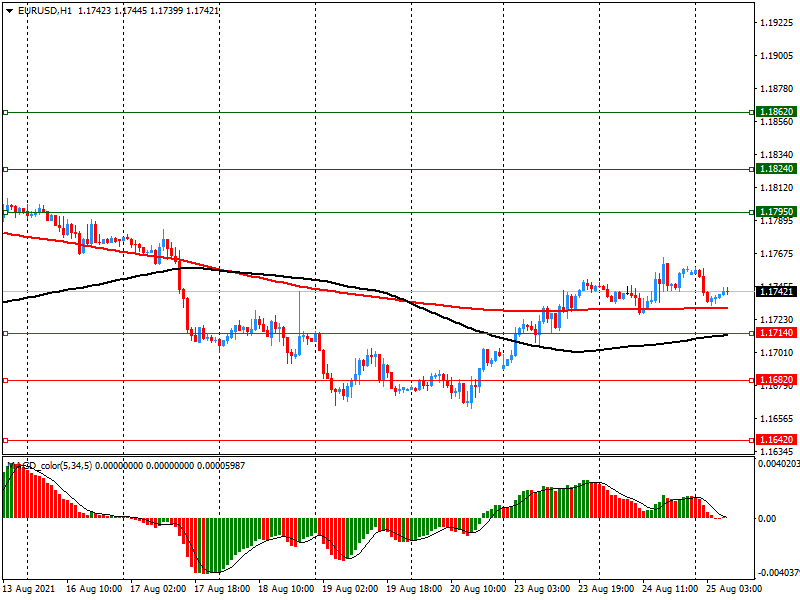
Comments:
- Overall open interest on the CALL options and PUT options with the expiration date September, 3 is 95212 contracts (according to data from August, 24) with the maximum number of contracts with strike price $1,2000 (8365);
GBP/USD
$1.3909 (789)
$1.3867 (899)
$1.3829 (228)
Price at time of writing this review: $1.3718
Support levels (open interest**, contracts):
$1.3656 (937)
$1.3623 (998)
$1.3584 (768)
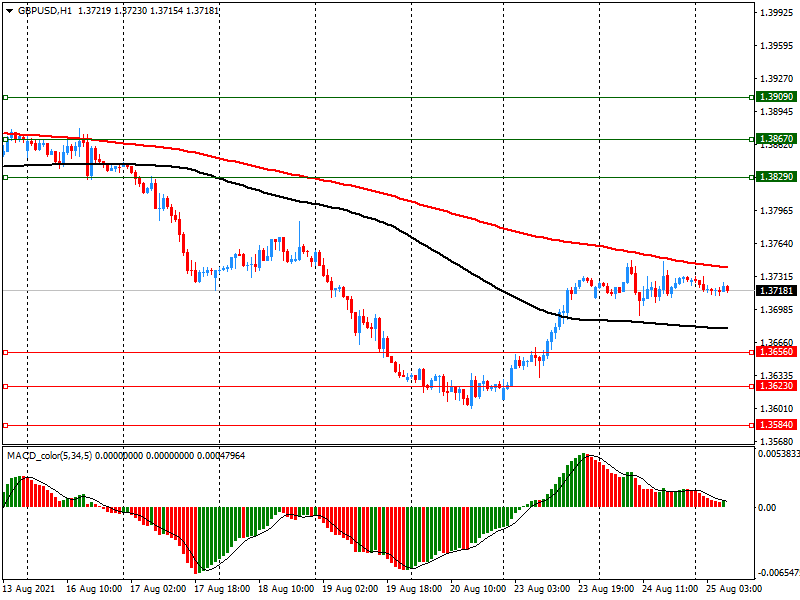
Comments:
- Overall open interest on the CALL options with the expiration date September, 3 is 18233 contracts, with the maximum number of contracts with strike price $1,4300 (2171);
- Overall open interest on the PUT options with the expiration date September, 3 is 15278 contracts, with the maximum number of contracts with strike price $1,3550 (1334);
- The ratio of PUT/CALL was 0.84 versus 0.86 from the previous trading day according to data from August, 24
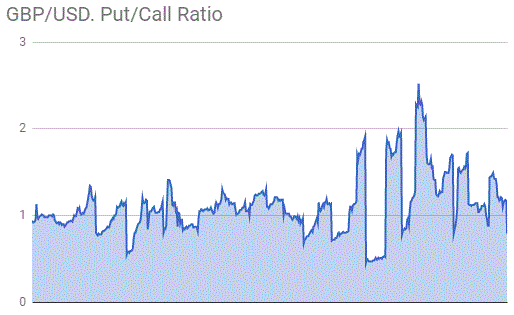
* - The Chicago Mercantile Exchange bulletin (CME) is used for the calculation.
** - Open interest takes into account the total number of option contracts that are open at the moment.
CNBC reports that U.S. Trade Representative Katherine Tai said the “Biden-Harris Administration and USTR are conducting a comprehensive review of U.S.-China trade policy”.
She acknowledged the significance of the U.S.-China trade relationship, and said the U.S. remains committed to “addressing China’s unfair trade policies and non-market practices that undermine American businesses and workers,” the readout said.
Michael Hirson, practice head for China and Northeast Asia at consulting firm Eurasia Group, has pointed out that Biden was able to persuade major G-7 countries to make strong statements against China.
However, Biden has “not yet articulated a trade strategy or another approach that would really be effective in countering China’s economic strength,” Hirson said.
Trade tensions between the world’s two largest economies escalated under former President Donald Trump. A dispute that began with tariffs on billions of dollars’ worth of goods from both sides has since spilled over into technology and finance.
eFXdata reports that Nordea Research adopts a structural bearish bias on EUR/USD.
"The relative inflation outlook also heavily favours the USD versus the EUR, likely as it hints of a growing policy divergence between the Fed and the ECB. The Fed will be faced with a super tight labour market maybe already before New Year’s, which could lead to accelerating wage growth. Some of the dynamics that we will see inflation-wise in the US will look almost “late-cyclical” during 2022-2023, which also leaves a clear possibility of a hiking cycle being launched in the second half of 2022 with several hikes to follow in 2023. We expect the first hike from the Fed in September 2022, followed by another three hikes in 2023," Nordea adds.
| Raw materials | Closed | Change, % |
|---|---|---|
| Brent | 70.91 | 3.28 |
| Silver | 23.841 | 0.97 |
| Gold | 1802.647 | -0.14 |
| Palladium | 2470.1 | 3.14 |
| Time | Country | Event | Period | Previous value | Forecast |
|---|---|---|---|---|---|
| 01:30 (GMT) | Australia | Construction Work Done | Quarter II | 2.4% | 2.5% |
| 05:00 (GMT) | Japan | Leading Economic Index | June | 102.6 | |
| 05:00 (GMT) | Japan | Coincident Index | June | 92.1 | |
| 08:00 (GMT) | Switzerland | Credit Suisse ZEW Survey (Expectations) | August | 42.8 | |
| 08:00 (GMT) | Germany | IFO - Current Assessment | August | 100.4 | 100.8 |
| 08:00 (GMT) | Germany | IFO - Expectations | August | 101.2 | 100 |
| 08:00 (GMT) | Germany | IFO - Business Climate | August | 100.8 | 100.4 |
| 10:00 (GMT) | United Kingdom | CBI retail sales volume balance | August | 23 | 20 |
| 12:30 (GMT) | U.S. | Durable goods orders ex defense | July | 1% | |
| 12:30 (GMT) | U.S. | Durable Goods Orders ex Transportation | July | 0.3% | 0.5% |
| 12:30 (GMT) | U.S. | Durable Goods Orders | July | 0.8% | -0.3% |
| 13:00 (GMT) | Belgium | Business Climate | August | 10.1 | |
| 14:30 (GMT) | U.S. | Crude Oil Inventories | August | -3.234 | -2.367 |
| Pare | Closed | Change, % |
|---|---|---|
| AUDUSD | 0.72539 | 0.61 |
| EURJPY | 128.855 | 0.05 |
| EURUSD | 1.17545 | 0.08 |
| GBPJPY | 150.548 | 0.05 |
| GBPUSD | 1.37292 | 0.07 |
| NZDUSD | 0.69469 | 0.91 |
| USDCAD | 1.25914 | -0.44 |
| USDCHF | 0.91223 | 0.01 |
| USDJPY | 109.623 | -0.04 |







© 2000-2026. All rights reserved.
This site is managed by Teletrade D.J. LLC 2351 LLC 2022 (Euro House, Richmond Hill Road, Kingstown, VC0100, St. Vincent and the Grenadines).
The information on this website is for informational purposes only and does not constitute any investment advice.
The company does not serve or provide services to customers who are residents of the US, Canada, Iran, The Democratic People's Republic of Korea, Yemen and FATF blacklisted countries.
Making transactions on financial markets with marginal financial instruments opens up wide possibilities and allows investors who are willing to take risks to earn high profits, carrying a potentially high risk of losses at the same time. Therefore you should responsibly approach the issue of choosing the appropriate investment strategy, taking the available resources into account, before starting trading.
Use of the information: full or partial use of materials from this website must always be referenced to TeleTrade as the source of information. Use of the materials on the Internet must be accompanied by a hyperlink to teletrade.org. Automatic import of materials and information from this website is prohibited.
Please contact our PR department if you have any questions or need assistance at pr@teletrade.global.


 Bank
Bank transfers


