- Analytics
- News and Tools
- Market News
CFD Markets News and Forecasts — 20-08-2021
On Monday, initially, the focus will be on business activity indices in the manufacturing sector and the service sector for August: Japan will report at 00:30 GMT, France at 07:15 GMT, Germany at 07:30 GMT, the eurozone at 08:00 GMT, and Britain at 08:30 GMT. At 10:00 GMT, Britain will publish the balance of industrial orders according to the CBI for August. At 13:45 GMT, the US will release the manufacturing PMI and the services PMI for August. At 14:00 GMT, the US will announce a change in existing home sales for July. Also at 14: 00 GMT, the eurozone will publish an indicator of consumer confidence for August. At 22:45 GMT, New Zealand will announce a change in retail trade volume for the 2nd quarter.
On Tuesday, at 06:00 GMT, Germany will announce the change in GDP for the 2nd quarter. At 14:00 GMT, the US will report on the change in new home sales for July and will release the Fed-Richmond manufacturing index for August. At 22:45 GMT, New Zealand will announce a change in the foreign trade balance for July.
On Wednesday, at 01:30 GMT, Australia will report on the change in construction work done for the 2nd quarter. At 08:00 GMT, Switzerland will release an index of investor expectations, according to ZEW and Credit Suisse for August. At 08:00 GMT, Germany will present the IFO business environment indicator, the IFO current situation assessment indicator and the IFO economic expectations indicator for August. At 10:00 GMT, Britain will release the retail sales index according to the CBI for August. At 12:30 GMT, the US will announce a change in durable goods orders for July. At 13:00 GMT, Belgium will publish an index of business sentiment for August. At 14:30 GMT, the US will report on the change in oil reserves according to the Ministry of Energy.
On Thursday, at 01:30 GMT, Australia will announce a change in the volume of capital expenditures in the private sector for the 2nd quarter. At 06:00 GMT, Germany will release the Gfk consumer climate index for September. At 08:00 GMT, the eurozone will report on the change in the M3 money supply and the private loans for July. At 11:30 GMT, in the eurozone, the ECB monetary policy meeting accounts will be released . At 12:30 GMT, the US will announce changes in GDP for the 2nd quarter and the number of initial applications for unemployment benefits. Also on Thursday, an economic symposium will be held in Jackson Hole. At 23:30 GMT, Japan will release the Tokyo consumer price index for August and report on the change in the unemployment rate for July.
On Friday, at 01:30 GMT, Australia will announce a change in the volume of retail trade for July. At 07:00 GMT, Switzerland will present the index of leading economic indicators from KOF for August. At 12:30 GMT, Canada will release the producer price index for July. Also at 12: 30 GMT, the US will publish the PCE price index for July, as well as report on changes in household income and expenses for July. At 14:00 GMT, the US will present the Reuters/Michigan consumer sentiment index for August. Also at 14:00 GMT in the United States, the head of the Federal Reserve Powell will make a speech. At 17:00 GMT, in the United States, the Baker Hughes report on the number of active oil drilling rigs will be released. Also on Friday, an economic symposium will be held in Jackson Hole.
eFXdata reports that analysts at Danske Research discuss AUD outlook.
"The weakening risk sentiment and the decline in iron ore prices weighed on the AUD yesterday. Australia's rising Covid-cases and lasting lockdowns are starting to be visible in economic data, as although the July unemployment rate fell to 4.6% (from 4.9%), the decline was driven by a drop in labor force participation rate, and the number of full-time employees actually declined."
"The combination of near-term domestic uncertainty and weakening demand outlook for Australia's key export commodities signals further weakness for the AUD," Danske adds."
ActionForex reports that analysts at TD Bank Financial Group provide their views on Canada's June retail sales.
"Reopening of non-essential stores boosted retail activity in June, with sales rising by 4.2% m/m. June’s growth was a only slightly lower than Statistics Canada’s preliminary estimate of 4.4% m/m. This left sales 3.5% below March level, but 8% above its pre-pandemic (February 2020) level."
"Looking ahead, the agency’s flash estimate suggests that retail activity decreased in July, with sales dropping by 1.7% m/m."
"Sales of motor vehicle & parts rose for the first time since March (+2.7%), and higher prices drove sales of gasoline higher in nominal terms (+6.0%). Gasoline sales also rose in volume terms (+4.7%) consistent with improving mobility trends."
"Core sales, which exclude the two above-mentioned categories, rose even more than the headline (+4.6%)."
"Categories hardest hit by third-wave restrictions led the rebound. Brisk growth was reported for clothing and clothing accessories stores (+49%), and furniture and home furnishing stores (+23%)."
"Retail activity continues to ebb and flow consistent with the tightening and easing of the public health restrictions. As expected, easing restrictions on in-person shopping and falling case counts ushered consumers back to stores in June."
"While consumers have been enjoying their newly found access to stores, they have also started shifting their spending patterns away from goods and toward services such as dining out, recreation, and travel. This transition likely weighed on retail sales in July, as indicated by the decline in the advance estimate. That said, improvement in spending on high-touch services, in addition to robust retail expenditure, bodes well for GDP growth in the third quarter."
FXStreet reports that Alvin Liew, the senior economist at UOB Group, reviews the latest publication of the FOMC Minutes of the 27-28 meeting.
“While the latest July FOMC minutes showed that the Federal Reserve (FED) could reach the standards set out to start QE tapering this year, it also highlighted there remained significant differences among the FOMC members on the timing of QE tapering as they differed in their views about the economy, the persistence of high inflation, ongoing labor market developments and the risk to recovery posed by the COVID-19 Delta variant.”
“The minutes generally painted a positive outlook for the US but there were reservations/ cautious views among FOMC officials considering the supply constraints & bottlenecks, and the challenges posed by the COVID-19 variant.”
“The latest FOMC minutes did not change our view. We still expect the first indicative hint of QE tapering to be released during the Jackson Hole Symposium (26 Aug) and further articulated into a pledge of the taper timeline in the 21/22 Sep 2021 FOMC. We expect the first taper to be carried out in Dec 2021 and the tapering process will last for nearly 1.5 years until May 2023. Thereafter, we project two 25bps rate hikes for 2023, first to 0.25%-0.50% in Jun and to 0.50%-0.75% in Dec.”
Statistics Canada reported on Friday the New Housing Price Index (NHPI) went up 0.4 percent m-o-m in July, following a 0.6 percent m-o-m advance in the previous month. This was the smallest increase since December 2020.
According
to the report, new home prices rose in 19 out of the 27 census metropolitan areas
(CMAs) surveyed in July, with Oshawa (+4.3 percent m-o-m) recording the largest
monthly advance in new home prices, as it enjoys proximity to the neighbouring Toronto region and is seen a cheaper alternative for those who commute to Toronto.
In y-o-y terms, NHPI soared 11.9 percent in July,
the same pace as in the previous month.
FXStreet reports that UOB Group’s Economist Lee Sue Ann comments on the Australian labour market figures.
“The Australian economy added 2,200 jobs in July, much better than expectations for a loss of 43,100 jobs following the increase of 29,100 jobs previously... The participation rate decreased by 0.2 pts to 66.0%. Accompanying the rise in employment, the unemployment rate fell further to 4.6% from 4.9% previously. The jobless rate has dropped for eight straight months, from 6.9% in October 2020, and this is the lowest print for the unemployment rate since December 2008.”
“That said, the rapid decline in the unemployment rate looks set to come to an end, amid multiple COVID-19 lockdowns across the country, which threaten the economic backdrop... The tightening of restrictions through July and August could further reduce participation over coming months. We think the unemployment rate is now set to spike above 5% again in coming months, before resuming its downtrend by 2022, assuming vaccination rates increase and lockdowns become less necessary.”
U.S. stock-index futures traded mixed and little changed on Friday as investors continued to grapple with worries about the economic impact of the COVID-19 Delta variant and uncertainties about the Fed's taper timeline.
Global Stocks:
Index/commodity | Last | Today's Change, points | Today's Change, % |
Nikkei | 27,013.25 | -267.92 | -0.98% |
Hang Seng | 24,849.72 | -466.61 | -1.84% |
Shanghai | 3,427.33 | -38.22 | -1.10% |
S&P/ASX | 7,460.90 | -3.70 | -0.05% |
FTSE | 7,050.84 | -8.02 | -0.11% |
CAC | 6,591.89 | -14.00 | -0.21% |
DAX | 15,711.46 | -54.35 | -0.34% |
Crude oil | $62.33 | -1.84% | |
Gold | $1,781.70 | -0.08% |
- Says big imponderable for economy is the path of Delta virus
- Delta virus is limiting production output and slowing return to office
- He will be watching it Delta carefully
- If Delta is having a more negative effect on the GDP growth, it could cause me to adjust my views
- A big economic variable is how quickly to get people vaccinated
(company / ticker / price / change ($/%) / volume)
3M Co | MMM | 193.22 | -0.67(-0.34%) | 652 |
ALCOA INC. | AA | 37.36 | 0.44(1.19%) | 87289 |
ALTRIA GROUP INC. | MO | 48.23 | -0.01(-0.02%) | 13047 |
American Express Co | AXP | 157.55 | -1.48(-0.93%) | 1028 |
AMERICAN INTERNATIONAL GROUP | AIG | 52.5 | -0.46(-0.87%) | 204 |
Apple Inc. | AAPL | 147.26 | 0.56(0.38%) | 597885 |
AT&T Inc | T | 27.55 | 0.02(0.07%) | 138166 |
Boeing Co | BA | 212.05 | -0.11(-0.05%) | 58360 |
Caterpillar Inc | CAT | 205 | 0.55(0.27%) | 5695 |
Chevron Corp | CVX | 93.66 | -0.63(-0.67%) | 23079 |
Cisco Systems Inc | CSCO | 57.29 | 0.02(0.03%) | 32249 |
Citigroup Inc., NYSE | C | 69.65 | -0.19(-0.27%) | 12581 |
Deere & Company, NYSE | DE | 365.25 | 6.27(1.75%) | 41808 |
E. I. du Pont de Nemours and Co | DD | 72.63 | -0.29(-0.39%) | 410 |
Exxon Mobil Corp | XOM | 52.25 | -0.48(-0.91%) | 74976 |
Facebook, Inc. | FB | 355 | -0.12(-0.03%) | 28132 |
FedEx Corporation, NYSE | FDX | 266.75 | -0.81(-0.30%) | 2145 |
Ford Motor Co. | F | 12.64 | -0.03(-0.24%) | 252931 |
Freeport-McMoRan Copper & Gold Inc., NYSE | FCX | 32.27 | -0.15(-0.46%) | 56661 |
General Electric Co | GE | 99.25 | -0.17(-0.17%) | 12939 |
General Motors Company, NYSE | GM | 48.94 | -0.14(-0.29%) | 63805 |
Goldman Sachs | GS | 392.81 | -0.76(-0.19%) | 4203 |
Hewlett-Packard Co. | HPQ | 27.66 | -0.12(-0.43%) | 3936 |
Intel Corp | INTC | 52.4 | -0.04(-0.08%) | 30204 |
International Business Machines Co... | IBM | 137.95 | -0.07(-0.05%) | 1547 |
Johnson & Johnson | JNJ | 177.93 | -0.64(-0.36%) | 1537 |
JPMorgan Chase and Co | JPM | 153.85 | -0.43(-0.28%) | 19905 |
Merck & Co Inc | MRK | 78.35 | -0.11(-0.14%) | 4453 |
Microsoft Corp | MSFT | 298.51 | 1.74(0.59%) | 157806 |
Nike | NKE | 165.49 | -0.10(-0.06%) | 4960 |
Pfizer Inc | PFE | 48.85 | 0.05(0.10%) | 147184 |
Procter & Gamble Co | PG | 144.68 | -0.31(-0.21%) | 1028 |
Starbucks Corporation, NASDAQ | SBUX | 114 | -0.32(-0.28%) | 3874 |
Tesla Motors, Inc., NASDAQ | TSLA | 683.37 | 9.90(1.47%) | 437704 |
The Coca-Cola Co | KO | 56.75 | -0.11(-0.19%) | 9261 |
Twitter, Inc., NYSE | TWTR | 62.21 | 0.16(0.26%) | 16380 |
Verizon Communications Inc | VZ | 55.29 | -0.08(-0.14%) | 52926 |
Visa | V | 231.14 | -0.43(-0.19%) | 1156 |
Wal-Mart Stores Inc | WMT | 149.75 | -0.36(-0.24%) | 2667 |
Walt Disney Co | DIS | 173 | -0.25(-0.14%) | 17019 |
Yandex N.V., NASDAQ | YNDX | 68.02 | -0.23(-0.34%) | 2269 |
Statistics
Canada announced on Friday that the Canadian retail sales increased 4.2 percent
m-o-m to CAD56.16 billion in June, following an unrevised 2.1 percent m-o-m drop
in May.
This was the first gain in retail sales in the last three months.
Economists
had forecast a 4.4 percent m-o-m decrease for June.
According
to the report, sales went up in 8 of 11 subsectors in June, accounting for 69.5
percent of total retail sales, led by lower sales at clothing and clothing
accessories stores (+49.1 percent m-o-m).
Core retail sales, which excludes gasoline stations and motor vehicle and parts dealers, rose 4.6 percent m-o-m in June after dropping 2.4 percent m-o-m in the previous month.
In
y-o-y terms, Canadian retail sales grew 6.2 percent in June, following an unrevised
24.6 percent jump in May.
FXStreet notes that S&P 500 managed to recover off its lows on Thursday but economists at Credit Suisse remain of the view a corrective phase is underway. A close below 4425 today would see a bearish “reversal week” established to add further downside pressure.
“It is quite possible we may see a bearish ‘reversal week’ if we see a close below key support at 4225 today, further increasing near-term bearish pressures. This is in addition to the broader ‘risk-off’ signals with a base in the USD now seen in place.”
“We look for a retest of 4368/64, below which is expected to see a test of what we look to be better support at 4328/18 – the key rising 63-day average and the 38.2% retracement of the rally from May. Our bias would be to look for a floor here. A close below 4318 though would instead warn of a more protracted correction lower.”
“Resistance stays seen at 4418/19 initially, with 4424/28 ideally capping to keep the immediate risk lower.”
FXStreet reports that Lee Sue Ann, an economist at UOB Group, reviews the latest inflation figures in the euro area.
“Eurozone CPI rose to 2.2% y/y in July, confirming an earlier estimate, and up from 1.9% y/y in June. This is the fastest pace since October 2018, and above the European Central Bank (ECB)'s target of 2.0%... Core CPI eased to 0.7% y/y, mostly on lower clothing prices due to the timing of summer sales in France and Italy. This was in line with the initial estimate, and down from 0.9% y/y in June.”
“The ECB is predicting further increases in inflation in the coming months, but sees this as largely temporary. We, too, expect to see inflation readings increasing further in August. The core rate should rebound above its June level, as the effect from the timing of clothing sales in France and Italy reverse. But we see the July readings as consistent with the view that the current upturn in inflation will prove transitory.”
“The sharp jump in inflation readings to pre-pandemic levels earlier this year signaled a rebound in economic activity, but core inflation remains subdued. There is still evidence of global supply chain issues feeding its way through pandemic high-demand items, albeit to a lesser extent than in the US, and these inflationary pressures are being offset by disinflation in parts of the service sector. That said, inflation in the service sector should recover as the Eurozone economy sustainably reopens, though gains will be offset somewhat by easing global supply chain bottlenecks in many goods prices.”
| Time | Country | Event | Period | Previous value | Forecast | Actual |
|---|---|---|---|---|---|---|
| 06:00 | Germany | Producer Price Index (YoY) | July | 8.5% | 9.2% | 10.4% |
| 06:00 | Germany | Producer Price Index (MoM) | July | 1.3% | 0.8% | 1.9% |
| 06:00 | United Kingdom | PSNB, bln | July | -21.5 | -11.8 | -10.4 |
| 06:00 | United Kingdom | Retail Sales (MoM) | July | 0.2% | 0.4% | -2.5% |
| 06:00 | United Kingdom | Retail Sales (YoY) | July | 9.2% | 6% | 2.4% |
GBP traded mixed against other major currencies in the European session on Friday, as risk currencies, including sterling, came under pressure amid heightened worries about the pace of the global economic recovery amid surging coronavirus infections caused by the highly contagious delta variant.
The pound fell against USD, CHF, EUR and JPY, but rose against NZD, CAD and AUD.
Concerns that the world’s major central banks will start scaling back their stimulus just as growth decelerates also undermined global risk sentiment.
In addition, the UK’s July retail sales report disappointed market participants with a sudden m-o-m drop. The Office for National Statistics (ONS) reported that Briain’s retail sales volumes dropped by 2.5 percent m-o-m in July, following a downwardly revised 0.2 percent m-o-m gain in the previous month. This was the largest monthly drop in retail sales since January. Economists had forecast a 0.4 percent m-o-m rise.
FXStreet notes that gold is under pressure amid fears of tighter monetary policy and renewed strength in the USD. Nevertheless, record low US 10-year real interest should limit any significant sell-off from the current level, in the view of strategists at ANZ Bank.
“Record low US 10-year real yields are supporting gold as the Fed debates tapering asset purchases. However, elevated inflation expectations appear to be having limited impact.”
“Lofty equity valuations are increasing the risk of a market correction. This could encourage investors to hold safe-haven assets. Renewed strength in the USD is a key headwind. Hawkish Fed comments could support the USD and drag prices lower.”
“Despite low-inerest rates and accommodative central banks’ stance, investment demand is not picking up. ETF flows in gold and silver remain subdued, while investors sold their long futures positions. Retail investment is showing some encouraging signs, with US eagle gold coin sales rebounding strongly by 19% YTD.”
“Physical demand is recovering in China as well as India, with spot premium turning positive for both countries.”
FXStreet reports that Karen Jones, Team Head FICC Technical Analysis Research at Commerzbank, suggests that USD/JPY is set to remain under pressure below 110 and see a dip to the 108.73 recent low.
“USD/JPY is seeing a small rebound near-term, but as this has made no impact on resistance so far, we maintain a negative bias.”
“We look for a retest of the 109.07 and 108.73 recent lows.”
“A drop through 108.56 (end of May low) would engage the 107.48 April low.”
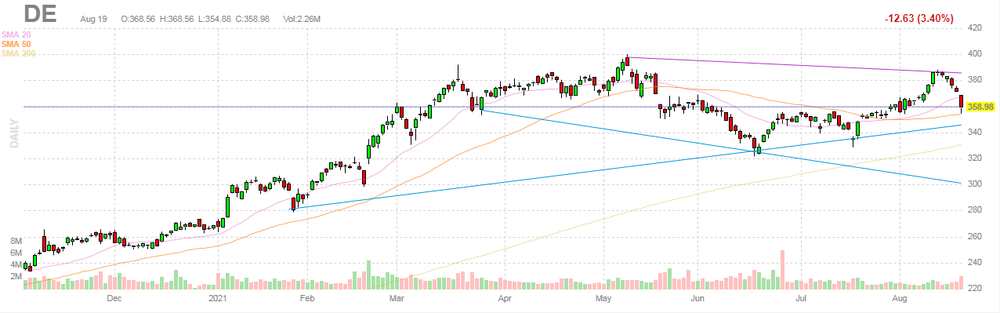
Deere (DE) reported Q3 FY 2021 earnings of $5.32 per share (versus $2.57 per share in Q3 FY 2020), beating analysts’ consensus estimate of $4.58 per share.
The company’s quarterly revenues amounted to $10.413 bln (+32.5% y/y), roughly in line with analysts’ consensus estimate of $10.332 bln.
DE closed Thursday's trading session at $358.98 (-3.40%).
FXStreet reports that FX Strategists at UOB Group note that the upside momentum in USD/CNH now faces the next hurdle at 6.1580 ahead of 6.5300.
24-hour view: “We highlighted yesterday that ‘the underlying tone has firmed and the bias is tilted to the upside’. We were of the view that ‘any advance is unlikely to break the major resistance at 6.5000’. However, USD took out 6.5000 and soared to 6.5040 before closing on a firm note at 6.5009 (+0.26%). Upward momentum is showing signs of slowing and this coupled with overbought conditions suggest that while USD could rise further, the major resistance at 6.5180 is unlikely to come into the picture.”
Next 1-3 weeks: “We have held the same view since early last week that USD ‘has to close above 6.5000 before a sustained advance can be expected’. Two days ago (18 Aug, spot at 6.4885), we highlighted that upward momentum has improved slightly and the ‘chance for USD to close above 6.5000 has increased’. USD rose to 6.5040 yesterday before closing at 6.5009 (+0.26%). While we would have preferred a stronger daily closing, the price actions suggest that USD is ready to head higher from here. Resistance is at 6.5180 followed by 6.5300.”
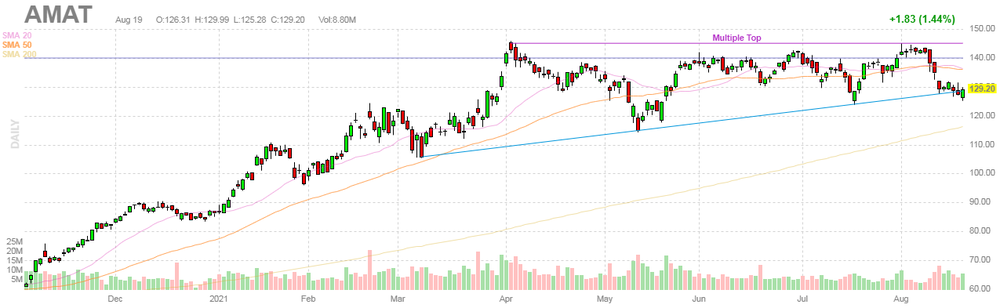
Applied Materials (AMAT) reported Q3 FY 2021 earnings of $1.90 per share (versus $1.06 per share in Q3 FY 2020), beating analysts’ consensus estimate of $1.78 per share.
The company’s quarterly revenues amounted to $6.196 bln (+41.0% y/y), beating analysts’ consensus estimate of $5.919 bln.
AMAT fell to $127.77 (-1.11%) in pre-market trading.
FXStreet reports that economists at Danske Bank discuss the USD/CNY outlook.
“We continue to look for USD/CNY to move gradually higher over the next 12 months and have not changed our profile towards the 12M forecast at 6.70.”
“With the overall USD strengthening and ongoing policy divergence (PBoC easing, the Fed tightening) downside pressure remains on CNY vs. USD.”
“We still look for EUR/CNY to be around 7.70 on 12M, slightly higher than the current level of 7.63.”
CNBC reports that U.S. Treasury yields fell, amid continued concerns about the spread of the delta variant and discussion from the Fed of tapering bond purchases.
The yield on the benchmark 10-year Treasury note fell less than a basis point to 1.235%. The yield on the 30-year Treasury bond gave up 1.2 basis point, falling to 1.864%.
Treasury yields ebbed lower despite the latest meeting minutes from the Federal Reserve, released Wednesday. In addition, concerns about the spread of the delta variant continued to weigh on sentiment.
eFXdata reports that MUFG Research sees a scope for further EUR/USD decline in the near-term.
"The US dollar and the performance of risk assets matters quite a lot when it comes to inflation expectations and the Fed will need to thread carefully. 11 new COVID cases in New Zealand is an example of central banks abroad having to pare back their own plans to reverse stimulus and with global COVID figures rising and Asia in particular struggling, an earlier start to tapering seems an unnecessary risk at this juncture. The break lower in EUR/USD below the 1.1700 level is key and also means we are now close to the entire EUR/USD rally since last November being reversed – the point in time when the COVID vaccines efficacy rates were announced that prompted the strong global risk-on rally," MUFG adds.
FXStreet reports that according to economists at MUFG, GBP is set to be underpinned by the Bank of England’s willingness to continue the plans to remove policy accommodation next year.
“With the markets priced for BoE action in 2022 certainly GBP will remain vulnerable to an extension of risk-off that starts to result in investors questioning the ability of G10 central banks to raise rates at all. But we don’t think we are at that juncture yet. Indeed, we don’t think we’ll get there either.”
“As COVID-19 hopefully recedes as a big issue, we expect Brexit to get much more focus and while the transitory inflation view still makes sense, the extent of easing inflation may well be far less in the UK than elsewhere. A more active BoE would be one implication that would result in GBP outperformance.”
eFXdata reports that ING Research discusses EUR/USD outlook.
"The move in EUR/USD below 1.1700 appeared to be a matter of when rather than if considering the deterioration in global sentiment and the lack of positive idiosyncratic drivers for the euro. The next key support for the pair should be at the 1.1600 November lows. More consolidation in the USD bullish trend could soon see markets look to 1.1500 as a next pivotal level in EUR/USD," ING adds.
Bloomberg reports that Reserve Bank of Australia board member Ian Harper said he expects the jobless rate to climb back above 5% and to see a “much bigger” fall in participation as renewed lockdowns along the nation’s east coast flow through to the labor market.
In July, unemployment actually fell to 4.6% from 4.9% and the economy managed to add jobs. But the report also showed hours worked fell and under-employment rose.
“Those numbers haven’t picked up the full impact” of the curbs, said Harper. “There are likely to be more job losses and more people leaving the labor market in the period ahead.”
Harper said the economy seems to be tracking between the central bank’s base case and downside scenarios, as set out in its quarterly update of economic forecasts released two weeks ago.
Harper’s confidence in a quick rebound is partly because the hit to the economy is on the supply side, while evidence from Australia and abroad shows demand returns rapidly when restrictions are lifted. Still, he acknowledged that the delta variant of coronavirus is different than what the country faced last year.
CNBC reports that China passed a major data protection law, setting out tougher rules on how companies collect and handle their users’ information. The rules add to Beijing’s tightening of regulation, particularly around data, which could impact the way China’s technology giants operate.
The Personal Information Protection Law (PIPL) lays out for the first time a comprehensive set of rules around data collection, processing and protection, that were previously governed by piecemeal legislation.
After several drafts, the PIPL was passed by China’s legislature on Friday, according to state media. However, the final version of the law has not yet been published.
The PIPL comes as China’s regulatory scrutiny on the country’s technology companies intensifies. With the PIPL, alongside the country’s Cybersecurity Law and Data Security Law, China has beefed up its data regulation.
“The release of the PIPL completes the trifecta of China’s foundational data governance regime, and will usher in a new age of data compliance for tech companies,” said Kendra Schaefer, Beijing-based partner at Trivium China consultancy.
FXStreet reports that economists at Nordea increase their conviction in a stronger USD and target levels around 1.10 in EUR/USD.
“We target levels around 1.10 in EUR/USD over the forecast horizon and expect the bulk of the move to happen sooner rather than later in conjunction with the launch of the tapering process.”
“Would the ECB be annoyed with a lower EUR/USD reading? Not at all since a lower reading would be helpful in bringing EUR inflation to 2% or above as wished for. This leaves a decent scope for a move lower in EUR/USD, also as positioning is not yet USD heavy.”
“The relative inflation outlook also heavily favours the USD versus the EUR, likely as it hints of a growing policy divergence between the Fed and the ECB. [...] We expect the first hike from the Fed in September 2022, followed by another three hikes in 2023.”
“We continue to think that the ECB will stick with the current EUR1850 B envelope, which still has more than EUR500 B of firepower left. Against the modest Euro-area inflation outlook, we do not see any ECB rate hikes even in our extended forecast horizon until the end of 2023.”
| Time | Country | Event | Period | Previous value | Forecast | Actual |
|---|---|---|---|---|---|---|
| 06:00 | Germany | Producer Price Index (YoY) | July | 8.5% | 9.2% | 10.4% |
| 06:00 | Germany | Producer Price Index (MoM) | July | 1.3% | 0.8% | 1.9% |
| 06:00 | United Kingdom | PSNB, bln | July | -21.5 | -11.8 | -10.4 |
| 06:00 | United Kingdom | Retail Sales (MoM) | July | 0.2% | 0.4% | -2.5% |
| 06:00 | United Kingdom | Retail Sales (YoY) | July | 9.2% | 6% | 2.4% |
During today's Asian trading, the US dollar was almost unchanged against the major currencies. The ICE index, which tracks the dynamics of the dollar against six currencies (euro, swiss franc, yen, canadian dollar, pound sterling and swedish krona), rose by 0.01% to 93.57 - this is the highest value since November 2020.
Traders are waiting for new signals from the Federal Reserve, believing that the chairman of the Fed, Jerome Powell, can give hints about when the reduction in the volume of repurchases will begin, during the annual economic symposium in Jackson Hole, which will be held next week.
The statistical data published on Thursday confirmed that the situation in the US labor market allows the Fed to start curtailing incentives. The number of new applications for unemployment benefits in the United States last week decreased by 29 thousand - to 348 thousand people, the lowest since the beginning of the pandemic, the US Department of Labor reported.
RTTNews reports that China maintained its one-year loan prime rate at 3.85 percent and the five-year loan prime rate at 4.65 percent.
The one-year and five-year loan prime rates were last lowered in April 2020. The one-year loan prime rate was cut by 20 basis points and five-year rate by 10 basis points in April 2020.
The loan prime rate is fixed monthly based on the submission of 18 banks, though Beijing has influence over the rate-setting. This lending rate replaced the central bank's traditional benchmark lending rate in August 2019.
With the economy losing momentum, it won't be long before the PBoC is guiding rates lower, Julian Evans-Pritchard, an economist at Capital Economics, said. Even so, another round of large-scale credit-led stimulus does not appear to be on the cards for now.
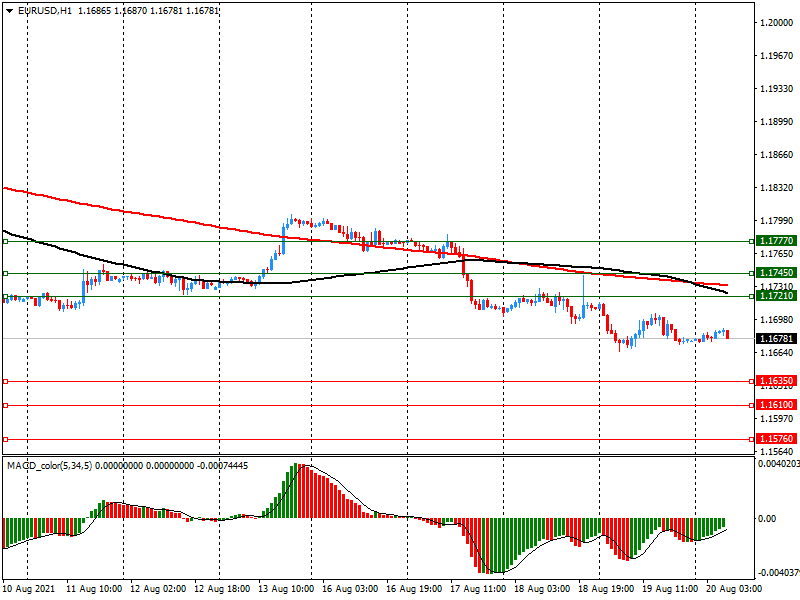
EUR/USD
Resistance levels (open interest**, contracts)
$1.1777 (736)
$1.1745 (1101)
$1.1721 (103)
Price at time of writing this review: $1.1678
Support levels (open interest**, contracts):
$1.1635 (5078)
$1.1610 (2748)
$1.1576 (3238)
Comments:
- Overall open interest on the CALL options and PUT options with the expiration date September, 3 is 90331 contracts (according to data from August, 19) with the maximum number of contracts with strike price $1,2000 (8348);
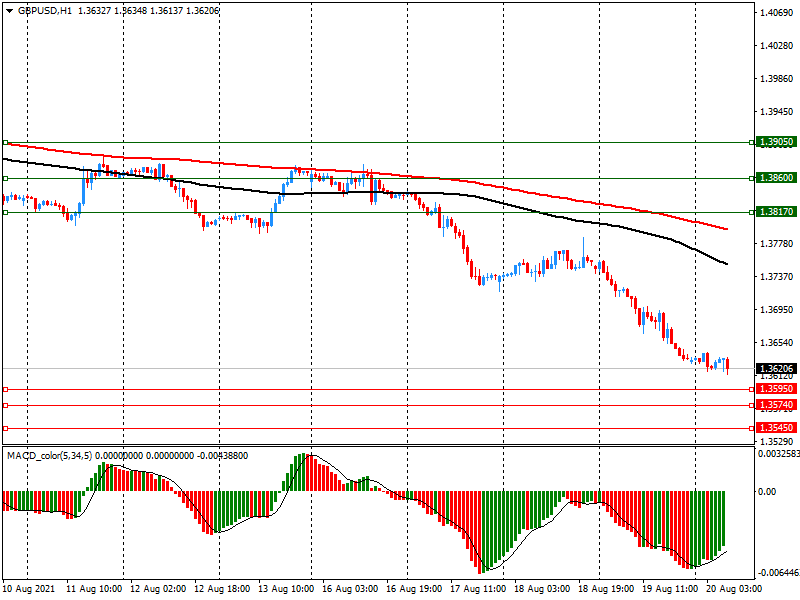
GBP/USD
$1.3905 (781)
$1.3860 (897)
$1.3817 (222)
Price at time of writing this review: $1.3621
Support levels (open interest**, contracts):
$1.3595 (939)
$1.3574 (1009)
$1.3545 (782)
Comments:
- Overall open interest on the CALL options with the expiration date September, 3 is 16532 contracts, with the maximum number of contracts with strike price $1,4300 (2171);
- Overall open interest on the PUT options with the expiration date September, 3 is 14764 contracts, with the maximum number of contracts with strike price $1,3550 (1352);
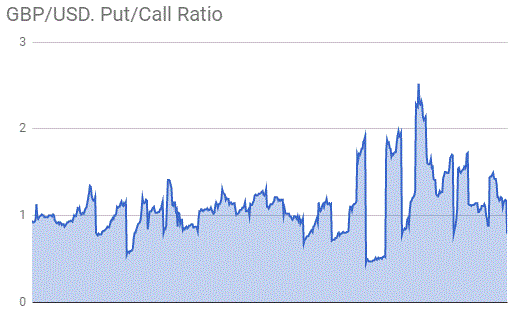
- The ratio of PUT/CALL was 0.89 versus 0.87 from the previous trading day according to data from August, 19
* - The Chicago Mercantile Exchange bulletin (CME) is used for the calculation.
** - Open interest takes into account the total number of option contracts that are open at the moment.
FXStreet reports that Quek Ser Leang at UOB Group’s Global Economics & Markets Research discusses US Dollar Index (DXY) prospects.
“A weekly close above the 55-week exponential moving average (currently at 92.55) would greatly increase the odds for USD Index to advance to the April’s high at 93.44’.”
“This week, USD Index stages a strong advance and it has just edged above 93.44 earlier. The breach of 93.44 (while not confirmed by a weekly closing just yet) is accompanied by a rapid build-up in momentum and further USD Index strength appears likely within these couple of months.”
“The next resistance level of note is at 94.00 (55-month exponential moving average, not visible in the chart above). At this stage, it is a bit too early to expect USD Index to advance towards the Sep 2020 high of 94.74. All in, the “consolidation phase” over the past two months appears to have ended and the next up-leg in USD Index has likely started. Only an unlikely break of 91.80 would indicate that USD Index is not ready to head higher.”
The Federal Statistical Office said that in July 2021, the index of producer prices for industrial products increased by 10.4% compared with July 2020. Economists had expected a 9.2% increase. This was the highest increase compared to the corresponding month of the preceding year since January 1975 (+10.5%), when prices rose strongly during the first oil crisis. Compared with the preceding month June 2021 the overall index rose by 1.9% in July 2021.
Mainly responsible for the increase of producer prices compared to July 2020 were the prices of intermediate products and of energy.
Prices of intermediate goods increased by 15.6% compared to July 2020. Compared to June 2021 these prices were up 2.3 %.
Energy prices as a whole increased by 20.4% compared to July 2020 and by 4.1 compared to June 2021. The price increase from July 2020 to July 2021 is mainly caused by a base effect resulting from the sharp drop in prices in spring 2020 in the course of the pandemic. The overall index disregarding energy was 7.4% up on July 2020.
Prices of durable consumer goods increased by 2.2% compared to July 2020 (+0.6% compared to June 2021), capital goods, such as machines and vehicles, by 1.8% (+0.5% compared to June 2021).
Prices of non-durable consumer goods increased by 1.8% compared to July 2020 and remained unchanged compared to June 2021.
According to the report from the Office for National Statistics, retail sales volumes fell by 2.5% between June and July 2021. Economists had expected a 0.4% increase. Looking more broadly, however, they were up by 5.2% in the three months to July compared with the previous three months and are 5.8% higher than their pre-coronavirus (COVID-19) pandemic February 2020 levels.
Food store sales volumes fell by 1.5% in July 2021, following an increase in the previous month when sales were positively boosted by the start of the Euro 2020 football championship.
Non-food stores reported a fall of 4.4% in sales volumes in July 2021 when compared with June 2021, driven by falls in other stores (negative 10.1%), such as second-hand goods stores and computer and telecoms equipment stores.
Automotive fuel sales volumes fell by 2.9% over the month, its first monthly fall since February 2021; with heavy rainfall in early July impacting road traffic volumes, automotive fuel sales volumes are now 6.7% below their pre-coronavirus pandemic February 2020 levels.
The proportion of retail sales online increased to 27.9% in July from 27.1% in June and remains substantially higher than the proportion of online retail spending in February 2020 (pre-coronavirus pandemic) of 19.8%.
| Raw materials | Closed | Change, % |
|---|---|---|
| Brent | 66.58 | -1.33 |
| Silver | 23.211 | -1.21 |
| Gold | 1779.778 | -0.42 |
| Palladium | 2308.48 | -4.83 |
| Time | Country | Event | Period | Previous value | Forecast |
|---|---|---|---|---|---|
| 06:00 (GMT) | Germany | Producer Price Index (YoY) | July | 8.5% | 9.2% |
| 06:00 (GMT) | Germany | Producer Price Index (MoM) | July | 1.3% | 0.8% |
| 06:00 (GMT) | United Kingdom | PSNB, bln | July | -22.8 | -11.8 |
| 06:00 (GMT) | United Kingdom | Retail Sales (MoM) | July | 0.5% | 0.4% |
| 06:00 (GMT) | United Kingdom | Retail Sales (YoY) | July | 9.7% | 6% |
| 12:30 (GMT) | Canada | Retail Sales YoY | June | 24.6% | |
| 12:30 (GMT) | Canada | Retail Sales, m/m | June | -2.1% | 4.4% |
| 12:30 (GMT) | Canada | New Housing Price Index, MoM | July | 0.6% | |
| 12:30 (GMT) | Canada | New Housing Price Index, YoY | July | 11.9% | |
| 12:30 (GMT) | Canada | Retail Sales ex Autos, m/m | June | -2% | 4.6% |
| 15:00 (GMT) | U.S. | FOMC Member Kaplan Speak | |||
| 17:00 (GMT) | U.S. | Baker Hughes Oil Rig Count | August | 397 |
| Pare | Closed | Change, % |
|---|---|---|
| AUDUSD | 0.71465 | -1.19 |
| EURJPY | 128.122 | -0.32 |
| EURUSD | 1.16767 | -0.27 |
| GBPJPY | 149.578 | -0.89 |
| GBPUSD | 1.36324 | -0.82 |
| NZDUSD | 0.68267 | -0.72 |
| USDCAD | 1.28218 | 1.33 |
| USDCHF | 0.91784 | 0.18 |
| USDJPY | 109.731 | -0.07 |







© 2000-2026. All rights reserved.
This site is managed by Teletrade D.J. LLC 2351 LLC 2022 (Euro House, Richmond Hill Road, Kingstown, VC0100, St. Vincent and the Grenadines).
The information on this website is for informational purposes only and does not constitute any investment advice.
The company does not serve or provide services to customers who are residents of the US, Canada, Iran, The Democratic People's Republic of Korea, Yemen and FATF blacklisted countries.
Making transactions on financial markets with marginal financial instruments opens up wide possibilities and allows investors who are willing to take risks to earn high profits, carrying a potentially high risk of losses at the same time. Therefore you should responsibly approach the issue of choosing the appropriate investment strategy, taking the available resources into account, before starting trading.
Use of the information: full or partial use of materials from this website must always be referenced to TeleTrade as the source of information. Use of the materials on the Internet must be accompanied by a hyperlink to teletrade.org. Automatic import of materials and information from this website is prohibited.
Please contact our PR department if you have any questions or need assistance at pr@teletrade.global.


 Bank
Bank transfers


