- Analytics
- News and Tools
- Market News
CFD Markets News and Forecasts — 24-08-2021
| Time | Country | Event | Period | Previous value | Forecast |
|---|---|---|---|---|---|
| 01:30 (GMT) | Australia | Construction Work Done | Quarter II | 2.4% | 2.5% |
| 05:00 (GMT) | Japan | Leading Economic Index | June | 102.6 | |
| 05:00 (GMT) | Japan | Coincident Index | June | 92.1 | |
| 08:00 (GMT) | Switzerland | Credit Suisse ZEW Survey (Expectations) | August | 42.8 | |
| 08:00 (GMT) | Germany | IFO - Current Assessment | August | 100.4 | 100.8 |
| 08:00 (GMT) | Germany | IFO - Expectations | August | 101.2 | 100 |
| 08:00 (GMT) | Germany | IFO - Business Climate | August | 100.8 | 100.4 |
| 10:00 (GMT) | United Kingdom | CBI retail sales volume balance | August | 23 | 20 |
| 12:30 (GMT) | U.S. | Durable goods orders ex defense | July | 1% | |
| 12:30 (GMT) | U.S. | Durable Goods Orders ex Transportation | July | 0.3% | 0.5% |
| 12:30 (GMT) | U.S. | Durable Goods Orders | July | 0.8% | -0.3% |
| 13:00 (GMT) | Belgium | Business Climate | August | 10.1 | |
| 14:30 (GMT) | U.S. | Crude Oil Inventories | August | -3.234 | -2.367 |
eFXdata reports that analysts at Credit Agricole CIB Research discuss the consequences from the unfolding crisis in Afghanistan on EUR/USD.
"We think that one important risk is that the latest developments could trigger a wave of displaced civilians that could head towards Europe in a repeat of the 2015 refugee crisis triggered by the civil war in Syria... In turn, this fueled national-level political risks that intensified in 2017 and escalated into EUR existential risks sending EUR/USD to multi-year lows."
"The question for many EUR-investors is whether the political crisis in Afghanistan would fuel another EUR existential crisis? We think that the answer is no..."
The
latest survey from the Federal Reserve Bank of Richmond revealed on Tuesday
that the U.S. fifth district's manufacturing activity continued to expand in August,
albeit at a slower pace than in July.
According
to the report, the composite manufacturing index dropped from 27 in July to 9
in August but remained in expansionary territory, as all three component
indexes - shipments (at 6 in August, down from 21 in July), new orders (at 5,
down from 25), and employment (at 18, down from 36) - declined steeply but remained
positive.
The
August print was the lowest since July 2020 and well below economists' forecast of 25.
A reading above 0 signals expansion, while a reading below 0 indicates
contraction.
Manufacturers
also reported that vendor lead times continued to increase and inventories
remained low, but, overall, they were optimistic that conditions would improve
in the next six months. In addition, the average growth rate of prices paid by survey
respondents fell slightly in August, while that of prices received increased.
Firms also forecast the price growth to slow over the next year, the Richmond
Fed noted.
The
U.S. Commerce Department announced on Tuesday that the sales of new
single-family homes rose 1.0 percent m-o-m to a seasonally adjusted annual rate
of 708,000 units in July.
Economists
had forecast the sales pace of 700,000 last month.
June’s
sales pace was revised up to 701,000 units from the originally reported 676,000
units.
According
to the report, new home sales in the South, the largest area, increased 1.3
percent m-o-m in July, while those in the West climbed 14.4 percent m-o-m. In
the meantime, new home sales in the Northeast plunged 24.1 percent m-o-m and
those in the Midwest tumbled 20.2 percent m-o-m.
The report also showed that median sales price surged
18.4 percent y-o-y to $390,500.
FXStreet notes that S&P 500 has surged to new record highs. The spotlight turns to trend resistance from April and the psychological 4498/4500 barrier, which strategists at Credit Suisse look to cap at first.
“The spotlight turns on trend resistance from April, today seen at 4493, just shy of the psychological 4500 level. Despite the strength yesterday our bias remains to look for a cap in this 4495/4500 zone at first for a fresh pullback.”
“A direct break of 4495/4500 can see resistance next at 4517/25. We do not see the market at the upper end of its ‘typical’ extreme though until it reaches 15% above its 200-day average, which is still some considerable distance away at 4624.”
“Support is seen at 4465 initially, then the price gap from yesterday morning at 4450/42.”
U.S. stock-index futures edged up on Tuesday, following a strong rally in the previous session that was caused by news about the U.S. Food and Drug Administration’s (FDA) full approval of the Pfizer/BioNTech’s coronavirus vaccine.
Global Stocks:
Index/commodity | Last | Today's Change, points | Today's Change, % |
Nikkei | 27,732.10 | +237.86 | +0.87% |
Hang Seng | 25,727.92 | +618.33 | +2.46% |
Shanghai | 3,514.47 | +37.34 | +1.07% |
S&P/ASX | 7,503.00 | +13.10 | +0.17% |
FTSE | 7,076.97 | -32.05 | -0.45% |
CAC | 6,639.07 | -44.03 | -0.66% |
DAX | 15,863.92 | +11.13 | +0.07% |
Crude oil | $66.60 | +1.46% | |
Gold | 27,732.10 | +237.86 | +0.87% |
(company / ticker / price / change ($/%) / volume)
3M Co | MMM | 195.5 | 0.82(0.42%) | 545 |
ALCOA INC. | AA | 41.38 | 0.27(0.66%) | 43719 |
ALTRIA GROUP INC. | MO | 48.53 | 0.05(0.10%) | 4792 |
Amazon.com Inc., NASDAQ | AMZN | 3,276.50 | 10.63(0.33%) | 26299 |
American Express Co | AXP | 161 | 0.55(0.34%) | 1740 |
Apple Inc. | AAPL | 149.47 | -0.24(-0.16%) | 499303 |
AT&T Inc | T | 27.54 | 0.02(0.07%) | 119646 |
Boeing Co | BA | 220.18 | 0.78(0.36%) | 86739 |
Caterpillar Inc | CAT | 209.5 | 0.36(0.17%) | 1572 |
Chevron Corp | CVX | 97.46 | 0.73(0.75%) | 28010 |
Cisco Systems Inc | CSCO | 58.4 | -0.14(-0.24%) | 15579 |
Citigroup Inc., NYSE | C | 71.05 | 0.16(0.23%) | 13799 |
Deere & Company, NYSE | DE | 363 | 0.20(0.06%) | 1576 |
Exxon Mobil Corp | XOM | 55.42 | 0.51(0.93%) | 78034 |
Facebook, Inc. | FB | 362.75 | -0.60(-0.17%) | 25583 |
FedEx Corporation, NYSE | FDX | 266.89 | -0.01(-0.00%) | 4280 |
Ford Motor Co. | F | 12.9 | 0.17(1.34%) | 919540 |
Freeport-McMoRan Copper & Gold Inc., NYSE | FCX | 34.45 | 0.25(0.73%) | 57098 |
General Electric Co | GE | 101.28 | 0.31(0.31%) | 6832 |
General Motors Company, NYSE | GM | 48.38 | 0.20(0.42%) | 132403 |
Goldman Sachs | GS | 402 | 0.55(0.14%) | 6851 |
Google Inc. | GOOG | 2,830.00 | 8.01(0.28%) | 8424 |
Hewlett-Packard Co. | HPQ | 28.65 | 0.09(0.32%) | 2612 |
Home Depot Inc | HD | 328.36 | 0.62(0.19%) | 1602 |
HONEYWELL INTERNATIONAL INC. | HON | 229.48 | 0.37(0.16%) | 367 |
Intel Corp | INTC | 53.39 | 0.16(0.30%) | 55796 |
International Business Machines Co... | IBM | 139.91 | 0.29(0.21%) | 5186 |
Johnson & Johnson | JNJ | 177.4 | -0.21(-0.12%) | 12160 |
JPMorgan Chase and Co | JPM | 156.73 | 0.03(0.02%) | 7780 |
Merck & Co Inc | MRK | 78.29 | -0.09(-0.11%) | 11472 |
Microsoft Corp | MSFT | 304.38 | -0.27(-0.09%) | 102627 |
Nike | NKE | 170 | 0.28(0.17%) | 114966 |
Pfizer Inc | PFE | 49.92 | -0.01(-0.02%) | 734705 |
Procter & Gamble Co | PG | 143.99 | -0.36(-0.25%) | 872 |
Starbucks Corporation, NASDAQ | SBUX | 115.31 | 0.16(0.14%) | 9445 |
Tesla Motors, Inc., NASDAQ | TSLA | 710.91 | 4.61(0.65%) | 203981 |
The Coca-Cola Co | KO | 56.51 | 0.07(0.12%) | 18357 |
Twitter, Inc., NYSE | TWTR | 64.3 | 0.17(0.27%) | 40643 |
Verizon Communications Inc | VZ | 55.47 | 0.05(0.09%) | 46781 |
Visa | V | 235.1 | 0.96(0.41%) | 5682 |
Wal-Mart Stores Inc | WMT | 150.58 | 0.13(0.09%) | 9705 |
Walt Disney Co | DIS | 177.83 | 0.17(0.10%) | 34649 |
Yandex N.V., NASDAQ | YNDX | 68.65 | -0.26(-0.38%) | 3962 |
The
Nonmanufacturing Business Outlook Survey, released by the Federal Reserve Bank
of Philadelphia on Tuesday, showed the region's business activity in the
nonmanufacturing sector continued to expand in early August, albeit at a slower
pace than in July.
According
to the survey, the regional activity index came in at 37.2, down from 44.8 in
July. This was the lowest reading in the last three months.
A
reading above 0 signals expansion, while a reading below 0 indicates
contraction.
According
to the report, the new orders index fell 4 points to a reading of 27.4 in August,
recording its first decline since April, while the sales/revenues index plunged
11 points to 29.0, the full-time employment index plunged 17 points to 8.2 and
the part-time employment index dropped 8 points to 2.1. At the same time, the
unfilled orders index rose 5 points to 13.0. On the price front, the prices paid
index decreased 5 points to 50.1, while the prices received index slipped 3
points to 26.2.
- Rise in non-bank finance is likely to have broadened monetary policy transmission
- It has also created new risks for the conduct of monetary policy
FXStreet reports that analysts Credit Suisse suggest that the EUR/CHF pair can see the immediate risk stay lower while below 1.0760 for a retest of the recent low and channel support at 1.0700/1.0691.
“Resistance at 1.0760 capping can keep the immediate risk lower for a retest of 1.0700/1.0691, a break of which can mark an acceleration in the downtrend with next support then seen at 1.0660/42, the November 2020 low and the 78.6% retracement of the 2020/2021 uptrend, with a better floor expected here at first.”
A direct break below 1.0660/42 would see support next at the July 2020 low and ‘neckline’ to the March/May 2020 base at 1.0605.”
| Time | Country | Event | Period | Previous value | Forecast | Actual |
|---|---|---|---|---|---|---|
| 06:00 | Germany | GDP (YoY) | Quarter II | -3.1% | 9.2% | 9.4% |
| 06:00 | Germany | GDP (QoQ) | Quarter II | -2% | 1.5% | 1.6% |
USD traded mixed and little changed against other major currencies in the European session on Tuesday as investors’ sentiment received a boost from the U.S. Food and Drug Administration’s (FDA) full approval of the Pfizer/BioNTech’s coronavirus vaccine and eased worries about imminent winding down of the U.S. Federal Reserve's stimulus measures.
The U.S. currency strengthened marginally against EUR, JPY and GBP, but declined against NZD, AUD and CAD.
The U.S. Dollar Index (DXY), measuring the U.S. currency's value relative to a basket of foreign currencies, edged up 0.03% to 92.99.
Market participants’ focus remains on the Fed’s Jackson Hole symposium, which is set to start on Thursday, August 26, and is expected to provide hints on the future of the U.S. central bank's policy. The symposium’s theme this year is "Macroeconomic Policy in an Uneven Economy” and it will be held virtually due to coronavirus risks. The Fed’s Chairman Jerome Powell is scheduled to address the event on Friday. Markets will be listening closely, hoping to get clues on when the Fed might look to begin tapering its asset purchases.
FXStreet reports that the price of copper (LME) has bounced off the 8800/8570 support area. Axel Rudolph, Senior FICC Technical Analyst at Commerzbank, suggests that the base metal now targets the 9620/9629 region.
“Copper’s slide has taken it to the 8800/8570 March to early April lows, before heading back up to the 9924 July peak. En route are the 55-day moving average at 9460 and also the four month resistance line and mid-August high at 9620/9629.”
“Minor resistance above the July high at 9924 can be spotted at the June 11 high at 10120 and still further resistance at the 10365 June high. This level would need to be exceeded for the resumption of the long-term uptrend to ensue. If so, the May peak at 10747.50 would be back in the picture.”
FXStreet notes that USD/CAD extends its dramatic retreat from the spike high at the end of last week at 1.2950. Economists at Credit Suisse see scope for further weakness to the 38.2% retracement of the June/August uptrend at 1.2590, potentially the uptrend and 200-day average at 1.2564/53, but with this latter area then ideally holding.
“Weakness can extend further yet to the 38.2% retracement of the June/August rally at 1.2590. Indeed, we see scope for an overshoot below here to the uptrend from the June low and 200-day average at 1.2564/53, but with a better floor here."
“A close below the 200-day average at 1.2553 would suggest the basing effort is probably over, with support seen next at 1.2479/74.”
“Resistance is seen at 1.2662 initially, above which can ease the immediate downside bias for a recovery back to 1.2711 ahead of 1.2748 and then 1.2779.”
FXStreet reports that economists at HSBC expect the NZD’s losses against the USD to be modest compared to other risk-on currencies where the case for monetary policy normalisation is much less compelling.
“The RBNZ projects at least one rate hike this year, with another four likely before the end of 2022. Meanwhile, the ‘peak’ rate is now projected at 2.1%, up from 1.8% in the last set of projections. All this would be something of a green light to NZD outperformance despite staying on hold at this meeting.”
“The NZD remains a higher beta G10 currency – the NZD generally outperforms when risk sentiment is positive and underperforms otherwise.”
“Provided the health situation in New Zealand does not translate into a much more prolonged lockdown and significantly negative shock to domestic output, we would still expect the NZD to outperform other risk-on currencies (such as the AUD) that are much further from monetary policy normalisation, especially in light of the RBNZ’s new and more hawkish rate projections for the months ahead.
“We do see NZD/USD declining modestly against our new backdrop of a stronger USD.”
The
Confederation of British Industry (CBI) reported on Tuesday its latest survey
of retailers showed retail sales volume balance climbed to +60 in the year to August
from +23 in July. This was the highest reading since December 2014.
Economists
had forecast the reading to ease to +20.
The
report also revealed that retail sales volumes were expected to grow at a slower,
but still strong, pace (+39) next month. Meanwhile, the retail orders balance
increased at a survey record pace (+68 in August (a record since July 1983), up
from +49 in July) but was seen to grow a slower, yet still solid, pace (+55%) in
September. In other survey results, average
selling prices in the three months to August rose at the quickest pace since
November 2017 (+73) and were forecast to grow at a similar pace next month (+75).
Employment in the retail sector decreased for the 19th consecutive quarter in
the year to August (-13), but at the slowest pace since November 2019, and was expected
to fall next month (-9), albeit at a slower pace. Investment intentions for the
next 12 months (compared to the previous 12) improved to the highest level
since February 1994 (+36).
“A
ramping-up in retail sales growth in the year to August shows just how much
consumer demand continues to spur economic recovery,” noted Alpesh Paleja, CBI
Lead Economist. While sales growth is set to remain strong, a more definitive
shift in household spending towards consumer services is anticipated later in
the year – leading to greater normalisation of growth in the retail sector. Furthermore,
there are signs of operational challenges still biting, with stock levels
reaching another record low and import penetration falling. Disruption is being
exacerbated by continued labour shortages, with many retailers reliant on
younger employees currently awaiting their jab.
FXStreet reports that the Credit Suisse analyst team expect AUD/USD to extend its recovery to 0.7266/91 but with strength seen as corrective ahead of an eventual fall to the 0.7085/43 region.
“Resistance is seen at 0.7245 initially, above which can see a test of the 13-day exponential average at 0.7266, potentially as far as the July low and 23.6% retracement of the May/August fall at 0.7288/91.”
“Our bias is for this 0.7266/91 to cap and for the risk to then turn lower again.”
“Support is seen at 0.7200 initially, below which can see a move back to 0.7148. Below this latter level would suggest the rebound is over for a fall back to 0.7106, then our core objective at 0.7085/43 – the ‘measured top objective’ and 38.2% retracement of the entire 2020/2021 bull trend.”
CNBC reports that British Prime Minister Boris Johnson will host an emergency meeting of G-7 leaders Tuesday to address the chaotic situation in Afghanistan and what their next moves will be.
The G-7 countries will attempt to formulate a plan for the immediate term and the future. The virtual meeting will come against the backdrop of a turbulent U.S. withdrawal from Afghanistan that has seen Taliban forces take control of the country in roughly 10 days as the Afghan military and government capitulated.
It also comes just one week ahead of the U.S.’s Aug. 31 deadline for the complete withdrawal of its forces from Afghanistan. Johnson is expected to request that Washington extend that deadline, something President Joe Biden has openly considered. But the Taliban have said they will not accept an extension.
Reuters reports that official data showed that the number of homes sold in the UK fell by more than half last month after the scaling-back of a tax break designed to encourage home purchases during the coronavirus crisis.
Britain's tax office said 73,740 homes were sold in July on a seasonally adjusted basis - 63% fewer than in June when buyers had rushed to complete sales before a COVID emergency tax break was reduced - although 4% more than in July 2020. Sales were down 24% compared with the same month in 2019, before the pandemic.
FXStreet reports that economists at ING have scaled down their GDP growth and USD/CNY forecasts for the second half of 2021.
“We expect GDP growth to slow to 4.5% YoY and 5.0% YoY in 3Q21 and 4Q21, respectively, with the full-year forecast of 8.9%, down from 9.2% back in July. With weaker growth, we expect monetary policy in China to diverge from that of the US, resulting in a narrower interest rate spread. We forecast USD/CNY to reach 6.70 by the end of the year from the estimate of 6.45 made in July.”
Bloomberg reports that Assistant RBNZ Governor Christian Hawkesby said that New Zealand’s central bank decided not to raise interest rates last week because of communication challenges, not economic risks.
It would have been difficult to explain an increase in the official cash rate on the same day the country entered a lockdown to combat a Covid-19 outbreak, Hawkesby said. He also said policy makers considered raising the OCR by as much as half a percentage point.
The comments leave little doubt that the Reserve Bank is eager to embark on a tightening cycle at its next OCR review on Oct. 6 and won’t be deterred by the current delta outbreak, which prompted the first nationwide lockdown in more than a year. Since the RBNZ held the OCR at 0.25% last week and the outbreak has grown, investors have scaled back bets on an October move, but Hawkesby stressed the central bank is focused on the economic outlook, not the duration of the lockdown.
FXStreet reports that economists at UBS do not forecast a sharp slowdown, and they expect the equity rally to continue.
“The Fed remains eager to avoid alarming markets, and inflation looks unlikely to compel them to tighten prematurely. The seven-day moving average of new cases in the US has more than doubled since the meeting, and Fed Chair Jerome Powell has said that the pandemic is ‘still very much with us’ and continues to cast a shadow over economic activity. On the price side, the latest data indicates that key drivers of inflation started to normalize in July.”
“The delta variant of COVID-19 could delay the recovery, but not derail it. Economic and earnings fundamentals look set to remain robust, even though growth momentum may be slowing. While the second quarter may mark a peak in momentum, fundamentals remain robust.”
“Instead of a hard landing, we expect inflation to recede gradually in 2022 and growth to remain strong. Against this backdrop, we now expect 45% growth in S&P 500 earnings in 2021 and think consensus forecasts for 2022 are likely to be revised upward by nearly 10%. We expect the S&P 500 to reach 5,000 by the end of 2022”
Reuters reports that the Asian Development Bank (ADB) said that the coronavirus pandemic may have pushed as many as 80 million people in developing Asia into extreme poverty last year, threatening to derail progress on global goals to tackle poverty and hunger by 2030.
Developing Asia's extreme poverty rate - or the proportion of its people living on less than $1.90 a day - would have fallen to 2.6% in 2020 from 5.2% in 2017 without COVID-19, but the crisis likely pushed last year's projected rate higher by about 2 percentage points, ADB simulations showed.
Among reporting economies in Asia and the Pacific, which refers to the 46 developing and three developed ADB member economies, only about one in four posted economic growth last year, it said.
As unemployment rates increased the region also lost about 8% of work hours, affecting poorer households and workers in the informal sector.
The economic damage brought about by the pandemic had further intensified the challenge of meeting global development goals adopted by the United Nations in 2015. U.N. members unanimously passed 17 Sustainable Development Goals, known as SDGs, in 2015, creating a blueprint of ambitious tasks from ending hunger and gender inequality to expanding access to education and health care. The goals had a deadline of 2030.
FXStreet reports that strategists at ANZ Bank discuss NZD/USD prospects.
“The recovery in equities and risk appetite, together with what the market appears to be viewing as ‘light’ at the end of the ‘lockdown tunnel’ has helped the kiwi. We would not overplay local factors given the drop in the USD DXY and similar strength seen in the AUD, but on balance the market seems to be slanting toward the view that NZ will beat Delta, and if that is the case, that should put OCR hikes and carry back on the table later in the year. That said, there are no guarantees and a lot depends on global developments. For now, the market has seen the NZD/USD pair bounce off 0.68 when all the chips were down, and that will likely be a solid base of support for now.”
Reuters reports that investors and dealers recommended that Britain's debt office should put a 10-12 year maturity on its first green government bond sale next month with 2033 the preferred maturity year, the Debt Management Office said on Tuesday.
A planned second sale in October was recommended to have a maturity of around 30 years with 2053 the preferred option, the DMO said on Tuesday.
Britain's government plans to issue at least 15 billion pounds ($20.6 billion) of new debt this financial year which is designed to tap into investor demand for bonds to fund environmental investments.
The DMO also said it planned to hold 20 gilt auctions in the October-to-December period, three of them of index-linked bonds.
FXStreet reports that Rabobank has rolled forward its USD/CAD forecast so the one-month projection is now at 1.27 and the three-month projection is at 1.28.
“In terms of short-term price action, the 1.26 handle should offer key support as the three-month bullish trendline, while below there, 1.2554 is the 200-day moving average. We expect the pair to primarily trade in the 1.2650 to 1.2750 region in the lead up to Friday’s Jackson Hole meeting.”
“We still see room for USD/CAD to edge higher and expect the pair to trade north of 1.28 again before year-end, but despite our constructive view on USD, we do not foresee USD/CAD breaking north of 1.30 and CAD upside as likely to keep USD/CAD in check.”
“We expect CAD to outperform most of its commodity currency peers in the coming weeks as domestic activity picks up and the acceleration of the vaccine rollout leaves the economy less vulnerable to renewed lockdowns.”
| Time | Country | Event | Period | Previous value | Forecast | Actual |
|---|---|---|---|---|---|---|
| 06:00 | Germany | GDP (YoY) | Quarter II | -3.1% | 9.2% | 9.4% |
| 06:00 | Germany | GDP (QoQ) | Quarter II | -2% | 1.5% | 1.6% |
During today's Asian trading, the US dollar was trading steadily against major currencies, with the dollar index trading near the lowest level in about a week.
The ICE index, which tracks the dynamics of the dollar against six currencies (euro, swiss franc, yen, canadian dollar, pound sterling and swedish krona), rose by 0.03%.
The key event this week will be the annual economic symposium in Jackson Hole, where Federal Reserve Chairman Jerome Powell will speak. Investors will be waiting for hints from him about when the Fed intends to start curtailing the asset repurchase program.
The symposium will be held on August 26-28. In addition to Powell, representatives of central banks and finance ministries of various countries, scientists, representatives of the banking sector and business will take part in it.
The minutes of the Fed's July meeting, published last week, showed that most Federal Reserve leaders are ready to start reducing the $120 billion asset repurchase program this year, despite the risks associated with a new strain of coronavirus.
eFXdata reports that Nomura Research maintains a bullish bias on USD/JPY.
"As a risk scenario, if the Fed decides to announce the start of tapering at the September FOMC meeting, it is highly likely that a continued improvement in US economic indicators and a reduction in concerns about delta variants will have occurred. Thus, even in the run-up to the September FOMC meeting, USD/JPY is expected to surpass its recent high of 111.66. Under the September tapering scenario, USD/JPY strengthening could accelerate to about 113-114," Nomura adds.
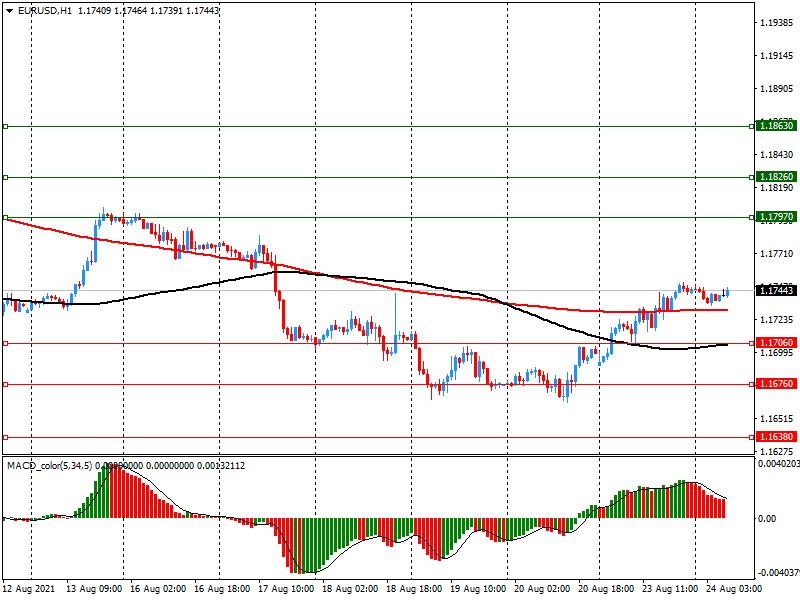
EUR/USD
Resistance levels (open interest**, contracts)
$1.1863 (1698)
$1.1826 (1520)
$1.1797 (828)
Price at time of writing this review: $1.1744
Support levels (open interest**, contracts):
$1.1706 (3409)
$1.1676 (5082)
$1.1638 (2761)
Comments:
- Overall open interest on the CALL options and PUT options with the expiration date September, 3 is 93007 contracts (according to data from August, 23) with the maximum number of contracts with strike price $1,2000 (8365);
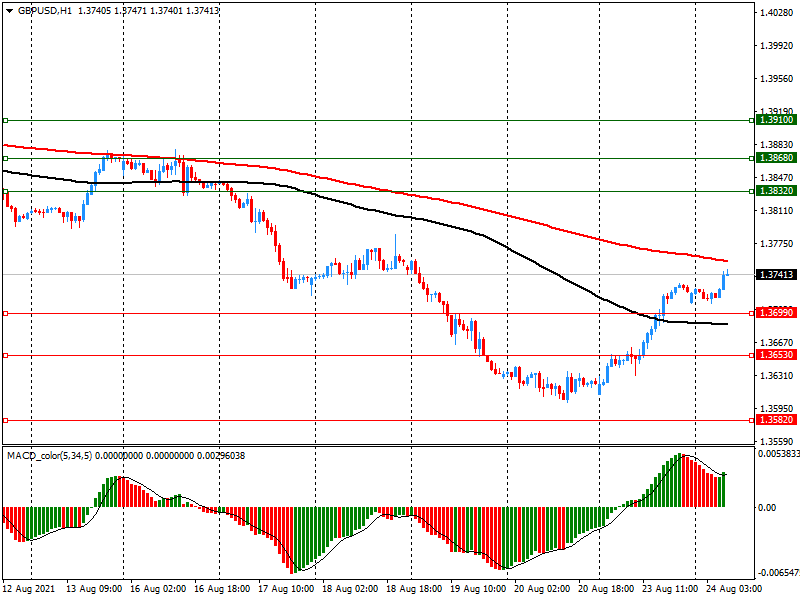
GBP/USD
$1.3910 (780)
$1.3868 (899)
$1.3832 (222)
Price at time of writing this review: $1.3741
Support levels (open interest**, contracts):
$1.3699 (1111)
$1.3653 (937)
$1.3582 (767)
Comments:
- Overall open interest on the CALL options with the expiration date September, 3 is 17723 contracts, with the maximum number of contracts with strike price $1,4300 (2171);
- Overall open interest on the PUT options with the expiration date September, 3 is 15239 contracts, with the maximum number of contracts with strike price $1,3550 (1334);
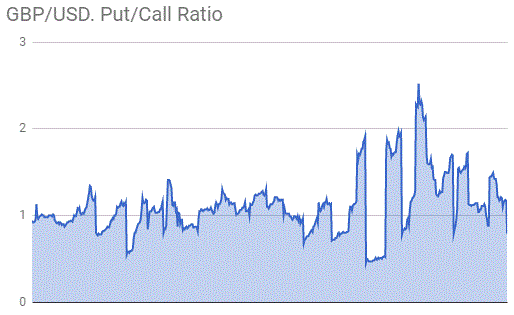
- The ratio of PUT/CALL was 0.86 versus 0.91 from the previous trading day according to data from August, 23
* - The Chicago Mercantile Exchange bulletin (CME) is used for the calculation.
** - Open interest takes into account the total number of option contracts that are open at the moment.
Reuters reports that according to the report from the Federal Statistics Office, private consumption and state spending drove a stronger-than-expected economic recovery in Germany in the second quarter following an easing of COVID-19 curbs.
Gross domestic product grew by 1.6% on the quarter from April to June adjusted for price, seasonal and calendar effects, the office said, slightly up from its previous estimate of 1.5% GDP growth.
| Raw materials | Closed | Change, % |
|---|---|---|
| Brent | 68.5 | 4.53 |
| Silver | 23.606 | 2.38 |
| Gold | 1805.077 | 1.34 |
| Palladium | 2394.73 | 5.25 |
| Time | Country | Event | Period | Previous value | Forecast |
|---|---|---|---|---|---|
| 06:00 (GMT) | Germany | GDP (YoY) | Quarter II | -3.1% | 9.2% |
| 06:00 (GMT) | Germany | GDP (QoQ) | Quarter II | -1.8% | 1.5% |
| 14:00 (GMT) | U.S. | Richmond Fed Manufacturing Index | August | 27 | |
| 14:00 (GMT) | U.S. | New Home Sales | July | 0.676 | 0.69 |
| 22:45 (GMT) | New Zealand | Trade Balance, mln | July | 261 |
| Pare | Closed | Change, % |
|---|---|---|
| AUDUSD | 0.72085 | 1.25 |
| EURJPY | 128.789 | 0.44 |
| EURUSD | 1.17447 | 0.46 |
| GBPJPY | 150.466 | 0.77 |
| GBPUSD | 1.37191 | 0.8 |
| NZDUSD | 0.6884 | 0.76 |
| USDCAD | 1.26472 | -1.4 |
| USDCHF | 0.91211 | -0.5 |
| USDJPY | 109.664 | -0.01 |







© 2000-2026. All rights reserved.
This site is managed by Teletrade D.J. LLC 2351 LLC 2022 (Euro House, Richmond Hill Road, Kingstown, VC0100, St. Vincent and the Grenadines).
The information on this website is for informational purposes only and does not constitute any investment advice.
The company does not serve or provide services to customers who are residents of the US, Canada, Iran, The Democratic People's Republic of Korea, Yemen and FATF blacklisted countries.
Making transactions on financial markets with marginal financial instruments opens up wide possibilities and allows investors who are willing to take risks to earn high profits, carrying a potentially high risk of losses at the same time. Therefore you should responsibly approach the issue of choosing the appropriate investment strategy, taking the available resources into account, before starting trading.
Use of the information: full or partial use of materials from this website must always be referenced to TeleTrade as the source of information. Use of the materials on the Internet must be accompanied by a hyperlink to teletrade.org. Automatic import of materials and information from this website is prohibited.
Please contact our PR department if you have any questions or need assistance at pr@teletrade.global.


 Bank
Bank transfers


