- Analytics
- News and Tools
- Market News
CFD Markets News and Forecasts — 26-08-2021
| Time | Country | Event | Period | Previous value | Forecast |
|---|---|---|---|---|---|
| 00:00 (GMT) | U.S. | Jackson Hole Economic Symposium | |||
| 01:30 (GMT) | Australia | Retail Sales, M/M | July | -1.8% | |
| 06:45 (GMT) | France | Consumer confidence | August | 101 | 100 |
| 12:30 (GMT) | Canada | Industrial Product Price Index, y/y | July | 16.8% | |
| 12:30 (GMT) | Canada | Industrial Product Price Index, m/m | July | 0.0% | 0.1% |
| 12:30 (GMT) | U.S. | Goods Trade Balance, $ bln. | July | -92.05 | |
| 12:30 (GMT) | U.S. | PCE price index ex food, energy, Y/Y | July | 3.5% | 3.6% |
| 12:30 (GMT) | U.S. | Personal spending | July | 1% | 0.3% |
| 12:30 (GMT) | U.S. | PCE price index ex food, energy, m/m | July | 0.4% | 0.3% |
| 12:30 (GMT) | U.S. | Personal Income, m/m | July | 0.1% | 0.2% |
| 14:00 (GMT) | U.S. | Reuters/Michigan Consumer Sentiment Index | August | 81.2 | 70.7 |
| 14:00 (GMT) | U.S. | Fed Chair Powell Speaks | |||
| 17:00 (GMT) | U.S. | Baker Hughes Oil Rig Count | August | 405 |
Says he has not seen anything that would materially change his outlook
Says businesses and consumers are adapting to COVID-19
Hopes Fed will announce taper plan in September
Says he would prefer to start tapering soon, but do it gradually (6-8 months)
Thinks Fed has communicated that a taper is coming
Notes inflation affects lower income community disproportionately; Fed has to take that very seriously
Carsten Brzeski, the Global Head of Macro for ING Research, notes that the latest ECB minutes confirm that at least in July, the only thing on the ECB’s mind was the new forward guidance and not tapering.
"According to the just-released minutes, the ECB had a very intense debate at the July meeting on implementing the new strategy."
"... in our view, the most important takeaways include:
The ECB seems to believe in reducing “the risk of possible side effects since it should help to shorten the time spent at very low-interest rates and, all else being equal, lower the required volume of asset purchases”. In our view, this was not how financial markets interpreted the new strategy and the July meeting announcements, as they resulted in a further delay of the expected first rate hike.
As a reminder, the ECB’s new forward guidance consists of three elements: first, inflation has to be at 2% “well in advance of the end of the projection horizon”, which in our view means inflation reaching 2% at the end of the forecast horizon will no longer be sufficient; second, inflation should be sustainably at 2%; and third, not only headline inflation, but also underlying inflation needs to be zooming in to 2%.
At least some ECB members seem to think that there is a trade-off between forward guidance and asset purchases as illustrated in the sentence “it was remarked that forward guidance on interest rates, if credible, should reduce the extent to which other instruments needed to be deployed.” For the rest, there was hardly any discussion on tapering or a rotation out of the PEPP purchases into more APP purchases.
Regarding inflation, the ECB seems to stick to its rather benign view of inflation being driven by a series of one-off factors without any second-round effects in sight. The latter seems to be extracted from the fact that wage settlements so far had been very moderate. However, looking at the recent wage negotiations in Germany, the ECB might soon have to rethink its take or at least would have to allow for a first round of the so-called second-round effects as several trade unions have clearly increased the demands."
eFXdata reports that analysts at Bank of America Global Research (BofA) discuss EUR/USD outlook.
"EURUSD has weakened in 3Q, consistent with our forecasts, but we expect the move to continue and we stick to our end-year forecast of 1.15, implying more USD upside to come. The recovery has been weaker in the Eurozone than in the US. Inflation expectations in the Eurozone remain well below that in the US. A more difficult outlook for risk assets during Fed policy normalization could also be negative for EURUSD."
"A resurgence in global risk appetite is now the main risk to our constructive USD view, now that risks of Fed policy complacency (pushing out of taper) have materially reduced. The ECB could fail to deliver on its promise for forceful policies, disappointing markets. Also, Eurozone inflation could increase in the rest of the year, while US inflation could fall, which could confuse markets despite both being primarily because of temporary effects."
ActionForex reports that analysts at TD Bank Financial Group review the second estimate for the U.S. Q2 GDP growth.
"Overall revisions to second-quarter real GDP were fairly minor. Real GDP growth was revised up one tick to 6.6%, from 6.5% in the advance estimate."
"Upward revisions to nonresidential fixed investment were a key feature, growing at a 9.3% annualized pace, compared to 8.0% in Q1. The decline in structures investment was revised up from -6.9% to -5.4%."
"Export growth was also revised up to 6.6%, compared to 6.0% in earlier estimates. Consumer spending was revised up modestly to 11.9%, versus 11.8%."
"Partially offsetting these upward revisions was a larger contraction in residential investment (-11.5% versus -9.8% in advance), a larger drawdown in inventories, and lower spending by state and local governments."
"Revised data show that growth in the U.S. economy was very slightly stronger in the second quarter than previously reported. As we sit in the back half of August the real question is how well spending will hold up against the current Delta wave. Growth in the third quarter is still tracking a very healthy 5%+ pace, but some high-frequency indicators are pointing to a loss in momentum in spending as consumer caution creeps in."
FXStreet reports that the ECB July meeting was all about revising the forward guidance on rates. But economists at Nordea suggest the debate on what to do with the bond purchases will be ahead in the September meeting.
“Upside risks to inflation had increased. However, the price outlook remained some distance from the ECB’s target level.”
“It is likely too early for the ECB to conclude that the coronavirus crisis phase is nearing its end at the September meeting. As a result, December now looks a likelier time to decide when the Pandemic Emergency Purchase Programme (PEPP), or more specifically net bond purchases under that programme, should end.”
“The pace of the bond purchases will be reviewed at the September meeting, and it is not out of the question that the central bank would decide to return to the buying pace prevailing early this year, before the ECB pledged to increase the pace significantly. Chief Economist Lane certainly left such an option open in his comments yesterday.”
“We continue to think that the ECB will stick with the current EUR1850 B PEPP envelope, which still has plenty of firepower left; enough to taper the purchases only during the first half of 2022.”
“The ECB’s continued support will limit the upside for bond yields, and given that the Fed is set to proceed faster in removing exceptional stimulus, we see plenty more downside for the EUR/USD.”
U.S. stock-index futures slipped on Thursday, as investors assessed the second estimate for the U.S. Q2 GDP growth and weekly jobless claims data, while awaiting the beginning of the Fed’s Jackson Hole symposium, which might shed some light on the U.S. central bank's plans for its policy.
Global Stocks:
Index/commodity | Last | Today's Change, points | Today's Change, % |
Nikkei | 27,742.29 | +17.49 | +0.06% |
Hang Seng | 25,415.69 | -278.26 | -1.08% |
Shanghai | 3,501.66 | -38.72 | -1.09% |
S&P/ASX | 7,491.20 | -40.70 | -0.54% |
FTSE | 7,131.30 | -18.82 | -0.26% |
CAC | 6,665.25 | -11.23 | -0.17% |
DAX | 15,786.86 | -73.80 | -0.47% |
Crude oil | $67.59 | -1.13% | |
Gold | $1,785.10 | -0.33% |
(company / ticker / price / change ($/%) / volume)
3M Co | MMM | 194 | -0.34(-0.18%) | 390 |
ALCOA INC. | AA | 41.86 | -0.20(-0.48%) | 14424 |
ALTRIA GROUP INC. | MO | 48.75 | 0.10(0.21%) | 12637 |
Amazon.com Inc., NASDAQ | AMZN | 3,299.98 | 0.80(0.02%) | 8222 |
American Express Co | AXP | 166.4 | 0.22(0.13%) | 3154 |
AMERICAN INTERNATIONAL GROUP | AIG | 55.06 | 0.13(0.24%) | 1403 |
Apple Inc. | AAPL | 148.26 | -0.10(-0.07%) | 566340 |
AT&T Inc | T | 27.45 | 0.02(0.07%) | 42423 |
Boeing Co | BA | 221.25 | 0.22(0.10%) | 46885 |
Caterpillar Inc | CAT | 215.1 | 0.34(0.16%) | 5258 |
Chevron Corp | CVX | 98.05 | -0.46(-0.47%) | 4104 |
Cisco Systems Inc | CSCO | 59.39 | 0.04(0.07%) | 15577 |
Citigroup Inc., NYSE | C | 73.77 | 0.59(0.81%) | 37605 |
Deere & Company, NYSE | DE | 376 | -0.37(-0.10%) | 7392 |
Exxon Mobil Corp | XOM | 55.18 | -0.28(-0.50%) | 26508 |
Facebook, Inc. | FB | 367.7 | -0.69(-0.19%) | 18955 |
FedEx Corporation, NYSE | FDX | 269.5 | -0.87(-0.32%) | 10027 |
Ford Motor Co. | F | 13.15 | -0.02(-0.15%) | 175814 |
Freeport-McMoRan Copper & Gold Inc., NYSE | FCX | 34.81 | -0.30(-0.85%) | 69257 |
General Electric Co | GE | 104.52 | -0.18(-0.17%) | 21828 |
General Motors Company, NYSE | GM | 49.65 | -0.05(-0.10%) | 13493 |
Goldman Sachs | GS | 414.2 | 1.08(0.26%) | 2209 |
Hewlett-Packard Co. | HPQ | 29.43 | 0.04(0.14%) | 11018 |
Home Depot Inc | HD | 323.87 | -0.01(-0.00%) | 1454 |
Intel Corp | INTC | 53.61 | -0.20(-0.37%) | 39793 |
International Business Machines Co... | IBM | 140.58 | 0.72(0.52%) | 864 |
Johnson & Johnson | JNJ | 174.55 | 0.32(0.18%) | 3026 |
JPMorgan Chase and Co | JPM | 162.37 | 1.45(0.90%) | 37875 |
Microsoft Corp | MSFT | 301 | -1.01(-0.33%) | 59929 |
Nike | NKE | 169.7 | -0.14(-0.08%) | 3771 |
Pfizer Inc | PFE | 47.53 | 0.02(0.04%) | 263351 |
Starbucks Corporation, NASDAQ | SBUX | 115.76 | 0.19(0.16%) | 6451 |
Tesla Motors, Inc., NASDAQ | TSLA | 708.5 | -2.70(-0.38%) | 74124 |
The Coca-Cola Co | KO | 56.18 | 0.11(0.20%) | 13893 |
Twitter, Inc., NYSE | TWTR | 64 | -0.17(-0.26%) | 10738 |
Verizon Communications Inc | VZ | 54.96 | 0.03(0.05%) | 28048 |
Visa | V | 232.87 | 0.28(0.12%) | 4230 |
Wal-Mart Stores Inc | WMT | 149.23 | 0.27(0.18%) | 2407 |
Walt Disney Co | DIS | 178.34 | 0.03(0.02%) | 15106 |
- Notes inflation was higher than expected
- Says he is skeptical that inflation will moderate in 2022
- If inflation does not moderate, Fed should be more aggressive
- Thinks Fed should get going on taper and finish taper by end Q1 of 2022.
- Sees a lot of reasons to roll back emergency measures
- Economy is learning to adapt to the pandemic
- Vaccine acceptance is increasing
- Delta will peak at some point
- If inflation moderates, rate increases can be put off, but if not, rate increases should start sooner which could disrupt US economy
- If we get taper done sooner, we have some optionality in 2022
- Expects GDP 6% in 2021 and 4% in 2022
A
report from the Commerce Department showed on Thursday that the U.S. economy expanded
slightly more than initially estimated in the second quarter of 2021, reflecting
upward revisions to nonresidential fixed investment and exports, which were
partly offset by downward revisions to private inventory investment,
residential fixed investment, and state and local government spending. Meanwhile,
imports, which are a subtraction in the calculation of GDP, were revised down.
According
to the second estimate, the U.S. gross domestic product (GDP) grew at a 6.6
percent annual rate in the second quarter, slightly better than a 6.5 percent
advance reported in initial estimate.
Economists
had expected the growth rate to be revised to 6.7 percent, following the previous
quarter's advance of 6.3 percent.
The
increase in real GDP in the second quarter reflected gains in personal
consumption expenditures (PCE), nonresidential fixed investment, exports, and
state and local government spending that were partly offset by declines in
private inventory investment, residential fixed investment, and federal
government spending. At the same time, imports rose.
The
data from the Labor Department showed on Thursday the number of applications
for unemployment increased more than forecast last week but remained near pandemic-era
lows.
According to the report, the initial claims for unemployment benefits rose by 4,000 to 353,000 for the week ended August 21.
Economists
had expected 350,000 new claims last week.
Claims for the prior week
were revised upwardly to 349,000 from the initial estimate of 348,000.
Meanwhile,
the four-week moving average of jobless claims dropped to 366,500 from an
upwardly revised 378,000 in the previous week.
As
for continuing claims, they slipped to 2,862,000 from an upwardly revised 2,865,000
in the previous week. This was the lowest reading since March 2020.
The
ECB released accounts of its July 21-22 monetary policy meeting. It noted that:
- Members agreed that it was necessary to align the forward guidance on interest rates with revised formulation of price stability objective in ECB’s new monetary policy strategy;
- The need to revise forward guidance on interest rates was emphasised, in order to provide a credible commitment to bringing inflation up to new target;
- Reformulated forward guidance was best understood as a set of conditions that would help guide ECB’s actions in pursuit of its inflation target, as defined in the new strategy; it did not necessarily imply “lower for longer” interest rates if it ultimately succeeded in anchoring inflation expectations at target, as intended;
- It was remarked that forward guidance on interest rates, if credible, should reduce extent to which other instruments needed to be deployed;
- New formulation of forward guidance was widely seen as finely balanced;
- It was noted that forward guidance language should clearly dispel notion that 2% was a ceiling for inflation, given that new strategy explicitly allowed for moderate and transitory overshooting;
- Members put forward a number of considerations. On one hand, the case was made for strengthening the forward guidance on interest rates even further… On the other hand, it was cautioned that requiring inflation to durably reach 2% at an earlier point in time would risk undermining medium-term orientation of monetary policy;
- Credibility of Governing Council’s forward guidance was seen as key to its success
- It is time to start altering Fed accommodation
- There has been good progress on the economy, inflation is coming in strong; that suggests opportunity to dial back asset purchases
- Communication in September meeting will reflect discussions on taper
- Less precise about dates than saying sooner rather than later; outlook suggest Fed can begin to make adjustments this year
USD traded mixed and little changed against other major currencies in the European session on Thursday as investors remained cautious ahead of the Federal Reserve’s crucial event, which might shed some light on the U.S. central bank's plans for its policy.
The U.S. Dollar Index (DXY), measuring the U.S. currency's value relative to a basket of foreign currencies, edged up 0.03% to 92.85.
The highly anticipated Fed’s Jackson Hole symposium is set to start later today, and will be held virtually due to coronavirus risks. The symposium’s theme this year is "Macroeconomic Policy in an Uneven Economy”. The Fed’s Chairman Jerome Powell is scheduled to address the event on Friday. Markets will be listening closely, hoping to get clues on when the Fed might look to begin tapering its asset purchases.
Earlier this month, several Fed’s officials have expressed views that it would be appropriate for the U.S. central bank to start tapering stimulus in the fourth quarter, but some others have stressed that more evidence of a recovery is needed, particularly in the labour market, before such action is taken.
Market participants also awaited the releases of the U.S. Q2 GDP data (second estimate) and weekly jobless claims, due at 12:30 GMT, which could set the tone for Powell's Jackson Hole speech.
FXStreet notes that the S&P 500 Index has notched ten record closing highs so far in August. Furthermore, it defended the 50-day moving average near 4365 last week resulting in an extension of the uptrend. Economists at Société Générale expects the S&P 500 to challenge the 4540 level next.
“S&P 500 is heading towards a potential hurdle of 4540 representing a trend line connecting peaks of September 2020, April/May 2021.”
“Test and rejection of above line near 4540 could result in a pullback. This is not a reversal signal, however, temporary exhaustion can’t be ruled out.”
“4440 and the recent low of 4365 will be short-term supports.”
FXStreet reports that economists at Westpac note that although surprisingly strong business surveys may allow for interim rebounds, the GBP/USD pair appears to be range-bound (1.36-1.40).
“The continued success in the UK's vaccination program should prevent any reversal of reopening of the economy, though the return to schools next month may prove to be a critical test of the relaxing of restrictions. However, the positive tone of surveys and reopening have so far merely supported rather than strengthened GBP.”
“GBP/USD’s failure to retest 1.40 this month reflects USD strength, underscoring a 1.36-1.40 range.”
FXStreet reports that FX Strategists at UOB Group, predict USD/CNH to keep the 6.4600-6.5050 range unchanged for the time being.
24-hour view: “We expected USD to ‘consolidate and trade between 6.4630 and 6.4850’. Our view for consolidation was not wrong even though USD traded within a narrower range than expected (6.4656/6.4789). Momentum indicators are mostly neutral and further consolidation would not be surprising, likely between 6.4630 and 6.4830.”
Next 1-3 weeks: “We continue to hold the same view as from Tuesday (24 Aug, spot at 6.4790). As highlighted, the outlook is mixed and USD could trade between 6.4600 and 6.5050 for a period of time. Looking ahead, the downside risk appears to be greater but USD has to close below the major support at 6.4500 before a sustained decline can be expected.”
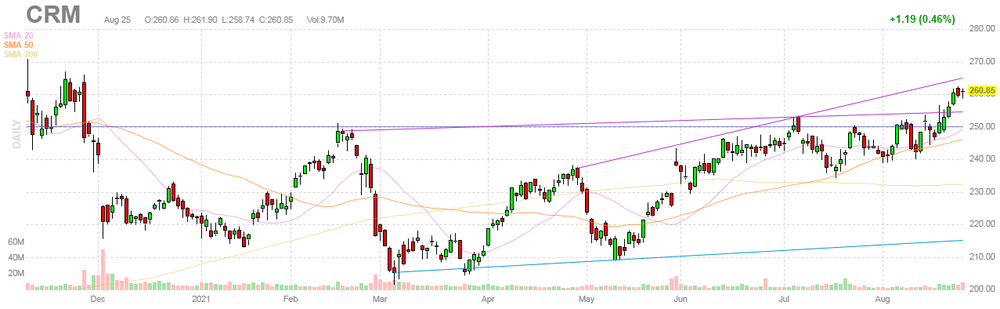
Salesforce.com (CRM) reported Q2 FY 2022 earnings of $1.48 per share (versus $1.44 per share in Q2 FY 2021), beating analysts’ consensus estimate of $0.93 per share.
The company’s quarterly revenues amounted to $6.340 bln (+23.1% y/y), beating analysts’ consensus estimate of $6.246 bln.
CRM rose to $267.36 (+2.50%) in pre-market trading.
FXStreet reports that the Federal Reserve is in the process of preparing the market for a tapering decision in the near future. Economists at Danske Bank do not expect a firm tapering announcement before the September FOMC but tapering will of course be discussed at the upcoming Jackson Hole conference.
“We expect that the Fed will announce tapering at the September FOMC meeting and that tapering will actually begin in Q4. We expect that tapering will be concluded in summer 2022 followed by a rate hike late 2022.”
“Although a tapering announcement this autumn should be no major surprise to the market, we argue that the recent curve flattening is too early in the cycle. We still have a bond market that has to adapt to significantly lower QE purchases in 2022 and the first rate hike is also in our view moving closer in time.”
“We do see some upside for US yields in Q4 and in 2022. We also assume that a further improvement in the US labour market and a repricing of the current very low real rates will add upside to US 10Y yields. That said, the fear of a ‘peak’ in inflation and growth are factors that point to stable or even lower yields/flatter curves.”
NFXStreet notes that USD/JPY remains confined to a narrow range. But Kit Juckes, Chief Global FX Strategist at Société Générale, expects the pair to surge higher above the 112 level.
“USD/JPY has, in 2021, reverted to closely tracking interest rate differentials, notably the 2y2y rate spread. At the very least, that’s a warning that if the Fed is successful in escaping the zero-rate bound (and Japan isn’t), USD/JPY could be in for a break higher.”
“...if the market gains rather than loses conviction in a Fed rate hike in late 2022 or early 2023, then USD/JPY is going to struggle to get back below 108 at any point and will in due course break above 112.”
eFXdata reports that TD Research discusses its expectations for ECB minutes.
"These accounts will reflect the ECB's first debate around how to enact their Strategy Review. They may give us a better idea of what changes we could see at the Sept meeting, and if it will just be about tapering the pace of PEPP purchases, or if the ECB might consider increasing the pace of APP purchases as well, to demonstrate their commitment to their new inflation target," TD adds.
FXStreet reports that the US Dollar Index (DXY) downside is likely limited to 91.5-92.0. Fresh marginal highs round 94.0 are on the cards into Q4, in the opinion of economists at Westpac.
“Our read is that while Fed officials note the risks of the delta strain, taper timeline remains intact. Key Fed officials at Jackson Hole and beyond likely remain confident that ‘substantial further progress’ is on the horizon and that a slowing of asset purchases can commence in coming months.”
“The Nov/Dec FOMC meetings look opportune for a taper announcement. That would leave the USD’s broad uptrend into Q4 intact. Fresh marginal DXY highs just beyond 94 are on the cards into Q4. Sustained DXY beyond that would require a setback in the Eurozone's recovery path and/or further covid setbacks in China.”
RTTNews reports that data from the Federal Statistical Office showed that Switzerland's employment level increased in the second quarter.
Employment level rose to 5.126 million in the second quarter from 5.101 million in the previous quarter. The total employment increased 0.6 percent annually in the second quarter.
On a seasonally adjusted basis, employment grew 0.2 percent sequentially in the second quarter.
According to the report from the Society of Motor Manufacturers and Traders (SMMT), UK car manufacturing output fell -37.6% in July, the first fall since February, with just 53,438 units made. It represented the worst July performance since 1956 as manufacturers grappled with the global shortage of semiconductors and staff absence resulting from the ‘pingdemic’, with some altering summer shutdown timings to help manage the situation.
In July production for the UK market declined -38.7% to 8,233 while manufacturing for export also fell, down -37.4% with 45,205 cars shipped overseas. Exports accounted for more than eight out of 10 (84.6%) vehicles built in the month as buyers around the world continued to be attracted to the wide range of high-quality cars made in Britain, including the latest alternatively fuelled models.
More than a quarter (26.0%) of all cars made in July were either battery electric (BEV), plug in hybrid (PHEV) or hybrid electric (HEV), their highest share on record, and meaning that UK car factories have turned out 126,757 of these important products since the start of the year.
Production overall remains up 18.3% on Covid hit 2020 at 552,361 units, but this is down significantly (-28.7%) on 2019 pre-pandemic levels when 774,760 cars rolled off production lines.
FXStreet reports that according to economists at Westpac, EUR/USD slippage below 1.17 may have proved short-lived, but rebounds are likely to be limited .
“The virulence of the delta variant has meant that, despite impressive acceleration in covid vaccination programs, the easing of restrictions has been relatively limited across much of the region. The lift in activity as restrictions eased has been sound, but supply constraints and the sense that restrictions will remain to some degree for longer appear to be unwinding expectations and may well see a pullback in coming confidence surveys.”
“Although EUR/USD managed to find support below 1.1700, rebounds are unlikely to gain much pace and the risks of pullbacks in Eurozone confidence may well pressure EUR/USD support into September’s ECB policy meeting.”
According to the report from the European Central Bank, the annual growth rate of the broad monetary aggregate M3 decreased to 7.6% in July 2021 from 8.3% in June, averaging 8.1% in the three months up to July. The components of M3 showed the following developments. The annual growth rate of the narrower aggregate M1, which comprises currency in circulation and overnight deposits, decreased to 11.0% in July from 11.8% in June. The annual growth rate of short-term deposits other than overnight deposits (M2-M1) was -1.8% in July, compared with -1.4% in June. The annual growth rate of marketable instruments (M3-M2) decreased to 7.7% in July from 8.6% in June.
Looking at the components' contributions to the annual growth rate of M3, the narrower aggregate M1 contributed 7.7 percentage points (down from 8.2 percentage points in June), short-term deposits other than overnight deposits (M2-M1) contributed -0.5 percentage point (down from -0.3 percentage point) and marketable instruments (M3-M2) contributed 0.4 percentage point (as in the previous month).
Annual growth rate of adjusted loans to households increased to 4.2% in July from 4.0% in June
Annual growth rate of adjusted loans to non-financial corporations stood at 1.7% in July, compared with 1.8% in June
FXStreet reports that Karen Jones, Team Head FICC Technical Analysis Research at Commerzbank, discusses EUR/USD prospects.
“EUR/USD’s upmove is pushing hard into the short-term downtrend at 1.1772. Currently, while it holds, we are unable to rule out a retest of the recent low at 1.1665. Below 1.1664 will allow for losses to 1.1602 and 1.1575, where we would look for signs of stabilisation. It is possible that this may be a falling wedge reversal pattern, but this will only be confirmed on a close above the downtrend at 1.1772. This guards the 1.1909 July high and then the 1.1990/1.2006 March high and 200-day ma.”
| Time | Country | Event | Period | Previous value | Forecast | Actual |
|---|---|---|---|---|---|---|
| 00:00 | U.S. | Jackson Hole Economic Symposium | ||||
| 01:30 | Australia | Private Capital Expenditure | Quarter II | 6.0% | 2.5% | 4.4% |
| 06:00 | Germany | Gfk Consumer Confidence Survey | September | -0.4 | -0.7 | -1.2 |
During today's Asian trading, the US dollar rose slightly against the main world currencies.
Markets are waiting for the speech of Federal Reserve Chairman Jerome Powell at the annual economic symposium in Jackson Hole on Friday. However, there is a growing opinion among analysts that he will not give any obvious indications on the timing of the start of the curtailment of the securities repurchase program, which now amounts to $120 billion per month.
"I don't think that Powell or anyone else from the Fed will hint too aggressively about reducing asset purchases," says IG Markets analyst Kyle Rodda. "In my opinion, the dollar continues to move up only on the basis that sooner or later the Fed is going to do it."
Investors became more positive about the prospects after the US Food and Drug Administration (FDA) fully approved the Pfizer-BioNTech vaccine against COVID-19 on Monday, which could speed up the vaccination process in the US.
The ICE index, which tracks the dynamics of the dollar against six currencies (euro, swiss franc, yen, canadian dollar, pound sterling and swedish krona), rose by 0.11%.
FXStreet reports that Bart Melek, Head of Commodity Strategy at TD Securities, expects WTI to edge lower towards the $65 level.
“OPEC+ commitment to increase supply by 400,000 b/d in each of the coming months should make the market looser than previously expected. The recent increase in yields across the curve, a firmer USD along with less risk appetite post taper announcement could be another set of factors likely bringing crude lower for a time.”
“The sharp drop in US net exports suggests that international demand is still soft due to COVID-19. As such, a WTI move back to $65/b in the near-term would not be a big surprise.”
Reuters reports that Japan's government maintained its economic assessment for a fourth straight month in August but offered a slightly bleaker view on the outlook than in July.
The August report warned of the need to pay attention to "heightening downside risk caused by the pandemic." That compared with the previous month's view that said the government needed to be vigilant to the "impact" of the pandemic.
The government kept its assessment unchanged for most parts of the economy including consumer spending, which it described as weak mainly due to the services sector.
Reflecting sluggish household demand for goods including those shipped from overseas, the government cut its assessment on imports for the first time in 10 months.
But it revised up its view on corporate profits for the first time in six months due to solid second-quarter earnings among manufacturers.
According to the GfK Consumer Climate Study Germany for August, overall, consumer sentiment in Germany was somewhat more moderate in August. While income expectations rose slightly, both economic expectations and propensity to buy declined. As a result, GfK is forecasting a value of -1.2 points in consumer sentiment for September, down 0.8 points from August of this year (revised from -0.4 points). Experts expected the index to be -0.7.
In addition to the decline in propensity to buy, an increasing propensity to save in August is currently causing consumer sentiment to drop.
Rolf Bürkl, a GfK consumer expert, commented on this observation: “Significant higher incidence values, a slowdown in vaccination momentum, and discussions about how to deal with unvaccinated individuals in the future have caused noticeable uncertainty among consumers in Germany. They fear that restrictions could even be tightened again. This is obviously depressing consumer sentiment right now.”
In addition, the topic of inflation is suddenly playing a role again in discussion about Germany's economic development. According to the Federal Statistical Office, cost of living increased by 3.8 percent in July of this year. The last time there was a higher rate of price increase was in December 1993, at 4.3 percent.
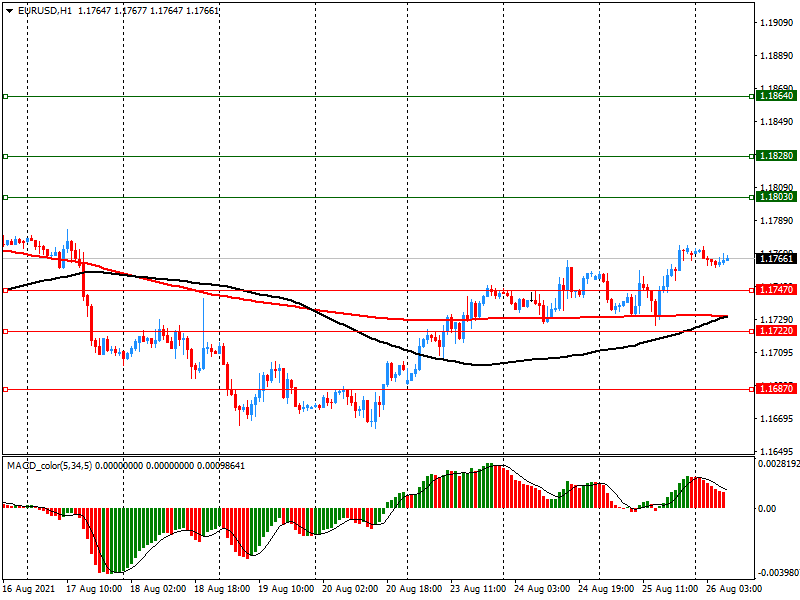
EUR/USD
Resistance levels (open interest**, contracts)
$1.1864 (1688)
$1.1828 (1804)
$1.1803 (872)
Price at time of writing this review: $1.1766
Support levels (open interest**, contracts):
$1.1747 (2473)
$1.1722 (3744)
$1.1687 (5862)
Comments:
- Overall open interest on the CALL options and PUT options with the expiration date September, 3 is 94930 contracts (according to data from August, 25) with the maximum number of contracts with strike price $1,2000 (8065);
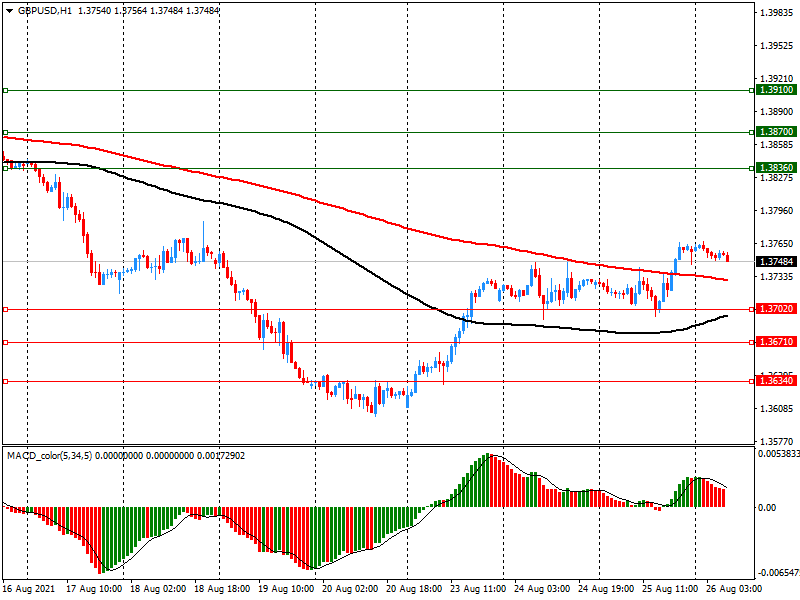
GBP/USD
$1.3910 (780)
$1.3870 (894)
$1.3836 (221)
Price at time of writing this review: $1.3748
Support levels (open interest**, contracts):
$1.3702 (999)
$1.3671 (924)
$1.3634 (998)
Comments:
- Overall open interest on the CALL options with the expiration date September, 3 is 18223 contracts, with the maximum number of contracts with strike price $1,4300 (2171);
- Overall open interest on the PUT options with the expiration date September, 3 is 15598 contracts, with the maximum number of contracts with strike price $1,3550 (1334);
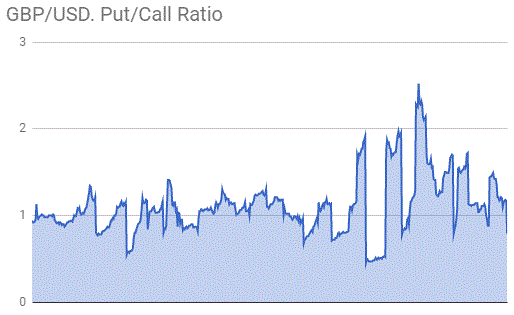
- The ratio of PUT/CALL was 0.86 versus 0.84 from the previous trading day according to data from August, 25
* - The Chicago Mercantile Exchange bulletin (CME) is used for the calculation.
** - Open interest takes into account the total number of option contracts that are open at the moment.
| Raw materials | Closed | Change, % |
|---|---|---|
| Brent | 71.47 | 0.82 |
| Silver | 23.811 | -0.02 |
| Gold | 1790.148 | -0.68 |
| Palladium | 2422.6 | -1.48 |
| Time | Country | Event | Period | Previous value | Forecast |
|---|---|---|---|---|---|
| 00:00 (GMT) | U.S. | Jackson Hole Economic Symposium | |||
| 01:30 (GMT) | Australia | Private Capital Expenditure | Quarter II | 6.3% | 2.5% |
| 06:00 (GMT) | Germany | Gfk Consumer Confidence Survey | September | -0.3 | -0.7 |
| 08:00 (GMT) | Eurozone | Private Loans, Y/Y | July | 4% | |
| 08:00 (GMT) | Eurozone | M3 money supply, adjusted y/y | July | 8.3% | 7.7% |
| 11:30 (GMT) | Eurozone | ECB Monetary Policy Meeting Accounts | |||
| 12:30 (GMT) | U.S. | Continuing Jobless Claims | August | 2820 | 2790 |
| 12:30 (GMT) | U.S. | Initial Jobless Claims | August | 348 | 350 |
| 12:30 (GMT) | U.S. | GDP, q/q | Quarter II | 6.3% | 6.7% |
| 23:30 (GMT) | Japan | Tokyo CPI ex Fresh Food, y/y | August | 0.1% | -0.2% |
| 23:30 (GMT) | Japan | Tokyo Consumer Price Index, y/y | August | -0.1% |
| Pare | Closed | Change, % |
|---|---|---|
| AUDUSD | 0.72712 | 0.23 |
| EURJPY | 129.421 | 0.43 |
| EURUSD | 1.17695 | 0.13 |
| GBPJPY | 151.3 | 0.52 |
| GBPUSD | 1.37573 | 0.22 |
| NZDUSD | 0.69705 | 0.34 |
| USDCAD | 1.25876 | -0.02 |
| USDCHF | 0.91264 | 0.04 |
| USDJPY | 109.967 | 0.31 |







© 2000-2026. All rights reserved.
This site is managed by Teletrade D.J. LLC 2351 LLC 2022 (Euro House, Richmond Hill Road, Kingstown, VC0100, St. Vincent and the Grenadines).
The information on this website is for informational purposes only and does not constitute any investment advice.
The company does not serve or provide services to customers who are residents of the US, Canada, Iran, The Democratic People's Republic of Korea, Yemen and FATF blacklisted countries.
Making transactions on financial markets with marginal financial instruments opens up wide possibilities and allows investors who are willing to take risks to earn high profits, carrying a potentially high risk of losses at the same time. Therefore you should responsibly approach the issue of choosing the appropriate investment strategy, taking the available resources into account, before starting trading.
Use of the information: full or partial use of materials from this website must always be referenced to TeleTrade as the source of information. Use of the materials on the Internet must be accompanied by a hyperlink to teletrade.org. Automatic import of materials and information from this website is prohibited.
Please contact our PR department if you have any questions or need assistance at pr@teletrade.global.


 Bank
Bank transfers


