- Analytics
- News and Tools
- Market News
CFD Markets News and Forecasts — 23-08-2021
| Time | Country | Event | Period | Previous value | Forecast |
|---|---|---|---|---|---|
| 06:00 (GMT) | Germany | GDP (YoY) | Quarter II | -3.1% | 9.2% |
| 06:00 (GMT) | Germany | GDP (QoQ) | Quarter II | -1.8% | 1.5% |
| 14:00 (GMT) | U.S. | Richmond Fed Manufacturing Index | August | 27 | |
| 14:00 (GMT) | U.S. | New Home Sales | July | 0.676 | 0.69 |
| 22:45 (GMT) | New Zealand | Trade Balance, mln | July | 261 |
eFXdata reports that analysts at MUFG Research discuss their expectations for the Fed Powell's speech at the Jackson Hole symposium.
"The deterioration in risk sentiment has been made worse by the rhetoric from Fed officials and the FOMC minutes indicating a growing chorus in favour of moving faster with tapering. However, given COVID developments these voices may well become less evident in the coming weeks."
"The marker may be set this week by Fed Chair Powell when he speaks at Jackson Hole. To reinforce recent speculation on a faster taper would only reinforce the divergence with other central banks, thus fuelling further USD gains and fuel risk of an asset price correction, a fall in inflation expectations, thus undermining the Fed’s new policy strategy. We see a more cautious speech this week that throws water on faster taper speculation."
The
European Commission (EC) reported on Monday its flash estimate showed the
consumer confidence indicator for the Eurozone fell by 0.9 points to -5.3 in August
from an unrevised -4.4 in the previous month. This was the lowest reading since April.
Economists
had expected the index to decrease to -5.0.
Considering
the European Union (EU) as a whole, consumer sentiment also deteriorated by 0.7 points to -6.3.
Despite this month’s declines, both indicators remained
above or close to their pre-pandemic levels.
The
National Association of Realtors (NAR) announced on Monday that the U.S.
existing home sales rose 2.0 percent m-o-m to a seasonally adjusted rate of
5.99 million in July from a revised 5.87 million in June (originally 5.86 million).
This was the highest reading since March.
Economists
had forecast home resales dropping to a 5.83 million-unit pace last month.
In
y-o-y terms, existing-home sales rose 1.5 percent in July.
According
to the report, three of the four major regions recorded m-o-m gains in
existing-home sales in July and only two registered advances in y-o-y terms. The
median existing-home price for all housing types in July was $359,900, up 17.8
percent y-o-y. This marked 113 straight months of y-o-y gains.
Single-family
home sales stood at a seasonally-adjusted annual rate of 5.28 million in July, being
up 2.7 percent m-o-m but down 0.8 percent from one year ago. The median
existing single-family home price was $367,000 in July, up 18.6 percent from July
2020. Meanwhile, existing condominium and co-op sales were recorded at a
seasonally-adjusted annual rate of 710,000 units in July, down from 730,000 in June
but up 22.4 percent from one year ago. The median existing condo price was $307,100
in July, an annual advance of 14.1 percent.
"We
see inventory beginning to tick up, which will lessen the intensity of multiple
offers," noted Lawrence Yun, NAR's chief economist. "Much of the home
sales growth is still occurring in the upper-end markets, while the mid- to
lower-tier areas aren't seeing as much growth because there are still too few
starter homes available."
Preliminary
data released by IHS Markit on Monday revealed that U.S. private sector
business activity continued to grow in early August, albeit at a softer pace
than in July.
According
to the report, the Markit flash manufacturing purchasing manager's index (PMI)
came in at 61.2 in August, down from 63.4 in July. The latest reading pointed
to the slowest expansion in factory activity since April s,
but substantial nonetheless. Economists had expected the reading to decrease to
62.8. A reading above 50 signals an expansion in activity, while a reading
below this level signals a contraction. Material shortages and pressure on
capacity led to a slowdown in output growth. The rate of increase in production
was the weakest since March. Challenges fulfilling new orders and an unprecedented
deterioration in vendor performance led to the second-steepest advance in
backlogs of work in the over 14-year series history. In addition, difficulties retaining
employees and finding suitable candidates led to the slowest growth in
workforce numbers in 2021-to-date.
The
Markit flash services purchasing manager's index (PMI) dropped to 55.2 in August,
down from 59.9 in the previous month. This was the lowest reading since December
2020. Economists had expected the reading to slip to 59.5. The slowdown in
activity growth was often linked to labour shortages, the spread of the Delta variant
and some instances of supply chain disruption. The rate of expansion of new
business decelerated to the softest in a year. Meanwhile, the rate of job creation
was the slowest since February amid a high turnover in staff. On the price
front, input costs rose significantly and at one of the quickest paces on
record amid solid hikes in supplier prices and greater wage bills. Subsequently,
service providers increased their selling prices at a sharper rate.
Overall,
IHS Markit Flash U.S. Composite PMI Output Index came in at 55.4 in August, down
noticeably from 59.9 in July. This represented an eight-month low.
“The
expansion slowed sharply again in August as the spread of the Delta variant led
to a weakening of demand growth, especially for consumer-facing services, and
further frustrated firms’ efforts to meet existing sales,” noted Chris
Williamson, Chief Business Economist at HIS Markit. ““Not only have supply
chain delays hit a new survey record high, but the August survey saw increasing
frustrations in relation to hiring. Jobs growth waned to the lowest since July
of last year as companies either failed to find suitable staff or existing
workers switched jobs.”
U.S. stock-index futures rose on Monday, pointing to the continuation of Friday's rebound, as investors eyed beaten-down equities while preparing for the Fed's symposium at Jackson Hole later this week.
Global Stocks:
Index/commodity | Last | Today's Change, points | Today's Change, % |
Nikkei | 27,494.24 | +480.99 | +1.78% |
Hang Seng | 25,109.59 | +259.87 | +1.05% |
Shanghai | 3,477.13 | +49.80 | +1.45% |
S&P/ASX | 7,489.90 | +29.00 | +0.39% |
FTSE | 7,108.32 | +20.42 | +0.29% |
CAC | 6,684.50 | +58.39 | +0.88% |
DAX | 15,833.59 | +25.55 | +0.16% |
Crude oil | $64.10 | +3.15% | |
Gold | $1,800.60 | +0.93% |
(company / ticker / price / change ($/%) / volume)
ALCOA INC. | AA | 38.43 | 0.72(1.91%) | 95457 |
ALTRIA GROUP INC. | MO | 48.63 | 0.16(0.33%) | 13522 |
Amazon.com Inc., NASDAQ | AMZN | 3,214.00 | 14.05(0.44%) | 29434 |
American Express Co | AXP | 161.22 | 1.47(0.92%) | 1315 |
Apple Inc. | AAPL | 148.52 | 0.33(0.22%) | 495635 |
AT&T Inc | T | 27.64 | 0.07(0.25%) | 126793 |
Boeing Co | BA | 216.7 | 4.03(1.90%) | 115876 |
Caterpillar Inc | CAT | 207 | 2.06(1.01%) | 7104 |
Chevron Corp | CVX | 96.2 | 1.90(2.01%) | 138050 |
Cisco Systems Inc | CSCO | 58.15 | -0.07(-0.12%) | 41999 |
Citigroup Inc., NYSE | C | 70.82 | 0.57(0.81%) | 14982 |
Deere & Company, NYSE | DE | 354 | 2.57(0.73%) | 1626 |
E. I. du Pont de Nemours and Co | DD | 73.5 | 0.65(0.89%) | 761 |
Exxon Mobil Corp | XOM | 53.93 | 1.19(2.26%) | 262890 |
Facebook, Inc. | FB | 358.89 | -0.48(-0.13%) | 53607 |
FedEx Corporation, NYSE | FDX | 268.5 | 1.95(0.73%) | 2068 |
Ford Motor Co. | F | 12.77 | 0.20(1.59%) | 544438 |
Freeport-McMoRan Copper & Gold Inc., NYSE | FCX | 33.66 | 0.86(2.62%) | 106607 |
General Electric Co | GE | 100.78 | 0.73(0.73%) | 33782 |
General Motors Company, NYSE | GM | 48.07 | -0.73(-1.50%) | 215037 |
Goldman Sachs | GS | 399.51 | 3.64(0.92%) | 8634 |
Google Inc. | GOOG | 2,779.00 | 10.26(0.37%) | 6597 |
Hewlett-Packard Co. | HPQ | 28.49 | 0.27(0.96%) | 3043 |
Home Depot Inc | HD | 331.47 | 2.23(0.68%) | 1794 |
HONEYWELL INTERNATIONAL INC. | HON | 228.28 | 0.58(0.25%) | 717 |
Intel Corp | INTC | 52.37 | 0.36(0.69%) | 130516 |
International Business Machines Co... | IBM | 139.4 | 0.29(0.21%) | 1581 |
JPMorgan Chase and Co | JPM | 155.78 | 1.06(0.69%) | 20629 |
Merck & Co Inc | MRK | 78.91 | 0.23(0.29%) | 6071 |
Microsoft Corp | MSFT | 303.88 | -0.48(-0.16%) | 223929 |
Nike | NKE | 168.67 | 0.88(0.52%) | 119641 |
Pfizer Inc | PFE | 50.22 | 1.50(3.08%) | 1613376 |
Procter & Gamble Co | PG | 145.1 | 0.01(0.01%) | 4535 |
Starbucks Corporation, NASDAQ | SBUX | 115.01 | 0.38(0.33%) | 18955 |
Tesla Motors, Inc., NASDAQ | TSLA | 686.25 | 5.99(0.88%) | 127030 |
The Coca-Cola Co | KO | 56.69 | 0.05(0.09%) | 18383 |
Twitter, Inc., NYSE | TWTR | 63.16 | 0.64(1.02%) | 20705 |
UnitedHealth Group Inc | UNH | 431.48 | 1.77(0.41%) | 18233 |
Verizon Communications Inc | VZ | 55.65 | 0.13(0.23%) | 34086 |
Visa | V | 232.65 | 1.29(0.56%) | 5182 |
Wal-Mart Stores Inc | WMT | 151.7 | 0.25(0.17%) | 6743 |
Walt Disney Co | DIS | 177 | 1.88(1.07%) | 37080 |
Yandex N.V., NASDAQ | YNDX | 68.45 | 0.34(0.50%) | 150 |
Robinhood Markets (HOOD) initiated with a Buy at Citigroup; target $63
Robinhood Markets (HOOD) initiated with a Buy at Mizuho; target $68
Robinhood Markets (HOOD) initiated with a Hold at Deutsche Bank; target $45
Robinhood Markets (HOOD) initiated with a Mkt Outperform at JMP Securities; target $58
Robinhood Markets (HOOD) initiated with a Neutral at Goldman; target $56
Robinhood Markets (HOOD) initiated with a Neutral at Piper Sandler; target $47
Robinhood Markets (HOOD) initiated with an Equal Weight at Barclays; target $50
Robinhood Markets (HOOD) initiated with an Overweight at KeyBanc Capital Markets; target $55
Robinhood Markets (HOOD) initiated with an Underweight at JP Morgan; target $35
Facebook (FB) downgraded to Neutral from Buy at Arete; target $381
The Chicago Federal Reserve announced on
Monday the Chicago Fed national activity index (CFNAI), a weighted average of
85 different economic indicators, came in at +0.53 in July, up from a revised -0.01
in June (originally +0.09), pointing to a pickup in economic growth in the previous
month. That was the highest reading since March.
At
the same time, the index’s three-month moving average rose +0.23 in July
from +0.01 in June.
According
to the report, three of the four broad categories of indicators used to
construct the index made positive contributions in July, and three categories
improved from June. Production-related indicators made a marginal positive
contribution of +0.38 to the CFNAI in July, up from -0.09 in June.
Employment-related indicators contributed +0.30 to the CFNAI in July, up from
+0.14 in the previous month. The contribution of the sales, orders, and
inventories category to the CFNAI improved to +0.02 in July from -0.06 in June.
Meanwhile, the personal consumption and housing category contributed -0.15 to
the CFNAI, down from +0.01 in June.
FXStreet reports that USD/CAD saw a rollercoaster session on Friday and whilst the sharp setback can extend further yet, weakness is still seen as corrective by the Credit Suisse analyst team.
“We see scope for weakness to extend further with support seen next at 1.2720 ahead of 1.2687 and then the 13-day exponential average and price support at 1.2649/43. We would look for an attempt to find a floor here.”
“A break below the 1.2649/43 region would suggest weakness can extend further to the 38.2% retracement of the June/August rally at 1.2590.”
“Resistance is seen at 1.2782 initially, then 1.2810, with a break above 1.2836 needed to reassert an upward bias again for strength back to 1.2950/57 and eventually the ‘measured base objective’ at 1.3024, also the 38.2% retracement of the 2020/2021 collapse.”
- Says that imposition of stricter protective measures, due to Delta variant and decline in the dynamics of vaccination, may put unexpected strain on economy in the autumn quarter
- Notes that early weeks of the rebound were timider than projected; that will likely weigh on full-year figure growth as well
- Some restrictions could be introduced in autumn if infections continue to rise
- But unlikely to be as strict as in the past given vaccine progress
| Time | Country | Event | Period | Previous value | Forecast | Actual |
|---|---|---|---|---|---|---|
| 07:15 | France | Services PMI | August | 56.8 | 57 | 56.4 |
| 07:15 | France | Manufacturing PMI | August | 58 | 57.3 | 57.3 |
| 07:30 | Germany | Services PMI | August | 61.8 | 61 | 61.5 |
| 07:30 | Germany | Manufacturing PMI | August | 65.9 | 65 | 62.7 |
| 08:00 | Eurozone | Manufacturing PMI | August | 62.8 | 62 | 61.5 |
| 08:00 | Eurozone | Services PMI | August | 59.8 | 59.8 | 59.7 |
| 08:30 | United Kingdom | Purchasing Manager Index Services | August | 59.6 | 59 | 55.5 |
| 08:30 | United Kingdom | Purchasing Manager Index Manufacturing | August | 60.4 | 59.5 | 60.1 |
| 10:00 | Germany | Bundesbank Monthly Report | ||||
| 10:00 | United Kingdom | CBI industrial order books balance | August | 17 | 16 | 18 |
USD weakened against most of its major rivals in the European session on Monday, as risk appetite improved somewhat, but investors overall remained cautious, preparing for the Jackson Hole annual symposium of central bankers, which is set to start on August 26 and is expected to provide hints on future Federal Reserve’s policy.
The U.S. Dollar Index (DXY), measuring the U.S. currency's value relative to a basket of foreign currencies, dropped 0.26% to 93.26.
The symposium’s theme this year is "Macroeconomic Policy in an Uneven Economy” and it will be held virtually due to coronavirus risks. The Fed’s Chairman Jerome Powell is scheduled to address the event on Friday. Markets will be listening closely, hoping to get clues on when the еру U.S. central bank might look to begin tapering its asset purchases.
Besides the Fed Chair’s crucial statement, investors will also have to digest a raft of important economic reports this week, which could provide some light on the impact of the urging COVID-19 cases on U.S. growth. Among the major releases will be data on business activity in the manufacturing and services sectors (due later today), new home sales (due on Tuesday), durable goods (due on Wednesday), jobless claims, GDP (due on Thursday), personal income and spending and consumer sentiment (due on Friday).
FXStreet reports that USD/MXN has evolved within a consolidation since November last year forming a double bottom at January lows of 19.60/19.53. Economists at Société Générale expect the pair to extend its positive momentum and break above the 20.76/85 region.
“Daily MACD is entering positive territory denoting upside momentum is regaining. The USD/MXN pair could revisit June high near 20.76/20.85. If this hurdle is overcome, the rebound could extend towards 21.21 and the neckline near 21.65.”
NFXStreet notes that GBP/USD’s weakness has been arrested just ahead of key support at 1.3571/67. Economists at Credit Suisse see scope for a near-term rebound to 1.3706/26.
“Resistance is seen at 1.3665 initially ahead of the 38.2% retracement of the decline of last week and back of the broken uptrend at 1.3706/26, which we look to then ideally cap and for the risk to turn lower again.”
“Above 1.3726 would suggest the recovery can extend further to the 38.2% retracement of the entire July/August fall at 1.3747, potentially as far as the 200-day average at 1.3786/91, but with a better cap expected here.”
“Support is seen at 1.3639 initially, with a break below 1.3601 seen clearing the way for a test of 1.3571/67.”
FXStreet reports that FX Strategists at UOB Group see USD/CNH edging higher to the 6.5180 level ahead of 6.5300 in the short-term horizon.
24-hour view: “USD subsequently rose to 6.5104 before easing off quickly. Waning upward momentum coupled overbought conditions suggest that USD has moved into a consolidation phase. For today, USD is likely to trade sideways within a 6.4880/6.5050.”
Next 1-3 weeks: “Our update from last Friday (20 Aug, spot at 6.4985) still stands. As highlighted, USD is ready to head higher and the resistance levels are at 6.5180 and 6.5300. USD subsequently rose to 6.5104 before pulling back. While shorter-term upward momentum has eased somewhat, only a break of 6.4800 (no change in ‘strong support’ level) would indicate that USD is not ready to head higher.”
The
latest survey by the Confederation of British Industry (CBI) revealed on Monday
the UK manufacturers' order books increased slightly in August.
According
to the report, the CBI's monthly factory order book balance rose to +18 in August
from +17 in the previous month. This was well above its long-run average of -14.
Economists had forecast the reading to come in at +16. Meanwhile, export order
books (-16 from -7 in July) weakened somewhat from last month but still sit
broadly in line with their long-run average (-18).
The
CBI also reported that output volumes in the three months to August (+22 from
+37 in July) decelerated from last month’s record pace but remained firm by
historical standards (long run average of +3). It
was also expected that output growth will pick up slightly in the next three
months (+26).
In
other survey results, stock adequacy (-14 from -11 in July) fell to its weakest
on record (since April 1977), marking the third month in a row in which a new
record-low outturn has been set. In addition, expectations for output price
growth over the next three months remained strong, a position broadly in line
with last month’s outturn (+43 from +42 in July, long run average of +3) and
close to the near-30 year high seen in June (+46).
“Manufacturing
activity remained strong this month, with total order books remaining firm and
most sub-sectors reporting rising output. However, early signs from the data suggest
that growth in activity may have peaked,” noted Alpesh Paleja, CBI Lead
Economist. “It is notable that stock adequacy deteriorated to a new record low
for the third consecutive month. Many firms are feeling the pinch from ongoing
supply chain disruption, which also partly explains the continued strength in
pricing pressures.”
Meanwhile,
Tom Crotty, Group Director at INEOS and Chair of the CBI Manufacturing Council,
said: “While
it is great to see manufacturing performing well, there is no getting away from
the fact that many firms are facing serious challenges, such as staff
shortages, supply disruption, and rising costs. It is important that these
issues are addressed quickly.”
Bloomberg reports that the market is now pricing in a 10-basis-point increase to the European Central Bank’s deposit rate in around three year’s time, just a third of what was expected in May.
But forward-looking gauges show consumer-price gains will still fall short of the ECB’s target by then, which suggests expectations for any tightening will have to be pushed back even further.
President Christine Lagarde said last month that rates wouldn’t rise until inflation of 2% comes sustainably into sight. The shift in forward guidance carries even more weight now that a surge in coronavirus cases threatens the recovery from the pandemic.
Current pricing is particularly jarring considering that, in December, a 10-basis-point cut was priced in for early 2022 -- a sign of how engrossed the market became with the prospect of an economic rebound.
While consumer-price gains jumped to 2.2% in July, the fastest pace since 2018, ECB policy makers have taken pains to stress the increase is transitory. Swaps show inflation will be running below 1.7% in 2024.
Reuters reports that data from the investment manager’s Global Dividend Index showed that global dividends are forecast to rise to $1.39 trillion this year, to reflect a stronger than expected recovery in the company payouts. Latest estimate, up 2.2 percentage points from an earlier one, is just 3% below the pre-pandemic peak.
Dividends, a company payout to shareholders, slumped last year against the backdrop of the COVID-crisis as regulatory constraints and government pressures to restrict payments weighed.
But a strong recovery is currently under way, with headline growth at 26.3% in the second quarter, data from the investment manager’s Global Dividend Index showed.
Underlying growth - adjusted for special dividends, changes in currency, timing effects, and index changes – was 11.2%.On a year-on-year basis, 2021 growth is expected at 10.7%, equivalent to an underlying rebound of 8.5%.
Dividends from companies restarting payments totalled $33.3 billion and accounted for three-quarters of the underlying growth in the second quarter, the report said.
FXStreet reports that Goldman Sachs economists are discussing the prospects for the Australian economy.
“Australia's gross domestic product is likely to fall 2% in the third quarter from the previous period, driven by weaker household consumption and construction activity. The economy is then expected to expand 1.8% in the fourth quarter as restrictions are relaxed more gradually than in the past.”
“Our base case is for the QE taper to proceed in September as scheduled (65% probability), but we continue to see a strong argument for the RBA to delay any (even if modest) withdrawal of policy support.”
“Revisions resulted in it cutting its 2021 forecast in annual averaged terms by half a percentage point to 4.2%. In turn, it boosted its 2022 estimate by 0.4 percentage point to 4.2%.
“Projects, based on the current pace, that the share of adults with two doses will rise from 30% currently to the government’s 70%-80% target by around mid-November.”
According to the report from IHS Markit / CIPS, UK private sector companies experienced a sharp slowdown in output growth during August.
At 55.3 in August, down from 59.2 in July, the headline seasonally adjusted UK Composite Output Index dropped for the third month running. The latest reading was still above the crucial 50.0 no-change threshold, but signalled the slowest expansion of output since the UK private sector returned to growth in March.
Weaker recoveries were seen in both the manufacturing and service sectors, with the latter recording the greatest loss of momentum since July. Analysis of comments provided by survey respondents suggested that incidences of reduced output due to shortages of staff or materials were fourteen times higher than usual and the largest since the survey began in January 1998.
New order growth eased only slightly in August, with stronger export sales helping to cushion a slower recovery in domestic demand. Resilient new business volumes contributed to another accumulation of unfinished work, although the latest rise in backlogs was the weakest since April.
August data pointed to the steepest rate of private sector job creation since the series began in January 1998, which was driven by a survey-record speed of hiring in the service economy. Extra recruitment was overwhelmingly attributed to the reopening of customer-facing parts of the service sector and efforts to replace staff that had departed at an earlier stage of the pandemic.
Inflationary pressures showed signs of easing in August, with input prices rising at the weakest pace for three months. However, many firms commented on higher wages due to tight labour market conditions. Severe shortages of raw materials and critical components also continued to push up purchasing prices, with UK goods producers signalling the sharpest overall downturn in supplier performance since April 2020.
According to the report from IHS Markit, eurozone business activity continued to grow at one of the strongest rates seen over the past two decades in August, the rate of expansion cooling only slightly despite widespread supply chain delays. Service sector growth exceeded that of manufacturing for the first time since the pandemic, buoyed by the further reopening of the economy. Firms’ costs and prices charged meanwhile again rose at some of the fastest rates seen over the past 20 years as demand again outstripped supply. While business confidence was subdued by rising concerns over the Delta variant, hiring remained the strongest for 21 years as firms boosted capacity to meet rising demand.
The headline Eurozone Composite PMI fell from a 15-year high of 60.2 in July to 59.5 in August. The latest figure matched that seen in June to register the joint-second-fastest expansion seen since 2006. Growth in the service sector overtook that of manufacturing for the first time in the recovery from the pandemic as COVID-19 containment measures were eased further during the month to the lowest since the start of the pandemic. Growth in the service sector was marginally slower than July’s 15- year high, however, as some firms came under pressure from the recent rise in COVID-19 cases. Manufacturing output also continued to grow at a pace rarely exceeded in the survey history as a result of the ongoing recovery of demand from the depths of the pandemic, though the rate of expansion moderated for a second month to the weakest since February.
According to the report from IHS Markit, business activity across Germany’s private sector continued to grow strongly in August, albeit with the rate of expansion easing slightly from that seen in July. The survey meanwhile indicated an ongoing rapid recovery in employment levels, supported by increasing demand and strong business confidence towards the outlook. Inflationary pressures remained elevated, however, with a near-record rise in business costs leading to another sharp increase in average prices charged for goods and services in August.
At 60.6, the headline Flash Germany PMI Composite Output Index remained well above the 50.0 no-change threshold and thereby indicative of a strong rate of growth. The reading was down from July’s record of 62.4 but still one of highest in the series history stretching back to 1998. By sector, services activity grew at a sharp rate that was only just shy of July’s peak. Manufacturing, on the other hand, showed a more notable loss of momentum, with the sector’s Output Index slipping to 59.0, its joint-lowest in a year, and below the equivalent services index (61.5) for the first time since July 2020.
August saw employment levels across the private sector rise for the eighth successive month, as growing workloads spurred companies to expand staffing capacity. The rate of job creation was the second fastest in the series history after that seen in July, with both monitored sectors recording further sharp (albeit slightly slower) increases in workforce numbers.
Another factor supporting the rapid recovery in staffing levels was strong business confidence towards the outlook for activity. Expectations ticked up and were the second-highest since comparable data were first available in July 2012. The improvement masked varied trends at the sector level, however. While services optimism was just below June’s 21-year high, manufacturing sentiment (though still highly positive overall) sank to its lowest since October 2020, weighed down by concerns over supply shortages and associated price pressures.
| Time | Country | Event | Period | Previous value | Forecast | Actual |
|---|---|---|---|---|---|---|
| 00:30 | Japan | Nikkei Services PMI | August | 47.4 | 43.5 | |
| 00:30 | Japan | Manufacturing PMI | August | 53.0 | 52.4 |
During today's Asian trading, the US dollar fell against the euro and the pound, but rose against the yen.
The ICE index, which tracks the dynamics of the dollar against six currencies (euro, swiss franc, yen, canadian dollar, pound sterling and swedish krona), fell by 0.13% after rising by 1% last week - to the highest level in almost 10 months.
Risk appetite on the world markets increased slightly on the positive news from China, where the spread of the new delta strain was brought under control. This contributes to the weakening of demand for safe haven currencies, including the dollar and the Japanese yen. Nevertheless, experts believe that the dollar will remain strong in the near future, as the difficult situation with COVID-19 in many countries persists, and the pandemic still threatens the recovery of the global economy.
The focus of traders this week is the annual economic symposium in Jackson Hole, where Fed Chairman Jerome Powell will speak. Investors will be waiting for hints from him about when the Fed intends to start curtailing the asset repurchase program.
The president of the Federal Reserve Bank of Dallas, Robert Kaplan, said ion Friday that he may reconsider his call to start curtailing the program as early as October if the situation with the pandemic worsens due to the spread of the delta strain.
Kaplan's statement shows that his attitude is not as "hawkish" as it was at the beginning of the month, experts say. This gives investors some hope that the Fed will maintain its stimulus policy for longer if the delta variant of the virus holds back economic progress.
eFXdata reports that MUFG Research discusses EUR outlook.
"The US dollar has advanced against all G10 currencies last week as China growth concerns and COVID risks undermine risk assets and lift the dollar. Fed Chair speech will be the focus this week and we see reason for some caution in guidance that should dampen speculation of a sooner and faster QE taper. But the dollar is set to remain supported until COVID uncertainties clear although we argue that impressive macro fundamentals in the euro-zone could limit the downside in EUR/USD from here," MUFG adds.
Reuters reports that Japan's factory activity growth slowed in August, while that of the services sector shrank at the fastest pace since May last year.
The au Jibun Bank Flash Japan Manufacturing PMI fell to a seasonally adjusted 52.4 in August from a final 53.0 in the prior month.
Overall orders and export orders increased, though the pace of growth was the slowest in seven months. Firms faced severe supply chain disruptions from a global semiconductor shortage, IHS Markit said.
The au Jibun Bank Flash Services PMI index dropped to a seasonally adjusted 43.5 from the previous month's final of 47.4, hitting its lowest since May 2020, when Japan's economy went through a deep COVID-19 slump.
The weak reading pushed down activity for the overall private sector, which contracted at the quickest pace since August 2020, said Usamah Bhatti, economist at IHS Markit, which compiled the survey.
The au Jibun Bank Flash Japan Composite PMI, which is estimated by using both manufacturing and services, fell to 45.9 from July's final of 48.8, hitting its lowest since August last year.
Reuters reports that a senior RBNZ official said that the fresh outbreak of the coronavirus in New Zealand is not a "game changer" yet and there is no pressure to act on monetary policy.
"At this stage we don't see it as a game-changer in the sense that our underlying economic analysis and views should be thrown out of the window and we should start again," the Reserve Bank of New Zealand's (RBNZ) Chief Economist Yuong Ha said.
However, Ha said the outbreak of the highly transmissible Delta variant in New Zealand has raised some economic uncertainty.
"Of course Delta, given how contagious and transmissible it is, may cast some amount of uncertainty, but .... our assessment that monetary policy stimulus should be removed at some point still sits behind our thinking at this stage," he said.
The Delta-driven outbreak has now widened to 107 cases from just a handful a week ago. New Zealand Prime Minister Jacinda Ardern announced a three-day extension the nationwide lockdown to midnight on Friday.
Employment numbers have surprised on the upside recently and are even stronger than pre-COVID levels, and labour shortages are also getting worse.
When asked if pressure was growing on RBNZ to act on policy, Ha said: "I don't think so. I think we are in a really good position in terms of optionality."
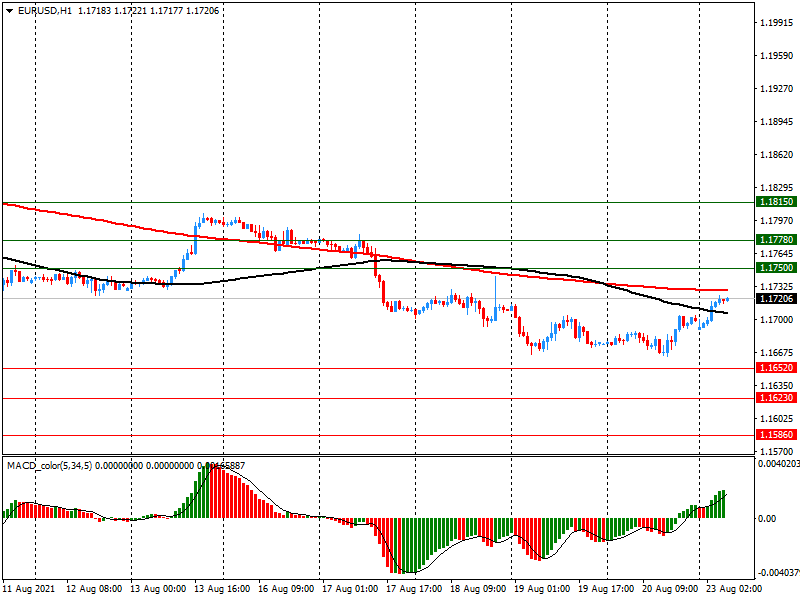
EUR/USD
Resistance levels (open interest**, contracts)
$1.1815 (1533)
$1.1778 (765)
$1.1750 (2097)
Price at time of writing this review: $1.1721
Support levels (open interest**, contracts):
$1.1652 (5081)
$1.1623 (2760)
$1.1586 (3266)
Comments:
- Overall open interest on the CALL options and PUT options with the expiration date September, 3 is 91965 contracts (according to data from August, 20) with the maximum number of contracts with strike price $1,2000 (8366);
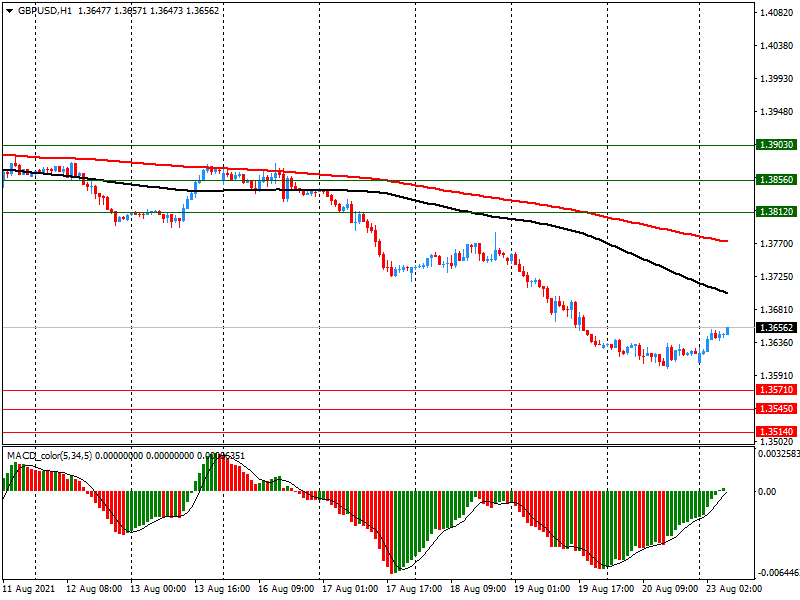
GBP/USD
$1.3903 (780)
$1.3856 (898)
$1.3812 (222)
Price at time of writing this review: $1.3656
Support levels (open interest**, contracts):
$1.3571 (1011)
$1.3545 (767)
$1.3514 (1334)
Comments:
- Overall open interest on the CALL options with the expiration date September, 3 is 16680 contracts, with the maximum number of contracts with strike price $1,4300 (2171);
- Overall open interest on the PUT options with the expiration date September, 3 is 15116 contracts, with the maximum number of contracts with strike price $1,3550 (1334);
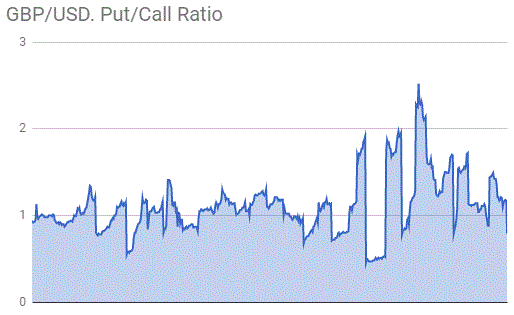
- The ratio of PUT/CALL was 0.91 versus 0.89 from the previous trading day according to data from August, 20
* - The Chicago Mercantile Exchange bulletin (CME) is used for the calculation.
** - Open interest takes into account the total number of option contracts that are open at the moment.
| Raw materials | Closed | Change, % |
|---|---|---|
| Brent | 65.03 | -2.56 |
| Silver | 22.992 | -0.96 |
| Gold | 1780.698 | 0.05 |
| Palladium | 2267.81 | -1.54 |
| Time | Country | Event | Period | Previous value | Forecast |
|---|---|---|---|---|---|
| 00:30 (GMT) | Japan | Nikkei Services PMI | August | 47.4 | |
| 00:30 (GMT) | Japan | Manufacturing PMI | August | 53.0 | |
| 07:15 (GMT) | France | Services PMI | August | 56.8 | 57 |
| 07:15 (GMT) | France | Manufacturing PMI | August | 58 | 57.3 |
| 07:30 (GMT) | Germany | Services PMI | August | 61.8 | 61 |
| 07:30 (GMT) | Germany | Manufacturing PMI | August | 65.9 | 65 |
| 08:00 (GMT) | Eurozone | Manufacturing PMI | August | 62.8 | 62 |
| 08:00 (GMT) | Eurozone | Services PMI | August | 59.8 | 59.8 |
| 08:30 (GMT) | United Kingdom | Purchasing Manager Index Services | August | 59.6 | 59 |
| 08:30 (GMT) | United Kingdom | Purchasing Manager Index Manufacturing | August | 60.4 | 59.5 |
| 10:00 (GMT) | Germany | Bundesbank Monthly Report | |||
| 10:00 (GMT) | United Kingdom | CBI industrial order books balance | August | 17 | 16 |
| 12:30 (GMT) | U.S. | Chicago Federal National Activity Index | July | 0.09 | |
| 13:45 (GMT) | U.S. | Manufacturing PMI | August | 63.4 | 62.8 |
| 13:45 (GMT) | U.S. | Services PMI | August | 59.9 | 59.4 |
| 14:00 (GMT) | Eurozone | Consumer Confidence | August | -4.4 | -5 |
| 14:00 (GMT) | U.S. | Existing Home Sales | July | 5.86 | 5.81 |
| 22:45 (GMT) | New Zealand | Retail Sales YoY | Quarter II | 6.8% | |
| 22:45 (GMT) | New Zealand | Retail Sales, q/q | Quarter II | 2.5% |
| Pare | Closed | Change, % |
|---|---|---|
| AUDUSD | 0.71388 | -0.11 |
| EURJPY | 128.437 | 0.25 |
| EURUSD | 1.16986 | 0.19 |
| GBPJPY | 149.551 | -0.02 |
| GBPUSD | 1.36208 | -0.09 |
| NZDUSD | 0.68354 | 0.13 |
| USDCAD | 1.28214 | -0.02 |
| USDCHF | 0.91677 | -0.12 |
| USDJPY | 109.783 | 0.05 |







© 2000-2026. All rights reserved.
This site is managed by Teletrade D.J. LLC 2351 LLC 2022 (Euro House, Richmond Hill Road, Kingstown, VC0100, St. Vincent and the Grenadines).
The information on this website is for informational purposes only and does not constitute any investment advice.
The company does not serve or provide services to customers who are residents of the US, Canada, Iran, The Democratic People's Republic of Korea, Yemen and FATF blacklisted countries.
Making transactions on financial markets with marginal financial instruments opens up wide possibilities and allows investors who are willing to take risks to earn high profits, carrying a potentially high risk of losses at the same time. Therefore you should responsibly approach the issue of choosing the appropriate investment strategy, taking the available resources into account, before starting trading.
Use of the information: full or partial use of materials from this website must always be referenced to TeleTrade as the source of information. Use of the materials on the Internet must be accompanied by a hyperlink to teletrade.org. Automatic import of materials and information from this website is prohibited.
Please contact our PR department if you have any questions or need assistance at pr@teletrade.global.


 Bank
Bank transfers


