- Analiza
- Novosti i instrumenti
- Vesti sa tržišta
Novosti i prognoe: devizno tržište od 17-07-2022
Wall Street Journal’s (WSJ) Nick Timiraos came out with the news piece that turned down market’s expectations of a 1.0% Fed rate hike. “Policy makers are leaning against full-point increase despite June inflation surge,” WSJ mentioned.
Key quotes
Federal Reserve officials have signaled they are likely to raise interest rates by 0.75 percentage point later this month, for the second straight meeting, as part of an aggressive effort to combat high inflation.
Policymakers left the door open to a larger, full-percentage-point increase at the July 26-27 gathering. But some of them simultaneously poured cold water on the idea in recent interviews and public comments ahead of their premeeting quiet period, which began Saturday.
Officials could face more difficult decisions later this year over how much higher to push rates, especially if the economy shows more obvious signs of slowing, but with inflation still well above the Fed’s 2% target.
Economists surveyed by The Wall Street Journal this month put the chance of a recession sometime in the next 12 months at 49%. Most of the 62 respondents expect the central bank to raise the fed-funds rate at least above 3.25% by the end of the year and to maintain it at or above that level through next year. Most expect the Fed’s first rate cut to occur by the end of 2023.
EUR/USD manages to stay firmer
The news adds strength to the EUR/USD pair’s rebound from a nearly two-decade low. That said, the major currency pair takes the bids to refresh its intraday high around 1.0100 by the press time of early Monday morning in Asia.
- Gold price has witnessed a modest recovery on double bottom formation around $1,700.00.
- The upbeat Retail Sales and a minor recovery in Michigan CSI have failed to support the DXY.
- Fed’s Bullard sees interest rates to 3.75% by the end of 2022.
Gold Price (XAUUSD) has attempted an upside break of the consolidation in the early Tokyo session formed in a narrow range of $1,703.22-1,705.90 on Friday. The precious metal is displaying some signs of volatility expansion after a minor squeeze. The bright metal has defended the psychological support of $1,700.00 on Friday, which is also akin to Thursday’s low. A dual test of the psychological support of $1,700.00 has made the level more crucial for the market participants. At the press time, the precious metal is displaying exhaustion signals at lower levels but needs more filters to feature a bullish reversal.
The US dollar index (DXY) ended the week on a positive note despite some losses on Friday. On a weekly note, the asset continued with its winning streak. The DXY is posting gains consecutively for the past three weeks. Although the asset has displayed a steel fall on a lower timeframe, the upside remains warranted amid a broader strength in the DXY. The asset is auctioning in an inventory distribution phase at around 108.00 and a sideways move is highly expected.
Also Read: Gold Weekly Forecast: Upward correction could be in the books during Fed's blackout

Fed to elevate interest rates to 3.75% by 2022
Upbeat US Retail Sales didn’t support the DXY bulls
Gold price was expected to display a downside move below the psychological support of $1,700 on Friday despite the release of the robust US Retail Sales. As per the market consensus, the economic data landed at 1%, higher than the prior release of -0.3% and the estimates of 0.8%. Soaring price pressures amid costly fossil fuels and food products were expected to drive Retail Sales higher. Also, the Retails Sales data that excludes automobiles landed similarly at 1%, higher than the consensus and prior release of 0.6%. Despite, the upbeat Retail Sales, the DXY has failed to display recovery signals.
-637936973257831355.png)
Improved Michigan CSI to delight Fed
Gold (XAUUSD) price remained on the backfoot after the release of the Consumer Sentiment Index (CSI) by the University of Michigan. The economic data was released at 51.1, minutely higher than the prior release of 50, and the expectations of 49.9. It is worth noting that the economic data was tumbling consecutively over the past two months. The higher inflation rate has been dampening the sentiment of the market participants. Consumers in the US were losing their confidence as higher price pressures had trimmed the value of their paychecks. A mild recovery in the sentiment data is expected to delight the Federal Reserve (Fed). However, the revival is not meaningful to strengthen the DXY.
-637936973418412586.png)
Fed’s interest rates to escalate to 3.75% by 2022
Gold price to see more weakness going forward as Fed policymakers are hiking their interest rates target for 2022 vigorously. St. Louis Federal Reserve Bank President James Bullard said on Friday that he expects to see good employment reports through the second half of this year, as reported by Reuters. Fed’s Bullard doesn’t see a recession despite the economy seeing a slowdown in the trend pace of growth. Also, he stated that inflation will continue to surprise the market participants to the upside.
More rate hikes to bring a slump in real estate
There is no denying the fact that the impact of higher interest rate hikes by the Fed is majorly borne by the home buyers. Higher interest rates are going to impact the interest obligations for the investors channelizing their liquidity in the real estate. The impact will shift later gradually to durable goods as hopes of recession will continue to build if inflation is bound to surprise the market on the upside.
Gold technical analysis
Gold prices are displaying some signs of recovery amid the formation of Double Bottom on an hourly scale. The successful retest of Thursday’s low at $1,767.70 has brought a mild recovery in the gold prices, however, this doesn’t warrant a bullish reversal. The latter needs more filters to compel investors to start betting on the same.
The precious metal has surpassed the 20-period Exponential Moving Average (EMA) at $1,707.53, which signals an intermittent recovery. However, the 50-period EMA at $1,712.20 is still scaling lower.
The Relative Strength Index (RSI) (14) is oscillating in a 40.00-60.00 range which signals a consolidation ahead.
Gold hourly chart

Gold analysis (XAU/USD) forecast
“The Swiss National Bank (SNB) is currently planning to raise interest rates by 50 or 75 basis points in its next scheduled monetary policy announcement in September,” Reuters quotes a Swiss newspaper published on Saturday.
Key quotes
The central bank last month raised its policy rate for the first time in 15 years and Chairman Thomas Jordan said soon afterwards that ongoing inflationary pressure meant further tightening would likely be needed.
Newspaper Schweiz am Wochenende said the central bank was planning a rate hike of 50 basis points to 0.25% from -0.25% at its next scheduled monetary policy announcement on Sept. 22, though the situation could yet change between now and then. It cited one or more unidentified people involved in the matter.
If inflation were to rise further, a rate hike of 75 basis points is possible, it added.
Asked about the report, a spokesperson for the SNB said it does not comment on speculation.
USD/CHF extends losses
The news appeared to have helped USD/CHF bears in stretching the previous day’s heavy losses as the quote refreshes intraday low around 0.9755 during the initial hours of Monday’s Asian session.
- AUD/NZD takes offers to refresh intraday low on upbeat NZ Q2 CPI.
- Failure to cross monthly resistance line, bearish MACD signals also favor sellers.
- 100-DMA appears a tough nut to crack for bears.
AUD/NZD justifies firmer New Zealand inflation data while refreshing the intraday low to 1.1017 during Monday’s initial Asian session. In doing so, the cross-currency pair also extends pullback from the 50-DMA.
That said, New Zealand’s (NZ) second quarter (Q2) headline inflation, as per Consumer Price Index (CPI), rose to 7.2% YoY versus compared to 7.1% market consensus and 6.9% prior.
Also read: New Zealand Q2 Consumer Price Index rose to 7.3% YoY, NZD/USD stays firmer
In addition to the upbeat NZ data and pullback from the 50-DMA, around 1.1040 by the press time, AUD/NZD sellers also cheer bearish MACD signals and Friday’s U-turn from a downward sloping resistance line from June 16.
With this, the quote signals more downside with the 50% Fibonacci retracement (Fibo.) of April-May moves, near 1.0005, acting as immediate support to watch ahead of the 1.0000 psychological magnet.
It’s worth noting, however, that the 61.8% Fibo. and the 100-DMA, respectively near 1.0960 and 1.0940, appear strong supports to break for the AUD/NZD bears afterward.
Meanwhile, the 50-DMA and aforementioned resistance line, close to 1.1040 and 1.1075 in that order, restrict short-term AUD/NZD recovery.
In a case where the pair rises past 1.1075, it can aim for late June’s swing high near 1.1110 before challenging the previous monthly high near 1.1180.
Should the AUD/NZD buyers manage to keep reins past 1.1180, they can aim for the 1.1200 threshold while surpassing the May month’s peak of 1.1193.
AUD/NZD: Daily chart
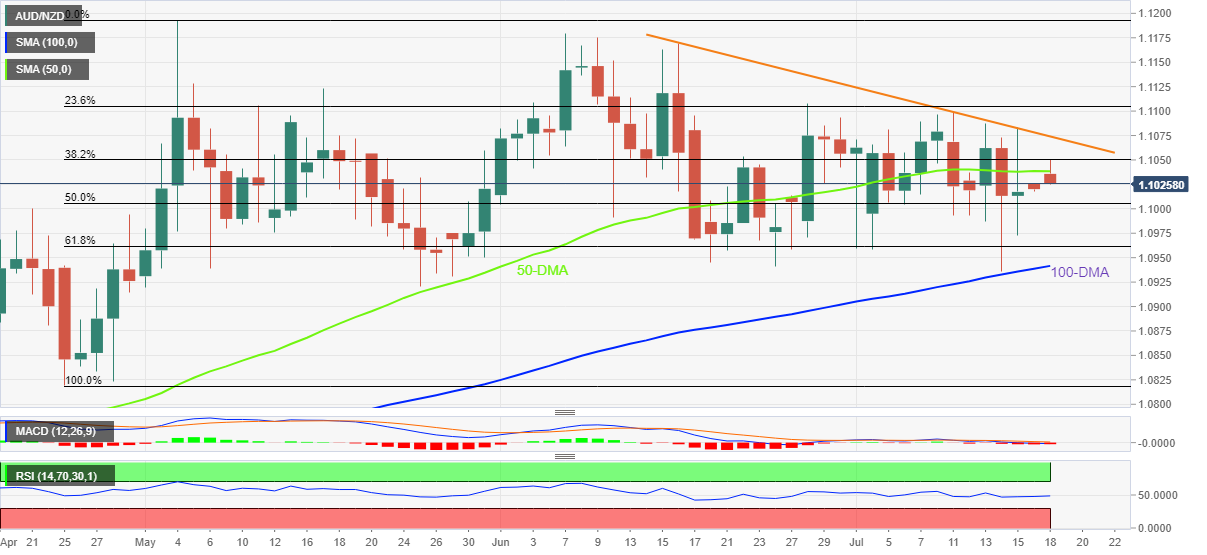
Trend: Further weakness expected
- NZD/USD holds onto Friday’s recovery moves on firmer NZ Q2 CPI.
- New Zealand CPI rose past market expectations and prior releases in Q2 2022, RBNZ announced new standing repurchase facility.
- Market’s cautious optimism, absence of Fed speakers can help Kiwi pair to extend recent rebound.
- Qualitative catalysts are the key as inflation, recession fears are of paramount importance.
NZD/USD justifies firmer New Zealand inflation data while keeping the corrective pullback from the two-year low, marked on Friday, to refresh the intraday high near 0.6165-70 during Monday’s initial Asian session. Also favoring the Kiwi pair could be the latest move by the Reserve Bank of New Zealand (RBNZ), as well as the US dollar’s pullback amid cautious optimism in the markets.
New Zealand’s second quarter (Q2) headline inflation, as per Consumer Price Index (CPI), rose to 7.2% YoY versus compared to 7.1% market consensus and 6.9% prior. The details also mentioned that the quarterly readings also strengthened to 1.7% QoQ versus 1.5% expected and 1.8% prior, per the latest release from Statistics New Zealand.
Additionally, New Zealand’s Business NZ PSI for June also rose to 55.4 versus the upwardly revised 55.3 reading.
Earlier in the day, the RBNZ announced new standing repurchase facility rules while stating, per Reuters, “Financial institutions may deposit the local currency with it in exchange for nominal government bonds to keep short-term interest rates at par with the bank's official cash rate.”
Other than New Zealand CPI and RBNZ move, NZD/USD also cheers the US dollar’s weakness amid downbeat US data and mixed Fedspeak.
That said, US Retail Sales for June grew 1.0% MoM versus 0.8% expected and -0.1% prior (revised from -0.3%) whereas the University of Michigan's Consumer Confidence Index edged higher to 51.5 in July's flash estimate, versus 49.9 expected and 50.0 prior.
However, the Index of Consumer Expectations declined to its lowest level since May 1980 at 47.3. Further, the US Industrial Production also contracted by 0.2% MoM in June while the New York Empire State Manufacturing Index rose to 11.1 versus -2.0 expected and -1.2 prior.
Among the key Federal Reserve (Fed) policymakers, Atlanta Fed President Raphael Bostic said on Friday that June's 75 basis points rate hike was a "big move" and added that the Fed wants policy transition to be orderly, as reported by Reuters. On the other hand, San Francisco Fed President Mary Daly said on Friday that the "Fed is working on getting down inflation without stalling economy." Further, St. Louis Federal Reserve Bank President James Bullard sounded neutral as he said, per Reuters, on Friday that it wouldn't make too much of a difference to do a 100 basis points (bps) or a 75 bps rate hike at the next meeting.
It’s worth that US Treasury Secretary Janet Yellen mentioned during the weekend that a strong dollar reduces US competitiveness to some extent. It is part of the monetary policy mechanism.
Amid these plays, Wall Street portrayed notable gains but the US Treasury yields eased on Friday.
Looking forward, a light calendar on Monday joins Fed policymakers’ blackout period to highlight the chatters surrounding inflation and recession as the key factors to determine immediate NZD/USD moves.
Technical analysis
A clear upside break of the monthly resistance line, around 0.6160 by the press time, appears necessary for the NZD/USD bulls to keep reins. Even so, May’s low around 0.6220 will be a crucial hurdle to watch. Meanwhile, pullback remains elusive until the quote drops back below 0.6100.
New Zealand’s second quarter (Q2) headline inflation, as per Consumer Price Index (CPI), rose to 7.3% YoY versus compared to 7.1% market consensus and 6.9% prior.
That said, the QoQ readings also strengthened to 1.7% versus 1.5% expected and 1.8% prior, per the latest release from Statistics New Zealand.
NZD/USD holds recovery
NZD/USD marked a quick uptick of around 15-pips before easing to 0.6160 just after the release of the key inflation data. The market reaction appears limited but helps the Kiwi pair to extend Friday’s rebound.
About New Zealand CPI
Consumer Price Index released by the Statistics New Zealand is a measure of price movements by the comparison between the retail prices of a representative shopping basket of goods and services . The purchase power of NZD is dragged down by inflation. The CPI is a key indicator to measure inflation and changes in purchasing trends. A high reading is seen as positive (or bullish) for the NZD, while a low reading is seen as negative.
“New Zealand's central bank said on Monday financial institutions may deposit the local currency with it in exchange for nominal government bonds to keep short-term interest rates at par with the bank's official cash rate,” per Reuters.
The news also added that the central bank, which delivered its sixth straight interest rate rise last week, added that the facility would allow institutions to lend NZ dollar overnight and "from tomorrow to the next day, on a secured basis."
Market reaction
NZD/USD fades the previous day’s corrective pullback from a two-year low, retreating to 0.6150 of late, as traders await the key New Zealand Q2 Consumer Price Index (CPI) data during early Monday.
- GBP/USD fades bounce off two-year low at the start of the key week.
- UK PM race signals Rishi Sunak, Liz Truss on top as final debates for the last two candidates continue.
- Britain up for increasing public sector workers’ wages by 5.0% to tame major strikes.
- Recession fears recently faded but UK data awaited for clear directions.
GBP/USD fails to extend the corrective pullback from a 28-month low as traders await the key political plays in the UK, not to forget headlines regarding inflation, employment and jobs report. That said, the Cable pair eases to 1.1867 during the initial hour of Monday’s Asian session.
GBP/USD also followed other major currency pairs as it cheered Friday’s US dollar pullback with hopes of a major increase in British public sector workers’ wages. However, cautious mood ahead of important data and decisive debate to determine the final candidates for the post of UK Prime Minister appears to have weighed on the quote of late.
That said, “Boris Johnson will next week offer pay rises averaging about 5 percent to millions of public sector workers, but ministers fear that below-inflation deals across the economy could trigger months of strikes,” said the Financial Times (FT). The news also adds, “The pay offer will be higher than originally proposed by government; ministers will argue it will help nurses, teachers and others cope with the cost of living crisis as inflation is expected to top 11 percent in the autumn.”
Elsewhere, Reuters said, “The five Conservative contenders still vying to be Britain's next prime minister clashed over tax cuts in a second televised debate on Sunday, with the two frontrunners - Rishi Sunak and Liz Truss - stepping up their battle on the economy.” It’s worth noting that UK’s ex-Chancellor Rishi Sunak gains major acceptance among Tories to be the next PM even if he resists tax cuts. On the other hand, Foreign minister Liz Truss has proposed, per Reuters, plans to axe increases in payroll tax and corporation tax at a cost of over 30 billion pounds ($36 billion) a year. “One candidate will be knocked out every day in the next three days, leaving a final two to face the verdict of Conservative Party members. They will vote for the winner who will be announced on Sept. 5,” adds Reuters.
It’s worth noting that softer US inflation expectations and mixed comments from the Fed policymakers appeared to have weighed on the US dollar the previous day. That said, US Retail Sales for June grew 1.0% MoM versus 0.8% expected and -0.1% prior (revised from -0.3%) whereas the University of Michigan's Consumer Confidence Index edged higher to 51.5 in July's flash estimate, versus 49.9 expected and 50.0 prior. However, the Index of Consumer Expectations declined to its lowest level since May 1980 at 47.3. Further, the US Industrial Production also contracted by 0.2% MoM in June while the New York Empire State Manufacturing Index rose to 11.1 versus -2.0 expected and -1.2 prior.
Talking about the Fedspeak, Atlanta Fed President Raphael Bostic said on Friday that June's 75 basis points rate hike was a "big move" and added that the Fed wants policy transition to be orderly, as reported by Reuters. On the other hand, San Francisco Fed President Mary Daly said on Friday that the "Fed is working on getting down inflation without stalling economy." Further, St. Louis Federal Reserve Bank President James Bullard sounded neutral as he said, per Reuters, on Friday that it wouldn't make too much of a difference to do a 100 basis points (bps) or a 75 bps rate hike at the next meeting.
It should be observed that US Treasury Secretary Janet Yellen mentioned during the weekend that a strong dollar reduces US competitiveness to some extent. It is part of the monetary policy mechanism.
Moving on, the key week starts with a light calendar but UK employment data, Consumer Price Index, Retail Sales and preliminary PMIs for July will be crucial economics to watch for fresh impulse. Also critical will be to watch the UK PM race and US PMIs for clear directions. Overall, GBP/USD is likely to be more volatile this week.
Also read: GBP/USD Weekly Forecast: A technical rebound could be in the offing
Technical analysis
A three-week-old resistance line challenges immediate GBP/USD recovery around 1.1865-70. Following that, June’s low of 1.1933 will be crucial for buyers to cross. On the contrary, a downside break of 1.1800 could recall sellers. That said, oversold RSI (14) conditions and impending bull cross of MACD tease a short-term rebound.
- AUD/USD aims to extend gains as bulls are hopeful above 0.6800 ahead of RBA minutes.
- The RBA minutes will provide a detailed view of the hawkish stance taken by RBA policymakers.
- The sold US Retail Sales data has failed to support the greenback.
The AUD/USD pair is hovering around the critical resistance of 0.6800 in the early Tokyo session. The asset is forming an initiative buying structure after a vertical upside move from Friday’s low at 0.6720. A sheer upside follow-up is expected from the asset if it violates 0.6806 decisively.
The antipodean is performing better against the greenback for the past two trading sessions after the release of the firmer aussie employment data. The Australian economy added 88.4k jobs in the labor market in June, significantly higher than the prior release of 60.6k and the expectations of 25k. Apart from that, the Unemployment Rate has declined to 3.5% from the prior release of 3.9%.
The upbeat employment generation figures and a steep fall in the jobless rate have delighted the Reserve Bank of Australia (RBA). This will empower the RBA to elevate interest rates in their next monetary policy meeting unhesitatingly.
Going forward, the release of the minutes from RBA for the July monetary policy meeting, which is scheduled for Tuesday will be of utmost importance. This will provide a detailed view behind featuring a consecutive 50 basis points (bps) interest rate hike by the RBA.
Meanwhile, the US dollar index (DXY) has tumbled below 108.00 after a perpendicular fall 19-year high of 109.29. Considering the momentum in the downside move, the asset is expected to extend its downside further. The release of the robust Retail Sales data on Friday has failed to support the DXY. The economic data landed at 15, higher than the estimates and the prior release of 0.8% and -0.3% respectively.







© 2000-2026. Sva prava zaštićena.
Sajt je vlasništvo kompanije Teletrade D.J. LLC 2351 LLC 2022 (Euro House, Richmond Hill Road, Kingstown, VC0100, St. Vincent and the Grenadines).
Svi podaci koji se nalaze na sajtu ne predstavljaju osnovu za donošenje investicionih odluka, već su informativnog karaktera.
The company does not serve or provide services to customers who are residents of the US, Canada, Iran, The Democratic People's Republic of Korea, Yemen and FATF blacklisted countries.
Izvršenje trgovinskih operacija sa finansijskim instrumentima upotrebom marginalne trgovine pruža velike mogućnosti i omogućava investitorima ostvarivanje visokih prihoda. Međutim, takav vid trgovine povezan je sa potencijalno visokim nivoom rizika od gubitka sredstava. Проведение торговых операций на финанcовых рынках c маржинальными финанcовыми инcтрументами открывает широкие возможноcти, и позволяет инвеcторам, готовым пойти на риcк, получать выcокую прибыль, но при этом неcет в cебе потенциально выcокий уровень риcка получения убытков. Iz tog razloga je pre započinjanja trgovine potrebno odlučiti o izboru odgovarajuće investicione strategije, uzimajući u obzir raspoložive resurse.
Upotreba informacija: U slučaju potpunog ili delimičnog preuzimanja i daljeg korišćenja materijala koji se nalazi na sajtu, potrebno je navesti link odgovarajuće stranice na sajtu kompanije TeleTrade-a kao izvora informacija. Upotreba materijala na internetu mora biti praćena hiper linkom do web stranice teletrade.org. Automatski uvoz materijala i informacija sa stranice je zabranjen.
Ako imate bilo kakvih pitanja, obratite nam se pr@teletrade.global.


 Банковни
 транcфери


