- Analiza
- Novosti i instrumenti
- Vesti sa tržišta
Forex-novosti i prognoze od 30-03-2022
- USD/JPY is auctioning in a narrow range of 121.32-122.24 ahead of the bond-buying conclusion.
- The BOJ bought JGBs heavily to vanish signs of recession in case of yield inversion.
- The DXY has been dumped by investors on subdued US GDP and ADP Employment Change.
The USD/JPY pair is oscillating in a narrow range of 121.32-122.24 as a broad-based buying in the Japanese yen is likely to over after the conclusion of the unlimited bond-buying program by the Bank of Japan (BOJ). The four-day bond-buying program of the BOJ will conclude on Thursday.
To curtail the likely inversion of the yield curve, the BOJ pledges to offer bids for the Japanese Government Bonds (JGBs) to cap the yields at 25 basis points. To address the mega buying of JGBs, the BOJ has announced that it will buy 600B yen in 3-5 yr JGBs and 725B yen in 5-10 yr JGBs. The BOJ has heavily bought the JGBs to stick to its ultra-loose monetary policy and to skip the signs of recession.
Meanwhile, the US dollar index (DXY) has tumbled below 98.00 decisively and is likely to drag further amid subdued performance from the US Gross Domestic Product (GDP) numbers and US Automatic Data Processing (ADP) payrolls. The US Bureau of Economic Analysis reported GDP (Q4) growth on an annualized basis at 6.9%, slightly lower than the estimates and previous print of 7%.
While the ADP recorded Employment Change at 455k lower than the market consensus of 450k and earlier print of 486k.
Going forward, the US Nonfarm Payrolls (NFP) will remain the major driver that will keep the street busy. But before that, investors will focus on the US Initial Jobless Claims and speech from the Federal Reserve (Fed) President John C. Williams, which are due on Thursday. On the Japanese docket, monthly and yearly Industrial Production data will hold significant importance.
- The Japanese yen is recovering as a quarter, and month-end flows accelerate.
- AUD/JPY Price Forecast: The cross-currency remains upward biased but might correct lower before resuming the uptrend.
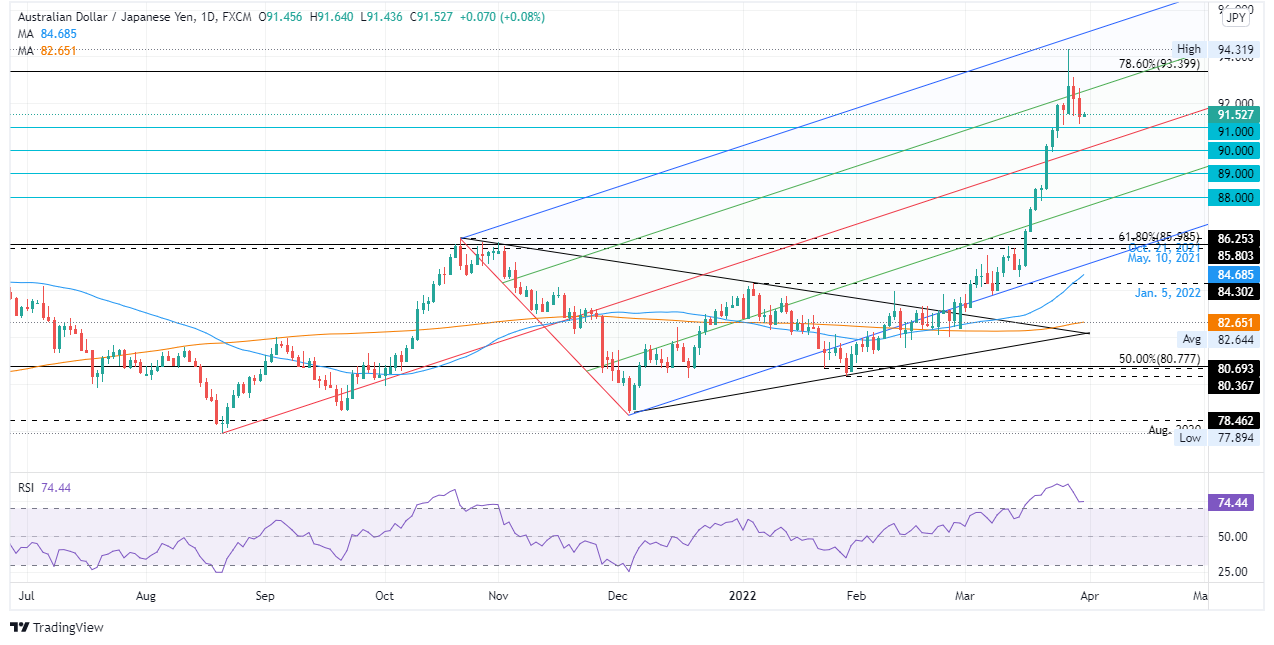
The AUD/JPY slid for the second consecutive day on Wednesday, as the Asian Pacific session is about to begin, courtesy of a dismal market mood as the Russia-Ukraine conflict escalates. Peace talks, according to Moscow, have failed to achieve a breakthrough as Russia intensifies its attacks on Ukraine. At 91.54 off the weekly highs, around 93.12, reflects the risk-off mood in the markets.
Wall Street’s finished Wednesday with a blood bath, with major indices in the red. Asian equity futures point to a lower open, except for China’s A50 and Hang-Seng, which benefit from a dovish People’s Bank of China (PBoC), which aims to pump more money into China’s financial markets to stimulate growth.
On Wednesday, the AUD/JPY began on a higher note, near 92.50s daily’s high, and then fell as the market mood shifted negatively, which boosted safe-haven peers appetite, particularly the Japanese yen and the Swiss franc, the leaders of the session. That said, the AUD/JPY settled down at current levels.
AUD/JPY Price Forecast: Technical outlook
The last two days’ AUD/JPY price action has achieved to record a series of lower highs and lower lows, so the pair is downward biased in the near term. It is worth noting that Wednesday’s close at 91.45 was lower than Monday’s 91.53 low, confirming the aforementioned.
That said, the AUD/JPY might correct before resuming upwards. So the AUD/JPY first support would be 91.50. A sustained break would expose 91.00. Once cleared, the next demand zone would be Pitchfork’s central-parallel line’s confluence with the 90.00 mark and then the 89.00 figure.
- WTI has attracted bids below $100.00 amid uncertainty over the OPEC meeting.
- The cumulative effect of OPEC uncertainty and reduction in oil inventories has underpinned WTI prices.
- Oil prices may shoot firmly if an embargo on Russian oil by Europe is put in place.
West Texas Intermediate (WTI), futures on NYMEX, has advanced towards $106.40 but is likely to remain lackluster as investors are keeping eye on the outcome of the OPEC meeting, which is due on Thursday. The agenda of the OPEC meeting is likely to revolve around the elevation of the oil supply to contain the prohibited oil from Moscow.
Russia had attracted plenty of sanctions from the Western leaders after its invasion of Ukraine. Right from the collapse of the International SWIFT banking system to the embargo on its oil, the Russian economy is losing financial stability. Overnight prohibition of Russian oil from the US and discussions on the embargo of Russian oil by the European Union (EU) has made their oil stockpiles toxic for them.
Although Russia has cut off its military activity from northern Ukraine and Kyiv in order to match the outcome of the first face-to-face negotiations between the officials of Moscow and Kyiv in Turkey, Western leaders are likely to stick with their sanctions amid destruction and death in Ukraine.
Apart from the uncertainty over the OPEC meeting, significant slippage in the US oil stockpiles reported by the Energy Information Administration (EIA) has underpinned the oil prices. The US EIA reported a slippage in oil stockpiles by -3.449M against the market consensus of -1.022M and prior print of -2.508M.
- The British pound on Wednesday gained some 0.32%.
- A dismal market mood failed to pressure the risk-sensitive currencies, which gained on US dollar weakness.
- GBP/USD Price Forecast: Unless bulls reclaim 1.3298, the GBP/USD might aim towards a renewed YTD low test around 1.2999.
The British pound recovered some ground vs. the greenback as the market mood turned sour, courtesy of reports of the Kremlin saying that although Ukraine’s effort to fulfill some of Russia’s demands, peace talks have not reached a breakthrough. At the time of writing, the GBP/USD is trading at 1.3137.
US equities reflected the aforementioned, trimming Tuesday’s gains on the Wednesday session. The US Dollar Index is down 0.58%, sitting at 97.838, portraying its softer tone on the Wednesday session. Furthermore, lower US Treasury yields are a tailwind for the Pound sterling, which reached a daily high of around 1.3182 but retreated towards the mid 1.3100-80 area.
GBP/USD Price Forecast: Technical outlook
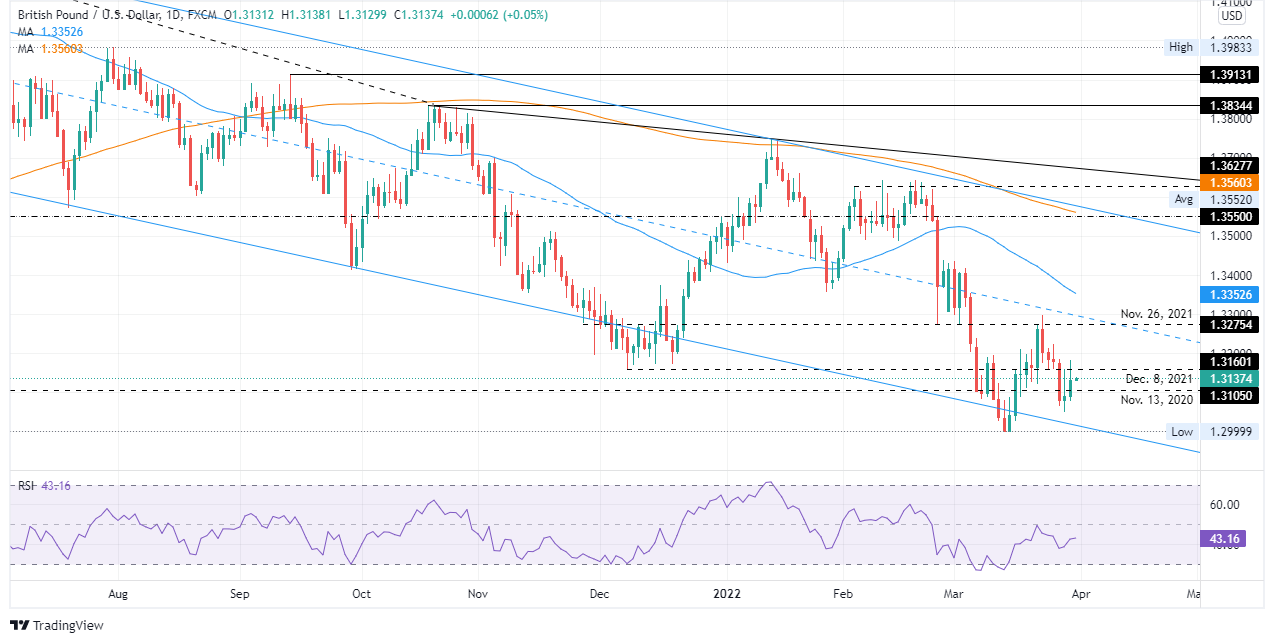
The GBP/USD keeps trading within the boundaries of a descending channel in the daily chart. The daily moving averages (DMAs) keep residing above the exchange rate, confirming the downward bias, and as long as the GBP/USD remains below 1.3298, downside risks remain.
That said, the GBP/USD recent jump could be viewed as a rally in a downtrend.
On the way down, the GBP/USD first support would be 1.3100. A sustained break would open the door towards a renewed test of the YTD low at 1.2999 but firstly would face some hurdles on its way down. The next support would be the March 29 1.3050 daily low, followed by the bottom-trendline of the descending channel, which confluences with the YTD low at 1.2999.
Ukrainian Negotiator: Russia and Ukraine will resume peace talks online on April 1, according to Reuters.
During the latest talks, Ukraine said the countries' two leaders should meet, but Russia said more work needed to be done on a draft treaty.
This follows a series of disappointing headlines around the peace talks with the head of the Russian republic of Chechnya Kadyrov saying that the Kremlin negotiator Minsky was wrong because they will not make any concessions over Ukraine.
These talks are taking place in Istanbul, Turkey. The deputy defence minister had said that Russian forces would cut back their military operations around the capital, Kyiv. The negotiators they would do so in order to focus attention on the talks, build mutual trust and create the right conditions for a peace agreement. However, on Wednesday, Russian forces bombarded the outskirts of Kyiv. The US administration had warned on Tuesday they were sceptical of Russia’s vow to curtail its military assault on Ukraine.
Market implications
As a consequence, equities ticked down and oil bounced as doubts grew over Russia’s intentions in Ukraine. The Thomson Reuters CRB Index rallied 2.2% with West Texas Intermediate crude in the spot market breaking $108bbl in New York trade. This in turn is supporting the Aussie.
Market pricing remains very responsive to sudden shifts in sentiment and the onset of quarter and month-end is an additional hurdle for markets to contend with.
The end of the week's US jobs market data will be important in this regard to determine whether the US dollar can continue to run higher on safe haven flows and both positive economic data and central bank prospects in the face of higher interest rates and a wave of mounting inflation pressures.
- USD/CHF is balanced in a narrow range of 0.9220-0.9240 below 61.8% Fibo retracement.
- A death cross of 50 and 200-period EMAs signals more downside going forward.
- The RSI (14) has slipped into a bearish range of 20.00-40.00, which indicates more pain ahead.
The USD/CHF pair is oscillating in a narrow range of 0.9220-0.9240 in early Tokyo. The asset has witnessed a steep fall recently after dropping below the previous week’s low at 0.9260.
On an hourly scale, USD/CHF is staying below 61.8% Fibonacci retracement (placed monthly lows and highs at 0.9150 and 0.9460 respectively) placed at 0.9269. The asset is oscillating near the declining trendline placed from March 21 low at 0.9294 adjoining the previous week’s low at 0.9260.
A death cross from the 50 and 200-period Exponential Moving Averages (EMAs) at 0.9328 triggered a bear attack on the counter.
The Relative Strength Index (RSI) (14) has shifted into a bearish range of 20.00-40.00 from 40.00-60.00, which indicates more pain ahead.
For further downside, Swiss franc bulls need to drag the asset below the ongoing consolidation of 0.9220-0.9240. This will expose the pair to more downside at March 7 low and monthly lows at 0.9197 and 0.9150 respectively.
On the contrary, greenback bulls can obtain control if the asset advances above the 20 EMA at 0.9281. This will drive the asset towards the 200 EMA at 0.9313, followed by 38.2% Fibo retracement at 0.9341.
USD/CHF hourly chart
-637842751172601252.png)
- NZD/USD holds positive ground despite risk-off sentiment.
- The Ukraine crisis remains in the driving seat with an eye kept on central banks.
NZD/USD is trading in the bullish territory on Thursday following a strong performance on Wednesday. The currency rose from a low of 0.6927 to a high of 0.6998. The bulls were out in force as the euro rallied and risk assets jumped on the cautious optimistic headlines surrounding the Ukraine & Russian peace talks.
However, the markets were whipsawed by headlines to the contrary as well as by sentiment related to central bank outlooks. nevertheless, the NZD managed to stay on its flight path and ended the day higher. ''The Kiwi is higher again this morning, knocking on the door of 70 cents as it takes a lead from the higher EUR, which has, in turn, risen as high inflation there looks like it will force the ECB’s erstwhile dovish hand,'' analysts at ANZ Bank explained.
''The AUD is also higher, but to a lesser extent, and that’s seen a bounce in NZD/AUD (see below), but it also neatly demonstrates how the Kiwi has seemingly been able to latch on to any positivity of late. But of course when that happens, fickle markets can be quick to turn. Still, we think the re-awakening of the EUR and AUD will be key to how the NZD performs in the coming weeks, and the writing seems to be on the wall on that score given market expectations for hikes and recent inflation reads.''
Ukraine peace talks, lack of progress
Russian forces bombarded the outskirts of Kyiv on Wednesday and this came following the warnings from the US administration that they were sceptical of Russia’s vow to curtail its military assault on Ukraine.
Additionally, both the Ukraine Defence Ministry and the Polish Deputy Prime Minister crossed the wires and stated that Russia is preparing for a new attack in Ukraine. All indications are that we are facing a long war, Aljazeera Tweeted, quoting the Polish PM. A Ukraine Defence Ministry spokesperson expressed a view that the Russian military continues to aim to take control of Mariupol, a strategic city in the east, saying that a major withdrawal is not taking place, and Russia is ready to resume attacks. Talks will resume April 1.
- Breakout of an ascending triangle pattern may challenge the monthly highs.
- Euro bulls have surpassed the 200 EMA for the first time this month.
- The RSI (14) has shifted into a bullish range, which adds to the upside filters.
The EUR/USD pair has extended its gains on Wednesday after overstepping Tuesday’s high at 1.1137. The asset has witnessed a firmer upside this week after breaching the consolidation of the last week, which placed in a narrow range of 1.0966-1.1045.
On a four-hour scale, EUR/USD has given a breakout of the ascending triangle formation by surpassing the horizontal line, which is placed near March 2 high at 1.1143. However, the advancing trendline is plotted from monthly lows at 1.0806, adjoining the March 28 low at 1.0945.
Euro bulls are firmer above the 200-period Exponential Moving Average (EMA) at 1.0960, which adds to the upside filters. However, the bulls seek validation of a bull cross from the 20 and 200-period EMAs.
The Relative Strength Index (RSI) (14) has shifted into a bullish range of 60.00-80.00 from 40.00-60.00, which has triggered a bullish setup.
Should the asset test March 2 high at 1.1143, the major will start advancing towards monthly highs at 1.1233, followed by February 14 low at 1.1280.
On the contrary, greenback bulls can be worthy if the asset drops below March 21 high at 1.1070, which will drag the asset towards March 28 low at 1.0945, followed by round level support at 1.0900.
EUR/USD four-hour chart
-637842731077068921.png)
- The Loonie trims weekly losses, so far up 0.01% on dismal market mood.
- The longer the Russia-Ukraine war, the heaviest the burden of global inflation as commodities rally.
- USD/CAD Price Forecast: To continue downwards, except that USD bulls push the pair decisively above 1.2530.
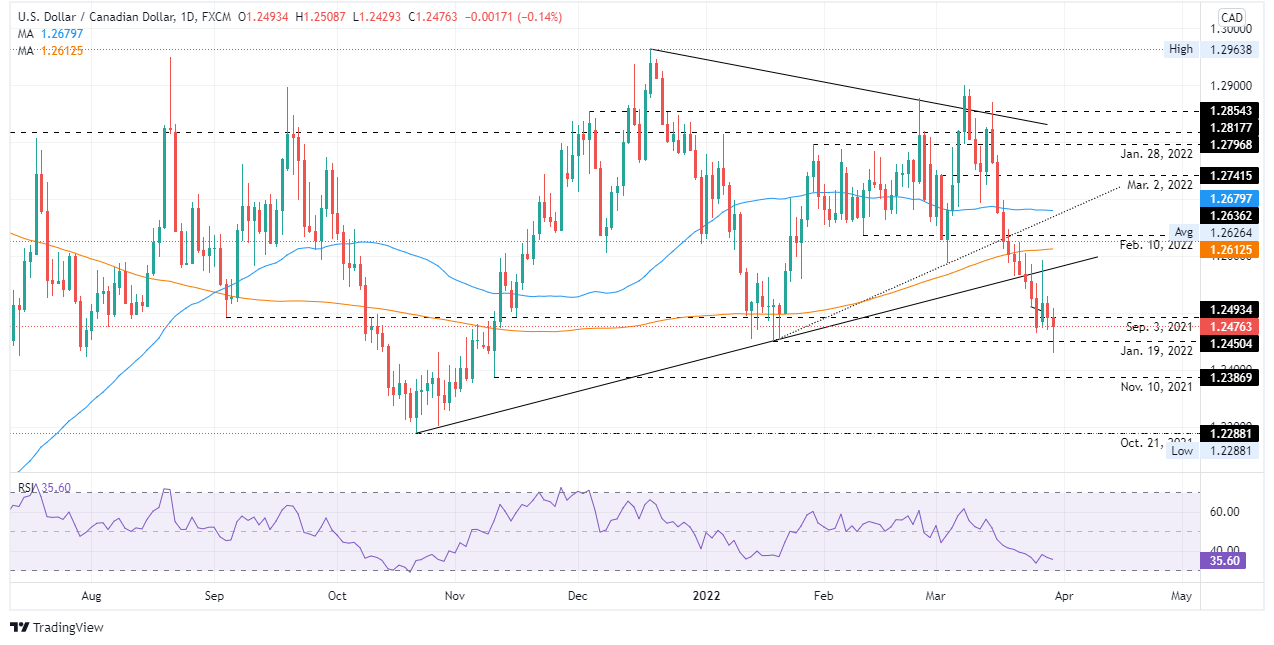
The USD/CAD extends its fall for the second straight day; after Monday’s price action printed a weekly high near the 1.2600 mark, the Loonie strengthened on the back of high oil prices, amid a downbeat market mood, courtesy of recent developments in the Eastern Europe front. At the time of writing, the USD/CAD is trading at 1.2475.
Developments in Eastern Europe fail to show progress, boost oil prices
US equities finished in the red, reflecting a dismal sentiment. Russian officials said that even though Ukraine has made an effort to fulfill some of the Russian demands, peace talks have not reached a breakthrough, as reported by the Kremlin. Also, as reported by Aljazeera Tweets, the Polish Deputy Prime Minister noted that Russia is preparing a new attack in Ukraine and added that all indicate that we are facing a long war.
That said, commodity prices aimed higher, led by crude oil and precious metals. The US crude oil benchmark, WTI, is trading at $107.44 per barrel, up 2.26% compared to Tuesday, while gold closes to 1% gains, exchanging hands at $1935.16 troy ounce.
In the FX space, commodity-linked currencies like the Canadian dollar continues strengthening vs. the greenback. Overnight, the USD/CAD opened near 1.2500, the day’s highs, and retreated towards 1.2420s until settling down around the 1.2470-90 area.
An absent Canadian economic docket left USD/CAD traders leaning on US macroeconomics. The US docket unveiled the ADP Employment Report, which came better than expected, showing an increase of 455K jobs in the economy in March, more than the 450K foreseen. Furthermore, the US GDP for the Q4 of 2021 grew at its highest pace since 2020’s Q3. The final reading rose by 6.9%, lower than the 7.1% estimated.
Later, Richmond Fed President Tomas Barkin said that he’s open to raising rates by 50-bps at the May meeting, depending on how strong is the US economy.
USD/CAD Price Forecast: Technical outlook
The USD/CAD is facing solid support at the 1.2420, which once pierced, jumped off immediately, a signal that it’s going to be defended by USD bulls. In fact, Wednesday’s price action is forming a hammer, a candlestick that, at the end of an upward/downward move, signals a change of the trend, but it would need confirmation.
Upwards, the USD/CAD first resistance would be 1.2500. A clear break would send the pair towards a renewed test of 1.2600, but first, it would face resistance at 1.2552.
On the flip side, in the event of extending the downtrend, the USD/CAD first support would be January 19, 1.2438 daily low. A breach of the latter could open the door towards 1.2288, but first, it would face November 10, 2021, a daily low at 1.2387, followed by 1.2300, and then the aforementioned 1.2288.
- AUD/USD bulls are running into a ceiling of resistance as commodities rise.
- The Ukraine crisis is intensifying, pressuring oil prices higher again.
AUD/USD has been stuck in a tight range on the day as the price attempts to move higher to test the resistance on the daily chart, but without conviction so far. At the time of writing, AID/USD is trading at 0.7508 and has chopped between 0.7502 and 0.7536 range so far.
The commodities markets have been given another boost by the prospects of the Ukraine crisis dragging on for longer. The prospects of a cease-fire have been dashed by the latest comments by key officials involved in the war.
The Kremlin on Wednesday has said there was no sign of a breakthrough yet. Ramzan Kadyrov, who is a powerful head of the Russia's republic of Chechnya, said on Wednesday that Moscow would make no concessions in its war in Ukraine and that Kremlin negotiator Vladimir Medinsky had been wrong to suggest otherwise.
Both the Ukraine Defence Ministry and the Polish Deputy Prime Minister crossed the wires and stated that Russia is preparing for a new attack in Ukraine. All indications are that we are facing a long war, Aljazeera Tweeted, quoting the Polish PM. A Ukraine Defence Ministry spokesperson expressed a view that the Russian military continues to aim to take control of Mariupol, a strategic city in the east, saying that a major withdrawal is not taking place, and Russia is ready to resume attacks.
Indeed, on Wednesday, Russian forces bombarded the outskirts of Kyiv and the US administration had warned on Tuesday they were sceptical of Russia’s vow to curtail its military assault on Ukraine, ending the day with a note of caution after hours of peace talks between the two sides appeared to make some headway.
As a consequence, equities ticked down and oil bounced as doubts grew over Russia’s intentions in Ukraine. The Thomson Reuters CRB Index rallied 2.2% with West Texas Intermediate crude in the spot market breaking $108bbl in New York trade. This in turn is supporting the Aussie.
Market pricing remains very responsive to sudden shifts in sentiment and the onset of quarter and month-end is an additional hurdle for markets to contend with. The end of the week's data will be important in this regard to determine whether the US dollar can continue to run higher on both positive economic data and central bank prospects in the face of higher interest rates and a wave of mounting inflation pressures.
On Friday, US Nonfarm Payrolls data will take centre stage as a meanwhile distraction to the Ukraine crisis this Friday. ''Employment likely continued to advance in March following two strong reports averaging +580k in Jan and Feb,'' analysts at TD Securities said.
''That said, we expect some of that boost to fizzle, though to a still firm job growth pace of +350k. Indeed, job gains should lead to a new drop in the unemployment rate to a post-COVID low of 3.7%. We also expect wage growth to slow to a still firm 0.3% MoM pace.''
AUD/USD technical analysis
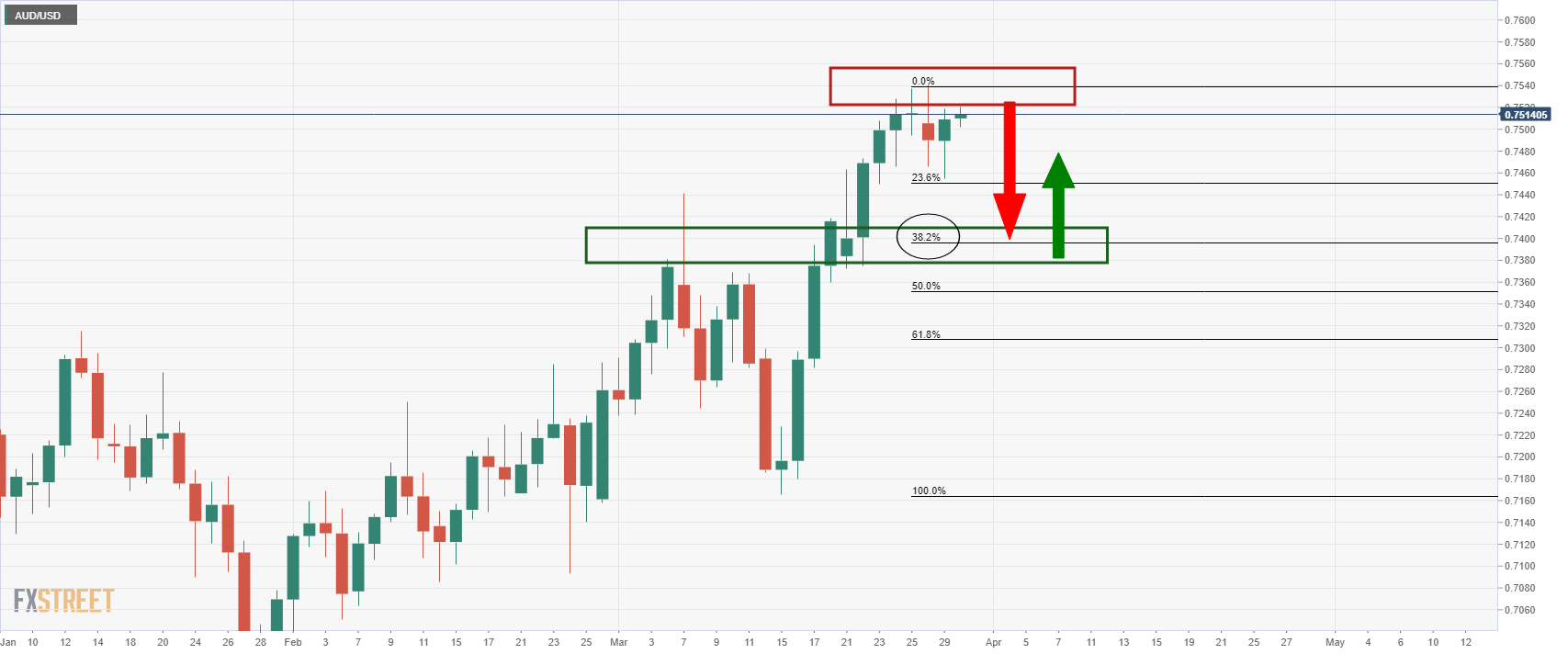
The price is testing the resistance in the daily chart but is yet to move in to mitigate that imbalance from the bullish rally on the daily chart. Therefore, the bears will be looking for a move to test at least 38.% Fibonacci retracement area that correlated with the prior resistance at the start of March near 0.74 the figure.
- The yen’s broad recovery continued for a second day on Wednesday as traders continued to pair short positions.
- GBP/JPY dipped as low as the 159.00 level at one point, but has since recovered back to the 160.00 area.
- BoJ relative dovishness, even versus an increasingly less hawkish BoE, plus falling geopolitical risk premia suggests support for the pair.
The yen’s broad recovery continued for a second day on Wednesday as traders continued to pair short positions against the currency in wake of recent jawboning from BoJ and Japanese government policymakers regarding JPY weakness. GBP/JPY thus dipped as low as the 159.00 level at one point but has since recovered back to the 160.00 area, where it continues to trade with on the daily losses of around 0.5%, meaning the pair has reversed nearly 3.0% lower versus earlier weekly highs in the mid-164.00s.
The recent pullback does not mean that the yen has suddenly become a long-term buy and GBP/JPY is set to fall back to earlier sub-151.00 monthly lows. Rather, the short-term bears riding a wave of profit-taking on recent GBP/JPY longs, which numerous technical indicators over the past few sessions had suggested had become heavily overbought at the start of the week, are likely targeting a retracement back to prior Q1 2022/Q4 2021 highs in the 158.00 area. Here, the longer-term and more patient GBP/JPY bulls may be inclined to add to long positions with a view to target an eventual move back into the mid-160s.
Recent BoJ insistence that it wants to stick to ultra-dovish policy, which it has backed up in recent days via market interventions to prevent Japanese 10-year yields moving above the top of the -0.25% to 0.25% target range, isn’t likely to change any time soon. That means that, even if the BoE is sounding much less hawkish as of late, rate differentials are likely to continue moving in sterling’s favour (against the yen anyway, though not versus most of the rest of the G10). That, combined with a recent unwind in geopolitical risk premia on a more promising tone to Russo-Ukraine peace talks, could keep the pair underpinned in the medium-term.
What you need to know on Thursday, March 31:
The main story in FX markets on Wednesday was a continued weakening of the US dollar, where the DXY dropped a further 0.6% to the 97.80s, where it now probes mid-March lows more than 1.5% below earlier weekly highs. Wednesday’s US data releases (ADP jobs and final Q4 GDP and Core PCE estimates) were robust, which alongside further hawkish Fed speak helped solidify expectations for a 50 bps rate hike from the bank in May.
But this wasn’t enough to shield the US dollar from a bearish combination of 1) unfavourable moves in rate differential amid downside in US yields, 2) month/quarter-end selling and 3) optimism regarding Russo-Ukraine peace talks. Regarding the latter, though skepticism about apparent progress in the talks this week remains elevated in wake of Russia’s continued offensive in Ukraine, FX markets seem to be pricing in a more favourable geopolitical outlook.
“The conflict may be moving to a more localized phase with some of the more extreme tail risk scenarios reducing in probability,” analysts at JPMorgan said on Wednesday in a note where they also recommended buying EUR/USD. For reference, EUR/USD hit its highest levels since the beginning of the month to the north of the 1.1150 mark on Wednesday, up 0.7% on the day and up 1.9% versus earlier sub-1.0950 weekly lows. The euro got some independent impetus from continued upside in short-end Eurozone yields as traders continued upping bets on ECB tightening in wake of the latest Spanish and German preliminary March HICP inflation figures, which surprised to the upside again.
In terms of the rest of the G10, while the euro was a strong performer, it was by no means the best, with the Swiss franc and Japanese yen taking that crown. USD/JPY dropped 0.8% to back under 122.00, a direct function of the drop in US yields on the day, leaving it now more than 2.5% below earlier weekly highs as traders pondered recent Japanese policymaker commentary regarding recent yen weakness. USD/CHF, meanwhile, saw an uncharacteristically large 0.9% drop from above 0.9300 to the low 0.9200s, leaving it only within a few pips of testing its 200-Day Moving Average.
In terms of the rest of the major G10 currencies, the kiwi was a beneficiary of strong domestic data (New Home Building Consents and Business Sentiment), with NZD/USD rallying slightly over 0.5% back to the upper 0.6900s. Its antipodean counterpart the Aussie failed alongside the loonie to benefit from higher energy prices, with AUD/USD trading in uninspired fashion in the 0.7500 area (still close to multi-month highs) and USD/CAD languishing just under 1.2500 and near-annual lows.
Finally, sterling was a middle-of-the-road performer, with GBP/USD rallying back into the mid-1.3100s but failing to hold above its 21-Day Moving Average for a sixth successive session, as EUR/GBP hit its highest level in more than three months near 0.8500.
Ahead, while FX market focus will remain transfixed on geopolitical developments and any associated impact on risk appetite/the commodity complex, economic data will also remain a key driver, with traders simultaneously also continuing to weigh up G10 monetary policy divergence. The OPEC+ meeting, US February Core PCE and Canadian January GDP figures are the main events to watch in the coming session, ahead of the release of the US labour market report on Friday, which is the most important event of the week. Eurozone HICP inflation figures are also out on Friday and should show a steep rise as the national figures out of Spain and Germany did on Wednesday.
- Gold is on the bid in late New York and the DXY is pressured.
- The Ukraine crisis is intensifying as hopes of a cease-fire anytime soon are dashed.
- XAU/USD bulls are looking to the month-end close for prospects of a continuation next month.
At $1,933.54, the gold price is 0.72% higher on the day with XAU/USD travelling between a low of $1,916.01 and $1,938.62 the high so far. Gold prices rose and have been supported by a softer US dollar and renewed doubts about the possibility of a ceasefire between Russia and Ukraine.
The US dollar (DXY) fell 0.6% to nearly a two-week low despite peace talk hopes between Ukraine and Russia deteriorating again. Gold prices fell by as much as 1.8% after Russia pledged to cut down on military operations around Kyiv and in northern Ukraine in peace talks on Tuesday, but the precious metal pared most of the losses to settle just 0.2% lower for the day as sceptics remained in the room.
Ukraine crisis intensifies
Concerns were solidified when, although the Kremlin on Wednesday welcomed that Kyiv had set out its demands for an end to the conflict in Ukraine in written form, it said there was no sign of a breakthrough yet. Ramzan Kadyrov, who is a powerful head of the Russia's republic of Chechnya, said on Wednesday that Moscow would make no concessions in its war in Ukraine and that Kremlin negotiator Vladimir Medinsky had been wrong to suggest otherwise. Polish Deputy Prime Minister also crossed the wires and stated that Russia is preparing for a new attack in Ukraine and all indications are that we are facing a long war, Aljazeera Tweeted.
On Wednesday, Russian forces bombarded the outskirts of Kyiv and the US administration had warned on Tuesday they were sceptical of Russia’s vow to curtail its military assault on Ukraine, ending the day with a note of caution after hours of peace talks between the two sides appeared to make some headway.
However, traders will be watching closely to see if there can still be progress following yesterday's talks. After all, the Ukrainian presidential advisor Mykhailo Podolyak said that there had been ''successful enough for a possible meeting between Putin and Zelensky.'' Podolyak added, “we have documents prepared now which allow the presidents to meet on a bilateral basis,.''
Markets have also been keeping a close tab on the US 2-year/10-year Treasury yield curve, which briefly inverted on Tuesday. The bond markets monitoring for tightening by the Federal Reserve has resulted in an inverse of the curve, signalling to markets that a recession could be on the way.
''With haven flows remaining robust, the risk of buyers being forced to offload in a vacuum alongside potential CTA liquidations have diminished for now, with key downside CTA triggers sitting in the $1870/oz region,'' analysts at TD Securities argued.
''Nonetheless, gold traders will also have to contend with macro outflows associated with a hawkish Fed as rates markets are readying for the Fed to deliver a hawkish surprise to markets,'' the analysts added. ''With that said, while geopolitical tensions and yield curve recession signals re-ignite investor interest in gold, downside risks still remain amid a hawkish Fed backdrop and as negotiators continue to work towards a ceasefire.''
Gold technical analysis
- Chart of the Week: Gold is moulding a bullish close for the month
We are in the last week of the month and the start of a new quarter could print a bullish prospect on the monthly chart, as illustrated below:
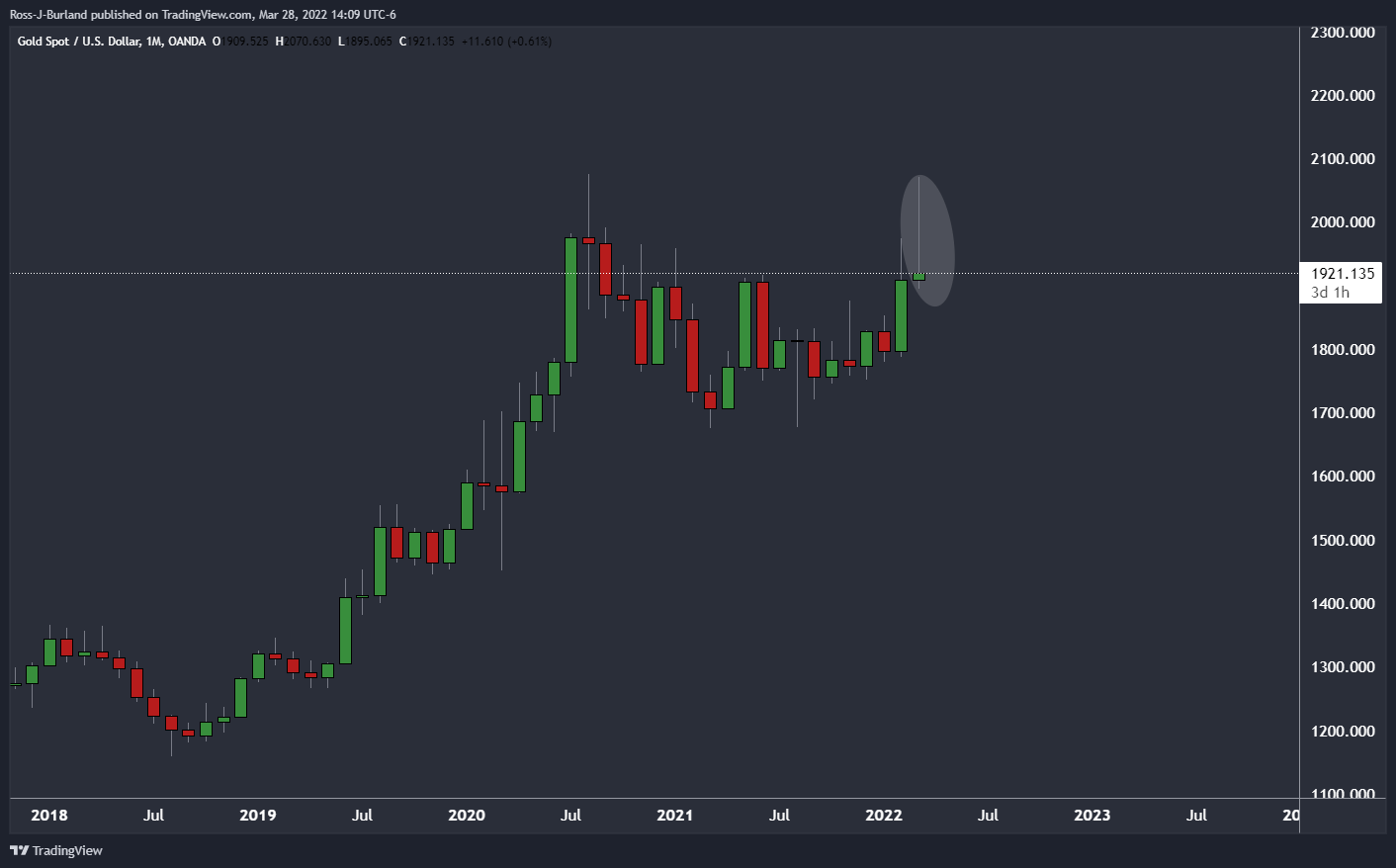
The month could close with a bullish candle and long wick that represents a phase of accumulation on the lower time frames, meaning, there is potential for a move high in the weeks ahead and a fresh cycle high thereafter.
- The shared currency bulls failed to cling to the 136.00 mark.
- Geopolitical developments in Eastern Europe turned sentiment negative as Russia backpedaled by saying that peace talks have not progressed.
- EUR/JPY Price Forecast: The path of least resistance in the near-term is downward biased.
The EUR/JPY retreats in the North American session, on a risk-off mood trading session to news from Russia’s – Ukraine front, as negotiations have failed to progress, as the French Foreign Minister noted. At the time of writing, the EUR/JPY is trading at 135.95.
The market sentiment turned dismal in the mid-European session, as Russia reported that although Ukraine’s efforts, they noted that there’s has been no breakthrough on it as Russia redeploys troops towards Donbas. That said, alongside Polish Deputy Prime Minister saying that Russia is preparing a new attack in Ukraine confirms the continuation of hostilities.
Aside from this, the EUR/JPY overnight seesawed in a 180-pip range. In the Asian session, the cross-currency pair reached its daily high at 136.66, retracing in the European session as a raft of negative sentiment struck the market, which lifted safe-haven peers, sending the EUR/JPY towards 134.87. Late in the North American session, the shared currency gained traction toward current levels.
EUR/JPY Price Forecast: Technical outlook
The EUR/JPY price action in the last two days shows indecision surrounding the pair. Failure to push above/below Monday’s boundaries keeps the EUR/JPY trapped in the 134.00-137.00 range, though the highs have been lower than each previous trading day in the last two days.
With that said, the EUR/JPY might be heading lower, though it would find some hurdles on its way south. The EUR/JPY first support would be 135.30. A decisive break would expose 134.87, followed by 133.97.
Upwards, the EUR/JPY first resistance would be 136.00. Breach of the latter would expose 136.50, followed by 137.00, and the YTD high at 137.54.
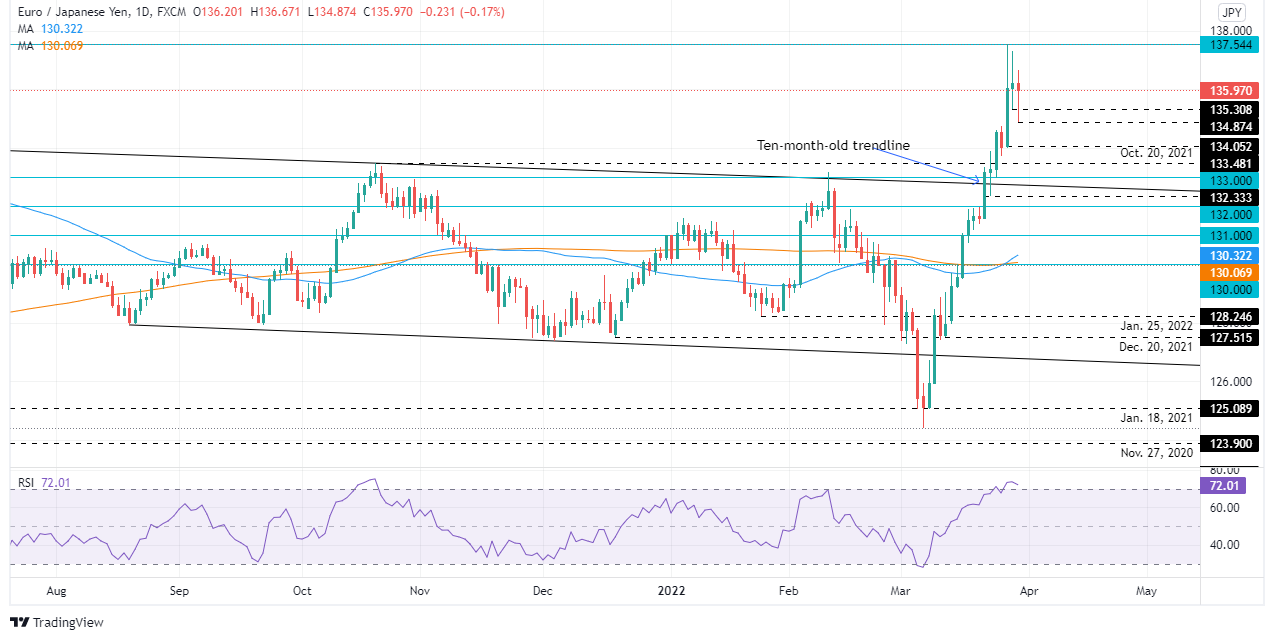
Technical levels to watch
Russia is beginning to reposition about 20% of the troops it has arrayed around Kyiv, the US Pentagon stated on Wednesday, adding that while some are moving to Belarus, none are moving back to home their home-garrison. The US expects Russia to refit and resupply troops to then redeploy them elsewhere in Ukraine, the Pentagon added, saying that the Pentagon would concur with the conclusion that Russian President Vladimir Putin had not been "fully" informed by the Ministry of Defense "at every turn" over the past month.
Separately, the White House said that it has information that Putin has been misled by the military and that he has tensions with some of his aides. The White House said the information it has about Putin underscores the problems with Russia's campaign in Ukraine.
- US equities are modestly lower across the board on Wednesday, as investors take profit following the recent impressive run higher.
- Waning Russo-Ukraine optimism, robust US data that solidified Fed tightening expectations and yield curve inversions were all cited as worries.
- The S&P 500 currently trades just above 4600 and on course to end the month 5.3% higher.
US equities are modestly lower across the board on Wednesday, as investors take profit following the recent impressive run higher, with one eye on geopolitical developments and the outlook for Fed policy and the US economy. The S&P 500, which rallied nearly as high as 4640 on Tuesday, is back to trading near the 4600 level, having dropped about 0.5% as optimism about Russo-Ukraine peace negotiations wanes somewhat after continued Russian assaults across Ukraine.
Meanwhile, US data (March ADP jobs and final Q4 GDP and Core PCE inflation) was robust and deemed by investors as supportive of expectations for a 50 bps rate hike from the Fed in May. Expectations for faster Fed tightening has pushed key parts of the US yield curve towards inversion recently, a worry for investors as yield curve inversions have accurately forecasted recessions in the past. Both of these have also been cited by investors as reasons for profit-taking and the modest downturn on Wednesday.
That means the index is on course for its first negative session in five and only its third since 15 March. Indeed, since that date, the index has rallied a stunning roughly 9.5% and, as the month-end approaches, is on course to post a monthly gain of about 5.3%. The S&P 500 is thus on course to post a quarterly loss of about 3.3%, the worst quarterly performance since H1 2020. But that masks the fact that the index was able to recover over 11.5% from earlier quarterly lows printed back in February in the 4120 area.
Looking at the other major US indices; the tech-heavy Nasdaq 100 index was last down about 0.7%, though remains robustly supported to the north of the 15,100 mark after the index hit its highest level since mid-January on Tuesday in the 15,200s. On the week, the index still trades about 2.5% higher, as the month-end approaches, gains since the end of February stand at about 6.3%. That strong monthly gain means the Nasdaq 100 is on course to end the quarter with losses of about 7.0%, which isn’t bad considering the index was at one point down more than 20% on the quarter.
Finally, the Dow was last down about 0.2% and remains robustly supported above the 35,000 level, putting it on course to end the month with gains of about 3.9% and quarterly losses of about 5.0%. The CBOE S&P 500 volatility index (or VIX) was last consolidating in the 19.00 area and near its lowest level since mid-January, having fallen precipitously in recent weeks from 37.50ish highs printed earlier this month. Analysts have questioned the resilience of the broad stock market and apparent complacency of the VIX (which is back below its long-run average of 20) in the face of such elevated risks pertaining to geopolitics, Fed (and central bank) policy and inflation.
- The New Zealand dollar is up in the week so far by 0.3%.
- Despite Ukraine’s efforts, negotiations in Eastern Europe stall as Moscow reports no “breakthrough.”
- NZD/USD Price Forecast: The pair is neutral-upwards biased once broken the 200-DMA.
The New Zealand dollar climbs for the second straight trading session, despite a risk-off market mood in the financial markets, courtesy of Moscow, which said they had not seen anything else promising or a breakthrough in their peace talks with Ukraine. At the time of writing, the NZD/USD is trading at 0.6980.
Russia-Ukraine negotiations show no progress, as reported by Moscow
Market sentiment turned sour since the European session. Global equities are falling, a consequence of no progress in negotiations between Russia and Ukraine, which added to the current high inflationary scenario, threatens to derail the post-pandemic economic recovery. Of late, the Polish Deputy Prime Minister said that Russia is preparing for a new attack in Ukraine and all indications are that we are facing a long war, according to Aljazeera Tweets. In the same tone, the French Foreign Minister stated that negotiations between Russia and Ukraine have not progressed.
Aside from this, the NZD/USD remains buoyant, despite the dismal market sentiment, in part lifted by a softer greenback, as portrayed by the US Dollar Index, down 0.55%, currently at 97.870. Also, the 2 to 10-year yield curve, which inverted at a time on Tuesday, stays almost flat, but with the 10-year yields above 2s, each one sitting at 2.373% and 2.332%, respectively.
An absent New Zealand economic docket would keep NZD/USD traders focused on US macroeconomic data and more Fed speaking.
Earlier in the North American session, the US economic docket featured ADP Employment Report, which showed that private companies added 455K jobs to the economy in March, higher than the 450K estimated, a prelude for Friday’s Nonfarm Payrolls report. Also, the US economy in the Q4 of 2021 grew at its highest pace since 2020’s Q3. The GDP on its final reading rose by 6.9%, a tick lower than the 7.1% foreseen.
Later, Richmond Fed President Tomas Barkin said that he’s open to raising rates by 50-bps at the May meeting, depending on how strong is the US economy.
NZD/USD Price Forecast: Technical outlook
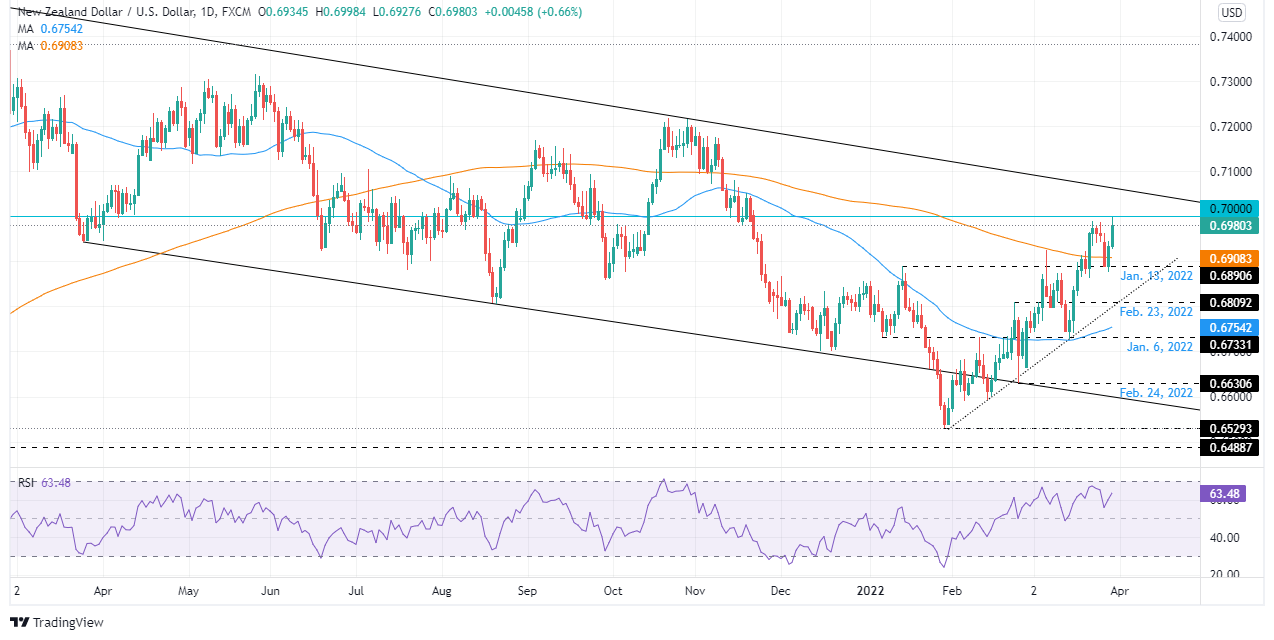
The NZD/USD reached a YTD high, but short of the 0.7000 mark, though retreated afterward. However, on Tuesday, the pair broke above the 200-day moving average (DMA) at 0.6908, a signal that the NZD/USD could aim higher. Also, the Relative Strength Index (RSI), a momentum indicator, points upward at 63.46, with room to spare before reaching overbought levels.
With that said, the NZD/USD’s first resistance would be the 0.7000 mark. Breach of the latter would expose the descending channel downslope top-trendline around the 0.7050-70 range, followed by 0.7100.
- GBP/USD bears are moving in on the hopes of a cease-fire dashed by relentless Russian attacks.
- Oil prices back on the bid, risk-off, US stocks lower and USD higher, weighing on GBP.
GBP/USD is trading around 1.313, 0.3% higher on the day in a technical move as the US dollar ebbed overnight on what, at first glance, seemed to be the makings of a breakthrough in Ukraine & Russian peace talks. However, the optimism over Ukraine-Russia peace talks waned on Wall Street and concerns over a recession are growing due to the prospect of a sharp rise in interest rates that is expected to hurt economic growth.
Ukraine crisis peace talks hopes dwindle
GBP is considered as being a risky currency and as such, it is coming under renewed pressure on Wednesday. The pair has started to slide from a high of 1.3182 that had been marked in the early New York trade. The Kremlin was reported to say that there was no sign of a breakthrough yet even though it welcomed Kyiv's move to set out its demands in written form. Ramzan Kadyrov, who is a powerful head of the Russia's republic of Chechnya, said on Wednesday that Moscow would make no concessions in its war in Ukraine and that Kremlin negotiator Vladimir Medinsky had been wrong to suggest otherwise. Polish Deputy Prime Minister also crossed the wires and stated that Russia is preparing for a new attack in Ukraine and all indications are that we are facing a long war, Aljazeera Tweeted.
As a consequence, US stocks fell on Wednesday. The S&P 500 is now down 0.6%. Markets had rallied in the previous session after Russia pledged to scale down military operations around Kyiv and in northern Ukraine. However. On Wednesday, Russian forces bombarded the outskirts of Kyiv. The US had warned on Tuesday they were skeptical of Russia’s vow to curtail its military assault on Ukraine’s capital, Kyiv, and the northern city of Chernihiv, ending the day with a note of caution after hours of peace talks between the two sides appeared to make some headway.
Still, there may be some hope yet. Following yesterday's talks, Ukrainian presidential advisor Mykhailo Podolyak said that there were ''successful enough for a possible meeting between Putin and Zelensky.'' he added, “we have documents prepared now which allow the presidents to meet on a bilateral basis," he said.
Eyes on oil prices
Looking at the positioning data, net short GBP positions had increased noticeably for a third week as concerns rise as to the cost of living crisis in the UK, so any signs of relief there are bound to support the pound in the spot market as inflation concerns abate.
There will therefore be a close eye kept on the price of oil and progress in peace talks that could trigger a sell-off in energy prices that might go a long way in supporting a recovery in the pound. Oil prices rebounded from day prior losses early on Wednesday on a report US inventories fell again and on skepticism over Russian promises during peace talks. West Texas Intermediate crude in the spot market is breaking $108bbl in New York trade.
BoE in focus
Meanwhile, the Bank of England's Governor Andrew Bailey acknowledged that the bank has softened its guidance on rate hikes this month to reflect the high level of economic uncertainty. This was backed up by BoE's Deputy Governor Ben Broadbent who has warned that the Ukraine crisis will have a big impact on the U.K. outlook:
- “As a big net importer of manufactures and commodities, it’s doubtful that the UK has ever experienced an external hit to real national income on this scale.”
- “From the narrow perspective of monetary policy it will result in the near term in the difficult combination of even higher inflation but weaker domestic demand and output growth.”
Looking ahead, analysts at Brown Brothers explained that, ''at the March 17 decision, the bank said that further tightening of policy “might be” appropriate in the coming months vs. the forward guidance in February, when such a move was seen as “likely.” Bailey said that while it’s been appropriate for the BoE to tighten policy under current circumstances, forward guidance should reflect the current heightened uncertainty,''
''WIRP suggests a hike at the next meeting May 5 is fully priced in, with only 25% odds of a 50 bp move then vs. 50% at the start of this week. Swaps market sees the policy rate at 2.25% over the next 12 months, up from 2.0% at the start of last week. Risks of another 25 bp of tightening over the following 12 months have now been priced out,'' the analysts added.
Key data events
Looking ahead for the week, US Nonfarm Payrolls data will take centre stage as a meanwhile distraction to the Ukraine crisis this Friday. ''Employment likely continued to advance in March following two strong reports averaging +580k in Jan and Feb,'' analysts at TD Securities said.
''That said, we expect some of that boost to fizzle, though to a still firm job growth pace of +350k. Indeed, job gains should lead to a new drop in the unemployment rate to a post-COVID low of 3.7%. We also expect wage growth to slow to a still firm 0.3% MoM pace.''
GBP/USD technical analysis
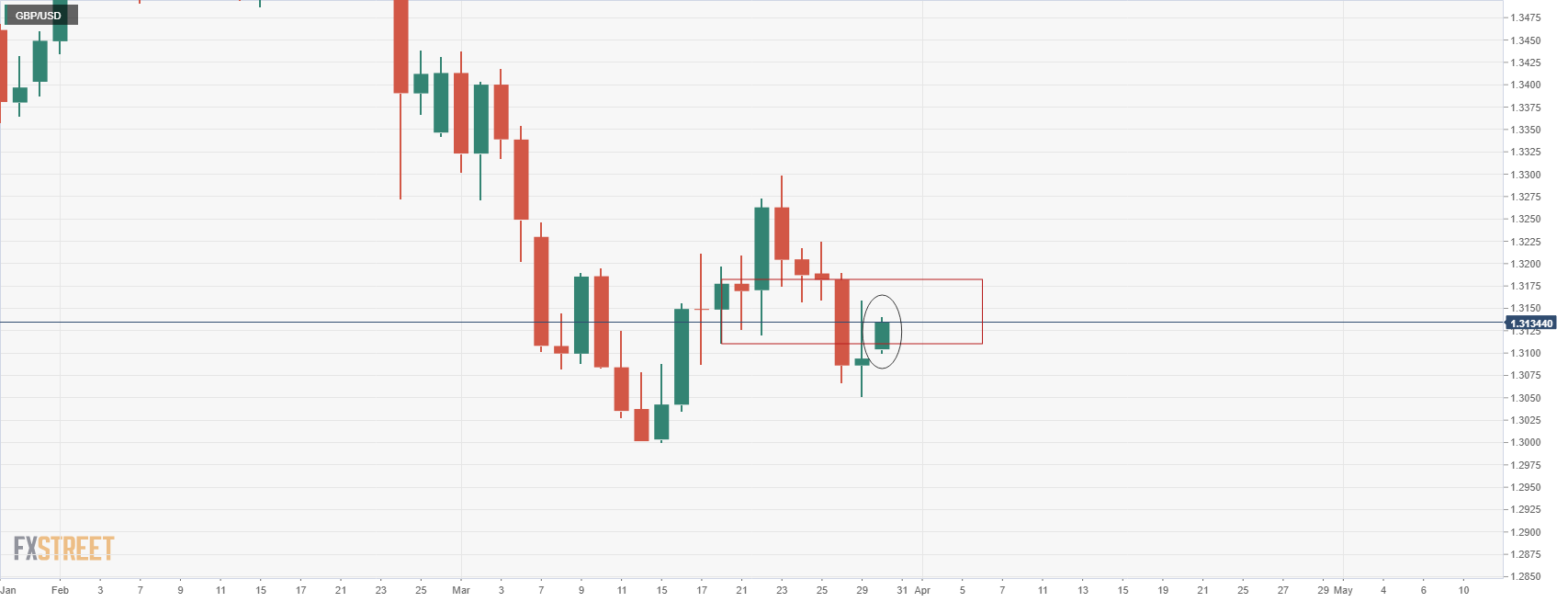
The following illustrates the pound's bullish trajectory on the daily chart in an M-formation:
GBP/USD daily chart
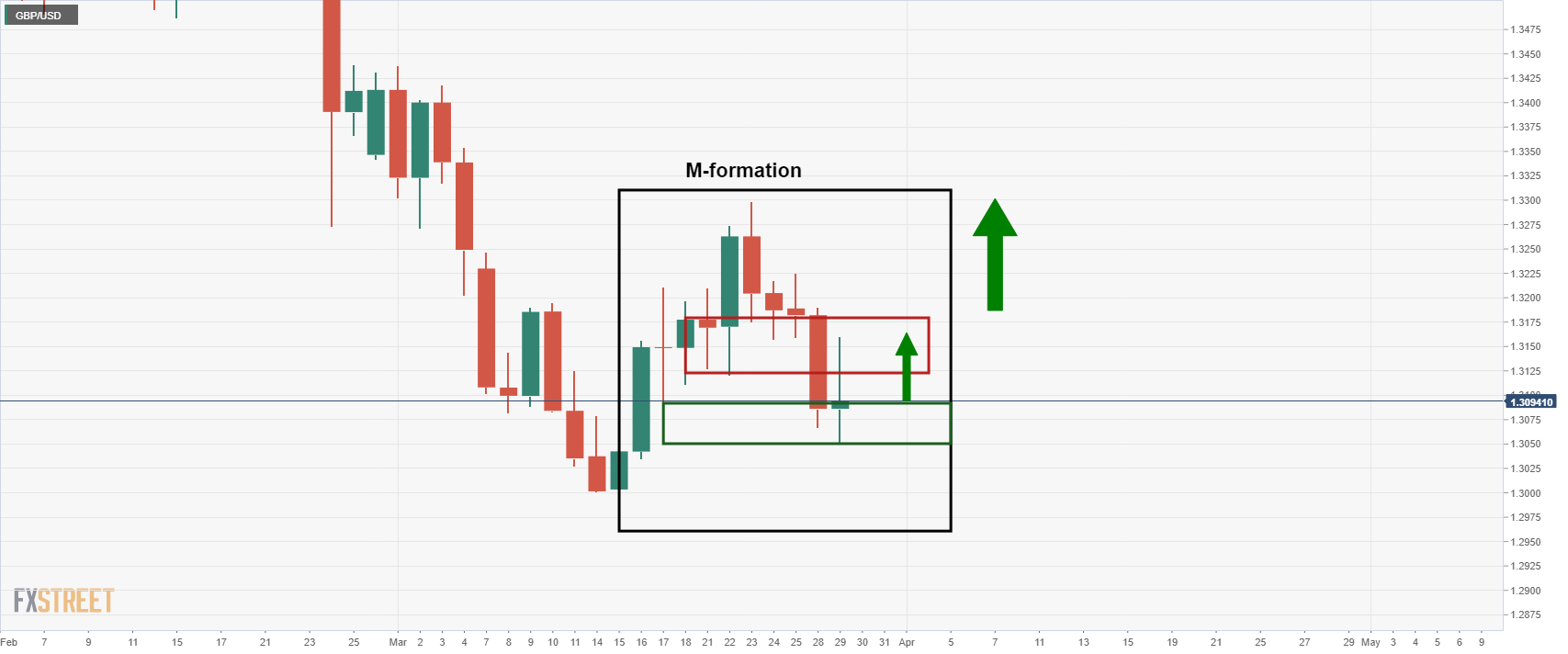
The chart above was from the prior day's close. The price attempts to recover towards the neckline of the formation:
Kansas City Fed President Esther George said in an interview with the WSJ on Wednesday that the current surge in inflation is different from what former Fed Chair Paul Volcker (served between 1975-1979) faced and has not yet become embedded in the economy. the path to policy normalisation is likely to be a long one, George continued, adding that the Fed's neutral rate is likely around 2.5%, though much is in flux.
The prospect of yield curve inversion should be considered in the Fed's balance sheet discussion, George continued, adding that the Fed's holdings should fall significantly, thus allowing long-term rates to climb. Yield curve inversions have implications for financial stability, she noted, and rolling off Fed assets could help steepen the curve. The policy rate will rise in a steady and deliberate manner, she added, before concluding that the US economy is performing well.
- The USD/JPY is trimming gains for the second consecutive day, down 300-pips since Tuesday.
- A dismal market mood, a softer greenback, and falling US bond yields boosted the prospects of the yen.
- USD/JPY Price Forecast: Faced solid support around 121.20s, which lifted the pair towards 122.00.
The Japanese yen extends its gains for the second straight day as the USD/JPY pair retreats from multi-year highs around 125.00, on a dismal market mood and Japanese month-end-flows. At the time of writing, the USD/JPY is trading at 121.89.
On Wednesday, the market sentiment turned sour on the Kremlin’s remarks that even though Ukraine has put demands down on paper, they don’t see anything really promising and stated that there’s much work ahead.
Aside from this, the greenback has remained soft for two consecutive trading sessions, with the US Dollar Index, down 0.58%, sitting at 97.836, a headwind for the USD/JPY. US Treasury yields remain on the back foot, with the 10-year US T-note at 2.352%, down four basis points.
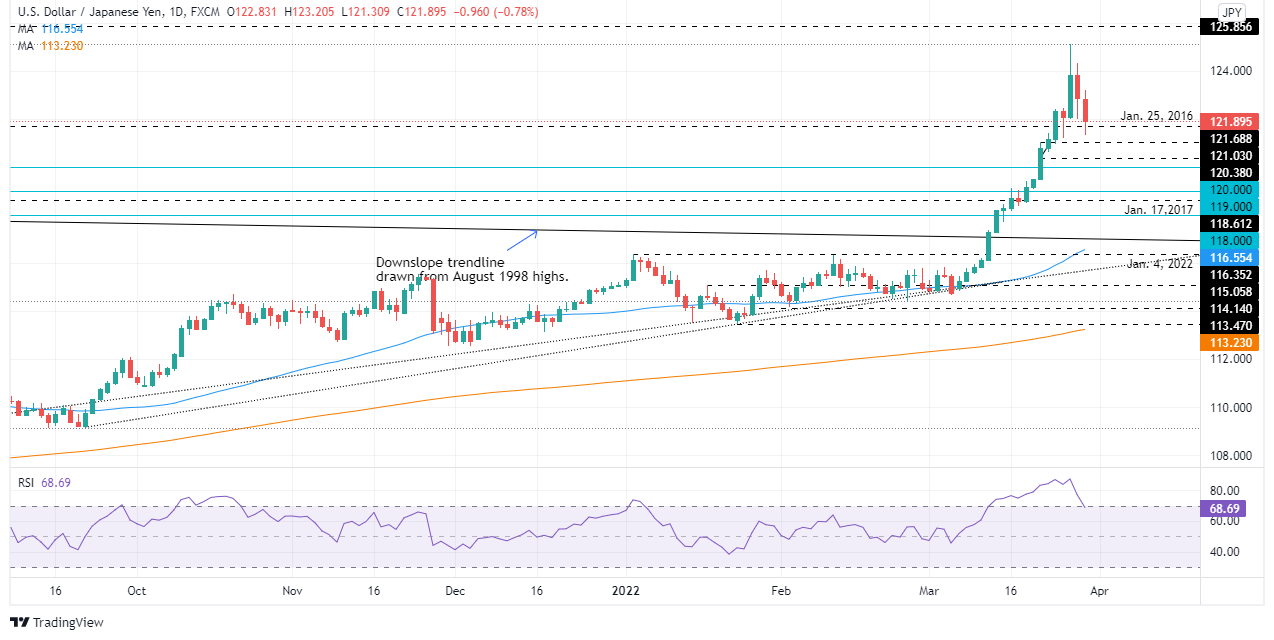
Overnight, the USD/JPY began the Asian session above 123.20 but dove towards the 200-hour simple moving average (SMA) at 121.25, a price level that found buyers, which lifted the pair towards the 121.90ish region.
USD/JPY Price Forecast: Technical outlook
The USD/JPY is upward biased, despite the 300-pip retracement from 125.00s. Nevertheless, the Relative Strength Index (RSI) just got out of overbought conditions at 68.94, a signal that could push the pair higher. However, it would need a daily close above 122.00 in the event of relaunching another test towards the YTD highs above 125.00.
If that scenario plays out, the USD/JPY first resistance would be 122.00. Breach of the latter would expose March 25 to 122.43 daily high, followed by the 123.00 mark, which once cleared would pave the way towards 125.10.
Technical levels to watch
Analysts at Wells Fargo expect the Australian dollar to soften in the quarters ahead, although they see the potential for some stabilization in early 2023. They forecast AUD/USD at 0.72 by the end of the third quarter.
Key Quotes:
“While the economy saw a strong rebound in Q4-2021 and is experiencing a tight labor market and resilient consumer sector, confidence indicators have shown some deterioration recently. Even in the context of strong jobs growth and rising underlying inflation trends, the Reserve Bank of Australia (RBA) maintains a patient stance, and we expect an initial 15 bps rate hike to occur in November of this year, bringing the Cash Rate to 0.25%. In our view, RBA rate hikes should still lag behind a hawkish Federal Reserve and fall short of the rate hikes currently priced by financial markets.”
“Our base case is for the Australian dollar to weaken moderately in the quarters ahead. However, we believe the risks are tilted to the upside, as it is possible that there will be a smaller decline in the currency than our base case forecast suggests.”
“Recent labor and consumer trends have been encouraging. If the economy proves to be more resilient than expected despite a softening in sentiment, this should provide some support for the Australian dollar. More persistent elevated underlying inflation could also prompt the Reserve Bank of Australia to raise rates earlier and faster than currently expected, which would provide further support the currency.”
Analysts at Wells Fargo forecast a period of extended weakness for the EUR, with risks tilted to the downside. They see EUR/USD trading at 1.0800 by the end of the third quarter.
Key Quotes:
“We forecast a period of extended euro weakness; however, the risks are potentially tilted toward a larger decline than we currently expect.”
“Growth slowed significantly in late 2021, and we expect a relatively gradual rebound in growth from early 2022. However, with higher energy prices likely to weigh on consumer purchasing power and given possible Ukraine uncertainties, Eurozone economic growth could be even more sluggish than we expect.”
“Eurozone inflation has surprised to the upside, although the rise in core inflation has been less marked to date. Were Ukraine uncertainties to intensify, it is possible the ECB could move more gradually to less accommodative policy than we currently forecast, which should weigh on the euro. Should these risks transpire, the euro could soften more than we currently forecast, with the EUR/USD exchange rate perhaps falling as low as $1.0000.”
- A continued pullback in the US dollar and yields from recent highs is giving precious metals a lift.
- XAG/USD is now more than 4.0% higher versus Tuesday’s sub-$24.00 lows, but has been unable to reclaim the $25.00 level.
- Waning geopolitical risk premia and caution ahead of key US data is holding back the silver bulls for now.
Even though the latest batch of US data (strong ADP and robust Q4 GDP and Core PCE numbers), alongside fresh hawkish commentary from Fed policymakers has been interpreted as solidifying expectations for a 50bps rate hike from the bank in May, the US dollar continues to come under intense selling pressure, supporting the precious metal complex. US yields also continue to ease back from recent highs, with the US-10 year on Wednesday falling back under the 2.40% mark, unwinding some of the recent upwards pressure on the “opportunity cost” of holding non-yielding assets like precious metals.
Spot silver (XAG/USD) prices are thus trading higher by about 0.75% on the day, though have not been able to mount a lasting push to the north of the $25.00 per troy ounce level. Still, at current levels in the $24.90s, XAG/USD is trading with gains of more than 4.0% versus Tuesday’s lows just under $24.00. Traders at the time piled in to buy silver as it tested its 200-Day Moving Average at $23.96. Successful defense of support in the key $24.00 area will have many bulls eyeing a retest of last week’s highs in the $25.80s.
But the recent shift in tone of Russo-Ukraine peace negotiations towards greater optimism that a peace deal can be struck means that geopolitical risk premia, a key factor underpinning silver prices in March, is somewhat lessened. Meanwhile, in the next two days, key US Core PCE and officials labour market data will be released, ahead of which its not unusual to see precious metal, FX and bond traders exercising greater levels of caution and more subdued trading conditions. Perhaps then it isn’t too much of a surprise that XAG/USD failed its efforts to push back above $25.00 on Wednesday.
Data released on Wednesday, showed real GDP grew during the fourth quarter an an annualized rate of 6.9%, below the 7% of previous estimates. According to analysts at Wells Fargo, the sequential rate of real GDP growth likely has downshifted in the first quarter of 2022, but it appears to have remained in positive territory.
Key Quotes:
“The first two estimates had shown that real GDP growth in the fourth quarter was driven largely by modest growth in consumer spending and by a sizable increase in inventories, which likely was intentional given the depleted nature of stocks in previous quarters. These drivers of growth in Q4 were generally reaffirmed by today's release. The sequential rate of real GDP growth likely has downshifted in the first quarter, but it appears to have remained in positive territory. The BEA is scheduled to publish the first estimate of Q1-2022 GDP growth on April 28.”
“Overall as demand softens we look for profit growth to slow this year. Our latest forecast has real GDP rising 3.0% for 2022 as a whole and corporate profits advancing roughly 8%.”
The USD/JPY could move toward 125.00 later in 2022, according to analysts at Rabobank. They warn the market has priced in a lot of interest rate hikes from the Federal Reserve, which may limit the appreciation of the pair.
Key Quotes:
“Having briefly hit the USD/JPY125 level earlier in the week, USD/JPY has been knocked by a bout of profit-taking. Yesterday’s decline in yields on shorter-dated US government paper supported the move lower in USD/JPY. Softer oil prices which can in part be linked with yesterday’s flurry of hopes regarding progress in peace talk between Ukraine and Russia have also contributed to the better tone on the JPY. The fact that this news happened to coincide with reports of a meeting between BoJ Governor Kuroda and PM Kishida was another persuading element in the drop in the value of USD/JPY. That said, the factors that has driven USD/JPY in recent weeks essentially remain in place. Consequently, the JPY remains vulnerable.”
“While interest rate differentials are supportive of USD/JPY, the market has priced in a lot of Fed rate rises. On a one year view the money market is currently positioned for rate rises totalling around 240 bps. This may mean scope for additional upside in short-dated US yields is limited. If US short-term US rates struggle to make further headway, this may limit or slow the pace of further appreciation of USD/JPY. “
“While actual FX intervention from Japan is unlikely, the authorities could be minded to make use of investors’ fear of a move to calm the market. News that BoJ Kuroda and PM Kishida were scheduled to meet this week certainly appeared to shake out short JPY positions. Subsequently Kuroda played down speculation that JPY weakness was a concern for the authorities.”
“We see scope for USD/JPY to move back towards 125 in the latter half of the year.”
- US dollar under pressure as US yields pullback.
- EUR/USD heads for the highest daily close in a month.
- Economic data shows accelerating inflation in Germany and job creation in the US.
The EUR/USD rose further during the American session and printed a fresh four week high at 1.1170. The pair is rising for the second day in a row, headed toward the highest close in a month.
A weaker US dollar is keeping the bullish tone of EUR/USD intact. Technical factors contribute to support the upside. The pair is holding well above 1.1100 and also breaking the 1.1135 resistance area.
The DXY is trading at weekly lows at 97.75, as US yields slide. The 10-year stands at 2.36%, away from the 2.43% it hit earlier on Wednesday. Equity prices in Europe ended lower amid skepticism about Russian withdrawing some troops from Kiev. In Wall Street stocks are off lows. Commodity prices are higher, weighing on the dollar.
Inflation up in EZ while US keeps creating Jobs
Inflation data from Germany came in above expectations, with the annual rate reaching 7.3%, the highest since 1981. The acceleration in prices creates a challenging environment for the European Central Bank (ECB). “The ECB will want to focus on inflation expectations and as long as these expectations remain fairly anchored, we only expect an end of the so-called unconventional measures over the next 12 months, i.e an end to net asset purchases and an end to negative deposit rates. It would need a clear end to the war, lifted sanctions combined with stepped up fiscal stimulus to engage the ECB in a more genuine tightening cycle”, wrote Carsten Brzeski, Global Head of Macro at ING.
In the US, the ADP employment report came in line with expectations showing an increase in private jobs of 455K. The third 4Q GDP reading showed a 6.9% expansion, below the 7% of previous estimates. The numbers did not affect the dollar. On Friday, the official employment report is due with Non-farm payrolls and the unemployment rate.
Technical levels
- The market sentiment turned sour as Moscow said there had been no “breakthrough” in talks.
- Global equities fall, commodities rise, and the greenback breaks under the 98.00 mark.
- XAU/USD Price Forecast: A hammer at the 50-DMA lifted the non-yielding metal above $1900.
Gold (XAU/USD) found some buying pressure around the $1900 mark, briefly broken on Wednesday amid an improvement in geopolitical developments in Eastern Europe, which dragged commodity prices down, with oil and silver recording losses, alongside the yellow-metal. At $1935.05, XAU/USD reflects the appetite for safe-haven assets, which in the FX space include the Japanese yen and the Swiss franc.
Moscow sees no “breakthrough” in peace talks with Ukraine
Meanwhile, reports from Moscow said that although Ukraine has begun to put demands down on paper and be more specific, they don’t see anything really promising that looks like a breakthrough and emphasized there’s a lot of work ahead. That said, the market sentiment shifted negatively, lifting the prices of commodities.
Global equities are dropping from weekly highs on the aforementioned, while the greenback is down. The US Dollar Index, a gauge of the buck’s measure vs. its peers, slides 0.64%, sits at 97.781, undermined by US Treasury yields down, with the 10-year benchmark note rate at 2.378%, down two basis points, though higher than the 2-year yield, which sits at 2.344%.
On Tuesday, the US 2 to 10-year yield curve briefly inverted when the 2-year exceeded the 10-year yield for the first time since 2019, reinforcing the view that the Federal Reserve tightening may cause a recession.
The US economic docket for Wednesday featured the US ADP Employment report for March, which showed that 455K jobs were added to the US economy, while the Department of Commerce reported that GDP for the Q4 in its Final reading came at 6.9%, a lower than the 7.1% estimated, but the highest since the Q3 of 2020.
Later, Richmond’s Federal Reserve President Thomas Barkin said that he would be open to a 50 bps hike in May “if necessary” and added that he would be looking at inflation and how strong the economy is. Barkin stated that it feels inflation will settle next year as the US central bank tightening moves take effect.
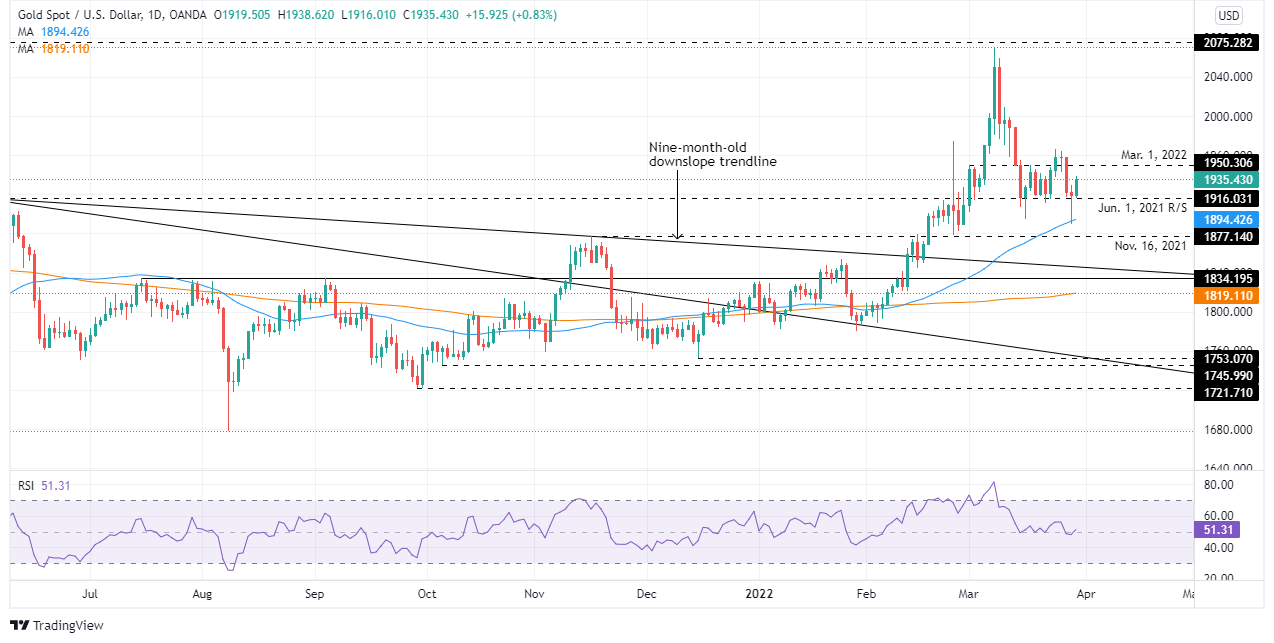
XAU/USD Price Forecast: Technical outlook
Gold’s Tuesday fall was stopped around the 50-day moving average (DMA) at $1894.43, in a downward move that looked like XAU/USD was going to get lower on positive news from Ukraine. However, once the market sentiment turned dismal, it printed a hammer, a bullish candlestick, that triggered Wednesday’s upward move, though downside risks remain unless XAU bulls reclaim the $1950 mark.
XAU/USD’s first resistance is March 1 daily high at $1950.30. Once cleared, it would open the door for a retest of the all-time high at $2075.28, but it would find the $2000 mark as the first resistance.
Russian President Vladimir Putin and German Chancellor Olaf Scholz held talks on Wednesday, reported Russian state media, and agreed to hold talks between experts on the potential for rouble payments for Russian gas payments. The call comes ahead of a 31 March deadline set by Putin for Gazprom and the Russian central bank to arrange for rouble payments for gas from "unfriendly countries", and may ease some fears of imminent disruption of gas flows into Europe.
Market Reaction
The Bloomberg Energy Index has been on the back foot in recent trade, perhaps as European gas shortage fears ease. The index has pulled back from around 101.50 to around 100.50 in a matter of minutes.
- WTI rebounded well on Wednesday and is back to the $108 area with oil markets skeptical on Russo-Ukraine peace progress.
- The Russia/West economic war continues also to ramp up, while oil inventories continue to drop and OPEC+ lifts output slowly.
The price action in crude oil markets over the past two days suggests that energy investors are not buying into optimism that has emerged this week regarding Russo-Ukraine peace talks. Russia has acknowledged that Ukraine has met its core request in pledging not to join NATO and on Tuesday announced plans to scale down military operations around Kyiv and northern Ukrainian city Chernihiv to foster better negotiating conditions.
That announcement, which came after Tuesday’s constructive talks between the two sides in Turkey, sent front-month WTI future momentarily below $100 per barrel on Tuesday. But as attacks by Russian forces across Ukraine have continued and President Zelenskyy and the Ukrainian Defense Ministry have warned of fresh troop build-ups, ceasefire hopes have diminished and WTI has made significant progress in rebounding towards $110.
At current levels in the $108.00 area, WTI trades higher by over $3 on the day and nearly $10 higher than Tuesday’s lows. Oil market participants are not just focused on the war in Ukraine, but also the unfolding economic war between Western powers and Russia. The latter camp are announced plans to impose even tougher sanctions on Russia on Wednesday, aimed at targeting the sectors of Russia’s economy critical to the sustaining of the offensive in Ukraine, including military supply chains.
Meanwhile, Russia signaled on Wednesday that it might also soon demand payment in rubles for the export of metals and grains as a 31 March deadline issued by the Russian President for Gazprom to arrange for gas payments in Russia’s domestic currency looms. Authorities across the EU are subsequently now bracing for disruption to gas flows from Russia and this is helping to broadly support the energy complex.
More broadly, amid uncertainties about energy flows out of Russia, expectations for the global oil market to remain very tight for the foreseeable future remain elevated. OPEC+ meet on Thursday and are not expected to do anything to ease this near-term tightness, with sources indicating the group is to stick to its current policy of gradual 400K barrel per day/month hikes to output quotas. OPEC+’s slow and steady approach comes at a time when OECD oil reserves are at historic lows the latest weekly US inventory figures emphasized this; headline crude oil stocks were down a larger than expected 3.45M barrels. WTI did not react to these latest numbers.
Philadelphia Fed President Tomas Barkin said on Wednesday that he would be open to a 50 bps rate hike in May if necessary and that he will be looking at inflation and how strong the economy is, according to an interview on Bloomberg TV. The war in Ukraine has added to inflationary pressures, he noted, caveating but has not impacted US demand. Indeed, there is still a tonne of excess demand for labour, he continued, noting that it feels like inflation will settle next year as the Fed's tightening actions take effect, excess consumer savings are spent and supply chain snags ease. Underlying demand in the economy remains strong, Barkin said.
At the same time as Barkin was giving his remarks, Fox reporter Charles Gasparino said that trading sources had told him that the robust core PCE reading (for Q4 2021) on Wednesday had pretty much locked in a 50 bps rate hike at the coming meeting. Gasparino said that some traders thought the Fed might move to lift rates on an intra-meeting basis, but other sources had told him that this was an unlikely move.
- AUD/USD edged higher for the second successive day on Wednesday amid sustained USD selling.
- The uptick lacked bullish conviction and remained capped near the YTD top set earlier this month.
- Bulls now await sustained breakthrough an ascending channel extending from sub-0.7000 levels.
The AUD/USD pair built on the previous day's goodish bounce from the vicinity of mid-0.7400s and edged higher for the second successive day on Wednesday. The pair held on to its modest intraday gains through the early North American session and was last seen trading around the 0.7520 region, just a few pips below the YTD high touched earlier this week.
Looking at the broader picture, the AUD/USD pair has been oscillating in a familiar trading band over the past one week or so. Given the recent strong recovery of over 500 pips from sub-0.7000 levels, this might still be categorized as a bullish consolidation phase. Moreover, the formation of an upward sloping trend channel adds credence to the constructive setup.
The upside, however, remains capped near the 0.7555 region, which marks the October 2021 swing high. The said area coincides with the top end of the aforementioned channel extending from the YTD low set in January and should act as a pivotal point. Sustained strength beyond will be seen as a fresh trigger for bullish traders and pave the way for additional near-term gains.
The AUD/USD pair might then accelerate the momentum and aim to reclaim the 0.7600 round-figure mark for the first time since June 2021. That said, technical indicators on the daily chart have moved on the verge of breaking into the overbought territory. This makes it prudent to wait for further near-term consolidation or modest pullback before placing aggressive bullish bets.
In the meantime, weakness back below the 0.7500 mark might continue to find decent support near the 0.7455-0.7450 region. A convincing below might prompt some long-unwinding trade and make the AUD/USD pair vulnerable to accelerate the corrective slide towards the 0.7400 mark. The downfall could get extended towards the very important 200-day SMA, around the 0.7300 round figure.
AUD/USD daily chart
-637842451212071892.png)
Technical levels to watch
Russian forces are preparing to resume offensive operations, a spokesperson of Ukraine's Defense Ministry said on Wednesday according to Reuters. Russian forces are still trying to take Mariupol and other towns and cities, the spokesperson added, noting that Russia's main efforts are focused on encircling Ukrainian troops in the East of the country.
The remarks come after the top Russian peace negotiator Vladimir Medinsky acknowledged that Ukraine has "essentially agreed" to Russia's core demands of not joining NATO and that, if Ukraine sticks to its promises, the threat of the emergence of a NATO stronghold in Ukraine is removed. Medinsky said that talks with Ukraine will continue, but the nation's position on Crimea and the Donbass are unchanged.
- EUR/USD extends the strong rebound to the 1.1160 zone.
- Next on the upside is seen the 55-day SMA near 1.1200.
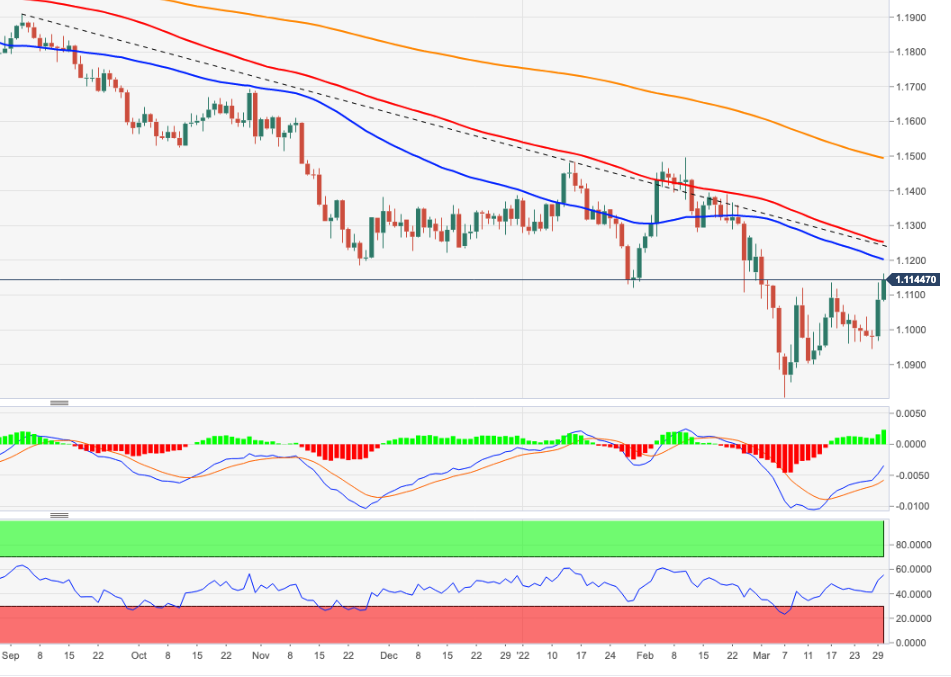
EUR/USD has quickly left behind the 1.1100 hurdle and rose to new 4-week tops in the 1.1160/65 band on Wednesday.
That said, the recovery now targets the temporary resistance at the 55-day SMA, today at 1.1201 ahead of the 1.1250 region, where the 100-day SMA and the 8-month line coincide.
The medium-term negative outlook for EUR/USD is expected to remain unchanged while below the key 200-day SMA, today at 1.1492.
EUR/USD daily chart
High oil and gas prices and improving risk sentiment have led to EUR/NOK trading below 9.50 for the first time since 2018. Economists at Nordea still see more downside in EUR/NOK until May/June. In their view, the cross could see 9.25, given that oil prices and risk sentiment do not worsen.
EUR/NOK could see 9.25 until Norges Bank starts selling NOK
“We still see more downside in EUR/NOK over the month or two so long as Norges Bank does not start selling ample amounts of NOK, which we don’t see happening before May/June. If we are right, the cross could see 9.25 before then.”
“Our view necessitates oil prices to hold their ground and risk sentiment not to worsen. The risk to this view is lower oil prices or Norges Bank starting to sell a lot of NOK from April 1 – which we don’t find very likely.”
“The window for NOK strengthening will close when Norges Bank eventually start selling a significant amount NOK. We see EUR/NOK turning higher (toward 10.00) when Norges Bank turns around.”
The S&P 500 Index has gapped higher to clear with ease the February highs at 4590/95. Analysts at Credit Suisse stay directly biased higher for the 78.6% retracement of the 2022 fall at 4663/68.
Support at 4593/76 holding on a closing basis to keep the immediate risk higher
“We stay directly biased higher for a test of the 78.6% retracement of the 2022 fall and price resistance at 4663/68 where we would then expect to see a cap at first. Should strength directly extend this would open the door to a move to 4707/12 next, then what we look to be tougher resistance, starting at 4744/49 and stretching up to the 4819 record high.”
“Support from the price gap at 4593/76 holding on a closing basis can keep the immediate risk higher. A closing break lower though would warn of a near-term exhaustive peak and a fall back to 4518/14.”
Gold has held strong as what appeared to be notable progress on ceasefire talks has since been walked back. Nonetheless, strategists at TD Securities highlight the downside risks that are still in place for the yellow metal.
Gold will have to contend with macro outflows associated with a hawkish Fed
“Headlines suggest Russia is even sending new forces, further emboldening the safe-haven flows into precious metals. At the same time, the 2y-10y curve flirting with inversion has further fueled talk of recession on the horizon.”
“While geopolitical tensions and yield curve recession signals re-ignite investor interest in gold, downside risks still remain amid a hawkish Fed backdrop and as negotiators continue to work towards a ceasefire.”
- USD/CHF drifted lower for the second successive day amid heavy USD selling bias.
- The US macro data failed to impress the USD bulls or lend any support to the pair.
- The Ukraine crisis benefitted the safe-haven CHF and also contributed to the slide.
The USD/CHF pair maintained its offered tone through the early North American session and was last seen hovering near the 0.9260 region, or over a three-week low.
The pair extended the overnight sharp retracement slide from the 0.9375-0.7380 area and witnessed heavy selling for the second successive day on Wednesday amid a broad-based US dollar weakness. Hopes for a diplomatic solution to end the war in Ukraine continued lending some support to the shared currency. This, along with a softer tone around the US Treasury bond yields, dragged the USD to over a one-week low and exerted some downward pressure on the USD/CHF pair.
The USD remained depressed and failed to gain any respite from the US ADP report, which showed that private-sector employers added 455K jobs in March as against the 450K anticipated. Adding to this, the previous month's reading was also revised higher to 486K from the 475K reported earlier. This, however, was overshadowed by the downward revision of the US Q4 GDP print, showing that the economic growth stood at 7.1% as compared to 7.2% estimated previously.
Meanwhile, the incoming geopolitical headlines raised scepticism about any progress in the Russia-Ukraine peace talks. In fact, a Kremlin spokesperson said that they have not noticed anything that looks like a breakthrough in negotiations. Moreover, an adviser to Ukraine’s President noted that Russia transferring forces from Kyiv to encircle troops in the east. This, in turn, tempered investors' appetite for riskier assets and benefitted the safe-haven Swiss franc.
On the other hand, sustained USD weakness suggests that the markets have fully priced in the prospects for a faster policy tightening cycle by the Fed. Hence, it would now be interesting to see if the USD/CHF pair is able to attract any buying at lower levels or prolongs its recent pullback from the YTD top, around the 0.9460 area touched earlier this month. Nevertheless, the market focus will remain on fresh developments surrounding the Russia-Ukraine saga.
Technical levels to watch
EUR/USD has staged a strong recovery. A break above 1.1151 would suggest the recovery can extend to its 55-day moving average (DMA) at 1.1202, but with a cap looked for here, in the view of analysts at Credit Suisse.
Support is seen at 1.0974/44
“We see scope for a break above 1.1151 for a test of the falling 55-DMA at 1.1202, but we look for this to then ideally cap for an eventual resumption of the broader downtrend.”
“A close above 1.1202 would be the first real sign we may have confirmation we have seen a more important low at our 1.0825 core objective and the now confirmed uptrend from 2017.”
“Support is seen at 1.1071 initially, below which can see a fall back to 1.1039/31, with fresh buyers expected here. Below 1.0974/44 is needed to mark an important turn lower again.”
The GBP is following the broad dollar-negative tone with a 0.4% gain on the day to the mid-1.31s. A close above this region could signal a possible reversal in the cable, economists at Scotiabank report.
Weak resistance stands at ~1.3180 ahead of the 1.32 mark
“GBP price action since its test of 1.33 last week points to continued losses toward a re-test of 1.30. Still, the currency held up decently on two occasions at support in the mid-figure zone yesterday and managed to break cleanly past 1.31 without much selling pressure.”
“A close above 1.3150 on the day would signal a possible reversal in the GBP that leaves the 1.30s behind more firmly; weak resistance stands at ~1.3180 ahead of the 1.32 mark.”
EUR/GBP has surged higher after establishing a low at 0.8295. A close above 0.8479 should confirm an important change of trend higher, economists at Credit Suisse report.
Support at 0.8384 to hold for a move to resistance at 0.8550/55
“A close above key resistance from the February high and 200-day average at 0.8471/79 should confirm to see the core trend higher with resistance seen at 0.8595/0.8618 initially, December 2021 high and 38.2% retracement of 2020/2022 fall. Whilst we would look for this to cap at first, above in due course should see the ‘measured base objective’ at 0.8715.
“Support is seen initially at the ‘neckline’ to the base at 0.8462/52, with 0.8384 now ideally holding to keep the immediate risk higher.”
The EUR/USD has started out the week strongly, rebounding from its close below 1.10 on Friday. Economists at Scotiabank highlight that the daily high of 1.1160 is key resistance.
ECB rate hike expectations are excessive
“With markets now expecting over 100bps in ECB hikes twelve months from now, we think EUR downside risks are building as the bank will have to temper expectations.”
“EUR’s decline under 1.11 yesterday stopped short at ~1.1070/75, which stands as intraday support after the figure.
“Daily high of 1.1160/65 is key resistance. The 50-day MA, which it hasn’t touched since late-Feb, follows as resistance at 1.1184 before the big figure.”
- GBP/USD has recovered back above the 1.3150 mark on Wednesday as geopolitical optimism weighs on the dollar.
- But the pair is struggling to emulate the likes of EUR/USD and break above its 21DMA, a potential bearish sign.
- The BoE’s recent dovish shift and subsequent unfavourable moves in yield spreads have dampened GBP’s appeal and continues to weigh.
Rather than being a result of any positive domestic UK fundamental developments (there are none to speak of), GBP/USD upside on Wednesday is largely a result of FX markets taking a more positive view of the geopolitical backdrop and selling USD. Indeed, the buck is down across the board and this has handed GBP/USD some respite, with the pair recently able to climb back to the north of the 1.3150 level for an on-the-day gain of around 0.5%. That’s a decent 0.8% recovery from earlier weekly lows in the 1.3050 region but still leaves the pair more than 1.0% below last week’s peaks near 1.3300.
Notably, cable continues to fail to emulate the recent gains seen in EUR/USD as it struggles to push above its 21-Day Moving Average, which currently resides near 1.3160. Failure to break higher towards 1.3200, a break above which would open the door to a retest of last week’s highs in the 1.3300 area, is likely to be taken as a bearish sign for GBP/USD moving forward. And these bearish technicals come against an equally bearish fundamental backdrop.
Analysts have noted that, since the BoE’s dovish shift where it softened its tone on the need for further rate hikes and emphasized its growing concern about the health of the UK economy amid the coming cost-of-living squeeze, UK yields have flatlined. US (and European) yields, by contrast, most certainly have not, as traders continue to up Fed and ECB tightening bets. Central bank policy divergence and pressure on yield spreads are likely to continue to weigh on sterling looking forward.
The pair was unreactive to US data in the form of the final estimate of Q4 GDP growth and March ADP national employment change, with the latter pointing to a strong official jobs report on Friday. Arguably, there is a lot of Fed hawkishness/US economic heat (high inflation, tight labour market) priced into the buck, suggesting further strong data/hawkish rhetoric this week won’t boost the US dollar much more.
Still, the lack of UK calendar events means the focus will remain on US fundamentals and the aforementioned divergence to UK fundamentals. That suggests a drop back towards weekly lows and a potential test of annual lows in the 1.3000 area may well be on the cards, assuming that further geopolitical optimism doesn’t come back into FX markets.
USD/JPY looks to have set an exhaustive peak at the 125.29/86 highs of 2015. Analysts at Credit Suisse look for a consolidation phase to emerge, with support seen at 121.02/120.72.
Consolidation phase to develop
“We have likely seen the peak in this phase of USD/JPY strength and with the JPY Trade Weighted Index also holding key support from the ‘neckline’ to its 2014/2016 base we look for further near-term weakness and then a consolidation phase.”
“Support for a pullback is seen at the 38.2% retracement of the rally from late February and 13-day exponential average at 121.02/120.72, which we look to try and hold for now. A closing break can see a deeper setback to support next at 119.75.”
“Above 123.21 is needed to clear the way for a move back to 124.31, but with a break above here needed to clear the way for strength back to the 125.11/89 highs.”
- DXY adds to Tuesday’s losses and drops to 97.80.
- Immediately to the downside emerges the 97.70 region.
The index intensifies the leg lower and breaks below the key support at the 98.00 yardstick midweek.
The continuation of the decline carries the potential to extend further south of the 98.00 mark and retest the weekly lows near 97.70 recorded on March 10,17. Down from here, the index faces temporary support levels at the 55- and 100-day SMAs at 96.98 and 96.56, respectively.
The current bullish stance in the index remains supported by the 6-month line just near 96.15, while the longer-term outlook for the dollar is seen constructive while above the 200-day SMA at 94.80.
DXY daily chart
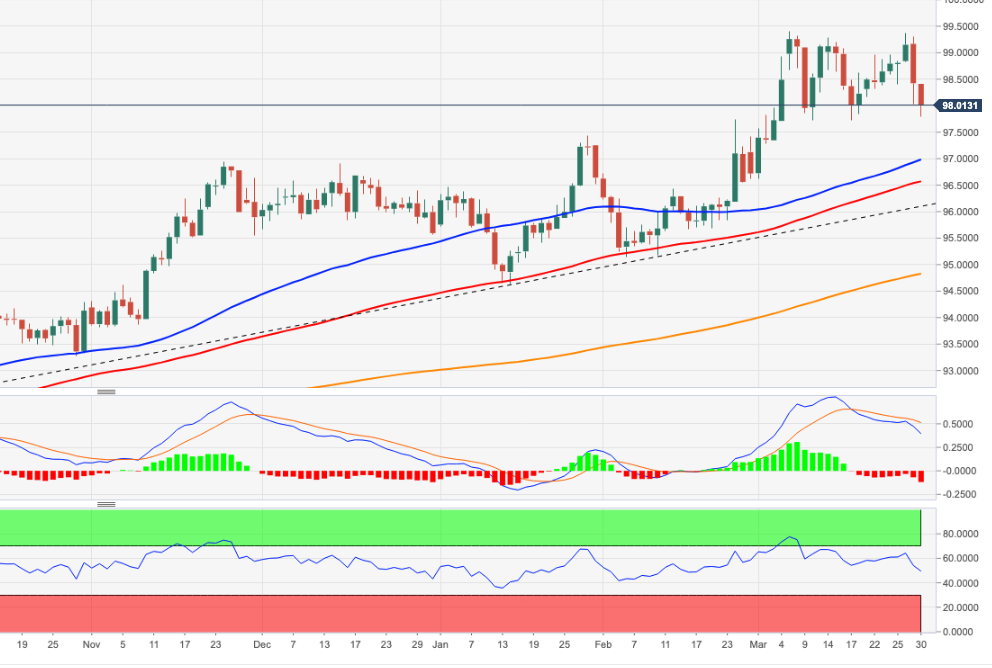
Ukrainian negotiator Mykhailo Podolyak said on Wednesday that he is optimistic after peace talks with Russia in Istanbul on Tuesday, reported Reuters. Podolyak added that a peace deal with Russia would be put to a national referendum after Russia withdraws its troops to their February 23 positions. The remarks come after Ukrainian President Volodymyr Zelenskyy earlier said in a speech to the Norwegian parliament that Russia was moving more troops into Ukraine.
Market Reaction
The latest optimistic remarks from a Ukrainian peace negotiator has not triggered a market reaction.
- A combination of factors dragged USD/CAD lower for the second successive day.
- Rising oil prices underpinned the loonie and exerted pressure amid a weaker USD.
- The US macro releases failed to impress the USD bulls or provide any impetus.
The USD/CAD pair remained on the defensive through the early North American session and was last seen trading near the daily low, around the 1.2480-1.2475 region.
Following an intraday uptick to levels just above the 1.2500 psychological mark, the USD/CAD pair turned lower for the second straight day on Wednesday and was pressured by a combination of factors. The heavily offered tone surrounding the US dollar was seen as a key factor that acted as a headwind amid rising crude oil prices, which tend to benefit the commodity-linked loonie.
In fact, the USD added to the previous day's losses and dropped to over a one-week low despite not so encouraging geopolitical headlines. In fact, a Kremlin spokesperson said that they have not noticed anything that looks like a breakthrough in negotiations. Moreover, an adviser to Ukraine’s President noted that Russia transferring forces from Kyiv to encircle troops in the east.
Even elevated US Treasury bond yields, bolstered by hawkish Fed expectations, did little to lend any support to the buck. On the economic data front, the US ADP report showed that private-sector employers added 455K jobs in March as compared to the 450K expected. Adding to this, the previous month's reading was also revised higher to 486K from the 475K reported earlier.
The upbeat report, however, was overshadowed by a slight disappointment from the final US GDP report, which showed that economic growth in the last quarter of 2021 stood at 7.1% as against the 7.2% estimated. This, in turn, failed to impress the USD bulls or provide any impetus to the USD/CAD pair, which remains well within the striking distance of over a two-month low set earlier this week.
On the other hand, the Canadian dollar drew support from strong follow-through rise in crude oil prices. Scepticism about any progress in the Russia-Ukraine peace talks, along with the growing prospect of new Western sanctions against Russia, acted as a tailwind for the black liquid. That said, the imposition of fresh COVID-19 restrictions in China might cap gains for the commodity.
The mixed fundamental backdrop might hold back traders from placing aggressive bearish bets around the USD/CAD pair. This, in turn, suggests that any subsequent slide is more likely to find decent support and attract some buying near the YTD low, around mid-1.2400s. The latter should act as a pivotal point, which if broken decisively should pave the way for further near-term losses.
Technical levels to watch
The final estimate of US GDP growth in Q4 2021 showed that the US economy grew at a pace of 6.9% annualised during the quarter, data published by the US Bureau of Economic Analysis (BEA) on Wednesday showed. Personal Consumption Expenditures Prices rose at an annualised pace of 6.4% during the quarter, a little above the expected 6.3% reading, whilst the GDP Price Index had prices rising at a pace of 7.1% annualised during the quarter, a little below the 7.2% expected.
Market Reaction
FX markets were unreactive to the backwards-looking US data.
Private sector employment in the US rose by 455,000 in March, ever so slightly above the 450,000 expected gain, according to US payroll company ADP's latest estimate of national employment change released on Wednesday. The broadly in line with expected ADP data will instill confidence that Friday's official jobs report will be strong and the official non-farm payroll number will be healthy. That said, ADP has had a poor track record of predicting the official NFP number in recent years and should be taken with a grain of salt.
Market Reaction
There was no reaction to the latest ADP figures, which were close to expectations.
Russia is sending new forces to Ukraine, Ukrainian President Volodymyr Zelenskyy said in a speech to the Norwegian Parliament on Wednesday according to Bloomberg. He urged European countries to ban Russian ships from entering their ports.
Zelenskyy's comments are seemingly at odds with Russia's claim on Tuesday that it would be scaling down military operations near northern cities in Ukraine in order to foster more conducive conditions for negotiations. The US had expressed skepticism about Russian claims, instead labelling it a major strategic shift. Likely, Russia's aims now will be to consolidate gains made in the south and east of Ukraine in order to strengthen its hand at the negotiating table and that could well involve sending more troops into the country.
Headline inflation in Germany rose at a pace of 7.6% YoY and 2.5% MoM in March according to the preliminary estimate of the Harmonized Index of Consumer Prices (HICP) released by Destatis on Wednesday. That was well above the median economist forecast for a YoY reading of 6.7% and a MoM reading of 1.8%. HICP is the ECB's preferred inflation gauge versus the Consumer Price Index (CPI). Speaking of, the headline German CPI rose at a pace of 7.3% YoY and 2.5% MoM, also well above expectations for 6.3% and 1.6% readings.
The 2.1% jump in the YoY rate of HICP was the largest ever and saw HICP inflation at its highest since records began in the mid-90s. The MoM rate of HICP inflation was also its highest ever. Meanwhile, the 2.2% jump in the YoY rate of headline CPI inflation was the largest since the early 90s and saw it hit its highest since the early 80s. The MoM rate of CPI was its highest ever (going all the way back to 1970).
Market Reaction
Regional German CPI data released earlier in the session pointed to a much larger than expected increase in MoM and YoY inflation rates, hence the euro has not reacted.
- NZD/USD gained traction for the second successive day on Wednesday amid sustained USD selling.
- Scepticism over Russia-Ukraine peace talks failed to impress the USD bulls or hinder the positive move.
- Investors now look forward to the US ADP report and the final Q4 GDP print for some trading impetus.
The NZD/USD pair extended its steady intraday ascent and climbed to a fresh daily high, back closer to the 0.7000 psychological mark heading into the North American session.
The pair attracted some dip-buying in the vicinity of the 0.6900 mark on Wednesday and build on the overnight goodish rebound from the one-week low. This marked the second successive day of a positive move and was sponsored by the heavily offered tone surrounding the US dollar.
Despite not so encouraging geopolitical headlines, investors remain optimistic about a diplomatic solution to end the war in Ukraine. This, in turn, was seen as a key factor that dented the greenback's status as the global reserve currency and acted as a tailwind for the NZD/USD pair.
In the latest developments surrounding the Russia-Ukraine saga, a Kremlin spokesperson said that they have not noticed anything that looks like a breakthrough in negotiations. Moreover, an adviser to Ukraine’s President noted that Russia transferring forces from Kyiv to encircle troops in the east.
This comes after the United States said on Tuesday that it has not seen signs of real seriousness from Russia in pursuing peace. Adding to this, a Pentagon spokesman said that Kyiv remains under threat even after Russia promised to scale back military operations in Ukraine’s capital city.
This, in turn, tempered investors' appetite for riskier assets, which was evident from the modest decline in the equity markets, though did little to lend any support to the buck. The USD bulls also seemed unimpressed by elevated US Treasury bond yields, bolstered by hawkish Fed expectations.
It would now be interesting to see if bulls are able to capitalize on the move or the NZD/USD pair continues with its struggle to make it through the 0.7000 psychological mark. Traders now look forward to the US ADP report and the final Q4 GDP print for some short-term opportunities.
Technical levels to watch
-
EUR/JPY corrects lower following recent cycle highs.
-
Overbought conditions favour a deeper retracement near term.
EUR/JPY trades on the defensive after two consecutive daily advances and following fresh tops past the 137.00 mark (March 24).
The underlying upside momentum in the cross remains unchanged, although a technical correction appears overdue mainly due to the overbought condition of the cross. Against that, the former 2022 high at 133.15 (February 10) should emerge as the next contention area in the very near term at least,
In the meantime, while above the 200-day SMA at 130.06, the outlook for the cross is expected to remain constructive.
EUR/JPY daily chart
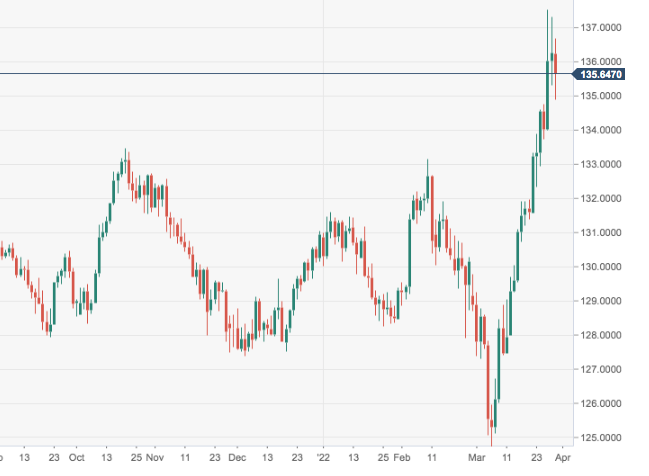
- EUR/USD has pulled back from earlier multi-week highs in the 1.1160s but remains well supported in the 1.1140 area.
- USD continues to suffer from broad weakness versus the majority of its G10 counterparts despite less optimistic Russo-Ukraine updates.
- Meanwhile, hot Eurozone inflation data has encouraged euro buying as US data comes into focus.
Though the pair has waned from its earlier multi-week highs in the 1.1160s after selling pressure ahead of the 50-Day Moving Average near 1.1180 emerged, EUR/USD continues to trade with healthy on-the-day gains of about 0.4% in the 1.1130s. The US dollar continues to suffer from broad weakness versus the majority of its G10 counterparts, even as recent tailwinds in the global equity space subside amid less optimistic headlines regarding Russo-Ukraine peace talks, lifting EUR/USD. Another factor likely encouraging euro buying against the buck is recent hot inflation readings coming out of the Eurozone which, as ECB President Christine Lagarde this morning remarked, support the ECB’s recent shift towards ending QE in Q3 and signaling rate hikes in Q4.
Ahead of the release of preliminary national German Consumer Price Inflation metrics for March at 1300BST, regional state CPI data releases earlier in the session saw sizeable MoM and YoY gains. Meanwhile, the preliminary estimate of Spanish headline HICP inflation in March hit a staggering 9.8%, well above the 8.1% expected. Upcoming German inflation figures are expected to be hot and thus may not provoke a market reaction, and EUR/USD focus will quickly shift to US data scheduled for release shortly after. US private payroll company ADP releases its estimate of US employment change in March at 1315BST and, though ADP’s metric has been a poor predictor of the official NFP in recent months, traders will nonetheless take note.
Shortly after at 1330BST, the final estimate of US GDP growth in Q4 2021 will be released and there will be remarks from Fed’s Thomas Barkin, Raphael Bostic and Esther George, all of whom support the Fed’s recent hawkish shift. Fed hawkishness/strong economic data is arguably well priced into USD at this point, and further profit-taking on US dollar longs coupled with inflationary Eurozone data may well mean EUR/USD remains supported above 1.1100 and eyes a move towards 1.1200.
- A combination of factors dragged USD/JPY lower for the second successive day on Wednesday.
- The downside seems cushioned amid the divergence in policy outlooks between the Fed and BoJ.
- Investors now eye the US ADP report and final Q4 GDP print for some short-term trading impetus.
The USD/JPY pair managed to recover nearly 60 pips from the multi-day low and was last seen trading just below the 122.00 mark, still down nearly 1% for the day.
The pair witnessed heavy selling for the second successive day on Wednesday and retreated further from its highest level since August 2015, around the 125.10 region touched on the first day of the week. Speculation that officials were uncomfortable and would respond to the Japanese yen's recent weakness turned out to be a key factor that dragged the USD/JPY pair lower.
Apart from this, a turnaround in the risk sentiment drove some haven flows towards the JPY and exerted additional downward pressure on the USD/JPY pair. The latest optimism over a diplomatic solution to end the Russia-Ukraine conflict faded rather quickly, which was evident from a fresh leg down in the equity markets. This, in turn, benefitted traditional safe-haven assets.
On the other hand, the US dollar added to the previous day's losses and dropped to over a one-week low. This further contributed to the USD/JPY pair's intraday slide to a multi-day low, around the 121.30 region. That said, an uptick in the US Treasury bond yields, bolstered by hawkish Fed expectations, helped limit any further losses for the major, at least for now.
The markets seem convinced that the Fed would adopt a more aggressive policy stance to combat high inflation and have been pricing in a 50 bps rate hike at the next two meetings. Conversely, the Bank of Japan is expected to stick to its ultra-loose policy for a prolonged period. This, in turn, supports prospects for the emergence of some dip-buying around the USD/JPY pair.
Hence, the downfall might still be categorized as a corrective pullback, warranting some caution before confirming that the USD/JPY pair has topped out. Market participants now look forward to the US economic docket, featuring the release of the ADP report on private-sector employment and the final Q4 GDP print later during the early North American session.
This, along with the US bond yields, might influence the USD price dynamics and provide some impetus to the USD/JPY pair. Apart from this, traders will take cues from fresh developments surrounding the Russia-Ukraine saga. The incoming geopolitical headlines would drive the broader market risk sentiment and demand for the safe-haven JPY.
Technical levels to watch
"The fact that Ukraine has started to put its demands down on paper, to be more specific is a positive thing," a Kremlin spokesperson said on Wednesday, per Reuters. The spokesperson, however, added that they have not noticed anything that looks like a breakthrough in negotiations.
Additional takeaways
"There is long work ahead."
"Peace talks need to be held in private, won't get into the substance of what is being discussed."
"Crimea is part of Russia and the Russian constitution precludes discussions about the fate of Russian regions with anyone."
"Senior lawmakers' idea of asking other countries to pay for a wide range of Russian exports in roubles should be worked on."
"Such idea is in Russia's national interest and that of its partners."
"Dollar's role as the main global reserve currency has reduced, settlements in national currencies are inevitable."
"Gas-for-roubles payment method to be announced publicly."
"Russia will not immediately demand switch to gas payments in roubles, promises gradual change."
Market reaction
The market mood sours following these remarks and the Euro Stoxx 600 Index was last seen losing 0.7% on the day.
"If there were no new asset purchases in July, the European Central Bank (ECB) could act on rates in September," ECB Governing Board member Robert Holzmann said on Wednesday, as reported by Reuters.
Key takeaways
"Negative rates are an anomaly."
"Inflation will be higher than previously forecast, raising rates would be slightly behind the curve rather than ahead of it."
"The public sees that when inflation rises it is up to the ECB to raise rates."
Market reaction
EUR/USD edges lower during the European trading hours but continues to trade in the positive territory near 1.1130.
- Gold price fades the rebound amid an uptick in the US Treasury yields.
- US dollar weakness could cap the downside in gold price amid Ukraine uncertainty.
- Gold Price Forecast: XAU/USD’s rebound appears limited, focus on ADP, yields.
The fate of gold price remains in the hands of sellers so far this week, as the sentiment in the bond markets and incoming Ukraine headlines continue to remain the main drivers. Inflation concerns are back in play, pushing yields across the globe higher, reducing the demand for non-yielding gold, despite a broad meltdown in the US dollar. Uncertainty over the Ukraine conflict is also weighing on the market mood, which could keep the downside limited in gold price. Attention now shifts towards the key US employment data.
Read: US ADP Employment March Preview: Private job creation slows while yield curve flattens
Gold Price: Key levels to watch
The Technical Confluences Detector shows that gold price is headed south once again, eyeing the critical Fibonacci 61.8% at $1,914.
The previous week’s low at $1,911 will be next on the test, below which the downside could accelerate towards $1,903, the Fibonacci 38.2% one-month.
The last line of defense for gold bulls is seen at around $1,897, the confluence of the pivot point one-day S1 and Fibonacci 23.6% one-day.
Alternatively, the pivot point one-week S1 at $1,925 is the immediate supply zone, beyond which the next bullish target is seen at the previous day’s high of $1,929.
Gold bulls need acceptance above the $1,932 to unleash the additional recovery. At that point, the SMA200 four-hour, Fibonacci 23.6% one-month and Fibonacci 61.8% one-week converge.
Further up, a fierce cap awaits at $1,937, the pivot point one-day R1 and SMA5 one-day intersection.
Here is how it looks on the tool
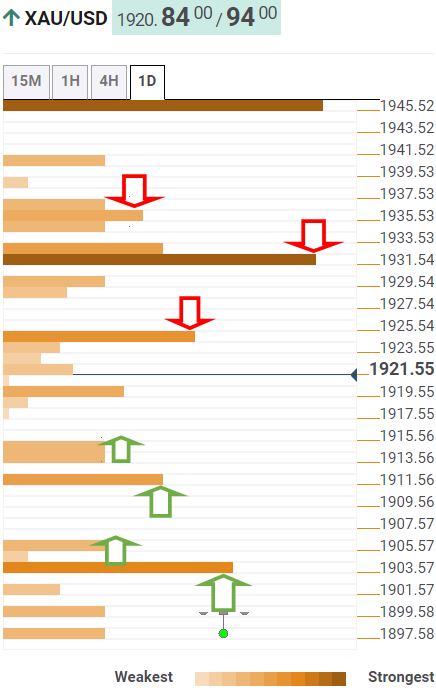
About Technical Confluences Detector
The TCD (Technical Confluences Detector) is a tool to locate and point out those price levels where there is a congestion of indicators, moving averages, Fibonacci levels, Pivot Points, etc. If you are a short-term trader, you will find entry points for counter-trend strategies and hunt a few points at a time. If you are a medium-to-long-term trader, this tool will allow you to know in advance the price levels where a medium-to-long-term trend may stop and rest, where to unwind positions, or where to increase your position size.
- Silver struggled to capitalize on the overnight strong rebound and remained below the $25.00 mark.
- The mixed technical set-up warrants caution for aggressive traders and before placing directional bets.
Silver struggled to capitalize on the previous day's solid rebound from sub-$24.00 levels, or a one-month low and witnessed subdued/range-bound price moves on Wednesday.
Spot prices remained confined in a narrow trading band, below the $25.00 psychological mark through the first half of the European session. The said handle marks a confluence support breakpoint, comprising the 200-period SMA on the 4-hour chart and the lower boundary of an upward sloping trend channel.
Given the overnight strong recovery from the vicinity of the 61.8% Fibonacci retracement level of the $22.00-$26.95 move up, some follow-through buying could be seen as a fresh trigger for bulls. The XAG/USD could then aim to surpass the $25.40-$25.50 intermediate hurdle and reclaim the $26.00 mark.
That said, neutral technical indicators on the daily chart haven't been supportive of a firm near-term direction and warrant caution before placing aggressive bets. Hence, it will be prudent to wait for strong follow-through buying before positioning for any meaningful upside for the XAG/USD.
On the flip side, the $24.75 area now seems to act as support and protect the immediate downside ahead of the $24.55-$24.50 region (50% Fibo. level). A convincing breakthrough would make the XAG/USD vulnerable to slide back to challenge the 61.8% Fibo. level support, around the $23.95-$23.85 region.
Silver 4-hour chart
-637842300195217596.png)
Technical levels to watch
Economists at Rabobank argue their case for a weaker renminbi in the 12 months to come. They do expect to see a slower and more gradual pace of renminbi weakening than previously anticipated.
Economic, monetary and political developments point towards a further weakening of CNY
“Despite a stronger than expected performance of USD/CNY during the first quarter of this year we foresee that economic, monetary and political developments (covid policy first and foremost) all point towards a further weakening of CNY relative to the US-dollar.”
“We foresee a gradual weakening to bring USD/CNY to 6.45, 6.50 and 6.55 at the end of respectively the second, third and last quarter of this year. We then see further weakening in twelve months from now with an exchange rate of 6.60.”
Gold is trading at just shy of $1,930 again. The ADP’s labour market data will be published in the US today, giving a foretaste of Friday’s official labour market report. However, its impact on the yellow metal should be limited.
Under the influence of news about Ukraine war
“The response of the markets reveals how nervous they are, and how news about the Ukraine war is influencing prices.”
“Jobs reports should show that the US labour market is in good shape and encouraging the US Fed in its view to raise interest rates more sharply. Bigger rate hikes are already anticipated by market participants, however, as can be seen from the Fed Fund Futures. We believe they are already priced in, meaning that the impact of the labour market data on the gold price should be limited.”
UOB Group’s FX Strategists noted USD/CNH could now navigate within the 6.3530-6.4000 range in the next weeks.
Key Quotes
24-hour view: “We expected USD to ‘trade sideways between 6.3790 and 6.3950’ yesterday. However, USD dropped to 6.3715 before closing on a soft note at 6.3736. While downward momentum has not improved by much, the decline in USD could extend to 6.3660 first before stabilizing. Resistance is at 6.3830 followed by 6.3900.”
Next 1-3 weeks: “On Monday (28 Mar, spot at 6.3850), we highlighted that while upward momentum is beginning to build, USD has to break and close above 6.4105 before a sustained advance is likely. We added, ‘the chance for USD to close above 6.4105 would remain intact as long as USD does not move below 6.3750’. USD breached 6.3750 yesterday and dropped to 6.3715. The build-up in momentum has fizzled out. The current movement appears to be part of a consolidation and USD is likely to trade between 6.3530 and 6.4000 for now.”
- EUR/USD pushes further and clinches new multi-week highs.
- The greenback remains offered as risk-on mood persists.
- Germany Flash Inflation Rate next of relevance in the docket.
The European currency extends the optimism for another session and lifts EUR/USD to fresh 4-week highs in the vicinity of 1.1150 on Wednesday.
EUR/USD up on weaker dollar, looks to Ukraine
EUR/USD advances for the third consecutive session and trades in levels last seen in early March on the back of the persevering appetite for riskier assets and the investors’ exodus from the greenback.
Indeed, the selling pressure in the US dollar has been exacerbated in past hours following inspiring news from the geopolitical landscape which has lifted hopes of a potential diplomatic solution to the war in Ukraine. The timing, however, remains pretty vague.
The better mood in the pair is also reflected in the European money market, where the German 10y bund yields rose further and approach the 0.70% level for the first time since March 2018.
Extra gains in spot came after ECB Board member Muller hinted at the idea that the bond purchases might end in Q3, while a rate hike may follow. In the same line, his colleague Kazimir suggested that the bank could hike rates at some point by year end. In addition, President Lagarde reiterated that a probable end to the APP in Q3 remains data dependent.
In the domestic calendar, final figures saw the EMU Consumer Confidence at -18.7 and the Economic Sentiment at 108.5. Later in the session, all the attention will be on the release of the preliminary figures for the German inflation for the month of March. In the NA session, the final Q4 GDP and the monthly ADP report will take centre stage.
What to look for around EUR
EUR/USD extends recent gains and advances well north of the 1.1100 mark following renewed downside in the greenback. Pockets of strength in the single currency should appear reinforced by the speculation of the start of the hiking cycle by the ECB at some point by year end, while higher German yields, elevated inflation, the decent pace of the economic recovery and auspicious results from key fundamentals in the region are also supportive of a rebound in the euro.
Key events in the euro area this week: EMU Final Consumer Confidence, ECB Lagarde, Germany Flash Inflation Rate (Wednesday) – Germany Retail Sales, Unemployment Change, Unemployment Rate, EMU Unemployment Rate (Thursday) – Final EMU, Germany Manufacturing PMI, EMU Flash Inflation Rate (Friday).
Eminent issues on the back boiler: Asymmetric economic recovery post-pandemic in the euro area. Speculation of ECB tightening/tapering later in the year. Presidential elections in France in April. Impact of the geopolitical conflict in Ukraine.
EUR/USD levels to watch
So far, spot is gaining 0.61% at 1.1153 and faces the next up barrier at 1.1201 (55-day SMA) followed by 1.1251 (100-day SMA) and finally 1.1390 (weekly high February 21). On the other hand, a drop below 1.0944 (weekly low March 28) would target 1.0900 (weekly low March 14) en route to 1.0805 (2022 low March 7).
European Central Bank (ECB) President Christine Lagarde is now speaking on the inflation outlook at an event hosted by the Bank of Cyprus on Wednesday.
Key quotes
It will take time before we can restore supply chains.
Does not see some factors which fuel inflation like fuel and food, continuing to move higher and higher.
Market reaction
EUR/USD is flirting with four-week highs above 1.1150 amid rising peripheral yields, falling US dollar and mixed EU sentiment data. The pair was last seen gaining 0.67% on the day, at 1.1160.
Oleksiy Arestovych, an adviser to President Volodymyr Zelenskyy, said on Wednesday, Russia was transferring forces from northern Ukraine to eastern areas, as it tries to encircle Ukrainian troops there.
Key takeaways
“Russia would keep some troops near Kyiv to try to prevent Ukrainian forces reinforcing the eastern front.”
"Although the Russians are withdrawing some troops from (around) Kyiv, they will still leave certain forces here (near Kyiv) to keep our troops here.”
Market reaction
Risk sentiment has turned sour on soaring inflation globally, which has re-ignited concerns over a potential recession.
The S&P 500 futures are down 0.30% alongside the negative European indices.
- EUR/GBP gained traction for the third straight day and climbed to a fresh YTD high on Wednesday.
- The overnight move up confirmed a breakout through the head and shoulders neckline resistance.
- The stage now seems all set for a move towards testing a near one-year-old descending trend-line.
The EUR/GBP cross added to its strong weekly gains and edged higher for the third successive day on Wednesday. The momentum lifted the spot price to a fresh YTD high, around the 0.8485-0.8490 region during the first half of the European session.
The shared currency continued drawing support from the latest optimism over the possibility of a diplomatic solution to end the war in Ukraine. Apart from this, expectations that the European Central Bank will scale back its ultra-loose monetary policy as soon as year-end to tame surging inflation further underpinned the euro.
On the other hand, the fact that the Bank of England had softened its language on the need for further rate hikes acted as a headwind for the British pound. The combination of supporting factors allowed the EUR/GBP cross to build on the overnight break through the 0.8450 region - the neckline resistance of an inverted head and shoulders pattern.
A subsequent move beyond a technically significant 200-day SMA and bullish technical indicators on the daily chart supports prospects for a further near-term appreciating move for the EUR/GBP cross. Hence, some follow-through strength towards testing a descending trend-line hurdle, around the 0.8535-0.8540 region, remains a distinct possibility.
on the flip side, the neckline resistance breakpoint, around mid-0.8400s, now seems to protect the immediate downside. Any further pullback might still be seen as a buying opportunity near the 0.8430 horizontal level. This, in turn, should help limit the downside near the 0.8400 mark, which should act as strong base for the EUR/GBP cross.
EUR/GBP daily chart
-637842278415921496.png)
Technical levels to watch
One of the German government's economic advisers, Volker Wieland, warned on Wednesday, the risk of a recession in Germany is substantial.
“A major lesson from the coronavirus and Russia crises was that Germany's economy needs diversification - not just for energy, but also in the country's industry supply chains as the sector relies heavily on upstream products from abroad,” he added.
In light of the recent price action, USD/JPY is now likely to trade between 121.00 and 124.50 in the next weeks, commented FX Strategists at UOB Group.
Key Quotes
24-hour view: “We expected USD to “trade in volatile manner between 122.60 and 124.60” yesterday. USD subsequently traded within a range of 121.97/124.30 before closing at 122.84 (-0.86%). The current movement appears to be part of a consolidation phase and USD is likely to trade between 121.50 and 122.70 for today.”
Next 1-3 weeks: “Yesterday (29 Mar, spot at 123.55), we highlighted that the rally is still intact but it is left to be seen if it can maintain a foothold above 125.10. We added, “a breach of 122.20 would indicate that the USD rally that started more than 2 weeks ago (see annotations in the chart below) has come to an end. USD subsequently dropped to 121.97 before rebounding. The breach of our ‘strong support’ level indicates that the rally has come to an end. USD appears to have moved into a consolidation phase and is likely to trade between 121.00 and 124.50 for now.”
The German government's council of economic advisers on Wednesday cut the country’s gross domestic product (GDP) forecast by more than half for this year, in the face of the economic uncertainty due to Russia's invasion of Ukraine.
Key takeaways
“See German GDP growth of 3.6% in 2023.”
“Cut forecast for German GDP growth in 2022 to 1.8% from 4.6%.”
“Expect average inflation rate of 6.1% in 2022, 3.4% in 2023.”
"Before the outbreak of war, rising industrial production and a robust labor market pointed to an economic recovery.”
“The Russian war of aggression against Ukraine has now drastically worsened economic conditions.”
"Germany should immediately pull out all the stops to arm itself against a possible halt in Russian energy supplies and at the same time quickly end its dependence on these imports.”
Market reaction
EUR/USD is trading close to a fresh daily high of 1.1145, adding 0.49% on the day.
“Unless there is a dramatic escalation of conflict in Ukraine, the first hike may come towards the end of this year,” European Central Bank (ECB) policymaker and Slovak central bank Governor Peter Kazimir said while commenting on the growth outlook on Wednesday.
Meanwhile, ECB policymaker Madis Muller said “APP could end in Q3.” He also said that the “rate hike may come after that.”
Market reaction
On these above relatively hawkish comments from the ECB officials, EUR/USD is holding firmer above 1.1100.
At the time of writing, EUR/USD is trading at 1.1125, up 0.28% on the day.
- AUD/USD gained positive traction on Wednesday, though lacked follow-through buying.
- Hopes for peace in Ukraine capped commodity prices and the resources-linked aussie.
- The risk-on mood, sliding US bond yields undermined the USD and extended support.
The AUD/USD pair surrendered a major part of its intraday gains and retreated to the lower end of its intraday trading range during the early part of the European session. The pair was last seen trading just a few pips above the 0.7500 psychological mark, up less than 0.15% for the day..
The latest optimism over the possibility of a breakthrough in the Russia-Ukraine peace negotiations kept a lid on the recent blowout rally in commodity prices. This, in turn, was seen as a key factor that acted as a headwind for the resources-linked Australian dollar, though a broad-based US dollar weakness continued lending support to the AUD/USD pair.
The overnight positive news flow surrounding the Russia-Ukraine saga boosted investors' confidence and dragged the safe-haven USD to over a one-week low. In fact, Russia said that it would scale down military operations around Ukraine's capital and north. Adding to this, Kyiv proposed adopting neutral status and lifted hopes for a diplomatic solution to end the war.
Apart from this, the ongoing sharp retracement slide in the US Treasury bond yields was seen as another factor that undermined the greenback. That said, firming expectations that the Fed would deliver a 50 bps rate hike at the next two meetings to combat stubbornly high inflation should extend some support to the US bond yields and limit losses for the USD.
The fundamental backdrop, along with the AUD/USD pair's inability to capitalize on the recent strong move up, could be seen as the first sign of bullish exhaustion. It, however, will be prudent to wait for some follow-through selling below the overnight swing low, around mid-0.7400s, before confirming that the major has topped out and positioning for any further decline.
Market participants now look forward to the US economic docket, featuring the release of the ADP report on private-sector employment and the final Q4 GDP print. This, along with the US bond yields, might influence the USD. Traders will further take cues from developments surrounding the Russia-Ukraine saga for some short-term opportunities around the AUD/USD pair.
Technical levels to watch
“There are lots of unpredictable shocks hitting the economy, things that would otherwise (and often do) move output and inflation around, the appropriate path of interest rates is necessarily unpredictable as well,” Bank of England (BOE) Deputy Governor Ben Broadbent said in his speech on Wednesday.
Additional quotes
“The Russian invasion of Ukraine has led to substantial rises in the cost of energy and other commodities.”
“As a big net importer of manufactures and commodities it’s doubtful that the UK has ever experienced an external hit to real national income on this scale.“
“From the narrow perspective of monetary policy it will result in the near term in the difficult combination of even higher inflation but weaker domestic demand and output growth.”
“My impression is that central bank communications can be sometimes mistaken for firmer commitments than they really are.”
Market reaction
GBP/USD is off the daily highs of 1.3134 on the above comments, currently trading at 1..3125, higher by 0.31% on the day.
European Central Bank (ECB) President Christine Lagarde said on Wednesday that the incoming data support the ECB's view on the inflation outlook and noted that they will conclude the Asset Purchase Programme (APP) in the third quarter as planned.
Key takeaways via Reuters
"Ukraine conflict is starting to drain confidence."
"Households are becoming more pessimistic and could cut back on spending."
"Business investment is likely to be affected."
"The longer the war lasts, the higher the economic costs will be and the greater the likelihood we end up in more adverse scenarios."
"Europe needs a plan to ensure that the necessary investment comes online as quickly and smoothly as possible."
"In the context of the ongoing conflict, we will take whatever action is needed."
Market reaction
These comments don't seem to be having a noticeable impact on the shared currency's performance against its rivals. As of writing, the EUR/USD pair was up 0.4% on the day at 1.1128.
EUR/USD has extended its recovery following Tuesday's upsurge. The pair could target 1.12 as long as buyers continue to defend 1.11, FXStreet’s Eren Sengezer reports.
Euro recovery to continue as long as 1.11 support holds
“The 200-period SMA aligns as critical support at 1.11. In case this level holds following a downward correction, EUR/USD faces interim resistance at 1.1140 (static level) before it can extend its rebound to 1.12 (psychological level, static level).”
“If the pair falls below 1.11 and starts using that level as resistance, next supports are located at 1.1080 (Fibonacci 61.8% retracement of the latest downtrend)and 1.1040 (Fibonacci 50% retracement).”
USD/JPY continues to fluctuate wildly. The Japanese yen is enjoying a relief rally but the broader outlook suggests the JPY is unlikely to rebound significantly at this point, economists at Scotiabank report.
JPY may correct but challenges remain
“Nominal yield differentials are a powerful source of support for the USD at the moment. Wide yield spreads also make the JPY an expensive long (and an attractive funding currency). Commodity prices are liable to remain elevated, weakening Japanese terms of trade. As a consequence of rising import costs, Japan’s external accounts position has weakened in recent months which has served to undermine its safe-haven position.”
“Market positioning has perhaps become too bearish and is due a correction. Seasonal trends typically turn a little more bearish for USD/JPY from this point of the year.”
“A push back under 120 may be possible in the next 2-4 weeks but we think the risk of the Fed lifting rates 50bps at the May 4th FOMC (and perhaps signaling that the pace of tightening is picking up over the next few meetings) will limit scope for USD losses and keep USD/JPY well-supported in the 118-120 zone.”
Economists at the Bank of America Global Research discusses GBP/USD seasonal outlook. They believe that strong April seasonals may result in cable rallying to upper end of channel at 1.35.
Scope for a rally in April
“The markets showed support for price at 1.30 in March and we presume this is a level buyers may defend until something fundamental/macro changes to weaken GBP.”
“Since 1999 in April, GBP/USD is up 78% of the time, in May is down 78% of the time and in June up 61% of the time.”
"We consider long GBP/USD on a March month-end dip while still above 1.30 support. The top of the channel in April is at 1.35."
See: GBP/USD is nearing the exhaustion of this decline – DBS Bank
Economists at Barclays stay bullish on the Canadian dollar and see scope for the USD/CAD to extend its leg lower over coming weeks.
Bank of Canada to turn incrementally more hawkish at its April meeting
"We retain our constructive view on the CAD and see scope for the USD/CAD to keep grinding lower, supported by higher terms of trade under our baseline outlook for resilient growth, strong exports and elevated oil prices.”
“Recently, market expectations for hikes by the BoC have gone up in line with the Fed and are likely to move in tandem going forward. We think that the BoC can turn incrementally more hawkish at the April 13 meeting given concerns around high inflation and the risk that longer-run inflation expectations could drift upwards."
- DXY tests multi-day lows in the 98.00 neighbourhood.
- US yields extend the downtrend on Wednesday.
- ADP, Q4 GDP next of note in the US calendar.
The continuation of the upbeat momentum in the risk complex forces the US Dollar Index (DXY) to shed further ground and revisit the 98.00 region on Wednesday.
US Dollar Index looks to data, Ukraine
The index adds to Tuesday’s pullback and puts the 98.00 support to the test on Wednesday amidst the persistent improvement in the risk-associated assets, in turn underpinned by recent positive news from the geopolitical scenario.
The corrective move in the dollar comes pari passu with a decent move lower in US yields after hitting fresh cycle peaks earlier in the week.
It will be an interesting day in the US docket, where weekly Mortgage Applications are due in the first turn seconded by the ADP report and the final Q4 GDP figures.
What to look for around USD
Positive developments from the geopolitical landscape put the buck under strong downside pressure and forced the index to drop further into the negative territory. In the meantime, very near-term price action in the greenback continues to be dictated by geopolitics, while the case for a stronger dollar in the medium/long term remains well propped up by the current elevated inflation narrative, a potential more aggressive tightening stance from the Fed, higher US yields and the solid performance of the US economy.
Key events in the US this week: Mortgage Applications, ADP Employment Change, Final Q4 GDP (Wednesday) – PCE Price Index, Initial Jobless Claims, Personal Income, Personal Spending (Thursday) – Nonfarm Payrolls, Unemployment Rate, Final Manufacturing PMI, ISM Manufacturing PMI (Friday).
Eminent issues on the back boiler: Escalating geopolitical effervescence vs. Russia and China. Fed’s rate path this year. US-China trade conflict. Futures of Biden’s Build Back Better plan.
US Dollar Index relevant levels
Now, the index is down 0.39% 98 02 and a break above 99.41 (2022 high March 7) would open the door to 100.00 (psychological level) and finally 100.55 (monthly high May 14 2020). On the flip side, the next down barrier emerges at 97.72 (weekly low March 17) seconded by 97.71 (weekly low March10) and then the 55-day SMA at 96.98.
- GBP/USD edged higher for the second successive day amid a broad-based USD weakness.
- The risk-on impulse, retreating US bond yields continued weighing on the safe-haven buck.
- The fundamental backdrop warrants some caution before placing aggressive bullish bets.
The GBP/USD pair held on to its modest intraday gains through the early European session and was last seen trading just a few pips below the daily high, around the 1.3120-1.3125 region.
Following the previous day's good two-way price moves, the GBP/USD pair edged higher for the second successive day on Wednesday and was supported by broad-based US dollar weakness. The latest optimism over the possibility of a breakthrough in the Russia-Ukraine peace negotiations remained supportive of the prevalent risk-on mood. This, along with the ongoing retracement slide in the US Treasury bond yields, dragged the greenback over a one-week low in the last hour and extended some support to spot prices.
That said, expectations that the Fed would adopt a more aggressive policy stance and deliver a 50 bps rate hike at the next two meetings should act as a tailwind for the US bond yields. Conversely, the Bank of England had softened its language on the need for further rate hikes. This, in turn, should cap gains for the GBP/USD pair and warrants some caution before positioning for any meaningful recovery from a near two-week low, around mid-1.3000s set in the previous day.
There isn't any major market-moving economic data due for release from the UK, leaving the GBP/USD pair at the mercy of the USD price dynamics. Meanwhile, the US economic docket features the release of the ADP report on private-sector employment and the final Q4 GDP print. This, along with the US bond yields, will drive the USD demand. Apart from this, traders will take cues from fresh developments surrounding the Russia-Ukraine saga to grab some short-term opportunities.
Technical levels to watch
Most of the G10 currencies that have performed worst since the start of the invasion of Ukraine by Russia on 24th February were the best performers yesterday as renewed optimism for a diplomatic solution allowed risk flows to dominate the financial markets. For example, USD/RUB is now back close to the level that prevailed on 24th February. However, economists at MUFG Bank note that we should be cautious over how developments unfold from here.
Fundamental backdrop for the USD is not consistent with a sustained sell-off from here
“When the dominant flow is only the conversion of energy revenues into rouble, RUB upward pressure is inevitable.”
“Crucially, the talks in Turkey did not secure a ceasefire and the Russian negotiator reiterated that de-escalation did not mean ceasefire. So whether the reversal of the invasion-fuelled financial market moves are sustained remains tenuous indeed.”
“The main impact for the financial markets is through the sanctions action and in that regard while this may be a positive sign of moving in the right direction we remain some distance away from any of the current sanctions being reversed.”
“We are somewhat sceptical over the FX moves yesterday prompted by the Russian statements of a de-escalation and see a risk of some pull-back over the coming days if there is no follow-through on the ground. In any case, the fundamental backdrop for the US dollar is not consistent with a sustained sell-off from here.”
The market variables that have driven USD/JPY higher have corrected taking the pair with them. Economists at MUFG Bank expect USD/JPY to suffer additional losses if correction in rates and oil is extended.
Pull-back in USD/JPY as US yields and energy correct
“The 2-year UST bond yield correction lower from yesterday’s high (-15bps) is actually the biggest this month while Brent crude oil has also corrected notably.”
“Governor Kuroda did meet with PM Kishida which fuelled speculation of some form of agreement to intervene. But in reality, it is the correction in rates and oil and if that correction is extended, USD/JPY could also correct further lower from here.”
AUD/USD's strength is expected to mitigate on a break below 0.7440, noted FX Strategists at UOB Group.
Key Quotes
24-hour view: “Yesterday, we expected AUD to ‘to trade sideways between 0.7465 and 0.7525’. AUD subsequently traded in a relatively choppy manner between 0.7456 and 0.7519. The underlying tone has improved somewhat and AUD could edge higher to 0.7540. A sustained advance above this level is unlikely (next resistance is at 0.7555). Support is at 0.7490 followed by 0.7460.”
Next 1-3 weeks: “There is no change in our view from yesterday (29 Mar, spot at 0.7500). As highlighted, upward momentum is waning but only a breach of 0.7440 (no change in ‘strong support’ level from yesterday) would indicate that the AUD strength that started more than a week ago has run its course. Until there is a breach of the ‘strong support’ level, there is a chance, albeit a slim one for AUD to test 0.7555.”
Gold's correlation to real rates is subject to regime shifts. Strategists at TD Securities find that expectations for Fed funds help to explain the regime.
Momentum is now the winner's trade in gold
“The monthly correlation between gold prices and real rates tends to deteriorate during hiking cycles, which suggests that gold's recent disconnect against real rates is consistent with historical precedents.”
“With 86% of momentum signals pointing long in gold over the past 60d, the charts continue to favor higher gold prices.”
The dollar came under pressure on Tuesday on the back of optimism around Russia-Ukraine peace talks. Still, economists at ING suspect there is not much geopolitical risk premium left in the FX market and a re-connection with rate dynamics could mean a rebound in the dollar in the coming weeks.
Soft USD momentum should not last long
“We doubt there is much geopolitical risk premium left in most assets, as markets appear to have taken an optimistic stance well before peace talks have yielded any result.”
“Once the dust has settled, the dollar remains in a position to emerge as an outperformer beyond the very near term, mostly thanks to the Fed accelerating the pace of tightening: we currently expect a 50bp hike in both May and June.”
“We still suspect that the FX market may be increasingly detached from trading the Russia-Ukraine situation and start to catch up with the wide moves in rate and growth differentials, all of which point to a stronger dollar. DXY holding above 98.00 today may be an early sign of this dynamic playing out.”
Markets may be counting on a “Goldilocks” scenario, where policymakers tame inflation with limited damage to economic growth and keep long-term rates low by historical standards. Economists at Morgan Stanley think such market confidence is warranted. Here are three reasons.
Stocks appear overvalued
“Earnings yields are low and price/earnings ratios are high relative to historical trends when considering prior periods of higher-than-expected inflation. Specifically, over the past 70 years or so, when the Consumer Price Index ran between 6% and 8%, S&P 500 price/earnings ratios averaged about 12. Today, that multiple is about 20. By another measure, the return premium that equity investors get for taking on risk appears low today.”
Markets may not be effectively pricing the impact of the Fed’s balance-sheet reduction and liquidity withdrawal
“Consensus expectations say the Fed will drain at least $560 billion over the rest of 2022, an action that would be equivalent to another quarter-percentage-point rate hike. The Fed has limited experience with these operations and execution risk is high.”
Market perceptions of the Fed’s resolve may be off
“Investors seem to be looking for the ‘Fed put,’ when policymakers limit market declines by easing monetary conditions. This hope may be misplaced, given the Fed’s recent hawkish rhetoric. It’s possible that some of this positioning may be politically driven, but there is growing potential that the central bank will need to prioritize taming inflation over backstopping markets. In fact, we now project rate hikes of 50 basis points in both May and June.”
The Bank of England’s (BoE) recent 25 bps rate hike hardly sustained the recent GBP rally, with cable reversing from an intra-month high of 1.3295. In the view of Benjamin Wong, Strategist at DBS Bank, GBP’s decline from last June’s 1.4248 peak appears to be edging close to exhaustion as we head out for likely better April.
Nearing exhaustion of multi-month decline
“The rally from the 1.1412 covid lows saw a 1.3200 neckline break which delivered an on-target high at 1.4248. Since GBP has struggled, and its price action is well within a descending channel – where we have a convoluted but clear pattern of a double three correction pattern. This pattern is usually deemed corrective in nature, and when completed, leads to an opportunity to go long.”
“Over a 10-year timeframe, the month of April is the most constructive month for GBP bulls.”
- Gold gained some positive traction on Wednesday, though lacked follow-through buying.
- The USD languished near a one-week low amid sliding US bond yields and extended support.
- Hopes for peace in Ukraine remained supportive of the risk-on mood and should cap gains.
Gold built on the overnight solid rebound from the 50-day SMA support, around $1,890 region, or over a two-month low and gained some positive traction during the first half of the trading on Wednesday. The XAU/USD held on to its modest gains through the early European session and was last seen trading just above the $1,925 level, up around 0.75% for the day. The US dollar languished near a more than one-week low amid some follow-through buying around the shared currency, bolstered by hopes for a breakthrough in the Russia-Ukraine peace negotiations. Apart from this, the ongoing retracement slide in the US Treasury bond yields undermined the greenback and extended some support to the dollar-denominated commodity.
That said, any meaningful recovery still seems elusive amid the latest optimism about a diplomatic solution to end the war in Ukraine. In fact, the Russian Defense Ministry promised to scale down military activity in Kyiv and Chernihiv to create conditions for dialogue. Adding to this, top Russian negotiator Vladimir Medinsky was quoted saying that there have been enough developments to hold a meeting between President Vladimir Putin and his Ukrainian counterpart Volodymyr Zelenskyy. Moreover, acceptance that the Fed would adopt a more aggressive policy stance and deliver a 50 bps rate hike at the next two policy meetings should further collaborate to cap gains for the non-yielding gold.
Investors might also refrain from placing aggressive bets ahead of important US macro data, starting with the release of the ADP report and the final Q4 GDP print later this Wednesday. This will be followed by the Fed's preferred inflation gauge, the Core PCE Price Index on Thursday. The focus, however, will remain on Friday's closely watched US monthly jobs report - popularly known as NFP. This will play a key role in influencing the near-term USD price dynamics. Apart from this, fresh developments surrounding the Russia-Ukraine saga should assist investors to determine the next leg of a directional move for gold prices.
Technical outlook
From a technical perspective, the XAU/USD, so far, has been showing some resilience below the $1,900 round-figure mark. The overnight bonce from a technical support favours bullish traders, though the lack of follow-through buying warrants some caution. In the meantime, any further move up is more likely to confront stiff resistance and remained capped near the $1,944-$1,945 region. The next relevant hurdle is pegged near the $1,956-$1.957 area, which if cleared decisively will reaffirm a near-term positive bias for gold prices.
On the flip side, the $1,914 area now seems to protect the immediate downside. Any meaningful slide below might continue to find decent support near the $1,895-$1,890 region, which should act as strong base for gold. A convincing breakthrough the latter would set the stage for an extension of the recent sharp pullback from the vicinity of the all-time high, around the $2,070 region touched earlier this month.
Gold daily chart
-637842204849912432.png)
Key levels to watch
The EUR/GBP is set to test the 0.85 resistance by the end of the week. However, economists at ING do not expect the pair to stay above that level.
Likely gradual return to the 0.83-0.84 region into the summer
“EUR/GBP is now trading at the highest since December 2021, and may well test the 0.85 resistance by the end of the week. We doubt, however, there is enough fundamental justification for EUR/GBP to trade consistently above 0.85, as the BoE-ECB policy divergence remains wide, and the Ukraine war looks likely to have hit the eurozone harder than the UK.”
“A gradual return to the 0.83-0.84 region looks more likely into the summer.”
EUR/USD rallied by more than 1% on Tuesday. In the view of economists at ING, German CPI is set to help euro hold on to gains.
Rate differentials and other fundamentals point to a weakening in the pair
“Geopolitical risk now appears almost fully priced out, while rate differentials and other fundamentals point to a weakening in the pair.”
“The euro might get some support today from the March inflation readings in Germany and France. German inflation looks set to have broken above 6.0%, once again driven by higher energy prices, which should keep alive the market’s expectations on ECB tightening in 2022.”
“We think EUR/USD can hold around 1.11 today, but we continue to see sizeable downside risks in the coming weeks.”
The ruble rallied powerfully on Tuesday, returning nearly to its level a month ago. Going forward, we have to watch for specific risk events besides military ones: external debt default could easily be one candidate, which can quickly reverse the trend of the currency again, economists at Commerzbank report.
Russia could dictate at any time that debt repayments will only be made in ruble
“The Russian leadership could dictate at any time that debt repayments will only be made in ruble, which will tantamount to a default. In view of such significant upcoming risks, we see the ruble rally as part of routine volatility and do not expect a sustainable recovery to pre-war levels at all.”
“How precisely the conversion to ruble will occur – either foreigners will supply Russia’s gas company with FX directly, or foreigners will supply FX to some bank or payment system, which will make rubles available – can potentially have some ‘frictional’ impact on ruble demand, but probably not much more.”
Japan’s Chief Cabinet Secretary Hirokazu Matsuno said on Monday, a “stable forex market is important,” adding that it is “not desirable to have dramatic changes in forex movements.”
“As a government, we will be keeping a close eye on forex market moves and its impact on the Japanese economy,” Matsuno said.
Amidst the recent wild swings in the USD/JPY exchange rate value, the Japanese officials express their concerns while trying to calm market nerves.
In the last hours, Bank of Japan (BOJ) Governor Haruhiko Kuroda said that the cost of buying US dollars to purchase commodities is one of the main factors behind the yen depreciation.
Market reaction
USD/JPY was last seen trading at 121.95, down 0.73% on the day.
Here is what you need to know on Wednesday, March 30:
Renewed optimism for a diplomatic solution to the Russia-Ukraine conflict allowed risk flows to dominate the financial markets on Tuesday and caused the greenback to lose interest. The dollar stays on the back foot early Wednesday as focus shifts to ADP Employment Change and Q4 GDP data from the US. The European docket will feature the German inflation report and eurozone sentiment figures as well. Additionally, investors will keep a close eye on geopolitical developments.
US ADP Employment March Preview: Private job creation slows while yield curve flattens.
Following Tuesday's talks, the Russian Defence Ministry announced that it will scale down military activity around Kyiv and Chernihiv. Moreover, one of the negotiators for Ukraine noted that they made enough progress to hold a meeting between Ukrainian President Volodymyr Zelenskyy and his Russian counterpart Vladimir Putin.
Although Pentagon said early Wednesday that Russia was moving troops around Kyiv instead of withdrawing them, the market action doesn't yet point to an apparent negative shift in sentiment with US stock index futures trading flat on the day. The US Dollar Index, which lost 0.7% on Tuesday, is already down 0.3% near 98.00 and the 10-year US T-bond yield is losing 1.3% at 2.37%. On a similar note, the British military intelligence argued that Russian forces were returning to Belarus to reorganize and resupply.
During the Asian trading hours, USD/JPY fell sharply toward 121.00. In response, the Bank of Japan (BOJ) announced that it has conducted an emergency market operation by offering to buy JPY100 billion worth of 10-25 year Japanese government bonds but the pair failed to stage a convincing recovery. Commenting on the latest market moves, BOJ Governor Kuroda noted that the cost of buying US dollars to purchase commodities was one of the main factors behind the recent JPY weakness.
EUR/USD reached its highest level in more than ten days at 1.1137 on Tuesday and snapped a four-day losing streak. The pair is clinging to modest daily gains above 1.1100 early Wednesday.
GBP/USD climbed above 1.3150 during the European trading hours on Tuesday but erased its daily gains to close flat near 1.3100. As of writing, the pair was trading in positive territory near 1.3120.
Gold plunged to its weakest level since late February at $1,890 on Tuesday. With US Treasury bond yields turning south, XAU/USD reversed its direction during the American session and continued to edge higher early Wednesday. The pair was last seen posting modest daily gains above $1,920.
Despite the improving market mood, Bitcoin lost its bullish momentum on Tuesday and registered small daily losses. BTC/USD is trading flat near $47,500 so far on the day. Ethereum advanced to its highest level since early January at $3,483 on Tuesday before going into a consolidation phase near $3,400 early Wednesday.
Economists at Danske Bank definitely think that it is the right call for the Federal Reserve to front-load rate hikes. They change their Fed call accordingly by now calling for 50bp rate hikes in both May, June and July and 25bp on each of the following meetings in 2022.
No one is ruling out 50bp rate hikes
“We now expect the Fed to deliver 50bp rate hikes in May, June and July. We expect the Fed to hike by 25bp at each of the following meetings, implying a Fed funds rate of 2.50-2.75% by year-end.”
“Risk is still skewed towards faster rate hikes and we cannot rule out a larger 75bp rate hike at some point or that the Fed continues hiking by 50bp for longer.”
German Economy Minister Robert Habeck said on Wednesday, “Germany will not accept any gas contract breaches by Russia,” per Reuters.
He added that the German government will set up a crisis task force to monitor gas supplies.
Additional comments
Gas crisis measures are preventive.
Urges consumers and companies to reduce gas consumption.
Crisis measures were taken after Russia demanded rouble payments for gas.
German gas storage at about 25% capacity.
Key question is how full are gas storage facilities in autumn.
High gas prices are pushing down consumption.
EU countries must deal with any Russian gas supply stoppage together.
All gas delivery contracts are being honoured for the time being.
Market reaction
EUR/USD is defending bids above 1.1100 amid hopes for diplomacy in the Russia-Ukraine peace talks. The spot is up 0.23% on the day.
Economists at TD Securities expect the Monetary Authority of Singapore (MAS) to adjust all of its policy settings at its April policy review, likely on Thursday, April 14. Regarding the USD/SGD, they expect the pair to trade lower to 1.33 by year-end.
S$NEER to strengthen as MAS continues with its tightening cycle post April-MPS
“Given increased inflation pressures, MAS to steepen the slope by 50bps, re-center the midpoint to prevailing S$NEER level and widen the S$NEER band.”
“The S$NEER should continue to strengthen as we think the MAS is not done with its tightening cycle.”
“The next level of support is at 1.3396 (23.6% Fib level) but we look for USD/SGD to eventually break through this level and hit 1.33 by year-end given the robust growth outlook and MAS' hawkish stance.”
COVID-19 and the war in Ukraine require Europe to conduct several policies. Several changes will be needed if Europe is to make a considerable public and private investment effort, economists at Natixis report.
Europe looks set to become a “war economy” for a long time
“Given the huge need for public spending and public and private investment in the wake of COVID-19 and in response to the war in Ukraine, Europe is heading towards a war economy. It will have to retain its savings and tolerate high fiscal deficits and low interest rates despite inflation.”
“European growth will first be weakened by the rise in energy and other commodity prices and by supply difficulties. But in the medium-term, the huge public and private investment effort are likely to lift potential growth.”
“European equity markets will first be hit by higher risk aversion, higher energy and other commodity prices, capital losses in Russia, etc. But they should then be bolstered by: Fiscal deficits; Higher private investment; Extremely negative real interest rates.”
The kiwi has comfortably regained the 0.69 handle. As economists at ANZ bank note, the AUD remains in the driving seat; that could see NZD/USD and NZD/AUD diverge.
NZD story is a good one but it may not be as good as the AUD
“The NZD story is a good one, but having ‘gone early’ with the recovery and hikes, it may not be as good as the AUD story; so, could we be in for a period of slight gains against the USD but losses against the AUD as the latter re-awakens?”
“Support 0.6540/0.6715 – Resistance 0.6995/0.7105/0.7225”
Chinese Foreign Minister Wang Yi and his Russian counterpart Sergey Lavrov met in in the eastern China’s province of Anhui on Wednesday, Reuters reports, citing headlines from the state broadcaster CGTN.
No details on the said meeting are provided, thus far.
“Lavrov and diplomats from other countries were scheduled to hold talks hosted by China on Afghanistan on Wednesday,” according to Reuters.
Open interest in natural gas futures markets reversed two consecutive daily pullbacks and went up by around 12.4K contracts on Tuesday, noted preliminary readings from CME Group. Volume extended the erratic performance and dropped by around 3.5K contracts.
Natural Gas: Near term top around $5.65
Natural gas prices extended the pessimism seen at the beginning of the week amidst rising open interest on Tuesday. Against that, the continuation of the leg lower appears on the cards in the very near term, while the commodity seems to have charted a near term top around $5.65 per MMBtu (March 28).
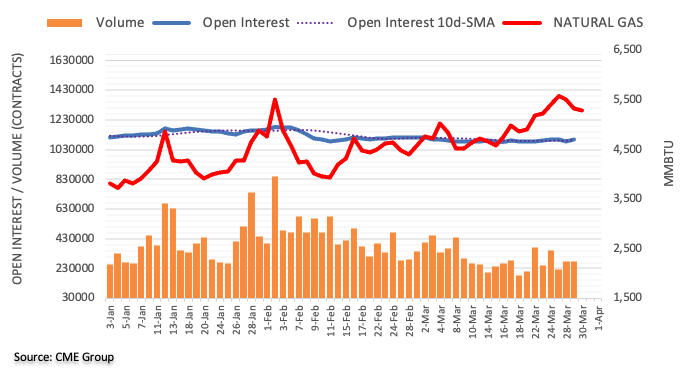
- USD/CHF is expecting more weakness amid softer DXY.
- The withdrawal of some Russian rebels hopes for de-escalation in the Russia-Ukraine war.
- The constructive outcome from the Russia-Ukraine peace talks has advocated risk-on impulse.
The USD/CHF continues to drop further as the improvement in the risk appetite of the market participants is shifting the liquidity from safe-haven assets to risk-perceived currencies. The asset is likely to be cushioned around the previous week’s low at 0.9260.
The de-escalation in the Russia-Ukraine war led by the withdrawal of Russian military troops from Ukraine has turned the market sentiment positive. In the first face-to-face negotiations between Russian and Ukrainian officials in Turkey, a constructive outcome took place in which the Russian rebels promised to be reduced from northern Ukraine and Kyiv while Ukraine will adopt a neutral status and will abstain from alliances. Moscow's lead negotiator cautioned that Russia's promise to decrease military operations did not represent a ceasefire and a formal agreement with Kyiv had a long way to go, as per Reuters. But, investors have still considered the step as a potential advance toward a truce.
Meanwhile, the US dollar index (DXY) looks to slip further below 98.00 amid upbeat market sentiment. The market participants have shrugged off the decent performance from the US Consumer Confidence. The US Conference Board reported Consumer Confidence at 107.2 in March from 105.7, reported a month earlier and a little above the expected 107.0 reading. This showed that the confidence of US individuals in the US economic activities is on elevation.
This week the US Nonfarm Payrolls (NFP) will remain the mega event for the market, which is due on Friday. But before that, investors will keep an eye over the US ADP Employment Change and Gross Domestic Product (GDP) Annualized, which are due on Wednesday.
Japan's former top currency diplomat Naoyuki Shinohara said on Wednesday, “it is 'meaningless' for Tokyo to conduct the yen-buying intervention.”
Additional quotes
“Yen-buying intervention, BOJ rate hike will not have a lasting effect in reversing the trend of weak yen.”
“Yen falls reflect economic fundamentals to some extent, moves not very fast.”
These comments come after the Bank of Japan (BOJ) conducted an emergency bond-buying operation, in addition to the offers it made early Asia to buy 600B yen in 3-5-year JGBs and 725B yen in 5-10-year JGBs.
Market reaction
USD/JPY is trading close to 122.00, licking its wounds after plunging to three-day lows of 121.32.
Gold price witnessed good two-way businesses on Tuesday, although it booked the second straight daily loss. Heading towards the US ADP Employment report showdown on Wednesday, XAU/USD is looking to extend the rebound, FXStreet’s Dhwani Mehta reports.
Focus shifts to US jobs, Ukraine updates
“The focus will remain on a fresh batch of top-tier US economic releases, including the ADP employment and the final Q4 GDP revision. The developments surrounding the Ukraine-Russia war and the yields’ price action will continue to remain the main drivers, influencing gold price.”
“Acceptance above $1,931 will provide legs to the latest uptick in gold price, as bulls will then look to retest the 21-DMA barrier at $1,952. The previous week’s high of $1,966 remains on the buyers’ radars.”
“Immediate support is seen at the previous week’s low of $1,910, below which the $1,900 round level could get tested. The bullish 50-DMA, now at $1,894 will make it an uphill battle for sellers while the last line of defense for buyers is seen at $1,890.”
FX option expiries for March 30 NY cut at 10:00 Eastern Time, via DTCC, can be found below.
- EUR/USD: EUR amounts
- 1.1000 2.44b
- 1.1050-60 1.8b
- 1.1100 2.17b
- 1.1150-55 1.36b
- 1.1195-00 1.64b
- USD/JPY: USD amounts
- 122.00 690m
- 122.50 250m
- 122.90 1b
- GBP/USD: GBP amounts
- 1.3100 630m
- AUD/USD: AUD amounts
- 0.7600 360m
- USD/CAD: USD amounts
- 1.2450 550m
- 1.2475 350m
- 1.2500 718m
- 1.2525 730m
- 1.2550 317m
- USD/CHF: USD amounts
- 0.9240 360m
- 0.9250 280m
- 0.9350 200m
- EUR/CHF: EUR amounts
- 1.0340 952m
- WTI looks to oscillate in a range of 97.72-115.87 as higher uncertainty is followed by volatility contraction.
- The RSI (14) has shifted in a 40.00-60.00 range, which signals consolidation ahead.
- The 20 and 50-period EMAs are scaling higher, which advocates that the upside is still intact.
West Texas Intermediate (WTI), futures on NYMEX, has been bounced sharply after recording weekly lows at 104.39 on Tuesday. The oil prices have remained highly uncertain in March, which is visible from the wild positive swing plotted from March 1 low at 94.48 to March 8 high at 126.51 and negative swing from March 8 high to March 15 low at 92.37.
Usually, larger-than-average moves in an asset are followed by tightening volatility. On the daily scale, the black gold is likely to remain balanced in a range of 97.72-115.87 and will display a symmetrical triangle formation. The trendline placed from the 20 December 2021 low at 66.10 adjoining the March 15 low at 92.37 will act as major support going forward.
The 20 and 50-period Exponential Moving Average (EMAs) at 104.70 and 97.78 respectively are scaling higher, which adds to the upside filters.
The Relative Strength Index (RSI) (14) has shifted into a 40.00-60.00 range from a bullish range of 60.00-80.00, which signals consolidation ahead.
Should the asset violates March 24 high at 115.87, the oil prices will start marching towards the round level resistance at 120.00, followed by March 8 high at 126.51.
On the flip side, bears can take control if the black gold drops below the 50-period EMA at 97.78, which will drag the asset towards March 15 low and February 18 low at 92.37 and 87.29 respectively.
WTI daily chart
-637842157465930855.png)
- USD/CAD remains weighed down by rebounding oil prices and a weaker US dollar.
- WTI price advances on fading Russia-Ukraine optimism on ceasefire.
- 1.2467 support appears at risk amid a sell-off in the Treasury yields.
USD/CAD is struggling to find acceptance above 1.2500, as bears maintain the upper hand amid a renewed upside in oil prices and broad US dollar weakness.
WTI prices rebounded after tumbling on Tuesday on fresh optimism that the Russia-Ukraine peace talks could yield into a ceasefire. The sentiment got a big boost after Russia said it would reduce its military activity in Ukraine, specifically around the capital Kyiv and Chernihiv, triggering a huge sell-off in the black gold.
Firmer oil prices lend support to the Canadian dollar while the US dollar bears the brunt of the retreat in the Treasury yields across the curve. The Bank of Japan (BOJ) unlimited bond-buying program-led slump in USD/JPY also added to the weight on the greenback.
Therefore, the pair remains on the back foot, with all eyes now on the US ADP jobs and Q4 final GDP release. The Russia-Ukraine updates will also have a significant impact on oil price, eventually affecting the USD/CAD pair.
Technically, USD/CAD remains poised to extend the previous decline, eyeing a test of the upward-sloping trendline resistance at 1.2467.
A breach of the latter will trigger a fresh downtrend towards 1.2400, below which the October 2021 lows near 1.2380 will be challenged.
The 14-day Relative Strength Index (RSI) is lurking in the bearish territory, backing the bearish potential.
USD/CAD: Daily chart
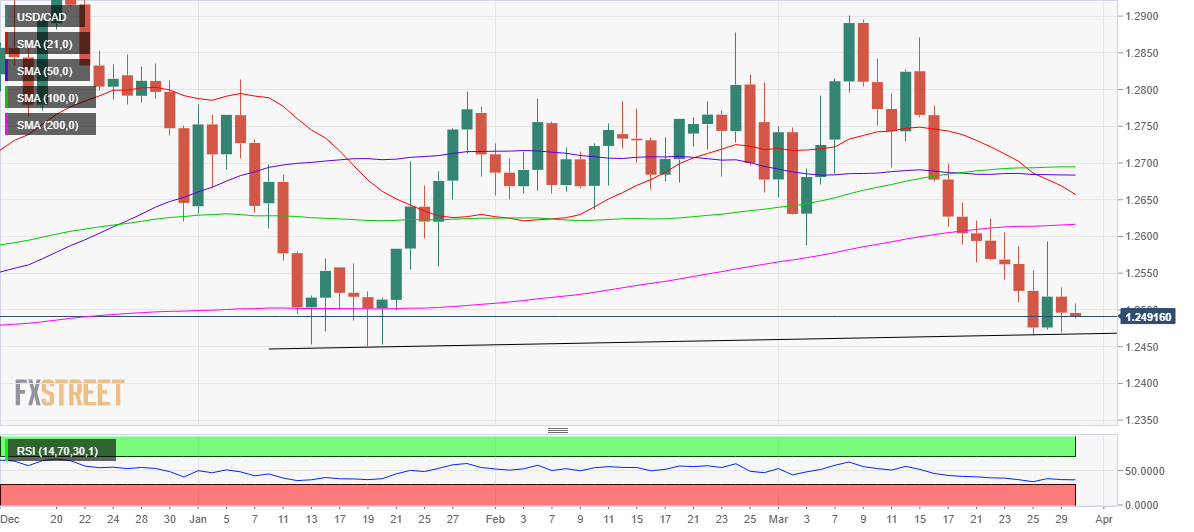
On the flip side, Tuesday’s high at 1.2530 will emerge as the initial hurdle, above which bears will aim for the January 21 lows of 1.2583.
Further up, the 1.2600 round figure will be on the buyers’ radars.
USD/CAD: Additional levels to consider
Considering advanced prints from CME Group for crude oil futures markets, traders scaled back their open interest positions by around 5K contracts on Tuesday. On the other hand, volume increased for the third straight session, this time by around 42.5K contracts.
WTI could still retest $95.00
Prices of the WTI briefly breached the $100.00 mark on Tuesday before rebounding and closing the session with modest gains. The bounce was on the back of diminishing open interest and could signal some lack of conviction in the move higher. That said, the commodity could still revisit the area of recent lows around $95.00 per barrel.
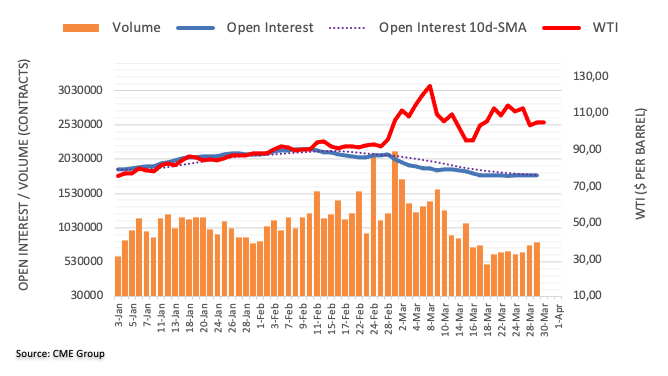
In opinion of FX Strategists at UOB Group, GBP/USD risks extra decline below the 1.3050 level in the next weeks.
Key Quotes
24-hour view: “We expected GBP to ‘trade sideways within a range of 1.3060/1.3140’ yesterday. GBP subsequently traded in a choppy manner between 1.3052 and 1.3157 before closing unchanged at 1.3095. Further choppy actions action is not ruled out, likely within a range of 1.3050/1.3150.”
Next 1-3 weeks: “Our update from yesterday (29 Mar, spot at 1.3100) still stands. As highlighted, downward momentum has improved slightly but GBP has to close below 1.3050 before a sustained decline is likely. The chance for GBP to close below 1.3050 is not high for now but it would remain intact as long as GBP does not move above 1.3195 (‘strong resistance’ level) within these few days. Looking ahead, the next support below 1.3050 is at 1.3000.”
CME Group’s flash data for gold futures markets noted open interest shrank for the third session in a row on Tuesday, this time by more than 8K contracts. Volume, instead, increased for the second consecutive session, now by around 58.2K contracts.
Gold: Next on the upside comes $1966
Gold prices dropped to 4-week lows around $1890 on Tuesday. The move, however, was on the back of shrinking open interest, which opens the door to a probable rebound in the very near term. The occasional recovery should target recent peaks around $1966 per ounce troy (March 24).
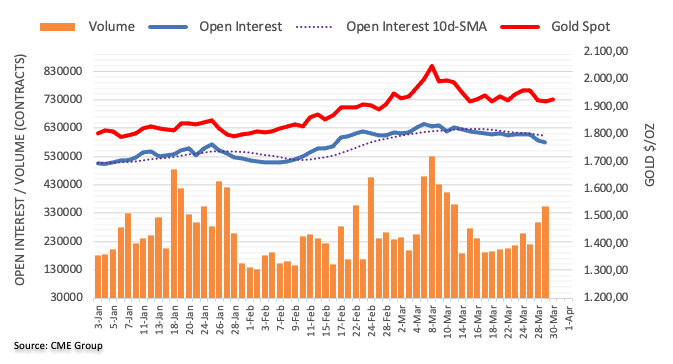
- USD/JPY has eased 2.8% from its fresh six-year high at 125.10 on BOJ’s unlimited bond-buying program.
- Risk-on impulse has faded the appeal for safe-haven assets.
- Investors have shrugged off the underperformance of Japan’s Retail Trade.
The USD/JPY has witnessed a bearish open rejection-reverse trading session on Wednesday as the asset moves higher gradually after opening around 122.80. However, the major has faced significant offers near 123.20 as investors prefer a ‘sell on rise’ approach. The pair has slipped near March 25 low at 121.18 at the press time.
A broader strength in the Japanese yen has been observed from Tuesday as the Bank of Japan (BOJ) paddles to cap the bond yields by 25 basis points. The BOJ has intended to buy Japanese Government Bonds (JGB) till Thursday to corner the yield curve from inversion. To address the mega buying of JGBs, the BOJ has announced that it will buy 600B yen in 3-5 yr JGBs and 725B yen in 5-10 yr JGBs. The BOJ is heavily buying the JGBs to continue with its ultra-loose monetary policy and to skip the signs of recession.
It is worth noting that investors have shrugged off the underperformance of Japan’s Retail Trade, which is released in early Tokyo. The yearly Retail Trade was reported at -0.8% higher than the previous figure of -1.1% but extremely lower than the market estimate of -0.3%.
Meanwhile, the US dollar index (DXY) seems losing its ground and is likely to tumble below Tuesday’s low at 98.40. Active risk-on impulse amid de-escalation in the Russia-Ukraine war has cheered investors and has helped them to ditch the defensives.
FX Strategists at UOB Group now suggest EUR/USD could advance to 1.1190 once 1.1140 is cleared.
Key Quotes
24-hour view: “The strong surge in EUR to a high of 1.1136 and the subsequent strong closing at 1.1085 (+0.97%) came as a surprise (we were expecting sideway-trading). The rapid rise appears to be running ahead of itself and EUR is unlikely to strengthen much further. For today, EUR is more likely to consolidate at these higher levels, expected to be between 1.1050 and 1.1140.”
Next 1-3 weeks: “We highlighted on Monday (28 Mar, spot at 1.0980) that downward momentum is beginning to build but EUR ‘has to close below 1.0950 before a sustained decline is likely’. EUR subsequently dropped to a low of 1.0943 but did not close below 1.0950. Yesterday (29 Mar), EUR jumped to a high of 1.1136 before closing on a strong note at 1.1085 (+0.97%). The risk has shifted to the upside and a clear break of 1.1140 could lead to EUR strengthening to 1.1190. The upside risk is intact as long as EUR does not move below the ‘strong support’ level (currently at 1.1000) within these few days.”
- Euro bulls have surpassed the 200 EMA for the first time this month.
- The asset has been on an adrenaline rush after violating the 20 EMA on the upside.
- The RSI (14) has shifted into a bullish range, which adds to the upside filters.
The EUR/USD pair has witnessed a strong upside on Tuesday after violating the 20-period Exponential Moving Average (EMA) on the upside, which is currently trading at 1.1040 at the press time. A firmer upside move in the asset has sent it near May 17 high at 1.1138, which has acted as a potential resistance earlier.
On a four-hour scale, EUR/USD is trading near the horizontal edge of ascending triangle formation, which is placed near March 2 high at 1.1143. However, the advancing trendline is plotted from monthly lows at 1.0806, adjoining the March 28 low at 1.0945.
The asset has surpassed 200-period EMA for the first time in March at 1.1094, which adds to the upside filters.
Meanwhile, the Relative Strength Index (RSI) (14) has shifted into a bullish range of 60.00-80.00, which signals a fresh impulsive wave going forward.
Should the asset violates March 2 high at 1.1143, the major will start marching decisively towards monthly highs at 1.1233, followed by February 14 low at 1.1280.
On the flip side, euro bulls can lose strength if the asset drops below March 21 high at 1.1070, which will drag the asset towards March 28 low at 1.0945, followed by round level support at 1.0900.
EUR/USD four-hour chart
-637842112862818497.png)
Following his meeting with Japan’s Prime Minister Fumio Kishida, Bank of Japan (BOJ) Governor Haruhiko Kuroda said that the “cost of buying dollars to purchase commodities is one of the main factors behind yen weakening.”
Additional comments
Discussed economy, financial markets in Japan and overseas with PM Kishida.
Discussed global economy, situations regarding Russia, Ukraine with PM Kishida.
Discussed with pm post-covid global economy, Russia and situation in Ukraine.
Told PM fx moves should reflect economic fundamentals.
PM Kishida made no specific request on monetary policy.
Did not discuss anything in particular for forex.
Don't think monetary adjustment would have a direct impact on currencies.
Told PM fx moves should reflect economic fundamentals.
Don't think BOJ’s market operation is directly affecting fx moves.
Yen is weakening but it is driven partly by dollar buying for energy imports.
Rising US interest rates is also a factor behind yen weaking.
Bank of Japan (BOJ) conducts an emergency market operation on Wednesday, in a desperate attempt to restrict the yields from piercing the 0.25% target.
The Japanese central bank made offers to buy JPY100 billion in 10–25-year Japanese government bonds (JGBs).
Market reaction
The free fall in USD/JPY stalled on the above announcement, prompting the pair to rebound towards 122.00, having hit day’s lows at 121.32.
The spot is currently trading at 121.62, down 0.99% on the day.
Read: BoJ will offer to buy 600B yen in 3-5 yr JGBs and 725B yen in 5-10 yr JGBs
- USD/INR is auctioning below 75.60 as DXY weakens on positive market sentiment.
- Falling oil prices add to the downside filters.
- A cut-off in Russian military activity from a few areas of Ukraine doesn’t represent a ceasefire.
The USD/INR pair is hovering around 75.60 amid positive market sentiment after the Russia-Ukraine peace talks displayed their initial constructive outcome. Risk-sensitive assets are underpinned and a shift in liquidity from safe-haven assets has been witnessed.
Russian leader Vladimir Putin has cut off its military activity in northern Ukraine and Kyiv as discussed in the peace talks. While Ukraine proposed to adopt neutral status with the stipulation of international guarantees to protect it from the attack. This was the first face-to-face discussion in nearly three weeks of negotiations and it has turned significant for a ceasefire.
Moscow's lead negotiator cautioned that Russia's promise to decrease military operations did not represent a ceasefire and a formal agreement with Kyiv had a long way to go, as per Reuters. However, the Indian rupee bulls are cheered by the headline and have been performing firmer against the greenback.
Adding to that, a serious plunge in oil prices is also supporting the Indian rupee as the latter is the leading importer of oil. The Indian rupee was facing sheer volatility earlier amid boiling oil prices as it was posing the risk of a wider fiscal deficit. However, a downward trending black gold in the past few trading sessions has brought a sigh of relief for the Indian currency.
Meanwhile, the US dollar index (DXY) is auctioning near Tuesday’s low at 98.35, which is indicating more weakness. Also, a decisive slippage below Tuesday’s low would expose it to the round level support at 98.00.
- GBP/USD bulls step up the pace in the hint for the 1.3160s.
- The US dollar bleeds as the focus remains on a breakthrough in peace talks Russia/ Ukraine.
GBP/USD is trading around 1.3110 and near the highs of the day as the US dollar slides. Sterling underperformed, returning to around 1.3100, net flat overnight, although the pair is picking up a bid in Asian markets ahead of the European open as Asia shares joined a global rally on Wednesday.
The hope for a negotiated end to the Ukraine conflict is keeping spirits alive and adding riskier currencies, such as the pound. The bond markets have signalled concern that aggressive rate hikes could damage the US economy after 10-year yields briefly dipped below two-year rates, but markets are shrugging this off.
The focus is on Russia and Ukraine whereby the Russians have promised to scale down military operations around Ukraine's capital and north, while Kyiv proposed Ukraine join the EU while adopting neutral status by not joining NATO. The peace talks are taking place in an Istanbul palace more than a month into the largest attack on a European nation since World War II.
''Talks successful enough for a possible meeting between Putin and Zelensky, says Ukrainian presidential advisor Mykhailo Podolyak. “We have documents prepared now which allow the presidents to meet on a bilateral basis," he said.
European currencies have generally been under pressure vs. the USD in the spot market given concerns about energy security and/or the economic impact of higher prices for gas and oil. However, the energy sector has tailed off in the hopes of a breakthrough in peace talks and a potential ceasefire. Net short GBP positions increased noticeably for a third week as concerns rise as to the cost of living crisis in the UK, so any signs of relief there are bound to support the pound in the spot market as inflation concerns abate.
Meanwhile, the Old Lady's Governor Andrew Bailey acknowledged that the Bank of England softened its guidance on rate hikes this month to reflect the high level of economic uncertainty. ''At the March 17 decision, the bank said that further tightening of policy “might be” appropriate in the coming months vs. the forward guidance in February, when such a move was seen as “likely.” Bailey said that while it’s been appropriate for the BoE to tighten policy under current circumstances, forward guidance should reflect the current heightened uncertainty,'' analysts at Brown Brothers explained.
''WIRP suggests a hike at the next meeting May 5 is fully priced in, with around 30% odds of a 50 bp move then vs. 50% before Bailey’s comments. Swaps market now sees the policy rate peaking near 2.25% over the next 24 months, down from 2.5% before Bailey’s comments but still up from 2.0% at the start of last week.''
Key data events
Looking ahead for the week, US Nonfarm Payrolls data will take centre stage as a meanwhile distraction to the Ukraine crisis this Friday. ''Employment likely continued to advance in March following two strong reports averaging +580k in Jan and Feb,'' analysts at TD Securities said.
''That said, we expect some of that boost to fizzle, though to a still firm job growth pace of +350k. Indeed, job gains should lead to a new drop in the unemployment rate to a post-COVID low of 3.7%. We also expect wage growth to slow to a still firm 0.3% MoM pace.''
GBP/USD technical analysis
The following illustrates the pound's bullish trajectory on the daily chart in an M-formation:
GBP/USD daily chart
The chart above was from the prior day's close. The price is now higher in Asia as it attempts to recover towards the neckline of the formation:
- EUR/JPY sees more downside amid broader strength in the Japanese yen.
- BOJ’s unlimited bond-purchase program has fetched much-needed support for the yen.
- Euro may remain inactive ahead of ECB’s Lagarde speech.
The EUR/JPY pair is facing a decent correction amid a broader strength in the Japanese yen. The asset has surrendered its intraday gains and is off from the day’s high at 136.67. The cross is oscillating in a narrow range of 135.20-137.30 but is likely to imbalance on the downside.
The Japanese yen has been strengthened against the shared currency as the third day of the bond-buying program by the Bank of Japan (BOJ) has started providing much-needed support to the yen. The pledge of unlimited bond-buying by the BOJ to defend the yield cap at 0.25% has progressed into the third day. The BOJ’s defense move of yield-curve control to safeguard its equities may report higher inflation in an already inflationary environment due to rising fuel and commodity prices.
Apart from the unlimited bond-buying program, the Japanese yen is performing despite downbeat Japan’s Retail Trade numbers in early Tokyo. The yearly Retail Trade was reported at -0.8% higher than the previous figure of -1.1% but extremely lower than the market estimate of -0.3%.
Meanwhile, the shared currency is likely to remain inactive as investors are waiting for the speech from the European Central Bank (ECB)’S Christian Lagarde, which is due on Wednesday. The speech from the ECB’s Lagarde will provide insights into the likely monetary policy action in April. Unlike the other Western leaders, the ECB is stuck with ground-level interest rates but a higher February inflation figure of 5.9% is calling for an interest rate hike in the coming monetary policy meeting.
- AUD/USD bears are moving on as commodity prices fade.
- The bears will be looking for a move to test the 0.74 figure for the days ahead.
AUD/USD is stalling on the daily advance and the Net AUD short positions failed to hold all of the previous week’s moves according to the latest CFTC positioning data, However, net shorts are still lower than last month’s levels. Soaring commodity prices have been offering the AUD support vs. the USD in the spot market but these too are falling as per the Thomson Reuters CRB index.
The following illustrates the prospects of a meanwhile correction on the AUD/USD daily chart:
AUD/USD daily chart

As illustrated, the price is stalling on the bid and is yet to move in to mitigate that imbalance from the bullish rally on the daily chart. The bears will be looking for a move to test at least 38.% Fibonacci retracement area that correlated with the prior resistance at the start of March near 0.74 the figure.
| Raw materials | Closed | Change, % |
|---|---|---|
| UKBrent | 111.6 | 1.47 |
| Silver | 24.776 | -0.4 |
| Gold | 1919.3 | -0.16 |
| Palladium | 2134.01 | -3.57 |
The Russia-Ukraine war is increasing uncertainty, Atlanta Fed President Raphael Bostic said while speaking on "Economic Leadership from America's Founding to the Global Pandemic" at the University of Southern California's George Washington Leadership Lecture Series.
Additional quotes
The war in Ukraine impacts inflation, boosts uncertainty.
Greater uncertainty is a source of risk for demand.
Market reaction
The US dollar index is holding the lower ground near 98.25, down 0.16% on the day. The main catalyst behind the dollar’s move lower is the huge sell-off in the USD/JPY pair this Wednesday.
- GBP/JPY is off the multi-day lows but not out of the woods yet.
- The yen leaps on persistent BOJ bond-buying, Japanese fiscal year-end flows.
- The pound bears the brunt of cautious BOE against the Fed’s hawkishness.
GBP/JPY is reversing a sharp fall below 160.00, as bears take a breather before the next push lower.
The buying interest around the Japanese yen remains unabated, which is likely to keep any upside attempts in the cross short-lived.
The yen gathered sudden strength over the last hour and triggered a huge sell-off in the USD/JPY pair, throwing the yen crosses under the bus.
The Bank of Japan's (BOJ) persistent efforts to defend the yield target at 0.25%, as it continues to buy Japanese Government Bond (JGBs) for the third consecutive day, are finally offering the much-needed support to JPY bulls.
The Japanese central bank has pledged to increase its offers to buy bonds after announcing that they offer to buy 600B yen in 3-5 yr JGBs and 725B yen in 5-10 yr JGBs, earlier on.
On the other side, the bearish sentiment around the pound also adds to the pain in the GBP/JPY cross. The BOE is likely to refrain from raising rates in its May meeting, as risks to the UK economic growth increase amid soaring inflation and the Ukraine uncertainty.
In his speech on Monday, BOE Governor Andrew Bailey sounded cautious, as he said that the situation was very volatile when asked about the May rate hike decision.
Looking ahead, the repatriation flows in the yen combined with the BOJ’s intervention will be closely eyed alongside the US ADP employment data. Further, the price action in the US Treasury yields and Ukraine updates could also have a significant impact on the pair.
GBP/JPY technical levels to watch
- Gold prices have found significant bids before $1,900 as a value bet.
- Progress in peace talks between Russia and Ukraine has underpinned the risk-on impulse.
- The DXY eyes below 98.00 on an upbeat market mood.
Gold (XAU/USD) has been hammered by the market participants as safe-haven assets lose appeal on progress in peace talks between Russia and Ukraine. The precious metal witnessed a steep fall this week after failing to sustain above the grounds of $1,950.00. Although a responsive buying slightly below $1,900 has pushed the gold prices near $1,920.00.
The Russian administration is withstanding the initial step of ceasefire with Ukraine and has withdrawn its troops in northern Ukraine and Kyiv. While Ukraine has adopted a neutral status and is abstaining from an alliance with the NATO community.
The initial gesture towards the roadmap of truce by Moscow and Kyiv has improved the market sentiment. Risk-sensitive assets are gaining traction amid active risk-on impulse.
Meanwhile, the US dollar index (DXY) has also faced the heat of sheer selling in the safe-haven assets. The DXY is reversing to Tuesday’s low around 98.00 and is likely to extend its losses amid the violation of the latter. The higher odds of 50 basis points (bps) interest rate hike by the Federal Reserve (Fed) are intact amid modest US JOLTS Job Openings data. The JOLTS Job Opening was recorded at 11.266M, a tad higher than the previous figure of 11.263M and the estimate of 11M.
For further direction, investors will focus on the quarterly US Gross Domestic Product annualized (Q4), which is due on Wednesday. A preliminary estimate for quarterly US GDP is 7%, synonymous with the previous figure.
Gold Technical Analysis
On the hourly scale, XAU/USD has sensed responsive buying after the re-test near March 16 low at $1,895.15. The precious metal has overstepped the 20-period Exponential Moving Average (EMA). The Relative Strength Index (RSI) (14) has shifted into a 40.00-60.00 range, which signals a consolidation ahead.
Gold hourly chart
-637842006388849934.png)
| Time | Country | Event | Period | Previous value | Forecast |
|---|---|---|---|---|---|
| 00:00 (GMT) | New Zealand | ANZ Business Confidence | March | -51.8 | |
| 07:00 (GMT) | Switzerland | KOF Leading Indicator | March | 105.0 | 100.8 |
| 08:00 (GMT) | Switzerland | Credit Suisse ZEW Survey (Expectations) | March | 9 | |
| 09:00 (GMT) | Eurozone | Economic sentiment index | March | 114 | 109 |
| 09:00 (GMT) | Eurozone | Industrial confidence | March | 14 | 9 |
| 09:00 (GMT) | Eurozone | Consumer Confidence | March | -8.8 | -18.7 |
| 09:00 (GMT) | Eurozone | ECB President Lagarde Speaks | |||
| 12:00 (GMT) | Germany | CPI, m/m | March | 0.9% | 1.6% |
| 12:00 (GMT) | Germany | CPI, y/y | March | 5.1% | 6.3% |
| 12:15 (GMT) | U.S. | ADP Employment Report | March | 475 | 400 |
| 12:30 (GMT) | U.S. | PCE price index, q/q | Quarter IV | 5.3% | 6.3% |
| 12:30 (GMT) | U.S. | PCE price index ex food, energy, q/q | Quarter IV | 4.6% | 5% |
| 12:30 (GMT) | U.S. | GDP, q/q | Quarter IV | 2.3% | 7.1% |
| 14:30 (GMT) | U.S. | Crude Oil Inventories | March | -2.508 | -1.022 |
| 23:50 (GMT) | Japan | Industrial Production (YoY) | February | -0.5% | |
| 23:50 (GMT) | Japan | Industrial Production (MoM) | February | -1.3% | 0.5% |
USD/JPY has dropped a huge 120+ pips in the last hour of trade despite the Bank of Japan's intervention for a third day, and this is all rather counterintuitive.
Moreover, the has been the worst-performing Group of 10 currency this year, and as the year-end approaches, Japanese exporters will be reporting their financial results in yen.
More to come...
In recent trade today, the People’s Bank of China (PBOC) set the yuan (CNY) at 6.3566 vs. the last close of 6.3635.
About the fix
China maintains strict control of the yuan’s rate on the mainland.
The onshore yuan (CNY) differs from the offshore one (CNH) in trading restrictions, this last one is not as tightly controlled.
Each morning, the People’s Bank of China (PBOC) sets a so-called daily midpoint fix, based on the yuan’s previous day closing level and quotations taken from the inter-bank dealer.
- EUR/USD bulls attempting to recover with 1.1100 roadblock ahead.
- Ukraine & Russian risks are in the driving seat as traders await key data events.
EUR/USD is trading at 1.1093 after moving in on hourly resistance near the highs of the day at 1.1099. The euro has been enjoying a relief rally built on constructive peace talks between Ukraine and Russia which initially sent the price of oil lower. However, sceptics were in the room and that has weighed on risk sentiment again, oil prices and capped the euro's advance to daily resistance near 1.1140.
The euro advanced when Russia said in talks in Istanbul on Tuesday that it would pull out its military operations around Ukraine's capital, Kyiv, and the north. Kyiv proposed adopting a neutral status, and not joining NATO. Kyiv requires that Moscow would not oppose Ukraine joining the European Union, Russia's lead negotiator Vladimir Medinsky said. Russia has previously opposed Ukrainian membership of the EU and especially of NATO. Medinsky said Russia's delegation would study and present the proposals to President Vladimir Putin.
Nevertheless, to prepare a peace agreement, Medinsky later told the TASS news agency, "we still have a long way to go". Meanwhile, the dollar, which had risen as much as 3.4% since Russia invaded Ukraine, lost its safe-haven appeal and declined 0.596% to 98.037, as traders looked to currencies deemed riskier, such as the euro.
"A decision was made to radically, by a large margin, reduce military activity in the Kyiv and Chernihiv directions," Russian Deputy Defence Minister Alexander Fomin told reporters on Tuesday.
However, the United States warned the threat was not over. For instance, Fomin has made no mention of other areas that have seen heavy fighting, including Mariupol in the southeast, Sumy and Kharkiv in the east and Kherson and Mykolaiv in the south.
Russia has started moving very small numbers of troops away from positions around Kyiv in a move that is more of a repositioning than a retreat or a withdrawal from the war, the Pentagon said on Tuesday. "It does not mean that the threat to Kyiv is over," spokesman John Kirby told a news briefing.
Additionally, Ukraine's President Volodymyr Zelenskyy said only a concrete result from the talks can be trusted.
"We can say the signals we are receiving from the talks are positive but they do not drown out the explosions of Russian shells," he said.
British Prime Minister Boris Johnson said a ceasefire agreement in Ukraine will not be enough to lift British sanctions against Russia. US president, in the same vein, says that the US will keep sanctions.
Meanwhile, the economic calendar is starting to heat up. We have European inflation figures for March on Wednesday, with the composite release on Friday, the same day as the US will release its Nonfarm Payrolls numbers as a key event for the week.
'Employment likely continued to advance in March following two strong reports averaging +580k in Jan and Feb,'' analysts at TD Securities said.
''That said, we expect some of that boost to fizzle, though to a still firm job growth pace of +350k. Indeed, job gains should lead to a new drop in the unemployment rate to a post-COVID low of 3.7%. We also expect wage growth to slow to a still firm 0.3% MoM pace.''
As for eurozone inflation, the analysts expect headline HICP inflation to soar across the euro area in March, mostly due to a substantial surge in energy prices. ''We also look for a rise in non-energy industrial goods prices to boost euro area core inflation to a 28-year high of 3.2% (mkt: 3.1%). However, newly passed energy subsidies and price caps add some downside risk to our headline forecasts.''
EUR/USD H1 chart

The hourly chart shows that the price is attempting to break the hourly resistance.
- Kiwi bulls are firmer above 200 EMA, seek a bull cross of 20 and 200-period EMAs for further validation.
- The RSI (14) looks to violate 60.00 on the upside which will add to the north side filters.
- The greenback bulls can be worthy if the asset settles below weekly lows.
The NZD/USD pair has been bounced back sharply led by sensing decent buying interest at the 200-period Exponential Moving Average (EMA), which is trading at 0.6882 at the press time. Kiwi bulls have regained the majority of the weekly losses as the asset initiated the week with a wide bearish tick.
On the daily scale, NZD/USD is closely trading at 61.8% Fibonacci retracement (placed from 21 October 2021 high at 0.7219 to January 28 low at 0.6529.), which is at 0.6954. The trendline placed from January 28 low at 0.6529, adjoining the February 14 and February 24 low at 0.6593 and 0.6630 respectively will continue to act as major support.
A bull cross is on the verge from the 20 and 200-period EMAs, which will add to the upside filters. Meanwhile, the Relative Strength Index (RSI) (14) looks to overstep 60.00, which will drive the asset higher.
For the upside, bulls need to surpass the weekly high at 0.6972, which will send the asset towards the psychological figure resistance at 0.7000, followed by the 19 November 2021 high at 0.7050.
Should the asset drops below weekly lows at 0.6876 decisively, greenback bulls will drag the pair towards March 17 low at 0.6823. Breach of the latter will expose the asset to more downside near round level support at 0.6800.
NZD/USD daily chart
-637841978577146269.png)
| Pare | Closed | Change, % |
|---|---|---|
| AUDUSD | 0.75095 | 0.28 |
| EURJPY | 136.228 | 0.1 |
| EURUSD | 1.10863 | 0.92 |
| GBPJPY | 160.915 | -0.77 |
| GBPUSD | 1.30962 | 0.03 |
| NZDUSD | 0.69351 | 0.58 |
| USDCAD | 1.24993 | -0.17 |
| USDCHF | 0.93076 | -0.38 |
| USDJPY | 122.875 | -0.8 |
- USD/JPY has attracted bids on downbeat Japan’s Retail Trade.
- The DXY has faced broader weakness amid positive market sentiment.
- BOJ’s unlimited bond-buying program may push the asset higher.
The USD/JPY pair has climbed sharply above 123.00 on downbeat Japan’s Retail Trade. Japan’s Ministry of Economy, Trade, and Industry have reported yearly Retail Trade at -0.8% higher than the previous figure of -1.1% but extremely lower than the market estimate of -0.3%.
The greenback has been underperforming against the Japanese yen in the last two trading sessions despite the ongoing 10-year benchmark Japanese Government Bonds (JGB)-purchase program by the Bank of Japan (BOJ). Usually, the bond-buying program by the central banks denotes their intention to keep the interest rates from rising. The BOJ is intended to restrict its interest rates from elevation bets. The four days bond-buying program of the BOJ will continue till Thursday.
Meanwhile, the BOJ has announced an emergency bond-buying operation and has offered to buy 150 billion Yen in 10-25 Year JGBs and 100 billion Yen in JGBs with maturity beyond 25 years.
On Tuesday, the market participants cheered the slightly higher Japan’s Unemployment Rate. The Statistics Bureau of Japan reported the Unemployment Rate at 2.7%, higher than the estimates and prior print of 2.8%.
The US dollar index (DXY) has lost its traction amid positive cues from the Russia-Ukraine peace talks. An announcement of a cut-off in Russian rebels in Ukraine has cheered the market sentiment. Risk-on impulse is gaining more traction and eventually the risk-sensitive assets.
Going forward, the US Nonfarm Payrolls (NFP) will be the major event this week. But before that, investors will focus on the US ADP Employment Change and Gross Domestic Product (GDP) Annualized, which are due on Wednesday.







© 2000-2026. Sva prava zaštićena.
Sajt je vlasništvo kompanije Teletrade D.J. LLC 2351 LLC 2022 (Euro House, Richmond Hill Road, Kingstown, VC0100, St. Vincent and the Grenadines).
Svi podaci koji se nalaze na sajtu ne predstavljaju osnovu za donošenje investicionih odluka, već su informativnog karaktera.
The company does not serve or provide services to customers who are residents of the US, Canada, Iran, The Democratic People's Republic of Korea, Yemen and FATF blacklisted countries.
Izvršenje trgovinskih operacija sa finansijskim instrumentima upotrebom marginalne trgovine pruža velike mogućnosti i omogućava investitorima ostvarivanje visokih prihoda. Međutim, takav vid trgovine povezan je sa potencijalno visokim nivoom rizika od gubitka sredstava. Проведение торговых операций на финанcовых рынках c маржинальными финанcовыми инcтрументами открывает широкие возможноcти, и позволяет инвеcторам, готовым пойти на риcк, получать выcокую прибыль, но при этом неcет в cебе потенциально выcокий уровень риcка получения убытков. Iz tog razloga je pre započinjanja trgovine potrebno odlučiti o izboru odgovarajuće investicione strategije, uzimajući u obzir raspoložive resurse.
Upotreba informacija: U slučaju potpunog ili delimičnog preuzimanja i daljeg korišćenja materijala koji se nalazi na sajtu, potrebno je navesti link odgovarajuće stranice na sajtu kompanije TeleTrade-a kao izvora informacija. Upotreba materijala na internetu mora biti praćena hiper linkom do web stranice teletrade.org. Automatski uvoz materijala i informacija sa stranice je zabranjen.
Ako imate bilo kakvih pitanja, obratite nam se pr@teletrade.global.


 Банковни
 транcфери


