- Analytics
- News and Tools
- Market News
Analytics, News, and Forecasts for CFD Markets: currency news — 05-03-2012.
The yen rallied versus all of its most-traded counterparts after China said it will lower its target for economic growth, boosting demand for the relative safety of Japan’s currency. China pared the nation’s economic growth target from an 8 percent goal in place since 2005, a signal that leaders are determined to cut reliance on exports and capital spending in favor of consumption. Officials will aim for inflation of about 4 percent this year, unchanged from the 2011 goal, according to Premier Wen Jiabao’s state-of-the-nation speech, delivered at the annual meeting of the National People’s Congress in Beijing.
The euro gained against most major currencies as Greece said it expected private creditors to accept its debt-swap terms because it constitutes “the best offer.” The euro rose against the dollar after European retail sales unexpectedly increased in January after four months of declines as growth in France helped to outweigh a drop in Germany. European Union leaders will hold a teleconference on March 9 to review the outcome of the 106 billion-euro ($140 billion) debt swap with Greece’s private creditors. Success depends on how many investors agree to the writedown by March 8 and the Greek government has set a 75 percent participation rate as a threshold for proceeding with the transaction.
European stocks dropped, snapping two days of gains, as China cut its forecast for economic growth this year and data showed manufacturing and services in the euro area shrank more than estimated.
China reduced its growth target to 7.5 percent this year, the lowest goal since 2004, according to a transcript of Premier Wen Jiabao’s address to the National People’s Congress. The government will also aim for inflation of about 4 percent this year, unchanged from its goal in 2011.
Stocks extended declines after euro-area services and manufacturing output shrank in February more than economists had estimated as the region’s economy struggled to rebound from a contraction in the fourth quarter of last year.
A euro-area composite index based on a survey of purchasing managers in both industries dropped to 49.3 from 50.4 in January, London-based Markit Economics said today. That was below an initial figure of 49.7 published on Feb. 22. A reading of less than 50 means the measure contracted.
National benchmark indexes declined in every western- European (SXXP) market except Switzerland and Iceland today. France’s CAC 40 Index (CAC) slipped 0.4 percent, while the U.K.’s FTSE 100 Index fell 0.6 percent. Germany’s DAX Index (DAX) lost 0.8 percent.
Rio Tinto dropped 3.9 percent to 3,422 pence, BHP Billiton Ltd. fell 2.9 percent to 1,971 pence and Vedanta Resources Plc slid 3.7 percent to 1,400 pence. Copper declined for a second day in London after China cut its target for economic growth.
Salzgitter sank 5.4 percent to 42.88 euros after the German steelmaker said it was “impossible” to provide an earnings forecast because the euro area’s sovereign-debt crisis remains a major risk.
Kloeckner & Co, Europe’s largest independent steel trader, dropped 3.3 percent to 11.23 euros.
Weir Group Plc retreated 4.7 percent to 1,939 pence as Citigroup Inc. downgraded the world’s biggest maker of pumps for the mining industry to “sell” from “neutral.”
BP climbed 1.6 percent to 504.6 pence, limiting the Stoxx 600’s slide, after Europe’s second-largest oil producer reached a deal with private plaintiffs -- the businesses and individuals harmed by the 2010 oil spill.
U.S. stocks fell, following a three- week advance for the Standard & Poor’s 500 Index, as China reduced its economic growth target and orders to American factories decreased for the first time in three months.
Equities joined a global slump as China pared its growth target to 7.5 percent from an 8 percent goal in place since 2005. Euro-area services output shrank more than estimated, led by Italy and Spain. In the U.S., orders to U.S. factories decreased for the first time in three months. Separately, the Institute for Supply Management’s index of non-manufacturing industries rose to 57.3 in February from 56.8 a month earlier.
Dow 12,913.54 -64.03 -0.49%, Nasdaq 2,944.22 -31.97 -1.07%, S&P 500 1,360.02 -9.61 -0.70%
Companies most-tied to the economy tumbled, sending the Morgan Stanley Cyclical Index down 1.7 percent. Alcoa (AA) lost 3.3 percent to $9.91. Caterpillar (CAT) slid 1.7 percent to $110.60.
Bank of America (ВАС) slumped 2.2 percent to $7.95. Citigroup lost 1.8 percent to $33.50 after naming board member Michael O’Neill to be chairman to succeed Richard Parsons, who is stepping down after overseeing the company’s recovery from near-collapse in 2008.
MetroPCS Communications slipped 4.9 percent to $10.04, while Leap Wireless International Inc. declined 8.2 percent to $9.69. Sanford C. Bernstein & Co. cut its recommendation for the stocks, saying any takeover bids for the carriers would be “fraught with challenges.”
CF Industries Holdings Inc. fell 4.9 percent to $179 after being cut to “neutral” from “buy” at Citigroup Inc. and removed from the firm’s “Top Picks Live” list.
Zynga Inc. slipped 6 percent to $13.81. The biggest developer of games for social-networking sites was cut to neutral from overweight by JPMorgan Chase & Co., meaning the shares are expected to perform in line with the stocks the analyst covers over the next six-to-twelve months.
Big Lots Inc. climbed 3.5 percent, the biggest advance in the S&P 500, to $44.22. The discount retailer was raised to “buy” from “neutral” at Northcoast Research. The 12-month share-price estimate is $53.
Oil fluctuated as U.S. President Barack Obama and Israeli Prime Minister Benjamin Netanyahu met to discuss how to confront Iran over its nuclear program and as China cut its economic growth target.
Futures advanced as much as 0.7 percent in New York a day after Obama said that he takes “no options off the table” including a “military effort” to stop Iran from having a nuclear weapon. The U.S. won’t hesitate to use military force against Iran if necessary, Obama told a conference of the American Israel Public Affairs Committee yesterday. There’s still time for diplomacy and sanctions to work, he said.
Prices fell as much as 1.1 percent earlier as China’s Premier Wen Jiabao his country will aim for economic growth of 7.5 percent this year, the lowest goal since 2004.
China is the second-biggest oil-consuming country after the U.S. The two nations were responsible for 32 percent of global oil consumption in 2010, according to BP Plc (BP/)’s Statistical Review of World Energy released on June 8. The 17 countries using the euro accounted for about 12 percent of world demand last year, BP figures show.
Oil rose earlier after a fatal vehicle collision and fire at a pumping station this weekend prompted Enbridge Inc. (ENB) to close the pipeline near Chicago.
Crude oil for April delivery rose 28 cents, or 0.3 percent, to $106.98 a barrel at 11:53 a.m. on the New York Mercantile Exchange. Prices are up 2.5 percent in the past year.
Brent oil for April settlement increased 76 cents, or 0.6 percent, to $124.41 a barrel on the London-based ICE Futures Europe exchange in London. The European benchmark’s premium to West Texas Intermediate widened to $17.43 a barrel from last week’s close of $16.95.
The price of gold falls amid falling demand for commodities due to investors' concern for the economic development of China and the eurozone.
Investors are concerned about economic news Monday from China, a major trading partner of Japan. On Monday it was announced that the PRC government plans to ensure growth of the national economy in the current year at 7.5%. Thus in 2011, according to the State Statistical Bureau of China, the economy grew by 9.2%.
In addition, according to the Prime Minister of China, consumer price inflation in the country in 2012 will be at 4%. The average 2011 inflation rate was 5.4%, although the Chinese government hoped to keep the average annual inflation in 2011 at around 4%.
In addition, investors continue to fear for the economy of the eurozone. On Monday, their fears were supported by the weak macroeconomic statistics in the region. On Monday it was reported that the composite index of business activity in the field of industrial production and services for the 17 eurozone countries, the final assessment, in February fell to 49.3 points from 50.4 points in January. Analysts were expecting at the same time maintain an index for February on the original mark of 49.7 points. An index value above 50 indicates growth in economic activity, lower - its decline.
March futures of gold on COMEX today fell to 1695.4 dollars per ounce.
EUR/USD
Offers $1.3300/10, $1.3270/85, $1.3230/50, $1.3210/20
Bids $1.3155/50, $1.3140/35, $1.3115/00
AUD/USD
Offers $1.0830/35, $1.0825, $1.0810/15, $1.0785/90, $1.0740/45
Bids $1.0650, $1.0625/20, $1.0600/95, $1.0575/70, $1.0555/50
EUR/JPY
Offers Y108.45/50, Y108.15/20, Y108.00/05, Y107.75/80, Y107.50/60
Bids Y106.85/80, Y106.50/45, Y106.20/10, Y106.00
USD/JPY
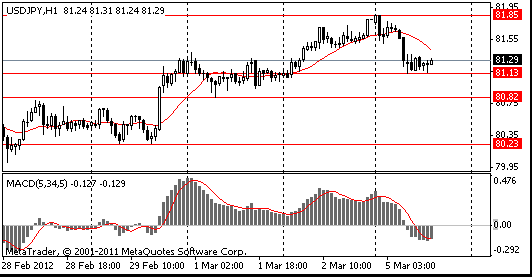
Offers Y82.50, Y82.25, Y82.00, Y81.85/90, Y81.50, Y81.35/40
Bids Y81.00, Y80.80/75, Y80.45/40, Y80.05/00
Resistance 3: Y82.80 (Apr 27 high)
Resistance 2: Y82.20 (high of May)
Resistance 1: Y81.85 (session high)
Current price: Y81.29
Support 1:Y81.10 (session low)
Support 1:Y80.80 (Mar 1 low)
Support 3:Y80.00/90 (Feb 23-24 and 28 lows)
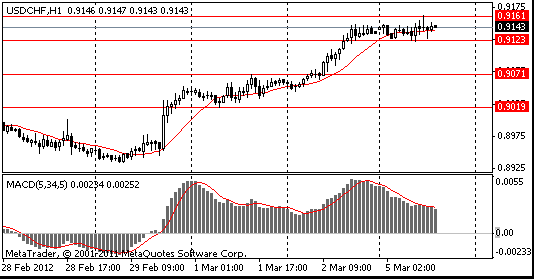
Resistance 3: Chf0.9210 (Feb 17 high)
Resistance 2: Chf0.9180 (close price on Feb 17)
Resistance 1: Chf0.9160 (session high)
Current price: Chf0.9113
Support 1: Chf0.9120 (session low)
Support 2: Chf0.9070 (Mar 1 high)
Support 3: Chf0.9020/10 (earlier resistance, Feb 27 high, Mar 1 low)
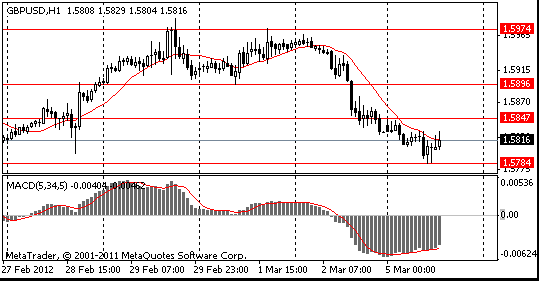
Resistance 3 : $1.5975/90 (area of Feb 29 and Mar 1 high)
Resistance 2 : $1.5900 (Mar 1 low)
Resistance 1 : $1.5850 (session high)
Current price: $1.5816
Support 1 : $1.5780 (session low)
Support 2 : $1.5760 (support line from Jan 13)
Support 3 : $1.5720 (Feb 24 low)
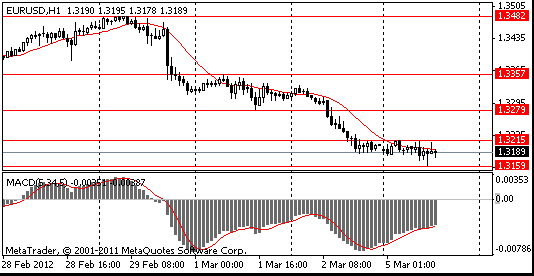
Resistance 3 : $1.3360 (Mar 1 high and Feb 24 low)
Resistance 2 : $1.3280 (Mar 1 high)
Resistance 1 : $1.3215 (session high)
Current price: $1.3189
Support 1 : $1.3160 (session low)
Support 2 : $1.3110 (Feb 17 low)
Support 3 : $1.2970 (Feb 16 low)
EUR/USD $1.3180, $1.3270
USD/JPY Y81.75, Y82.25
AUD/USD $1.0730, $1.0850, $1.0900
USD/CHF Chf0.9000
EUR/CHF Chf1.2050
00:30 Australia ANZ Job Advertisements (MoM) February +6.0% +3.3%
The euro slid for a fourth day against the yen before data economists say will show the region’s retail sales dropped for a third month, adding to signs the currency bloc’s debt woes are hurting the economy. Euro-area retail sales probably declined 0.1 percent in January from the previous month when they fell 0.3 percent, a Bloomberg News survey of economists showed before data from the European Union’s statistics office today. The European Central Bank is predicted to keep its benchmark interest rate unchanged at a record low 1 percent at its March 8 meeting, according to a separate survey.
The Institute for Supply Management’s non-manufacturing index was at 56.2 last month, another survey showed before the report from the Arizona-based group today. The gauge for U.S. service industries was 56.8 in January, the highest since February 2011 and above the 50 level that signals expansion.
Australia’s dollar weakened against most of its peers amid concern slower growth in China’s economy will decrease demand for the South Pacific country’s commodities.
China’s government will target economic growth of 7.5 percent this year, the lowest goal since 2004, according to a state-of-the-nation speech from Premier Wen Jiabao to lawmakers in Beijing today.
The yen appreciated versus all of its 16 major counterparts amid speculation Japanese exporters are taking advantage of the currency’s drop to repatriate overseas income.
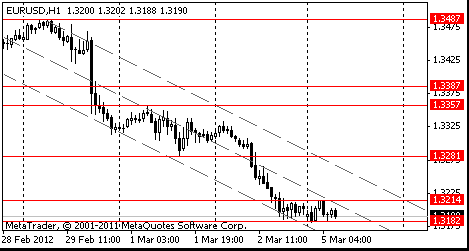
EUR/USD: during the Asian session the pair holds in range $1.3180-$1.3215.
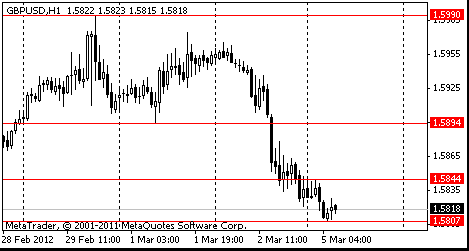
GBP/USD: during the Asian session the pair decreased come nearer to $1.58.
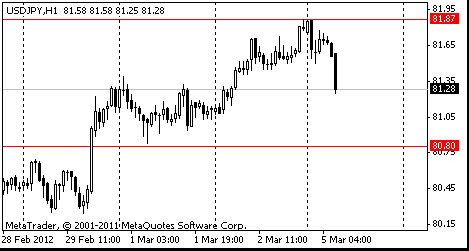
USD/JPY: during the Asian session the pair fell, after growth on Friday.
This morning sees the release of the final services PMIs, including France at 0848GMT, Germany at 0853GMT and then the main EMU data at 0858GMT. EMU data for Monday rounds off with retail trade at 1000GMT. The UK also releases the Markit/CIPS Services PMI at 0928GMT. US data starts at 1430GMT with the weekly Capital Goods Index. At 1500GMT, Factory Orders, the ISM Non-Manufacturing Index and also the online help-wanted index are all due.
On Monday the euro extended its decline, falling by the most in more than three months against the yen, after Standard & Poor’s placed the region’s rescue fund on negative outlook. The euro briefly extended its losses against the dollar after S&P cut its outlook on the bailout fund, the European Financial Stability Facility, to negative, reflecting a similar move on two euro-area nations that act as guarantors to the facility. The EFSF lost its top credit rating in January after earlier downgrades to France and Austria. The euro remained lower even after Germany’s lower house of parliament approved a second Greek bailout package worth 130 billion euros ($174 billion). German Chancellor Angela Merkel and euro-area leaders now shift their focus on whether to bolster the region’s bailout firewall as they prepare for a summit meeting in Brussels on March 1-2.
On Tuesday the euro strengthened against the dollar and yen on speculation a European Central Bank allotment of three-year loans to banks will bolster investor appetite for the region’s assets. After lending euro-region banks a record 489 billion euros ($658 billion) in its first longer-term refinancing operation, or LTRO, on Dec. 21, the Frankfurt-based ECB tomorrow will probably grant them another 470 billion euros this week. Using the operations, banks can borrow from the ECB at around 1 percent and invest the proceeds in higher-yielding securities such as the 10-year Italian government bond, yielding 5.35 percent. The 17-nation currency earlier pared its gain against the greenback after Irish Prime Minister Enda Kenny said the nation will hold a referendum to ratify the European fiscal compact, raising concern about the measure’s implementation.
On Wednesday the dollar rallied against the euro and yen after comments from Federal Reserve Chairman Ben S. Bernanke reduced speculation the central bank will provide more monetary stimulus. The dollar erased earlier losses after Bernanke said there are “positive developments” in the labor market, adding that “the job market remains far from normal.” Bernanke said that “in light of the somewhat different signals received recently from the labor market than from indicators of final demand and production, however, it will be especially important to evaluate incoming information to assess the underlying pace of economic recovery.”
On Thursday the dollar depreciated against the majority of its most-traded counterparts as reports showed manufacturing from China to the U.S. expanded in February, increasing speculation that global growth is on the mend. The Institute for Supply Management’s U.S. factory index fell to 52.4 in February from 54.1 in the prior month, the Tempe, Arizona-based group’s data showed. Readings above 50 signal growth. A separate report showed U.S. personal spending increased 0.2 percent in January, less than the 0.4 percent forecast in a Bloomberg survey. The U.S. grew at a “modest to moderate pace” in January and early February, fueled by manufacturers, the Fed said yesterday in its Beige Book business survey. The growth is being echoed in other parts of the world, spurring investor confidence in the global economic recovery. China’s purchasing managers’ index rose for a third month in February, increasing to 51 from 50.5 in January, the statistics bureau and logistics federation said.
On Friday the dollar rose to a nine-month high against the yen before U.S. reports next week forecast to show growth in the world’s biggest economy is gathering pace while deflation persists in Japan. The dollar gained against most major currencies after Federal Reserve Chairman Ben S. Bernanke cast doubt about a third round of asset purchases. The yen dropped against most of its major counterparts as Japan’s consumer prices decreased, fanning speculation the central bank will expand monetary easing. The euro declined a third day since the European Central Bank’s bank-loan program as a German report showed retail sales unexpectedly fell. The euro weakened versus the dollar after Germany’s statistics bureau said retail sales adjusted for inflation and seasonal swings fell 1.6 percent in January.
Resistance 3: Y82.75 (Apr 27 high)
Resistance 2: Y82.20 (high of May)
Resistance 1: Y81.85 (session high)
The current price: Y81.28
Support 1:Y80.80 (Mar 1 low)
Support 2:Y80.00/90 (Feb 23-24 lows)
Support 3:Y79.35 (Feb 20 low)
Resistance 3 : $1.5990 (Feb 29 high)
Resistance 2 : $1.5895 (Mar 1 high)
Resistance 1 : $1.5845 (session high)
The current price: $1.5818
Support 1 : $1.5800/10 (area of Feb 27-28 low, session low)
Support 2 : $1.5760 (low of the Asian session on Feb 22)
Support 3 : $1.5720 (Feb 24 low)
Resistance 3 : $1.3355 (Mar 1 high)
Resistance 2 : $1.3280 (Mar 1 low)
Resistance 1 : $1.3215 (session high)
The current price: $1.3190
Support 1 : $1.3180 (session low)
Support 2 : $1.3115 (Feb 17 low)
Support 3 : $1.3040 (Feb 15 low)
00:30 Australia ANZ Job Advertisements (MoM) February +6.0%
08:00 United Kingdom Halifax house price index February +0.6% +0.1%
08:00 United Kingdom Halifax house price index 3m Y/Y February -1.8%
08:15 Switzerland Retail Sales Y/Y January +0.6% +2.1%
08:50 France Services PMI (finally) February 52.3 50.3
08:55 Germany Services PMI (finally) February 53.7 52.6
09:00 Eurozone Services PMI (finally) February 50.4 49.4
09:30 United Kingdom Purchasing Manager Index Services February 56.0 55.0
09:30 Eurozone Sentix Investor Confidence March -11.1 -5.7
10:00 Eurozone Retail Sales (MoM) January -0.4% 0.0%
10:00 Eurozone Retail Sales (YoY) January -1.6% -1.5%
15:00 U.S. ISM Non-Manufacturing February 56.8 56.2
15:00 U.S. Factory Orders January +1.1% -1.2%







© 2000-2026. All rights reserved.
This site is managed by Teletrade D.J. LLC 2351 LLC 2022 (Euro House, Richmond Hill Road, Kingstown, VC0100, St. Vincent and the Grenadines).
The information on this website is for informational purposes only and does not constitute any investment advice.
The company does not serve or provide services to customers who are residents of the US, Canada, Iran, The Democratic People's Republic of Korea, Yemen and FATF blacklisted countries.
Making transactions on financial markets with marginal financial instruments opens up wide possibilities and allows investors who are willing to take risks to earn high profits, carrying a potentially high risk of losses at the same time. Therefore you should responsibly approach the issue of choosing the appropriate investment strategy, taking the available resources into account, before starting trading.
Use of the information: full or partial use of materials from this website must always be referenced to TeleTrade as the source of information. Use of the materials on the Internet must be accompanied by a hyperlink to teletrade.org. Automatic import of materials and information from this website is prohibited.
Please contact our PR department if you have any questions or need assistance at pr@teletrade.global.


 Bank
Bank transfers


