- Analytics
- News and Tools
- Market News
Analytics, News, and Forecasts for CFD Markets: currency news — 07-05-2012.
The euro weakened to a more than three-month low after Francois Hollande was elected president of France and as Greek voters flocked to anti-bailout parties, stoking concern austerity efforts in Europe may be derailed. The 17-nation currency slid for a sixth day, its longest series of declines since September, dropping as much as 1 percent before paring losses. Hollande, who becomes the first Socialist in 17 years to control Europe’s second-biggest economy, pledged to push for less austerity and more growth in the region.
Hollande’s platform calls for policies German Chancellor Angela Merkel opposes, including increased spending and delayed deficit cuts. He used his campaign to call for an activist European Central Bank, defying Germany. Merkel telephoned Hollande to congratulate him and to invite him for talks in Berlin “as soon as possible,” according to a statement from her government.
Greek elections left the two biggest parties short of the clear majority to keep bailout efforts on track. With the nation dependent on rescue funds to stay in the euro, the next government will need to find cuts worth 5.5 percent of gross domestic product in 2013 and 2014.
EUR/USD $1.3000, $1.3050, $1.3100, $1.3170, $1.3200
USD/JPY Y80.00, Y80.10, Y80.60
EUR/JPY Y105.25, Y106.00
AUD/USD $1.0240, $1.0250
EUR/GBP stg0.8085
Data:
05:45 Switzerland Unemployment Rate April 3.1% 3.1% 3.1%
07:00 Switzerland Foreign Currency Reserves April 237.5 235.6
07:15 Switzerland Consumer Price Index (MoM) April +0.6% +0.2% +0.1%
07:15 Switzerland Consumer Price Index (YoY) April -1.0% -0.9% -1.0%
08:30 Eurozone Sentix Investor Confidence May -14.7 -15.0 -24.5
10:00 Germany Factory Orders s.a. (MoM) March +0.3% +0.5% +2.2%
10:00 Germany Factory Orders n.s.a. (YoY) March -6.1% -2.8% +1.3%
The euro still under pressure after Francois Hollande was elected president of France and as Greek voters flocked to anti-bailout parties, stoking concern austerity efforts in Europe may be derailed.
Hollande, who becomes the first Socialist in 17 years to control Europe’s second-biggest economy, pledged to push for less austerity and more growth in the region. The yen and the dollar strengthened versus most of their peers.
German Chancellor Angela Merkel’s party had its worst election result in more than half a century in the state of Schleswig-Holstein. Voters in Greece and France challenged austerity as Europe’s sole prescription for the financial crisis, adding pressure on Merkel to broaden her focus from debt reduction to save the 17-nation bloc.
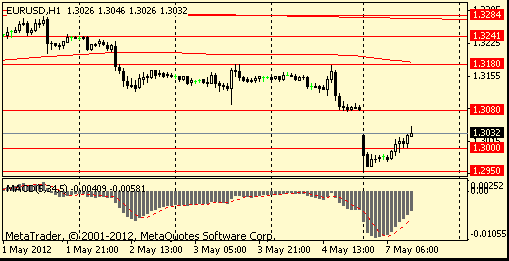
EUR/USD: during European session the pair compensated a part of losses suffered today, become stronger in $1,3030 area.

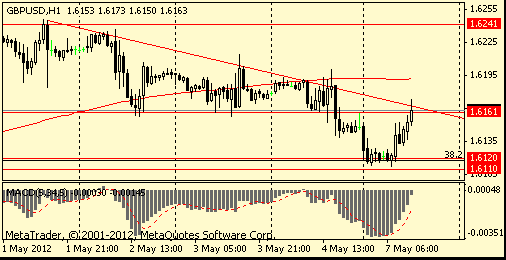
GBP/USD: the pair showed high in $1,6170 area then little decreased.

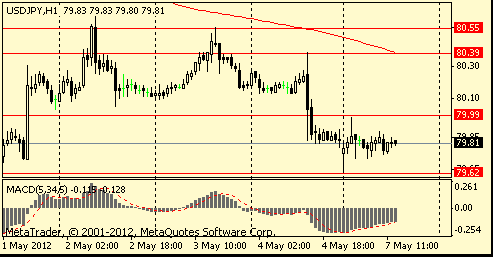
USD/JPY: during European session the pair was limited Y79,70-Y80,00.

At 1900GMT, the U.S. Federal Reserve Consumer Credit data hits screens Consumer credit usage is expected to rise $9.5 billion in March. Retail sales were reported up 0.8% in the month, both including and excluding motor vehicle sales. Richmond Federal Reserve Bank Pres. Jeffrey Lacker speaks at 2200GMT to business and government executives and community leaders in Greensboro, N.C.
EUR/USD
Offres $1.3120, $1.3100, $1.3080/85, $1.3050
Bids $1.2955/50, $1.2925/20, $1.2900, $1.2860/50
USD/JPY
Offers Y81.20/25, Y81.00, Y80.75/80, Y80.60/70, Y80.50/55, Y80.25/30, Y80.00/10
Bids Y79.60/50, Y79.35/30, Y79.00, Y78.80
Resistance 3: Y80.55 (area of May 2-3 highs)
Resistance 2: Y80.40 (May 4 high, МА (200) for Н1)
Resistance 1: Y80.00 (session high)
Current price: Y79.91
Support 1: Y79.60/50 (May 1 low, high of November’2011)
Support 2: Y79.15 (61,8 % FIBO Y76.00-Y84.20)
Support 3: Y78.40 (МА (200) for D1)
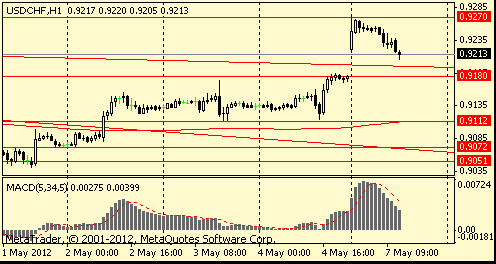
Resistance 3: Chf0.9380 (Jan 23 high)
Resistance 2: Chf0.9330 (high of March)
Resistance 1: Chf0.9270 (session high)
Current price: Chf0.9213
Support 1: Chf0.9190/80 (area of May 4 high and resistance line from Mar 15 broken earlier)
Support 2: Chf0.9110 (area of May 3-4 lows, МА (200) for Н1)
Support 3: Chf0.9050 (May 2 low)
Resistance 3 : $1.6240 (May 1-2 high)
Resistance 2 : $1.6190 (МА (200) for Н1)
Resistance 1 : $1.6160/70 (area of session high and resistance line from May 1)
Current price: $1.6161
Support 1 : $1.6120/10 (38,2 % FIBO $1,5820-$ 1,6300, session low)
Support 2 : $1.6080 (area of Apr 23 and 25 lows)
Support 3 : $1.6060 (50,0 % FIBO $1,5820-$ 1,6300)
Resistance 3 : $1.3240 (May 2 high)
Resistance 2 : $1.3180 (May 3-4 high)
Resistance 1 : $1.3080 (May 4 low)
Current price: $1.3032
Support 1 : $1.3000 (psychological level, low of April and March)
Support 2 : $1.2950 (session low)
Support 3 : $1.2930 (Jan 25 low)
EUR/USD $1.3000, $1.3050, $1.3100, $1.3170, $1.3200
USD/JPY Y80.00, Y80.10, Y80.60
EUR/JPY Y105.25, Y106.00
AUD/USD $1.0240, $1.0250
EUR/GBP stg0.8085
00:00 United Kingdom Bank holiday -
01:30 Australia Building Permits, m/m March -7.8% +3.2% +7.4%
01:30 Australia Building Permits, y/y March -15.2% -18.0% -15.0%
01:30 Australia Retail sales (MoM) March +0.2% +0.3% +0.9%
01:30 Australia Retail Sales Y/Y March +1.9% +1.8%
01:30 Australia ANZ Job Advertisements (MoM) April +1.0% -3.1%
01:30 Australia National Australia Bank's Business Confidence April 3 4
The euro fell to a three-month low after Socialist Francois Hollande was elected president of France and as Greek voters flocked to anti-bailout parties, stoking concern austerity efforts in Europe may be derailed. Hollande got about 52 percent of the vote in the French presidential election against about 48 percent for incumbent Nicolas Sarkozy, according to estimates by four pollsters. In Greece, New Democracy won 20 percent of the total vote with more than half of the ballots from yesterday’s elections counted, according to the Interior Ministry website. Socialist Pasok, which partnered with New Democracy in securing a second rescue package for the country, trailed in third place with 42 seats. Official projections predicted the two would fall one short of the 151 seats needed to win a majority.
The 17-nation currency slid for a sixth day, its longest series of losses since September 2011, after German Chancellor Angela Merkel’s party had its worst election result in more than half a century in the state of Schleswig-Holstein. Merkel’s Christian Democratic Union recorded its lowest share of the vote since 1950 in the northern state of Schleswig- Holstein. It placed first with 30.9 percent support, while coalition partner the Free Democratic Party slumped to 8.2 percent, according to ZDF television projections. That’s not enough for a rerun of their CDU-FDP coalition.
Australia’s currency was on track for its longest stretch of losses in nine months even after domestic reports showed gains in retail sales and building approvals. Australia’s retail sales climbed 0.9 percent in March after a revised 0.3 percent gain in the previous month, the country’s statistics office said in Sydney today. The median forecast in a Bloomberg News survey was for a 0.2 percent advance. A separate report showed the number of permits granted to build or renovate houses and apartments rose 7.4 percent in March from February, when they dropped a revised 8.8 percent.
EUR/USD: during the Asian session the pair showed a new monthly low, having fallen below $1.3000.
GBP/USD: during the Asian session the pair continued Friday’s falling.
USD/JPY: during the Asian session the pair showed a new monthly low.
A light calendar day on the Continent Monday, giving markets the chance to come to terms with the overnight election results from France, Greece and Germany. At 1000GMT, German manufacturing output numbers are released. There is no UK data, with markets closed for a national holiday. On the other side of the Atlantic, at 1230GMT, Canadian Building permits for March are released. At 1900GMT, the U.S. Federal Reserve Consumer Credit data hits screens Consumer credit usage is expected to rise $9.5 billion in March. Retail sales were reported up 0.8% in the month, both including and excluding motor vehicle sales. Richmond Federal Reserve Bank Pres. Jeffrey Lacker speaks at 2200GMT to business and government executives and community leaders in Greensboro, N.C.
On Monday the euro weakened against the yen after a report showed Spain’s economy entered its second recession since 2009, adding to concern Europe’s debt crisis is worsening.
The common currency extended its monthly decline versus the dollar as Spain’s government struggled to convince investors it can narrow its budget deficit in an economy that’s grappling with almost 25 percent unemployment.
On Tuesday the dollar rose from a four-week low versus the euro after a U.S. factory gauge unexpectedly advanced in April, easing concern the economic recovery is flagging and damping bets the Federal Reserve will introduce more stimulus. The Institute for Supply Management’s index of U.S. manufacturing rose to 54.8 in April from 53.4 a month earlier, the Tempe, Arizona-based group’s report showed.
On Wednesday the euro weakened for a third day against the dollar, the longest losing streak in almost a month, after data showed European manufacturing shrank and unemployment rose in Germany, adding to concern the debt crisis will worsen. The euro dropped against most of its 16 major peers as London-based Markit Economics said its purchasing-manager index of euro-region manufacturing shrank for a ninth month, falling to a 34-month low of 45.9 in April from 47.7 in March. A reading below 50 shows contraction. The number of people out of work in Germany increased a seasonally adjusted 19,000 last month to 2.87 million, the Nuremberg-based Federal Labor Agency said. Economists surveyed by Bloomberg forecast a decline of 10,000. Yields on Germany’s two-, five-, 10-, and 30-year bonds dropped to record lows.
On Thursday the euro strengthened versus the yen after European Central Bank President Mario Draghi said policy makers didn’t discuss cutting interest rates at their meeting this week. The 17-nation currency fluctuated against the dollar after Draghi said at a press conference in Barcelona there has been “significant progress” on the fiscal front. The ECB kept its main refinancing rate at a record low 1 percent, as predicted. While the ECB still expects a gradual economic recovery this year, “downside risks” prevail and the outlook has become “more uncertain,” Draghi said.
On Friday the yen gained versus all of its major counterparts as investors sought safety after U.S. payrolls increased less than forecast in April and before elections in Europe that may result in leadership changes. France and Greece hold elections this weekend, with French voters casting ballots in the final round of the country’s presidential race and Greeks set to decide on a new parliament. The euro fell for a fifth day versus the dollar, the longest stretch since September, as France and Greece prepared for elections May 6, spurring bets their commitment to austerity may flag.
Asian stocks fell for a second day, with a regional benchmark index heading for its biggest drop in two weeks, as Australia’s central bank cut its economic growth forecast and U.S. service industries rose less than forecast, sparking concern the global recovery may be faltering.
Nikkei 225 Closed
Hang Seng 21,068.17 -181.36 -0.85%
S&P/ASX 200 4,396.04 -32.92 -0.74%
Shanghai Composite 2,452.01 +11.93 +0.49%
Samsung Electronics Co., the world’s No. 1 mobile-phone maker by sales, fell 2.9 percent in Seoul.
Rio Tinto Group, the world’s third-biggest mining company, lost 1.1 percent in Sydney as metal prices dropped.
Sun Hung Kai Properties Ltd. lost 1.4 percent after Hong Kong’s biggest developer announced former Chairman Walter Kwok’s arrest.
Ascendas Real Estate Investment Trust slid 3.8 percent in Singapore after the industrial landlord sold shares at a discount.
European stocks declined, extending their weekly drop, as a government report showed U.S. employers added fewer jobs than forecast in April.
U.S. payrolls climbed by 115,000 last month, the smallest gain in six months, after a revised 154,000 increase in March that was more than initially estimated, Labor Department figures showed today. The jobless rate fell to a three-year low of 8.1 percent as people left the labor force.
In Europe, four elections this weekend have the potential to reshape the region’s political map and show how the response to the financial crisis remains hostage to the whims of voters on both sides of the region’s economic divide.
Euro-region services and manufacturing output contracted more than initially estimated in April, adding to signs the economy is struggling to regain strength. A composite index based on a survey of purchasing managers in both industries dropped to 46.7 from 49.1 in March, London-based Markit Economics said today. That’s less than an estimate of 47.4 published on April 23. Readings below 50 indicates contraction.
U.K. house prices dropped the most in 1 1/2 years in April as a stamp-duty exemption for first-time buyers ended and the economy fell into its first double-dip recession since the 1970s, according to Halifax. Prices declined 2.4 percent from March, the mortgage unit of Lloyds Banking Group Plc said.
Hays slid 8.4 percent to 83.35 pence in London, the biggest drop since 2008, and Randstad lost 5.2 percent to 24.28 euros in Amsterdam. Michael Page International Plc retreated 5.4 percent to 385 pence.
Wacker Chemie tumbled 6.1 percent to 59.80 euros, the largest decline in two months. First-quarter net income dropped to 40 million euros from 168 million euros a year ago. The company said it sees its 2012 earnings before interest, taxes, depreciation and amortization “markedly” below its 2011 level.
Taylor Wimpey, the U.K.’s second-largest homebuilder by volume, dropped 7.7 percent to 47.69 pence, the steepest fall since August. Barratt Developments Plc , the biggest, sank 7.5 percent to 124.3 pence.
BHP Billiton, the world’s biggest mining company, decreased 3.9 percent to 1,918 pence and Rio Tinto fell 4.4 percent to 3,214.5 pence as a gauge of basic-resources companies was the worst performer among the 19 industry groups in the Stoxx 600 today. Xstrata Plc slid 3.1 percent to 1,131.5 pence.
Belgacom SA, Belgium’s largest telephone company, advanced 1.3 percent to 21.76 euros after first-quarter profit of 199 million euros beat the average 194 million-euro analyst estimate.
U.S. stocks declined a third day, giving the Standard & Poor’s 500 Index its worst week in 2012, after data showing employers added fewer jobs than forecast intensified concern about the pace of economic recovery.
Stocks slumped as payrolls climbed 115,000, the smallest gain in six months and below the estimate for a 160,000 advance. The jobless rate unexpectedly fell to a three-year low of 8.1 percent as people left the labor force. Concern about Europe’s debt crisis also helped send stocks slower as services and manufacturing output in the euro region shrank and France, Germany and Greece prepared for elections this weekend.
The Morgan Stanley Cyclical Index of companies most-tied to the economy lost 1.7 percent. Chevron (CVX) sank 2.1 percent to $103.72. Bank of America (ВАС) slid 3.3 percent to $7.74. Intel (INTC) slid 2.3 percent to $27.90.
LinkedIn Corp. surged 7.2 percent to $117.30, the highest price since its market debut in May 2011. The biggest professional-networking website reported first-quarter sales and profit that beat analysts’ estimates amid a jump in membership.
Micron Technology Inc. added 1.2 percent to $6.55 amid speculation that the memory chipmaker may try to acquire the assets of Elpida Memory Inc. cheaply after a potential rival dropped out of the bidding. Micron has no comment on rumor or conjecture, said Dan Francisco, a spokesman for Micron.
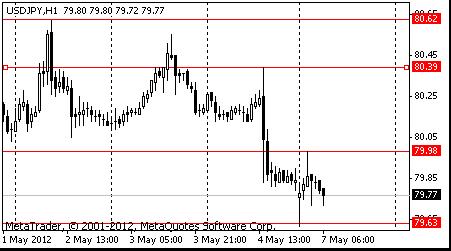
Resistance 3: Y80.60 (May 2 high)
Resistance 2: Y80.40 (May 4 high)
Resistance 1: Y80.00 (session high)
The current price: Y79.77
Support 1: Y79.65 (session low, May 1 low)
Support 2: Y79.35 (Feb 20 low)
Support 3: Y78.70 (Feb 15 high)
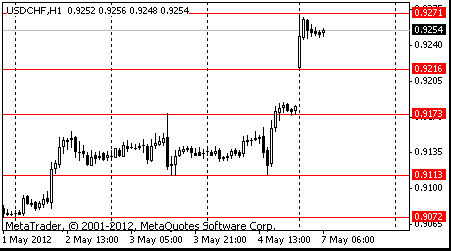
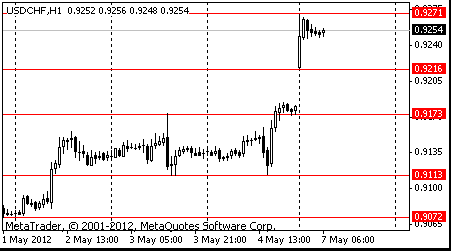
Resistance 3: Chf0.9335 (Mar 15 high)
Resistance 2: Chf0.9300 (psychological level)
Resistance 1: Chf0.9270 (session high)
The current price: Chf0.9254
Support 1: Chf0.9215 (session low)
Support 2: Chf0.9175 (May 3 high)
Support 3: Chf0.9115 (May 3-4 high)
Resistance 3 : $1.6215 (May 3 high)
Resistance 2 : $1.6200 (May 4 high)
Resistance 1 : $1.6160 (May 2-3 high)
The current price: $1.6119
Support 1 : $1.6115 (session low)
Support 2 : $1.6080 (Apr 25 low)
Support 3 : $1.6035 (Apr 20 low)

Resistance 3 : $1.3180 (May 3 high)
Resistance 2 : $1.3080/95 (area of May 3-4 low)
Resistance 1 : $1.3030 (session high)
The current price: $1.2976
Support 1 : $1.2950 (session low)
Support 2 : $1.2875 (Jan 23 low)
Support 3 : $1.2810 (Jan 17 high)
00:00 United Kingdom Bank holiday -
01:30 Australia Building Permits, m/m March -7.8% +3.2%
01:30 Australia Building Permits, y/y March -15.2% -18.0%
01:30 Australia Retail sales (MoM) March +0.2% +0.3%
01:30 Australia Retail Sales Y/Y March +1.9%
01:30 Australia ANZ Job Advertisements (MoM) April +1.0%
01:30 Australia National Australia Bank's Business Confidence April 3
05:45 Switzerland Unemployment Rate April 3.1% 3.1%
07:00 Switzerland Foreign Currency Reserves April 237.5
07:15 Switzerland Consumer Price Index (MoM) April +0.6% +0.2%
07:15 Switzerland Consumer Price Index (YoY) April -1.0% -0.9%
08:30 Eurozone Sentix Investor Confidence May -14.7 -15.0
10:00 Germany Factory Orders s.a. (MoM) March +0.3% +0.5%
10:00 Germany Factory Orders n.s.a. (YoY) March -6.1% -2.8%
12:30 Canada Building Permits (MoM) March +7.5% +2.3%
19:00 U.S. Consumer Credit March 8.7 9.5
21:30 Canada Gov Council Member Murray Speaks -
23:01 United Kingdom RICS House Price Balance April -10% -10%







© 2000-2026. All rights reserved.
This site is managed by Teletrade D.J. LLC 2351 LLC 2022 (Euro House, Richmond Hill Road, Kingstown, VC0100, St. Vincent and the Grenadines).
The information on this website is for informational purposes only and does not constitute any investment advice.
The company does not serve or provide services to customers who are residents of the US, Canada, Iran, The Democratic People's Republic of Korea, Yemen and FATF blacklisted countries.
Making transactions on financial markets with marginal financial instruments opens up wide possibilities and allows investors who are willing to take risks to earn high profits, carrying a potentially high risk of losses at the same time. Therefore you should responsibly approach the issue of choosing the appropriate investment strategy, taking the available resources into account, before starting trading.
Use of the information: full or partial use of materials from this website must always be referenced to TeleTrade as the source of information. Use of the materials on the Internet must be accompanied by a hyperlink to teletrade.org. Automatic import of materials and information from this website is prohibited.
Please contact our PR department if you have any questions or need assistance at pr@teletrade.global.


 Bank
Bank transfers


