- Analytics
- News and Tools
- Market News
Analytics, News, and Forecasts for CFD Markets: currency news — 14-05-2012.
The euro dropped to its lowest level in almost four months against the dollar as a leadership vacuum in Greece prompted European officials to weigh prospects for the currency union’s first
Alexis Tsipras, who heads Greece’s anti-bailout Syriza party, wouldn’t attend a meeting called by President Karolos Papoulias today, the Athens-based party said in a statement. Syriza rejected a unity government last week following inconclusive elections on May 6. Greece may face another vote unless leaders can agree on a new coalition.
Australia’s currency dropped below parity with the greenback for the first time this year as global stocks and commodities fell.
Sterling rallied against all of its 16 most-traded peers as investors sought an alternative to the shared currency. The pound gained as much as 0.9 percent to 79.63 pence per euro, the most since November 2008, before trading at 79.75 pence, up 0.8 percent. It rose 0.3 percent to $1.6109.
Cable offers to $1.6120 erased, further supply $1.6150.
EUR/USD $1.2840, $1.2900, $1.2970, $1.2975, $1.3000
USD/JPY Y79.50, Y80.00, Y81.00
GBP/USD $1.6125
EUR/GBP stg0.8065
AUD/USD $1.0190, $1.0200
NZD/USD $0.7925
Data:
07:15 Switzerland Producer & Import Prices, m/m April +0.3% +0.4% -0.1%
07:15 Switzerland Producer & Import Prices, y/y April -2.0% -2.1% -2.3%
09:00 Eurozone Industrial production, (MoM) March +0.5% +0.5% -0.3%
09:00 Eurozone Industrial Production (YoY) March -1.8% -1.4% -2.2%
The euro dropped as a leadership vacuum in Greece prompted European officials to weigh prospects for the currency union’s first-ever departure of a member state.
The common currency slid after Greece’s biggest anti-bailout party defied overtures to join the government. The euro also weakened after euro-area industrial production unexpectedly declined in March.
Alexis Tsipras, who heads Greece’s anti-bailout Syriza party, won’t attend a meeting called by President Karolos Papoulias today, the Athens-based party said in a statement. Syriza rejected a unity government last week following inconclusive elections on May 6. Greece may face another vote unless leaders can agree on a new coalition.
The European Union’s statistics office said industrial production in the region contracted in March. Output slipped 0.3% from February, when it advanced 0.8%. Economists forecast a gain of 0.4%.
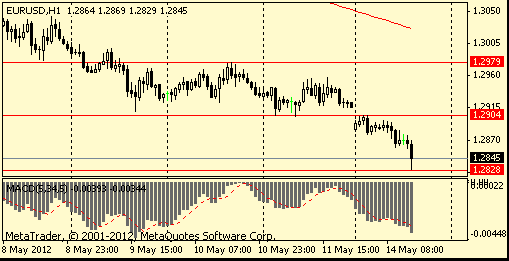
EUR/USD: the pair decreased, showed low in $1,2830 area.
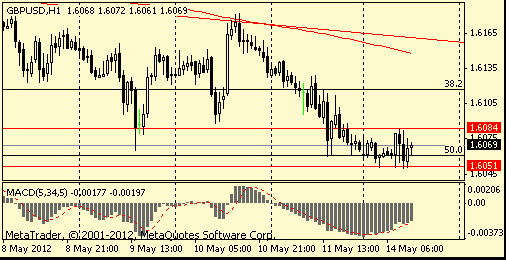
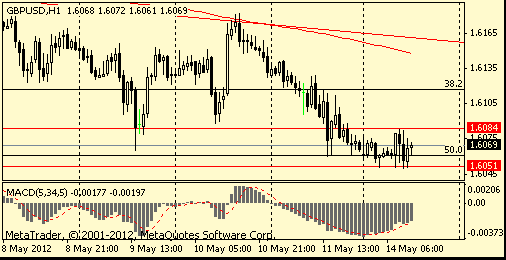
GBP/USD: during European session the pair was limited $1,6050-$ 1,6085.
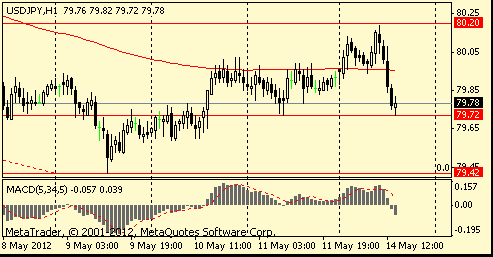
USD/JPY: the rate showed high in Y80,20 area. But later the pair fell, reached area of May 11 low Y79,70.
EUR/USD
Offers $1.2980, $1.2960, $1.2935, $1.2895/05, $1.2880
Bids $1.2860/50
GBP/USD
Offers $1.6200/05, $1.6150/55, $1.6115/20, $1.6100
Bids $1.6055/40, $1.6010/00, $1.5980, $1.5965/60
AUD/USD
Offers $1.0100, $1.0080/85, $1.0065/70, $1.0040/50, $1.0025/30, $1.0015/20
Bids $0.9960, $0.9950, $0.9920/10, $0.9885/80, $0.9850
USD/JPY
Offers Y81.00, Y80.85/90, Y80.60/70, Y80.50/55, Y80.35/40, Y80.20
Bids Y79.65/60, Y79.50, Y79.40/35, Y79.25, Y79.00
EUR/JPY
Offers Y103.90/00, Y103.80, Y103.70, Y103.55/60, Y103.50
Bids Y102.60, Y102.50, Y102.20/15, Y102.00, Y101.85/80
EUR/GBP
Offers stg0.8080, stg0.8060/65, stg0.8050
Bids stg0.7975/70, stg0.7950, stg0.7925/20
Resistance 3: Y80.55/60 (area of May 2-3 highs)
Resistance 2: Y80.30 (resistance line from Mar 23)
Resistance 1: Y80.20 (session high)
Current price: Y79.88
Support 1: Y79.70 (May 11 low)
Support 2: Y79.40 (May 9 low)
Support 3: Y79.15 (61,8 % FIBO Y76.00-Y84.20)

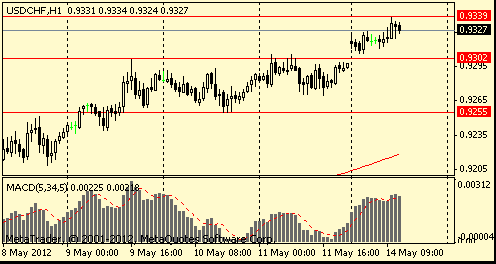
Resistance 3: Chf0.9400 (psychological level)
Resistance 2: Chf0.9380 (Jan 23 high)
Resistance 1: Chf0.9340 (session high)
Current price: Chf0.9327
Support 1: Chf0.9300 (earlier resistance, area of May 9 and 11 highs)
Support 2: Chf0.9255 (May 10 low)
Support 3: Chf0.9220 (МА (200) for Н1)
Resistance 3 : $1.6200 (area of May 7-8 high)
Resistance 2 : $1.6150/60 (resistance line from May 7, МА (200) for Н1)
Resistance 1 : $1.6080 (session high)
Current price: $1.6069
Support 1 : $1.6050 (session low)
Support 2 : $1.6000 (61,8 % FIBO $1,5820-$ 1,6300, Apr 19 low, psychological level, support line from Jan 13)
Support 3 : $1.5900 (psychological level)
Resistance 3 : $1.3070/80 (area of May 4 low, May 7-8 highs)
Resistance 2 : $1.2980 (May 10 high)
Resistance 1 : $1.2900 (session high)
Current price: $1.2873
Support 1 : $1.2860 (session low)
Support 2 : $1.2800 (psychological level)
Support 3 : $1.2620 (low of January)

EUR/USD $1.2840, $1.2900, $1.2970, $1.2975, $1.3000
USD/JPY Y79.50, Y80.00, Y81.00
GBP/USD $1.6125
EUR/GBP stg0.8065
AUD/USD $1.0190, $1.0200
NZD/USD $0.7925
01:30 Australia Home Loans March -2.5% -1.7% +0.3%
02:25 Australia RBA Assist Gov Lowe Speaks -
06:00 Japan Prelim Machine Tool Orders, y/y April +2.4% +0.5%
The euro fell to its lowest level in more than three months as European officials begin to weigh the prospect of Greece withdrawing from the currency union. The 17-nation euro weakened versus most of its 16 major counterparts before Greek President Karolos Papoulias is set to continue discussions with political party leaders on forming a national unity government. Greece’s Papoulias will meet with party leaders today, state-run NET TV said, without citing anyone. Syriza’s Alexis Tsipras, who heads the largest anti-bailout party and rejected a unity government following last week’s inconclusive elections, won’t attend the meeting, NET TV reported. Greece may face new national elections unless a government is formed.
In Germany, Chancellor Angela Merkel’s Christian Democratic Union party received its weakest share of the vote since World War II in a North Rhine-Westphalia ballot yesterday. The state is Merkel’s biggest electoral test this year before the federal vote due in the second half of 2013. She is due to give a press conference on the election results today in Berlin.
A report due today may show the euro area’s industrial production growth moderated in March. Europe’s shared currency also weakened before a report that may show industrial production in the 17-nation region rose 0.4 percent in March after a revised increase of 0.8 percent in the previous month, according to the median estimate in a Bloomberg News survey. The European Union’s statistics office reports the figures today. From a year earlier, output is predicted to have decreased 1.4 percent.
The Australian dollar declined even after the People’s Bank of China said May 12 that reserve ratios will fall 50 basis points, effective May 18. That was the third reduction in six months. China is Australia’s largest trading partner.
China’s reserve ratio cut “provided some support to the Aussie,” said Emma Lawson, a currency strategist in Sydney at National Australia Bank Ltd. (NAB) “But I think broader global concerns around Europe are probably a stronger driver for today.”
EUR/USD: the pair fell, updated a monthly low.
GBP/USD: the pair traded in a range $1.6050-$1.6085.
USD/JPY: the pair rose above Y80.00.
European data for Monday starts at 0900GMT, at the same time as EMU industrial output data. At 1100GMT, German Chancellor Angela Merkel gives a press conference in Berlin, which follows elections in the region of North Rhine Westphalia at the weekend.
On Monday the euro weakened to a more than three-month low after Francois Hollande was elected president of France and as Greek voters flocked to anti-bailout parties, stoking concern austerity efforts in Europe may be derailed. The 17-nation currency slid for a sixth day, its longest series of declines since September, dropping as much as 1 percent before paring losses. Hollande, who becomes the first Socialist in 17 years to control Europe’s second-biggest economy, pledged to push for less austerity and more growth in the region.
On Tuesday the euro weakened for a seventh day against the dollar as Greek politicians struggled to form a new government after elections on the weekend raised the prospect of the country withdrawing from the currency bloc. The pound dropped against the dollar as a report showed U.K. house prices fell in April. The pound declined from within two U.S. cents of an eight- month high against the dollar after an industry report showed a gauge of house prices declined.
On Wednesday the euro weakened for an eighth day against the dollar as Greek politicians struggled to form a new government, fueling concern the nation will leave Europe’s currency union. The 17-nation currency extended its run of losses to the longest since September 2008 as Spain’s 10-year bond yields climbed back above 6 percent. Euro area leaders from the European Central Bank’s Joerg Asmussen to German Finance Minister Wolfgang Schaeuble have begun to raise doubts that Greece can stay in the monetary union. Growth in German exports slowed to 0.9 percent in March from 1.5 percent in February, the Federal Statistics Office in Wiesbaden said.
On Thursday the euro rose from a three-month low as Europe’s bailout fund confirmed that aid to Greece had been received and officials said progress was made forming a government, easing concern the nation will leave the monetary union. Greece’s socialist leader Evangelos Venizelos said he saw the first “good omen” in four days of attempts to form a coalition government and avert a new election. Greece “can continue to function with the disbursement,” commission spokesman Olivier Bailly told reporters in Brussels after yesterday’s European Financial Stability Facility decision to disburse immediately only 4.2 billion euros ($5.4 billion) of a 5.2 billion-euro loan tranche. The remaining 1 billion euros will be “disbursed in due time to cover future needs.”
On Friday the euro weakened for a second week, touching a three-month low versus the dollar, as concern builds that Greece may be forced to withdraw from the currency union with the nation’s politicians unable to form a government. The 17-nation currency rose earlier after the leader of Greece’s New Democracy Party said four parties have vowed to remain in the euro if they form part of the next administration. Gross domestic product in the euro area will drop 0.3 percent this year, the European Commission said, reiterating a February forecast. Greece will have the deepest contraction, with GDP shrinking 4.7 percent, while the economies of Spain and Italy are seen falling 1.8 percent and 1.4 percent, respectively.
Resistance 3: Y81.20 (area of 38,2% FIBO Y84,20-Y79,40, МА (200) on Н4)
Resistance 2: Y80.50/55 (area of May 2-3 high)
Resistance 1: Y80.15 (session high)
The current price: Y80.02
Support 1: Y79.70 (May 11 low)
Support 2: Y79.40 (May 9 low)
Support 3: Y79.15 (61,8% FIBO Y76.00-Y84.20)
Resistance 3: Chf0.9410 (Jan 19 high)
Resistance 2: Chf0.9380 (Jan 23 high)
Resistance 1: Chf0.9330 (high of Mar)
The current price: Chf0.9319
Support 1: Chf0.9305 (session low)
Support 2: Chf0.9255/70 (area of May 10-11 low)
Support 3: Chf0.9190/80 (area of May 4 high, May 7-8 low)

Resistance 3 : $1.6240 (May 1-2 high)
Resistance 2 : $1.6180/00 (area of May 7-10 high)
Resistance 1 : $1.6130 (a high of the European session on May 11)
The current price: $1.6067
Support 1 : $1.6050 (session low)
Support 2 : $1.6035 (Apr 20 low)
Support 3 : $1.6000 (61,8% FIBO $1,5820-$1,6300, Apr 19 low, psychological level)

Resistance 3 : $1.3120 (МА (100) for D1)
Resistance 2 : $1.3070/80 (area of May 4 low, May 7-8 high)
Resistance 1 : $1.2960/80 (area of May 10-11 high)
The current price: $1.2888
Support 1 : $1.2870 (Jan 23 low)
Support 2 : $1.2810 (Jan 17 high)
Support 3 : $1.2730 (Jan 18 high)

01:30 Australia Home Loans March -2.5% -1.7%
02:25 Australia RBA Assist Gov Lowe Speaks -
06:00 Japan Prelim Machine Tool Orders, y/y April +2.4%
07:15 Switzerland Producer & Import Prices, m/m April +0.3% +0.4%
07:15 Switzerland Producer & Import Prices, y/y April -2.0% -2.1%
09:00 Eurozone Industrial production, (MoM) March +0.5% +0.5%
09:00 Eurozone Industrial Production (YoY) March -1.8% -1.4%
15:45 Switzerland SNB Chairman Jordan Speaks







© 2000-2026. All rights reserved.
This site is managed by Teletrade D.J. LLC 2351 LLC 2022 (Euro House, Richmond Hill Road, Kingstown, VC0100, St. Vincent and the Grenadines).
The information on this website is for informational purposes only and does not constitute any investment advice.
The company does not serve or provide services to customers who are residents of the US, Canada, Iran, The Democratic People's Republic of Korea, Yemen and FATF blacklisted countries.
Making transactions on financial markets with marginal financial instruments opens up wide possibilities and allows investors who are willing to take risks to earn high profits, carrying a potentially high risk of losses at the same time. Therefore you should responsibly approach the issue of choosing the appropriate investment strategy, taking the available resources into account, before starting trading.
Use of the information: full or partial use of materials from this website must always be referenced to TeleTrade as the source of information. Use of the materials on the Internet must be accompanied by a hyperlink to teletrade.org. Automatic import of materials and information from this website is prohibited.
Please contact our PR department if you have any questions or need assistance at pr@teletrade.global.


 Bank
Bank transfers


