- Analytics
- News and Tools
- Market News
CFD Markets News and Forecasts — 03-11-2021
- GBP/USD bull sin charge as the dollar softens following the Fed.
- Daily M-formation is compelling toward the 61.8% ratio.
GBP/USD has been bid over the last 24-hours on the back of the looming Bank of England as well as a slide in the US dollar that gave back some territory following the Federal Reserve on Wednesday. This has left cable mitigating the space between 1.3690 and 1.3660 from a technical standpoint.
The following illustrates the prospects of a test in the 1.37 area for the forthcoming session and also the possibility of mitigation of the lastest bullish rally from the 1.3660s.
GBP/USD H1 analysis
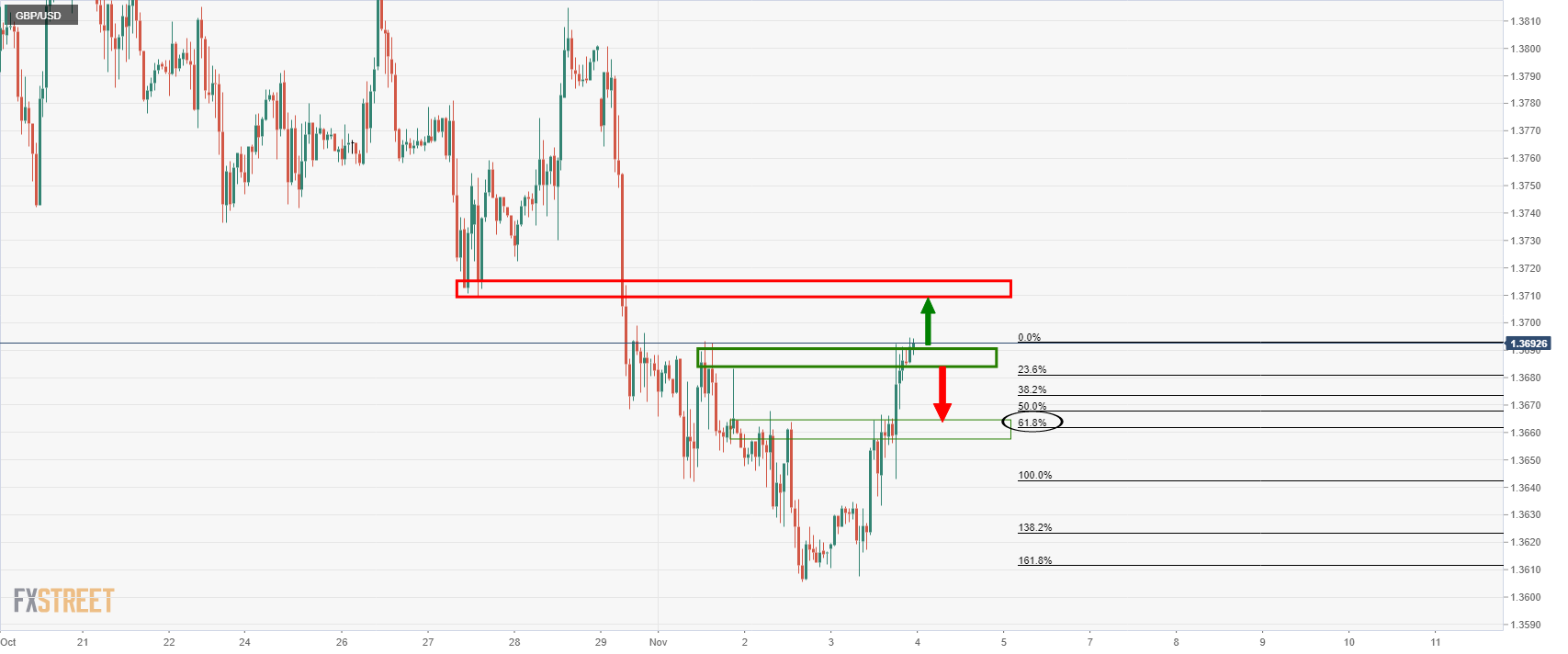
The price is already forming a support structure which gives rise to the likelihood of an onward journey into the 1.37 area. However, a correction to the 61.8% Fibo, based on current ranges, is not out of the question leading into the BoE event on Thursday.
GBP/USD daily chart
From a daily perspective, there is a meanwhile bullish bias to test into resistance prior to a downside continuation as follows:
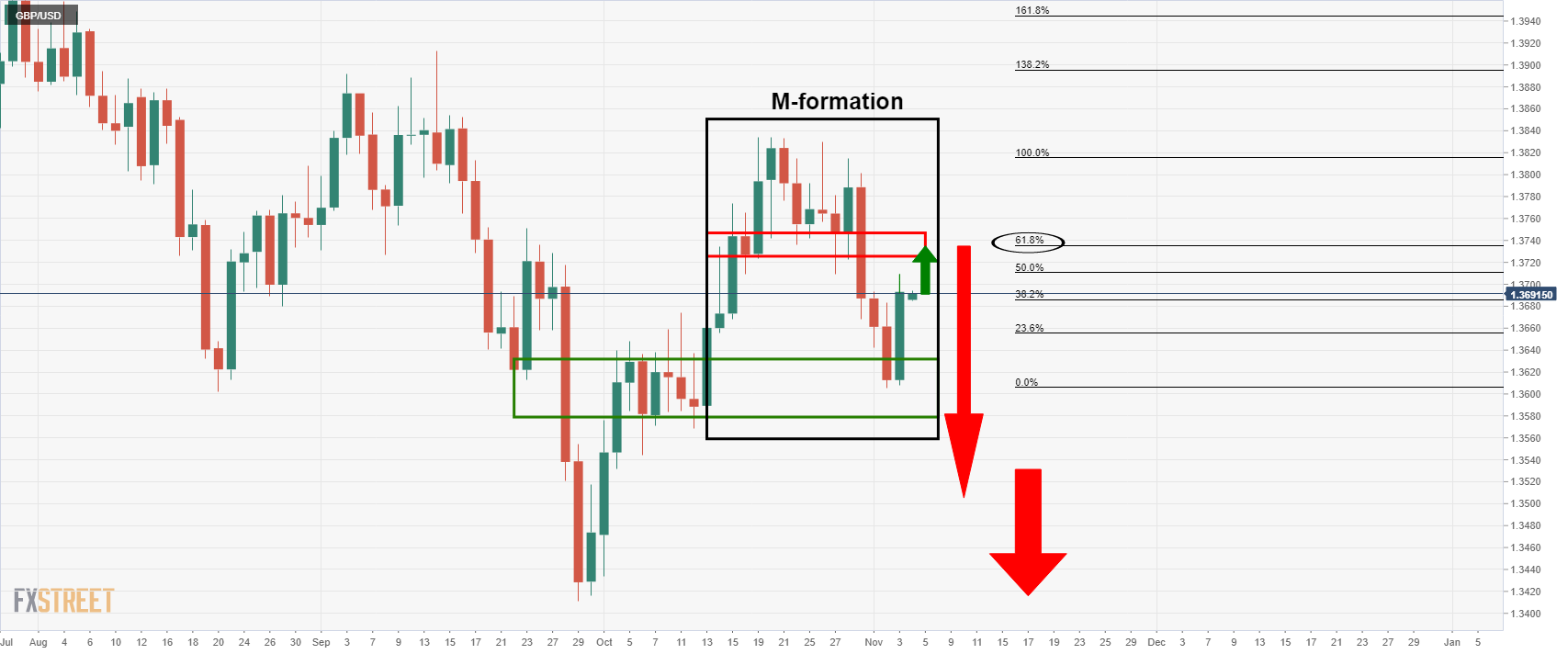
The price has formed an M-formation on the charts and the neckline of the formation would be expected to pull in the price to test the 61.8% Fibo prior to the next downside impulse, depending on the outcome on the Bank of England.
- Gold begins the Asian session in the right foot, up 0.28%.
- The Federal Reserve will begin reducing bond purchases by the middle of November.
- The Fed would reduce its QE by $15 billion.
- The US T-bond 10-year yield advances to 1.60%.
XAU/USD advances as the Asian session begin, up 0.28%, trading at $1,774 at the time of writing. On Wednesday, the Federal Reserve decided to keep rates unchanged at the 0 to 0.25% range. Also, the bond taper process is a reality. The central bank said that it will reduce the pace of bond purchases by $15 billion a month, until the end of the stimulus, by the first half of 2022.
Gold reacted to the downside, dipped to $1,759, but found some buying pressure to settle at the end around $1,770. On its way south, the yellow-metal pushed through the 100-day moving average, which keeps USD bulls in control, as long as the price remains below the abovementioned.
Sumary of the Federal Reserve monetary policy statement
Putting this aside, Wednesday’s focus was on the Fed. In its monetary policy statement, the US central bank noted that higher inflation pressures are transitory (sticking to its stance) and added that supply and demand imbalances contributed to elevated prices. Despite the jump in inflation, the Fed sees an improvement in economic activity and observes progress in the labor market.
Concerning the bond purchasing program, the Fed said that they “will begin taper later this month with reductions in treasuries purchases by $10 bln, MBS by $5 bln.” It is worth noticing that the central bank left the door open for adjustments at the QE’s pace. They added that “comparable decreases in buying pace are likely reasonable each month, but we are willing to adapt if necessary.”
As portrayed by US equity stocks printing new all-time highs, market participants’ reaction seems tilted to a dovish taper announcement. However, the central bank left the door open for an accelerating pace in case that higher inflation remains stickier than expected.
That said, at press time, the US 10-year bond yields advances two basis points, sitting at 1.60%, for the first time in the week. Also, the 2-year benchmark note rate, which gives clues about near-time interest rates, is flat at 0.48%.
Meanwhile, the US Dollar Index slides 0.25%, currently at 93.85, reinforcing the thesis that investors move towards riskier assets exchanging safe-haven currencies, like the greenback and the Japanese yen, as the abovementioned weakened on the release of the Fed’s monetary policy statement.
XAU/USD Price Forecast: Technical outlook
Daily chart

On Wednesday, XAU/USD price action seesawed in a $29 range, reaching a daily low at $1,759 before settling at current levels. The daily moving averages (DMA’s) remain above the spot price but with a flattish slope, depicting gold is in a sideways trend. Further, the yellow metal is approaching the abovementioned levels, signaling that the downward bias is fading. Nevertheless, a clear upside break above the 200-day moving average (DMA) at $1,800 might keep gold bulls in charge. In that outcome, the following resistance area would be the July 15 high at $1,834, followed by an empty road towards $1,900.
Conversely, if USD bulls like to remain in control, they need to hold prices below the 200-DMA. In that outcome, the first support area would be the November 3 low at $1,759. A breach of the latter would expose a rising upslope trendline that travels from the August 9 lows towards the September 29 low, around the $1,740-50 area.
- AUD/USD hourly double bottom in place, medium term risks skewed to the upside.
- Nonfarm Payrolls will be the next major test for the pair.
- Meanwhile, the price could move in on the 61.8% Fibo of The Fed spike.
AUD/USD bears are moving in from a first resistance area for the session ahead, although the risks are skewed to the upside considering the hourly double bottom lows at a firm support area.
As per the prior analysis at the start of the week, AUD/USD Price Analysis: A countertrend trader's set up in the making? the price has indeed made the forecasted correction as follows:
AUD/USD prior analysis
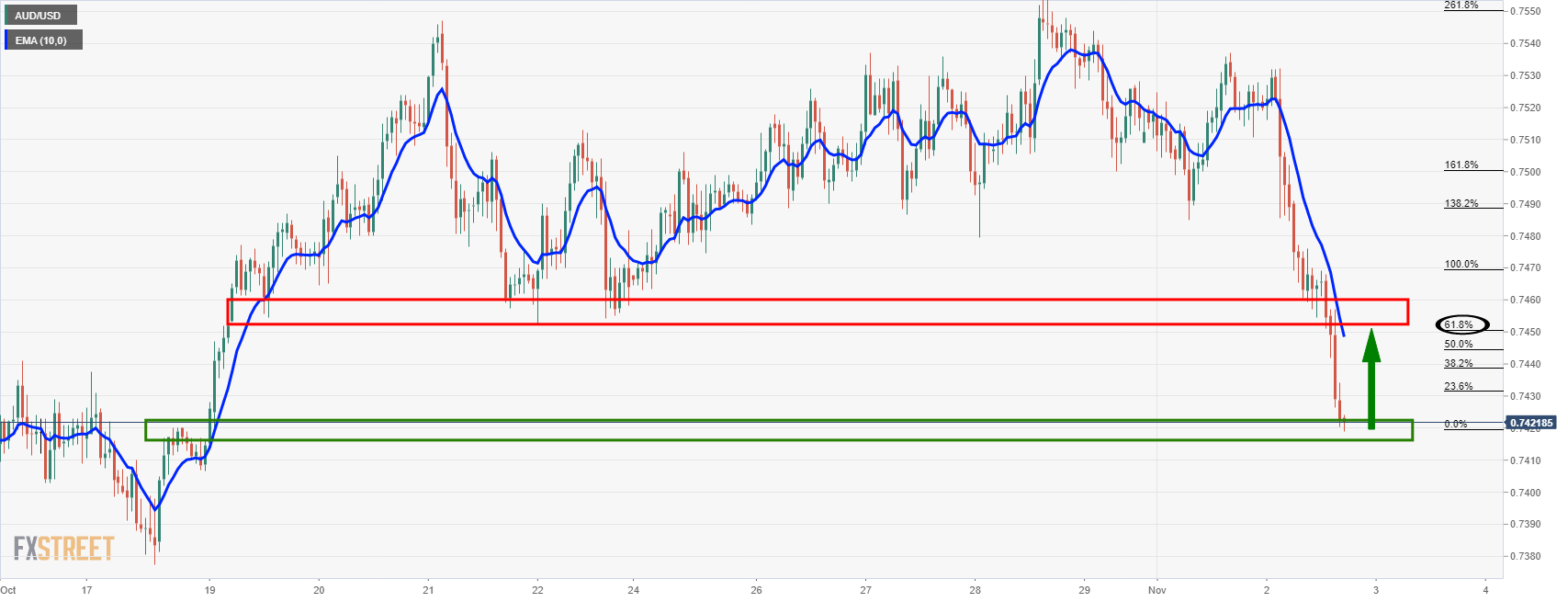
It was stated that the price ran into what would be expected to be a strong area of support and given the imbalance, a correction was the most probable next scenario.
''Looking back at the price action, it would appear that there is a huge imbalance all the way back to the 0.7450s. This also coincides with a 61.8% Fibonacci as well as a smoothed 200 hourly moving average.''
AUD/USD's progress
Following the analysis, the price indeed started to recover from the marked support area. It made a 38.2% Fibonacci retracement initially that pave the way for with potentially more on the way:
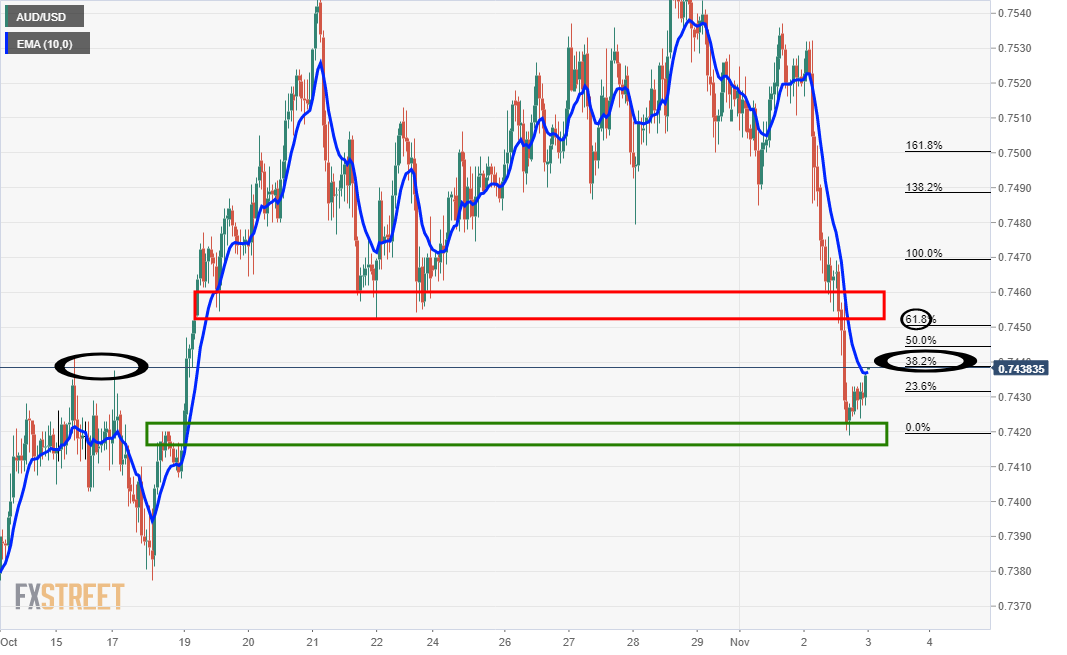
AUD/USD meets 61.8% before and after Fed volatility
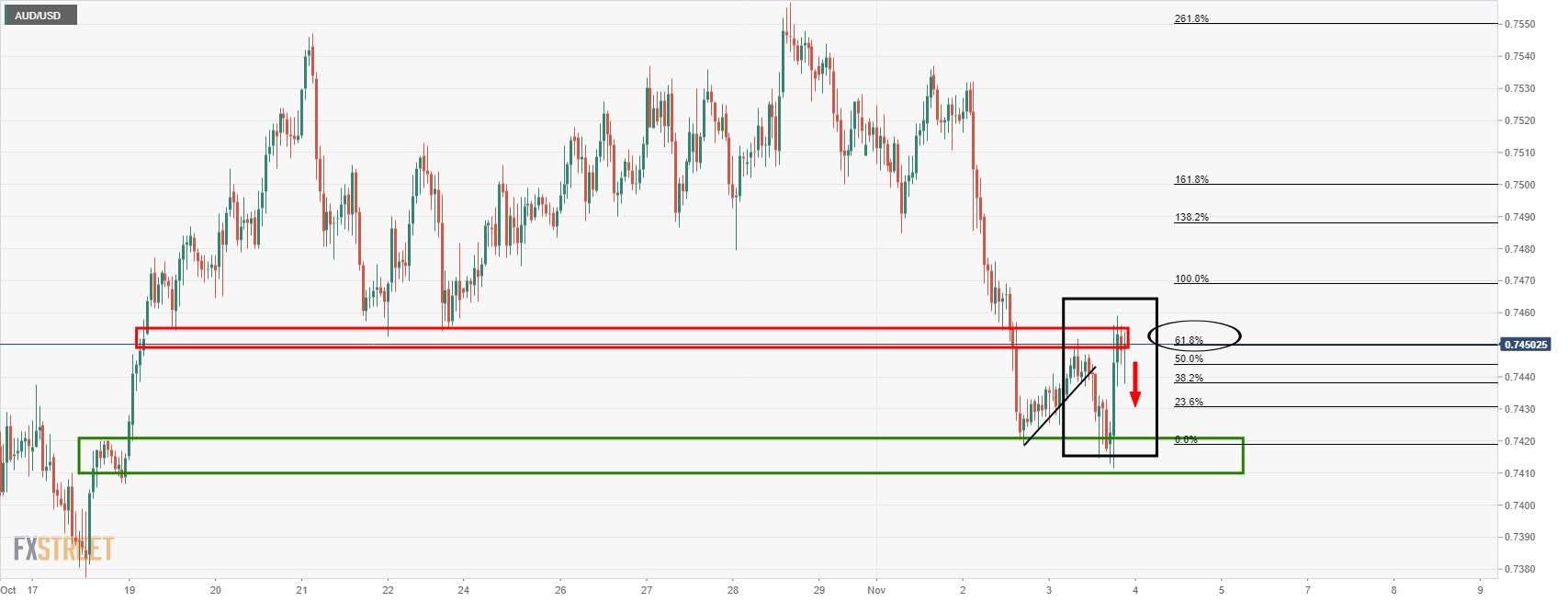
Meanwhile, the price did meet the 61.8% ratio and offered an opportunity to short into deeper pools of liquidity until the Federal Reserve meeting. The subsequent price action has left a W-formation on the hourly chart which would likely see the price retest the neckline and the confluence of the 61.8% ratio in the forthcoming sessions as follows:
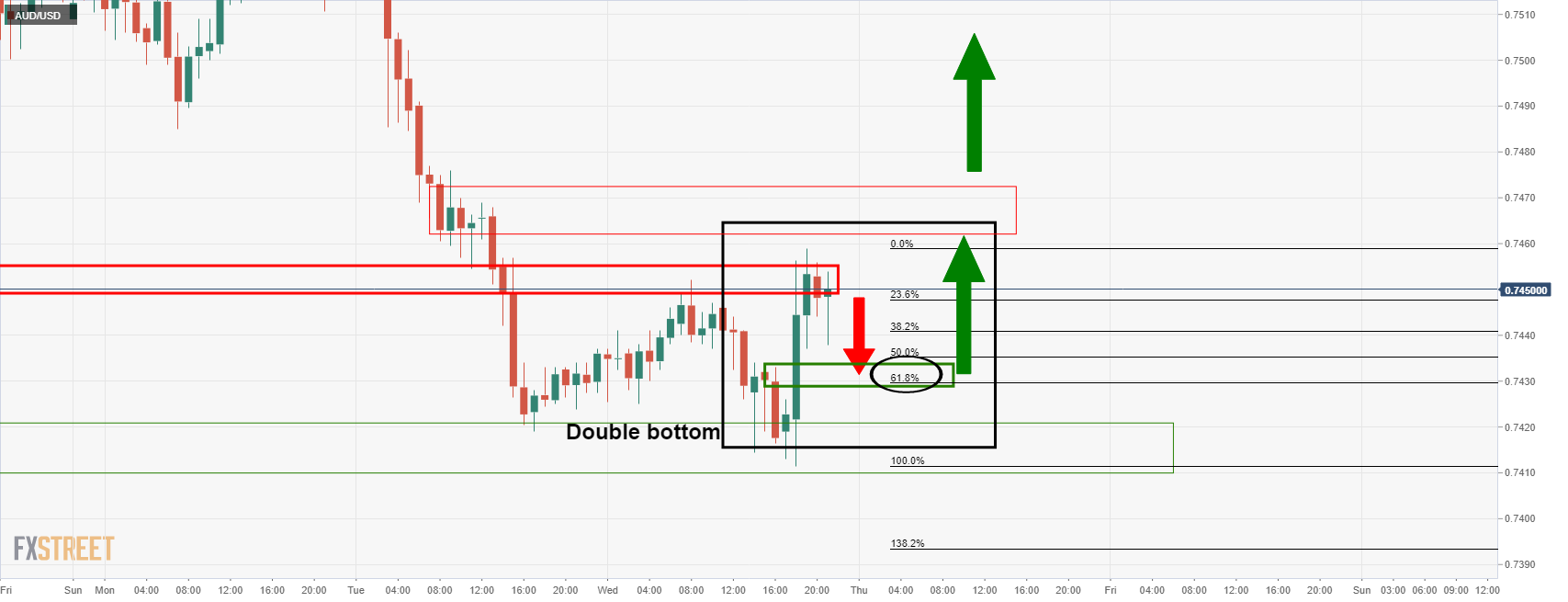
Given the double bottom and the lack of event risks between now and the Nonfarm Payrolls on Friday, there could be some further consolidation prior to a retest of the 0.7480 resistance and a run on the 0.7520 liquidity.
- XAG/USD steady around $23.50 post-Fed taper announcement.
- The US central bank left the door open for a faster QE’s reduction pace.
- XAG/USD: From a technical perspective and confirmed by a bullish flag, tilted to the upside.
Silver (XAG/USD) edges higher post-Fed bond taper announcement, up 0.13%, trading at $23.54 during the New York session at the time of writing. On Wednesday, the Federal Reserve revealed that it would reduce its bond purchasing program in the middle of November. Furthermore, leave the door open that would adjust the pace of its QE reduction program as the central bank’s needed.
It seems investors perceived the US central bank bond tapering announcement as dovish, as portrayed by US equities printing new all-time highs around the New York close.
Fed’s Chairman Jerome Powell post-Fed press conference remarks
On Wednesday, after revealing the Fed’s QE reduction pace to kick start later in November, Fed’s Chairman Jerome Powell held its press conference. There he said that the central bank could be patient in regards to hiking rates. Further added that in case of needing to tackle heightened prices, he said, “we will not hesitate,” after announcing the scale back by $15 billion of its bond purchasing program.
Chairman Powell reiterated that tapering “does not imply any signal regarding the Fed’s interest rate policy.” Moreover, he noted that the pace would put them on track to finish the pandemic stimulus program in the middle of 2022 but left the door open for adjustments.
Jerome Powell insisted that “we don’t think it is a good time to raise interest rates because we want to see the labor market heal further.”
Concerning inflation, Fed’s Chairman said that it “is elevated,” but it is attributed to supply and demand imbalances related to the COVID-19 pandemic.
XAG/USD Price Forecast: Technical outlook
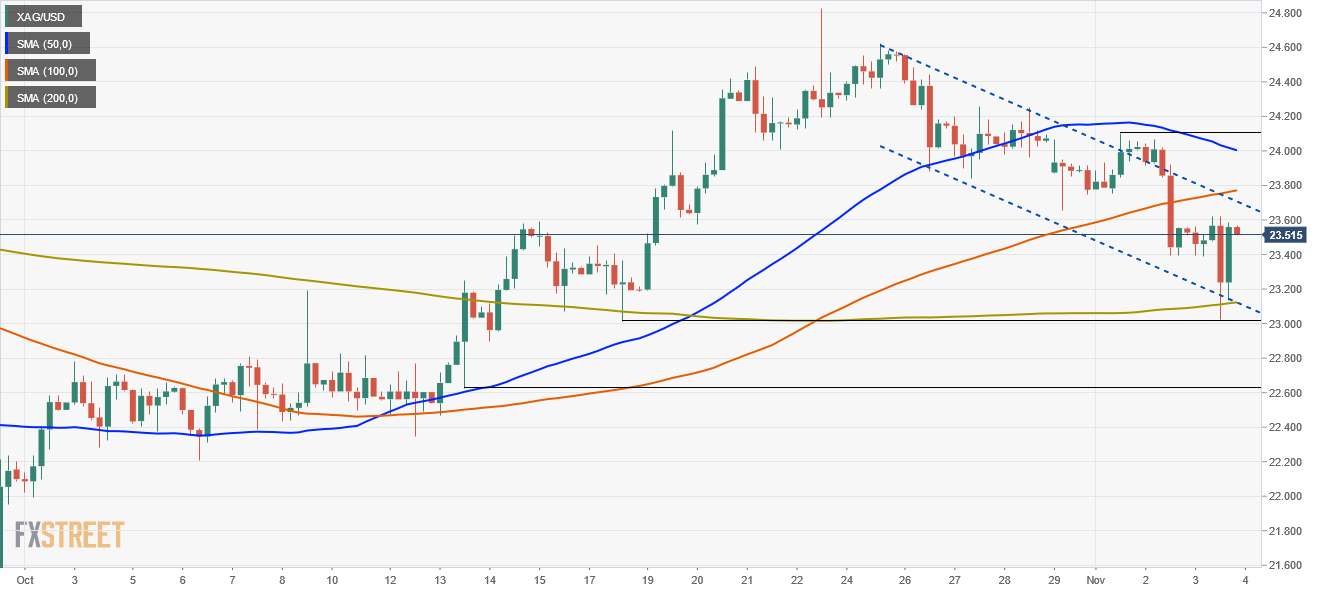
The white metal is approaching the tops of a bullish flag pattern in the 4-hour chart. Furthermore, the precious metal bounced off the 200-simple moving average (SMA) around $23.09, and rallied $0.50, as the Fed announced the bond taper. Nevertheless, to resume its upward trend, it would need to reclaim the 100-SMA at $23.73.
In the outcome of the above-mentioned, the following resistance area would be the confluence of the $24.00 psychological level and the 50-SMA. A breach of that level could send silver towards 2021 highs around $24.85.
On the flip side, failure at $23.73 would keep USD bulls in control, exposing the $23.00 figure as the first support level before re-testing the $22.00 figure.
- S&P 500 and Nasdaq 100 clinch fifth consecutive record closes, the latter at 4660.
- Stocks were supported on Wednesday amid a dovish slant to the latest Fed policy announcement.
For reasons that are not abundantly clear, US equity markets were jubilant in wake of the latest Fed policy announcement, enjoying broad gains in wake of the Fed’s rate decision and monetary policy statement, and then extending on those gains as Fed Chair Jerome Powell spoke in the post-meeting press conference. In the end, the S&P 500 and Nasdaq 100 both managed to notch record closes for a fifth consecutive session, the former closing at 4560 (+0.6% on the day) and the latter surging above 16K for the first time to close near 16.15K (+1.0% on the day). The Dow also managed to get in on the spoils, closing above 36.15K (+0.3% on the day).
In recent days, the main driver of the march higher across US equity markets has been a strong Q3 earnings season, where more than 60% of companies have beaten analyst expectations and aggregative Q3 S&P 500 earnings growth is set to exceed 40% YoY on the quarter (well above expectations just a few weeks ago). Corporate American continues to thrive, in other words, despite 1) the ongoing presence of the Covid-19 virus, 2) severe global supply chain issues and bottlenecks and 3) rising labour costs.
But it was all about the Fed on Wednesday. To recap, the main news was that the Fed has formally kicked off the process of unwinding its extraordinary stimulus measures, first implemented in 2020 to support the pandemic stricken economy, and will reduce the monthly pace of bond buying by $15B in November and then again in December. Thereafter, the pace of further monthly bond-buying reductions can be adjusted as the Fed deems appropriate, though the bank said a continuation of the current $15B/month pace seems appropriate. This is bang in line with market expectations, with Fed members signaling well in advance that they had been thinking about taking this course of action.
The other major focus of the meeting was the tone the Fed (and Chairman Powell in the press conference) would adopt on inflation and the potential for rate hikes. Here, the Fed may have disappointed the hawks; in the statement, the current spike in inflation was still described as largely being driven by transitory factors (some hoped the “transitory” word would be dropped). In the post-meeting press conference, Powell said emphasised that it was the Fed’s base case that inflation would “abate” in Q2/Q3 2022 and, thus, the bank is prepared to be patient when it comes to rate hikes, thus allowing more time for the labour market recovery to advance. This emphasis on patience and the Fed’s belief that inflation is still transitory was interpreted as dovish and likely goes some way in explaining why stocks have rallied so much.
Door opened for hawkish shift in 2022?
While markets have largely interpreted the tone of the updated FOMC statement on monetary policy and Fed Chair Powell’s remarks in the press conference as dovish, some analysts have noted that the Fed did also appear to open the door to a hawkish shift in policy in 2022. Firstly, the Fed statement said the pace of the QE taper would become flexible from January, meaning that if they wanted to, the Fed could quicken the taper process if inflation risks remain elevated.
Moreover, though Powell was keen to impress that the Fed wants to be patient when it comes to rate hikes, he also emphasised that the uncertainty with regards to the path of inflation in the US economy is now more pronounced. Powell also noted that the Fed is positioning for a number of potential scenarios must implicitly mean that the Fed is preparing for a possible hawkish shift if inflation comes in hotter than expected over the coming months. While markets might have thus far interpreted events as dovish, it seems that Fed policy going forward is set to be data-dependent. If it looks as though the YoY rate of US CPI is set to remain elevated in the 4.0-5.0% region into Q2 next year, prepare for a hawkish Fed shift in Q1.
- NZD/USD bulls reach up into neutral territory.
- Bears will be looking to a correction of the sharp hourly bullish impulse.
- Fed makes no great shakes and tapers as expected.
NZD/USD is on the front foot and higher by nearly 0.9% following a rally from 0.7103 to a high of 0.7173 the highs on the approach to the Asia open. The markets were fixated on The Federal Reserve on Wednesday that flew past without anything unexpected.
Consequently, the Kiwi is little changed from where it was at yesterday’s close but is higher on the day following a slide in the greenback after the Fed’s tapering announcement. ''Tapering doesn’t reduce liquidity but it does slow the pace of growth,'' analysts at ANZ bank explained.
''As such, Fed policy will be “less stimulatory” than contractionary. US bond markets did not react initially, but yields are now rising and that could put the bid back into the USD – this was a positive step and should sustain rather than crush the US economy.''
Fed main takeaways
- Meanwhile, the FOMC announced a tapering of its QE programme was followed up with the details as follows:
- A reduction in asset purchases will begin this month at a $15bn pace, split between $10bn treasuries and $5bn MBSs.
- There was no interest rate guidance, and the decision was a unanimous 11-0.
- The Fed state that the pace would alter as necessary.
- The statement reiterate that inflation pressures remain "elevated," but softened the language about it being transitory to "largely reflecting factors that are expected to be transitory" (versus "largely transitory" in September).
- The Fed repeated that the economy and the employment situation have "improved in recent months" but Covid has slowed the recovery.
- Maximum employment is yet to be achieved.
- "Policy will adapt appropriately" to those dynamics he said.
As for data, the US services ISM in October surprised with a rise to a record high of 66.7 (est. 62.0, prior 61.9). In addition to further gains in prices paid (to 82.9 from 77.5), new orders rose to 69.7 (from 63.5) - the highest reading since 1997, and business activity rose to 69.8 (from 62.3).
Ahead of this week's Nonfarm Payrolls, ADP private-sector employment in October at 571k beat expectations (est. 400k), although September was downgraded by 45k to 523k. this came as a welcoming prelude to the key event on Friday.
NZD/USD technical analysis

The focus is now on the downside following the rally into higher liquidity above and a correction into the 50% mean reversion location can be expected in surpassing the 38.2% Fibo target as first potential stop.
What you need to know on Thursday, November 4:
The American dollar ended Wednesday with modest losses against most of its major rivals, following the US Federal Reserve monetary policy announcement. The US central bank kept interest rates unchanged as expected, and announced the reduction of its asset purchases by $15 billion per month. The Fed will begin taper later this month with reductions in Treasuries purchases by $10 bln, and mortgage-backed securities by $5 bln.
Also, policymakers still think inflation will be “transitory” although Powell noted that supply chain issues will likely extend well into next year, which means inflation will also remain high. Utterly patient stance with inflation above 2%. Among other things, he also said that he would not want to surprise markets by changing the taper strategy, opposite to the statement that noted that they can adjust the strategy as needed.
His conservative stance put some pressure on the greenback while providing a boost to Wall Street, with the three major indexes reaching record highs. US Treasury yields advanced, with the yield on the 10-year Treasury note settling at 1.60%.
The EUR/USD pair is still incapable to advance beyond 1.1615, while GBP/USD trades near 1.3700. The AUD/USD pair recovered towards 0.7450, but the risk is skewed to the downside amid an also dovish RBA. The USD/CAD pair fell below 1.2400, despite weaker oil prices.
WTI settled around $80.00, down after US crude stocks rose by more than expected, while gasoline inventories hit a four-year low. Also, Iran nuclear talks are set to resume on November 29 in Vienna.
Gold plummeted ahead of the Fed’s decision, trimming part of their intraday losses ahead of the close. It finished the day at around $1,770.00 a troy ounce.
Ethereum in price discovery mode may not stop until ETH hits $7,000
Like this article? Help us with some feedback by answering this survey:
- Oil prices have dropped sharply in recent trade, with WTI now at $80.00 and down about $3.0 n the day.
- News that Iran/EU/US nuclear talks will restart at the end of the month has exacerbated the drop.
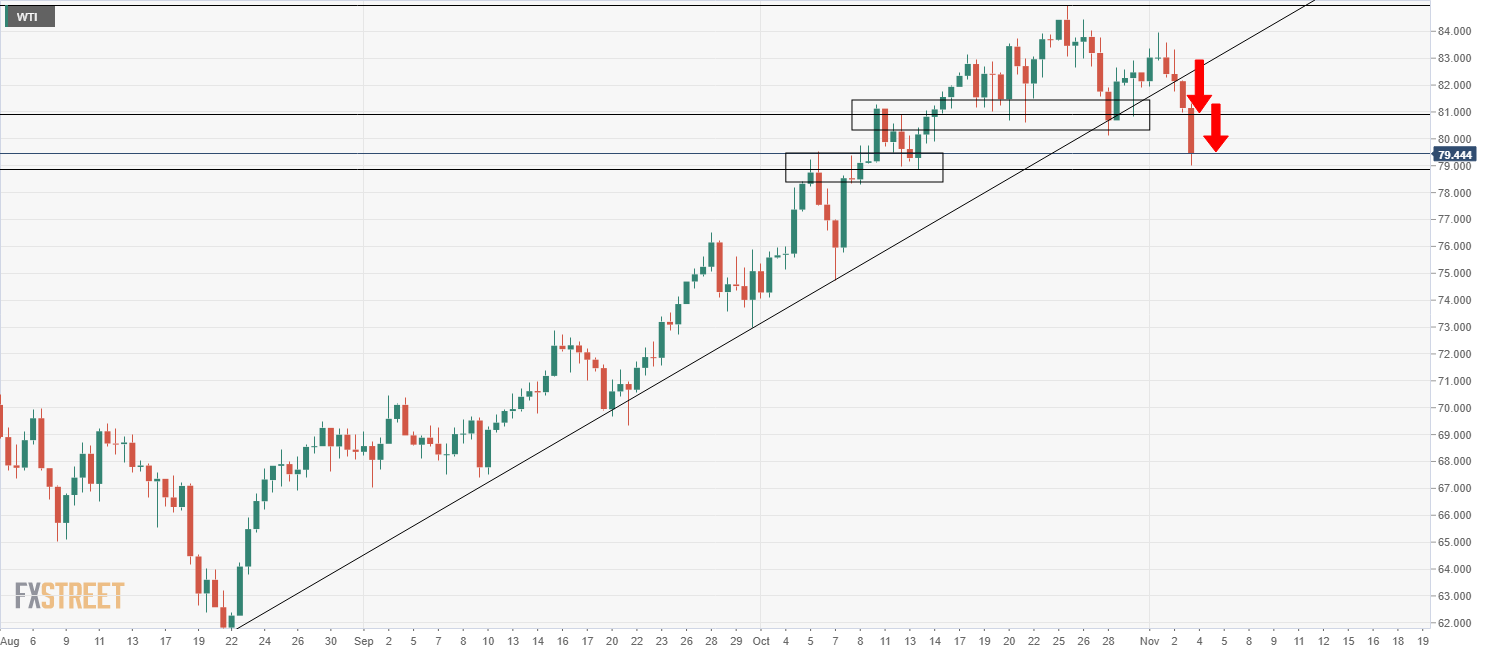
Oil prices have been dropping sharply in recent trade. Front-month futures contracts for the American benchmark for sweet light crude oil, West Texas Intermediary or WTI, has now dropped back to $80.00 per barrel level for the first time since mid-October. As things stand, WTI is down about $3.0 or more than 3.5% on the day, the largest percentage drop in one day since early August.
News that Iran and the EU (and indirectly, the US) will return to the negotiating table regarding Iran and the US rejoining the 2015 nuclear pact, thus paving the way for the removal of sanctions that limit Iranian oil exports, is being cited as weighing on the price action. Talks will begin again on the 29th of November. Iran might be able to increase output by as much as 2M barrels per day if the sanctions are lifted, which would go some way to closing the current gap between the global supply of oil and the global demand for oil.
A stop run/technical selling may also have contributed to the pace of the recent drop; $81.00 was a key area of support that had held up on multiple occasions over the last two weeks and there may have been a number of stops in the $80.00-$81.00 region that got triggered. Also, when WTI broke below $82.00, it appears to have also dropped under a long-term upwards trendline, which may have also exacerbated the selling pressure.
Bearish Inventory Data
Prior to the acceleration of the sell-off in crude oil markets over the last few hours, prices had already been trading substantially lower on the day. Weekly Private API inventory data showed larger than expected build in both crude oil and distillate stocks in the US on Tuesday and official inventory data from the US EIA on Wednesday confirmed these builds. According to the EIA, crude oil inventories rose by 3.3M barrels. Market commentators said the bigger than expected build in crude oil stocks weighed on crude oil prices on Wednesday, though it should be noted that, according to the EIA, gasoline stocks fell to their lowest since 2017 and crude oil stocks at the Cushing Oklahoma storage hub were at their lowest in three years.
OPEC+
This is indicative of the fact that global oil market conditions remain tight, with global demand now thought to be back above 100M barrels per day, while supply continues to lag by a few million barrels per day as OPEC+ increases output at a slower pace than the recent recovery in demand. For this reason, some might see Wednesday’s drop in crude oil prices as a good dip-buying opportunity. But the proximity of Thursday’s OPEC+ meeting might keep traders hesitant.
The cartel is not expected to cave to international pressure to increase oil output at a faster pace and various member state oil ministers have signaled that they think it appropriate to stick to the current plan whereby output is lifted at a pace of 400K barrels per day/month. They might cite the recent outbreak of Covid-19 infections (which is touted to already be more widespread than at any other time since the initial outbreak in 2020), which threatens to send the country back into a nationwide lockdown, as a reason for their cautious approach.
In recent trade, it has been reported that Iran's talks with world powers aimed at reinstating a 2015 nuclear deal will resume on Nov. 29.
This comes across a number of news agencies in the last hour.
Iran's top nuclear negotiator, Ali Bagheri Kani, was reported to have spoken and announced the date as Western concerns over Tehran's nuclear advances grow.
This is from Reuters:
"In a phone call with @enriquemora, we agreed to start the negotiations aiming at removal of unlawful & inhumane sanctions on 29 November in Vienna," Bagheri Kani wrote in a tweet.
In April, Tehran and six powers started to discuss ways to salvage the nuclear pact, which has eroded since 2018 when then-President Donald Trump withdrew the United States from it and reimposed sanctions on Iran, prompting Tehran to breach various limits on uranium enrichment set by the pact. read more
But the talks have been on hold since the election of Iran's hardline President Ebrahim Raisi in June, who is expected to take a tough approach when the talks resume in Vienna.''
Market implications
Iran has been the wold card for oil for some time and this is sure to keep traders o the edge of their seats.
USD/CAD has pulled back sharply from earlier session highs above 1.2450 and is at present flirting with the 1.2400. Trade has been choppy over two or so hours given the Fed policy announcement and press conference with Fed Chair Jerome Powell, which is still ongoing. The US dollar is seeing broad weakness in response to the event and that is the main reason why USD/CAD has been able to pull back from highs.
Markets are seeing a broadly dovish reaction to the Fed announcement, seemingly because the Fed stuck to its classification of inflation as transitory (some feared this wording would be dropped) and after Fed Chair Powell said in the press conference that he thinks the Fed can be “patient” on interest rates to allow time for the labour market to continue its recovery. The Fed announced its QE taper plans, saying it would reduce the monthly pace of purchase by $15B in November and then again in December, in line with the pace that most market participants had been expecting Of course the bank also held the Federal Funds target range at 0.0-0.25%.
Dovish Fed vibes have not been enough to send USD/CAD convincingly back into negative territory on the day, however. At its current level close to 1.2400, USD/CAD is only down about 0.1% on the day. That’s because a sharp drop in oil prices is weighing heavily on oil-sensitive currencies like the Canadian dollar. Some analysts are citing the fact that a date has now been set for the resumption of nuclear talks between Iran and the EU (and also the US, indirectly) as weighing on oil. Talks will resume on the 29th of November, opening the door for a potential deal for Iran and the US to return to the 2015 nuclear pact which would allow for the lifting of US sanctions on Iranian oil exports, which could bring millions of barrels of oil per day in supply back to global markets.
Door opened for hawkish shift in 2022?
Back to the Fed; while markets have largely interpreted the tone of the updated FOMC statement on monetary policy and Fed Chair Powell’s remarks in the press conference as dovish, some analysts have noted that the Fed also appears to opening the door to a hawkish shift in policy in 2022. Firstly, the Fed statement said the pace of the QE taper would become flexible from January, meaning that if they wanted to, the Fed could quicken the taper process if inflation risks remain elevated.
Moreover, the greater emphasis that Powell placed on the uncertainty with regards to the path of inflation in the US economy and his more pronounced insistence that the Fed is positioning for a number of potential scenarios must implicitly mean that the Fed is preparing for a possible hawkish shift if inflation comes in hotter than expected over the coming months. While markets might have thus far interpreted events as dovish, it seems that Fed policy going forward is set to be data-dependent. If it looks as though the YoY rate of US CPI is set to remain elevated in the 4.0-5.0% region into Q2 next year, prepare for a hawkish Fed shift in Q1.
- USD/CHF seesaws around the 0.9100-0.9130 range as Fed’s Powell speaks.
- The USD/CHF is finding strong support at 0.9100, as the pair has jumped off that level three times.
- Fed’s Powell acknowledged that inflation is running well above the 2% goal.
The USD/CHF slides during the New York session, down 0.30%, trades around 0.9117 at the time of writing. On Wednesday, the Federal Reserve decided to keep interest rates at the 0-0.25% range, but most importantly, unveiled the bond taper process is a go, and it will start by the middle of November. Moreover, the monetary policy statement highlights that the Fed would be flexible with the pace of reductions in assets purchases, leaving the door open for a faster or slower QE’s reduction program.
Market reaction.
The USD/CHF pair dipped to 0.9100 but bounced off the lows, reaching up to 0.9140. However, at press time, Federal Reserve Chairman Jerome Powell is hosting his post-Fed press conference.
Summary of some of Chairman’s Powell conference remarks.
Federal Reserve Chairman Jerome Powell said that the slowdown in job gains is concentrated in specific sectors. Furthermore, he said that the participation rate remains subdued, and employers are having difficulties hiring people. Powell added, though, that “these problems on jobs should diminish.”
Regarding inflation, he said that supply and demand imbalances contributed to higher prices and acknowledged that inflation is running well above the 2% goal. The chairman blamed bottlenecks and supply chains as the main drivers of heightened inflationary pressures.
Moreover, he added that “our [central bank] tools can’t ease supply constraints.” Powell reiterated that if the Fed sees signs that inflation is more persistent beyond the central bank level, they will adjust.
Summary of the Federal Reserve monetary policy statement
Summarizing comments of the Federal Reserve’s statement, they said that “elevated inflation is largely transitory, and supply and demand imbalances related to pandemic have contributed to sizable prices increases in some sectors.”
Moreover, they added, “[the fed] will begin taper later this month with reductions in treasuries purchases by $10 bln, MBS by $5 bln.”
Nevertheless, the Fed left the door open for additional adjustments at the QE’s pace. They said “similar reductions in pace of purchases likely appropriate each month, but prepared to adjust if warranted.”
Concerning economic conditions, the central bank sees an improvement in economic activity while the labor market strengthens.
Regarding COVID-19, they said, “Summer’s rise in COVID-19 cases slowed the recovery of sectors adversely affected by the pandemic.” They reiterated that the
To finalize, they reiterated that the economy’s path would lie on the course of the COVID-19 pandemic.
- EUR/USD holds within familiar ranges following the Fed taper announcement.
- Fed statement inline with expectations, yet transitory language a touch more hawkish.
- All eyes on Powell's presser, the Fed Dec meeting, US data and how hawkish the ECB will be.
EUR/USD was trading around 1.1600 throughout the Federal Reserve event on Wednesday. The outcome was more or less in line with the market's expectations but the Fed has acknowledged in a tweak in its statement that inflation might not be as transitory as expected.
Nevertheless, the price made a fresh high during the chairman's presser, touching 1.1616 at the time of writing as Powell attempts to dial down inflation risks. The range, so far today, has been between 1.1562 and 1.1616.
Fed statement takeaways
A taper announcement was made, something that was well telegraphed in prior Fed communications. In the statement, it maintained the transitory language but changed the wording, from ''reflecting transitory factors'' to, ''factors that are expected to be transitory'':
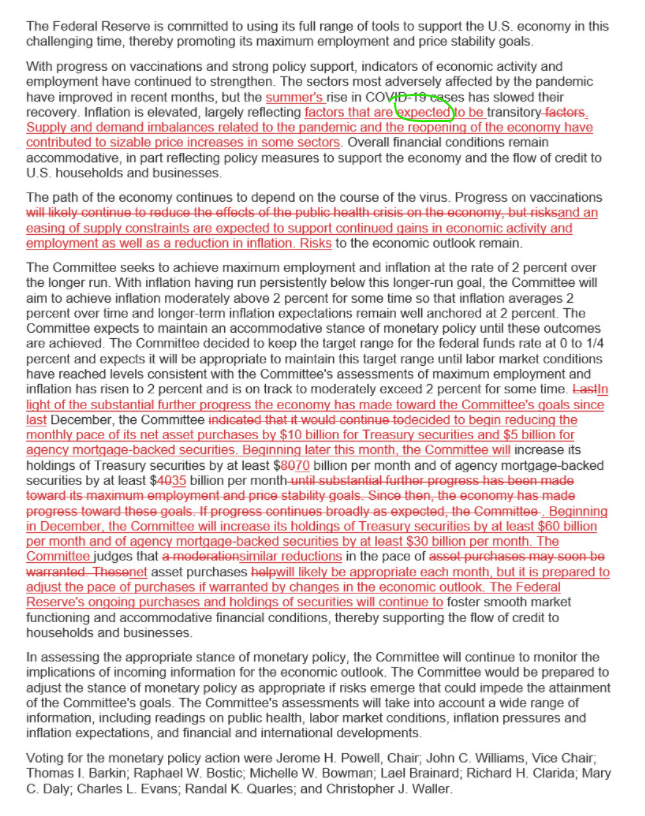
- Tapering starting November, with monthly reductions of $15 bln.
- Prepared to adjust taper pace ‘as warranted’.
- Interest rate decision actual: 0.25% vs 0.25% previous; est 0.25%.
Fed's chair, Powell's presser
Powell is emphasising that the US is not at maximum employment and he has tried to water down the market's take on the tweak to the 'transitory' verbiage in the statement. The US dollar was sent on the backfoot following his reasoning but overall, the markets are steady and will very quickly move to a focus on US data with the Nonfarm Payrolls just around the corner.
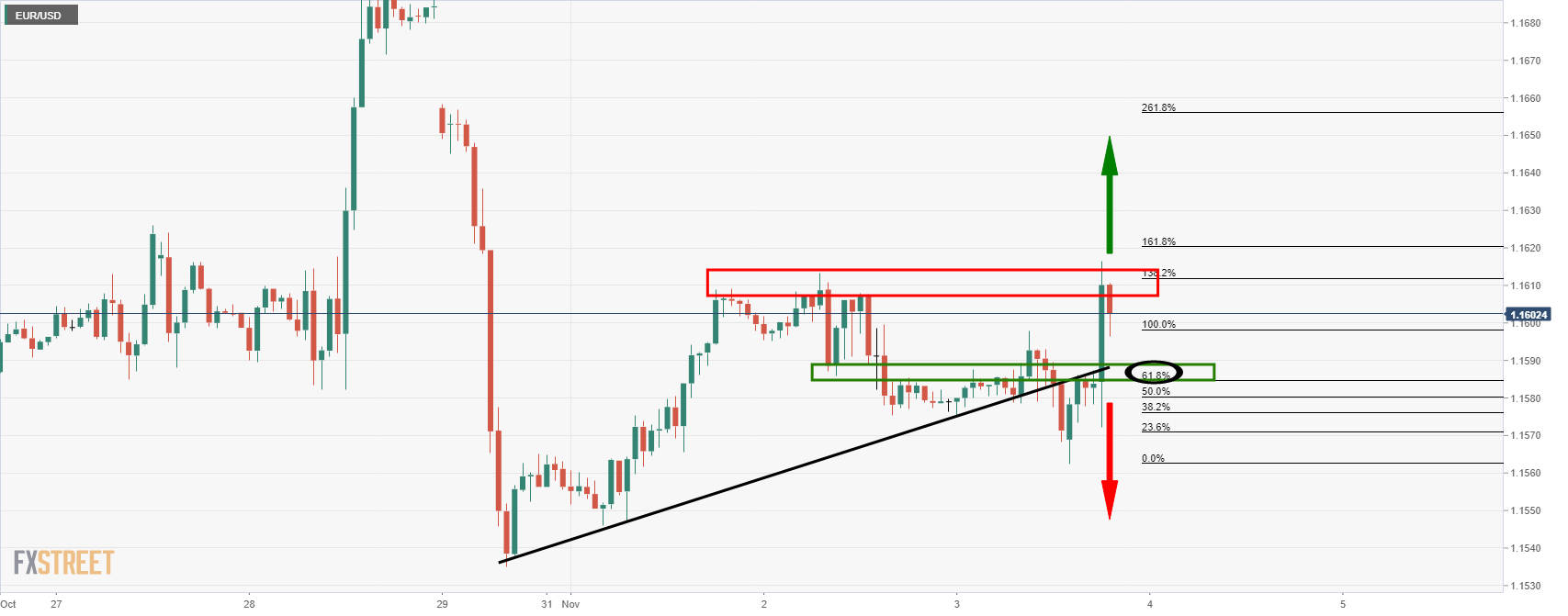
EUR/USD H1 chart
From a technical standpoint, the downside is still vulnerable so long as the price stays within the confines of recent ranges as follows:
- The Fed as expected left rates unchanged on Wednesday.
- Tapering is finally to begin at the rate of $15 billion a month.
- Transitory inflation, well we will have to see about that.
The Federal Reserve as expected left interest rates unchanged on Wednesday in a widely telegraphed move. The Fed never likes to surprise markets too much and stuck to the well-flagged script. Signaling the beginning of the end of the massive bond-buying stimulus program that propped up the economy and notably equity markets since the pandemic began. However, the Fed is determined to get value for money from the transitory printing press as it sticks with its oft-stated view that inflation will be transitory. At least they did admit that it may be transitory for longer, if that makes sense! " Inflation is elevated, largely reflecting factors that are expected to be transitory," Powell said. "With progress on vaccinations and strong policy support, indicators of economic activity and employment have continued to strengthen". On a lighter note, Fed Chair Powell is asked to explain transitory and says it does not leave a permanent persistent mark on prices and inflation. Clearly this is where the test lies and so far the equity market feels the Fed is not behind the curve. The currency and bond markets are not so sure.
The Fed is to buy $60 billion in Treasuries during December and $30 billion in Mortgage Backed Securities (MBS). That's $10 billion fewer Treasuries and $5 billion less in MBS. Still, a significant amount thought so this taper is treading carefully.
The equity market reacted as only they can, positively. No news can dent this juggernaut just yet and certainly a meek and well-flagged taper is not going to do the trick. The dollar too has struggled for direction post the decision whipsawing around 1.16 but slightly weakening for now. US yields quickly spiked with the curve steeping but this has abated and 2-year yields remain little changed at 0.47%, 10 year at 1.57%, and 30 year at 1.98%.
Overall a solid and cautious approach from the Fed with the risk perhaps of straying too far behind the curve just about put to bed. Equity markets are within striking distance of more all-time highs and VIX, a measure of volatility in the equity market, is falling to the low end of the recent range at 15. MOVE, a measure of bond market volatility, has also dropped but this one is elevated compared to the recent past, indicating the bond market may be about to have a showdown with the Fed. For equity people, risk is on so more gains are likely.
-637715630918029562.png)
EuroUSD 15 minute.
Equities are clearly happy!
-637715631467835890.png)
S&P 500 15 minute
Following the Federal Open Market Committee's (FOMC) decision to keep the policy rate unchanged and to reduce asset purchases by $15 billion per month, FOMC Chairman Jerome Powell is delivering his comments on the policy outlook.
Key quotes
"By many measures, we are in a very tight labor market."
"The issue is, how persistent is the labor market tightness, given it's due to COVID."
"It is clear we are set to go up to a higher employment level."
"You want to be in a position to act to cover the full range of possible outcomes; risks are skewed to higher inflation."
"We need to be ready to act if we have to."
"It is appropriate to be patient on jobs and inflation."
"Transition away from goods could bring inflation down."
"We want to see the process unfold to gauge true state of the economy."
"We think time will tell us more."
"Now is not the time to raise rates."
"If we need to raise rates, we'll be patient but not hesitate."
About Jerome Powell (via Federalreserve.gov)
Jerome H. Powell took office as Chairman of the Board of Governors of the Federal Reserve System on February 5, 2018, for a four-year term. Mr. Powell also serves as Chairman of the Federal Open Market Committee, the System's principal monetary policymaking body. Mr. Powell has served as a member of the Board of Governors since taking office on May 25, 2012, to fill an unexpired term. He was reappointed to the Board and sworn in on June 16, 2014, for a term ending January 31, 2028.
Following the Federal Open Market Committee's (FOMC) decision to keep the policy rate unchanged and to reduce asset purchases by $15 billion per month, FOMC Chairman Jerome Powell is delivering his comments on the policy outlook.
Key quotes
"We understand that people with lower incomes are affected more by inflation."
"We will use our tools to make sure high inflation doesn't become a permanent feature."
"Wages is a key measure of how tight the labor market is."
"We have to be humble about what we know about this economy."
"We want to see further development of the labor market in the absence of another COVID spike."
"People are still staying out of the labor market in part due to COVID."
"There is room for a whole lot of humility here on maximum employment."
"We have high inflation and we have to balance that with our employment goals."
"We are in a complicated situation."
"We hope to get more clarity over the first half of next year."
"When we reach maximum employment, it's very possible inflation test will already be met."
"We are not evaluating the liftoff test today."
"Liftoff test is clearly not met on employment goal."
About Jerome Powell (via Federalreserve.gov)
Jerome H. Powell took office as Chairman of the Board of Governors of the Federal Reserve System on February 5, 2018, for a four-year term. Mr. Powell also serves as Chairman of the Federal Open Market Committee, the System's principal monetary policymaking body. Mr. Powell has served as a member of the Board of Governors since taking office on May 25, 2012, to fill an unexpired term. He was reappointed to the Board and sworn in on June 16, 2014, for a term ending January 31, 2028.
US equity markets saw upside in the immediate aftermath of the latest Fed rate decision, with the S&P 500 rallying to fresh record intra-day levels just shy of the 3640 mark. The Fed held the federal funds target range at 0.0-0.25% as expected, and, also as expected, announced that it would taper its QE programme, which is currently buying bonds at a pace of $120B per month, by $15B from mid-November and then again in mid-December. Thereafter, the Fed said that it would likely be appropriate for further reductions in the pace of bond-buying programme in 2022 to continue at a similar pace, though the Fed would be prepared to adjust as necessary.
The dovish surprise that appeared to support equities appears to have been the fact that the Fed did not adjust its language regarding how it views inflation as “hawkishly” as some might have expected. The bank maintained its description of inflation being largely driven by transitory factors, though did add another sentence going into a little more detail as to the drivers (reopening, supply chain problems) of high inflation. Some might have expected the bank to say something like “inflation is partly driven by transitory factors”.
Fed Chair Jerome Powell is currently conducting his usual post-monetary policy announcement press conference and equities seem to be liking what they are hearing, with the S&P 500 having now pushed to the north of the 4640 level and is eyeing a test of 4650. Taken in sum, Powell’s remarks on the labour market, inflation and interest rates seem to be more dovish than what the market may have been expecting; Powell doubled down on the classification of inflation as expected to be transitory, saying he expects it to abate in Q2 or Q3 next year. He also said that, as a result, the Fed is willing to be patient when it comes to rates. This isn’t the sort of language one would expect to hear from a man who is about to hike rates as soon as June 2022, as money markets are currently pricing.
Still, Powell has been hedging himself; he reiterated past comments that he does think the risk of more persistent inflation has risen and that the Fed is “positioning itself for a range of possible outcomes”, which could include being faced with a trade-off between inflation and employment (i.e. needing to hike before the jobs market has returned to full employment because inflation is too high). Still, Powell said he thinks the labour market can recover fully by mid-2022, which is conveniently also the period after which if inflation is still high, the Fed would start hiking rates (in other words, ignore high inflation until employment recovers, then start to address it!). These potentially more hawkish scenarios, under which rate hikes would likely begin in mid-2022 are not being presented as the Fed’s base case. Net-net, markets seem to be interpreting Powell tone/remarks as dovish, hence the upside seen in stocks and the broad weakness being seen in the US dollar.
Following the Federal Open Market Committee's (FOMC) decision to keep the policy rate unchanged and to reduce asset purchases by $15 billion per month, FOMC Chairman Jerome Powell is delivering his comments on the policy outlook.
Key quotes
"If we see a need to deviate from taper plan, will make that transparent."
"We wouldn't surprise markets if we have to change the pace of the taper."
"We would telegraph any changes transparently."
"Level of inflation we have right now is not at all consistent with price stability."
"We will use our tools as appropriate to get inflation under control."
"It is not a good time to raise interest rates because we want to give labor market time to heal further."
"Transitory means it will not leave behind persistently higher inflation."
About Jerome Powell (via Federalreserve.gov)
Jerome H. Powell took office as Chairman of the Board of Governors of the Federal Reserve System on February 5, 2018, for a four-year term. Mr. Powell also serves as Chairman of the Federal Open Market Committee, the System's principal monetary policymaking body. Mr. Powell has served as a member of the Board of Governors since taking office on May 25, 2012, to fill an unexpired term. He was reappointed to the Board and sworn in on June 16, 2014, for a term ending January 31, 2028.
Following the Federal Open Market Committee's (FOMC) decision to keep the policy rate unchanged and to reduce asset purchases by $15 billion per month, FOMC Chairman Jerome Powell is delivering his comments on the policy outlook.
Key quotes
"Inflation that we are seeing is not due to a tight labor market."
"Inflation we are seeing now is due to bottlenecks, and strong demand."
"We have to be aware of the risks of the trade-off between inflation and employment."
"We see higher inflation persisting and have to be in place to address that risk."
"We are positioning ourselves to address a range of plausible outcomes."
About Jerome Powell (via Federalreserve.gov)
Jerome H. Powell took office as Chairman of the Board of Governors of the Federal Reserve System on February 5, 2018, for a four-year term. Mr. Powell also serves as Chairman of the Federal Open Market Committee, the System's principal monetary policymaking body. Mr. Powell has served as a member of the Board of Governors since taking office on May 25, 2012, to fill an unexpired term. He was reappointed to the Board and sworn in on June 16, 2014, for a term ending January 31, 2028.
Following the Federal Open Market Committee's (FOMC) decision to keep the policy rate unchanged and to reduce asset purchases by $15 billion per month, FOMC Chairman Jerome Powell is delivering his comments on the policy outlook.
Key quotes
"It is time to taper, it is not time to raise rates."
"It is time to take a rethink because the economy has made substantial further progress but still ground to cover on employment gains."
"Our baseline expectation is supply chain issues will persist well into next year."
"We should see inflation moving down by Q2 or Q3."
"We can be patient on rates."
"If a response is called for, we will not hesitate."
"We are watching carefully on how the economy evolves, will adapt accordingly."
"We could achieve maximum employment by the middle of next year."
"Wages have been moving up very strongly."
About Jerome Powell (via Federalreserve.gov)
Jerome H. Powell took office as Chairman of the Board of Governors of the Federal Reserve System on February 5, 2018, for a four-year term. Mr. Powell also serves as Chairman of the Federal Open Market Committee, the System's principal monetary policymaking body. Mr. Powell has served as a member of the Board of Governors since taking office on May 25, 2012, to fill an unexpired term. He was reappointed to the Board and sworn in on June 16, 2014, for a term ending January 31, 2028.
Following the Federal Open Market Committee's (FOMC) decision to keep the policy rate unchanged and to reduce asset purchases by $15 billion per month, FOMC Chairman Jerome Powell is delivering his comments on the policy outlook.
Key quotes
"Our taper would cease by the middle of next year."
Even after balance sheet stops expanding, our holdings will support financial conditions."
"Decision to taper does not imply any direct signal on rates."
"We are focusing on what we can control."
About Jerome Powell (via Federalreserve.gov)
Jerome H. Powell took office as Chairman of the Board of Governors of the Federal Reserve System on February 5, 2018, for a four-year term. Mr. Powell also serves as Chairman of the Federal Open Market Committee, the System's principal monetary policymaking body. Mr. Powell has served as a member of the Board of Governors since taking office on May 25, 2012, to fill an unexpired term. He was reappointed to the Board and sworn in on June 16, 2014, for a term ending January 31, 2028.
Following the Federal Open Market Committee's (FOMC) decision to keep the policy rate unchanged and to reduce asset purchases by $15 billion per month, FOMC Chairman Jerome Powell is delivering his comments on the policy outlook.
Key quotes
"Supply and demand imbalances have contributed to sizable price increases."
Bottlenecks are affecting how supply can respond to demand."
"Inflation running well above 2% goal."
"Bottlenecks longer-lasting than expected."
"Drivers of higher inflation predominantly connected to COVID-related factors."
"We understand difficulties of high inflation for families."
"Our tools can't ease supply constraints."
"We think our economy will adjust to supply and demand imbalances and inflation will recede."
"Believe inflation will decline closer to 2% goal as economy adjusts."
"Global supply chains will return to normal, but timing uncertain."
If we see signs inflation is moving persistently beyond levels we want, we will adjust."
About Jerome Powell (via Federalreserve.gov)
Jerome H. Powell took office as Chairman of the Board of Governors of the Federal Reserve System on February 5, 2018, for a four-year term. Mr. Powell also serves as Chairman of the Federal Open Market Committee, the System's principal monetary policymaking body. Mr. Powell has served as a member of the Board of Governors since taking office on May 25, 2012, to fill an unexpired term. He was reappointed to the Board and sworn in on June 16, 2014, for a term ending January 31, 2028.
Following the Federal Open Market Committee's (FOMC) decision to keep the policy rate unchanged and to reduce asset purchases by $15 billion per month, FOMC Chairman Jerome Powell is delivering his comments on the policy outlook.
Key quotes
"Slowdown in job gains concentrated in certain sectors."
"Participation rate remains subdued."
"Unemployment rate understates shortfall in employment."
Prime-age participation remains well below pre-pandemic levels."
"Employers are having difficulties filling jobs."
"These problems on jobs should diminish."
About Jerome Powell (via Federalreserve.gov)
Jerome H. Powell took office as Chairman of the Board of Governors of the Federal Reserve System on February 5, 2018, for a four-year term. Mr. Powell also serves as Chairman of the Federal Open Market Committee, the System's principal monetary policymaking body. Mr. Powell has served as a member of the Board of Governors since taking office on May 25, 2012, to fill an unexpired term. He was reappointed to the Board and sworn in on June 16, 2014, for a term ending January 31, 2028.
Following the Federal Open Market Committee's (FOMC) decision to keep the policy rate unchanged and to reduce asset purchases by $15 billion per month, FOMC Chairman Jerome Powell is delivering his comments on the policy outlook.
Key quotes
"We remain attentive to risks."
"Real GDP growth has slowed notably."
"COVID has held back recovery."
"Demand has been very strong."
"With COVID receding, economic growth should pick up this quarter."
"We expect strong economic growth this year."
"Pace of improvement in jobs has slowed."
About Jerome Powell (via Federalreserve.gov)
Jerome H. Powell took office as Chairman of the Board of Governors of the Federal Reserve System on February 5, 2018, for a four-year term. Mr. Powell also serves as Chairman of the Federal Open Market Committee, the System's principal monetary policymaking body. Mr. Powell has served as a member of the Board of Governors since taking office on May 25, 2012, to fill an unexpired term. He was reappointed to the Board and sworn in on June 16, 2014, for a term ending January 31, 2028.
- Federal Reserve leaves rates unchanged at 0-0.25%.
- The Federal Reserve will begin the bond tapering process in mid-November.
- The pace of the bond taper: $70 billion a month of treasuries, and $35 billion a month Mortgage-Backed Securities(MBS).
Gold (XAU/USD) extends its sharply fall, seesawing around $1,765 as the Federal Reserve announced the bond tapering, it will start by mid-November, and the pace of the QE program will reduce from $120 billion a month to $105 billion, a $15 billion reduction as the market expected. Furthermore, it leaves the doors open for a faster bond tapering process, as the Fed says that “comparable decreases in buying pace are likely reasonable each month, but we are willing to adapt if necessary.”
Market Reaction
XAU/USD is seesawing around the $1,760-$1,770 area, but its initial reaction spiked towards $1,770, retracing the move towards $1,766.
Summary of the Federal Reserve monetary policy statement
Summarizing comments of the Federal Reserve’s statement, they said that “elevated inflation is largely transitory, and supply and demand imbalances related to pandemic have contributed to sizable prices increases in some sectors.”
Furthermore, they added, “[the fed] will begin taper later this month with reductions in treasuries purchases by $10 bln, MBS by $5 bln.”
However, they leave the door open for adjustments at the QE’s pace. They said “similar reductions in pace of purchases likely appropriate each month, but prepared to adjust if warranted.”
Concerning economic conditions, they see an improvement in economic activity while the labor market continues to strengthen.
Regarding COVID-19, they said, “Summer’s rise in COVID-19 cases slowed the recovery of sectors adversely affected by the pandemic.” They reiterated that the
To finalize, they reiterated that the economy’s path would lie on the course of the COVID-19 pandemic.
- GBP/USD holds its ground following the Fed taper announcement.
- Fed statement inline with expectations, a slight tweak to the transitory language supports greenback.
- All eyes now turn to Powell's presser, the Fed Dec meeting and US data as well as the BoE.
GBP/USD was trading around 1.3670 on the release of the Federal Reserve's statement where it appears that the board members are less certain that inflation will be transitory. Nevertheless, the price made a fresh high during the knee-jerk reaction to the statement and wider spreads. The range, so far today, has been between 1.3607 and 1.3686.
Fed statement takeaways
The Federal Reserve will begin dialling back the quantitative easing that it has provided since the coronavirus pandemic erupted last year in response to high inflation that now looks likely to persist longer than it did just a few months ago. In the statement, it maintained the transitory language but changed the wording, from ''reflecting transitory factors'' to, ''factors that are expected to be transitory'':
- Tapering starting November, with monthly reductions of $15 bln.
- Prepared to adjust taper pace ‘as warranted’.
- Interest rate decision actual: 0.25% vs 0.25% previous; est 0.25%.
Next up, Fed's Powell presser, watch live
The Fed's chair Jerome Powell will now likely emphasize how tapering will lead to flexibility in responding if the economy evolves in a way that deviates significantly from expectations. He should be pressed on the change in the statement with regards to transitory language as well.
Given there is no set detail as for the path of tapering beyond December, he will likely be questioned as to what the expected lines are going to be from there onwards and how fast he expects the taper to be until the rate hike lift-off.
BoE and US data firmly in focus
The market will now be left data watching with respect to the US dollar. At the end of the week, Nonfarm Payrolls will be critical and given today's ADP report, the bias is tirled to the bullish side.
This week's Bank of England policy decision is close to a coin toss, according to analysis at TD Securities. However, regardless of the outcome, the analysts at TDS expect the BoE to hike rates by 15bps at one of the two remaining 2021 meetings. ''This meeting is marginally more suitable, given recent messaging and the accompanying MPR, projections, and press conference. The MPC's tone will likely imply a subsequent hike, but probably not until February.''
AUD/USD saw a temporary pop higher from earlier session lows in wake of the release of the latest FOMC rate decision and monetary policy statement, at one point coming within a whisker of the 0.7450 level. As expected, the bank held the federal funds target range at 0.0-0.25% and announced that it would taper its QE programme, which is currently buying bonds at a pace of $120B per month, by $15B from mid-November and then again in mid-December. Thereafter, the Fed said that it would likely be appropriate for further reductions in the pace of bond-buying programme in 2022 to continue at a similar pace, though the Fed would be prepared to adjust as necessary.
The dovish surprise that appeared to momentarily send AUD/USD higher appears to have been the fact that the Fed did not adjust its language regarding how it views inflation as “hawkishly” as some might have expected. The bank maintained its description of inflation being largely driven by transitory factors, though did add another sentence going into a little more detail as to the drivers (reopening, supply chain problems) of high inflation. Some might have expected the bank to say something like “inflation is partly driven by transitory factors”.
Nonetheless, the dovish initial reaction that saw AUD/USD pop higher has now more or less fully unwound, with AUD/USD back at pre-Fed announcement levels in the 0.7420s. Focus now shifts to Fed Chair Jerome Powell’s press conference which kicks off at 1830GMT. His remarks on inflation, the potential for further adjustments to the pace of the QE taper and the potential for rate hikes next year will be the key themes.
The Federal Open Market Committee (FOMC) announced on Wednesday that it left the benchmark interest rate, the target range for federal funds, unchanged at 0%-0.25% as widely expected.
More importantly, the Fed decided to reduce its asset purchases by $15 billion per month.
Follow our live coverage of the FOMC decision and the market reaction.
Market reaction
With the initial market reaction, the greenback weakened against its rivals and the US Dollar Index was last seen losing 0.2% on the day at 93.90.
Key takeaways from the policy statement as summarized by Reuters
"Elevated inflation largely transitory."
"Supply and demand imbalances related to pandemic have contributed to sizable prices increases in some sectors."
"Will begin taper later this month with reductions in treasuries purchases by $10 bln, MBS by $5 bln."
"Similar reductions in pace of purchases likely appropriate each month, but prepared to adjust if warranted."
"Economic activity, employment have continued to strengthen."
"Summer’s rise in COVID-19 cases slowed the recovery of sectors adversely affected by the pandemic."
"Path of economy continues to depend on course of virus."
- EUR/USD sits around 1.1580 resistance ahead of the Fed.
- Bears eye 1.1520 demand area and then a break below 1.1500 in coming sessions.
EUR/USD is sitting around 1.1580 ahead of the Federal Reserve interest rate decision at the top of the hour. The pair has changed hands between a low of 1.1562 and a high of 1.1598 so far on Wednesday following a slew of economic positives from the US in the early New York trade.
The greenback has edged higher on Wednesday, holding near recent peaks versus the euro as well as the yen. Traders are in anticipation today of an expected announcement on the unwinding of the Fed's pandemic-era stimulus. If there is going to be any surprises outside of a ''no-taper'', it will be most likely from the Fed's Chairman, Jerome Powell, in topics surrounding inflationary pressures and timings of lift-off. Before he speaks, the Fed's policy statement, which will likely kick-off the tapering of its $120 billion-a-month asset purchase program, is due at 2 p.m. Eastern time (1800 GMT), followed by the news conference with Powell.
What's priced in?
''At this point, the Fed has managed expectations perfectly in terms of preparing the markets for what is likely to be speed tapering,'' analysts at Brown Brothers Harriman. ''Most Fed officials seems to agree that it’s better to get tapering over as quickly as possible in order to leave the Fed maximum flexibility to hike rates when needed. The most likely path for tapering has already been flagged by the Fed, which would reduce asset purchases by $15 bln per month ($10 bln UST and $5 bln MBS) starting this month so that QE effectively ends mid-2022.''
Around tapering, flexibility will be something that markets will respond to as well as timings for rate hike lift-off. Any signal that Powell is open to responding with rate hikes to inflation, if the case for it being transitory keeps weakening, would reinforce the supportive US dollar backdrop.
''We don't expect any definitive new "liftoff" signal, and we expect "elevated" inflation will continue to be seen as "largely reflecting transitory factors," but the chair will likely emphasize how tapering will lead to flexibility in responding if the economy evolves in a way that deviates significantly from expectations,'' analysts at TD Securities explained.
ECB dials down hawkish sentiment
The Fed announcement follows meetings of the Reserve Bank of Australia on Tuesday and the ECB last Wednesday, both of which pushed back against market pricing of tighter policy. European Central Bank Christine Lagarde said an interest rate rise in 2022 was very unlikely because inflation was too low, sending government bond yields lower. But the euro barely budged.
She noted that “In our forward guidance on interest rates, we have clearly articulated the three conditions that need to be satisfied before rates will start to rise. Despite the current inflation surge, the outlook for inflation over the medium term remains subdued, and thus these three conditions are very unlikely to be satisfied next year.”
Of note, the swaps market is pricing in 7 bp of tightening over the next twelve months, down from 11 bp yesterday and over 20 bp right after Thursday’s decision. As such, Lagarde’s efforts seem to be working.
EUR/USD technical analysis
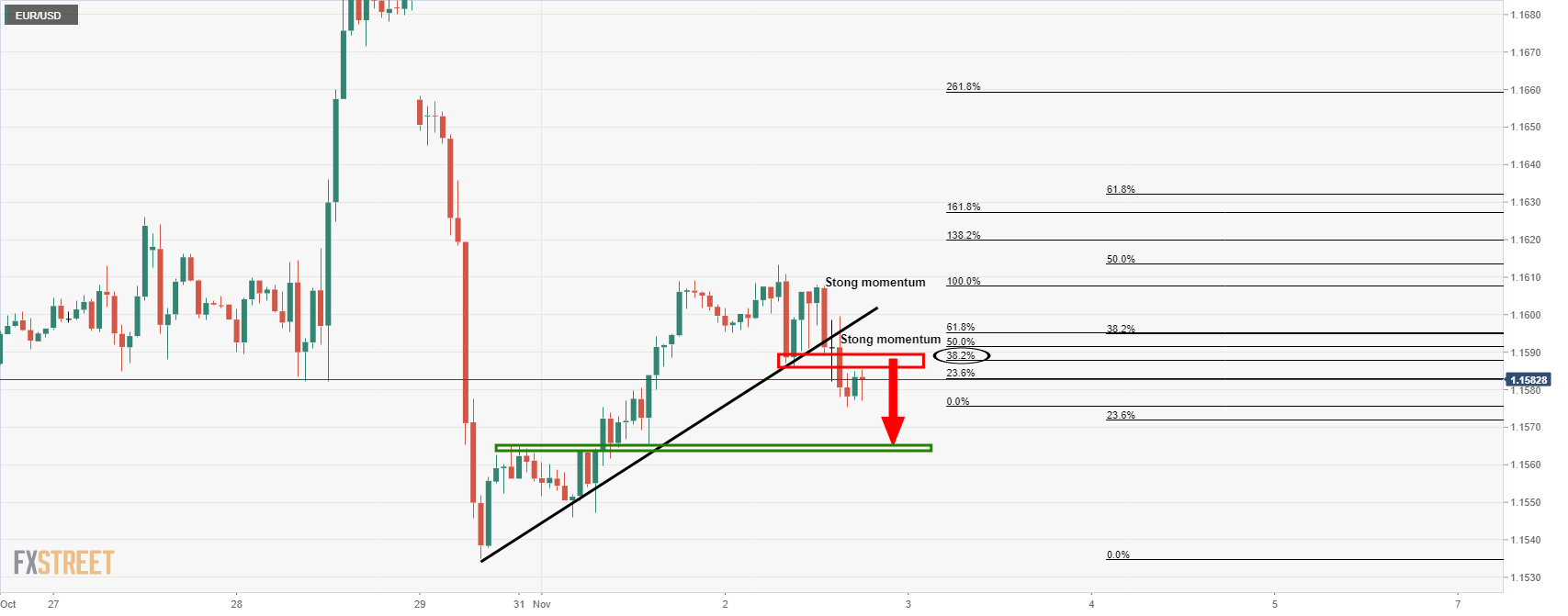
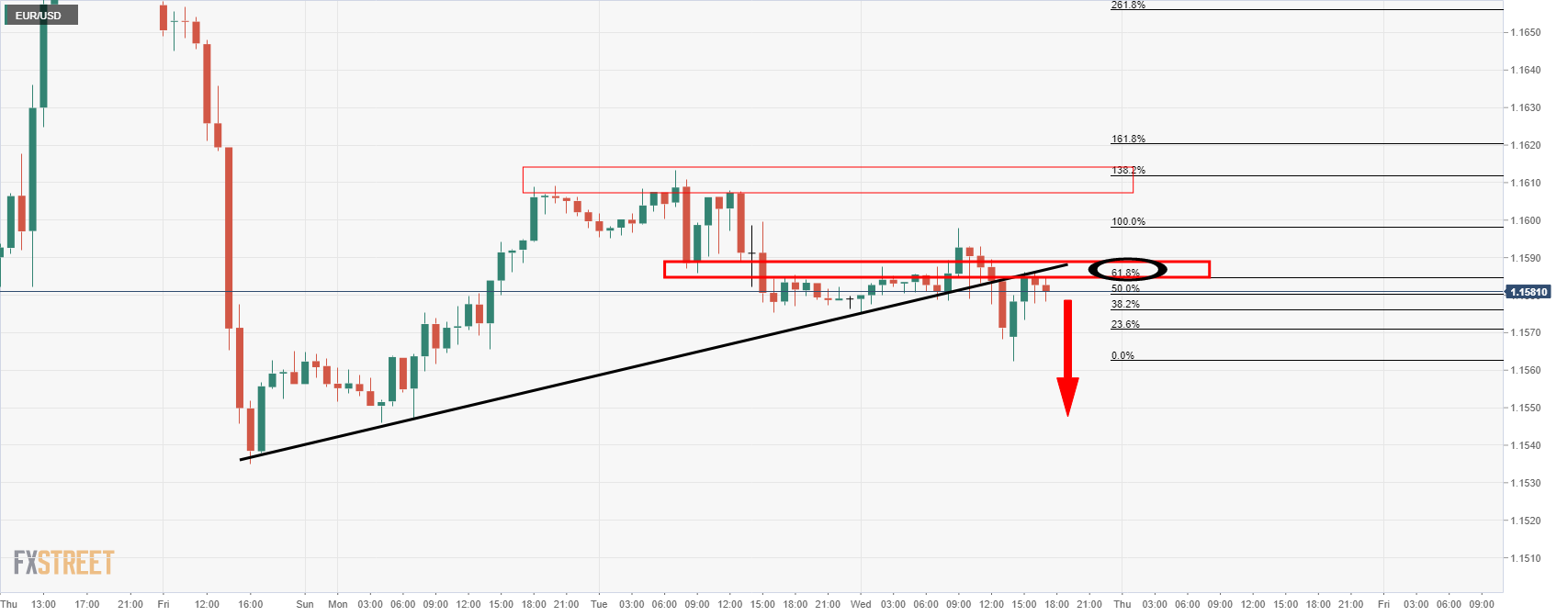
While the macro side of the trade is somewhat uncertain with respect to how markets will respond to the semi-unknown, the technical picture for EUR/USD is more heavily tilted to the downside as follows:
EUR/USD Price Analysis: Bears seeking a break below 1.15 the figure
As per the prior analysis above, the price action has followed suit:
EUR/USD prior analysis, H1 chart
EUR/USD live market update
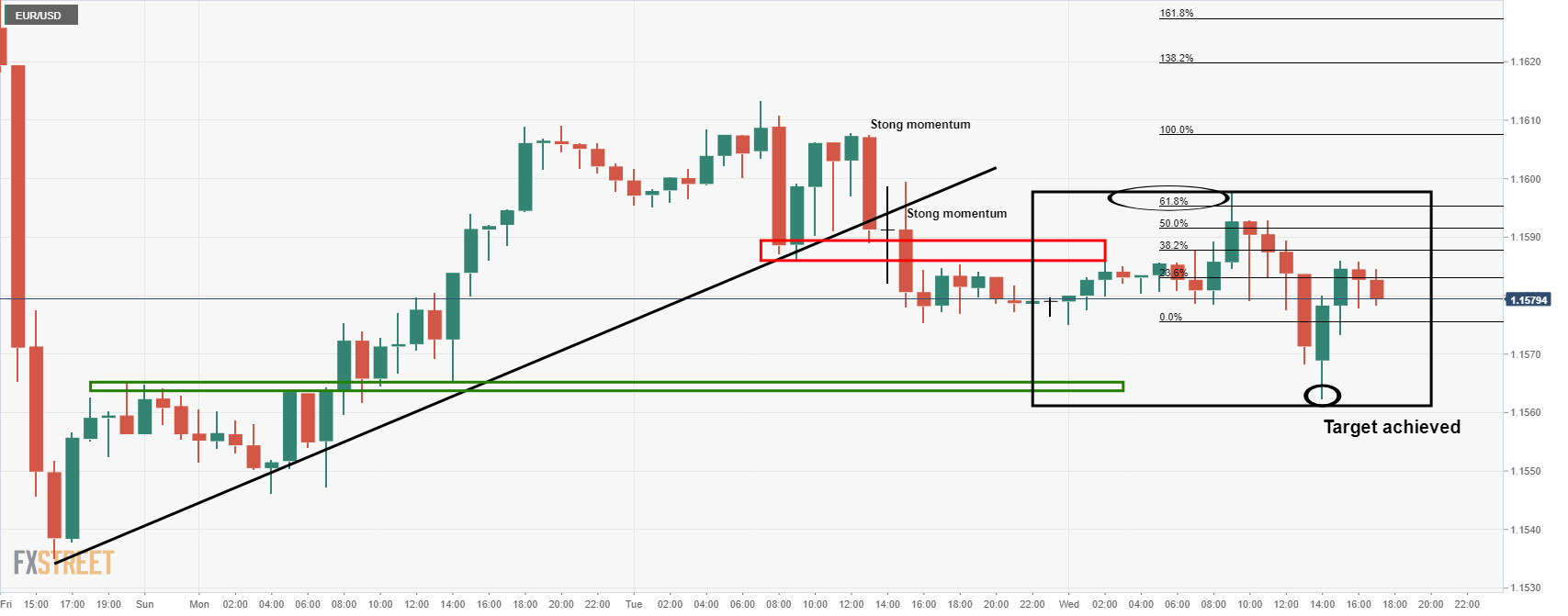
The price picked up some extra liquidity in a touch of the 61.8% Fibo prior to reaching the target as illustrated above.
However, the bears may not be done yet and a break of 1.15 the figure is still very much to play for. Ahead of the Fed, where we could expect some price swings, either way, the hourly chart is still offering prospects of a downside continuation as follows:
Jerome Powell, Chairman of the Federal Reserve System, will be delivering his remarks on the monetary policy outlook at a press conference following the meeting of the Board of Governors. Powell's speech will start at 18:30 GMT.
Follow our live coverage of the Fed's policy announcements and the market reaction.
Related articles
Fed Interest Rate Decision Preview: Inflation, employment and interest rates.
Five dollar-moving things to watch out for on the historic tapering announcement.
EUR/USD Forecast: Dovish ECB and upcoming Fed hints at a bearish extension.
About Jerome Powell (via Federalreserve.gov)
Jerome H. Powell took office as Chairman of the Board of Governors of the Federal Reserve System on February 5, 2018, for a four-year term. Mr. Powell also serves as Chairman of the Federal Open Market Committee, the System's principal monetary policymaking body. Mr. Powell has served as a member of the Board of Governors since taking office on May 25, 2012, to fill an unexpired term. He was reappointed to the Board and sworn in on June 16, 2014, for a term ending January 31, 2028.
- USD/JPY has risen back above 114.00 from earlier lows aided by strong US data.
- The upcoming Fed meeting will ultimately determine the direction of FX markets on Wednesday.
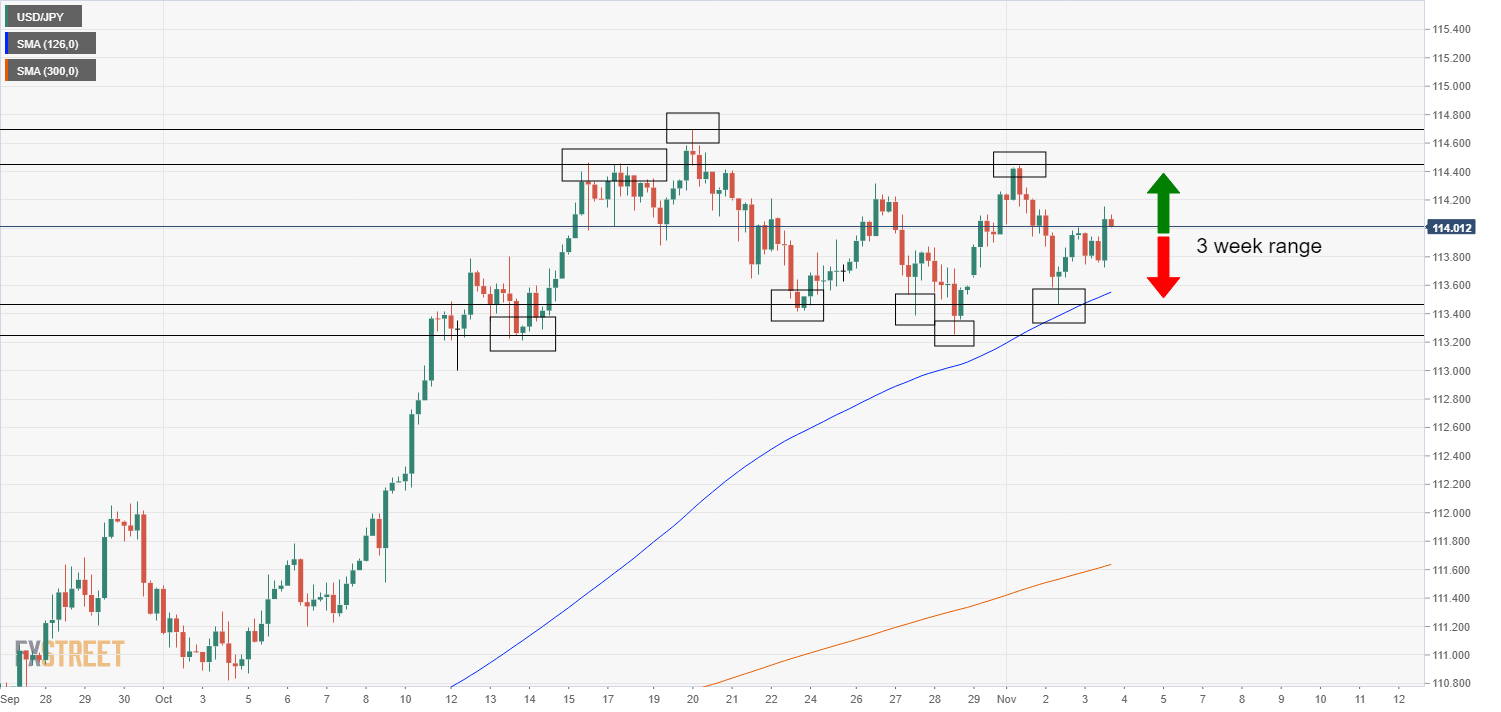
While the upcoming Fed monetary policy announcement at 1800GMT and follow up press conference with Fed Chairman Jerome Powell from 1830GMT will ultimately dictate the lay of the land for FX markets when all is said and done on Wednesday, USD/JPY has tentatively managed to reclaim the 114.00 level in recent trade, as the currency pair tracks a modest move higher in US yields in response to a duo of strong US data releases earlier in the session. As things stand, the pair is not even 0.1% higher on the day, but it has reversed a more respectable 0.3% from earlier lows when it grazed 113.70. At 114.00, USD/JPY is pretty much bang in the middle of the roughly 113.50-114.50 range that has persisted for roughly the last three weeks.
Strong US data support USD/JPY ahead of the Fed
Notable upticks were seen on the chart at 1215GMT, when ADP released their national employment change estimate for October, which was notably stronger than the 400K median economist forecast at 571K thus adding some upside risk to Friday’s official payroll number (though analysts note the link between ADP and NFP in recent months has been hit and miss), and then again at 1400GMT, when the Institute of Supply Management released their October Services PMI survey, which rocketed to a record high of 66.7.
Anthony Nieves, Chair of the Institute for Supply Management, said in the report that “in October, strong growth continued for the services sector, which has expanded for all but two of the last 141 months”, though he cautioned that “ongoing challenges — including supply chain disruptions and shortages of labor and materials — are constraining capacity and impacting overall business conditions”. Overall, Wednesday’s economic data suggests the US economy is in good health at the start of Q4, with major contraint being the persistance of well documented, ongoing supply chain disruptions.
- US crude oil benchmark (WTI) drops almost 3%, barely holding to $81.00.
- US crude oil inventories increased more than estimates, pushing oil prices lower.
- WTI bulls will need to reclaim 82.65, to remain in charge.
Western Texas Intermediate (WTI), as the US crude oil benchmark is known, is plummeting during the day, down almost 3.50%, trading at $81.16 a barrel per day during the New York session at the time of writing.
The US Energy Information Agency (EIA) reported that US crude oil inventories increased by 3.291M barrels from the week ending on October 29. According to the report, US stockpiles are about 6% below the five-year average for this time of the year.
Furthermore, demands of the White House start to mount on the OPEC+, as US President Joe Biden says that higher prices are attributed to the cartel’s unwillingness to increase the crude oil output as required.
Meanwhile, the Organization of Petroleum Exporting Countries and its allies (OPEC+) will host its monthly meeting on November 4. Most analysts expect the cartel to stick with the 400,000 barrel a day production unless the White House pressure is enough to force an increase of it.
WTI Price Forecast: Technical outlook
4-hour chart
WTI’s price briefly tested the October 28 low at $80.58 but jumped off almost instantaneously. The price drop was sharp enough, leaving the 50 and the 100-simple moving averages (SMA’s) above, which were functioning as dynamic support levels. However, the $80.00-$81.00 seems strong enough to hold off sellers to push the price below.
Nevertheless, a breach of the October 28 low would put the $80.00 figure to the test. On the other hand, an upside break above the 100-SMA at $82.65 would leave oil bull’s in charge as they get ready to push towards higher readings.
- Euro pares Tuesday’s losses, as mild risk-on market sentiment weighs on the Japanese yen.
- Safe-haven currencies like the Japanese yen and the US dollar are down, while the outlier is the Swiss franc rising.
- EUR/JPY: Bullish flag in the daily chart could propel the cross-currency pair towards 134.00.
The EUR/JPY trims some of Tuesday’s losses and advances 0.12%, trading at 132.08 during the New York session at the time of writing. The market’s mood is mixed, but on the FX market, it is slightly tilted risk-on, as the Japanese yen and the US dollar fall, except for the Swiss franc, which advances against most G8 currencies.
During the Asian session, the pair was sharply down around 131.50. Once the European session kicked in, buying pressure sent the EUR/JPY rallying towards 132.17. However, the upside move was capped around those levels, as traders seem to prepare for the Federal Reserve monetary policy statement.
EUR/JPY Price Forecast: Technical outlook
Daily chart
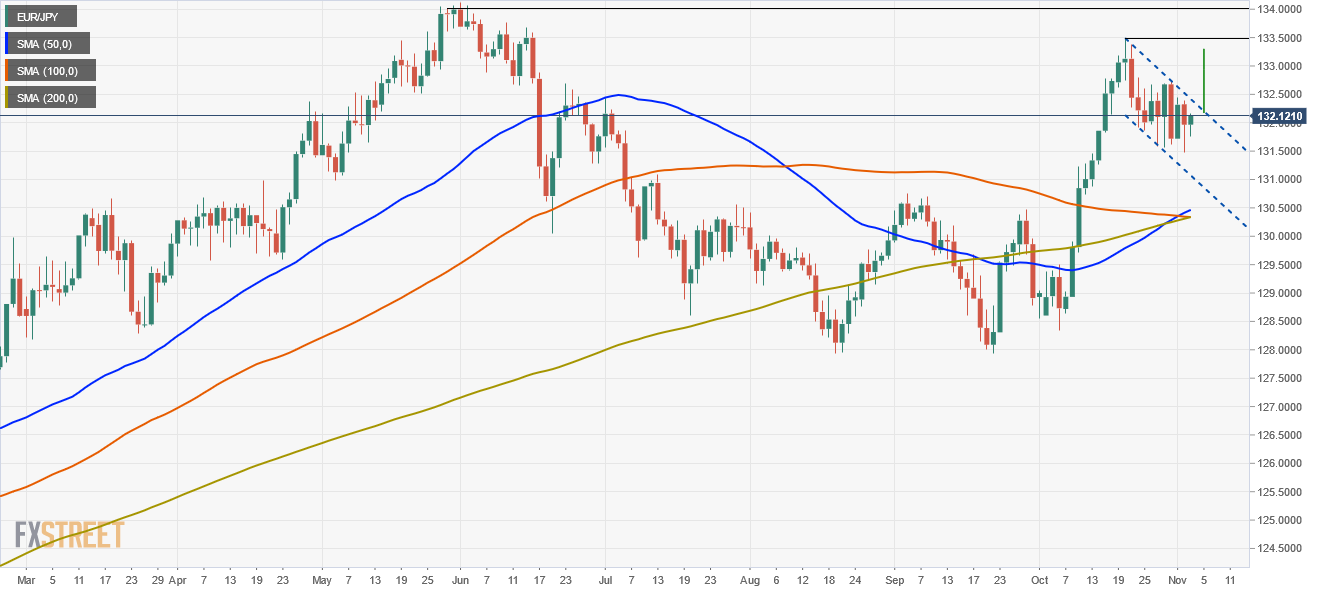
The EUR/JPY daily chart shows that the pair has an upward bias. The daily moving averages (DMA’s) are well below the spot price, with the 200-day moving average below the shortest time frames but flattish. The cross-currency seems to be forming a bullish flag, indicating that the pair has upside, but a break above the top of the bullish flag, around 132.90, is required to confirm its validity.
In the case of that outcome, the final target of the upside move would be 134.00, but it would find some hurdles on the way north. The first resistance would be 133.00, followed by a downslope trendline that travels from June 1 high towards October 20 high, around the 133.40-60 area.
The Relative Strength Index (RSI) at 56, flattish, indicates the pair could print another leg-up before reaching overbought levels.
Data released on Wednesday, showed the ISM services index reached a record high level in October. Activity has never been more fast-paced, demand shows no signs of slowing, prices show no signs of falling, good help is hard to find and the wait time for supplies is everlong, explained analysts at Wells Fargo.
Key Quotes:
“October's services ISM rose to its highest level on records that date back to 1997. A number of components rose to multi-year, if not all-time highs.”
“The biggest increase of any component was the business activity measure, which shot up 7.5 points to a record high 69.8. Service providers have never been busier at any point in the past 24 years.”
“New orders surged to 69.7, a more than six-point jump from the 63.5 level in September. Finding sales and taking new orders used to be the tricky part. In today's white-hot demand environment taking orders is a piece of cake, the challenge comes when you try to deliver those services.”
“The highest reading of any sub-component is still the prices-paid measure.”
“The primary challenge to the labor market's recovery continues to be the supply of workers. While the factors deterring workers from looking for employment have not disappeared over the past month, many have eased with fewer people reporting not looking for work due to COVID fears and childcare in October. The recent expiration of enhanced unemployment benefits amid strong wage gains should also incentivize workers to return to the labor force. Squaring all of these developments, we still expect to see that employers added 390K workers in October when the payroll report is released Friday.”
- GBP/USD is the joint best performing G10 currency on Wednesday alongside NZD.
- However, FX markets are mostly in wait-and-see mode ahead of the Fed meeting.
GBP/USD is at present trading back to the north of the 1.3650 level, having bounced from Asia Pacific session lows close to 1.3600. With the pair higher by about 0.3% so far on the session, pound sterling is the best performing G10 currency this morning alongside the New Zealand dollar. Unlike for the New Zealand dollar, which is benefitting from a stellar Q3 jobs report released during the Asia Pacific session on Wednesday, the reason’s for GBP/USD outperformance on Wednesday ahead of the much anticipated Fed monetary policy announcement is not clear.
Looking at FX markets more broadly, conditions are mostly subdued, with most of the rest of the G10 majors flat, with traders/market participants reluctant to place big bets ahead of the Fed meeting at 1800GMT and the post-meeting press conference with Fed Chair Powell at 1830GMT. The US dollar broadly ignored a stronger than expected estimate of national employment change in October from US payroll processing company ADP (which came in at 571K versus forecasts for 400K), and was unfazed by a significantly stronger than expected ISM Services PMI survey, also for October. With regards to the latter, the headline index rose to its highest since the series began at 66.7, well above forecasts for 62.0, amid a sharp rise in the business activity and new orders subindices, a sign that US growth momentum has picked up sharply at the start of Q4.
GBP outperformance could be a reflection of economic optimism after IHS Markit released their final version of the October UK Services PMI survey this morning, which saw the headline index get a decent upwards revision to 59.1 from the prior estimate of 58.0, a substantial jump from September’s reading of 55.4. That suggests economic growth momentum has improved in the UK economy heading into October. According to Duncan Brock, Group Director at the Chartered Institute of Procurement & Supply, “the dominant service sector in the UK economy had a surprisingly good month in October with a strong uptick in overall output, job creation and new orders as business and consumers began to spend again unfettered by lockdown and pandemic restrictions”.
Elsewhere, Brexit remains in the headlines; UK PM Boris Johnson said on Wednesday that the UK wants “substantive” changes to the existing Northern Ireland Protocol. Political analysts expect the UK to soon trigger Article 16, which allows to the UK to take unilateral action on the agreement if it deems the application of the protocol is resulting in serious negative consequences. EU leaders are warning the UK against taking such a step, as it opens up the prospect of further fraught negotiations on trade and legal matters that may escalate, as the ongoing UK/France fishing row also threatens to. The tone of the news on this latter dispute has improved in recent days however after the French opted not to impose retaliatory measures on the UK overfishing access and French government ministers recently praised the UK government’s constructive approach to discussions on fishing.
Looking ahead, traders won’t have much time to rest following Wednesday’s Fed event, with attention turning to a live Bank of England meeting on Thursday, where economists are split over whether or not the bank will hike rates by 15bps.
- Metals drop sharply so far on Wednesday, ahead of the FOMC statement.
- US dollar gains momentum, rises modestly following better-than-expected US data.
- XAG/USD extends weekly losses, finds support at $23.00.
Silver and gold are falling sharply on Wednesday before the FOMC statement. XAG/USD is now off lows, hovering around $23.25, down 1.20% for the day. Earlier, it tumbled to $23.00, reaching the lowest level since October 18.
The sharp decline represents an extension of the slide that started from levels near $25.00 last week. It has accelerated over the last two days, when it dropped from $24.05.
The US dollar gained some momentum following US economic data but it still remains mixed for the day across the board as market participants await the outcome of the FOMC meeting. The Federal Reserve is expected to announce a taper to its purchase program. The tone and the words of Jerome Powell are likely to trigger volatility, including metals.
The ADP reports showed private payrolls increased by 571K in October, above the 400K expected, while the ISM service sector rose to a record high level of 66.7 in October. The data boosted US yields and added support to the dollar. Still, the FOMC meeting will be the key driver, at least until Friday’s NFP.
A daily close for XAG/USD under $22.70 would point to a renewed weakness while a recovery back above $24.00 should clear the way again for a test of $25.00.
Technical levels
- AUD/USD is probing two-week lows in the lower-0.7400s, but remains close to its 21DMA.
- FX markets are calm ahead of the Fed; if they are hawkish, AUD could be an underperformer.
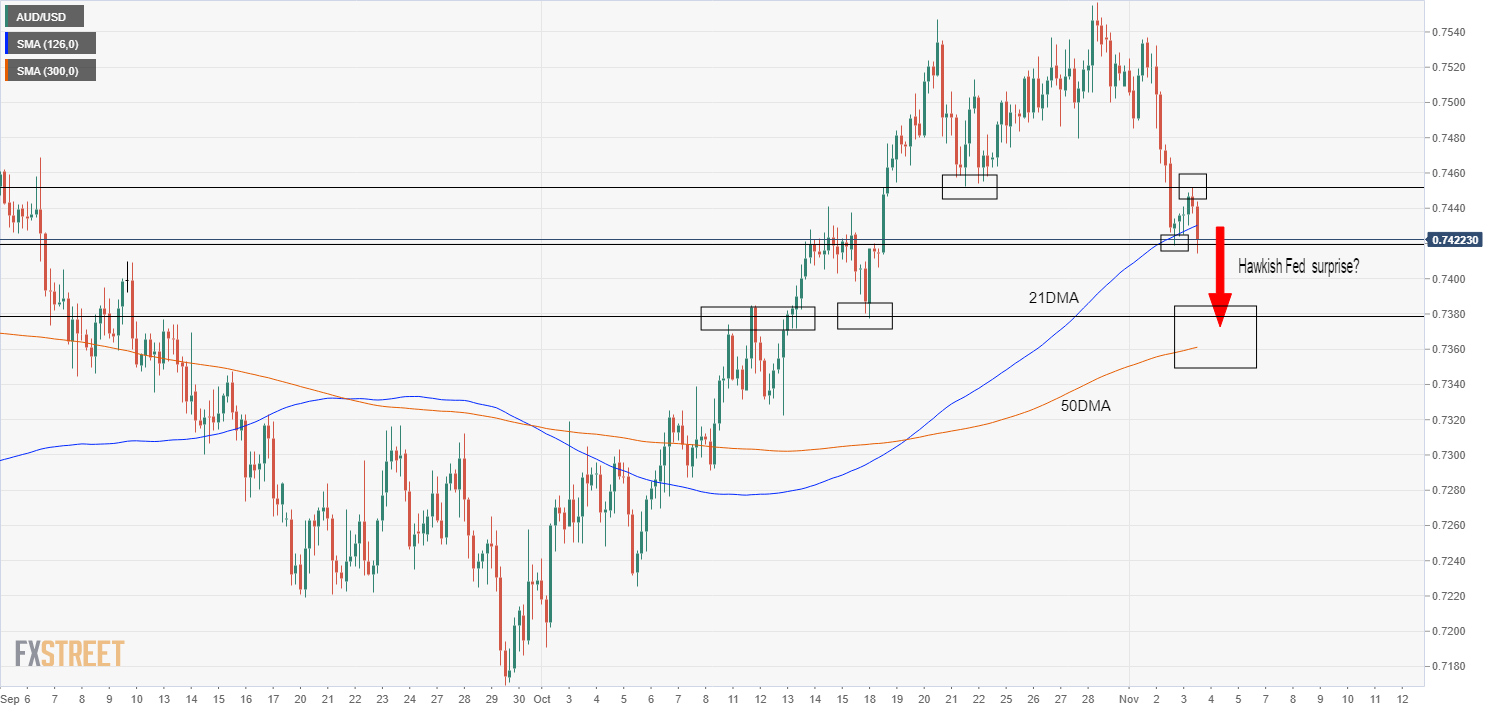
AUD/USD printed fresh two-week lows under the 0.7420 level in recent trade but has since rebounded a little and continues to trade fairly close to its 21-day moving average at 0.7428. FX markets are likely to mostly remain calm in the coming hours given the proximity of arguably the most important Fed policy announcement yet this year at 1800GMT. Fundamental catalysts for the Aussie have been light on Wednesday; Australian Housing Approvals in September saw a sharp 4.3% MoM drop due to lockdowns, but any woes were outweighed by a better than expected Chinese Caixin Service PMI report for the month of October, that saw the headline index rising to 53.8 from the flash estimate of 53.1.
If the Fed is hawkish in terms of its tone on inflation (i.e. sees upside inflation risks growing, risk that inflation is more persistent than initially thought…), AUD would be one of the G10 currencies more at risk of succumbing to the US dollar’s advances, some FX strategists have reasoned. That’s because the RBA was out earlier this week emphasising that it will not be hiking rates in 2022, rather the first hike is likely not until 2023 or even 2024, meaning the bank is likely to fall well behind the Fed with regards to monetary policy normalisation. Note that three-month eurodollar futures for June 2022 currently trade at 99.58 (versus futures for this month trading at 99.83), implying that a 25bps rate hike is pretty much fully priced in by the end of Q2 2022. Based on the same logic, currencies whose central banks are ahead of the Fed in terms of monetary normalisation, like NZD, NOK, GBP and CAD are likely to hold up better in the scenario that the Fed does deliver a hawkish surprise.
In the above-outlined scenario, AUD/USD could see an exacerbation of recent losses and move below the 0.7400 level and towards 0.7350, where the 50DMA resides, would be on the cards. Technicians continue to cite AUD/USD’s recent failure to break above the 200DMA recently in the 0.7550 area as a bearish near-term indicator.
- Pound outperforms on Wednesday ahead of Bank of England announcement on Thursday.
- Yen under pressure amid higher US yields.
- GBP/JPY above the 20-SMA in 4-hour charts fails at 156.00.
The GBP/JPY gained momentum on Wednesday on the back of a stronger pound and a weak Japanese yen. The cross broke above 155.50 and jumped reaching at 155.90, a two-day high.
The rally lost momentum near 156.00 and the pound pulled back modestly. The intraday bias is still positive. GBP/HJPY is trading around two key levels: the 156.00 resistance and the 20-SMA in four-hour charts. If it manages to rise clear above 1256.00, the outlook would look brighter for the pound. The next resistance stands at 156.40.
If GBP/JPY is unable to regain 156.00 it will keep the cross in a bearish channel. A close below 155.00 should expose the weekly low at 154.62. Below the next support stands at 154.40.
GBP/JPY 4-hour chart
-637715493148294376.png)
- USD/CAD reached a daily high of around 1.2450, on upbeat US economic data.
- Falling crude oil prices weaken the commodity-linked Canadian dollar.
- Investors' expectations of US interest rates edge up, portrayed by the US 2-year yield, almost at 0.50%.
USD/CAD climbs during the New York session, up 0.06%, trading at 1.2424 at the time of writing. As portrayed by European and US equity indices fluctuating between gainers and losers, the market sentiment is subdued ahead of the Federal Reserve meeting.
Also, retreating crude oil prices, with Western Texas Intermediate (WTI) falling almost 3.5%, undermined the oil-linked currency, acting as a headwind for the CAD. Nevertheless, the price action is to remain within narrow ranges, as the greenback keeps contained, showed by the US Dollar Index, at 94.11, barely up 0.02%.
US T-bond yields rise ahead of the FOMC, the 2-year almost at 0.50%
Meanwhile, the US 10-year Treasury yield advances two basis points, sitting at 1.566%, while the US 2-year Treasury yield, which could give hints of market participants' point of view about short-term interest rates, is at 0.48%, three basis points up.
Investors expect the Federal Reserve to announce the reduction of its pandemic Quantitative Easing program. The total amount of monthly purchases of about $120 billion is expected to be cut by $15 billion, as the US central bank looks to normalize monetary policy conditions. Once the statement is released, the focus would turn to the Fed Chairman Jerome Powell post-meeting press conference.
In the meantime, the US economic docket featured the US ADP report, which unexpectedly surprised markets, showed the creation of 571K jobs added to the economy against 400K foreseen by analysts. Furthermore, the ISM Services PMI for October rose to 66.7, higher than the 62 estimated, showing the resilience of the services sector amid COVID-19 lockdowns.
FX Market Reaction
The USD/CAD rose to 1.2450 on the economic releases, but retreated at current levels, as investors await the FOMC meeting.
USD/CAD Price Forecast: Technical outlook
The USD/CAD daily chart depicts a break above an ascending channel around 1.2420. The price is pushing towards the 200-day moving average (DMA) that lies at 1.2481, a crucial level to watch at 18:00 GMT when the Federal Reserve unveils its monetary policy statement. In the case of an upbreak above the 200-DMA, traders would expect the price to travel towards the 100-DMA around 1.2530, but first, the 1.2500 figure needs to be broken.
On the flip side, the 1.2400 area could be the area to defend for USD/CAD bulls. Once it is broken, the 1.2350 support level, where the price has been seesawing for two weeks, would be the next to be tested.
The Relative Strength Index (RSI) at 49 is slightly up. A pierce the 50 mid-line would confirm a bullish signal in case of opening fresh bids on the USD/CAD pair.
- The barrel of WTI loses further ground and trades close to $81.00.
- The EIA said US crude oil supplies rose more than expected.
- The FOMC event will grab all the attention later on Wednesday.
Prices of the barrel of the America benchmark for the sweet light crude oil remain on the defensive and approach the $81.00 mark midweek.
WTI in 4-day lows
Crude oil prices lose ground for the second session in a row on Wednesday and threaten to breach the $81.00 mark per barrel following another unexpected build in weekly US crude oil inventories.
Indeed, the EIA reported a 3.291M barrels build during the week ended on October 29, while supplies at Cushing shrank by 0.916M barrels and gasoline inventories went down by 1.488M barrels. The larger-than-expected increase in crude oil stockpiles added to the nearly 3.6M barrel build reported by the API late on Tuesday.
Also weighing on crude oil prices, commodities and the rest of USD-dubbed assets appears the better tone in the greenback ahead of the key FOMC event due later in the European evening.
WTI significant levels
At the moment the barrel of WTI is losing 1.85% at $81.49 and a breach of $80.62 (weekly low October 28) would aim for $79.44 (weekly low Oct.13) and then $74.99 (weekly low Oct.7). On the upside, the next hurdle is located at $84.85 (monthly high Nov.1) followed by $85.39 (2021 high Oct.25) and finally $86.00 (round level).
- EUR/GBP has slipped back underneath the 0.8500 level and is eyeing a test of its 21DMA at 0.8465.
- The main driver of the pair this week is set to be Thursday’s key Bank of England meeting.
EUR/GBP has slipped back underneath the 0.8500 level on Wednesday after flirting with the key area of resistance over the past few days. The catalyst for the move lower from above 0.8500, where the pair was trading as recently as the Wednesday European open, to current levels under 0.8480, isn't clear; IHS Markit’s final UK Services PMI survey for October was released this morning and saw upwards revision versus the flash estimate released last month and some have suggested this is helping sterling this morning. Commentary from ECB members this morning has also been quite dovish, with members pushing back against the idea of rate hikes in 2022, which contrasts strongly with expectations for rate hikes from the Bank of England as soon as Thursday this week.
Whatever the reason for the move lower, EUR/GBP is now testing support in the form of the 28 October high at 0.8475 ahead of a potential test of its 21-day moving average at 0.8465. The main driver of the pair for the rest of the week will of course be Thursday’s aforementioned BoE meeting – with markets unsure as to whether the bank will hike rates or not and as to what the voting split on rate hikes will be, the higher than usual degree of uncertainty about this meeting means the FX market reaction could be choppy and go both ways.
ECB pushes back against hawkish market pricing
A number of ECB policymakers have spoken publically thus far on Wednesday. The most important comments came from ECB President Christine Lagarde; after she was criticised last week for not pushing back as strongly against money market pricing for rate hikes in 2022 as markets had expected her to, resulting in volatile conditions in FX and bond markets in the days since Lagarde was a little more explicit on Wednesday. The conditions that the ECB wants to see before it starts hiking interest rates (i.e. that inflation is above the 2.0% target and that is it expected to remain there for the duration of the bank’s forecast horizon) are unlikely to have been met next year, she said, saying that the Eurozone economy would continue to require support even after the pandemic has faded. Moreover, Lagarde added that the medium-term inflation outlook remains subdued.
Three-month Euribor futures for December 2022, which slumped as low as 100.155 last Friday (implying that markets were pricing as much as 50bps of ECB rate hikes by the end of 2022), are now back to trading around 100.30, which implies a more modest 30bps of hikes by the end of next year. If ECB policymakers are right, this could rally all the way back to the 100.50 area (which would imply no hikes). This would likely weigh on the euro, though for now FX markets are focused on the upcoming Fed meeting.
Brexit, fish wars
Brexit remains in the headlines; UK PM Boris Johnson was recently on the wires talking about how the UK wants “substantive” changes to the existing Northern Ireland Protocol. Political analysts expect the UK to soon trigger Article 16, which allows the UK to take unilateral action on the agreement if it deems the application of the protocol is resulting in serious negative consequences. EU leaders are warning the UK against taking such a step, as it opens up the prospect of further fraught negotiations on trade and legal matters that may escalate, as the ongoing UK/France fishing row also threatens to. The tone of the news on this latter dispute has improved in recent days however after the French opted not to impose retaliatory measures on the UK overfishing access and French government ministers recently praised the UK government’s constructive approach to discussions on fishing.
- EUR/USD keeps the offered stance unchanged around 1.1570.
- US ADP report surprised to the upside in October at 571K jobs.
- The FOMC event is due later with QE tapering in the centre of the debate.
Sellers seem to remain in control of the sentiment around the European currency and force EUR/USD to drop to daily lows near 1.1560 on Wednesday.
EUR/USD weaker on US data, looks to the Fed
EUR/USD now accelerates losses and adds to Tuesday’s bearish price action against the backdrop of further recovery in the greenback as well as the prevailing cautiousness ahead of the FOMC gathering.
Indeed, the buying interest in the dollar improved further after above-estimated results from the US calendar. Actually, the US ADP report showed the US economy added 571K jobs during October, while the ISM Non-Manufacturing rose to 66.7 during last month and headline Factory Orders expanded at a monthly 0.2% in September.
Further upside in the buck also comes in response to the rebound in US yields in the front end and the belly of the curve to 0.50% and 1.57%, respectively.
EUR/USD levels to watch
So far, spot is losing 0.12% at 1.1565 and faces the next up barrier at 1.1689 (55-day SMA) followed by 1.1692 (monthly high Oct.28) and finally 1.1755 (weekly high Sep.22). On the other hand, a break below 1.1535 (weekly low Oct.29) would target 1.1524 (2021 low Oct.12) en route to 1.1495 (monthly low Mar.9 2020).
- ISM Services PMI rose to a new all-time high in October.
- US Dollar Index holds in the positive territory above 94.00.
The business activity in the US service sector continued to expand at a record-setting pace in October with the ISM Services PMI jumping to 66.7 from 61.9 in September. This reading beat the market expectation of 62 by a wide margin.
Further details of the publication revealed that the Prices Paid Index rose to 82.9 from 77.5 and the Employment Index retreated to 51.6 from 53. Finally, the New Orders Index improved to 69.7 from 63.5.
Commenting on the survey, "in October, strong growth continued for the services sector, which has expanded for all but two of the last 141 months," said Anthony Nieves, Chair of the ISM Services Business Survey Committee. "However, ongoing challenges — including supply chain disruptions and shortages of labor and materials — are constraining capacity and impacting overall business conditions."
Market reaction
The greenback preserves its strength after this report and the US Dollar Index was last seen rising 0.1% on the day at 94.18.
- Wall Street's main indexes opened modestly lower on Wednesday.
- Falling crude oil prices continue to weigh on energy shares.
- Fed will announce monetary policy decisions later in the session.
Major equity indexes in the US started the day with small losses on Wednesday as investors stay on the sidelines while waiting for the US Federal Reserve to announce monetary policy decisions.
As of writing, the S&P 500 was down 0.12% on the day at 4,625, the Dow Jones Industrial Average was losing 0.35% at 35,923 and the Nasdaq Composite was virtually unchanged at 15,655.
Among the 11 major S&P 500 sectors, the Energy Index is down more than 1% pressured by a more-than-1% decline witnessed in US crude oil prices. On the other hand, the Consumer Discretionary Index is up 0.4% as the biggest gainer after the opening bell.
S&P 500 chart (daily)
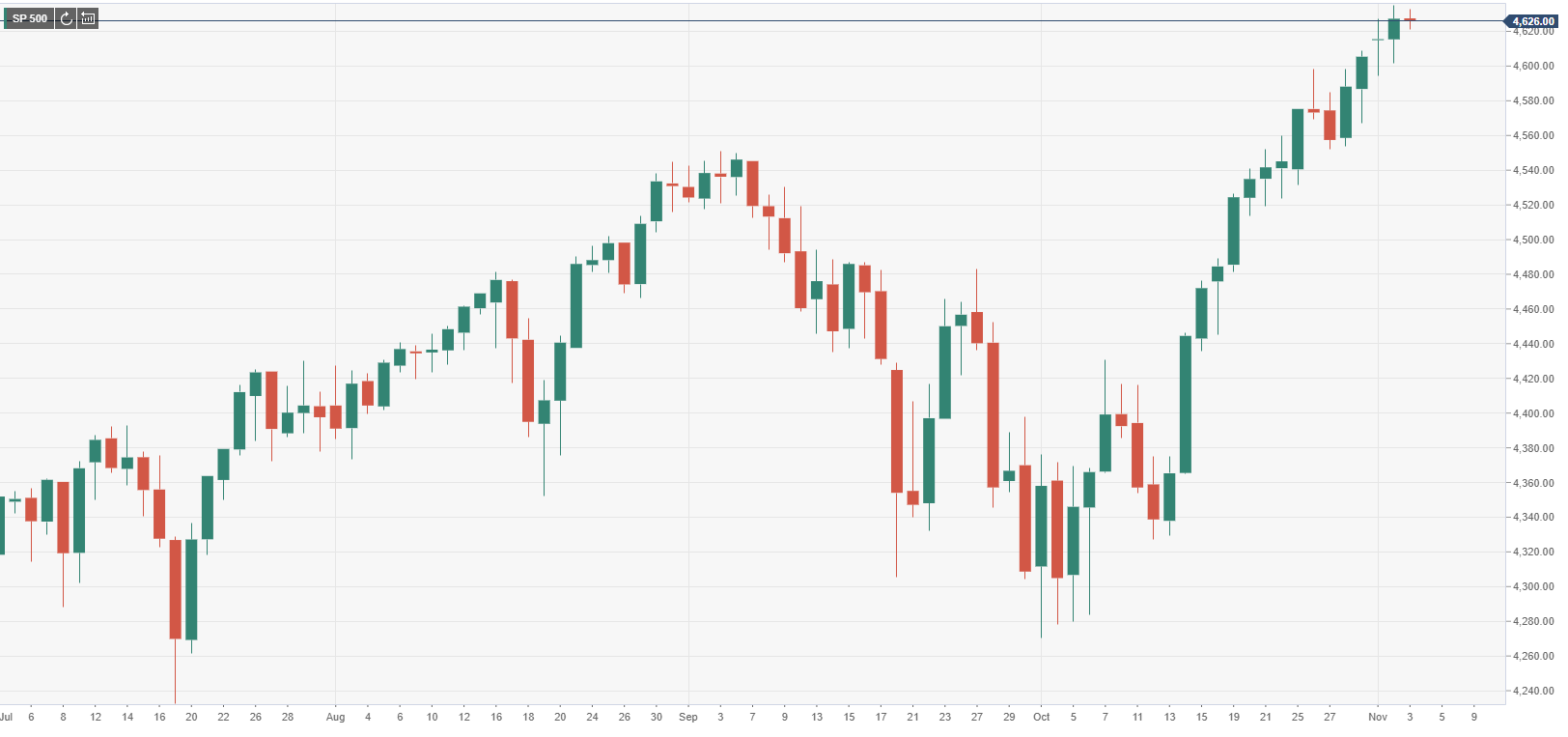
- USD/JPY reversed an intraday dip amid the emergence of fresh buying around the USD.
- Upbeat ADP report reaffirmed hawkish Fed expectations and revived the USD demand.
- The cautious mood underpinned the JPY and capped gains ahead of the FOMC decision.
The USD/JPY pair gained some positive traction during the early North American session and inched back closer to daily tops, around the 114.00 mark in the last hour.
The US dollar attracted some dip-buying on Wednesday and reversed its intraday losses in reaction to upbeat US macro data, which, in turn, acted as a tailwind for the USD/JPY pair. The ADP reported that the US private=sector employers added 571K jobs in October, beating estimates for a reading of 400K by a big margin and reaffirming hawkish Fed expectations.
Meanwhile, the cautious mood – as depicted by a generally weaker tone around the equity markets – could benefit the safe-haven Japanese yen and cap gains for the USD/JPY pair. Investors might also refrain from placing aggressive bets heading into the key central bank event risk – the outcome of a critical two-day FOMC monetary policy meeting.
The Fed is scheduled to announce its decision later during the US session and is widely anticipated to begin tapering its $120 billion-a-month bond purchase program. The markets also seem convinced that the US central bank would be forced to adopt a more aggressive policy response amid fears of a faster-than-expected rise in inflationary pressures.
Hence, the focus will be on the accompanying monetary policy statement. Apart from this, Fed Chair Jerome Powell's remarks at the post-meeting press conference will be looked upon for clues about the likely timing when the Fed will hike interest rates. This, in turn, will influence the USD and provide a fresh directional impetus to the USD/JPY pair.
Hence, it will be prudent to wait for some follow-through buying before positioning for the resumption of the strong appreciating move from the 109.00 neighbourhood touched in September. In the meantime, repositioning trade might infuse some volatility in the markets and allow traders to grab short-term opportunities around the USD/JPY pair.
Technical levels to watch
Irish Prime Minister Micheal Martin said on Wednesday that it would be unwise and reckless for the British government to trigger Article 16, as reported by Reuters.
Additional takeaways
"Triggering Article 16 would have far-reaching implications for UK-EU relations."
"UK raising of the ECJ issue is disingenuous and wrong."
"Current situation with regards to Brexit is very challenging and very serious."
Market reaction
The GBP/USD pair is edging lower from session highs in the early American session and was last seen trading at 1.3640, where it was still up 0.2% on a daily basis.
- XAU/USD has dropped under support just above $1770 following a strong ADP report.
- Focus now turns to the Fed announcement, where the bank will unveil its QE taper plans.
Spot gold (XAU/USD) prices have been dropping in recent trade and have recently dropped under a key area of support in the form of last week’s low at just above $1770. As things stand, XAU/USD is trading slightly under $1770 with losses of more than 1.0%. FX and bond markets are not on the move, rather, the DXY not moving much and is just above 94.00, while 10-year nominal and real yields are not moving much in the respective 1.55% and -1.0% areas, so the recent drop is not being driven by cross-asset correlations.
Strong jobs data triggers the drop
The catalyst for the most recent drop appears to have been stronger than expected jobs data from US payroll processing company ADP, whose national employment change estimate for October was released at 1215GMT and showed 571K jobs being added to the economy last month. ADP has a patch record in the post-pandemic era when it comes to accurately predicting the official non-farm payroll (NFP) number released by the US Bureau of Labour Statistics each month. Nonetheless, a stronger-than-expected ADP estimate is usually seen as a good sign that increases the chance the NFP number is going to be strong.
The median estimate for Friday’s NFP number currently stands at 450K, but in wake of the ADP data, some economists and analysts might be inclined to increase their guesses. If the US labour market report on Friday is as strong as hoped, or even stronger, this would support the case for faster policy normalisation by the Fed, most analysts agree. A more hawkish Fed means higher interest rates sooner, which would likely also translate into higher bond yields, which would raise the opportunity cost of non-yielding gold.
Upcoming Fed policy announcement
Speaking of the Fed, the immediate focus for FX, bond and precious metal markets is the Fed upcoming policy announcement at 1800GMT on Wednesday, followed by the usual press conference with Fed Chair Jerome Powell at 1830GMT. The Fed is widely expected to announce its QE tapering plans; purchases are currently running at a pace of $120B per month and this is likely to be reduced at a pace of $15B per month (meaning net purchases reach zero by June 2022). The QE taper announcement will not trigger a market reaction as it is now very much priced in, unless of course the Fed opts for a more aggressive pace of taper of say $20B per month, which would be interpreted by markets hawkishly (negative for gold).
Tapering aside, the most important theme at this Fed meeting is the tone of the statement of Powell’s remarks when it comes to inflation; the Fed has in the past brushed off the current spike in inflation as mostly as a result of transitory factors, but they are under growing pressure to acknowledge that there is a growing risk this is not the case. In recent weeks, Fed members have conceded that pro-inflationary supply chain disruptions may persist longer than expected, labour market indicators are increasingly tight (wage inflation is growing) and there is a risk that consumer and market-based measures of inflation expectations may become de-anchored from the Fed’s 2.0% target as energy costs surge. The Fed is thus going to sound more hawkish on inflation, but whether they will sound hawkish enough to live up to money market pricing which looks for rate hikes as soon as mid-2022 is another question. Any reference to money market pricing by the Fed chair would be of significant interest.
European Central Bank (ECB) Governing Council member Francois Villeroy de Galhau said on Wednesday that there was no need for the ECB to raise its policy rate in 2022, as reported by Reuters.
Regarding the inflation outlook in France, Villeroy noted that it's expected to return below 2% next year.
Market reaction
The shared currency came under renewed bearish pressure following these comments. As of writing, the EUR/USD pair was trading at fresh session lows near 1.1570, losing 0.05% on a daily basis.
- Upbeat Chinese PMI, renewed USD weakness assisted AUD/USD to gain traction on Wednesday.
- The USD bulls seemed unimpressed and largely shrugged off stronger than expected ADP report.
- Investors seemed reluctant ahead of the highly-anticipated FOMC monetary policy decision.
The AUD/USD pair traded with a mild positive bias through the early North American session, albeit seemed struggling to capitalize on the move beyond mid-0.7400s.
The pair gained some positive traction on Wednesday and recovered a part of the previous day's heavy losses, triggered by a less hawkish Reserve Bank of Australia (RBA). Upbeat Chinese's macro data extended some support to the aussie, which, along with the emergence of fresh selling around the US dollar provided a modest lift to the AUD/USD pair.
Meanwhile, the intraday USD decline lacked any obvious fundamental catalyst and remained limited amid expectations for an early policy tightening by the Fed. Apart from this, a better-than-expected ADP report, showing that the US private-sector employers added 571K jobs in October, acted as a tailwind for the greenback and capped gains for the AUD/USD pair.
The downside, however, remains cushioned, at least for the time being, as investors seemed reluctant to place aggressive bets ahead of the key central bank event risk. The Fed is scheduled to announce its monetary policy decision later during the US session and is widely expected to begin tapering its $120 billion-a-month bond purchase program.
The markets have fully priced in the expected move, suggesting that the focus will be on the monetary policy statement and Fed Chair Jerome Powell's remarks at the post-meeting press conference. Investors will look for clues about the likely timing when the Fed would start raising interest rates, which will play a key role in influencing the greenback.
On the other hand, the RBA was not very concerned about inflation on Tuesday and Governor Philip Lowe downplayed expectations for lift-off in 2022. The diverging central bank policy outlooks favour bearish traders and support prospects for an extension of the rejection slide from a technically significant 200-day SMA tested last week.
Technical levels to watch
- NZD/USD is currently trading at 0.7140, having bounced from its 200DMA on Tuesday, aided by strong NZ jobs numbers.
- The main driver of FX market price action on Wednesday is set to be the Fed meeting.
NZD/USD recently broke back to the north of an area of prior support turned resistance at 0.7130 in recent trade, as the currency benefits from the tailwind of a stellar Q3 jobs report released in early in the Wednesday Asia Pacific trading session. Dip-buying, when the pair hit its 200DMA at 0.7100 on Tuesday, may also have helped it recover, and with the pair now changing hands at around 0.7140, it is holding onto gains of about 0.4% on the day, making the kiwi the best performing G10 currency on the day.
Trading conditions in broader FX markets are quite subdued, however, and this is likely to cap further NZD/USD gains over the coming hours, with market participants now in wait and see mode ahead of the Fed’s latest monetary policy announcement at 1800GMT, followed by the usual press conference 30 minutes later with the Fed Chair Jerome Powell. A smattering of US data releases between now and the Fed event might be of some interest to FX traders, though most will likely still refrain from placing any big bets just yet.
On the topic of US data; ADP (a major US payroll processing company) just released their monthly estimate of employment change and think that the US economy added 571K jobs in October, more than the 400K added jobs analysts had been expecting their data to show. Over the last few months, ADP has had a mixed record when it comes to predicting the actual non-farm payrolls (NFP) number released by the US Bureau of Labour Statistics, but in wake of the strong ADP number, some economists might be inclined to revise slightly higher their estimate for the official NFP number. The median economist for Friday’s payroll number is currently 450K.
USD has not reacted to the data, thus NZD/USD remains close to 0.7140. It will be worth keeping an eye on upcoming the release of the final October Markit Services PMI survey at 1345GMT and then the release of the more widely followed ISM Services PMI survey, also for October, at 1400GMT.
Strong Kiwi Jobs
According to the Household Labour Force Survey (HFLS), the unemployment rate in New Zealand dropped to 3.4% in Q3, down from 4.0% in Q2, a much larger decline than any economists or local banks had been expecting (both Westpac and ANZ had seen a drop to 3.8%), despite a Covid-19 outbreak leading to the imposition of a national lockdown and localised lockdowns of varying degrees of strictness continuing since. That took the unemployment rate to its lowest since Q4 2007, prior to the global financial crisis. There were also signs of building wage pressures, with labour costs up 0.7% QoQ and rising to 2.5% YoY, while average household earnings were up 1.2% on the quarter. The participation rate also sharply to 71.2% from 70.5% in Q2, as improving labour market prospects attracted workers back to the labour market.
The strong data supports the case for the RBNZ to continue with its policy of the gradual removal of monetary stimulus (i.e. 25bps rate hikes at each meeting) and might even embolden some of the more hawkish members to argue that this pace of rate hikes out to be accelerated. The unemployment rate is now well below the RBNZ or any other economists estimate of NAIRU, which is the estimate of the “natural” rate of unemployment below which wage driven inflation pressures will start to build, and with inflation already near 5% YoY in Q3, the RBNZ will be keen to act to prevent longer-term measures of inflation expectations from becoming deanchored.
- GBP/USD gained strong positive traction on Wednesday and reversed the overnight losses.
- A modest USD weakness prompted some short-covering ahead of the key FOMC decision.
- The USD bulls remained on the defensive following the release of the upbeat US ADP report.
The GBP/USD pair added to its intraday gains and shot to fresh daily tops, around the 1.3660 region heading into the North American session.
Having defended the 1.3600 mark, the GBP/USD pair staged a goodish rebound on Wednesday and has now reversed the previous day's losses to three-week lows. The uptick lacked any obvious fundamental catalyst and could be attributed to a modest US dollar weakness amid some repositioning trade ahead of the key event risk.
The USD bulls remained on the defensive and largely shrugged off a stronger ADP report, which showed that the US private-sector employers added 571K jobs in October. This was above the 400K anticipated and slightly higher than the 568K reported in the previous month, though did little to provide any meaningful impetus.
The market focus remains glued to the outcome of a critical FOMC meeting, scheduled to be announced later during the US session. The Fed is widely expected to begin tapering its $120 billion-a-month bond purchase program, though the investors will look for clues about the likely timing for the Fed's policy tightening.
Hence, the accompanying monetary policy statement and Fed Chair Jerome Powell's comments at the post-meeting press conference will draw plenty of market attention. This, along with the Bank of England meeting on Thursday, should assist investors to determine the next leg of a directional move for the GBP/USD pair.
In the meantime, the impasse over the Northern Ireland Protocol, along with worries that the UK Prime Minister Boris Johnson will trigger Article 16 might hold bulls from placing aggressive bets. This, in turn, warrants some caution before confirming that the GBP/USD pair has bottomed out and positioning for any further gains.
Technical levels to watch
- EUR/USD posts mild gains in the 1.1580/90 band ahead of FOMC.
- A drop to the YTD low at 1.1524 remains on the cards.
EUR/USD partially recovers the ground lost following Tuesday’s daily pullback.
As long as the pair keeps trading below recent tops near 1.1600, a move lower should not be ruled out. Against that, EUR/USD faces the next support at the weekly low at 1.1535 (October 29) ahead of another potential visit to the 2021 low at 1.1524 (October 12.
In the meantime, the near-term outlook for EUR/USD is seen on the negative side below the key 200-day SMA, today at 1.1895.
EUR/USD daily chart
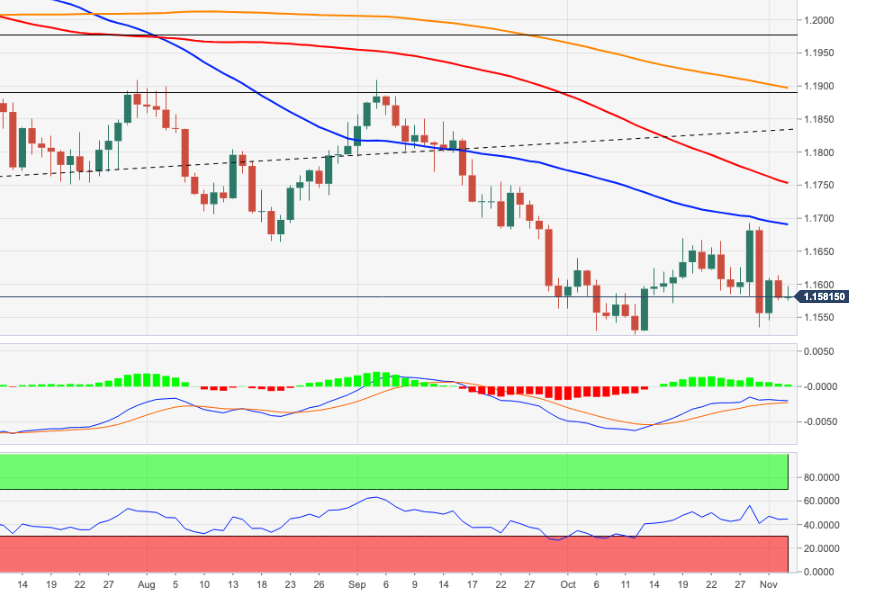
- ADP Employment Change came in better than expected in October.
- US Dollar Index continues to tread water above 94.00.
Employment in the US' private sector rose by 571,000 in October, the monthly data published by the Automatic Data Processing (ADP) Research Institute revealed on Wednesday. This reading followed September's print of 523,000 (revised from 568,000) and came in better than the market expectation of 400,000.
Commenting on the data, "the labor market showed renewed momentum last month, with a jump from the third quarter average of 385,000 monthly jobs added, marking nearly 5 million job gains this year," said Nela Richardson, chief economist, ADP. "Service sector providers led the increase and the goods sector gains were broad-based, reporting the strongest reading of the year."
Market reaction
The US Dollar Index showed no immediate reaction to this report and was last seen moving sideways above 94.00.
- DXY fades Tuesday’s daily drop and challenges 94.00.
- Next on the upside is located the monthly high around 94.30.
Price action around DXY stays choppy and now returns to the negative territory in the 94.00 region on Wednesday.
Further recovery is now predicted to challenge last week’s tops around 94.30. A move further north from there could pave the way for another visit to the 2021 high at 94.56 (October 12) in the relatively near term.
Looking at the broader picture, the constructive stance on the index is seen unchanged above the 200-day SMA at 92.01.
DXY daily chart
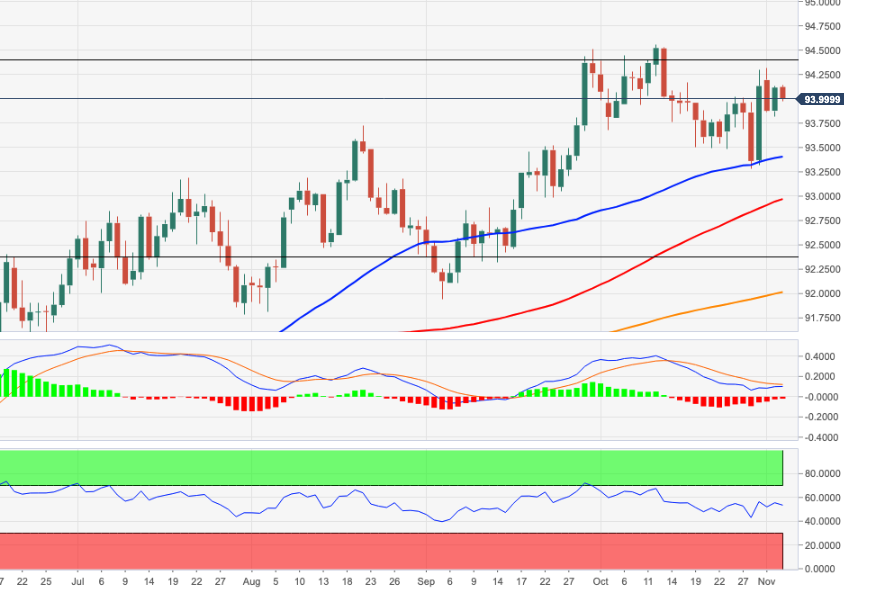
- EUR/JPY adds to the ongoing weekly pullback on Wednesday.
- The mid-131.00s emerge as the next area of contention.
The selling bias around EUR/JPY remains well in place for the second session in a row on Wednesday.
The continuation of the downtrend is predicted to meet the next support of relevance around 131.50, where recent lows and a Fibo retracement (of the October’s rally) coincide. A move further south from here should expose a visit to another Fibo level at 130.97.
In the broader scenario, while above the 200-day SMA at 130.29, the outlook for the cross is expected to remain constructive.
EUR/JPY daily chart
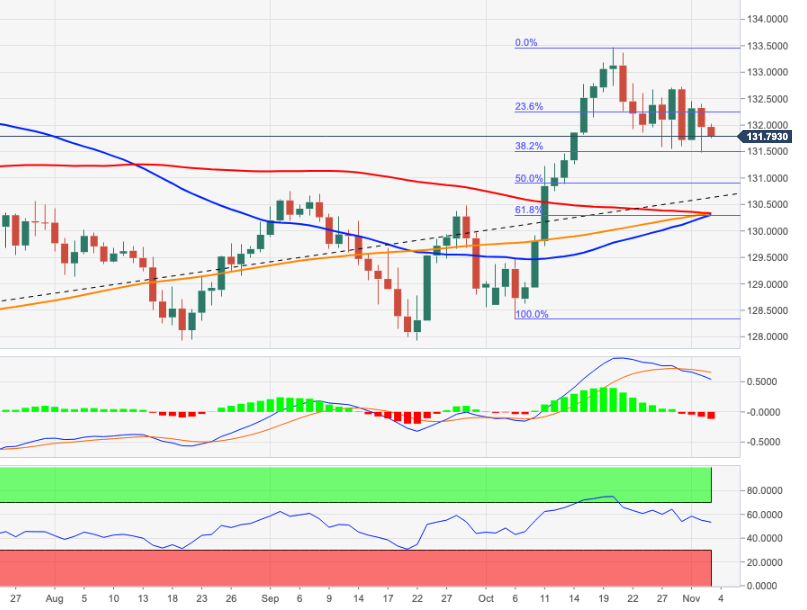
- USD/CAD remained confined in a narrow trading band through the mid-European session.
- Sliding crude oil prices undermined the loonie and extended some support to the major.
- A softer tone around the USD capped gains amid nervousness ahead of the FOMC decision.
The USD/CAD pair lacked any firm directional bias and seesawed between tepid gains/minor losses through the mid-European session. The pair was last seen trading around the 1.2410-15 region, nearly unchanged for the day.
A combination of diverging forces failed to provide any meaningful impetus, or assist the USD/CAD pair to capitalize on the previous day's positive move. Retreating crude oil prices – now down over 2% – undermined the commodity-linked loonie and acted as a tailwind for the major. However, the upside remains capped amid the emergence of some selling around the US dollar.
Meanwhile, the USD downtick lacked any obvious fundamental catalyst and could be attributed to some repositioning trade ahead of the key event risk – the outcome of a critical two-day FOMC meeting. The Fed is scheduled to announce its policy decision during the US session and is widely anticipated to begin tapering its $120 billion-a-month bond purchase program.
The move is fully priced in the markets and investors will look for clues about the likely timing when the Fed would hike interest rates. Hence, the market focus will be on the accompanying monetary policy statement and Fed Chair Jerome Powell's remarks at the post-meeting press conference. This will influence the USD and provide a fresh directional impetus to the USD/CAD pair.
In the meantime, investors' reluctance to place aggressive bets turned out to be a key factor that led to a subdued/range-bound price action. Market participants now look forward to the release of the ADP report on private-sector employment and ISM Services PMI. Any significant divergence from expected readings might produce some trading opportunities around the USD/CAD pair.
Technical levels to watch
"The recent surge in inflation is transitory, however factors behind it could be more persistent than initially estimated," European Central Bank (ECB) Governing Council member and Spanish central bank chief Pablo Hernandez de Cos said on Wednesday, per Reuters.
Additional takeaways
"This could lead to relatively high rates of inflation in coming months."
"There is currently high uncertainty about the duration of the current inflation surge."
"As pointed out by ECB President Christine Lagarde, ECB's forward guidance does not support the market view of a first interest rate hike in the third quarter of 2022 nor any time soon afterwards."
Market reaction
The EUR/USD pair showed no immediate reaction to these remarks and was last seen posting small daily gains at 1.1585.
- USD/TRY adds to Tuesday’s gains and approaches 9.80.
- Turkey’s CPI rose less than expected in October.
- Unconfirmed rumours regarding Erdogan’s death/severe illness re-surfaced.
The Turkish lira extends the bearish note for the second session in a row and pushes USD/TRY to the 9.75 region on Wednesday.
USD/TRY climbs to new multi-day highs
USD/TRY is up for the second straight session and now trades at shouting distance from the all-time peak near 9.85 recorded on October 25.
The re-emergence of rumours regarding President Erdogan’s death or severe illness condition seems to be adding extra pressure on the Turkish currency. It is worth noting, however, that these rumours are not new to the markets and that they remain unconfirmed.
On the domestic backyard, inflation in Turkey extended the uptrend in October, this time showing consumer prices rose 19.89% vs. the same month of 2020, a tad below forecasts for a +20.0% reading. On a monthly basis, the CPI rose 2.39%. Further data saw Producer Prices rising 5.24% inter-month and 46.31% over the last twelve months.
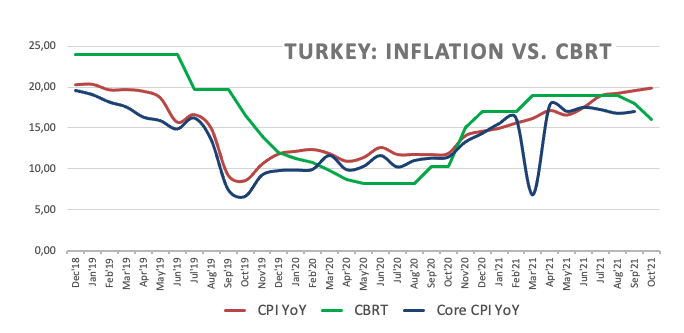
USD/TRY key levels
So far, the pair is gaining 0.66% at 9.6634 and a drop below 9.4128 (weekly low Oct.26) would aim for 9.3386 (20-day SMA) and finally 9.1965 (weekly low Oct.21). On the other hand, the next up barrier lines up at 9.8395 (all-time high Oct.25) followed by 10.0000 (psychological level).
US ADP jobs report overview
Wednesday's US economic docket highlights the release of the ADP report on private-sector employment, scheduled at 12:15 GMT. According to the consensus estimates, the US private-sector employers added 400K jobs in October, down from 568K in the previous month. The report will influence expectations from Friday's official Nonfarm Payrolls (NFP) report, though is likely to be overshadowed by the key central bank event risk.
How could it affect EUR/USD?
The Fed is scheduled to announce its latest monetary policy decision later during the US session and is widely expected to begin tapering its bond purchases. Given that the Fed's tapering move is fully priced in, investors will look for clues over the timing when the US central bank will hike interest rates. This, in turn, suggests that the market would react little to the data, albeit any significant divergence from the expected reading might still provide some impetus.
Meanwhile, Eren Sengezer, Editor at FXStreet, offered a brief technical outlook for the EUR/USD pair: “The near-term technical outlook shows that the pair remains in a consolidation phase with the Relative Strength Index (RSI) indicator on the four-hour chart moving sideways around 50. However, EUR/USD stays below the 20, 50, 100 and 200-period SMAs on the same chart, suggesting that buyers are showing no interest in the euro for the time being.”
Eren also outlined important technical levels to trade the major: “On the upside, 1.1600 (psychological level, 100-period SMA) now aligns as the first line of resistance ahead of the 1.1620/30 area (Fibonacci 23.6% retracement of September downtrend, 200-period SMA) and 1.1670 (Fibonacci 38.2% retracement).1.1580 (static level) is acting as interim support before the pair can target 1.1550 (static level) and 1.1525 (2021 low).”
Key Notes
• US ADP Employment Change October Preview: The labor market plays second fiddle
• EUR/USD Forecast: Euro's failure to hold above 1.1600 a warning sign before Fed?
• EUR/USD Price Analysis: Bears seeking a break below 1.15 the figure
About the US ADP jobs report
The Employment Change released by the Automatic Data Processing, Inc, Inc is a measure of the change in the number of employed people in the US. Generally speaking, a rise in this indicator has positive implications for consumer spending, stimulating economic growth. So a high reading is traditionally seen as positive, or bullish for the USD, while a low reading is seen as negative, or bearish.
- EUR/USD trades within a narrow range around 1.1580.
- EMU Unemployment Rate ticked lower to 7.4% in September.
- The FOMC event takes centre stage later in the NA session.
The single currency exchanges gains with losses vs. the greenback and prompts EUR/USD to navigate a tight range in the 1.1580 zone on Wednesday.
EUR/USD looks to FOMC
EUR/USD manages to somewhat reverse Tuesday’s pullback and trades in a cautious note in line with the rest of the global markets, all ahead of the imminent FOMC meeting later on Wednesday.
It is worth recalling that markets’ consensus sees the Federal Reserve announcing the start of the QE tapering process this month, with bets falling on a potential $15B per month and to finish at some point in mid-2022. Investors, however, remain divided on whether it will be a dovish or a hawkish taper.
In the euro docket, the jobless rate in the broader Euroland went down to 7.4% in September, matching the previous forecasts.
Later in the US data space, the weekly Mortgage Applications by MBA are due seconded by Factory Orders, the ADP report and the ISM Non-Manufacturing.
What to look for around EUR
EUR/USD’s upside remains so far capped by the inability of the pair to break above 1.1600 on a convincing fashion. In the meantime, spot continues to look to the risk appetite trends for direction as well as dollar dynamics, while the loss of momentum in the economic recovery in the region - as per some weakness observed in key fundamentals - is also seen pouring cold water over investors’ optimism and tempering bullish attempts in the European currency. Further out, the single currency should remain under scrutiny amidst the implicit debate between investors’ expectations of a probable lift-off sooner than anticipated and the ECB’s so far steady hand, all amidst the persevering elevated inflation in the region and prospects that it could extend further than previously estimated.
Key events in the euro area this week: ECB’s Lagarde, EMU Unemployment Rate (Wednesday) - Final Services PMIs (Thursday) – EMU Retail Sales (Friday).
Eminent issues on the back boiler: Asymmetric economic recovery post-pandemic in the region. Sustainability of the pick-up in inflation figures. Pick-up in the political effervescence around the EU Recovery Fund in light of the rising conflict between the EU, Poland and Hungary on the rule of law. ECB tapering speculations.
EUR/USD levels to watch
So far, spot is gaining 0.01% at 1.1580 and faces the next up barrier at 1.1689 (55-day SMA) followed by 1.1692 (monthly high Oct.28) and finally 1.1755 (weekly high Sep.22). On the other hand, a break below 1.1535 (weekly low Oct.29) would target 1.1524 (2021 low Oct.12) en route to 1.1495 (monthly low Mar.9 2020).
"In our forward guidance on interest rates, we have clearly articulated the three conditions that need to be satisfied before rates will start to rise," Christine Lagarde, President of the Europen Central Bank (ECB), said on Wednesday, per Reuters.
Key takeaways
"Despite the current inflation surge, the outlook for inflation over the medium term remains subdued, and thus these three conditions are very unlikely to be satisfied next year."
"We continue to use the PEPP to safeguard favourable financing conditions and ensure that borrowing costs for all sectors of the economy do not unduly tighten."
"Even after the expected end of the pandemic emergency, it will be still important that monetary policy – including the appropriate calibration of asset purchases – supports the recovery and the sustainable return of inflation."
"An undue tightening of financing conditions is not desirable at a time when purchasing power is already being squeezed by higher energy and fuel bills, and it would represent an unwarranted headwind for the recovery."
Market reaction
The EUR/USD pair edged lower from session highs after these remarks and was last seen trading flat on the day at 1.1580.
- GBP/USD gained positive traction on Wednesday and snapped three days of the losing streak.
- BoE rate hike expectations extended some support to the pair amid a subdued USD demand.
- Brexit jitters kept a lid on any meaningful upside ahead of the critical central bank meetings.
The GBP/USD pair maintained its bid tone through the first half of the European session and was last seen trading near daily tops, around the 1.3625-30 region.
The pair managed to defend the 1.3600 round-figure mark and staged a modest recovery from three-week lows on Wednesday, snapping three successive days of the losing streak. Expectations for an imminent Bank of England interest rate hike move by the end of this year turned out to be a key factor that extended some support to the British pound. Apart from this, a subdued US dollar demand provided a modest lift to the GBP/USD, though the uptick lacked bullish conviction.
The impasse over the post-Brexit arrangements for Northern Ireland, along with worries that the UK Prime Minister Boris Johnson will trigger Article 16 held bulls from placing aggressive bets. This overshadowed a positive development, wherein France announced to delay the imposition of threatened sanctions on UK trade amid a row over post-Brexit fishing rights. The GBP/USD pair reacted little to an upward revision of the UK Services PMI to 59.1 for October from 58.0 estimated.
Investors seemed reluctant and preferred to wait on the sidelines ahead of the key central bank meetings. The Fed is scheduled to announce its monetary policy decision later during the US session and is expected to begin tapering its $120 billion-a-month asset purchase program. However, the key focus will be on the accompanying policy statement and Fed Chair Jerome Powell's remarks at the post-meeting press conference.
Investors will look for hints about the likely timing when the US central bank will raise interest rates, which, in turn, will influence the USD. Apart from this, the BoE policy meeting on Thursday should assist investors to determine the near-term trajectory for the GBP/USD pair. In the meantime, Wednesday's US macro data – the ADP report and ISM Services PMI – might provide some trading impetus to the GBP/USD pair.
Technical levels to watch
- UK Final Services PMI upwardly revised to 59.1 in October.
- GBP/USD holds higher ground above 1.3600 on the UK data.
- Eyes on US ADP, ISM Services PMI ahead of the critical Fed decision.
The UK services sector activity expanded more than expected in October, the final report from IHS Markit confirmed this Wednesday.
The seasonally adjusted IHS Markit/CIPS UK Services Purchasing Managers’ Index (PMI) was revised sharply higher to 59.1 in October versus 58.0 expected and a 58.0 – last month’s flash reading.
Key points
Fastest rise in business activity for three months.
Cost inflation accelerates to its strongest in over 25 years.
Average prices charged increase at survey-record pace.
Tim Moore, Economics Director at IHS Markit, which compiles the survey
“Looser international travel restrictions and greater domestic mobility helped to lift the UK service sector recovery out of its recent malaise in October. Business activity expanded at the fastest pace since July, driven by the first acceleration in new order growth for five months. The latest survey also pointed to the best month for export sales since June 2018.”
FX implications
GBP/USD is holding onto its intraday gains on the upbeat UK data. The spot is trading at 1.3628, up 0.14% on the day.
- DXY trades with marginal losses around the 94.00 region.
- The Fed is likely to announce the start of the QE tapering.
- US ADP report will take centre stage later in the session.
The US Dollar Index (DXY), which gauges the greenback vs. a bundle of its main competitors, sheds some ground although it manages well to keep business abobe the 94.00 mark on Wednesday.
US Dollar Index focuses on the FOMC event
The index extends the erratic performance so far this week and keeps navigating the upper end of the weekly range around the 94.00 neighbourhood, all amidst thin trading condition ahead of the FOMC gathering due later in the European evening.
In the meantime, the continuation of the downtrend in US yields across the curve seems to be weighing on the dollar’s performance, with the front end hovering around 0.45%, the belly near 1.52% and the long end flirting with multi-week lows around 1.93%.
The cautious note in the buck comes as market participants expect the Federal Reserve to announce the start of the tapering of its $120B stimulus programme as soon as in November and at a likely $15B monthly pace.
Other than the FOMC meeting, the weekly MBA Mortgage Applications are due seconded by the ADP report, Factory Orders and the ISM Non-Manufacturing.
What to look for around USD
The index managed to regain the 94.00 barrier and now looks to keep business above it ahead of the FOMC event. The upcoming Fed gathering plus Friday’s Nonfarm Payrolls are seen dictating the price action around the buck for the time being. In addition, the greenback should continue to closely track the performance of US yields and the progress of the current elevated inflation as well as views from Fed’s rate-setters regarding the probability that high prices could linger for longer, all along the performance of the economic recovery against the backdrop of unabated supply disruptions and the equally incessant raise in coronavirus cases.
Key events in the US this week: Factory Orders, ISM Non-Manufacturing, ADP Report, FOMC meeting (Wednesday) – Balance of Trade, Initial Claims (Thursday) – Nonfarm Payrolls, Unemployment Rate (Friday).
Eminent issues on the back boiler: Discussions around Biden’s multi-billion Build Back Better plan. US-China trade conflict under the Biden’s administration. Tapering speculation vs. economic recovery. Debt ceiling debate. Geopolitical risks stemming from Afghanistan.
US Dollar Index relevant levels
Now, the index is losing 0.06% at 94.04 and a break above 94.30 (weekly high Oct.29) would open the door to 94.56 (2021 high Oct.12) and then 94.74 (monthly high Sep.24 2020). On the flip side, the next down barrier emerges at 93.27 (monthly low October 28) followed by 92.98 (weekly low Sep.23) and finally 92.96 (100-day SMA).
- Upbeat Chinese data assisted AUD/USD to gain some positive traction on Wednesday.
- A subdued USD demand remained supportive, though the uptick lacked follow-through.
- Investors seemed reluctant to place aggressive bets ahead of the critical FOMC decision.
The AUD/USD pair edged higher through the early part of the European session and climbed to fresh daily tops, around mid-0.7400s in the last hour.
Having found some support near the 0.7420 area, the AUD/USD pair managed to stage a modest recovery on Wednesday and recovered a part of the previous day's RBA-inspired slump to two-week lows. China's Caixin Services PMI unexpectedly rose to 53.8 in October - the highest since July - and turned out to be a key factor that benefitted the China-proxy Australian dollar. This, along with a subdued US dollar price action provided a modest lift to the major, though any meaningful upside still seems elusive.
Investors seem convinced that the Fed would be forced to adopt a more aggressive policy response to contain stubbornly high inflationary pressures. On the other hand, the RBA on Tuesday was not very concerned about inflation and Governor Philip Lowe downplayed expectations for lift-off in 2022. The divergence in monetary policy outlooks might hold investors from placing aggressive bets ahead of the outcome of the critical FOMC monetary policy meeting. This, in turn, warrants some caution for bullish traders.
The Fed is scheduled to announce its decision later during the US session and is widely expected to begin tapering its $120 billion-a-month asset purchase program. The key focus, however, will be on the accompanying policy statement and Fed Chair Jerome Powell's remarks at the post-meeting press conference. Investors will look for clues about the likely timing when the Fed will hike interest rates, which will influence the USD price dynamics and provide a fresh directional impetus to the AUD/USD pair.
In the meantime, traders might take cues from the US economic docket, featuring the release of the ADP report on private-sector employment and ISM Services PMI. The data might produce some short-term trading opportunities, though the reaction is more likely to be limited ahead of the key central bank event risk.
Technical levels to watch
The Federal Reserve announces the Interest Rate Decision and releases the Monetary Policy Statement at 18:00 GMT and as we get closer to the release time, here are the expectations as forecast by analysts and researchers of 13 major banks. The Fed is widely expected to announce a reduction of $15 billion in monthly asset purchases while keeping the policy rate unchanged.
ING
“A November 3rd taper announcement looks like a forgone conclusion. It seems set to start in November with asset purchases reduced by USD15 B each month, split USD10 B Treasuries and USD5 B Agency MBS. The plan is for its purchases to be reduced to zero by June, but with the economy growing, creating jobs and likely experiencing elevated inflation through to at least the middle of next year we think it could be concluded more swiftly. We don’t think interest rate increases will be far behind. We have been forecasting two interest rate increases in the second half of 2022 for quite some time – once in September and once in December. However, given the evident intensification of inflation pressures the risks are increasingly skewed towards the Federal Reserve taking a more aggressive position and hiking three times, starting in July.”
Westpac
“Prior to the pre-meeting media blackout, numerous members of the FOMC expressed support for a formal taper decision at the November meeting. They also gave similar guidance on its length, with mid-2022 seen as the optimal end date. Beginning in December, this process will see bond and RMBS purchases by the Federal Reserve reduced by a combined USD15 B per month. With this decision essentially a done deal for the market, participants will be focused on any discussion around the next steps for policy beyond the taper. We expect Chair Powell and the FOMC will recognise the risks with respect to inflation, but like the BoC be in no hurry to signal rate increases, with December 2022 still the most likely starting point.”
Danske Bank
“We expect the Fed will announce QE tapering at next week’s meeting. We expect the Fed to start tapering immediately in November with a tapering pace of USD15 B per month (completed in June). Risk is tilted towards a higher tapering pace of USD20 B per month. Fed Chair Jerome Powell sounded more concerned about high inflation on Friday, which we expect him to repeat on Wednesday. We expect Powell to repeat that the tapering decision is not related to a future decision on rate hikes. Still, we expect the rhetoric to be more hawkish than in September.”
TDS
“Fed officials will almost certainly announce the start of tapering. As for ‘liftoff,’ we don't expect any definitive new signals, and we expect ‘elevated’ inflation will continue to be characterized as ‘largely reflecting transitory factors,’ but the chairman will likely emphasize how tapering will give officials flexibility in responding if the economy evolves in a way that deviates significantly from current expectations.”
Rabobank
“The FOMC meeting is expected to conclude with a formal announcement of the start of tapering. There will be no update of the economic and rate projections). During the press conference, Powell is likely to stress again that the end of tapering does not automatically mean the start of hiking. And that the high inflation readings are transitory. We’ll put USD5 in the Atlanta Fed’s swear jar.”
RBC Economics
“The FOMC next week is expected to announce it will taper its bond-buying program to USD10 B in Treasuries and USD5 B in mortgage backed securities, and commit to wind down net purchases around mid-year 2022.”
SocGen
“We look for the Fed to announce a reduction in the pace of current holdings of USD15 B per month. At present, the Fed purchases USD120 B per month, consisting of USD80 B of Treasury securities and USD40 B of mortgage-backed securities. It is expected to reduce Treasury purchases by USD10 B per month and mortgage-backed securities by USD5 B per month. By reducing in increments of USD15 B per month, the Fed should end its asset purchases by the middle of 2022.”
NBF
“Based on recent Fed communications, a taper of the central bank’s asset purchase pace is all but assured to be unveiled. The pace of reduction is likely to be set at USD15 B/month (allocated proportionally between Treasuries and MBS), which would imply completion of the tapering process midway through next year. The statement will surely acknowledge elevated inflation and we’ll be keen to see if the Fed opts to drop its ‘transitory’ assessment of inflationary pressures. There will be no accompanying summary of economic projections presented – that will come in December – but the balance of risks is very clearly skewed to a more hawkish dot plot given ongoing inflationary pressures. However, Powell may remain non-committal in the press conference on the timing of future interest rate adjustments and reiterate that tapering asset purchases is not a signal that interest rate hikes are imminent.”
CIBC
“Powell might not have the votes to be an all-out hawk, or the nerve to deliver a very stern message on rates before his reappointment is a lock. But giving the green light to start tapering now, and doing so on a tight timetable, would be a clear signal that the Fed wants to get that out of the way in time for a couple of rate hikes in the latter half of next year.”
Nordea
“The Fed is ready to pull the tapering trigger this Wednesday and we see risks clearly tilted towards a swifter process than anticipated by the consensus. Powell will hence have to be very concrete rhetorically to avoid a copy/paste of what RBA, BoC and BoE have triggered in the very front-end of the respective yield curves. Unless Powell and the FOMC explicitly state that nothing can happen on the policy rate until a certain date, we expect markets to chase rate hikes even further after the policy decision to start tapering.”
ABN Amro
“Fed will seek to push back on rate hike expectations – but how aggressively? The key question going into this meeting will be to what extent the Fed pushes back against market pricing, which now suggests the Fed will begin raising rates by the middle of 2022. We continue to think there is a high bar for the Fed to row back on its signalling that the end of asset purchases would not be immediately followed by rate hikes. As such, Chair Powell will likely push back against the recent shift in market expectations. However, it might be difficult to do this with credibility at this stage, with markets likely awaiting a convincing turnaround in inflation dynamics before rate hike expectations unwind. This is not likely in the near term – if anything, we expect a reacceleration in monthly inflation in the US over the coming months, with price growth cooling again in the first half of 2022. Consistent with this, we continue to expect the Fed to look through the current elevated inflation, and to begin hiking in early 2023.”
Citibank
“We do not expect Chair Powell to strongly push back against the market pricing of earlier Fed rate hikes. Tapering USD120 B in asset purchases is widely expected to be announced. We expect a mid-November start of a USD 15B/month reduction. That pace, however, may likely be left relatively flexible, giving Fed officials the option to bring forward the end of tapering and the potential first-rate hike. Citi’s base case remains the first Fed rate hikes in Dec-22, but inflation concern could lead to scenarios with faster tapering of asset purchases and earlier hikes.”
Deutsche Bank
“Our view is that the Fed will announce monthly reductions of USD10 B and USD5 B in the pace of Treasury and MBS purchases respectively, with the first cut to purchases coming in mid-November. We see this bringing the latest round of QE to an end in June 2022, though this would also offer some flexibility to respond to any changes in the economic environment over the coming eight months should they arise. On the question of rate hikes, we think lift-off won’t take place until December 2022, but don’t see Chair Powell actively pushing back on current market pricing (a full hike nearly priced in by mid-year 22) given the elevated uncertainty about the outlook, particularly on inflation.”
See – Fed Preview: Five dollar-moving things to watch out for on the historic tapering announcement
The USD Dollar Index (DXY) has staged a rebound after defending the lower limit of a multi-month channel near 93.20/92.90 which is also the 23.6% retracement from May. Economists at Société Générale expect the index to test the 96.20 level on a break above 94.50/75.
Further downside on a break below 93.20/92.90
“Holding above the channel (now at 93.50), DXY could head towards weekly Ichimoku cloud and recent high at 94.50/94.75. If this is reclaimed, the uptrend is expected to extend towards next objectives of 95.30 and 96.20, the 50% retracement from 2020.”
“Only a break below 93.20/92.90 would denote a deeper down move.”
- GBP/JPY gained traction on Wednesday and snapped three days of the losing streak.
- Hawkish BoE expectations helped revive the GBP demand and remained supportive.
- The cautious mood underpinned the safe-haven JPY and might cap any further gains.
- Investors also seemed reluctant ahead of the FOMC/BoE monetary policy meetings.
The GBP/JPY cross held on to its modest intraday gains through the early European session and was last seen hovering near daily tops, around the 155.20-25 region.
The cross gained some positive traction during the first half of the trading action on Wednesday and built on the previous day's modest bounce from the 154.65 area, or near three-week lows. This marked the first day of a positive move for the GBP/JPY cross and was supported by the emergence of some buying around the British pound.
Expectations for an imminent Bank of England interest rate hike move by the end of this year acted as a tailwind for the sterling, which further benefitted from a subdued US dollar demand. That said, the impasse over the post-Brexit arrangements for Northern Ireland might keep a lid on any meaningful upside for the GBP/JPY cross.
The recent talks between the EU and the UK to resolve the dispute ended without a major breakthrough. The markets also seem concerned that the UK Prime Minister Boris Johnson will trigger Article 16 of the Northern Ireland Protocol. Investors might also refrain from placing aggressive bets heading into critical central bank meetings.
The Fed is scheduled to announce its monetary policy decision later this Wednesday and the BoE MPC will meet on Thursday. In the meantime, the cautious market mood underpinned the safe-haven Japanese yen, which should further collaborate to cap gains for the GBP/JPY cross amid absent relevant market moving economic releases from the UK.
Technical levels to watch
Analysts at Credit Suisse expect a USD/INR range of 74.00-76.00 in Q4 with the Reserve Bank of India (RBI) defending both sides to smoothen volatility. In 2022, however, they think the RBI will drop the “red line” of 76.00 and allow more INR weakness.
Optimism is contagious, but rupee strength is not a side effect
“We share the optimistic consensus view among economists on India’s GDP outlook. However, we still hold the view that what is good for Indian GDP is actually bad for the rupee. We think rising domestic demand and imports will turn the trade deficit more negative, pressuring INR weaker.”
“We expect a USD/INR range of 74-76 in Q4. The RBI will likely continue limiting rupee strength, keeping USD/INR above 74.00. Conversely the central bank will also likely limit rupee weakness and keep USD/INR below 76.00.”
“The RBI’s preference for a weaker rupee points to USD/INR eventually breaking through 76.00 in 2022, similar to how prior ‘red lines’ of 60 and 68 were broken in, respectively, 2013 and 2018.”
USD/JPY weakness remains seen as healthy and temporary. Therefore, economists at Credit Suisse maintain their core bullish outlook and expect the pair to hit the 123.00 level in the long run.
Near-term support moves to 113.26
“USD/JPY extends its pullback following its move to price and retracement resistance at 114.73/92 but with a major base in place above 112.40 we maintain our view this is a temporary and healthy setback only.”
“We look for a move above 114.92 in due course for a test of the long-term downtrend from April 1990, currently at 117.07. It’s worth reiterating though the ‘measured base objective’ is significantly above here at 122.90/123.00, however this is very much a longer term objective.”
“Near-term support moves to 113.26, then 113.08/00, with 112.23/05 ideally holding any deeper setback.”
EUR/GBP is correcting higher. Karen Jones, Team Head FICC Technical Analysis Research at Commerzbank, expects the pair to test the 55-day moving average (DMA) at 0.8529 and alleviate downside pressure above here.
EUR/GBP to target 0.8239 below the 0.8400 level
“EUR/GBP is correcting higher near-term, new lows charted last week were not confirmed by the daily RSI, and on Monday we charted an outside day to the topside.”
“We are correcting higher and attention is on the 55-DMA at 0.8529. The market will need to regain this in order to alleviate downside pressure and to challenge 200-DMA at 0.8589 and then the 0.8659/73 highs since May.”
“Below 0.8400 attention should revert to the 0.8239 2019 low and the 200-month ma lies at 0.8167.”
Economists at Credit Suisse raise their USD/MXN target range from 20.00-20.60 to 20.40-21.15 as they see headwinds for MXN increasing into year-end.
Curb your expectations
“We now see the August highs around 20.40 as the low end of the range, and see upside potential for now limited to the 76.4% retracement of the 2021 high-to-low retracement at 21.15.”
“Expectations of a less supportive BOP in Q4 and fears of a dovish Banxico shift in Q1 can also limit the scope for USD/MXN downside.”
GBP/USD extended its slide on Tuesday and fell to its lowest level in two weeks at 1.3605. Karen Jones, Team Head FICC Technical Analysis Research at Commerzbank, expects the cable to recover after this correction lower but, for the moment, remains on the sidelines.
GBP/USD is on the defensive
“GBP/USD continues to slide lower having recently failed at the 200-day ma at 1.3851, but it is possible that this was just an a-b-c correction lower and the market will recover, however conflicting signals keep us to the side lines.”
“Below the market we have 1.3569, the 12th October low and we may see slippage back to here. This guards the 1.3411 recent low.”
“A move above the 200 day ma should see further gains to 1.3914 (mid-September high). Resistance at 1.3914 guards the more important 1.3984/1.4018 medium-term pivot.”
The EuroStoxx 50 has finally resolved its multi-month range higher, reinforcing its underlying core bullish trend. Analysts at Credit Suisse see next resistance at the psychologically important 4300 mark and eventually 4500/73 over the longer-term, the 2007 highs.
Broader bullish outlook
“We look for a resumption of the uptrend in Q4, with resistance seen next at the psychologically important 4300 mark and eventually 4500/73 over the longer-term, the 2007 highs.”
“Ideally, the 63-day average, currently at 4162, manages to floor setbacks going forwards to reinforce our view that the market has entered a new trending phase. Below would instead open the door for a setback toward the 200-day average, currently at 4005, which is not our base case.”
- NZD/USD edged higher on Wednesday in reaction to upbeat New Zealand jobs data.
- A subdued USD demand remained supportive, though the uptick lacked follow-through.
- Investors turned cautious and seemed reluctant ahead of the critical FOMC decision.
The NZD/USD pair maintained its bid tone through the early European session and was last seen hovering near daily tops, around the 0.7125-30 region.
Having shown some resilience below the 0.7100 mark, the NZD/USD pair staged a modest rebound from the very important 200-day SMA and recovered a part of the overnight slump to two-week lows. The move-up followed the release of better-than-expected employment data from New Zealand and was further supported by a subdued US dollar price action.
According to the official data released earlier this Wednesday, total employment rose from 0.4% to 2.0% during the third quarter of 2021. Adding to this, New Zealand's unemployment rate fell from 4.0% to 3.4% or a record low set in Q4 2007. The data pointed to the underlying strength in the economy and bolster the case for another rate hike by the RBNZ.
On the other hand, the USD struggled to capitalize on the previous day's positive move and was seen consolidating in a range ahead of the critical FOMC monetary policy decision. The Fed is widely expected to begin tapering its $120 billion-a-month asset purchase program, though investors will look for clues about the likely timing of the policy tightening.
The markets seem convinced that the Fed would be forced to adopt a more aggressive policy response to contain stubbornly high inflationary pressures. Hence, the focus will remain glued to the accompanying monetary policy statement and Fed Chair Jerome Powell's comments at the post-meeting press conference, which will influence the near-term USD price dynamics.
Heading into the key central bank event risk, investors might refrain from placing aggressive bets. This, in turn, might keep a lid on any further gains for the NZD/USD pair. In the meantime, traders might take cues from the US economic docket, featuring the releases of the ADP report on private-sector employment and ISM Services PMI.
Technical levels to watch
Economists at Credit Suisse now expect EUR/NOK to trade in a 9.65-10.00 range through the rest of Q4. They see limited scope for the Norges Bank meeting on Thursday, November 4, to drive further NOK strength.
Stalling oil prices and reduced NOK purchases limit downside potential in EUR/NOK
“Barring a hawkish surprise from the Norges Bank, we do not see a reason for this week’s Norges Bank meeting to be a major driver of NOK price action.”
“Although we acknowledge that the commodities backdrop continues to be supportive for NOK (albeit decreasingly so) we are reluctant to upgrade our NOK target ahead of the meeting.”
“With oil prices now stalled and near-term risks poised to the downside, NOK purchases on behalf of the government markedly reduced, and market expectations already very hawkish, we struggle to see a reason to upgrade our NOK target.”
“We now see our 9.65 EUR/NOK target as a floor for the currency through Q3. We see upside limited in EUR/NOK 10.00.”
AUD/USD has at last failed at the 200-day moving average (DMA) at 0.7550. Karen Jones, Team Head FICC Technical Analysis Research at Commerzbank, expects the aussie to decline as low as 0.7171.
Above the 200-DMA lies the seven-month resistance line at 0.7605
“AUD/USD has finally failed at the 200-DMA at 0.7555, intraday Elliott wave counts have turned negative and we look for further weakness.”
“Dips should find interim support at 0.7427 the 4th August high and this guards the 55-DMA at 0.7347 then base of the channel at 0.7233 and the 29th September low at 0.7171.”
“Above the 200-DMA lies the seven-month resistance line at 0.7605. We will need to regain this zone for further upside impetus.”
Considering advanced prints from CME Group for natural gas futures markets, open interest resumed the downtrend and went down by 940 contracts on Tuesday. In the same direction, volume shrank by around 33.5K contracts, partially reversing the previous daily build.
Natural Gas could still retest $4.80
Tuesday’s positive price action in natural gas was amidst declining open interest and volume and allows for the resumption of the recent downtrend in the very near term. That said, natural gas could slip back to the initial contention area around the $4.80 mark per MMBtu in the short-term horizon.
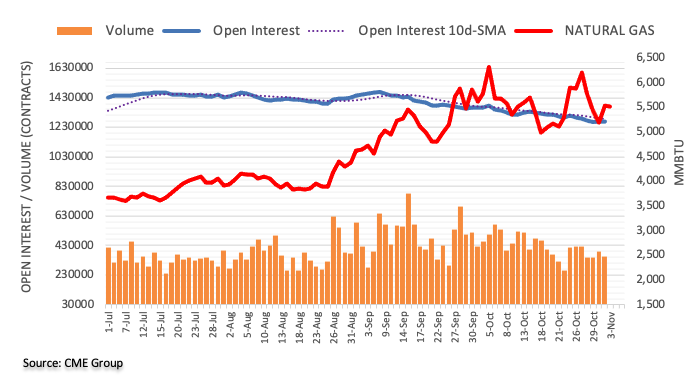
Gold is having a difficult time attracting investors on Wednesday. Will the Fed rescue XAU/USD bulls? A dovish surprise could trigger a fresh upswing in the yellow metal, according to FXStreet’s Dhwani Mehta.
Hawkish Fed to knock off XAU/USD towards mid-$1700s
“A dovish surprise from the Fed could trigger a fresh upswing in gold price back towards $1800.”
“An outrightly hawkish Fed could help gold bears flex their muscles, knocking off the price towards mid-$1700s.”
“Gold price is testing the crucial support at $1780. A sustained move below the latter could bring the rising trendline support at $1777 in play. A daily closing below that level is needed to validate the triangle breakdown, which will open floors towards the October lows of $1746.”
“XAU/USD could rebound towards the horizontal 200-DMA at $1791 on recapturing the 100-DMA hurdle at $1786. The extended recovery will call for a test of the $1800 mark, above which the triangle resistance at $1807 will be challenged.”
- USD/JPY witnessed a subdued/range-bound price action through the early European session.
- Nervousness ahead of the key FOMC decision benefitted the safe-haven JPY and capped gains.
- The downside remains cushioned as traders seem reluctant heading into the key event risk.
The USD/JPY pair extended its sideways consolidative move and remained confined in a range below the 114.00 mark heading into the European session.
The pair struggled to capitalize on the previous day's rebound from the 113.45 region and witnessed a subdued/range-bound price action through the first half of the trading action on Wednesday. Investors turned nervous ahead of the critical FOMC meeting. This was evident from the cautious market mood, which benefitted the safe-haven Japanese yen and acted as a headwind for the USD/JPY pair amid a softer tone around the US dollar.
The downside, however, remains cushioned as investors seemed reluctant to place aggressive bets heading into the key central bank event risk. The Fed will announce its monetary policy decision later during the US session and is widely expected to begin tapering its $120 billion-a-month asset purchase program. Investors, however, would look for clues about the likely timing when the US central bank will raise interest rates.
The markets have been pricing in the prospects for an early policy tightening by the Fed amid growing worries about a faster-than-expected rise in inflationary pressures. Hence, the focus will remain on Fed Chair Jerome Powell's remarks at the post-meeting press conference. This will play a key role in influencing the near-term USD price dynamics and help investors to determine the next leg of a directional move for the USD/JPY pair.
In the meantime, traders might take cues from the US economic docket – featuring the releases of the ADP report on private-sector employment and the ISM Services PMI. The data might provide some impetus to the USD/JPY pair, though the initial reaction is more likely to be muted as traders might prefer to wait for a fresh catalyst from the latest FOMC policy update.
Technical levels to watch
Here is what you need to know on Wednesday, November 3:
Following an uninspiring start to the week, the dollar regathered its strength on Tuesday and closed higher against most major rivals. Although risk flows dominated the markets and the benchmark 10-year US Treasury bond yield remained steady above 1.5%, the greenback managed to find demand as the Fed policy meeting went underway. The European economic docket will feature the euro area September Unemployment Rate. October ADP Employment Change and ISM Services PMI from the US will be looked upon for fresh impetus before the Fed announces the Interest Rate Decision and releases the Monetary Policy Statement at 1800 GMT. FOMC Chairman Jerome Powell will deliver his remarks on policy decisions at 1830.
US ADP Employment Change October Preview: The labor market plays second fiddle.
The Fed is widely expected to announce a reduction of $15 billion in monthly asset purchases while keeping the policy rate unchanged. Investors will keep a close eye on the Fed's language regarding the rate outlook and inflation expectations.
Fed Interest Rate Decision Preview: Inflation, employment and interest rates.
Market mood: All three major equity indexes in the US hit new record highs on Tuesday. During the Asian session, the data from China revealed that the business activity in the service sector expanded at a stronger pace than expected in October with the Caixin Services PMI improving to 53.8, vs 50.7 expected. Nevertheless, the market mood seems to have turned cautious ahead of the European session. As of writing, the Shanghai Composite and the Nikkei 225 indexes were down 0.6% and 0.45%, respectively. Meanwhile, US stock index futures are down between 0.1% and 0.15%.
EUR/USD failed to hold above 1.1600 following Monday's rebound and seems to have gone into a consolidation phase around 1.1580. Data releases from the euro area are unlikely to trigger a sharp reaction in the pair.
GBP/USD extended its slide on Tuesday and fell to its lowest level in two weeks at 1.3605, pressured by the broad USD strength and the lack of progress in Brexit talks. Ahead of Thursday's Bank of England (BoE) meeting, the dollar's valuation is likely to drive the pair's action.
After posting large losses on Tuesday, NZD/USD regained its traction in the Asian session and moved into the positive territory above 0.7100. The data from New Zealand showed that the Unemployment Rate declined to 3.4% in the third quarter from 4%. This reading came in much better than analysts' estimate of 3.9%. Additionally, the Employment Change was up 2% in the same period, compared to the market consensus of 0.4%.
Gold is having a difficult time attracting investors on Wednesday. Currently, XAU/USD is down 0.5% at $1,780. Sellers could move to the sidelines and allow the pair to find support in the second half of the day.
Cryptocurrencies: Bitcoin gained nearly 4% on Tuesday and seems to have gone into a consolidation phase around $63,000, where the upper limit of the two-week-old trading channel is located. Ethereum hit a new all-time high near $4,600 on Wednesday.
CME Group’s flash data for crude oil futures markets noted traders added nearly 3.5K contracts to their open interest positions on Tuesday for the first time after eight consecutive daily pullbacks. Volume, instead, went down for the second session in a row, this time by around 46.7K contracts.
WTI: Next support comes at $80.60
Tuesday’s retracement in prices of the barrel of the West Texas Intermediate was accompanied by rising open interest, which is indicative that further decline remains in the pipeline at least in the very near term. Against this, recent lows in the $80.60 region emerge as the next contention area for the time being.
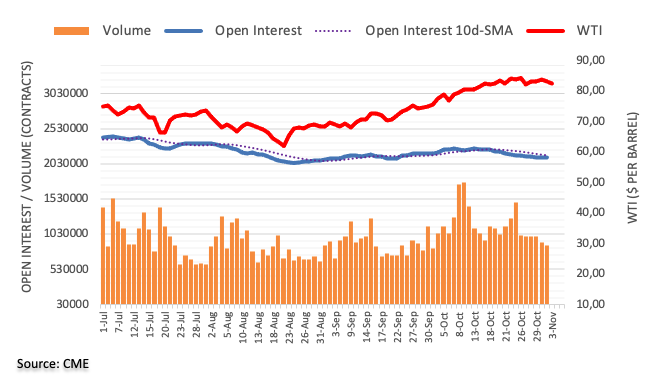
- Gold remains on the back foot, extends previous day’s losses.
- Options market turns most bearish in three months as market braces for Fed tapering.
- Fed November Preview: Gold needs a dovish surprise to overcome key hurdle
Gold (XAU/USD) pares intraday losses around $1,782, following a downside break to the key support during early Wednesday. In doing so, the yellow metal justifies the bearish Risk Reversals (RR) to drop for the second consecutive day ahead of the all-important US Federal Reserve (Fed) meeting.
Market’s indecision ahead of the Fed’s verdict could be linked to the mixed headlines over US stimulus and inflation expectations, not to forget fresh fears of the COVID-19 third wave.
Although US President Joe Biden keeps teasing a deal on the much-awaited $1.75 trillion aid package this week, Senator Joe Manchin conveyed a less likely announcement before Thanksgiving, per CNN. Elsewhere, US inflation expectations, as measured by the 10-year breakeven inflation rate per the St. Louis Federal Reserve (FRED) data, snapped a four-day downtrend to bounce off the lowest levels since October 12 by the end of Tuesday’s North American trading.
It’s worth noting that the recent jump in the covid numbers in China, New Zealand and the UK challenges market sentiment with Bloomberg terming Beijing’s latest covid outbreak as the widespread since the Wuhan incident.
On a different page, the one-month risk reversal of gold, a measure of the spread between call and put prices, dropped the most since early August to -0.725, per the latest Reuters data. The same hints at the escalating bearish bias among the gold traders before crucial market events, namely the Fed.
In addition to the Fed, the US ADP Employment Change, ISM Services PMI and Factory Orders will also entertain the gold traders. However, major attention will be on how much tapering the US central bank manages to agree upon considering the fresh covid fears and reflation woes.
Technical analysis
Gold defies a three-week-old ascending trend channel, also slipped below 100-DMA, while printing $1,781 as a quote amid receding bullish bias of the MACD and descending RSI line.
Given the rejection of the bullish chart pattern, backed by bearish oscillators, gold prices are likely to decline towards an early October’s swing high near $1,770.
Following that, a horizontal area comprising multiple levels marked since September 16, near $1,745, holds the gate for the bullion’s further weakness target’s September’s low near $1,721.
On the flip side, a corrective pullback beyond $1,785 support confluence, now resistance, could trigger the run-up to a $1,810 level comprising a two-month-long descending trend line and a horizontal line from late August.
In a case where the gold buyers manage to conquer the $1,810 hurdle, the upper line of the short-term bullish channel near $1,824 becomes crucial for the run-up to the “double top” marked in July and September around $1,834.
To sum up, a clear downside break of a short-term rising channel lures gold bears ahead of the Fed’s verdict.
Gold: Daily chart
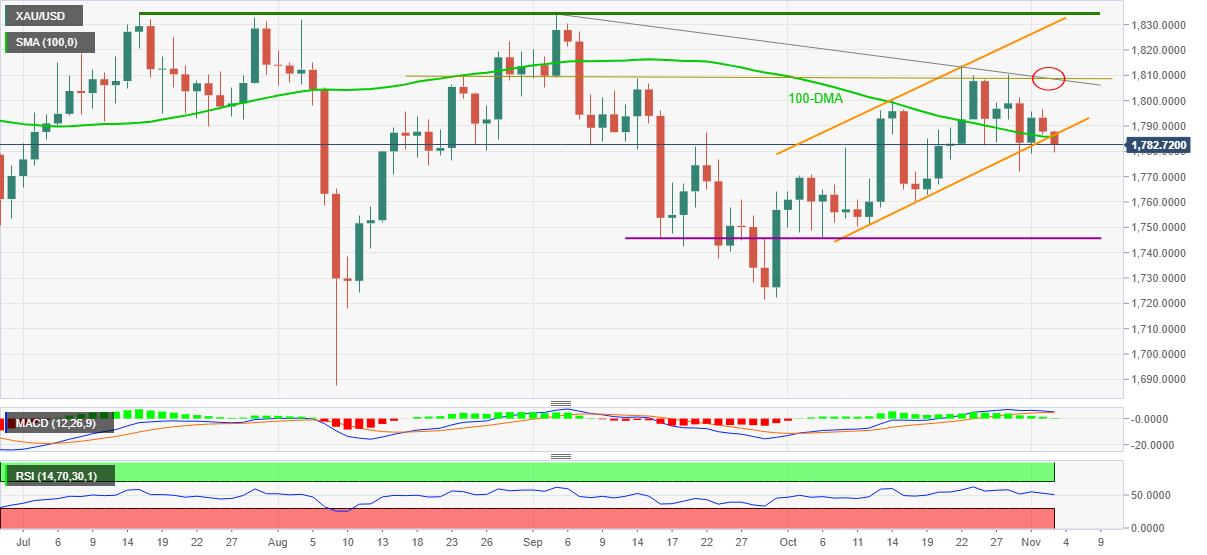
Trend: Further weakness expected
FX option expiries for November 3 NY cut at 10:00 Eastern Time, via DTCC, can be found below.
- EUR/USD: EUR amounts
- 1.1550 494m
- 1.1600 554m
- 1.1650 556m
- 1.1700 800m
- GBP/USD: GBP amounts
- 1.3550 545m
- 1.3615 742m
- 1.3650 631m
- USD/JPY: USD amounts
- 113.75 750m
- 114.00 485m
- 114.30 580m
- AUD/USD: AUD amounts
- 0.7350 743m
- 0.7525 400m
- USD/CAD: USD amounts
- 1.2450 920m
- 1.2555 450m
- 1.2575 780m
- EUR/GBP: EUR amounts
- 0.8400 400m
- 0.8465 440m
Open interest in gold futures markets shrank by around 1.5K contracts on Tuesday, partially reversing the previous build considering preliminary figures from CME Group. Volume followed suit and dropped for the second session in a row, now by around 6.3K contracts.
Gold remains under pressure below $1,800
Gold extended the pessimism in the first half of the week. Tuesday’s downtick was in tandem with shrinking open interest and volume, leaving the prospect for a deeper pullback somewhat curtailed in the very near term. In the meantime, the $1,800 mark per ounce troy remain as the key resistance for bulls’ aspirations.
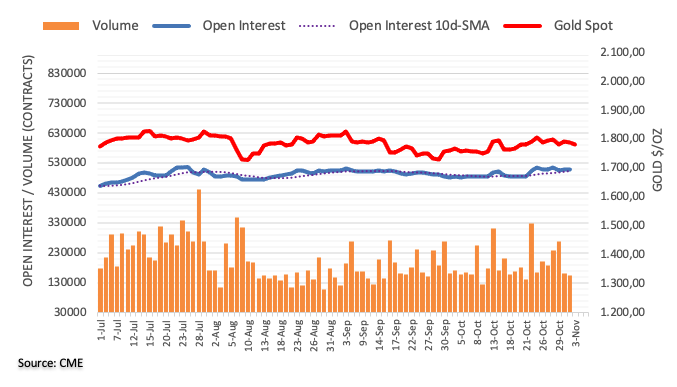
- USD/CAD holds a two-day uptrend amid a pause in the USD advance.
- WTI slips on a weekly build in the US crude stockpiles, cautious mood.
- All eyes on the Fed decision, US economic data also remain in focus.
USD/CAD is holding the higher ground above 1.2400, flirting with four-day tops near 1.2425, as the bulls cheer the sell-off in WTI prices ahead of the critical US events.
The bullish undertone in the major can be associated with the sell-off in WTI prices, in the face of a weekly climb in the US crude inventories, per the American Petroleum Institute’s (API) latest data. The API data showed that US crude supplies rose by 3.6 million barrels for the week ended Oct. 29.
On the other side, a pause in the US dollar’s rebound is making it an uphill battle for the USD/CAD bulls to extend the further upside. The dollar bulls turn on the sidelines ahead of the all-important Fed decision, with tapering on the cards.
Although it’s the Fed’s outlook on the interest rates and inflation that will be crucial for the financial markets in the coming months. Meanwhile, the sentiment in the oil market will also play a crucial part in the loonie’s performance, as investors eagerly await the OPEC+ meeting on Thursday.
In the meantime, the US ADP and ISM Services PMI will offer fresh trading impulse to the pair, as traders gear up for the Fed decision.
USD/CAD: Technical levels to watch out
- USD/INR picks up bids after renewing multi-day low.
- Risk reversals jump the most since October 06.
- Two-month-old support line break favor bears amid descending RSI line.
USD/INR consolidates intraday losses around a one-month low, picking up bids to 74.61 heading into Wednesday’s European session.
In doing so, the Indian rupee (INR) pair justifies the previous day’s downside break of a two-month-old support line, now resistance around 74.80.
However, the options market signal for the pair turns bullish of late. That said, a measure of the spread between call and put prices, known as the Risk Reversal (RR), jumps the most in a month to +0.125 level following a two-day fall.
The aforementioned mismatch between the technical signals and options market clues precedes the US Federal Reserve’s (Fed) key verdict on tapering of bond purchases, likely to be announced today.
Should the Fed propels the US dollar, the latest rebound could bounce back beyond the previous support of around 74.80 to regain the 75.00, comprising July’s top.
On the contrary, a 50-day EMA level of 74.51 holds the key to further USD/INR weakness towards the 75.00 psychological magnet, including 200-day EMA.
USD/INR: Daily chart
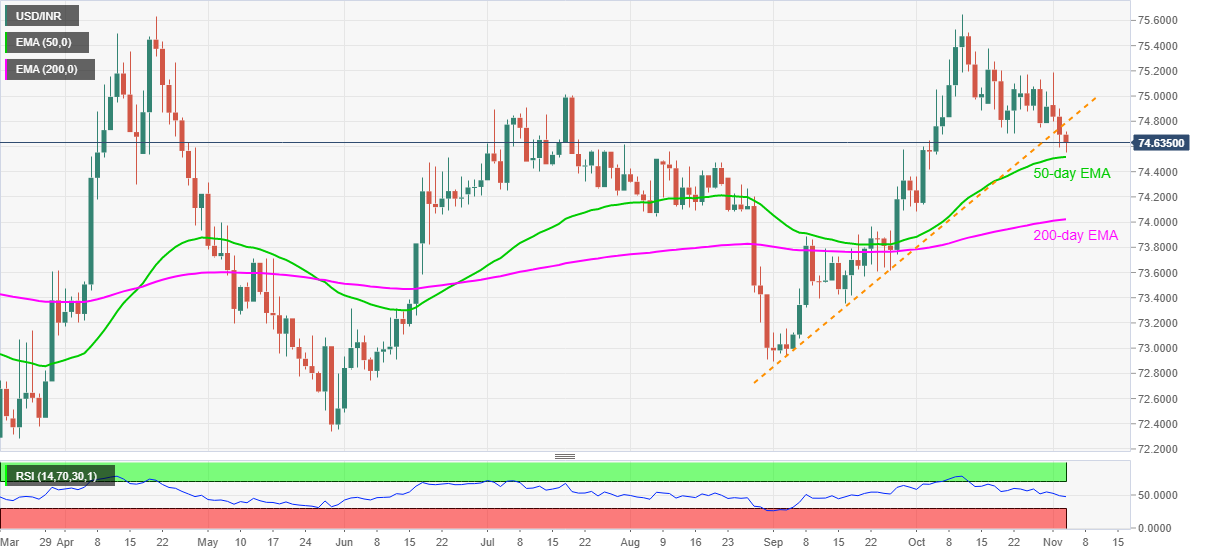
Trend: Further weakness expected
- USD/TRY struggles to extend the bounce off important support lines.
- Weekly horizontal area restricts immediate upside before highlighting the record top.
- Multiple technical levels probe bears below $9.5190 support break.
- Turkish CPI, US Fed in focus amid a bullish technical set-up.
USD/TRY pokes weekly high around $9.6080 ahead of Wednesday’s European session. In doing so, the Turkish Lira (TRY) pair portrays indecision following a rebound from the key support lines.
That said, a firmer Momentum line and sustained trading beyond resistance line from last week, as well as from early October, enables USD/TRY buyers to battle a seven-day-old horizontal resistance zone, around $9.6400.
However, a clear break of which will propel the quote towards the record high of $9.8505, with $9.7150-60 likely acting as an intermediate halt.
Meanwhile, pullback moves may initially aim for a three-week-long support line near $9.5670 before directing USD/TRY sellers to a weekly trend line support of $9.5190.
It should be noted, however, that a downside break of $9.5190 isn’t a sign of trend reversal as the latest trough and October 19 peak, respectively around $9.4110 and $9.3765, allows buyers to return.
To sum up, USD/TRY remains bullish ahead of the Turkish Consumer Price Index (CPI) data for October, 19.58% YoY prior.
USD/TRY: Four-hour chart
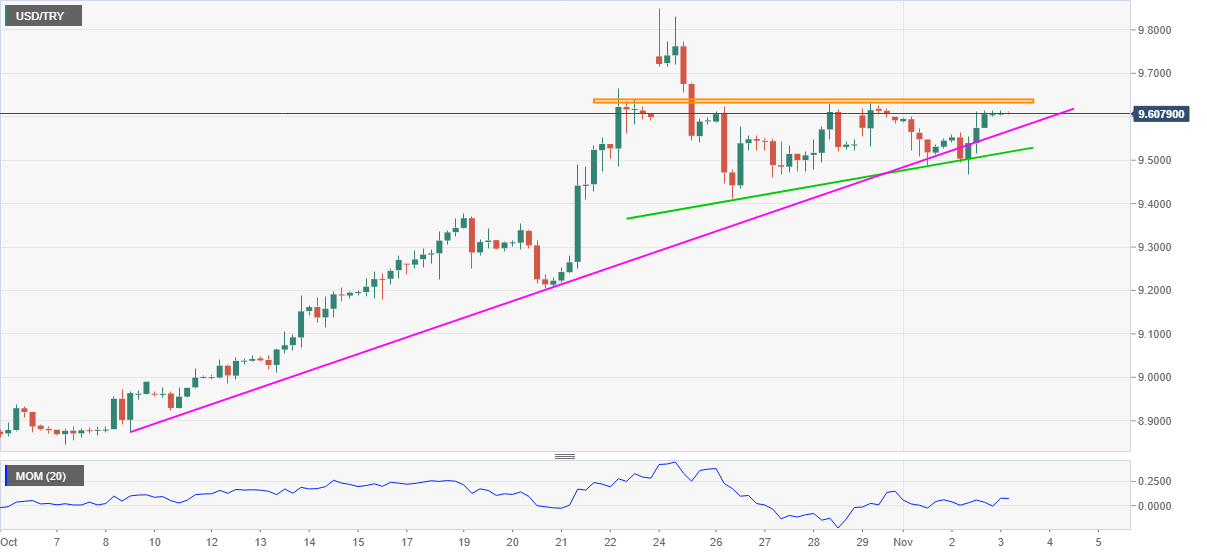
Trend: Further upside expected
- EUR/USD holds lower ground, retreats from intraday high of late.
- Downbeat PMIs weighed on Euro the previous day, USD consolidates gains on Wednesday.
- Fed has comparatively fewer reasons than ECB to defend bond buying.
- US ADP Employment Change, ISM Services PMI and Factory Orders are important too.
EUR/USD remains indecisive around 1.1580 heading into the European session on the key Wednesday. The currency major pair dropped the previous day amid downbeat European fundamentals, as well as the market’s rush for USD. However, anxiety ahead of the US Federal Reserve (Fed) decision and a speech from the European Central Bank (ECB) President Christine Lagarde challenge the pair’s latest moves.
Downbeat prints of October’s final Manufacturing PMIs for Germany, France and the Eurozone as a whole dragged the regional currency the previous day. Also weighing on the Euro were receding chatters over the ECB’s tighter monetary policy.
It should be noted, however, that the inflation pressure remains present in the bloc and hence ECB’s Lagarde has fewer options than to accept the wait-and-see situation, which in turn allows EUR/USD moves to take clues from the Fed’s verdict.
Before that, US ADP Employment Change, ISM Services PMI and Factory Orders can offer a gist of how far the Fed needs to go for controlling the escalating price pressure while also keeping the economy fluid. Also likely to challenge the $15.00 billion Fed tapering forecast are the fears of a third wave covid wave.
Against this backdrop, the stock futures remain mildly offered while the bonds remain inactive amid off in Japan. The US Dollar Index (DXY) flirts with the 94.00 round-figure with mild losses by the press time.
It’s worth mentioning that a rebound in the US inflation expectations and bearish bias of the options traders are catalysts that keep EUR/USD bears hopeful ahead of the key Fed decision.
Read: Fed Interest Rate Decision Preview: Inflation, employment and interest rates
Technical analysis
With a sustained pullback from 50-DMA, around 1.1690 at the latest, EUR/USD sellers are up for challenging the yearly bottom surrounding 1.1525. However, the 1.1550 round figure may offer an intermediate halt during the fall. Its worth noting August month’s low near 1.1665 adds to the upside filters.
- AUD/USD stays range-bound following the biggest daily slump in five months.
- Rising wedge confirmation, steady declines below 0.7460 support convergence keep sellers hopeful.
- Short-term horizontal support area, 200-SMA put a floor under the prices amid oversold RSI.
AUD/USD consolidates the RBA-led big slump within an 18-pip trading range, picking up bids near 0.7438 heading into the European session on Wednesday.
Although oversold RSI conditions probe the immediate downside of the Aussie pair, the bears remain hopeful of breaking the key technical supports the previous day.
After confirming a rising wedge bearish chart pattern on the RBA’s verdict to give up the bond yield targeting, the Aussie pair also slipped below a convergence of 100-SMA and an ascending trend line from September 29, around 0.7460.
That said, the quote remains on the bear’s radar until crossing the 0.7460 support-turned-resistance. Even so, the lower line of the wedge, around 0.7500 adds to the upside filters before recalling the AUD/USD buyers.
In a case where the pair stays strong beyond the 0.7500 threshold, the upper line of the stated bearish formation and October’s peak will lure the bulls around 0.7560.
Alternatively, three-week-old horizontal support, near 0.7380, seems live on the AUD/USD pair seller’s radar but any further weakness will be challenged by the 200-SMA level around 0.7360.
AUD/USD: Four-hour chart
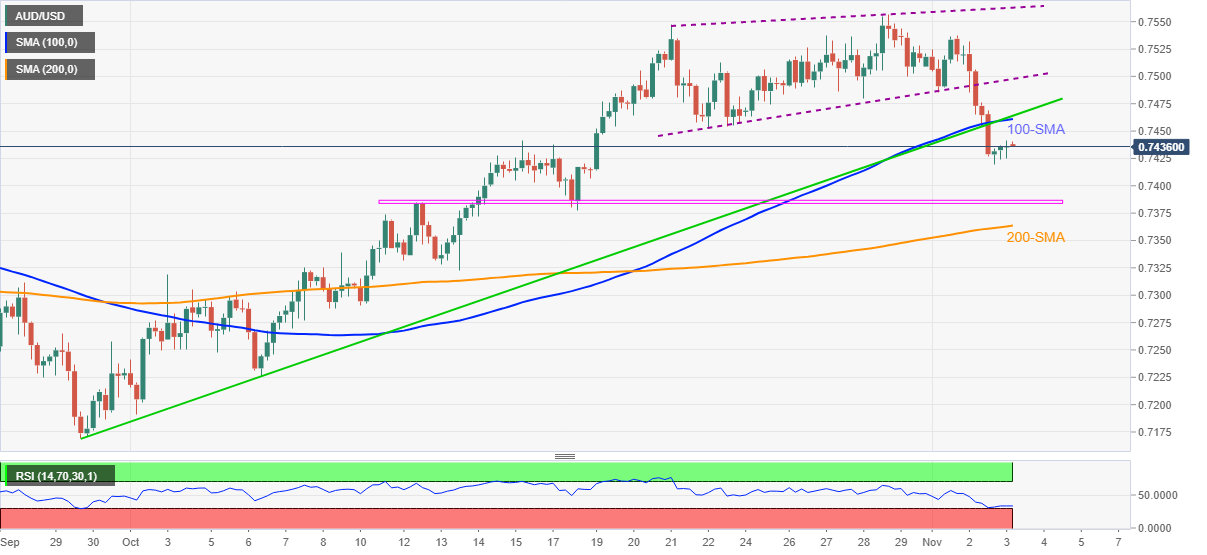
Trend: Bearish
- GBP/USD refreshes intraday top, extends bounce off three-week low.
- UK PM Johnson downplays Brexit-led fishing raw with France ahead of Thursday’s talks in Paris.
- Markets rethink over BOE rate hike calls, UK prints highest virus-led death toll since February.
- UK/US data to entertain buyers ahead of key Fed verdict.
GBP/USD cheers the US dollar pullback heading into Wednesday’s London open, up 0.14% on a day around 1.3630. In doing so, the cable pair refreshes intraday high while printing the first positive daily performance in four, not to forget bouncing off a three-week low.
In addition to the market’s preparation for today’s US Federal Reserve (Fed) verdict, the quote benefits from UK PM Boris Johnson’s comments suggesting an easing Brexit tussle with France. “Boris Johnson downplayed the significance of a rift between the U.K. and France over post-Brexit fishing licenses, calling the issue ‘vanishingly unimportant’ compared with efforts to limit global warming,” said Bloomberg. It’s worth noting that UK’s Brexit Minister David Frost has already accepted the French invitation to visit Paris for further Brexit talks, especially after France warned to bloc UK vessels.
Elsewhere, chatters relating the Bank of England’s (BOE) rate hike also swirl and propel the GBP/USD prices. “The arguments for and against the Bank of England raising its policy rate this Thursday are finely balanced. But ultimately members of the central bank’s Monetary Policy Committee should hold off and wait,” said the Financial Times (FT). On the same line, Reuters highlights a 5.0% inflation print of the UK, versus BOE’s 2.0% target, to highlight the probabilities of a rate change by the “Old Lady”.
Amid the aforementioned catalysts, the cable prices seem to ignore the UK’s higher coronavirus-led death toll since February. “The UK has had its highest number of daily Covid deaths reported since late February, as another 293 people have died within 28 days of a positive Covid-19 test,” per The Guardian.
It should be observed that comments from US Senator Joe Manchin add to the market’s hope of stimulus and weighing on the US dollar, indirectly helping the GBP/USD prices. Senator Manchin said, per CNN, to have chief concerns that will need to be addressed in order to secure his vote for the $1.75 trillion economic package. The policymaker was cited expressing new optimism that a deal could ultimately be reached that would win his support on President Joe Biden's domestic agenda before Thanksgiving.
Looking forward, final prints of the UK’s October Services PMI, expected to confirm 58 forecast, may offer immediate direction ahead of a slew of the US data and the Fed decision. Among the US data, ADP Employment Change, ISM Services PMI and Factory Orders will be the key while the Fed is expected to keep the benchmark rate unchanged but taper monthly bond purchases by $15 billion.
Read: Fed Interest Rate Decision Preview: Inflation, employment and interest rates
Technical analysis
Although lows marked during August and July, respectively around 1.3600 and 1.3570, restrict short-term GBP/USD declines, corrective pullback needs to cross the previous support line from October 04, near 1.3670 to convince the buyers.
- Gold price falls further amid pre-Fed anxiety, DXY, yields hold firmer.
- The Fed is likely to announce tapering by $15 billion per month.
- Fed November Preview: Gold needs a dovish surprise to overcome key hurdle.
It’s the all-important Fed Day this Wednesday, with the US dollar and Treasury yields firming up, as a rollback of asset purchases by $15 billion per month is already discounted by the market. Gold traders will look for hints on the Fed’s timing of the interest rates hike and the inflation outlook to steer the fresh direction in the bright metal. Ahead of the Fed event, the US ADP jobs and ISM Services PMI data will offer some trading incentives.
Read: Fed Interest Rate Decision Preview: Inflation, employment and interest rates
Gold Price: Key levels to watch
The Technical Confluences Detector shows that gold is on its way to test the Bollinger Band four-hour Lower support at $1777, as the downward spiral extends.
The next stop for gold bears is envisioned at $1775, the pivot point one-day S3.
The intersection of the previous week’s low and Fibonacci 61.8% one-month around $1772 will be a tough nut to crack for gold sellers.
The SMA200 four-hour at $1770 will be the line in the sand for the optimists.
On the upside, immediate resistance around $1782 will challenge the bulls. That level is the confluence of the Fibonacci 23.6% one-week, SMA50 one-day and pivot point one-day S2.
Gold buyers will then seek fresh entries above the SMA100 four-hour at $1785.
Further up, a dense cluster of healthy resistance levels between $1788-$1790 will test the bearish commitments on the road to recovery.
That zone is the convergence of the Fibonacci 23.6% one-day, Fibonacci 38.2% one-month and SMA100 one-day.
The SMA200 one-day at $1793 will offer additional resistance, above which the Fibonacci 23.6% one-month at $1799 will be eyed.
Here is how it looks on the tool
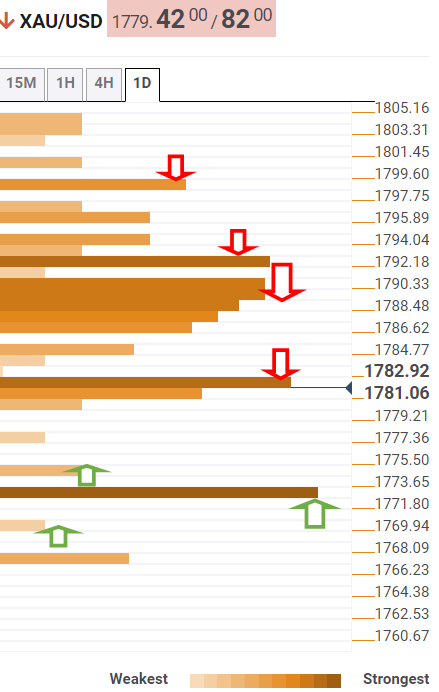
About Technical Confluences Detector
The TCD (Technical Confluences Detector) is a tool to locate and point out those price levels where there is a congestion of indicators, moving averages, Fibonacci levels, Pivot Points, etc. If you are a short-term trader, you will find entry points for counter-trend strategies and hunt a few points at a time. If you are a medium-to-long-term trader, this tool will allow you to know in advance the price levels where a medium-to-long-term trend may stop and rest, where to unwind positions, or where to increase your position size.
| Raw materials | Closed | Change, % |
|---|---|---|
| Brent | 84.68 | -0.73 |
| Silver | 23.526 | -2.18 |
| Gold | 1787.813 | -0.28 |
| Palladium | 2008.23 | -2.1 |
- GBP/JPY’s rebound to find more legs above this key hurdle.
- The cross spots a bull flag on the daily chart amid bullish RSI.
- Bullish crossover to play out ahead of the Fed and BOE verdicts.
GBP/JPY is snapping its three-day bearish streak, rebounding firmly above 156.00 ahead of the critical Federal Reserve’s (Fed) and Bank of England (BOE) monetary policy decisions.
The latest downtrend in the cross could be attributed to the looming Brexit risks and a broad-based US dollar rebound, as investors reassess the rate hike bets from the major central banks.
Looking ahead, the Fed speculations will continue influencing the pair ahead of the FOMC outcome due later on Wednesday. Ahead of that the US ADP and ISM Services PMI will also offer some fresh trading incentives amid a public holiday in Japan.
Technically, GBP/JPY is hovering within a potential bull flag, carved out from the ongoing corrective pullback after a staggering rally to five-year tops above 158.00.
developing story ...
- EUR/GBP remains pressured around intraday low on the first negative day in three.
- Bullish MACD signals, sustained break of 20-day EMA keep buyers hopeful.
EUR/GBP bulls take a breather following a two-day uptrend, down 0.08% intraday around 0.8500 during early Thursday.
In doing so, the cross-currency pair marks a reversal from the 50-day EMA, as well as 38.2% Fibonacci retracement (Fibo.) of July-October fall.
It should be noted, however, that the successful break of 20-day EMA and bullish MACD signals keep EUR/GBP buyers hopeful to tackle the 0.8505 immediate hurdle to aim for 50% and 61.8% Fibo. levels, respectively around 0.8535 and 0.8565.
Should the pair buyers remain dominant past 0.8565, a two-week-old horizontal hurdle around 0.8615 will be the key to watch.
Alternatively, pullback moves remain less important until staying beyond the 20-day EMA level of 0.8478.
Following that, August month’s low and multiple bottoms marked during October, near 0.8450 and 0.8420 in that order, should challenge the EUR/GBP bears.
EUR/GBP: Daily chart
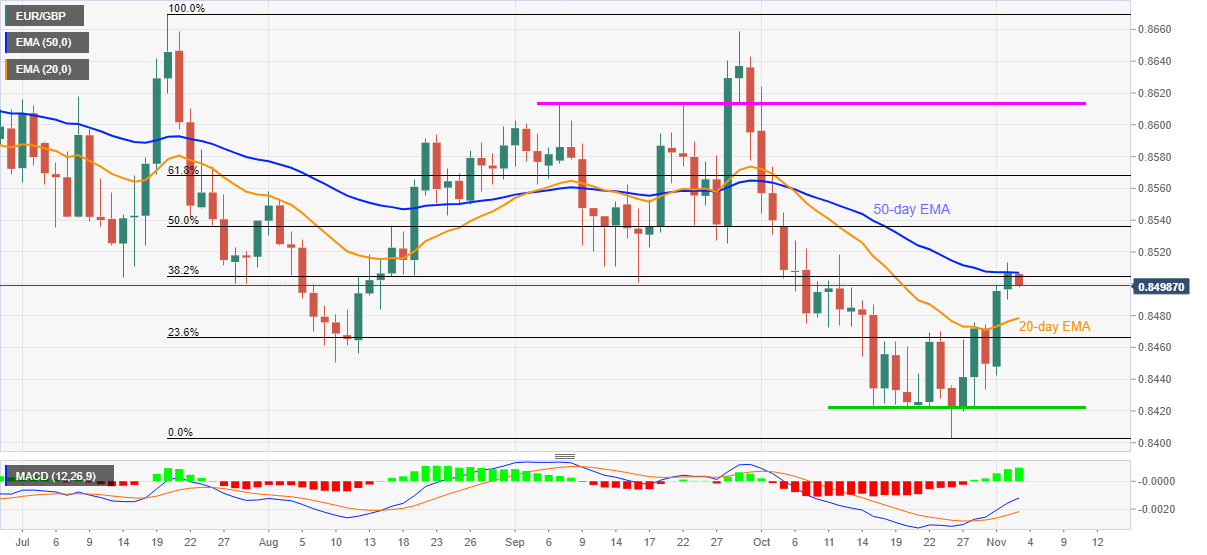
Trend: Further upside expected
- USD/INR bull flag plays out as expected ahead of the FOMC.
- Bulls will be looking for signals of a correction to the upside and an eventual bullish breakout.
As per the prior analysis, USD/INR Price News: The bull flag continues to play out, eyes on the downside, the price has indeed moved in on the support and lower bounds of the bullish flag. Given the nature of a bullish flag, the expectations would now be for a move higher. However, there could be some more downside to go before this occurs.
USD/INR daily chart
-637715006868288391.png)
As illustrated, the price of the rupee is meeting a layer of support which could lead to an upside correction in accordance with the bullish flag and ultimately lead to a breakout. However, the US dollar is going to be under the spotlight over the course of this week throughout data that could go one way or the other and set the tone for the foreseeable future. In a negative outcome for the dollar, USD/INR would be expected to drop below the flag's dynamic support and potentially lead to a significant bearish continuation.
China's Caixin services PMI for October came in at 53.8 vs. 50.7 expected and 53.4 last, showing that the country’s services activity continues to expand in the reported month.
The rate of growth was the quickest seen since July and solid, albeit slightly softer than the long-run series average (54.1).
Wang Zhe, senior economist at Caixin Insight Group said, “Supply and demand both recovered as disruptions from local Covid-19 outbreaks faded by the middle of October. The gauges for business activity and total new business both reached the highest level in three months." said
"Overseas demand also rebounded as the measure for new export business moved into expansionary territory,” he added.
AUD/USD keeps gains above 0.7400
The upside surprise on the Chinese Services PMI numbers has little to no impact on the aussie dollar, as AUD/USD is off the daily highs, currently trading at 0.7430, up 0.05% on the day.
- S&P 500 Futures struggle to extend Wall Street gains amid pre-Fed trading lull.
- Off in Japan restricts bond moves and adds to the lackluster session.
- US stimulus headlines, ADP Employment Change and PMIs can entertain traders.
S&P 500 Futures seesaws around the all-time high near 4,630 during early Wednesday. In doing so, the risk barometer portrays the typical pre-Fed trading lull by the press time. Adding to the market’s sluggish moves is the bank holiday in Japan.
Wall Street posted notable gains the previous day amid brighter earnings and hopes of the US stimulus. However, chatters surrounding a further delay in the $1.75 trillion infrastructure stimulus and Evergrande tested market sentiment afterward.
Read: S&P 500 posts fourth consecutive record close, Dow clinches 36K level
In contrast to the previous hopes of getting the deal done during this week, US Senator Joe Manchin said, per the CNN, to have chief concerns that will need to be addressed in order to secure his vote for the $1.75 trillion economic package. The policymaker was cited expressing new optimism that a deal could ultimately be reached that would win his support on President Joe Biden's domestic agenda before Thanksgiving.
Elsewhere, the Financial Times (FT) highlights the remaining coupon payment by China’s struggling real estate player Evergrande to pinpoint the market risk. “Evergrande faces rising repayment pressure on its dollar-denominated bonds in the coming months, despite making several last-minute transfers in October that allowed the heavily indebted Chinese property company to narrowly avoid a default,” said the FT. The news adds, “Investors and global markets will be watching for clues as to the eventual fate of the world’s most indebted property developer, which faces $8.1bn in interest and principal payments on its offshore bonds before the end of 2022 and has hundreds of projects across China.”
It’s worth noting that a rebound in the US inflation expectations, as measured by the 10-year breakeven inflation rate per the St. Louis Federal Reserve (FRED) data, also challenge the risk appetite before the key Fed verdict. That said, the inflation gauge snapped a four-day downtrend to bounce off the lowest levels since October 12 by the end of Tuesday’s North American trading.
Amid these plays, commodities remain pressured while the major currency pairs look for a fresh direction. Also to note is the bank holiday in Japan that restricts global bond moves and adds filters to the market’s performance.
Looking forward, investors will closely observe Fed decision expectations of $15.00 billion of tapering eyed.
Read: Fed Interest Rate Decision Preview: Inflation, employment and interest rates
Also important will be the updates on the US stimulus and early signals for Friday’s jobs report, namely US ADP Employment Change, as well as US ISM Services PMI.
- WTI extends previous day’s losses, stays near intraday low.
- 100-SMA adds to the downside filters targeting 200-SMA.
- Steady RSI suggests further grinding ahead of weekly inventory data, Fed.
WTI crude oil remains on the back foot around $81.90, down 0.42% intraday during early Wednesday.
The black gold snapped a three-day uptrend while reversing before the weekly resistance line the previous day. However, the quote’s latest declines battle 100-SMA and an ascending support line from early October to keep bears hopeful.
Given the steady RSI line, the commodity prices are likely to grind near the stated technical supports, namely 100-SMA level of $82.00 and the monthly trend line support near $81.50.
Should the oil prices drop below $81.50, the last weeks’ swing low near the $80.00 threshold will act as an intermediate halt during the fall towards the 200-SMA level of $78.54.
Meanwhile, corrective pullback remains less interesting until staying below the stated resistance line, close to $83.70 by the press time.
Following that, a run-up to the recent multi-month high of around $85.40 can’t be ruled out.
To sum up, oil bears are bracing for entry but awaits weekly official inventory data from the US Energy Information Administration (EIA), as well as the US Federal Reserve (Fed) meeting conclusion.
WTI: Four-hour chart
_03112021-637715003133974075.png)
Trend: Further weakness expected
In recent trade today, the People’s Bank of China (PBOC) set the yuan (CNY) at 6.4079 vs. the estimate of 6.4041.
About the fix
China maintains strict control of the yuan’s rate on the mainland.
The onshore yuan (CNY) differs from the offshore one (CNH) in trading restrictions, this last one is not as tightly controlled.
Each morning, the People’s Bank of China (PBOC) sets a so-called daily midpoint fix, based on the yuan’s previous day closing level and quotations taken from the inter-bank dealer.
- AUD/USD is on the verge of a 61.8% Fibo and bullish correction but markets await the Fed.
- Quiet trade could see the price rift into the next key US data and events.
AUD/USD remains steady as the markets await the next central bank outcome following the prior session's Reserve Bank of Australia (RBA) outcome. The AUD was under pressure following the RBA’s policy meeting with long-end rates and inflation expectations remaining a focus for markets as the Federal Reserve concludes its two-day meeting.
RBA tones it down
Firstly, the RBA ditched the yield target and amended its forward guidance, but the outcome was dovish all in all as the Board’s statement emphasised it is prepared to be patient. RBA’s Lowe explained that underlying inflation would have to print at 2.5% before the Board would consider lifting the cash rate.
As such he saw current market pricing as “not consistent with our reaction function. This followed the RBA discontinuing its yield target while reflecting less confidence about the duration of the 0.1% cash rate. The RBA also flagged the second half of 2023 as the time inflation will be at the mid-point of the target band.
All eyes on the Fed
As for the Fed, the markets are positioned for a tapering announcement following guidance from the central bank which has managed expectations perfectly in terms of preparing the markets for what is likely to be speed tapering.
''Most officials seem to agree that it’s better to get tapering over as quickly as possible in order to leave the Fed maximum flexibility to hike rates when needed,'' analysts at Brown Brothers Harriman explained. ''We believe that the most likely path for tapering has already been flagged by the Fed, which would reduce asset purchases by $15 bln per month ($10 bln UST and $5 bln MBS).''
AUD/USD technical analysis
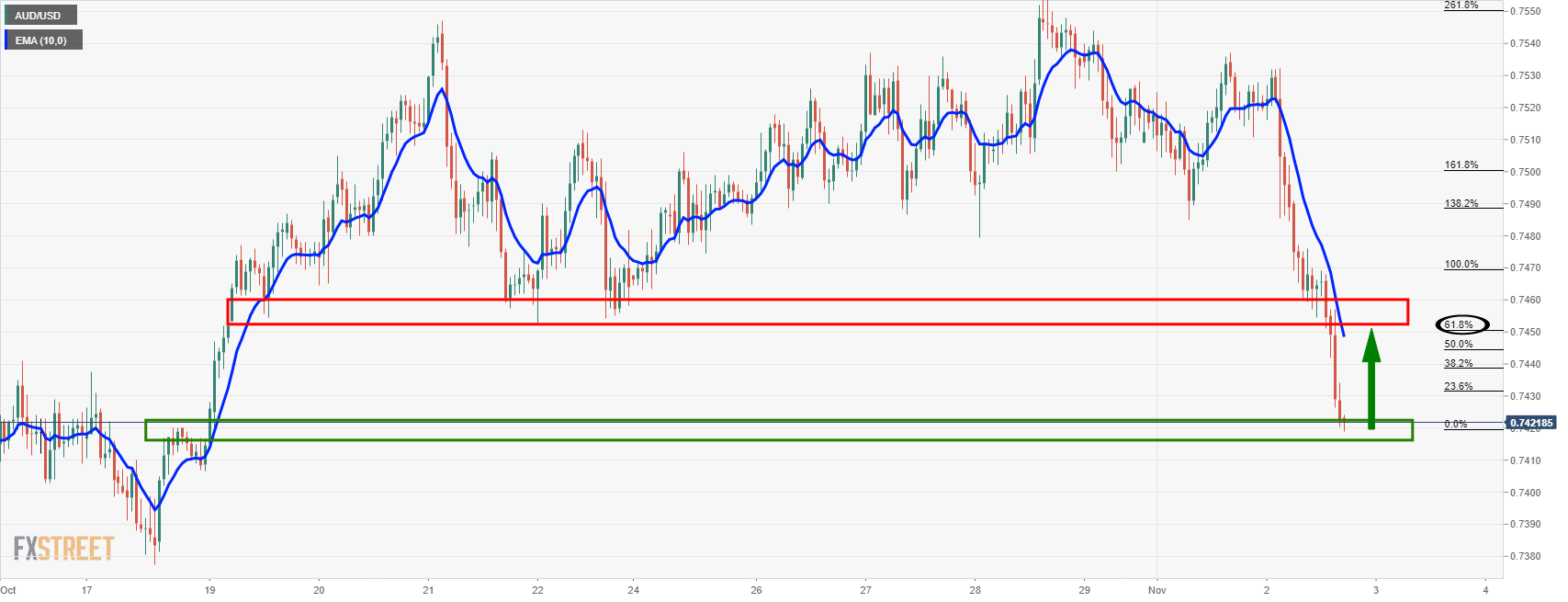
As illustrated, from the analysis overnight, the price is indeed recovering from the marked support area. It has now made a 38.2% Fibonacci retracement with potentially more on the way:
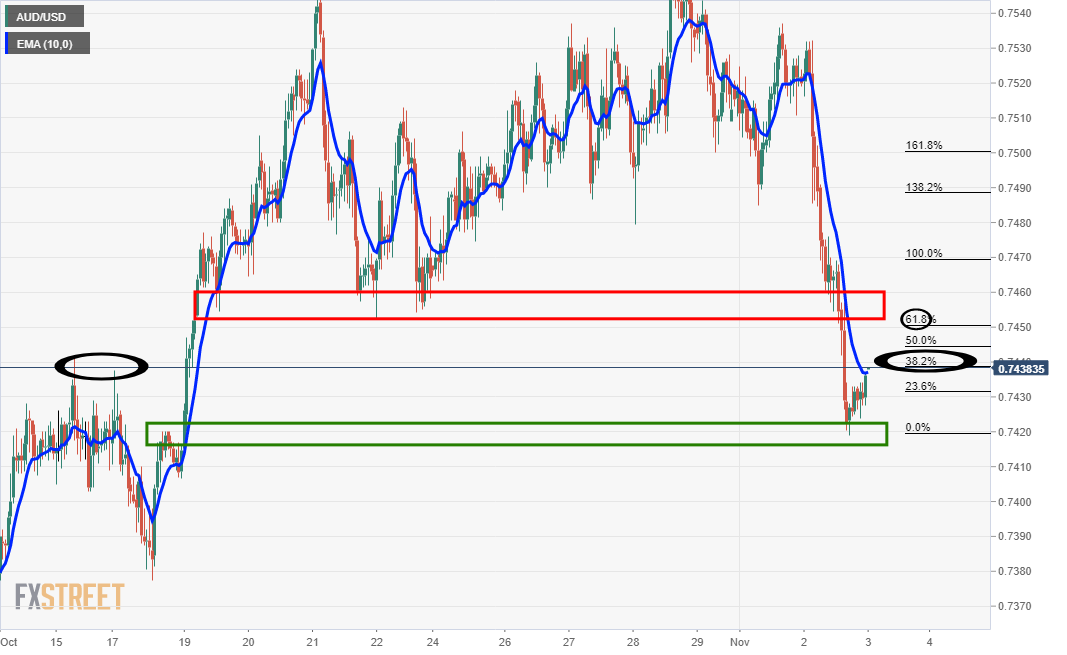
- EUR/USD bounces off intraday low to add to the weekly gains.
- Risk reversals drop for three days in the last four.
- Fed is expected to announce $15 billion tapering amid reflation fears.
EUR/USD picks up bids to poke the intraday high near 1.1580 during early Wednesday.
The major currency pair dropped the previous day following the US dollar’s rebound amid the pre-Fed anxiety, as well as due to the downbeat Eurozone data.
Among the bloc’s data were downbeat second readings of the Eurozone and German PMIs for October.
Also adding to the pair’s weakness was a rebound in the US inflation expectations and options market data.
US inflation expectations, as measured by the 10-year breakeven inflation rate per the St. Louis Federal Reserve (FRED) data, snapped a four-day downtrend to bounce off the lowest levels since October 12 by the end of Tuesday’s North American trading.
On the other hand, one-month risk reversal on EUR/USD, a measure of the spread between call and put prices, dropped for the third day in last four during Tuesday, to -0.012 at the latest while following a 0.000 figure marked in Monday.
It’s worth noting that the equal odds of a Fed move and US stimulus hopes keep EUR/USD traders guessing ahead of the event.
Read: Fed Interest Rate Decision Preview: Inflation, employment and interest rates
Other than the Fed decision, US ADP Employment Change and PMIs for October will also be important for the EUR/USD traders.
Technical analysis
Unless crossing a downward sloping trend line from June, around 1.1700, EUR/USD remains on the bear’s radar.
The latest Reuters poll of nearly foreign exchange analysts, conducted during October 29 – November 02 period, highlights investors’ preference for currencies carrying higher interest rates in both the short and medium-term.
Key quotes
Calls for tighter monetary policy to tame inflation running at multiyear highs in the United States and elsewhere have prompted money markets to bring forward rate hike expectations, and are now at odds with central banks’ own projections.
Those expectations have pushed yields on U.S. Treasuries and other sovereign debt higher, especially at the shorter end of the curve, to the highest in more than a year. That is set to continue.
But while rising Treasury yields have helped the dollar to maintain its gains so far this year, rate hike speculation elsewhere looks set to restrain the greenback from strengthening any further.
The Oct. 29-Nov. 2 poll of nearly 70 foreign exchange analysts showed nearly all major currencies trading higher than current levels in the next 12 months – a view these analysts have held for years, even as the dollar drifted higher.
Also read: US dollar sits firm in the 94 area ahead of the Fed
US inflation expectations, as measured by the 10-year breakeven inflation rate per the St. Louis Federal Reserve (FRED) data, snapped a four-day downtrend to bounce off the lowest levels since October 12 by the end of Tuesday’s North American trading.
In doing so, the risk barometer licks its wounds around 2.51% as markets await the US Federal Reserve’s (Fed) decision on the monthly bond-buying practices.
With the latest bounce in the inflation expectations, the reflation fears get a new life before the key Fed verdict, which in turn could push the Fed hawks to surpass market expectations of $15 billion tapering of bond purchases. However, Fed Chairman Jerome Powell recently sounded 50-50, despite removing the ‘transitory’ word from his speech to term inflationary pressure, which in turn keeps the traders guessing.
Hence, the risk appetite is likely to remain weak ahead of the Fed event but the US ADP Employment Change and PMIs for October can entertain the traders.
Read: Fed Interest Rate Decision Preview: Inflation, employment and interest rates
- USD/JPY bounces off intraday low, prints lackluster day after mild daily losses.
- Cautious mood ahead of the Fed verdict, concerns over US stimulus probe sentiment.
- Japan banks are off due to Culture Day, US ADP Employment Change, PMIs can offer intermediate moves.
USD/JPY remains sidelined after a negative day, keeping the bounce off the intraday low of 113.90 near 114.00 during Wednesday’s Asian session. The yen pair portrays the market’s cautious mood ahead of the US Federal Reserve (Fed) policy decision but a bank holiday at home and light calendar elsewhere challenges the momentum of late.
In addition to the tapering tantrums, chatters surrounding US stimulus also weigh on the market’s mood. In contrast to the previous hopes of getting the deal done during this week, US Senator Joe Manchin said, per the CNN, to have chief concerns that will need to be addressed in order to secure his vote for the $1.75 trillion economic package. The policymaker was cited expressing new optimism that a deal could ultimately be reached that would win his support on President Joe Biden's domestic agenda before Thanksgiving.
Elsewhere, a rebound in the US Treasury yields and inflation expectations ahead of the key Fed decision also challenged the USD/JPY traders. Additionally, the re-election of Japan’s Fumio Kishida as the Prime Minister reduces challenges for the Bank of Japan (BOJ) and hence the pair traders convey fears of any reduction in the easy money amid the recently firmer price pressure into the economy.
Amid these plays, US Treasury yields rebound whereas the S&P 500 Futures print mild losses by the press time.
Moving on, US ADP Employment Change for October and ISM Services PMI for October may offer intermediate moves to the USD/JPY prices ahead of the key Fed decision with the market players aiming for a $15.00 billion tapering.
Technical analysis
USD/JPY seesaws inside a three-week-old symmetrical triangle between 113.35 and 114.40 amid bearish MACD signals, which in turn keeps the bears hopeful. That said, 21-DMA near 113.60 offers immediate support to the pair.
| Time | Country | Event | Period | Previous value | Forecast |
|---|---|---|---|---|---|
| 00:30 (GMT) | Australia | Building Permits, m/m | September | 6.8% | -2% |
| 01:45 (GMT) | China | Markit/Caixin Services PMI | October | 53.4 | |
| 07:00 (GMT) | United Kingdom | Nationwide house price index, y/y | October | 10% | 9.3% |
| 07:00 (GMT) | United Kingdom | Nationwide house price index | October | 0.1% | 0.4% |
| 09:15 (GMT) | Eurozone | ECB President Lagarde Speaks | |||
| 09:30 (GMT) | United Kingdom | Purchasing Manager Index Services | October | 55.4 | 58 |
| 10:00 (GMT) | Eurozone | Unemployment Rate | September | 7.5% | 7.4% |
| 12:15 (GMT) | U.S. | ADP Employment Report | October | 568 | 369 |
| 13:45 (GMT) | U.S. | Services PMI | October | 54.9 | 58.2 |
| 14:00 (GMT) | U.S. | Factory Orders | September | 1.2% | 0% |
| 14:00 (GMT) | U.S. | ISM Non-Manufacturing | October | 61.9 | 62 |
| 14:30 (GMT) | U.S. | Crude Oil Inventories | October | 4.267 | 1.567 |
| 18:00 (GMT) | U.S. | Fed Interest Rate Decision | 0.25% | 0.25% | |
| 18:30 (GMT) | U.S. | Federal Reserve Press Conference |
| Pare | Closed | Change, % |
|---|---|---|
| AUDUSD | 0.74297 | -1.22 |
| EURJPY | 131.912 | -0.27 |
| EURUSD | 1.15783 | -0.23 |
| GBPJPY | 155.116 | -0.39 |
| GBPUSD | 1.36117 | -0.36 |
| NZDUSD | 0.71224 | -0.84 |
| USDCAD | 1.23973 | 0.25 |
| USDCHF | 0.91374 | 0.54 |
| USDJPY | 113.947 | -0.04 |
- US dollar sits tight ahead of the FOMC outcome on Wednesday.
- US data will also be a focus leading into the Nonfarm Payrolls.
The US dollar was slightly firmer overnight as traders get set for the US Federal Reserve that started its two-day meeting on Tuesday. The Fed is expected to announce the start of tapering of its massive asset purchases put in place at the start of the COVID-19 pandemic. The US dollar index, DXY, which measures the greenback against a basket of peer currencies, was flat at 94.115. The price rallied from a low of 93.82 to a high of 94.132.
FOMC in focus
A tightening phase from central banks is being priced in by the markets due to the concerns about rising inflation to end pandemic-era levels of easing. In this regard, the FOMC has the market positioned for a tapering announcement following guidance from the central bank which has managed expectations perfectly in terms of preparing the markets for what is likely to be speed tapering.
'Most officials seem to agree that it’s better to get tapering over as quickly as possible in order to leave the Fed maximum flexibility to hike rates when needed,'' analysts at Brown Brothers Harriman explained. ''We believe that the most likely path for tapering has already been flagged by the Fed, which would reduce asset purchases by $15 bln per month ($10 bln UST and $5 bln MBS).''
In data, October’s ISM non-manufacturing PMI and Markit services PMI should retain strength as reopening buoys activity and expectations. Meanwhile, US jobs data will be in focus and another robust print for ADP employment change is anticipated in October. The current consensus is 450k and we suspect it will creep higher.
Yesterday, October ISM Manufacturing PMI came in strongly at 60.8 vs. 60.5 expected and 61.1 in September. Readings above 60 are rare and yet here we are above 60 for 8 of the past 11 months. Looking at the components, employment came in at 52.0 vs. 50.2 in September, which could be symbolic of a healthy Nonfarm Payrolls report at the end of the week where forex volatility could be highest, depending on the outcome.
- USD/CAD consolidates recent losses around short-term key resistance.
- Sustained trading beyond 61.8% Fibonacci retracement, six-week-old trend line resistance test bears.
- September’s low adds to the upside filters before convincing buyers.
USD/CAD seesaws near 1.2410, grinds higher following the biggest daily jump in two weeks. In doing so, the Loonie pair battles 20-day EMA to extend the previous day’s run-up during Wednesday’s Asian session amid a sluggish Momentum line.
That said, successful trading beyond 61.8% Fibonacci retracement (Fibo.) and the pair’s ability to keep the early-week break of a descending resistance line from September 20, now resistance, favor USD/CAD buyers.
It’s worth noting that September’s low of 1.2493 acts as an additional resistance beyond the immediate 20-day EMA hurdle of 1.2423.
Should the quote manage to stay firmer past 1.2493, also cross the 1.2500 threshold, USD/CAD bulls may aim for 38.2% Fibonacci retracement of June-August upside, near 1.2590.
On the flip side, the 61.8% Fibo. level surrounding 1.2365 preceded the resistance-turned-support line near 1.2345, to restrict short-term declines of the USD/CAD prices.
Also challenging the pair bears is the 1.2300-2290 region, comprising the lows marked in July and October.
USD/CAD: Daily chart
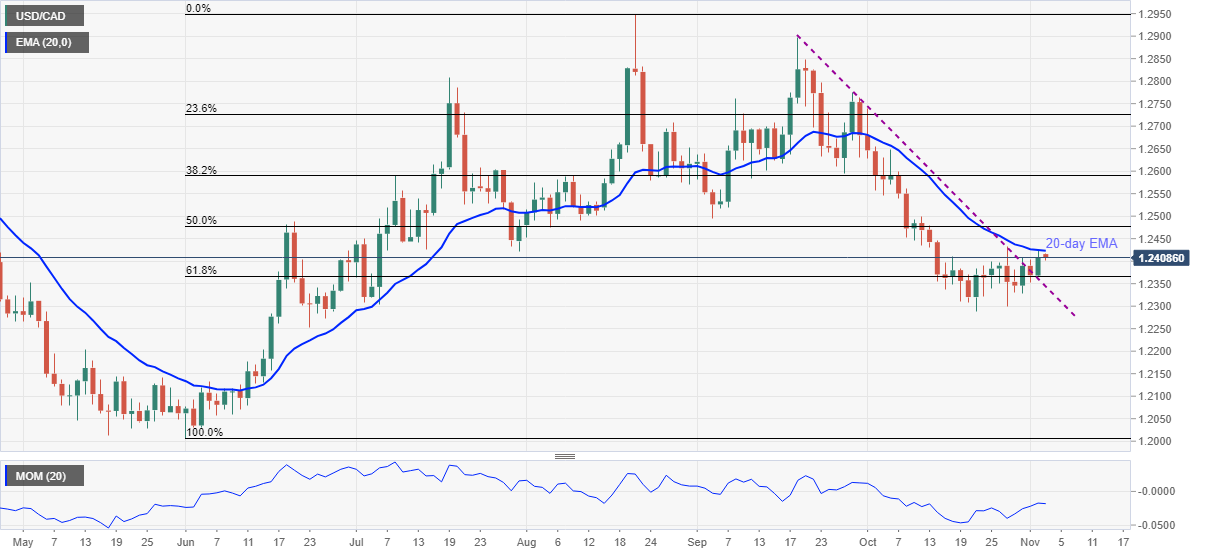
Trend: Further recovery expected







© 2000-2026. All rights reserved.
This site is managed by Teletrade D.J. LLC 2351 LLC 2022 (Euro House, Richmond Hill Road, Kingstown, VC0100, St. Vincent and the Grenadines).
The information on this website is for informational purposes only and does not constitute any investment advice.
The company does not serve or provide services to customers who are residents of the US, Canada, Iran, The Democratic People's Republic of Korea, Yemen and FATF blacklisted countries.
Making transactions on financial markets with marginal financial instruments opens up wide possibilities and allows investors who are willing to take risks to earn high profits, carrying a potentially high risk of losses at the same time. Therefore you should responsibly approach the issue of choosing the appropriate investment strategy, taking the available resources into account, before starting trading.
Use of the information: full or partial use of materials from this website must always be referenced to TeleTrade as the source of information. Use of the materials on the Internet must be accompanied by a hyperlink to teletrade.org. Automatic import of materials and information from this website is prohibited.
Please contact our PR department if you have any questions or need assistance at pr@teletrade.global.


 Bank
Bank transfers


