- Analytics
- News and Tools
- Market News
CFD Markets News and Forecasts — 07-11-2021
- USD/CAD loses bullish traction amid firmer WTI prices, USD pullback.
- USD/CAD’s upswing above 21-DMA falters at the 200-DMA.
- Daily RSI wavers at 50.00, impending bear cross threatens the upside.
USD/CAD is trading modestly flat around mid-1.2400s in Monday’s early trades, having finished Friday almost unchanged.
The upside in the major faltered in the second half of the previous week after WTI prices resumed their uptrend while the US dollar lost its footing after Fed’s patient stance.
Heading into a fresh week, investors digest the latest comments from the Bank of Canada (BOC) Governor Macklem on inflation, as the focus shifts towards Fed Chair Jerome Powell’s appearances and the US Consumer Price Index (CPI) data due later this week.
Looking at USD/CAD’s daily chart, the pair is looking for a fresh directional impetus after forming a Doji candlestick on Friday.
The renewed upswing triggered in the major on acceptance above the 21-Daily Moving Average (DMA) near 1.2395 ran into strong offers at the horizontal 200-DMA at 1.2477.
For the bulls to regain control, the pair needs to find a strong foothold above the latter. The next bullish target is then envisioned at the 1.2500 level.
USD/CAD: Daily chart
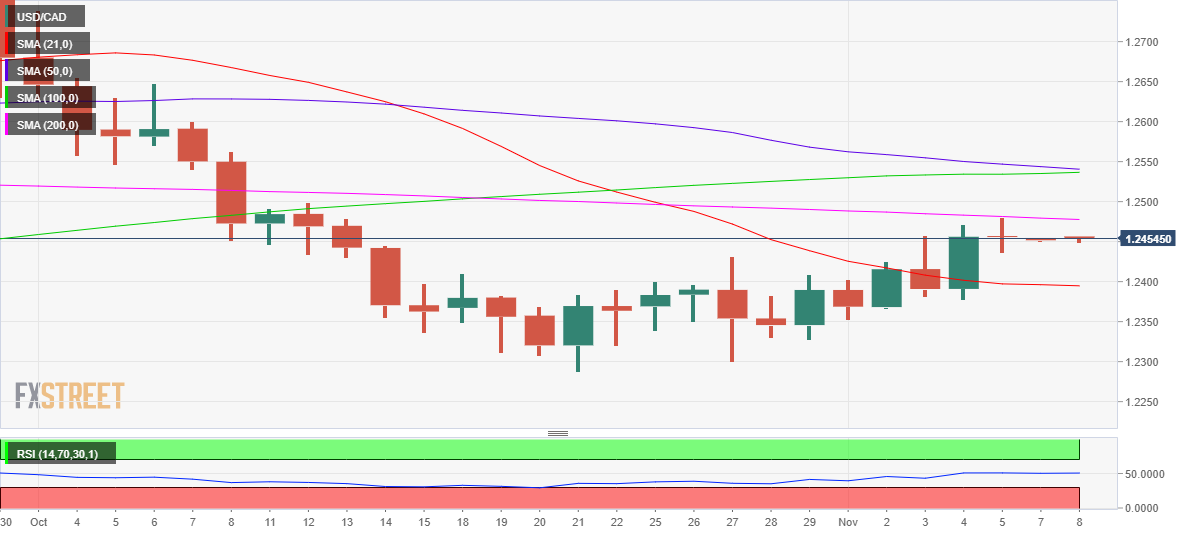
The Relative Strength Index (RSI) trades at the 50.00 level, pointing to a lack of clear directional bias for now.
Meanwhile, the 50-DMA is set to cut the 100-DMA from above, which if occurs will confirm a bear cross on the said timeframe, triggering a fresh downswing in the major.
Sellers will then look to retest the 21-DMA, the resistance-turned-support, below which the downside will open up towards 1.2300.
USD/CAD: Additional levels
- USD/JPY is under pressure as the high yielding currencies slump.
- Central bank rhetoric is less hawkish, giving rise to strength in the yen.
The yen has benefitted from an unwind of the higher-yielding currencies following the central bank meetings from last week with all three, the Reserve Bank of Australia, the Federal Reserve and the Bank of England, emphasising the transitory nature of inflation. Consequently, the US dollar fell and the yen gained over 5% on the final two days of trade last week.
At the time of writing, USD/JPY is trading flat for the open and is supported at a low of 113.32 and a high of 113.44 so far. The expectations of how far interest rates may rise were reined in last week and this took residence over a solid Nonfarm Payrolls report that failed to support the greenback following an initial surge on the release of the data. DXY, which measures the greenback against a basket of six rivals, rose as high as 94.634 after the jobs report, its firmest since Sept. 25, 2020.
US dollar under pressure
However, risk apatite took off and US stocks staged a broad rally. This weighed the greenback and enabled the yen to add to gains made earlier in the week. The dollar dropped to 94.118 but was still up around 0.1% for the week. However, on Wednesday, Fed Chair Jerome Powell said he was in no rush to hike borrowing costs, as there was "still ground to cover to reach maximum employment." The central bank had also announced a $15 billion monthly tapering of its $120 billion in monthly asset purchases.
''Bearish market positioning unwound,'' analysts at ANZ Bank explained in a note at the start of the week. ''Central banks are still hesitant, believing that current inflation pressures, whilst proving more lasting than initially thought, will pass.'' This has seen the US 10-year yield crumble from a restest of the daily counter-trendline into the 1.4550% territory. The more central bank sensitive yield, the 2-year fell a whopping 5.37% on the day on Friday.
US CPI in focus
This puts US inflation data on the radar this week. US Consumer Price Index is expected to slow significantly in 2022 by analysts at TD Securities as fiscal stimulus fades and supply constraints ease, but we don't expect the data to be validated in the very near term. ''The CPI probably rose rapidly in October, reflecting a surge in energy prices and a resumption of the uptrend in used vehicle prices after two declines. The health insurance part likely picked up as well,'' the analysts argued.
Randall Kroszner, a former Federal Reserve (Fed) Governor expressed his take on the timing of an interest rate hike by the world’s most powerful central bank.
Key quotes
“The Fed will hike by (northern) summer.”
“Elevated inflation won't ease in just 1 or 2 months.”
“The main things holding back US economy are supply constraints and low labor market participation.”
Related reads
- Fed's George: Now may be a time when Fed's goals appear to be in conflict
- USD/JPY bulls step in at daily support, sights on monthly resistance
Bank of Canada (BOC) Governor Tiff Macklem warned about inflation looking to last longer than previously anticipated, citing that it is 'transitory but not short-lived'.
Key quotes
“I think transitory to economists, means sort of not permanent.”
“I think to a lot of people, transitory means it's going to be over quickly and maybe I don't know exactly what the right word is, but it's probably something like you know, transitory but not short-lived.”
“I do want to assure Canadians that we are going to keep inflation under control.”
“And we have the tools, we have the mandate and we will be adjusting our tools to bring inflation back to target.”
“We said it's going to be sometime around the middle of next year. If you want it in months, sometime between April and September” when asked about the potential interest rates hike.
Market reaction
USD/CAD is trading almost unchanged on the day, at 1.2450, as of writing, shrugging off the above comments.
- GBP/USD consolidates the recovery below 1.3500 as a new week kicks in.
- The UK is set to trigger Article 16, as Brexit risks intensify.
- The US dollar could benefit amid potential risk-aversion, ahead of Fedspeak.
GBP/USD appears to pause its recovery from two-month lows of 1.3424 in early Asian dealings on Monday, as Brexit concerns are seen returning, spoiling the party for the GBP trading.
Brexit woes back in play
The 1.3500 remains a tough nut to crack for the GBP bulls, as the Irish Foreign Minister Simon Coveney warned against the UK government’s readiness to trigger Article 16 of Northern Ireland. Coveney said that doing so could lead to a trade dispute between the European Union (EU) and the Kingdom.
Further, the Bank of England’s (BOE) status-quo on the interest rates decision last week combined with Governor Andrew Bailey's cautious stance will continue to remain a weight on the major, despite the recent pullback in the US dollar across the board.
On Friday, the US dollar corrected sharply from the yearly highs against its major peers, tracking the sell-off in the Treasury yields, as investors reassessed the Fed’s tightening bets after Chair Jerome Powell said that they are patient on the rate hike last Wednesday.
However, with the Brexit woes back, GBP/USD’s recovery is likely to remain at risk, with Bailey’s speech and Fedspeak awaited later on Monday.\
Separately, the much-trumpeted free trade agreements (FTAs) “barely scratch the surface of the UK’s challenge to make up the GDP lost by leaving the EU”, according to an analysis commissioned by The Independent from top academics at the University of Sussex UK Trade Policy Observatory.
GBP/USD: Additional levels to consider
Brexit themes are coming in at the start of the week to put GBP at the top of the fundamental watchlist in the open. The British government is preparing to trigger Article 16 of the Northern Ireland Protocol. Minister for Foreign Affairs Simon Coveney has warned that doing so could lead to a trade dispute between the European Union and the UK.
Most economists would agree that this will damage both sides, but the Uk is more vulnerable to the negative ramifications which likey will be a weight on the pound, especially following the Bank of England's surprise hold at last week's meeting.
The minister said that Ireland needs to prepare contingency plans and will not be surprised now if this happens after the COP26 summit.
Mr Coveney said "this would be a significant act that would damage relationships between Britain and Ireland and put extraordinary pressure on parties in Northern Ireland". Mr Coveney told This Week that "whether that is part of an ongoing negotiating strategy to try to change, amend or end the Protocol is hard to know, but certainly the signals are not good".
Following talks between the pair in Brussels on Friday, the UK government said that "progress had been limited" but that "gaps could still be bridged through further intensive discussions".
Prior to Friday's meeting with Mr Sefcovic, Lord Frost said: "We're not going to trigger Article 16 today, but Article 16 is very much on the table and has been since July."
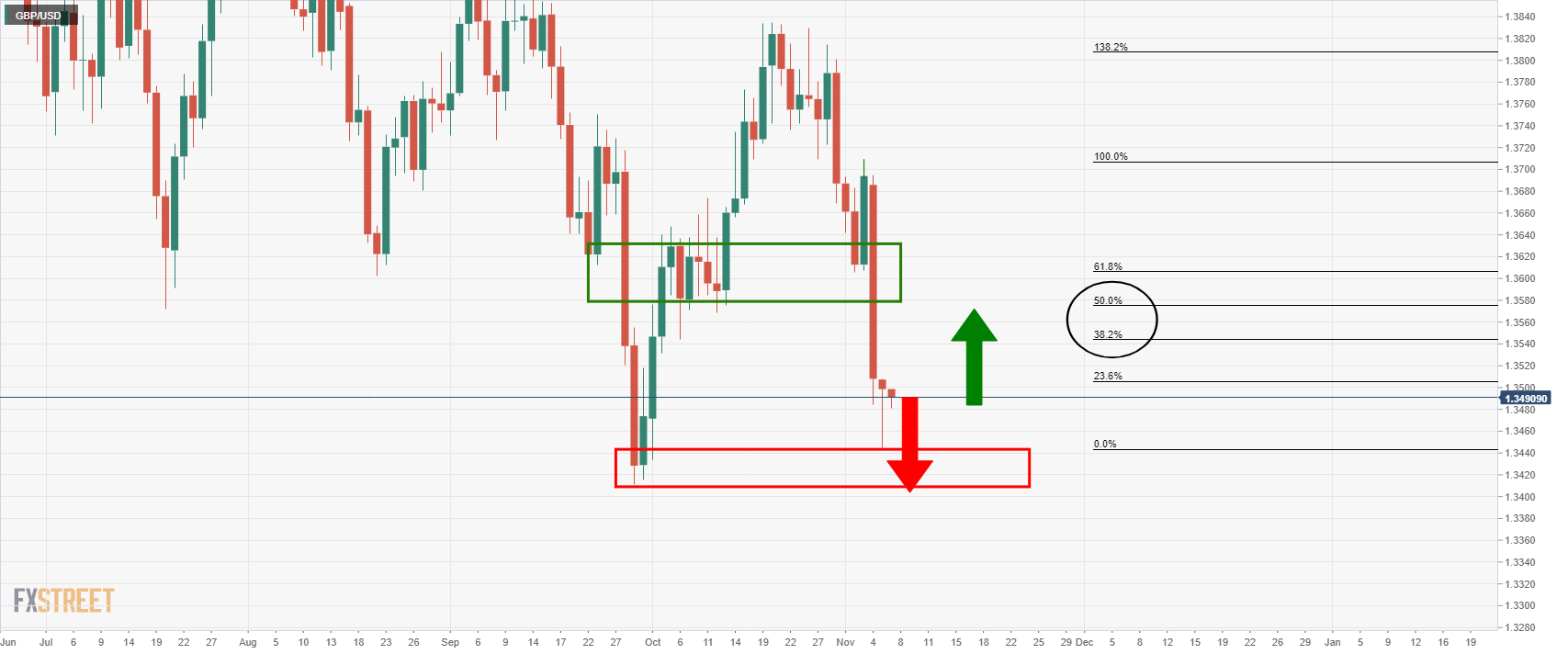
GBP/USD has so far steadied in the low 1.34 area but momentum is with the bears and there is a risk of a break of the lat September lows of 1.3411 for the sessions ahead should this risk gather traction.
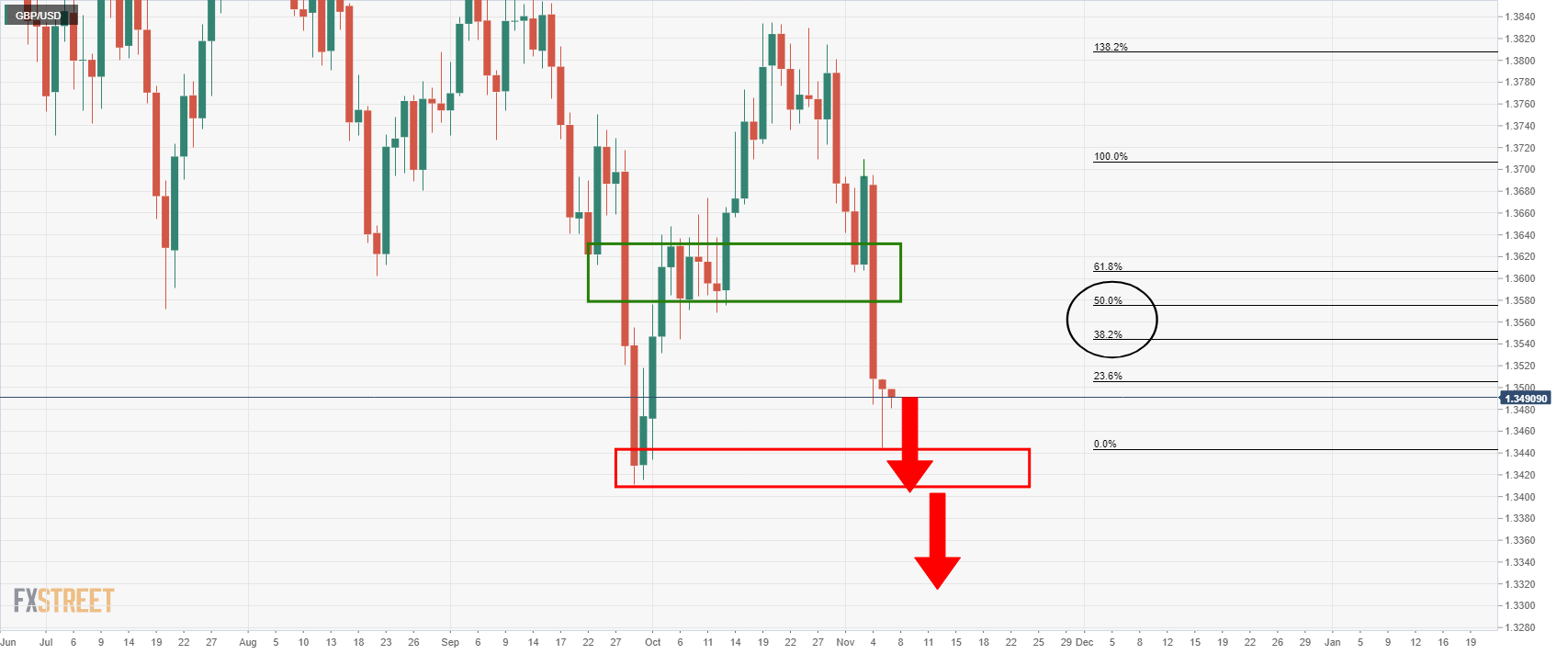
However, given that we are yet to see a correction, the 1.35 area is not out of the question either:
- EUR/USD prints fresh 2021 lows on Friday then rebounds.
- EUR buyers need validation above 21-DMA to unleash further recovery.
- A daily closing below 1.1512 will revive the downtrend in EUR/USD.
EUR/USD is holding onto Friday’s solid comeback from fresh 2021 lows of 1.1513 starting out a fresh week.
The sharp sell-off in the US dollar alongside the Treasury yields, in the face of the Fed’s patient stance over the rate hike prospects, knocked down the US dollar vs. its major peers, aiding EUR/USD’s recovery.
Attention now remains on the US Consumer Price Index (CPI) data and Fedspeak due on the cards this week for fresh trading direction in the main currency pair.
From a short-term technical perspective, the pair will face stiff resistance at the horizontal 21-Daily Moving Average (DMA) at 1.1599 on its road to recovery from multi-month troughs.
If that is cleared on a sustained basis, then the EUR buyers will look to take out the previous week’s highs at 1.1616.
Further up, the downward-sloping 50-DMA barrier at 1.1669 will be next on the bulls’ radars.
EUR/USD: Daily chart
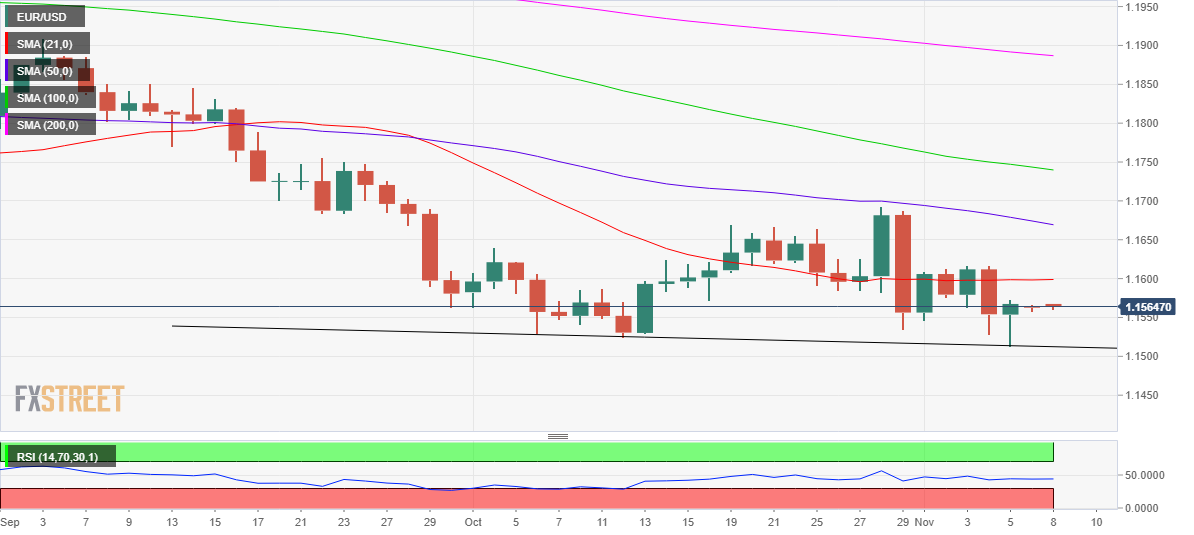
The 14-Day Relative Strength Index (RSI), however, remains below the midline, suggesting that the recovery attempts could be limited.
The immediate cushion for the pair is seen at the previous 2021 low of 1.1524, below which the falling trendline support at 1.1512 could be challenged.
A firm break below the latter is needed to unleash the additional downside towards the July 2020 levels of around 1.1450.
EUR/USD: Additional levels to consider
- Gold bulls take the lead with the focus on more patent rhetoric from central banks.
- Bulls are relishing within a lower yield environment and the focus is on the $1,830s.
- XAU/USD turns bullish on falling bond yields, technical breakout
Gold on Friday made an impressive rally as US yields crumbled on the back of the market's shift towards risk-on sentiment following a series of central banks that are in harmony with their patient rhetoric in respect to rate hikes. XAU/USD rallied from a low of $1,785.06 to a high of $1,818.36 and ended the day 1.47% higher.
The yellow metal relished in a risk-on environment on Friday as US stocks lapped up the benefit of not only a more relaxed tone towards central bank tightening but on a solid US Nonfarm Payrolls report that cemented the prospects of a firm recovery in the US jobs sector. The outcome was a welcomed relief for the start of the last quarter and came in contrast to what some economists had predicted for the final stage of the year.
NFP was solid
There was a 531k rise in Oct's US jobs market. We also saw an upward revision to Sept (312k vs 194k) that showed that a solid and dynamic labour market recovery is in place and that US economic activity is reaccelerating. ''For the transitory inflation argument to hold,'' however, ''it will be necessary for the participation rate to rise, and put downward pressure on wages,'' analysts at ANZ Bank explained. Nevertheless, the analysts argued that ''it was a very strong payrolls report and one that signals that the "transitory" dogma will be quite seriously challenged. If repeated in coming months, an accelerated taper seems probable.''
The most key for the precious metals markets on Friday, US Treasury yields fell despite stronger than expected employment payrolls data. Traders for the second straight day pushed out cash rate expectations on the view that central banks may be slower to move on inflation. This has seen the US 10-year yield crumble from a restest of the daily counter-trendline into the 1.4550% territory. The more central bank sensitive yield, the 2-year fell a whopping 5.37% on the day on Friday. ''This should see local rates markets start the week under some buying pressure,'' analysts at ANZ Bank argued.
Meanwhile, analysts at TD Securities explained that the central bank reiterated that its tools cannot help ease the temporary supply constraints that have ultimately driven inflation higher. ''In this context, data beats could result in a higher inflation risk premium, but the jury is still out on the Fed's reaction.'' The analysts also explained that ''market pricing for Fed hikes may also still be distorted by the terrible liquidity in Treasuries following the recent positioning washout.''
''In this context, while the breadth of traders' short positions is not extreme by any means, position sizing is bloated considering the number of participants short, which leaves the hawks vulnerable to a squeeze. An ongoing CTA buying program could also help the yellow metal break through the $1800/oz range that has contained its nascent rally.''
For the week ahead, the main economic event next week will be the release of the October Consumer Price Index in the US, where 5.8% YoY is expected (4.3% core). However, for the start of the week, the central bank theme will likely dominate and yields will be the focus.
Gold technical analysis
From a 4-hour perspective, the price of gold has been firmly bid but should profit-taking ensue by the weaker hands, then a correction would be the most likely trajectory to start the week off.
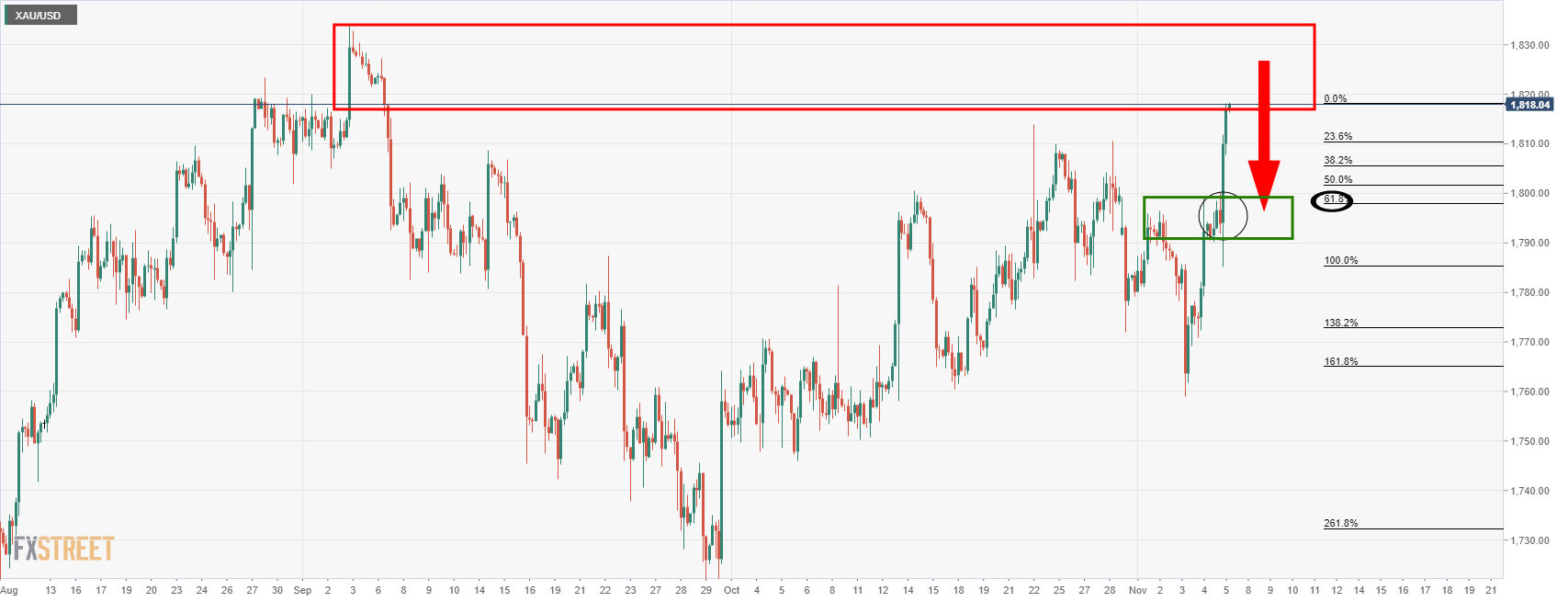
The price is meeting a resistance area, but as it stands, a 61.8% Fibonacci retracement has a confluence with the prior resistance just below $1,800 which could be expected to attract a retest in the coming sessions. With that being said, a continuation to the upside opens risk to $1,830 for the near term.
- AUD/USD is sidelined as markets ditch the hawkish theme leaving global yields on the backfoot.
- Higher yielders in forex have suffered in recent sessions which now leaves AUD hanging in the balance of risk sentiment for the open.
- AUD/USD awaits the next domestic catalyst in Aussie jobs data Nov 11.
AUD/USD ended the week sharply lower on Friday, failing to capitalise on the strength in the US stock market and an unwind of the bearish market positioning. Despite a solid Nonfarm Payrolls outcome, the US dollar was unable to perform as fixed income rallied. AUD/USD ended Friday flat at 0.74 the figure and had travelled between a low of 0.7360 and a high of 0.7412.
US Nonfarm Payrolls was expected to be a supportive factor for the US dollar, but that wasn't to be. Instead, while hitting its highest level in more than a year, as measured by the DXY index, the safe-haven currency pulled back a bit as risk appetite improved and stocks staged a broad rally. While the jobs report was strong, there remained more of a focus on central banks which have erred on the patient side.
Central banks in focus
Last week, there were central bank meetings from the Reserve Bank of Australia, the Federal Reserve and the Bank of England. ''All three emphasised the transitory nature of inflation, expectations of how far interest rates may rise were reined in as bearish market positioning unwound,'' analysts at ANZ Bank explained in a note at the start of the week. ''Central banks are still hesitant, believing that current inflation pressures, whilst proving more lasting than initially thought, will pass.'' This has seen the US 10-year yield crumble from a restest of the daily counter-trendline into the 1.4550% territory. The more central bank sensitive yield, the 2-year fell a whopping 5.37% on the day on Friday. Consequently, the DXY index is struggling and the low yielding FX is faring the best, leaving AUD somewhat sidelined.
The RBA discontinued its policy of yield curve control on Tuesday and flagged the possibility of an earlier increase in the Cash Rate Target in 2023 instead of 2024. However, the central bank pushed back against the hawkish repricing of recent weeks, stating that the “return of underlying inflation to the midpoint of the target range for the first time in 7 years does not, by itself, warrant an increase in the cash rate”.
For the week ahead, Aussie jobs data will be important this Thursday. ''The RBA is upbeat on the labour market and expects jobs to fully recover to pre-Delta levels (Aug) by year-end (as stated in its Nov SoMP),'' analysts at TD Securities explained. ''There is still a shortfall of 284k jobs and jobs could return quickly given the easing in restrictions in NSW and VIC. The participation rate is expected to pick up to 65% in tandem with the reopening, bringing the u/e rate to 4.7% from 4.6%.''







© 2000-2026. All rights reserved.
This site is managed by Teletrade D.J. LLC 2351 LLC 2022 (Euro House, Richmond Hill Road, Kingstown, VC0100, St. Vincent and the Grenadines).
The information on this website is for informational purposes only and does not constitute any investment advice.
The company does not serve or provide services to customers who are residents of the US, Canada, Iran, The Democratic People's Republic of Korea, Yemen and FATF blacklisted countries.
Making transactions on financial markets with marginal financial instruments opens up wide possibilities and allows investors who are willing to take risks to earn high profits, carrying a potentially high risk of losses at the same time. Therefore you should responsibly approach the issue of choosing the appropriate investment strategy, taking the available resources into account, before starting trading.
Use of the information: full or partial use of materials from this website must always be referenced to TeleTrade as the source of information. Use of the materials on the Internet must be accompanied by a hyperlink to teletrade.org. Automatic import of materials and information from this website is prohibited.
Please contact our PR department if you have any questions or need assistance at pr@teletrade.global.


 Bank
Bank transfers


