- Analytics
- News and Tools
- Market News
CFD Markets News and Forecasts — 04-11-2021
- GBP/USD hovers around 1.3500 after the Bank of England decided to keep rates unchanged.
- US and UK central banks push back higher rates, thus propelling equity markets to all-time new highs.
- GBP/USD: As long as it remains below 1.3571, sellers are in control.
The GBP/USD is steady as the Asian Pacific session kicks in, up 0.04%, trading at 1.3503 during the day at the time of writing. The market sentiment is upbeat, as the Federal Reserve said it would begin the bond tapering process, reducing purchases by $15 billion in the middle of November while pushing back higher interest rates. Investors used that as a signal to keep pushing equities at all-time highs, while in the FX market risk-sensitive currencies, dropped against the buck.
Meanwhile, on Thursday, the Bank of England (BoE) Monetary Policy Committee (MPC) decided to keep rates at 0.10%, despite that some BoE policymakers, including Governor Andrew Bailey, expressed concerns about high inflation in weeks before the meeting.
According to the MPC statement, the BoE rationale to maintain rates unchanged is that “It will be necessary to raise bank rate over coming months if data, especially jobs, is in line with the forecast.” Furthermore, they added that the “MPC still sees value in waiting for official labour market data after end of furlough, before deciding on tightening policy.”
Regarding asset purchases, the bank stayed put at 895 billion of Sterling. Concerning high inflation levels, the Boe “forecasts inflation to peak of 4.80% in Q2 2022.” Moreover, the UK’s central bank forecasts show inflation in two years at 2.23%, based on market interest rates.
GBP/USD Price Forecast: Technical outlook
In the daily chart, the GBP/USD pair found resistance around 1.3500, but as long as it remains below the July 20 low at 1.3571, it would be vulnerable to British pound sellers. Additionally, the daily moving averages (DMA’s) are well above the spot price, with a bearish slope, so GBP/USD traders would expect some selling pressure mounting on the pair ahead of the US Nonfarm payrolls report.
If GBP/USD bulls reclaim 1.3571, an attack to the 1.3600 figure is on the cards. On the other hand, failure at the abovementioned would expose the 1.3500 psychological level, followed by the 2021 low at 1.3411.
- AUD/USD extended its second consecutive day losses after central banks kept rates unchanged.
- In the FX market, risk-averse mood weighed on the AUD boosts the greenback.
- AUD/USD: Failure to reclaim 0.7450 would clear the path for sellers on its way towards 0.7170.
The AUD/USD slides as the Asian Pacific session begins, barely down 0.01%, trading at 0.7400 at the time of writing. The market sentiment was upbeat throughout Thursday, portrayed by global equity indices finishing in the green, led by US major indices reaching all-time new highs, except for the Dow Jones Industrial, which lost 0.09%.
In the FX market, the risk-sensitive currencies were down, led by the British pound, which collapsed when the Bank of England (BoE) kept rates unchanged, despite some inflation worries expressed by some of its members, which ultimately backpedaled, as the vote to hold rates, was 7-2. Alongside Sterling, the AUD, the NZD, and the CAD, were also down, as safe-haven currencies were bid during the session.
Additionally, on Wednesday, the Federal Reserve unveiled that it is reducing the amount of its bond purchasing program by $15 billion, which was initially perceived as a dovish taper. Investors' reaction prompted a sell-off of the greenback, but as of Thursday, the market reversed its course, as the US dollar was one of the gainers of the session.
AUD/USD Price Forecast: Technical outlook
Weekly chart
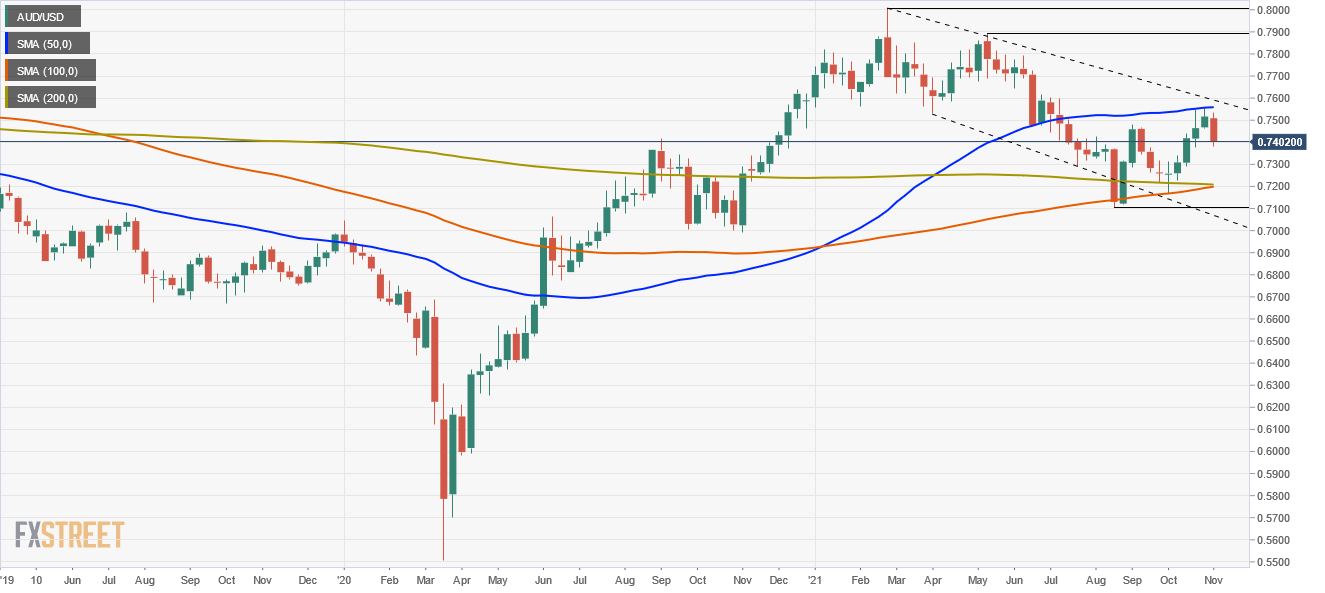
The AUD/USD pair is forming a bearish-engulfing candle pattern with strong bearish implications but requires a weekly close at 0.7450 to confirm its validity. In that outcome, the next support level would be the confluence of the 100 and the 200-week moving average (WMA) around the 0.7170-0.7200 area. Furthermore, the Relative Strength Index (RSI) is at 48 aims lower, confirming the downward bias.
Daily chart
-637716622808107436.png)
In the daily chart, the AUD/USD pair bounced off the 100-day moving average (DMA) at 0.7377, retreating towards the 0.7400 figure. Nevertheless, it broke the strong support level now turned resistance at 0.7450m which could be viewed as a level where AUD/USD sellers would lean to open fresh offers as the pair has a downtrend bias, depicted by the 200-DMA above the spot price. Furthermore, the Relative Strength Index (RSI), a momentum indicator is at 47, aims lower below the 50-midline, adding another signal for AUD/USD sellers. However, caution is warranted, as the 50 and the 100-DMA are beneath the price action around the 0.7360-80 area, that in case of being breached, could open the door for further losses. The first support level would be the September 24 high at 0.7315. A clear break of the latter would expose the September 30 low at 0.7169.
- AUD/NZD is correcting the recent bearish daily impulse.
- Bulls will be on the lookout for resistance to target, namely in the 61.8% ratio.
AUD/NZD is stalling on the downside as the kiwi gives back some ground following the labour data surprise and dialled up risks of the Reserve Bank of New Zealand hiking interest rates at a faster pace as firstly anticipated. The following illustrates the prospects of an upside corrector price t the next downside leg.
AUD/NZD daily chart
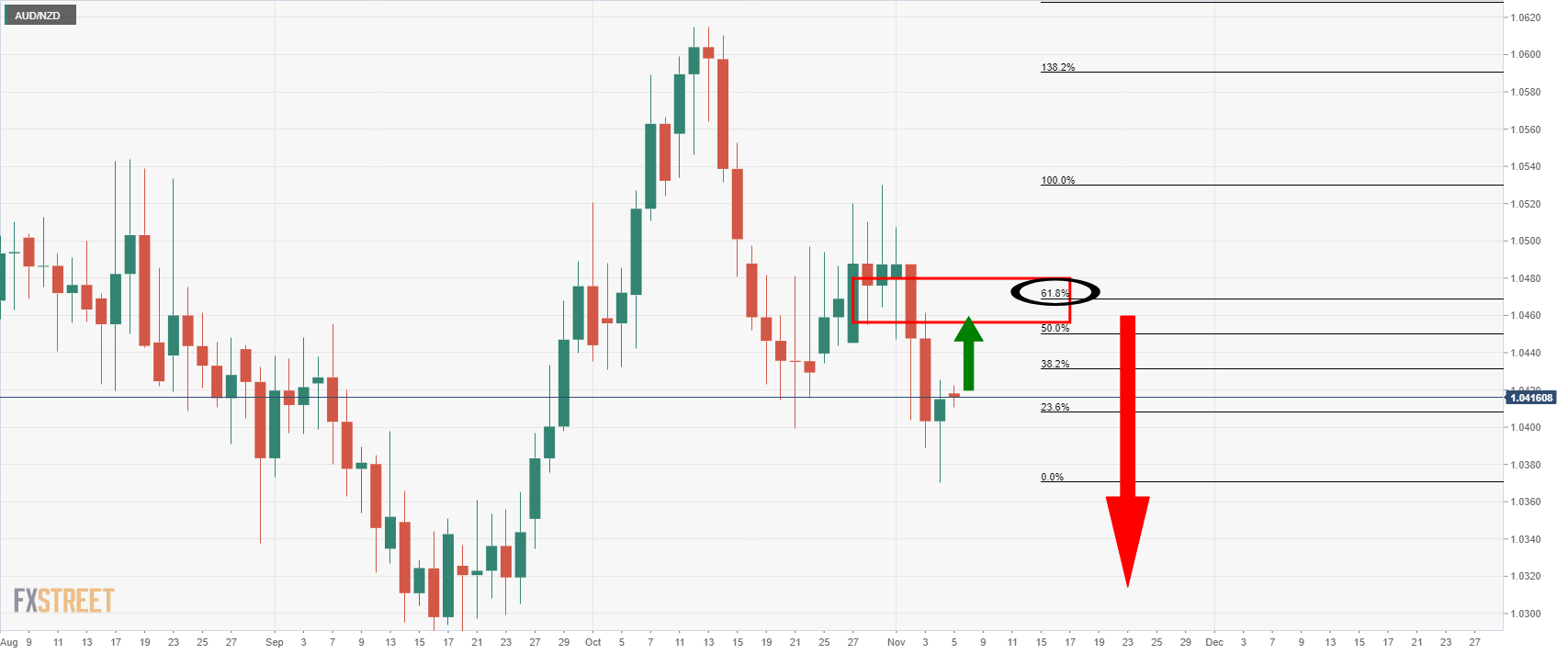
The price has found demand in what has been a strong sell-off prior to the support on the daily chart. This leaves prospects of a significant correction to target the 61.8% Fibonacci retracement level near 1.10480 in the coming days.
Additionally, as extra conviction, the price has left a reversion pattern in the form of an M-formation as follows:
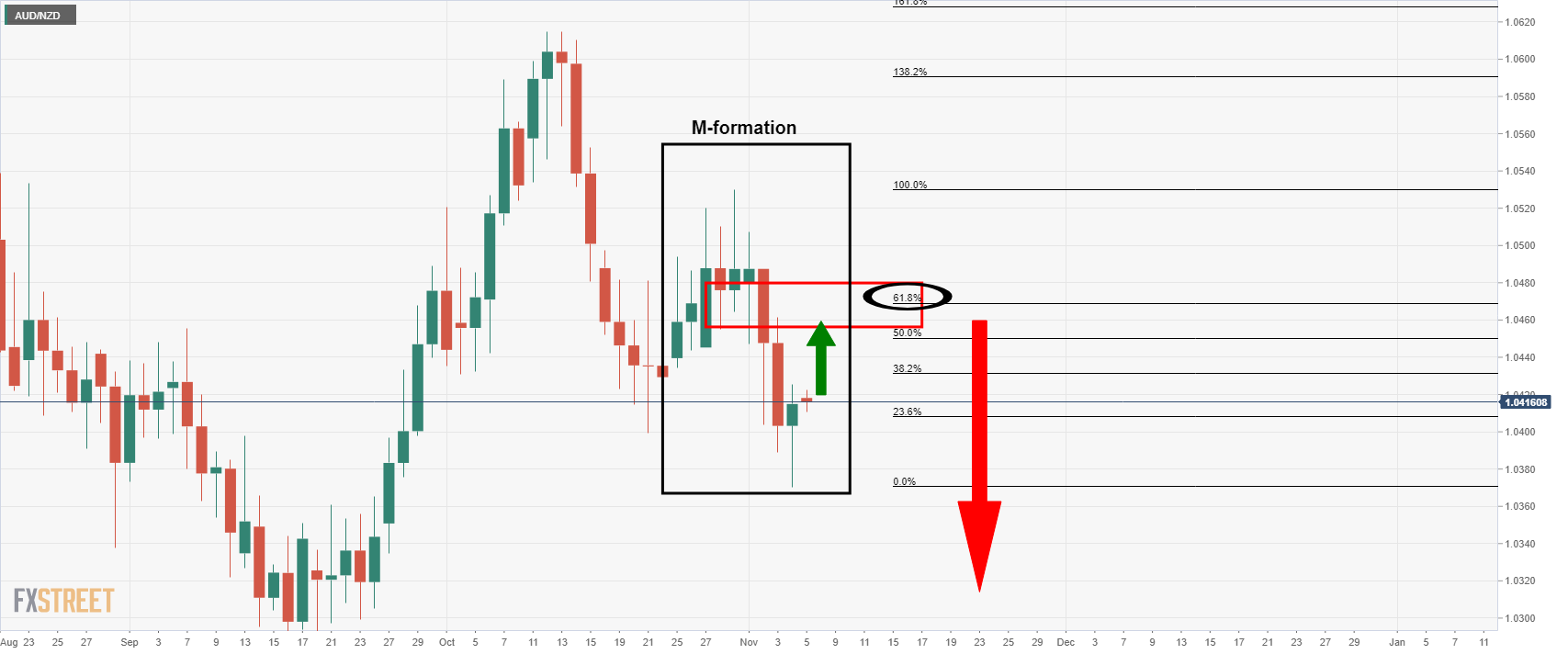
An M-formation has a high probability rate of the price reaching the neckline of the pattern and this has a confluence with the golden ratio. Therefore, this would be expected to act as resistance on a restest by the bulls and lead to a downside continuation.
- Gold is on the defensive from a critical level of resistance on the daily chart.
- All eyes will now turn to the US jobs market as the US dollar seeks to regain its title on the forex leader board.
The price of gold was ending the day higher by 1.25% after travelling from a low of $1,769.64 to a high of $1,798.95 despite a front footed greenback as investors bought the post-Federal Reserve USD dip. The greenback recovered some 0.5% on Thursday as measured by the US dollar index, the DXY. The index rallied from a low of 93.825 to a high of 94.473.
The US dollar rebounded on Thursday from a dip after the US Federal Reserve repeated it saw high inflation as transitory and announced on Wednesday a $15 billion monthly cut to its $120 billion in monthly purchases of Treasuries and mortgage-backed securities. The knife was later buried when Chairman Jerome Powell said he was in no rush to hike borrowing costs leading to an additional sell-off in the greenback.
However, as fast as traders were to let go of the greenback, they were just as quick to buy back into the prospects of faster timings of a rate hike from the Fed following a series of strong data this week ahead of FrduaysNonfar Payrolls event.
Nonfarm Payrolls in focus
''We expect employment and wage gains to slow in the year ahead as the boosts from fiscal stimulus and reopening fade and the participation rate rises, but, more immediately, momentum appears to be up again as the drag from Delta fades.,'' analysts at TD Securities explained.
''We forecast up 550k in total for payrolls in October, with private payrolls up 600k. We forecast up 0.5% m/m for hourly earnings, with the 12-month change rising to 5.0% from 4.6%.''
The prospects of maximum employment in the comings months should keep the US dollar elevated and real yields less negative as a headwind for the gold price.
However, the analysts at TD Securities also acknowledged that ''the Fed reiterated that its tools cannot help ease the temporary supply constraints that have ultimately driven inflation higher.'' This, they say, is a dovish message ''relative to market expectations for Fed hikes, which still remains far too hawkish, but which may also be distorted by the recent positioning washout across Treasuries.''
''Nonetheless, the yield curve steepening does reflect that market pricing has started to acknowledge that the Fed may let inflation run hot for a bit longer. In this context, while the breadth of traders short positions is not extreme by any means, position sizing is bloated considering the number of participants short, which leaves the hawks vulnerable to a squeeze.''
''Going forward, the market will continue to gauge whether the Fed holds strong enough cards to bluff, which leaves a larger focus on economic data. In this respect, we expect some immediate strength resulting from the fading Delta wave, but that the fiscal drag will turn sufficiently contractionary to delay the prospect of rate hikes.''
Gold technical analysis
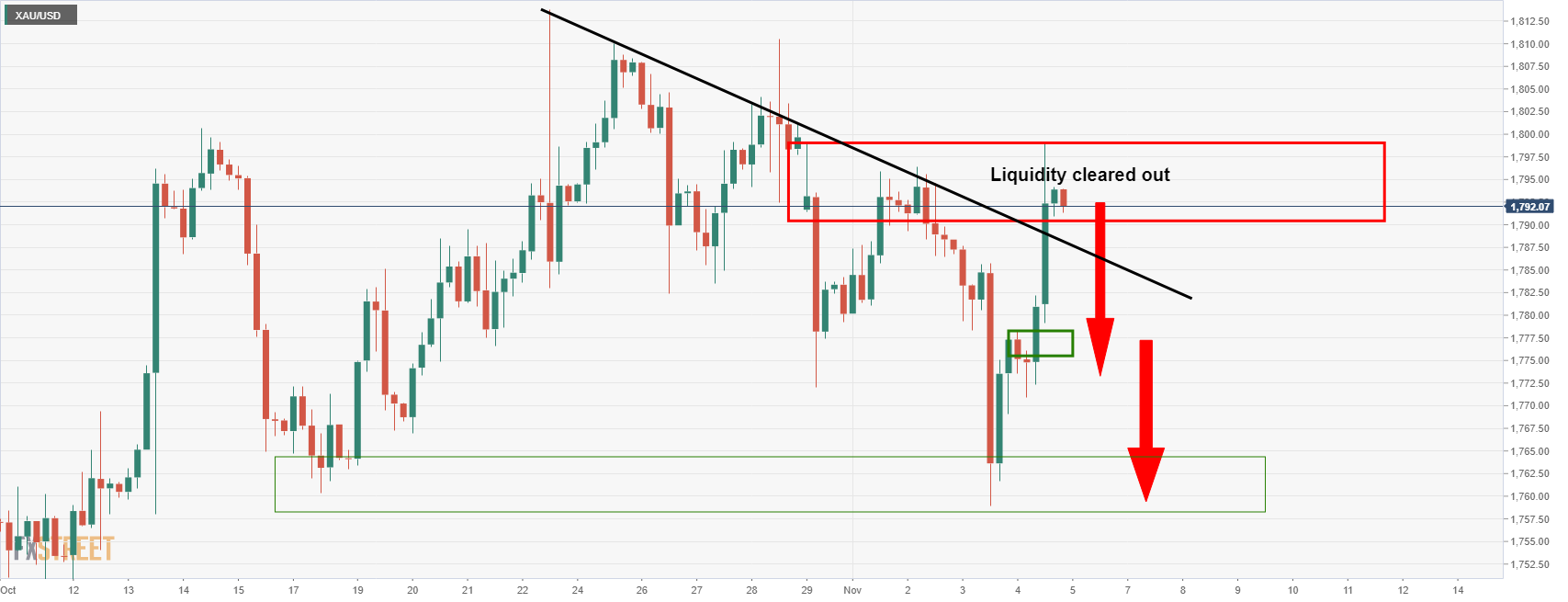
The price is wedged back into a consolidation area on the daily chart and offers little clue as to where the market might be headed next.
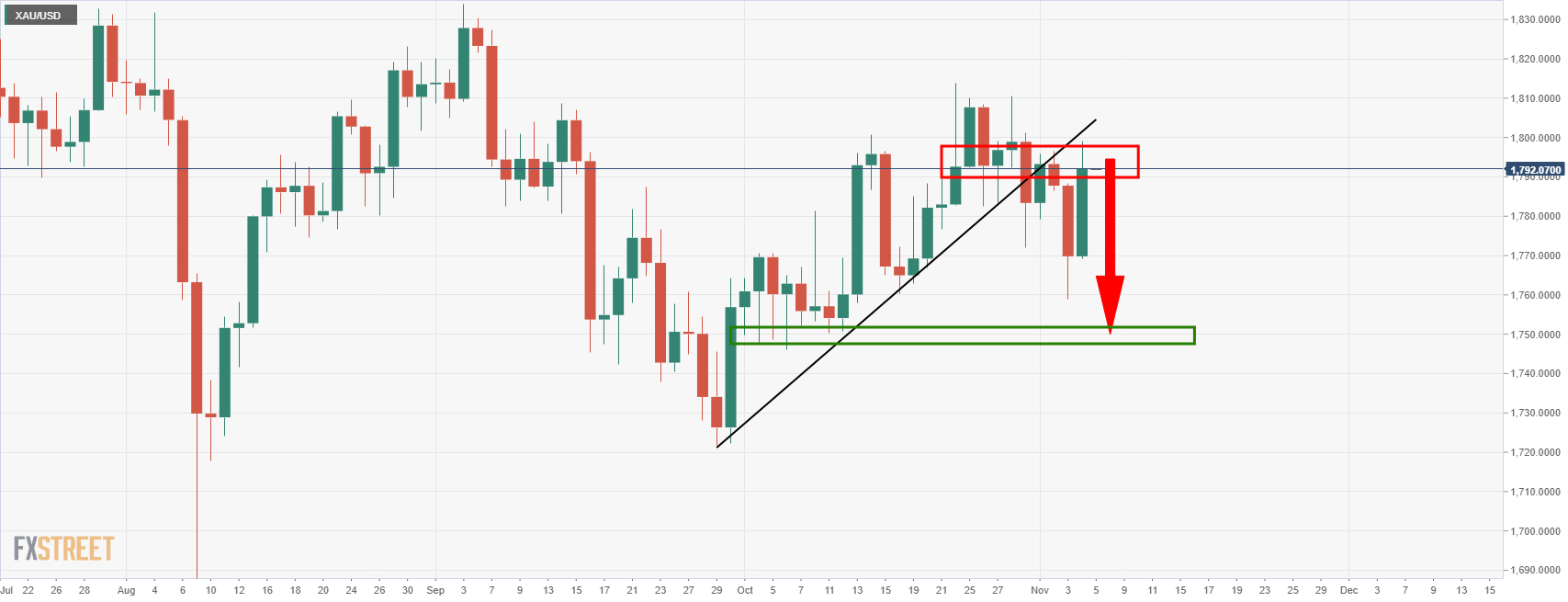
However, should the resistance hold, then the path of least resistance is likely to the downside.
meanwhile, from a 4-hour perspective also, the market could well have picked up enough liquidity on the break of the counter trendline and filling buy stops for which could result in a downside move into the $1,750s for the forthcoming session.
- The S&P 500 and Nasdaq 100 posted their sixth successive record closes on Thursday.
- Equities, particularly duration-sensitive tech names, benefitted from a sharp drop in US yields.
- Focus now turns to US jobs data on Friday.
Another day, another record close for the S&P 500 and Nasdaq 100 indices. That’s marks six record closes now in the last six sessions for both indices. The S&p 500 posted a gain of 0.4% to close at 4680, while the Nasdaq 100 was higher by 1.25% to close at 16.35K. The Dow posted a small loss of 0.1%, but remain above the 36K level. The CBOE Volatility Index (VIX), often referred to as Wall Street’s fear guage, remained stable just above 15.00, leaving it not far from post-pandemic lows around 14.00 set back in June.
Chipmakers saw notable gains with the Philadelphia SE Semiconductor Index surging 3.5% on the day after strong earnings from heavyweight Qualcomm (+12.7% on the day), whose business is thriving despite severe global supply chain disruptions. More broadly, tech stocks were the beneficiaries of a sharp decline in US bond yields (2s -5bps to 0.43%, 5s -7bps to 1.115%, 10s -8bps to 1.53% and 30s -5bps to 1.97%) – the major catalyst of the drop was a dovish surprise from the BoE which triggered a historic decline in (particularly short-end) UK yields, a drop that spilled across to international markets.
Remember that the valuation of many tech stocks is much more dependent on expectations for future earnings growth rather than on current earnings, more so than for many other equity sectors, thus when interest rates rise, the opportunity cost of banking on future earnings growth rises, thus weighing on the valuation of these stocks. On the other side of the coin, these also so-called growth or “duration-sensitive” names benefit when yields fall.
With yields sharply lower, the S&P 500 financials index was under pressure, dropping 1.3%. Sticking with the sectors, a sharp drop in oil prices as traders took profit on pre-OPEC+ decision long positioning (some said they didn’t want to be caught out by a US policy response to OPEC+ not lifting output by as much as they wanted) weighed on the S&P 500 energy index, though just before the close it managed to recovery into positive territory on the day and close about 0.2% higher. A number of major US oil producers have announced plans to up investment to expand production in recent days.
Fed giveth, NFP taketh away?
Stocks have had a great week thus far, the S&P 500 up 1.6% and the Nasdaq 100 up over 3.0%, with both indices now up 9.5% and 13.5% respectively from the September lows. Key to the rally in recent weeks has been a much better than expected Q3 corporate earnings season, but another major driver of the rally this week was Wednesday’s Fed policy announcement; investors had fully priced in the $15B/month QE taper announcement and cheered the Fed’s continued characterisation of inflation as largely being driven by transitory factors, as well as Powell insistence that in the bank’s base case, inflation will be coming down in mid-2022 and he is willing to be patient when it comes to interest rate hikes.
But some analysts noted that the Fed did also acknowledge that uncertainty regarding the path of the economy (with regards to both inflation and employment), which they think opens the door to a potential hawkish shift by the Fed in early 2022 if inflation remains elevated and labour market progress is strong. The Fed clearly wants to maintain the optionality to shift in a hawkish or dovish direction next year, hence why it didn’t yet announce the pace of its QE taper beyond December. For now, Fed policy is on autopilot until the end of the year, but it will be watching the data intently.
Thus, Friday’s labour market data will be an important one and will set the tone of what is to be expected for the labour market for the rest of Q4. A very strong report could raise the risk of a hawkish Fed shift in 2022 and push yields higher, which could result in equities ending the week on a sour note. The major US indices are likely due a bit of a pullback at this point anyway, those seeking to take profit might not need much excuses.
- USD/JPY slumps during the day, despite broad US dollar strength across the board.
- Lower US T-bond yields weighed on the USD/JPY pair, benefiting the Japanese yen.
- USD/JPY: Bullish above 114.00, otherwise range-bound, with 113.50 as strong support.
The USD/JPY slides during the New York session, down 0.21%, trading at 113.76 at the time of writing. As portrayed by US stock indices rising between 0.01% and 1.30%, market sentiment is upbeat, except for the Dow Jones Industrial losing 0.35%. In the FX market, risk-averse sentiment prevails, as safe-haven peers appreciate, thus favoring the Japanese yen, versus the greenback.
In the meantime, the US Dollar Index, a basket of six currencies, rises almost half percent, up to 94.32. Contrarily, the US 10-year Treasury yield drops six basis points, sits at 1.519%, a tailwind for the USD/JPY, due to its high correlation.
USD/JPY Price Forecast: Technical analysis
4-hour chart
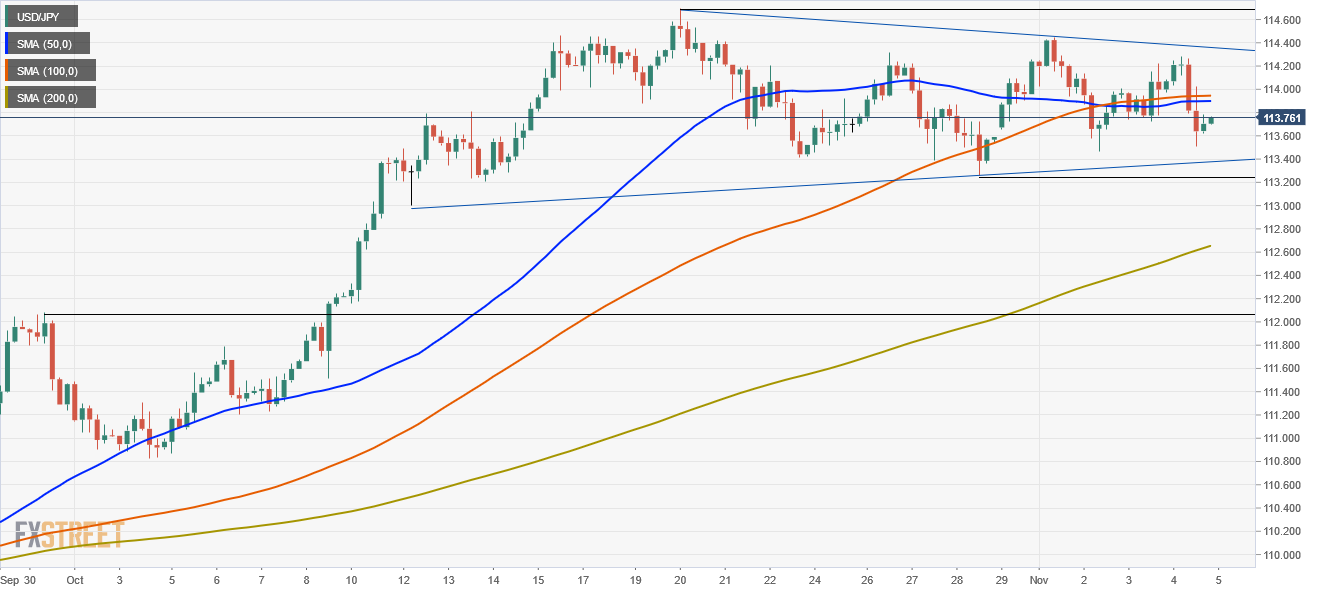
The USD/JPY is in consolidation within the 113.50-114.50 range. Furthermore, the 50 and the 100-simple moving averages (SMA’s) hover around 114.00, acting as a tailwind for price action in the last couple of days. It’s worth noticing that the 113.50 is a level respected by USD/JPY traders, in which the pair bounced off towards the top of the range. Nevertheless, the almost horizontal slope of the moving averages does not provide enough clues for the direction of the trend.
For USD bulls to resume the upward trend, they need to reclaim the 114.00 figure. In that ourcome, the following resistance on the way north would be the downslope trendline that travels from October 20 high towards November 1 high, around 114.30. A breach of the latter would expose the 2021 high at 114.70.
On the flip side, a break below 113.50 could open the way for further losses. The first demand zone would be 113.00, followed by the September 30 high at 112.00.
- USD/CAD is at session highs above 1.2450, the pair trading as a function of oil, which has sold off recently.
- Focus for the pair returns to economic fundamentals on Friday with the release of US and Canadian jobs numbers.
USD/CAD is currently trading at highs of the day slightly to the north of the 1.2450 per barrel mark, sharply up from Asia Pacific session lows around the 1.2400 level, the pair trading as a function of oil prices more than anything else. On which note, crude oil prices have reversed sharply from what were at the time very impressive on the day gains (WTI was up more than $3.0 above $83.00) to hit fresh near four-week lows (WTI currently trades around $79.00), with this latest bout of selling pressure exerting a drag on the loonie and giving USD/CAD tailwinds.
The pair now trades at its highest levels since 13 October, and the bulls will be hoping that oil can continue with its downwards trajectory enough so that USD/CAD hits the next notable area of resistance around 1.2480, where the 200-day moving average resides. With regards to Canadian economic news/fundamentals, there hasn’t been anything of note on Thursday aside from a slightly bigger than expected trade surplus of C$ 1.86B in September, data which hardly ever moves USD/CAD anyway.
There have been a number of important updates for crude oil markets today, which can be neatly summarized as; 1) as expected, OPEC+ agrees to hike output by 400K barrels per day in December, despite international calls for a larger output hike, 2) the US isnt happy about OPEC+’s decision and is assessing options (they could release crude oil from their strategic reserves or even ban crude oil exports) and 3) traders are citing post-OPEC+ profit-taking, technical selling and recent negative China Covid-19 outbreak news as the major drivers of the sell-off.
Crude oil newsflow is likely to take a back seat on Friday (although traders should be on notice for any announcement from the US) and economics will return to the forefront with the release of US and Canadian October labour market reports, both out at 1330GMT. With both the Fed and BoC currently on course to start lifting interest rates in 2022, the timing of lift-off is highly sensitive to the persistence of inflation at high levels, but also the progress back to pre-pandemic levels of health of the labour market. USD/CAD traders will have to weigh up both jobs reports simultaneously, which can sometimes make for a confused reaction in USD/CAD.
- Sterling crosses fell heavily on the back of the BoE surprise hold.
- GBP/CAD bears running out of juice into weekly demand territory.
GBP/CAD fell heavily in trade on Thursday following a surprise from the Bank of England that did not raise rates as expected. GBP/CAD fell from a high of 1.6962 to a low of 1.6792 and was ending on Wall Street down some 0.80%. The following, however, illustrate that the path of least resistance, for the time being, is likely to the upside.
GBP/CAD daily charts
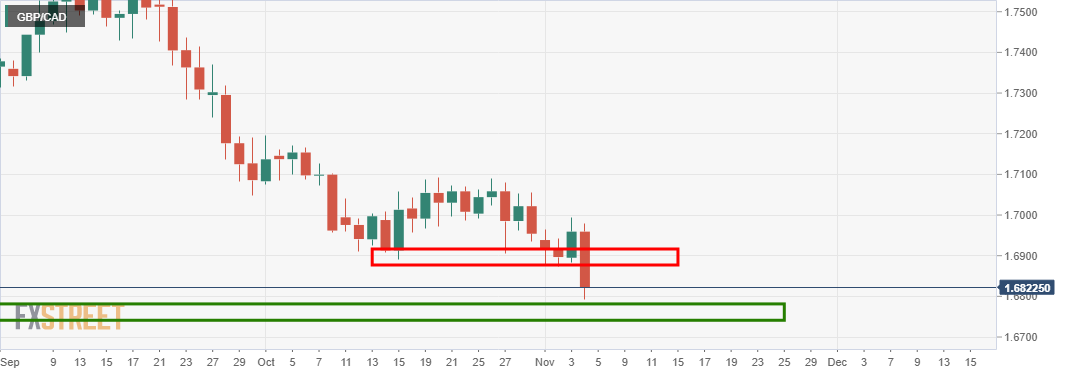
The steep drop could be luring bears into a false sense of security at this juncture when zooming out and taking the weekly demand into consideration as follows:
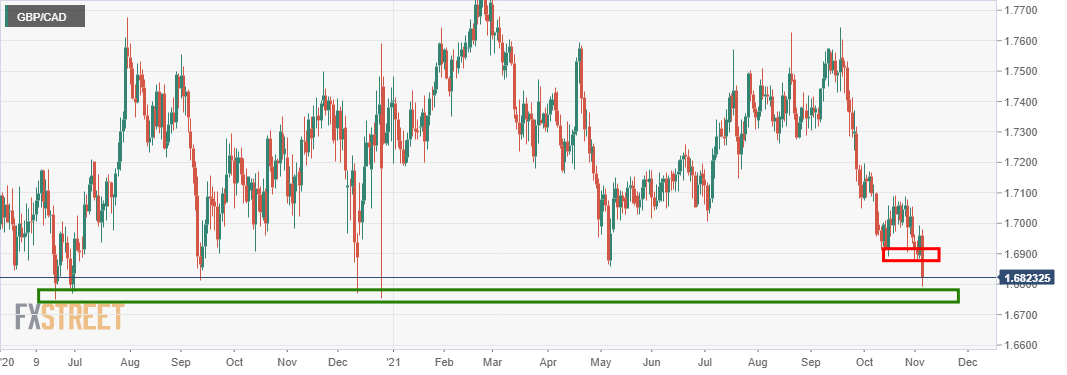
There is a chance that the trend will continue a little while yet, however, 1.6800 marks a central point of demand and the more probable scenario at this juncture is a respite in the current move, especially from a lower time frame perspective, as follows:
GBP/CAD H1 chart
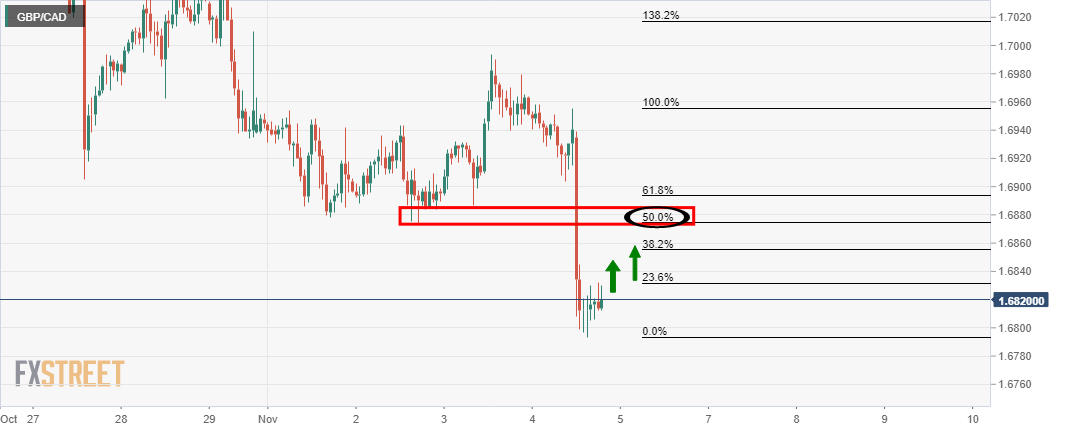
The price fell sharply on the back of the BoE and this leaves a huge imbalance for which would be expected to be filled in coming sessions. The 50% mean reversion target is compelling as it aligns with prior support that would be expected to act as resistance near 1.6880.
Should the area hold, then the downside will be opened again for a retest and bears will be keen to test below 1.68 the figure for a deeper probe of the weekly demand area with 1.6730 in scope.
What you need to know on Friday, November 5:
On Thursday, the American dollar is the overall winner, resuming its advance and reaching fresh weekly highs against high-yielding rivals. On the other hand, safe-haven assets edged higher against the greenback, although without breaking any critical level.
The Bank of England had a monetary policy meeting and decided to leave the benchmark interest rate unchanged at 0.1%, disappointing markets that were anticipating a rate hike and further boosting the dollar’s demand. The GBP/USD pair plummeted to 1.3470, to end the day around the 1.3500 figure.
The EUR/USD pair met sellers around 1.1615 for a third consecutive day, with bulls giving up, resulting in a test of 1.1527. AUD/USD briefly pierced the 0.7400 figure, settling around the level, while USD/CAD jumped to 1.2460, despite plummeting crude oil prices. WTI currently trades around $79.10 a barrel after the OPEC+ decided to maintain its current output steady at 400K barrels per day.
Gold returned to its comfort zone just below the 1,8000 mark, currently trading at around $1,793.00 a troy ounce.
Central bankers are putting a lot of effort into down-talking inflation concerns. BOE’s Governor Andrew Bailey noted that “the warning signs are there, the bells are ringing, as it were, so we have to watch this carefully, and that’s what we’re doing,” but he added that they yet see medium-term inflation “de-anchored.” On Wednesday, US Federal Reserve Chief Jerome Powell delivered a similar message, repeating that inflation is high but still expecting it to normalize without the central bank’s intervention.
European equities benefited from a dovish BOE, ending the day in the green. Wall Street was unable to follow the lead and finished the day mixed.
US Treasury yields retreated, with that on the 10-year note hitting an intraday high of 1.60% to settle near a daily low of 1.509%.
The week will end on a high note, as the US will publish the Nonfarm Payrolls report.
Dogecoin and Shiba Inu at war as Binance, Crypto.com add SHIB-DOGE trading pair
Like this article? Help us with some feedback by answering this survey:
- EUR/GBP continues to climb and is now above 0.8550, with bulls likely targetting a test of the 200DMA at 0.8587.
- After disastrous miscommunication by the BoE in the run-up to Thursday’s policy announcement, the BoE faces credibility questions.
EUR/GBP continues to steadily climb in wake of Thursday’s dovish BoE surprise that has sent GBP tumbling versus all of its major G10 counterparts, the euro included. The pair, having cleared a number of key levels of resistance at the psychological 0.8500 level, the prior weekly high at 0.8510 and the 50-day moving average at 0.8523, is now consolidating slightly to the north of the 0.8550 level. While the euro might not be the best G10 currency to express a bearish GBP view against, given that the ECB is still expected to lag well behind the BoE in terms of monetary policy tightening even if the BoE is now going to be more dovish than market participants had been expecting as recently as this morning, it still seems likely that the latest bounce in the pair will have legs. The next target for the bulls will be the 200DMA at 0.8587.
BoE faces credibility questions
Thursday was not a good day for the credibility of the Bank of England’s policymaking, something which the severe sterling sell-off and a sharp drop in UK gilt yields can attest to. Hawkish commentary from BoE Monetary Policy Committee (MPC) members in the run-up to the latest monetary policy meeting had convinced money markets and a good proportion of analysts/economists that a 15bps rate hike was on its way and that the bank would be signaling that further rapid tightening though to 2023 would also be likely. In the end, only two of the nine MPC members voted for a 15bps hike and only three voted for an early end to the bank’s current £895B bond-buying scheme (i.e. to cap it at £875B).
The BoE said that it wanted to wait to see more labour market data given the UK government’s furlough scheme just ended at the end of September (the unemployment rate is likely to rise modestly) and, rather than guaranteeing rate hikes as many thought the BoE would at minimum do if it opted not to hike rates, the bank merely said that rate increases would be appropriate in the coming months IF the economy progresses as expected. Meanwhile, in the post-meeting press conference, inflation was categorised as “transitory” and seen coming back close to the bank’s 2.0% target by the end of the forecast horizon.
Needless to say, markets were completely wrong-footed, and governor Bailey & co. now face intense scrutiny regarding the bank’s credibility in light of this failure to properly guide investor expectations. The governor retorted to a critical press that it was not the BoE’s job to guide market rates, which is not something you would see Fed Chair Jerome Powell saying; the Fed Chair, who just masterfully pulled of a QE taper without creating any notable market drama, understands the importance of guiding market expectations properly overtime to the transmission of monetary policy to the economy. In private, BoE members will know they messed up. But volatility surrounding BoE policy in UK markets is likely to be elevated in the months ahead as markets question whether they can trust anything BoE members are telling them.
- AUD/USD dipped below 0.7400 for the first time in ten days, printed a low of 0.7382.
- In the FX Market, the sentiment is risk-averse, as safe-haven currencies appreciate.
- US Jobless Claims improve for the fourth consecutive week.
The AUD/USD pair plunges during the day, down 0.62%, trading at 0.7402 at the time of writing. The market mood is upbeat, as portrayed by global equities trading higher, headed by US stocks indices reaching all-time highs, whereas, in the FX market, safe-haven peers appreciate against risk-sensitive currencies like the AUD, the NZD, and the GBP.
The Australian dollar has been seesawing in the last couple of days
On Wednesday, the AUD/USD pair dipped as low as 0.7420 on positive US macroeconomic figures for October. ADP employment jobs report, prelude of Nonfarm Payrolls, and US PMI Services number were better than expected, lifting the greenback against most G10 currencies. Later on the day, the Federal Reserve announced the telegraphed bond taper, which investors perceived as dovish, which witnessed a spike of 50 pips on the pair, settling around 0.7450.
On Thursday, during the Asian session, market participants changed their course as the Fed left the door open for a faster bond tapering process. The US central bank said that “comparable decreases in buying pace are likely reasonable each month, but we are willing to adapt if necessary.” AUD/USD traders reacted, sending the pair sliding towards 0.7382.
Meanwhile, the US Dollar Index, which tracks the buck’s performance against its peers, advances half percent, sits at 94.32, a tailwind for the AUD/USD pair. US T-bond yields drop in the bond market, with the 10-year falling five basis points, down to 1.524% at press time.
US Jobless Claims improve for the fourth consecutive week
On the macroeconomic docket, the Australian Retails Sales for the Q3 dropped by 4.4%, better than the 4.6% foreseen by analysts, blamed for lockdowns. Further, the Trade Balance for September showed a surplus of A$12.243 B lower than the A$15 B in August.
On the US front, the Bureau of Labor Statistics (BLS) reported the Initial Jobless Claims for the week ending on October 29, which rose to 269K, better than the 277K estimated by economists, adding to the improvement of the labor market, as it is the fourth consecutive week of drops.
- WTI prices have seen a sharp reversal from earlier highs above $83.00 and now trade under $79.00.
- Profit-taking in wake of the OPEC+ meeting and technical selling are likely major factors driving the move.
Oil prices have seen rollercoaster price action thus far this Thursday. At one point, front-month WTI future prices were up more than $2.50 vs Wednesday’s closing levels, nearly reaching $83.50, but prices have since seen a near $5.0 (more than 5.0%) reversal and WTI is now trading underneath the $79.00 level. That means the American benchmark for sweet light crude oil is now trading at near one-month lows. Some analysts are perplexed that oil chose Thursday to sell off so aggressively, a day on which OPEC+ refused to cave to international pressure to increase output at a faster pace, instead opting to stick to the usual 400K barrel per day per month hike in output in December.
Some argued it was a classic case of buy the rumour, sell the fact; one analyst was quoted on Reuters arguing that, following a load up in speculative long positioning building up in the run-up to the OPEC+ meeting, traders were now inclined to take-profits in anticipation that further calls from the White House for the cartel to increase output might send prices lower. Rather than just putting verbal pressure on OPEC+ to increase output, the US government is also said to be considering options including releasing crude oil stored in the Strategic Petroleum Reserve (SPR) and imposing a ban on US oil exports, measures which could weigh on crude oil prices in the near-term. Another recent bearish development being cited by some analysts as weighing on crude oil markets this week is the resurgence of Covid-19 in China, where the country still operates a strict zero Covid-19 policy (meaning widespread lockdowns remain on the table), presenting a near-term risk to demand.
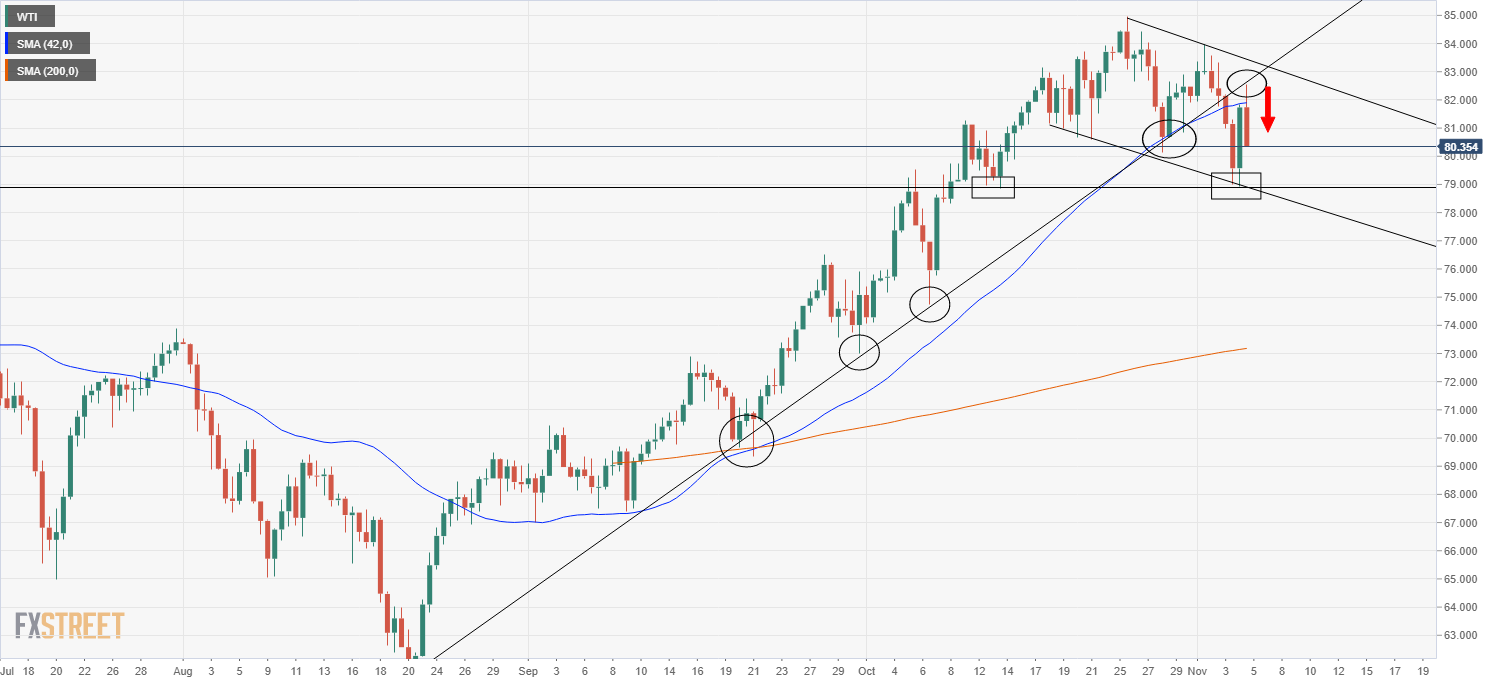
Technicians will argue that technical selling also played a key part in driving prices lower on Thursday; WTI prices had been supported by a bullish trendline going all the way back to August, a trendline that up until Wednesday was respected very well. After breaking below this trendline on Wednesday, Thursday saw the first major retest (when prices went above $83.50), which speculative, short-term sellers of crude oil may have leapt on. If oil is trading technically right now, the next key area of support to look at is the 6 July high at around $77.00 per barrel. Whilst some short-term sellers might want to book profit at this level, there is also a risk of the presence of stops below it, so a break below could see the sell-off accelerate and WTI head towards its 50DMA at just above $76.00.
-637716500229602594.png)
Reuters reported that The European Central Bank is keenly aware of citizens' concern about high inflation but is very unlikely to raise interest rates next year as price pressure are likely to abate, ECB board member Isabel Schnabel said on Thursday.
"This high inflation is causing growing concerns among people and we are taking these concerns very seriously," Reuters noted Schnabel saying at a financial conference.
"Despite the uncertainty, there remain good reasons to believe that inflation in the euro area will visibly decline over the course of next year and gradually fall back below our target of 2% in the medium term, meaning that the conditions ... for raising rates are very unlikely to be satisfied next year," she added.
More to come...
- EUR/USD bears take profit and wait patiently in the wings for a retest of 1.1580.
- Bulls accumulating from daily support and eye a 50% mean reversion of the hourly bearish impulse ahead of NFP.
As per the prior analysis, EUR/USD sits tight ahead of the Fed, but bears ready to clean-up, followed by EUR/USD bulls come up for their last breath? and EUR/USD Price Analysis: Bears giving way, for now the bears have finally sunk their teeth into the low baring fruits of the Federal Reserve.
The following illustrates the strength in the greenback and the subsequent downfall of the euro in and around the Fed meeting earlier this week and endorses more downside to follow.
EUR/USD weekly prospects to test 1.1500
Firstly, casting eyes over prior analysis, EUR/USD Price Analysis: Bears seeking a break below 1.15 the figure, the weekly chart was analysis as follows, forecasting a bear trend to test into the weekly fractal highs of the spring and summer below 1.15 the figure:
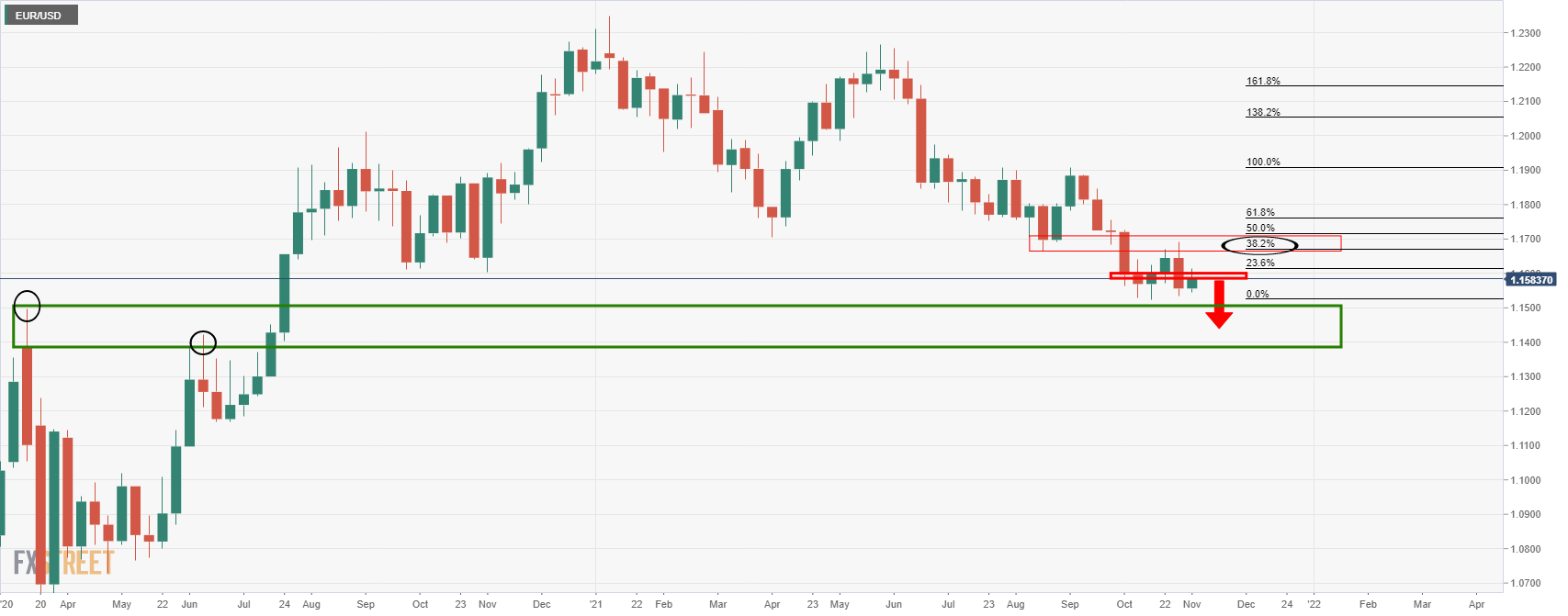
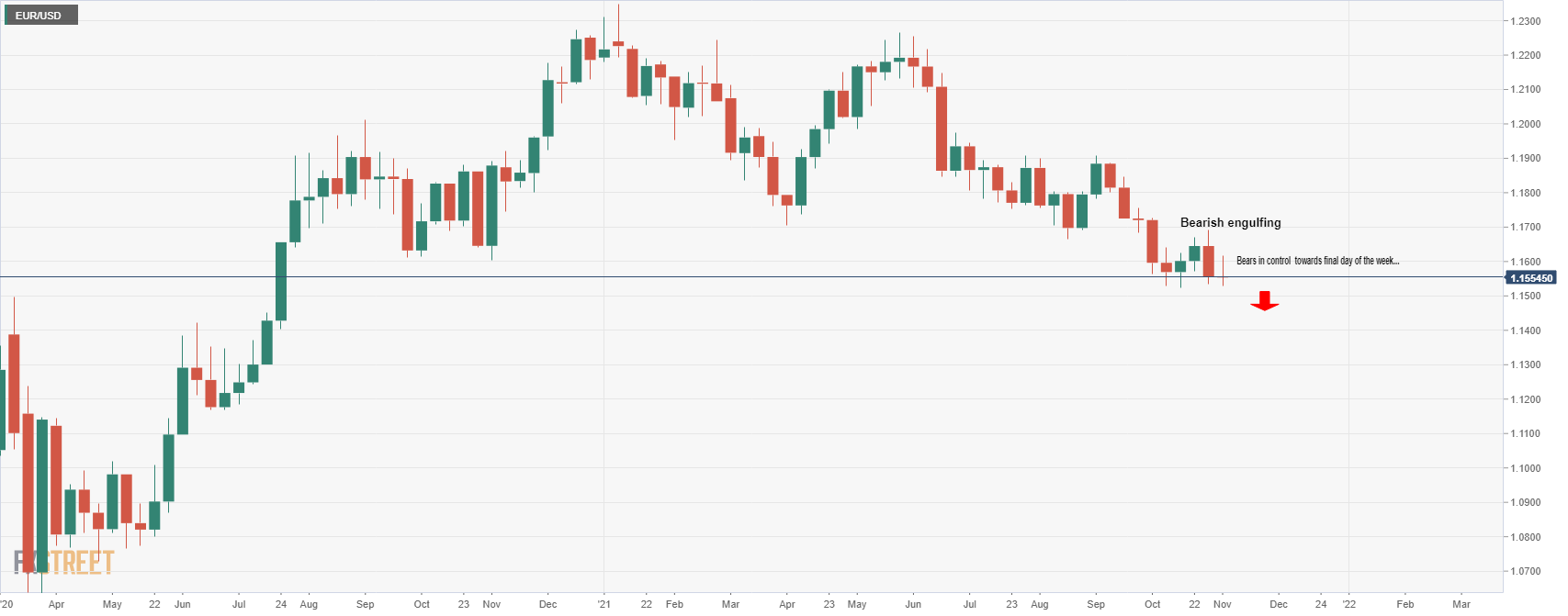
Since testing the 38.2% Fibo, the price is making headway in that respect:
Moving down to more recent price action, the bears have cleaned up from the discount that was on offer following the Federal Reserve as follows:
EUR/USD H1 chart, prior analysis
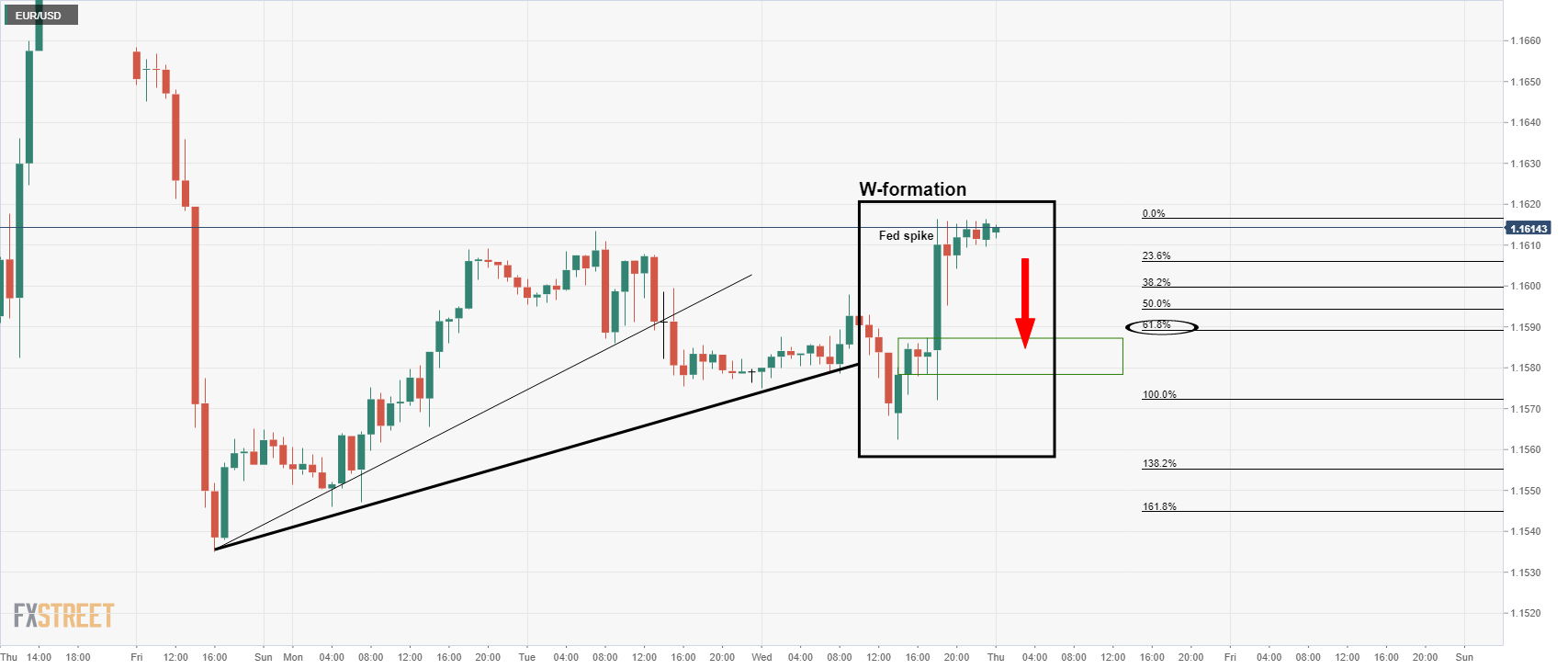
The W-formation was a compelling bearish reversion pattern that left the downside vulnerable and which has resulted in a break of support and given way to follow-through on Thursday as follows:
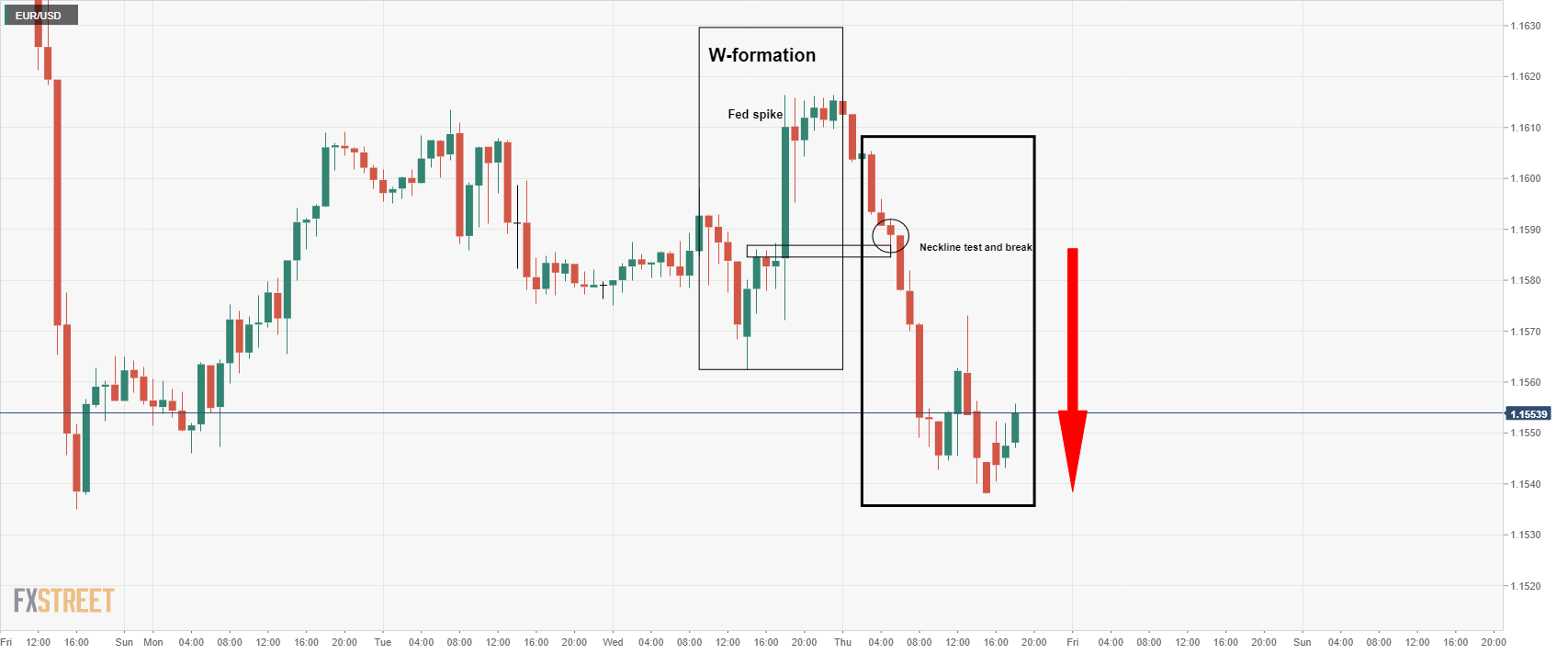
At this juncture, some consolidation would be the most probable outcome following such a sharp move to the downside. This is especially true ahead of the key risk event in the Nonfarm Payrolls and weaker hands that would prefer to take profits ahead of the weekend. Mitigation of the imbalance left behind could lead to a retest of the 1.1580s as follows:
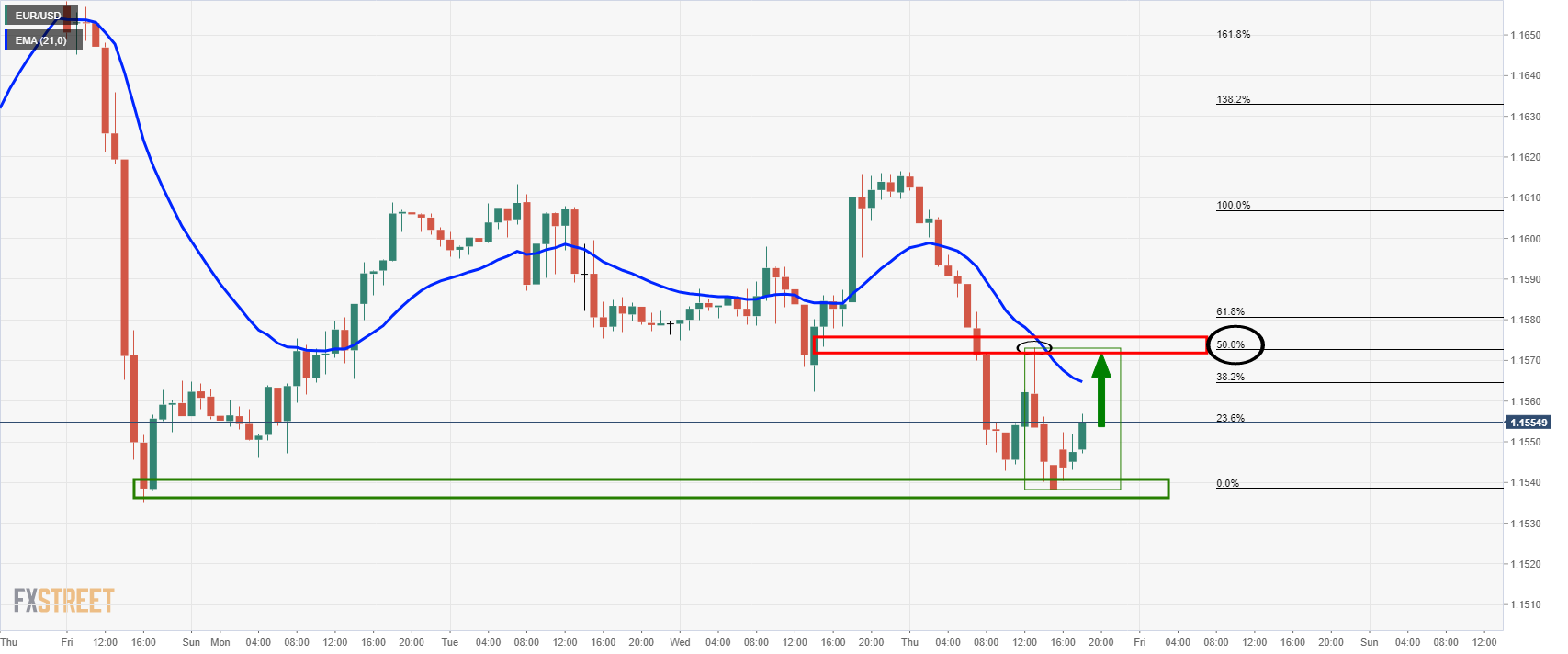
From the daily support, the price is carving out a double bottom which would be expected to lead to a correction. A 50% mean reversion of the latest hourly bearish impulse comes in neat 1.1580 and the hourly wicks highs as a meanwhile target area.
- NZD/USD bulls are defending daily lows near 0.7100 ahead of critical events.
- NFP and the RBNZ are the next major catalysts for the pair.
On US dollar strength on Thursday, the New Zealand dollar has given back the bulk of its post-third-quarter jobs data that has reinforced bets the Reserve Bank of New Zealand will hike rates later this month.
However, the US dollar rebounded on Thursday, recovering after the Federal Reserve repeated it saw high inflation as transitory. A buy the US dip outcome has led to a break of 0.71 the figure in NZD/USD. The pair has fallen from a high of 0.7178 to a low of 0.7094 so far and into daily support.
RBNZ rate hike on the cards
Firstly, earlier in the week, the third-quarter NZ Employment Change arrived at 4.2% YoY, sharply higher than the consensus forecast of 2.7%, according to a Bloomberg survey. The increase in the participation rate and a drop in the jobless rate was a highly positive result leading to demand for the kiwi.
The data highlighted underlying strengths in the labour market. Consequently, RBNZ tightening expectations remain high, with WIRP suggesting a 5 bp hike is fully priced in for November 24, with nearly 30% odds of a 50 bp move.
The bird was further supported on Wednesday after the Fed announced a widely expected $15 billion monthly taper to its $120 billion in monthly purchases of Treasuries and mortgage-backed securities. Additionally, the Fed's Chairman Jerome Powell emphasise that there was no rush at the central bank to hike borrowing costs.
The US dollar lost ground but investors were keen to buy the dip right up until the beginning of the New York session, where the greenback came under pressure from Treasury yields. In more recent trade, the US 10-year Treasury yield touched a session low of 1.514%, the lowest since Oct. 14 which could give some support to NZD/USD ahead of what is expected to be a period of consolidation before Friday's Nonfarm Payrolls event.
All eyes turn to the NFP event
A strong report is expected, which might be the reasoning for the rebound in the greenback in the past 24-hours. ''We expect employment and wage gains to slow in the year ahead as the boosts from fiscal stimulus and reopening fade and the participation rate rises, but, more immediately, momentum appears to be up again as the drag from Delta fades,'' analysts at TD Securities said.
''We forecast up 550k in total for payrolls in October, with private payrolls up 600k. We forecast up 0.5% m/m for hourly earnings, with the 12-month change rising to 5.0% from 4.6%.''
NZD/USD technical analysis
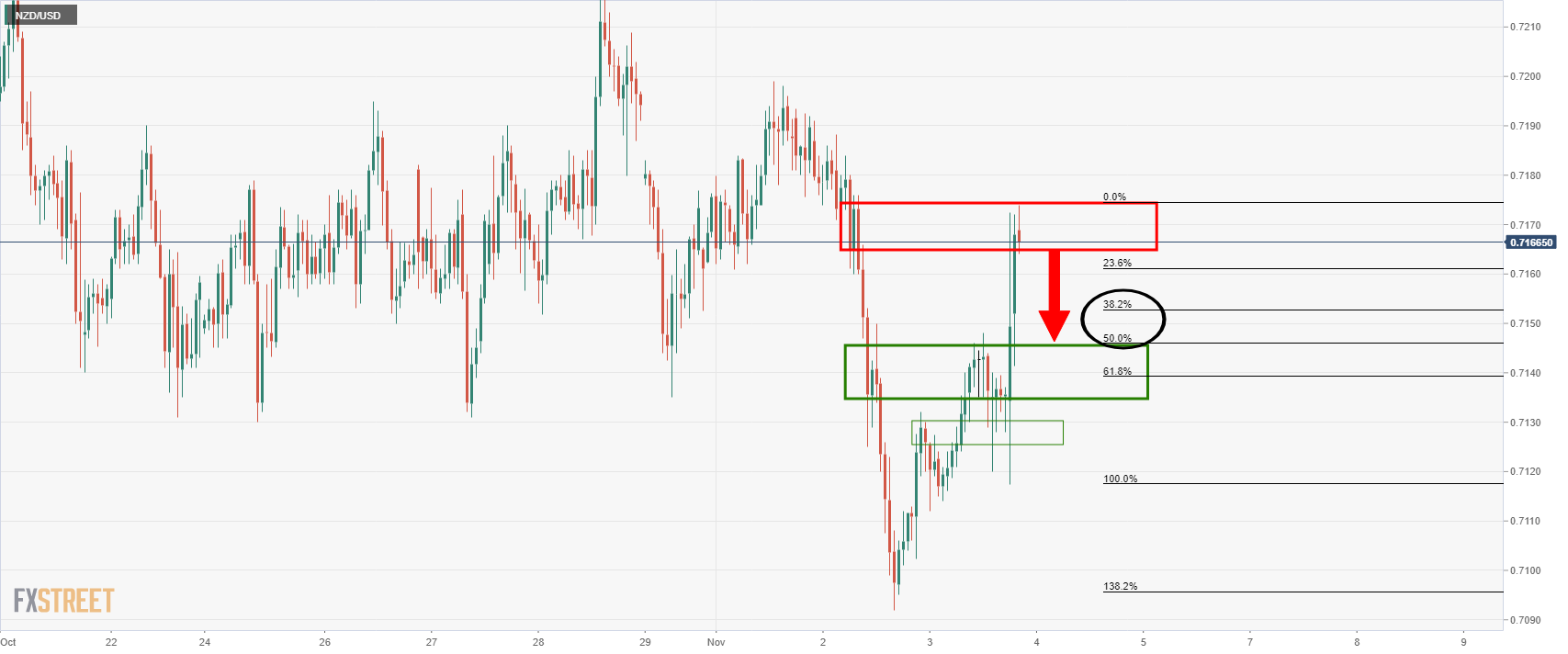
As per the Asian session's analysis, the focus was on the downside following the rally into higher liquidity. A correction into the 50% mean reversion location was an expected move, but what followed was a very strong followthrough to test November lows.
Prior analysis:
Live update:
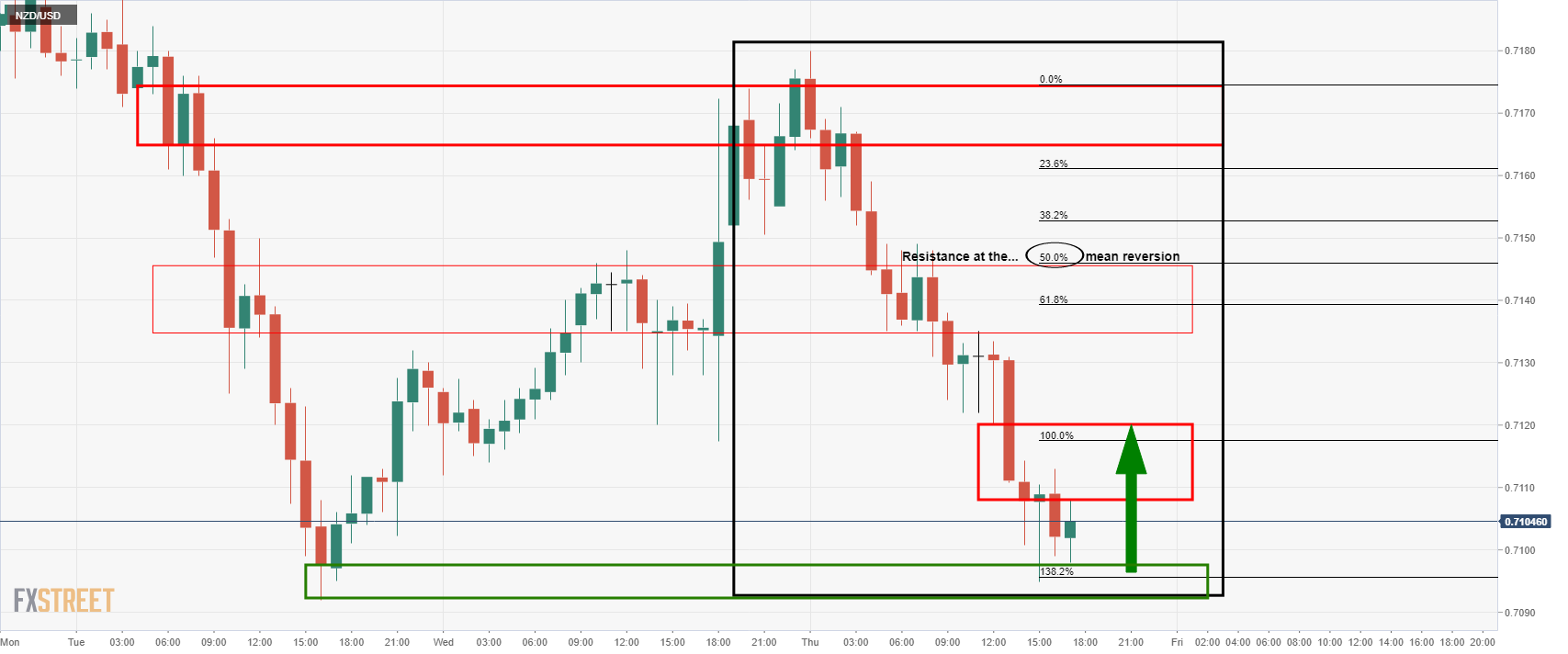
As illustrated, the price action since the prior analysis has followed accordingly, even testing the 50% mean reversion level as an area of resistance following the breakout to the downside. At this juncture, and holding in daily support, there could be a period of consolidation as markets get set for the end of the week's showdown in the US Nonfarm Payrolls event.
- EUR/JPY is downward pressured, on the back of central banks pushing back higher rates.
- The market sentiment is upbeat, except for the FX market, as the Japanese yen and the US dollar appreciate.
- EUR/JPY: The bottom-trendline of a bullish flag caused a jump of 30 pips in the pair.
The EUR/JPY plunges during the day, down 0.83%, trading at 131.28 in the New York session at the time of writing. The market sentiment is upbeat, spurred by central banks of developed countries, pushing back higher rates. On Wednesday, the Federal Reserve announced the so telegraphed bond taper, but it was perceived as dovish. Additionally, on Thursday, the Bank of England (BoE) backpedaled their intentions of hiking rates as the market expected, keeping them unchanged, catching some investors out off guard.
That said, global equities headed by US stocks in all-time highs rallied. Contrarily in the FX market, risk-sensitive currencies fall, benefitting the safe-haven peers, like the greenback and the Japanese yen
EUR/JPY Price Forecast: Technical outlook
4-hour charr
-637716443006753455.png)
The EUR/JPY pair briefly broke the bottom-trendline of a bullish flag but found buyers around the 131.00, bouncing off to current prices. The 50 and the 100-simple moving averages (SMA’s) are above the spot price, exerting downward pressure on the currency. However, the 200-SMA around 130.80 would be a tough hurdle for EUR/JPY sellers to overcome.
Nevertheless, to keep EUR/JPY bulls in charge, they need to reclaim the 50-SMA at 132.10. In that outcome, the following resistance area would be the 100-SMA at 132.25, followed by the top of a bullish fag around the 132.60 area. A breach of the latter would expose the October 20 high at 133.47.
On the flip side, failure at 132.10 would expose a downward break of the bullish flag around the 131.00 region. In that outcome, the first support would be the 200-SMA, followed by October 6 high at 129.49, which was resistance now turned support.
- Spot gold has recovered back to its 200DMA at $1790 following Wednesday’s dip as low as $1760.
- Wednesday’s Fed meeting got the recovery started, while a synchronised fall in global bond yields post-BoE has helped on Thursday.
Spot gold (XAU/USD) has undergone a strong recovery following sharp losses incurred on Wednesday that at the time saw prices drop as low as $1760, with prices having now recovered all the way back to the 200-day moving average (DMA) at $1790. Spot prices even had a go at break above the $1800 level again in earlier trade, though bullish momentum has since waned. Likely, precious metal markets will see more rangebound trade until the release of the official US October labour market report at 1230GMT on Friday, ahead of which traders are likely to refrain from placing any big bets.
What’s been driving recent moves
US data released on Wednesday in the run-up to the Fed meeting was the main catalysts for spot gold’s drop to $1760 at the time, with the October ADP national employment estimate and the headline ISM Service PMI index both beating expectations by a significant margin and thus boosting optimism about US economic health at the start of Q4 2021. A benign/even slightly dovish market reaction to Wednesday’s FOMC policy announcement, where the bank announced $15B/month QE tapers for November and December, reiterated its base case expectation was for inflation to still subside in mid-2022 and Powell said the bank was willing to be patient on rate hikes, helped lift XAU/USD from lows an into the mid-$1770s. The catalyst behind the most recent surge from the $1770s to current levels has been a sharp drop in global bond yields, led by bond markets in the UK following a much more dovish than anticipated BoE policy announcement (they didn’t hike rates and pushed back against market pricing for the number of hikes expected in 2022 and 2023).
Strong US jobs data could pull the rug
If Friday’s October labour market report is strong (i.e. payroll number of 500K+, further decline in the unemployment rate and further upside in rates of wage growth), this will likely boost optimism that full employment is not too far off (a key condition the Fed says it wants to see before hiking interest rates). That would likely see short and long-term US (and probably global) bond yields supported. A move back towards 0.50% for the 2-year and back to 1.60% for the 10-year would not be a good thing for gold and, in this scenario, XAU/USD could lose its grip on the 200DMA and slide back towards the 21 and 50DMAs in the $1780 region.
Gold stays sidelined and beneath the July and August highs and downtrend from August 2020 at $1,832/39. Strategists at Credit Suisse expect the yellow metal to head lower and fall below the $1,691/77 region.
Break above $1,834/39 to lessen the topping threat significantly
“We are mildly biased towards an eventual break lower, however, only a move below $1,691/77 would mark a major top for an important change of trend lower, with support then seen at $1,620/15 initially, before $1,565/60.”
“Only a break above $1,834/39 would be seen to complete an in-range base and lessen the topping threat significantly, instead clearing the way for a deeper recovery to $1,917.”
- The British pound collapsed 300 pips, down to 153.00 on a BoE’s decision to keep rates unchanged at 0.10%.
- The BoE decision lies on the back of a weaker labor market, as the furlough program ended in September.
- GBP/JPY: The 153.50 key support/resistance area, a daily close above, would keep bulls in control, otherwise the bears.
The GBP/JPY is plummeting, down 1.50%, trading at 153.56 during the New York session at the time of writing. The market sentiment is upbeat, as the Federal Reserve said it would start reducing bond asset purchases on $15 billion by the middle of November while pushing back higher interest rates. Investors used that as a signal to keep pushing equities at all-time highs, while in the FX market risk-sensitive currencies, drop against the greenback.
Back to the GBP/JPY, on Thursday, the Bank of England (BoE) Monetary Policy Committee (MPC) decided to keep rates unchanged at 0.10%, despite that some members, including BoE Governor Bailey, expressed concerns about high inflation in weeks before the meeting.
The reason to keep the rate unchanged is that “It will be necessary to raise bank rate over coming months if data, especially jobs, is in line with the forecast,” according to the MPC statement. Moreover, they added that the “MPC still sees value in waiting for official labour market data after end of furlough, before deciding on tightening policy.”
Concerning asset purchases, the bank stayed put at 895 billion of Sterling. Regarding high inflation levels, the BoE “forecasts inflation to peak of 4.80% in Q2 2022.” Further, the UK’s central bank forecasts show inflation in two years at 2.23%, based on market interest rates.
GBP/JPY Price Forecast: Technical outlook
Daily chart
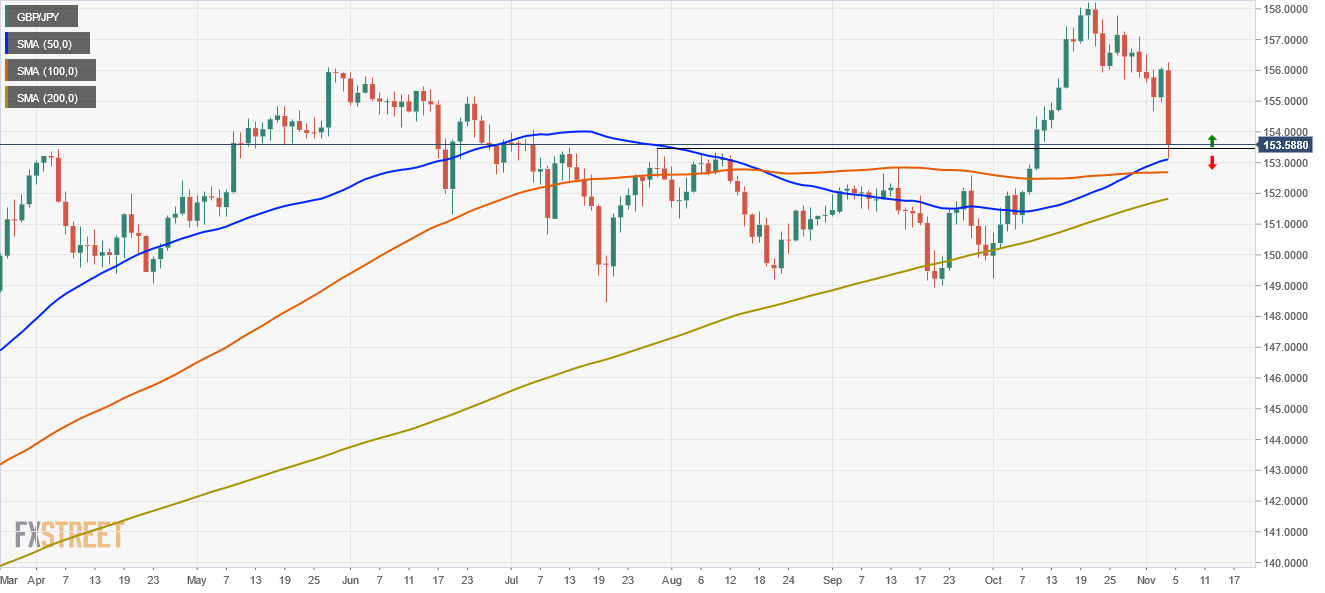
The GBP/JPY Thursday’s price action depicts that investors were heavily-positioned towards a BoE rate hike, but the British pound collapsed as the BoE disappointed. The Average Daily Range (ADR) of the day is 300 pips, as the GBP/JPY dropped from 156.00 towards 153.00.
It is worth noticing that the pair briefly closed to the 50-day moving average (DMA) at 153.00 and bounced off, as the market found buyers around that level. However, if GBP/JPY bulls would like to keep in control, they would need a daily close above the July 29 high at 153.50. In that outcome, a renewed test towards 154.00 is on the cards.
On the flip side, failure at the abovementioned would open the door for another 153.00 challenge. A break of the latter would open the door for further losses, exposing the 100-DMA at 152.60, followed by the 200-DMA at 151.74.
- Spot silver has rebounded well from Wednesday’s sharp drop to $23.00, though hasn’t yet reclaimed $24.00.
- Precious metals are getting a boost from a sharp drop in global bond yields after Thursday’s dovish BoE policy announcement.
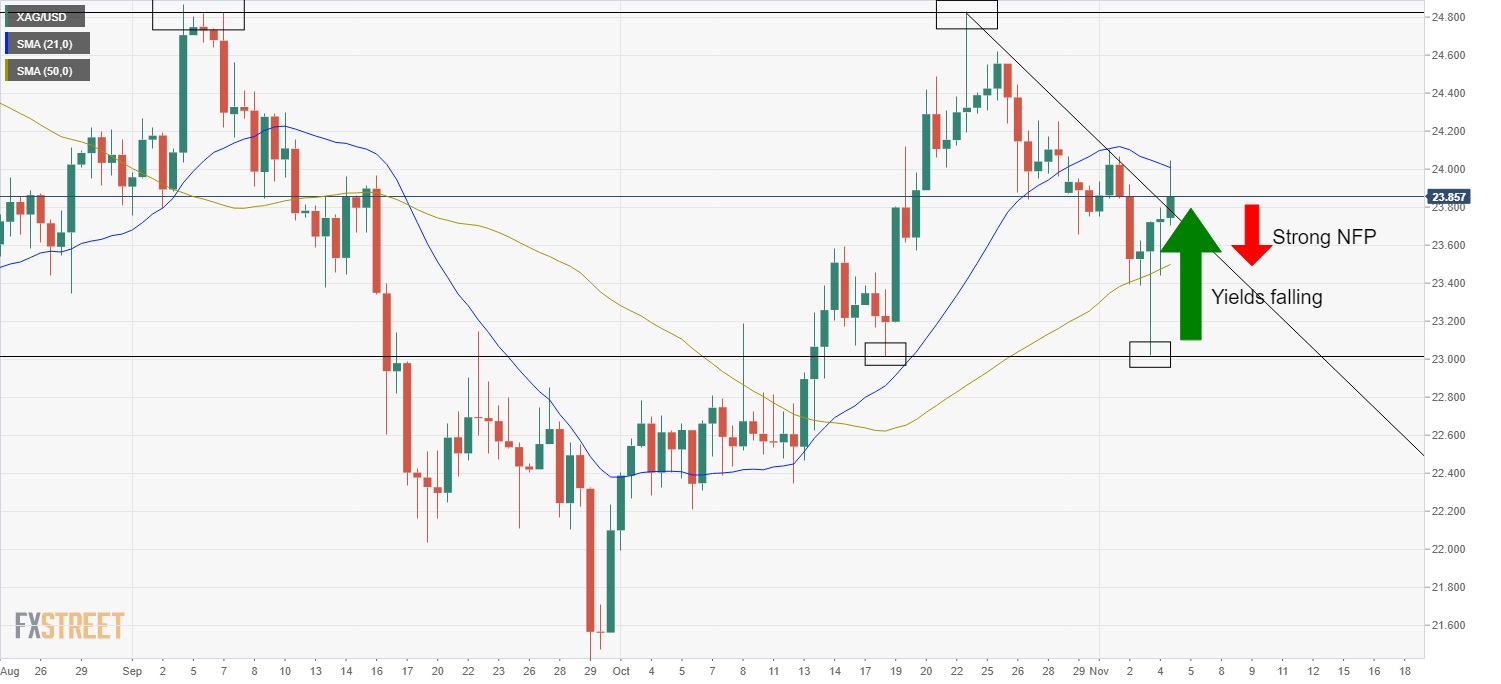
Spot silver (XAG/USD) prices have gained significant ground in recent trade and, having dipped as low as $23.00/oz on Wednesday, are now not far from trading in positive territory on the week in the $23.80s, though for now the precious metal is struggling to reconquer the $24.00 level. If XAG/USD can get above $24.00, this would mean that prices have broken out of a recent negative trend in place since 22 October. Any resultant technical buying could see XAG/USD continue higher towards the $24.50 level and perhaps even as high the $24.80s, where a double top from 3 September and 22 October resides.
Such a move higher would rely on continued downside in the global and US yield environment. For reference, much of Thursday’s rally in spot silver, which has seen prices rise from around $23.50, owes itself to a sharp drop in developed market bond yields in wake of a much more dovish than expected BoE policy announcement; UK 2-year yields have dropped a stunning more than 30bps to under 0.50% from above 0.7% prior to the policy announcement (biggest one-day drop since March 2020), while 10-year UK yields are down nearly 15bps to under 1.0%.
This has led yields in the US and elsewhere lower; US 2-year yields are down roughly 6bps and have been testing the 0.40% level in recent trade, while 10-year yields have pulled back from above 1.60% to the low 1.50s%. Real yields have also been heading lower in the US (a good indicator that it is dovish central bank vibes driving bond yields lower), with the 10-year TIPS yield back sharply to just above -1.05% from previously as high as -0.95%. The key point is that lower bond yields decrease the opportunity cost of holding non-yields precious metals such as silver, thus increasing investor demand and pushing their prices up.
Strong data to send yields up again?
But continued downside in global bond yields is far from guaranteed, with Friday’s US jobs report having the potential to throw a wrench into proceedings. The Fed yesterday pretty much put its policy on autopilot for the rest of 2021 with its $15B/month QE taper announcement for November and December, but essentially said uncertainty about the state of the economy (inflation and the jobs market) in 2022 is high and thus the bank is preparing for a range of possible outcomes. That should be interpreted as the Fed saying they are “data-dependent” and if the data justifies a hawkish shift, they will shift hawkish, while if it justifies a dovish shift, they will be more patient with monetary policy stimulus removal. That makes upcoming data releases, such as Friday’s jobs report, all the more important.
If the data on Friday is strong (i.e. payroll number of 500K+, further decline in the unemployment rate and further upside in rates of wage growth), this will boost optimism that full employment is not too far off (a key condition the Fed says it wants to see before hiking interest rates). That would likely see short and long-term US (and probably global) bond yields supported. A move back towards 0.50% for the 2-year and back to 1.60% for the 10-year would not be a good thing for silver, which, in this scenario, may slide back towards this week’s lows around $23.00/oz.
Solid domestic demand in the US has caused import growth to outpace exports for the better part of the past year, explained analysts at Wells Fargo. They point out that with consumption slowly rebalancing back toward services spending, imports should eventually slow and provide some relief at US largest ports.
Key Quotes:
“Exports plunged 3.0% in September, which more than offset the 0.6% gain in import growth and caused the U.S. trade deficit to widen to a record deficit of $80.9 billion. Weakness in exports was broad based with every major category of goods having moved lower during the month, with the exception of consumer goods where a $1.5 billion gain in pharmaceutical preparations prevented a decline in the overall category. Industrial supplies exports plunged 10.5%, in real terms, which was the largest monthly decline since 2008.”
“Consumption has started to slowly rebalance back toward services spending, which should weigh on imports and provide some relief at our nation's largest ports where a previously unimaginable number of container ships await port space to offload their goods. All of this said, we're likely some time away from a meaningful reprieve and things may get worse before they get better.”
“Further, the need to replenish record-low retail inventories will likely keep goods flowing into the country at an accelerated rate for some time. But the continued slowing in domestic spending and gradual gain in the pace of global growth should eventually lead trade to modestly boost growth as the trade deficit gradually narrows.”
The Bank of England (BoE) kept its monetary policy unchanged at the November meeting. Analysts at TD Securities point out the message was that the Monetary Policy Committee (MPC) is willing to be patient.
Key Quotes:
“The messaging today was cautious, and with a 7-2 vote to hold Bank Rate, it's clear that the committee isn't chomping at the bit to hike rates. We continue to expect a gradual pace of rate hikes from here, and as we recently explored, there are immense challenges facing the UK that the MPC will have to navigate carefully.”
“The BoE outcome was undoubtedly damaging for GBP, generating a positioning-induced squeeze lower. While GBP still holds one of the largest discounts of all currencies on our dashboard, things could get worse before value buyers emerge. We target a 1.3450 pivot in the weeks ahead and could see EURGBP eye a fresh retest of 0.86.”
“We expect the MPC to hike Bank Rate in February 2021, taking Bank Rate to 0.25%, though a December hike can't be ruled out. While the MPC expects inflation to peak around 5% y/y in April, we expect the pace of hikes in 2022 to be measured: uncertainty around COVID, the persistence of supply shocks and re-opening mis-match, and Brexit, remain elevated.”
“We look for a subsequent 25bps hikes in August and November, followed by two more hikes in 2023. This means the MPC will need to make a decision on reinvestments after its August 2022 meeting, and a decision on active selling of Gilts following its February 2023 meeting.”
Following the Bank of England decision to keep monetary policy unchanged on Thursday, analysts at Danske Bank see upside risks for the EUR/GBP pair in the short-term but they still expect it to move lower later, with a 0.83 target in twelve months.
Key Quotes:
“As expected, the EUR/GBP moved higher on announcement now trading at 0.856 vs. 0.847 before the announcement. We are still of the view that the move higher in EUR/GBP will be short-lived but near-term there are upside risks given the current market pricing of Bank of England.”
“We still expect rate hikes from the Bank of England, while we expect the ECB to stay patient despite recent increases in rate hike expectations.”
“We still believe the environment is more supportive for GBP than EUR, as GBP usually strengthens in an environment where USD does. That said, the potential for a stronger GBP is lower than for USD. We still target EUR/GBP in 0.83 12M.”
- The pound remains under pressure after the BoE decision.
- US dollar gains momentum as stocks turn lower and despite a decline in US yields.
- GBP/USD drops almost two hundred pips, heads for third lowers close since December.
The GBP/USD slide was triggered by the Bank of England and more recently reinforced by a rally of the US dollar across the board. Cable broke under 1.3500, reaching at 1.3482, the lowest level in a month. It is falling almost two hundred pips on Thursday, having the worst performance in weeks.
The decision of the Bank of England (BoE) to keep rates and QE unchanged weighed on the pound that lost ground against all its rivals. Governor Baily’s press conference did not alter cable’s sell off. Analysts at Danske Bank see the three rate hike in 2020 (15bp in February, 25bp in May and 25bp in November). “The reason is that we expect the economic recovery will continue (including increasing employment) amid still high inflation.”
More recently, the decline of GBP/USD gained momentum after breaking under 1.3500 and also amid a stronger US dollar. The DXY is up by 0.60%, at 94.45, the highest level since mid-October. At the same time, US yields are falling sharply with the 10-year at 1.52%, near Wednesday’s low.
The outcome of the FOMC meeting so far has not been negative for the dollar. On Friday, the critical Non-farm Payrolls report is due. The consensus point to a net gain in jobs of 425K and the unemployment rate to drop to 4.7%.
Technical levels
- NZD/USD is back to testing weekly lows in the 0.7100 region, having given back its post-Fed gains.
- The US dollar is seemingly getting a boost from strong US data ahead of Friday’s key jobs report.
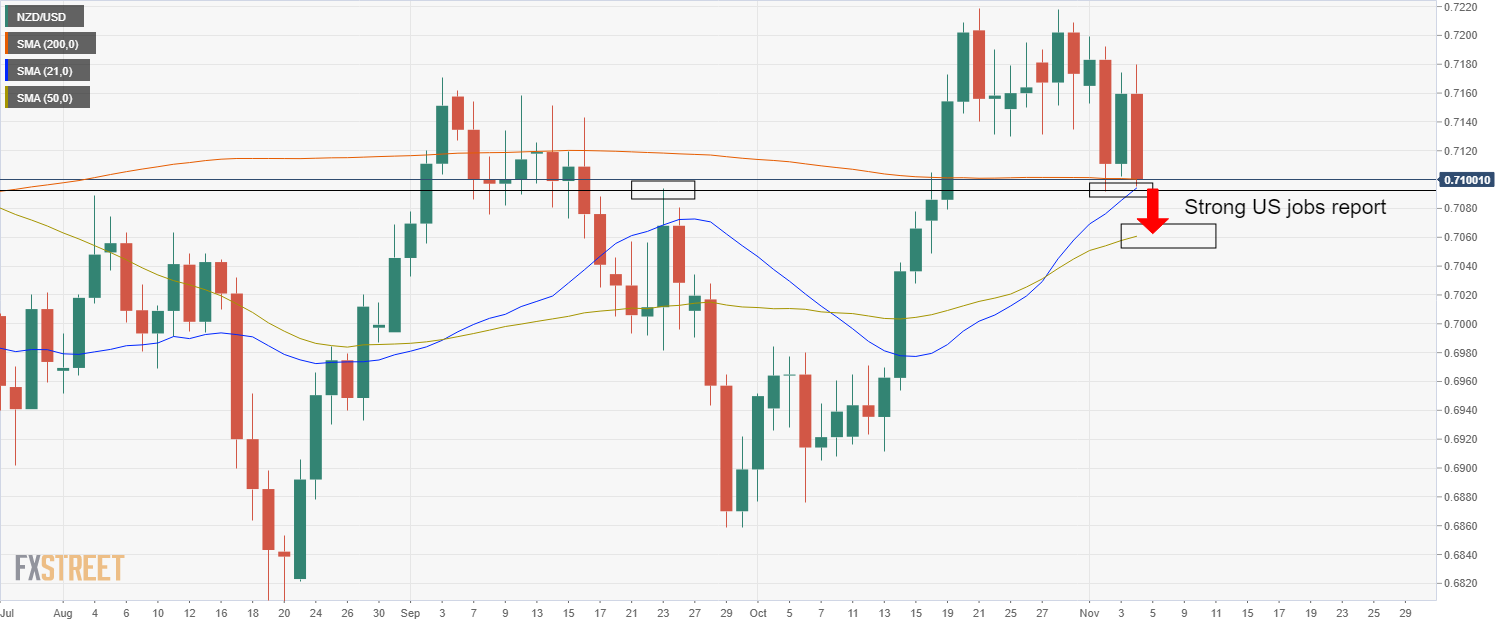
NZD/USD has now more than erased Wednesday’s post-Fed rally that saw the currency pair reach as high as 0.7180. The pair is now back to testing its 200-day moving average (DMA) at pretty much bang on the 0.7100 level and is only a few pips above weekly lows and the 21DMA around 0.7090. FX market conditions may be set to enter a period of relative calm with the latest flurry of central banks now in the rearview mirror (the BoE and Norges Bank both issued policy decisions on Thursday following on from the Fed on Wednesday and RBA on Tuesday) ahead of the release of Friday’s key US labour market report.
That suggests that NZD/USD may struggle to push much lower than current levels; traders may instead wait to see whether the US labour market had as good a month as alternative labour market indicators for October suggest was the case; for reference, initial jobless claims fell throughout October, US payroll processing company ADP’s estimate of national employment change beat expectations in October by a healthy margin (coming in at 571K versus forecasts for 400K) and the ISM Manufacturing and Services PMI employment subindices both point to a continuation of job growth last month. If Friday’s headline payroll number is strong, this could be the impetus that the bears need to push NZD/USD lower, with the 50DMA at 0.7060 the next obvious target. Markets will also be focused on the US unemployment rate, the participation rate and the rate wage growth.
On the topic of jobs data, the New Zealand dollar has struggled to benefit in wake of a stellar Q3 New Zealand labour market report earlier in the week, which saw the unemployment rate plummet to 3.4%, its lowest since 2007 and well below the RBNZ’s estimate of the natural rate of full employment. December 2022 NZ Bank Bill futures, which moved to price in 100bps in additional rate hikes by next December during the month of October (helped by Q3 CPI nearly hitting 5.0%), are little moved this week, despite the strong data. At 97.29, the Bank Bill future implies a further 180bps in rate hikes (approximately) by the end of 2022.
- USD/CAD extends its recovery for the second day in a row, up 0.61%.
- Overall, US dollar strength across the board lifts the USD/CAD despite risk-on market sentiment.
- Rising crude-oil prices fail to lift the prospects of the CAD.
The USD/CAD climbs to fresh weekly highs, up 0.62%, trading at 1.2468 during the New York session at the time of writing. Investors’ mood is upbeat, portrayed by global equity indices in the green, except for the Dow Jones Industrial in the US, retracing some 0.12%. On Wednesday, the Fed announced the beginning of its pandemic-related QE reduction program at a pace of $15 billion, starting at the middle of November.
US Dollar bulls gained some ground against the loonie, despite higher crude oil prices, during the day, with Western Texas Intermediate (WTI) trading at $81.45, up more than 1%, failing to underpin the commodity-linked Canadian dollar. Furthermore, the US Dollar Index, which tracks the greenback’s performance against a basket of six peers, is firmly up more than a half percent, sitting at 94.38.
The US Dollar reaction to the Fed initially was as investors seemed to be convinced of a dovish taper. Nevertheless, Thursday’s price action has shown the opposite, as the US T-bond 2-year yield is retreating from almost 0.50% towards 0.40% threshold, as market participants backpedal against the possibility of a hike rate by the middle of 2022. Now the odds of the abovementioned dropped to 50%, as Chairman Powell pushed back against rising rates.
Dissecting the Fed’s message, the US central bank is expected to end the taper by June of 2022. But, it left the door open for adjustments of its program, hedging against a possibility of stickier than expected inflation that could prompt the Fed to react as quickly as they can. However, they reiterated their transitory posture on inflation, as Chair Powell admitted that the supply constraints are lasting longer than anticipated and could persist well into next year. He predicted that inflation would move down in Q2 or Q3.
On the macroeconomic front, the Canadian docket featured the International Merchandise Trade for September, which showed a surplus of $1.8B versus a $0.43B foreseen by analysts.
On the US front, the Bureau of Labor Statistics (BLS) reported the Initial Jobless Claims for the week ending on October 29, which rose to 269K, better than the 277K estimated by economists, adding to the improvement of the labor market, as it is the fourth consecutive week of drops.
USD/CAD Price Forecast: Technical outlook
In the daily chart, the USD/CAD is closing near the November 3 high at 1.2456, which saw on that day, a retracement towards 1.2400. The daily moving averages (DMA’s) are located above the spot price, meaning CAD bulls are in control. Nevertheless, the greenback has shown some strength, as the pair Is closing to the 200-DMA, which sits at 1.2479.
Furthermore, the November 3 high around 1.2456, coupled with the 200-DMA some 30 pips above, could be a substantial hurdle to overcome for USD bulls, but in case of breaching above of it, it would open the door for further gains, being 1.2500 the first supply area. Once that is breached, the following resistance level would be the confluence of the 50 and 100-DMA around the 1.2530-50 region.
On the flip side, failure of a daily close above 1.2456 would keep USD/CAD bears in charge, exposing the 1.2400 figure as the first support level.
- WTI has dropped sharply from earlier session highs above $83.00 to the mid-$81.00s.
- OPEC+ has agreed, as widely expected, to go ahead with a 400K oil output hike in December.
According to sources cited by Reuters, OPEC+ has, as widely anticipated, agreed to stick to their existing plan to increase output by 400K barrels per day/month in December. Despite this news, trade has been choppy over the last hour or so, with oil prices having fallen back sharply from earlier highs. Front-month WTI futures, which were above $83.00 less than two hours ago, have now dropped back to the mid-$81.00s, though that still leaves WTI higher by well over $1.0 on the day.
The recent emergence of selling pressure could be technical; on Wednesday, during oil’s sharp sell-off, WTI dropped below a long-term uptrend that had been supporting the price action all the way back to 20 August and had been respected on multiple occasions. When prices recovered back above the $83.00 level on Thursday and retested this prior uptrend, technical sellers might have used this as an opportunity to load up on short-positions again, perhaps to target a move back lower towards weekly lows around $80.00.
To recap, oil markets were under pressure on Wednesday due to a bearish combination of 1) bigger than expected build in US crude oil inventories, according to the latest weekly data from the US EIA and 2) news that Iran and the EU will restart nuclear deal negotiations at the end of the month, which could open the door to the removal of US sanctions on Iranian crude oil exports. Another factor cited to have been weighing on oil prices this week is the deteriorating Covid-19 situation in China; citizens are being advised not to go abroad for non-essential/urgent reasons and the current outbreak has now spread to 19 of China’s 33 provinces, more than during any other outbreak since the initial outbreak in Wuhan in early 2022.
Looking ahead, it will be key to watch 1) the outbreak in China (does it get worse and threaten oil demand, thus dragging prices lower?) and 2) the US response to OPEC+’s refusal not to hike output at a faster rate – they might start released crude oil from their strategic petroleum reserve to surpress US prices and the government is also threatening an oil export ban.
- EUR/USD dropped to weekly lows near 1.1540 on Thursday.
- The greenback keeps the bid tone intact despite lower yields.
- US Initial Claims surpassed estimates at 269K.
The intense move higher in the greenback keeps EUR/USD under pressure in the mid-1.1500s for the time being.
EUR/USD offered near YTD lows
EUR/USD came under moderate selling pressure on Thursday on the back of the persistent rebound in the greenback, which pushed the US Dollar Index (DXY) to fresh 3-week highs around 94.35 and shifted at the same time the focus to the 2021 highs in the mid-94.00s.
In fact, the pair quickly left behind the post-FOMC gains recorded on Wednesday and resumed the downtrend amidst the persistent negative mood in the risk complex and despite US yields trade on the defensive across the curve.
Same path follows yields of the German 10y Bund, which navigate the area of 4-week lows around -0.22%.
In the calendar, early results showed the final October Services PMIs in both Germany and the euro area receded from the previous readings, while Producer Prices in the bloc rose more than expected in September.
Across the pond, Challenger Job Cuts rose to 22.822 in October, Initial Claims increased by 269K in the week to October 30 and the trade deficit widened to $80.9B in September.
EUR/USD levels to watch
So far, spot is losing 0.51% at 1.1552 and faces the next up barrier at 1.1687 (55-day SMA) followed by 1.1692 (monthly high Oct.28) and finally 1.1755 (weekly high Sep.22). On the other hand, a break below 1.1535 (weekly low Oct.29) would target 1.1524 (2021 low Oct.12) en route to 1.1495 (monthly low Mar.9 2020).
- US dollar gains momentum versus G10 currencies, but the yen is the best performer.
- USD/JPY continues to move in a two-week old range around 114.00.
The USD/JPY peaked on Thursday at 114.26 and then turned to the downside. Recently it reached a fresh daily low at 113.68, and it remains near the lows, with a clear short-term bearish bias.
The yen is the top performer amid lower US yields. The 10-year yield is at daily lows at 1.53%. US stocks are mixed in Wall Street, still holding onto most of Wednesday’s gains.
Despite the recent US economic report and the FOMC meeting, USD/JPY continues to move in a range between 113.40 and 114.40. The main trend still points north, but the dollar’s momentum eased.
After Fed, focus turns to NFP
The Federal Reserve on Wednesday announced a slowdown in its asset purchase program, as expected. Jerome Powell played down expectations about rate hikes in the short to medium term. Stocks rose, and US yields pulled back after the FOMC meeting.
Focus now turns to the US official employment to be released on Friday. The ADP report on Wednesday surpassed expectations, and on Thursday, the jobless claims report showed a new low since March 2020 for initial and continuing claims.
Regarding the NFP, analysts at TD Securities point out that a strong payrolls beat should broadly support the US dollar. “A strong payroll report is likely to reinforce the post-FOMC pricing suggesting the Fed will let inflation overshoot further. This could keep the market's pricing for hikes little changed but should lend additional support to curve steepeners and TIPS BEs.” If data sends US yields higher, USD/JPY could be among the biggest gainers.
Technical levels
- AUD/USD is currently at multi-week lows testing the 0.7400 level to the downside.
- The pair has been losing ground amid a broad USD pick-up, perhaps driven by good US jobs data.
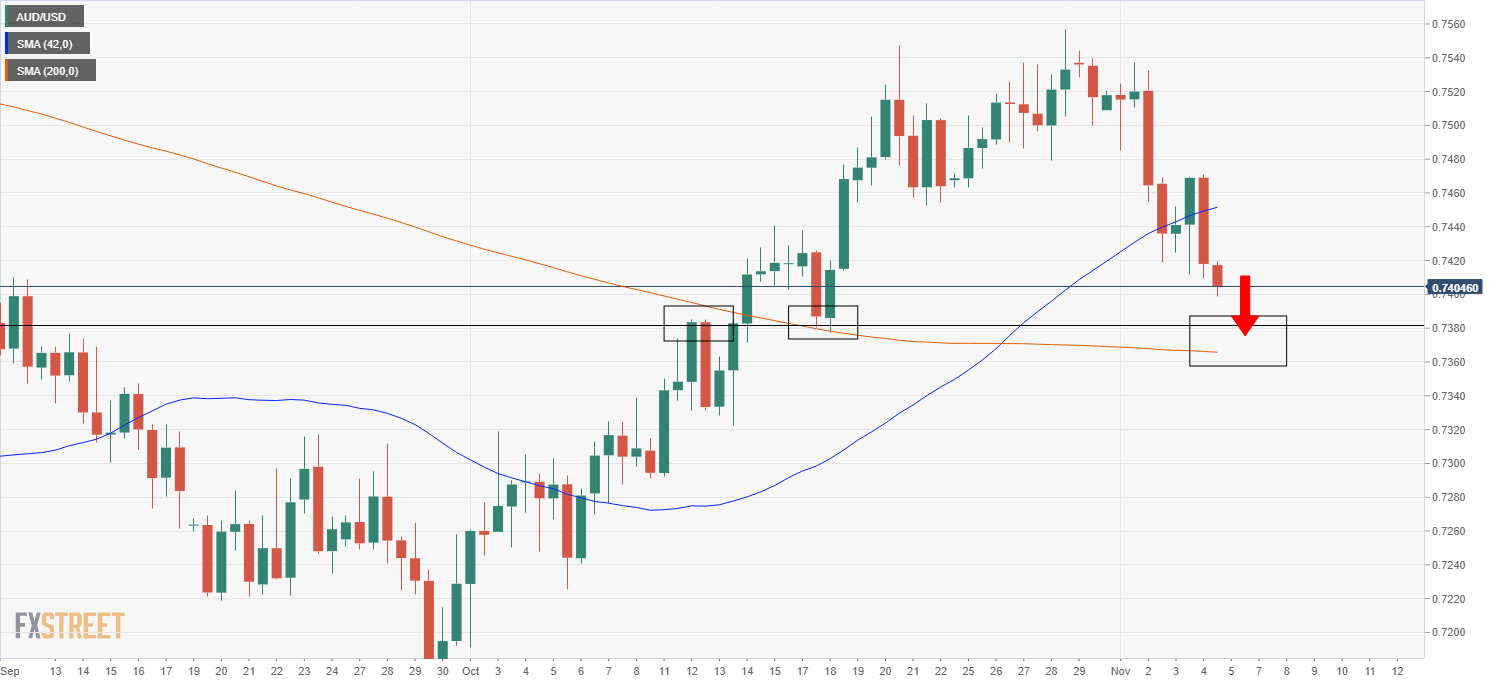
AUD/USD has been heading lower over the last few hours and is currently probing the 0.7400 level, meaning it is at its lowest level since 18 October and has now seemingly lost its grip on its 21-day moving average (DMA), which currently resides in the 0.7430s. If the 0.7400 level goes, that could open the door to some more selling pressure, with bears perhaps targetting the 50DMA at 0.7360 and support around the 0.7380 level just above it.
Aussie rollercoaster
The pair has been on a bit of a rollercoaster over the last 24 hours, initially dropping to fresh multi-week lows under 0.7420 at the start of Wednesday’s US session amid strong US ADP and Service PMI data (both for October), before reversing higher amid broad dollar weakness following a more dovish than expected Fed policy announcement, with the exchange rate peaking in the 0.7470s.
The reversal back lower again and to fresh lows for the week since the start of the Thursday Asia Pacific session is mostly down to a pick up in USD strength; analysts seem to have arrived at the conclusion that, net-net, Wednesday’s Fed policy announcement wasn’t as dovish as first thought, as, while the bank did maintain its label of high inflation as transitory and say it wants to be patient on rate hikes, it also appeared to open the door for earlier rate hikes and a potential acceleration of the pace of QE tapering in early 2022. Thus, money market pricing for Fed rate hikes beginning in mid-2022 has been left relatively unchanged. This money market reaction contrasts with the RBA’s successful attempt at their rate decision earlier in the week to dampen market expectations for a rate hike in 2022.
The US dollar is getting further tailwinds on Thursday amid sharp losses in GBP after the BoE failed to live up to market hype for a rate hike and following another strong US weekly jobless claims report. Initial Jobless Claims (IJC) fell to a fresh post-pandemic low of 269K (that’s four weeks on the bounce of IJC coming in under 300K), leaving it now not far above the 200-250K range historically associated with a healthy US labour market. Stronger than expected Australian Retail Sales data for Q3 (sales dropped 4.4% QoQ due to lockdowns, less than the 4.6% expected decline) and Trade Balance numbers (the Aussie trade surplus came in at A$ 12.243B in September, a smaller than expected decline from A$ 15B in August) have failed to support the Aussie, which the third-worst performing G10 currency on the day (only GBP and NZD are faring worse).
Looking ahead, the main event for FX markets now is Friday’s US labour market report. If strong, AUD is vulnerable to further selling pressure.
- Wall Street's main indexes are trading mixed on Thursday.
- Falling US Treasury bond yields weigh on financial shares.
- Energy stocks regain traction as OPEC meeting gets underway.
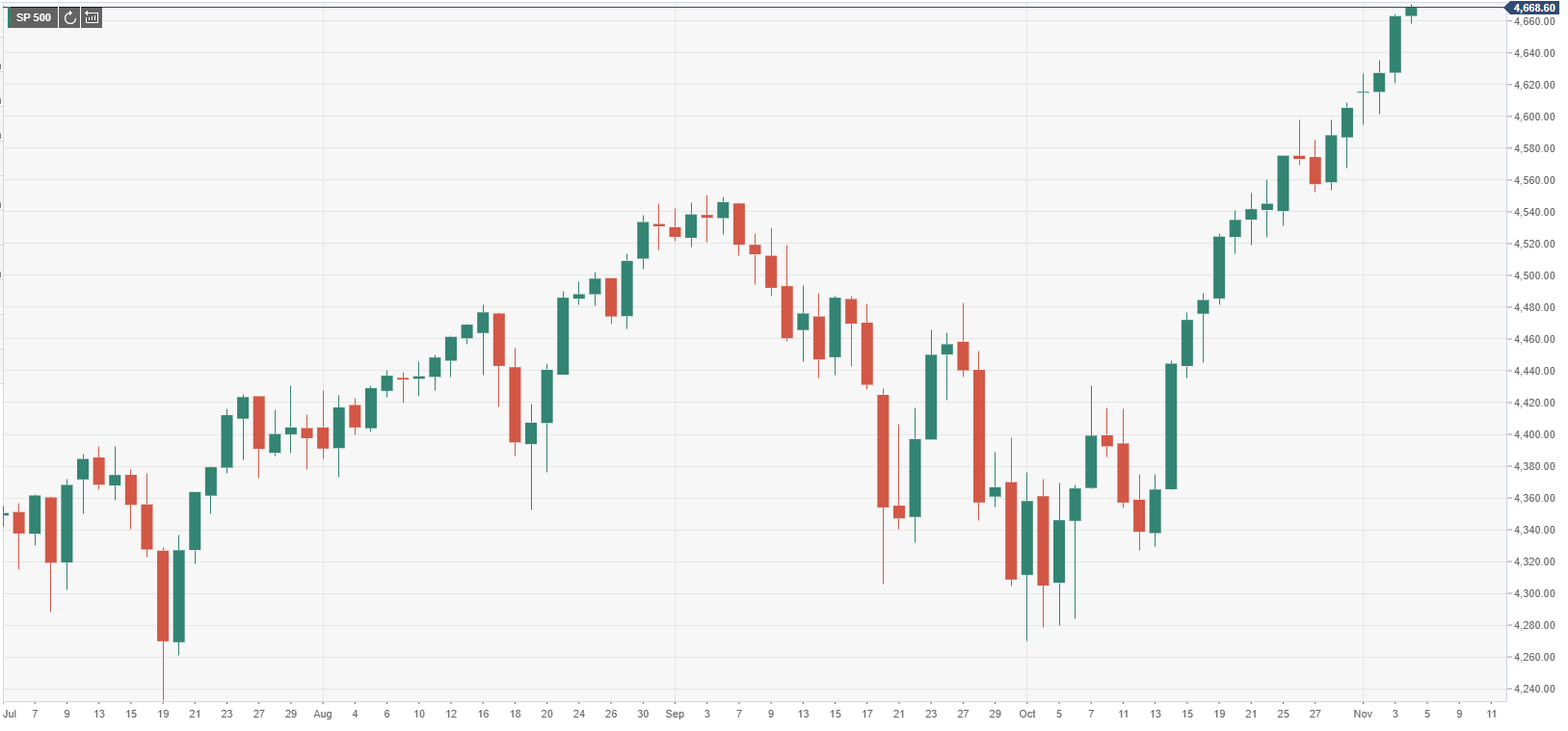
Major equity indexes in the US opened mixed on Monday amid varying performances of major sectors. As of writing, the S&P 500 Index was trading at a new all-time high of 4,665, rising 0.12% on the day. The Dow Jones Industrial Average was down 0.15% at 36,110 and the Nasdaq Composite was up 0.2% at 15,843.
Among the 11 major S&P 500 sectors, the Financials Index is down nearly 1% after the opening bell pressured by the sharp decline witnessed in the benchmark 10-year US Treasury bond yield. On the other hand, the Energy Index is up 1.5% supported by rising crude oil prices ahead of OPEC's announcements.
Earlier in the day, the data from the US showed that Unit Labor Costs increased by 8.3% in the third quarter, surpassing the market expectation of 5.2% by a wide margin. Moreover, weekly Initial Jobless Claims declined to 269,000, the lowest print since the beginning of the pandemic.
S&P 500 chart (daily)
- EUR/GBP is sharply higher in wake of the latest BoE policy announcement, which was a dovish surprise.
- The pair hit its highest since early October above 0.8530 and its 50DMA.
EUR/GBP has risen sharply in the last hour or so in response to a more dovish than expected Bank of England policy announcement and is now trading at its highest levels since the 5th of October. The pair was trading close to its 21-day moving average at just above 0.8460 prior to the announcement but has since jumped all the way to the 0.8530s, which now puts it above its 50-day moving average at 0.8523.
BoE recap
To recap the BoE event quickly; the bank confounded investor expectations for a 15bps rate hike, instead of voting 7-2 to maintain interest rate at 0.1%, and voting 6-3 to maintain the size of its gilt remit at £895B, which means gilt purchases will continue until the end of the year. The bank said it wants to make sure the economy evolves as expected over the coming months, and is particularly keen to observe the labour market after the government’s furlough scheme ended at the end of September, before hiking, though it did say that rate hikes would likely be warranted in “the coming months”, which will keep expectations for a December rate hike alive.
The bank’s new economic forecasts also had a dovish bias, with 2022 GDP growth forecasts getting a sizeable downward revision to 5.0% from 6.0% and inflation, whilst seen peaking at 5.0% in April, seen falling back to the 2.0% target by the end of the three-year forecast horizon. This is in fitting with the BoE’s overarching view that the sharp rise in inflation will ultimately be transitory, though uncertainty about future energy prices makes forecasting more difficult. The dovish forecasts were are being interpreted as pushing back against the money market’s aggressive pre-announcement pricing to hikes over the next two years.
Policy divergence could weigh on GBP
The December 2022 short-sterling futures contract (a proxy for where the BoE bank rate is expected to be next December) rose sharply in response to the BoE meeting and is currently around 98.85, having been as low as 98.65 earlier on Thursday, which means markets are pricing about 20bps less in rate hikes by next December. By contrast, the three-month December 2022 Euribor future (a proxy for where the ECB deposit rate will be next December) has only risen from about 100.30 to 100.35 on Thursday.
That means the implied BoE/ECB December 2022 interest rate differential has dropped by about 15bps on Thursday – if this differential continues to close over the coming weeks as markets pare back on hawkish BoE rate hike bets, this could continue to lift EUR/GBP. A good target for the bulls might be the 200DMA at 0.8587.
- The BOE disappointed investors right after the Fed delivered as planned.
- US indexes are poised to open at record highs as European stocks soar.
- XAU/USD recovered to its comfort zone around $1,790 a troy ounce.
Gold added over $20.00 ahead of Wall Street’s opening and trades around $1,792.00 a troy ounce, trimming all of its post-Fed losses and returning towards its comfort zone. Market players are struggling to digest the latest headlines from central banks. On Wednesday, the US Federal Reserve announced it will start trimming its pandemic facilities, at a pace of $15 billion per month starting this month. The announcement was no shocker as Chief Jerome Powell anticipated it in the previous meeting.
The Bank of England just unveiled its monetary policy decision, keeping rates on hold despite the market’s speculation of a rate hike. Just 2 out of 9 MPCs voted for a hike, disappointing investors and sending the pound sharply down against most major rivals.
At the same time, global indexes are on the run, with Wall Street poised to hit all-time highs.
Gold price short-term technical outlook
XAU/USD trades around the 23.6% retracement of its latest daily advance after meeting buyers around the 61.8% retracement of the same rally on Wednesday. The overall technical picture is neutral, as the bright metal has hovered around the current level for most of the last two weeks, recovering sharply towards it on spikes on either side of it. The October high at 1,813.80 is a critical resistance level to break to gain bullish traction, while bears would take control only once below 1,756.60.
Following the Bank of England's (BoE) decision to leave the policy rate and the Asset Purchase Facility unchanged at 0.1% and £895 billion, respectively, BoE Governor Andrew Bailey is delivering his remarks on the policy outlook.
Key quotes
"We have not had any official labour market data that post-dates end of furlough scheme."
"Do not assume I am giving a strong clue by noting that there are 2 official labour market releases between now and December meeting."
"No member of the MPC, myself included, gave any commitment about this meeting."
"It was a very close call today."
"We are in a situation where calls are close and quite hard."
"We never said we would act at a particular meeting."
About Andrew Bailey (via bankofengland.co.uk)
"Andrew Bailey previously held the role of Deputy Governor, Prudential Regulation and CEO of the PRA from 1 April 2013. While retaining his role as Executive Director of the Bank, Andrew joined the Financial Services Authority in April 2011 as Deputy Head of the Prudential Business Unit and Director of UK Banks and Building Societies. In July 2012, Andrew became Managing Director of the Prudential Business Unit, with responsibility for the prudential supervision of banks, investment banks and insurance companies. Andrew was appointed as a voting member of the interim Financial Policy Committee at its June 2012 meeting."
- GBP/USD has dropped sharply and is down about 100 pips from pre-BoE announcement levels.
- The bank opted not to hike interest rates and seems to have pushed back against long-term rate hike pricing.
- But the bank signaled that a hike in December remains on the cards.
GBP/USD dropped sharply following a dovish surprise from the BoE. In an immediate reaction to the surprising monetary policy decision, the pair hit four-week lows under 1.3550, a near 90 pip drop from pre-BoE levels in the 1.3630s. Since the start of Governor Bailey’s press conference, GBP/USD has been extending on its losses and is now at more than one-month lows in the 1.3640s. Needless to say, GBP is the worst performing G10 currency on the day, with GBP/USD currently nursing losses of about 1.0%
The BoE’s decision not to hike rates on Thursday is likely to dampen investor expectations as to the aggressiveness of the coming BoE rate hiking cycle, which is in contrast to the market’s reaction to Wednesday’s FOMC meeting, which had a neutral effect on market expectations for rate hikes from the Fed. If anything, the risk is that the Fed might be drawn into lifting rates sooner than markets currently price, so if further divergence is seen in money market rate hike pricing between the UK and US (i.e. dovish bets upped in the UK, hawkish bets upped in the US), this could send GBP/USD back toward annual lows close to 1.3400. There isn't much by way of key support levels to prevent this.
BoE delivers dovish surprise
At 1200GMT, the Bank of England released their latest rate decision and monetary policy statement. The bank opted to hold interest rates at 0.1%, despite the fact that money markets were fully pricing in a 15bps rate hike. But the bank did say that it would probably have to start lifting interest rates “over the coming months” if the economy performed as expected, which should keep market expectations for a rate hike at the next monetary policy meeting in December alive. Only two BoE members voted to hike interest rates (MPC members Dave Ramsden and Michael Saunders), while three members voted to limit the bank’s UK government bond-buying remit to a total £875B. Given that six members voted to maintain the remit at £895B, QE purchases will continue until the end of the year.
The seven members who voted to hold rates at 0.1% expressed a desire to observe labour market developments in wake of the end of the government’s furlough scheme at the end of September – much of the official labour market data for October and beyond won’t be available until December, but a survey released by the UK Office for National Statistics showed that most workers who had still been on the government’s furlough programme at the end of September have now returned to their old jobs on the same number of hours. As a result, a large jump in the rate of unemployment seems unlikely, which should keep the BoE on course for a first rate hike in December, all going well.
The bank also released its new economic forecasts as part of its new Monetary Policy Report (MPR); GDP growth projections received a downgrade, with the UK economy now not seen reaching its pre-pandemic size until Q1 2022 as opposed to Q4 2021 (the forecast in the previous MPR). 2021 GDP growth is now seen at 7.0% and 2022 growth at 5.0% (down from 6.0% previously forecast). With regards to inflation, the bank now forecasts CPI reaching 5.0% by April 2022, mostly a reflection of higher energy costs (Ofcom raise the gas price cap in April), but then inflation is seen falling back towards the bank’s 2.0% target by the end of the three-year forecast time horizon. Some analysts have suggested that the bank’s inflation forecasts are more dovish than expected and may signal to rate markets that they are pricing in too many BoE hikes over the coming years. December 2022 Short-sterling futures (i.e. a proxy for where the BoE interest rate will be next December) jumped from 98.60 (implied 130bps of rate hikes) to around 98.80 (implied 110bps of rate hikes), a reflection of investors dialing back their expectations as to how aggressive the coming BoE hiking cycle will be.
Governor Andrew Bailey has been speaking to the press at his usual post-meeting conference since 1230GMT, with the governor so far emphasising how inflation is likely to fall back to target in the coming years, though energy price volatility presents uncertainty, whilst hinting towards the fact that money market pricing for long-term rate hikes might be too aggressive. Bailey cautioned against views on the scale of rate hikes that would ultimately push inflation back below the bank’s 2.0% forecast.
Following the Bank of England's (BoE) decision to leave the policy rate and the Asset Purchase Facility unchanged at 0.1% and £895 billion, respectively, BoE Governor Andrew Bailey is delivering his remarks on the policy outlook.
Key quotes
"Cannot give a fixed time span for 'transitory' inflation."
"The longer the period of above-target inflation, the greater the chance it translates into expectations."
"Energy prices tend to go up then go down again, not stay permanently high."
About Andrew Bailey (via bankofengland.co.uk)
"Andrew Bailey previously held the role of Deputy Governor, Prudential Regulation and CEO of the PRA from 1 April 2013. While retaining his role as Executive Director of the Bank, Andrew joined the Financial Services Authority in April 2011 as Deputy Head of the Prudential Business Unit and Director of UK Banks and Building Societies. In July 2012, Andrew became Managing Director of the Prudential Business Unit, with responsibility for the prudential supervision of banks, investment banks and insurance companies. Andrew was appointed as a voting member of the interim Financial Policy Committee at its June 2012 meeting."
Following the Bank of England's (BoE) decision to leave the policy rate and the Asset Purchase Facility unchanged at 0.1% and £895 billion, respectively, BoE Governor Andrew Bailey is delivering his remarks on the policy outlook.
Key quotes
"Unemployment is not expected to rise materially in the near term, but there is a high degree of uncertainty."
"MPC notes that CPI will be below 2% target at end of the forecast period, will probably fall a little further beyond that point."
"This period of higher inflation is likely to be temporary."
"I would caution against views on the scale of the increase in bank rate that would be likely to push inflation below target."
About Andrew Bailey (via bankofengland.co.uk)
"Andrew Bailey previously held the role of Deputy Governor, Prudential Regulation and CEO of the PRA from 1 April 2013. While retaining his role as Executive Director of the Bank, Andrew joined the Financial Services Authority in April 2011 as Deputy Head of the Prudential Business Unit and Director of UK Banks and Building Societies. In July 2012, Andrew became Managing Director of the Prudential Business Unit, with responsibility for the prudential supervision of banks, investment banks and insurance companies. Andrew was appointed as a voting member of the interim Financial Policy Committee at its June 2012 meeting."
Following the Bank of England's (BoE) decision to leave the policy rate and the Asset Purchase Facility unchanged at 0.1% and £895 billion, respectively, BoE Governor Andrew Bailey is delivering his remarks on the policy outlook.
Key quotes
"What happens to energy prices is clearly very uncertain, material risks around this assumption."
"Inflation hits target three calendar quarters earlier under alternative energy price scenario."
"Inflation framework recognises there will be occasions when inflation will depart from target due to shocks."
"Given lag between change in monetary policy and impact on inflation, BOE will always focus on the medium term."
"Near-term uncertainties remain, especially on labour market and persistence of domestic cost and price pressures."
About Andrew Bailey (via bankofengland.co.uk)
"Andrew Bailey previously held the role of Deputy Governor, Prudential Regulation and CEO of the PRA from 1 April 2013. While retaining his role as Executive Director of the Bank, Andrew joined the Financial Services Authority in April 2011 as Deputy Head of the Prudential Business Unit and Director of UK Banks and Building Societies. In July 2012, Andrew became Managing Director of the Prudential Business Unit, with responsibility for the prudential supervision of banks, investment banks and insurance companies. Andrew was appointed as a voting member of the interim Financial Policy Committee at its June 2012 meeting."
Following the Bank of England's (BoE) decision to leave the policy rate and the Asset Purchase Facility unchanged at 0.1% and £895 billion, respectively, BoE Governor Andrew Bailey is delivering his remarks on the policy outlook.
Key quotes
"UK and global economy continue to face challenges as we recover from pandemic."
"Rise in unemployment after furlough is only expected to be small."
"Monetary policy can do little to affect inflation in the near term."
"Inflation expectations for 2-3 years out have risen less than short-term measures."
"MPC judge medium-term inflation expectations still well anchored, will monitor closely."
About Andrew Bailey (via bankofengland.co.uk)
"Andrew Bailey previously held the role of Deputy Governor, Prudential Regulation and CEO of the PRA from 1 April 2013. While retaining his role as Executive Director of the Bank, Andrew joined the Financial Services Authority in April 2011 as Deputy Head of the Prudential Business Unit and Director of UK Banks and Building Societies. In July 2012, Andrew became Managing Director of the Prudential Business Unit, with responsibility for the prudential supervision of banks, investment banks and insurance companies. Andrew was appointed as a voting member of the interim Financial Policy Committee at its June 2012 meeting."
- Unit Labor Costs in US rose sharply in third quarter.
- US Dollar Index continues to edge higher toward 94.30.
Unit Labor Costs in the US rose at an annual rate of 8.3% in the third quarter, the US Bureau of Labor Statistics reported on Thursday. This reading surpassed the market expectation of 5.2% by a wide margin and followed the second quarter's increase of 1.3%.
Further details of the publication revealed that the Nonfarm Productivity declined by 5% in the same period, missing analysts' estimate for a decrease of 1.5%.
Market reaction
The greenback continues to outperform its rivals following these mixed prints and the US Dollar Index was last seen rising 0.46% at 94.28.
- Weekly Initial Jobless Claims in US declined by 14,000.
- US Dollar Index clings to gains above 94.00 after the data.
There were 269,000 initial claims for unemployment benefits in the US during the week ending October 30, the data published by the US Department of Labor (DOL) revealed on Thursday. This reading followed the previous print of 283,000 (revised from 291,000) and came in better than the market expectation of 277,000.
Market reaction
The greenback preserves its strength against its major rivals after this report and the US Dollar Index was last seen rising 0.45% on the day at 94.27.
Additional takeaways
"The 4-week moving average was 284,750, a decrease of 15,000 from the previous week's revised average."
"The advance seasonally adjusted insured unemployment rate was 1.6% for the week ending October 23, a decrease of 0.1 percentage point from the previous week's unrevised rate."
"The advance number for seasonally adjusted insured unemployment during the week ending October 23 was 2,105,000, a decrease of 134,000 from the previous week's revised level."
- EUR/USD trades well on the defensive near 1.1540.
- A drop to the YTD low at 1.1524 stays in the pipeline.
EUR/USD retreats to fresh multi-day lows in the 1.1540 region on Thursday.
As long as the pair keeps trading below recent tops near 1.1600, a move lower should not be ruled out. Against that, EUR/USD faces the next support at the weekly low at 1.1535 (October 29), which if cleared should open the door to a visit to the 2021 low at 1.1524 (October 12.
In the meantime, the near-term outlook for EUR/USD is seen on the negative side below the key 200-day SMA, today at 1.1892.
EUR/USD daily chart
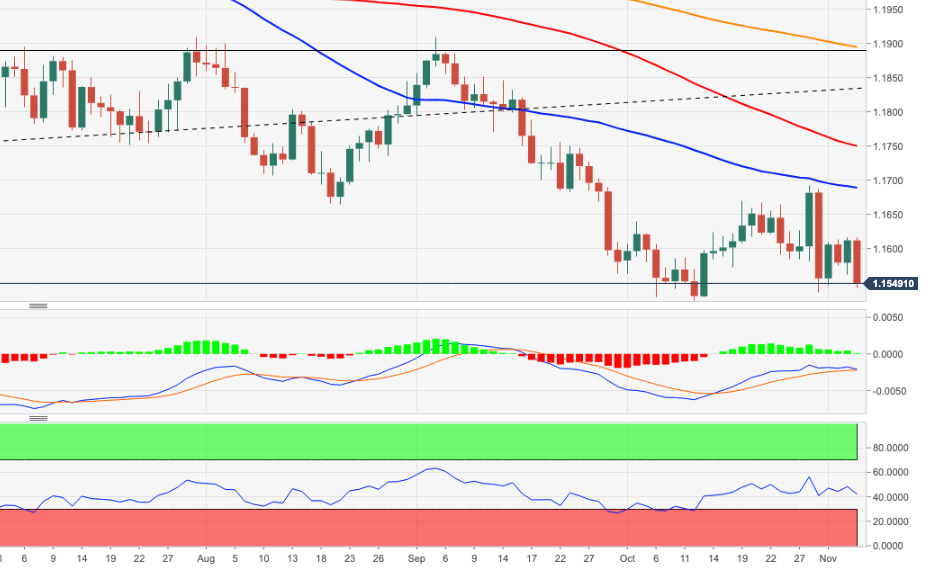
- DXY regains the upside and advances further north of 94.00.
- A break above 94.30 is expected to pave the way to YTD peaks.
The upside momentum in DXY now flirts with recent tops in the vicinity of 94.30 on Thursday.
If the 94.30 region is cleared in the near term, then another visit to the 2021 high at 94.56 (October 12) should start to emerge on the horizon. Above the latter, the September 2020 high at 94.74 should come next.
Looking at the broader picture, the constructive stance on the index is seen unchanged above the 200-day SMA at 92.03.
DXY daily chart
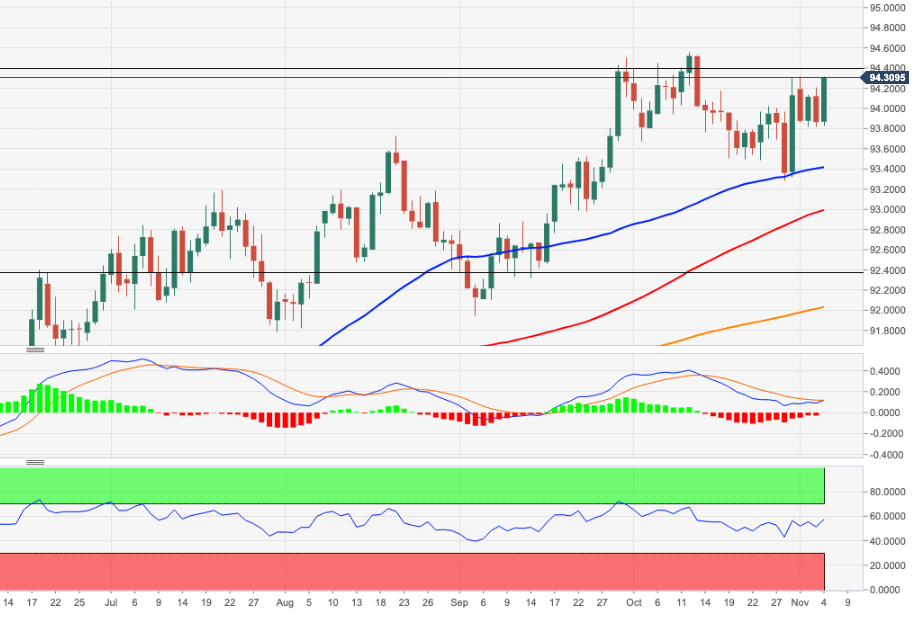
The Bank of England's (BoE) Monetary Policy Committee (MPC) decided to leave the benchmark interest rate unchanged at 0.1% following the November policy meeting. Although this decision was in line with the market consensus, market pricing was pointing out to a 50% chance of a 15 basis points rate hike.
Market reaction
With the initial market reaction, the British pound came under heavy selling pressure and the GBP/USD pair was last seen losing 0.75% on the day at 1.3580.
Follow our live coverage of the BoE policy announcements and the market reaction.
Key takeaways from policy statement as summarized by Reuters
"Policymakers vote 7-2 to keep bank rate at 0.1%."
"It will be necessary to raise bank rate over coming months if data, especially jobs, is in line with the forecast."
"MPC still sees value in waiting for official labour market data after end of furlough, before deciding on tightening policy."
"Policymakers vote 6-3 to maintain gilt purchase target at 875 bln stg."
"Policymakers vote 9-0 to maintain corporate bond purchase target at 20 bln stg."
"BOE maintains total asset purchases at 895 bln stg."
"Policymakers Ramsden and Saunders voted to raise rates to 0.25% from 0.1%."
"Will reinvest proceeds of maturing corporate bonds in november, taking into account climate impact."
"Supply-chain bottlenecks and signs of weaker consumer demand have lowered near-term growth outlook since August."
"UK growth forecast to be relatively subdued in 2023 and 2024, reflecting higher energy prices and less monetary and fiscal support."
"BOE estimates GDP growth of +1.5% QQ for Q3 2021 (Sept forecast: +2.1% QQ), sees +1.0% QQ in Q4 2021."
"BOE estimates quarterly GDP will return to Q4 2019 size in Q1 2022 (Aug forecast: Q4 2021)."
"BOE estimates GDP in 2021 +7% (Aug forecast: +7.25%), 2022 +5% (Aug: +6%), 2023 +1.5% (Aug: +1.5%), 2024 +1%, based on market rates."
"More workers on furlough at end of Sept than expected, few signs of redundancies, unemployment to rise slightly."
"Monetary Policy Report shows unemployment rate at 4.5% in Q4 2021 based on market rates (Aug forecast: 4.7%)."
"BOE forecasts inflation peak of 4.80% in Q2 2022 (Aug forecast: peak of 4.02% in Q1 2022)."
"Onflation forecasts do not factor in sharp fall in energy prices that markets expect in mid 2022."
"Upward pressure on CPI expected to dissipate over time as supply disruption eases, demand rebalances, energy prices stop rising."
"BOE forecast shows inflation in two years' time at 2.23% (Aug forecast: 2.07%), based on market interest rates."
"Inflation would be below 2% in Q4 2023 and Q4 2024 if market expectations of energy price falls and scale of boe rate rises both correct."
"Market interest rates imply more BOE tightening than in August, point to bank rate at 1.0% in Q4 2022, 1.1% in Q4 2023, 1.0% in Q4 2024 (Aug rate: 0.30% in Q4 2022, 0.57% in Q4 2024)."
"BOE forecast shows inflation in three years' time at 1.95% (Aug forecast: 1.89%), based on market interest rates."
"BOE estimates wage growth +3.5% YY in Q4 2021 (Aug forecast: +2.25%), +1.25% YY in Q4 2022 (Aug: +1.75%), +2.25% in Q4 2023 (Aug: +2.75%), +2.75% in Q4 2024."
"BOE estimates overall slack in economy is 0.25% of GDP in 2021 (Aug estimate 0.5%), sees excess demand of 0.25% in 2022 (Aug: excess demand 0.5%), excess demand of 0.25% in 2023 (Aug: excess demand 0.25%), slack of 0.25% in 2024."
- EUR/JPY drops further and clinches new 3-week lows.
- A breach of 131.50 exposes further weakness near term.
EUR/JPY now accelerates the weekly leg lower and challenges the key contention area in the mid-131.00s on Thursday.
The continuation of the downtrend is predicted to meet the next support of relevance around 131.50, where recent lows and a Fibo retracement (of the October’s rally) coincide. A move further south from here should expose a visit to another Fibo level at 130.97.
In the broader scenario, while above the 200-day SMA at 130.32, the outlook for the cross is expected to remain constructive.
EUR/JPY daily chart

Bank of England (BoE) Governor Andrew Bailey will deliver his remarks on the monetary policy decisions in a press conference at 1230 GMT on Thursday, November 4.
Follow our live coverage of the BoE policy announcements and the market reaction.
Related articles
GBP/USD Forecast: Can a BOE rate hike save the pound?
BOE Preview: Guide to trading critical Super Thursday with GBP/USD, in three stages.
About Andrew Bailey (via bankofengland.co.uk)
"Andrew Bailey previously held the role of Deputy Governor, Prudential Regulation and CEO of the PRA from 1 April 2013. While retaining his role as Executive Director of the Bank, Andrew joined the Financial Services Authority in April 2011 as Deputy Head of the Prudential Business Unit and Director of UK Banks and Building Societies. In July 2012, Andrew became Managing Director of the Prudential Business Unit, with responsibility for the prudential supervision of banks, investment banks and insurance companies. Andrew was appointed as a voting member of the interim Financial Policy Committee at its June 2012 meeting."
- EUR/NOK trades without clear direction in sub-9.90 levels.
- The Norges Bank left the policy rate unchanged at 0.25%.
- The next rate hike could come at the December meeting.
The Norwegian krone alternates gains with losses vs. the single currency and prompts EUR/NOK to keep a tight range below the 9.9000 area on Thursday.
EUR/NOK: Upside capped by 9.9000
EUR/NOK so far charts another inconclusive session, always below the 9.9000 yardstick and in the wake of the Norges Bank monetary policy meeting.
Indeed, the Nordic central bank left the key rate unchaged at 0.25%, although it signalled a potential hike at the December meeting.
The central bank noted that the economic recovery pushed the activity back to pre-pandemic levels, while the unemployment receded further and underlying inflation still runs below the back’s target.
The Norges Bank also acknowledged the lingering uncertainty coming from the pandemic and added that current supply constraints could add to the already elevated inflation and temper the economic upturn.
The recovery in prices of the European reference Brent crude also lends support to NOK so far.
EUR/NOK significant levels
As of writing the cross is losing 0.09% at 9.8664 and faces the next resistance at 9.9021 (monthly high Nov.3) followed by 10.0000 (round level) and then 10.0466 (55-day SMA). On the other hand, a breach of 9.7869 (20-day SMA) would open the door to 9.7197 (monthly low Nov.1) and finally 9.6624 (2021 low Oct.21).
- NZD/USD is pushing lower toward 0.7100 on Thursday.
- US Dollar Index reclaims 94.00 after closing in the red on Wednesday.
- Coming up: Weekly Initial Jobless Claims and Q3 Unit Labor Costs data from US.
The NZD/USD pair managed to close in the positive territory on Wednesday but reversed its direction on Thursday. As of writing, the pair was down 0.4% on the day at 0.7130.
DXY advances beyond 94.00
On Wednesday, the initial reaction to the US Federal Reserve's policy announcements and Chairman Jerome Powell's remarks on the rate outlook caused the greenback to weaken against its rivals.
The Fed decided to reduce its asset purchases by $15 billion per month as expected but Powell reiterated that they will not be automatically raising the policy rate when the quantitative easing program concludes.
Nevertheless, the greenback didn't have a difficult time regaining its traction as the market pricing of a 60% chance of a rate hike by June 2022 remained unchanged following the Fed event. As of writing, the US Dollar Index (DXY) was up 0.45% on the day at 94.27.
Later in the session, the weekly Initial Jobless Claims and the third-quarter Unit Labor Costs data will be featured in the US economic docket. However, these data are unlikely to upbeat sentiment surrounding the dollar. In the meantime, the benchmark 10-year US Treasury bond yield is down more than 2% on a daily basis, suggesting that the DXY's upside could be capped in the second half of the day in case yields continue to edge lower.
Technical levels to watch for
Citing sources familiar with the matter, Reuters reported on Thursday that the Organization of the Petroleum Exporting Countries (OPEC) and its allies are likely to stick to plans to raise oil output by 400,000 barrels per day (bpd).
"Despite the pressure from consumers, I think the decision of the OPEC+ meeting on November 4 will most likely be the same increase of 400,000 bpd," an OPEC source told Reuters.
Market reaction
This headline doesn't seem to be having a noticeable impact on crude oil prices. As of writing, the barrel of West Texas Intermediate (WTI) was up 1.72% on the day at $81.45.
- DXY gathers extra pace and retests the 94.20/25 band.
- US yields trade on the defensive with the 10y easing to 1.58%.
- Weekly Claims, Challenger Job Cuts, Trade Balance next on tap.
The US Dollar Index (DXY), which measures the greenback vs. a bundle of its main rival currencies, resumes the upside and clinches new 3-day highs in the 94.20/25 band on Thursday.
US Dollar Index looks to data, yields
The index regains the 94.00 hurdle and beyond and manages to leave behind Wednesday’s post-FOMC pullback against the backdrop of the sour mood in the risk complex and despite the corrective downside in US yields.
The dollar lost momentum on Wednesday after the FOMC event did not leave room for surprises. Indeed, the Committee announced the Fed will start tapering its stimulus programme at a $15B per month ($10M in Treasuries and $5B in MBS) and it is forecast to end at some point by mid-2022. Later, Chairman Powell reiterated that the start of the QE tapering has no implications on any timing for the interest rate lift-off.
In the US data space, Challenger Job Cuts, the usual Initial Claims and Balance of Trade figures are all due later in the NA session.
What to look for around USD
The index managed to regain the 94.00 barrier and above on the back of the renewed offered stance in the risk-associated universe. In the meantime, and while investors continue to digest the Fed meeting, a vigilant stance is expected to prevail in light of Friday’s Nonfarm Payrolls. In addition, the greenback should continue to closely track the performance of US yields and the progress of the current elevated inflation as well as views from Fed’s rate-setters regarding the probability that high prices could linger for longer, all along the performance of the economic recovery against the backdrop of unabated supply disruptions and the equally incessant raise in coronavirus cases.
Key events in the US this week: Balance of Trade, Initial Claims (Thursday) – Nonfarm Payrolls, Unemployment Rate (Friday).
Eminent issues on the back boiler: Discussions around Biden’s multi-billion Build Back Better plan. US-China trade conflict under the Biden’s administration. Tapering speculation vs. economic recovery. Debt ceiling debate. Geopolitical risks stemming from Afghanistan.
US Dollar Index relevant levels
Now, the index is gaining 0.37% at 94.20 and a break above 94.30 (weekly high Oct.29) would open the door to 94.56 (2021 high Oct.12) and then 94.74 (monthly high Sep.24 2020). On the flip side, the next down barrier emerges at 93.27 (monthly low October 28) followed by 92.98 (weekly low Sep.23) and finally 92.32 (low Sep.14).
- USD/CAD stalls its post-Fed recovery as WTI finds its feet in European trading.
- The downside in the pair remains capped by the resurgent USD demand.
- All eyes on the WTI price action ahead of the OPEC meeting.
USD/CAD is falling back towards the daily lows of 1.2375, as the bulls fail to resist above the 1.2400 level.
In doing so, the major pauses the Asian rebound, courtesy of the rebound in WTI prices. The US oil is recovering ground, as traders reposition ahead of the OPEC and its allies (OPEC+) meeting due later on Thursday.
Higher oil prices benefit the resource-linked Canadian dollar, as black gold is Canada’s top export product.
Despite the pullback in the pair, the bulls remain hopeful amid a broad-based recovery in the US dollar. The greenback has reversed more than half of the Fed-led decline, now trading at 94.10, up 0.25% on the day.
The US currency tumbled alongside the Treasury yields during Fed Chair Jerome Powell’s press conference, in which he responded that the central bank will stay patient on the interest rate hikes until the maximum employment goal is reached.
Looking ahead, the pair will remain at the mercy of the US dollar dynamics and the sentiment around the US oil, with all eyes on the OPEC+ meeting.
USD/CAD: Technical levels to watch out
Open interest in natural gas futures markets extended the erratic performance and rose by around 29.5K contracts on Wednesday considering preliminary readings from CME Group. In the same direction, volume reversed the previous drop and gained around 110.8K contracts.
Natural Gas approaches $6.00
Wednesday’s positive price action was on the back of rising open interest and volume and exposes the continuation of the weekly rebound in the very near term. That said, natural gas continues to target the key $6.00 mark per MMBtu for the time being.
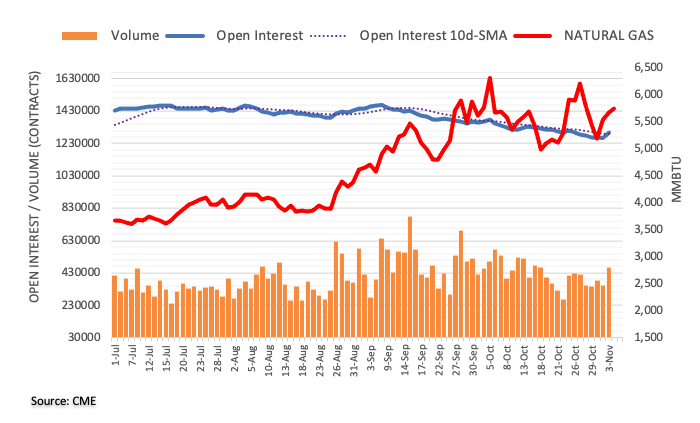
- German Factory Orders rebounded 1.3% MoM in September, a miss.
- On a yearly basis, Germany’s Factory Orders rose by 9.7% in September.
- EUR/USD tests lows below 1.1600 on dismal German Factory data.
The German Factory Orders rebounded less than expected in September, suggesting that the recovery in the manufacturing sector of Europe’s economic powerhouse seems to be losing momentum.
Contracts for goods ‘Made in Germany’ jumped 1.3% on the month vs. 2.0% expected and -7.7% last, the latest data published by the Federal Statistics Office showed on Wednesday.
On an annualized basis, Germany’s Industrial Orders rose by 9.7% in the reported month vs. 11.7% previous.
FX implications
The shared currency remains weighed by the downbeat German Factory Orders data, with EUR/USD testing lows near 1.1575, down 0.26% on the day.
About German Factory Orders
The Factory orders released by the Deutsche Bundesbank is an indicator that includes shipments, inventories, and new and unfilled orders. An increase in the factory order total may indicate an expansion in the German economy and could be an inflationary factor. It is worth noting that the German Factory barely influences, either positively or negatively, the total Eurozone GDP. A high reading is positive (or bullish) for the EUR, while a low reading is negative.
Here is what you need to know on Thursday, November 4:
The dollar moved sharply in both directions during FOMC Chairman Jerome Powell’s press conference and ended up closing the day modestly lower against its major rivals on Wednesday. Ahead of the Bank of England’s (BOE) Interest Rate Decision, markets remain relatively calm and the greenback seems to have regathered its strength. The European Commission will release the updated Economic Forecasts for the euro area. The weekly Initial Jobless Claims, third-quarter Unit Labor Costs and September Goods Trade Balance data will be featured in the US economic docket.
As expected, the US Federal Reserve decided to reduce its asset purchases by $15 billion per month, starting mid-November. In its policy statement, the Fed adopted a flexible tone by noting that it is prepared to adjust the pace of purchases in the coming months if warranted by the changes in the economic outlook. Regarding the rate outlook, Powell reiterated that a rate hike won’t necessarily follow right away when the quantitative easing program concludes. The chairman said that they believe inflation will start to ease toward 2% in the second half of 2022 and emphasized that they have a lot of ground to cover regarding their employment goals.
Federal Reserve tapers, Treasury rates rise and markets yawn.
Meanwhile, the data from the US showed that employment in the private sector rose more than expected in October and the economic activity in the service sector expanded at its strongest pace on record with the ISM Services PMI jumping to 66.7 from 61.9 in September.
The Fed’s tapering announcement had little to no impact on market sentiment and the S&P 500 Index, once again, posted a new all-time high. The 10-year US Treasury bond yield rose more than 3% on Wednesday and now holds above 1.6%, easing concerns over a flattening yield curve. China’s Shanghai Composite and Japan’s Nikkei 225 indexes are up 0.7% and 0.8%, respectively, reflecting the upbeat market mood.
EUR/USD climbed above 1.1600 in the late American session on Wednesday but seems to have lost its momentum already. Several European Central Bank policymakers said on Wednesday that there was no reason to hike rates next year. The data from Germany showed that Factory Orders rose by 9.7% on a yearly basis in September.
GBP/USD lost its traction after rising toward 1.3700 on Wednesday and now stays in the negative territory while waiting for the BOE’s policy announcements. The bank could opt out for a 15 basis points rate hike to ease off the price pressures. A bigger rate hike is likely to provide a boost to the GBP while a no-hike could trigger another leg lower in the pair. Governor Andrew Bailey’s comments on the rate outlook can also ramp up the volatility later in the session.
BOE Preview: Guide to trading critical Super Thursday with GBP/USD, in three stages.
Gold fell to its lowest level in more than two weeks below $1,760 before going into a consolidation phase. XAU/USD is posting small daily gains around $1,770 in the early European session but looks fragile following Wednesday's decline.
Cryptocurrencies: Bitcoin is struggling to find direction and continues to fluctuate above $60,000. Ethereum notched a new all-time high above $4,600 on Wednesday and seems to have gone into a consolidation phase around $4,500.
CME Group’s flash data for crude oil futures markets noted traders added just 111 contracts to their open interest positions on Wednesday for the first time since October 21. Volume followed suit and went up by around 328.5K contracts, reversing at the same time two daily drops in a row.
WTI risks further losses below $80.00
Wednesday’s sharp pullback in prices of the WTI was on the back of increasing open interest and volume, allowing for the continuation of the corrective downside at least in the very near term. A convincing break below the $80.00 mark per barrel should open the door to extra losses to, initially, the $75.00 region.
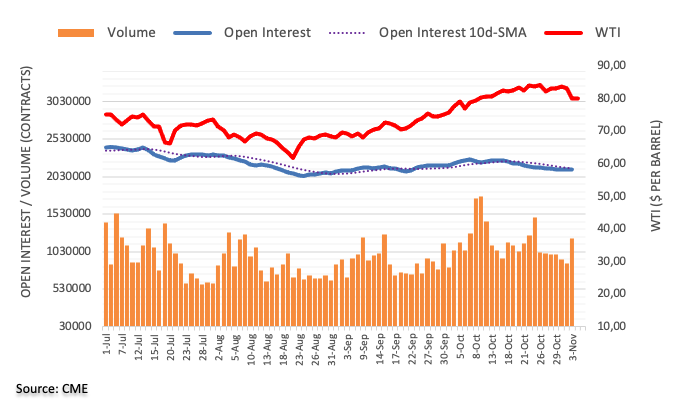
According to advanced figures from CME Group for gold futures markets, open interest rose by just 794 on Wednesday, partially reversing the previous daily drop. In the same line, volume reversed two daily pullbacks in a row and went up by around 113.2K contracts.
Gold appears supported around $1,760
Wednesday’s pullback in prices of gold seems to have met some decent contention in the $1,760 region. The downtick was amidst rising open interest and volume and leaves the door open to further decline in the very near term. The loss of $1,760 could well see the weekly low around $1,750 per ounce troy re-visited in the near term.
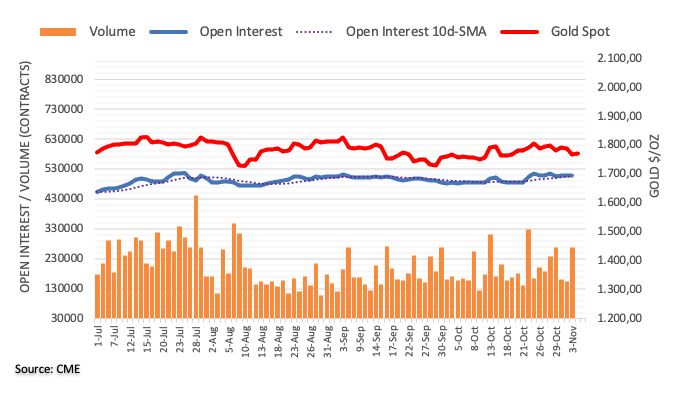
- AUD/USD reverses Wednesday’s rebound-induced by dovish Powell.
- The aussie clings to 21-DMA support for the third straight session.
- Daily highs at 0.7471 could be retested as RSI stays bullish.
AUD/USD is turning south once again, having failed to find acceptance above the 0.7450 barrier amid a broad rebound in the US dollar and mixed Australian Trade and Retail Sales data.
The Fed tapered as expected but the central bank’s stance on the future rate hikes cheered the doves and triggered a sharp sell-off in the shorter-duration yields alongside the greenback.
From a short-term technical perspective, AUD/USD continues to challenge the 21-Daily Moving Average (DMA) at 0.7441, awaiting a daily closing below the latter to initiate a fresh downswing towards the descending 100-DMA at 0.7382.
developing story ...
- EUR/USD reverses Wednesday’s gains and returns to 1.1580.
- The greenback looks bid in the wake of the FOMC event.
- German Factory Orders, Services PMI next on tap.
The selling bias hits the single currency and forces EUR/USD to return to the sub-1.1600 area ahead the opening bell in Euroland on Thursday.
EUR/USD looks to USD, yields
Following a volatile session on Wednesday, EUR/USD managed to chart decent gains, although the absence of follow through motivate spot to slip back to the negative territory on Thursday.
The pair, in the meantime, stays under pressure on the back of the decent advance in the greenback, which motivates the US Dollar Index (DXY) to regain the 94.00 barrier and beyond amidst a mixed tone in US yields.
It is worth recalling that the greenback surrendered ground on Wednesday after the Federal Reserve announced it will start tapering its bond-purchase programme later in the month at a monthly $15B, matching the broad consensus. Later, in his press conference, Chief Powell gave an upbeat assessment of the economy although he emphasized that the start of the tapering process has no links to a rates lift-off.
Later in the domestic docket, German Factory Orders and the final October Services PMI are due. In the broader euro area, September’s Producer Prices and the Services PMI are also due.
Across the pond, the usual Initial Claims, Challenger Job Cuts and Balance of Trade figures are all scheduled for later in the NA session.
What to look for around USD
The index managed to regain the 94.00 barrier and now looks to keep business above it following the FOMC event. In the meantime, and while investors continue to digest the Fed meeting, a vigilant stance is expected to prevail in light of Friday’s Nonfarm Payrolls. In addition, the greenback should continue to closely track the performance of US yields and the progress of the current elevated inflation as well as views from Fed’s rate-setters regarding the probability that high prices could linger for longer, all along the performance of the economic recovery against the backdrop of unabated supply disruptions and the equally incessant raise in coronavirus cases.
Key events in the US this week: Balance of Trade, Initial Claims (Thursday) – Nonfarm Payrolls, Unemployment Rate (Friday).
Eminent issues on the back boiler: Discussions around Biden’s multi-billion Build Back Better plan. US-China trade conflict under the Biden’s administration. Tapering speculation vs. economic recovery. Debt ceiling debate. Geopolitical risks stemming from Afghanistan.
EUR/USD levels to watch
So far, spot is losing 0.24% at 1.1584 and faces the next up barrier at 1.1688 (55-day SMA) followed by 1.1692 (monthly high Oct.28) and finally 1.1755 (weekly high Sep.22). On the other hand, a break below 1.1535 (weekly low Oct.29) would target 1.1524 (2021 low Oct.12) en route to 1.1495 (monthly low Mar.9 2020).
FX option expiries for November 4 NY cut at 10:00 Eastern Time, via DTCC, can be found below.
- EUR/USD: EUR amounts
- 1.1500 522m
- 1.1525 1.1b
- 1.1550 1.1b
- 1.1600 518m
- 1.1625 474m
- 1.1650 470m
- GBP/USD: GBP amounts
- 1.3825 461m
- USD/JPY: USD amounts
- 112.50 1.1b
- 113.00 1.5b
- 114.00 2.1b
- 114.30 1.8b
- 114.50 733m
- 115.00 989m
- 115.30 850m
- AUD/USD: AUD amounts
- 0.7300 619m
- 0.7500 797m
- USD/CAD: USD amounts
- 1.2420 790m
- 1.2550 610m
- 1.2600 460m
- EUR/GBP: EUR amounts
- 0.8520-25 821m
- Gold price stalls the recovery amid a bounce in the USD, yields.
- The Fed tapers by $15 billion, stays patient on rate hikes.
- Gold Price Forecast: Firmer bearish case once below 1,756.60.
The Fed’s tapering occurred as expected and triggered a rebound in gold price, as a $15 billion worth of taper was well priced-in. Further, Fed Chair Jerome Powell’s patient stance on the interest rate hikes offered additional zest to gold bulls. However, the renewed upswing in the US Treasury yields amid rising inflation expectations put a fresh bid under the greenback, checking gold’s recovery from a three-week trough of $1759. Attention now turns towards Friday’s US NFP release for fresh gold price direction.
Read: Federal Reserve tapers, Treasury rates rise and markets yawn
Gold Price: Key levels to watch
The Technical Confluences Detector shows that gold is easing towards the strong support at $1772, the intersection of the previous week’s low and Fibonacci 61.8% one-month.
The next relevant support is environed at $1770, the Fibonacci 38.2% one-day.
If the downside momentum accelerates, then sellers will target the pivot point one-week S1 at $1767.
The previous day’s low of $1759 will be on the bears’ radars on the extended decline. Further south, the pivot point one-day S1 at $157 will be challenged.
Alternatively, the Fibonacci 61.8% one-day at $1777 will test the immediate upside attempts, above which powerful resistance around $1782 will come into play.
That level is the confluence of the SMA50 one-day, Fibonacci 23.6% one-week and SMA10 four-hour.
A bunch of healthy resistance levels around $1788 is critical for gold bulls to take out should the recovery extend momentum.
The price area is the convergence of the previous day’s high, Fibonacci 38.2% one-month, SMA100 one-day and pivot point one-day R1.
Here is how it looks on the tool
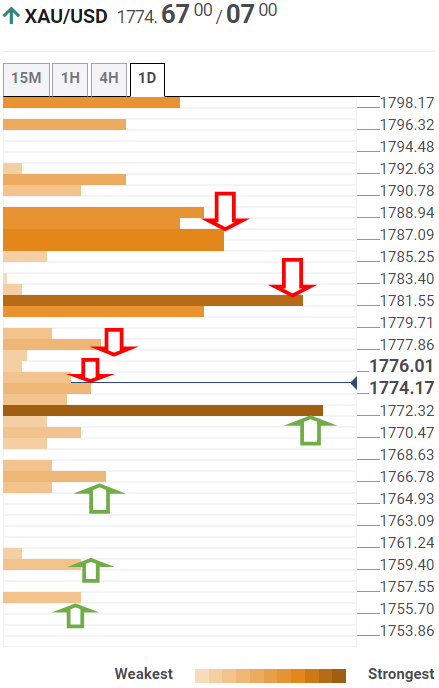
About Technical Confluences Detector
The TCD (Technical Confluences Detector) is a tool to locate and point out those price levels where there is a congestion of indicators, moving averages, Fibonacci levels, Pivot Points, etc. If you are a short-term trader, you will find entry points for counter-trend strategies and hunt a few points at a time. If you are a medium-to-long-term trader, this tool will allow you to know in advance the price levels where a medium-to-long-term trend may stop and rest, where to unwind positions, or where to increase your position size.
- GBP/USD sellers return on Super Thursday, as BOE and Brexit talks eyed.
- BOE is likely to defy market expectations and keep rates steady at 0.1%.
- Brexit talks also likely to play out as the US dollar attempts a bounce.
GBP/USD is resuming its recent downtrend on Super Thursday, reversing the Fed-led impressive rebound from near three-week lows of 1.3606.
All eyes on the BOE event
The GBP bears have fought back control, as speculations surrounding an imminent rate hike by the Bank of England (BOE) die down after the Fed disappointment on Wednesday.
The Fed tapering its bond-buying by $15 billion per month but at the same time, Chair Jerome Powell said that they remain patient on the interest rate hikes until their maximum employment goal is accomplished. He also tweaked the wording around inflation, noting that rising price pressures are ‘expected to be transitory.’
In the lead-up to the BOE rate decision, the CME BOEWatch tool shows a 55% probability of a rate lift-off at the central bank’s November meeting. Although it could be a close call for the BOE policymakers as they continue to assess the inflation and Brexit risks.
On the Brexit front, tensions continue to persist between the European Union (EU) and the UK over the Northern Ireland (NI) protocol.
The European Commission Vice President Frans Timmermans said it was “extremely well-known in London” that the demand to ditch the European Court of Justice (ECJ) could not be met.
This comes after UK Brexit minister Lord Frost said that the ECJ should be replaced with an independent arbitration panel and that it can have no role in settling disputes in Northern Ireland, per the Independent.
Meanwhile, the UK-French conflict over the post-Brexit fishing rights continues to remain a headwind for the pound. Traders now brace for the all-important BOE decision for the next direction in the currency pair. Brexit talks in Paris will also hog some attention alongside the US weekly jobless claims.
GBP/USD: Levels to consider
After the conclusion of the meeting, the Bank of Japan (BOJ) Governor Haruhiko Kuroda said that he discussed Japan, global economies and financial markets with PM Fumio Kishida.
Additional quotes
Explained monetary policy to PM Kishida.
No discussion on economic stimulus package.
Told PM Kishida that the BOJ is aiming to achieve 2% inflation target.
Corporate funding for financial institutions is firmly in place.
Will continue yield curve control even after coronavirus is contained.
BOJ is in different situation from western central banks, when asked about fed move overnight.
Market reaction
USD/JPY is holding onto the latest rebound above 114.00 on Kuroda’s comments. The spot was last seen trading at 114.19, up 0.19% on the day.
- NZD/USD fades the bounce from two-week lows, as USD bulls return.
- Post-Fed risk-on mood, recovery in the US yields drive the USD uptick.
- Focus shifts to the US NFP release for a decisive move in the kiwi.
NZD/USD is back in the red zone, heading towards the 0.7150 level in Thursday’s Asian trading.
The resurgent demand for the US dollar amid a rebound in the US Treasury yields is weighing on the kiwi’s recovery from two-week lows of 0.7092 reached on Tuesday.
The yields and the dollar are reversing the US Federal Reserve (Fed) inflicted losses, in the face of Chair Jerome Powell turning out dovish, citing patience on raising the interest rates until the central bank’s maximum employment goal is achieved.
The Fed announced tapering of its bond-buying programme by $15 billion per month while noting the rising price pressures are ‘expected to be transitory’.
The dovish stint by Powell and Co. is contradicting the strong hawkish expectations from the Reserve Bank of New Zealand (RBNZ). The RBNZ is expected to hike rates by as much as 50bps when its meets later this month.
The monetary policy divergence between the Fed and RBNZ could help limit any pullback in NZD/USD, as traders may readjust their positions ahead of Friday’s critical US Nonfarm Payrolls (NFP) release.
In the meantime, the US weekly Jobless Claims and goods trade balance could entertain the traders this Thursday.
NZD/USD technical levels to consider
In its latest assessment of the global economy, Moody’s Investors Service highlighted that the “headwinds to growth will dissipate next year, allowing the global economy to enter stable growth by 2023.”
Additional takeaways
“COVID-19 outbreaks continued supply chain logjams and labor shortages to diminish in 2022.
“Expect G20 economies to grow 4.4% collectively in 2022 and then by 3.2% in 2023.”
“Monetary and credit conditions will tighten as central banks look to remove pandemic-era liquidity and interest rate support.”
“Another risk to global recovery is potential for more persistent supply chain disruptions, ratcheting up of inflation.”
Related reads
- World Bank expects global growth of 5.7% in 2021 and 4.4% in 2022
- OECD trims global growth forecast to 5.7% for 2021 from 5.8% in May
- GBP/JPY builds on Wednesday’s rebound towards 156.50
- The cross is teasing a bull flag breakout on the daily chart amid bullish RSI.
- BOE outcome eyed alongside a daily closing above the 156.50 hurdle.
GBP/JPY is looking to extend Wednesday’s impressive rebound from near the 154.50 region, having reclaimed the critical 21-Daily Moving Average (DMA) at 155.81.
The latest uptick comes ahead of the all-important Bank of England (BOE) interest rate decision and after the US Federal Reserve (Fed) disappointed the hawks, despite the $15 billion worth of tapering.
From a short-term technical perspective, GBP/JPY is approaching the falling trendline resistance of a potential bull flag, at 156.50.
A daily closing above that hurdle will confirm the bullish continuation pattern, opening doors for a rally towards the 160.00 level.
Ahead of that barrier, the multi-month highs at 158.22 will come into play.
The Relative Strength Index (RSI) has stalled its ascent but holds comfortable above the midline, backing the buying resurgence.
The 50 and 100-DMAs bullish crossover confirmed on October 28 also plays out in favor of the bulls.
GBP/JPY daily chart
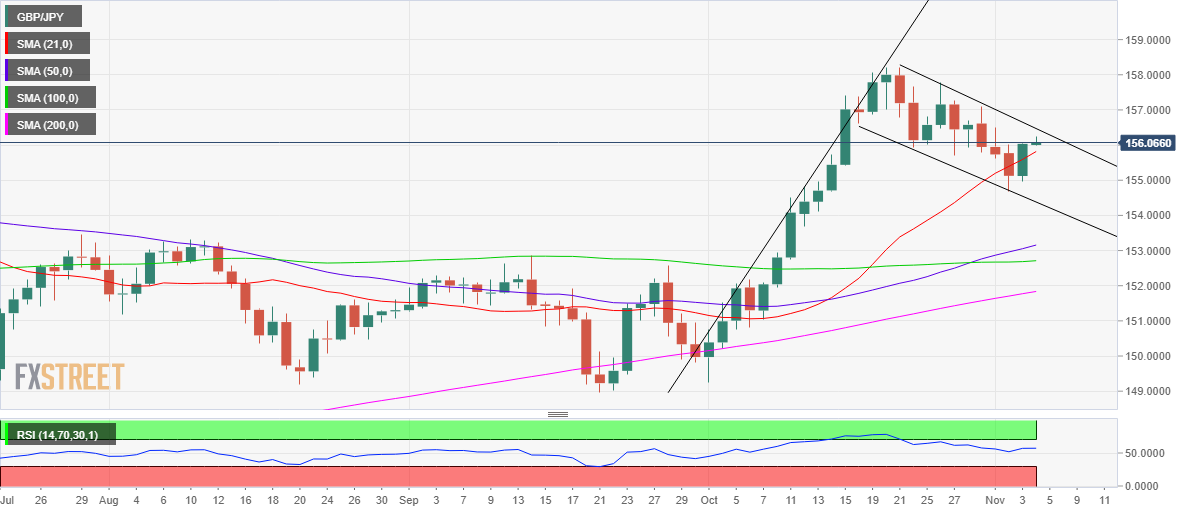
On the flip side, a firm break below the falling trendline support at 154.37 could lead to the bull flag pattern failure, calling for a sharp drop towards the upward-sloping 50-DMA at 153.15.
The next line of defense is positioned at the horizontal 100-DMA at 152.71.
GBP/JPY additional levels to watch
According to the economists at Bank of America (BofA), the Bank of England (BOE) is seen hiking the benchmark interest rate by 15 basis points (bps) on Thursday.
Read: BOE Preview: A rate hike or no rate hike, GBP/USD set to fall?
Key quotes
"We expect a 6-3 BoE vote to hike Bank Rate 15bp on Thursday. However, we do not think that decision is a foregone conclusion.”
“We expect BoE forecasts and communication to be consistent with fewer/slower rate hikes than the market prices.”
"With the market now fully priced for a 15bp rate hike, the risks are obviously skewed towards disappointment and a GBP sell-off, given the amount of rate hikes which are now priced in beyond this meeting.”
“Should the MPC decide to delay the hike, the temptation would be for markets to roll this into December, so any disappointment in GBP would likely be short-lived.”
| Raw materials | Closed | Change, % |
|---|---|---|
| Brent | 81.89 | -3.2 |
| Silver | 23.539 | 0.01 |
| Gold | 1769.763 | -1 |
| Palladium | 1997.73 | -0.52 |
China’s Premier Li Keqiang said during a meeting with the State Council on Wednesday, fine-tuning of policies, as economic challenges grow amid resurgent coronavirus cases and power shortages, per Bloomberg.
“Li called for authorities to ensure the supplies of major agricultural goods and improve the capacity of reserves, Bloomberg reports, citing state broadcaster CCTV.
The comments by China’s No. 2 leader come shortly after he said the economy faces new downward pressures and called for cuts in taxes and fees to ease pressure on small and medium-sized companies.
Related reads
- China’s President Xi: Will ensure smooth supply chains
- AUD/USD stalls the post-Fed bounce above 0.7450 on mixed Australian data
Japan's Trade Minister Hiroshi Kajiyama urges the US to abolish extra tariffs on steel and aluminium, per Reuters.
It is being reported that the request was made in the Minister's meeting with US Trade Representative Katherine Tai.
Market reaction
USD/JPY is unperturbed by the above reports, trading near-daily highs of 114.24, up 0.21% on the day, at the press time.
- USD/JPY bounces in tandem with Treasury yields, recaptures 114.00
China “will ensure smooth supply chains,” China Central Television (CCTV), a Chinese state-controlled broadcaster, cites comments from the country’s President Xi Jinping on Thursday.
He added that China “will extend international shipping cooperation.”
more to come ,,,
- USD/INR is under immense pressure and takes on critical support.
- Bulls will need to step up at this juncture or face liquidation below 74 the figure.
USD/INR has been on the offer for the best part of the past several weeks and it has now moved in on a critical level of daily support as illustrated in the chart below. A break here will open prospects of a significant downside continuation which leaves the 74 area vulnerable and 73.50 exposed.
USD/INR daily chart
-637715869244699320.png)
The bullish flag is not looking so bullish any longer, at least should the support structure that has been drawn above be taken out. With that being said, we could see a resurgence in the US dollar, but this will now depend on the prospects of interest rate hike timings from the Federal Reserve.
The week will climax with critical data in Nonfarm Payrolls on Friday. That data could throw the bulls a lifeline. In doing so, the price would be expected to move in towards the 74.80 resistance area which will then act as a possible last defence for a break of the trendline resistance.
- USD/JPY regains 114.00 and beyond amid an upbeat mood, rebound in T-yields.
- The US dollar attempts a bounce after Fed’s Powell-induced blow.
- Japanese traders return, volatility persists ahead of the US second-tier data.
USD/JPY is holding the higher ground above 114.00. having found strong bids near the 113.90 region, as the risk appetite returns along with the Japanese traders in the Fed’s aftermath.
Fed’s Powell says patience on rate hikes
The Fed announced the much-awaited tapering on Wednesday, reducing the bond-buying by $15 billion per month starting this month. Although Fed Chair Jerome Powell’s patient approach on raising interest rates lifted the market sentiment while smashing the US Treasury yields alongside the dollar.
So far this Thursday’s trading, the major is bouncing back above 114.00, tracking the rebound in the Treasury yields across the curve, which has put a fresh bid under the US dollar. The benchmark 10-year US rates are back above 1.60%, recovering from the post-Fed dip to near 1.54%.
Further, the Japanese traders return to markets after Wednesday’s public holiday, cheering the record close on Wall Street overnight, collaborating with the upside in the pair. The Nikkei 225 index is up 1% on the day, closing in on the 30,000 level.
Next of relevance for USD/JPY remains the US weekly jobless claims and trade data, as the JPY bulls ignored the upbeat Japanese Jibun Bank / Markit Services PMI for October, which arrived at 50.7 vs. 47.8 prior.
USD/JPY technical levels to consider
- USD/CAD consolidates ahead of critical US jobs data.
- Markets will now assess the economic backdrop with respect to Fed rate hike timings.
USD/CAD is flat on the day and in the consolidation of the prior daily bearish impulse after a being outcome from the Federal reserve that weighed on the greenback in what was giving back territory gained earlier in the week. Investors weighed the Federal Reserve's move to taper its bond-buying program, with CAD recovering from an earlier three-week low which it hit as oil prices tumbled.
There was a limited reaction across the G10FX space following the Fed meeting after it said it will begin trimming its monthly bond purchases in November with plans to end them in 2022, but held to its belief that high inflation would prove "transitory" and likely not require a fast rise in interest rates.
All eyes now turn to data events
However, as for liftoff, it will now depend on how the economy evolves, so US data is going to be critical and volatility could be sparked as soon as today with JOLTS ahead of Friday's all-important Nonfarm Payrolls.
''Officials have become more concerned about the risk that the pickup in inflation will turn out to be less "transitory" than hoped, raising the risk of an earlier-than-anticipated start to rate hikes, but officials still think inflation will moderate as COVID fallout wanes,'' analysts at TD Securities explained.
''We continue to forecast no rate hikes until the end of 2023, but the exact timing will inevitably depend on how the outlook evolves as data are reported. We expect a fading of fiscal stimulus to the point of policy turning contractionary to result in momentum be down enough by the middle of next year to delay action.''
Meanwhile, as a potential prelude to Friday's jobs data, the US ADP private employment report surprised to the upside in October. The series rallied to 571k after registering a 523k gain in September (revised lower from 568k).
In recent trade today, the People’s Bank of China (PBOC) set the yuan (CNY) at 6.3943 sv the estimated 6.3911 and the previous 6.4079.
About the fix
China maintains strict control of the yuan’s rate on the mainland.
The onshore yuan (CNY) differs from the offshore one (CNH) in trading restrictions, this last one is not as tightly controlled.
Each morning, the People’s Bank of China (PBOC) sets a so-called daily midpoint fix, based on the yuan’s previous day closing level and quotations taken from the inter-bank dealer.
According to the US-based Fitch Ratings, the Reserve Bank of Australia’s (RBA) monetary policy tweak in November keeps the 2023 rate hike expectations intact amid the looming inflation risk.
Key quotes
“The RBA has indicated it will not raise the cash rate until inflation is sustainably within its 2%-3% target range, a condition that it previously did not expect to be met before 2024 under its central scenario. However, its guidance was softened in its 2 November 2021 monetary policy statement, which hinted that faster-than-expected progress towards meeting the inflation target could lead to a case for raising the rate before 2024. The RBA also officially discontinued its target of 0.1% for the yield on the Australian government’s April 2024 bond.”
“We believe the next step will be the termination of government bond purchases, probably in late 1Q22 or during 2Q22; bond purchases were reduced to AUD4 billion weekly, from AUD5 billion, in September 2021. We continue to expect the cash rate to be raised in 2023, although there is a possibility that it could even be raised in late 2022 if inflation and wage growth exceed our assumptions.”
-
AUD/USD stalls the post-Fed bounce above 0.7450 on mixed Australian data
- AUD/USD bulls face an uphill battle after mixed Australian Trade, Retail Sales data.
- The US dollar slips as Fed Chair Powell says ‘patience’ on rate hike after taper
- All eyes on the RBA Monetary Policy Statement and the US NFP release due Friday.
AUD/USD is off the highs but holds above the 0.7450 level following the release of the Australian Trade Balance and Retail Sales data, which came in mixed for September.
Read: Aussie Trade Balance surplus a positive for AUD
Despite the retracement, the aussie keeps its recovery mode intact amid the risk-on market mood. The Japanese traders return from a holiday and drive the Nikkei 225 index about 1% higher on the day, tracking another record run on Wall Street overnight. Meanwhile, the ASX 200 is adding 0.20% so far.
The upbeat mood can be attributed to the dovish comments from Fed Chair Jerome Powell, which failed to offer any fuel to the mid-2022 rate hike expectations. The Fed did announce the widely expected $15 billion worth of tapering on Wednesday but noted that the lift-off test is not met on the employment goal.
The dovish comments from Powell knocked the US dollar down, triggering a fresh upswing in the riskier assets such as the aussie dollar. Post-Fed, the currency pair is on a rebound from the lows of 0.7413, currently trading at 0.7461, up 0.22% on the day.
As the dust settles over the Fed’s aftermath, markets will shift their attention towards Friday’s Monetary Policy Statement from the Reserve Bank of Australia (RBA) and the US NFP release. Meanwhile, the pair will take cues from the US weekly jobless claims data and the risk tone for fresh trading opportunities.
AUD/USD: Technical levels to watch out
- EUR/USD bulls attempting to take on the bear's commitments.
- Daily charts remain bearish ahead of the main event in NFP on Friday.
The bulls took over regardless of the bearish structure that was in platy following the Federal Reserve volatility and the lack of liquidity in markets has enabled the price to meander into Tokyo with no decisive bias. The W-formation is somewhat compelling but there are no signs that the bulls are going to step aside immanently.
EUR/USD H1 chart
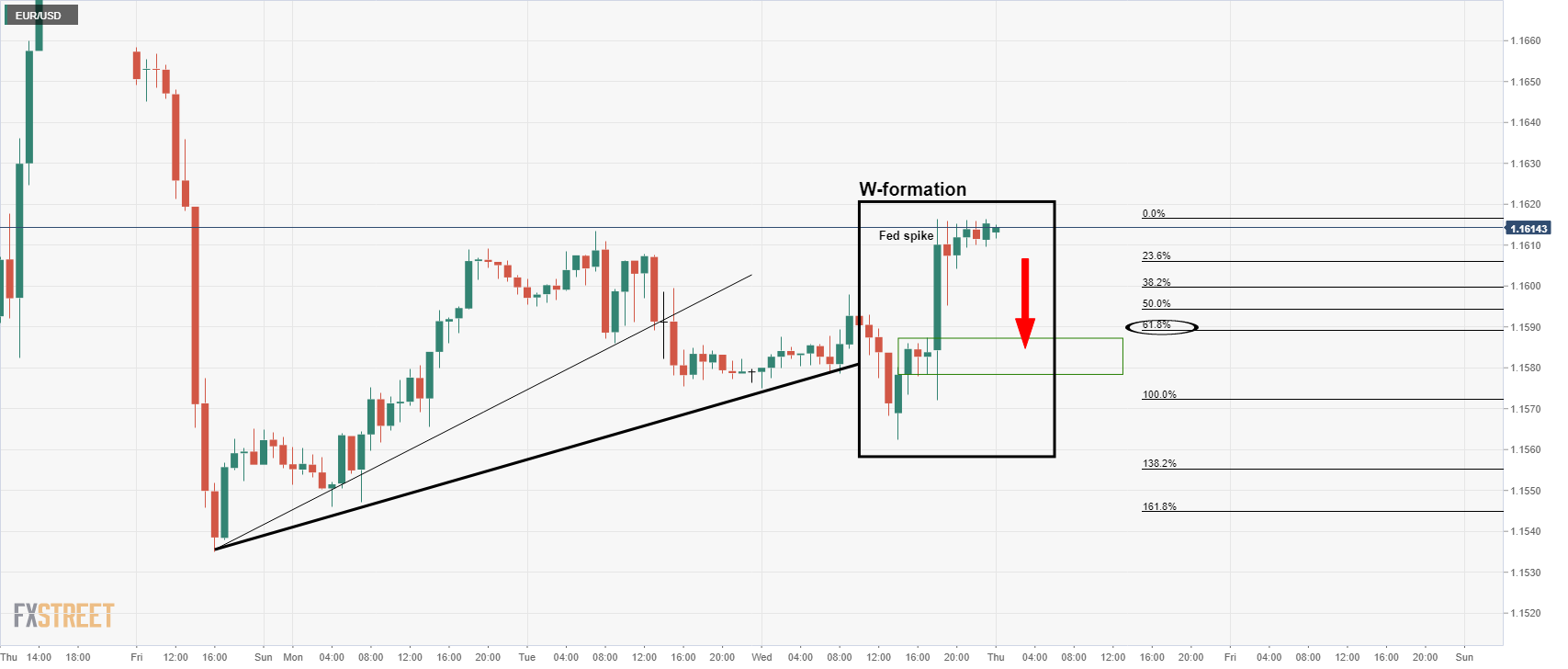
Meanwhile, casting eyes over prior analysis, EUR/USD Price Analysis: Bears seeking a break below 1.15 the figure, the price still has room to go to the upside before bears might commit fully once again.
EUR/USD daily bearish engulfing candle
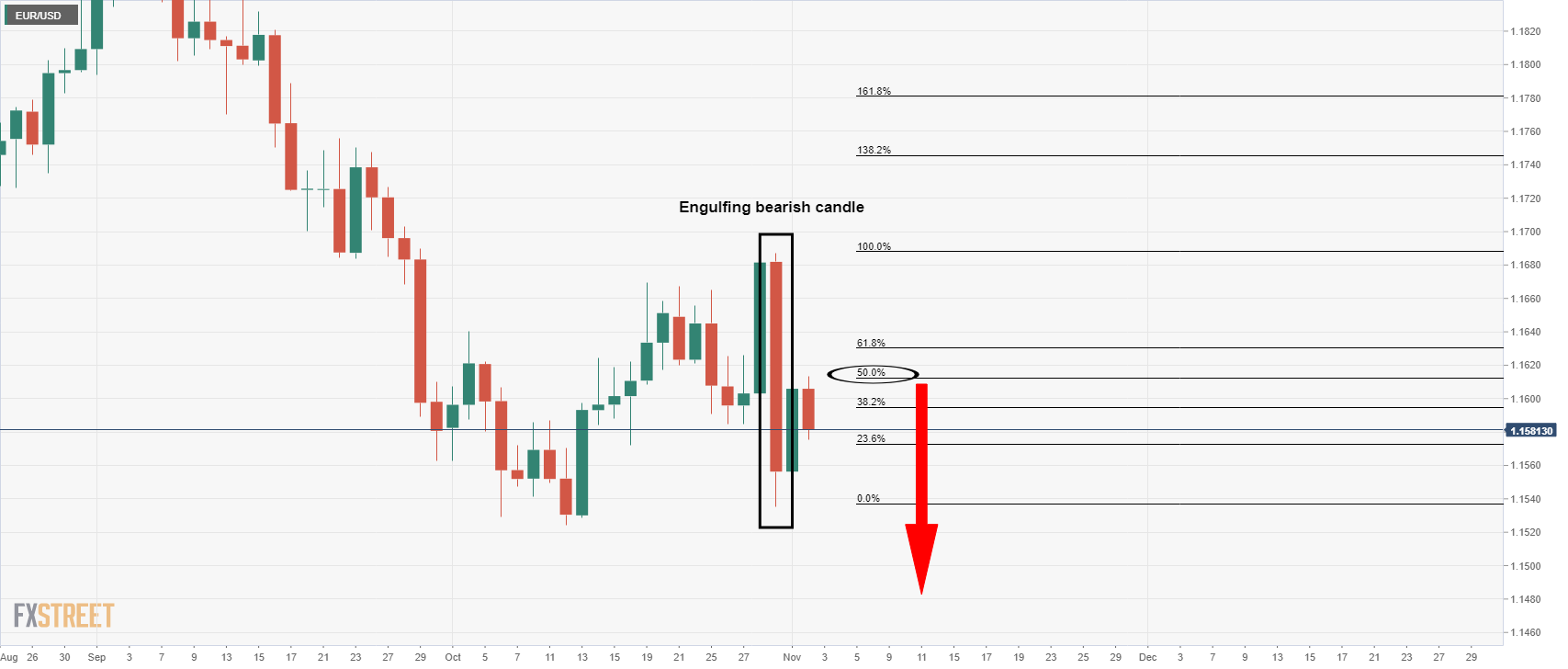
We had seen a strong momentum candle in the last few days which was yet to lead to a lower low. The price had instead corrected 50% of the imbalance in a phase of mitigation and a retest of liquidity.
EUR/USD live update
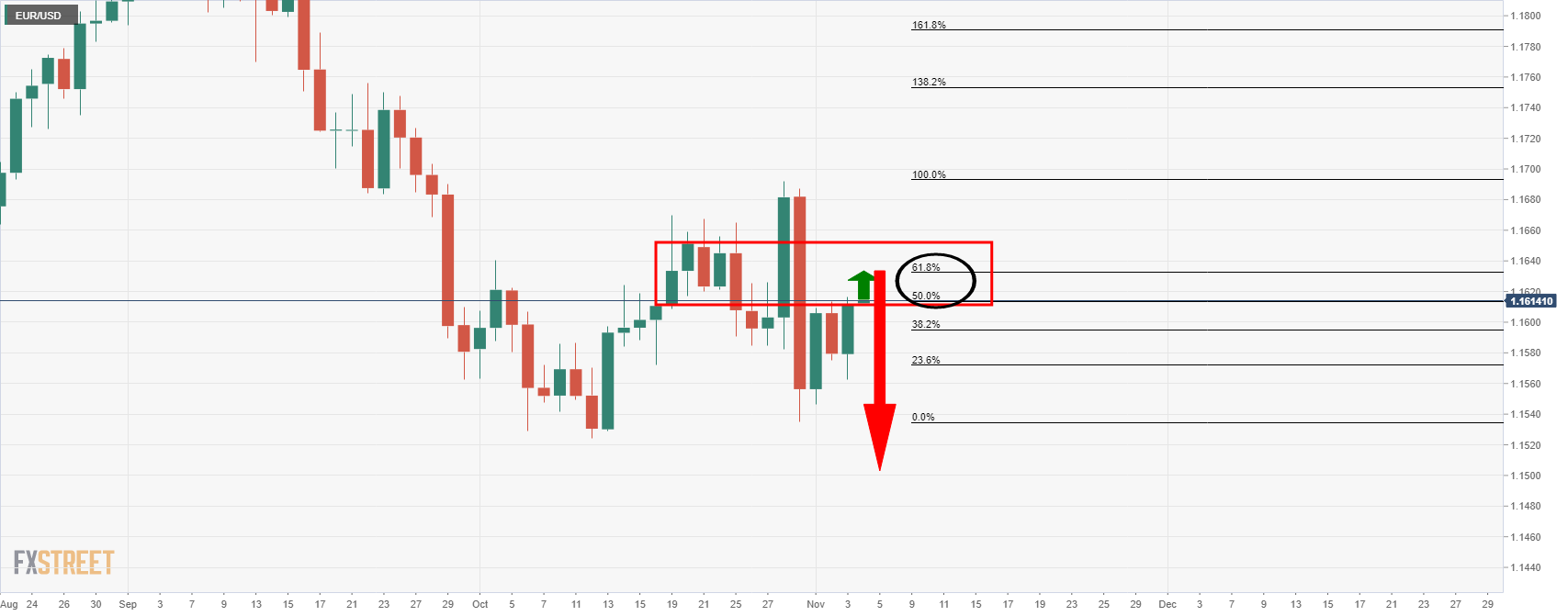
The price is attempting some further upside here, so best let this play out before banking on bearish bets.
Australia Trade Balance for September arrived A$12.243b vs the estimated A$12.175b and vs the prior A$15.077b).
- Australia exports (MoM) Sep -6% (est -3%; prev 4%).
- Australia imports (MoM) Sep -2% (est 1%; prev -1%).
The data comes as a consequence of lower iron ore prices subduing exports (f/c -5%) and oil prices support for imports (f/c +0.5%). However, the Aussie can take some comfort that it was better than expected.
Meanwhile, final Retail Sales arrived -4.4% for the third quarter vs the expected 4.6% and prior 0.8% QoQ with sales down due to the coronavirus lockdown. Traders are in anticipation of a pick up in sales as the nation moves out of lockdown.
About the Trade Balance
The trade balance released by the Australian Bureau of Statistics is the difference in the value of its imports and exports of Australian goods. Export data can give an important reflection of Australian growth, while imports provide an indication of domestic demand. Trade Balance gives an early indication of the net export performance. If a steady demand in exchange for Australian exports is seen, that would turn into a positive growth in the trade balance, and that should be positive for the AUD.
| Time | Country | Event | Period | Previous value | Forecast |
|---|---|---|---|---|---|
| 00:30 (GMT) | Australia | Retail Sales, M/M | September | -1.7% | 1.3% |
| 00:30 (GMT) | Australia | Trade Balance | September | 15.077 | 12.2 |
| 07:00 (GMT) | Germany | Factory Orders s.a. (MoM) | September | -7.7% | 2% |
| 08:00 (GMT) | Switzerland | SECO Consumer Climate | Quarter IV | 7.8 | |
| 08:50 (GMT) | France | Services PMI | October | 56.2 | 56.6 |
| 08:55 (GMT) | Germany | Services PMI | October | 56.2 | 52.4 |
| 09:00 (GMT) | Eurozone | Services PMI | October | 56.4 | 54.7 |
| 09:30 (GMT) | United Kingdom | PMI Construction | October | 52.6 | 52 |
| 10:00 (GMT) | Eurozone | Producer Price Index, MoM | September | 1.1% | 2.2% |
| 10:00 (GMT) | Eurozone | Producer Price Index (YoY) | September | 13.4% | 15.2% |
| 12:00 (GMT) | United Kingdom | BoE Interest Rate Decision | 0.1% | 0.1% | |
| 12:00 (GMT) | United Kingdom | Asset Purchase Facility | 875 | 875 | |
| 12:00 (GMT) | United Kingdom | Bank of England Minutes | |||
| 12:30 (GMT) | U.S. | Continuing Jobless Claims | October | 2243 | 2118 |
| 12:30 (GMT) | U.S. | Unit Labor Costs, q/q | Quarter III | 1.3% | 7% |
| 12:30 (GMT) | U.S. | Nonfarm Productivity, q/q | Quarter III | 2.1% | -3% |
| 12:30 (GMT) | U.S. | Initial Jobless Claims | October | 281 | 275 |
| 12:30 (GMT) | U.S. | International Trade, bln | September | -73.3 | -80.5 |
| 12:30 (GMT) | Canada | Trade balance, billions | September | 1.94 | 1.55 |
| 16:50 (GMT) | United Kingdom | MPC Member Cunliffe Speaks | |||
| 21:30 (GMT) | Australia | AIG Services Index | October | 45.7 | |
| 23:30 (GMT) | Japan | Household spending Y/Y | September | -3% | -3.9% |
| Pare | Closed | Change, % |
|---|---|---|
| AUDUSD | 0.745 | 0.29 |
| EURJPY | 132.347 | 0.31 |
| EURUSD | 1.16118 | 0.28 |
| GBPJPY | 155.963 | 0.52 |
| GBPUSD | 1.36831 | 0.5 |
| NZDUSD | 0.71571 | 0.49 |
| USDCAD | 1.23867 | -0.15 |
| USDCHF | 0.91154 | -0.3 |
| USDJPY | 113.977 | 0.02 |







© 2000-2026. All rights reserved.
This site is managed by Teletrade D.J. LLC 2351 LLC 2022 (Euro House, Richmond Hill Road, Kingstown, VC0100, St. Vincent and the Grenadines).
The information on this website is for informational purposes only and does not constitute any investment advice.
The company does not serve or provide services to customers who are residents of the US, Canada, Iran, The Democratic People's Republic of Korea, Yemen and FATF blacklisted countries.
Making transactions on financial markets with marginal financial instruments opens up wide possibilities and allows investors who are willing to take risks to earn high profits, carrying a potentially high risk of losses at the same time. Therefore you should responsibly approach the issue of choosing the appropriate investment strategy, taking the available resources into account, before starting trading.
Use of the information: full or partial use of materials from this website must always be referenced to TeleTrade as the source of information. Use of the materials on the Internet must be accompanied by a hyperlink to teletrade.org. Automatic import of materials and information from this website is prohibited.
Please contact our PR department if you have any questions or need assistance at pr@teletrade.global.


 Bank
Bank transfers


