- Analytics
- News and Tools
- Market News
CFD Markets News and Forecasts — 08-11-2021
- Gold is on the verge of a breakout and $1,830 is key.
- A break of 1,830 opens the risk of a run on $1,850 stops and territory to $1,900.
- XAU/USD turns bullish on falling bond yields, technical breakout
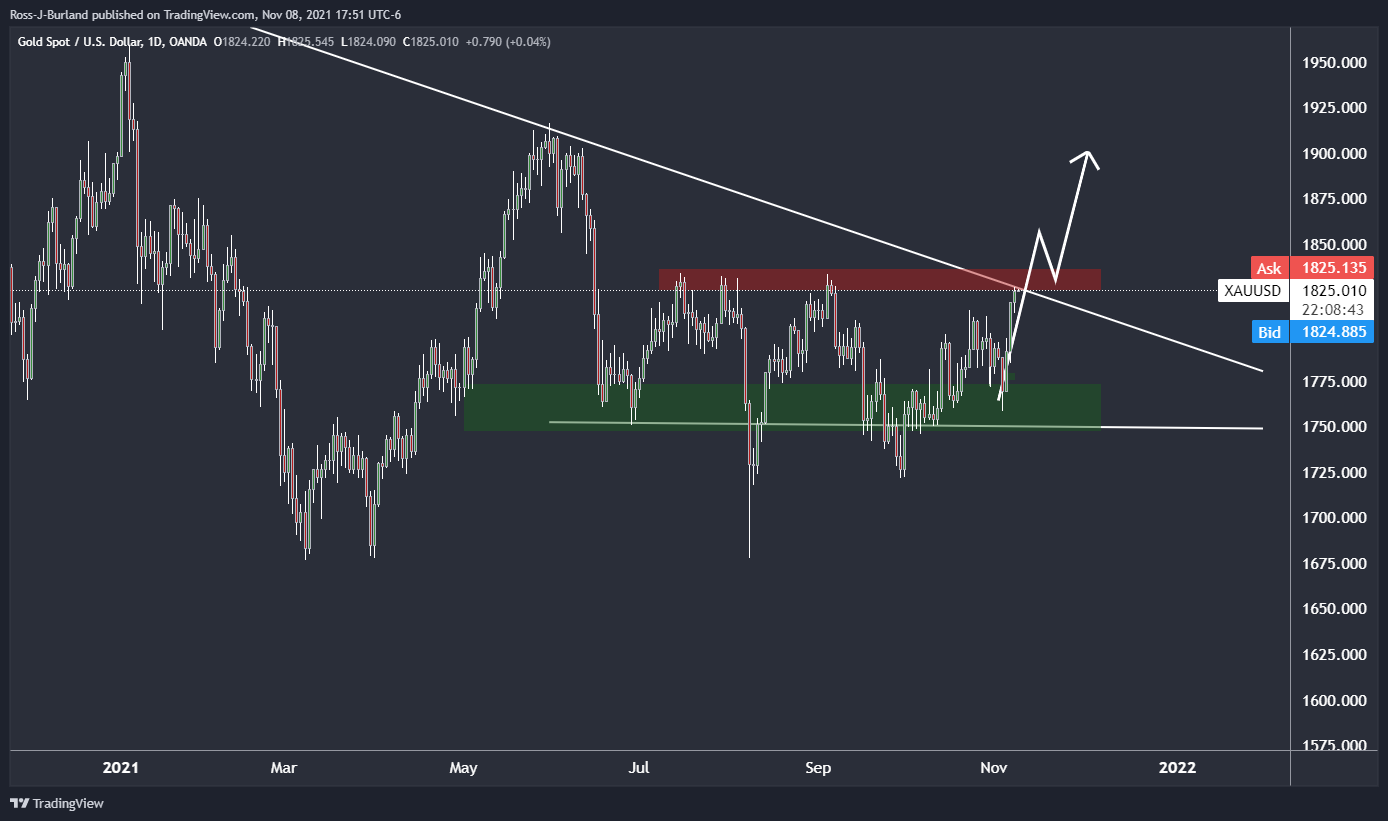
Gold was an impressive performer in these past few sessions and XAU/USD has moved in towards the $1,830s, albeit still not quite there yet. $1,830, as illustrated below, is a key technical area on the longer-term charts, so it is paramount that bulls get over the line in the coming week.
Meanwhile, XAU/USD is trading at $1,824.67 and holds in bullish territory, ''itching for a breakout,'' as analysts at TD Securities say. ''Prices are set to challenge the multi-month downtrend from all-time highs. Counter-intuitively, this comes after a strong nonfarm payrolls report — but as noted, this datapoint does little to resolve the debate on inflation, nor does it inform the Fed's reaction function.'
In this regard, gold extended recent gains at the start of the week amid stronger investor demand. ''The weaker USD, combined with rising inflation expectations supported an appetite for the precious metal,'' analysts at ANZ bank argued.
On Monday, we heard from several Fed officials. Most prominently, James Bullard said the central bank may have to end the taper somewhat sooner to control inflation. However, this did little to support the greenback nor yields as the market has made up its mind that the Fed is in no hurry to hike rates nor speed up the tapering process. We will have to wait for more data, especially with regard to jobs, and the December Fed meeting in this regard will be important. However, according to the New York Fed, inflation expectations among US households rose to 5.7% in October which is higher than the market is priced for.
Focus is on US real yields
In this context, US real yields are plummeting, in support of gold prices. ''While the breadth of gold traders' short positions is not extreme by any means, position sizing is bloated considering the number of participants short, which leaves the hawks vulnerable to a squeeze,'' analysts at TD Securities said.
''Importantly, the market's microstructure still features little market depth, which suggests that a positioning squeeze could have an outsized impact on prices. Further, a breakout north of the multi-month downtrend could help the trend of ETF outflows reverse, powering gold prices even higher. Unfortunately for the bulls, we expect that a recent CTA buying program has run its course, suggesting algorithmic trend follower flow will not lend its support.''
Gold technical analysis

The above is an example of what could come from a break above the descending trendline resistance from a monthly perspective as the bulls gear up towards a run on the psychological $1,900 and then the $2,000 milestone.
Meanwhile, from a daily perspective, the price is testing the horizontal resistance for the fourth time where it now meets the descending trendline resistance near 1,830. If this breaks, bulls will be seeking a run above 1,850 buy stops and onwards.
- EUR/CAD extends its three-day rally, closes robust resistance at 1.4440.
- Dovish ECB stance has the potential of weighing on in the EUR.
- The Bank of Canada ended its QE program, could hike rates by April 2022.
The EUR/CAD pair begins the week in the right foot, flat as Tuesday’s Asian Pacific session begins, trading at 1.4420 at the time of writing. On Monday, US equities finished in the green, gaining between 0.09% and 0.29%, except for the Nasdaq Composite, which lost 0.14%.
ECB and BoC monetary policy divergence favors the Canadian dollar
On Monday, ECB’s Chief Economist Philip Lane crossed the wires. He said that elevated prices are temporary. Further added that the ECB believes that in 2022 bottlenecks and energy prices will ease or stabilize, according to El Pais.
Inflation rose by 4.1% on an annual basis in the Euro Area, up from 3.4%. Finance ministers are starting to worry that the jump could spur solid wage growth, triggering an inflationary spiral.
STIR in the Eurozone area retreated, as ECB policymakers led by ECB’s President Christine Lagarde reiterated that inflation is temporary and would moderate once supply constraints ease and shipping conditions improve. Also, ECB President Lagarde pushed back higher rates at the press conference after the monetary policy meeting, insisting that prices would ease.
Meanwhile, the Bank of Canada ended its QE program on October 27, which market participants viewed as a very hawkish taper announcement. Although a reduction in their bond purchasing program was expected, as the labor market recovered to pre-pandemic levels, the end of the program caught investors off guard.
Further, the BoC said it could begin hiking interest rates in April, three months sooner than previously thought. That to tackle inflation, which in September rose to 4.4%, the highest in two decades.
Money markets expect a hike as soon as March and five in total next year. Tightening cycles tend to slow economic activity.
That said, the EUR/CAD lies on the dynamics of the divergence between the ECB and the BoC. As long as the BoC keeps its hawkish stance and the ECB remains dovish, EUR/CAD traders could probably witness new year-to-date lows from the near term until the end of 2021.
EUR/CAD Price Forecast: Technical outlook
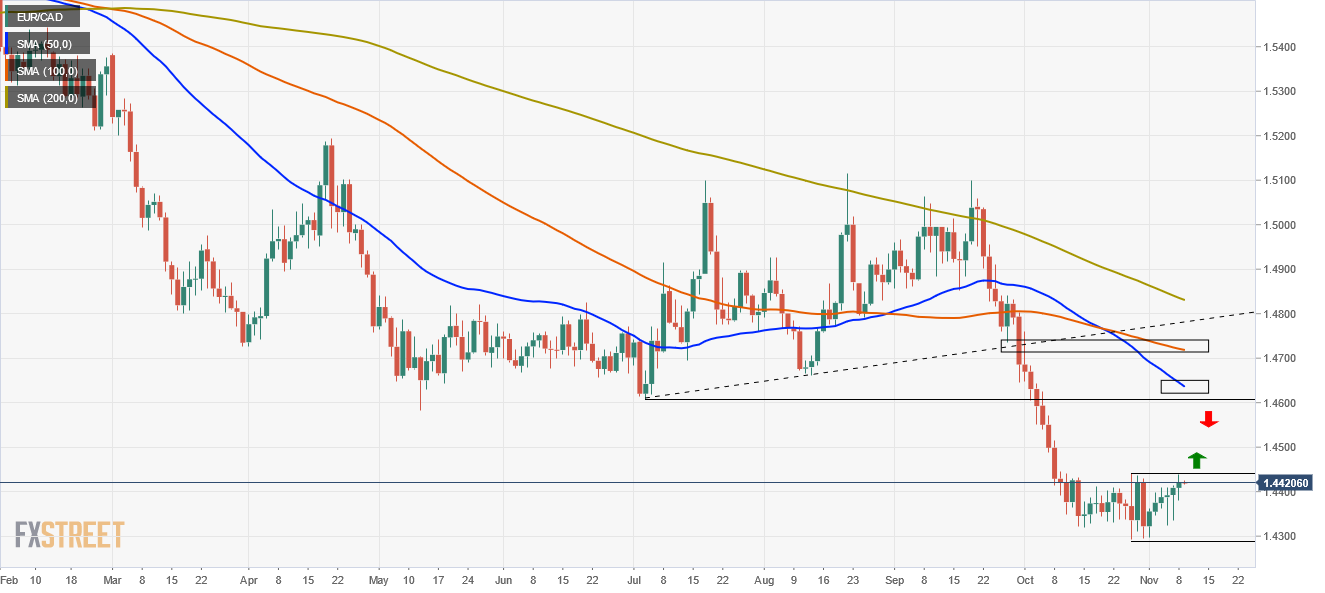
The daily chart shows that the EUR/CAD pair has remained trapped on the price action of October 27, within the 1.4292-1.4441 range, range-bound, tilted to an upward break at press time. However, the pair has mid-term downward bias as long as the daily moving averages (DMA’s) are still well above the spot price around the 1.4605 level. Furthermore, the Relative Strength Index (RSI), at 46, confirms the mid-term bias, so EUR/CAD sellers could be found around the 1.4400 area, as It was tested three times before.
To resume the downward bias, EUR/CAD sellers would need to reclaim the 1.4300 figure. In that outcome, the following demand zone would be February 16, 2020, low at 1.4263.
On the other hand, an upside break above the 1.4441 range would expose the 1.4500 figure as its first resistance level. A break above the abovementioned would expose the 50-day moving average (DMA) at 1.4625.
US inflation expectations, as measured by the 10-year breakeven inflation rate per the St. Louis Federal Reserve (FRED) data, jump to the fresh high since October 27 by the end of Monday’s North American trading.
In doing so, the risk barometer extends the previous week’s rebound from the lowest levels since October 12 to flash 2.62%, per the official website data.
It’s worth noting that the jump in the US inflation expectations has been the key catalyst that pushes the Federal Reserve (Fed) policymakers towards rate lift-off. Recently, Charles L. Evans, the chief executive officer of the Federal Reserve Bank of Chicago said, “If inflation expectations increase a lot, it would make sense to think about a 2022 rate hike, per Reuters.
While the tapering tantrums underpin the US dollar strength, President Joe Biden’s stimulus and anxiety over the Fed reshuffle in 2022 seems to weigh on the greenback of late. The same highlights Tuesday’s speech from Fed Chairman Jerome Powell as the day’s crucial event to forecast market moves.
Read: AUD/USD stays firmer above 0.7400 amid softer USD, upbeat sentiment
- EUR/USD bulls pause after two-day uptrend, keeps short-term resistance breakout.
- Firmer RSI, Momentum line back buyers below two-month-old key trend line hurdle.
- Horizontal area from early October restricts short-term downside.
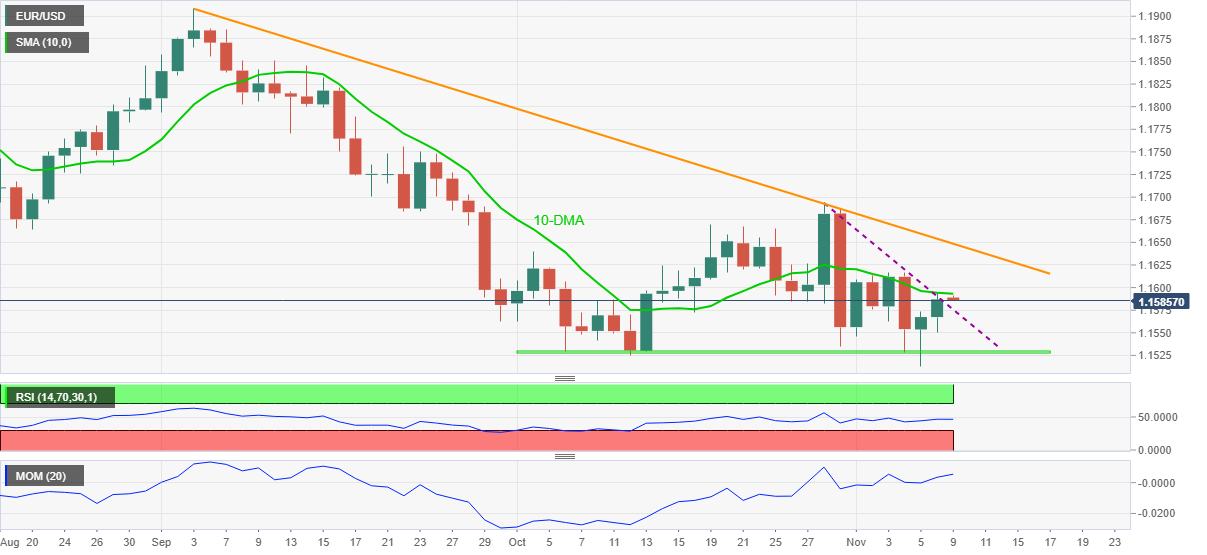
EUR/USD struggles to extend the two-day rebound, seesaws around 1.1590-85 during Tuesday’s Asian session. Even so, the major currency pair keeps the previous day’s upbeat break of a downward sloping trend line from October 28 amid price-positive signals from the RSI and Momentum indicators.
It should be noted, however, that the pair buyers remain worried below the descending resistance line from early September, near 1.1650.
Even if the EUR/USD bulls manage to cross the 1.1650 trend line hurdle, the last month’s high near 1.1695 and the 1.1700 threshold will challenge the further advances.
Meanwhile, the resistance-turned-support close to 1.1575 restricts short-term declines ahead of the multiple supports marked since the initial October month surrounding 1.1530-25.
Also acting as a downside filter is the yearly low near 1.1510 and the 1.1500 round-figure.
To sum up, EUR/USD is likely to remain in the recovery mode but the bulls remain cautious below 1.1700.
EUR/USD: Daily chart
Trend: Further recovery expected
- GBP/USD struggles to keep the strongest run-up in a week.
- DUP leader pushes for Article 16 activation amid sluggish Brexit talks.
- UK PM Johnson unveils more covid-led hospitalizations, highlights need for booster jabs.
- Brexit talks, speeches from BOE and Fed leaders will be in focus.
GBP/USD seesaws around 1.3560-70 following the heaviest daily jump in over a week. While the broad US dollar weakness allowed the Cable pair to recover the previous day, fears concerning Brexit and the UK’s coronavirus conditions seem to weigh on the quote of late.
Having heard of the ‘limited’ progress on the Brexit talks, the UK’s readiness to trigger Article 16 highlights fears concerning the key issue and drag down the GBP/USD prices of late. The Independent said, “Britain’s negotiator Lord David Frost emerged from a meeting with European Commission vice president Maros Sefcovic in Brussels on Friday saying advances towards new trading rules for Northern Ireland had been ‘limited’.” Following that, the BBC came out with the news saying, “Democratic Unionist Party (DUP) leader Sir Jeffrey Donaldson has reiterated his belief that ‘conditions have been met to trigger Article 16,’”
Elsewhere, UK PM Boris Johnson mentions the booster jabbing for the COVID-19 as the "single most important thing" people can do for "our country" and to protect the NHS (National Health Services), per Sky News. “We are starting to see too many elderly people going into hospital,” adds UK PM Johnson.
It’s worth noting that the passage of US President Joe Biden’s $1.0 trillion infrastructure spending plans by the House of Representatives and upbeat US jobs report for October offered a positive start to the week to the markets. The same joined chatters over the Fed reshuffle and weighed on the US Dollar Index (DXY) to help the GBP/USD buyers.
Amid these plays, Wall Street benchmarks closed with mild gains even as the US 10-year Treasury yields recovered.
Looking forward, comments from the Bank of England’s (BOE) Governor Andrew Bailey and Fed Chairman Jerome Powell can offer short-term direction to the GBP/USD prices as both the central bank leaders have been hawkish of late, with the BOE’s Bailey being a bit cautious after the last week’s hint of December hike in rates.
Technical analysis
GBP/USD rebound fades below a downward sloping resistance line from October 29, around 1.3620 by the press time. Also important is the convergence of 50-day and 20-day SMA near 1.3690-3700 area. Adding to the downside bias is the bearish MACD signals and weak RSI line.
- AUD/JPY struggles to keep rebound from 18-day low.
- Bearish MACD signals, failure to cross 20-day EMA keep sellers hopeful.
- 50-day EMA adds to the downside filters, late October’s swing low also challenges bulls.
AUD/JPY seesaws around 84.00 threshold after bouncing off the lowest levels since mid-October. In doing so, the cross-currency pair remains wobbles between the key support line and a short-term Exponential Moving Average (EMA) amid bearish MACD signals during the early Asian session on Tuesday.
Despite staying above an upward sloping support line from September 22, bearish MACD and the failure to cross 20-day EMA on a daily closing basis favor the pair sellers to attack the 83.95 trend line support level.
While a clear break of the 83.95 support directs the quote toward the 50-day EMA level of 83.15, any further weakness won’t hesitate to challenge the September’s peak surrounding the 82.00 round figure. During the fall, the 83.00 psychological level may offer an intermediate halt.
Alternatively, a daily close beyond 84.30, comprising the 20-day EMA, needs validation from the late October month’s swing low of 84.60 to recall the AUD/JPY buyers.
Following that, the 85.00 threshold and multiple hurdles around the 86.00-86.10 could challenge the pair’s further advances.
To sum up, AUD/JPY bears aren’t out of the woods despite Monday’s recovery moves.
AUD/JPY: Daily chart

Trend: Further weakness expected
- AUD/USD grinds higher after printing the biggest daily gains in over a week.
- Equities, gold underpin recovery moves despite sluggish week-start.
- China trade numbers came in positive, Aussie NAB figures improved too.
- Fedspeak remains cautiously optimistic, Powell’s comments eyed.
AUD/USD holds onto Monday’s gains past 0.7400, edging higher around 0.7420 during the early Tuesday morning in Asia. The risk barometer pair recovered from the monthly low on Friday amid mixed concerns while a sluggish start to the week and the downbeat US dollar helped the Aussie pair print the biggest daily gains in seven days the previous day.
Although firmer US jobs report and President Joe Biden’s stimulus helped AUD/USDS bulls to remain hopeful, the Fed tapering tantrums didn’t allow bears to leave the desk. In doing so, the quote initially ignored upbeat trade numbers from Australia’s biggest customer, namely China, before tracking equities and gold to the north.
The passage of the US infrastructure spending bill followed firmer US jobs report for October to recall optimists of late. Joining them were chatters surrounding the likely change in the US Federal Reserve (Fed) board and its likely impact on the future monetary policies.
“A giddy President Joe Biden on Saturday hailed the congressional passage of a long-delayed $1 trillion infrastructure bill as a ‘once in a generation’ investment and predicted a broader social safety net plan will be approved despite tense negotiations,” said Reuters. Another US stimulus of around $1.75 trillion is looming but US President Biden seems hopeful to get it passed and hence favor the AUD/USD buyers.
On the other hand, US Nonfarm Payrolls (NFP) rose by 531,000 in October, better than the market expectation of 425,000. The figures were also beyond September's print got revised higher to 312,000 from 194,000. Further details of the publication revealed that the Unemployment Rate declined to 4.6% from 4.8% in September.
With around four or five Fed policymakers ready to leave the US central bank’s board, anxiety over the Fed’s next move amid push for tapering and rate hike weigh on the US dollar. Recently, Charles L. Evans, the chief executive officer of the Federal Reserve Bank of Chicago, said that the current surge in inflation is largely "temporary" and will fade as supply-side pressures get resolved, but he also sounded less convinced by that story than before.
Talking about the data, China reported a record trade surplus in October, with an all-time high surplus of $42 billion with the US. At home, the National Australia Bank’s (NAB) Business Conditions and Business Confidence indices grew past +5 and +10 figures to +11 and +21 respectively during October.
Amid these plays, US equities post a positive start to the week even as the US Treasury yields remain firmer. Further, the US Dollar Index (DXY) extended Friday’s loss.
Looking forward, firmer risk appetite enables AUD/USD to remain positive but a lack of major data/events ahead of Thursday’s Aussie jobs report may question the recovery moves. That said, the scheduled speech from Fed Chair Jerome Powell will be important for short-term direction.
Technical analysis
Friday’s Doji candlestick above 100-DMA backs AUD/USD run-up beyond a weekly resistance line, now support around 0.7410. However, the late October’s swing low near 0.7455 adds a filter to the upside momentum targeting 200-DMA, near 0.7550 at the latest.
- WTI bulls hold in there but struggle to surge. The US Biden administration is weight.
- The White House looks to curb high oil and gasoline prices.
The price of West Texas Intermediate WTI crude oil climbed on Monday on the demand vs supply play-off following OPEC+ declining to boost production last week. However, the US Biden Administration remains a thorn in the side for the bulls as it is still looking to take measures to lower prices help check gains. WTI climbed from a low of $81.07 on Monday and scored a high of $82.64 with demand up and supply waning due to weak production and dwindling global inventories.
Crude oil pared some of the day's gains as the White House looks to curb high oil and gasoline prices. President Biden said he wants to see more supply, with the administration looking at other tools such as tapping the strategic reserve, analysts at ANZ bank explained, noting that Energy Secretary, Jennifer Granholm, warned that could cut crude oil prices by 5%. This follows OPEC’s decision to stick with its scheduled 400kb/d increase in output despite consumers saying the current pace is too slow to sustain the post-COVID recovery.
Meanwhile, Saudi Arabia's decision to hike their official selling price underscores a tight market but also highlights that the group of producers is ignoring President Biden’s calls for more oil, analysts at TD Securities explained.
''OPEC's message to consumer nations was resoundingly clear—not only has the group of producers eased fears of a faster pace of output hikes, but it has clarified that member nations won't compensate for those who are underproducing relative to their quotas.''
''In reality,'' the analysts say, ''the OPEC+ group's decision likely acknowledges the fact that US production still remains curtailed, despite significantly higher prices, which allows the group to enjoy higher prices without fear of losing much market share. This suggests that the very cautious pace of output hikes should keep energy markets on a tightening trajectory in the near term.''
- XAU/EUR extends its rally to a third-straight day, up some 0.27% during the New York session.
- XAU/EUR raised almost 4% since last week’s lowest low, as central banks pushed back higher rates.
- XAU/EUR: A break above €1,592 would open the door to fresh yearly highs.
XAU/EUR advances for the third consecutive day, extending its rally since Thursday of last week, up 0.27%, trading at €1,574.63 during the New York session at the time of writing. The market sentiment has been upbeat throughout the day, as witnessed by major US equity indices rising between 0.08% and 0.29%.
In the last week, some central banks of global developed economies held their monetary policy meetings for November. In the case of the Reserve Bank of Australia (RBA), the central bank decided to keep its interest rates unchanged at 0.10% while continuing its bond purchasing program at A$4 Billion a week until February 2022. Furthermore, it dropped the Yield Curve Control on the Australian April 2024 Government bond. Also, it pushed back the expectations of higher rates but moved its target to 2023, instead of 2024, according to previous monetary policy meetings.
In the US, the Federal Reserve will begin the bond taper process by the middle of November. Additionally, it maintained its interest rates unchanged and reiterated that the bond taper would not mean that rates would need to get higher. Moreover, it pushed back higher interest rates, thus propelling a switch of the money market participants, as most expected two rate hikes to just one by the end of 2022.
The Bank of England (BoE) disappointed investors in the UK, as the market expected a rate hike, as some BoE’s members expressed concerns about higher inflation. They added that supply constraints, chains disruption, and elevated petrol prices are to be blamed regarding inflationary pressures.
That said, as portrayed by the central banks’ summary, investors flew towards safe-haven assets, in turn propelling XAU/EUR prices higher, jumping from €1,518 to €1,577, as the market expects policymakers to stay put on their monetary policy stances.
XAU/EUR Price Forecast: Technical outlook
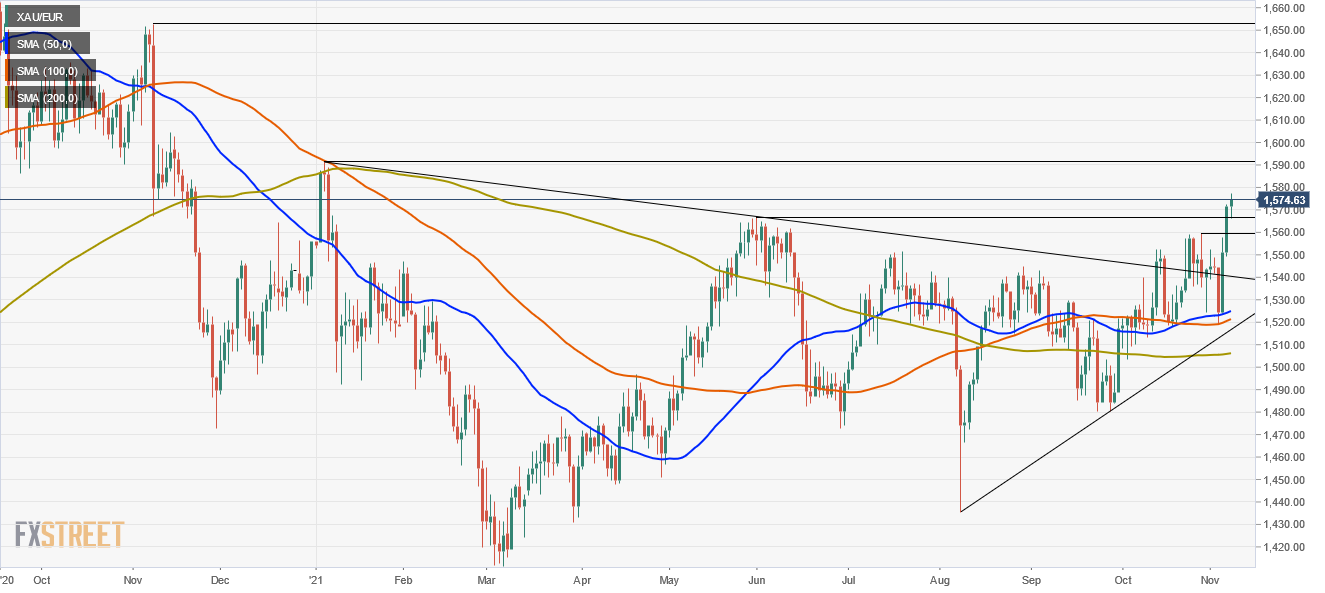
In the daily chart, the XAU/EUR is trading well above the daily moving averages (DMA’s), meaning that the yellow metal has an upward bias. Furthermore, the following solid resistance area would be the 2021 high at €1,592. A breach of the latter would open the door for fresh yearly highs, with 1600 as the next supply zone in line.
On the other hand, failure at the abovementioned would expose the June 6 high at €1,567, followed by the October 28 high at €1,535.
- The S&P 500 clinched an eight successive record close and moved above 4700 for the first time.
- Tesla shares were down 4.9% after CEO Musk’s poll where he offered to sell 10% of his holdings.
The S&P 500 index managed to clinch an eighth consecutive record close on Monday, ending the session slightly to the north of the 4700 level for the first time after posting a modest gain of about 0.1% for the day. The Nasdaq 100 dropped 0.15%, though remains right at record levels in the 16,300s. The Dow outperformed, rallying 0.3% to move above 36.4K for the first time amid outperformance in industrial and material names; the S&P 500 industrials index was up 0.3%, while the material index was up over 1.0%. These sectors were boosted by the news last Friday that Congress had finally passed the $550B bipartisan infrastructure investment package. Also working in favour of the Dow is the fact that Tesla isnt included in the index, as is the case for the S&P 500, where it accounts for about a 2.5% weighting, and the Nasdaq 100, where it accounts for a more than 5.0% weighting.
Tesla (TSLA) shares dropped 4.9% after CEO Elon Musk held a Twitter poll over the weekend in which he asked his followers whether or not he should sell 10% of his TSLA holding and pledged to abide by the outcome of the poll. 57.9% of the 3.5M poll participants voted in favour of Musk selling shares. Musk owns 23% of Tesla shares and (at last Friday’s closing price) 10% of his stocks would be worth over $20B. Most analysts agreed it was normal for a public announcement of such a large stock sale would way on TSLA in the short run. Many suspected that the sale would do little to impact the value of TSLA shares in the long run, with strong institutional demand ready to lap up the available shares.
US equities remain well supported at/close to record levels for now as a strong Q3 earnings season draws to a close. According to Refinitiv data cited by Reuters, 81% of the 445 S&P 500 companies to report earnings thus far have beaten analyst expectations. Other positives being cited include a more certain outlook for Fed policy now that the Fed’s QE taper timeline has been announced for the rest of the year and a continued fading in the prevalence of the Covid-19 delta variant in the US, which has boosted the growth outlook for Q4.
- CAD has failed to benefit from a rise in crude price, with USD/CAD locked in the 1.2450 region.
- BoC Governor Macklem was keen to impress to the public over the weekend that the BoC would control inflation.
In fitting with mostly subdued trading conditions being seen across G10 foreign exchange markets, it’s been quite an uninspired day for USD/CAD, with the pair going sideways for most of the session within a few pips of the 1.2450 level. It's notable that USD/CAD was unable to test, let alone break to the north of, its 200-day moving around 1.2480 average at the end of last week. As is often the case in FX markets, rejection at a key moving average (like the 200DMA) can be interpreted as a bearish technical signal. There is support in the 1.2430 area, but should the bears push the pair below that, the next notable support is the 21DMA just under 1.2400.

USD/CAD was pushed higher from previously under 1.2400 by a sharp drop in crude oil prices towards the end of last week but has been unable to track a subsequent recovery in crude oil prices by pushing lower. WTI prices are up almost $1.0 on Monday and trading back to the north of the $82.00 level again, more than $3.50 above last week’s lows. It seems that market participants are taking a breather following the chaotic week just gone.
In terms of relevant news for the pair; BoC Governor Tiff Macklem spoke over the weekend and reiterated his expectation that the spike in inflation is set to be transitory. However, he was keen to impress to the public that the BoC would keep inflation under control. At the last BoC meeting, the bank statement opened the door for rate hikes as soon as Q2 2022.
Meanwhile, a few Fed speakers have hit the wires on Monday. Fed Vice Chair Richard Clarida reiterated a previously held stance that the conditions for rate hikes might be met by the end of 2022, perhaps a more dovish stance than market participants had been expecting given recent inflation developments. Meanwhile, St Louis Fed President James Bullard, who will be a voter in 2022, was hawkish, saying he sees one of the “hottest” labour markets in the post-war period and could see the unemployment rate dropping under 4.0% in Q1 2022. Comments from other Fed members, including Patrick Harker, Michelle Bowman and Charles Evans, largely stuck to the script established at the last meeting. Meanwhile, Fed Governor Randall Quarles will resign at the end of the year.
- NZD/USD bulls stay in charge as the RBNZ and Fed are played off in money markets.
- US dollar remains better offered despite recovery attempts post-Fed.
NZD/USD added around 0.7% on Monday and travelled from a low of 0.7103 to score a high of 0.7176 as it farse as one of the most reliable of the higher-yielding currencies with respect to the Reserve Bank of New Zealand. The US dollar was also a contributing factor given its 0.17% slide across a number of currencies on Monday, as measured by the DXY index.
The US dollar dipped on Monday after hitting 15-month highs on Friday following strong US Nonfarm Payrolls data. The report showed the US employment increased more than expected in October as the headwind from the surge in COVID-19 infections over the summer subsided. This was an encouraging signal that economic activity will be regaining momentum in the fourth quarter.
However, the data was not enough to steer investors' minds away from the fact that central banks are not as hawkish as the market was positioning for. This was evident across three central banks, the Reserve Bank of Australia, the Federal Reserve and the Bank of England. All three banks last week leaned on the side of patience with regards to timings of interest rate hikes and their transitory mantra with regard to inflation pressures.
Fed vs RBNZ in play
On Wednesday the Fed stuck to its view that current high inflation is expected to be transitory and said it would start trimming its massive bond-buying program this month. However, maximum employment was not yet achieved so the central bank will want to see more job growth before raising interest rates. This led to a fall in US yields and the greenback.
By contrast, short end NZ interest rate markets remain buoyant, with 66bps of hikes priced in over the next two meetings which are helping the NZD. ''If the RBNZ is of a mind to hike by 50bps, now’s the time, but that still seems incongruous with the uncertain global backdrop and cautious tone of other central banks,'' analysts at ANZ Bank said in a note on Tuesday. 'Still, until we know the outcome, markets will price in the risk.''
- The US Dollar is under selling pressure amid higher US T-bond yields.
- The single currency extends its two-day sharp rise, threatening to break above 1.1600.
- EUR/USD: A break above 1.1600 would expose 1.1650; otherwise, it could fall towards 1.1400.
The EUR/USD advances for the second day in a row, beginning the week in the right foot, up 0.18%, trading at 1.1587 during the day at the time of writing. Positive market sentiment as witnessed by rising US stock indices surrounds the financial markets. In the FX market, risk-sensitive currencies rise, with the NZD, the GBP, and the AUD, as the strongest ones, while the greenback falls, despite higher US T-bond yields.
In the last week, three central banks held their monetary policy reunions. They all pushed back higher interest rates, in line with what European Central Bank (ECB) President Christine Lagarde expressed two weeks ago. On Monday, Philip Lane, ECB’s Chief Economist, said that supply bottlenecks and higher energy prices are the main risks of inflation and economic recovery. Furthermore, added that “our [ECB] analysis is indicating that the euro area is still confronted with weak medium-term inflation dynamics remains compelling.” Further said that economic activity could outperform the central bank’s expectations only if consumer confidence increase and saves less tha expected.
In the meantime, the Federal Reserve announced the reduction by $15 billion to its Quantitative Easing program. Moreover, it left the door open for adjustments to the taper. If economic conditions improve faster than expected, the US central bank could increase the pace of reduction of its bond purchases program, meaning that it could finish sooner than the first half of 2022 as widely expected.
That said, the European economic docket will feature on Tuesday, the Zew Survey on Tuesday, and some ECB members' speeches. ECB's President Christine Lagarde and also Isabel Schnabel will cross the wires.
Across the Atlantic, the Producer Price Index will be unveiled. Also, Federal Reserve Chairman Jerome Powell will hit the wires.
EUR/USD Price Forecast: Technical outlook
In the daily chart, the shared currency bounced off the low around 1.1500, approaching the 1.1600 figure, which was respected in the last four previous tests, would be a strong resistance level to overcome. A daily close above the latter would expose the EUR/USD for further gains. The first supply zone would be a downward slope that confluences with the 50-day moving average around the 1.1650-80 area. A break above the abovementioned would open the door towards the October 28 high at 1.1691.
On the flip side, failure at 1.1600 would open the door for further downside, with the October 13 low at 1.1524, as the first demand zone. A break below the latter would expose the single currency towards new yearly lows, around the 1.1400 figure.
- AUD/JPY has seen a subdued start to the week, barely budging from the 84.00 level.
- Monday’s calm marks a significant shift from last week’s volatility.
It’s been a very mundane start to the week for AUD/JPY, with the pair largely sticking to within a few pips of the 84.00 level for most of the session. The currency pair did manage to squeak out a fresh multi-week lows under 83.80 at the Asia Pacific reopen of trade on Monday, but lacked the conviction to extend on the hefty losses incurred last week.
To recap last week’s price action; the pair tanked from highs around 86.00 to lows current levels around 84.00 (a near 2.5% drop) as a result of 1) a dovish showing from the RBA, where Governor Philip Lowe pushed back strongly against expectations for rate hikes in 2022 and 2) a broader paring back on hawkish central bank bets across developed markets (which benefits the yen, given there were no hawkish bets on the BoJ to pare back on in the first place). As of the time of writing, the pair is sat just to the north of the 84.00 level. The most notable upside resistance is at 84.50 (last Tuesday and Wednesday’s lows), while to the downside the next support is the 200-day moving average just to the south of the 83.00 level.
Chinese trade data for October was released over the weekend and came in mixed. Exports beat expectations, but imports missed. Given that China is a big export destination for Australian goods, this is likely to be interpreted as a net negative for AUD, although FX markets didn’t show much of a reaction. Analysts read the weaker than expected import data as further signs that Chinese growth momentum continues to weaken. Elsewhere, the Bank of Japan released the Summary of Opinions from the most recent policy meeting, which offered up few surprises and also did little to stir the FX pot.
AUD/JPY traders arriving for the upcoming Tuesday Asia Pacific session should keep an eye on Japan September trade, current account and bank lending figures scheduled for release at 2350GMT, the Australia October NAB Business Confidence survey at 0030GMT and the Japan October Eco Watchers Survey at 0500GMT.
What you need to know on Tuesday, November 9:
The greenback gave up some ground on a quiet Monday. The week started with China reporting a record Trade Balance surplus, although imports increased by less than anticipated, with notable declines in oil and soya beans buying.
Several US Federal Reserve policymakers give speeches within different events, although references to monetary policy were scarce. Vice-Chair Richard Clarida said that benchmarks for rate hikes could be met by the end of 2022 but added that the Fed is still "a ways away" from considering lift-off, adding that he expects a full return to pre-pandemic employment levels by the end of 2022.
More relevant is the fact that Fed’s Randal Quarles said he is stepping down from his post around the end of the year. Vice-Chair Richard Clarida leaves in January, while Powell’s term ends in February. A Fed’s reshuffle could bring some interesting changes next year.
The EUR/USD pair neared 1.1600, but held below the level, while GBP/USD recovered to the 1.3550 price zone. Commodity-linked currencies were marginally higher, with AUD/USD trading around 0.7420 and USD/CAD in the 1.2440 price zone. The USD/JPY pair is under selling pressure despite the better tone of Wall Street, down to the 113.20 region.
US government bond yields ticked higher with that on the 10-year Treasury note flirting with 1.50% by the end of the American session.
Gold was among the best performers, surging to a fresh one-month high of $1,826.43 a troy ounce, ending the day nearby. Crude oil prices edged lower at the beginning of the day, recovering most of the ground lost ahead of the close. WTI settled at $82.10 a barrel.
Bitcoin shoots past Tesla and Facebook to become world's sixth-largest asset
Like this article? Help us with some feedback by answering this survey:
- GBP/CAD bears are looking for a fade on rallies.
- The weekly resistance s compelling and could give rise to a downside extension in the coming days.
GBP/CAD has been a strong performer at the start of the week as the pound parse back some of the Bank of England sell-off from last week. The cross has rallied around 0.5% on the day which has given rise to a bearish prospect on the charts for the week ahead, as illustrated as follows:
GBP/CAD weekly chart
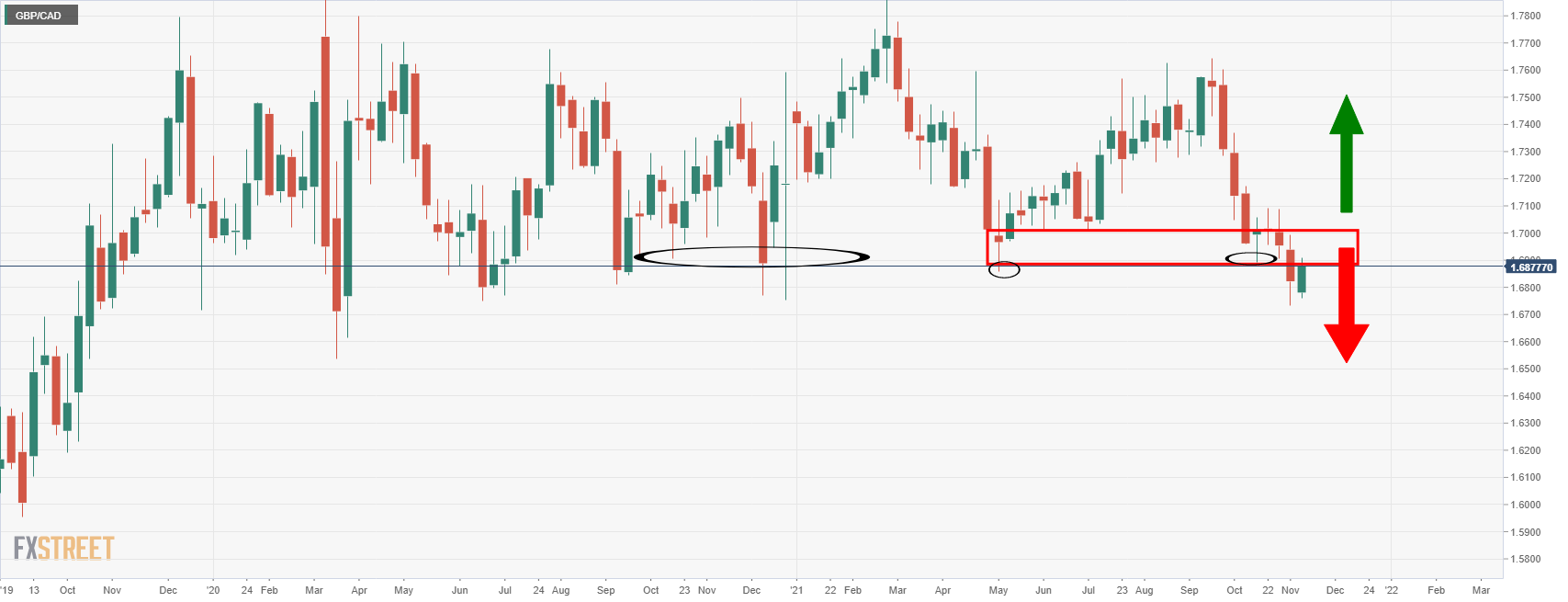
The weekly chart shows that the price is testing what is expected to be a solid area of weekly resistance. A break above, however, opens risk of a restest to the upside for the weeks ahead and further wide consolidation.
GBP/CAD daily chart
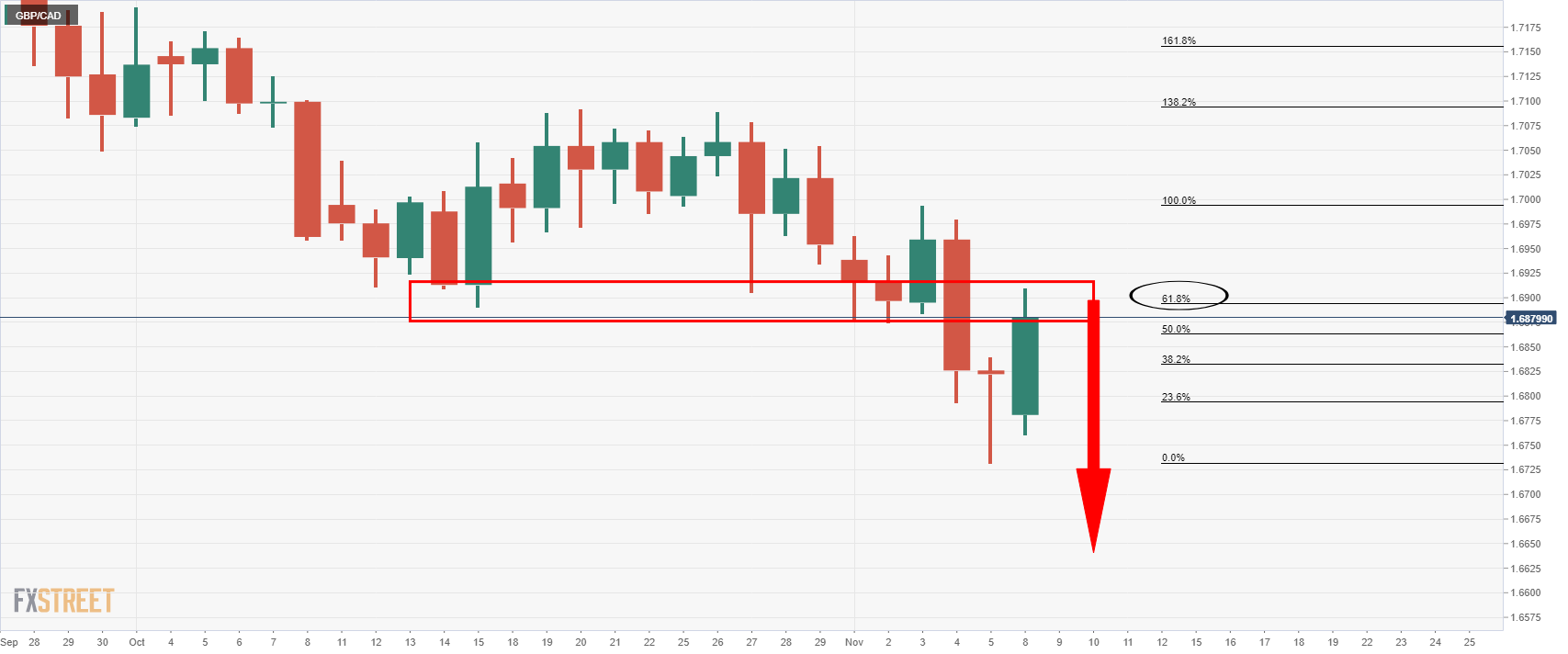
The daily chart shows that the price has rallied into this critical area of resistance also which would be expected to hold up on initial tests. The 61.8% Fibonacci is a milestone in this regard. Consolidation would be expected at this juncture and should the overall downtrend play out, then we can expect a downside extension to develop over the course of the comings days.
GBP/CAD 4-hour chart
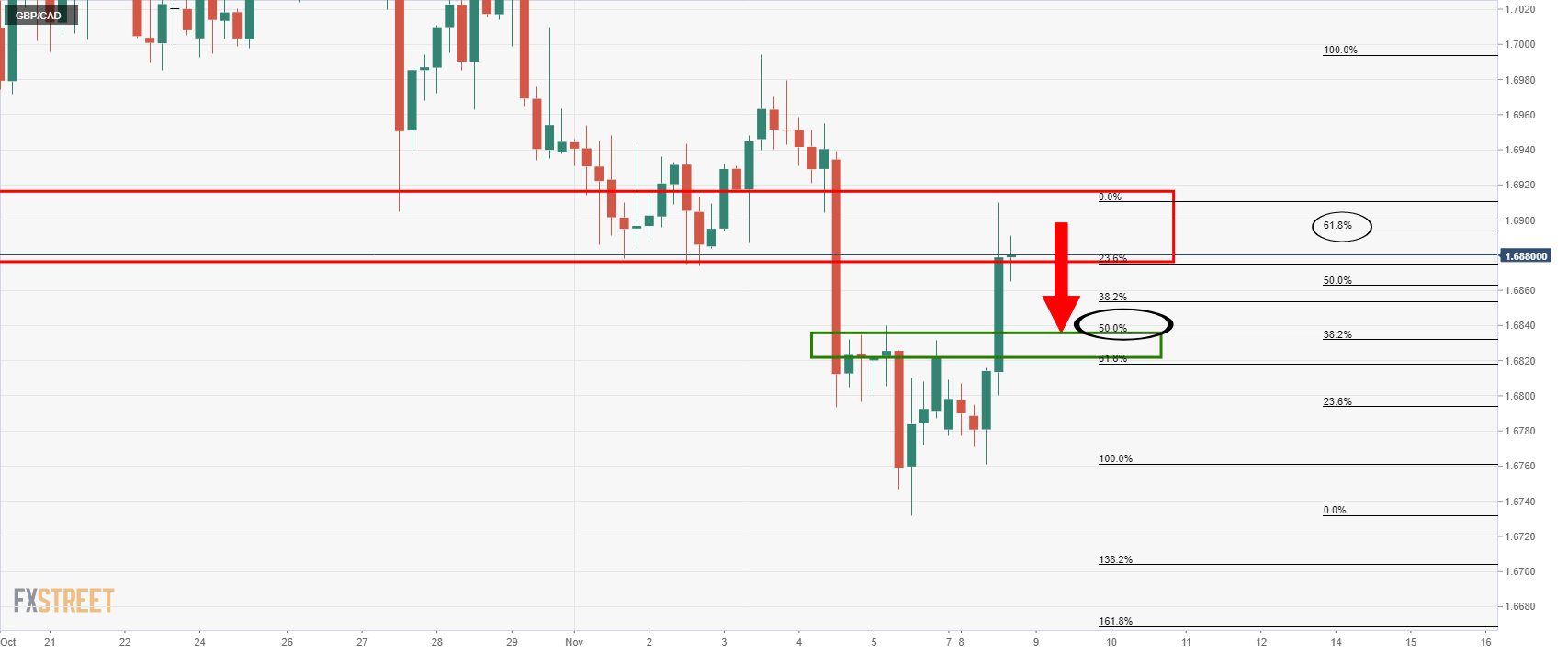
In the meantime, the 4-hour time frame sees the 50% mean reversion aligned nicely with the prior highs as a target for the bears. This comes near 1.6820.
GBP/CAD hourly chart
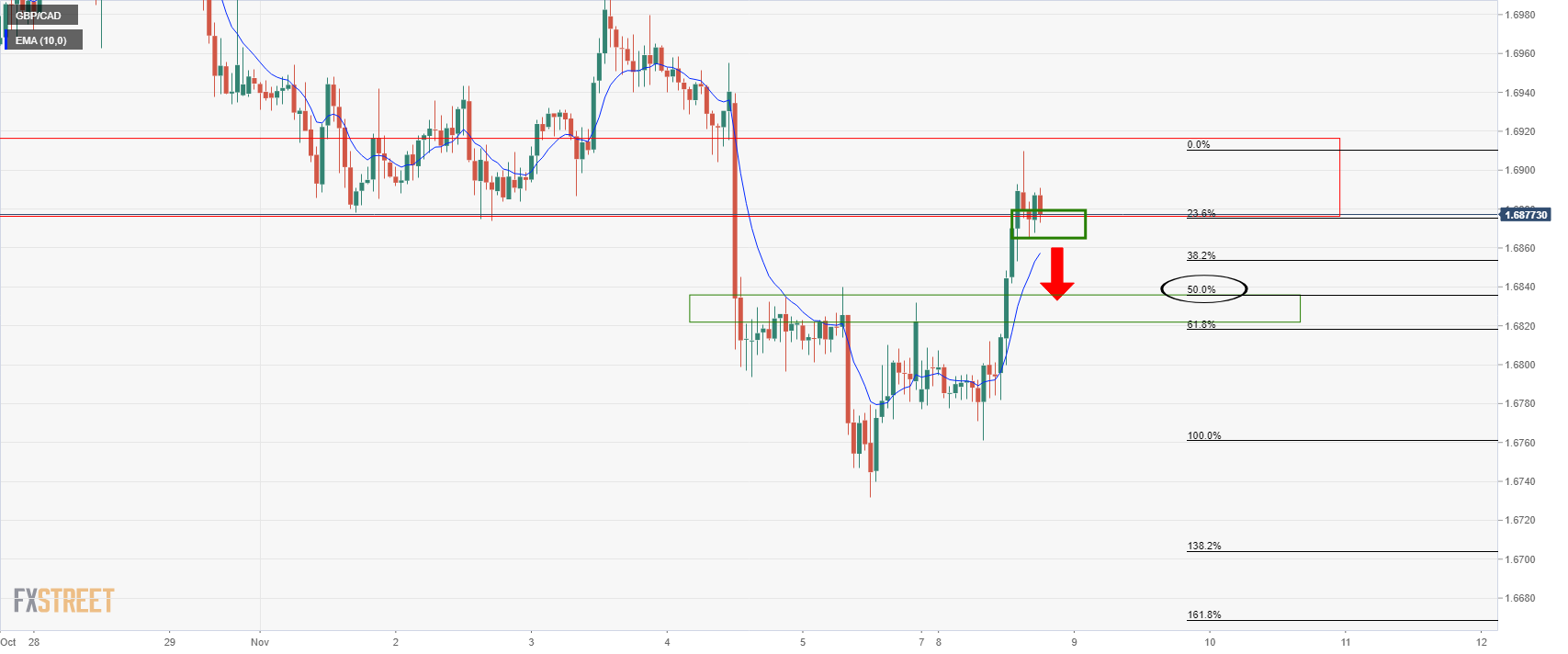
From an hourly perspective, there is some basing taking place near 1.6860, so bears will want to see this level of support cleared to open the way towards the 1.6820s in the forthcoming sessions.
Charles L. Evans, the chief executive officer of the Federal Reserve Bank of Chicago, is crossing the wires on Monday and he has repeated his view that the current surge in inflation is largely "temporary" and will fade as supply-side pressures get resolved, but he also sounded less convinced by that story than before.
"I had expected to see more progress by now," Evans said in remarks prepared for delivery to the Original Equipment Suppliers Association, adding that there are signs that inflationary pressures may be building more broadly, including increases in rents.
"These developments deserve careful monitoring and present a greater upside risk to my inflation outlook than I had thought last summer."
Key comments from Fed's Evans
Still have a ways to go until inclusive full employment.
Big question is how much of a mark current price pressures will leave on underlying inflation.
Economy still very much tied to virus, path forward is highly uncertain.
With case counts down, there's room for optimism.
By unemployment rate alone, full employment would be well within sight, but doesn't tell the whole story.
Stronger labor market conditions will draw some early retirees back to work.
Much of the current surge in inflation is temporary.
Highly uncertain how long it will take for supply and demand conditions to normalize and bring inflation lower.
Sees greater upside risk to inflation outlook than had seen last summer.
Uncertainties on outlook could lead fed to move up or delay rate increases.
Market implications
Evans comments are in line with the Fed's main message last week when the central bank continued to lean on the transitory mantra. This has weighed on the greenback in recent sessions.
- XAG/USD advances for the third day in a row, above the 100-DMA.
- Fed Vice-Chairman Clarida: The benchmark for higher rates could be met by the end of 2022.
- Fed Vice-Chairman Clarida: The Fed is still “a ways away” from lifting off rates.
- XAG/USD: Bull’s target is $24.60 before launching an attack towards $25.00.
Silver (XAG/USD) advances sharply for the third consecutive day, up some 1.05%, trading at $24.40 during the New York session at the time of writing. Further, it is printing a two-week high amid higher US T-bond yields, with the 10-year Treasury yield at 1.49%, up near four basis points in the session.
Silver rises, boosted by falling Real Yields
Usually, higher US Treasury yields have an inverse correlation with precious metals like gold or silver, but as of writing what it is influencing, the jump in XAG/USD is real yields. As noted by Joel Frank, FX Street analyst, in its article Gold Price Analysis: XAU/USD hits two-month highs above $1820 as real yields decline, he commented that “US real yields, which saw a sharp fall last week, continue to head lower on Monday, with the 10-year TIPS yields down roughly 2bps on the session and back below -1.10%.” Real yields it’s the interest rates minus inflation, though as TIPS yields drop lower, investors could expect higher prices on precious metals. Furthermore, US inflation expectations are edging higher, thus increasing the appetite of precious metals as an inflation hedge.
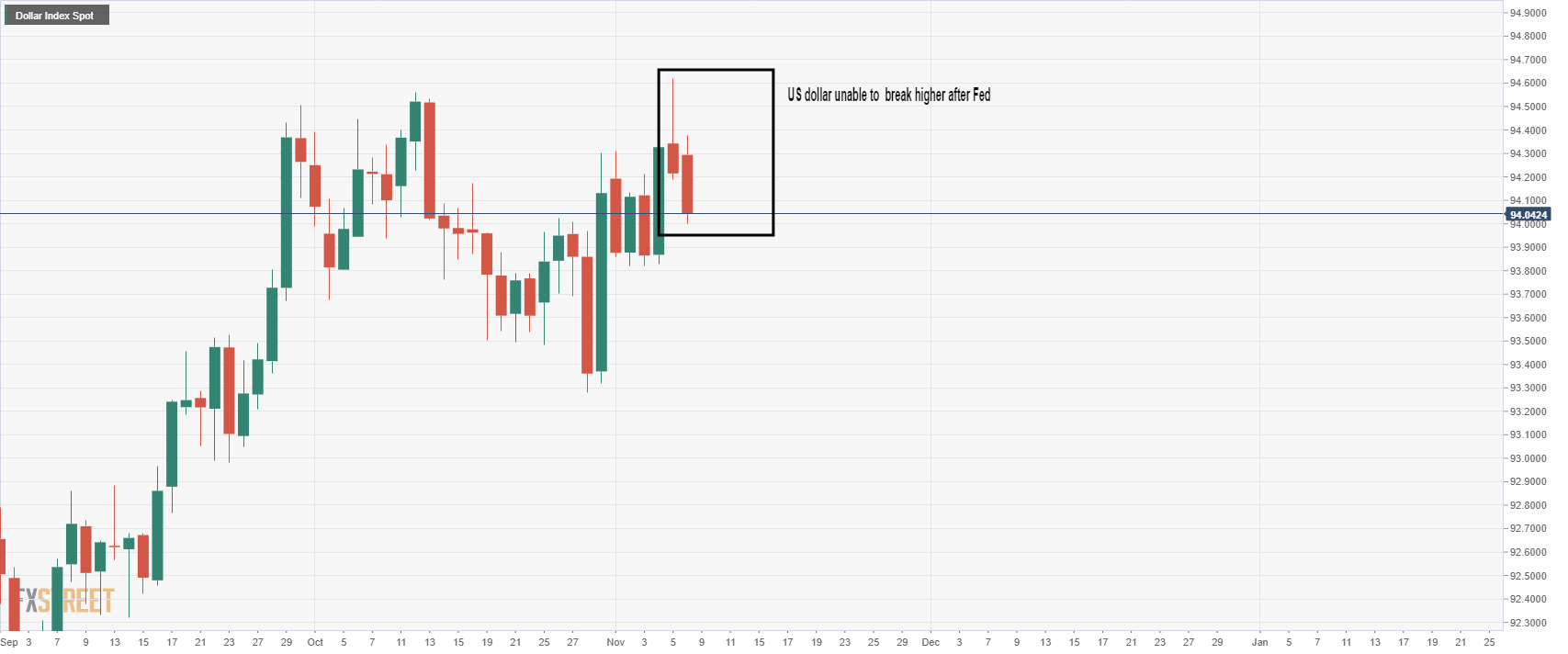
In the meantime, the US Dollar Index, which tracks the greenback’s performance against a basket of six peers, is down 0.14%, sitting at 94.08, boosting the appetite of the non-yielding metal.
During the day, some Fedspeakers crossed the wires. One of the most relevant, Vice-Chairman Richard Clarida, said that the benchmark for higher rates could be met by the end of 2022 but reiterated that the Fed is still “a ways away” from lifting off rates, per Reuters. Further noted that “Core PCE inflation measured since Feb. 2020, before the pandemic, through Sept. 2021 already averaging 2.8%.”
XAG/USD Price Forecast: Technical outlook
In the daily chart, XAG/USD just broke the 100-day moving average (DMA) at $24.16, closing to the mid-line of Andrew Pitchfork’s indicator around the $24.60 area. A daily close above the latter could propel the white-metal towards higher prices, being the September 5 high at $24.85, its first resistance level. A sustained break above that level would expose the 200-DMA at $25.35.
On the other hand, failure at Pitchfork’s central line would expose the 100-DMA as the first support, followed by the $24.00 figure.
- EUR/GBP is back under 0.8550 after the pair rejected its 200DMA close to 0.8600.
- Central Bank divergence may continue to push the pair lower in the coming months.
EUR/GBP has traded with a largely negative bias this Monday, dropping from early session highs near 0.8590 to current levels below the 0.8550 mark. The pair has now on two occasions in the past two days failed to break above its 200-day moving average, which sits just below the 0.8600 level. Technicians might see this as a bearish sign, which may have exacerbated recent selling pressure. At present, EUR/GBP trades with on the day losses of around 0.2% and is still some way (about 1.0%) above its pre-BoE policy announcement levels from last week in the 0.8460s.

To quickly recap, the bank wrong-footed speculators as it opted not to go with a widely expected 15bps rate hike and sounded more dovish than expected on inflation and the prospect for rate hikes further out. But the ECB was also dovish last week, with ECB President Christine Lagarde pushing back strongly against EUR STIR market pricing for rate hikes as soon as the end of 2022. Since then, there has been further dovish commentary from the second most important ECB member, Chief Economist Philip Lane. He said over the weekend and reiterated on Monday his expectation that the current spike in inflation is set to be transitory and that over-reacting to a short-term spike would be a policy mistake.
Though the BoE’s disregard for investor expectations will have undoubtedly resulted in the build-up of some risk premia in GBP, the bank remains on course to begin the process of monetary policy normalisation well ahead of the ECB. BoE Governor Bailey was back on the wires only a few moments ago reiterating the bank’s worries about second-round inflation effects. Speculators may see the recent failures to break above the 200DMA as a sign that EUR/GBP’s near year-long downtrend has further room to run. Barring any further BoE surprises, a good medium-term central bank divergence play might be to ride EUR/GBP lower from here to annual lows around 0.8400.
Elsewhere, Brexit remains in the headlines and the UK looks set to trigger Article 16, which will inflame tensions with the EU and risks spilling into a trade war. As Brexit did back in the day, this presents upside risks to EUR/GBP. Otherwise, the only notable Eurozone and UK events this week is the German November ZEW survey and a speech from ECB President Christine Lagarde on Tuesday and the preliminary estimate of UK GDP on Thursday.
The Bank of England's governor, Andrew Bailey, has stated in recent trade that the Old Lady will have to act with rates if there is evidence of higher inflation expectations feeding into wages.
Key comments from BoE's Bailey
Says much of rise in inflation has to do with reopening after lockdowns.
Says what we are concerned about is once we have increase in inflation we want to stop it becoming generalised.
Says problem now is that what's pushing up inflation is not too much demand.
Says the risk is that we are going to get more bottlenecks, especially for labour.
Says we would and will have to act with rates if we see evidence of higher inflation expectations feeding into wages.
More to come...
- Crude oil has been choppy but trades with a positive bias around $82.00.
- A few positives have been attributed as supporting prices on Monday, though US intervention remains a risk.
Crude oil prices have been choppy in recent trade but continue to trade with a positive bias on the day. Front-month futures contracts for the American benchmark for sweet light crude oil, called West Texas Intermediary or WTI, currently trades close to $82.00/barrel, having swung between the $81.30-$82.60 at various points throughout the session. At present, WTI currently trades with on-the-day gains of about 60 cents or a little under 1.0%. To the upside, the next notable area of resistance is last Thursday’s high in the $83.30s, while, to the downside, the next notable area of support is last week’s low at around $78.30.
Market commentators have suggested a few factors as supportive for crude oil prices at the start of the week, including; 1) the passage of the $550B US infrastructure investment package at the end of last week (which improves the US growth and oil demand outlook), 2) news over the weekend that the Saudi Arabian’s had upped their Official Selling Price (OSP), which indicates strong demand, 3) better-than-expected Chinese export growth figures over the weekend, which suggest strong global demand ahead of the winter holiday’s and an easing of supply chain woes and 4) further signs that global jet fuel demand is set to rebound back to pre-pandemic levels as countries reduce travel restrictions (from 8 November, the US is allowing fully vaccinated travels to visit quarantine free from the EU, UK, China, India, Brazil and more and travel booking are reportedly rising).
One downside risk to prices this week is a potential announcement from the Biden administration of measures aimed at addressing high gasoline and heating costs. Reportedly, the US Energy Secretary is currently weighing up options and President Joe Biden could make an announcement as soon as the end of the week. Touted actions include tapping the strategic petroleum reserve, which is supposed to be only be used in emergency situations, and placing a ban on energy exports.
Federal Reserve Governor Michelle Bowman says that it is likely that we will see higher inflation from housing for a while.
More to come...
Patrick Timothy Harker, who is the President of the Federal Reserve Bank of Philadelphia, says he does not expect the Federal Funds Rate will rise before the Fed's bond tapering is complete.
"I don’t expect that the federal funds rate will rise before the tapering is complete, but we are monitoring inflation very closely and are prepared to take action, should circumstances warrant it," Harker said in remarks prepared for a virtual event organized by the Economic Club of New York.
Reuters reported that The also said he ''expects inflation to moderate over the next year as supply demand imbalances caused by the pandemic are resolved, echoing a message shared by Fed officials last week when they announced they will begin to reduce the pace of asset purchases by $15 billion a month.''
Key comments from Fed's Harker
Says he does not expect that the federal funds rate will rise before the fed's bond tapering is complete.
Says fed officials are monitoring inflation very closely and are prepared to take action, should circumstances. warrant it.
Says he expects inflation to moderate next year as supply chains come back online and bottlenecks ease
Says US economy should see another growth spurt to more than 4% next year if another major covid-19 wave can be avoided.
Says he expects economic growth to return to between 2% and 3% in 2023.
Says he expects more people to return to the workforce as forbearance programs run out.
More to come...
- The S&P 500 advances 0.07% is sitting at 4702, with energy and materials as the leading gainers.
- The Dow Jones Industrial adds 0.23%, currently at 36,412.
- The Nasdaq Composite is barely down 0.01% at 16,358.
The S&P 500 edges higher in the New York session, up some 0.08%, sits at 4,701 at the time of writing. The Dow Jones Industrial adds 0.23%, up to 36,412, while the Nasdaq Composite falls 0.01%, at 16,358. Positive US jobs data last Friday, coupled with a dovish taper by the Federal Reserve on Wednesday, prompted investors towards riskier assets, as US equity indices keep posting new all-time highs on the last week.
Furthermore, robust third-quarter earnings ease market participants’ worries about heightened inflation. In the last week, three central banks unveiled their monetary policy statements, in which It can be read that inflation is transitory despite high energy prices, blaming supply constraints and bottlenecks, coinciding that once those factors ease, inflation will moderate.
Sector-wise, Energy, Materials, and Financials are the gainers, rising 1.34%, 1.08%, and 0.84%, respectively. On the other hand, the main losers are Utilities and Consumer Staples, down 1.60% and 1.1%.
S&P 500 Price Forecast: Technical outlook
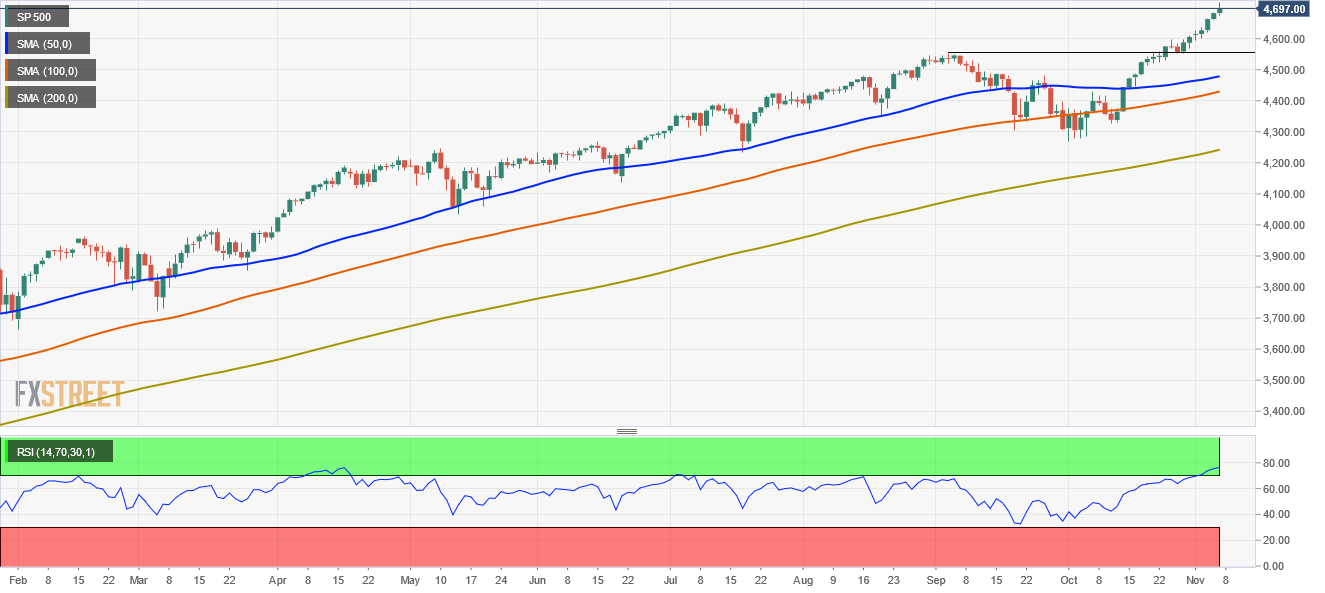
The daily chart shows the index keeps in a solid upward trend, showing no signs of exhaustion, despite that the Relative Strength Index (RSI) is at overbought levels at 77, aiming higher. Furthermore, the daily moving averages (DMA’s) are below the index value, sitting well below the 4,500 level. However, in case of a correction lower, the first demand zone would be the September 3 high at 4,550.
- Spot gold continues to nudge higher as real yields fall and is now above $1820.
- The precious metal is being supported by lower real yields and a weaker US dollar on Monday.
- Remarks from influential Fed member Clarida may have triggered a dovish market reaction.
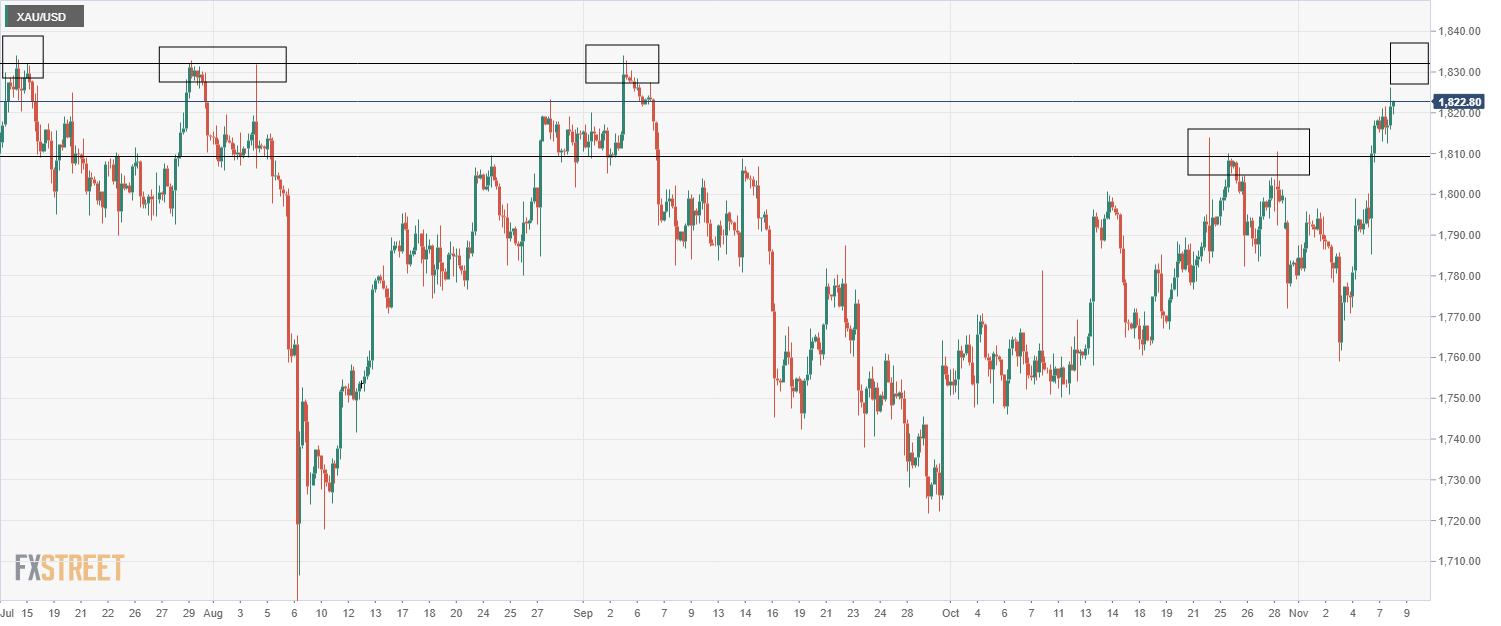
Spot gold (XAU/USD) continues to trade with an upside bias on Monday after breaking above key resistance last Friday in the $1814/oz area. Spot prices surpassed $1820 earlier in the session, the highest level in over two months. Gold bulls will now be eyeing a move back to test resistance in the $1830s, an area that spot prices tried and failed to break above on between July and early September. To the downside, there is support in the form of the October highs around $1810.
Falling Real Yields
US real yields, which saw a sharp fall last week, continue to head lower on Monday, with the 10-year TIPS yields down roughly 2bps on the session and back below -1.10%. Gold has a negative correlation to real yields; as real yields decline, this reduces the opportunity cost for investors in holding non-yielding precious metals, thus boosting their appeal. The fact that US inflation expectations are moving higher may also be helping gold given its reputation as an inflation hedge. 10-year break-evens are up about 6bps to 2.58% on Monday and showing signs that a move back towards recent multi-decade highs close to 2.7% could be on the table.
Weaker Dollar
A weakening US dollar is also giving dollar-denomination spot gold a helping hand on Monday. The Dollar Index has weakened by about 0.3% on the session and has fallen back to test the 94.00 level. A weaker USD makes spot gold cheaper for global buyers, thus increasing its demand.
Influential Fed member and Vice Chairman of the FOMC Richard Clarida spoke earlier in the session and his comments were more dovish than many might have expected; he said the conditions for a rate hike could be met by the end of 2022 and the Fed is still some way from considering rate lift-off. USD STIR markets currently price a hike by September 2022, thus Clarida’s remarks may be interpreted by some as dovish pushback against the market’s pricing. This may have contributed to USD underperformance on Monday and may, thus, be helping gold.
On Tuesday, the Producer Price Index for October is due in the US and on Wednesday the Consumer Price Index. According to analysts at Wells Fargo, the numbers on Wednesday, are unlikely to offer much of a reprieve on the inflation front.
Key Quotes:
“Consumer Price Index report for the month of October is unlikely to offer much of a reprieve on the inflation front. Our forecast is for a 0.6% month-over-month increase on the headline index and a monthly increase of 0.4% on the core index. If realized, this would put headline CPI inflation at 5.9% year-over-year and core CPI inflation a bit lower at 4.4% year-over-year.”
“A key question for the inflation outlook is the extent to which some price growth in certain sectors coming back down to Earth, such as new and used vehicles, will offset a broadening out of inflation in other areas, such as housing.”
“Goods inflation has been running at rates not seen in decades, while services inflation has mostly been in line with its historical average. We expect goods inflation to hand the baton to services over the course of the next year, but all signs indicate that supply chain bottlenecks will keep fanning the flames on inflation in the near term.”
- Cable rises further from monthly lows amid a weaker dollar.
- DXY retreats from monthly highs toward 94.00.
- US inflation data due on Tuesday and Wednesday, to be watched closely.
The GBP/USD pair is recovering on Monday after falling last week to 1.3423, the lowest level in a month and slightly above the YTD low. During the American session, cable rose to 1.3578, reaching a fresh intraday high. It is hovering around 1.3550, up more than 70 pips for the day.
The recovery in GBP/USD is being driven by a weaker US dollar across the board. The greenback is retreating after last week rally, continuing the move that started on Friday after the NFP.
Higher US yields are not helping the greenback. The 10-year stands t 1.48%, (up more than 2%). The DXY is falling for the second day in a row, testing 94.00. US inflation data on Tuesday and Wednesday will be watched closely.
Market participants continue to digits the last week’s Bank of England meeting. The dovish tone from the central bank weighed on the pound. During Monday’s European session, the pound strengthened for the first time since the meeting and rose across the board.
Still, what the BoE did and the Brexit concerns could still impact on GBP. “The outlook for GBP will be guided by expectations regarding the pace of BoE policy tightening relative to the policy decisions taken by other major central banks such as the Fed and the ECB. On the margin, UK politics concerning the issues of Brexit and sleaze may also impact the performance of GBP”, explained analysts at Rabobank.
Supported again above 1.3400
The decline of GBP/US found support above 1.3400, like what happened back in September. If it breaks below, the pound would likely accelerate to the downside. On the upside, a firm recovery above 1.3600 should strengthen the bullish outlook.
Technical levels
- NZD/USD has been on the front foot in recent hours, rallying back to the upper 0.7100s.
- The kiwi is the best performing G10 currency on the day amid positive NZ reopening news.
NZD/USD has continued to advance as the US session gets underway, recently scaling new heights for the day in the 0.7170s, up from Monday Asia Pacific session levels of just above 0.7100. The most immediate upside resistance is last Wednesday’s high at 0.7180, which the pair hasn’t quite been able to pip just yet on Monday. The New Zealand dollar is the best performing G10 currency on the day so far, up around 0.8% on the session versus the US dollar.
Market commentators are citing positive New Zealand reopening news as supportive for the kiwi; the government announced that the country’s largest city Auckland would have its Covid-19 alert level downgraded on Wednesday, allowing shops to reopen. Further reopening is expected at the end of the month. The country’s full vaccination rate is expected to hit 90% within a few weeks, a key threshold the government has said must be met in order for lockdowns to be eased.
The New Zealand economy has performed much better than expected so far in 2021, with the latest jobs data showing the unemployment rate dropping to 3.4% in Q3, well below any economist/RBNZ estimate of NAIRU (the “natural” rate of unemployment, below which inflationary pressures will build). Prompt reopening after recent lockdowns will ensure this year’s economic progress isn't scuppered. Indeed, following the recent strong jobs report, some analysts are calling for a 50bps hike at the next RBNZ meeting. “We see an increased chance of a 50bps hike at the November RBNZ meeting, given the following meeting won’t take place until February 2022” comments Citi.
Technical buying could also be helping NZD/USD on Monday; last Friday, the pair was probing its 21 and 200-day moving averages around the 0.7100 level. The fact this significant area of support has held might be interpreted as a bullish signal by some technicians, many of whom may be targetting a return to the October highs in the 0.7220 area.
Looking ahead, kiwi traders will be keeping an eye on October Electronic Card Retail Sales data, scheduled for release at 2145GMT. Otherwise, the pair is likely remain focused on Fed speak, with remarks from NY Fed President John Williams, FOMC member Michelle Bowman and FOMC member Charles Evans coming up over the next few hours. Remarks from Fed Vice Chair Clarida earlier in the session were broadly viewed as dovish and may have contributed to USD weakness/upside in NZD/USD.
The pound has settled above its recent lows vs. both the USD and the EUR, but it remains in a clearly weakened positioned. EUR/GBP is still seen at 0.85 by year-end while UK politics concerning the issues of Brexit and sleaze may impact the performance of the pound, economists at Rabobank report.
Brexit and sleaze in the Tory party need to be monitored
“How much support the pound can garner from a potential BoE rate hike in the coming months will to some extent depend on whether a move is judged to be warranted. In the wake of mounting headwinds to growth in the UK, it appeared at the time that market participants were wary of a policy mistake from the Bank. This suggests that GBP may have struggled to rally even if the Bank had raised rates last week.”
“The fact that EUR/GBP has never come close to returning to the levels held prior to the 2016 referendum on EU membership suggests that Brexit-related uncertainty is largely already in the price. That said, headlines that the UK government may be close to triggering Article 16 of the Northern Ireland protocol has the potential to open a fresh set of worms for GBP.”
“The accusations regarding sleaze in the Tory party and the government’s U-turn last week over parliamentary standards have taken a toll on the PM personal poll rating. Given the government’s strong majority and absence of any near-term election, this may not translate directly into a softer pound near-term unless the situation worsens.”
“We retain our year-end EUR/GBP forecast of 0.85.”
- Japanese yen among top performer despite risk appetite and higher yields.
- US dollar weakens across the board during the American session.
- USD/JPY heads for lowest close in a month.
The USD/JPY is falling on Monday for the third day in a row and it reached at 113.07, the lowest level since October 12. It remains near under pressure amid a weaker greenback across the board.
After trading in a range for days, USD/JPY broke to the downside, clearing the way to more losses. The short-term outlook now favors the downside. The next support levels might be seen at 112.95 and 112.10. On the upside, now 113.40 is the immediate resistance. If it rises above 114.40 the US dollar would recover strength, probably resuming the bullish long-term trend.
The move lower in USD/JPY takes place despite a rebound in US yields. The 10-year stands at 1.48% and the 2-year rose to 0.43%. Not even risk appetite is giving support to the pair. The Dow Jones gains 0.36%, at new record levels, while the S&P500 rises by 0.14%.
After a quiet Monday in terms of US economic data, on Tuesday the PPI and on Wednesday the CPI could trigger market moves following last week FOMC meeting. Inflation numbers are likely to influence on expectations about Fed’s monetary policy.
Technical levels
- USD/CAD begins the week on the right foot, despite broad US dollar weakness.
- The US 10-year Treasury yield trims some of the last week's losses, up at 1.481%.
- Higher crude-oil prices failed to underpin the Loonie.
The USD/CAD begins the week on the right foot, advancing some 0.01% trading at 1.2450 during the New York session at writing. As portrayed by US equity indices rising, the market sentiment is upbeat. The greenback lost traction after a better than expected US jobs report, while US T-bond yields rose.
USD/CAD rises, despite weaker US dollar amid higher crude-oil prices
The USD Index, which measures the buck's value against a basket of six rivals, loses 0.10%, sits at 94.10. Contrarily, the US 10-year Treasury yield advances almost three basis points, currently at 1.481%, acting as a tailwind for the USD/CAD pair.
Furthermore, higher crude oil prices failed to underpin the Loonie, with Western Texas Intermediate (WTI) the US crude oil benchmark rallying some 0.63%, trading at $80.87, approaching the $81.00 figure.
In the last week, three central banks pushed back against higher interest rates. Focusing on the Federal Reserve, the US central bank unveiled its bond-taper asset, to begin by the middle of this month. The pace of its reduction would be $15 billion each month, but it opened the door for further acceleration depending on economic conditions. However, they start to put aside employment figures, becoming more vocal about inflation, blaming supply bottlenecks and chain disruptions.
After the FOMC meeting, market participants started to price in one interest rate hike by late 2022, which in the USD/CAD could be positive for USD bulls. However, the Bank Of Canada has already finished its QE program, and the market expects higher rates than in the US.
According to Royal Bank of Canada in a note to clients, "given inflation concerns and uncertainty about the degree of economic slack, we think the bank will lean toward an earlier rate hike in April. Our call for three rate increases in 2022 is still well short of the four to five hikes priced in by markets."
Later in the week, the US economic docket will feature fed speakers, inflation figures, and employment data that could offer fresh impetus for USD/CAD traders.
USD/CAD Price Forecast: Technical outlook
The USD/CAD pair is steady above the bearish-flag top-trendline in the daily chart, approaching the 200-day moving average (DMA) at 1.2475. Furthermore, the Relative Strength Index (RSI), a momentum indicator at 53, aims slightly up, confirming an upward bias. However, USD bulls will need a daily close above the 200-DMA to resume the uptrend firmly. In that outcome, the confluence of the 50 and the 100-DMA within the 1.2530-40 range would be the next supply zone. A breach of the latter would expose 1.2600.
On the flip side, failure at the 200-DMA and a break beneath the 1.2400 figure would open the door for further losses. The first demand zone would be the October 27 low at 1.2300. A downward break would expose the October 21 low at 1.2287.
EUR/USD seems to have gone into a consolidation phase. Still, economists at Scotiabank think a breach of 1.15 is only a matter of time with a test of 1.14 following relatively quickly.
EUR/USD at risk of falling below 1.15
“The EUR/USD traded narrowly in a <30pips range with decent support in the 1.1550 zone on dips while the 1.1575 area stands as resistance.”
“The EUR’s steep swings over the past two weeks have left it a clear risk of a test – and cross – of 1.15 amid continued downward pressure since late-May. A cross under the figure sees limited support until 1.1422 and the 1.14 area and then losses could quickly extend into the 1.11s.”
“The 1.16 zone is resistance followed by the mid-figure area that stands as downtrend resistance.”
The USD/CAD is little changed to start the week, with spot holding in the mid 1.24s. Last week, the pair were halted by the 200-day moving average (DMA) at 1.2479, which is a sign of CAD strength but a minor bounce in the next few weeks is on the cards.
CAD to remain generally well-supported
“The overall technical tone remains consolidative and it is impossible to exclude the risk of USD/CAD creeping a little higher still in the next few weeks. But rejection of the 200-DMA is an important sign of resilience in the CAD, we think.”
“USD support is 1.2415 and 1.2385.”
“Resistance is 1.2525/30.”
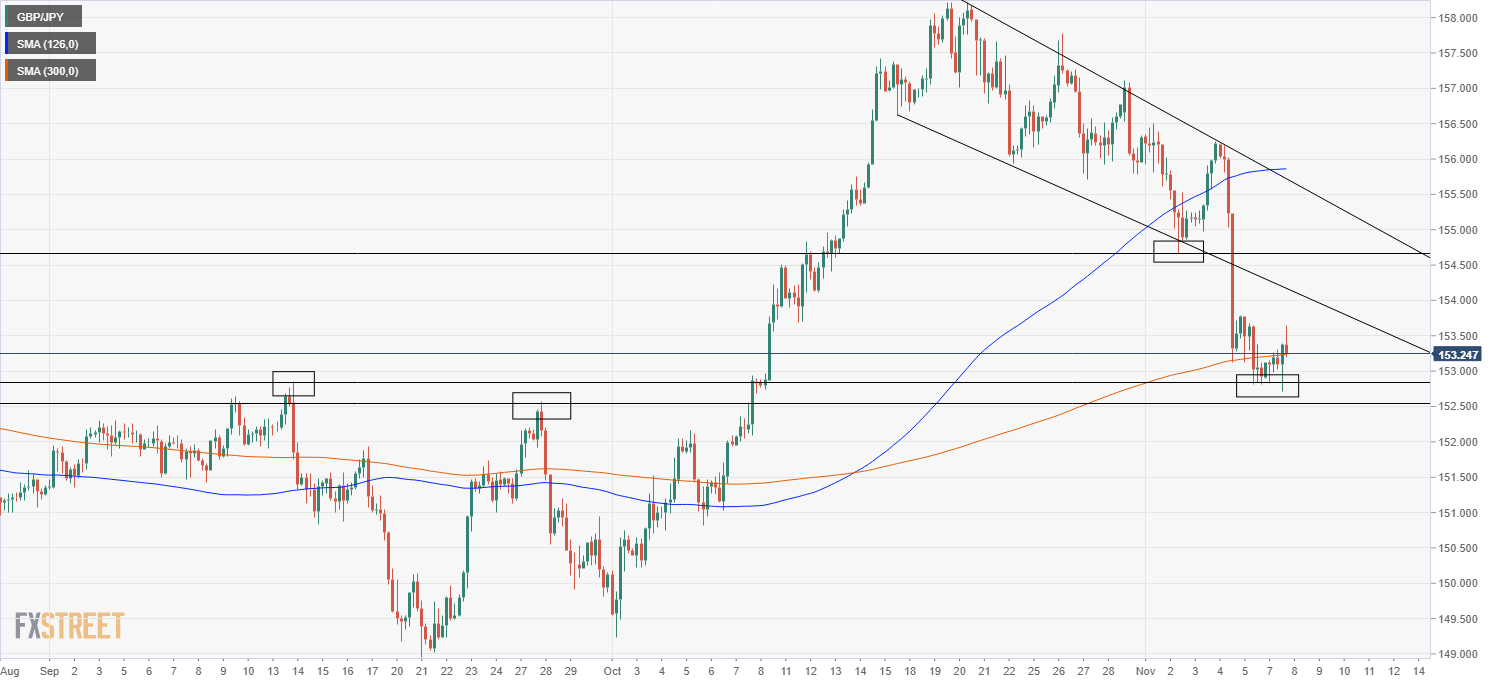
GBP/JPY is seeing subdued trade, with prices not deviating too far from the 50-day moving average (which currently resides just under 153.20). The pair seems to have found some support ahead of the September highs in the 152.50-1.5300 region. To the upside, the 2 November low at 154.70 and the 21DMA at 155.80 are the most notable areas of resistance.
The pair had dropped more than 2.0% from early Thursday highs above 156.00 to Friday lows under 153.00, with the sharp decline triggered as the Bank of England wrong-footed investors by opting not hike interest rates by 15bps and sounding much more dovish thank expected with regards to the potential for rate hikes over the coming years. But GBP/JPY is seeing a modest rebound on Monday and has now clambered back to the north of the 153.50 level, despite the ongoing presence of UK/EU tensions.
UK press reported over the weekend that the UK is set to trigger Article 16, a clause that allows the UK (or EU) to unilaterally suspend parts of the Northern Ireland protocal if its implementation is causing significant societal damage. A final decision will be taken by the end of the month, the reports suggested. EU leaders have warned in recent weeks that such a move by the UK could lead to the EU suspending the entirety of its existing trade deal with the UK. A suspension of the post-Brexit free-trade deal of represents a downside risk to a UK economy already struggling with supply chain turmoil, high energy costs and a sharp recent drop in fiscal stimulus after the expiry of the government’s employee furlough scheme.
This Week
Focus returns to the Bank of England on Monday, with Governor Andrew Bailey partaking in a Q&A session from 1700GMT. Looking ahead to the rest of the week, the main event for sterling traders will be the release of the preliminary estimate of Q3 GDP data at 0700GMT on Thursday. Yen traders, meanwhile, will keep an eye on a steady trickle of data releases, including September trade and current account metrics and the Eco Watchers Survey on Tuesday and October Producer Price Inflation on Thursday.
Gold has capitalized on falling US T-bond yields and looks to extend its rally north of the multi-month downtrend, strategists at TD Securities report.
Gold is itching for a breakout
“Gold prices are set to challenge the multi-month downtrend from all-time highs. Counter-intuitively, this comes after a strong Nonfarm Payrolls report.”
“The central bank has reiterated that its tools cannot help ease the temporary supply constraints that have ultimately driven inflation higher. In this context, markets for central bank hikes are repricing. In this context, US real yields are plummeting, in support of gold prices.”
“A breakout north of the multi-month downtrend could help the trend of ETF outflows reverse, powering gold prices even higher.”
“Unfortunately for the bulls, we expect that a recent CTA buying program has run its course, suggesting algorithmic trend follower flow will not lend its support.”
USD/MXN has come off the June, October and current November highs at 20.7490/9794. In the view of Axel Rudolph, Senior FICC Technical Analyst at Commerzbank, the pair is set to head back down towards the 19.5980 June low.
Key resistance at 20.7490/9794 provoked failure
“USD/MXN recent steep ascent only briefly overcame the June and October highs at 20.7490/9035 and made its current November peak at 20.9794 before giving back most of its recent gains.”
“The October through at 20.1195 is back in focus, a drop below which would engage the 2020-2021 support line and September low at 19.9876/8476 and the April and May as well as the late June to mid-August lows at 19.8001/7061. Then there is the June low at 19.5980 which is also expected to eventually be reached provided that no rise and daily chart close above last week’s high at 20.9794 is made.”
“If last week’s high at 20.9794 were to unexpectedly be exceeded on a daily chart closing basis, the February high at 21.0483 would be back on the plate. Further up lies the March high at 21.6380.”
Federal Reserve Vice Chair Richard Clarida said on Monday that benchmarks for rate hikes could be met by the end of 2022 but added that the Fed is still "a ways away" from considering lift-off, as reported by Reuters.
Additional takeaways
"Policy path outlined in September dot plot would be consistent with Fed's framework if current inflation and jobs forecasts are met."
"Repeat of 2021 inflation next year would not be a policy success."
"Core PCE inflation measured since Feb. 2020, before the pandemic, through Sept. 2021 already averaging 2.8%."
"Expecting full return to pre-pandemic employment levels by end 2022, unemployment rate at 3.8% with participation rising."
Market reaction
The US Dollar Index showed no immediate reaction to these comments and was last seen trading flat on the day near 94.20.
The Norwegian krone continued to weaken over the past week, mainly due to lower oil prices. Consolidation is likely the name of the game in the short-term, however, risks remain on the upside in both EUR/NOK and USD/NOK, economists at Nordea report.
NOK weakened during the past week
“Lower oil prices have led to a weaker NOK. Last week’s OPEC+ meeting resulted in an increase in production by 400K barrels/day, in line with the original plan from the cartel. What has likely contributed negatively to the oil price is a weaker demand outlook in China due to the resurgence of covid, and statements from President Biden that oil prices are unacceptably too high.”
“First resistance level for EUR/NOK is at 10.00 and then around 10.15. On the downside, 9.80 and then 9.75 are support levels.
“For USD/NOK, we have resistance around 8.60/8.70 on the upside, and support around 8.45 on the downside.”
“This week’s calendar is short. Inflation figures in the US and Norway will be released, but their effects on the NOK should be minor.”
St. Louis Federal Reserve President James Bullard told Fox Business Network on Monday that he sees the Fed hiking its policy rate twice in 2022, as reported by Reuters.
Additional takeaways
"If we had to, we could end the taper somewhat sooner than June."
"If inflation is more persistent, we may have to take action a little sooner."
"We have done a lot to move policy in a more hawkish direction."
"We have quite a bit of inflation."
"I expect supply chain disruptions to extend through 2022."
"I expect a lot of continuity in Fed policy no matter how Fed Chair appointment process works out."
Market reaction
Investors showed little to no reaction to these comments and the US Dollar Index was last seen losing 0.04% on a daily basis at 94.18.
In an interview with Fox Business Network on Monday, St. Louis Fed President James Bullard said that he expects the US economy to grow by more than 4% in 2022, as reported by Reuters.
Additional takeaways
"It's one of the hottest labour markets in the post-war era."
"I expect unemployment to fall below 4% sometime in the first quarter."
"Not really looking at much improvement in the labour force participation going forward."
Market reaction
These comments don't seem to be having a significant impact on the dollar's performance against its major rivals. As of writing, the US Dollar Index was posting small daily gains at 94.15.
AUD/USD continues to meander close to the 0.7400 level, a level around which is has gently pivoted since the US dollar weakened in response to last Friday’s US labour market report (despite that report being stronger than expected across most metrics). In recent trade, it has pushed to fresh daily highs just above 0.7410, but isn't showing much conviction as of yet. The key levels that technicians will be watching this week are the 50-day moving average (DMA) at 0.7445 and last Wednesday’s high at 0.7470 to the upside and the 21DMA and last week’s low in the 0.7360 region to the downside. Chinese trade data overnight was mixed; exports beat expectations, but imports missed and, thus, given that China is a big export destination for Australian goods, this is a net negative for AUD. Analysts read the weaker than expected import data as further signs that Chinese growth momentum continues to weaken.
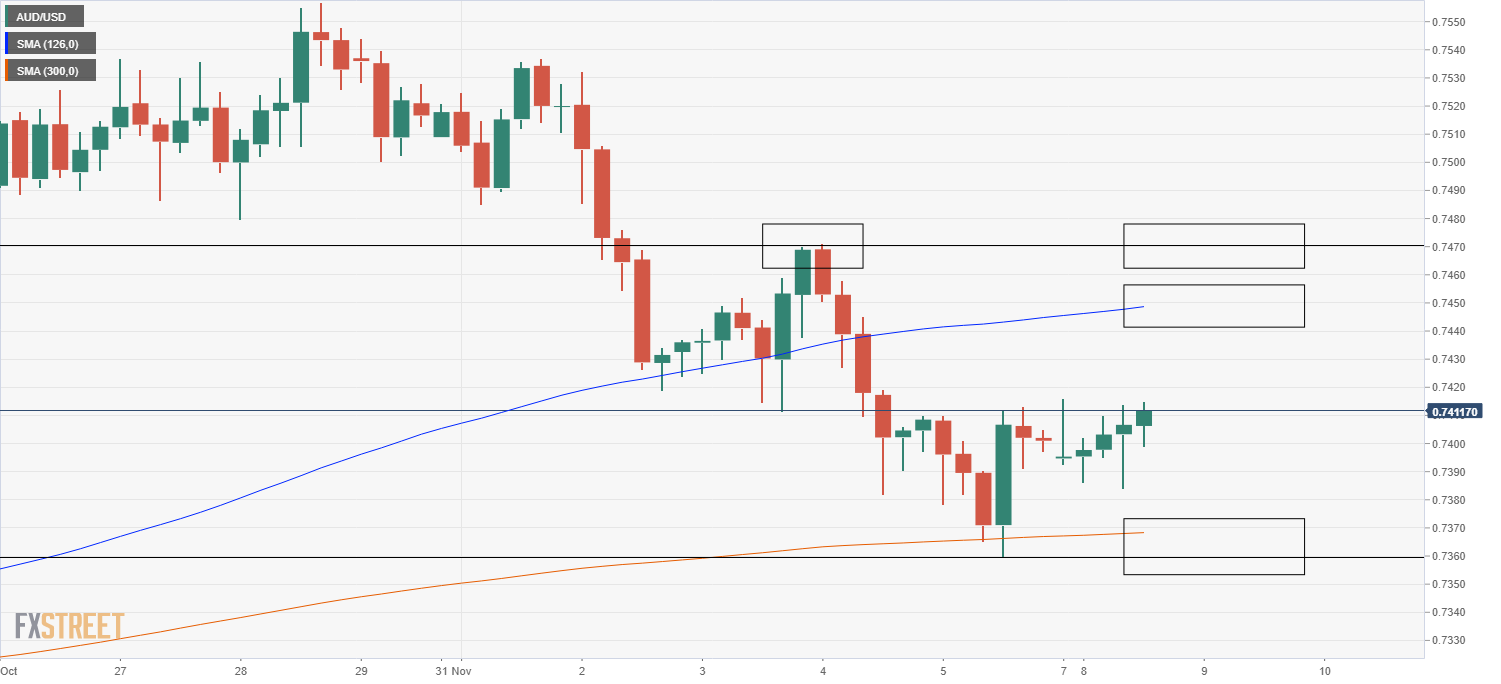
This Week
Last week was a hectic one, with the RBA and Fed both deciding on monetary policy and the end result being a sharp fall for the pair as a dovish RBA Governor Philip Lowe pushed back more aggressively against market pricing for rate hikes in 2022 than his Fed counterpart Jerome Powell. In the absence of key central bank events and the US labour market report, this week should be a calmer affair, though there are plenty of Fed policymakers speaking publically this (including a number throughout Monday’s US session) and US inflation data is set for release on Tuesday (the Producer Price Inflation report) and Wednesday (the Consumer Price Inflation report).
Meanwhile, Thursday sees the release of both Australian and US jobs data; the former is the official labour market report for Australia for the month of October and is expected to show employment rising modestly as lockdowns were eased, while the latter is the US September JOLTs report, which should show that labour demand in the US remains incredibly strong. Ahead of Aussie jobs on Thursday, the release of the NAB October Business Confidence survey during Tuesday’s Asia Pacific session and then the release of the Westpac Consumer Confidence survey during Wednesday’s APac session may trigger some AUD volatility.
European Central Bank (ECB) chief economist Philip Lane said on Monday that supply bottlenecks and rising energy prices are the main risks to the pace of economic recovery and the inflation outlook, as reported by Reuters.
Additional takeaways
"Our analysis is indicating that the euro area is still confronted with weak medium-term inflation dynamics remains compelling."
"If supply shortages and higher energy prices last longer, these could slow down the recovery."
"If persistent bottlenecks feed through into higher than anticipated wage rises or the economy returns more quickly to full capacity, price pressures could become stronger."
"Economic activity could outperform our expectations if consumers become more confident and save less than currently expected."
Market reaction
These comments don't seem to be having a significant impact on the common currency's performance against its rivals. As of writing, the EUR/USD pair was up 0.12% on a daily basis at 1.1578.
EUR/USD failed to sustain its break to new lows on Friday and remains floored above 1.1495/93 – the March 2020 high and 50% retracement of the 2020/2021 bull trend. Nevertheless, a major top remains in place and analysts at Credit Suisse still look for a resumption of the core downtrend.
Resistance at 1.1683/95 to cap
“EUR/USD failed to sustain a break to new 2021 lows and remains floored above major support at 1.1495/93 – the March 2020 high and 50% retracement of the 2020/2021 bull trend, with short-term momentum increasingly poor. Nevertheless, our bias stays lower following the recent decisive rejection of key resistance from its falling 55-day average (and downtrend from June) at 1.1683/95.”
“A major top remains in place, reinforcing the case for a resumption of the core downtrend and a clear break below the 1.1524/13 October lows. Below here and 1.1495/93 would trigger a move to support then seen next at 1.1377/70, before the 61.8% retracement at 1.1300/1.1290, where we would expect to see another pause.”
“Resistance stays at 1.1614/18, with 1.1632/36 ideally capping. We shall maintain an immediate tactical bearish bias though whilst below 1.1689/95.”
Recent US dollar strength versus the South African rand has come to an end. USD/ZAR topped out at 15.4929 and is to slide back towards the September trough at 14.0630, Axel Rudolph, Senior FICC Technical Analyst at Commerzbank, reports.
USD/ZAR depreciation is on the cards
“The 55-day moving average at 14.7906 and also the 200-day moving average and six-month support line at 14.5638/4530 are now back in the frame, as is the October trough at 14.3520 and also the September low at 14.0630.”
“Below the September low at 14.0630 the June trough can be spotted at 13.4066.”
“We will adhere to this bearish forecast while resistance at 15.4929 caps on a daily chart closing basis. Short-term sideways trading is likely to be seen, however.”
“Above the 15.6645/6945 zone lies the May 2016 high at 15.9854.”
- GBP/USD attracted some buying near mid-1.3400s amid renewed USD selling bias.
- The prevalent risk-on environment acted as a headwind for the safe-haven USD.
- Rebounding US bond yields might limit the USD slide and cap gains for the major.
- Dovish BoE, Brexit jitters might further hold bulls from placing aggressive bets.
The GBP/USD pair climbed further beyond the key 1.3500 psychological mark and refreshed daily tops heading into the North American session. The pair was last seen trading around the 1.3530-35 region, up nearly 0.30% for the day.
Following an intraday dip to mid-1.3400s, the GBP/USD pair gained some positive traction and built on Friday's recovery move from five-week lows touched in reaction to the upbeat US NFP report. The underlying bullish sentiment in the financial markets undermined the safe-haven US dollar, which, in turn, was seen as a key factor that provided a goodish lift to the major.
The passage of a long-delayed $1 trillion US infrastructure bill added to the optimism over the global economic growth and turned out to be a key factor that boosted investors' confidence. That said, a solid rebound in the US Treasury bond yields should limit the USD losses. This, along with Brexit jitters, could keep a lid on any further gains for the GBP/USD pair.
The Fed last week stuck to its transitory inflation narrative and indicated that policymakers were in no rush to hike borrowing costs. Market participants, however, seem convinced that the US central bank would be forced to adopt a more aggressive policy response to contain stubbornly high inflation. This was seen as a key factor that pushed the US bond yields higher.
Meanwhile, investors remain worried that the UK government will trigger Article 16 of the Northern Ireland Protocol. Apart from this, the Bank of England's surprise decision last week to keep interest rates steady might further hold bulls from placing aggressive around the British pound. This warrants some caution before positioning for any further appreciating move for the GBP/USD pair.
In the absence of any major market-moving economic releases on Monday, traders will take cues from Fed Chair Jerome Powell's remarks at an online conference. This, along with the US bond yields and the broader market risk sentiment, will drive the USD demand. Apart from this, BoE Governor Andrew Bailey's comments will influence the GBP and provide some impetus to the GBP/USD pair.
Technical levels to watch
- EUR/USD is flat ahead of the start of the US trading session and supported above 1.1550.
- This week should be calmer than last, but US inflation data, Fed and ECB speak are notable risks.
EUR/USD is trading flat in the 1.1570 region, having remained supported above 1.1550, ahead of Monday’s US trading session's start amid broadly contained FX market conditions. The pair largely ignored a slightly better than expected survey of investor confidence for November (the Eurozone Sentix survey); the headline index rose to 18.3 from 16.9 in October as expectations built that supply chain disruptions which have severely hampered Eurozone manufacturing in recent months would start abate in the coming months. After a flurry of central bank activity last week that saw the Fed announce (as expected) its QE taper plans, ECB policymakers push back more firmly against money market pricing for rate hikes in 2022 and the Bank of England wrong-foot investors as it opted not to hike interest rates by 15bps, as well as the release of the US labour market report on Friday, this week is likely to be calmer.
Week Ahead
That’s not to say that there aren't key risk events to keep an eye on. Monday sees a number of FOMC members hit the wires; Fed Chair Jerome Powell at 1530GMT, though given the topic of his speech is diversity, he is unlikely to speak on monetary policy. But NY Fed President Williams will speak at 1530GMT, FOMC member Michelle Bowman will speak at 1700GMT and FOMC member Charles Evans at 1850GMT. Focus will switch from central bankers to inflation on Tuesday and Wednesday, with the release of the October Producer Price Inflation and October Consumer Price Inflation reports. The median economist forecast for the headline CPI rate is 5.8%, up from 5.4% in September, as food prices rise, used-car prices pick back up again and inflationary pressures in housing costs continues to build.
Fed policymaker Ester George sounded hawkish last week, saying the argument for patience had diminished given that the labour market is very tight and inflation is high. The comments could be interpreted as her being open to an accelerated pace of QE taper at the start of next year (from the current $15B/month rate in November and December announced by the Fed last week) that could pave the way for earlier rate hikes. It will be worth watching whether other Fed members agree and whether hot US inflation continues to support her more hawkish view. Another data point worth watching that should support the view of the US labour market being very tight is the release of the September JOLTs report on Thursday, which should continue to show that the number of job vacancies in the US is significantly more than the number of unemployed persons.
USD STIR markets currently fully price a first Fed hike by September 2022, less aggressive than the market’s positioning this time last week – if Fed speak is hawkish, inflation data hot and JOLTs data still indicative of massive demand for US labour, then risks tilted towards money markets bringing this pricing forwards rather than pushing it back. Given that, over the weekend, influential ECB member and Chief Economist Philip Lane remained resolute in his judgment that the current spike in inflation being seen in the Eurozone is transitory and that other core-ECB members speaking this week (like ECB President Christine Lagarde) are also likely to sound dovish, there is a risk that Fed rate hike pricing gets pulled forward more aggressively than ECB pricing, which points to downside risks for EUR/USD.
- USD/CHF regained positive traction on Monday amid the risk-on environment.
- The emergence of fresh selling around the USD did little to hinder the move up.
- Investors look forward to Powell’s remarks for some short-term trading impetus.
The USD/CHF pair refreshed daily tops, around 0.9155 region during the mid-European session, with bulls making a fresh attempt to build on the momentum beyond 200-day SMA.
The underlying bullish sentiment in the financial markets undermined demand for the safe-haven Swiss franc and assisted the USD/CHF pair to catch fresh bids on the first day of a new week. The passage of a long-delayed $1 trillion US infrastructure bill added to the optimism over the global economic growth and turned out to be a key factor that boosted investors' confidence.
Bulls seemed unaffected by the emergence of some selling around the US dollar, which, so far, has failed to gain any traction despite a solid rebound in the US Treasury bond yields. Investors looked past the Fed's dovish message last week and seem convinced that the US central bank would be forced to adopt a more aggressive policy response to contain stubbornly high inflation.
It, however, remains to be seen if the USD/CHF pair is able to capitalize on the move or meet with fresh supply at higher levels. In the absence of any relevant market-moving economic releases from the US, traders on Monday will take cues from Fed Chair Jerome Powell's remarks at an online conference. This, along with the US bond yields, will influence the USD and provide some impetus.
Meanwhile, the key focus will remain on the latest US consumer inflation figures, scheduled for release on Wednesday. The data will drive expectations about the likely timing when the Fed could tighten its monetary policy and play a key role in determining the next leg of a directional move for the USD/CHF pair.
Technical levels to watch
- Silver shot to two-week tops on Monday, though lacked follow-through.
- The set-up favours bullish traders and supports prospects for further gains.
- Dips below the $24.00 mark could now be seen as an opportunity for bulls.
Silver built on last week's goodish rebound from over two-week lows and gained some follow-through traction on Monday. The uptick pushed the XAG/USD to two-week tops, around the $24.30 region, though bulls struggled to capitalize on the move beyond 100-day SMA.
Looking at the broader picture, the recent pullback from the $24.80-85 region found decent support and stalled near the $23.00 mark. The latter should now act as a key pivotal point for traders and help determine the next leg of a directional move for the XAG/USD.
Meanwhile, bullish technical indicators on hourly/daily charts support prospects for an eventual break through the 100-day SMA barrier. This will set the stage for a move towards the $24.55 intermediate hurdle en-route October monthly swing highs, around the $24.80 area.
On the flip side, any meaningful pullback below the $24.00 mark could be seen as a buying opportunity and remain limited near the $23.70 level. This is followed by support near mid-$23.00s, below which the XAG/USD could accelerate the slide towards the $23.00 mark.
Sustained weakness below would turn the XAG/USD vulnerable to test the next relevant support near mid-$22.00s before eventually breaking below the $22.00 round-figure mark. The downward trajectory could get extended towards YTD lows, around the $21.40 area touched in September.
Silver daily chart
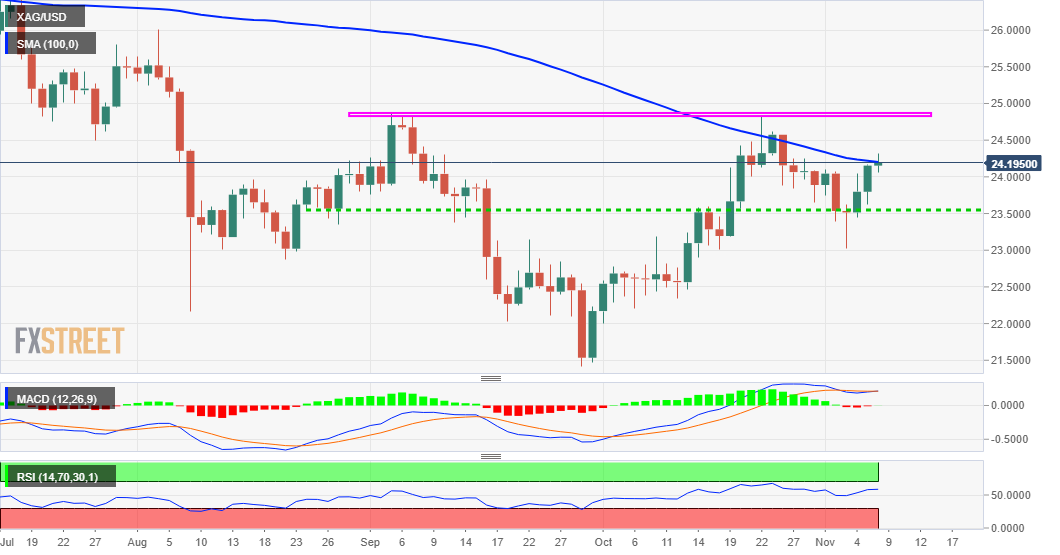
Technical levels to watch
USD/TRY’s advance has taken it to its October all-time high at 9.8610 below which it continues to consolidate. The pair will confirm a top here on a daily chart close below 9.4055, Axel Rudolph, Senior FICC Technical Analyst at Commerzbank, reports.
Daily chart close below 9.4055 to confirm a top formed at 9.8610
“A drop and daily chart close below the 9.4055 October 26 low would confirm that a top has indeed been formed with the October 20 low at 9.2010 remaining in focus.”
“More significant support can be spotted at the September high at 8.9636 and also between the June high and October low at 8.8057/37.”
“In case of an unexpected rally and daily chart close above the 9.8610 October peak being made, the psychological 10.0000 mark would be next in line around which the cross would then be expected to stall. If not, we would have to allow for an hourly 0.01 x 3 Point & Figure upside target at 11.0400 to be reached.”
- Oil prices gained traction for the second successive session on Monday.
- Prospects for rising energy demand remained supportive of the move.
- US President Biden’s call on OPEC+ to produce more crude capped gains.
WTI crude oil built on Friday's positive move and gained some follow-through traction for the second straight session on Monday. The momentum pushed spot prices to two-day tops, around the $81.70 region during the mid-European session, with bulls now awaiting a sustained strength beyond 200-hour SMA.
The optimistic outlook for global economic growth, along with the passage of a long-delayed $1 trillion US infrastructure bill supported prospects for rising energy demand. Apart from this, a move by Saudi Arabia's state-owned producer Aramco – to raise the price of its benchmark crude for customers in Asia – further pointed to strong demand.
This comes on the back of the recent decision by OPEC+ to keep a cap on crude supplies and further fueled supply concerns, which, in turn, extended support to the black gold. Apart from this, a subdued US dollar price action further acted as a tailwind for dollar-denominated commodities, including oil. The uptick, however, lacked any strong follow-through.
US President Joe Biden called on OPEC+ to produce more crude to dampen rising prices and said his administration has other tools to deal with the higher price of oil. This seemed to be the only factor that might hold bullish traders from placing aggressive bets and keep a lid on any meaningful gains for the commodity, at least for the time being.
Technical levels to watch
USD/RUB has risen to the 72.22/65 resistance zone which capped. The pair is set to remain below this area and slide again, according to Axel Rudolph, Senior FICC Technical Analyst at Commerzbank.
USD/RUB Briefly slipped through the December 2018 high at 69.78 before stabilizing above it
“USD/RUB reached the December 2018 high at 69.78 before rallying to 72.25 so far in November, to right within our 72.22/65 target zone. It consists of the September low, the 55-day moving average and the eight-month downtrend line. While this resistance area caps, overall downside pressure should retain the upper hand.”
“Above 72.65 lies the September 20 high at 73.62 and meanders the 200-day moving average at 73.74.”
“Below the October low at 69.22 sits the 68.04 June 2020 low.”
- EUR/GBP was seen consolidating its recent gains to over two-month tops.
- Dovish BoE, Brexit worries continued acting as a headwind for the sterling.
- Stronger USD weighed on the euro and kept a lid on any meaningful gains.
The EUR/GBP cross seesawed between tepid gains/minor losses through the first half of the European session and was last seen hovering in the neutral territory, around the 0.8570-75 region.
The cross consolidated last week's dovish Bank of England-inspired strong rally to over two-month tops, with bulls still awaiting a sustained move beyond the very important 200-day SMA. The BoE surprised investors and decided to hold interest rates steady. This comes amid worries that the UK government will trigger Article 16 of the Northern Ireland Protocol, which turned out to be a key factor behind the British pound's relative underperformance.
Meanwhile, the shared currency struggled to gain any traction amid a pickup in the US dollar demand. This, in turn, failed to impress bullish traders or provide any meaningful impetus to the EUR/GBP cross, which, so far, has been capped below the 0.8600 mark. Hence, it will be prudent to wait for a strong follow-through buying before positioning for any further appreciating move amid absent relevant market-moving economic releases, either from the Eurozone or the UK.
From a technical perspective, acceptance above the 200-DMA and a subsequent strength beyond the 0.8600 mark will set the stage for additional gains. The EUR/GBP cross might then surpass an intermediate hurdle near the 0.8635 horizontal zone and aim to test September monthly swing highs, around the 0.8655-60 region. The momentum could further get extended towards reclaiming the 0.8700 round-figure mark.
Technical levels to watch
- Gold edged lower on Monday following an early uptick to two-month tops.
- Rebounding US bond yields acted as a headwind for the non-yielding metal.
- The cautious market mood helped limit losses for the safe-haven commodity.
Gold witnessed a modest intraday pullback from two-month tops touched earlier this Monday and dropped to the $1,813-12 region during the early part of the European session. This marked the first day of a negative move in the previous three sessions and was sponsored by a goodish rebound in the US Treasury bond yields, which tend to drive flows away from the non-yielding yellow metal.
The Fed last week stuck to its transitory inflation narrative and indicated that policymakers were in no rush to hike borrowing costs. Investors, however, seem convinced that the US central bank would be forced to adopt a more aggressive policy response to contain stubbornly high inflation. This, in turn, triggered a fresh leg up in the US bond yields and acted as a tailwind for the US dollar, which was seen as another factor that weighed on the dollar-denominated gold.
Meanwhile, the cautious mood around the global equity markets acted as a tailwind for the safe-haven precious metal and helped limit any deeper losses, at least for now. Nevertheless, gold, for now, seems to have snapped two successive days of the winning streak and remains at the mercy of the US bond yields. In the absence of any major market-moving economic releases from the US, traders will take cues from Fed Chair Jerome Powell's remarks later during the US session.
The focus, however, will remain on the latest US consumer inflation figures, due on Wednesday. The CPI print will play a key role in influencing market expectations about the likely timing of the Fed's policy tightening, which, in turn, should help determine the next leg of a directional move for gold.
Technical outlook
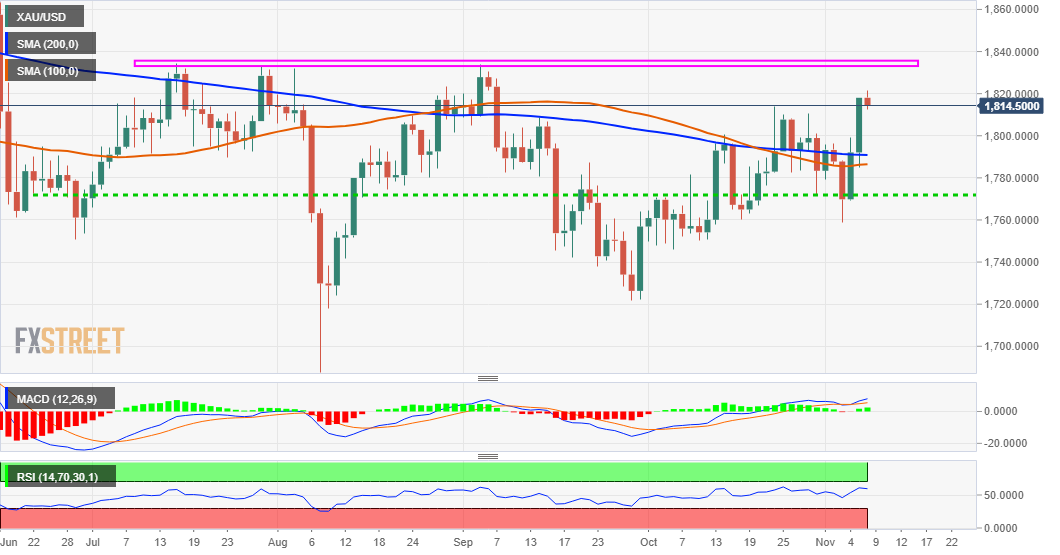
From a technical perspective, last week's sustained break through the $1,800 mark and acceptance above the $1,1810 level favours bullish traders. Hence, some follow-through strength towards testing a strong barrier, around the $1,832-34 heavy supply zone, remains a distinct possibility. That said, weakness below the $1,800 mark might prompt some long-unwinding and drag gold back towards the $1,780 level en-route the $1,770 support zone.
Levels to watch
GBP/USD failed to break above 1.3500 on Friday. The pair has started the new week on the back foot and it is set to struggle to rebound as Brexit tensions escalate, FXStreet’s Eren Sengezer reports.
Reescalating Brexit tensions seem to be forcing investors to adopt a cautious stance
“Commenting on reports claiming that the UK could trigger Article 16, Ireland’s Foreign Minister Simon Coveney told RTE News on Sunday that Britain was ‘deliberately forcing a breakdown’ over Brexit's Northern Ireland Protocol. Coveney further added that the EU could suspend the entire Brexit deal in case the UK was to trigger Article 16.”
“Unless the pair manages to make a daily close above 1.3500, recovery attempts are likely to remain limited in the near term with fundamental drivers remaining bearish.”
“Supports are located at 1.3400 (psychological level, static support, 2021 low) aligns as the first target before 1.3360 (static level) and 1.3300 (psychological level).”
See: GBP/USD continues to make its way lower towards the 1.3166 mark – DBS Bank
- GBP/USD witnessed some intraday selling on Monday, though lacked follow-through.
- A combination of factors acted as a tailwind for the USD and exerted some pressure.
- Dovish BoE, Brexit worries weighed on the sterling and contributed to the selling bias.
- The attempted recovery from mid-1.3400s runs the risk of fizzling out rather quickly.
The GBP/USD pair quickly recovered around 35 pips from early European session lows, albeit remained well below the key 1.3500 psychological mark.
The US dollar kicked off the new week on a positive note amid a solid rebound in the US Treasury bond yields. Despite the Fed's dovish outlook, investors seem convinced that the US central bank would be forced to adopt a more aggressive policy response to contain stubbornly high inflation. Apart from this, the cautious market mood further underpinned the greenback's relative safe-haven status and exerted some downward pressure on the GBP/USD pair.
On the other hand, the British pound was weighed down by the Bank of England's surprise decision last week to hold interest rates steady. This comes on the back of worries that the UK government will trigger Article 16 of the Northern Ireland Protocol further acted as a headwind for the sterling. The GBP/USD pair, however, managed to find decent support near mid-1.3400s, though the attempted recovery lacked follow-through or bullish conviction.
The fundamental backdrop seems tilted firmly in favour of bearish traders and any subsequent move up might still be seen as a selling opportunity. There isn't any major market-moving economic data due for release on Monday, either from the UK or the US. This further makes it prudent to wait for a sustained strength beyond the 1.3500 mark before confirming that the GBP/USD pair might have bottomed out and positioning for any further appreciating move.
Later during the US session, traders will take cues from Fed Chair Jerome Powell's remarks at an online conference. This, along with the US bond yields and the broader market risk sentiment, will drive the USD demand. Apart from this, BoE Governor Andrew Bailey's comments will influence the GBP and provide some impetus to the GBP/USD pair. The key focus, however, will remain on Wednesday's release of the latest US consumer inflation figures.
Technical levels to watch
The USD/CNH pair is little changed at 6.3970. Economists at Société Générale expect to see a short-term bounce towards 6.4250.
Critical hurdle seen at 6.4650
“A short-term bounce towards 6.4250 is not ruled out.”
“Daily Ichimoku cloud at 6.4650 will be a crucial hurdle.”
On Friday, EUR/USD did trade a new low for the year at 1.1514 but fought back and returned over 1.1550. The pair consolidates around this level and could see a leg higher towards the 1.1610 mark, then 1.1700, economists at Société Générale report.
Holding above 1.1495/1.1450 is crucial to see a rebound
“EUR/USD briefly violated the lows of October however formation of a daily Hammer candlestick denotes possibility of an initial bounce.”
“It is worth noting that the pair is not far away from potential support of 1.1495/1.1450 representing the peak of March 2020 and monthly Ichimoku cloud. Defending this zone can result in a rebound towards 1.1610 and the graphical levels of 1.1700. This would be a decisive resistance.”
GBP/USD has been going through a recent rough patch. A break under recent 1.3412 lows would mean a bearish triangle remains in play with better support coming in towards the 200-week moving average pegged at 1.3166, Benjamin Wong, Strategist at DBS Bank, reports.
Bears going through the gears
“On the daily Ichimoku charts, there are two points to observe. GBP’s post-BoE risk event’s decline stalled into the 1.3412 prior low. This can naturally conjure a simple double bottom setup and has seen downside momentum recede a tad on the DMI ADX readings. However, for GBP to regain composure, it must progress over the intermediate cloud resistance at 1.3698 (and the key moving average at 1.3835).”
“Brexit concerns return. There remains a threat that the UK’s Brexit negotiator David Frost may trigger Article 16 (of the Northern Ireland Protocol). This has naturally drawn fire from both the European Union (EU) and the Irish. A suspension of what was agreed prior infers a UK-EU trade war, and is GBP negative.”
“The retreat is guided by a bearish triangle breakout, with the possibility of GBP doing a 38.2% Fibonacci correction of 1.1412-1.4248 (Covid flash lows to late-May highs), which calibrates at 1.3158. A move here has to contend with 1.3201 as well, which is currently the weekly Ichimoku’s cloud support. Additionally, we remain biased to turn long around the 200-week moving average 1.3166.”
See – GBP/USD: Break below September low of 1.3411 to open up 1.3165 – Commerzbank
EUR/CHF is losing downside momentum on approach to the 1.0505 2020 low. Karen Jones, Team Head FICC Technical Analysis Research at Commerzbank, warns that a break below this level would open up the 1.0255 April low.
Negative below the 55-DMA at 1.0759
“EUR/CHF is losing downside momentum as it approaches the 1.0505 2020 low, we would allow for this to hold the initial test. Below here will target the 1.0255/35 April 2015 low and 50% retracement of the move 2015-2018.”
“Rallies will find nearby resistance at the 1.0629.23, the November 2020 low and the 2016 low. Near-term rallies will find additional resistance at the 1.0666 downtrend and the 1.0696 19th August low.”
“The 55-day moving average lies at 1.0759 and the market will stay offered while capped there.”
The US dollar remains at weaker levels after the sell-off later on Friday. President Biden’s pick for Fed Chair is coming into greater focus as the potential choice of Fed Governor Lael Brainard presents a high downside risk for the US dollar, economists at MUFG Bank report.
US yields continued to correct lower
“The tightening labour market will keep pressure on the Fed to keep tightening policy going forward, and speed up rate hike plans if labour force participation does not improve as expected.”
“The Fed did not directly pushback against higher yields at last week’s FOMC meeting but neither did it provide any encouragement for the market to price in earlier rate hikes. The improvement in risk sentiment has likely taken some of the shine of the US dollar. Less upward pressure on rates at the short end of the curve has also encouraged investors to take advantage of higher yields on offer at the long end of the curve.”
“There have been reports that President Biden has spoken to both Fed Chair Powell and Fed Governor Lael Brainard at the White House last week as he weighs up his picks for the Fed leadership. The potential appointment of Lael Brainard poses the main downside risk for the US dollar in the near-term. Market participants would expect the Fed to be even more cautious about tightening policy under her leadership.”
See – USD has room to strengthen as focus moves back to relative FX stories – HSBC
- The USD kicked off the new week on a positive note amid rebounding US bond yields.
- The cautious market mood was seen as another factor underpinning the safe-haven USD.
- The uptick lacked bullish conviction as focus now shifts to the US CPI report on Wednesday.
The US Dollar Index climbed to fresh daily tops, around the 94.35 region during the early European session, albeit lacked follow-through momentum.
A combination of factors assisted the USD to attract some buying on the first day of a new week and stall its retracement slide from YTD tops touched in reaction to the upbeat US NFP report. As investors looked past last week's dovish FOMC statement, the US Treasury bond yields staged a solid rebound on Monday and underpinned the greenback.
The US central bank announced to lower its monthly asset purchases by $15 billion, though stuck to transitory inflation narrative at the end of November policy meeting last Wednesday. Adding to this, Fed Chair Jerome Powell – in the post-meeting press conference – said that policymakers were in no rush to hike borrowing costs.
Investors, however, seem convinced that the Fed would be forced to adopt a more aggressive policy response to contain stubbornly high inflation. This, in turn, triggered a fresh leg up in the US bond yields. Apart from this, the cautious market mood was seen as another factor that underpinned the greenback's relative safe-haven status.
That said, the uptick lacked bullish conviction as investors preferred to wait on the sidelines ahead of this week's release of the latest consumer inflation figures on Wednesday. In the meantime, the US bond yields and the broader market risk sentiment will influence the USD ahead of Fed Chair Jerome Powell's remarks at an online conference.
Technical levels to watch
The Federal Reserve (Fed) will start tapering this month, while the European Central bank (ECB) said it is “very unlikely” to raise rates in 2022 and the Bank of England (BoE) surprised markets by holding rates. Economists at HSBC expect GBP/USD to be somewhat range-bound in the months ahead.
EUR to underperform the USD in the months ahead
“The FX market has returned to the ‘relative’ stories once again where the outlook for the Fed’s monetary policy remains in contrast to that for other central banks, for example, the very dovish guidance being provided by the ECB. The case for the EUR as a funding currency (which often has a low-interest rate) continues to build. As such, we expect the EUR to underperform the USD in the months ahead.”
“The BoE voted 7-2 to keep its policy rate at 0.10%. The MPC also voted 6-3 to continue with the existing quantitative easing (QE) programme, which in any case is scheduled to end next month. The BoE cut its growth projections but raised its inflation projections for this year and next. All this suggests ‘modest’ tightening is coming. A rate hike in February 2022 is our economists’ base case, while the 16 December meeting is very much live.”
“Beyond the BoE’s fairly hawkish hold, we remain cautious on the GBP, given the likely limited scale of rate hikes going forward, a deteriorating current account deficit, and less fiscal support for the UK economy than before.”
EUR/GBP rallied higher after the Bank of England decision and on Friday hit the 200-day moving average (DMA) at 0.8585. Karen Jones, Team Head FICC Technical Analysis Research at Commerzbank, expects the pair to reach the 0.8659/73 May highs.
Rally has reached the 200-DMA at 0.8585
“The 200-DMA at 0.8585 has so far held on a closing basis and we may see some near-term consolidation, but upside risks remain.”
“Above 0.8585, the pair will signal scope to revisit the 0.8659/73 highs since May. Above 0.8673 lies the 0.8722 April high.”
“Initial support is 0.8464. Below 0.8464 would negate upside pressure and allow for a retest of the 0.8402 October low.”
Global moves in elections, COVID-19 restrictions and energy prices are having ripple effects across markets. How should investors think about these dynamics for Asia and EM equities? Jonathan Garner, chief Asia and Emerging Markets Equity Strategist for Morgan Stanley Research, brings his perspectives.
Time to move to the sidelines for Indian equities
“We continue to prefer Japan to Non-Japan Asia and Emerging Markets. Japan has outperformed Emerging Markets by 500 basis points year to date but remains cheaper to its own recent valuation history than Emerging Markets and with stronger upward earnings revisions. The broad contours of market-friendly macro and micro policy in Japan are likely to continue.”
“We are most constructive on Eastern Europe, Middle East and Africa and in particular Russia, Saudi Arabia and UAE, which are positively leveraged to rising energy prices. We are also warming up to ASEAN, having upgraded Indonesia to overweight alongside our existing overweight on Singapore. ASEAN economies are finally beginning to reopen post-COVID, which is stimulating domestic consumption.”
“We have recommended taking profits on Indian equities after a year of exceptionally strong performance.”
Within Latin America, we have established a clear preference for Chile versus Brazil on relative economic momentum and export price dynamics.”
“We remain underweight Taiwan and equal weight China. Although valuations have improved in pockets, we expect further earnings downgrades for China and await a clearer pickup in growth and liquidity before turning more constructive.”
USD/JPY stays relatively quiet around mid-113.00s on Monday. Karen Jones, Team Head FICC Technical Analysis Research at Commerzbank, notices that a break below 113.26 would clear the way for a potential slump to the 111.66 July high.
USD/JPY targets 114.55 while above 113.26
“USD/JPY is consolidating above 113.26, it is on the defensive and looks increasingly toppy.”
“Should a close below the 113.26 recent low be seen we would allow for a deeper sell-off to 112.56, the 38.2% retracement, and potentially the 111.66 July high.”
“While above the 113.26 support, scope will remain for 114.55/69 the November 2017 high and recent high. Above 114.55/69 we have 115.60, the 61.8% retracement of the move down from 2015 and then the 117.06 the 1998-2021 resistance line.”
- NZD/USD gained strong follow-through traction on the first day of a new week.
- A subdued USD price action was seen as a key factor that provided a goodish lift.
- Rebounding US bond yields should limit the USD losses and cap gains for the pair.
The NZD/USD pair edged higher through the early European session and climbed to two-day tops, closer to mid-0.7100s in the last hour.
A combination of factors assisted the NZD/USD pair to attract some dip-buying near the 0.7100 mark on the first day of a new week and build on Friday's goodish rebound from near three-week lows. Rising bets for another rate hike by the RBNZ acted as a tailwind for the kiwi and provided a goodish lift to the major amid a subdued US dollar price action.
Last week, the US central bank reiterated that the inflation is transitory, while Fed Chair Jerome Powell said that policymakers were in no rush to hike borrowing costs. This, in turn, kept the USD bulls on the defensive through the early part of the trading action on Monday, though rebounding US Treasury bond yields helped limit any deeper losses.
Apart from this, the cautious market mood further held traders from placing aggressive bearish bets around the safe-haven greenback and might cap gains for the perceived riskier kiwi. This warrants some caution before positioning for any further appreciating move for the NZD/USD pair and confirming that the recent pullback from multi-month tops has run its course.
There isn't any major market-moving economic data due for release from the US on Monday. Hence, the broader market risk sentiment, along with the US bond yields will influence the USD price dynamics and provide some impetus to the NZD/USD pair. Traders might further take cues from Fed Chair Jerome Powell's remarks at an online conference for short-term opportunities.
Technical levels to watch
AUD/USD has recently failed at the 200-day moving average (DMA) at 0.7551 and last week broke down further. Karen Jones, Team Head FICC Technical Analysis Research at Commerzbank, notes that the aussie is set to tackle the 55-DMA at 0.7360. A break below here would open up 0.7171.
Rallies to be capped at the 0.7450 level
“AUD/USD is poised to encounter the 55-DMA at 0.7360. Failure here will target the base of the channel at 0.7241 and the 29th September low at 0.7171.
“Intraday Elliott wave counts are implying rallies to 0.7450 will struggle.”
NZD/USD ended the week stronger, with the USD under pressure as markets eye a patient approach from the Fed despite US jobs strength. Economists at ANZ Bank expect the kiwi to struggle to see further gains as the economy stalls.
US NFP rose more than expected
“Stronger US jobs data did little to alter market participants’ view that the Fed is likely to remain patient, and that there is still a lot of water to flow under the proverbial bridge before the Fed actually hikes rates, and that weighed on the USD.”
“We have sympathy with the view that the best is behind us insofar as NZ data surprises go, and the Delta situation will clearly get worse before it gets better. That may not drive the NZD lower, at least while the RBNZ is hiking, but it may cap its topside potential.”
“Support 0.6860/0.6900 – Resistance 0.7215/0.7310”
GBP/USD suffered heavy losses following the Bank of England's decision to leave its policy rate unchanged last week. Karen Jones, Team Head FICC Technical Analysis Research at Commerzbank, notes that the cable could plummet to 1.3165 on a break below the 1.3411 September low.
Attention is on the 1.3411 September low
“GBP/USD sold off last week after the BoE decision and starts this week with attention on the 1.3411 recent low.”
“Rallies will find initial resistance at the 55-DMA at 1.3699 and the market will stay directly offered while below there.”
“Below 1.3411 we have little until the 200-week ma at 1.3165.”
- USD/JPY regained some positive traction on Monday, though lacked bullish conviction.
- Rebounding US bond yields turned out to be a key factor that extended some support.
- A subdued USD demand might cap gains for the major amid the cautious market mood.
The USD/JPY pair maintained its bid tone heading into the European session and was last seen trading near daily tops, just above mid-113.00s.
The pair attracted some dip-buying on the first day of a new trading week and recovered a major part of Friday's losses to the 113.30-25 horizontal support. Rebounding US Treasury bond yields underpinned the US dollar and turned out to be a key factor that acted as a tailwind for the USD/JPY pair.
The greenback was further supported by the upbeat US NFP report, which showed that the economy created 531K jobs in October. Moreover, figures for the previous two months were also revised higher to show an additional 235,000 jobs, though the Fed's dovish outlook capped the upside for the greenback.
As was widely expected, the US central bank last week announced to lower its monthly asset purchases by $15 billion and reiterated that the inflation is transitory. In the post-meeting press conference, Fed Chair Jerome Powell said that policymakers were in no rush to hike borrowing costs.
Apart from this, a cautious market mood could lend some support to the safe-haven Japanese yen and keep a lid on any runaway rally for the USD/JPY pair, at least for the time being. This, in turn, warrants some caution for bullish traders and positioning for any meaningful appreciating move.
There isn't any major market-moving economic data due for release from the US on Monday, leaving the greenback at the mercy of the US bond yields. Later during the US session, Powell's remarks at an online conference might influence the USD and produce some trading impetus to the USD/JPY pair.
Technical levels to watch
EUR/USD seems to have gone into a consolidation phase a little above mid-1.1500s after dropping toward 1.1500 on Thursday. Karen Jones, Team Head FICC Technical Analysis Research at Commerzbank, expects the pair to stage a minor bounce towards the 1.1675 downtrend.
New lows for the year not maintained
“EUR/USD last week eroded the 1.1522 October low but did not maintain the break.”
“We may see a small bounce higher but the pair stays directly offered below the 1.1675 five-month downtrend.”
“For now, attention is on the 50% retracement of the move from 2020 and the March 2020 high at 1.1492/95. Key support is the previous downtrend (from 2008) which is now located at 1.1366.”
FX option expiries for November 8 NY cut at 10:00 Eastern Time, via DTCC, can be found below.
- EUR/USD: EUR amounts
- 1.1550 470m
- 1.1600 550m
- 1.1785 641m
- GBP/USD: GBP amounts
- 1.3350 360m
- USD/JPY: USD amounts
- 114.25 1.1b
- AUD/USD: AUD amounts
- 0.7500 378m
- EUR/GBP: EUR amounts
- 0.8575 1.1b
In an interview to El País – a Spanish-language daily newspaper – the European Central Bank (ECB) Chief Economist, Philip Lane, was noted saying that the current period of inflation is very unusual and temporary.
Key quotes:
- Inflation is unexpectedly high at the moment but it's not a sign of a chronic situation.
- We believe there are strong reasons for inflation to fall next year.
- Supply bottlenecks will largely be fixed next year.
- Energy demand forecasts have also fallen short due to the rapid pace of recovery.
- These headaches are not going to eliminate the basic dynamism of recovery.
- Will ensure that Europe has a strong recovery and that it is not derailed by an unnecessary adjustment of financing costs.
Market reaction
The headlines did little to influence the shared currency, or provide any impetus to the EUR/USD pair, which extended its sideways consolidative price action about mid-1.1500s.
Here is what you need to know on Monday, November 8:
The US Dollar Index pulled away from the 2021-high it set at 94.62 on Friday but managed to close the second straight week in the positive territory, supported by the upbeat October jobs report. In the absence of high-tier macroeconomic data releases, markets started the new week in a quiet manner and investors will keep a close eye on central bank speakers on Monday. FOMC Chairman Jerome Powell will deliver the opening remarks at a virtual conference titled 'Gender and the Economy Conference'. New York Federal Reserve President John Williams, Fed Vice Chair Richard Clarida, Fed Governor Bowman and Bank of England (BoE) Governor Andrew Bailey will also be speaking later in the day.
On Friday, the US Bureau of Labor Statistics announced that Nonfarm Payrolls (NFP) rose by 531,000 in October, surpassing the market expectation of 425,000. Wall Street's main indexes finished the week at new all-time highs but US stock index futures are losing between 0.15% and 0.35% in the early European session on Monday. Meanwhile, the 10-year US Treasury bond yield, which lost nearly 10% in the second half of the week, is trying to stage a rebound toward 1.5%. Late Friday, US Democrats passed a $1 trillion infrastructure bill.
EUR/USD seems to have gone into a consolidation phase a little above mid-1.1500s after dropping toward 1.1500 on Thursday. Sentix Investor Confidence for November will be featured in the European economic docket.
GBP/USD suffered heavy losses following the BoE's decision to leave its policy rate unchanged last week. In an interview with Bloomberg TV, Governor Bailey said that it's not their job to guide financial markets on interest rates. With the BoE event out of the way, investors will shift their attention to headlines surrounding Brexit talks.
USD/JPY edged lower amid falling US T-bond yields in the second half of the previous week and stays relatively quiet around mid-113.00s on Monday. The Bank of Japan's 'Summary of Opinions' of its October policy meeting showed that the recent JPY weakness was a reflection of the differential in inflation, monetary policy stance between Japan and other countries.
Gold capitalized on falling US T-bond yields and broke above several key resistance levels to end the week at its strongest level since early September near $1,820. XAU/USD looks to extend its rally as technical indicators point to a bullish shift in the near-term outlook.
Cryptocurrencies: Following a two-week consolidation phase above $60,000, Bitcoin regained its traction and broke above $65,000 on Monday. The all-time high for BTC sits at $67,000. Ethereum preserves its bullish momentum at the start of the week and trades above $4,700.
- USD/CAD struggled for a firm direction and oscillated in a range on Monday.
- Bullish oil prices underpinned the loonie and capped the upside for the pair.
- A combination of factors extended some support to the USD and the major.
The USD/CAD pair remained confined in a narrow trading band through the Asian session and was last ween hovering in the neutral territory, around mid-1.2400s.
A combination of factors failed to provide any meaningful impetus to the USD/CAD pair, instead led to a subdued/range-bound price action on the first day of a new week. Crude oil prices built on Friday's goodish bounce from near one-month lows and edged higher for the second successive day. This, in turn, underpinned the commodity-linked loonie and acted as a headwind for the major.
On the other hand, the Fed's dovish outlook kept the US dollar bulls on the defensive and further collaborated to keep a lid on any meaningful upside for the USD/CAD pair. It is worth recalling that the US central bank stuck to its transitory inflation narrative last Wednesday, while Fed Chair Jerome Powell reiterated that policymakers were in no rush to hike borrowing costs.
That said, a solid rebound in the US Treasury bond yields, along with Friday's upbeat US monthly jobs report and a softer rise tone, helped limit losses for the safe-haven greenback. This, in turn, warrants some caution for bearish traders and before positioning for any meaningful corrective slide for the USD/CAD pair from the 1.2480 region, or near one-month tops touched on Friday.
There isn't any major market-moving economic data due for release on Monday, leaving the USD at the mercy of the US bond yields and the broader market risk sentiment. Apart from this, oil price dynamics might provide some impetus to the USD/CAD pair. Traders will further take cues from Fed Chair Jerome Powell's remarks at an online conference later during the US session.
Technical levels to watch
- A subdued USD demand assisted AUD/USD to gain some positive traction on Monday.
- A combination of factors acted as a tailwind for the USD and capped any further gains.
- The market focus will be on the latest US consumer inflation figures due on Wednesday.
The AUD/USD pair traded with a mild positive bias through the Asian session, though lacked any follow-through buying beyond the 0.7400 mark.
The pair struggled to capitalize on Friday's goodish rebound from the post-NFP swing lows to multi-week lows and witnessed subdued/range-bound price moves on the first day of a new week. Against the backdrop of the upbeat US monthly jobs report, a solid rebound in the US Treasury bond yields acted as a tailwind for the US dollar and capped the upside for the AUD/USD pair.
Apart from this, a cautious mood around the Asian equity markets further held traders from placing bullish bets around the perceived riskier aussie. That said, the Fed's dovish outlook kept a lid on any meaningful gains for the greenback and extended some support to the AUD/USD pair. It is worth recalling that the Fed last week reiterated that inflation is transitory.
In the post-meeting press conference, Fed Chair Jerome Powell said that policymakers were in no rush to hike borrowing costs. He also added that the current level of inflation is not consistent with price stability and that the central bank would use tools as appropriate to get it under control. Hence, the focus shifts to the US consumer inflation figures due on Wednesday.
In the meantime, the US bond yields, along with the broader market risk sentiment will influence the USD price dynamics and provide some impetus to the AUD/USD pair. Later during the US session, traders will take cues from Powell's remarks at an online conference for some short-term opportunities around the AUD/USD pair.
Technical levels to watch
- EUR/USD was seen oscillating in a range during the early part of the trading action on Monday.
- A combination of factors continued underpinning the USD and capped the upside for the major.
- Dovish Fed outlook held the USD bulls from placing aggressive bets and extended some support.
The EUR/USD pair lacked any firm directional bias and seesawed between tepid gains/minor losses, around mid-1.1500s through the Asian session.
The pair struggled to capitalize on the previous session's modest recovery move from the post-NFP swing lows to the lowest level since July 2020 and oscillated in a narrow range during the early part of the trading action on Monday. A softer risk tone around the Asian equity markets, along with a solid rebound in the US Treasury bond yields underpinned the US dollar and acted as a headwind for the EUR/USD pair.
The greenback was further supported by Friday's upbeat US monthly jobs report, which showed that the economy created 531,000 new jobs in October. Moreover, figures for August and September were also revised higher to show an additional 235,000 jobs over those months. That said, the Fed's dovish outlook held the USD bulls from placing aggressive bets and extended some support to the EUR/USD pair, at least for now.
As was widely expected, the US central bank last week announced a reduction of $15 billion to its monthly asset purchases. In the post-meeting press conference, Fed Chair Jerome Powell reiterated that inflation is transitory and that policymakers were in no rush to hike borrowing costs. This, in turn, failed to provide any meaningful impetus to the greenback and led to subdued/range-bound price action around the EUR/USD pair.
There isn't any major market-moving economic data due for release on Monday, either from the Eurozone or the US. Hence, the focus will be on Powell's remarks at an online conference later during the US session, which will influence the USD price dynamics and produce some trading opportunities around the EUR/USD pair.
Technical levels to watch
- Gold price hits fresh two-month highs above $1,820 on Monday.
- Gold ignores strong NFP but rebound in yields, USD could cap the rally.
- Gold price turns bullish on falling bond yields, technical breakout.
Gold price remains on track for additional upside, as buyers seize control above the $1,800 mark after the solid comeback seen in the previous week. The Fed’s dovish stance on interest rates hike combined with lower levels of US labor force participation bolstered gold’s upsurge. However, the latest rebound in the US dollar alongside the Treasury yields, despite the cautious risk tone, could likely threaten gold’s bullish streak ahead of Fed Chair Jerome Powell’s speech.
Read: Gold Chart of the Week: Bulls not going down without a fight
Gold Price: Key levels to watch
The Technical Confluences Detector shows that gold is challenging the previous high one-hour at $1,821.
On buying resurgence, gold price could see a quick advance towards the pivot point one-day R1 at $1,830.
The next upside barrier is envisioned at $1,834, September highs. A firm break above the latter could open doors towards $1,838, the pivot point one-week R1.
On the flip side, sellers need acceptance below a dense cluster of healthy support levels around $1817 to temporarily negate the upside momentum.
That level is the confluence of the pivot point one-month R1 and the previous low four-hour.
The previous month’s high of $1814 will be next on the bears’ radars. Further south, the Fibonacci 23.6% one-day at $1810 will be targeted.
A breach of the latter will fuel a fresh downswing towards $1805, where the Fibonacci 23.6% one-week coincides with the Fibonacci 38.2% one-day.
Here is how it looks on the tool
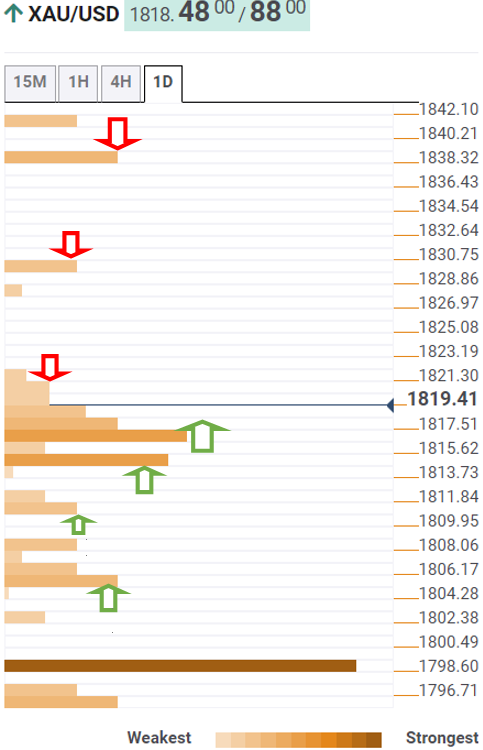
About Technical Confluences Detector
The TCD (Technical Confluences Detector) is a tool to locate and point out those price levels where there is a congestion of indicators, moving averages, Fibonacci levels, Pivot Points, etc. If you are a short-term trader, you will find entry points for counter-trend strategies and hunt a few points at a time. If you are a medium-to-long-term trader, this tool will allow you to know in advance the price levels where a medium-to-long-term trend may stop and rest, where to unwind positions, or where to increase your position size.
- GBP/USD reverses Friday’s rebound, two-month lows back in sight.
- Cautious BOE, USD bounce and Brexit woes weigh on the cable.
- Bearish daily RSI points to more weakness on the cards.
GBP/USD is reversing Friday’s swift pullback, as the bears fight back control, looking to retest the critical demand area around 1.3425.
The mixed market sentiment combined with escalating Brexit concerns take the wind out of GBP/USD brief recovery from two-month lows of 1.3424 reached Friday. Brexit News: UK appears set to trigger Article 16
Meanwhile, Bank of England (BOE) Governor Andrew Bailey’s weekend comments also undermine the sentiment around the pound. “I don’t think it’s our job to steer markets day by day and week by week,” Bailey told Bloomberg TV.
Next of relevance for the major remains the speeches by the Fed and BOE central banks’ Chiefs, scheduled later on Monday.
Looking at GBP/USD’s daily chart, the bears are looking to test the rising trendline support at 1.3427 after the recovery faltered near 1.3500.
A daily closing below the support line could fuel a fresh drop towards the 1.3411 September lows. Further south, the 1.3400 round number could be threatened.
The 14-day Relative Strength Index (RSI) is edging lower below the midline, keeping the bearish potential intact.
GBP/USD: Daily chart
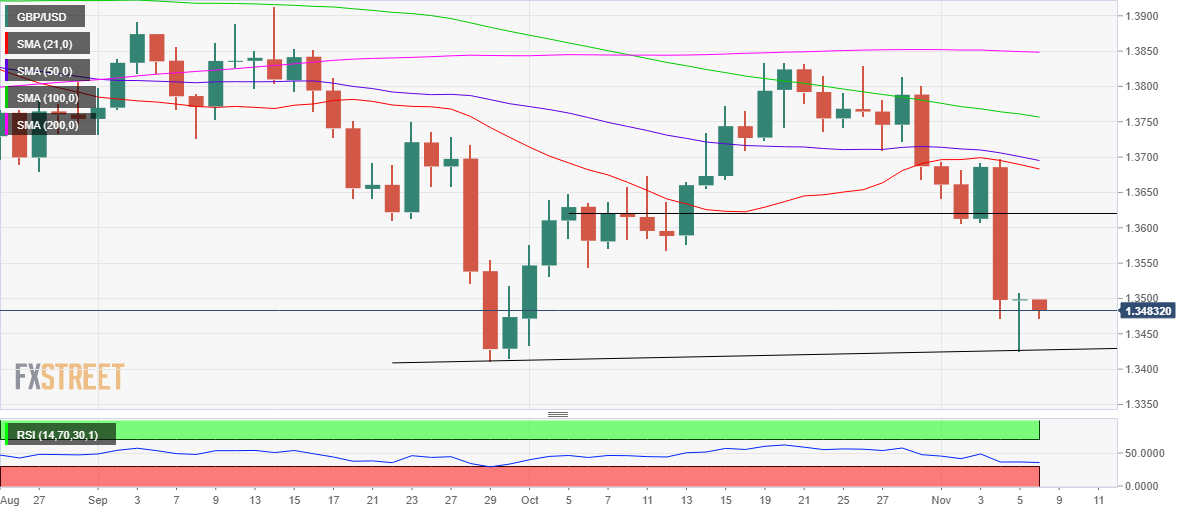
On the upside, the recovery needs to find acceptance above 1.3500 to take on the previous support now resistance at 1.3559.
The next significant resistance awaits at the 1.3600 psychological mark, which was a pivotal support a week ago.
GBP/USD: Additional levels to consider
Analysts at Goldman Sachs are confident that the world has overcome the worst supply chain crisis, citing the following reasons for their optimism on the resolution of supply chain bottlenecks.
Key quotes
“Shipping rates have generally declined from September's peak.”
“A number of companies have recently indicated optimism.”
“According to GXO Logistics, 'we're through the worst of it.’”
Related reads
- Moody's: US supply chains stress is intensifying, could slow economy in coming months
- China’s President Xi: Will ensure smooth supply chains
| Raw materials | Closed | Change, % |
|---|---|---|
| Brent | 83.25 | 1.56 |
| Silver | 24.151 | 1.62 |
| Gold | 1817.912 | 1.49 |
| Palladium | 2020.12 | 0.91 |
Defending his position after last Thursday’s push back against aggressive bets of tightening, Bank of England (BOE) Governor Andrew Bailey told Bloomberg TV that his remarks on the need to curb inflation before the meeting were “conditional”.
Additional quotes
“I don’t think it’s our job to steer markets day by day and week by week,”
“Pre-meeting comments were prompted by concern that falling bond yields could lead to a rise in inflationary pressures. “
“The bets after his remarks were “in the right direction, overdone.”
Market reaction
Amidst Brexit concerns and BOE’s dovishness, GBP/USD is resuming its downside momentum towards the two-month lows of 1.3424. At the time of writing, the cable is losing 0.13% on the day to trade at 1.3477.
The Japanese government is mulling an economic stimulus package worth more than JPY30 trillion ($265 billion) to ease the coronavirus pandemic-induced pain, Reuters reports, citing a story carried by Kyodo news late Sunday.
Additional takeaways
“Such a plan that would require issuing new debt.”
“Part of the spending will come from funds carried over from last year's budget.”
Among items expected to be included in the package was a restart of a domestic tourism promotion campaign and steps to realize a 10 trillion-yen fund for university research, the Sankei newspaper reported on Friday.
Market reaction
USD/JPY is little affected by these headlines, currently trading at 113.56, up 0.15% on the day.
- USD/INR bulls stepping in at critical daily support.
- A 50% mean reversion could be on the cards for the starting sesisons of the week.
USD/INR has been a slow-burning grind to the downside for the past several days and is now testing a critical layer of support as the last defence until a break of 74 the figure.
The bulls, however, could be seen here and a retracement to test the 74.40s could be on the cards for the forthcoming sessions. The following illustrates the landscape and prospects of a significant correction on the daily chart:
USD/INR daily chart
-637719325152923653.png)
There is a 50% mean reversion level that has a confluence of the prior support, at least from a closing basis, located near 74.40. A test there could be on the cards for the sessions at the start of the week before bears engage in force again.
With that being said, should the US dollar continue to slide, then bears will be keen to see a break of the 74 level that will expose 73.80support, an eara that should significant trading activity throughout the Sepetember business of this year.
- USD/TRY is picking up fresh bids after Friday’s retreat.
- Record highs of 9.85 eyed amid bullish RSI, as 21-SMA support holds.
- The pair eyes a symmetrical triangle breakout on the 4H chart.
USD/TRY is keeping its range play intact around 9.70 kicking off a new week, as bulls are looking to regain control after Friday’s brief retreat.
The US dollar is attempting a bounce across the board, lending support to the currency pair. Meanwhile, the lira continues to bear the brunt of the policy concerns, despite the government’s denial of a report that the finance minister had offered his resignation.
From a short-term technical perspective, USD/TRY is consolidating at the higher side of a potential symmetrical triangle formation spotted on the four-hour chart.
Bulls need a four-hourly candlestick closing above the falling trendline resistance at 9.76 to validate an upside breakout from the triangle.
The next relevant upside target will be the record high of 9.85. Above that, the 10.00 psychological level will be tested.
The Relative Strength Index (RSI) has edged slightly lower but remains well above the midline, keeping the buyers hopeful.
USD/TRY: Four-hour chart
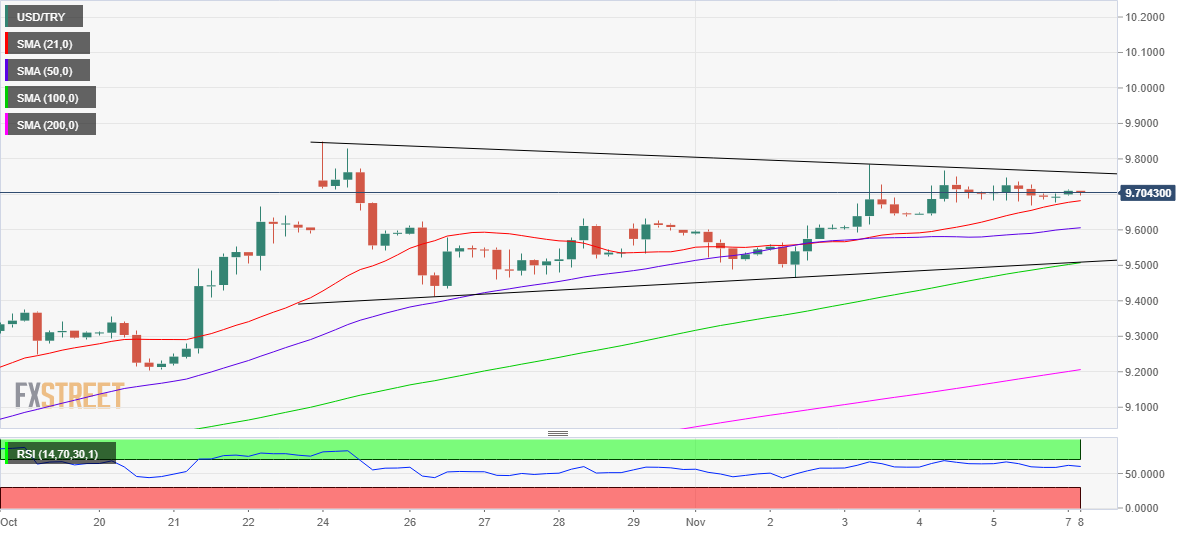
On the flip side, the 21-Simple Moving Average (SMA) at 9.67 offers powerful support to USD/TRY. A sustained break below the latter could expose the mildly bullish 50-SMA at 9.60.
If the bearish pressures accelerate, then a further drop towards 9.50 could be in the offing. That level emerges as a fierce cap, as it is a confluence of the 100-SMA and the rising trendline support.
TD Securities Head of Global Strategy Bart Melek expresses his afterthoughts on the US Nonfarm payrolls data and its impact on gold price.
Key quotes
“Gold rallied despite the US economy adding an impressive 531,000 positions and the unemployment rate dropping to 4.6% in October.”
“The reason for that was the unchanged participation rate, which remained at 61.6%.”
"That essentially means that the labor force participation is still at problematically low levels, and we are nowhere near full employment.”
"This is why markets are not pricing in the probability of Fed's tightening as imminent. Plus, it is doubtful that the strong job growth pace will continue for the next six months or a year."
“With the Fed's somewhat dovish tapering announcement and the jobs data in mind, the anticipated June rate hike is not looking very likely.”
"The Fed will keep monetary policy quite easy for a prolonged period because we are not near full employment. Fed's view is that keeping the economy hot will ultimately trigger the absorption of more people into the labor force. They need to reverse those mass resignations.”
In recent trade today, the People’s Bank of China (PBOC) set the yuan (CNY) at 6.3959 vs the previous fix of 6.3980 and the prior close of 6.3992.
About the fix
China maintains strict control of the yuan’s rate on the mainland.
The onshore yuan (CNY) differs from the offshore one (CNH) in trading restrictions, this last one is not as tightly controlled.
Each morning, the People’s Bank of China (PBOC) sets a so-called daily midpoint fix, based on the yuan’s previous day closing level and quotations taken from the inter-bank dealer.
- AUD/JPY bulls step in at support following Friday's rout in higher-yielding forex.
- Risk sentiment remains elevated but the bulls are taking charge regardless.
AUD/JPY is adding gains on the first day o the week as the Aussie gains traction with traders picking up the pieces leftover from Friday's rout in the higher-yielding currencies, such as the Aussie. AUD/JPY, at the time of writing, is trading at 84.05 and up some 0.18% after travelling from a low of 83.81 to a high of 84.13. 84.20 is a key resistance to break for the session ahead,
On Friday, USD/JPY spiked to 114.03 on the strong headline payrolls data but traders were quick to reverse their tact considering the harmony amongst central banks and a less hawkish stance. This led to a surge in fixed income and a drop in US treasury yields. Consequently, the higher yielders on forex bore the brunt of the sentiment which helped the yen climb to the top of the forex leaderboard. The risk-on sentiment weighed on on AUD/JPY also and we are now seeing some stability in today s markets from those moves.
Key data in focus
Meanwhile, for the week ahead, US Consumer Price Index and Aussie jobs will be the focus as traders try to assess the economic landscape while central banks depend on it. ''The Reserve Bank of Australia is upbeat on the labour market and expects jobs to fully recover to pre-Delta levels (Aug) by year-end,'' analysts at TD Securities said. ''There is still a shortfall of 284k jobs and jobs could return quickly given the easing in restrictions in NSW and VIC. The participation rate is expected to pick up to 65% in tandem with the reopening, bringing the u/e rate to 4.7% from 4.6%.''
As for CPI, the analysts at TDS explained that they are expecting inflation to slow significantly in 2022 as fiscal stimulus fades and supply constraints ease, but we don't expect the data to be validated in the very near term. ''The CPI probably rose rapidly in October, reflecting a surge in energy prices and a resumption of the uptrend in used vehicle prices after two declines. The health insurance part likely picked up as well.''
- AUD/USD’s rebound falters on Monday, as risk-aversion seeps in.
- 100-DMA is likely at risk once again after rejection above 0.7400.
- Bearish RSI favors the bears while 21-DMA offers stiff resistance.
AUD/USD has reversed the early bids while trading almost unchanged on the day just below 0.7400, as the bears return on Monday amid risk-aversion.
Growing concerns over rising inflation and its impact on the global economic recovery weigh on the investors’ sentiment, as major central banks, including the Reserve Bank of Australia (RBA), refrained from making a move on the interest rates in the previous week.
Additionally, the renewed uptick in the US Treasury yields is adding to the weakness in the aussie, with all eyes now turning towards Fed Chair Jerome Powell’s speech, US CPI data and the Australian jobs report due on the cards later this week.
Looking at AUD/USD’s daily chart, the major is looking to retest the critical 100-Daily Moving Average (DMA) support at 0.7379, having failed to find acceptance above the 0.7400 level for the second straight session.
The horizontal 50-DMA at 0.7367 will be next strong support, below which the sellers will look for fresh entries, which could drag the rates towards the 0.7300 threshold.
The 14-Day Relative Strength Index (RSI) is trading listlessly but still below the midline, suggesting that there is more room for the downside.
AUD/USD: Daily chart
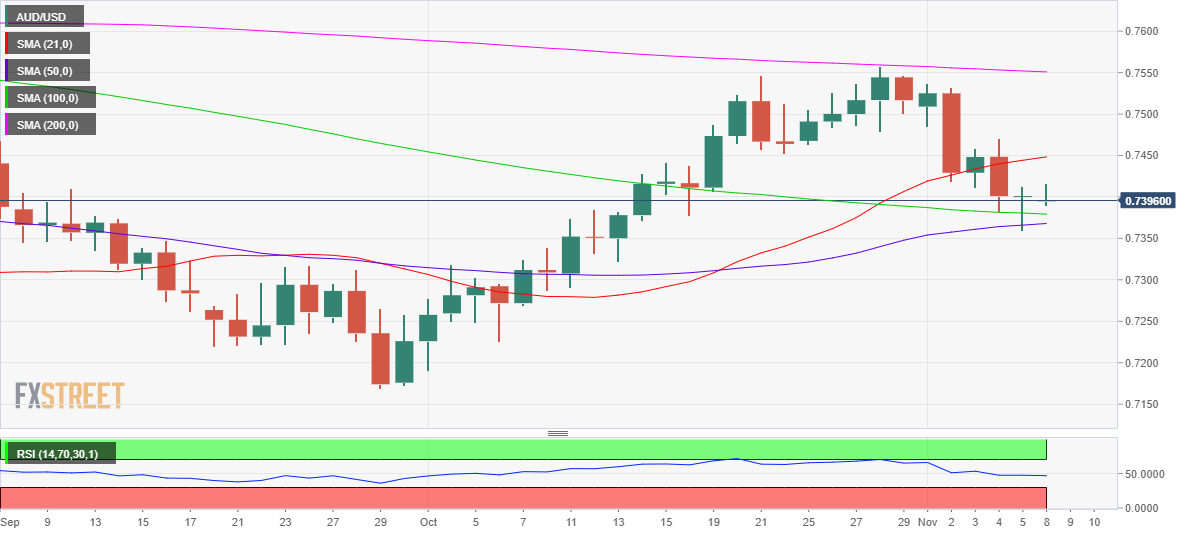
On the flip side, the aussie bulls will challenge the upward-pointing 21-DMA at 0.7448 should the 100-DMA hold the fort yet again.
Further up, a rally towards Thursday’s high of 0.7471 cannot be ruled out. The next relevant upside barrier for the pair is placed at the 0.7500 round figure.
AUD/USD: Additional levels to consider
- GBP/JPY bulls are seeking a significant correction from daily support.
- Bulls need to clear the 4-hour resistance near 153.50.
GBP/JPY is on the verge of a significant correction from the daily support that is illustrated in the following analysis of the daily and 4-hours charts below.
GBP/JPY daily chart
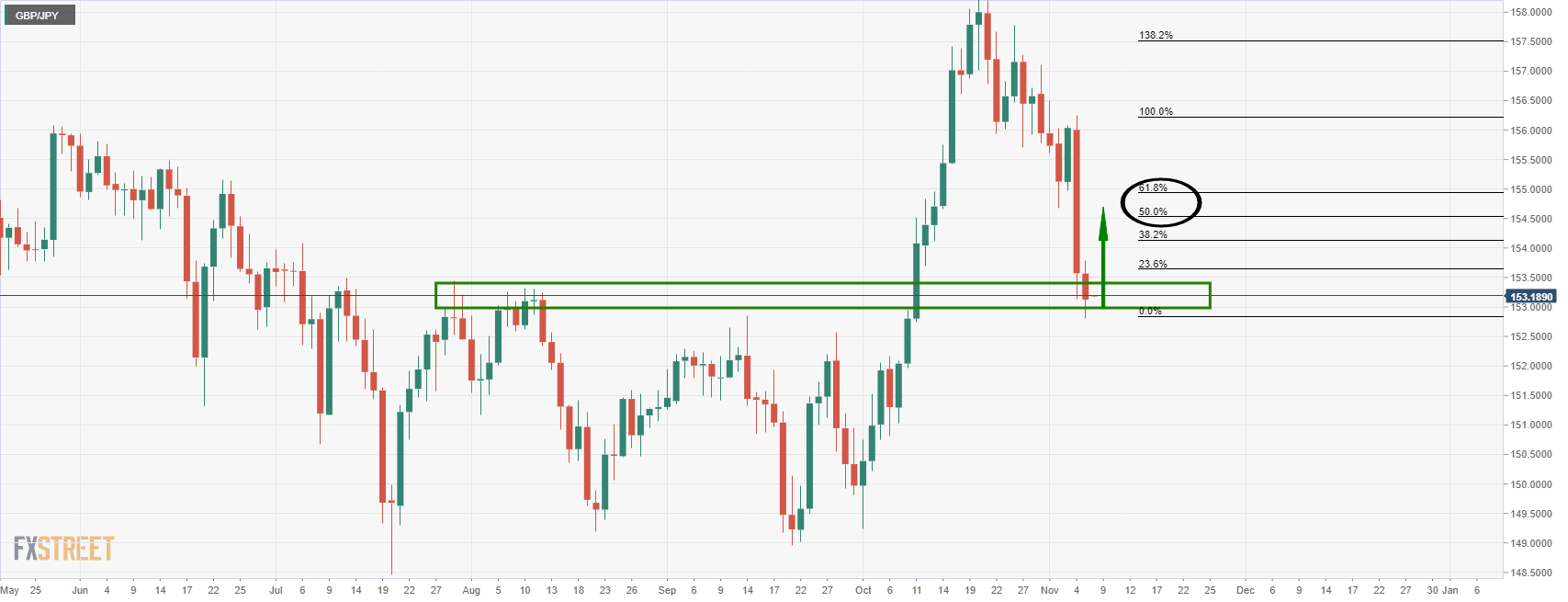
The price is meeting a compelling level of support at this juncture which gives rise to the prospects of a significant correction back into the 50% mean reversion of the bearish impulse. Beyond there, the 61.8% Fibonacci level could be targeted with 155 on the bull's radar.
GBP/JPY 4-hour chart
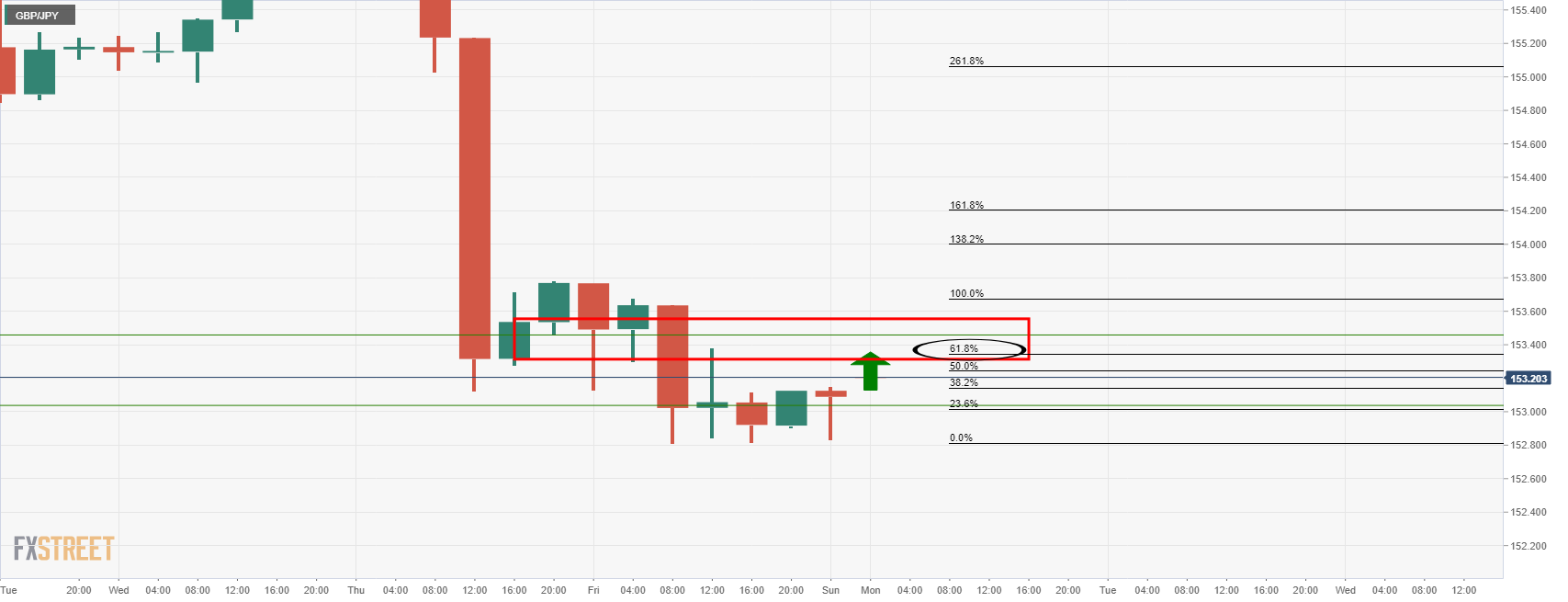
The 4-hour chart is bullish into the 61.8% Fibonacci of the latest bearish impulse which targets the 153.35s and the neckline of the M-formation's neckline. A break there will open risk towards the daily chart's targets as illustrated above.
| Time | Country | Event | Period | Previous value | Forecast |
|---|---|---|---|---|---|
| 05:00 (GMT) | Japan | Leading Economic Index | September | 101.3 | |
| 05:00 (GMT) | Japan | Coincident Index | September | 91.3 | |
| 06:45 (GMT) | Switzerland | Unemployment Rate (non s.a.) | October | 2.6% | 2.6% |
| 12:00 (GMT) | Eurozone | Eurogroup Meetings | |||
| 14:00 (GMT) | U.S. | FOMC Member Clarida Speaks | |||
| 15:30 (GMT) | U.S. | Fed Chair Powell Speaks | |||
| 17:00 (GMT) | U.S. | FOMC Member Bowman Speaks | |||
| 21:00 (GMT) | U.S. | FOMC Financial Stability Report | |||
| 23:30 (GMT) | Japan | Labor Cash Earnings, YoY | September | 0.7% | |
| 23:50 (GMT) | Japan | Current Account, bln | September | 1665.6 | 1060.1 |
US President Biden is looking at the Strategic Petroleum Reserve (SPR) release, in order to reduce gas prices, the country’s Energy Secretary Jennifer Granholm said while speaking on CNN’s “State of the Union” on Sunday.
Key quotes
"The president is all over this."
"I think we'll be looking at that forecast that's coming out on Tuesday."
On Friday, Granholm called on oil-producing nations to immediately increase crude supplies to mitigate the surging cost of living.
Read: WTI is starting the week off better bid, eyes on $82.00
| Pare | Closed | Change, % |
|---|---|---|
| AUDUSD | 0.74023 | 0.03 |
| EURJPY | 131.149 | -0.19 |
| EURUSD | 1.1566 | 0.12 |
| GBPJPY | 153.021 | -0.31 |
| GBPUSD | 1.34939 | -0 |
| NZDUSD | 0.71196 | 0.2 |
| USDCAD | 1.24556 | -0 |
| USDCHF | 0.91208 | -0.03 |
| USDJPY | 113.391 | -0.31 |
- WTI bulls stay in charge at the start of the week and eye the $82 area.
- Markets continue to price the OPEC+ Group rebuff of the US call to boost supplies.
Crude prices climbed by more than 2% on Friday on renewed supply concerns after OPEC+ producers rebuffed a US call to accelerate output increases even as demand nears pre-pandemic levels. On Monday, the bulls remain in control and West Texas Intermediate (WTI) crude oil has added 0.2% so far. WTI has moved from a low of $81.07 to a high of $81.75 as traders continue to price the OPEC+ Group rebuff of the US call to boost supplies beyond its schedule of 0.4-million-barrels per day monthly increases.
The cartel's decision came as it expects demand in the fourth quarter of this year and the first quarter of next year will be weak. ''OPEC's message to consumer nations was resoundingly clear—not only has the group of producers eased fears of a faster pace of output hikes, but it has clarified that member nations won't compensate for those who are underproducing relative to their quotas,'' analysts at TD Securities explained. ''This suggests that the very cautious pace of output hikes should keep energy markets on a tightening trajectory in the near term.''
Meanwhile, the number of oil rigs operating in the US rose by six this week, according to data compiled by energy-services firm Baker Hughes (BKR). Reuters reported that the count ended at 450 in the seven days through Friday, quoting Baker Hughes. ''A year earlier, the US had 226 oil rigs in operation. Oil and gas rigs in the US rose by six to 550. Gas was unchanged at 100 rigs, the Houston-based company's data showed. In the same period of 2020, there were 71 gas rigs and three miscellaneous rigs in operation.'' Reuters also reported that, overall, ''there were 300 rigs operating a year ago. Across North America, oil and gas equipment was unchanged at 710, up from 386 at the same point last year. In Canada, the count was down by six to 160, compared with 86 operating during the same period last year. ''
The Iran wild card is back
Last week, the United States on Friday hit Iran with a fresh set of sanctions as President Joe Biden prepares for a key weekend meeting with European leaders to discuss the possible resumption of nuclear talks with the Islamic Republic. It was been reported last week that Iran's talks with world powers aimed at reinstating a 2015 nuclear deal will resume on Nov. 29. Iran's top nuclear negotiator, Ali Bagheri Kani, was reported to have spoken and announced the date as Western concerns over Tehran's nuclear advances grow.
Analysts at TD Securities explained that their ''proprietary gauge of energy supply risk has only managed to wobble in response to the Iran wildcard, shrugging off the aggressive decline in European natural gas and Chinese coal prices. This reflects the fact that the right tail in energy supply risk is fat, despite the decline in spot prices, as the market's ability to withstand a shock this winter is extremely low.''
The Bank of Japan (BOJ) published the ‘Summary of Opinions' of its October meeting on Monday, with the key takeaways noted below.
“Japan's economy is expected to develop more clearly in the first half of next year, but it must be wary of risks such as persistent supply shortages and an offshore recession.”
“Japan's economy is expected to gradually strengthen as pent-up demand materializes.”
“China's economic development will be closely monitored to see if it will slow further due to supply restrictions and power shortages.”
“Growing energy costs and rising corporate inflation forecasts are anticipated to exacerbate inflationary pressures.”
“The BOJ wants to scrutinize surveys including the December BOJ Tankan report to see whether improvements in corporate funding is broadening.”
“BOJ must maintain an easy monetary policy to help improve the output gap and allow to pass costs on to households more smoothly.”
“The BOJ must communicate clearly it has absolutely no reason to tweak current easy policy as inflation is still short of its target.”
“Recent yen weakness reflects differential in inflation, monetary policy stance between Japan and other countries. “
“Must look at various transmission channels in debating weak yen impact on the economy.”
Market reaction
USD/JPY is shrugging off the upbeat BOJ’s Summary of Opinions, as it advances 0.13% on the day. The spot currently trades at 113.52.
-
USD/JPY bulls step in at daily support, sights on monthly resistance
- NZD/USD under pressure, starting out a fresh week.
- The kiwi ignores broad US dollar weakness as risk-off prevails.
- Focus shifts to Fedspeak ahead of the US CPI release.
NZD/USD is on the back foot, defending the 0.7100 level, as the bears look to extend the previous week’s losses amid a downbeat market mood.
The kiwi fails to benefit from the broad-based US dollar weakness, as markets reprice the Reserve Bank of New Zealand’s (RBNZ) rate hike expectations after the Fed and Bank of England (BOE) disappointed the hawks and came in dovish last week.
Further, the fall in the yields amid cold water on hopes of sooner than expected global monetary policy normalization adds to the dour mood, weighing on the higher-yielding NZD. The S&P 50 futures are down 0.07% so far while the benchmark US 10-year Treasury yields are losing 0.20% to trade at 1.45%.
Traders also turn cautious ahead of this week’s US inflation data, which could refuel the Fed’s hawkish expectations, especially after Friday’s solid Nonfarm payrolls. The US economy added 531K jobs in October vs. 425K expectations and 312K previous.
In the meantime, the risk trends and the dollar dynamics will continue to play out, with Fed Chair Jerome Powell’s speech next in focus.
NZD/USD technical levels to consider







© 2000-2026. All rights reserved.
This site is managed by Teletrade D.J. LLC 2351 LLC 2022 (Euro House, Richmond Hill Road, Kingstown, VC0100, St. Vincent and the Grenadines).
The information on this website is for informational purposes only and does not constitute any investment advice.
The company does not serve or provide services to customers who are residents of the US, Canada, Iran, The Democratic People's Republic of Korea, Yemen and FATF blacklisted countries.
Making transactions on financial markets with marginal financial instruments opens up wide possibilities and allows investors who are willing to take risks to earn high profits, carrying a potentially high risk of losses at the same time. Therefore you should responsibly approach the issue of choosing the appropriate investment strategy, taking the available resources into account, before starting trading.
Use of the information: full or partial use of materials from this website must always be referenced to TeleTrade as the source of information. Use of the materials on the Internet must be accompanied by a hyperlink to teletrade.org. Automatic import of materials and information from this website is prohibited.
Please contact our PR department if you have any questions or need assistance at pr@teletrade.global.


 Bank
Bank transfers


