- Analiza
- Novosti i instrumenti
- Vesti sa tržišta
Novosti i prognoe: devizno tržište od 11-12-2020
On Monday, at 04:30 GMT, Japan will publish the index of activity in the service sector for October and report changes in industrial production for October. At 10:00 GMT, the eurozone will announce changes in industrial production for October. At 20:00 GMT New Zealand will release Westpac economic confidence index for the 4th quarter
On Tuesday, at 00:30 GMT, in Australia, the RBA meeting's minutes will be released. At 02:00 GMT, China will announce changes in fixed asset investment, industrial production and retail trade for November. At 06:45 GMT, Switzerland will publish the economic forecast from SECO. At 07:00 GMT, Britain will report changes in the number of applications for unemployment benefits for November, as well as the unemployment rate and average earnings for October. At 07:30 GMT, Switzerland will present the producer and import price index for November. At 07:45 GMT, France will release the consumer price index for November. At 13:15 GMT, Canada will announce a change in the housing starts for November, and at 13:30 GMT, a change in the manufacturing shipments for October. Also at 13:30 GMT, the US will publish the NY Fed Empire State manufacturing index and the index of import prices for November. At 14:15 GMT, the US will report changes in the capacity utilization rate and industrial production for November. At 21:00 GMT, the US will announce changes in the total and net volume of purchases of long-term US securities by foreign investors for October. At 21:45 GMT, New Zealand will announce a change in the balance of payments for the 3rd quarter. At 23:30 GMT, Australia will release a leading economic indicators for November. At 23:50 GMT, Japan will report changes in the foreign trade balance for November.
On Wednesday, at 00:30 GMT, Japan will present the manufacturing PMI and the service sector PMI for December. At 07:00 GMT, Britain will publish the consumer price index, the retail price index, the producer purchase price index and the producer selling price index for November. Then the focus will be on the manufacturing and services business activity indices for November: France will report at 08:15 GMT, at 08:30 GMT - Germany, at 09: 00 GMT - the Eurozone, and at 09:30 GMT - Britain. At 10:00 GMT, the Euro zone will announce a change in the foreign trade balance for October. At 13:30 GMT, Canada will release the consumer price index for November, as well as report changes in the volume of transactions with foreign securities and wholesale trade for October. In addition, at 13:30 GMT, the US will announce a change in retail trade volume for November. At 14:45 GMT, the US will publish the index of business activity in the manufacturing sector and the PMI for the services sector for December, and at 15:00 GMT will report changes in the volume of business inventories for October and release the NAHB housing market index for December. At 15:30 GMT, the US Department of energy will release a report on changes in oil reserves. At 19:00 GMT in the US, the FOMC's interest rate decision will be announced. At 19: 30 GMT the FOMC press conference will be held. At 21:45 GMT, New Zealand will announce changes in GDP for the 3rd quarter.
On Thursday, at 00:30 GMT, Australia will announce changes in the unemployment rate and the number of people employed for November. At 07:00 GMT, Switzerland will announce a change in the foreign trade balance for November. At 08: 30 GMT, in Switzerland, the SNB's interest rate decision will be announced, and at 09:00 GMT the SNB will hold a press conference. At 10:00 GMT, the Eurozone will present the consumer price index for November. At 12:00 GMT in Britain, the Bank of England will announce its decision on the interest rate and the planned volume of asset purchases. At 13:30 GMT, the US will report changes in building permits and housing starts for November, as well as the number of initial applications for unemployment benefits. At 21:45 GMT, New Zealand will announce a change in the trade balance for November. At 23:30 GMT, Japan will release the consumer price index for November.
On Friday, at 00:00 GMT, New Zealand will publish ANZ's business confidence indicator for December. At 03: 00 GMT in Japan, the Bank of Japan's interest rate decision will be announced, and at 06:30 GMT the Bank of Japan will hold a press conference. At 07:00 GMT in Germany, the producer price index for November will be released. At 09:00 GMT, the Euro zone will report a change in the current account balance for October. Also at 09:00 GMT, Germany will publish the IFO business optimism index, the IFO current situation assessment indicator, and the IFO economic expectations index for December. At 10:00 GMT, the eurozone will release the producer price index for November. At 12:00 GMT, in Britain, the Bank of England's quarterly report will be released. At 13:30 GMT, the US will announce a change in the current account balance for the 3rd quarter. Also at 13:30 GMT, Canada will report changes in retail sales for October. At 15:00 GMT, the eurozone will release the consumer confidence index for December, and the US will publish the index of leading indicators for November. At 18:00 GMT, the US will present the Baker Hughes report on the number of active oil drilling rigs.
FXStreet notes that iron ore prices hit a seven year high in December and while the surge should fade post the Lunar New Year, economists at Westpac have upgraded their forecast profile on improving underlying support.
“Our March 2021 has been lifted to $130/t from $105/t. For end 2021 there is a more modest lift to $112/t vs $90/t before and end 2022 is now $100/t vs $85/t.”
“In the year to October, Chinese steel production is up 13% and is on track to lift at least 6% for all of 2020, a strong result following the 8% gain in 2019. In addition steel production from the rest of the world has recovered from the COVID-19 shock to be on par with a year ago.”
“With steel prices remaining firm and steel inventories (at both traders and steel mills) rising only modestly, it appears that demand for steel will remain supportive of iron ore prices at least into the first half of 2021.”
FXStreet reports that economists at Danske Bank now think it is 50/50 whether there will be a Brexit deal or not but an agreement seems unlikely before the new soft deadline on Sunday. EUR/GBP has moved higher, as investors have priced in a higher no-deal risk premium. In case of a deal, EUR/GBP is set to move significantly lower targeting 0.86. In the case of no deal, the cross will move to 0.97.
“We think a deal is unlikely before the Sunday deadline based on recent comments. [...] We think it is now 50/50 (from 60% for a deal and 40% for no-deal previously) whether there will be a deal or not. At the end of the day, it is entirely up to Prime Minister Boris Johnson to make up his mind.”
“Where EUR/GBP is heading depends on the outcome of Brexit. In case there is a deal, we expect the combination of investors pricing out the no-deal risk premium and more positive risk sentiment will send EUR/GBP lower, targeting 0.86 in three months. If there is no deal, we think the cross will move even higher, targeting 0.97.”
“GBP may remain under heavy pressure near-term, especially if we are right that a deal will not be reached before the new soft deadline on Sunday.”
A report from the University of Michigan revealed on Friday the preliminary reading for the Reuters/Michigan index of consumer sentiment increased 5.9 percent m-o-m to 81.4 in early December.
Economists had expected the index would drop to 76.5 this month from November’s final reading of 76.9.
According to
the report, the index of current U.S. economic conditions rose 5.5 percent
m-o-m to 91.8 in December from 87.0 in the previous month. Meanwhile, the index
of consumer expectations surged 6.0 percent m-o-m to 74.7.3 this month from 70.5
in Nonember.
“Consumer
sentiment posted a surprising increase in early December due to a partisan
shift in economic prospects”, noted Surveys of Consumers chief economist,
Richard Curtin“. Following Biden's election, Democrats became much more
optimistic, and Republicans much more pessimistic, the opposite of the partisan
shift that occurred when Trump was elected,” he added.
- We believe a solution in talks with UK is difficult but possible
- EU and UK must remain partners regardless of Brexit talks' outcome
FXStreet reports that analysts at Credit Suisse apprise that USD/JPY ideally stays capped at its 55-day average and highs at 104.75/77 with the broader risk still seen lower.
“USD/JPY strength has been capped as expected ahead of the top of its range and 55-day average at 104.75/77 and we continue to and for the risk to then turn lower again.”
“Support moves to 103.92 initially, then 103.63, beneath which should reassert the downtrend with potentiall trend support from March seen at 103.45 today, then more importantly at the early November low at 103.20/17. Whilst a fresh hold here should be allowed for, an eventual break can resolve the range of the past month lower for a more concerted decline with support seen at 102.80/74 and evebtually and more importantly at 101.63/18.”
The Labor
Department reported on Friday the U.S. producer-price index (PPI) edged up 0.1
percent m-o-m in November, following an unrevised 0.3 percent m-o-m gain in
October.
For the 12
months through November, the PPI rose 0.8 percent after an unrevised 0.5
percent advance in the previous month. That was the largest advance since the
12 months ended in February.
Economists had
forecast the headline PPI would increase 0.2 percent m-o-m last month and 0.8
percent over the past 12 months.
According to
the report, the November uptick in the final demand index can be traced to a
0.4-percent m-o-m increase in prices for final demand goods. Meanwhile, the
index for final demand services was unchanged m-o-m.
Excluding
volatile prices for food and energy, the PPI also edged up 0.1 percent m-o-m
and jumped 1.4 percent over 12 months. Economists had forecast gains of 0.2
percent m-o-m and 1.5 percent y-o-y.
FXStreet notes that while US corporate credit spreads are now close to their pre-pandemic levels, economists at Capital Economics think that they will fall further in general as the global economy recovers with the help of vaccines.
“The upshot is that we think that corporate bonds will typically make further gains over the next couple of years, against the backdrop of a further recover in the global economy; exceptionally loose monetary policy around much of the world; direct purchases by central banks; and a continued hunt for yield.”
- We are always hopeful on Brexit
- Yet to see big change from EU
- Fisheries is big problem
GBP continued to decline against its major rivals in the European session on Friday, weighed down by growing fears that the EU and the UK might not reach a trade deal before the end of a Brexit transition period on December 31, 2020.
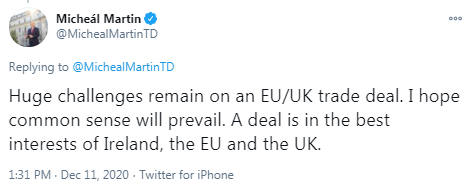
British and European leaders continue to express doubts, whether the two sides will be able to strike a trade deal. The UK's Prime Minister Boris Johnson stated on Thursday that there was “a strong possibility” that Britain and the EU would fail to strike a post-Brexit trade deal past the end of the year. British PM also said that "now is the time" for companies and people to prepare for a no-deal outcome. On Friday, a senior EU official told Reuters that the latest developments in the trade talks between the UK and the EU did not leave them "very optimistic" and suggested that Sunday's target date for a Brexit deal might well turn into another missed deadline. He also added that the gaps in negotiations were still "very very big". The European Commission's (EC) president Ursula von der Leyen also said that the positions of the two sides remained "far apart" on fundamental issues and reiterated that they would decide on Sunday, whether there were conditions for a deal or not. Micheál Martin tweeted that "huge challenges" remained between the UK and the EU negotiators on a trade deal. "I hope common sense will prevail," he added.
Adding to the negative sentiment, London's mayor Sadiq Khan said that urgent action is needed to avoid a tier-3 lockdown in Great Britain's capital city.
FXStreet reports that according to economists at Charles Schwab, Consumer Staples and Utilities are likely to perform worse than the broader stock market as represented by the S&P 500 Index.
“With additional fiscal stimulus, potential for a very effective vaccine now in late-stage trials, and accommodative monetary policies, we think that the economic recovery has a better chance of maintaining traction. At this stage of the business cycle, the consumer staples sector typically underperforms the overall market. While longer-term price momentum has held up, we think that growing confidence in the economy will weigh on relative performance going forward.”
“While interest rates are expected to remain generally low, they could edge higher as the economy continues to expand. On the flip side, there is the potential for a renewed decline in the economy to push rates even lower, or there could be significant government funding to Utilities as part of clean-energy initiatives that would benefit the sector’s profit outlook.”
- Latest developments in EU-UK talks did not leave us "very optimistic"
- Gaps in talks on new trade deal are still "very very big"
FXStreet reports that analysts at Credit Suisse note that NZD/USD saw another strong reversal back higher from the 13-day exponential average, negating the recently completed bearish ‘reversal day’ to leave the market pressuring against the crucial 0.7111 resistance again.
“NZD/USD has reversed sharply higher to pressure back against the crucial 78.6% retracement of the 2017/2020 fall at 0.7111. We keep our bias for further consolidation at first, but stay alert for a clear break higher in due course and with a major base still in place, we stay biased higher over the medium-term and see resistance initially at 0.7121, ahead of the 50% retracement of the entire 2014/2020 fall at 0.7151/58, where we expect the market to take breather at first. A sustained move higher would reinforce the core bull trend and see resistance at 0.7200 initially.”
Reuters reports that European Commission President Ursula von der Leyen said the positions in talks with Britain on a trade deal remained apart on the question of ensuring a level playing field in the future and access to UK fishing waters for EU fleets.
She said the two sides would decide on Sunday "whether we have conditions for an agreement, or not."
"One way or the other, in less than three weeks, it will be new beginnings for old friends," she told.
She said the EU understood Britain wanted to be in control of its waters from 2021 but also stressed that London "must understand the legitimate expectations of EU fishing fleets" who have fished in UK waters for decades or longer.
eFXdata reports that Citi re-flagged the risk Switzerland being named as a currency manipulator.
"CHF was featured in a Bloomberg report that outlined the prospect of Switzerland being named as a currency manipulator in an upcoming US treasury report.," Citi notes.
"CitiFX Strategy flagged this risk back in October, noting that countries named currency manipulators tend to see their currencies strengthen on account of the perception that their central banks have limited ability to weaken currencies thereafter," Citi adds.
FXStreet reports that the Credit Suisse analyst team discusses the USDCAD prospects.
“USD/CAD saw a sharp move lower on Thursday as the pair saw a sustained break beneath the 1.2783 October 2018 low. With a large ‘head and shoulders’ top still in place, we stay based lower and although we are seeing signs of an oversold condition and we look for further direct weakness with support seen initially at 1.2707/00, then 1.2632, removal of which should see a move back to the 78.6% retracement of the 2017/2020 surge at 1.2620, where we would expect to see fresh buyers at first.”
“Big picture, we expect a move below 1.2620 in due course with support then seen next at 1.2528.”
Reuters reports that the Bank of England took steps to keep banks lending through 2021, saying it was ready to deal with any market disruption from a big change in the UK's trading relationship with the European Union.
Governor Andrew Bailey said Britain had done all it can to mitigate risks from a no-deal departure from the EU on Dec. 31, and it was ready to deal with any disruptions to financial markets.
"What has the Bank of England got in its armoury, as it were? The answer is a lot. We will use our tools, as we did in March, should we be in that situation," Bailey told.
Market disruptions would not threaten financial stability, but Bailey warned that some EU customers might not be able to get access to UK financial services because the EU has not taken mitigating action.
"There is a limit to what we can do," Bailey said.
FXStreet reports that economists at Westpac have extended the scale of the USD downtrend from a further 2% to around 5% as the effect of vaccines and the stance of policy argue for a sustained USD depreciation.
“This decisive scientifi c success will speed the elimination of downside risks, most notably in Europe and the US, and also improves the likely scale of recovery around the globe.”
“Short and medium-to-long term interest rates are therefore set to remain at historically-low levels as far as the eye can see.”
“As the opening-up of the global economy erases concerns over downside risks, investors will look for new opportunities for profit. Many will be outside the US and Europe.”
“On both a financial and real investment basis then, we see strong justification to extend the forecast decline in the US dollar index from a further 2% to almost 5%. This revised forecast will see the DXY index down to around 86.8 by mid-2022.”
According to the report from Istat, in October 2020 the seasonally adjusted industrial production index increased by 1.3% compared with the previous month. Economists had expected a 1.1% increase. The change of the average of the last three months with respect to the previous three months was +11.7%. The index measures the monthly evolution of the volume of industrial production (excluding construction). With effect from January 2018 the indices are calculated with reference to the base year 2015.
The calendar adjusted industrial production index decreased by 2.1% compared with October 2019 (calendar working days being 22 versus 23 days in October 2019).
The unadjusted industrial production index decreased by 5.1% compared with October 2019.
FXStreet reports that economists at Morgan Stanley think the yield on the benchmark US 10-year government bond will rise by about 0.5%, to a yield of about 1.5%.
“Some investors aren't as optimistic as we are about the US or global economy next year, and since yields and economic activity tend to rise and fall together, this is a natural place for honest disagreement. But there's another, different type of skepticism towards higher interest rates. This camp agrees that growth will improve next year, but they don't think that yields will rise as much as we expect, because the Federal Reserve wouldn't allow that to happen.”
“The idea that the Fed would prevent a rise in interest rates is pretty common in the market. But we think it's wrong. Not wrong, we'd stress, because it assumes the Federal Reserve would prefer interest rates to be low - we think they do - but wrong because it would imply a pretty material leap in action, a leap that's both risky and potentially unnecessary.”
“Interest rates are so low that even if they were to rise the 0.5% that we forecast next year, they'd still be some of the lowest levels ever recorded, both outright, and relative to the levels of inflation.”
Reuters reports that Culture Secretary Oliver Dowden said that Britain will not back down in trade talks with the EU and will thrive even if breaking away from the bloc without a trade deal is a "choppy" ride.
The United Kingdom quit the EU in January but remains an informal member until Dec. 31 when it will finally leave the bloc's orbit after 48 years - with or without a trade agreement.
Dowden said there was still a chance of a deal, and negotiations are set to continue until Sunday. He said Johnson wanted an agreement but no British leader could accept the EU's demands on fishing rights and allowing Britain to be punished if in the future it diverged from the bloc's rules.
"Still, I think, there is a significant possibility that we could get that deal," Dowden told Sky News. "That deal cannot come at any price."
"If it comes to it, it will be choppy but we can survive and indeed thrive over the longer run," Dowden said of a no-trade deal Brexit.
FXStreet reports that Karen Jones, Team Head FICC Technical Analysis Research at Commerzbank, discusses the prospects of the GBP/USD.
“GBP/USD is again backing away from tough resistance at the 1.3500/1.3540 recent high and December 2019 high. We are alert to a set back from here near-term.”
“Nearby support is offered by the 55-day moving average at 1.3129 and also by 1.3050, the five-month uptrend.”
“The 1.3515/40 December 2019 high is considered to be a major break up point to the 1.4377 2018 high longer-term. This is such major resistance we will need to see two daily closes or a weekly close above here to confirm a break higher.”
| Time | Country | Event | Period | Previous value | Forecast | Actual |
|---|---|---|---|---|---|---|
| 07:00 | Germany | CPI, m/m | November | 0.1% | -0.8% | -0.8% |
| 07:00 | Germany | CPI, y/y | November | -0.2% | -0.3% | -0.3% |
During today's Asian trading, the US currency continued to decline against the euro, yen, and pound.
Yesterday, the European central bank (ECB) extended the Pandemic Emergency Purchase program (PEPP) for nine months and increased its volume by 500 billion euros to 1.85 trillion euros. The ECB expected to keep the base interest rate on loans at 0% and the deposit rate at -0.5%.
ECB President Christine Lagarde said that the eurozone economy is likely to experience a significant decline in the fourth quarter of 2020 due to the second wave of coronavirus, but the pace of contraction will be weaker compared to the second quarter.
Meanwhile, European leaders finally approved a $2.2 trillion budget plan on Thursday, as well as a 750 billion Euro emergency package of support for the economy.
The weakening of the dollar, in particular, was supported by traders ' optimism about the imminent introduction of COVID-19 vaccines, which supports risk appetite. The Vaccines and Related Biological Products Advisory Committee recommended approve emergency use of the Covid-19 vaccine from Pfizer and BioNTech in the US following a meeting on Thursday
Reuters reports that Bundesbank said in a biannual update of its macroeconomic projections that Germany's economy will contract less this year than previously projected.
Germany's economy is expected to contract by 5.5% this year on a calendar-adjusted basis, beating an earlier expectation for a 7.1% drop.
But next year, it is likely to grow by just 3%, below the central bank's June forecast for 3.2%. The recovery will then accelerate and by 2022, growth could hit 4.5%, beating the previous projection for 3.8%
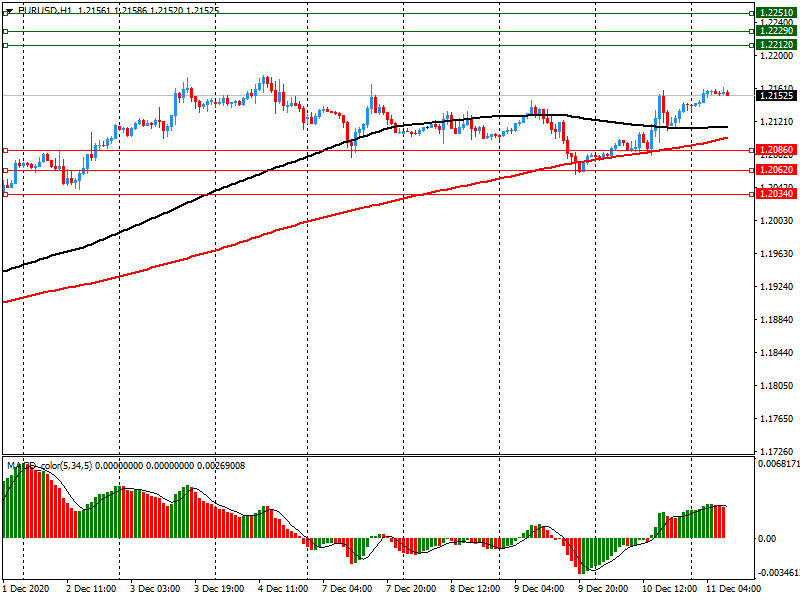
EUR/USD
Resistance levels (open interest**, contracts)
$1.2251 (1011)
$1.2229 (1402)
$1.2212 (832)
Price at time of writing this review: $1.2153
Support levels (open interest**, contracts):
$1.2086 (600)
$1.2062 (1424)
$1.2034 (3895)
Comments:
- Overall open interest on the CALL options and PUT options with the expiration date January, 8 is 62060 contracts (according to data from December, 10) with the maximum number of contracts with strike price $1,1800 (4074);
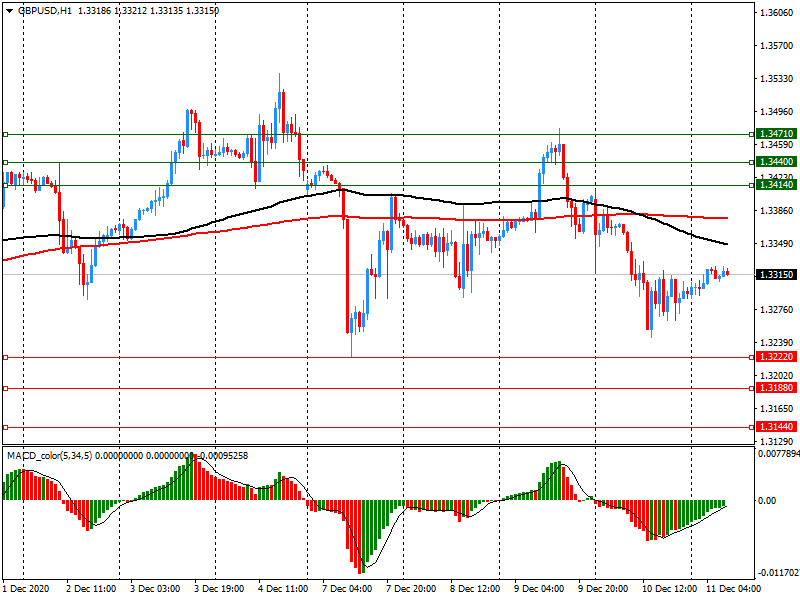
GBP/USD
Resistance levels (open interest**, contracts)
$1.3471 (305)
$1.3440 (643)
$1.3414 (1530)
Price at time of writing this review: $1.3315
Support levels (open interest**, contracts):
$1.3222 (642)
$1.3188 (620)
$1.3144 (653)
Comments:
- Overall open interest on the CALL options with the expiration date January, 8 is 58132 contracts, with the maximum number of contracts with strike price $1,4000 (33004);
- Overall open interest on the PUT options with the expiration date January, 8 is 27317 contracts, with the maximum number of contracts with strike price $1,2800 (3950);
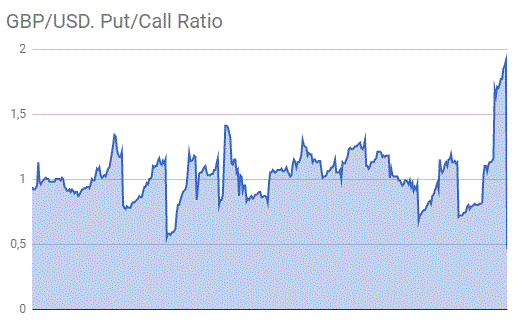
- The ratio of PUT/CALL was 0.47 versus 0.47 from the previous trading day according to data from December, 10
* - The Chicago Mercantile Exchange bulletin (CME) is used for the calculation.
** - Open interest takes into account the total number of option contracts that are open at the moment.
According to the report from the Federal Statistical Office (Destatis), the inflation rate in Germany, measured as the year-on-year change in the consumer price index, stood at -0.3% in November 2020. This was the fourth time this year that the inflation rate was negative. The price decrease even accelerated slightly (October: -0.2%). The last time an inflation rate as low as this was observed was in January 2015. Destatis also reports that consumer prices decreased markedly by 0.8% compared with October 2020.
One of the reasons for the negative inflation rate was again the temporary value added tax reduction, which was implemented on 1 July 2020 as a measure of the Federal Government's stimulus package. Since then, it has had a downward effect on the consumer prices compared with a year earlier.
The prices of goods (total) fell 1.8% from November 2019 to November 2020. This was mainly due to price decreases for energy products (-7.7%). The decrease in energy prices thus accelerated (October 2020: -6.8%). Excluding energy product prices, the inflation rate would have been +0.6% in November 2020.
The prices of services (total) were up 1.1% in November 2020 on the same month of the previous year. A major factor contributing to this price development was the increase in net rents exclusive of heating expenses (+1.4%), as households spend a large part of their consumption expenditure on this item.
Compared with October 2020, the overall consumer price index fell markedly by 0.8% in November 2020. Consumers paid less especially for motor fuels (-2.8%, including supergrade petrol: -3.7%). Prices of energy products (total) fell by 1.0%. Food prices, however, rose 0.5% in November 2020. Seasonal month-on-month price increases were recorded especially for vegetables (+3.0%).
| Time | Country | Event | Period | Previous value | Forecast |
|---|---|---|---|---|---|
| 07:00 (GMT) | Germany | CPI, m/m | November | 0.1% | -0.8% |
| 07:00 (GMT) | Germany | CPI, y/y | November | -0.2% | -0.3% |
| 13:30 (GMT) | Canada | Capacity Utilization Rate | Quarter III | 70.3% | 77.5% |
| 13:30 (GMT) | U.S. | PPI excluding food and energy, m/m | November | 0.1% | 0.2% |
| 13:30 (GMT) | U.S. | PPI excluding food and energy, Y/Y | November | 1.1% | 1.5% |
| 13:30 (GMT) | U.S. | PPI, y/y | November | 0.5% | 0.8% |
| 13:30 (GMT) | U.S. | PPI, m/m | November | 0.3% | 0.2% |
| 15:00 (GMT) | U.S. | Reuters/Michigan Consumer Sentiment Index | December | 76.9 | 76.5 |
| 18:00 (GMT) | U.S. | Baker Hughes Oil Rig Count | December | 246 |
| Pare | Closed | Change, % |
|---|---|---|
| AUDUSD | 0.75375 | 1.29 |
| EURJPY | 126.53 | 0.56 |
| EURUSD | 1.2141 | 0.5 |
| GBPJPY | 138.537 | -0.73 |
| GBPUSD | 1.32933 | -0.7 |
| NZDUSD | 0.70976 | 1.1 |
| USDCAD | 1.2741 | -0.58 |
| USDCHF | 0.88607 | -0.31 |
| USDJPY | 104.211 | 0.04 |







© 2000-2026. Sva prava zaštićena.
Sajt je vlasništvo kompanije Teletrade D.J. LLC 2351 LLC 2022 (Euro House, Richmond Hill Road, Kingstown, VC0100, St. Vincent and the Grenadines).
Svi podaci koji se nalaze na sajtu ne predstavljaju osnovu za donošenje investicionih odluka, već su informativnog karaktera.
The company does not serve or provide services to customers who are residents of the US, Canada, Iran, The Democratic People's Republic of Korea, Yemen and FATF blacklisted countries.
Izvršenje trgovinskih operacija sa finansijskim instrumentima upotrebom marginalne trgovine pruža velike mogućnosti i omogućava investitorima ostvarivanje visokih prihoda. Međutim, takav vid trgovine povezan je sa potencijalno visokim nivoom rizika od gubitka sredstava. Проведение торговых операций на финанcовых рынках c маржинальными финанcовыми инcтрументами открывает широкие возможноcти, и позволяет инвеcторам, готовым пойти на риcк, получать выcокую прибыль, но при этом неcет в cебе потенциально выcокий уровень риcка получения убытков. Iz tog razloga je pre započinjanja trgovine potrebno odlučiti o izboru odgovarajuće investicione strategije, uzimajući u obzir raspoložive resurse.
Upotreba informacija: U slučaju potpunog ili delimičnog preuzimanja i daljeg korišćenja materijala koji se nalazi na sajtu, potrebno je navesti link odgovarajuće stranice na sajtu kompanije TeleTrade-a kao izvora informacija. Upotreba materijala na internetu mora biti praćena hiper linkom do web stranice teletrade.org. Automatski uvoz materijala i informacija sa stranice je zabranjen.
Ako imate bilo kakvih pitanja, obratite nam se pr@teletrade.global.


 Банковни
 транcфери


