- Analiza
- Novosti i instrumenti
- Vesti sa tržišta
Novosti i prognoe: devizno tržište od 15-12-2020
| Time | Country | Event | Period | Previous value | Forecast |
|---|---|---|---|---|---|
| 00:30 (GMT) | Japan | Manufacturing PMI | December | 49 | |
| 00:30 (GMT) | Japan | Nikkei Services PMI | December | 46.7 | |
| 07:00 (GMT) | United Kingdom | Producer Price Index - Input (MoM) | November | 0.2% | 0.4% |
| 07:00 (GMT) | United Kingdom | Producer Price Index - Input (YoY) | November | -1.3% | |
| 07:00 (GMT) | United Kingdom | Producer Price Index - Output (YoY) | November | -1.4% | -0.9% |
| 07:00 (GMT) | United Kingdom | Producer Price Index - Output (MoM) | November | 0.0% | 0.1% |
| 07:00 (GMT) | United Kingdom | Retail Price Index, m/m | November | 0% | 0.2% |
| 07:00 (GMT) | United Kingdom | HICP ex EFAT, Y/Y | November | 1.5% | |
| 07:00 (GMT) | United Kingdom | Retail prices, Y/Y | November | 1.3% | 1.3% |
| 07:00 (GMT) | United Kingdom | HICP, m/m | November | 0% | 0.1% |
| 07:00 (GMT) | United Kingdom | HICP, Y/Y | November | 0.7% | 0.6% |
| 08:15 (GMT) | France | Services PMI | December | 38.8 | 40 |
| 08:15 (GMT) | France | Manufacturing PMI | December | 49.6 | 50.1 |
| 08:30 (GMT) | Germany | Services PMI | December | 46 | 44 |
| 08:30 (GMT) | Germany | Manufacturing PMI | December | 57.8 | 56.4 |
| 09:00 (GMT) | Eurozone | Manufacturing PMI | December | 53.8 | 53 |
| 09:00 (GMT) | Eurozone | Services PMI | December | 41.7 | 41.9 |
| 09:30 (GMT) | United Kingdom | Purchasing Manager Index Services | December | 47.6 | 50.5 |
| 09:30 (GMT) | United Kingdom | Purchasing Manager Index Manufacturing | December | 55.6 | 55.9 |
| 10:00 (GMT) | Eurozone | Construction Output, y/y | October | -2.5% | |
| 10:00 (GMT) | Eurozone | Trade balance unadjusted | October | 24.8 | |
| 13:30 (GMT) | Canada | Foreign Securities Purchases | October | 4.5 | |
| 13:30 (GMT) | Canada | Wholesale Sales, m/m | October | 0.9% | 0.9% |
| 13:30 (GMT) | U.S. | Retail sales | November | 0.3% | -0.3% |
| 13:30 (GMT) | U.S. | Retail Sales YoY | November | 5.7% | |
| 13:30 (GMT) | U.S. | Retail sales excluding auto | November | 0.2% | 0.1% |
| 13:30 (GMT) | Canada | Consumer Price Index m / m | November | 0.4% | 0% |
| 13:30 (GMT) | Canada | Bank of Canada Consumer Price Index Core, y/y | November | 1% | |
| 13:30 (GMT) | Canada | Consumer price index, y/y | November | 0.7% | 0.8% |
| 14:45 (GMT) | U.S. | Services PMI | December | 58.4 | 55.9 |
| 14:45 (GMT) | U.S. | Manufacturing PMI | December | 56.7 | 55.7 |
| 15:00 (GMT) | U.S. | NAHB Housing Market Index | December | 90 | 88 |
| 15:00 (GMT) | U.S. | Business inventories | October | 0.7% | 0.7% |
| 15:30 (GMT) | U.S. | Crude Oil Inventories | December | 15.189 | |
| 19:00 (GMT) | U.S. | FOMC Economic Projections | |||
| 19:00 (GMT) | U.S. | Fed Interest Rate Decision | 0.25% | 0.25% | |
| 19:30 (GMT) | U.S. | Federal Reserve Press Conference | |||
| 21:45 (GMT) | New Zealand | GDP y/y | Quarter III | -12.4% | -1.3% |
| 21:45 (GMT) | New Zealand | GDP q/q | Quarter III | -12.2% |
According to ActionForex, analysts at TD Bank Financial Group note that Canadian manufacturing sales increased 0.3% (m/m) in October, below Statistics Canada’s preliminary flash estimate (0.6%).
"This follows an upwardly revised 2.2% increase in September (previously reported as 1.5%). The release leaves the level of manufacturing sales around 3% below its pre-pandemic (February) levels."
"The picture was less encouraging after controlling for price effects, with manufacturing shipment volumes flat on the month.
The increase was not broad based across industries. Only 10 of the 21 industries saw sales increases. The headline increase was largely driven by higher sales of paper products (+5.4%), petroleum and coal products (+3.1%), and primary metals (+2%)."
"The below-expectations print for manufacturing sales in October was worsened by flat volumes growth. Like most other areas of the economy, momentum in Canada’s manufacturing sector has been losing steam. Importantly, this backward-looking release doesn’t fully capture the potential impacts of renewed restrictions domestically and abroad on demand for some manufacturing products."
"Forward-looking indicators have turned more mixed of late. New and unfilled orders were notably weak. Meanwhile, employment growth in the sector has virtually stalled in the past two months, although growth in hours worked has been slightly more encouraging. The one respite is manufacturing sentiment, which has surprisingly held firm in Canada and the U.S. in November (Canada’s largest trading partner). The picture is being further clouded by elevated COVID-19 cases and renewed restrictions. Against this backdrop, the near-term path for the sector is expected to remain bumpy and uneven until vaccine rollouts accelerate in the spring of 2021."
FXStreet reports that the S&P 500 Index has reached new all-time highs in the past few weeks driven by an impressive series of positive economic surprises. Economists at Morgan Stanley remain bullish overall and still expect a powerful V-shaped economic recovery next year. However, the benchmark index of the broader US market has already priced in a great deal of optimism about the year to come and some positive catalysts may have run their course.
“Corporate earnings growth could average 25% in 2021, according to a consensus estimate compiled by FactSet. Positive earnings revisions are now running at their swiftest pace in more than 20 years. Forward price/earnings multiples are at extreme levels relative to the past 20 years (22 vs. 15 historically for the S&P 500). This is despite the fact that inflation expectations and long-term interest rates are rising. Those conditions typically lead to lower stock multiples, which we expect.”
“The Fed has committed to keeping its key short-term interest rate near zero through December 2023 and has already deployed every means possible to stimulate the economy, leaving it with only modest short-term tools. Many investors expect another round of federal government stimulus, to the tune of $900 billion, which seems the largest package that a divided Congress would likely pass.”
“It will likely take new catalysts for stocks to rise further from here. A Democratic sweep in Georgia Senate races that could lead to an expansionary Biden agenda around infrastructure could be one outcome that isn’t yet priced into markets. But given current polling, the probability of that happening is only 20%.”
The report from
the New York Federal Reserve showed on Tuesday that manufacturing activity in
the New York region grew slightly in early December.
According to
the survey, NY Fed Empire State manufacturing index fell from 6.3 in November
to 4.9 in December, pointing to a very little growth in activity. This was the
lowest reading since August.
Economists had
expected the index to come in at 6.9.
Anything below
zero signals contraction.
According to
the report, the new orders index edged down 0.3 point to 3.4, indicating a
slight advance in orders, and the shipments index jumped 5.8 points to 12.1,
pointing to a relatively substantial increase in shipments. The employment
index rose 4.8 points to 14.2, its highest level in over a year, pointing to ongoing
significant gains in employment. Delivery times (4.3) were somewhat longer, and
inventories (-4.3) edged lower. On the price front, the prices paid index rose
8 points to 37.1, its highest level in two years, indicating a pickup in input
price gains, while the prices received index held steady at 10.0, pointing to
ongoing modest selling price increases.
The Federal
Reserve reported on Tuesday the U.S. industrial production rose 0.4 percent
m-o-m in November, following a revised 0.9 percent m-o-m increase in October
(originally a 1.1 percent m-o-m gain).
Economists had
forecast industrial production would increase 0.3 percent m-o-m in October.
According to
the report, manufacturing output grew 0.8 percent m-o-m in November, driven by a
5.3 percent m-o-m surge for motor vehicles and parts. Mining production jumped
2.3 percent m-o-m. Meanwhile, and the output of utilities fell 4.3 percent
m-o-m, as warmer-than-usual temperatures reduced the demand for heating.
Capacity
utilization for the industrial sector increased 0.3 percentage point m-o-m to 73.3
percent in November. That was 0.4 percentage points above economists’ forecast
but 6.5 percentage points below its long-run (1972-2019) average.
In y-o-y terms,
the industrial output dropped 5.5 percent in November, following a revised 5.0
percent tumble in the prior month (originally a 5.3 percent decline).
Statistics
Canada released its Monthly Survey of Manufacturing on Tuesday, which showed
that the Canadian manufacturing sales rose 0.3 percent m-o-m in October to CAD54.13
billion, following a revised 2.2 percent m-o-m increase in September
(originally a 1.5 percent m-o-m gain).
Economists had
forecast a 0.6 percent m-o-m advance for October.
According to
the survey, sales increased in 10 of 21 manufacturing industries led by the paper
(+5.4 percent m-o-m), petroleum and coal (+3.1 percent m-o-m) industries.
Overall, sales of
non-durable goods industries jumped 0.6 percent m-o-m, while sales of durable
goods industries were flat m-o-m in October.
The Labor
Department reported on Tuesday the import-price index, measuring the cost of
goods ranging from Canadian oil to Chinese electronics, edged up 0.1 percent
m-o-m in November, following an unrevised 0.1 percent m-o-m drop in October. Economists had expected prices to advance 0.3 percent m-o-m last
month.
According to
the report, the November decline was driven by a drop in prices for nonfuel
imports (-0.3 percent m-o-m), which, however, was partially offset by a climb
in import fuel prices (+4.3percent m-o-m).
Over the
12-month period ended in November, import prices fell 1.0 percent, due to a
plunge in import fuel prices (-24.6 percent), which more than offset a gain in
import nonfuel prices (+1.6 percent).
Meanwhile, the
price index for U.S. exports increased 0.6 percent m-o-m in November, following
an unrevised 0.2 percent m-o-m gain in the previous month. The November advance
was driven by higher prices for both agricultural exports (+3.7 percent m-o-m)
and nonagricultural exports (+0.3 percent m-o-m).
Over the past
12 months, the price index for exports dropped 1.1 percent, reflecting a
decline in prices of nonagricultural (-1.7 percent) exports, which more than offset
higher agricultural export prices (+4.4 percent).
The Canada
Mortgage and Housing Corp. (CMHC) reported on Tuesday the seasonally adjusted
annual rate of housing starts was at 246,033 units in November, up 14.4 percent
from an upwardly revised 215,134 units in October (originally 214,875 units).
Economists had
forecast an annual pace of 215,000 for November.
According to the report, urban starts climbed by 15.0
percent m-o-m last month to 233,106 units, as multiple urban starts surged by
22.5 percent
m-o-m to 177,661 units, while single-detached urban starts fell by 3.8 percent
m-o-m 55,445 units. At the same time, rural starts were estimated at a
seasonally adjusted annual rate of 12,927 units.
| Time | Country | Event | Period | Previous value | Forecast | Actual |
|---|---|---|---|---|---|---|
| 07:00 | United Kingdom | Average earnings ex bonuses, 3 m/y | October | 1.9% | 2.6% | 2.8% |
| 07:00 | United Kingdom | Average Earnings, 3m/y | October | 1.4% | 2.2% | 2.7% |
| 07:00 | United Kingdom | ILO Unemployment Rate | October | 4.8% | 5.1% | 4.9% |
| 07:00 | United Kingdom | Claimant count | November | -29.8 | 64.3 | |
| 07:30 | Switzerland | Producer & Import Prices, y/y | November | -2.9% | -2.7% | |
| 07:45 | France | CPI, y/y | November | 0% | 0.2% | 0.2% |
| 07:45 | France | CPI, m/m | November | 0% | 0.2% | 0.2% |
| 09:00 | France | IEA Oil Market Report | ||||
| 13:15 | Canada | Housing Starts | November | 215.1 | 215 | 246 |
USD traded mixed against its major rivals in the European session on Tuesday as investors weighed accelerating COVID-19 cases against prospects for more coronavirus stimulus aid. The U.S. currency rose against EUR, CHF, AUD and NZD, but fell against GBP, JPY and CAD.
The U.S. lawmakers released the latest proposal for a COVID-19 relief bill, splitting a previous $908 billion bipartisan proposal into two bills - one bill for $748 billion that calls for spending for programs that are popular on both sides of the aisle and the second bill for $160 billion that includes the more contentious areas such as state and local aid and liability protection. House Speaker Nancy Pelosi said that both sides remained in negotiations.
According to the latest data by Johns Hopkins, the U.S. topped 300,000 coronavirus deaths on Monday, while the total number of confirmed cases surpassed 16.5 million.
FXStreet notes that the AUD/USD pair extends its consolidation below the start of a cluster of long-term Fibonacci retracements and the first core upside objective of the Credit Suisse analyst team starting at 0.7574, which is expected to cap for now.
“AUD/USD continues to consolidate as expected after reaching the beginning of a cluster of long-term Fibonacci retracements and our first core upside objective, starting at 0.7574, the 78.6% retracement of the entire 2018/2020 fall, and stretching up to the 38.2% retracement of the entire 2011/2020 fall at 0.7624/38. We, therefore, continue to look for this resistance zone to cap at first and for the consolidation phase to extend.”
“Support is seen initially at 0.7507/00, which ideally now holds. Below here though can see a move back to 0.7485, removal of which would see a move to the 13-day exponential average at 0.7456/54 next, where we would expect to see a stronger attempt to hold.”
NFXStreet notes that as the NZ economy’s performance since covid has been impressive, providing fundamental support for NZD outperformance, economists at Westpac target NZD/USD 0.7200 by year-end. What’s more, the kiwi is forecast to surpass the 0.7500 level by mid-2021.
“The NZD/USD pair retains potential for slightly further upside near-term, targeting 0.7200 by year-end, although we caution it is technically stretched and in need of a correction. That aside, we expect to see the kiwi above 0.7500 by mid-2021.”
FXStreet reports that the Credit Suisse analysts team notes that the S&P 500 Index has now closed (just) below its 13-day exponential average and as daily MACD momentum has crossed lower, the risk for a corrective setback looks to be increasing.
“The S&P 500 rally continues to lose momentum with the market unable to hold its early gains from yesterday, closing (just) below its 13-day exponential average, with daily MACD now having also crossed lower.”
“Below support at 3636/33 would see this pressure increase further with support then seen next at 3625/22 ahead of the late November low and price gap at 3594/78, with fresh buyers expected here. Failure to hold here though would be seen exposing the 38.2% retracement of the October/December rally at 3530.”
FXStreet reports that analysts at Commerzbank note that silver recently recovered from just ahead of the 21.64 September low and rallied to the 24.69 downtrend, which is exposed. Above the downtrend, XAG/USD targets 28.93, 29.89.
“Silver (XAG/USD) increasingly looks to have based around 21.87 and the rally has so far reached the 24.69 downtrends, where it is holding. It is exposed.”
"The downtrend at 24.69 represents the barrier on the topside. This guards the 28.93 and 29.89 recent peaks.”
Brexit: A deal can still be done and provisionally applied - ABN Amro
FXStreet notes that with a little over two weeks left until the UK leaves the EU’s single market and customs union, negotiations on a post-Brexit trade deal are continuing, even at this eleventh hour. The risk of a no-deal scenario is now very high but even if a deal is not struck in time, economists at ABN Amro expect one to be concluded in the course of 2021.
“Parliamentary timetables and the need for proper scrutiny make it now virtually impossible for a deal to be formally ratified before the end of the transition period. Instead, if a deal is struck, it will likely be provisionally applied by the European Council (i.e. the EU member states) and the UK while it awaits formal approval by the UK and European parliaments (and potentially, EU national and regional parliaments).”
“There are presently three main sticking points that need to be overcome for a deal to be agreed: 1. Fish quotas, 2. ‘Level playing field’ provisions and 3. Governance of the deal. Of these, the most contentious is the level playing field.”
“It remains to be seen if a deal can be agreed in time even to apply provisionally. However, there are signs of movement on the EU side.”
- We hope to start COVID-19 vaccination before year-end
- We want a regular approval, not an emergency approval
- COVID-19 infection numbers and the death toll in Germany are too high
FXStreet reports that analysts at Credit Suisse discuss the prospects of the EUR/USD pair.
“We continue to look for a clear and sustained move above our long-held 1.2145/55 first upside objective – the ‘neckline’ to the early 2018 top and 78.6% retracement of the 2018/2020 – to reassert the uptrend, with resistance above 1.2178 then seen at 1.2215 next, ahead of the March measured base objective” at 1.2355.”
“Big picture, we continue to look for an eventual move to 1.2518/98 – the 2018 high, 38. 2% retracement of the entire 2008/2016 bear market and 61.8% retracement of the fall from 2014 – which we expect to prove a tougher barrier.”
eFXdata reports that MUFG Research discusses the latest Brexit trade deal developments.
"According to reports, a new UK proposal floated with the EU over the weekend on how to create a competitive level playing field might just break the deadlock," MUFG notes.
"The positive steps on the level the playing field have revived hopes that a last minute trade deal can be reached. The latest developments have supported our assumption that a last minute trade deal would be reached, but the risks remain high that efforts to reach a deal could still fail posing significant downside risks for the pound," MUFG adds.
Reuters reports that Economy Minister Yasutoshi Nishimura said that Japan's latest economic stimulus package to cushion the blow from the coronavirus pandemic is likely to boost the economy most strongly next fiscal year.
The $708 billion stimulus package, which was endorsed by the cabinet last week, is expected to boost gross domestic product by around 0.5% in the current fiscal year through March, 2.5% in fiscal 2021, and 0.6% from fiscal 2022 onwards, Nishimura told reporters.
The boost from the new stimulus package is likely to lead to creation or support of jobs for about 600,000 people until the end of next fiscal year, the government said in an estimate released Tuesday.
The package, which includes about 40 trillion yen ($384.36 billion) of fresh fiscal spending, contains initiatives aimed at lowering carbon emissions and boosting adoption of digital technology.
FXStreet reports that economists at HSBC now abandon their ‘U-shaped’ view and expect USD weakness to persist into 2021.
“Massive monetary and fiscal easing have allowed markets to retain their ‘V-shaped’ recovery mindset, despite renewed waves of COVID-19 in many countries. Expectations for disbursement of a vaccine through 2021 have allowed risk appetite to shrug off the current wave of renewed containment measures. A selectively risk-positive spin on the implications of the US election outcome has also sustained the reflationary theme for 2021.”
“We have chosen to abandon our ‘U-shaped’ view to embrace the market’s enthusiasm for a ‘V-shaped’ recovery, although we do so modestly. It means further broad weakness in the USD rather than divergent prospects for it.”
Reuters reports that the International Energy Agency (IEA) warned that the roll-out of vaccines this month to combat the coronavirus pandemic will not quickly reverse the destruction wrought on global oil demand.
"In the meantime, the end of year holiday season will soon be upon us with the risk of another surge in COVID-19 cases and the possibility of yet more confinement measures," the IEA said in its monthly report.
IEA revised down its estimates for oil demand this year by 50,000 barrels per day (bpd) and for next year by 170,000 bpd, citing scarce jet fuel use as fewer people travel by air.
Global oil stocks, which have mounted as consumption faltered during the pandemic, will finally reach a deficit compared to pre-crisis levels at the end of 2019 by July, the IEA added.
According to the report from Istat, in November 2020 the rate of change of Italian consumer price index for the whole nation (NIC) was -0.1% on monthly basis and -0.2% on annual basis (from -0.3% in October); confirming the flash estimate.
The decrease on annual basis (for the seventh consecutive month) of All items index was still mainly due to the wide decreases of prices of Energy products (-8.6%, from +8.7% in October), whereas its lower extent was determined by the speed-up of prices of Services related to recreation, including repair and personal care (from +0.1% to +0.7%) and by the lower extent of the decrease of prices of Services related to transport (from -2.0% to -1.6%).
Core inflation (excluding energy and unprocessed food) was +0.4% (up from +0.2% in the previous month) and inflation excluding energy was +0.6% (up from +0.5%).
The decrease on monthly basis was mainly due to the of prices of Services related to transport (-1.0%) and of Services related to recreation, including repair and personal care (-0.8%), only partially offset by the increase of those of Unprocessed food (+0.7%).
Prices of Grocery and unprocessed food increased by +0.5% on monthly basis and by +1.2% on annual basis (the same as in the previous month).
RTTNews reports that the State Secretariat For Economic Affairs, or SECO, said that the Swiss economy is set to shrink less than expected this year, but the recovery next year would be slower than forecast earlier.
GDP is set to fall a seasonally and calendar adjusted 3.3 percent this year, which is slightly less than the 3.8 percent decline projected in October. Yet, this would be the strongest decrease since 1975.
The growth forecast for next year was lowered to 3 percent from 3.8 percent. The Swiss economy is projected to grow 3.1 percent in 2022.
The unemployment rate is projected to climb to 3.3 percent next year from 3.2 percent this year. Thereafter, it is seen easing to 3 percent in 2022.
Consumer prices are forecast to fall 0.7 percent this year and edge up 0.1 percent next year. Inflation is projected at 0.3 percent in the year after.
FXStreet reports that while economists at Rabobank expect broad-based USD weakness to run further in 2021, EUR/USD has been in a consolidation phase since December 3 and the Fed outcome could provide a fresh trigger.
“At the very least the market is expecting the FOMC to produce more clarity on forward guidance. Given that US economic recovery is losing momentum and that a fresh fiscal package is still awaited from Congress, we see a chance that the Fed could go beyond forward guidance this week. That said, our central view is that the Fed will wait until outstanding issues surrounding the election have been cleared and hopefully until there is more fiscal stimulus in place before taking further policy stimulus.”
“While we see risk of a souring in risk appetite triggering a dip towards EUR/USD 1.18 in Q1 2021, we have revised up our forecasts for EUR/USD moderately across the board. Our 12-month EUR/USD forecast now stands at 1.23 from a previously forecast of 1.20.”
| Time | Country | Event | Period | Previous value | Forecast | Actual |
|---|---|---|---|---|---|---|
| 00:30 | Australia | RBA Meeting's Minutes | ||||
| 02:00 | China | Retail Sales y/y | November | 4.3% | 5.2% | 5% |
| 02:00 | China | Industrial Production y/y | November | 6.9% | 7% | 7% |
| 02:00 | China | Fixed Asset Investment | November | 1.8% | 2.6% | 2.6% |
| 06:45 | Switzerland | SECO Economic Forecasts | ||||
| 07:00 | United Kingdom | Average earnings ex bonuses, 3 m/y | October | 1.9% | 2.6% | 2.8% |
| 07:00 | United Kingdom | Average Earnings, 3m/y | October | 1.4% | 2.2% | 2.7% |
| 07:00 | United Kingdom | ILO Unemployment Rate | October | 4.8% | 5.1% | 4.9% |
| 07:00 | United Kingdom | Claimant count | November | -29.8 | 64.3 | |
| 07:30 | Switzerland | Producer & Import Prices, y/y | November | -2.9% | -2.7% | |
| 07:45 | France | CPI, y/y | November | 0% | 0.2% | 0.2% |
| 07:45 | France | CPI, m/m | November | 0% | 0.2% | 0.2% |
During today's Asian trading, the US dollar was little changed against the euro and the yen on expectations for a two-day meeting of the FOMC, the results of which will be announced tomorrow.
The ICE index, which tracks the dollar's performance against six currencies (the euro, swiss franc, yen, canadian dollar, pound sterling and swedish krona), rose 0.01%.
There is no consensus among economists on what decisions the Fed will make this week.
"The only thing that seems to be in no doubt about this week's FOMC meeting is that the interest rate range on federal loan funds is maintained," said Richard Moody, chief economist at Regions Financial Corp.
The pound rose slightly against the dollar. Yesterday, European media reported, citing EU diplomats, that some progress has been made in negotiations with London, but there is still an impasse on the division of fisheries.
On the same day, the EU's chief negotiator, Michel Barnier, told reporters in Brussels that it is still possible to agree a deal on the UK-EU relationship after Brexit, and work on this is continuing.
The Chinese yuan was almost unchanged against the US dollar, despite the data on China. Retail sales in China in November increased by 5% compared to the same month last year, according to data from the National Bureau of Statistics of China. Retail sales rose for the fourth month in a row in November, with the pick-up being the highest in eleven months, as consumer demand continues to recover from the negative impact of the COVID-19 pandemic.
The volume of industrial production in China last month increased by 7% in annual terms - the highest since March last year.
According to the report from the INSEE, in November 2020, the Consumer Price Index (CPI) rose by 0.2% over one month, after being stable in October 2020. The service prices rebounded (+0.1% after –0.3% in October) and those of food prices accelerated (+0.6% after +0.2%). The prices of tobacco grew sharply (+4.9%) after being stable in the last month and those of energy also increased (+0.3% after +0.2%). In contrast, the prices of manufactured goods fell back in November (–0.3% after +0.4% in October).
Seasonally adjusted, consumer prices rose by 0.4% in November, after being stable in October.
Year on year, consumer prices increased by 0.2% after being stable the two previous months. This increase in inflation resulted from the acceleration of the service prices (+0.7 % after +0.4 %) and those of the food (+2.0% after +1.5%). The energy prices fell at the same rate as in the last month (–7.8%). The prices of tobacco slowed down (+12.5% after +13.7%) and those of manufactured goods decreased more sharply (–0.3% after –0.1%).
Year on year, core inflation rose, in November, up to +0.4% after +0.3% in October. The Harmonised Index of Consumer Prices (HICP) rose by 0.2% over a month after being stable in the previous month; year on year, it increased by 0.2% after +0.1% in October.
According to the report from the Federal Statistical Office (FSO), the Producer and Import Price Index fell by 0.1% in November 2020 compared with the previous month. The index stood at 97.9 points (December 2015 = 100). Economists had expected a 0.1% increase.
This decline was due in particular to lower prices for petroleum products and pharmaceutical preparations. Compared with November 2019, the price level of the whole range of domestic and imported products fell by 2.7%.
In particular, lower prices for pharmaceutical preparations and petroleum products were responsible for the decrease in the producer price index compared with the previous month. In contrast, rising prices were seen for waste collection and materials recovery as well as for basic pharmaceutical products.
The import price index registered lower prices compared with October 2020, particularly for petroleum products as well as petroleum and natural gas. Declining prices were also seen for basic pharmaceutical products, citrus fruit and rubber and plastic products. Non-ferrous metals and products made therefrom, plastics in primary forms, other chemical products and organic products of the chemical industry, on the other hand, became more expensive.
The Office for National Statistics said that early estimates for November 2020 suggest that there is a slight drop over the month in the number of payroll employees in the UK. Since February 2020, the number of payroll employees has fallen by 819,000; however, the larger falls were seen at the start of the coronavirus (COVID-19) pandemic.
Data from our Labour Force Survey (LFS) show a large increase in the unemployment rate while the employment rate continues to fall. The number of redundancies reached a record high in August to October 2020 although the weekly data show that while the level remains high there was a slight decrease in October.
The UK employment rate, in the three months to October 2020, was estimated at 75.2%, 0.9 percentage points lower than a year earlier and 0.5 percentage points lower than the previous quarter.
The UK unemployment rate, in the three months to October 2020, was estimated at 4.9%, 1.2 percentage points higher than a year earlier and 0.7 percentage points higher than the previous quarter. Unemployment was expected to rise to 5.1%.
Early estimates for November 2020 indicate that the number of payrolled employees fell by 2.7% compared with November 2019, which is a fall of 781,000 employees; since February 2020, 819,000 fewer people were in payrolled employment.
The Claimant Count increased slightly in November 2020, to 2.7 million; this includes both those working with low income or hours and those who are not working.
There were an estimated 547,000 vacancies in the UK in September to November 2020; this is 251,000 fewer than a year ago and 110,000 more than the previous quarter.
Growth in average total pay (including bonuses) among employees for the three months August to October 2020 increased to 2.7%, and growth in regular pay (excluding bonuses) also increased to 2.8%.
EUR/USD
Resistance levels (open interest**, contracts)
$1.2253 (1021)
$1.2233 (1397)
$1.2217 (832)
Price at time of writing this review: $1.2147
Support levels (open interest**, contracts):
$1.2073 (1776)
$1.2043 (3890)
$1.2009 (699)
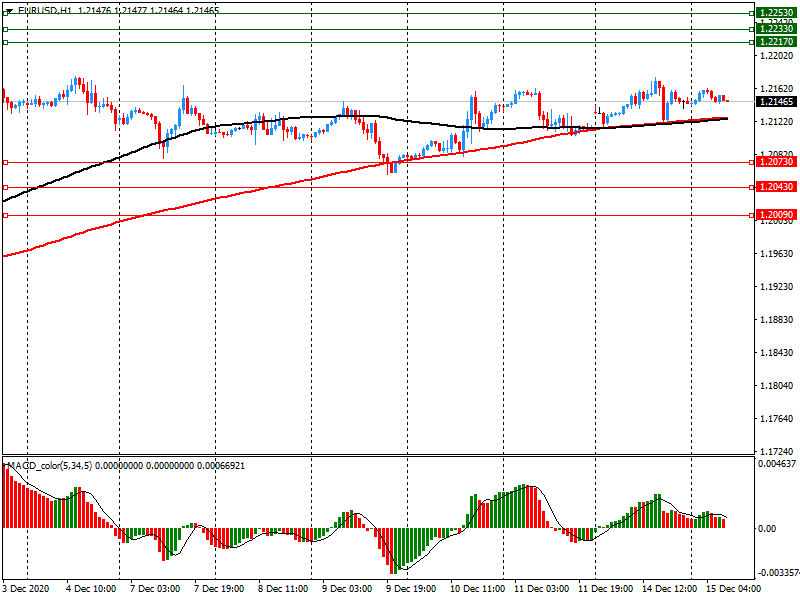
Comments:
- Overall open interest on the CALL options and PUT options with the expiration date January, 8 is 62722 contracts (according to data from December, 14) with the maximum number of contracts with strike price $1,1800 (4536);
GBP/USD
Resistance levels (open interest**, contracts)
$1.3472 (303)
$1.3445 (646)
$1.3423 (1530)
Price at time of writing this review: $1.3333
Support levels (open interest**, contracts):
$1.3266 (643)
$1.3231 (520)
$1.3185 (653)
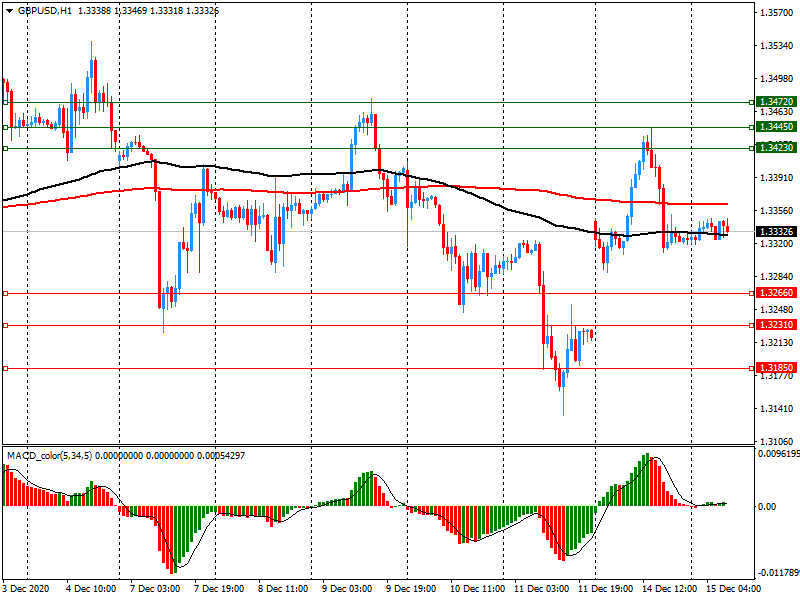
Comments:
- Overall open interest on the CALL options with the expiration date January, 8 is 58675 contracts, with the maximum number of contracts with strike price $1,4000 (33027);
- Overall open interest on the PUT options with the expiration date January, 8 is 27714 contracts, with the maximum number of contracts with strike price $1,2800 (4020);
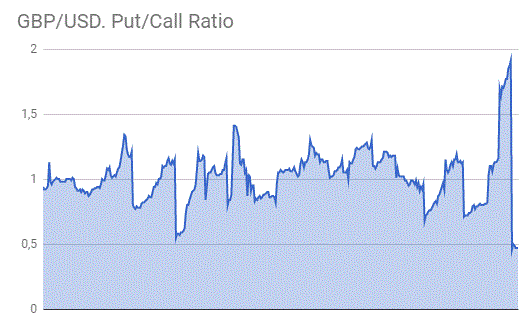
- The ratio of PUT/CALL was 0.47 versus 0.47 from the previous trading day according to data from December, 14
* - The Chicago Mercantile Exchange bulletin (CME) is used for the calculation.
** - Open interest takes into account the total number of option contracts that are open at the moment.
| Time | Country | Event | Period | Previous value | Forecast |
|---|---|---|---|---|---|
| 00:30 (GMT) | Australia | RBA Meeting's Minutes | |||
| 02:00 (GMT) | China | Retail Sales y/y | November | 4.3% | |
| 02:00 (GMT) | China | Industrial Production y/y | November | 6.9% | |
| 02:00 (GMT) | China | Fixed Asset Investment | November | 1.8% | 2.6% |
| 06:45 (GMT) | Switzerland | SECO Economic Forecasts | |||
| 07:00 (GMT) | United Kingdom | Average earnings ex bonuses, 3 m/y | October | 1.9% | 2.6% |
| 07:00 (GMT) | United Kingdom | Average Earnings, 3m/y | October | 1.3% | 2.3% |
| 07:00 (GMT) | United Kingdom | ILO Unemployment Rate | October | 4.8% | 5.1% |
| 07:00 (GMT) | United Kingdom | Claimant count | November | -29.8 | |
| 07:30 (GMT) | Switzerland | Producer & Import Prices, y/y | November | -2.9% | |
| 07:45 (GMT) | France | CPI, y/y | November | 0% | 0.2% |
| 07:45 (GMT) | France | CPI, m/m | November | 0% | 0.2% |
| 09:00 (GMT) | France | IEA Oil Market Report | |||
| 13:15 (GMT) | Canada | Housing Starts | November | 214.9 | 214.8 |
| 13:30 (GMT) | Canada | Manufacturing Shipments (MoM) | October | 1.5% | 0.6% |
| 13:30 (GMT) | U.S. | NY Fed Empire State manufacturing index | December | 6.3 | 6.8 |
| 13:30 (GMT) | U.S. | Import Price Index | November | -0.1% | 0.3% |
| 14:15 (GMT) | U.S. | Capacity Utilization | November | 72.8% | 72.9% |
| 14:15 (GMT) | U.S. | Industrial Production YoY | November | -5.3% | |
| 14:15 (GMT) | U.S. | Industrial Production (MoM) | November | 1.1% | 0.3% |
| 19:30 (GMT) | Canada | BOC Gov Tiff Macklem Speaks | |||
| 21:00 (GMT) | U.S. | Net Long-term TIC Flows | October | 108.9 | |
| 21:00 (GMT) | U.S. | Total Net TIC Flows | October | -79.9 | |
| 21:45 (GMT) | New Zealand | Current Account | Quarter III | 1.828 | |
| 23:50 (GMT) | Japan | Trade Balance Total, bln | November | 872.9 | 529.8 |
| Pare | Closed | Change, % |
|---|---|---|
| AUDUSD | 0.75314 | -0.25 |
| EURJPY | 126.314 | 0.18 |
| EURUSD | 1.21442 | 0.09 |
| GBPJPY | 138.592 | -0.05 |
| GBPUSD | 1.33247 | -0.17 |
| NZDUSD | 0.70792 | -0.27 |
| USDCAD | 1.27653 | 0.09 |
| USDCHF | 0.88671 | -0.21 |
| USDJPY | 104.003 | 0.08 |







© 2000-2026. Sva prava zaštićena.
Sajt je vlasništvo kompanije Teletrade D.J. LLC 2351 LLC 2022 (Euro House, Richmond Hill Road, Kingstown, VC0100, St. Vincent and the Grenadines).
Svi podaci koji se nalaze na sajtu ne predstavljaju osnovu za donošenje investicionih odluka, već su informativnog karaktera.
The company does not serve or provide services to customers who are residents of the US, Canada, Iran, The Democratic People's Republic of Korea, Yemen and FATF blacklisted countries.
Izvršenje trgovinskih operacija sa finansijskim instrumentima upotrebom marginalne trgovine pruža velike mogućnosti i omogućava investitorima ostvarivanje visokih prihoda. Međutim, takav vid trgovine povezan je sa potencijalno visokim nivoom rizika od gubitka sredstava. Проведение торговых операций на финанcовых рынках c маржинальными финанcовыми инcтрументами открывает широкие возможноcти, и позволяет инвеcторам, готовым пойти на риcк, получать выcокую прибыль, но при этом неcет в cебе потенциально выcокий уровень риcка получения убытков. Iz tog razloga je pre započinjanja trgovine potrebno odlučiti o izboru odgovarajuće investicione strategije, uzimajući u obzir raspoložive resurse.
Upotreba informacija: U slučaju potpunog ili delimičnog preuzimanja i daljeg korišćenja materijala koji se nalazi na sajtu, potrebno je navesti link odgovarajuće stranice na sajtu kompanije TeleTrade-a kao izvora informacija. Upotreba materijala na internetu mora biti praćena hiper linkom do web stranice teletrade.org. Automatski uvoz materijala i informacija sa stranice je zabranjen.
Ako imate bilo kakvih pitanja, obratite nam se pr@teletrade.global.


 Банковни
 транcфери


