- Analiza
- Novosti i instrumenti
- Vesti sa tržišta
Novosti i prognoe: devizno tržište od 21-07-2022
- EUR/GBP is juggling in a minute range of 0.8520-0.8527 as investors await UK Retail Sales.
- The ECB paddled up its interest rates surprisingly by 50 bps.
- A slippage in UK Retail Sales is likely to weaken the pound bulls.
The EUR/GBP pair is displaying back and forth moves in a narrow range of 0.8520-0.8527 in the early Tokyo session. The cross has turned sideways as investors are awaiting the release of the UK Retail Sales. In the New York session, the asset surrendered its entire gains recorded on an interest rate hike by the European Central Bank (ECB).
ECB President Christine Lagarde unexpectedly announced a rate hike by half a percent vs. expectations of 25 bps. Credit goes to the soaring price pressures which forced the ECB policymaker to feature a jumbo rate hike. Earlier, ECB Large in his testimony guided that the ECB is interested in elevating interest rates by 25 bps in July and later on by 50 bps in September.
Also, the ECB announced a new quantitative tool to support the southern European economies. The new fragmented tool ‘Transmission Protection Instrument’ will provide liquidity to the above-mentioned countries against public securities and also private securities, if required, having a maturity period of 1-10 years.
As per the market consensus, the UK Retail Sales may slip to -5.3% vs. -4.7% recorded earlier. This indicates the vulnerability in the overall demand in the UK. The Retail Sales data is already contaminated with higher price pressures and more damage to the Retail Sales indicates that the overall demand is extremely lower.
- AUD/NZD has faced barricades around while attempting to surpass 1.1095 on weak Aussie PMI.
- The upbeat Australian employment data will support the RBA for hiking rates unhesitatingly.
- Kiwi bulls remained under pressure despite the rate hike announcement by the RBNZ.
The AUD/NZD pair has slipped below 1.1090 as the S&P Global reported downbeat Aussie PMI data. The Composite PMI has landed at 50.6, lower than the prior release of 52.6. Also, the Manufacturing and Services PMI remained lower at 55.7 and 50.4 respectively than their expectations and their former figures.
The cross has remained in the grip of bulls for the past week after the release of the upbeat aussie employment data. The Unemployment rate slipped significantly to 3.5% from the prior release of 3.9% and the expectations of 3.8%. The print of 3.5% jobless rate has been the lowest in the past 48 years. Also, the economy managed to generate 88.4k employment opportunities in June, much higher than the estimates of 25k and the former figure of 60.6K. There is no denying the fact that the tight labor market will delight the Reserve Bank of Australia (RBA) while drafting the next rate hike.
On the kiwi front, the kiwi bulls have failed to capitalize on the interest rate hike announcement by the Reserve Bank of New Zealand (RBNZ). RBNZ Adrian Orr features a consecutive rate hike by 50 basis points (bps), pushing the Official Cash Rate (OCR) to 2.5% in order to combat the runaway inflation rate.
Next week, the release of the Australian Consumer Price Index (CPI) by the Bureau of Statistics will be of significant importance. Earlier, the overall CPI for the first quarter of CY2022 landed at 5.1%. This time, investors should brace for further elevation as oil prices remained upbeat.
- EUR/JPY is set to finish the week with decent gains of 0.58%.
- The EUR/JPY seesawed on a 200 pip range due to ECB’s decision on Thursday.
- EUR/JPY Price Analysis: The hourly chart is neutral-downward biased and might print a leg up towards 141.00 before resuming downwards.
The EUR/JPY edges up as the Asian session begins, though it is trading near Thursday’s lows, printed on a volatile trading session, where the European Central Bank (ECB) hiked rates by 50 bps. After the ECB's decision, the EUR/JPY hit a fresh two-week high at 142.32 but nosedived to the daily low at 140.13 once investors dissected the monetary policy statement, alongside the ECB’s President Mrs. Lagarde’s presser. At the time of writing, the EUR/JPY is trading at 140.41.
Also read: EUR/JPY Price Analysis: Struggles around 142.00, tanks below 140.50
EUR/JPY Price Analysis: Technical outlook
The EUR/JPY daily chart depicts the pair as neutral biased, even though the daily EMAs reside below the spot price. EUR/JPY traders should note that buyers have been unable to challenge the YTD high around 144.27, signaling sellers that it was the time to step in. The latter ones piled around the GBP/JPY weekly high around 142.32 and sent the pair towards the 20-day EMA at 140.17, but they will need a daily close below to increase their chances of testing the 50-day EMA at 139.61.
EUR/JPY 1-hour chart
The EUR/JPY hourly chart is neutral-to-downward biased. Although the hourly EMAs are above the exchange rate, except for the 200-hour, the Relative Strenght Index (RSI) shifted above the RSI’s 7-period SMA, used them in conjunction as buying/selling signals, suggesting that a leg-up is on the cards. Therefore, the GBP/JPY might aim to the confluence of the 20 and 50-hour EMAs, where the daily pivot resides around the 140.95-141.05 area, before resuming downwards.
That said, the GBP/JPY’s first support will be the July 21 daily low at 140.13. A breach of the latter will expose the confluence of the 200-hour EMA and the S1 daily pivot around the 139.53-63 range, followed by a challenge to the S2 daily pivot at 138.80.
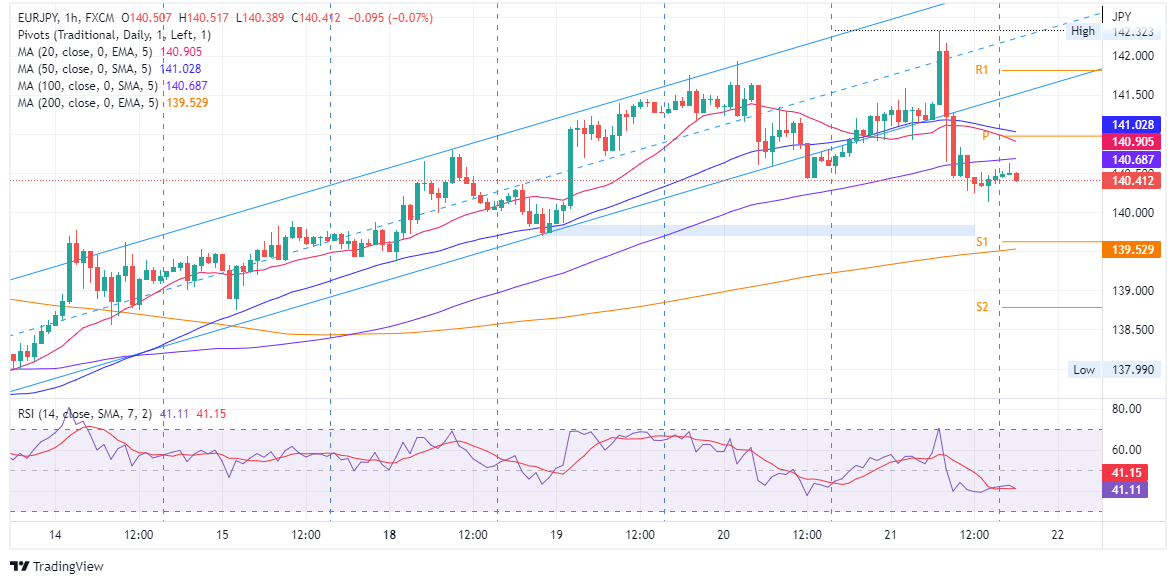
EUR/JPY Key Technical Levels
- AUD/JPY takes offers to refresh intraday low after Australia’s PMIs for July.
- Australia’s preliminary S&P global PMIs for July dropped below market forecasts and prior.
- BOJ couldn’t help yen, Aussie benefited from mildly positive market sentiment.
- Japan’s National Consumer Price Index for June, risk catalysts will be important for fresh impulse.
AUD/JPY slides towards 95.00, down 0.10% intraday near 95.15 during Friday’s initial Asian session. The cross-currency pair posted a corrective pullback around 95.60 the previous day but the bears returned to the table on downbeat Australia data, not to forget the fears of recession.
Australia’s S&P Global Manufacturing PMI eased to 55.7 in July versus 56.2 prior and 56.4 expected. Further, the S&P Global Services PMI dropped to 50.4 during the stated month compared to 55.0 market consensus and 52.6 prior. Further, the S&P Global Composite PMI also declined to 50.6 versus 52.6 previous readouts.
Bank of Japan (BOJ) announced no change in its monetary policy the previous day while keeping the benchmark rate unchanged at -0.10% while keeping the target rate for the Japanese Government Bonds (JGBs) at 0.0%. However, fears of firmer inflation and challenges to growth, as signaled in the BOJ’s quarterly Outlook Report appeared to have weighed on the Japanese yen.
It’s worth noting that the risk-on mood appeared to have favored the AUD/JPY, due to its risk barometer status. The upbeat sentiment could be linked to the resumption of gas flows from Russia’s Nord Stream 1 pipeline, as well as the European Central Bank’s (ECB) new tool called the Transmission Protection Instrument (TPI) to tame disorderly market dynamics in the bloc.
Amid these plays, Wall Street benchmarks closed firmer and the US Treasury 10-year Treasury yields marked the biggest daily slump in five weeks. That said, S&P 500 Futures drops 0.40% by the press time.
Moving on, Japan’s National Consumer Price Index (CPI) for June, prior 2.5% YoY, could offer immediate directions. However, major attention will be given to the risk catalysts for fresh impulse.
Technical analysis
AUD/JPY remains mildly positive while trading between a weekly support line around 95.25 and a three-month-old horizontal resistance near 95.75.
- WTI pares the biggest daily loss in over a week ahead of the key activity data for July.
- Restoration of Nord Stream 1 gas pipeline drowned oil prices despite risk-on mood, softer USD.
- Libya’s resumption of oil production, ECB rate hikes and fears of recession in China also favor sellers.
- Key PMIs for the US, Eurozone and the UK will be crucial to watch.
WTI crude oil prices remain sidelined at around $96.00, after posting the biggest daily slump in eight days, as energy traders await fresh clues. The black gold dropped heavily the previous day, despite the risk-on mood, amid fears of more output and less demand.
The resumption of gas flows from Russia’s Nord Stream 1 pipeline was the key catalyst weighing on the oil prices. “Flows through Russia's Nord Stream 1 natural gas pipeline, which runs under the Baltic Sea to Germany, partially resumed after being shut for maintenance on July 11. The pipeline had already run on reduced volumes following a dispute sparked by Russia's invasion of Ukraine,” said Reuters.
On the same line as the European Central Bank’s (ECB) higher-than-expected 0.50% rate hike, as well as the announcement of the Transmission Protection Instrument (TPI) tool. Analysts at the Australia and New Zealand Banking Group (ANZ) describe it as a bond purchase program aimed at countering unwarranted disorderly market dynamics that pose a risk to effectively delivering on its price stability mandate.
Elsewhere, the resumption of oil production by Libya's National Oil Corp (NOC) and fears of China’s economic slowdown, as signaled by the Asian Development Bank (ADB) the previous day, also weigh on the black gold prices.
It’s worth noting, however, that the softer US dollar and risk-on mood may help the energy benchmark to lick its wounds.
Moving on, the preliminary activity details for July will be important for the oil traders amid fears of an economic slowdown. Also important will be how the major oil producers react to the US-led push to increase the output to tame the prices. Recently, Russian President Vladimir Putin called Saudi Arabia’s Crown Prince Mohammed bin Salman to discuss the output as they both led OPEC+ producers in June.
Technical analysis
Despite the U-turn from $100.69, WTI bears need validation from the 200-DMA level of $93.65 to retake control.
- The GBP/JPY is set to finish the week with gains, up by 0.37%.
- GBP/JPY Price Analysis: A break below the 200-hour EMA to send the pair sinking towards 163.60s.
GBP/JPY barely rises as the Asian Pacific session begins, after Thursday’s session witnessed the cross-currency pair sliding from daily highs near 166.00 to 164.53 daily lows, in a volatile trading session, where the European Central Bank (ECB) grabbed the spotlight, hiking 50 bps for the first time in a decade. At the time of writing, the GBP/JPY is trading at 164.90, up 0.10%.
GBP/JPY Price Analysis: Technical outlook
The GBP/JPY daily chart depicts the pair as upward biased. Nevertheless, the risks are skewed to the downside, as sellers piled around the high 165.90-166.00 area and sent the pair plummeting towards the July 11 daily high at 164.46, which, once broken according to market structure, would shift the trend to neutral.
GBP/JPY 1-hour chart
The GBP/JPY hourly chart depicts the pair as downward biased. GBP/JPY buyers, unable to break Wednesday’s high around 166.25, left the pair vulnerable, so sellers stepped in and dragged the cross-currency pair towards the daily low around 164.53. Worth noting that the Relative Strength Index (RSI) is aiming higher but remains in bearish territory. However, the price action suggests that the GBP/JPY might print a leg up to the confluence of the 20 and 50-hour EMAs, around 165.26-33, before resuming the downtrend.
Therefore, the GBP/JPY first support would be the 200-hour EMA at 164.43. Break below will expose the S1 daily pivot at 164.20, followed by the 164.00 figure. A decisive break will send the GBP/JPY sliding towards the July 15 daily low at 163.64.
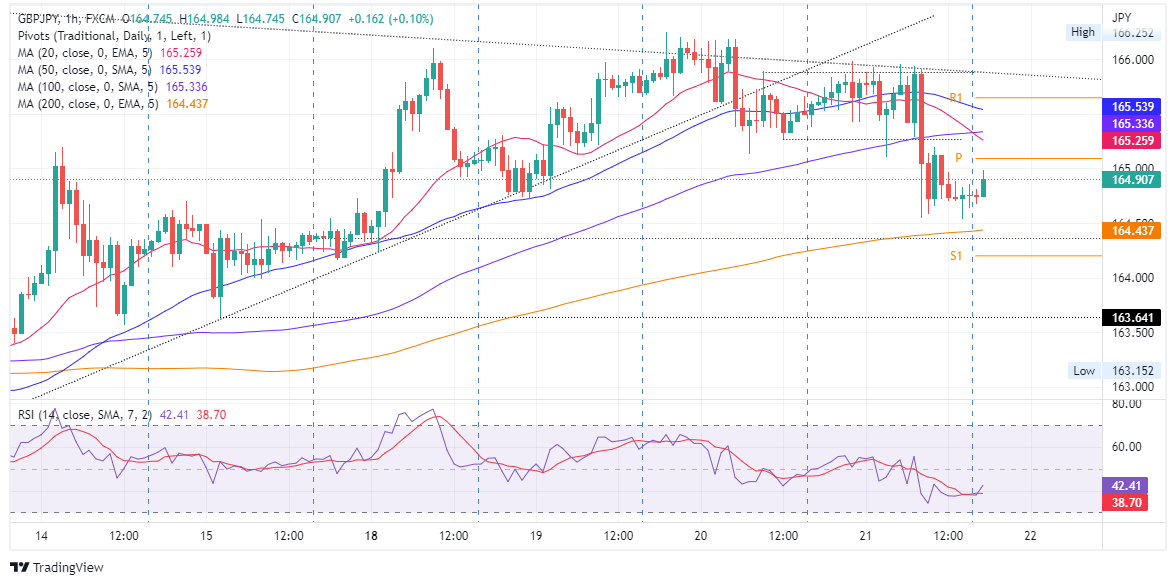
GBP/JPY Key Technical Levels
- EURUSD is advancing towards 1.0300 as DXY tumbles amid a positive market mood.
- The ECB elevated its interest rates by 50 bps and announced a new tool ‘TPI’ to support southern Europe.
- Investors are shifting their focus to the Fed as it will announce monetary policy next week.
EURUSD price is displaying a sheer upside move after picking bids below 1.0200 in the late New York session. The pair displayed wild moves on Thursday after the European Central Bank (ECB) came forward with 50 basis points (bps) interest rate hike. The asset printed a fresh three-week high of 1.0277 and is expected to reclaim again. Broadly, the major has turned sideways and is auctioning in a wide range of 1.0153-1.0277 from the past three trading sessions.
The US dollar index (DXY) has surrendered the cushion of 107.00 completely after failing to sustain above 107.30 on Thursday. On a broader note, the asset is consolidating in a wide range of 106.40-107.33 and is eyeing a fresh downside impulsive wave with a downside break. It is worth noting that the asset has displayed volatility contraction after a sheer downside move from a high of 109.30, recorded last week. Now, the ongoing process of inventory distribution will unfold the downside potential.
Also Read: Oversized ECB hike fails to turn the tide on EURUSD
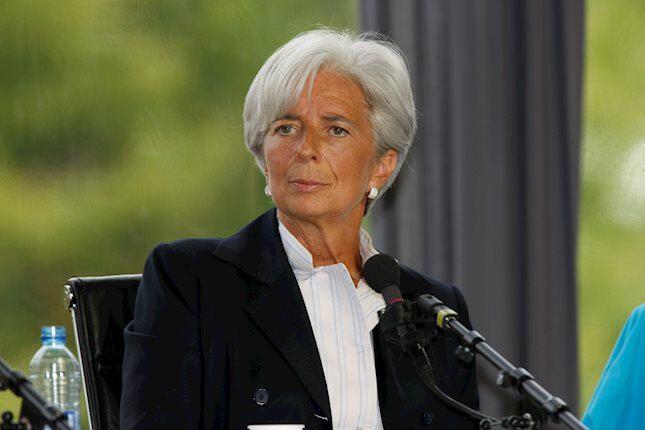
ECB President Christine Lagarde announced a rate hike by 50 bps
EURUSD turns volatile as ECB hikes interest rates surprisingly by 50 bps
EURUSD price displayed topsy-turvy moves on Thursday as the ECB elevated its interest rates by 50 bps. ECB President Christine Lagarde unexpectedly announced a rate hike by half a percent vs. expectations of 25 bps. Credit goes to the soaring price pressures which forced the ECB policymaker to feature a jumbo rate hike. Earlier, ECB Large in his testimony guided that the ECB is interested in elevating interest rates by 25 bps in July and later on by 50 bps in September.
-637940398461598499.png)
-637940398463808994.png)
Introduction of TPI to support Southern Europe
ECB President Christine Lagarde came with plenty of surprises on Thursday. Other than the interest rate hike by 50 bps, the introduction of the Transmission protection Instrument (TPI) to support southern European economies was not expected. The announcement of higher interest rates may be fruitful for core European Union (EU) members such as Germany and France due to their stable financial position. However, southern European economies such as Italy, Greece, and Spain that are facing financial instability may face more headwinds due to higher borrowing costs.
Therefore, the ECB has introduced a new fragmented tool under which the ECB will purchase public securities of these countries and also private securities, if required, to support them against unwarranted deterioration in financing conditions. The public securities would have a maturity between 1 to 10 years.
ECB is unable to determine a neutral rate for now
EURUSD price vapored its optimism early on Thursday after ECB Lagarde didn’t lay down a crisp framework for neutral rates that would keep inflation near its standards. Price pressures have soared in eurozone as a figure of 8.6% for an overall inflation rate is sufficient to annoy households. It looks like the ECB has still not crunched out how far price pressures can go, which has paused them to derive neutral rates for lending operations.
Focus shifts to Fed
EURUSD price is likely to find further direction from the monetary policy announcement by the Federal Reserve (Fed), which is due next week. As a slippage in long-run inflation expectations ruined the odds of a rate hike by 100 bps, an interest rate decision by 75 bps is still on the cards. No doubt, the decision will accelerate the Fed-ECB policy divergence further in absolute terms. But relative mathematics in Fed-ECB policy divergence will calm down as ECB has just started hiking its interest rates.
DXY sees a bumpy ride on firmer Wall Street
The DXY surrendered its optimism on Thursday after the second quarter show by the US companies delighted with the better-than-expected earnings from Tesla. Wall Street remained firmer led by upbeat results from Tesla and a stellar performance by tech companies. This improved the risk appetite of the market participants and the safe haven lost its appeal. The DXY is looking bearish now and is expected to extend its losses after slipping below Wednesday’s low at 106.39.
EURUSD technical analysis
EURUSD price is forming a Bullish Flag on a four-hour scale that signals a continuation of bullish momentum after a rangebound phase. Usually, a consolidation phase denotes intensive buying interest from the market participants, which prefer to enter an auction after the establishment of the trend.
The shared currency bulls have successfully defended the 20-period Exponential Moving Averages (EMA) a few times around 1.01720, which adds to the upside filters.
Meanwhile, the Relative Strength Index (RSI) (14) is attempting to shift into the bullish range of 60.00-80.00. An occurrence of the same will infuse fresh blood into the shared currency bulls.
A breach of Thursday’s high at 1.0278 will drive the asset towards the round-level resistance at 1.0300, followed by July 1 low at 1.0366.
Alternatively, the greenback bulls could gain control if the asset drops below Monday’s low at 1.0081. An occurrence of the same will drag the asset towards the psychological support at 1.0000. A breach of the psychological support will expose the greenback bulls to recapture its two-year low at 0.9952.
EURUSD four-hour chart
-637940397943628907.png)
Elliott Wave Trading Strategies: DAX 40, FTSE 100, STOXX 50, DXY, EUR/USD
- USD/CAD remains pressured towards three-week-old ascending support line.
- RSI retreat, failures to cross 200-SMA and monthly horizontal resistance all favor sellers.
- 61.8% Fibonacci retracement of June-July upside adds to the downside filters.
USD/CAD holds lower grounds around 1.2870 during the initial hour of Friday’s Asian session, after reversing from 1.2936 the previous day. In doing so, the Loonie pair portrays the initially to stay beyond the 200-SMA while also marking the U-turn from a horizontal resistance establishes since the month’s start.
Given the downbeat RSI and sluggish MACD adding strength to the bearish bias, the USD/CAD prices are likely to challenge an upward sloping support line from June 28, at 1.2850 by the press time.
Following that, the 61.8% Fibonacci retracement (Fibo.) of the June-July advances, near 1.2785, will be important to watch for the pair sellers.
Meanwhile, the 200-SMA and the aforementioned horizontal resistance, respectively near 1.2915 and 1.2940, guard short-term recovery moves of the USD/CAD pair.
Following that, an area comprising multiple levels marked since June 17, between 1.3080 and 1.3090, could challenge the pair buyers before directing them to the monthly peak of 1.3223.
Overall, USD/CAD is likely to witness further downside but needs validation from 1.2850.
USD/CAD: four-hour chart
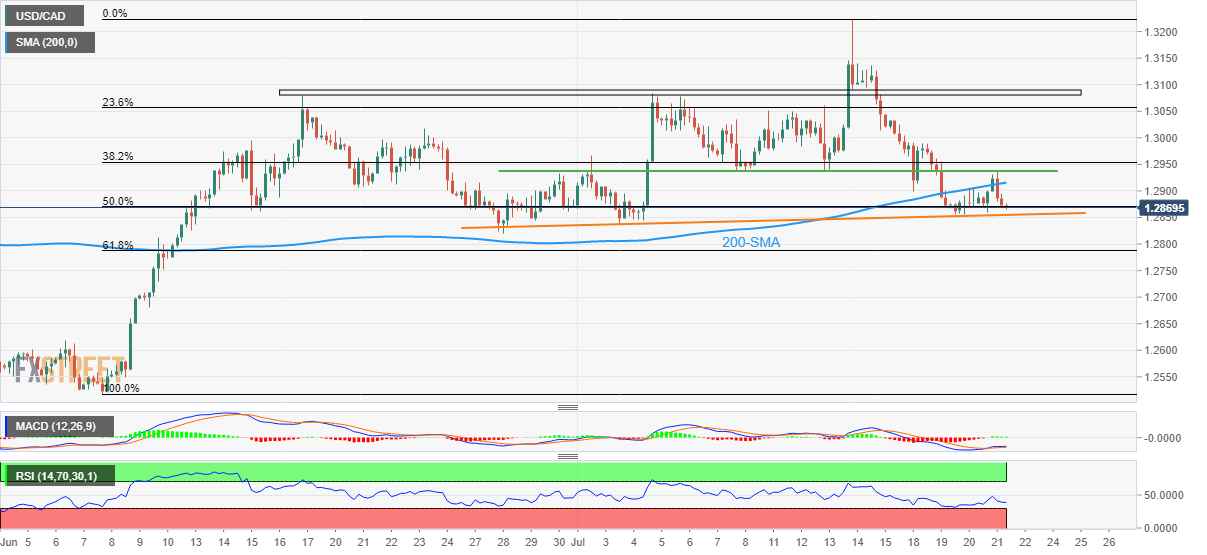
Trend: Further weakness expected
- Bulls run up to a key level on the charts and a correction could be in order.
- AUD/USD W-formation on the 4-hour time frame is a compelling feature.
AUD/USD is flat in the first hour of Asian trade on Friday as it moves in on extremes of a broadening formation on the charts, but fundamentally, the stock markets o Wall Street and a softer US dollar have been a driver as well as a hawkish central bank. AUD/USD rallied to 0.6937 from a session low of 0.6858.
On Wednesday Reserve Bank of Australia, (RBA) Governor Philip Lowe emphasised higher rates with the Australian government bond futures have also started to price in higher rates. Yields on most government bonds up about 10 basis points since the start of the week.
Global stock markets are also supportive of the Aussie and are on track for a fifth straight session of gains. The euro was up in and the greenback down in choppy trading after the European Central Bank raised interest rates for the first time in more than a decade as it tries to combat inflation. The ECB rose by 50 bps and it also introduced a bond protection plan, called the Transmission Protection Instrument (TPI), that is designed to cap borrowing costs across the region.
Another thorn in the side of the US dollar, Wall Street's main indexes climbed on Thursday boosted by a late-afternoon rally and gains in heavyweight growth stocks, including Tesla. The tech-heavy Nasdaq added 1.4% to lead the gains while the S&P 500 closed at its highest level since June 9. The Dow Jones Industrial Average climbed 0.5%.
Meanwhile, despite a risk on tone in financial markets, the concerns over Europe's gas supply, fresh wobbles in China's property market and the detection of foot-and-mouth viral fragments in imported meat products in Australia could be a weight going forward.
Additionally, traders will wait anxiously for the US Federal Reserve meeting next week where policymakers are expected to raise interest rates by 75 basis points to curb runaway inflation. There will also be a focus on crucial second-quarter US Gross Domestic product data, which is likely to be negative again. Two-quarters of negative GDP growth would mean the United States is in a recession, which has been a supportive factor for the greenback for its safe haven qualities. If stocks stumble on a bad outcome, the Aussie will potentially follow suit.
AUD/USD technical analysis
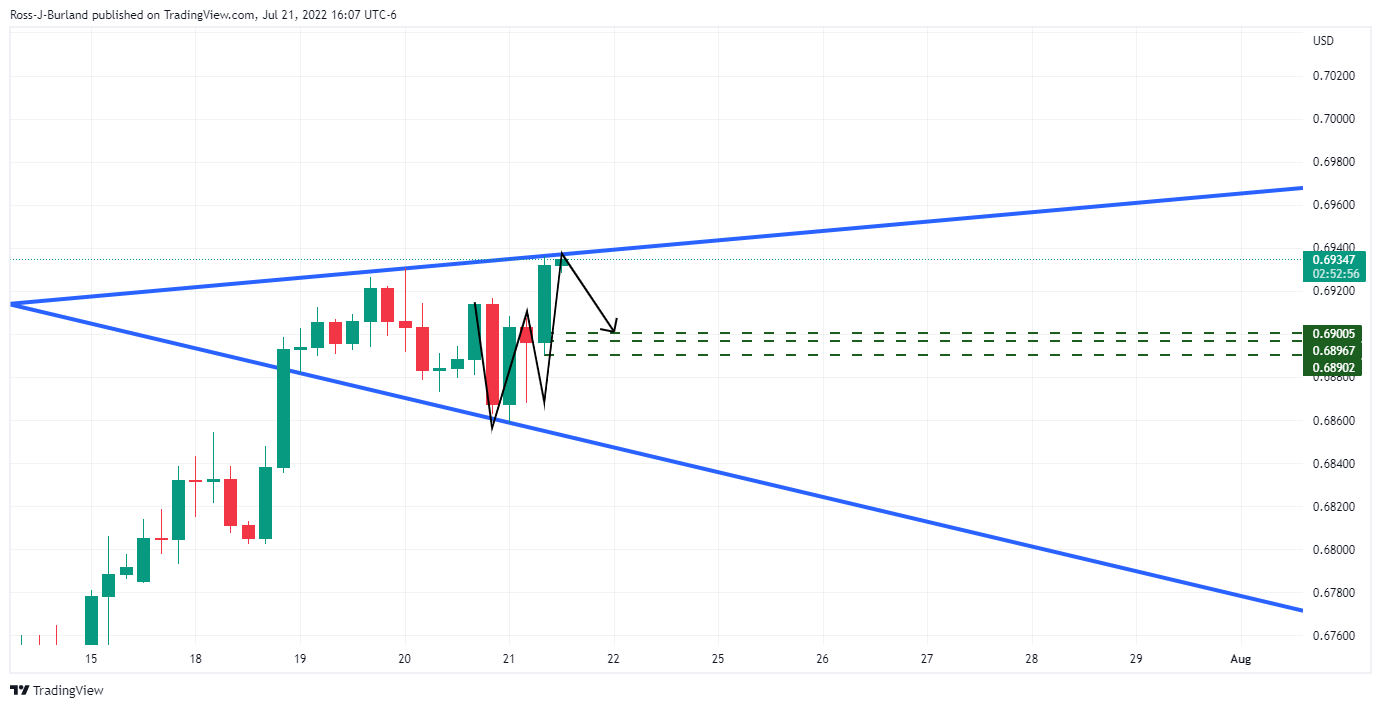
The price is meeting a broadening formation extreme and the W-formation on the 4-hour time frame is a compelling feature as well which could see the price revert to test the neckline and 15-min price bar lows if bears stay committed. 0.6890 is eyed in that regard.
- The Japanese yen appreciated sharply against the greenback, more than 0.60%.
- Worse than expected, US data begins to anticipate a recession.
- The Bank of Japan (BoJ) kept rates unchanged and pledged to its ultra-loose monetary policy stance.
The USD/JPY plunges as Wall Street Thursday’s session ends, with equities registering decent gains as sentiment improved since the mid-North American session, despite high inflation and growing concerns of a global recession. However, instead of boosting the greenback, the Japanese yen strengthened and trimmed weekly losses amidst an upbeat market mood.
The USD/JPY is trading at 137.39, down 0.56%. The major began trading around the 138.00 area but rallied towards the bottom trendline of a daily chart ascending wedge near 138.87, tumbling afterward as the greenback and US Treasury yields plunged. That said, the USD/JPY hit the daily low at 137.37.
US data missed estimations, a headwind for the USD/JPY
In the New York session, US sensitive economic data show the slowdown in the US labor market. Firstly, Initial Jobless Claims rose 251K, most than the 240K estimate, the highest in 8 months. Also, the Philadelphia Fed Manufacturing Index for June tumbled to -12.3, its lowest level since 1979, while the Conference Board dropped -0.8% MoM, more than the -0.5% estimated.
Elsewhere, the US Dollar Index fell 0.41% to 106.598, undermined by dropping US Treasury yields. The US 10-year Treasury yield sank 15 bps, from 3.028% to 2.877%, a headwind for the USD/JPY.
On Thursday Asian session, the Bank of Japan decided to leave rates unchanged and maintained its Yield Curve Control (YCC) in the 10-year JGB bond at around 0%. Further, the central bank raised forecasts for inflation while noting that growing risks are skewed to the downside.
What to watch
The Japanese economic docket will feature inflation figures alongside Jibun Bank Manufacturing and Services PMIs. On the US front, the S&P Global Services, Manufacturing, and Composite PMIs would shed some clues about the current status of the US economy.
Also read: USD/JPY Price Analysis: Stumbles below 138.00 on RSI negative divergence
USD/JPY Key Technical Levels
- GBP/USD bulls are taking back control in late New York trade.
- The days ahead is bullish as per the current price action.
- Bears will need to commit to a break of 1.1890 to open downside risk.
GBP/USD's broadening formations and current price action open the way towards the 1.2050s and beyond for the sessions ahead. A break of the round 1.2000 will be key in this regard.
GBP/USD daily chart, the bearish scenario
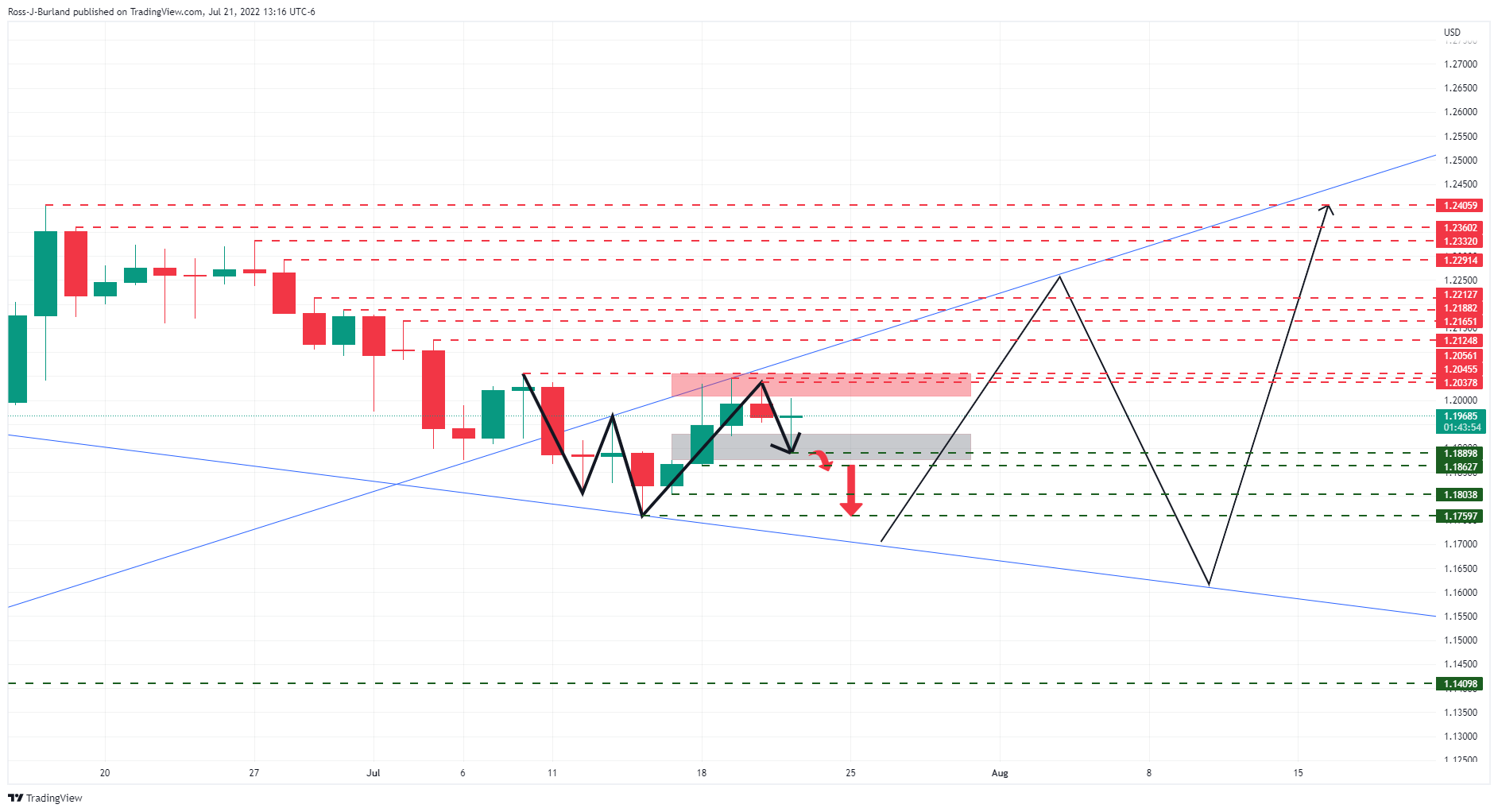
The daily chart's W-formation has played out with the price mitigating 61.8% of the inefficiency so far, grey area:
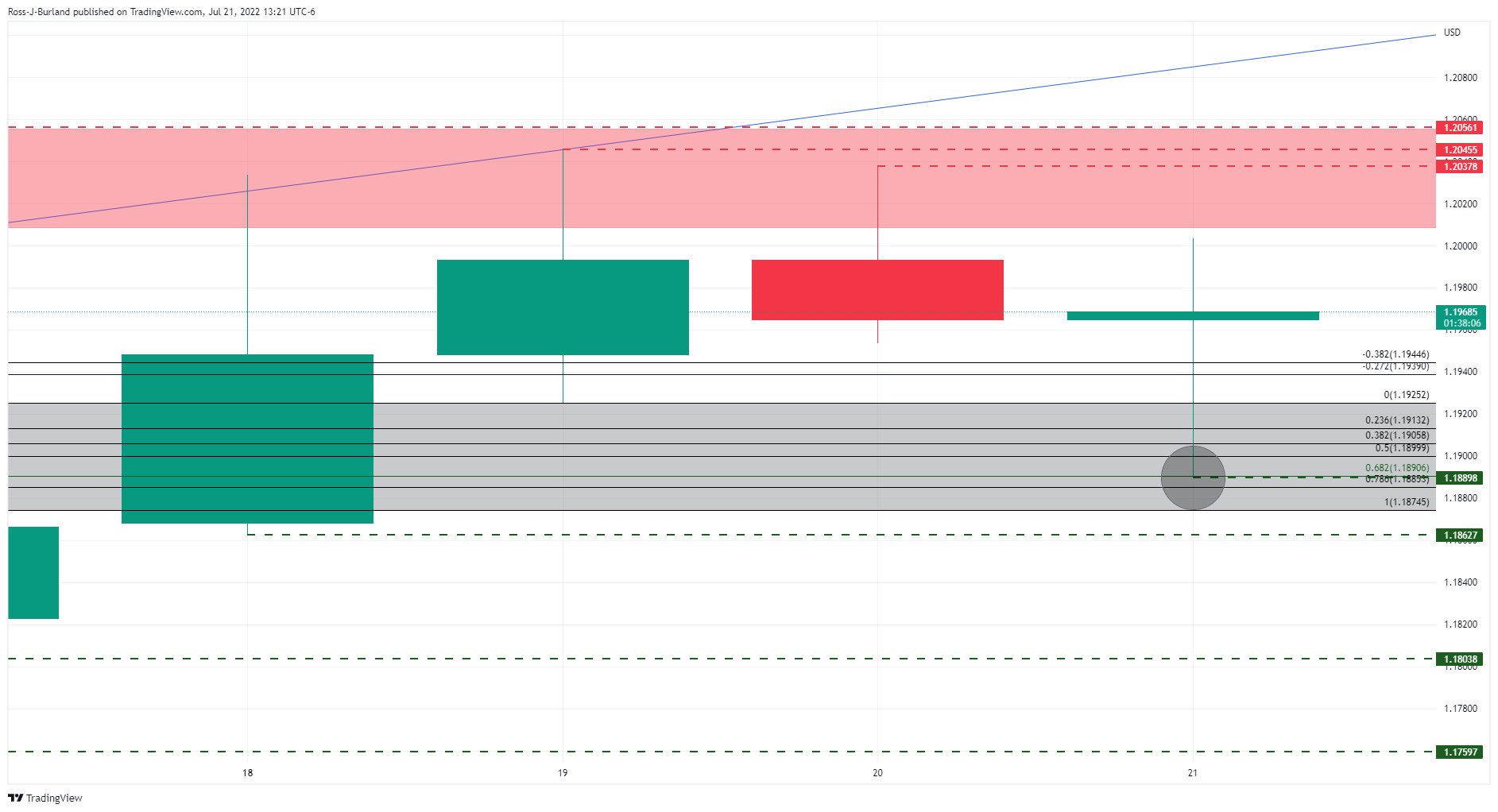
If the price were to continue lower, then the broadening formation would be expected to see cable extend into the low 1.17s in the days ahead. 1.1804 will be key in this regard ahead of 1.1760 as illustrated by the daily lows above.
GBP/USD daily chart, bullish scenario
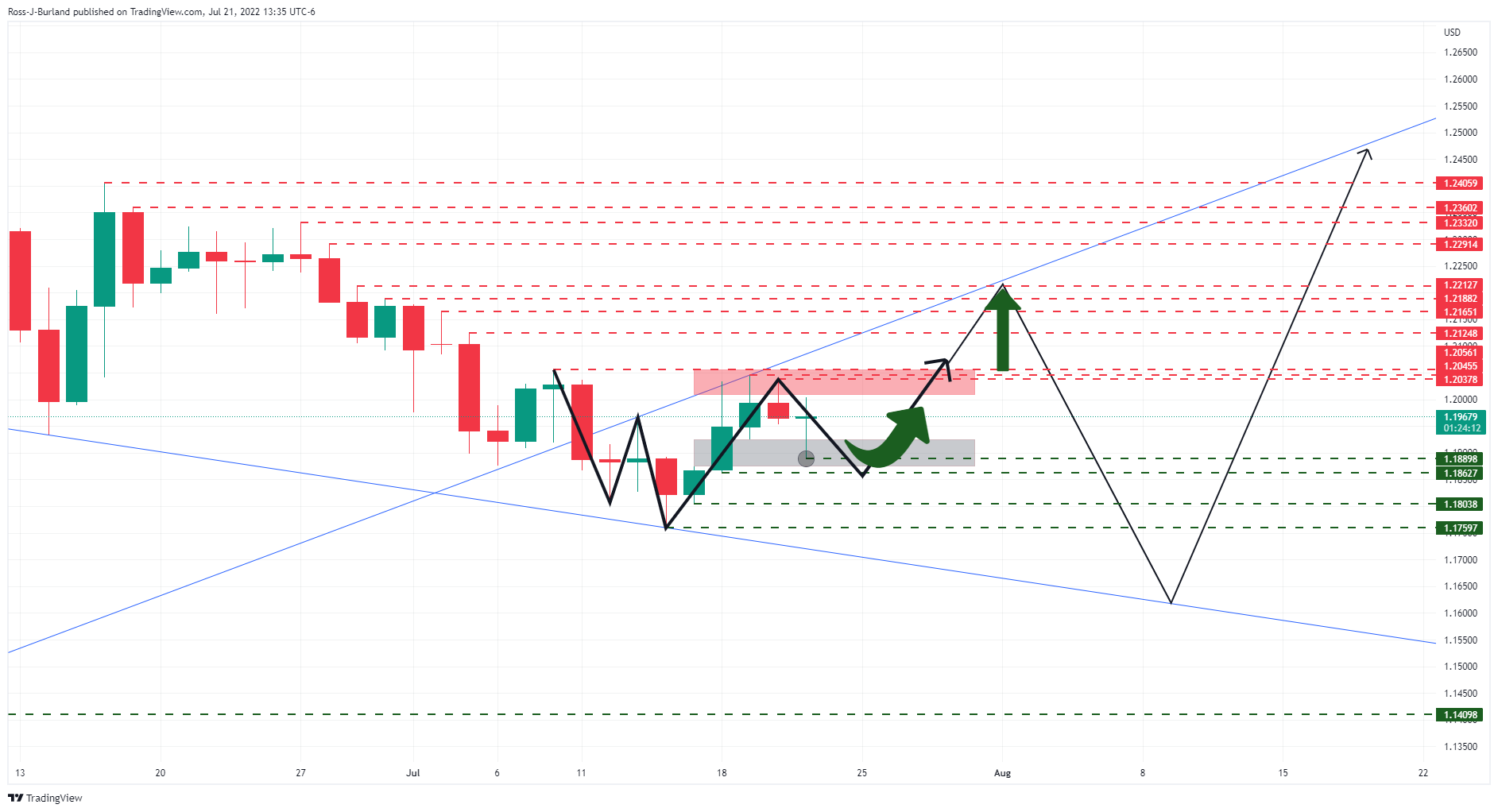
Should the bulls commit at this juncture, on a break of the cluster of daily highs and resistance, then there will be prospects of a move towards the broadening formation's upper boundaries near 1.2220.
GBP/USD H1 chart, bullish scenario

The broadening formation and bullish price action on the hourly time frame open risk of a break of the recent highs to open the way for a move to the upper boundary of the broadening formation towards the 1.2050s and beyond for the sessions ahead. A break of the round 1.2000 will be key in this regard.
What you need to take care of on Friday, July 22:
The market's attention was on the EU on Thursday, amid a series of events taking place in the Union.
The most relevant was the European Central Bank monetary policy decision. The ECB hiked rates by 50 bps, the first hike in over a decade, and moved away from negative rates. The main issues that forced the ECB into taking more aggressive action were inflation and the ongoing crisis with Russia.
However, Gazprom resumed gas flows to the EU through the Nord Stream 1 pipeline. The German Energy Regulator noted that the pre-maintenance level of 40% capacity could be exceeded on this first day, providing additional relief to EUR buyers.
Finally, Italian Prime Minister Mario Draghi effectively resigned, and elections will be held by the second half of September. Italian President Sergio Mattarella has dissolved the Italian parliament, opening the door for a snap election on September 25.
The American dollar advanced after the ECB's decision, but easing US Treasury yields limited its gains. The EUR/USD pair finished the day just below the 1.0200 threshold. GBP/USD settled at around 1.1975.
US stocks managed to post modest gains, which put further pressure on the dollar.
Crude oil prices remained under pressure, with WTI settling at $96.30 a barrel. Gold advanced and finished the day at $1,717 a troy ounce.
Commodity-linked currencies posted modest gains against the dollar, with AUD/USD trading at 0.6910 and USD/CAD at 1.2880. Safe-haven JPY and CHF posted substantial gains vs their American rival.
The focus on Friday will be on growth-related figures, as S&P Global will publish the preliminary estimates of the July PMIs.
Bitcoin Price Update: Tesla's impact on Bitcoin market value
Like this article? Help us with some feedback by answering this survey:
- NZD/USD slides almost 0.12% on Thursday; the major is still up by 1% in the week.
- A risk-on impulse fails to propel the NZD/USD higher as traders’ focus shifts to the Fed in the next week.
- The US labor market has begun to slow down, aligning with the housing market, as data reported in the week missed expectations.
The NZD/USD snaps four days of gains on Thursday, barely losing almost 0.06%, despite an upbeat mood around the financial markets. US equities are rising after the ECB hiked rates 50 bps for the first time in 11 years, while better-than-expected US corporate earnings keep investors’ nerves controlled amidst high inflation and a global economic slowdown.
The NZD/USD is trading at 0.6221. After opening near 0.6220s, the major climbed to 0.6241, the daily high, but price action shifted gears, and the NZD/USD tumbled towards the daily low at 0.6184. However, the major recovered some ground, and buyers reclaimed the 0.6200 figure as the New York session winded down.
In the meantime, the greenback is retracing from daily highs, as illustrated by the US Dollar Index (DXY). The DXY is down 0.13%, at 106.896, a tailwind for the NZD/USD, which so far failed to capitalize on the buck weakness. Also weakening across the board are US Treasury yields led by the 10-year benchmark note coupon, down ten bps, at 2.923%.
US employment data, although lagging, shows signs of slowing down
Before Wall Street opened, the US Bureau of Labor Statistics reported that claims for unemployment in the week ending on July 16 rose more than estimations and hit an 8-month high. The labor market begins to show flashes of an aggressive Federal Reserve, but would not deter Jerome Powell and Co. from reaching its target to tame inflation to the 2% target.
At the same time, the Philadelphia Fed Manufacturing Index in June declined for the second consecutive month to -12.3 from -3.3. The report said that “on balance, the firms continued to report increases in employment, but the employment index declined 9 points to 19.4, the lowest reading since May 2021.”
Meanwhile, during the Asian session, the NZ Trade Balance fell from -$9.56B to -$10.51B YoY from (revised) prior. Monthly figures reported a deficit of $701 million vs. a $195M surplus in the previous month.
What to watch
An absent NZ economic docket would leave NZD/USD traders adrift to US data and the market mood. On Friday, the US docket will feature S&P Global PMIs, ahead of the next week’s Federal Reserve monetary policy meeting.
NZD/USD Key Technical Levels
- Gold price falls back into the hands of the bulls following the ECB events.
- XAUUSD is now at a critical juncture in the bearish cycle where a significant correction could play out.
- The Federal Reserve meeting will be an important event for rate and gold traders.
Gold price is higher by 1% in midday New York trade and has recovered from the fresh lows of $1,680.93 after sliding from $1,718.39 to Thursday's highs. The yellow metal was pressured even as the US dollar weakened early on Thursday, with the ICE dollar index last seen down below the 107 figure but in the middle of the day's range of 106.415 and 107.323. The day has been turbulent due to the European Central Bank that raised interest rates for the first time in more than a decade as it seeks to tame inflation.
ECB lifts the lid on rates, gold price rallies
The ECB took the well-telegraphed plunge and raised rates. Seeking to tame inflation, the ECB had for weeks flagged a 25 basis point hike, until earlier this week, when sources told Reuters the central bank was weighing a bigger move. This came to fruition on Thursday when the central bank hiked by 50bps and also announced a bond protection plan, called the Transmission Protection Instrument (TPI), that is designed to cap the borrowing costs across the region in an effort to help heavily indebted countries like Italy, whose coalition government fell after the resignation of Prime Minister Mario Draghi. The outcome for XAUUSD was bullish despite the two-way trip in the euro and US dollar. Gold rallied from the day's lows and the bulls committed to the upside, buying the dip throughout the hours ensuing the ECB event.
Read more: Eurozone rate hike: A big step for the ECB, but a small help for the euro
US bond yields fall in wake of ECB hasty normalization
Bullish for the gold price, US bond yields fell with the benchmark 10-year note below 3% after the first interest rate hike in 11 years by the ECB as concerns about runaway inflation trumped worries about growth. The two-year US Treasury yield was down to a low of 3.121% while the yield on 10-year Treasury notes fell to 2.917% which is back into the middle of the range for July as investors get set for the Federal Reserve interest rate decision on July 27 in which it is largely expected to hike rates by 75 basis points.
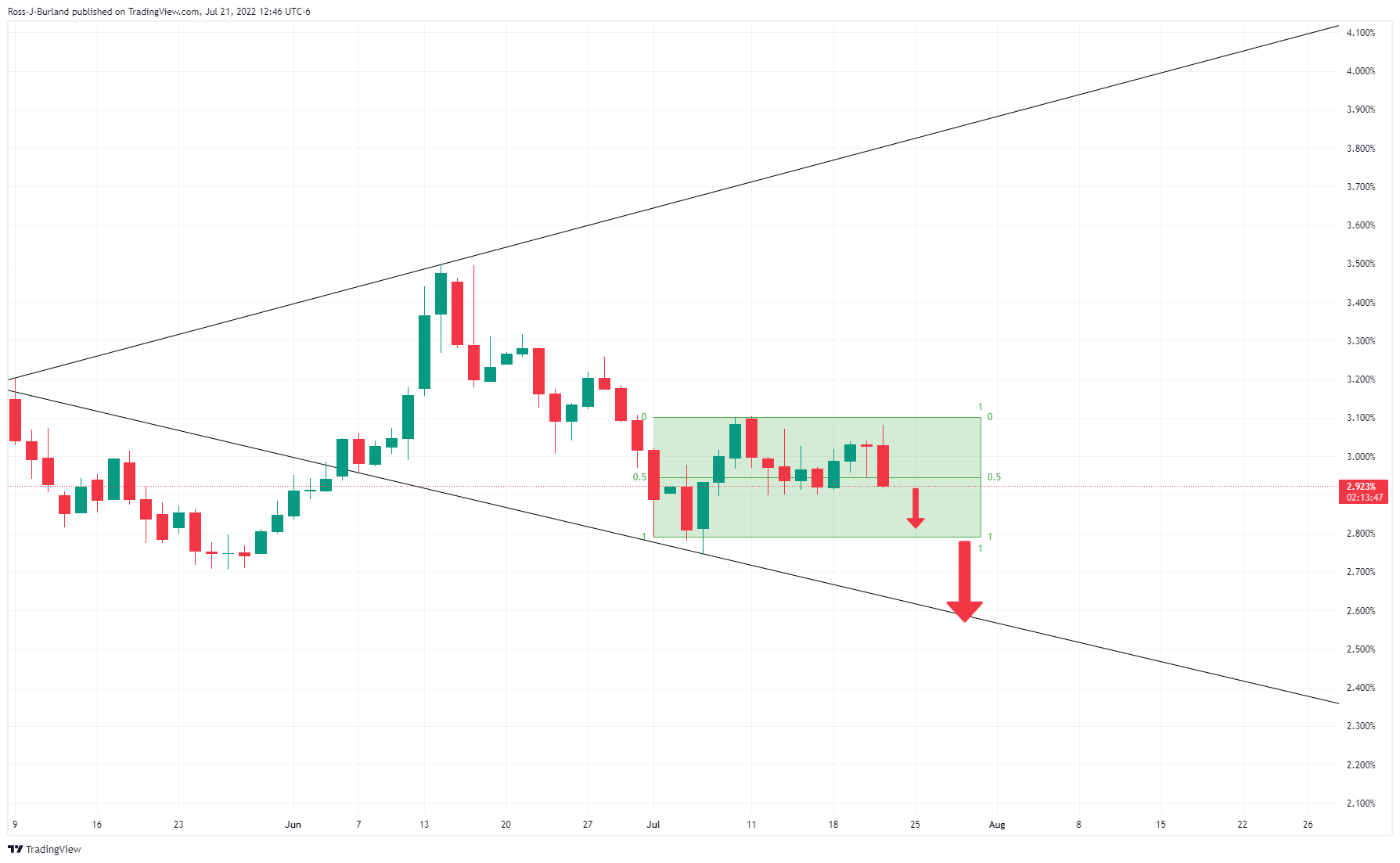
10-year yield broadening formation, bearish bias
Fed expectations
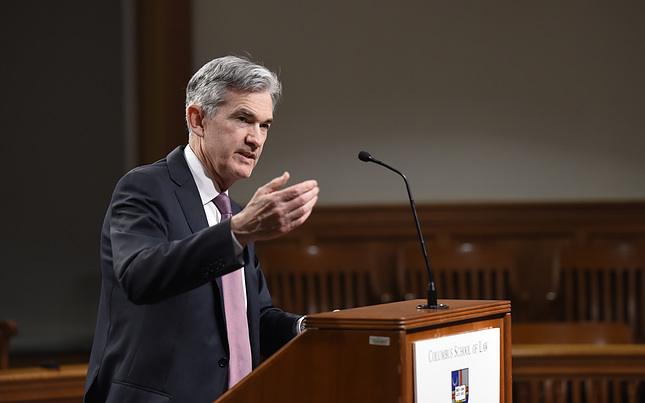
Fed chairman, Jerome Powell
For the Fed, which meets next Tuesday and Wednesday, many are of the opinion that the central bank will hike by 75 bps, especially now that the ECB rose rates by 50bps. The fed would also be expected to continue hiking rates by at least 50 bps hikes at each meeting in the remainder of the year. This would raise the target range for the federal funds rate to 3.75-4.00% by 2023 which is more than indicated by the FOMC’s dot plot (3.4%) and futures markets (3.55%).
''We think that the Fed is still underestimating the persistence in inflation, and has yet to acknowledge that a wage-price spiral has already started in the US,'' analysts at Rabobank argued. ''US CPI inflation rose to 9.1% in June and its core measure stands at 5.9%. At the same time, nominal wages have risen by 6.7% year-on-year in July according to the Atlanta Fed’s wage growth tracker. This does suggest that the wage-price spiral that the Fed still hopes to avert, is already here.''
Gold price outlook, all things considered
For the gold price, while today's surprise 50bp hike from the ECB has helped prices pare their losses as the USD weakens, analysts at TD Securities argue that the liquidation vacuum in gold will persist. ''Risks for a significant capitulation event are rising,'' the analysts said, and this, they say, is because ''prop traders have overtaken money managers as the dominant speculative force in gold markets.''
''Today, the behemoth position held by the average prop-trader is near twice its typical size, suggesting a substantial amount of pain is reverberating across gold markets as prices revert lower amid the most hawkish Fed regime in decades. Given this massive speculative length was established in 2020, and does not appear to be associated with a Fed or inflation narrative, this complacent position appears particularly vulnerable. Weakening prices may fuel additional selling into a liquidation vacuum, with every participant from Shanghai traders to ETF holders selling their length.''
Gold price technical analysis
Gold price analysis, from a longer-term perspective, reveals the prospects of a correction from the weekly broadening formation's lower boundary as illustrated below:
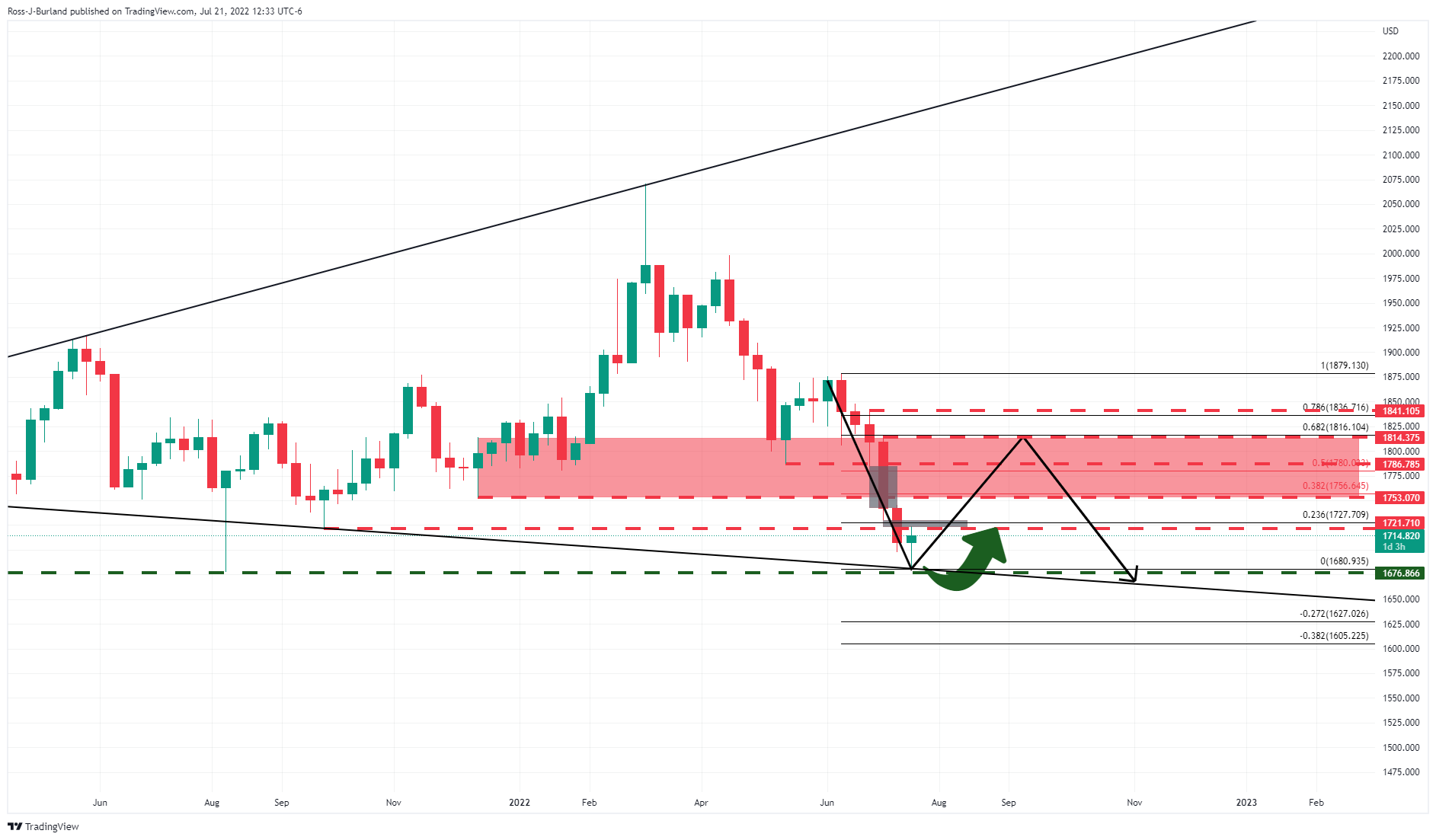
XAUUSD has fallen a handful of dollars shy of the $1,677 pivot lows and bulls are moving in which could leave this week's candle as a bull hammer. A move into the grey areas as dawn on the chart above, which are spaces of price imbalance, will open the risk of a significant continuation higher triggering a series of buy stops along the way.
A 50% mean reversion guards the golden 61.8% ratio on a break of the psychological $1,800. On the other hand, a break of the said picot lows of $1,677 could play out first of all which could likely;y cause a flurry of volatility considering the number of orders that are sitting below.
- USD/CHF is still upward biased, but in the short-term might aim towards 0.9600.
- A market sentiment shift, dented demand for the greenback, and a headwind for the USD/CHF.
- USD/CHF Price Analysis: Downwards-to-neutral, and if sellers reclaim 0.9670, the major will tumble towards 0.9600.
The USD/CHF slides for the second day in four retreats below 0.9700, amidst an improved market mood weighing on the greenback after the ECB delivered its first rate hike in 11 years, which initially sent the USD/CHF towards its daily low at 0.9667. Nevertheless, buyers stepped in and saw it as an opportunity for a better entry price. At the time of writing, the USD/CHF is trading at 0.9694.
Of late, sentiment shifted upbeat, as shown by US equities rising. Nonetheless, it remains fragile, with high global inflation, worldwide economic slowdown, and a US recession looming. Efforts of global central banks to tighten monetary conditions would likely end with a worldwide recession.
USD/CHF Price Analysis: Technical outlook
On Thursday, the USD/CHF began trading around 0.9700 but climbed as the mood shifted sour, hitting a daily high at 0.9739. However, earlier gains were retraced on the ECB’s decision, which sent the major to the daily low at around 0.9667 before marching firmly, shy of the 0.97000 mark. Nevertheless, the USD/CHF daily chart is upward biased, and unless sellers reclaim 0.9495, buyers remain in charge.
USD/CHF 1-hour chart
The USD/CHF hourly chart portrays the major as downwards-to-neutral biased, with the SMAs above the exchange rate. Also, the Relative Strength Index (RSI), albeit flat, is in negative territory and below the RSI’s 7-day SMA, further cementing the bias. All that said, alongside USD/CHF price action below the mid-line of an ascending channel, suggest the downtrend would continue in the short term.
Therefore, the USD/CHF first support would be the S1 daily pivot at 0.9675. A breach of the latter will immediately expose the bottom trendline of the aforementioned ascending channel, meaning that the USD/CHF next target would be 0.9600. However, firstly the USD/CHF sellers would need to clear the S2 pivot point at 0.9641 before reaching the 0.9600 figure
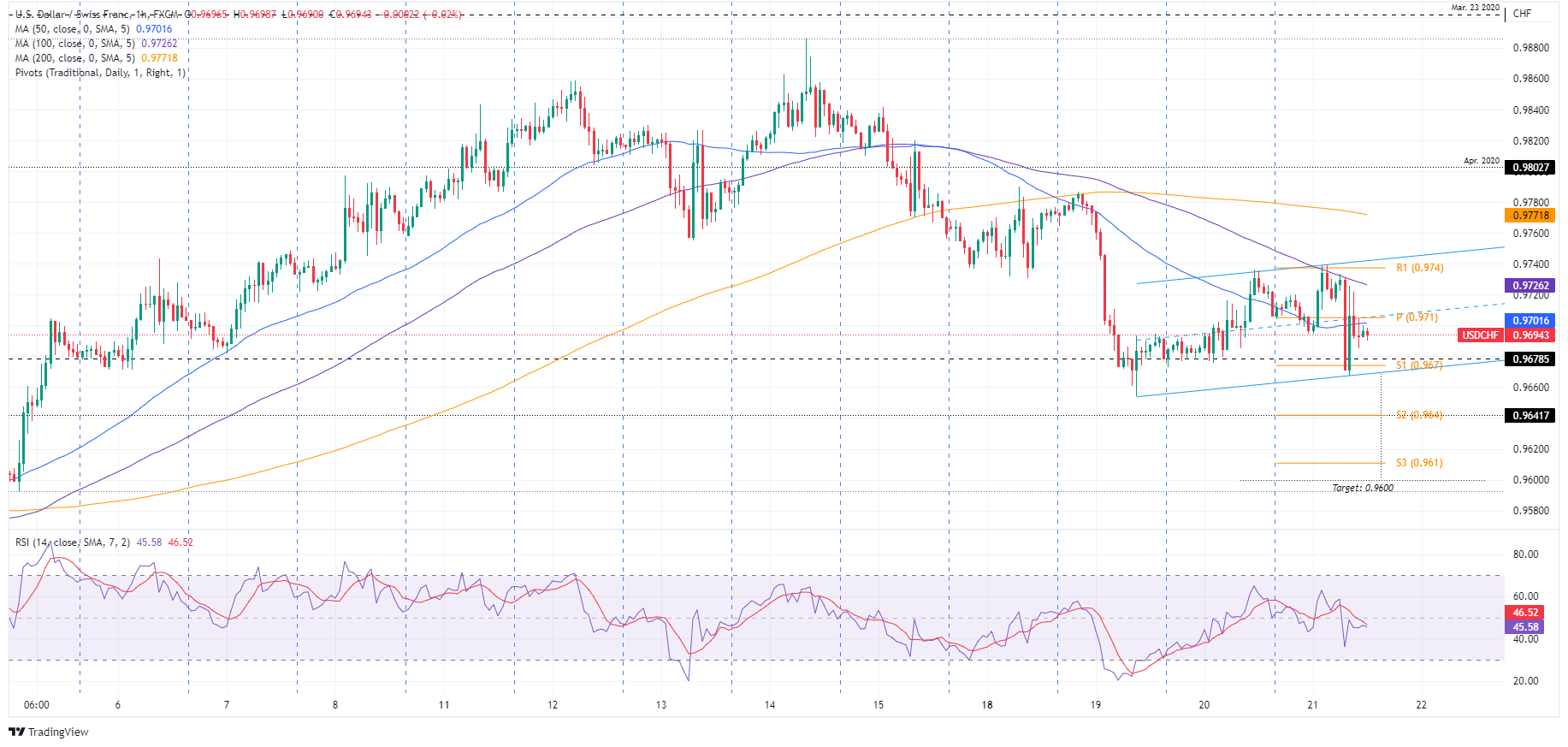
USD/CHF Key Technical Levels
- USD/JPY drops during the day but remains range-bound until sellers break below 137.70.
- The BoJ decided to hold rates unchanged, and the YCC control in the 10-year at 0.25%.
- USD/JPY Price Analysis: Negative divergence in the daily chart opens the door for further losses.
The USD/JPY falls below the 138.00 threshold following the Bank of Japan’s decision to hold rates unchanged while pledging to its dovish monetary policy stance and keeping the Yield Curve Control (YCC) in the 10-year JGB bond yield at 0.25%. At the time of writing, the USD/JPY is trading at 137.98, down by a minimal 0.18%.
USD/JPY Price Analysis: Technical outlook
USD/JPY Daily chart
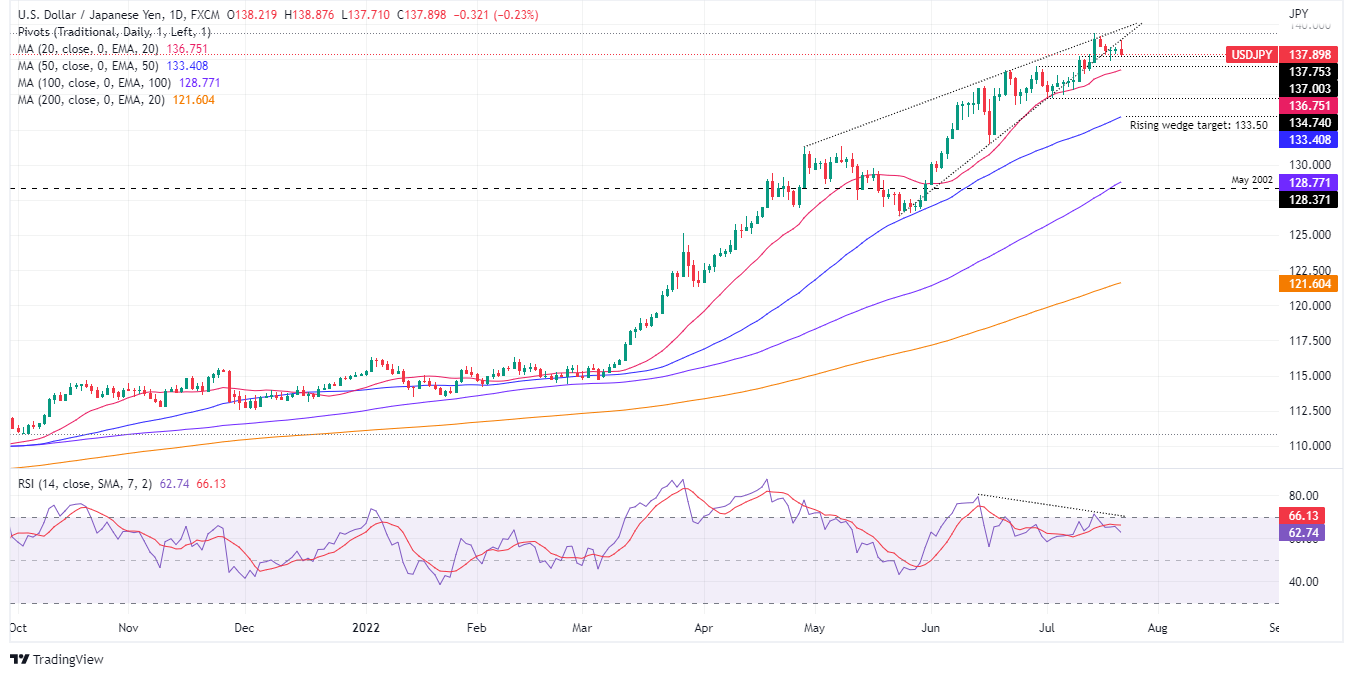
The USD/JPY uptrend is still intact, but it appears to be losing steam. Albeit reaching higher highs, the Relative Strength Index (RSI) is still diverging from price action. Indeed, two days ago, the RSI slid below the RSI’s 7-day SMA, meaning that sellers began to overcome buyers. Additionally, the break of the rising wedge to the downside opened the door for a fall to 133.50, but the pair is consolidating around 137.70s-138.80s.
Therefore, the USD/JPY’s first support will be the July 19 low at 137.38. Break below will expose the 20-day EMA at 136.75, followed by the MTD low at 134.74.
USD/JPY 1-hour chart
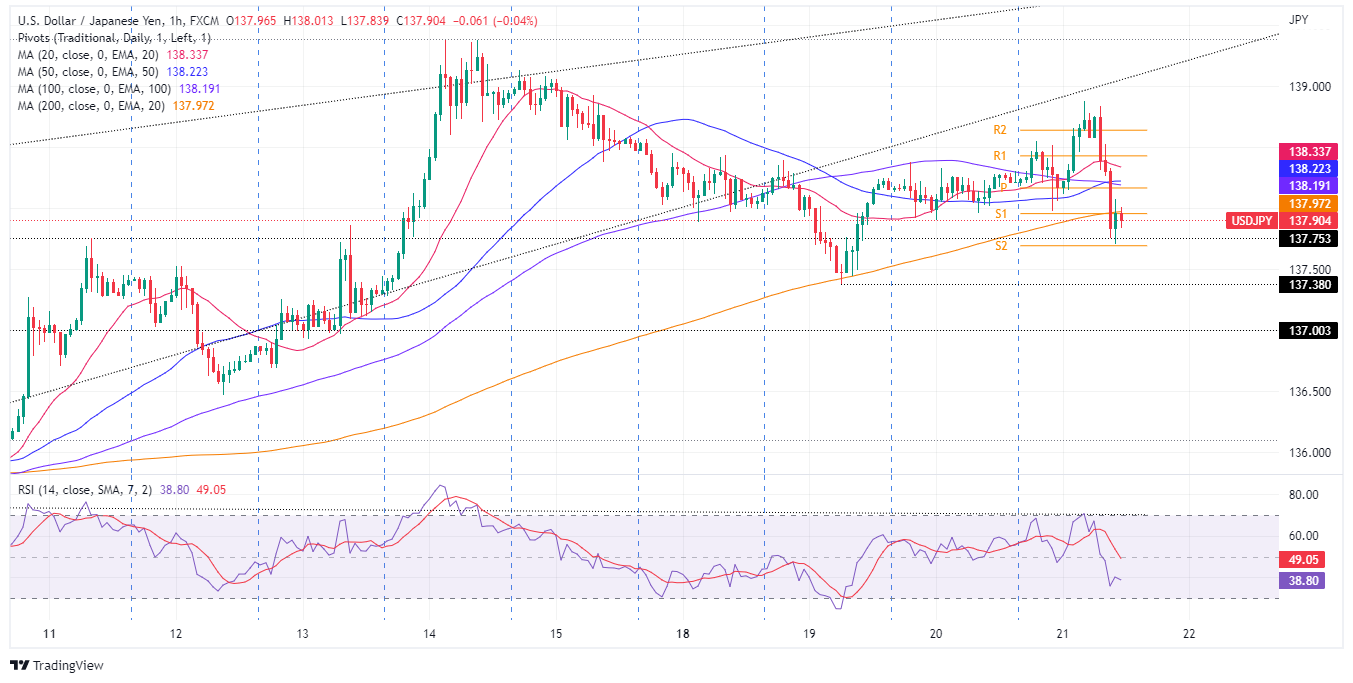
In the near term, the USD/JPY 1-hour chart illustrates the pair sliding below all the hourly EMAs but bracing for the 200-hour EMA, just below it, around 137.88. USD/JPY traders should notice that the exchange rate is also below the July 20 low lying at 137.95, further opening the door for a test of the weekly lows at 137.38.
However, on its way south, USDJPY’s sellers would have some hurdles to overcome. The USD/JPY first support will be the S2 daily pivot at 137.69. A breach of the latter will send the major towards the week’s low at 137.38, followed by the figure at 137.00.
USD/JPY Key Technical Levels
The European Central Bank (ECB) raised the key interest rates on Thursday for the first time in 11 years. Analysts at Danske Bank expect the central bank to hike another 100bp this year, before halting its cycle. They still prefer the idea of selling ECB-induced euro rallies.
Key Quotes:
“EUR/USD initially rallied close to 1.03 upon announcement before (paradoxically) ending the session below pre-ECB levels. In our view, this highlights one of our long-held views: currencies should primarily be treated as a play on the relative attractiveness of asset markets and only secondly as a play on relative rates. Higher shortened EUR rates on balance improve the carry attractiveness of investing in the single currency.”
“The larger-than-expected ECB rate hike and the signal of more frontloaded tightening also skew European asset return distributions to the left. This makes EUR-denominated assets less attractive. The lack of convincing details on the TPI programme highlights how the ECB cannot have its cake and eat it, in the sense that the price of tightening policy across the Eurozone requires a relatively tighter stance for the economies with the lowest r*s; Italy being the case in point. In turn, this challenges the investment outlook for the EUR that still suffers heavily on a relative terms of trade and cost-adjusted-productivity basis vis-à-vis the USD.”
“In our view, EUR/USD remains fundamentally overvalued. Hence, at this stage, we still like to sell ECB-induced EUR rallies and still pencil in EUR/USD firmly settling below parity over the coming quarters.”
- Silver erased losses and rose back above $18.70.
- The rebound could gain momentum if it breaks $19.00.
- The primary trend remains bearish; break under $18.00, to open doors to $17.50.
Silver bottomed on Thursday at $18.23, slightly above the YTD low of $18.13. It then rebounded sharply back above $18.50, boosted by a rally in gold prices following a sharp decline in US yields.
XAGUSD rose above the $18.75 area, a relevant short-term support. It peaked at $18.81 hitting a fresh daily high. If the rebound holds, the odds of a more sustainable recovery will rise. The next critical resistance stands around $19.00.
If silver firmly breaks the $19.00 zone, it could point to a double bottom near $18.20 and recover a strong support. The following relevant barrier is seen at the $19.50 area that contains the 20-day Simple Moving Average (intermediate resistance at $19.15).
The daily chart also offers some positive signs for the metal, with MACD making the first bullish cross in two months. Stochastic Oscillators are coming out from oversold levels.
A decline back under $18.50 should add pressure to the $18.20 low, softening the mentioned bullish signs. The break under $18.20 would expose $18.00. The break below could trigger volatility and a potential acceleration toward $17.45.
Silver daily chart
-637940173898558753.png)
The European Central Bank's internal metrics do not currently show an unwarranted fragmentation in any eurozone country, Reuters reported on Thursday, citing sources familiar with discussions.
Sources further told Reuters that the ECB does not expect the Transmission Protection Instrument (TPI) to be triggered imminently and that policymakers did not discuss any particular country on Thursday. "All eurozone countries currently eligible for ECB's TPI based on conditions outlined on Thursday."
Market reaction
The shared currency lost interest on this headline and the EUR/USD pair was last seen trading flat on the day at 1.0183.
Analysts at TD Securities said that they expect the European Central Bank to hike its policy rate by 50 basis points (bps) in September and by 25 bps thereafter until the repo rate reaches its terminal level of 1.5%.
EUR rally looking like a strategic fade
"Rates: The ECB delivers a 50bps rate hike hedged with its new TPI tool and PEPP reinvestments. Price action in front-end was still relatively muted as markets were already positioned for bigger moves after this week's leaks. The ECB's tool was credible, but the key issue is will any member state "activates" it. We consider that the path for peripherals could be rocky. We continue to favour flatter 5s30s curve and wider EGB spreads."
"FX: The ECB delivered a 'surprise' 50bp hike and an anti-fragmentation tool. Despite this, today's ECB decision looks more like a faux-flex than a resolute commitment to fight inflation. There is little the ECB can do to avert an impending energy crisis or an implosion in the current account. EUR's recent rally is increasingly looking like a strategic fade as a sub-parity paradigm looks increasingly difficult to avert."
Italian President Sergio Mattarella has dissolved the Italian parliament, opening the door for a snap election on September 25, Reuters reported on Thursday, citing Italian state broadcaster RAI.
Market reaction
This development doesn't seem to be having a noticeable impact on the shared currency's performance against its major rivals. As of writing, the EUR/USD pair was trading at 1.0200, where it was up 0.23% on a daily basis. Meanwhile, Italy's FTSE MIB Index lost 0.7% on the day after Prime Minister Mario Draghi resigned earlier in the day.
- AUD/USD sets to finish the week with gains, up 1.54%.
- Wobbling sentiment keeps the AUD/USD seesawing in a 50-70 pip range.
- AUD/USD to remain below 0.7000 according to National Australia Bank.
The AUD/USD rally shows signs of losing steam but remains up in the day after recording its first losing day out of the last five on Wednesday, though at the time of writing, it registers minimal gains of 0.14%. The AUD/USD is trading at 0.6897 amidst a trading session characterized by fragile sentiment.
AUD/USD Thursday’s price action witnessed the pair opening around 0.6880s, below the 0.6900 figure. However, it climbed to the daily high at 0.6916 before retreating to the 0.6850s area, hitting a daily low at 0.6858; once the dust settled, it is trading at current levels.
AUD/USD seesawing as sentiment swings amidst a volatile session
Sentiment remains fragile, shifting throughout the day. The ECB’s first hike in 11 years, the global economic slowdown looming, led by China and US recession fears lingering in traders’ minds, keep riskier assets on the backfoot. Reflection of that is the AUD/USD seesawing in a 50-70 pip range, with no apparent bias. However, during recessionary times, the greenback is king.
In the meantime, in tone with recent news of US companies halting hiring, namely Apple, Google, and Ford; the US Department of Labour unveiled that Initial Jobless Claims for the week ending on July 16 increased by 251K, more than the 240K estimated, hitting a fresh 8-month high. Claims rose when the Fed it’s raising rates to tame stubbornly high inflation. Nevertheless, it’s a consequence that US workers would have to deal with until the US central bank begins to see inflation slowing down.
Meanwhile, the Philadelphia Fed Manufacturing Index in June declined for the second consecutive month to -24.8 from -12.4. The report said that “on balance, the firms continued to report increases in employment, but the employment index declined 9 points to 19.4, the lowest reading since May 2021.”
On the Australian side, the Reserve Bank of Australia (RBA) Governor Philip Lowe emphasized that higher rates would be needed to anchor inflation expectations, he said on Wednesday.
AUD/USD to remain below 0.7000 according to National Australia Bank
“We think the USD has not yet peaked given a hawkish Fed and rising concerns over an imminent global recession,” said analysts at National Australia Bank in a note.
“Our stronger for still longer dollar view implies a more extended period below 0.70 for Aussie/dollar with the currency seen broadly contained in a $0.65-0.70 range over coming quarters.”
AUD/USD Key Technical Levels
The European Central Bank raised key interest rates on Thursday by 50 bps. The move was larger than expected. Analysts at Wells Fargo believe inflation remains elevated enough, and inflation risks worrisome enough, to continue with a more forceful pace of rate hikes for the time being.
Key Quotes:
“As the lead into the July meeting made clear, even forward guidance on interest rates does not guarantee a particular policy rate outcome. Moreover, we believe inflation remains elevated and inflation risks worrisome enough—Lagarde cited inflation risks were to the upside and have intensified in the short-term—to continue with a more forceful pace of rate hikes for the time being.”
“Our view remains that today's hike will be followed up by another 50 bps Deposit Rate increase at the September meeting. In addition, while inflation remains elevated and until Eurozone economic growth slows in a much more meaningful manner, we also see a steady series of rate increases as more likely than not. In that context, we also forecast a 25 bps rate increase at the October and December meetings, which would bring the Deposit Rate to 1.00% by the end of 2022.”
“We anticipate that will be the peak during the current cycle—as inflation begins to recede by 2023 and growth slows sharply, we see the ECB keeping interest rates steady through most, if not all, of next year. In essence, after today's announcement, we anticipate a shorter, sharper rate hike cycle from the European Central Bank than previously.”
- Volatile session across financial markets after ECB meeting.
- US Dollar without a clear direction, US yields tumble.
- USD/CAD holds onto weekly losses as recovery fades above 1.2900.
The USD/CAD reversed and dropped back below 1.2900 in a volatile session for financial markets following the European Central Bank meeting and US data.
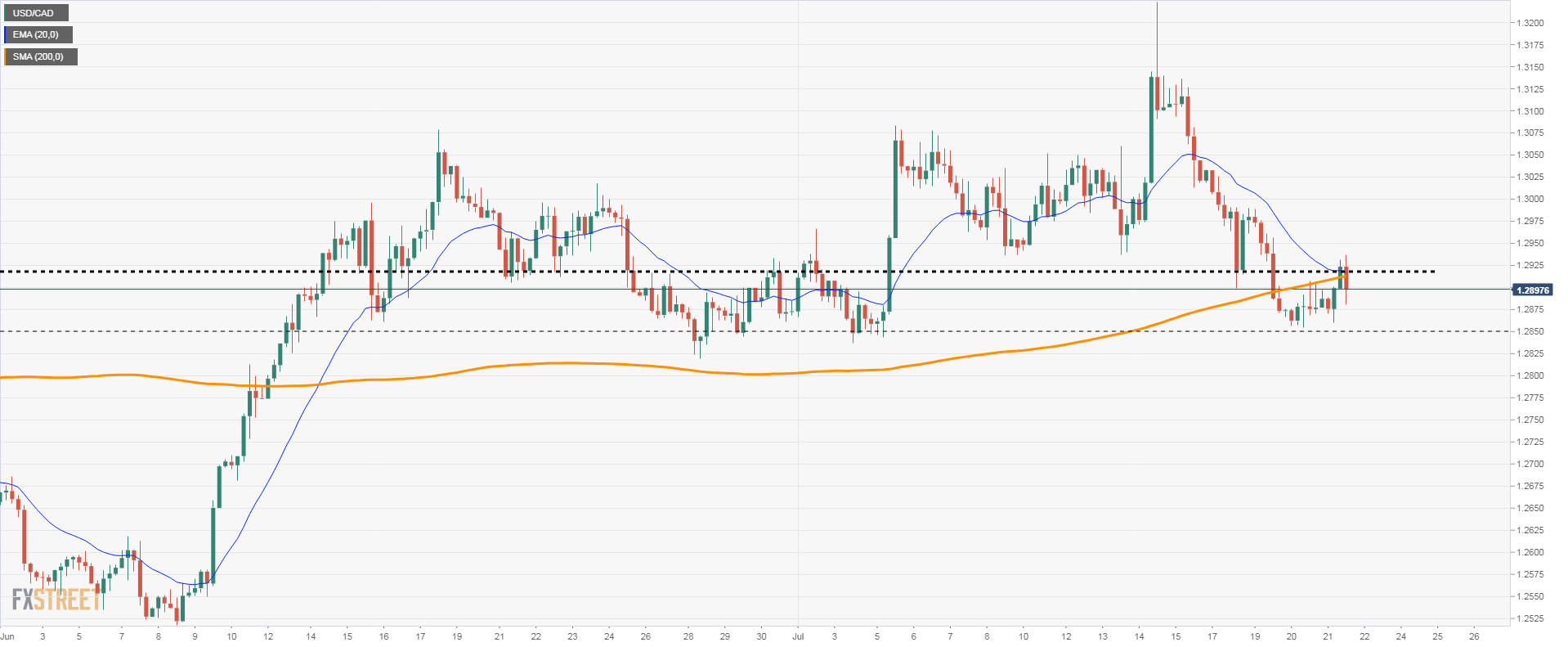
The pair peaked at 1.2935 and then pulled back. It is hovering around 1.2880, flat for the day and approaching the weekly low, near the strong support zone of 1.2850.
The rejection from above 1.2900/05 (horizontal levels, and 20 and 200 Simple Moving Average in four-hour chart) reinforced the bearish short-term bias. If USD/CAD consolidates above it would point to further gains.
USD/CAD 4-hour chart
Data, ECB and uncertainty
Equity markets are posting modest losses, but the dollar is not benefiting from this as US yields are falling sharply. The US 10-year stands at 2.92%, the lowest since Monday, and the 30-year at 3.06%. Crude oil prices are falling more than 3%.
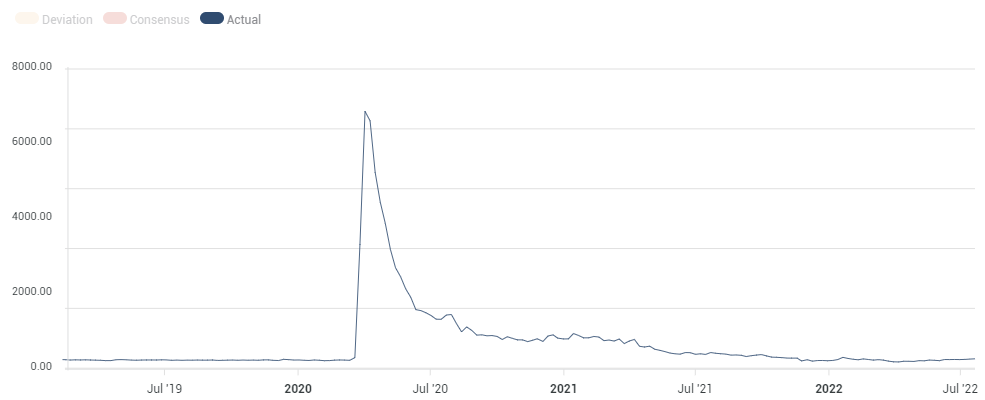
US economic data weighed on the US dollar on Thursday. Initial Jobless Claims rose more than expected to the highest level in eight months while Continuing Claims also rose above expectations to the highest in eleven weeks. The Philly Fed tumbled unexpectedly. On Friday, Canada will report May retail sales and the US the flash July S&P Global PMI.
Technical levels
- The GBP/USD is almost flat during the day, barely up 0.02%.
- A dismal mood weighs on the British pound due to ECB’s hiking rates and US President Joe Biden testing positive for Covid-19.
- GBP/USD Price Analysis: Tilted to the downside, as sellers eye 1.1800.
GBP/USD stays in positive territory, though downward pressured, once the European Central Bank (ECB) added to the list of global bank authorities shifting to tightening monetary policy, delivering a surprisingly 50 bps rate hike to all of its three rates, aimed to normalize policy amidst a high inflation scenario.
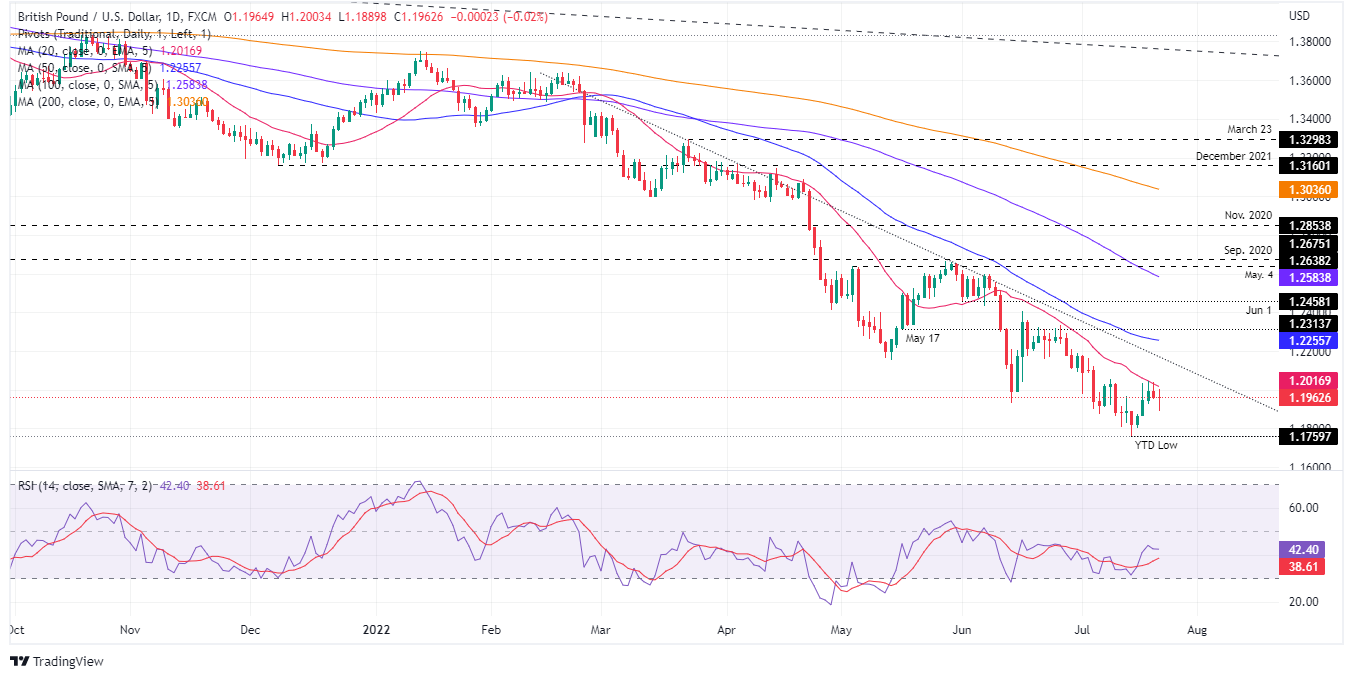
The GBP/USD is trading at 1.1962 after hitting a daily high at 1.2003, but its correlation with the EUR/USD dragged the pair down towards the daily low below 1.1900. However, once the dust settled, the British pound stood still at current levels.
GBP/USD capped by sentiment and safety flows
A risk-off impulse has kept investors’ flows toward safe-haven assets. Sentiment deteriorated due to factors like the ECB’s monetary policy decision and US President Joe Biden testing positive for Covid, which sent US equities down between 0.22% and 0.87%. The greenback is clinging to the 107.000 area as shown by the US Dollar Index, almost flat, while US Treasury yields are down, reflecting safety flows.
Before Wall Street opened, the US Department of Labour reported that Initial Jobless Claims for the week ending on July 16 rose 251K, higher than the 240K estimated, hitting a fresh 8-month high. At the same time, the Philadelphia Fed Manufacturing Index in June declined for the second consecutive month to -24.8 from -12.4. The report said that “on balance, the firms continued to report increases in employment, but the employment index declined 9 points to 19.4, its lowest reading since May 2021.”
US Jobless Claims rise above expectations
The lack of UK economic data keeps GBP/USD traders assessing words from the Bank of England Governor Andrew Bailey. On Wednesday he stated that a 50 bps rate hike in August is possible, triggering a jump in the GBP/USD. Nevertheless, the gloomy UK economic outlook will keep the pound under selling pressure, despite the efforts that the BoE makes to tame inflation, opening the door for a stagflationary scenario.
Analysts at Rabobank expect the GBP/USD to fall towards 1.1800
“Given our expectation that USD strength is likely to persist for around 6 months or so in view of risks to global growth, we foresee the potential for further sharp drops in the value of the pound. We have revised lower our target for cable from 1.18 and see the potential for a dip to levels as low as 1.12 on a 1-to-3-month view. The assumes a more sustained break below EUR/USD 1.00.”
GBP/USD Price Analysis: Technical outlook
The GBP/USD is still downward biased, despite bouncing off the weekly lows around 1.1860s. GBP/USD buyer’s failure to break above the 20-day EMA at 1.2015 sent the pair tumbling below the 1.2000 figure, extending towards the 1.1920s area. Even the Relative Strength Index (RSI), which at the beginning of the week aimed higher, shifted gears and is about to break below 40 as selling pressure mounts on the pair.
Therefore, the GBP/USD first support would be the 1.1900 mark. Break below will expose the July 18 daily low at 1.1862, followed by the figure at 1.1800 and the YTD low at 1.1760.
The European Central Bank (ECB) recently published additional details regarding its new anti-fragmentation tool titled "the Transmission Protection Instrument (TPI)."
Key takeaways
"TPI purchases would be focused on public sector securities."
"Purchases under the TPI would be conducted such that they cause no persistent impact on the overall Eurosystem balance sheet and hence on the monetary policy stance."
"TPI buys with a remaining maturity of between one and ten years."
"Purchases of private sector securities could be considered."
"Purchases would be terminated either upon a durable improvement in transmission, or based on an assessment that persistent tensions are due to country fundamentals."
"TPI conditions: Sound and sustainable macroeconomic policies."
Market reaction
The EUR/USD pair is struggling to gain traction and was last seen trading flat on the day near 1.0180.
- EUR/JPY sees wild swings as Lagarde fails to impress.
- ECB hikes key rates by 50 bps and announces a new anti-fragmentation tool.
- BOJ sticks to its ultra-loose monetary policy guidance.
EUR/JPY is looking to stabilize around 141.00 after the sharp 150-pips volatile trading witnessed in the last hour, thanks to the ECB policy announcements.
The cross broke its intraday trading range to the upside and jumped sharply to hit the highest level in two weeks at 142.32 after the ECB hiked the key interest rates by 50 bps while announcing its Transmission Protection Instrument (TPI), a new bond purchase scheme aimed at helping more indebted eurozone countries and preventing financial fragmentation within the currency bloc.
The optimism on a more hawkish than expected ECB quickly vapored out after the central bank revealed the forward guidance, noting the meeting-by-meeting approach, as the next rate hike path remains data-dependent.
Also, the lack of specifics on the new anti-fragmentation tool and doubts about its ability to protect the member countries weighed heavily on the euro. This took the wind out of the EUR/JPY impressive rally.
On the JPY side of the story, EUR/JPY continues to find support from the BOJ’s dovish rhetoric, as it stuck to its ultra-loose monetary policy stance. The BOJ stood pat on its monetary policy settings while leaving the policy guidance unchanged. BOJ Governor Haruhiko Kuroda, however, did acknowledge the negative effects of the rapid weakening of the yen in his post-policy meeting press conference.
With the ECB and BOJ policy decisions out of the way, investors now look forward to the sentiment on Wall Street for fresh trading impetus. US earnings season is underway and could have a significant impact on risk sentiment.
EUR/JPY technical levels
- Gold price witnessed an intraday short-covering move from over a 15-month low.
- The post-ECB rise in the euro weighed on the USD and offered support to the metal.
- A weaker tone around the equity markets benefitted the safe-haven commodity.
Gold price staged a goodish intraday bounce from the $1,680 region, or its lowest level since March 2021 touched earlier this Thursday and shot to a fresh daily high in the last hour. The XAUUSD was last seen trading around the $1,710 region, up nearly 0.50% for the day, though any meaningful upside still seems elusive.
Gold price benefitted from modest USD weakness
The US dollar came under renewed selling pressure as investors continue scaling back their bets for a massive 100 bps rate hike move by the Federal Reserve in July. Apart from this, the hawkish European Central Bank (ECB) inspired an intraday spike in the shared currency and dragged the USD Index to a fresh two-week low. This, in turn, was seen as a key factor that prompted an intraday short-covering around the dollar-denominated gold.
Also read: Gold Price Forecast: Will the ECB rescue XAUUSD bulls?
Aggressive major central bank moves to cap gains
That said, the prospects for further interest rate hikes by major central banks to curb inflation might continue to act as a headwind for the non-yielding gold. The ECB followed the global tightening trend and raised its official rates for the first time since 2011 on Thursday. The central bank delivered a jumbo 50 bps rate increase against the broader consensus for a 25 bps and also indicated that rates would rise further in future meetings.
Adding to this, the overnight hawkish comments by the Bank of England Governor Andrew Bailey bolstered bets for a 50 bps rate hike in August, which would be the biggest since 1995. The Federal Reserve is also expected to raise rates by another 75 bps at its upcoming policy meeting on July 26-27. Moreover, the Reserve Bank of Australia had signalled earlier this week the need for higher interest rates to tame rising inflation.

ECB hikes rates by 50 bps
Risk-off impulse offered some support
A softer risk tone, however, offered some support to the safe-haven gold. The recent bounce in the equity markets ran out of steam rather quickly amid the worsening global economic outlook and growing recession fears. Investors remain concerned that rapidly rising interest rates, the Russia-Ukraine and the imposition of strict COVID-19 controls in China would pose challenges to global growth. This, in turn, tempered investors' appetite for riskier assets.
Gold price technical outlook
Gold price might struggle to move back above the $1,710-$1,712 immediate hurdle, which is followed by the $1,725-$1,726 supply zone. Some follow-through buying could trigger a fresh bout of a short-covering move and lift the XAUUSD back towards the $1,744-$1,745 resistance zone. The latter should act as a key pivotal point, which if cleared decisively would suggest that the metal has formed a near-term bottom.
On the flip side, the $1,700-$1,695 zone now seems to protect the immediate downside ahead of the YTD low, around the $1,680 region. Sustained weakness below, leading to a subsequent break through the 2021 yearly low, around the $1,677-$1,676 area, would be seen as a fresh trigger for bearish traders. The gold price could then prolong the downward trajectory and test the next relevant support near the $1,670 horizontal zone.
-637940086205061604.png)
Gold price: Will the ECB drive gold prices higher or lower?
Christine Lagarde, President of the European Central Bank (ECB), is delivering her remarks on the policy outlook and responding to questions following the bank's decision to hike key rates by 50 basis points.
Key quotes
"Governing Council would rather not use TPI, would not hesitate if it has to."
"Differences in local finances can legitimately arise."
"Governing Council will make a decision on whether TPI activation is proportionate."
"There is no recession under the baseline scenario."
"Euro has a bearing on inflation going forward."
About ECB's press conference
Following the ECB´s economic policy decision, the ECB President gives a press conference regarding monetary policy. Her comments may influence the volatility of EUR and determine a short-term positive or negative trend. Her hawkish view is considered as positive, or bullish for the EUR, whereas her dovish view is considered as negative, or bearish.
Christine Lagarde, President of the European Central Bank (ECB), is delivering her remarks on the policy outlook and responding to questions following the bank's decision to hike key rates by 50 basis points.
Key quotes
"Compliance of EU fiscal framework a condition of TPI."
"Absence of severe macro imbalances is condition for TPI."
"Third TPI condition: fiscal sustainability."
"Debt sustainabilty analysis to take into account ECB, ESM, IMFanalyses."
"Fourth TPI condition: Sound and sustainable macro policies in line with recovery and resilience funds."
About ECB's press conference
Following the ECB´s economic policy decision, the ECB President gives a press conference regarding monetary policy. Her comments may influence the volatility of EUR and determine a short-term positive or negative trend. Her hawkish view is considered as positive, or bullish for the EUR, whereas her dovish view is considered as negative, or bearish.
Christine Lagarde, President of the European Central Bank (ECB), is delivering her remarks on the policy outlook and responding to questions following the bank's decision to hike key rates by 50 basis points.
Key quotes
"Activating TPI will be at the discretion of the Governing Council."
"Initial signs of inflation expectations above target warrant monitoring."
"Risks to inflation tilted to upside."
"If TPI is activated, it will avoid an interference with the appropriate monetary policy stance."
"We will address issue of excess liquidity."
"ECB is capable of going big on TPI."
About ECB's press conference
Following the ECB´s economic policy decision, the ECB President gives a press conference regarding monetary policy. Her comments may influence the volatility of EUR and determine a short-term positive or negative trend. Her hawkish view is considered as positive, or bullish for the EUR, whereas her dovish view is considered as negative, or bearish.
Christine Lagarde, President of the European Central Bank (ECB), is delivering her remarks on the policy outlook and responding to questions following the bank's decision to hike key rates by 50 basis points.
Key quotes
"Decision was unanimous on TPI."
"Bigger rate hike justified by the materialization of inflation risk, among others."
"TPI, reinvestments also supported bigger hike."
"All members of governing council rallied to consensus of 50 bps hike."
"All members can be eligible for TPI."
About ECB's press conference
Following the ECB´s economic policy decision, the ECB President gives a press conference regarding monetary policy. Her comments may influence the volatility of EUR and determine a short-term positive or negative trend. Her hawkish view is considered as positive, or bullish for the EUR, whereas her dovish view is considered as negative, or bearish.
Christine Lagarde, President of the European Central Bank (ECB), is delivering her remarks on the policy outlook and responding to questions following the bank's decision to hike key rates by 50 basis points.
Key quotes
"Energy costs should stabilise, bottlenecks ease."
"Wage growth has continued to increase gradually, including forward-looking indicator."
"Wage growth is still contained."
"Strengthening economy, catch-up effects should support faster wage growth."
"Inflation risk has intensified."
"Volume of lending remains strong but it's expected to decline."
About ECB's press conference
Following the ECB´s economic policy decision, the ECB President gives a press conference regarding monetary policy. Her comments may influence the volatility of EUR and determine a short-term positive or negative trend. Her hawkish view is considered as positive, or bullish for the EUR, whereas her dovish view is considered as negative, or bearish.
Christine Lagarde, President of the European Central Bank (ECB), is delivering her remarks on the policy outlook and responding to questions following the bank's decision to hike key rates by 50 basis points.
Key quotes
"Outlook clouded for second half of 2022 and beyond."
"Economic activity is slowing."
"The war is an ongoing drag."
"Firms face higher costs, supply chain disruptions."
"Supply bottlenecks may be easing."
"Global energy prices may stay high in near term."
"Price pressure is spreading across more and more sectors."
"We expect inflation to be undesirably high for some time."
"Higher inflation pressures also stem from weaker euro."
- EUR/GBP gained strong positive traction and shot to over a two-week high on Thursday.
- The ECB raised interest rates by 50 bps and provided a goodish lift to the shared currency.
- Investors now await ECB President Lagarde’s press conference for some meaningful impetus.
The shared currency strengthened across the board after the European Central Bank announced its policy decision, lifting the EUR/GBP cross to over a two-week high. The cross was last seen trading around the 0.8575-0.8580 region, up nearly 1% for the day.
As was expected, the ECB's governing council took a larger first step on its policy rate normalisation path than signalled and opted to hike key interest rates by 50 bps vs. 25 bps expected. Policymakers judged that the frontloading to exit the negative interest rates regime was appropriate because of higher-than-expected inflation.
The ECB also unveiled a new tool called 'Transmission Protection Instrument' to prevent rising borrowing costs from sparking a debt crisis amid the ongoing political turmoil in Italy. The central bank said additional details of the anti-fragmentation toll would come in as a separate announcement during the post-meeting press conference.
Hence, traders would now closely scrutinize ECB President Christine Lagarde's comments, which will play a key role in influencing the common currency and provide a fresh impetus to the EUR/GBP cross. In the meantime, the resumption of Russian gas supply via the Nord Stream 1 pipeline and a jumbo ECB rate hike should continue to underpin the euro.
Technical levels to watch
- Philadelphia Fed Manufacturing Index fell sharply in July.
- US Dollar Index stays deep in negative territory near 106.50.
The Federal Reserve Bank of Philadelphia's Manufacturing Business Outlook Survey's diffusion index for current general activity declined to -12.3 in July from -3.3 in June. This print missed the market expectation of 0 by a wide margin.
Additional takeaways
"The index for new orders declined for the second consecutive month, from -12.4 to -24.8."
"The current shipments index rose from 10.8 to 14.8. The indexes for current inventories and unfilled orders were negative, at -9.3 and -10.4, respectively."
"On balance, the firms continued to report increases in employment, but the employment index declined 9 points to 19.4, its lowest reading since May 2021."
Market reaction
The greenback struggles to find demand after this report and the US Dollar Index was last seen losing 0.5% on the day at 106.50.
- Initial Jobless Claims rose by 7,000 in the week ending July 16.
- US Dollar Index stays on the back foot following earlier recovery.
There were 251,000 initial jobless claims in the week ending July 16, the weekly data published by the US Department of Labor (DOL) showed on Thursday. This print followed the previous week's print of 244,000 and came in worse than the market expectation of 240,000.
Further details of the publication revealed that the advance seasonally adjusted insured unemployment rate was 1% and the 4-week moving average was 240,500, an increase of 4,500 from the previous week's revised average.
"The advance number for seasonally adjusted insured unemployment during the week ending July 9 was 1,384,000, an increase of 51,000 from the previous week's revised level," the DOL's publication further read.
Market reaction
The US Dollar Index stays on the back foot in the early American session and was last seen losing 0.44% on the day at 106.58.
Christine Lagarde, President of the European Central Bank (ECB), is scheduled to deliver her remarks on the monetary policy outlook at a press conference at 12:45 GMT.
Follow our live coverage of ECB's policy announcements and the market reaction.
About ECB's press conference
Following the ECB´s economic policy decision, the ECB President gives a press conference regarding monetary policy. Her comments may influence the volatility of EUR and determine a short-term positive or negative trend. Her hawkish view is considered as positive, or bullish for the EUR, whereas her dovish view is considered as negative, or bearish.
- EURUSD refreshed its daily high after the ECB raised interest rates by 50 bps vs 25 bps expected.
- The risk of a sovereign debt crisis in Italy could hold back traders from placing fresh bullish bets.
- Investors now look forward to ECB President Lagarde’s comments for some meaningful impetus.
EURUSD price gained some positive traction in the last hour and shot to a fresh daily high, beyond mid-1.0200s after the European Central Bank (ECB) announced its monetary policy decision.
As was widely expected and pre-committed, the ECB followed the global tightening trend and raised its official rates for the first time since 2011. The landmark decision to hike rates by 50 bps, as against the broader consensus for a 25 bps increase, underpinned the shared currency and provided a modest lift to the EURUSD pair.
That said, a rate hike raises the risk of a sovereign debt crisis in Italy, especially after Mario Draghi chose today to end his term as Prime Minister. This, in turn, could offset the optimism led by the resumption of Russian gas supply via the Nord Stream 1 pipeline and hold back traders from placing aggressive bullish bets around the EURUSD pair.
Investors might also prefer to wait for details of the ECB's new anti-fragmentation tool aimed to shield highly indebted countries from surging borrowing costs. Hence, the focus remains on the post-meeting press conference, where comments by ECB President Christine Lagarde might infuse some volatility around the euro crosses.
Technical levels to watch
The European Central Bank (ECB) announced on Thursday that it raised its key rates by 50 basis points (bps) following the July policy meeting. Markets were expecting the bank to hike its rates by 25 bps.
With this decision, the interest rate on the main refinancing operations and the interest rates on the marginal lending facility and the deposit facility will be increased to 0.50%, 0.75% and 0.00% respectively, with effect from 27 July 2022.
The bank also announced that the Governing Council approved the new anti-fragmentation tool titled "Transmission Protection Instrument (TPI)."
Follow our live coverage of the market reaction to the ECB's policy announcements.
Key takeaways from policy statement via Reuters
"In line with ECB's strong commitment to its price stability mandate, ecb took further key steps to make sure inflation returns to its 2% target over medium term."
"ECB judged that it is appropriate to take a larger first step on its policy rate normalisation path than signalled at its previous meeting."
"This decision is based on ECB's updated assessment of inflation risks and reinforced support provided by TPI for effective transmission of monetary policy."
"At ECB's upcoming meetings, further normalisation of interest rates will be appropriate."
"Frontloading today of exit from negative interest rates allows ECB to make a transition to a meeting-by-meeting approach to interest rate decisions."
"Future policy rate path will continue to be data-dependent and will help to deliver on its 2% inflation target over medium term."
"ECB assessed that establishment of TPI is necessary to support effective transmission of monetary policy."
"TPI will be an addition to ECB's toolkit and can be activated to counter unwarranted, disorderly market dynamics that pose a serious threat to the transmission of monetary policy across the euro area."
"Scale of TPI purchases depends on severity of risks facing policy transmission."
"Purchases are not restricted ex-ante."
"By safeguarding transmission mechanism, TPI will allow ecECB to more effectively deliver on its price stability mandate."
"In any event, flexibility in reinvestments of redemptions coming due in Pandemic Emergency Purchase Programme (PEPP) portfolio remains first line of defence to counter risks to transmission mechanism related to pandemic."
"Details of TPI are described in a separate press release to be published at 15:45 CET."
Market reaction
With the initial market reaction, the EUR/USD pair gained traction and was last seen rising 0.7% on the day at 1.0247.
The Central Bank of the Republic of Türkiye (CBRT) left its benchmark interest rate, the one-week repo rate, unchanged at 14.00% as expected on Thursday.
Key takeaways from policy statement via Reuters
"Despite losing momentum, credit growth, and allocation of funds for real economic activity purposes are closely monitored."
"Will continue to implement the strengthened macroprudential policy set decisively and take additional measures when needed."
"Will continue to use all available instruments decisively within the framework of liraization strategy until strong indicators point to a permanent fall in inflation."
"Effects of high global inflation on inflation expectations and international financial markets are closely monitored."
"Stability in the general price level will foster macroeconomic stability and financial stability."
"Tourism-led improvement in current account balance continues with a solid pace."
"High course of energy prices and the likelihood of a recession in main trade partners keep the risks on current account balance alive."
Market reaction
USD/TRY retreated from 2022-highs after the CBRT's policy announcements and was last seen trading at 17.6675, where it was up 0.35% on a daily basis.
ECB monetary policy decision – Overview
The European Central Bank (ECB) is scheduled to announce its monetary policy decision this Thursday at 12:15 GMT, which will be followed by the post-meeting press conference at 12:45 GMT. The ECB is all but certain to hike its benchmark interest rates for the first time since 2011. Markets, meanwhile, are split on whether the ECB policymakers would stick to the previously telegraphed 25 bps increase or raise rates by 50 bps to curb runaway inflation.
According to Dhwani Mehta, Senior Analyst at FXStreet: “The ECB will deliver a 50 bps lift-off this month, in the wake of rampant inflation, resumption of the Russian gas supply and the fact that the ECB is way behind the curve. It’s also worth noting that front-loading rates now may allow the central bank some room to pause or go slower on rate hikes when a recession hits.”
How could it affect EURUSD?
Given that the ECB has pre-committed to start the rate-hike cycle in July, a 25 bps increase is fully priced in the markets and might do little to provide a meaningful impetus to the shared currency. A bigger move, meanwhile, could trigger a sharp rise in the bond yields for highly indebted countries. The risk, however, could be mitigated if the ECB announces details of its new anti-fragmentation tool. Nevertheless, the event is likely to infuse some volatility around the euro cross and produce some meaningful trading opportunities around the EURUSD pair.
Eren Sengezer, European Session Lead Analyst at FXStreet, outlined important technical levels for the EURUSD pair: “On the downside, 1.0170 (Fibonacci 38.2% retracement of the latest downtrend) aligns as first support ahead of 1.0100 (psychological level, Fibonacci 23.6% retracement, 50-period SMA on the four-hour chart). In case the latter fails, the pair, once again, could test parity. Resistances are located at 1.0200 (psychological level), 1.0220 (Fibonacci 50% retracement, 100-period SMA) and 1.0270 (Fibonacci 61.8% retracement).”
Key Notes
• ECB Preview: Is the time ripe for a 50 bps rate hike?
• ECB Preview: Three critical factors to watch, and why EUR/USD is set to plunge
• EUR/USD Forecast: 25 bps ECB hike might not be enough to save the euro
About the ECB interest rate decision
ECB Interest Rate Decision is announced by the European Central Bank. Usually, if the ECB is hawkish about the inflationary outlook of the economy and rises the interest rates it is positive, or bullish, for the EUR. Likewise, if the ECB has a dovish view on the European economy and keeps the ongoing interest rate, or cuts the interest rate it is seen as negative, or bearish.
Commenting on the potential impact of the latest UK political developments on the British pound, Rabobank analysts argued the new British prime minister will be unlikely to substantially alter the gloomy tone that has been weighing on the GBP.
BoE’s mandate may have to be re-examined
"While tax hikes would boost demand, they could also create further inflation and counter the current policy tightening efforts of the BoE. This could mean further rate rises from the BoE then would otherwise be the case, which would sap the growth potential that Truss hopes to create. "
"Truss at the weekend indicated that the BoE’s mandate may have to be re-examined. She suggested that Japan may be able to provide examples of best practices. This, however, only served to highlight how unaware Truss is of the deflation and growth issues that have plagued the BoJ for decades. Additionally, any further signs from Truss that she could move to reduce the BoE’s independence will not be welcomed by GBP investors given fears that she may make the Bank a lackey to vote-winning government policies."
"Given our expectation that USD strength is likely to persist for around 6 months or so in view of risks to global growth, we foresee the potential for further sharp drops in the value of the pound. We have revised lower our target for cable from 1.18 and see the potential for a dip to levels as low as 1.12 on a 1-to-3-month view. The assumes a more sustained break below EUR/USD1.00."
- Silver witnessed heavy selling on Thursday and dropped back closer to the YTD low.
- The technical set-up supports prospects for a further near-term depreciating move.
- Oversold oscillators suggest that bears could take a brief pause near the $18.15 area.
Silver extended the previous day's retracement slide from the $19.10 region, or a multi-day high and witnessed some follow-through selling on Thursday. The downward trajectory dragged the white metal to the $18.30 area, well within the striking distance of a two-year low during the first half of the European session.
From a technical perspective, the XAG/USD on Wednesday struggled to find acceptance above the 50-period SMA on the 4-hour chart. The subsequent slide below the $18.55 intermediate support could be seen as a fresh trigger for bearish traders and supports prospects for an extension of over a one-month-old downward trajectory.
That said, technical indicators on the daily chart are flashing oversold conditions. This, in turn, suggests that any downfall is more likely to find some support and stall near the YTD low, around the $18.15 zone touched last week. This is closely followed by the $18.00 mark, which if broken would reaffirm the negative bias.
The XAG/USD might then accelerate the slide towards the $17.45-$17.40 intermediate support en-route to the $17.00 round-figure mark. The bearish trend could further get extended and drag spot prices to the next relevant support near the $16.70-$16.60 region.
On the flip side, the $18.55-$18.60 support breakpoint now becomes an immediate strong hurdle. Any further recovery might still be seen as a selling opportunity near the 50-period SMA on the 4-hour chart, currently around the $18.80 region. This, in turn, should cap the XAG/USD near the $19.00 mark, which should now act as a pivotal point.
Silver 4-hour chart
-637939951903301040.png)
Key levels to watch
“On the day prior to its monetary policy meeting today the inflation data published yesterday confirmed that the South African central bank (SARB) is facing a further rise in inflation rates,” explains Elisabeth Andreae, FX and EM Analyst at Commerzbank.
Additional Quotes:
“Like the majority of analysts polled by Bloomberg we expect the SARB to take countermeasures today by hiking the key rate in a 50bp step to then 5.25%.”
“A third of analysts expects a larger step of 75 bp though and some market participants also seem to be expecting that. Enforced rate hikes promise a more rapid success on the inflation front and other central banks’ more active approach might be putting pressure on SARB. However, this approach increases the risk of stronger drops in growth.”
“The rand has been trading at significantly weaker levels against USD and EUR recently, which means that a lot already seems priced in as regards rate expectations. A rate step in line with consensus expectations might cause some disappointment amongst market participants, putting pressure on the rand.”
“A surprisingly large step or a surprisingly hawkish statement might support the rand at least temporarily, due to the growing risks possible gains are likely to be limited though.”
- AUD/USD turned lower for the second straight day amid the emergence of fresh USD buying.
- Recession fears took its toll on the global risk sentiment and benefitted the safe-haven buck.
- Investors now look forward to the US economic data for short-term trading opportunities.
The AUD/USD pair attracted some sellers for the second straight day on Thursday and retreated further from over a three-week high, around the 0.6930 region touched the previous day. The downfall dragged spot prices to a fresh daily low, around the 0.6860 area during the first half of the European session.
A turnaround in the global risk sentiment - as depicted by the emergence of fresh selling around the equity markets - assisted the safe-haven US dollar to regain positive traction. In fact, the USD Index is now looking to build on the overnight bounce from a two-week low, which, in turn, exerted downward pressure on the AUD/USD pair.
The market sentiment remains fragile amid concerns that rapidly rising borrowing costs and the Russia-Ukraine war would pose challenges to global economic growth. Apart from this, the imposition of strict COVID-19 controls in China fueled recession fears and weighed on investors' sentiment, taking its toll on the risk-sensitive aussie.
Apart from this, elevated US Treasury bond yields, bolstered by hawkish Fed expectations, turned out to be another factor that underpinned the greenback. Despite receding bets for a massive 100 bps rate hike in July, investors seem convinced that the Fed would be forced to deliver a larger increase later this year to curb soaring inflation.
On the other hand, the minutes from the Reserve Bank of Australia policy meeting released on Tuesday indicated that further increases in interest rate will be needed to return inflation to the target over time. This could lend some support to the Australian dollar and limit deeper losses for the AUD/USD pair, warranting caution for bears.
Hence, it would be prudent to wait for strong follow-through selling before confirming that the recent strong rebound from the 0.6680 area, or a two-year low has run out of steam. Moving ahead, the US economic data - the Philly Fed Manufacturing Index and Jobless Claims - might provide some impetus to the AUD/USD pair during the early North American session.
Technical levels to watch
- GBP/USD turned lower for the second straight day amid the emergence of some USD dip-buying.
- Elevated US bond yields and a turnaround in the risk sentiment underpinned the safe-haven buck.
- Receding bets for a 100 bps Fed rate hike in July could cap the USD and limit losses for the major.
Having faced rejection near the 1.2000 psychological mark, the GBP/USD pair turned lower for the second successive day on Thursday and retreated further from a two-week high touched on Tuesday. The downward trajectory extended through the early part of the European session and dragged spot prices to a three-day low, around the 1.1920 region in the last hour.
The recent recovery in the equity markets ran out of steam rather quickly amid the worsening economic outlook. Investors remain concerned that rapidly rising borrowing costs, the Russia-Ukraine war and the latest COVID-19 outbreak in China would pose challenges to global growth. Apart from this, the nervousness ahead of the crucial European Central Bank decision led to an intraday turnaround in the risk sentiment. This, in turn, assisted the safe-haven US dollar to attract some dip-buying and exerted downward pressure on the GBP/USD pair.
The USD was further underpinned by elevated US Treasury bond yields, bolstered by expectations that the Fed would be forced to tighten its policy at a faster pace to curb soaring inflation. That said, receding bets for a 100 bps Fed rate hike move in July capped any meaningful upside for the greenback. On the other hand, the British pound drew support from the fact that the Bank of England Governor Andrew Bailey on Wednesday raised the possibility of a 50 bps rate hike in August. This, in turn, helped limit deeper losses for the GBP/USD pair.
Traders also seemed reluctant to place aggressive bets and preferred to wait on the sidelines ahead of the crucial European Central Bank policy decision. The announcement would influence the shared currency and trigger some cross-driven volatility around the GBP/USD pair. Later during the early North American session, traders will take cues from the US economic docket - featuring the release of the Philly Fed Manufacturing Index and Weekly Initial Jobless Claims. The data would drive the USD demand and provide a fresh impetus to spot prices.
Technical levels to watch
Here is what you need to know on Thursday, July 21:
Investors remain on the sidelines and the market mood remains cautious early Thursday ahead of the European Central Bank's (ECB) highly-anticipated policy announcements. Later in the day, the US economic docket will feature the weekly Initial Jobless Claims data and the Federal Reserve Bank of Philadelphia's Manufacturing Survey. Meanwhile, the US Dollar Index stays relatively quiet near 107.00 and US stock index futures post modest losses.
The ECB is forecast to hike key rates by 25 basis points (bps) following its July policy meetings. Earlier in the week, however, some reports suggested that ECB policymakers were set to discuss a 50 bps hike. Additionally, the bank is expected to unveil its new anti-fragmentation tool. Previewing the ECB meeting, "the ECB decision has become more consequential for the euro – and arguably with more downside risks – after the report discussing a 50 bps rate hike," said FXStreet analyst Yohay Elam. "Given the specter of a Russian gas cut off and rationing, it is hard to see the bank vowing to raise borrowing costs by a certain amount in September. It is still a long time off."
ECB Preview: Three critical factors to watch, and why EUR/USD is set to plunge.
Meanwhile, Nord Stream 1 pipeline resumed gas flows following the 10-day maintenance. German Energy Regulator Bundesnetzagentur said on Thursday that the pre-maintenance level of 40% capacity could be exceeded today. Meanwhile, Italy is expected to go into a snap election in later September after Italian Prime Minister Mario Draghi announced that he will resign.
Earlier in the day, the Bank of Japan (BOJ) left its policy settings unchanged as expected. Commenting on the policy outlook, BOJ Chief Haruhiko Kuroda reiterated that they will not hesitate to ease the monetary policy further if necessary. The USD/JPY pair edged higher during the Asian trading hours and was last seen trading in positive territory near 138.50.
EUR/USD trades sideways below 1.0200 after having snapped a three-day winning streak on Wednesday.
GBP/USD stays on the back foot early Thursday and continues to edge lower toward 1.1900.
Gold plunged below $1,700 and was last seen trading deep in negative territory near $1,690. The benchmark 10-year US Treasury bond yield holds in positive territory above 3%, putting additional weight on XAU/USD's shoulders.
Bitcoin is down more than 1% near $23,000 in the early European session. Ethereum continues to edge lower and fluctuates below $1,500 after having registered modest losses on Tuesday and Wednesday.
Gas is flowing again! But an acute energy crisis has by no means been averted, writes Esther Reichelt, FX and EM Analyst at Commerzbank.
Key Quotes:
“The EU yesterday called for a significant reduction in gas consumption of 15% over the next eight months and is threatening mandatory rationing. But the EU continues to steer almost blindly through the crisis. Neither can the success of savings measures be reliably estimated, nor is it known which gas supply it will be able to draw on at all. The Russian president has already announced a further reduction in the supply volume for next week, and a complete supply freeze cannot be ruled out.”
“This means that a significantly higher euro risk premium remains justified. This is because the threat of a gas shortage puts a double burden on the single currency. Even if rationing could be avoided, the economy faces a significant structural change away from cheap Russian gas, which will weigh on potential growth and return prospects in the euro area. At the same time, high gas prices are fueling inflation and reducing the purchasing power of the euro.”
- Gold price witnessed selling for the second straight day and dropped to a nearly one-year low.
- The prospects for a further rise in interest rates continued to drive flows away from the metal.
- A positive risk tone exerted additional pressure; modest USD weakness failed to lend support.
Gold price is extending the overnight breakdown momentum below the $1,700 mark and continued losing ground for the second successive day on Thursday. The downward trajectory dragged the XAUUSD to its lowest level since August 2021, around the $1,689-$1,688 region during the early European session.
Gold price weighed down by hawkish central banks
The prospects for more interest rate hikes by major central banks turned out to be a key factor that contributed to driving flows away from the non-yielding gold. The European Central Bank is all set to raise interest rates for the first time since 2011 on Thursday. A Reuters report indicated earlier this week that policymakers might discuss a jumbo 50 bps rate hike move to tackle soaring inflation. The Federal Reserve is also expected to raise rates by another 75 bps at its policy meeting on July 26-27.
The Bank of England Governor Andrew Bailey also raised the possibility of increasing interest rates by 50 bps in August and said that the central bank has an absolute priority to bring inflation back down to its 2%. Furthermore, the minutes from the Reserve Bank of Australia policy meeting released on Tuesday revealed that additional increases in interest rate will be needed to return inflation to the target over time. This, in turn, continued weighing on the gold price, which pays no interest.
Also read: Gold Price Forecast: Will the ECB rescue XAUUSD bulls?
Positive risk tone exerted additional pressure
The recent recovery in the global risk sentiment was seen as another factor that undermined the gold price. Investors have been scaling back bets on a 100 bps Fed rate hike move in July. Apart from this, the resumption of Russian gas supply via the Nord Stream 1 pipeline helped ease fears about a possible recession and boosted investors' confidence. This was evident from a generally positive tone around the equity markets, which tends to dent demand for traditional safe-haven assets.

Gold bars
Weaker USD failed to lend support
The US dollar struggled to capitalize on the previous day's bounce from its lowest level since July and met with a fresh supply amid diminishing odds for a more aggressive policy tightening by the Fed. A weaker greenback, however, did little to lend any support to the dollar-denominated commodity or stall the ongoing downfall. This, in turn, suggests that the path of least resistance for the gold price is to the downside and any attempted recovery could still be seen as a selling opportunity.
Gold price technical outlook
Gold price has now found acceptance below the $1,700 round-figure mark and seems vulnerable to slide further. Some follow-through selling below the August 2021 low, around the $1,687-$1,686 region, would reaffirm the negative bias and drag the XAUUSD to the $1,677-$1,676 area. The latter represents the 2021 year low and is followed by the $1,670 horizontal support, below which the metal is likely to prolong its downward trajectory.
On the flip side, any meaningful recovery beyond the $1,700 mark is likely to attract fresh sellers and remain capped near the $1,710-$1,712 supply zone. The next relevant hurdle is pegged near the $1,725-$1,726 region, which if cleared could trigger a bout of a short-covering. The gold price could then aim to surpass the $1,734-$1,735 horizontal resistance and test the $1,749-$1,752 strong barrier.
-637939867209776460.png)
Gold price: Will the ECB drive gold prices higher or lower?
- USD/JPY keeps post-BOJ rebound as Governor Haruhiko Kuroda shows readiness for further easing.
- Hopes of firmer growth jostle with hints of rising inflation expectations in BOJ Governor Kuroda’s press conference.
- BOJ left monetary policy unchanged but quarterly economic outlook report seemed downbeat.
- US dollar remains pressured ahead of ECB, risk appetite dwindles even as yields rebound.
USD/JPY prints mild gains around 138.30 as Bank of Japan (BOJ) Governor Haruhiko Kuroda tried to resell monetary easing in his speech on early Thursday in Europe. In doing so, the yen pair holds onto the post-BOJ rebound amid the market’s cautious optimism.
BOJ Governor Kuroda repeated his pledge while saying that (He) won't hesitate to ease monetary policy further if necessary. “Risks to economy skewed to the downside for time being but will be balanced thereafter,” adds BOJ’s Kuroda.
Earlier in the day, the Bank of Japan (BOJ) matched market expectations by announcing no change in the current monetary policy. In doing so, the Japanese central bank kept the benchmark rate unchanged at -0.10% while keeping the target rate for the Japanese Government Bonds (JGBs) at 0.0%. However, the quarterly release of the BOJ Outlook report does cite the inflation fears and weighs on the yen. Also favoring the USD/JPY buyers are the downbeat GDP forecasts, as well as expectations of higher CPI, within the stated report.
The yen also justifies its risk barometer status as the market sentiment recently improved after the restoration of the gas flows from Russia’s Nord Stream 1 pipeline. It’s worth noting that the US dollar’s weakness ahead of the European Central Bank (ECB) monetary policy meeting appears to challenge the USD/JPY bulls.
On the contrary, firmer US Treasury yields seem to favor the pair buyers as the US 10-year benchmark rise 1.3 basis points to 3.05% to refresh its one-week high.
Looking forward, markets are likely to witness the pre-ECB anxiety and may challenge the USD/JPY traders. However, any surprises from the bloc’s central bank shouldn’t be taken lightly.
Technical analysis
Unless breaking a five-week-old support line and the 21-DMA, respectively around 137.50 and 136.70, USD/JPY remains on the road to the 140.00 psychological magnet.
- NZD/USD edged lower on Thursday, though renewed USD selling helped limit losses.
- Receding bets for more aggressive Fed rate hikes continued weighing on the buck.
- Traders now look forward to the US economic releases for short-term opportunities.
The NZD/USD pair witnessed some selling on Thursday and moved away from a multi-week high, around the 0.6270-0.6275 region touched the previous day. The pair remained on the defensive through the early European session and was last seen trading around the 0.6225-0.6230 area, just a few pips above the daily low.
Following the recent strong rally of over 200 pips from the 0.6060 area, or the lowest level since May 2020, bulls took a brief pause amid fears about a possible recession. Investors remain concerned that rapidly rising borrowing costs, the Russia-Ukraine war and the latest COVID-19 outbreak in China would pose challenges to global growth. This, in turn, was seen as a key factor that acted as a headwind for the risk-sensitive kiwi, though the emergence of fresh US dollar selling helped limit the downside for the NZD/USD pair.
The USD struggled to capitalize on the previous day's bounce from its lowest level since July amid receding bets for a more aggressive rate hike by the Federal Reserve in July. It is worth recalling that several FOMC members said last week that they will likely stick to a 75 bps rate increase at the upcoming meeting on July 26-27. This, in turn, forced investors to scale back their expectations for a supersized 100 bps rate hike move, bolstered by the continuous surge in the US consumer inflation to a four-decade high in June.
Investors, however, seem convinced that the Fed would be forced to deliver a larger rate hike later this year to curb stubbornly high inflation. This was reinforced by elevated US Treasury bond yields, which should help limit deeper USD losses and continue to act as a headwind for the NZD/USD pair. That said, it would still be prudent to wait for strong follow-through selling before confirming that the recent recovery move has run out of steam. Market participants now look forward to the US macro data for some impetus.
Thursday's US economic docket features the release of the Philly Fed Manufacturing Index and the usual Weekly Initial Jobless Claims later during the early North American session. This, along with the US bond yields, might influence the USD price dynamics and provide some impetus to the NZD/USD pair. Apart from this, traders will take cues from the broader market risk sentiment to grab short-term opportunities.
Technical levels to watch
Bank of Japan (BOJ) Chief Haruhiko Kuroda maintained its pledge to ease the monetary policy further if required while addressing the post-monetary policy decision press conference.
Additional quotes
Risks to economy skewed to the downside for time being but will be balanced thereafter.
No change to policy stance aiming to achieve stable, sustainable inflation regardless of ex-PM Abe’s death.
Must be vigilant to financial, currency market moves and their impact on Japan’s economy, prices.
Possible to achieve inflation target with wage growth.
Will continue to support Japan’s economic growth from monetary front.
Important for forex to move stably reflecting economic fundamentals.
Recent rapid yen weakening is negative for economy.
Massive monetary easing has had substantial effect of boosting economy, prices so far.
Important for profitable companies benefited from weak yen to ramp up capex, raise wages, to strengthen virtuous cycle from income to spending.
Will coordinate closely with govt to watch impact of forex moves on economy, prices.
Rapid yen weakening undesirable also because companies may hold back on making investments.
Will need to continue monetary easing because price hikes will not be sustained.
Passing on of price hikes is broadening through economy.
Biggest impact of monetary easing is stimulus to economy by lowering real interest rates.
BOJ must maintain monetary easing to support economy, expecting wages to grow further.
Market reaction
USD/JPY is showing little to no reaction to these comments, trading flat at 138.25, at the time of writing.
- EUR/GBP reverses the previous day’s pullback from two-week top.
- Key SMAs challenge buyers inside bullish chart formation, RSI (14) hints at further upside.
- Five-week-old trend line is the key hurdle, bears can refresh monthly low by breaking 0.8500.
EUR/GBP grinds higher around 0.8530 as it refreshes its intraday top while reversing the previous day’s pullback from a fortnight high heading into Thursday’s European session.
In doing so, the cross-currency pair remains inside a weekly ascending trend channel while poking the 100-SMA.
Given the first RSI (14), not oversold, as well as the sustained trading inside the weekly bullish channel, the EUR/GBP prices are likely to remain firmer.
That said, the 100-SMA and the 200-SMA could restrict immediate upside moves around 0.8525 and 0.8555 in that order.
In a case where EUR/GBP manages to rise past 0.8555, it can aim for a downward sloping resistance line from June 15, around 0.8630 by the press time.
Alternatively, pullback moves need to defy the bullish channel pattern by breaking the 0.8500 support.
Following that, the recent low of 0.8403 and the May month low of 0.8393 will be crucial for the EUR/GBP bears to watch.
Overall, EUR/GBP is expected to keep the bullish bias intact but upside momentum could witness multiple hurdles.
EUR/GBP: Four-hour chart
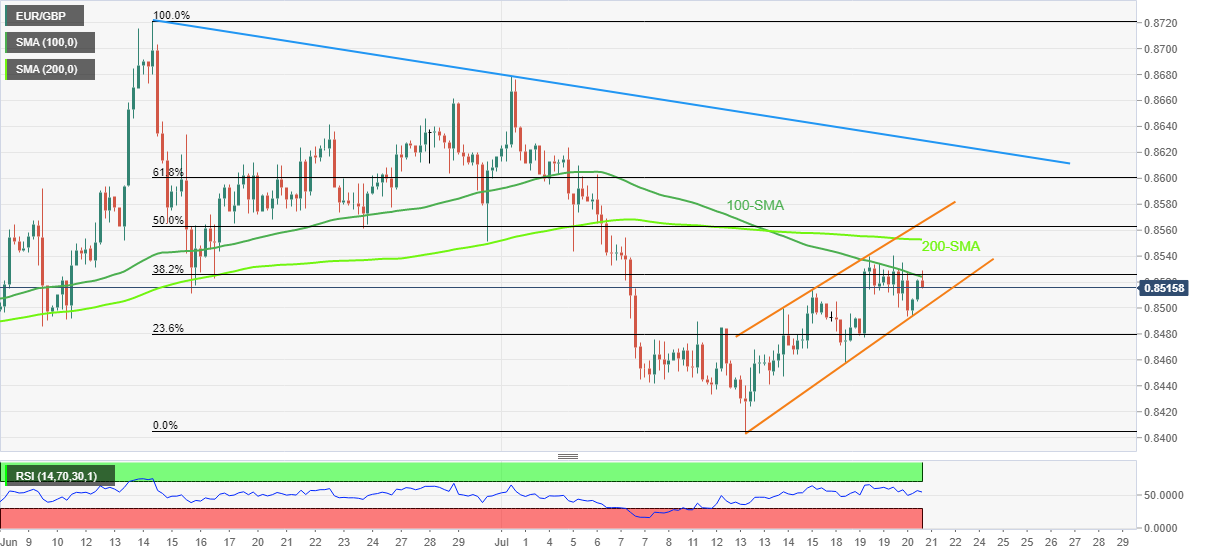
Trend: Further recovery expected
Strategists at Danske Bank offer their take on the Italian political turmoil, with Prime Minister Mario Draghi’s fate in limbo.
Key quotes
“Italy has been plunged into a new government crisis after three of the four biggest parties of Mario Draghi's unity government (Five Star Movement, League and Forza Italia) announced they would not support him in a confidence vote.”
“For the past 18 months, Draghi has served as a rare unifying force in Italian politics and has overseen the implementation of important structural reforms (e.g. in the justice system) that are a pre-requisite to receive NGEU funds.”
“If no alternative parliamentary majority can be formed - which currently seems unlikely - President Mattarella would likely have to call for early elections (possibly held on 25 September), just as the crucial budget season is kicking off in autumn.”
“With the exception of Brothers of Italy, early elections are not in the interests of most parties and as a result of recent constitutional changes, lower and upper house seats will be reduced by a third after the next election.”
“Based on current polling, a centre-right coalition led by Brothers of Italy might be the most likely outcome in our view, although a lot could still change once the election campaign gets underway.”
- USD/TRY snaps three-day uptrend after rising to the highest levels since December 2021.
- CBRT is expected to leave benchmark rate unchanged at 14.0%, despite record inflation.
- US dollar retreats as Nord Stream 1 restores gas flow, ECB rate hike looms.
USD/TRY bulls take a breather around a seven-month high as the quote retreats to 17.58 heading into Thursday’s European session. In doing so, the Turkish lira (TRY) pair prints the first daily loss in four as traders await a monetary policy meeting on the Central Bank of the Republic of Turkiye (CBRT).
The quote refreshed the yearly high earlier in the day as markets expect no change in the CBRT’s monetary policy even if the Turkish inflation jumped to a record high in May.
Earlier in the month global credit rating agency cut Turkiye’s debt rating to "B" from "B+" on Friday, citing rising inflation and economic concerns, per Reuters. The reason could be linked to the nation’s continuous push for qualitative measures and resistance toward the rate hike even if the headlines inflation refreshes all-time high. That said, the Turkish Consumer Price Index (CPI) jumped to a record high of around 39.0% during June.
On a broader front, restoration of the gas flows from Russia’s Nord Stream 1 pipeline, even if gradual, appeared to have improved the market’s mood although Germany considers it as 30% of capacity. The same joins the pre-Fed blackout period and the hopes of a hawkish move from the European Central Bank (ECB) to weigh on the US dollar.
Amid these plays, the US 10-year Treasury yields fail to improve, down 1.5 basis points near 3.02% but the S&P 500 Futures reverse early day losses and gain upside momentum.
Moving on, likely inaction from the CBRT and anticipated disappointment from the ECB may keep USD/TRY bulls hopeful. However, any surprises won’t be taken lightly.
Technical analysis
Unless declining below the previous resistance line from June, around 17.50 by the press time, USD/TRY bulls remain on their way to the 2021 yearly high near 18.35.
- A break of inventory distribution will infuse fresh blood into the aussie bulls.
- The dovish stance adopted by the BOJ has weakened yen against the antipodean.
- The RSI (14) is attempting to shift into the bullish range of 60.00-80.00.
The AUD/JPY pair has turned sideways in a narrow range of 95.43-95.57 after a firmer rebound from 95.20. The cross is expected to extend its gains as the Bank of Japan (BOJ) has kept a dovish stance in its monetary policy announcement. On a broader note, the asset is extremely bullish and is turning its every corrective move into an impulsive rally.
On an hourly scale, the cross is consolidating near the critical resistance, which is placed from June 21-high at 95.31. The asset is forming an inventory distribution that indicates the initiation of longs by those market participants, which prefer to enter a time corrective phase after a juggernaut rally.
The asset has surpassed the 20-period Exponential Moving Average (EMA) at 95.31 firmly in the Asian session. Also, the 50-EMA at 95.00 acted as crucial support for the counter.
Meanwhile, the Relative Strength Index (RSI) (14) is attempting to shift into the bullish range of 60.00-80.00. An occurrence of the same will infuse fresh blood into the aussie bulls.
For more upside, the asset needs to surpass Wednesday’s high at 95.76 for a high of June 8 closing price at 96.47. A breach of the latter will drive the asset to a fresh seven-year high of around 97.00.
Alternatively, a decisive downside below June 28 high at 94.72 will drag the asset towards the round-level support at 94.00, followed by July 15 low at 93.15.
AUD/JPY hourly chart
-637939798869882526.png)
FX option expiries for July 21 NY cut at 10:00 Eastern Time, via DTCC, can be found below.
- EUR/USD: EUR amounts
- 1.0000 1.2b
- 1.0200 1.2b
- 1.0250 228m
- 1.0300 405m
- USD/JPY: USD amounts
- 138.15 230m
- 138.25 259m
- AUD/USD: AUD amounts
- 0.6820 513m
- 0.6950 472m
- USD/CAD: USD amounts
- 1.2700 520m
- 1.2900 730m
- 1.3150 250m
- 1.3200 740m
- NZD/USD: NZD amounts
- 0.6150 273m
- 0.6225 200m
- 0.6300 500m
- EUR/CHF: EUR amounts
- 0.9925 718m
- 1.0000 625m
- 1.0075 440m
- USD/CAD takes the offers to refresh intraday low, reverses previous day’s rebound from 12-day bottom.
- Bearish MACD, failure to bounce off 50-DMA keep sellers hopeful.
- Monthly horizontal resistance line guards immediate upside, 50% Fibonacci retracement lures sellers.
USD/CAD renews intraday bottom around 1.2860 heading into Thursday’s European session. In doing so, the Loonie pair reverses the previous day’s corrective pullback from a two-week low as bears poke the 50-DMA support.
Considering the quote’s failure to rebound from the 50-DMA, as well as the bearish MACD signals, the sellers are likely to conquer the immediate support around 1.2855, comprising the 50-DMA.
Following that, the 50% Fibonacci retracement level of its April-July upside, around 1.2815, will precede the 1.2800 threshold to lure the USD/CAD bears.
It’s worth noting, however, that a convergence of the 200-DMA and the 61.8% Fibonacci retracement, near 1.2700, appear a tough nut to crack for the pair sellers afterward.
Meanwhile, recovery remains elusive until the quote stays below a horizontal area comprising multiple peaks marked since late June, around 1.2935-45.
Following that, an area comprising the triple tops marked since May, close to 1.3075-85, will be crucial to watch for fresh impulse.
In a case where USD/CAD bulls manage to keep reins past 1.3085, they can rally towards the recently flashed multi-month high near 1.3225.
USD/CAD: Daily chart
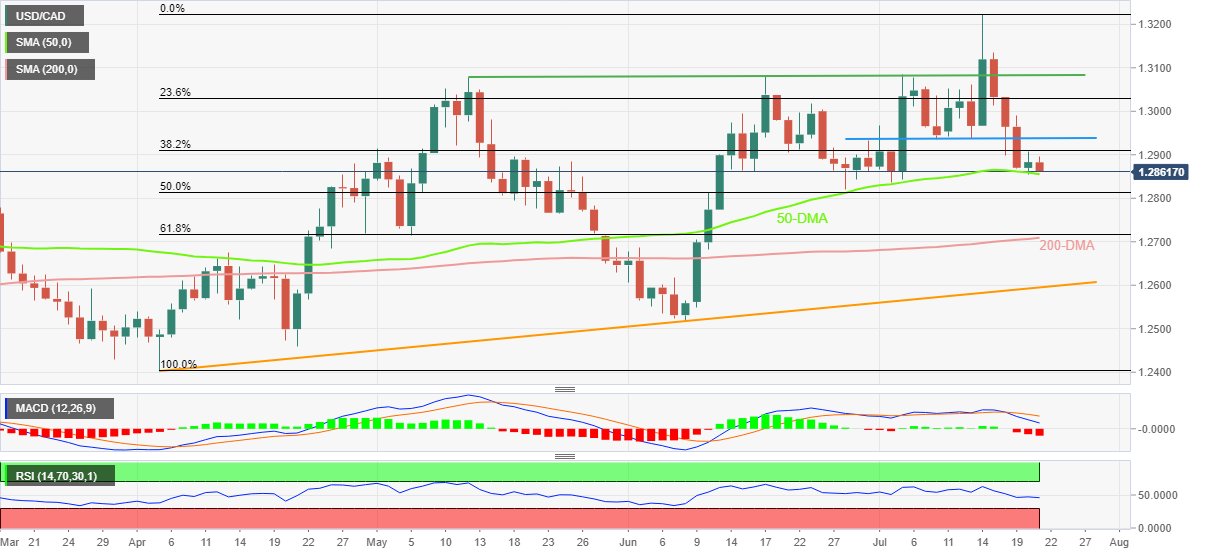
Trend: Further weakness expected
FX option expiries for July 21 NY cut at 10:00 Eastern Time, via DTCC, can be found below.
- EUR/USD: EUR amounts
- 1.0000 1.2b
- 1.0200 1.1b
- USD/CAD: USD amounts
- 1.2700 520m
- 1.2900 445m
- 1.3150 250m
- 1.3200 560m
- AUD/USD: AUD amounts
- 0.6820 513m
- 0.6950 472m
- NZD/USD: NZD amounts
- 0.6150 273m
- 0.6500 282m
- 0.6700 449m
- Asia-Pacific shares fade the previous optimism ahead of the key ECB.
- ADB cuts developing Asia forecasts amid fears from Ukraine, central bank aggression.
- China’s covid woes, fears from real-estate markets also exert downside pressure.
- ECB could renew investor sentiment if defending its dovish bias.
Market sentiment remains mixed during early Thursday morning in Europe as traders remain anxious ahead of the key European Central Bank (ECB) monetary policy meeting. Also keeping the Asia-Pacific equity traders on their toes is the return of recession fears and escalating covid woes in the region.
It should be noted that the Asian Development Bank (ADB) downgraded its growth forecasts for developing Asia for this year and next, reflecting the economic fallout from Russia's war in Ukraine and aggressive tightening by global central banks to tame inflation, per Reuters. As per the latest forecasts, the ADB said it now expects the bloc's combined economy, which includes China and India, to expand 4.6%, slower than its 5.2% projection in April.
Elsewhere, the South China Morning Post (SCMP) amplified covid woes as it said, “China’s top Covid official denies authorities are easing controls and calls for a swift response to new outbreaks.”
While portraying the mood, the MSCI’s index of Asia-Pacific shares ex-Japan drops 0.15% intraday whereas Japan’s Nikkei 225 printed mild gains around 27,740 as the Bank of Japan (BOJ) defends its easy money policies despite citing inflation fears.
Elsewhere, Australia’s ASX 200 gains 0.10% near 6,765 while Chinese stocks are mostly down amid looming fears of real-estate bankruptcy and coronavirus crisis. Even so, New Zealand’s NZX 50 gains 1.0% as Kiwi traders remain hopeful of firmer growth ahead.
Hong Kong’s Hang Seng drops 1.0% and weighs on Indonesia’s IDX Composite, down 0.80% intraday at the latest, but India’s BSE Sensex prints mild gains even if the nation is expected to witness economic pessimism.
On a broader front, the S&P 500 Futures pare early day losses but the US 10-year Treasury yields fail to improve, down 1.5 basis points near 3.02%.
The global markets recently turned positive on the restoration of the gas flows from Russia’s Nord Stream 1 pipeline, even if gradual, appeared to have improved the market’s mood although Germany considers it as 30% of capacity.
Looking forward, Asia-Pacific traders should observe the ECB outcome for clear directions. Also important will be the updates on Nord Stream gas output for Europe and recession fears.
Also read: S&P 500 Futures, yields remain pressured as recession fears accelerate ahead of ECB
- GBP/USD has kissed an intraday high of 1.2000 as DXY sees more downsides.
- UK’s core CPI shifts minutely lower to 5.8% which indicates that price pressures are near to peak.
- The overall demand in the UK looks vulnerable as Retail Sales may slip further despite higher inflation.
The GBP/USD pair has touched an intraday high of 1.2000 after concluding its time correction. The cable has been underpinned by the market participants as the US dollar index (DXY) has extended its losses to near 106.70. The DXY is expected to extend its losses after violating Wednesday’s low at 106.39.
On the pound front, price pressures have remained on the higher side led by volatile oil and food prices. However, the core Consumer Price Index (CPI) has shown some exhaustion. The overall inflation rate landed at 9.4%, higher than the expectations of 9.3% and the prior release of 9.1%. While the core CPI remained in line with the estimates at 5.8% and lower than the former print of 5.9%. No doubt, the volatile oil prices have shown their impact on the overall inflation rate. However, the core CPI has shown some exhaustion signals, which may trim bumper rate hike expectations.
Talking upon the UK political front, it is official that ex-Chancellor Rishi Sunak and Foreign Minister Liz Truss, are left in the race to be the next UK PM. These two will be voted on during the next seven weeks to September.
Going forward, UK Retail Sales will be of utmost importance. On an annual basis, the economic data may slip to -5.3% vs. -4.7% recorded earlier. This indicates the vulnerability in the overall demand in the UK. The Retail Sales data is already contaminated with higher price pressures and more damage to the Retail Sales indicates that the overall demand is extremely lower.
- AUD/USD takes the bids to refresh intraday high, reverse the previous day’s pullback from three-week top.
- Market sentiment remains sour but the US dollar bulls step back amid hawkish expectations from the ECB.
- Downbeat Aussie data, comments from Australia PM also act as upside hurdles.
- ECB will be crucial, second-tier US data could also entertain traders.
AUD/USD cheers the US dollar weakness as it refreshes intraday high around 0.6915 during early Thursday morning in Europe. In doing so, the Aussie pair pays little heed to the downbeat data at home and mixed comments from Australia's Prime Minister (PM), not to forget the risk-aversion wave.
National Australia Bank’s (NAB) Business Confidence gauge dropped to the lowest levels since late 2021 while printing 5 the figure, below 16 market expectations and 15 prior. Also, the Aussie PM Anthony Albanese warned the Reserve Bank of Australia against “overreach” in its efforts to tamp down inflation. It’s worth noting that RBA Governor Philip Lowe teased 0.50% rate hike during his speech the previous day.
Elsewhere, the restoration of the gas flows from Russia’s Nord Stream 1 pipeline, even if gradual, appeared to have improved the market’s mood although Germany considers it as 30% of capacity.
However, risk-aversion remains on the table as fears of economic slowdown in Germany and political crisis in Italy join China’s worsening covid conditions to keep the market sentiment sour and weigh on the AUD/USD prices, due to its risk barometer status.
While portraying the mood, the S&P 500 Futures pare early day losses but the US 10-year Treasury yields fail to improve, down 1.5 basis points near 3.02%.
Looking forward, risk catalysts will be crucial for the AUD/USD traders ahead of the key monetary policy announcements from the European Central Bank (ECB). While the ECB’s likely disappointment appears to renew the US dollar buying afterward, any surprise might not hesitate to drag the DXY further towards the south, which in turn can propel the Aussie pair towards a fresh monthly high.
Also read: ECB Preview: Three critical factors to watch, and why EUR/USD is set to plunge
Technical analysis
AUD/USD bulls aim for the monthly high surrounding 0.6930 while extending the break of the previous resistance line from mid-June, near 0.6815 by the press time. However, the 50-day EMA near 0.6960 could challenge the pair buyers afterward, if not then the odds of witnessing the 0.7000 on the chart can’t be ruled out
Citing a spokesman for the Nord Stream 1 pipeline, several Russian media outlets reported on Thursday, gas deliveries have resumed via the pipeline.
The spokesman, however, said that the restoration of gas flows will be gradual.
Meanwhile, the German gas regulator said that the current nominations for gas flows via the Nord Stream 1 pipeline is still at 30% capacity.
Market reaction
EUR/USD jumped nearly 15-pips on the above headlines, now trading at 1.0222, adding 0.45% on the day.
- USD/INR is aiming to recapture its all-time highs at 80.20 despite weaker DXY.
- FII selling spree and widening fiscal deficit are hurting the Indian rupee.
- The US economy may face the headwinds of lower job additions in the labor market.
The USD/INR pair is auctioning comfortably above 80.00 and is aiming to recapture its all-time high at 80.21, which was recorded last week. The asset is aiming higher despite a steep fall in the US dollar index (DXY) this week. The catalyst which is weakening the Indian rupee is the widening fiscal deficit.
The Indian economy is importing cheaper Russian oil in bulk, catering to its higher dependency on oil imports to address its massive demand. Also, the economy has restricted the exports of wheat and sugar, which has led to a widening fiscal deficit.
Apart from that, Foreign Institutional Investors (FIIs) are in deep selling mode and channelizing their funds from the developing country into the US, considering interest rate elevation by the Federal Reserve (Fed). The Indian economy is operating at an inflation rate of around 7% and the Reserve Bank of India (RBI) is in no hurry to accelerate its repo rate in its August monetary policy meeting vigorously.
Meanwhile, the US dollar index (DXY) has tumbled below 107.00 after failing it convert the pullback move into a bullish reversal. The asset is declining towards its fresh two-week low at 106.39. The DXY may extend its losses as the labor market in the US may bear the consequences of higher price pressures.
Google has halted its recruitment process for the past two weeks, which indicates lower demand prospects. A slippage in the employment generation process may force the Fed to paddle interest rates at a slower rate.
- EURUSD price reverses the previous day’s pullback from fortnight high.
- Market sentiment remains sour but US dollar struggles to justify its safe-haven appeal amid Fed’s blackout period.
- ECB is set for a 0.25% rate hike but widely discussed 50 bps move tease policy hawks, pair bulls.
EURUSD price grinds higher around the intraday top near 1.0225 as traders brace for the key monetary policy announcements from the European Central Bank (ECB). It’s worth noting, however, that the US dollar’s struggle to justify its safe-haven appeal, even at the time when recession and covid fears escalate, appears to challenge the pair buyers as they pare the previous day’s losses around the weekly top.
Widespread fears of economic recession in Germany join Italy’s political crisis and downbeat EU Consumer Confidence to weigh on the regional currency Euro. However, record high inflation and hawkish expectations from the ECB appear to have underpinned the latest rebound in the major currency pair.
Also read: ECB Preview: Three critical factors to watch, and why EUR/USD is set to plunge
EURUSD price fails to justify economic/political crisis at home
Be it Germany’s fears of economic contraction or Italy’s political crisis, the EURUSD price has more fears to consider than to stay hopeful of welcoming the bulls on the ECB. That said, the International Monetary Fund (IMF) cut down Germany’s 2022 GDP forecast to 1.2% and to 0.8% for 2023 versus the previous expectations of 2.0% German GDP for both years. On the other hand, Italian Prime Minister Mario Draghi won a confidence motion, but as three major cotillion parties boycotted the vote and hence Mr. Draghi may again resign and trigger early elections in the nation.
US Dollar struggles during Fed’s blackout
The Fed policymaker’s pre-meeting absence appears to have tested the US dollar bulls even if the risk-aversion triggered the greenback’s rebound on Wednesday. That said, the US Dollar Index (DXY) fades the previous day’s rebound from a two-week low as it retreats to 106.80, down 0.23% intraday, at the latest. The greenback’s recent weakness could be linked to the market’s expectations of a more hawkish outcome from the ECB than the widely anticipated 0.25% rate hike.
Nord Stream 1 to keep EURUSD bears hopeful
Mixed clues surrounding Russia’s Nord Stream 1 pipeline, the key gas route supplying energy to Germany and major European nation, appears to keep EURUSD traders worried. The reason could be linked to the pipeline’s latest halt due to maintenance and the uncertainty over its restart due to the sour relations between Europe and Russia. European Commission President Ursula von der Leyen said on Wednesday that it was a likely scenario that there could be a full cut-off of Russian gas, as reported by Reuters. On the other hand, Russian President Vladimir Putin mentioned that they are yet to see in which condition the equipment for Nord Stream 1 will be after returning from maintenance, per Reuters.
US/EU data exert downside pressure
Downbeat prints of the US and EU data appear to keep EURUSD bears hopeful ahead of the ECB as the pain seems more on the bloc’s side than the US. That said, Eurozone Consumer Confidence marked the record slump on Wednesday while flashing a -27.00 print for July. On the other hand, US Existing Home Sales dropped for the fifth consecutive month in June to a seasonally adjusted annual rate of 5.12 million versus 5.38M expected and 5.41M prior. This was the fifth straight decline and took sales to the lowest level in two years. It’s worth noting that the record inflation in Eurozone and downbeat employment figure make today’s ECB the key.
ECB is the key
ECB headquater in Germany
The European Central Bank (ECB) is likely to revisit the rate hike path after suffering multiple years of negative rates. The initial market forecasts hint at the 0.25% increase in the benchmark rates, which in turn could trigger a kneejerk EURUSD bounce. However, the market is already pricing in a 0.50% rate lift and hence any moves below the same may not lure the pair buyers. Even so, qualitative actions surrounding Quantitative Easing (QE) could keep the meeting interesting.
EURUSD price technical outlook
EURUSD bulls again approach the 100-SMA level surrounding 1.0215, after facing multiple rejections in the last two days, as firmer RSI backs the early week breakout of the 50-SMA and descending trend line from June 27.
It’s worth noting, however, that multiple tops surrounding 1.0275-80 could act as an additional short-term hurdle for the pair before it can rally towards the 10-week-old resistance zone near 1.0355-65.
Even if the quote rises past 1.0365, a convergence of the 100-SMA and descending resistance line from June 09, close to 1.0385, appear the last defense of EURUSD bears before giving control to the bulls.
Alternatively, pullback remains elusive until the quote remains beyond the 1.0100 support confluence including the 50-SMA and previous resistance line.
Following that, the 61.8% Fibonacci Expansion (FE) of March-May 2022 moves near 0.9950 and the December 2002 low near 0.9860 will be important to watch.
EURUSD: Four-hour chart
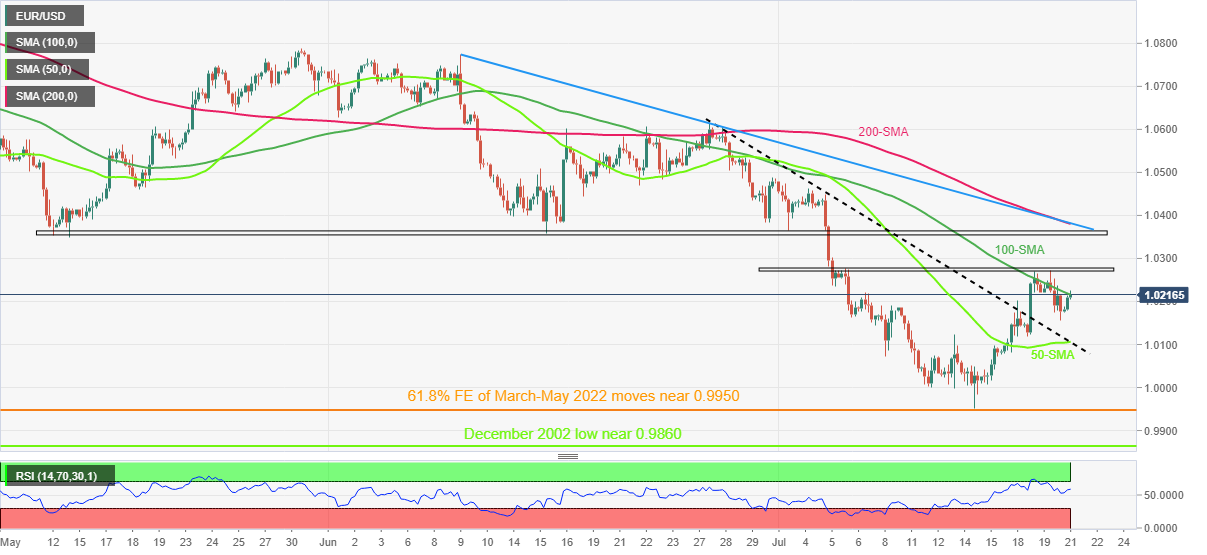
Euro must hold 1.0074 on ECB .25 hike
- EUR/JPY has not displayed much reaction to status quo maintenance by the BOJ.
- The BOJ will continue to buy JGBs to keep raining helicopter money.
- As per the market consensus, the ECB will hike interest rates by 25 bps.
The EUR/JPY pair has remained muted after the conclusion of the two-day monetary policy committee (MPC) meeting of the Bank of Japan (BOJ). The BOJ has maintained its status quo by keeping interest rates unchanged at -10 basis points (bps). BOJ Governor Haruhiko Kuroda kept a dovish stance on monetary policy as the central bank is committed to buying Japan’s Government Bonds (JGB) at an annual pace of around 80 trillion yen.
Taking into account, BOJ’s agenda of keeping the inflation rate above 2%, the central bank has no other option than to feature policy easing. In order to keep price pressures above the desired rate, the wage rates are needed to be accelerated. Therefore, the central bank will keep on raining helicopter money into the economy to accelerate the overall demand. It is worth noting that the Japanese economy has yet not reached its pre-pandemic growth levels yet.
Going forward, investors are expecting a European Central Bank (ECB)-BOJ policy divergence. The ECB is set to announce a rate hike for the first time in 11 years. As per the market consensus, the ECB will step up its interest rates by 25 basis points (bps) as ECB President Christine Lagarde will prefer to test the waters first. Investors should open their viewpoint also to 50 bps rate hike as households in Europe are facing the heat of ultra-hot inflation.
China's Vice-Premier Sun Chunlan, the official leading the country’s COVID-19 response, said on Thursday, the latest covid control is not about relaxing rules
Additional comments
“Urged cities to take decisive measures to contain outbreaks quickly.”
"The latest Covid-19 control playbook is not about relaxing rules, but about precision, which requires greater efforts to grasp prevention and close loopholes.”
“Need to act swiftly to stop outbreaks spreading in the run up to the Communist Party congress, the country’s main political event of the year.”
These comments come after the country reported 826 cases for Wednesday, compared with 935 Tuesday, which was the highest daily tally since May 21.
Some neighbourhoods in Shenzhen implemented new lockdowns while infections in Shanghai continued to rise rapidly.
Related reads
- USD/CNH grinds higher around mid-6.7700s as ADB cuts China growth forecast for 2022
- US Commerce Sec. Raimondo warns on recession risk if chips from Taiwan cut off
- GBP/JPY eases inside fortnight-old bullish channel after BOJ.
- BOJ announced no policy change, as expected, but cited inflation fears in quarterly outlook report.
- RSI conditions, 166.20-25 area challenge buyers, 200-HMA tests bears.
GBP/JPY eases from an intraday high surrounding 166.00, to 165.67 by the press time, as the Bank of Japan (BOJ) managed to impress yen buyers without altering the current monetary policy during early Thursday.
That said, the Bank of Japan (BOJ) matched market expectations by announcing no change in the current monetary policy. In doing so, the Japanese central bank kept the benchmark rate unchanged at -0.10% while keeping the target rate for the Japanese Government Bonds (JGBs) at 0.0%. The reason for the GBP/JPY weakness could be linked to the hopes of the BOJ’s next move to be hawkish as the quarterly prints of the BOJ outlook report do cite the inflation fears and weighs on the yen.
Also read: BOJ Outlook Report: Risks to price outlook skewed to upside for time being, roughly balanced thereafter
Technically, the GBP/JPY pair remains on the buyer’s radar as it stays inside a two-week-long bullish channel formation.
However, the recent pullback in the RSI, as well as the pair’s failures to cross the 166.20-25 hurdle, tease short-term sellers.
That said, the 200-HMA and the stated channel’s support line restrict the immediate downside of the GBP/JPY pair, respectively around 164.30 and 164.20.
In a case where the quote drops below 164.20, it can slump towards the monthly low around 160.40 before challenging the 160.00 threshold.
Alternatively, recovery remains elusive until the quote crosses the 166.20-.25 resistance area.
Following that, the aforementioned channel’s resistance line near 166.80 could test the bulls before highlighting the 170.00 psychological magnet for the bulls.
GBP/JPY: Hourly chart

Trend: Further upside expected
- USD/JPY remains mildly bid after a knee-jerk movement on BOJ.
- BOJ left monetary policy unchanged, quarterly report cites inflation fears for the time being.
- Risk-aversion jostles with downbeat yields to restrict immediate moves.
- BOJ Governor Kuroda’s speech awaited ahead of the key ECB for fresh impulse.
USD/JPY holds onto the daily gains, after the BOJ triggered a 50-pip move, as traders seek more clues during early Thursday morning in Europe. In doing so, the yen pair also justifies the market’s indecision ahead of the key monetary policy announcements from the European Central Bank (ECB).
The Bank of Japan (BOJ) matched market expectations by announcing no change in the current monetary policy. In doing so, the Japanese central bank kept the benchmark rate unchanged at -0.10% while keeping the target rate for the Japanese Government Bonds (JGBs) at 0.0%.
It’s worth noting, however, that the quarterly release of the BOJ Outlook report does cite the inflation fears and weighs on the yen. Also favoring the USD/JPY buyers are the downbeat GDP forecasts, as well as expectations of higher CPI, within the stated report.
Also read: BOJ Outlook Report: Risks to price outlook skewed to upside for time being, roughly balanced thereafter
Elsewhere, the market’s sour sentiment and cautious mood ahead of the ECB appear to keep the buyers hopeful. However, an absence of the Fed policymakers’ comments, due to the pre-Fed blackout period, appears to weigh on the US dollar and the USD/JPY prices.
That said, the risk-off mood could be linked to the fears of recession emanating from Europe and strong inflation data from the UK, as well as from Canada. Also underpinning the US dollar’s safe-haven demand were the Sino-American tensions and China’s covid woes.
While portraying the mood, S&P 500 Futures drop 0.15% intraday whereas Japan’s Nikkei 225 prints mild gains around 27,700 by the press time. Further, the US 10-year Treasury yields also stretch Wednesday’s pullback from the weekly top to 3.01%, down 2.2 basis points (bps) by the press time.
Moving on, a speech from BOJ Governor Haruhiko Kuroda will be the immediate catalyst to watch for the USD/JPY traders ahead of the ECB. Additionally, important will be the chatters surrounding inflation and recession.
Technical analysis
USD/JPY stays on the bull’s radar unless breaking a five-week-old support line and the 21-DMA, respectively around 137.50 and 136.70.
- Gold price has printed a fresh 11-month low near $1,690.00 despite a weaker DXY.
- The precious metal and DXY are reacting against their universal negative relationship.
- The odds of a recession have accelerated as the US job market may suffer from lower demand.
Gold price has settled below the psychological support of $1,700.00 firmly. The precious metal has printed a fresh 11-month low at $1,690.04 and is expected to display more downside as the asset has not displayed any recovery signs yet. It is worth noting that the asset has broken the volatility contraction to the downside and bears are unleashed. The bright metal is set to recapture its yearly lows, which are placed at $1,687.78.
On the dollar front, the US dollar index (DXY) has failed to turn the pullback move into a bullish reversal and is eyeing the south-side direction. The asset faced barricades around 107.26 and has surrendered the critical support of 107.00. A decisive downside move below Wednesday’s low at 106.39 will strengthen the bears further and the DXY will shift its cushion lower initially at around 105.00.
Also Read: Gold Price Forecast: Bears looking for fresh 2022 lows under $1,700.00

Gold price and the DXY are opposing their inverse character
Gold price and DXY move downside in tandem
Investors have turned their back on the gold price despite the weakness in the DXY. Usually, gold price and DXY carries an inverse relationship as losses in one asset result in gains for the other. This time, both assets are declining and it would be worth calling ‘gold price’ a weaker asset as rick-perceived currencies are performing stronger. The gold price has printed a fresh 11-month high at $1,690.04.
Recession fears accelerate as Google halts recruitment process
The odds of a recession have accelerated as IT giant Google has halted its recruitment process for the past two weeks. As we are aware of the fact that price pressures are still far from control despite the heavy rate hikes by the central banks. The catalyst which was empowering the central banks to tighten policy unhesitatingly was the tight labor market. Now, expectations of lower headcounts by Google in upcoming quarters also signal lower employment generation in the US. The dual impact of a weak labor market and the impact of higher inflation will affect the US economy.
Gold price to remain vulnerable on hawkish ECB bets
Gold price will face more heat as the European Central Bank (ECB) is expected to announce a rate hike for the first time in 11 years. The street is discussing the extent of a rate hike. Think tanks believe that most probably the ECB will hike its interest rates by 25 basis points (bps) as it will prefer to test the waters first. However, odds of a 50 bps rate are also open as price pressures have crossed the tolerance power of the households in Europe.
S&P Global PMI to remain in focus
Due to a light economic calendar this week, investors’ focus will remain on the release of the S&P Global PMI data. As per the market consensus, the economic catalysts are expected to deliver a weak performance. The Global Composite data is seen at 51.7, lower than the prior release of 52.3. The Manufacturing PMI may slip to 52 vs. 52.7 recorded earlier. While the Services PMI is expected to display a mild correction to 52.6 against the former figure of 52.7. This will keep the DXY on the back foot and may support the shared currency bulls.
-637939713613188285.png)
Gold technical analysis
Gold price has given a downside break of the Descending Triangle that signals a volatility contraction with a downside bias. The downward-sloping trendline of the above-mentioned chart pattern is plotted from July 18 high at $1,723.97 while the horizontal support is placed from June 14 low at $1,697.69.
The 50-and 200-period Exponential Moving Averages (EMAs) at $1,704.86 and $1,722.04 respectively are declining, which adds to the downside filters.
Meanwhile, the Relative Strength Index (RSI) (14) has shifted into the bearish range of 20.00-40.00, which signals more downside ahead.
Gold hourly chart
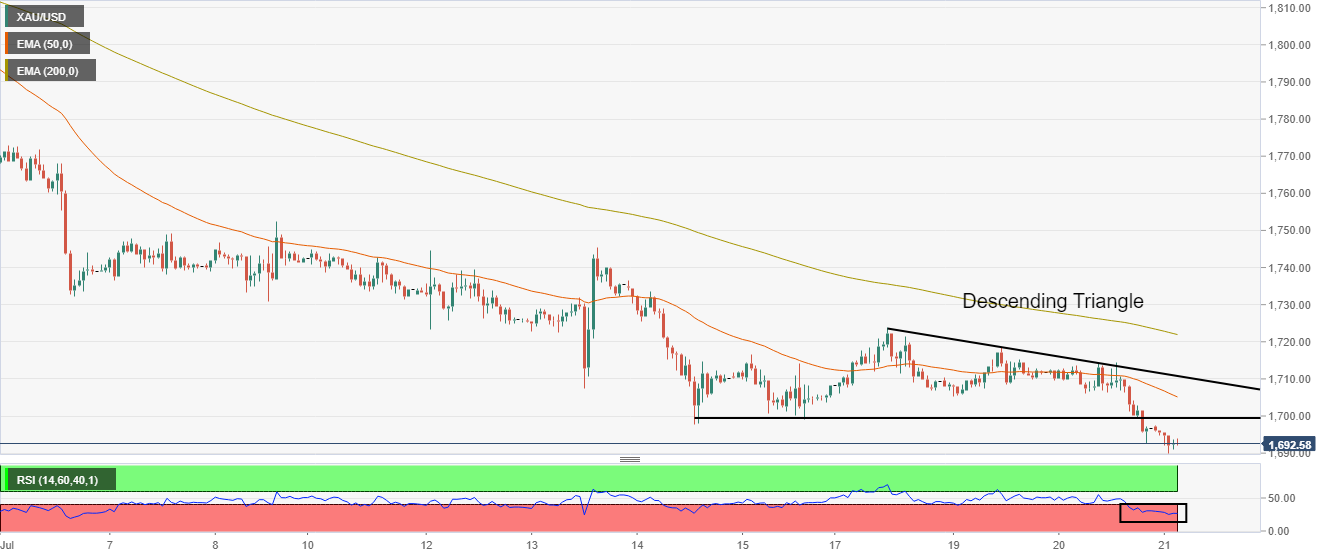
Gold halts decline, but bearish risks still intact
In its quarterly outlook report, the Bank of Japan (BOJ) noted that “risks to price outlook skewed to the upside for time being, roughly balanced thereafter.”
Additional takeaways
Japan's economy likely to recover as impact of pandemic, supply constraints subsides.
Must be vigilant to financial, currency market moves and their impact on Japan’s economy, prices.
Uncertainty regarding Japan’s economy is very high.
Japan's economy picking up as impact of pandemic subsides.
Inflation expectations are rising.
Exports rising as a trend but being affected by supply constraints.
Output is under strong downward pressure.
Consumption likely to continue increasing even as household real income comes under pressure from rising prices.
Corporate profits to remain high as a whole thanks in part to weak yen.
Exports, output likely to continue rising moderately as supply constraint eases.
Board's core-core CPI median forecast for fiscal 2022 at +1.3 vs +0.9% in April.
Board's core-core CPI median forecast for fiscal 2023 at +1.4% vs +1.2% in April.
Board's core-core CPI median forecast for fiscal 2024 at +1.5% vs +1.5% in April.
Board's real GDP median forecast for fiscal 2022 at +2.4% vs +2.9% in April.
Board's real GDP median forecast for fiscal 2023 at +2.0% vs +1.9% in April.
Board's real GDP median forecast for fiscal 2024 at +1.3% vs +1.1% in April.
About BOJ Interest Rate Decision
BoJ Interest Rate Decision is announced by the Bank of Japan. Generally, if the BoJ is hawkish about the inflationary outlook of the economy and rises the interest rates it is positive, or bullish, for the JPY. Likewise, if the BoJ has a dovish view on the Japanese economy and keeps the ongoing interest rate, or cuts the interest rate it is negative, or bearish.
Following the conclusion of its two-day policy review meeting on Thursday, the Bank of Japan (BOJ) board members decided to leave its monetary policy settings unchanged, holding rates at -10bps while maintaining 10yr JGB yield target at 0.00%.
Summary of the statement
The BOJ vote was 8 to 1, leaving its pledge to buy JGBs unchanged so that its holdings increase at an annual pace of around 80 trln yen.
BOJ board member Kataoka dissented to decision on the YCC.
BOJ repeats April market ops guidance to offer to buy 10-year JGBs at 0.25% every business day unless it is highly likely no bids will be submitted.
BOJ keeps guidance on policy bias, says to take more easing steps without hesitation as needed with eye on pandemic's impact on economy.
BOJ keeps forward guidance on interest rates, says expects short- and long-term policy rates to remain at 'present or lower' levels.
Market reaction
The yen caught a fresh bid on the expected BOJ announcement, smashing the USD/JPY pair down to test the 138.00 level. The pair was last seen trading flat on the day at 138.25.
About BOJ Interest Rate Decision
BoJ Interest Rate Decision is announced by the Bank of Japan. Generally, if the BoJ is hawkish about the inflationary outlook of the economy and rises the interest rates it is positive, or bullish, for the JPY. Likewise, if the BoJ has a dovish view on the Japanese economy and keeps the ongoing interest rate, or cuts the interest rate it is negative, or bearish.
US Commerce Secretary Gina Raimondo warned on Wednesday that the country’s current dependence on foreign computer chip fabrication from Taiwan puts it at risk of a recession if it’s ever cut off.
Key quotes
“While many computer chips are designed in the US by companies like Intel, the location of the manufacturing is just as important.”
“If you allow yourself to think about a scenario where the United States no longer had access to the chips currently being made in Taiwan, it’s a scary scenario,”
“It’s a deep and immediate recession. It’s an inability to protect ourselves by making military equipment. We need to make this in America. We need a manufacturing base that produces these chips, at least enough of these chips, here on our shores because otherwise we’ll just be too dependent on other countries.”
“The more than $50 billion CHIPS Act would help subsidize the creation of semiconductor manufacturing plants in the US.”
Making some comments on inflation, Bank of Canada (BOC) Governor Tiff Macklem said in an interview late Wednesday that “inflation in Canada is going to remain painfully high.”
Also read: Canada: Annual CPI rises to 8.1% in June vs. 8.4% expected
Additional quotes
“Inflation will probably remain above 7% for the rest of 2022.”
“July's inflation rate is likely to be below June's 8.1%.”
“Demand is running ahead of the economy's ability to produce the goods people want, which will continue to create inflationary pressures.”
"We are deliberately front-loading our interest rate response. We want to get ahead of this.”
Market reaction
USD/CAD was last seen trading almost unchanged on the day at 1.2878.
Early on Thursday, around 03:00 AM GMT, the Bank of Japan (BOJ) will announce routine monetary policy meeting decisions, as well as the quarterly BOJ Outlook Report, taken after a two-day brainstorming. Following the rate decision, BOJ Governor Haruhiko Kuroda will attend the press conference, around 06:00 AM GMT, to convey the logic behind the latest policy moves.
The Japanese central bank is widely expected to keep the short-term interest rate target at -0.1% while directing 10-year Japanese Government Bond (JGB) yields toward zero.
Although the BOJ isn’t expected to offer any change in its monetary policy, the latest hawkish moves of the major central banks and the inflation fears highlight today’s BOJ as the key event for the USD/JPY traders. Also increasing the importance of the BOJ announcements are the quarterly economic forecasts from the outlook report.
Ahead of the event, Standard Chartered said,
We expect it to keep the policy balance rate and 10Y yield target unchanged in July; the ruling LDP’s recent landslide election victory provides a strong mandate for PM Kishida and BoJ Governor Kuroda to maintain the dovish monetary policy stance. The BoJ has been under pressure as Japan’s inflation has risen above 2%. However, Kuroda has reaffirmed that the BoJ will maintain its dovish stance to support the economy. Separately, Japan will release national CPI data on 22 July. We expect CPI inflation to have eased to 2.4% YoY, supporting a dovish stance by the central bank. We think it is too early to say if Japan’s CPI has peaked, with core inflation having risen, indicating that inflationary pressure on the demand side is growing.
Additionally, FXStreet’s Valeria Bednarik said,
The USD/JPY pair has little chances of turning volatile, as the decision is already priced in. Policymakers may hint at tightening, although not in the near term. If the BOJ is set to change its monetary policy, it will likely be in the last quarter of the year. Nevertheless, a heads up could be enough to boost the local currency and push USD/JPY firmly down.
How could it affect the USD/JPY?
USD/JPY extends pullback from intraday high towards 138.00 as traders brace for the Bank of Japan (BOJ) monetary policy report. Downbeat US Treasury yields and the market’s fears of recession, not to forget aggressive central bank actions and covid woes, seem to exert downside pressure on the yen pair of late.
Japanese policymakers have already turned down the expectations of any major moves from the Bank of Japan (BOJ). However, the Japanese policymakers have recently shown their dislike for the yen’s weakness and volatility in the market, which in turn could join the broad inflation woes to push the BOJ towards dumping its age-old dovish bias. The same could quickly drag the USD/JPY pair towards an upward sloping support line from mid-June, near 137.50. However, the risk-off mood and firmer USD, as well as fewer odds of the BOJ’s hawkish mood, can keep the USD/JPY buyers hopeful.
Technically, USD/JPY remains firmer above a five-week-old support line and the 21-DMA, respectively around 137.50 and 136.70, which in turn could keep the pair buyers hopeful.
Key Notes
USD/JPY bulls move in on a critical hourly resistance
BOJ Preview: Still on hold, but for how long?
About BoJ Rate Decision
BoJ Interest Rate Decision is announced by the Bank of Japan. Generally, if the BoJ is hawkish about the inflationary outlook of the economy and rises the interest rates it is positive, or bullish, for the JPY. Likewise, if the BoJ has a dovish view on the Japanese economy and keeps the ongoing interest rate, or cuts the interest rate it is negative, or bearish.
- GBP/USD bears are lining up for a push lower, but bulls are moving in on hourly resistance.
- The hourly M-formaiton neckline needs to hold at this juncture.
GBP/USD is trading flat on the day, so far, but is close to the New York lows and trading on the backfoot. The US dollar has been under demand for the last few sessions on political turmoil in Europe and ahead of the European Central Bank while the pound has been unable to fully relish the surprise outcome of UK inflation.
The UK's inflation data surprised to the upside for June. Headline inflation rose to 9.4% YoY (consensus: 9.3%) from 9.1% in May, with core inflation easing slightly to 5.8% from 5.9%. The consensus is that inflation will continue rising over the coming months. This leaves a hawkish stance over the Bank of England that will have to raise rates aggressively, despite the elevated risk of recession. The markets are pricing in a move of 50bp to 1.75% in August, followed by 25bp hikes in subsequent meetings, with the policy rate peaking at 2.5% by December.
As for the US dollar, the greenback was higher and tested into the 107 area as measured by the DXY index. The currency's gains, however, were capped as traders were hesitant to drive big moves ahead of a crucial European Central Bank policy decision on Thursday and political upset surrounding not only the resignation of the Italian Prime Minister, Mario Draghi but also due to the uncertainties surrounding the reopening of a key Russian gas pipeline.
GBP/USD daily chart
Meanwhile, the technical outlook is bearish as per the following daily chart's W-formation:

The bears have been slowly chipping away at the prior bullish rally but the price imbalance into the neckline of the formation is compelling and could attract a mitigation process in the coming sessions.
From an hourly perspective, the price has met a 50% mean reversion of the prior bearish impulse that has a confluence with the neckline of the prior M-formation. If this continues to act as resistance, the price will be coiling up for a potential downside continuation toward the broadening formations' lower bound trendline:

- USD/CNH struggles to extend the previous day’s gains around weekly high.
- ADB cuts China’s GDP forecasts for 2022 but keeps 4.8% GDP expectations for 2023.
- Covid woes in China push the nation’s policymakers to reinstate their growth forecasts.
- Recession fears escalate in Eurozone amid gas troubles, ECB will be the key event.
USD/CNH remains sidelined inside a choppy range between 6.7700 and 6.7775 during Thursday’s Asian session. In doing so, the offshore Chinese Yuan (CNH) pair struggles to justify the recently downbeat growth forecasts from the Asian Development Bank (ADB), as well as the covid fears. That said, the market’s anxiety ahead of the key monetary policy announcements from the European Central Bank (ECB) could be cited as the catalysts behind the latest inaction.
“China's economy will likely expand 4.0% this year, the ADB said, a drop of 1 percentage point from its April forecast, but will recover lost ground in 2023 with intact growth seen at 4.8%,” per Reuters.
On Wednesday, China’s covid numbers crossed the 1,000 mark for the first time in two months and propelled the virus woes. On the same line were the Sino-American tussles over Taiwan Strait as China warned the US not to provoke over the transit of the Taiwan Strait. Even so, US Defence Department Spokesman John F. Kirby said that the US has no plans to reduce its presence in the Indo-Pacific to counter China's threat, per Reuters.
Elsewhere, the US dollar benefited from the return of the recession fears, mainly emanating from Europe due to the gas crisis in the bloc. In this regard, Russian President Vladimir Putin mentioned that they are yet to see in which condition the equipment for Nord Stream 1 will be after returning from maintenance, per Reuters. However, European Commission President Ursula von der Leyen said on Wednesday that it was a likely scenario that there could be a full cut-off of Russian gas, as reported by Reuters. It should be noted that the fears over gas might have pushed the International Monetary Fund (IMF) to cut its growth forecasts for Germany. That said, the IMF lowered its growth forecasts for Germany to 1.2% for 2002 and 0.8% for 2023. In its previous forecast, the IMF was expecting the German economy to grow by 2% in both years.
Also portraying the region’s economic woes are the political woes in Italy as Prime Minister Mario Draghi won a confidence motion, but as three major cotillion parties boycotted the vote and hence Mr. Draghi may again resign and trigger early elections in the nation.
It’s worth noting that the People’s Bank of China (PBOC) left benchmark policy rates unchanged during Wednesday’s policy announcement and Chinese Premier Li Keqiang signaled flexibility on the economic growth rate.
Amid these plays, Wall Street closed with reduced gains and the US 10-year Treasury yields also snapped a two-day uptrend at around 3.03%. Further, the S&P 500 Futures also drop 0.25% intraday to 3,952 by the press time.
Moving on, a lack of major data/events, as well as the pre-ECB anxiety, could restrict USD/CNH moves. However, the market’s pessimism might keep buyers hopeful.
Technical analysis
A successful run-up beyond the 10-DMA, at 6.7452 by the press time, directs USD/CNH towards a two-month-old horizontal resistance area around 6.7860-90.
In recent trade today, the People’s Bank of China (PBOC) set the yuan (CNY) at 6.7620 vs. an estimate of 6.7609 and the previous 6.7465.
About the fix
China maintains strict control of the yuan’s rate on the mainland.
The onshore yuan (CNY) differs from the offshore one (CNH) in trading restrictions, this last one is not as tightly controlled.
Each morning, the People’s Bank of China (PBOC) sets a so-called daily midpoint fix, based on the yuan’s previous day's closing level and quotations taken from the inter-bank dealer.
- Market sentiment dwindles amid economic fears, pre-ECB anxiety.
- S&P 500 Futures retreat from monthly high, US 10-year Treasury yields extend previous day’s pullback.
- Firmer inflation also weigh on risk appetite amid a light calendar.
- ECB is expected to announce 0.25% rate hike but fears of economic slowdown in the bloc keep optimists away.
Global markets remain cautious during Thursday’s Asian session, extending the previous day’s turbulence forward, as traders await the key monetary policy announcements from the European Central Bank (ECB). Also exerting downside pressure on the risk appetite are the fears of economic slowdown and central banks’ aggression, due to firmer inflation.
While portraying the mood, S&P 500 Futures drop 0.15% intraday while reversing from a six-week high to 3,956 at the latest. Further, the US 10-year Treasury yields also stretch Wednesday’s pullback from the weekly top to 3.02%, down 1.5 basis points (bps) by the press time.
It’s worth noting that Wall Street benchmarks managed to post another positive day, despite retreating before the close on negative news concerning the US jobs from top-tier firms including Google and Ford.
Recently, the Asian Development Bank (ADB) slashed its growth forecasts for developing Asia for this year and next, per Reuters. The news cites the economic fallout from Russia's war in Ukraine and aggressive tightening by global central banks to tame inflation as the key catalysts. “Downgrading its 2022 forecast for the third time, the ADB said it now expects the bloc's combined economy, which includes China and India, to expand 4.6%, slower than its 5.2% projection in April,” mentions Reuters.
On Wednesday, lowered its growth forecasts for Germany to 1.2% for 2002 and 0.8% for 2023. In its previous forecast, the IMF was expecting the German economy to grow by 2% in both years.
Behind the IMF forecasts are the recent fears surrounding Russia’s gas supplies to the bloc. European Commission President Ursula von der Leyen said on Wednesday that it was a likely scenario that there could be a full cut-off of Russian gas, as reported by Reuters. On the other hand, Russian President Vladimir Putin mentioned that they are yet to see in which condition the equipment for Nord Stream 1 will be after returning from maintenance, per Reuters.
Elsewhere, the record inflation from the UK, a firmer CPI from Canada and Italy’s political crisis were also weighing on the market sentiment. Additionally, covid fears from China and a blackout period for the Fed appear a burden on the market players. It should be noted that the latest Reuters poll hints at 0.75% Fed rate hike and 40% chance of the US recession.
Given the return of recession fears, as well as firmer inflation and hopes of central banks’ aggression, risk appetite is likely to remain softer, which in turn could help the safe-haven assets like the US dollar. However, today’s ECB meeting will be crucial as the bloc’s central bank faces multiple challenges as it tries to defend the Euro.
Also read: Forex Today: Sentiment sours amid recession fears and ahead of the ECB
- Oil prices are continuously struggling to cross the psychological resistance of $100.00.
- Tight labor market in the US economy has just got an evil eye. Google halted the recruitment process.
- PBOC’s status quo in times when the economy is facing pandemic will impact the oil prices.
West Texas Intermediate (WTI), futures on NYMEX, is continuously struggling to surpass the magical figure of $100.00 from the entire week. The oil prices have remained sideways amid the unavailability of any potential trigger that could guide the asset to a directive move. The black gold has traded in a $96.28-100.70 range and is likely to continue its consolidation further.
The ghost of recession is back in sight as the US corporate has signaled no vacancy slogan due to lower demand. Considering the expectations of slippage in demand due to extreme policy tightening measures by the Federal Reserve (Fed) and other central banks, Google reported a two-week halt in recruitment, while Ford announced plans to cut around 8,000 jobs.
Price pressures are still far from control despite the heavy rate hikes by the central banks and the catalyst which was empowering them to tighten policy unhesitatingly was the tight labor market. Now, expectations of lower headcounts by Google in upcoming quarters may weigh pressure on central banks and the impact of higher inflation will keep lingering on the economy. This has accelerated the odds of a recession situation in the US economy.
Apart from that, unchanged interest rate policy by the People’s Bank of China (PBOC) in times when the economy is going through a pandemic, Chinese economic activities will face more heat. It is worth noting that China is a leading importer of oil and a halt in manufacturing activities in China will pose a significant impact on oil prices.
“The US Federal Reserve (Fed) will opt for another 75 basis point rate hike rather than a larger move at its meeting next week to quell stubbornly-high inflation as the likelihood of a recession over the next year rises to 40%,” as per the latest Reuters poll of economists.
Key findings
The July 14-20 Reuters poll found 98 of 102 economists expect the Fed to hike rates by 75 basis points at the end of the July 26-27 meeting to 2.25%-2.50%. The remaining four said they expected a 100 basis point hike.
Fed funds futures are pricing only around a one-in-five chance of a full percentage point hike, putting those expectations largely in line with the poll results.
Median predictions from the latest poll showed a 40% probability of a U.S. recession over the coming year, with a 50% chance of one happening within two years. That was a significant upgrade from 25% and 40% in a June poll.
Over 90% -- or 47 of 51 respondents -- said any potential recession would either be mild or very mild. Only four said it would be severe.
A strong majority expects the Fed to slow to 50 basis points in September and then raise by only 25 basis points at the November and December meetings. Those views remained largely unchanged from the last poll.
Over 80% of respondents, 82 of 102, saw the fed funds rate at 3.25%-3.50% or higher by the end of this year. There was no change to where or when the Fed would stop raising rates, at 3.50%-3.75% in Q1 2023, according to the median forecast.
Still, price pressures were expected to remain elevated and above the Fed's 2% target rate over the coming years. Inflation as measured by the Consumer Price Index was forecast to average 8.0%, 3.7% and 2.5% in 2022, 2023 and 2024 respectively.
Also read: US Dollar Index defends bounce off fortnight low around 107.00 with eyes on ECB
- NZD/USD remains pressured around intraday low inside weekly bullish channel.
- MACD, RSI joins pullback from 200-SMA to favor sellers.
- 100-SMA appears the last defense of buyers, the road to recovery seems bumpy.
NZD/USD struggles to defend the 0.6200 as it retreats to 0.6225 during Thursday’s mid-Asian session.
In doing so, the Kiwi pair justifies the previous day’s pullback from the 200-SMA amid the impending bear cross of the MACD, as well as recently downbeat RSI (14).
With this, the NZD/USD sellers approach the 0.6200 threshold, a break of which will defy the week-long bullish trend channel formation as the psychological magnet coincides with the ascending channel’s lower line.
Even so, the 100-SMA level of 0.6177 appears as the last defense of the pair buyers before directing them to the recently flashed multi-month low of 0.6060.
On the flip side, a clear break of the 200-SMA, at 0.6253 by the press time, could aim for the stated channel’s resistance line, close to 0.6300 at the latest.
Following that, 50% and 61.8% Fibonacci retracements of the June-July downturn, respectively around 0.6320 and 0.6380 could challenge the NZD/USD buyers.
Also acting as an upside filter is the June 16 swing high near 0.6400, a break of which could help the bulls to aim for the early June swing low surrounding 0.6460, as well as the previous monthly peak of 0.6576.
NZD/USD: Four-hour chart

Trend: Further weakness expected
- Positive Divergence enables a bargain buy that would be actionable above 0.6900.
- The 50-period EMA has acted as major support for the counter.
- Advancing 200-EMA adds to the upside filters.
The AUD/USD pair is displaying back and forth moves in a narrow range of 0.6880-0.6892 in the early Tokyo session. The asset has turned sideways after a modest rebound or it could also be considered an inventory distribution after a downside move from Wednesday’s high at 0.6930. On a broader note, the major is highly positive and has added more than 3% gains from its two-year low of 0.6681, recorded last week.
Loss of corrective momentum is visible on an hourly scale as the asset made a higher low while the momentum oscillator, Relative Strength Index (RSI) (14) made a lower low. The formation of a positive divergence will unfold a bargain buy and will drive the asset higher.
The 50-period Exponential Moving Average (EMA) at 0.6880 has acted as major support for the counter. Also, the 200-EMA at 0.6832 is aiming higher, which adds to the upside filters.
Should the asset overstep July 10 high at 0.6900, aussie bull will regain its mojo and will drive the asset towards June 28 high at 0.6965. A breach of the latter will send the major towards the psychological resistance at 0.7000.
On the flip side, a steep fall below the round-level support of 0.6800 will strengthen the greenback bulls. This may decline the pair towards July 13 low at 0.6724, followed by July 14 low at 0.6680.
AUD/USD hourly chart
-637939605942275008.png)
In various media outlets of late, Australia's Prime Minister Anthony Albanese has warned the Reserve Bank of Australia against “overreach” in its efforts to tamp down inflation.
The comments come following the RBA's Governor Phillip Lowe's uber hawkish statements over the wires this week that signalled rates could rise at least 2.5% over the coming months.
Albanese said that a sharp spike in borrowing costs would place “real pressure on people,” and while he recognised the RBA’s independence, “they need to be careful that they don’t overreach as well.”
RBA has “more work to do”
Analysts at ANZ Bank said that the RBA Governor Lowe’s speech on Wednesday and the following Q&A made it clear the RBA has “more work to do,” but his view of where the neutral cash rate might lie still includes 2.5%, which is lower than the range alluded to in deputy governor Bullock’s speech on Tuesday.
''On the other hand, he is also open to the possibility that, 'maybe we’ve gone past the point of full employment,' in which case, the RBA will need to take policy into clearly restrictive territory to bring inflation back to target.''
Meanwhile, AUD/USD has steadied this week so far and homes in on 0.7000 the figure.
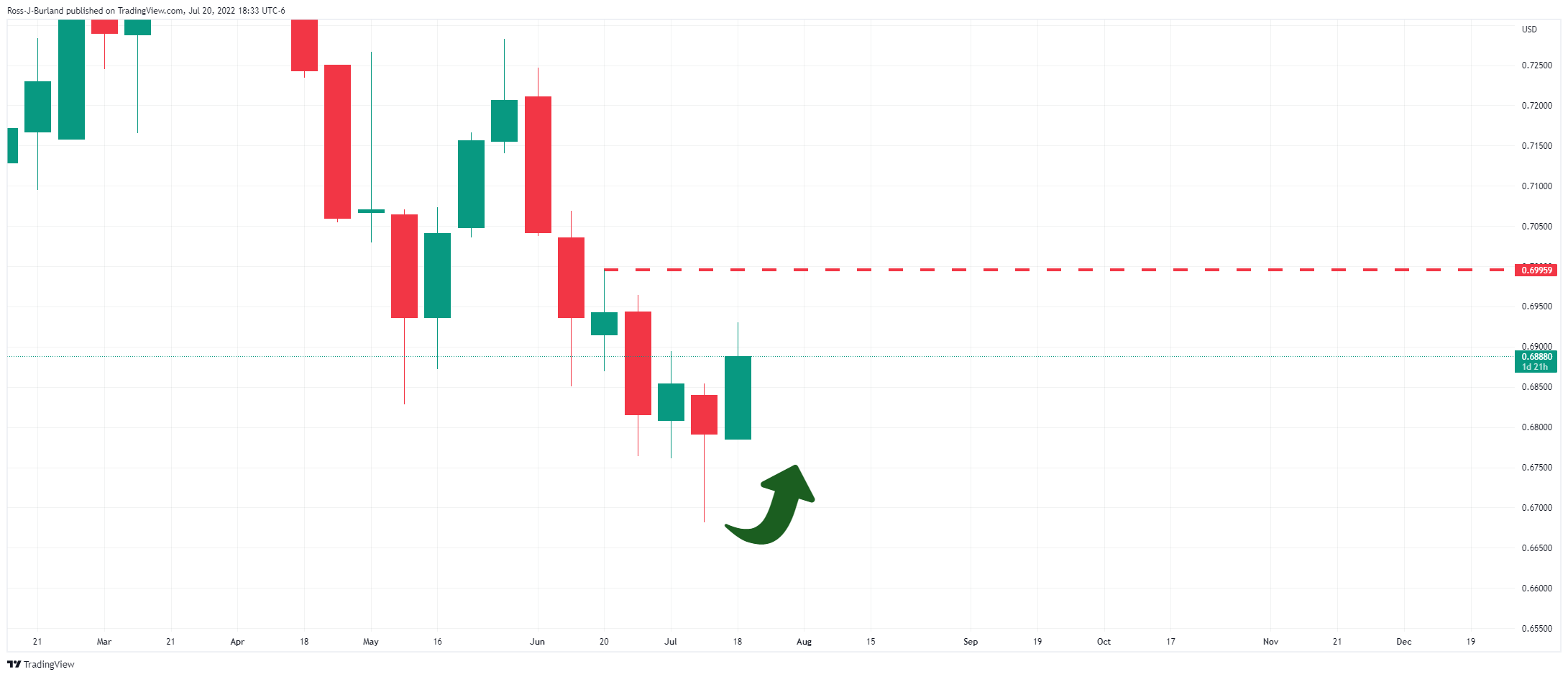
- US Dollar Index seesaws after bouncing off two-week low.
- Return of recession fears, higher inflation numbers join Fed’s blackout period to underpin USD rebound.
- Lack of major data/events at home tests DXY buyers.
- ECB is likely to announce 25 bps rate hike but may not disappoint US dollar bulls unless taking big step.
US Dollar Index (DXY) dribbles around 107.05 after bouncing off a fortnight low the previous day. In doing so, the greenback gauge portrays the market’s indecision ahead of a key monetary policy meeting of the European Central Bank (ECB). It’s worth noting that the DXY printed the first daily gains in four the previous day.
The DXY’s gains could be linked to the market’s fears of recession emanating from Europe and strong inflation data from the UK, as well as from Canada. Also underpinning the US dollar’s safe-haven demand were the Sino-American tensions and China’s covid woes.
Russian President Vladimir Putin mentioned that they are yet to see in which condition the equipment for Nord Stream 1 will be after returning from maintenance, per Reuters. However, European Commission President Ursula von der Leyen said on Wednesday that it was a likely scenario that there could be a full cut-off of Russian gas, as reported by Reuters. It should be noted that the fears over gas might have pushed the International Monetary Fund (IMF) to cut its growth forecasts for Germany. That said, the IMF lowered its growth forecasts for Germany to 1.2% for 2002 and 0.8% for 2023. In its previous forecast, the IMF was expecting the German economy to grow by 2% in both years. In addition to the IMF, the Asian Development Bank (ADB) also cut its developing Asia growth forecast to 4.6% for 2022 versus 5.2% previous expectations.
Also signaling more pain for the bloc, as well as for markets, were political jitters in Italy. That said, Prime Minister Mario Draghi won a confidence motion, but as three major cotillion parties boycotted the vote and hence Mr. Draghi may again resign and trigger early elections in the nation.
While portraying the mood, Wall Street closed with reduced gains and the US 10-year Treasury yields also snapped a two-day uptrend at around 3.03%. With this in mind, the S&P 500 Futures also drop 0.25% intraday to 3,952 by the press time.
Moving on, US Weekly Jobless Claims and Philadelphia Fed Manufacturing Survey for July may entertain DXY traders. However, major attention will be given to the ECB’s verdict as markets expect more than the 0.25% hike signaled the previous day. Hence, the ECB policymakers not only need to announce the 25 bps rate lift but should also do more to regain Euro bulls’ confidence, in absence of which the US dollar could extend the latest recovery.
Technical analysis
Previous resistance from May 13 joins 20-DMA to restrict short-term US Dollar Index downside around 106.45. The recovery moves, however, need validation from 107.50.
- USD/JPY bulls are moving on a key area of resistance.
- A break of hourly resistance opens prospects of a longer bullish run.
- All eyes turn to the ECB today which could see volatility in money markets.
USD/JPY is attempting to move higher towards 138.50 and a key technical area on the hourly time frame. The US dollar remains firm in Asia, following the lead from overnight as the euro weakens into the European Central Bank meeting on Thursday.
The day was dominated by European political dramas and concerns about European gas availability from the Nord Stream 1 pipeline. Gas orders have reportedly signalled that the Nord Stream will return to 40% of capacity but the caveat is that Moscow has warned that unless a spat over sanctioned parts is resolved, flows will be tightly curbed. Therefore, this leaves the euro and risk in EZ financial markets on tenterhooks as investors wait to see whether gas flows will resume on Thursday when maintenance on the Nord Stream pipeline is set to end.
In other news, the prospects of Italian politics plunging into months of upheaval surrounding the resignation of the prime minister, Mario Draghi. Read more here: Italian PM Draghi will announce his resignation in the chamber tomorrow
This all circles over the ECB meeting. The ECB is expected to hike by 25bps and announce an anti-fragmentation tool. However, the risk of a 50bps hike has grown materially and is almost a coin toss as analysts at TD Securities argued. ''it is the sensible outcome to the meeting, but goes against recent communications.''
As for the US dollar, it rose in a choppy session, but its gains were capped as traders were hesitant to drive flows much further ahead of the ECB. The dollar index (DXY) climbed 0.459% while US Treasury yields were mixed, moving within narrow ranges, as bond investors balanced their positions ahead of another Federal Reserve meeting next week.
A fairly strong US 20-year bond auction contributed to gains on the long end while the yield of the US two-year note exceeded that of the benchmark 10-year debt by about 21.8 basis points. The inversion was as deep as 34.4 bps on Monday, the largest inversion since 2000, reflecting worries that aggressive Fed hikes could tip the world's largest economy into recession.
For the day ahead, domestically, the Bank of Japan is set to raise its inflation forecast on Thursday but maintain ultra-low interest rates and warn of risks to a fragile economy, reinforcing its position as an outlier in a wave of global increases to borrowing costs.
| Pare | Closed | Change, % |
|---|---|---|
| AUDUSD | 0.68864 | -0.18 |
| EURJPY | 140.717 | -0.45 |
| EURUSD | 1.01788 | -0.5 |
| GBPJPY | 165.547 | -0.18 |
| GBPUSD | 1.19773 | -0.21 |
| NZDUSD | 0.62266 | 0.04 |
| USDCAD | 1.2884 | 0.1 |
| USDCHF | 0.97087 | 0.24 |
| USDJPY | 138.241 | 0.05 |
- EUR/GBP has scaled above 0.8500 as investors are underpinning shared currency ahead of ECB.
- The ECB may step up its interest rates for the first time in 11 years.
- UK’s overall inflation has climbed to 9.4% while the core CPI slips by 10 bps to 5.8%.
The EUR/GBP pair has rebounded gradually after testing the prior inventory distribution area, which is placed in a narrow range of 0.8475-0.8495 with lower selling pressure. The cross is attempting to establish above 0.8500 as investors are underpinning the shared currency bulls on expectations of a rate hike announcement by the European Central Bank (ECB).
ECB President Christine Lagarde is expected to step up its interest rate for the first time in 11 years. As the price pressures have gone beyond the tolerance power of households in Europe and the Asset Purchase Program (APP) has been concluded, the ECB needs to feature an interest rate hike. No doubt, the extent of the rate hike could be lower initially as the ECB may prefer to test the waters and later on hike rates by a higher extent.
Meanwhile, the situation of gas supply from Nord Stream 1 to Europe has turned obscure after comments from Russian President Vladimir Putin said that they are yet to see in which condition the equipment for Nord Stream 1 will be after returning from maintenance.
On the pound front, price pressures have remained on the higher side led by volatile oil and food prices. However, the core Consumer Price Index (CPI) has shown some exhaustion. The overall inflation rate landed at 9.4%, higher than the expectations of 9.3% and the prior release of 9.1%. While the core CPI remained in line with the estimates at 5.8% and lower than the former print of 5.9%.
- USD/CHF holds onto the previous day’s bounce off 21-DMA.
- Impending bear cross on MACD, 50-DMA challenge bulls.
- 100-DMA, ascending trend line from March appear extra filters to the south.
- Horizontal area from early May appears a tough nut to crack for bulls.
USD/CHF defends Wednesday’s recovery moves above 0.9700, at 0.9715 during Thursday’s Asian session. In doing so, the Swiss currency (CHF) pair buyers poke the 50-DMA hurdle.
It’s worth noting that the MACD teases bears but steady RSI and the quote’s sustained trading beyond the 21-DMA, the 100-DMA and an upward sloping trend line from late March keep buyers hopeful.
That said, a clear upside break of the immediate 50-DMA resistance, around 0.9720 by the press time, appears necessary for the USD/CHF buyers to aim for the 0.9800 threshold.
However, a horizontal area comprising multiple levels marked since early May around 0.9875-80, appears crucial for the bulls before they aim for the yearly peak surrounding 1.0065.
Meanwhile, pullback moves remain elusive beyond the 21-DMA support of 0.9689.
Following that, the 100-DMA and a four-month-old ascending trend line support, respectively near 0.9595 and 0.9570, could challenge the USD/CHF bears.
In a case where the quote drops below 0.9570, the odds of witnessing a slump towards June’s low of 0.9495 can’t be ruled out.
USD/CHF: Daily chart
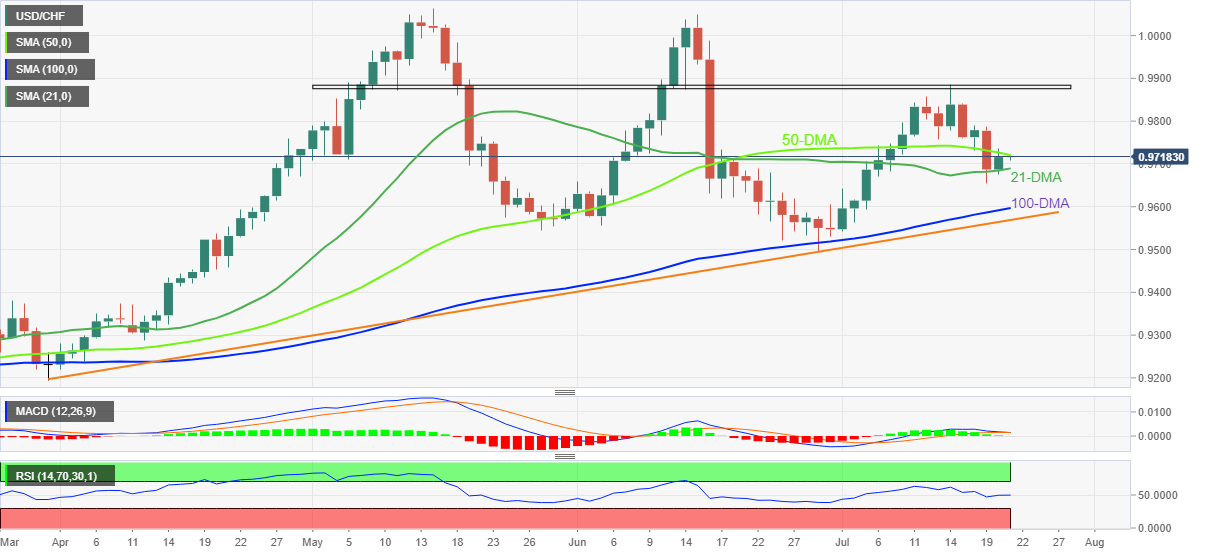
Trend: Further recovery expected







© 2000-2026. Sva prava zaštićena.
Sajt je vlasništvo kompanije Teletrade D.J. LLC 2351 LLC 2022 (Euro House, Richmond Hill Road, Kingstown, VC0100, St. Vincent and the Grenadines).
Svi podaci koji se nalaze na sajtu ne predstavljaju osnovu za donošenje investicionih odluka, već su informativnog karaktera.
The company does not serve or provide services to customers who are residents of the US, Canada, Iran, The Democratic People's Republic of Korea, Yemen and FATF blacklisted countries.
Izvršenje trgovinskih operacija sa finansijskim instrumentima upotrebom marginalne trgovine pruža velike mogućnosti i omogućava investitorima ostvarivanje visokih prihoda. Međutim, takav vid trgovine povezan je sa potencijalno visokim nivoom rizika od gubitka sredstava. Проведение торговых операций на финанcовых рынках c маржинальными финанcовыми инcтрументами открывает широкие возможноcти, и позволяет инвеcторам, готовым пойти на риcк, получать выcокую прибыль, но при этом неcет в cебе потенциально выcокий уровень риcка получения убытков. Iz tog razloga je pre započinjanja trgovine potrebno odlučiti o izboru odgovarajuće investicione strategije, uzimajući u obzir raspoložive resurse.
Upotreba informacija: U slučaju potpunog ili delimičnog preuzimanja i daljeg korišćenja materijala koji se nalazi na sajtu, potrebno je navesti link odgovarajuće stranice na sajtu kompanije TeleTrade-a kao izvora informacija. Upotreba materijala na internetu mora biti praćena hiper linkom do web stranice teletrade.org. Automatski uvoz materijala i informacija sa stranice je zabranjen.
Ako imate bilo kakvih pitanja, obratite nam se pr@teletrade.global.


 Банковни
 транcфери


