- Analiza
- Novosti i instrumenti
- Vesti sa tržišta
Forex-novosti i prognoze od 02-12-2021
- EUR/USD holds lower ground after two consecutive days of downtrend.
- Sustained trading below 100-SMA, bearish MACD favor sellers.
- Weekly support becomes the key for bear’s entry targeting 61.8% FE.
- 1.1385, five-week-old descending trend line add to the upside filters.
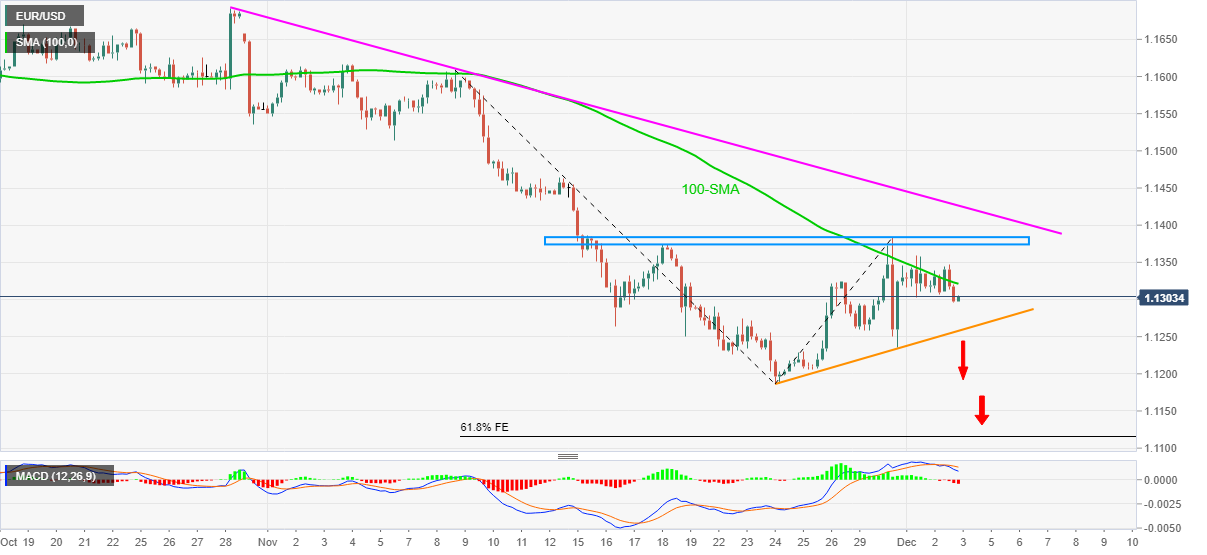
EUR/USD bears remain hopeful around 1.1300, grinding lower during early Friday morning in Asia.
The major currency pair dropped for the last two days following its failures to cross the 100-SMA. Also favoring the sellers is the MACD line that flashed bear cross.
However, a clear downside break of the one-week-long ascending support line, around 1.1255 at the latest, becomes necessary for the pair sellers to aim for the yearly low of 1.1186.
Following that, 61.8% Fibonacci Expansion (FE) of November 09-30 moves, near 1.1120, will gain the market’s attention.
Alternatively, a 100-SMA level of 1.1320 will guard the immediate recovery moves ahead of a horizontal area comprising multiple tops marked since mid-November, near 1.1375-85. Adding to the resistance is a downward sloping trend line from late October, close to 1.1430 by the press time.
Should the quote manage to rally past 1.1430, the 1.1465 level may act as an intermediate halt during the rally targeting the early November’s low near 1.1515.
EUR/USD: Four-hour chart
Trend: Further weakness expected
- On Thursday, XAU/EUR pare Wednesday gains, down some 1.49%.
- WHO’s official said that some of the early indications regarding the Omicron variant are that most cases are mild.
- XAU/EUR: The upward bias is still in play, though a daily close above €1,590 is needed to extend gold gains.
Gold (XAU/EUR) vs. the euro advances as the Asian session begins, up some 0.05%, trading at €1,565 at the time of writing. Investors’ worries about the Omicron coronavirus strain seem to ease, as a World Health Organization (WHO) official said that some of the early indications are that most cases are mild. Either way, financial markets would likely remain volatile unless investors get more clarity on the new COVID-19 variant.
In the overnight session, XAU/EUR seesawed around the €1,560-€1,580 range, remaining at those levels until the New York open. Since then, the gold vs. the euro slid towards €1,555, though staged a recovery of 15, to settle down at current levels.
On Thursday, the macroeconomic docket of the Eurozone featured the so-called “prices at the gate,” with the Producer Price Index for October on a monthly and yearly basis. Both readings were higher than expected, with the monthly figure rising 5.4%, more than the 3.5% foreseen. The annual figure rose by 21.9%, higher than the 19% estimated.
In the meantime, the German 10-year Bund yield is falling four basis points, sitting at -0.375%, boosting the yellow metal prospects against the single currency.
XAU/EUR Price Forecast: Technical outlook
The XAU/EUR daily chart shows that the single currency trimmed some losses against the non-yielding metal, but the bias remains tilted to the upside. Why? Because the daily moving averages (DMA’s) with an upslope reside well below the spot price, signaling that XAU bulls are in charge. In fact, Thursday’s low coincides with the 50-DMA level at €1,557, which would be the first support, if the EUR appreciates
In the outcome of extending Wednesday’s gains, the first resistance would be the November 30 high at €1,590. Breach of the latter could pave the way for further gains. The following resistance would be the €1,600 psychological level, followed by the November 18 cycle low previous support-turned-resistance at €1,633.
On the flip side, the first support would be the 50-DMA at €1,557. The break of the previous-mentioned would expose essential support areas, like the 100-DMA at €1,539, followed by the confluence of 200-DMA and the November 3 low, between the €1,516-20 range.
-637740837583742282.png)
On Thursday, US Deputy Secretary of State Wendy Sherman and the Secretary-General of the European External Action Service, Stefano Sannino, held talks in Washington. They released a joint statement raising strong concerns over China’s "problematic and unilateral actions" in the South and East China Seas and the Taiwan Strait, per Reuters.
Key quotes
The two sides discussed rights abuses in China, including repression of religious minorities in Xinjiang and Tibet and the erosion of autonomy in Hong Kong.
They expressed strong concern over China’s problematic and unilateral actions in the South and East China Seas and the Taiwan Strait that undermine peace and security in the region and have a direct impact on the security and prosperity of both the United States and European Union.
Sherman and Sannino are due to continue their China-related discussions with high-level consultations on the Indo-Pacific on Friday.
FX reaction
The news should have weighed down the AUD/USD prices, considering Australia’s trade proximity to China, but the pre-NFP trading lull keeps the quote mostly unchanged around 0.7100 of late.
Read: AUD/USD bears look to 0.7000 on firmer yields ahead of US NFP
- AUD/USD remains depressed after seven-day south-run around yearly low.
- Fed hawks fuelled yields, equities consolidate losses amid mixed concerns over Omicron.
- Aussie, China PMIs can offer intermediate moves during pre-NFP trading lull.
AUD/USD traders flirt with the 0.7100 threshold after seven consecutive days of a south-run. That said, the risk barometer struggled for a clear direction the previous day despite posting mild losses on firmer Treasury yields. Though, equity bulls stopped the quote’s weakness as Aussie traders brace for the key Friday comprising the US Nonfarm Payrolls (NFP) data.
The benchmark US 10-year Treasury yields bounced off a 10-week low to regain 1.45% level, up five basis points (bps), on Thursday as Fedspeak pushed for sooner tapering in the last-ditched efforts before the silent-period starting from this Saturday. Among the key promoters of faster rolling back of easy money, also conveying reflation fears, were Federal Reserve (Fed) Bank of San Francisco President Mary Daly and Richmond President Thomas Barkin.
It’s worth noting that softer-than-expected prints of the US Initial and Continuing Jobless Claims for the week, as well as downbeat Challenger Job Cuts for November, also underpinned the hopes of faster Fed tapering and favored the yields.
The firmer bond coupons in turn propelled the US Dollar Index (DXY) to print a second consecutive day of gains but couldn’t stop equities from consolidating the previous two days’ losses.
At home, Australia Trade Balance and housing numbers came in stronger but the Imports and PMI details were mixed for October and November respectively. That said, the Pacific major is alert enough to tame the virus outbreak, with various state boundaries and checks announced of late.
Also important for the AUD/USD traders to know is the fact that multiple Chinese developers were bracing for the bond issue, suggesting relief for the cash-crunch market. Adding to the positives was the news that China will prolong the period of tax exemption for foreign bond investors. Furthermore, chatters that the UK announced SOTOVIMAB, an injectable drug, to be effective against Omicron joins the US policymakers’ rush to avoid government shutdown to ease the market fears and favor the risk-barometer pair.
That said, AUD/USD traders may react to China’s Caixin Services PMI but major attention will be given to the virus updates. Above all, the US jobs report for November will be a make-or-break case to follow.
Read: Nonfarm Payrolls Preview: Jobs’ headline could be a make it or break it in tapering’s decision
Technical analysis
Having offered a clear downside break of yearly support, AUD/USD is well-set for 0.7000-0.6990 support zone comprising lows marked during September and November 2020. The 0.7050 levels may offer an intermediate halt during the fall.
Should the bulls return, the previous support line near 0.7145 and the monthly descending trend line surrounding 0.7175 will challenge the corrective pullback.
After multiple days of jostling, the US policymakers managed to avoid the government shutdown as the House of Representatives passed a bill to extend the government funding through February.
The short-term government funding bill approaches the Senate as market chatters spread that it will be law before Saturday’s deadline.
FX reaction
Given the already higher odds of no US government shutdown, coupled with the market’s attention to the US jobs report, the news gets mostly ignored. That said, equities posted notable gains on Thursday but the yields were also stronger ahead of the key day.
Read: US Nonfarm Payrolls November Preview: Can we agree the labor market is healing?
Early Friday morning in Asia, global rating giant Fitch crossed wires while conveying the news to downgrade Turkish long-term Issuer Default Ratings (IDRs) to negative from stable. The rating giant kept the status of BB- for Turkey’s IDR unchanged.
Key quotes (from Fitch)
The central bank's premature monetary policy easing cycle and the prospect of further rate cuts or additional economic stimulus ahead of the 2023 presidential election have led to a deterioration in domestic confidence, reflected in a sharp depreciation of the Turkish lira, including unprecedented intra-day volatility, and rising inflation.
After the 2018 and 2020 crises, Turkey enters this new period of stress from a vulnerable position, with a high degree of uncertainty regarding the economic authorities' policy reaction function, high external financing requirements, deteriorating inflation dynamics and weakened external buffers.
The central bank has repeatedly changed its policy guidance in recent months from a commitment to maintaining positive real rates to focusing on core inflation dynamics, and more recently on narrowing the current account deficit.
We forecast inflation to reach 25% by end-2021 and remain one of the highest among rated sovereigns, averaging 20% in 2022-2023.
There is a high degree of uncertainty regarding the timing and type of policy response due to the public statements of government authorities, including the president, in favor of low rates and a weaker lira, and the increased visibility of political interference in the central bank decisions and management.
Moreover, the focus of the government on supporting faster commercial credit growth, a key rationale behind the easing cycle in Fitch's view, and the prospect of significant real wage increases for 2022 could reverse the improvement in the current account (forecast to halve to 2.5% of GDP in 2021) and increase external financing pressures.
USD/TRY en-route $14.00
Having reacted to Turkish Prime Minister Erdogan Recep Tayyip Erdoğan’s action, by replacing Finance Minister with his Deputy Nureddin Nebati, USD/TRY remains firmer around $13.69 by the press time. That said, the Turkish Lira (TRY) pair is well-set to refresh the record top of $13.95.
Read: Turkish Finance Minister Nebati says high interest rates won't be a priority
- The shared currency trims some of Wednesday’s losses, up some %.
- The market sentiment is upbeat, boosting the prospects of riskier assets to the detriment of the JPY and the CHF.
- EUR/JPY: Trading range-bound, though slightly tilted to the downside.
As the New York session ends, the EUR/JPY advance some 0.24%, trading at 127.88 at the time of writing. The market sentiment is upbeat at press time, following a risk-off European session, with all of its indices in the red. In the US, equity indices finished the session with gains, rising between 0.52% and 1.66%.
Market participants reassess the impact of the new COVID-19 Omicron variant. Although it has been reported to be more transmissible, it appears to cause mild symptoms. Apart from that, the US central bank looking to finish the bond taper in the Q1 of 2022 dented the prospects of safe-haven assets like the Japanese yen, with US equities rallying and US bond yields following their footsteps.
EUR/JPY Price Forecast: Technical outlook
In the 1-hour chart, the EUR/JPY pair is trading sideways. In the overnight session, EUR/JPY bulls pushed the pair towards the confluence of the 50 and the 100-hour simple moving averages, around 128.20, failing to break above it. That left the pair, at the mercy fof JPY bulls, which sent the pair tumbling towards 127.70.
It is worth noting that the pair has a downward bias in the near term, as the 1-hour moving averages (MA’s) reside above the spot price. If the EUR/JPY keeps falling further, the first support would be the December 1 high 127.56. A breach of the latter would expose the 127.00 figure, followed by February 9 swing low at 126.43.
On The flip side, the first resistance would be 128.00. A break above that level would expose the November 30 high at 128.60, followed by the 200-hour SMA at 128.62.
-637740790412102771.png)
- GBP/JPY bull sin charge and eye 151 the figure.
- The daily chart is moving in on a critical level of resistance.
GBP/JPY bulls are taking charge at the end of the week's sessions as risk appetite improves. Markets are moving into consolidation and profits are being taken ahead of Friday's Nonfarm Payrolls. This is giving the yen bulls something to be fearful of and helping GBP/JPY to move higher.
GBP/JPY hourly chart
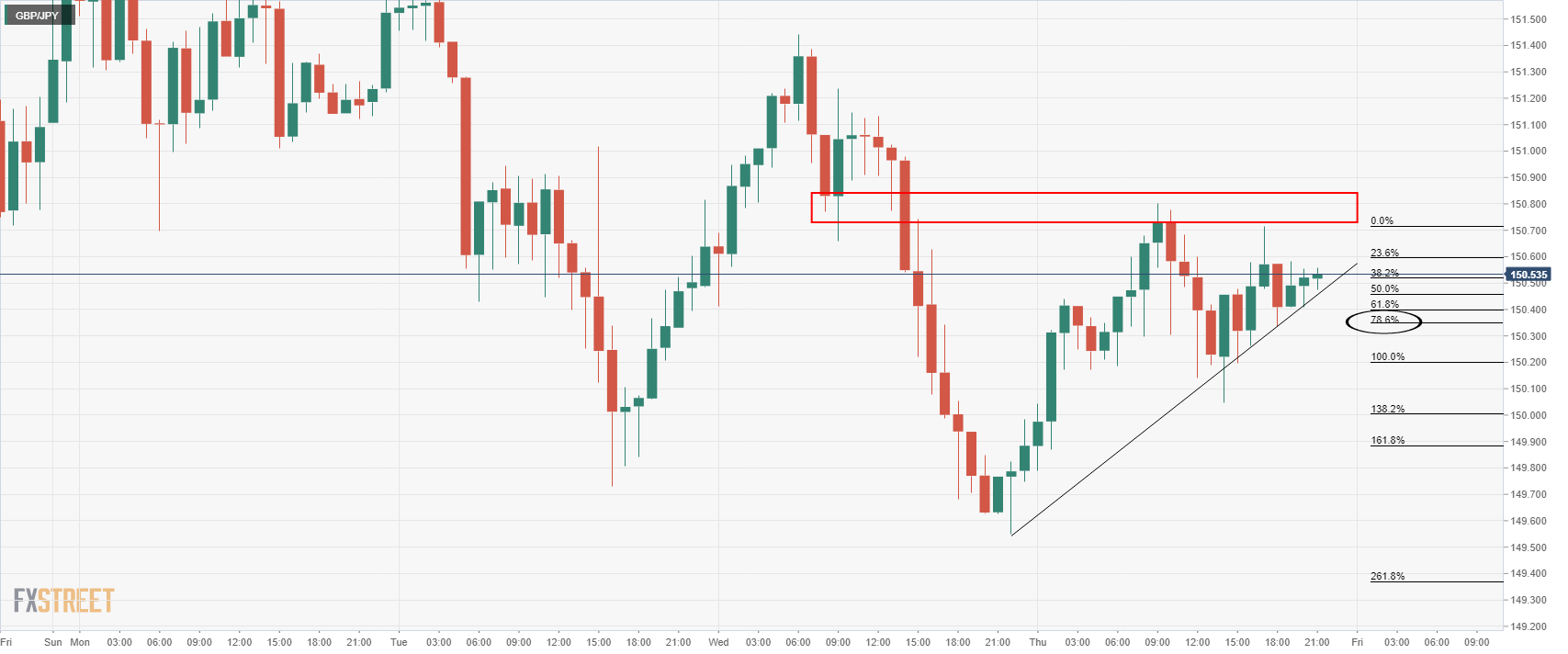
GBP/JPY is riding dynamic hourly support and is on the verge of an upside extension following a 78.6% Fibonacci retracement. The bulls will eye the 150.80 key psychological level for the coming sessions.
GBP/JPY daily chart
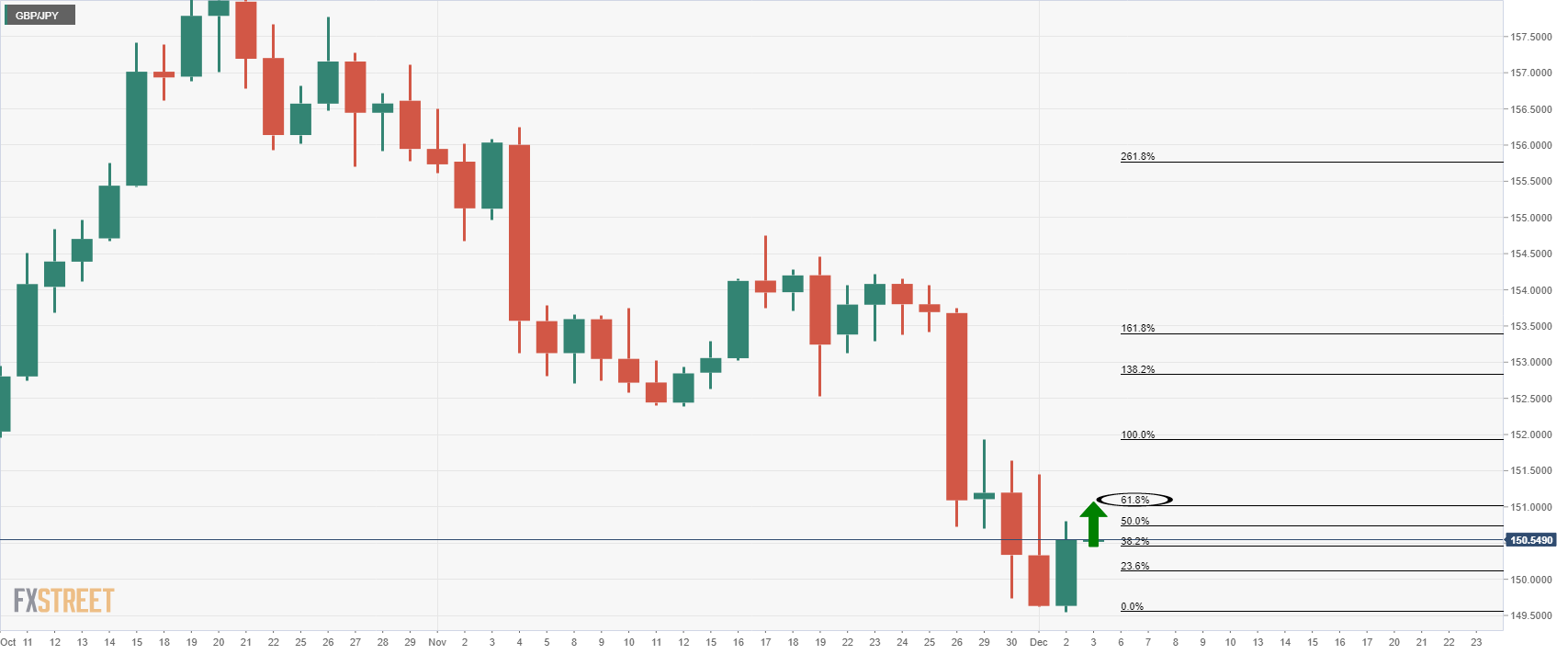
From a daily perspective, the bulls eye the 61.8% Fibonacci retracement level near 151 the figure. This meets an old support area that would be expected to act as resistance.
- US equities gained on Thursday, despite a lack of fresh fundamentals, as market conditions remain choppy and unpredictable.
- The S&P 500 recovered from the low 4500s to close to the 4600 level ahead of the close.
US equity market conditions remained for the most part choppy and unpredictable on Thursday. The S&P 500, which sold off sharply into the Wednesday close and ended the session under the 21-day moving average in the 4510s, bounced in early Thursday trade and now trades nearly 1.7% higher on the day at 4590. The index has now pared its on-the-week losses to just 0.3%, though still trades some 3.5% below last week’s record peaks close to 4750.
The Nasdaq 100 saw comparatively modest gains of under 1.0%, with the index bouncing from lows under 15.8K to back above 16.0K. Short-end and real yields continued to rally, reducing the duration-sensitive tech sector’s tailwinds. The index continues to trade about 4.0% below record levels printed back on 22 November. The Dow was up more than 2.0%. The CBOE S&P 500 Volatility Index (VIX) was down nearly 4.0 points to close to 27.0, more than 5.0 points down from Wednesday’s 11-month highs above 32.0.
Driving the day
There wasn’t any one specific reason for the upside on Thursday. Omicron and uncertainty about the influence that its global spread will have on the global economic/monetary bank policy outlook remains the dominant market theme. On that front, there hasn’t been much fresh information on the virus, aside from more data from South Africa that points to its high transmissibility and ability to partially evade vaccine/natural immunity (both known qualities of the variant).
The equity bulls remain hopeful that the severity of symptoms caused by infection is a lot milder than other variants, but it remains far too soon to say for sure at this point. Even if the illness is as severe, most suspect vaccines/part infection will still offer enough protection to avoid March 2020-style lockdowns.
Some pointed to the recent string of strong US macro data releases as behind the rally on Thursday. Initial weekly jobless claims and November challenger layoffs on Thursday were both better than expected after Wednesday’s strong November ISM Manufacturing PMI survey and ADP employment change estimate. The data suggests Friday’s November labour market report, the most important data release of the week, should show strong gains in employment.
But strong US data endorses the Fed’s increasingly hawkish view of the economy, something which some investors have said has added another layer of uncertainty to the market right when it didn’t need it (due to Omicron). Recall that earlier in the week in his testimony before Congress, Fed Chair Jerome Powell was bullish on growth and the labour market, expressed concern about high inflation, and, thus, hinted towards a faster QE taper. Fed speakers on Thursday endorsed this viewpoint. A strong NFP number on Friday should solidify market expectations for a faster pace of taper from January.
- After falling for eight consecutive days, the British pound snapbacks edges up 0.50%.
- A risk-on market mood benefits the risk-sensitive GBP.
- GBP/JPY: Found strong demand around the 149.00 area, as the pair gains 130+ pips in the day.
The British pound advances during the New York session as risk-sensitive currencies rise, while the safe-haven ones like the Japanese yen and the Swiss franc fall sharply. The GBP/JPY is rising, trading at 150.51 at the time of writing.
The market sentiment is upbeat in the New York session, with US equity indices rising between 0.77% and 2.62%. It seems that the Omicron variant, although being more transmissible, it causes mild symptoms that would not threaten people’s life. That alongside the US central bank looking to finish the bond taper in the Q1 of 2022, dented the prospects of safe-haven assets, with US equities rallying and US bond yields following their footsteps.
GBP/JPY Price Forecast: Technical outlook
The GBP/JPY has been on a free fall since November 24, when it broke the 50-day moving average (DMA). However, the December 1 low at 149.60 seems to be the bottom of the eight-day dip, at press time advancing 0.50%. Furthermore, an upslope trendline that travels from July swing lows to September cycle lows was briefly broken, but GBP bulls entered around the 149.40s area, pushing the pair higher.
In the outcome of a daily close above 150.45, that would form a bullish engulfing candle pattern with bullish implications. The first resistance on the way up would be the 151.00 psychological level. The latter’s breach would expose the November 29 high at 151.90, followed by the 200-DMA at 152.43.
On the flip side, the GBP/JPY first support level would be the 150.00 figure. A break under that level would expose the upslope trendline lying around 149.59, followed by the October 1 swing low at 149.22.
-637740735698347046.png)
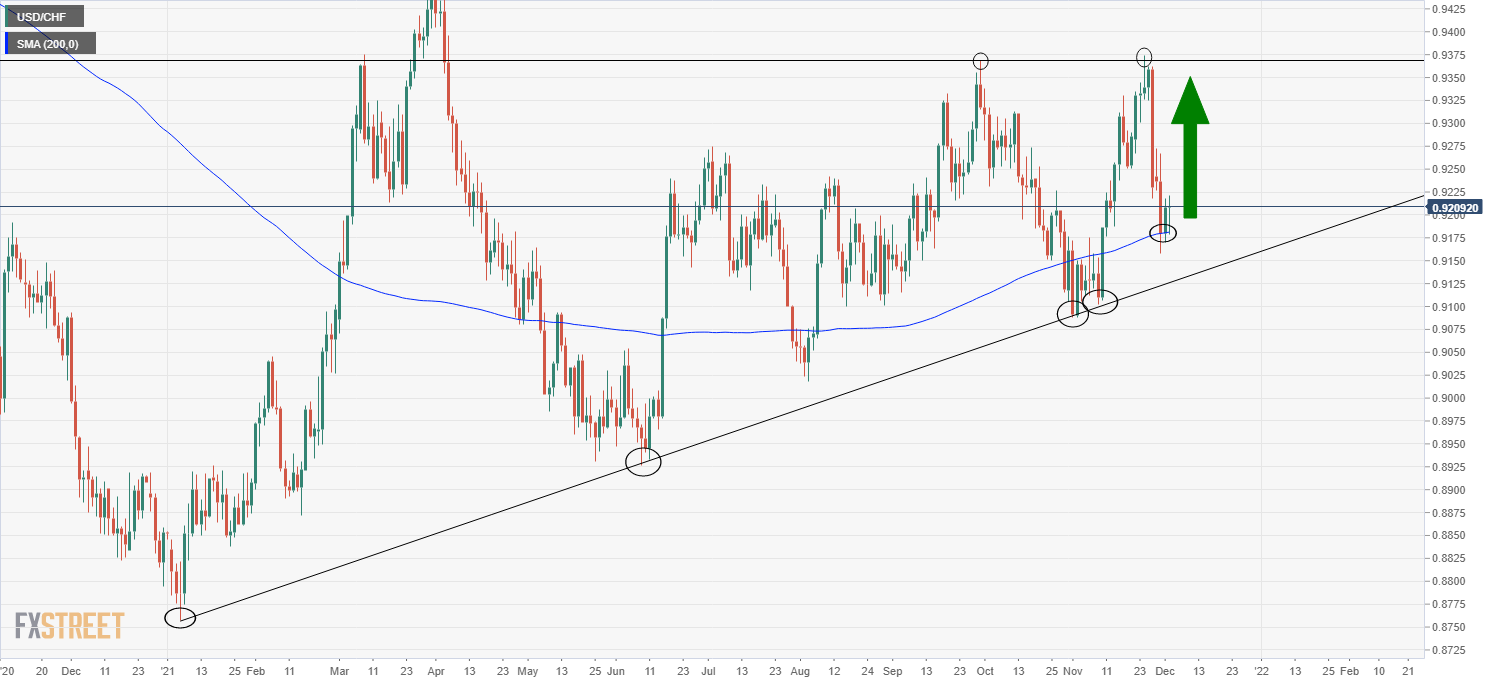
- USD/CHF remained supported above its 200DMA at 0.9180 for a third straight session.
- The pair continues to trade with tight ranges ahead of the key US jobs data and amid ongoing Omicron uncertainty.
USD/CHF found good support at its 200-day moving average for a third consecutive day on Thursday. The pair has been hovering just to the north of its 200DMA at close to 0.9180 since Tuesday, during which time it has undulated within a fairly tight 0.9180-0.9220 range. The 21 and 50DMA both currently sit at the 0.9230 level and have been, for the most part, capping the gains.
The pair has been going sideways despite Fed Chair Jerome Powell’s hawkish assessment of the state of the US economy in Congressional testimony earlier in the week. Powell said it would be appropriate to discuss speeding the pace of the bank’s QE taper. There has also been a string of strong US data releases for the month of November; the ISM Manufacturing survey, ADP estimate of national employment change, and Challenger layoffs all endorse Powell’s bullish stance on the economy.
Two factors are keeping market participants tentative and cautious on placing big bets on the pair. Firstly, the most important US data release of the week is on Friday in the form of the official November US labour market report. Fed members will want to see continued strong gains in employment if they are to agree on an acceleration of the QE taper at the 15 December meeting.
Secondly, the outlook for the US economy remains clouded by the emergence of Omicron, with infections now being detected in the US. In the worst-case scenario, which is being considered as a reasonable possibility, the new variant might couple high transmissibility and immune escape with severe symptoms and a high mortality rate. This may see the US (and other countries) go into lockdown and may push back Fed (and other central bank tightening plans). This would benefit the Swiss franc which is 1) a safe haven and 2) not exposed to dovish central bank repricing (there are no hawkish SNB expectations to pull back on in the first place!).
Until uncertainty about the virus has cleared up, USD/CHF may have a difficult time recovering to its pre-Omicron levels in the mid-0.9300s, even in the face of further strong data and hawkish Fed vibes. That’s not to say Friday won’t see volatile trading conditions. But in the short-run, the pair's determination to remain supported above the 0.9200 may be a signal that the recent bearish run will soon reverse.
- NZD/USD was the second-best performer vs. USD on Thursday.
- US Nonfarm Payrolls will now be the key.
Despite a more hawkish sentiment around the Federal Reserve following the set-up in Fed speaker's rhetoric, in including the Fed chair, Jerome Powell's, traders bought the dip on Wall Street. This led to a recovery in risk-FX and pushed the New Zealand dollar higher in a correction to 0.6831 from 0.6799 the low.
It would appear that the US dollar is regarded as overbought. The DXY index, which measures the greenback vs a basket of currencies, was unable to capitalise on the risks surrounding the new coronavirus variant, Omicron nor hawkish Fed speakers.
The greenback, throughout the pandemic, has been regarded as a safe haven and benefitted at times of panic and uncertainty. However, this time around, it has fallen behind the yen, CHF and even the euro. This has enabled the commodity complex to find support and has given some stability to the forex space.
The Kiwi was the second-best performer against the USD overnight, and the bump in the USD was barely discernible, analysts at ANZ Bank explained.
''Stepping back, the Kiwi continues to hover around 0.68, with the bears citing key support at around 0.6750, and the bulls focussed on typical December seasonality. If buyers are in the wings, they are certainly not revealing themselves. Still, let’s see what tonight’s US jobs numbers look like, as that will set USD direction,'' the analysts argued.
US Nonfarm Payrolls coming up
Looking ahead, US Nonfarm Payrolls will be key. 'Payrolls probably surged again,'' analysts at TD Securities explained. ''A strong trend continues to be signalled by surveys and claims, but our forecast also reflects the latest Homebase data—with a decline in the Homebase series more than accounted for by seasonality. Along with our +650k forecast for payrolls, we forecast a 0.2pt decline in the unemployment rate and a 0.4%MoM (5.0% YoY) rise in hourly earnings.''
What you need to know on Friday, December 3:
The dollar gathered some momentum in the last trading session of the day on Thursday, helped by upbeat local data and higher US government bond yields, as concerns were put temporarily aside. Wall Street posted substantial gains, although major indexes are still in the red on a weekly basis.
As for government bond yields, that on the 10-year Treasury note peaked at 1.466%, holding nearby at the session ends. US indexes posted substantial gains, with the Dow Jones Industrial Average up nearly 700 points and the S&P500 adding roughly 2% at the time being.
Different US Federal Reserve officials backed chief Jerome Powell’s recent words. Federal Reserve Bank of San Francisco President Mary Daly said the Fed might need to taper asset purchases faster than anticipated, while Richmond President Thomas Barkin said inflation has gone up faster than he expected due to the virus, vaccines and fiscal support.
European Central Bank policymaker Fabio Panetta said that inflation and the new pandemic wave is endangering the Union’s recovery at an early stage, although earlier this week, he noted that there’s no need to tighten monetary policy to control inflation, driven by temporary factors.
The EUR/USD pair briefly pierced the 1.1300 level, hovering around it heading into the Asian opening. The British Pound remained weak, with GBP/USD stuck around 1.1330. Commodity-linked currencies edged lower, with the AUD/USD pair trading below 0.7100 and the USD/CAD above 1.2800.
Gold fell to a fresh one-month low of 1,761.87, having bounced modestly ahead of the close. Crude oil prices fell to fresh multi-month lows but bounced back, with WTI currently trading at $66.10 a barrel.
The US will publish the Nonfarm Payrolls report on Friday. The country is expected to have added 550K new jobs in November, while the unemployment rate is seen contracting to 4.5% from 4.6%. The country added 531K positions in October, which brought the total number of jobs to 148.3 million, leaving a shortfall of 4.2 million compared to pre-pandemic levels.
Top 3 Price Prediction Bitcoin, Ethereum, Ripple: ETH outperforming its peers, BTC struggles and XRP bearish
Like this article? Help us with some feedback by answering this survey:
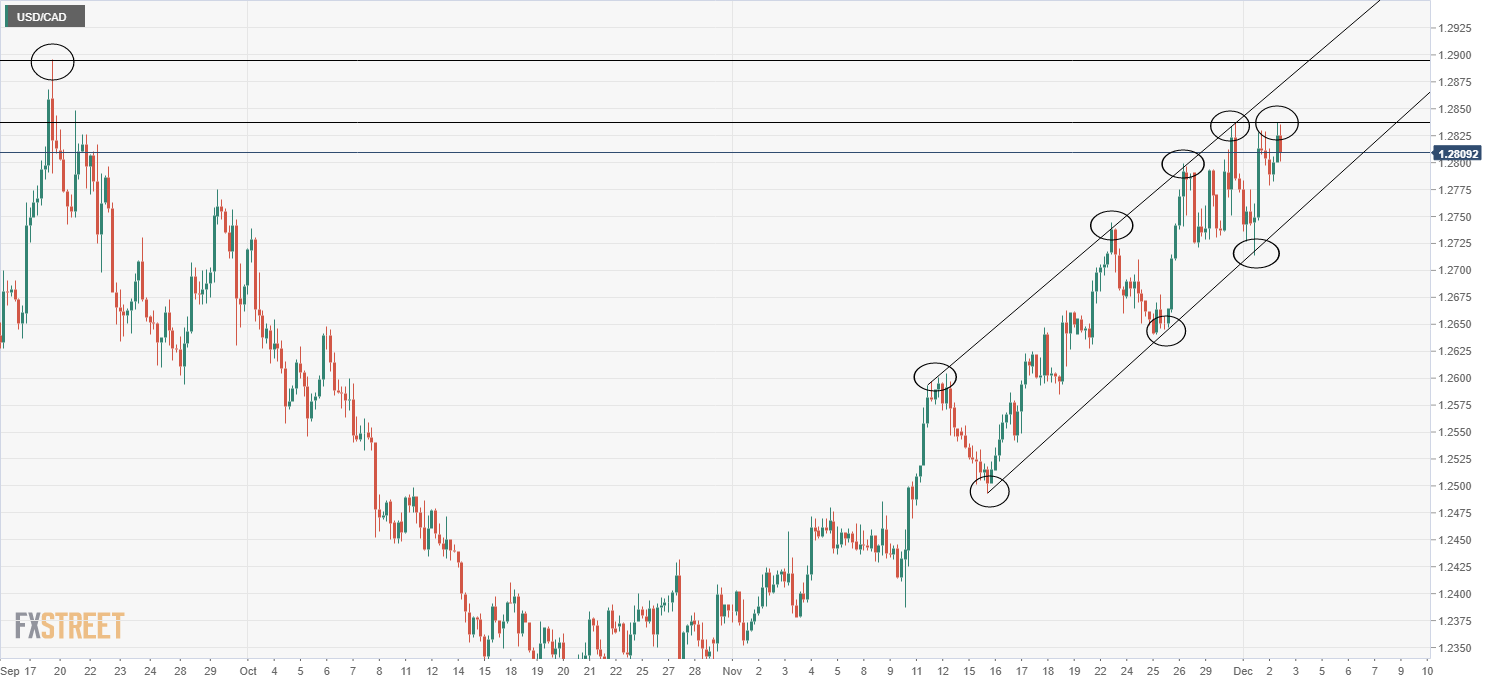
- USD/CAD squeezed out a fresh two-and-a-half month high on Thursday but is now flat just above 1.2800.
- The pair continues to ebb higher within the confines of a bullish trend channel.
It’s been a largely subdued day for USD/CAD, with the pair for the most part following the path of least resistance and gradually ebbing higher. USD/CAD has been moving higher in recent weeks within a bullish trend channel. The pair at one point managed to squeeze out a fresh another two-and-a-half month high at 1.28376 (less than one pip above Tuesday’s high at 1.28369). The pair has since dropped back to trade around 1.2810, where it is flat on the session.
Strong US data
Amid a lack of any fresh Canadian fundamental newsflow on the day, USD/CAD traders were mainly focused on US dollar and crude oil market flows. Beginning with the former; the US dollar was broadly neutral against its G10 peers on Thursday, despite further strong US macro data. Initial weekly jobless claims and November challenger layoffs on Thursday were both better than expected after Wednesday’s strong November ISM Manufacturing PMI survey and ADP employment change estimate.
One reason why the dollar may have ignored the strong data is because it broadly fits with the narrative of US economic/labour market strength being painted by the Fed. For another, it's official US jobs report day on Friday (the November report), so it's perhaps not surprising to see FX markets enter wait-and-see mode. A few Fed members spoke, though none added anything beyond Powell’s hawkish message from earlier in the week.
Choppy oil
Moving on to oil markets; conditions were choppy with WTI now broadly flat on the day after OPEC+ announced its decision to press ahead with a 400K barrel per day output hike in January. The surprise decision (analysts had expected a halt amid Omicron-related uncertainty) initially triggered downside, but oil prices swiftly recovered. Omicron and oil flows will remain a key driver on Friday, but maybe overshadowed somewhat by the dual release of both US and Canadian November jobs data at 1330GMT.
- It’s been a choppy day for oil, with traders in two minds about the OPEC+ decision to hike January output.
- WTI has swung between lows in the $62.00s and highs above $67.00, and currently trades a tad higher near $66.00.
Oil prices have had a choppy day on Thursday. Front-month futures of the American benchmark for sweet light crude oil, called West Texas Intermediary or WTI, swung between lows at $62.50 and highs just above $67.00, a near $5.0 range. At present, WTI is trading close to the $66.0 mark and is slightly in the green on the day.
OPEC+ press ahead with output hikes
The day’s price action reflects the market’s ongoing struggle to ascertain what's next for the crude oil demand outlook. The big news of the day was OPEC+’s decision to surprise markets by not choosing to halt output hikes in January but to press ahead with another incremental 400K barrel per day output hike on the month. The decision cause initial selling pressure, which is when WTI hit the $62.00s, but the dip was quickly bought into.
Some analysts interpreted the OPEC+ decision as a positive for oil markets as it signaled that the group’s confidence in the market had not been rocked by recent Omicron-related developments. OPEC “thought it might do more damage than good, to pause on production increases and that it might send a signal to the market that the demand destruction priced in was real,” said a senior analyst at Price Futures Group. “I think the OPEC decision is sending a signal of confidence that they believe the price action recently has been overdone” the analyst added.
WTI still well below pre-Omicron levels
But WTI continues to trade some $12 below its levels this time last week. Of course, the emergence of the new Omicron Covid-19 variant has been the main driver of the downside. A number of countries have restricted flights, delivering an immediate blow to the near-term outlook for crude oil prices via a dampening of jet fuel demand. This partly explains the recent drop, but another big reason for lower crude oil prices is simply the high level of uncertainty about the new variant. The key questions are 1) how transmissible is it? 2) how well does it evade vaccine/natural immunity? and 3) how severe are the symptoms when infected?
Early evidence strongly supports the notion that the new variant is significantly more transmissible than prior variants, which obviously is not good news. Meanwhile, a study on the Omicron variant released by South Africa’s NICD on Thursday showed that re-infection was three times as likely as compared to other variants. This adds further evidence to the hypothesis that Omicron is better able to avoid natural immunity (acquired by infection with a past Covid-19 variant) than past variants have been. It seems very likely this would also apply to vaccine-acquired immunity.
More reassuringly, early front-line experience of doctors in South Africa suggests the symptoms are much milder than other variants. But it is very early days still these early hypotheses could quickly shift. Thus, markets are set to remain highly headline-driven. The best-case scenario for crude oil would be if Omicron proves to be very mild and actually something health officials want to let spread around the world in order to reach herd immunity and eradicate the nastier Covid-19 strains (like delta).
- AUD/USD is dangerously close to breaking to the downside again.
- The daily chart points to a test of the recent lows down at 0.7062 and 0.7030 thereafter.
As per the prior analysis, AUD/USD Price Analysis: High forex vol points to continuation to weekly support, the price is moving in on the weekly lows:
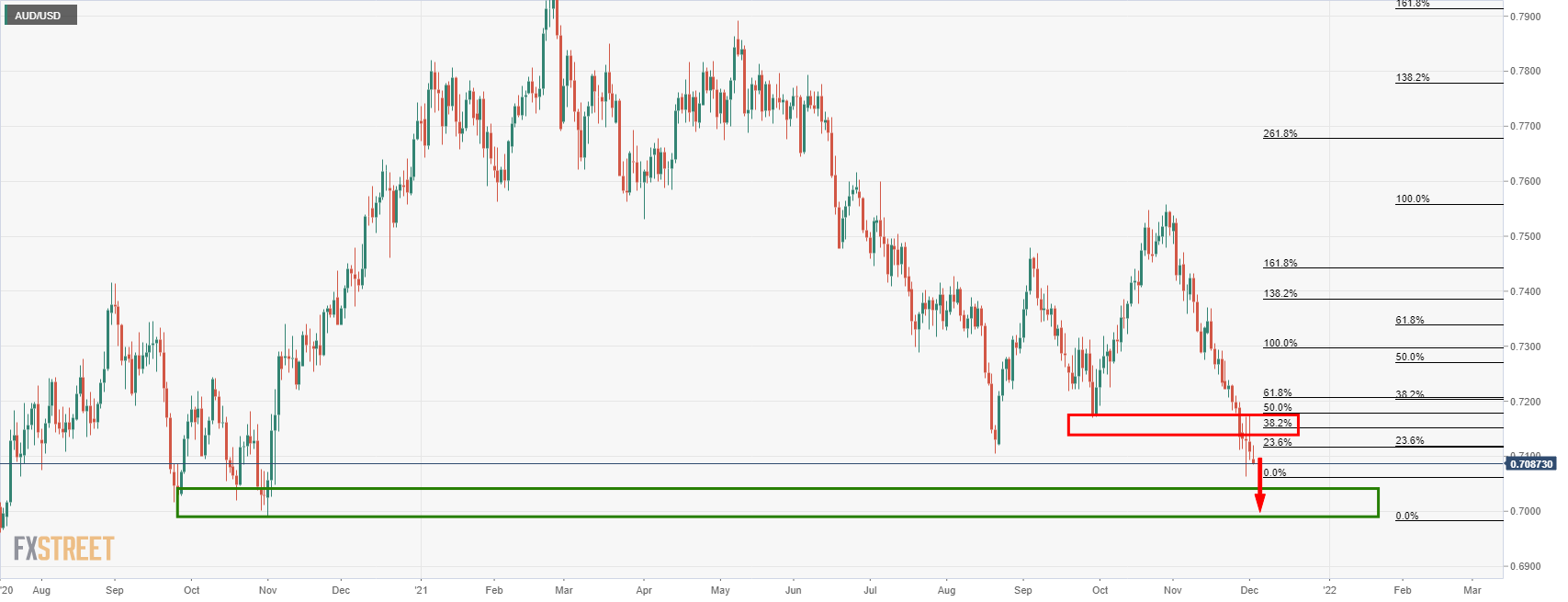
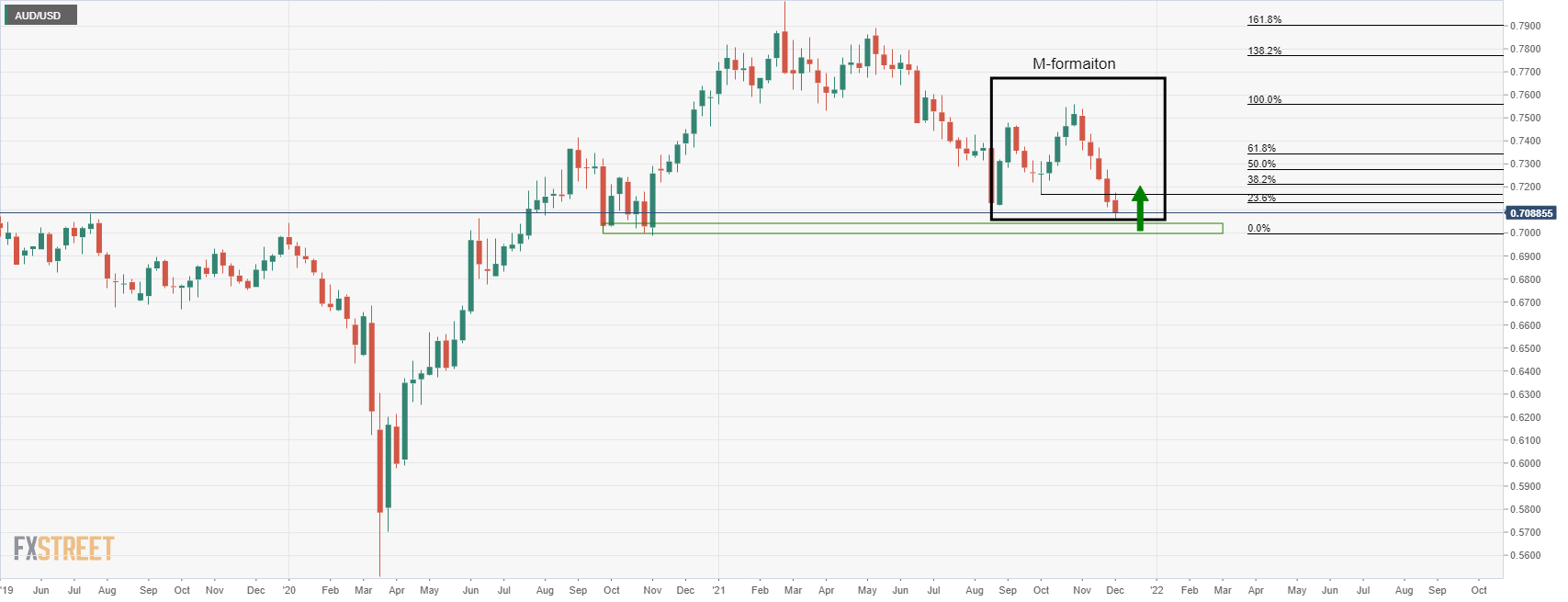
In the daily chart above, the weekly lows are illustrated with 0.6990 eyed as a potential target on a break of 0.7030. With that below said, the weekly chart's M-formation is a bullish reversion pattern that should be noted as well.
AUD/USD H1 chart
Meanwhile, the pull back on the hourly chart has not made it to a 38.25 Fibonacci retracement level and instead stalled at 0.7120, staying blow the 21-EMA:
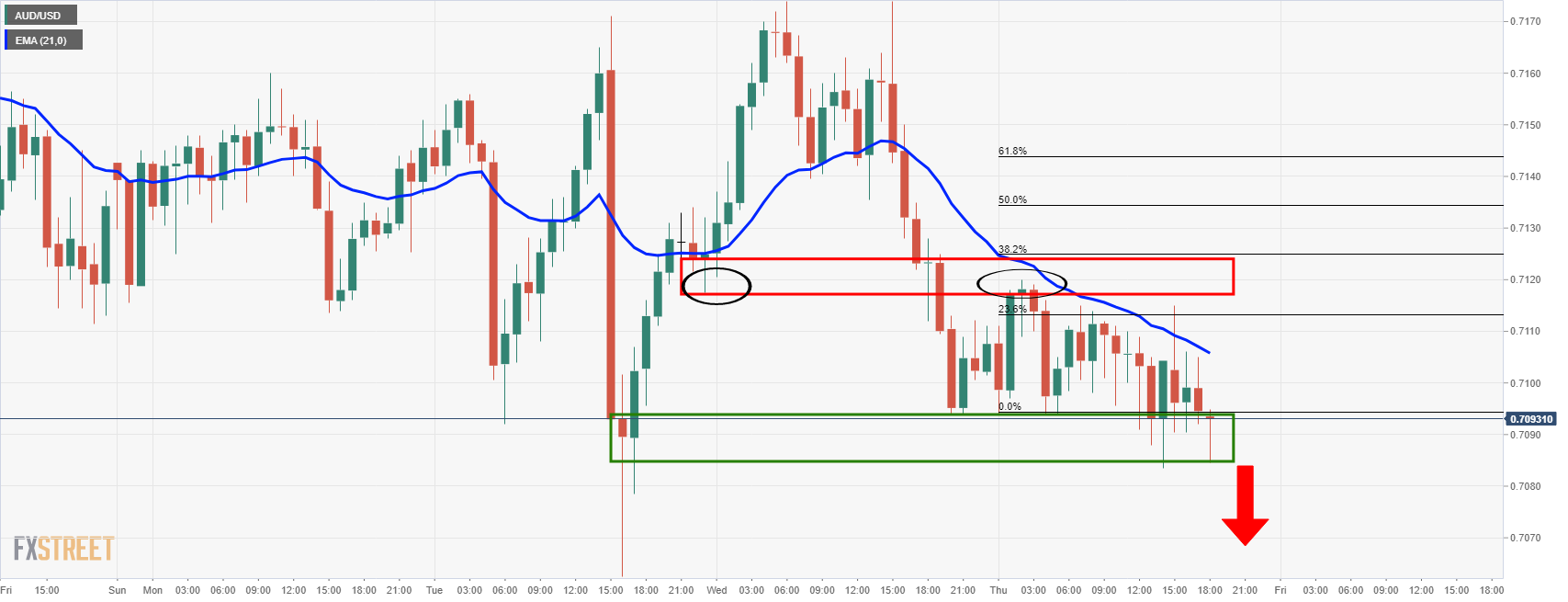
Bears will want to see a break of the 0.7080 support before fully engaging, or otherwise face the risk of a trapped market between support and resistance.
- In the last couple of hours, the euro slump continues, seesawing around the 1.1300 figure.
- Fed’s Bostic and Daly aims for a faster bond taper, Barkin would rather keep the $15B pace.
- EUR/USD break under 1.1300 could pave the way for a re-test of YTD low at 1.1186.
The shared currency drops sharply during the New York session, down 0.08%, trading around the 1.1300s at the time of writing. In the last couple of hours, the market sentiment has been mixed. European stock indices finished the session in red, contrarily of rising US indices across the pond. The NZD and the GBP are the leading gainers in the FX market, while the rest of the G8 peers print modest losses.
The EUR/USD tries to break under the 1.1300 figure for the second time, as the USD seems to benefit from higher US bond yields, rising from the short-term until the long-maturity ones. The US 10-year Treasury yield, one of the barometers for rates, edges up two and a half basis points, sitting at 1.46%, amid a group of Fed speakers crossing the wires. In the meantime, the US Dollar Index, which tracks the greenback’s performance against a basket of six rivals, advances 0.11%, reclaiming the 96 handle, sitting at 96.13.
Fed’s Bostic and Daly aims for a faster bond taper, Barkin would rather keep the current pace
Atlanta Fed President Raphael Bostic said, “The longer we have higher inflation, the greater the risk.” Further added that he will push for ending QE taper sooner than later and aim to finalize it by the first quarter of 2022. Additionally, Bostic commented that if inflation stays elevated at around 4% in the next year, that would be a good case of pulling forward interest rate hikes.
In the same tone, San Francisco Fed President Mary Daly said that the “Fed may need to start crafting a plan to think about raising interest rates.”
Meanwhile, Richmond Fed President Thomas Barkin said that he is supporting the pace of the bond tapering, Further added that long-term inflation expectations are always a concern.
EUR/USD Price Forecast: Technical outlook
The daily chart of the EUR/USD depicts the pair has a downward bias. The simple moving averages (SMA’s) with a downslope reside above the spot price, confirming the bearish bias. Also, in the last three days, the EUR/USD has found strong resistance lying around 1.1340s, causing a retracement on the pair, down to 1.1300.
In the outcome of breaking under 1.1300, the first support would be the November 30 low at 1.1235. The breach of the latter would expose the year-to-date low at 1.1186.
On the other hand, the EUR/USD first resistance would be the November 30 swing high at 1.1382, immediately followed by 1.1400. A break above that level could pave the way for further gains. The following resistance would be 1.1459, followed by the 50-SMA at 1.1507.
- Gold is on the offer below critical daily support structures.
- Bears are looking for a break into the $1,750s for the rest of the week.
The price of gold has been on the backfoot while the greenback consolidates and risk appetite improves. The US stock market has surged back to life with the S&P 500 running up over 1.6% on the day so far.
Gold, on the other hand, has fallen around 1% and is printing a fresh low at the time of writing at $1,763.51. The price has fallen from $1,783.45 on the day. Investors continue to acknowledge the hawkish tilt at the Federal Reserve which makes this week's Nonfarm Payrolls a key event ahead of the December Fed meeting.
The idea that the Fed is closer to a rate hike is dampening the demand for the non-yielding inflation hedge that is the yellow metal. Strong jobs on Friday could be the nail in the coffin for gold and support the greenback higher in anticipation of a faster rate of tapering from the Fed.
''Payrolls probably surged again,'' analysts at TD Securities explained. ''A strong trend continues to be signalled by surveys and claims, but our forecast also reflects the latest Homebase data—with a decline in the Homebase series more than accounted for by seasonality. Along with our +650k forecast for payrolls, we forecast a 0.2pt decline in the unemployment rate and a 0.4%MoM (5.0% YoY) rise in hourly earnings.''
Meanwhile, the United States recorded its first case of the Omicron variant on Wednesday, weighing on market sentiment. The person was fully vaccinated and is experiencing "mild symptoms, which are improving at this point," Fauci said. Dr. Grant Colfax, San Francisco's director of public health, said the person had not had a booster shot. Meanwhile, the United States and Germany also added to the nations around the globe planning stricter COVID-19 restrictions on Thursday.
Gold technical analysis
''The yellow metal has struggled to shore up enough support to catalyze a buying program amid Chair Powell's more hawkish communications,'' analysts at TD Securities argued.
''However, while the hawkish announcement has thus far kept gold prices from breaking north of a key threshold for CTA short covering, it ultimately does not represent a significant shift relative to market pricing. In turn, CTA trend followers may still have a surprise in store for the hawks should prices break north of $1790/oz.''
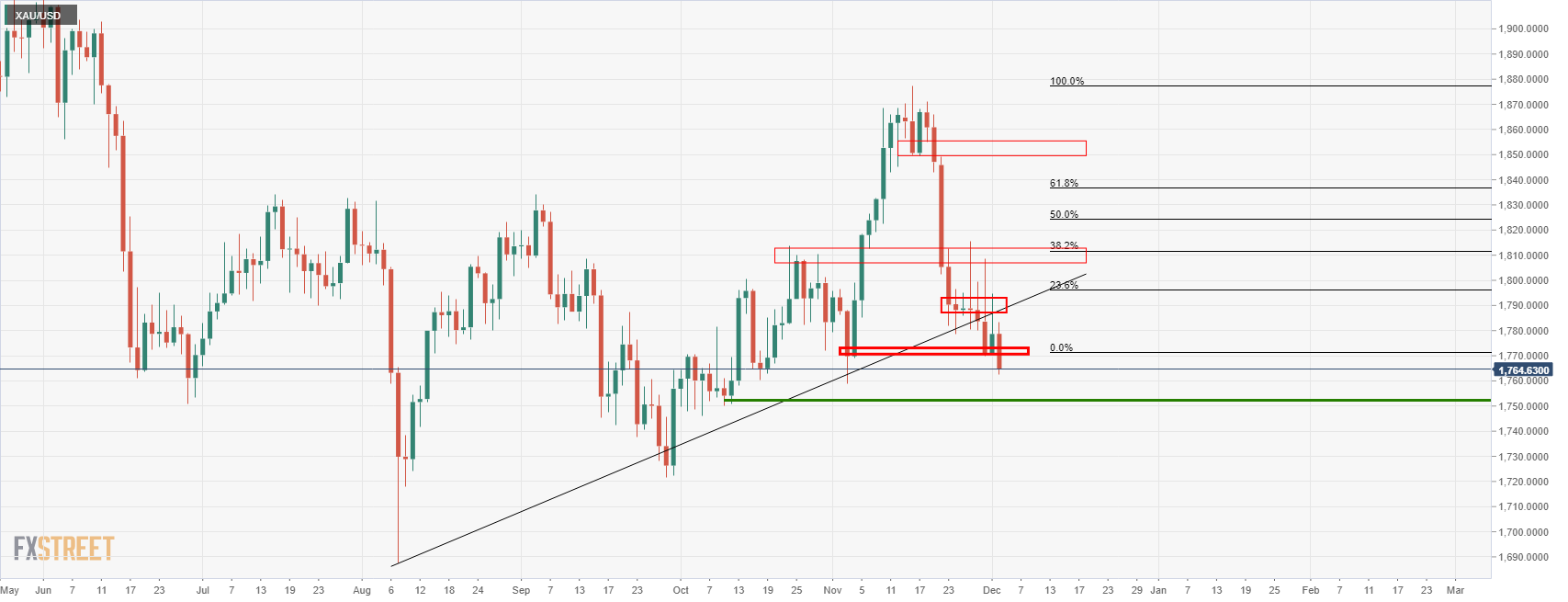
Following a restest of the counter trendline, the price is deteriorating below daily support that would now be expected to act as resistance. The focus is on the $1,750s for the remainder of the week.
- The British pound recovered some ground against the EUR.
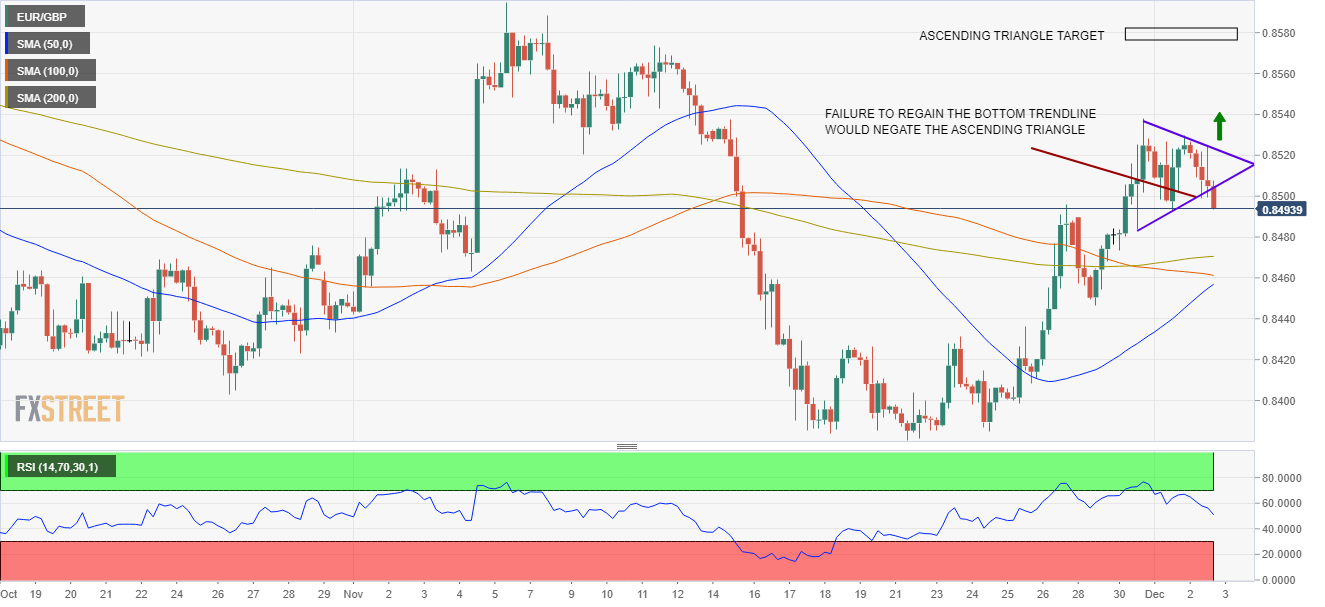
- The 4-hour chart shows the formation of an ascending triangle that would target the 0.8580-0.8580 area once broken.
The British pound has regained some strength against the shared currency, advancing after losing for five consecutive days. The EUR/GBP pair falls moderately during the New York session, down 0.36%, trading at 0.8497 at the time of writing.
In the overnight session, the EUR/GBP pair tested the December 1 high at 0.8530. However, the upward move was faded, retreating towards the S1 daily pivot at 0.8498, which coincidentally confluences with the 100-hour simple moving average. In the last couple of hours, the pair seesawed between tie 0.8490-0.8524, steady around that range.
EUR/GBP Price Forecast: Technical outlook
The EUR/GBP has an upward bias, as portrayed by the 4-hour chart. In this timeframe, the simple moving averages (SMA’s) reside below the spot price, although in disorder. From top to bottom lies the 200-SMA at 0.8468, the 100-SMA at 0.8462, and the 50-SMA at 0.8452.
Also, it is essential to notice the formation of an ascending triangle that has bullish implications, that in the outcome of breaking higher, would target 0.8570-0.8580. Nevertheless, the last candlestick, pushed lower, breaking the bottom upslope support trendline, would negate the chart pattern on the outcome of being broken.
If the EUR/GBP continues falling, it will negate the triangle formation, leaving as the first support the SMA’s confluence in the 0.8452-0.8470 range. The breach of the latter would expose the 0.8400 figure, followed by the year-to-date low at 0.8380
In the outcome of regaining the triangle-bottom-upslope trendline, the first resistance would be 0.8525. Once that level is broken, the next supply zone would be 0.8541, followed by the 0.8570-0.8580 range.
Federal Reserve Bank of San Francisco President Mary Daly said on Thursday that the Fed might need to taper asset purchases faster than anticipated.
Additional Comments:
"Fed may need to start crafting a plan to think about raising interest rates."
"Long-run inflation expectations have been remarkably stable, giving her confidence that people still believe the Fed is credible."
"The Fed's goals are in tension today and officials always need to plan for all scenarios."
Raphael Bostic, President of the Federal Reserve Bank of Atlanta, said on Thursday that inflation has gone up faster than he expected due to the virus, vaccines and fiscal support.
Additional Comments:
"He is as comfortable with the Fed's new average inflation targeting framework as he was 18 months ago."
"Forward guidance may not be as easy to understand as when the central bank was approaching inflation from below 2% target."
"Long term inflation expectations are always a concern."
"Important to have long-run inflation expectations stable at the fed's target."
"He is supportive of normalizing monetary policy as the fed is doing."
Raphael Bostic, President of the Federal Reserve Bank of Atlanta, said on Thursday that the Fed is open to the possibility that maximum employment might be fewer jobs than before.
Additional Comments:
"Understanding what maximum employment is in the current environment will take some time."
"My interest rate path is to go slow and steady, get to neutral rate in late 2024, early 2025."
"I am hopeful that as fed moves policy, some tensions in the economy will dissipate."
"If that doesn't happen, the Fed will have to take more strident steps."
"Fed will try to try to stay focused as much as possible on both sides of the dual mandate."
"It would be appropriate to try and get fed balance sheet smaller."
"I haven't given detailed thought yet on exactly how to shrink balance sheet, but discussing that over next several months."
Raphael Bostic, President of the Federal Reserve Bank of Atlanta, said on Thursday that he would push for getting the QE taper over with sooner rather than later.
Additional Comments:
"We do need to be tapering bond purchases, have served purpose."
"Tapering will provide more optionality in 2022 on interest rate liftoff."
"If inflation stays elevated in 2022, at around 4%, there will be good case for pulling forward interest rate hikes and doing more than one next year."
"Good for fed to taper before raising interest rates."
"I think tapering of the bond-buying program by end of the first quarter of 2022 is in our interest."
"Fed can let data inform policy once taper is out the way."
"We want to see continued momentum in job gains in the monthly report tomorrow."
"I don't see tension right now between maximum employment and price stability."
"Taper will not put brakes on the economy, just removing some stimulus."
"The labor market is in a tremendous amount of flux
Raphael Bostic, President of the Federal Reserve Bank of Atlanta, said on Thursday that analysis from the Fed board suggests that successive waves of Covid-19 have been associated with a milder slowdown each time. If that happens again, he added, he thinks the US economy will grow despite new variants.
Additional Comments:
"In early stages on omicron assessment on the economy."
"How much omicron affects people participating in the economy is key."
"I don't think demand and supply imbalances will get worse."
Raphael Bostic, President of the Federal Reserve Bank of Atlanta, said on Thursday that we're at elevated inflation levels and we need to make sure we're on top of that.
Additional Comments:
"The longer we have higher inflation, the greater the risk."
"Uncertainty on inflation has the ability to prolong inflation environment for longer."
"We've seen a pretty robust recovery in employment and GDP growth."
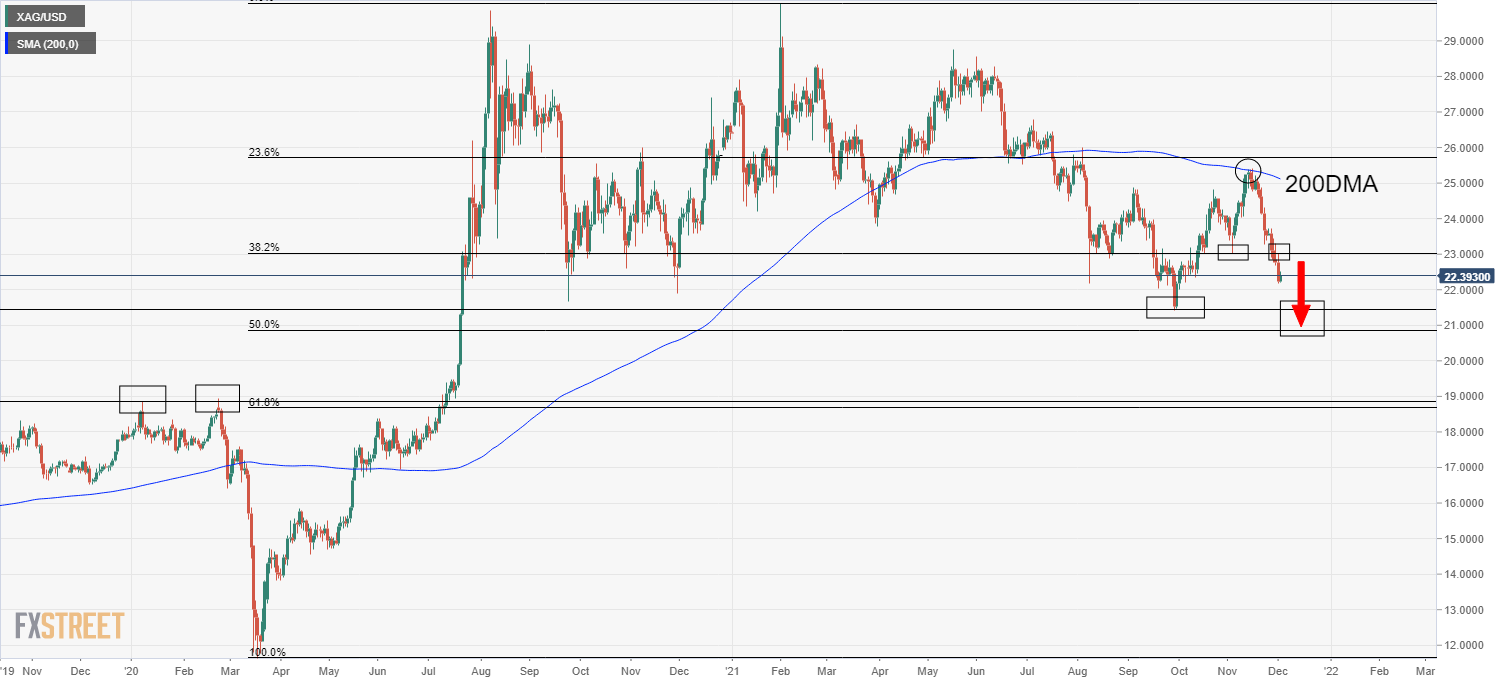
- Spot silver prices are subdued on Thursday beneath $22.50 ahead of Friday’s key US jobs data.
- A strong report may solidify silver’s recent bearish trend.
Spot silver (XAG/USD) prices remained subdued to the south of the $22.50 mark, having slipped beneath this level on Wednesday. On the day, spot prices are flat but losses on the week stand at nearly 4.0%. Moreover, since the silver topped out at its 200-day moving average of just under $25.50 back in early/mid-November, prices have declined more than 12%. The main driver of recent weakness in silver markets has been a strengthening US dollar (the DXY has risen from around 94.00 to current levels around 96.00) and rising US real yields 5-year TIPS are roughly 40bps higher versus mid-November levels under -1.90%. Both reflect a hawkish shift in Fed expectations.
Looking ahead, silver is likely to continue to trade in subdued fashion on Thursday in the absence of any important new data coming out about the Omicron variant, given that the November US jobs report is due out on Friday. Silver prices have been under pressure this week in wake of Fed Chair Jerome Powell’s surprisingly hawkish tone on inflation, the economy and the potential for a faster QE taper. The major US macro data releases so far this week have been strong, endorsing the Fed’s bullish view and Friday’s jobs report is expected to be no different. For reference, the report is expected to show 550K jobs added to the US economy in November.
A strong US labour market report for November may add further fuel to XAG/USD’s recent bearish trend. Bears will be targetting a test of the September lows in the $21.50 area soon. This is a key area of support going all the way back to September 2020. A break below there opens the door to a run towards the 50% retracement back to the post-pandemic high just above $30.00 to the post-pandemic low just under $12.00 at $20.90, as well as the psychologically important $20.00 level.
On Friday, the NFP report and in Canada job figures will be released. Analysts at TD Securities expect the Canadian unemployment rate at 6.6% in November (in line with market consensus) and a positive net change in employment of 37K.
Key Quotes:
“We look for relatively modest labour market gains in November with another 30k jobs added, pulling the UE rate 0.1pp lower to 6.6%. Job growth should be driven by full-time employment, but we will not see the impact of BC floods due to an early reference week. We also look for a sharp uptick in wages, reflecting a combination of base-effects and recent momentum.”
“Barring a very significant surprise, the focus should be on US payrolls where we expect a strong report. We think the CAD's losing streak may be coming to an end. 1.28/29 in USDCAD looks toppish to us but we think better prospects may be had against the funders. We are particularly focused on CADJPY.”
- XAU/USD drops further even as US yields remain in recent range.
- US dollar and equities mixed, oil rebounds, and metals hold soft tone.
Gold prices continue under pressure on Thursday. XAU/USD dropped further to 1762$, reaching the lowest level in four weeks; it remains near the lows, looking at the 1760$ support area.
The declines are taking place even as US yields remain relatively steady and amid mixed US dollar. Also in Wall Street, equity prices are mixed. Price action suggests the negative tone in gold has strengthened and a slide below $1760 would expose the next support at $1745/50. A consolidation above $1780 should alleviate the bearish pressure, clearing the way for a test of $1790.
Economic data released on Thursday in the US showed a lower than expected increase in initial jobless claims. On Friday, the Non-farm payroll is due. Those numbers could have a significant impact on monetary policy expectations, affecting yields, the dollar and gold.
The weekly chart also shows gold under pressure, headed toward the third decline in a row, and price back under the 20-week simple moving average. If it ends Friday around current levels would be the lowest weekly close since early October.
Technical levels
- Sterling advances, amid a mixed-market sentiment, favored by rising US equities.
- Omicron COVID-19 nervousness seems to ease as investors’ risk appetite moderately improves.
- GBP/USD Technical outlook: In the 4-hour chart, the 50-SMA has capped three times any GBP upside moves, at press time lies around 1.3330s
The British pound edges higher, snapping three days losses so far, up some 0.32%, trading at 1.3307 during the New York session at press time. Market conditions remain mixed, which is portrayed by European stock indices falling, contrary to the US, with the Dow Jones, the S&P 500, and the Nasdaq rising. Also, it seems that investors’ worries linked to the Omicron new coronavirus strain just discovered 1in the last week, ease as a World Health Organization (WHO) official said that some of the early indications are that most cases are mild.
Either way, markets would likely remain volatile unless market participants get more clarity on the new COVID-19 variant.
Apart from this, in the overnight session, the GBP/USD pair printed a daily low at 1.3263, amid USD strength on dampening market sentiment through the Asian session. However, the British pound is staging a rebound, trading above the 100 and the 50-hour simple moving averages (SMA’s) that could favor GBP bulls in the near term, unless USD bulls could push the pair below the 1.3300 handle. The upward move was courtesy of USD selling pressure as US equity indices rise, influencing risk-sensitive currencies like the GBP.
On Wednesday, two Fed policymakers favor a fast bond taper. In an appearance at the Congress, Fed’s Chair Powell reiterated that a faster wind-down of the QE’s program is necessary so that the Fed could tame inflationary pressures. Later on, Cleveland Fed President Loretta Mester expressed that a more rapid taper would be like “buying insurance” in the necessity of hiking rates as need it
In the Brexit saga, according to BBH analysts, noted that “reports suggest a compromise on fishing rights is within reach, with the EU hailing the granting of a new batch of fishing licenses by the UK as progress towards a concrete long-term deal later this month.”
In the macroeconomic docket, there’s nothing from Canada to report. On the US front, Initial Jobless Claims for the week ending on November 26 rose to 222K, better than the 240K forecasted, while the Continuing Jobless Claims for the week ending on November 18 rose to 1.956M, lower than 2M for the first time, since March 2020.
GBP/USD Price Forecast: Technical outlook
The GBP/USD in the 4-hour chart has a downward bias, as the GBP/USD has tested dynamic resistance at the 50-simple moving average (SMA) three times, failing to overcome it. Also, the 100 and the 200-SMA on top of the shorter time-frame one adds more fuel to the bearish bias.
In the outcome of GBP/USD further falling, the first support would be December 1 low at 1.3261, followed by a confluence area around November 30 low and the figure at 1.3190-1.3200.
- Mexican peso ends two-day rally versus US dollar amid risk aversion on Wednesday.
- USD/MXN likely to face consolidation before next directional move.
- Primary trend remains bullish, but under 21.30 more losses could take place.
The USD/MXN is falling again on Thursday but it remains far from Wednesday’s low. It bottomed at 21.11 and then rebounded sharply, erasing most of the day’s losses. In the very short-term it remains with a negative bias, still facing volatility, although trading quietly on Thursday.
Price is moving around 21.30, a key technical level. A consolidation below would keep the door open to more losses, with the next support levels at 21.15 and then the strong barrier at 20.90. A break of the support at 20.90, could be followed by more losses toward the uptrend line at 20.50.
On the upside, a firm recovery above 21.45 would alleviate the negative pressure. No signs of a resumption of the primary uptrend are seen at the moment. The USD/MXN seems to be forming a consolidation range likely between 21.15 and 21.65. Above 21.70, the 22.00 zone would be exposed.
Technical levels
-637740557709448214.png)
- USD/JPY found resistance at its 50DMA and has slipped back under 113.00.
- Further strong US data has failed to support the pair.
- FX markets are in wait-and-see mode ahead of Friday’s NFP.
USD/JPY found resistance at its 50-day moving average in earlier trade in a telling sign that, despite surging short-end and real US yields on strong US macro data and a more hawkish Fed, the safe-haven favouring the yen remains strong. USD/JPY has been fairly subdued on Thursday and trades within recent intra-day ranges. The pair hit highs earlier in the session in the 113.30s, but has since reversed back to the south of the 113.00 level.
Strong US data
Better than expected initial jobless claims numbers for the week ending on 27 November failed to give USD/JPY any notable lift, as did the strongest monthly Challenger job layoff reading since 1993. The strong US data comes on the heels of a better-than-expected November US ISM manufacturing PMI survey and a slightly above expected ADP national employment number, both released on Wednesday. The string of strong US macro data reports ought to boost expectations for Friday’s official jobless claims report. Markets currently expect the report to show that 550K jobs were added to the economy last month and that the unemployment rate continued to decline to 4.5%.
In fairness, ahead of the key official US jobs report, it does make sense that the FX markets would enter wait-and-see mode to a degree. But the US dollar’s inability to recover its post-Omicron variant emergence losses versus the likes of the yen and euro this week despite Fed Chair Jerome Powell’s hawkishness earlier in the week triggering a recovery in Fed tightening expectations is perplexing. Recall that much of the USD depreciation versus the yen and euro seen last Friday was attributed to a pullback in Fed tightening expectations, so the question is, as these have recovered why has the dollar not kept pace?
Why USD/JPY remains subdued
Some have suggested that it is because the dollar was overbought this time last week and thus was due a technical correction anyway. Others point at long-end US yields. Unlike short-end and real yields, long-term nominal yields have not recovered after Powell’s hawkishness. The 10-year continues to trade in the low 1.40s%, barely above multi-month lows and more than 20bps down from pre-Omicron levels. USD/JPY tends to be most sensitive to US/Japan 10-year rate differentials. The bid in long-term bonds that has pushed yields down liekly reflects worries that the long-term outlook for US growth and inflation has become more muted with the Fed set to start tightening despite the threat of Omicron.
- The Loonie falls for the third consecutive day amid mixed-risk sentiment and unmoved oil prices.
- In the overnight session, the USD/CAD remained subdued around the 1.2775-1.2829 range.
- Fed policymakers favoring a faster taper: Bullard, Bostic, Mester, and Powell.
The US/CAD extends its gains for the third day in a row, amidst a mixed bag market sentiment, modestly rising 0.02%, trading at 1.2817 at the time of writing. European indices are falling, following the Asian equity futures path, whereas, In the US, major stock indices are rising as traders keep assessing the impact of the COVID-19 Omicron variant in the global economy.
The USD/CAD remained range-bound in the overnight session, trading between the 1.2775-1.2829 range, fluctuating between the daily central pivot point and the December 1 swing high. That, in part, as risk-off market sentiment, dented investors’ appetite for riskier assets; also, crude oil prices remained subdued ahead of the OPEC+ meeting. As Wall Street opened, USD/CAD bulls pushed the pair to a new daily high at 1.2835, but the move was faded, retreating towards the 1.2810s area.
Fed officials add to the hawkish list
On Wednesday, Fed policymakers reinforced the need for a faster taper. Fed’s Chair Jerome Powell said that inflation is linked to the pandemic, and elevated prices have been stubbornly persistent. Further noted that “we need to move on from the word transitory” and reinforced the strength of the US economy.
In the same posture, Cleveland Fed President Loretta Mester said, “making the taper faster is definitely buying insurance and optionality so that if inflation doesn’t move back down significantly next year, we’re in a position to be able to hike if we have to.” She noted that recent data “have come in supportive of that case, so I’m very open to considering a faster pace of tapering.”
That said and for those who like to keep the score, Bullard, Bostic, Mester, and Powell favor a faster QE’s reduction, which would aim to end in the first quarter of 2022.
Meanwhile, Western Texas Intermediate (WTI) US crude oil benchmark falls almost 1%, trading at $64.99, underpinning the USD/CAD direction, amid some US Dollar weakness.
In the macroeconomic docket, there’s nothing from Canada to report. On the US front, Initial Jobless Claims for the week ending on November 26 rose to 222K, better than the 240K forecasted, while the Continuing Jobless Claims for the week ending on November 18 rose to 1.956M, lower than 2M for the first time, since March 2020.
During the day, Fedspeaking would be the driver of the day, with Bostic, Quarles, Daly, and Barkin crossing the wires.
In 2022, economists at ING expect the dollar to stay strong. EUR/USD and USD/JPY could trade at 1.10 and 120.00, respectively.
Sharper Fed tightening cycle to propel the greenback
“Assuming that Omicron risks play out closer to the benign end of the spectrum, we look for the sharper Fed tightening cycle to return as a theme in early 2022. This should be good news for the dollar.”
“In a world where the European and Japanese central banks are late to tighten – or have the biggest cause to pause – dollar gains should largely come at the expense of the low-yielding currencies. Here EUR/USD can trade to 1.10 through the year and USD/JPY potentially as high as 120.”
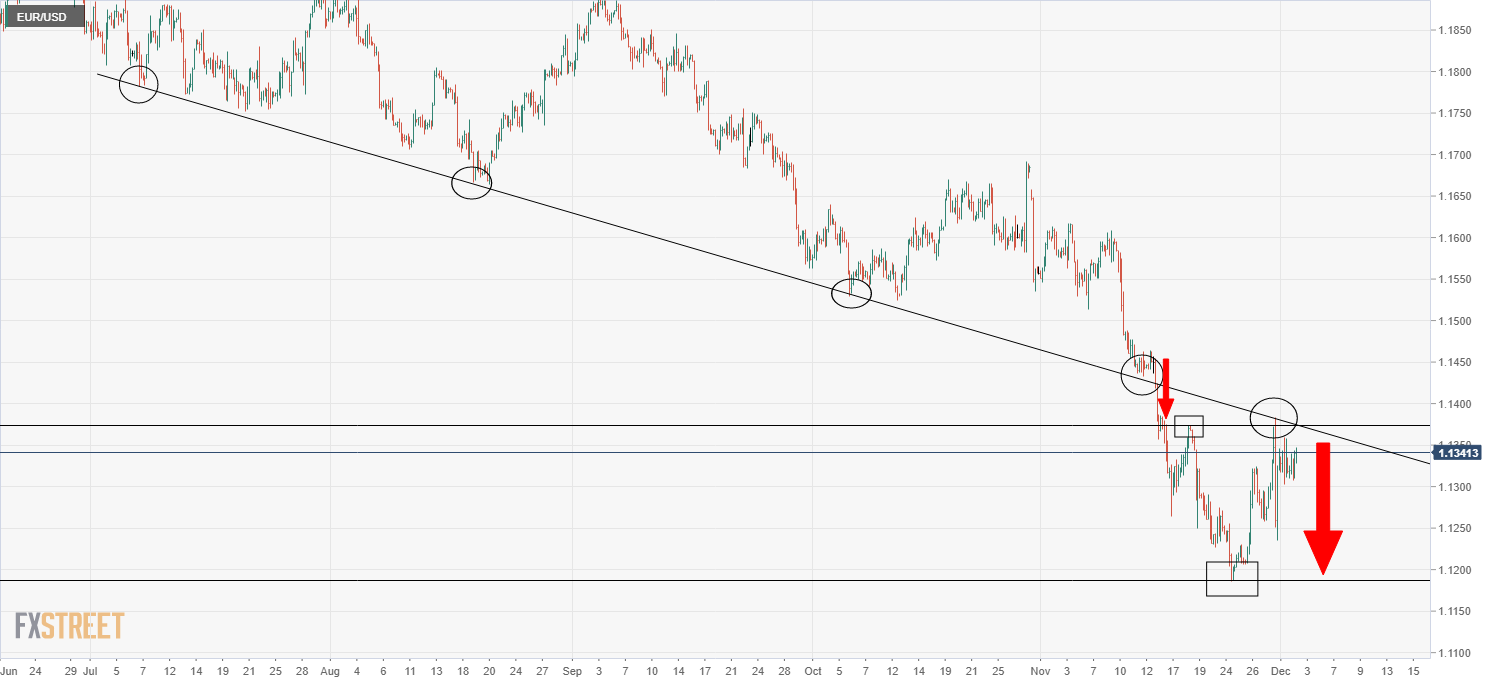
- EUR/USD has nudged higher to the 1.1340s but remains stuck within recent intra-day ranges.
- Further strong US macro data has been ignored, with focus instead on Friday’s US jobs report.
EUR/USD continues to trade within recent intra-day ranges in the 1.1300-1.1350 region as FX markets take a breather from the heightened volatility of recent sessions. FX market conditions are likely to remain fairly subdued now ahead of Friday’s US jobs report. The pair has nudged modestly higher and is currently trading in the 1.1340s, up about 0.2% on the day. These gains come despite further strong US macro data in the form of a better-than-expected initial weekly jobless claims number and job layoffs in November dropping to near 30-year lows.
The pair has also largely ignored the latest headlines about Germany imposing restrictions on the unvaccinated and restrictions being tightened in Belgium. Ahead, four Fed speakers will be coming out of the woodworks on Thursday and if they adopt more a hawkish line in tandem with Fed Chair Jerome Powell earlier in the week.
Hawkish Fed being priced back in
On the back of strong US macro data and hawkish commentary from Powell, who sounded concerned about inflation risks and hinted at a faster QE taper, USD money markets have been unwinding last Friday’s dovish repricing. Recall, news of the Omicron variant last Friday saw markets aggressively pare back expectations for Fed policy tightening in 2022 amid fears it would derail the US economic recovery. The implied yield on the December 2022 three-month eurodollar future fell from close to 1.10% on Thursday to as low as 0.80% on Tuesday prior to Powell’s comments but has since recovered to around 1.0%.
But dollar struggling to keep up
Yet the dollar recovery has been far less impressive. EUR/USD was trading close to 1.1200 prior to the omicron news and is only about 30-40 pips below Tuesday’s 1.1385 highs. Uncertainty regarding the new variant remains elevated and it seems that this, combined with profit-taking on the overbought dollar (particularly versus the euro) is keeping EUR/USD supported. In terms of the technicals; EUR/USD is currently testing a key downtrend that acted as support until mid-November but is now acting as resistance. This, coupled with the earlier weekly highs and 21-day moving average in the 1.1380s, is likely to continue capping the price action for now.
Just when we thought we were through the worst, along comes the Omicron variant. Nobody knows if the new variant will be more transmissible or deal a significant blow to the current vaccines. These are the best and worst outcomes for the global economy, in the view of economists at ING.
Optimistic Omicron
“Omicron proves to be a ‘storm in a teacup’. The Federal Reserve accelerates its taper in December and gears up for three rate hikes in 2022. Sporadic Delta lockdowns slow eurozone growth over Christmas and early into the new year, but the situation improves through the spring. The European Central Bank begins to taper amid growing wariness about inflation. The Bank of England kicks off its rate hike cycle this month.”
Omicron ‘difficult’ but not a ‘disaster’
“This is loosely our base case. Omicron doesn’t help Europe at a time of spiking cases and offers more justification for more aggressive action in the run-up to Christmas. But high vaccine rates and the arrival of boosters mean the continent (including the UK) comes off more lightly than other parts of the world. The effect might be slightly more noticeable in the US, even if the bar for lockdowns is much higher. Meanwhile, in Asia, Omicron stalls the move away from zero-Covid, especially in China. The recovery of supply chains is further delayed.”
“Central banks are likely to ‘wait and see’ in December, not least because it may be weeks before we know what we’re dealing with. But inflation remains front and centre, so we should still expect some tightening of monetary policy next year.”
Omicron deals significant blow to the recovery
“We expect a dip in first-quarter GDP in the major developed economies, albeit not as deep as in early-2021. But the subsequent recovery could be gradual. Overall growth momentum proves more lacklustre through 2022, compared to the rapid rebounds we saw in Q2/3 2021.”
- EUR/JPY challenges once again the mid-127.00s on Thursday.
- Markets remain side-lined on omicron jitters, upcoming US NFP.
- US yields trade in a mixed fashion; yen struggles vs. the dollar.
EUR/JPY manages to reverse the initial drop to the 127.50 region and so far posts decent gains just below 128.00 the figure on Thursday.
EUR/JPY looks to risk trends for direction
EUR/JPY bounces off the so far solid contention area around 127.50 on Thursday, always against the backdrop of the absence of clear direction in the global markets, a mild selling bias in the greenback and increasing cautiousness surrounding the progress of the omicron variant.
Indeed, the dollar appears offered amidst the mixed performance in US yields and despite another auspicious print from the weekly Claims in the US economy, all morphing into fresh legs for the European currency and the resumption of the upsid momentum in the cross.
In the euro docket, the unemployment rate in Euroland came down to 7.3% in October. In Japan, the Consumer Confidence stayed put at 39.2 in November and Foreign Bond Investment shrank by ¥1343.2B in the week to November 27.
EUR/JPY relevant levels
So far, the cross is gaining 0.26% at 127.95 and a surpass of 128.78 (weekly high Dec.1) would expose 129.59 (weekly high Nov.23) and then 130.53 (200-day SMA). On the downside, the next support comes at 127.48 (monthly low Nov.29) followed by 126.00 (round level) and finally 125.08 (2021 low Jan.18).
US Treasury Secretary Janet Yellen, speaking at a Reuters Next event, said on Thursday that a strong US economy, which could likely prompt interest rate increases, is generally good for the world and emerging markets.
Key takeaways:
“It's up to the Federal Reserve to decide when to raise interest rates.”
“Don't want to have wage-price spiral develop in which inflation becomes chronic.”
“It's Fed's job to ensure we don't have wage-price spiral seen in the 1970s.”
“Learned while serving as fed chair to avoid surprises for markets on any rate increases.”
“Working with semiconductor manufacturers, but takes a long time to ramp up production.”
“Tariffs do contribute to higher prices.”
“Some Trump-era tariffs create problems without having any 'real strategic justification'.”
“Lowering tariffs through 'exclusion process' could be helpful, but not a 'game-changer.”
“Omicron variant could cause 'significant problems' for the economy, still evaluating that.”
Market Reaction
Market have not reacted to Yellen's commentary.
GBP/USD is on track for its first gain in four sessions as it climbs back above 1.33. The pair could extend its advance on a break above the 1.3334 downtrend, economists at Scotiabank report.
Support is seen at the 1.33 region
“A firm breach above the Oct/Nov downtrend that acted as resistance on Tuesday and Wednesday, and today at 1.3334 could see the pound aim for a test of 1.34 that stands as resistance after 1.3360/70.”
“Support is the 1.33 zone followed by ~1.3275 and ~1.3260 ahead of the next big figure.”
USD/CAD rallied over 3% during November. Economists at Rabobank expect the pair to trade back in the 1.28-1.30.
USD/CAD and volatility, expect both to remain elevated
“The USD smile theory seems to be in play, so we are bullish USD regardless of whether the US continues to outperform and the Fed tightens policy, or if the global environment sours and global growth slows. The new omicron variant posing a tail risk that could trigger that second scenario.”
“Despite being diverse environments, the outcome is likely to be the same; that is, USD outperformance. However, positioning is stretched and with volatility high we can certainly expect to see sizeable pullbacks.”
“Still, the trend for USD is likely to remain positive and as such we favor USD/CAD returning to the 1.28-1.30 range that dominated the back end of 2020.”
- EUR/USD leaves behind Wednesday’s daily retracement.
- Further upside is seen initially challenging 1.1382.
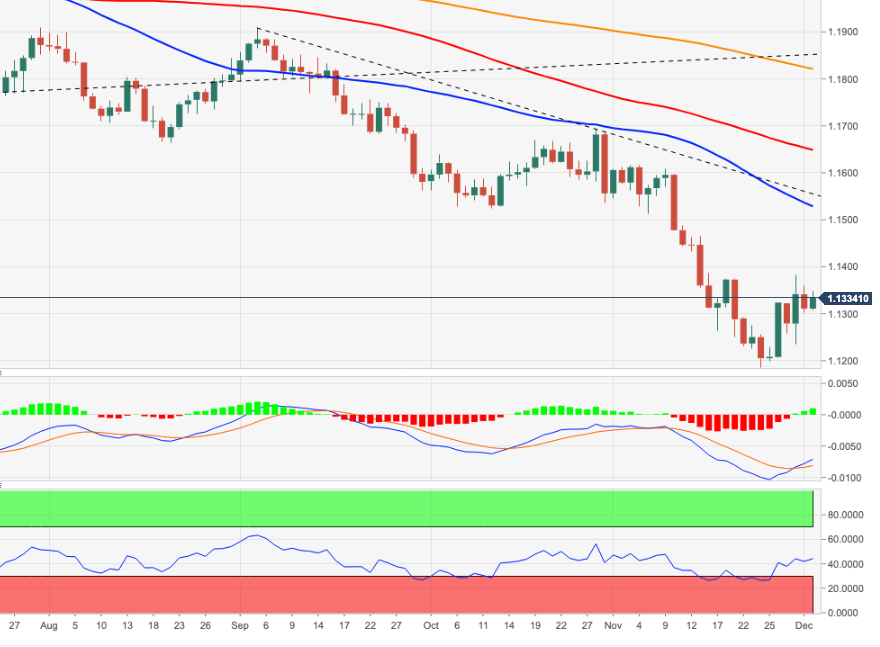
EUR/USD regains the smile and the buying interest and advances to the 1.1350 zone on Thursday.
In case the recovery picks up further impulse, then the pair is forecast to test the weekly top at 1.1382 (November 30) ahead of another weekly high at 1.1464 (November 15).
The probability of further losses remains unchanged as long as EUR/USD trades below the 2-month resistance line (off September’s peak) near 1.1545. In the longer run, the offered stance in spot is expected to persist while below the 200-day SMA at 1.1819.
EUR/USD daily chart
Oil prices have come under severe selling pressure in recent trade after Reuters reported that, according to an OPEC+ source, the cartel agreed to go ahead with its planned 400K barrel per day output hike in January.
Analysts had expected that, given greater uncertainty about the medium-term crude oil demand outlook due to the global spread of the Omicron Covid-19 variant, OPEC+ would pause output hikes.
Market Reaction
In the last few minutes, WTI has sunk from above $65.00 to around $63.50, though is off earlier lows around $62.50.
The S&P 500 has completed a large bearish “outside day” to reinforce the existing bearish “reversal week” from 4750. A weekly close below the key 63-day average support at 4524 would warn of a more serious correction lower, analysts at Credit Suisse report.
A close above 4524 this Friday can help stabilize the market
“Critical remains as to how we close the week, especially with Payrolls on Friday as a weekly close below 4524 would warn of a more serious correction lower especially in light of widening US credit spreads and with both the VIX and Oil also currently through key technical levels.”
“Immediate support is seen at the 50% retracement of the October/November rally at 4512/10, below which can see support next at 4486 ahead of gap support from mid-October at 4448/38. The critical long-term 200-day average is currently seen lower at 4299.”
“A close above 4524 this Friday can help stabilize the market with resistance then seen next at 4560. More important resistance is seen at the recent price gap, 13-day exponential average and ‘outside day’ high at 4631/55.”
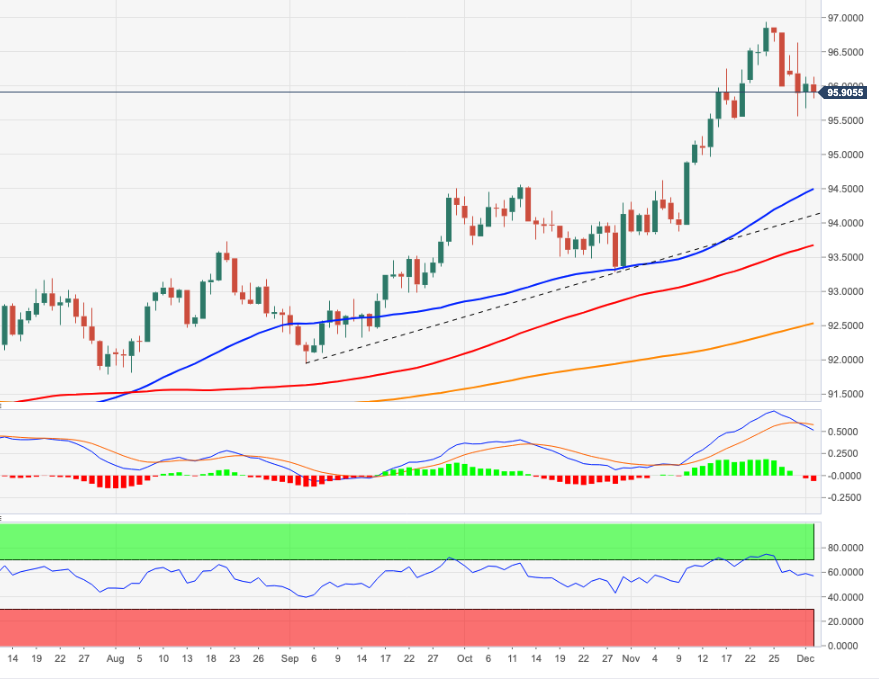
- DXY resumes the downside and revisits the sub-96.00 area.
- Recent lows in the mid-95.00s offer decent contention.
DXY trades on the defensive and puts once again the 96.00 region to the test on Thursday.
The next significant support comes at 95.51 (November 18), which is also reinforced by the proximity of the 20-day SMA, today at 95.64.
In the meantime, while above the 2-month support line (off September’s low) near 94.50, extra gains in DXY remain well on the table. In addition, the broader constructive stance remains underpinned by the 200-day SMA at 92.53.
DXY daily chart
- AUD/USD slipped under 0.7100 in recent trade after good US jobs data.
- US data has been strong this week and, coupled with a hawkish sounding Fed, presents downside risks to AUD/USD.
AUD/USD slipped under the 0.7100 level in recent trade and is currently trading lower by about 0.2% on the day, weighed by good US data. This week’s broadly strong US data endorses Fed Chair Jerome Powell’s bullish take on the economy and message that the bank should press ahead with policy tightening in light of pandemic risks.
To recap, November ISM Manufacturing PMI and ADP data released on Wednesday were both strong. Meanwhile, further evidence of labour market strength in November came on Thursday in the form of Challenger job cuts reaching lows since 1993 and weekly Initial Jobless Claims remaining at healthy, pre-pandemic levels in the week ending November 27. Friday’s US labour market report will be key, however. Another strong print could send AUD/USD back towards November lows in the 0.7060s area.
Aussie data, Victoria outbreak, RBA
Thursday saw the release of further Australian economic data; monthly retail sales and trade balance numbers were broadly in line with expectations, though monthly home loans figures saw a surprise MoM contraction. Thursday’s batch of data didn’t really shift the dial much and come after Wednesday’s not as bad as feared GDP figures, which showed the economy shrinking at a 1.9% QoQ in Q3 versus an expected 2.7% QoQ drop in economic activity (as a result of lockdowns). Australia gradually reopened in November as vaccine coverage rates hits key thresholds, but infections in Victoria surged on Thursday to above 1.4K, their highest level in around one month and Omicron is already known to be circulating – the risk of further lockdowns despite the state’s high vaccination rate remains one to watch.
For now, it seems that AUD is being insulted from domestic Covid-19 concerns as hawkish central bank expectations are priced back in, with money markets betting the RBA will keep pace with the Fed and start hiking interest rates in June next year. The RBA has insisted that it won’t hike until 2023 at the earliest, but the less bad than feared downturn in GDP in Q3 sets the stage for a stronger rebound in Q4 and the quarters ahead. “We expect the RBA to announce, next week, a decision to taper its bond-buying to A$2 billion a week from February, and likely end QE in May” Nomura economist Andrew Ticehurst told Reuters on Thursday, despite RBA Governor Philip Lowe saying a decision on QE would not be made until February.
- There were 222K initial weekly jobless claims in the week ending 27 November.
- That was less than an expected rise to 240K from last week's 194K.
There were 222,000 initial claims for unemployment benefits in the US during the week ending November 27, data published by the US Department of Labor (DoL) revealed on Wednesday. This reading followed last week's print of 194,000 (revised from 199,000) and came in lower than the market's expectation for 240,000.
Continued jobless claims fell to 1.956M in the week ending November 20, the data showed, below expectations for a drop to 2.00M from 2.063M the week prior. That marked a fresh post-pandemic low.
Market Reaction
The dollar saw a very minimal reaction to the data, which fits in with the narrative that the US labour market is currently very healthy/tight.
During November the Australian dollar weakened notably against the US dollar from 0.7508 to 0.7094. Economists at MUFG Bank expect the AUD/USD pair to see a gradual move higher throughout 2022 as the Australian economy recovers and markets readjust the high level of tightening priced into the US curve.
Downside for the aussie AUD/USD from here is limited
“Even after the Omicron market shift, the US rate market is still priced for more than two rate hikes in 2022 and hence the downside for AUD/USD from here is more limited.”
“The data from Australia is now set to improve as covid restrictions are eased. Still, the RBA justifies its more cautious stance on raising rates by pointing to weak wage growth. Q3 wages increased by just 2.2% with the RBA citing sustained growth at least 3.0% as needed to meet RBA inflation goals.”
“With more than 70bps of tightening over the coming 12 months, the pricing still looks excessive but assuming this is also the case in the US, we believe there is scope for a gradual grind higher in AUD/USD through 2022.”
Turkish Finance Minister Nureddin Nebati said on Thursday that high interest rates won't be a priority, according to newswires. Elvan was installed as Finance Minister earlier on Thursday and is seen as a strong supporter of President Recep Erdogan's drive to lower interest rates. Nebati added that he would take steps to achieve a more predictable market and economy.
Market Reaction
The lira hasn't seen any immediate market reaction and USD/TRY continues to trade just to the south of the 13.50 level.
- Challenger Job cuts fell under 15K in November.
- That marked the lowest number since 1993, but FX markets were unmoved ahead of Friday's NFP report.
According to Challenger, Grey & Christmas, job cuts were down 77% YoY in November at 14,875, the lowest such number since 1993. Nearly half of the cuts were down to vaccine refusal (7227).
Market Reaction
Further evidence of a super tight US labour market at this point likely will not alter Fed thinking at this point. Chairman Jerome Powell already indicated a hawkish shift this week in response to optimism about US economic and labour market strength and worries about inflation. Hence, FX markets have not been impacted by the latest numbers. Traders are more focused on Friday's official November labour market report, which is released at 1330GMT on Friday.
According to S&P Global Ratings, if Turkey's central bank (CBRT) continues with its monetary policy easing cycle, authorities might have to permit further depreciation of the lira. By using "borrowed" reserves to defend its exchange rate, S&P continued, the CBRT risks further damaging confidence in the lira and could raise financial stability questions.
The weaker lira will negatively affect Turkey's sovereign balance sheet and recent developments could present downside risks to the country's current rating which remains at B+ with stable outlook, S&P said. Turkey has seen a "significant amount of quasi-fiscal activity" via state banks, and if those banks ultimately run into trouble they may need considerable capital support, the rating agency concluded.
Market Reaction
The comments arent too surprising given recent developments in the Turkish economy/exchange rate. At present, USD/TRY is consolidating slightly to the south of the 13.50 level.
Irish Foreign Minister Simon Coveney said on Thursday that there are still real gaps between the UK and European Union in their disagreement over the implementation of the Northern Ireland Protocol (NIP), according to Reuters.
Coveney added that there hasn't yet been a breakthrough moment and that protocol issues are unlikely to be resolved by the year's end.
Market Reaction
GBP hasn't seen any reaction to the comment, with GBPUSD continuing to meander to the north of the 1.3300. GBP is actually the top performing G10 currency on the day so far, up 0.3% versus the buck, despite recent news that the US is to delay a deal to remove Trump-era steel tariffs on the UK due to UK threats to trigger Article 16 of the NIP.
- EUR/JPY rebounds from earlier lows in the mid-127.00s.
- Further decline remains on the table for the time being.
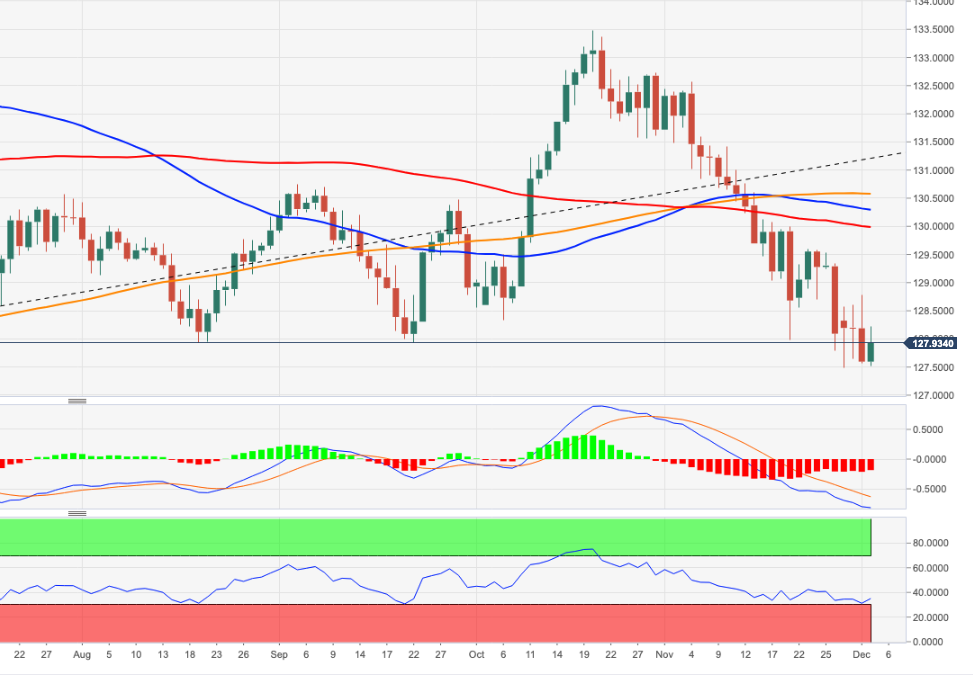
EUR/JPY once again visited the contention area around 127.50 on Thursday, where dip buyers seem to have re-emerged.
The continuation of the downtrend remains well on the cards for the time being. While the next support of relevance emerges at the 2021 low near 125.00 the figure, a test of this level looks unlikely in the short-term horizon.
Looking at the broader picture, the outlook for the cross is expected to remain negative while below the 200-day SMA, today at 130.53.
EUR/JPY daily chart
According to sources cited by Reuters, OPEC+ may as an option discuss hiking output by just 200K barrels per day (BPD) in January versus the current agreement which stipulates 400K BPD monthly output hikes into mid-2022. Moreover, a senior OPEC+ source reportedly said that sentiment at the moment is to stick to the existing output plan at the meeting.
Market Reaction
Oil prices saw some downside as traders had been expecting the cartel to halt output hikes for now amid higher uncertainty about the demand picture in light of the new Omicron variant. WTI slipped under the $66.00 level and is now back to trading broadly flat on the day. Traders await the outcome of Thursday's OPEC+ meeting which is scheduled to start at 1300GMT.
Lee Sue Ann, Economist at UOB Group, reviews the recent release of the Q3 GDP in the Australian economy.
Key Takeaways
“The Australia economy saw its third biggest fall on record in 3Q21, on the back of shutdowns across New South Wales, Victoria and the Australian Capital Territory during the period. GDP contracted 1.9% q/q, a major downturn from 2Q21 (when GDP rose a revised 0.7% q/q). Still, the latest reading came in better than expectations for a -2.7% q/q reading. From a year earlier, the economy expanded by 3.9% y/y, higher than an estimated 3.0% y/y increase, but significantly lower from last quarter’s revised reading of 9.5% y/y (9.6% y/y previously).”
“The latest GDP numbers were much better than expected, placing the economy in a better position for a recovery ahead. As this juncture, we look for a rebound in 4Q21 as major states proceed with reopening plans, which will allow economic activity to recover. We expect 4Q21 growth of around 1.5% y/y (+1.8% q/q), which will see full-year GDP for 2021 at 4.0%. However, the emergence of the new COVID-19 Omicron variant could potentially start taking a toll on the global outlook. This will not only pose a risk to the economic outlook for 2022, and also a need for patience on policy normalisation.”
- EUR/USD posts decent gains and moves to the 1.1330/40 region.
- Global markets remain mostly side-lined on omicron concerns.
- October’s Unemployment Rate in the euro area eased to 7.3%.
The single currency regains some optimism on Thursday and lifts EUR/USD to the 1.1330/40 band amidst a mild offered bias in the greenback.
EUR/USD looks to COVID, risk trends
EUR/USD manages to pick up some pace and leave behind Wednesday’s negative price action, always above the 1.1300 yardstick and against the backdrop of increasing cautiousness in the global markets in response to omicron concerns.
While there is still a lot of uncertainty regarding the omicron variant, its resistance to current vaccines and its impact on the global growth prospects, a rising number of nations are already planning to re-impose lockdown measures and restrictions, which could ultimately affect the demand.
On the dollar side, investors appear to have already digested Powell’s hawkish testimony on Wednesday, while US yields reverse the recent weakness and return to the positive territory.
In the domestic calendar, the jobless rate in the euro area dropped to 7.3% in October. Across the pond, Challenger Job Cuts is due seconded by the usual weekly Claims.
What to look for around EUR
EUR/USD manages well to keep the trade above the 1.1300 mark amidst an erratic week so far. The corrective downside in the greenback propped up the recent move higher in spot, although this is regarded as temporary. Fresh coronavirus concerns sparked after the new variant omicron was discovered last week is likely to keep the demand for the safe haven on the raise at least in the very near term. In the meantime, the outlook for the European currency remains well into the bearish territory on the back of the ECB-Fed policy divergence, increasing COVID-19 cases in Europe as well as some loss of momentum in the economic recovery in the euro area, as per some weakness observed in key fundamentals.
Key events in the euro area this week: EMU Unemployment Rate (Thursday) – EMU/Germany Final Services PMIs, ECB’s Lagarde (Friday).
Eminent issues on the back boiler: Asymmetric economic recovery post-pandemic in the region. Increasing likelihood that elevated inflation could last longer. Pick-up in the political effervescence around the EU Recovery Fund in light of the rising conflict between the EU, Poland and Hungary on the rule of law. ECB tapering speculations.
EUR/USD levels to watch
So far, spot is gaining 0.16% at 1.1337 and faces the next up barrier at 1.1382 (weekly high November 30) followed by 1.1464 (weekly high Nov.15) and finally 1.1527 (55-day SMA). On the other hand, a break below 1.1186 (2021 low Nov.24) would target 1.1185 (monthly low Jul.1 2020) en route to 1.1168 (low Jun.19 2020).
- Annual PPI for the euro area jumped above 20% in October.
- Unemployment Rate in the euro area declined to 7.3% as expected.
Producer Price Index in the euro area increased by 5.4% on a monthly basis in October and brought the annual rate up to 21.9% from 16.1% in September. Both of these readings came in stronger than analysts' estimates. In the EU, PPI was up 5% and 21.7% on a monthly and yearly basis, respectively.
Other data from the euro area showed that the Unemployment Rate declined to 7.3% from 7.4% in September, as expected.
Market reaction
The EUR/USD pair edged slightly higher after these data and was last seen posting small daily gains at 1.1330.
During November, the Canadian dollar weakened versus the US dollar from 1.2394 to 1.2803. In the view of economists at MUFG Bank, the CAD should gradually recover with the Bank of Canada (BoC) set to move ahead of the Federal Reserve (Fed), but these gains will be modest.
The market is priced for notable tightening by the Fed
“The prospect of a faster QE taper and at possibly three rate hikes by the Fed will limit the scope for the Canadian dollar to recover vs the US dollar over the near-term.”
“A rate hike in Q2 2022 is priced and could well be delivered but if global conditions are more challenging next year the BoC just like the Fed is unlikely to deliver what is currently priced in the market.”
“We expect crude oil prices to begin correcting lower from Q2 next year. So while we expect the BoC to lead the Fed and for CAD to recover, the move stronger will be modest given global conditions and the gradual decline in crude oil prices.”
- GBP/USD gained some positive traction on Thursday amid a softer USD.
- Hawkish Fed expectations could help limit the USD losses and cap gains.
- Brexit woes might also hold back traders from placing fresh bullish bets.
The USD witnessed some selling during the early part of the European session and pushed the GBP/USD pair to a fresh daily high, around the 1.3325 region in the last hour.
The pair attracted fresh buying near the 1.3265 area on Thursday and for now, seems to have snapped three consecutive days of the losing streak. The uptick was exclusively sponsored by some US dollar weakness, though any meaningful recovery still seems elusive.
Concerns about the new variant of the coronavirus eased after the World Health Organization (WHO) official said that some of the early indications is that most Omicron cases are mild. This, in turn, was seen as a key factor that undermined the safe-haven USD.
That said, the prospects for a more aggressive policy tighening by the Fed – to contain stubbornly high inflation – could act as a tailwind for the greenback. In fact, the money markets indicate that the Fed could begin liftoff in June and hike rates thrice in 2022.
The bets increased further after Fed Chair Jerome Powell said the central bank needs to be ready to respond to the possibility that inflation may not recede in the second half of 2022. Powell also said the Fed would consider a faster tapering of its bond purchases at the upcoming meeting.
Apart from this, the UK-EU impasse over the Northern Ireland Protocol and the worsening row over the post-Brexit fishing rights between France and Britain might further hold back the GBP bulls. This warrants some caution before positioning for any further appreciating move.
Hence, it will be prudent to wait for a sustained strength beyond the weekly swing high, around the 1.3370 region, before confirming that the GBP/USD pair has bottomed out. This, in turn, will set the stage for an extension of this week's bounce from sub-1.3200 levels, or YTD low.
There isn't any major market moving economic data due for release from the UK on Thursday, leaving the GBP/USD pair at the mercy of the USD price dynamics. Later during the early North American session, traders might take cues from the usual Weekly Iniital Jobless Claims from the US.
This, along with speeches by influential FOMC members, will influence the USD and provide some impetus to the GBP/USD pair. Apart from this, developments surrounding the coronavirus saga and Brexit-related headlines could produce some trading opportunities around the pair.
Technical levels to watch
The Norwegian krone was the worst performing G10 currency in November. Looking ahead, economists at MUFG expect the undervalued NOK to strengthen in the next year as the Norges Bank hikes rates.
A big downside risk is the emergence of the new Omicron COVID-19 variant
“We expect OPEC+ members to decide to slow plans to further increase oil production in the near-term. We only expect tight oil market conditions to improve from around the middle of next year.”
“A bigger downside risk is the emergence of the new Omicron COVID-19 variant. It has already reinforced fears that had been building over an economic slowdown in Europe that had been weighing on the krone.”
“New COVID-19 cases in Norway have also hit their highest level during the pandemic putting pressure on the government to re-tighten restrictions. It would likely be only a temporary setback for Norway’s economy that has rebounded strongly.”
“We still expect the Norges Bank to continue gradually raising rates. In these circumstances, we expect the undervalued krone to strengthen in the year ahead.”
Economist at UOB Group Enrico Tanuwidjaja comments on the latest inflation figures in Indonesia.
Key Takeaways
“Indonesia’s annual inflation rate rose to 1.75% y/y in November vis-à-vis 1.66% a month earlier, lower than market expectation of 1.80% (Reuters). This was the highest inflation rate since May, amidst loosening restrictions in some regions in the country. On a month-on-month basis, Indonesia’s inflation came in at 0.37% inflation in November, following a reading of 0.12% m/m in October.”
“Annual core inflation rate rose slightly to 1.44% y/y in November (vs. October’s at 1.33%) and volatile prices component slowed to 3.05% y/y (vs. October 3.16%). Meanwhile, the government-administered prices component rose in November to 1.69% y/y vs. 1.47% in the previous month.”
“Going forward, we expect the headline inflation to gradually recover, and exceed the lower end of the government's 2021 inflation target (2.0% - 4.0%), as the daily COVID-19 cases are now more under control.”
- USD/TRY fades Wednesday’s downtick and refocuses on the upside.
- The CBRT signalled it has no plans to reduce rates in H1 2022.
- Key Turkey’s inflation figures are due on Friday.
The lira resumes the downside and prompts USD/TRY to continue the rally to the 13.5000 region on Thursday.
USD/TRY looks to CBRT, data
Following Wednesday’s pullback, USD/TRY now regains upside traction and approaches the mid-13.00s on the back of further effervescence in the domestic political arena.
Indeed, earlier on Thursday, President Erdogan appointed N.Nebati as the new Minister of Treasury and Finance after the resignation of former minister L.Elvan, who was an advocate of the orthodox approach to the monetary policy.
In addition, S.Kavcioglu, Governor of the Turkish central bank (CBRT), suggested that investors will see the impact of the current monetary policy stance in H1 2022 and added that there are no plans to cut the One-Week Repo Rate further during that period. Kavcioglu, in addition, noted that companies’ investment appetite and employment expectations remain at high levels, while the improvement in the current account balance became clearer.
In the docket, Turkish Exports rose to $21.50B in November (from $20.8B). All the attention, in the meantime, remains on the release of the inflation figures for the month of November, due on Friday.
USD/TRY key levels
So far, the pair is gaining 2.07% at 13.3935 and a drop below 12.3585 (low Dec.1) would open the door to 11.5451 (low November 24) and finally 11.2500 (20-day SMA). On the other hand, the next up barrier lines up at 13.8473 (all-time high Dec.1) followed by 14.0000 (round level).
The Swedish krona has corrected sharply lower in November. Looking ahead, economists at MUFG Bank expect the SEK to strengthen gradually against the euro as the Riksbank is set to outpace the European Central Bank in tightening policy.
COVID-19 cases in Sweden remain well below levels from previous waves
“It has been reassuring so far that new COVID-19 cases in Sweden remain well below levels from previous waves. It should help to dampen the need for the Swedish government to re-tighten restrictions over the winter and thereby limit further disruption for the domestic economy.”
“The Riksbank is expected to lag other G10 central banks in raising rates alongside the ECB. It has just started to pencil in the first hike in 2024. However, we expect Riksbank to be more active in tightening policy through their balance sheet than the ECB. The Riksbank is considering plans to shrink the balance sheet in 2022. In these circumstances, we expect the krona to strengthen gradually against the euro in the year ahead.”
Citing sources familiar with the matter, Reuters reported on Thursday that the OPEC+ group will likely discuss pausing the oil output hike for January among its options.
OPEC+ will announce its supply policy following the meeting on Thursday.
Market reaction
Crude oil prices continue to edge higher on Thursday as investors continue to unwind their positions ahead of the OPEC+ decision on output strategy. As of writing, the barrel of West Texas Intermediate (WTI) was up 2.2% on a daily basis at $67.15.
- The Fed's hawkish outlook prompted fresh selling around gold on Thursday.
- A stronger USD offset Omicron fears and further weighed on the commodity.
- The technical set-up supports prospects for a slide to November swing low.
Gold came under some renewed selling pressure on Thursday and dropped to a near one-month low, around the $1,768 region during the early part of the European session. Growing conviction that the Fed would tighten its monetary policy sooner rather than later to contain stubbornly high inflation drove flows away from the non-yielding yellow metal. In fact, the money markets indicated that the Fed could begin liftoff in June and hike rates thrice in 2022.The bets increased further after Fed Chair Jerome Powell said the central bank needs to be ready to respond to the possibility that inflation may not recede in the second half of 2022.
In his congressional testimony, Fed Chair Jerome Powell said the US central bank would consider a faster tapering of its bond purchases at the upcoming two-day meeting starting on December 14. The more hawkish shift from Powell acted as a tailwind for the US dollar, which was seen as another factor that weighed on the dollar-denominated gold. Apart from this, a solid rebound in the US equity futures further undermined the safe-haven XAU/USD. This, to a larger extent, offset concerns about that economic fallout from the spread of the Omicron variant of the coronavirus and did little to lend any support to the commodity.
The market concerns exacerbated further after US officials said the new, more transmissible and possible vaccine-resistant vairant had been found in the country. The market mood, however, remained supported by the overnigth comments from the World Health Organization (WHO) official, saying that some of the early indications is that most Omicron cases are mild. The official further added that there is no need to develop a new vaccine and makers should only do minor adjustments to the current vaccines. The fundamental backdrop seems tilted firmly in favour of bearish traders and support prospects for further losses.
Even from a technical perspective, the overnight attempted recovery met with a fresh supply and faltered near a technically significant, 200-day SMA. This comes on the back of the recent break through a one-week-old trading range support and adds credence to the negative outlook. Hence, a subsequent slide towards testing the November monthly swing low, around the $1,759 region, remains a distinct possibility. The steady decline could further get extended towards the next relevant support near the $1,750 area.
Market participants now look forward to the US economic docket, featuring the release of Challenger Job Cuts and the usual Weekly Initial Jobless Claims. This, along with speeches by influential FOMC members, will influence the USD price dynamics and provide some impetus to the XAU/USD. Traders will further take cues from developments surrounding the coronavirus saga and the broader market risk sentiment to grab some short-term opportunities around gold. The key focus, however, will remain on Friday's release of the US monthly jobs report (NFP).
Gold daily chart
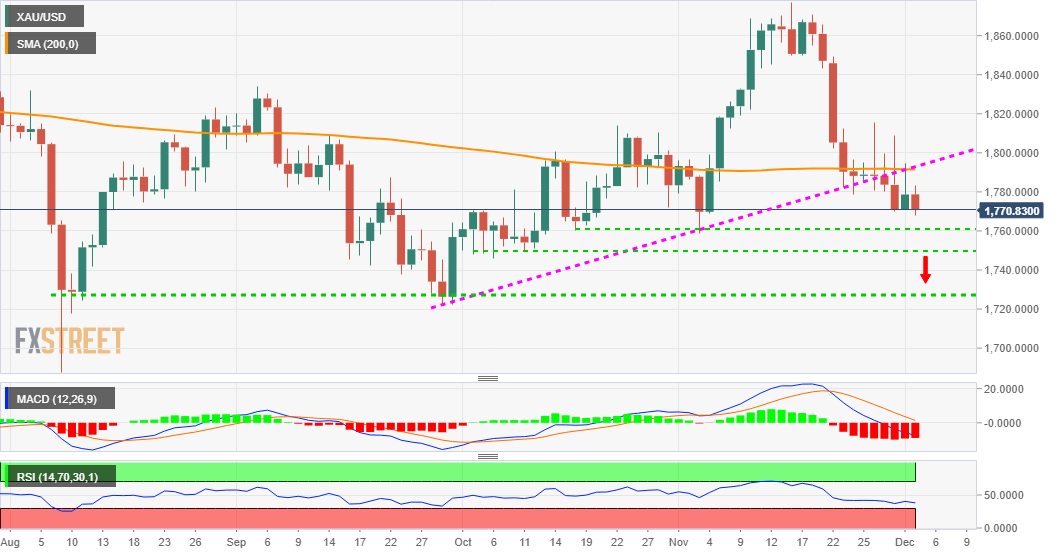
Levels to watch
Further retracement could push USD/CNH to test the 6.3525 level in the short-term horizon, noted FX Strategists at UOB Group.
Key Quotes
24-hour view: “Yesterday, we held the view that USD ‘is likely to break Nov’s low near 6.3615’. While our view was not wrong as USD dropped to 6.3610, the subsequent rapid rebound from the low came as a surprise. Downward pressure has eased somewhat with the rebound and USD is unlikely to weaken further. For today, USD is more likely to trade sideways between 6.3650 and 6.3800.”
Next 1-3 weeks: “There is no change in our view from yesterday (01 Dec, spot at 6.3650). As highlighted, the recent improvement in downward momentum suggests that USD could weaken to 6.3525. The downside risk is deemed intact as long as USD does not move above the ‘strong resistance’ at 6.3880 (no change in level from yesterday).”
- DXY alternates gains with losses around 96.00.
- US yield rebound across the curve on Thursday.
- Initial Claims, Fedspeak next on tap in the US docket
The greenback, when tracked by the US Dollar Index (DXY), follows the generalized side-lined mood in the global markets around the 96.00 neighbourhood on Thursday.
US Dollar Index looks to data, yields, omicron
The index trades without a clear direction in the second half of the week, falling in line with the broad-based range bound theme prevailing in the global markets and amidst persistent caution surrounding the progress of the omicron variant.
In the meantime, US yields manage to pick up some upside traction and reverse part of the recent weakness. That said, the front end of the curve approaches 0.60%, the belly flirts with the 1.50% zone and the long end trades closer to 1.80%.
In the calendar, the usual weekly Initial Claims will be the salient event on Thursday seconded by Challenger Job Cuts. In addition, FOMC’s R.Quarles (permanent voter, centrist), Richmond Fed T.BARKIN (voter, centrist), Atlanta Fed R.Bostic (voter, centrist) and San Francisco Fed M.Daly (voter, hawkish) are all due to speak.
What to look for around USD
The dollar managed to bounce off recent lows in the mid-95.00s on the back of the recovery in yields and the hawkish twist from Powell’s testimony. In the meantime, the current backdrop of rising omicron concerns, fresh safe haven demand, the “higher-for-longer” narrative around current elevated inflation and speculations of a Fed’s lift-off earlier than anticipated remain all factors supportive of the dollar for the time being.
Key events in the US this week: Initial Claims (Thursday) – Nonfarm Payrolls, Unemployment Rate, Factory Orders, ISM Non-Manufacturing (Friday).
Eminent issues on the back boiler: US-China trade conflict under the Biden’s administration. Debt ceiling issue. Geopolitical risks stemming from Afghanistan.
US Dollar Index relevant levels
Now, the index is gaining 0.02% at 96.02 and a break above 96.93 (2021 high Nov.24) would open the door to 97.00 (round level) and then 97.80 (high Jun.30 2020). On the flip side, the next down barrier emerges at 95.51 (weekly low Nov.30) followed by 94.96 (weekly low Nov.15) and finally 94.44 (low Nov.18).
The CNY appreciated roughly by about 0.65% against USD in November. For 2022, given the weakening growth outlook in China, economists at MUFG Bank expect the USD/CNY to hit the 6.65 mark in the fourth quarter.
Delay in recovery of global supply chain to provide support for CNY in near-term
“Balancing the weaker US dollar, the possible still strong exports, and weaker sentiment about China’s domestic growth, we expect USD/CNY to reach 6.3850 by year-end.”
“For 2022, we believe that China’s exports growth and trade balance are set to decline in medium-term, as COVID-19 becomes more under control and normalization of productions in US and Euro area advances. These, combined with continued deceleration of China’s GDP growth in 2022 and potential narrowing in the spread of real yields between China and the US from current elevated level will likely weigh on CNY against USD.”
“We expect USD/CNY to reach 6.6500 in Q4 2022.”
- WTI price meets supply, as RSI turns south on the 4H chart.
- A symmetrical triangle breakdown likely on the OPEC+ decision.
- Any rebound could face stiff resistance at the key 68.30 barrier.
WTI (NYMEX futures) has stalled its rebound heading into the OPEC and its allies (OPEC+) meeting, starting at 1300 GMT on Thursday.
The alliance is likely to decide on the planned oil output hikes, in the face of the US Strategic Petroleum Release (SPR) and the looming fears over the Omicron covid variant.
At the time of writing, the US oil is easing towards $66.00, having faced stiff resistance just below the $67 mark.
Looking at WTI’s four-hour chart, the black gold is wavering within a symmetrical triangle formation, with the risks skewed to the downside, despite the recent recovery.
The Relative Strength Index (RSI) has turned slightly lower while sitting just above the oversold territory, justifying the view of a potential downside.
Meanwhile, WTI faces strong offers at around $68.30, which is the confluence of the bearish 21-Simple Moving Average (SMA) and falling trendline (triangle) resistance.
Therefore, unless bulls find acceptance above the latter, bears will continue to remain hopeful, with the rising trendline (triangle) support at $64.94 likely at risk.
A four-hourly candlestick closing below that demand area will open floors for a retest of the multi-month troughs at $64.31.
The next downside target for WTI sellers is envisioned at the $63.50 psychological level.
WTI: Four-hour chart
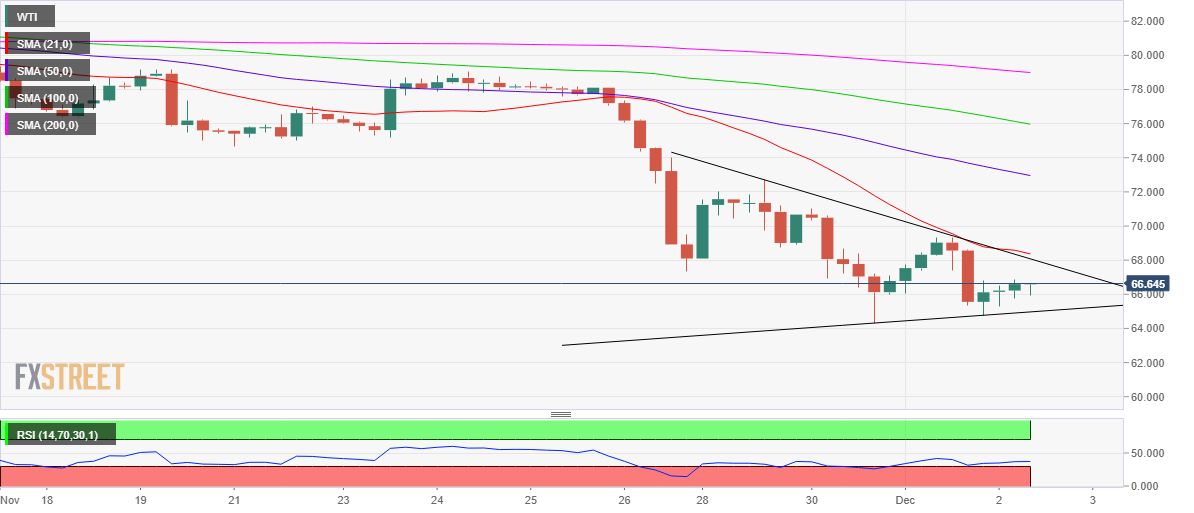
WTI: Additional levels to watch
Brent Oil has experienced a sharp pullback after faltering near 2018 levels of $86.70. It has achieved projections of $68.20. Strategists at Société Générale expect the black gold to remain under pressure towards the August low of $64.60.
Signals of rebound are still not visible
“The down move is a bit stretched however signals of rebound are still not visible.”
“Daily Tenkan line near $75.60 is expected to be a near-term resistance.”
“Next potential support is located at August low of $64.60.”
The pound depreciated against the dollar in November although held up relatively well in response to the increased uncertainty related to the new Omicron covid variant. Economists at MUFG Bank expect the GBP/USD pair to move downward in the first months of next year before staging a bounce later in 2022.
A Bank of England rate hike in December will provide GBP with limited support
“But the OIS market currently has an additional 100bps on top of a December hike priced for 2022 and we view this as excessive and see those expectations coming down over the coming months – that will keep GBP/USD under downward pressure initially. Beyond Q1 2022, we then see scope for modest GBP gains as UK GDP growth picks up and cost of living concerns ease as inflation begins to adjust lower.”
“A BoE rate hike in December will provide GBP with limited support, and higher yields in the US with the BoE refraining from tightening again in February will keep GBP/USD under downward pressure initially. Later in 2022, the reality of a more dovish Fed coupled with further BoE rate hikes will prompt GBP/USD to move higher.”
- AUD/USD witnessed a subdued price action through the early part of the European session.
- Omicron fears continued weighing on investors’ sentiment and the perceived riskier aussie.
- Fed rate hike bets underpinned the USD and further collaborated to cap gains for the major.
The AUD/USD pair lacked any firm directional bias and remained confined in a narrow trading band around the 0.7100 mark through the early part of the European session.
A combination of diverging forces failed to provide any meaningful impetus to the AUD/USD pair and led to a subdued/range-bound price action on Thursday. Growing concerns over the spread of the omicron variant of the coronavirus and its impact on the economic recovery continued weighing on investors' sentiment. This was evident from the prevalent cautious mood around the equity markets, which, in turn, acted as a headwind for the perceived riskier aussie.
On the other hand, the US dollar, so far, has struggled to gain any traction and was seen as the only factor lending some support to the AUD/USD pair. That said, market conviction that the Fed will tighten its monetary policy sooner rather than later continued lending some support to the greenback. In fact, investors started pricing in the possibility of at least a 50 bps rate hike by the end of 2022 in reaction to Fed Chair Jerome Powell's hawkish comments.
Powell said it's time to retire the word transitory as the risk of persistently higher inflation has increased. He further signalled that the Fed could speed up the tapering of its asset purchases. This, along with rebounding US Treasury bond yields, should help revive the USD demand. Hence, the AUD/USD pair's range-bound price action might still be categorized as a bearish consolidation phase, which supports prospect for an extension of the recent fall witnessed since late September.
Market participants now look forward to the US economic docket, featuring the release of Challenger Job Cuts and the usual Weekly Initial Jobless Claims. This, along with speeches by influential FOMC members, will influence the USD price dynamics and provide some impetus to the AUD/USD pair. Traders will further take cues from developments surrounding the coronavirus saga and the broader market risk sentiment to grab some short-term opportunities around the major.
Technical levels to watch
AUD/EUR should see a return to 0.6450 in the first quarter of 2022. However, in the short-term, there is scope for a probe of 0.6225/40 as markets nervously await hard data on vaccine efficacy vs Omicron, economists at Westpac report.
Substantial move in yield spreads in Aussie’s favour in recent weeks
“The aussie was set back sharply after the November RBA meeting where it insisted that a 2022 rate hike remained very unlikely. Yet, markets are betting on higher rates in Australia but limited change in Europe, producing the highest AUD 2yr yield premiums since 2019.”
“Looking into Q1 2022, we see the euro with more downside against a strong USD, to the 1.10 area, whereas the aussie should be able to break even around 0.71. This would see AUD/EUR back to 0.6450, though shorter-term, there is scope for a probe of 0.6225/40.”
EUR/USD moved lower in November with the stance of the ECB in stark contrast to the increased speculation of a more active Federal Reserve in reversing monetary accommodation. Economists at MUFG Bank expect the euro to rebound modestly vs. the USD later in 2022 as the European Central Bank (ECB) could turn more hawkish next year.
QE in 2022 could be left undetermined due to Omicron
“Even though we are not in a position to know the detailed make-up of Omicron, assuming it is not a major setback in the battle against covid, the divergence in policy is likely to be maintained. Hence, assuming Omicron does not evolve into the worst-case scenario of a more severe and more infectious strain, we expect Fed rate hike expectations to remain elevated and possibly revert back toward the pre-Omicron level of close to three rate hikes in 2022 – which will provide support for the dollar over the short-term.”
“The emergence of Omicron makes for a difficult policy meeting on 16th December when the markets expect details on QE policy after PEPP ends in March. If Omicron uncertainties remain high then, the decision on the size of APP after PEPP may be left until Q1 2022. But either way, we expect some level of QE to persist throughout most of 2022 which will further reinforce the divergence in rate policy with most of the rest of G10.”
“The EUR will be well anchored through to end-Q1 2022. But beyond then, a more dovish Fed failing to deliver on expected rate hikes and building expectations of QE ending in the eurozone that could open up the prospect of ECB hikes in 2023 will allow EUR/USD to slowly grind higher from current cheap levels.”
USD/JPY climbs further beyond the 113.00 mark. Another leg higher is looking likely through the end of the year but economists at Westpac are more cautious in their forecast for 2022.
113.00/50 likely to remain an important cap for the pair in the short-term
“Near-term, 113.00/50 is likely to remain an important cap for the market. However, we still see the USD strengthening over coming weeks given the Fed has already begun its taper, is set to debate accelerating it/raising inflation dots at the Dec meeting and US data is coming in well above expectations.”
“We still see 115/116 as likely into mid-Dec though in the very short-term markets are likely to remain skittish as we await results from the key drug companies as they run antibody tests on the new Omicron variant.”
“Beyond end Dec we would be more cautious about a correction in the USD given the size of the move. With both monetary and fiscal policy set to become less supportive and US cases accelerating, further USD upside is less obvious.”
“We shift our one week bias back to neutral, maintain a positive outlook on the month and maintain a neutral outlook on three months.”
Ralf Reinert, Vice President of its vaccine team, offers some encouraging comments on the Omicron covid variant in a Bloomberg interview, citing that he doesn’t expect a significant drop against the new strain.
He added that it could take up to two to three weeks to know if the vaccine will be effective against the omicron variant.
Meanwhile, GlaxoSmithKline Plc said its COVID-19 antibody treatment appears effective against the variant in early testing, per Bloomberg.
The drugmaker said in a statement: “Lab tests of the mutations found in the variant showed the drug is still active against the virus.”
Market implications
S&P 500 futures gain 0.50% on the day, pausing the advance amid risk-off trading in the European indices.
Market participants are still in the process of assessing the potential scale of the disruptive impact from the new Omicron COVID-19 variant and a further hawkish policy pivot from the Federal Reserve. Unless the Fed then expects US growth to slow sharply (worst case scenario) next year, economists at MUFG Bank expect the Fed to continue to tighten policy. It leaves room for US rates and the US dollar to rise further at the start of next year.
US dollar to trade at stronger levels through Q1 2022
“We suspect that relatively quickly, the markets will revert back to being driven by expectations of a more active Fed in 2022 and this we believe will open up the scope for relative rate hike expectations to shift back in favour of the US dollar initially. Data of late indicate a strong Q4 GDP growth rate for the US which will encourage the Fed to taper QE faster.”
“But we do not believe a faster taper through Q1 2022 by the Fed will be followed by numerous (three) rate hikes and expect the Fed to prove much more cautious in raising rates and will ultimately deliver less than market pricing – perhaps just hiking once. This caution will prompt a repricing that ultimately results in USD depreciation. Hence, the depreciation we see will be largely delivered in H2 2022 but will also be relatively modest.”
“Given the outlook is partly unsighted by the uncertainty of Omicron, we have had to make a key assumption that the new variant does not derail the prospects of recovery and reversal of monetary policy easing. That will initially favour the US dollar but Fed caution further into next year will see the dollar weaken in H2.”
On Wednesday, the dollar oscillated and ultimately trended higher. A strong US jobs report tomorrow is likely needed to avert another dovish re-pricing, but the lack of data today may keep the dollar mostly flat, barring any new news on the virus, economists at ING report.
USD is in need of more good data
“Given the material downside risks caused by the Omicron variant, markets will likely require the data flow to remain quite strong to avert another dovish repricing. In this sense, tomorrow's payrolls are set to be quite key, while today some more marginal focus will be on the initial jobless claims.”
“We think the dollar may find some stabilisation today ahead of tomorrow’s nonfarm payrolls, although unpredictable developments about the new variant can rapidly shift momentum in either direction.”
- USD/CHF caught fresh bids on Thursday and was supported by a combination of factors.
- The USD continued drawing support from rising bets for eventual Fed rate hike in 2022.
- Stability in the equity markets offset Omicron fears and undermined the safe-haven CHF.
The USD/CHF pair maintained its bid tone through the early European session and was last seen hovering near the daily swing high, around the 0.9215-20 region.
Following the previous day's good two-way price moves, the USD/CHF pair regained positive traction on Thursday and was supported by the emergence of fresh buying around the US dollar. Growing acceptance that the Fed would be forced to adopt a more aggressive policy response to contain stubbornly high inflation continued acting as a tailwind for the greenback.
In fact, the markets started pricing in the possibility of at least a 50 bps rate hike by the end of 2022 in reaction to the Fed Chair Jerome Powell's hawkish comments. Powell said it's time to retire the word transitory as the risk of persistently higher inflation has increased. He further signalled that the Fed could speed up the tapering of its asset purchases.
This, along with rebounding US Treasury bond yields, extended some support to the USD. Apart from this, signs of stability in the equity markets helped offset concerns that the spread of the new variant of the coronavirus could derail economic recovery. This, in turn, undermined the safe-haven Swiss franc and provided a goodish lift to the USD/CHF pair.
From a technical perspective, the recent pullback showed some resilience below the very important 200-day SMA. Hence, Thursday's uptick could also be attributed to some short-covering move from a technically significant moving average. It, however, remains to be seen if the USD/CHF pair is able to capitalize on the move or meets with a fresh supply at higher levels.
Market participants now look forward to the US economic docket, featuring the release of Challenger Job Cuts and the usual Weekly Initial Jobless Claims. This, along with speeches by influential FOMC members, will influence the USD. Traders will further take cues from the broader market risk sentiment to grab some short-term opportunities around the USD/CHF pair.
Technical levels to watch
GBP/USD could see a short squeeze if Omicron's concerns subside prior to the Bank of England’s (BoE) “finely balanced” December meeting. However, further USD strength still risks a slide to 1.3150-75, economists at Westpac report.
Asset managers turned aggressively negative of GBP into December
“GBP is vulnerable to a sharp short squeeze, given the positions of asset managers, should the Omicron variant prove to be less concerning. Given the strength in recent survey data in the UK, this could tilt the bias of MPC towards acting with a rate hike rather than further prevarication.”
“EU/UK talks continue and recent distressing migrant deaths have intensified the tensions with France. EU tensions are therefore likely to limit any GBP upside.”
“In the absence of a position squeeze, GBP/USD will remain at risk of a retracement (basis Mar 2020 low) towards 1.3150-75 on further USD strength.”
Sweden's krona dropped more than all other G10 currencies on Wednesday, showing an above-average sensitivity to risk appetite. The EUR/SEK could extend its march forward on a break above 10.30, in the opinion of economists at ING.
Positive SEK seasonality in December to emerge if Omicron fears fade
“SEK faces wider downside risk than EUR when it comes to scaling down tightening expectations for 2022. Despite the hawkish surprise at the November meeting, the Riksbank is only projecting a first-rate hike in 2024. Markets are currently forecasting 30bp of tightening in 2022, and 50bp more in 2023; a realignment of rate expectations with the Riksbank’s rate projections is, by all means, understandable in the current market environment.”
“The EUR/SEK rally may find more fuel should it break above 10.30 by the end of the week.”
“Normally, SEK has a positive seasonality in December, but that might only emerge if the Omicron-variant risk is priced out.”
The market has seen a squeeze in EUR/USD off last week’s test of 1.1200. The pair could see another one towards 1.14 but economists at Westpac expect EUR/USD to retest the 1.1200 level, if not the 1.1050/00 area.
Relative growth and inflation profiles are biased USD outperformance
“This week’s weaker than expected German Oct retail sales underscores the potentially lower growth path for core Europe into 2022. Conversely, this week also saw a surprise rise in both headline and core CPI that would have, in the absence of Omicron, increased the hand of more hawkish ECB members into the 16th Dec ECB meeting.”
“Should Omicron concerns subside, relative growth and inflation profiles are biased to US and USD outperformance.”
“EUR/USD may experience another interim squeeze towards 1.14, but bias will be for a retest of 1.1200, if not the 1.1000-50 area, in advance of the ECB meeting.”
USD/JPY has reversed lower from a recent 115.52 high. A sustained decline under 112.62 opens the downside towards 110.58 as technical indicators remain overbought with trend intensity picking up momentum, Benjamin Wong, Strategist at DBS Bank, report.
Stay patient and allow the market to do its correction
“Given intermediate trend support pegs 112.62, USD understandably pushed back higher from Tuesday’s 112.53 lows. At this stage, there remain many moving parts on the omicron risk event. On the daily charts, trend intensity is growing and the technical indicator still guides us that USD has yet to see a fullersized correction.”
“Firm resistance is now lowered to 104.02 and for USD/JPY to negate this corrective pressure, a sustained break over 114.78 is required.”
“A 38.2% Fibonacci retracement of the entire rally range of 102.59-115.52 calibrates support at 110.58. Just a stone throw from 200-day moving average (DMA) of 110.49.”
US growth forecasts for 2022 are already not very strong. But analysts at Natixis see several reasons why indeed we should be quite pessimistic about US growth in 2022.
Mechanisms that may hamper US growth in 2022
“Even though it remains high, the US structural fiscal deficit will be much lower in 2022 than in 202, which will contract demand. Even if the deficit reduction comes from the end of spending related to the COVID-19 crisis, it has a contractionary effect on the economy when it goes beyond what is provided by growth.”
“Wage earners’ purchasing power declines with the rise in inflation, which may weaken consumption.”
“The contribution of foreign trade to growth will remain negative, which is shown by the deterioration in foreign trade, caused by the surge in imports due to strong consumption of goods.”
“Both the participation rate and the employment rate have fallen, which may weaken production unless these declines are offset by higher productivity gains.”
“Consumers remain cautious, as shown by the still high level of the household savings rate; there is therefore no consumption of accumulated savings.”
“This prospect of modest growth in 2022 in the US will not push the Federal Reserve to be very aggressive in exiting quantitative easing.”
NZD/USD continues to range trade near 0.68. Lower interest rates may be a challenge but seasonality often delivers NZD strength in December, economists at ANZ Bank report.
NFP to lift the USD on strong figures
“The kiwi continues to fluctuate around 0.68 and seems to be well bid on any moves into the high-0.67s. But seems to be equally well-offered on any meaningful rallies, giving the impression that while it may have found a base, it is not in a hurry to go anywhere.”
“A less dovish Fed has not helped the USD this week. But US payroll data due out on Friday might give the USD a boost if it beats expectations.”
“Markets have ignored the seasonal tendency for the NZD to appreciate in December, and instead seem more focussed on interest rates, which have retreated from earlier highs.”
“Support 0.6700/0.6775 – Resistance 0.7000/0.7215/0.7310”
The aussie is weakest in the G10 over the past week. The USD’s support from Federal Reserve expectations suggests scope for a probe of the 0.7000/50 area in coming days, economists at Westpac report.
RBA likely to note the downside risks from the new covid variant but reserve judgement
“It is likely to be difficult for AUD/USD to rally very far in the next 10-14 days, given the expectations for the 15 December FOMC decision in the wake of Fed Chair Powell’s hawkish shift and the anxious wait for hard evidence on the efficacy of existing COVID-19 vaccines against the Omicron variant.”
“The Reserve Bank of Australia seems likely to note the downside risks from the new variant but wisely to reserve judgement, producing limited AUD impact.”
“The USD’s support from Fed expectations suggests scope for a probe of the 0.7000/50 area in coming days.”
- USD/JPY gained strong positive traction on Thursday amid a turnaround in the risk sentiment.
- Rising Fed rate hike bets acted as a tailwind for the USD and remained supportive of the move.
- Worries about Omicron variant could underpin the safe-haven JPY and cap any further gains.
The USD/JPY pair added to its intraday gains and climbed to a fresh daily high, around the 113.25 region during the early European session.
The pair once again managed to find some support ahead of mid-112.00s and attracted fresh buying on Thursday amid a strong recovery in the global risk sentiment. Despite fears about the new Omicron variant of the coronavirus, a generally positive tone around the equity markets undermined the safe-haven Japanese yen. This, in turn, was seen as a key factor that extended some support to the USD/JPY pair.
On the other hand, the US dollar struggled to gain any meaningful traction and did little to provide any additional boost to the major. That said, expectations for a more aggressive policy tightening by the Fed acted as a tailwind for the greenback. This, along with rebounding US Treasury bond yields, impressed bullish traders and remained supportive of the USD/JPY pair's move beyond the 113.00 round figure.
It, however, remains to be seen if bulls are able to capitalize on the move or the USD/JPY pair meets with fresh supply at higher levels. Worries about the economic fallout from the new more transmissible Omicron variant could keep a lid on any optimistic move in the markets and cap gains for the USD/JPY pair. Hence, any futher move up might confront stiff resistance near the overnight swing high, around the 113.60-65 area.
Market participants now look forward to the US economic docket, featuring the release of Challenger Job Cuts and the usual Weekly Initial Jobless Claims data. This, along with speeches by a slew of influential FOMC members, will influence the USD and provide some impetus to the USD/JPY pair. Traders will further take cues from developments surrounding the coronavirus saga to grab some short-term opportunities.
Technical levels to watch
Here is what you need to know on Thursday, December 2:
Major currency pairs struggled to make a decisive move in either direction on Wednesday as investors paid little to no attention to high-tier data releases from the US. FOMC Chairman Jerome Powell repeated his remarks on the policy outlook on the second day of his testimony. Ahead of Friday's November jobs report, the weekly Initial Jobless Claims data will be featured in the US economic docket. Eurostat will release October Unemployment Rate and Producer Price Index figures.
While testifying before the House Financial Services Committee, Powell reiterated that it was appropriate to consider a faster taper and noted that they need to move on from the word "transitory" when describing inflation. Despite Powell's hawkish tone, the 10-year US Treasury bond yield lost nearly 3% on Wednesday before staging a rebound early Thursday. The 10-year yield is currently up 2.5% at 1.45%, helping the greenback stay resilient against its rivals. The US Dollar Index, which tracks the dollar's performance against a basket of six major currencies, is moving sideways near 96.00.
Anthony Fauci, Director at the US National Institute of Allergy and Infectious Disease, said on Thursday that Americans don't need to alter their travel plans after they have detected the Omicron variant in the US. However, several reports suggest that travellers will be required to wear masks on aeroplanes, trains and buses through mid-Marc. Nevertheless, US stocks futures are trading in the positive territory in the early European session, suggesting that the market mood is likely to remain upbeat in the second half of the day.
EUR/USD fluctuated in a tight range above 1.1300 on Wednesday and continues to move sideways early Thursday.
GBP/USD closed in the negative territory on Wednesday and seems to have gone into a consolidation phase around 1.3300.
USD/JPY is edging higher on the back of rising US Treasury bond yields on Thursday and was last seen rising 0.5% on the day at 113.25.
Gold climbed above $1,790 in the early American session on Wednesday but erased a large portion of its daily gains before closing at $1,782. As of writing, XAU/USD was posting small losses at $1,776.
Cryptocurrencies: Bitcoin is staying near $57,000 after losing its recovery momentum before reaching $60,000 on Wednesday. Ethereum retreated to $4,500 area after snapping a four-day winning streak on Wednesday.
According to FX Strategists at UOB Group, USD/JPY’s decline is expected to meet solid support in the mid-112.00s in the short-term horizon.
Key Quotes
24-hour view: “Our view for ‘the rebound in USD to extend’ was incorrect as it dropped to 112.65. Despite the decline, downward momentum has not improved by much. For today, USD could drift lower but a break of the major support at 112.50 is unlikely (minor support is at 112.65). Resistance is at 113.25 but only a break of 113.50 would indicate that the current downward pressure has eased.”
Next 1-3 weeks: “There is not much to add to our update from yesterday (01 Dec, spot at 113.40). We continue to hold the same view that USD could weaken further but 112.50 is expected to offer solid support. On the upside, a breach of the ‘strong resistance’ level at 114.00 (level was at 114.30) would indicate that USD is not ready to move below 112.50. Looking ahead, a clear break of 112.50 would shift the focus to 112.00.”
Gold price is trying hard to build on Wednesday’s rebound. As FXStreet’s Dhwani Mehta notes, XAU/USD could resume the rebound on golden cross confirmation.
Markets likely to remain on the edge amid Omicron woes
“Should the risk recovery gain traction in the sessions ahead, then the dollar could extend the uptick in tandem with the yields, prompting gold price to resume the downside. However, fears over the new covid variant could cushion any move lower in gold, especially after a single Omicron detected in the US has unnerved markets.”
“The confluence of the 50, 100 and 200-DMAs at $1,792 remains a tough nut to crack for gold bulls. The next upside target is seen at the $1,800 threshold. If the recovery momentum gathers steam, then gold bulls could retest Wednesday’s high of $1,809, above which the previous month’s high at $1,814 will be on their radars.”
“On the downside, a sustained break below Tuesday’s low of $1,770 is needed to revive the downtrend towards the November 3 low of $1,859. Further south, the $1,750 psychological level will be challenged.”
See – Gold Price Forecast: Positive XAU/USD story in play for first half of next year – TDS
The new Omicron covid variant is expected to derail the global economic recovery and threaten the inflation outlook, Moody's Investors Service said in its latest report.
more to come...
- Silver snaps four-day downtrend, bounces off nine-week low.
- Bearish MACD signals, sustained break of previous key support line from September keep sellers hopeful.
- Four-month-old horizontal area, 2021 low act as additional supports before 61.8% FE.
Silver (XAG/USD) stays firmer above $22.00, up 0.82% intraday around $22.42 as traders await Thursday’s European session.
The bright metal bounces off a two-month-old horizontal area but bearish MACD signals and a clear weakness after breaking the support line from late September favor sellers.
Hence, further selling can be witnessed on a sustained break of the stated immediate support zone near $22.00-15.
Following that, the yearly bottom marked in September and 61.8% Fibonacci Expansion (FE) of May-November moves, respectively near $21.40 and $20.80, will be lure XAG/USD sellers.
Meanwhile, corrective pullback remains elusive below the early November’s low around $23.00, a break of which will escalate the recovery moves towards the 38.2% Fibonacci retracement (Fibo.) level of May-September fall, around $24.20.
Should silver buyers remain dominant past $24.20, the previous support line from September and November’s peak, close to $24.35 and $25.40 in that order, will be in focus.
Silver: Daily chart
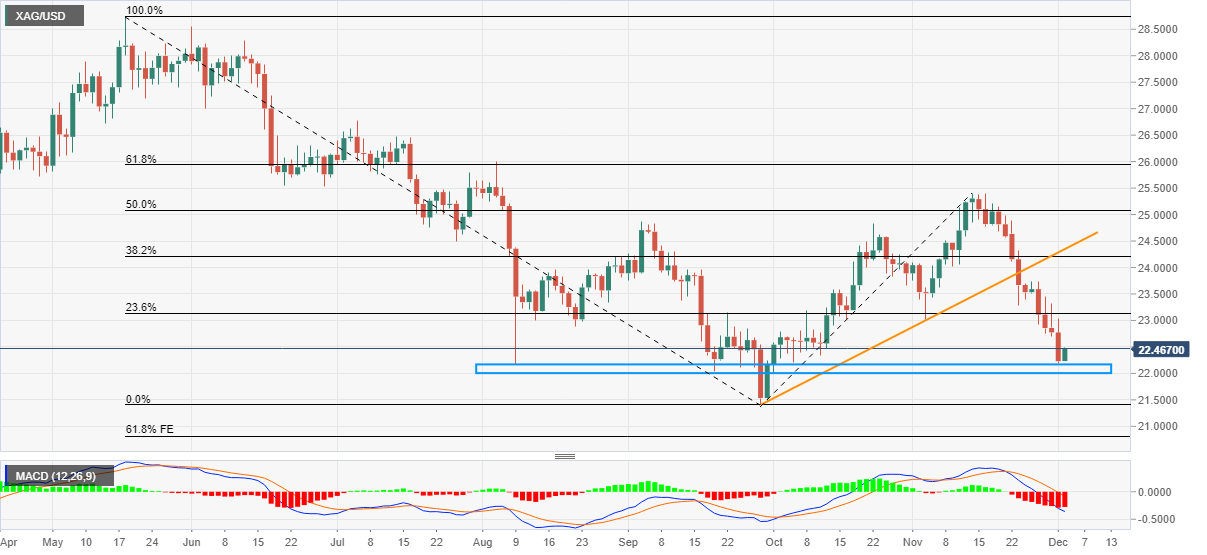
Trend: Further weakness expected
- A generally positive tone around the equity market assisted NZD/USD to gain traction on Thursday.
- Rising Fed rate hike bets acted as a tailwind for the USD and capped any further upside for the pair.
- Omicron fears could keep a lid on any optimistic move and undermine the perceived riskier kiwi.
The NZD/USD pair surrendered its modest intraday gains and has now drifted back closer to the 0.6800 mark heading into the European session.
Following the previous day's turnaround from the weekly high, the NZD/USD pair managed to attract some buying during the early part of the trading action on Thursday, albeit lacked any follow-through. A generally positive tone around the Asian equity markets acted as a headwind for the safe-haven US dollar and benefitted the perceived riskier kiwi. That said, hawkish Fed expectations helped limit any deeper USD pullback and kept a lid on any meaningful gains for the major.
The money markets started pricing in the possibility of at least a 50 bps rate hike by the end of 2022 after Fed Chair Jerome Powell signalled to speed up the tapering of asset purchases. Apart from this, concerns about the economic fallout from a possibly vaccine-resistant coronavirus variant should keep a lid on any optimistic move in the markets. The market worries exacerbated further after US officials said that the new more transmissible Omicron variant had been found in the country.
The fundamental backdrop favours the USD bulls and supports prospects for an extension of the NZD/USD pair's recent downward trajectory witnessed since late October. That said, repeated failures to find acceptance below the 0.6800 mark warrants some caution for aggressive bearish traders. This makes it prudent to wait for some follow-through selling below the mentioned handle before confirming that negative outlook and positioning for a further near-term depreciating move.
Market participants now look forward to the US economic docket, featuring the release of Challenger Job Cuts and the usual Weekly Initial Jobless Claims data. This, along with speeches by a slew of influential FOMC members, will influence the USD price dynamics and provide some impetus to the NZD/USD pair. Traders will further take cues from developments surrounding the coronavirus saga and the broader market risk setiment to grab some short-term opportunities.
Technical levels to watch
- USD/CAD remains pressured around intraday low, snaps two-day run-up.
- WTI oil rises the most in a week as OPEC+ verdict looms.
- Fedspeak, US data and virus updates are the key ahead of Friday’s jobs report.
USD/CAD sellers attack intraday low surrounding 1.2797, down 0.18% daily as European traders brace for Thursday’s bell. Even so, the Loonie pair remains up for the seventh consecutive week.
The quote’s latest weakness could be linked to the increase in prices of Canada’s main export, namely WTI crude oil. The black gold adds around 2.0% while snapping a two-day downtrend as energy traders await OPEC and its allies (OPEC+) meeting’s verdict on the output.
Additionally weighing on the USD/CAD prices could be the indecision among the Fed policymakers and comparatively less hawkish tone than the Bank of Canada (BOC) officials. Recently, Fed Chair Powell reiterated his reflation fears but also said, per Reuters, that he still believes inflation will come down “meaningfully” in the second half of 2022, during testimony against a Senate Commission.
On the contrary, Federal Reserve Bank of New York President John C. Williams said, per New York Times, that Omicron could prolong supply and demand mismatches, causing some inflation pressures to last. Further, Cleveland Fed President Loretta Mester hints at speeding up the taper and likely rates in the next year, per Bloomberg.
It’s worth observing that the BOC Governor Tiff Macklem pushed for interest rate hikes during the latest appearance a week ago, as signaled by Bloomberg.
Other than the Fed versus BOC saga, the first Omicron case in the US and China’s cautious optimism act as extra catalysts that help the USD/CAD sellers.
Amid these plays, US Treasury yields seesaw around a 10-week low whereas stock futures print mild gains by the press time.
Moving on, weekly Initial Jobless Claims from the US will join a slew of Fed policymakers’ speeches and covid updates to entertain USD/CAD traders but major attention will be given to the OPEC+ news and Friday’s employment data from the US and Canada.
Technical analysis
A clear upside break of the previous resistance line from August, around 1.2775 at the latest, directs USD/CAD buyers towards September’s high near 1.2900.
Considering advanced figures for natural gas futures markets from CME Group, open interest shrank for the third straight session on Wednesday, this time by around 2.8K contracts. Volume, instead, rose for the third consecutive day, now by around 3.3K contracts.
Natural Gas: Next stop at the 200-day SMA around $3.87
The selloff in prices of the natural gas continued on Wednesday. The negative move was on the back of shrining open interest, which could remove some momentum from the leg lower. Against that, the next target of note for bears emerges at the 200-day SMA, today around $3.87 per MMBtu.
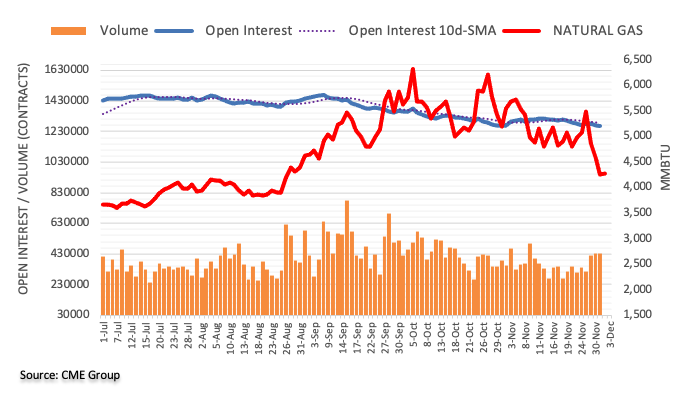
While further downside in NZD/USD remains in the pipeline, another visit to 0.6760 seems to be losing momentum, commented FX Strategists at UOB Group.
Key Quotes
24-hour view: “We expected NZD to ‘trade between 0.6780 and 0.6860’ yesterday. NZD subsequently rose to 0.6867 before dropping back down quickly to 0.6804. The weakened underlying tone suggests NZD is likely to drift lower towards 0.6780. The major support at 0.6760 is unlikely to come under threat. Resistance is at 0.6830 followed by 0.6855.”
Next 1-3 weeks: “Our view from Monday (29 Nov, spot at 0.6825) still stands. As highlighted, further NZD weakness is not ruled out but the prospect for NZD to weaken to the next major support at 0.6760 is not high. On the upside, a breach of 0.6880 (no change in ‘strong resistance’ level from yesterday) would indicate that the weak phase from early last week has come to an end.”
CME Group’s flash data for crude oil futures markets saw traders scaled back their open interest positions by around 18.4K contracts on Wednesday. Volume followed suit and shrank by around 223.5K contracts.
WTI: Recovery targets the $70.00 mark
Prices of the WTI extended the weekly knee-jerk on Wednesday. The move, however, was in tandem with shrinking open interest and volume, which is indicative that further decline looks not favoured for the time being. In the meantime, bullish attempts continue to target the key $70.00 mark per barrel, which also coincides with the 200-day SMA.
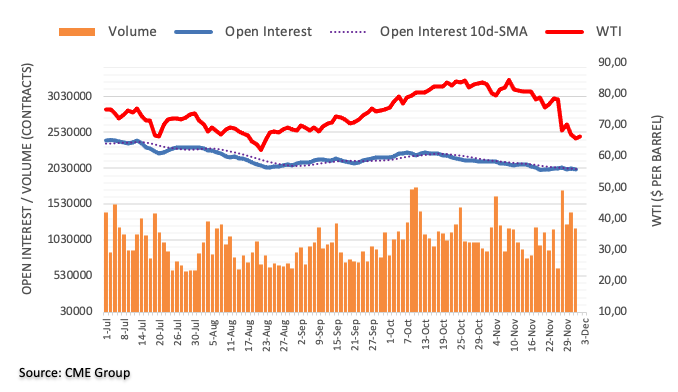
- GBP/USD gained some positive traction on Thursday, albeit lacked any follow-through.
- Brexit-related uncertainties acted as a headwind for the British pound and capped gains.
- The fundamental backdrop favours USD bulls and support prospects for a further decline.
The GBP/USD pair retreated a few pips from the Asian session high and was last seen trading just below the 1.3300 mark, up around 0.10% for the day.
The pair gained some positive traction during the early part of the trading action on Thursday and for now, seems to have snapped three consecutive days of the losing streak. An uptick in Asian equity markets undermined the safe-haven US dollar and extended some support to the GBP/USD pair, though any meaningful recovery still seems elusive.
The UK-EU impasse over the Northern Ireland Protocol and the worsening row over the post-Brexit fishing rights between France and Britain might continued acting as a headwind for the sterling. Apart from this, the prospects for a more aggressive policy tightening by the Fed favours the USD bulls and collaboarte to cap gains for the GBP/USD pair.
In fact, the money markets started pricing in the possibility of at least a 50 bps rate hike by the end of 2022 in reaction to Fed Chair Jerome Powell's hawkish comments. Testifying before the congress for the second day on Wednesday, Powell reiterated that the US central bank is likely to speed up the tapering of its asset purchases.
Meanwhile, concerns about the economic fallout from the detection of a new and possibly vaccine-resistant coronavirus variant should keep a lid on any optimistic move in the markets. The market concerns exacerbated further after US officials said that the more transmissible Omicron vairant had been found in the country.
The fundamental backdrop supports prospects for an extension of the recent downward trajectory, though the lack of any strong follow-through selling warrants some caution. There isn't any major market moving economic data due for release from the UK on Thursday, leaving the GBP/USD pair at the mercy of the USD price dynamics.
Later during the early North American session, traders will take cues from the release of the US Weekly Initial Jobless Claims and speeches by a slew of influential FOMC members. This, along with the broader market risk sentiment, will drive the USD demand and provide some short-term trading impetus to the GBP/USD pair.
Technical levels to watch
Further comments are flowing in from the Bank of Japan (BOJ) board member Hitoshi Suzuki, as he now speaks on the US Federal Reserve’s (Fed) monetary policy.
Key quotes
If fed tapers, raise interest rates faster than expected, that could push up long-term interest rates including for Japan’s.
Japan's long-term rates may rise in the future once uncertainty surrounding covid subsides, helping the economy recover further.
Japan's corporate bond, CP markets have improved significantly from when funding was tight during the pandemic.
The Bank of Japan (BOJ) Suzuki said that the central bank hasn’t decided on the fate of the pandemic relief programme that reaches the deadline in March.
Additional comments
Structural problems Japanese financial institutions face have not changed since when I became board member more than four years ago.
Japan's financial system has become somewhat more stable than before thanks to govt, BOJ measures to ease hit from the covid pandemic.
Without change at financial institutions to face structural woes, hard to sustain stability in Japan’s financial system
No change to basic view laid out on the economy, prices in BOJ’s Oct quarterly report.
Spread for Japan corporate bond, CP narrowing quite a bit.
Smaller firms' funding conditions have improved as a whole, but remain severe for some sectors.
Want to scrutinise BOJ’s Dec Tankan in deciding whether to extend the deadline for pandemic-relief programmes.
BOJ’s pandemic-relief programmes were introduced as an emergency step, so need to terminate them at some point in the future.
Market reaction
USD/JPY is off the daily highs, battling 113.00, despite the rebound in the US dollar alongside the Treasury yields.
The spot is currently trading at 113.05, up 0.29% on the day.
FX Strategists at UOB Group suggested GBP/USD still risks further pullbacks in the next weeks.
Key Quotes
24-hour view: “Yesterday, we held the view that GBP ‘could continue to trade in a choppy manner within a range of 1.3240/1.3355’. GBP subsequently traded between 1.3263 and 1.3352. The underlying tone appears to have weakened somewhat and GBP could dip to 1.3240 before the risk of a rebound would increase. The major support at 1.3195 is not expected to come under threat. Resistance is at 1.3310 followed by 1.3340.”
Next 1-3 weeks: “There is not much to add to our update from yesterday (01 Dec, spot at 1.3295). We continue to hold the same view that while further GBP weakness is not ruled out, 1.3195 is a solid support and may not be easy to crack. On the upside, a break of 1.3390 (no change in ‘strong resistance’ level from yesterday) would indicate that the weakness in GBP from early last week has run its course.”
- USD/ZAR consolidates the heaviest daily rebound in over a week.
- MACD, CCI hints at bullish bias, 100-SMA, six-week-old support line challenge sellers.
Despite marking the biggest rebound in a week, USD/ZAR steps back from a short-term resistance line, offered around $15.97 during early Thursday morning in Europe.
It should be noted, however, that the CCI and MACD indicators do tease the bulls, which in turn highlights the weekly resistance line near $16.11 as a key to the South African currency (ZAR) pair’s fresh run-up to the yearly peak of $16.36.
In a case where the USD/ZAR bulls keep reins past $16.36, October 2020 high near $16.80 and the $17.00 threshold will be in focus.
Alternatively, the quote’s current pullback eyes the weekly low of $15.73. However, the 100-SMA and an ascending support line from October 20, 2021, respectively near $15.70 and $15.50, will challenge the USD/ZAR declines afterward.
Adding strength to the downside filters are the tops marked during early November around $15.50, a break of which will make the quote vulnerable to test $15.00 and the last month's bottom close to $14.85.
USD/ZAR: Four-hour chart
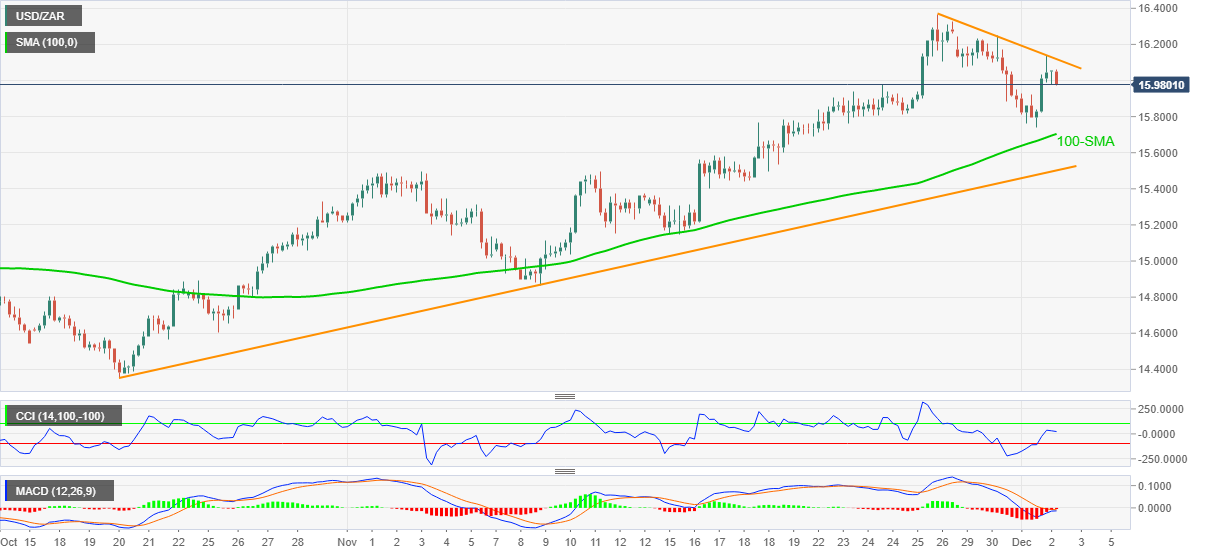
Trend: Pullback expected
In light of preliminary readings from CME Group for gold futures markets, open interest dropped for the third session in a row on Wednesday, this time by around 6.7K contracts. In the same direction, volume extended the erratic performance and went down by around 66.2K contracts.
Gold poised for further consolidation below $1,800
Wednesday’s positive price action in gold was amidst shrinking open interest and volume, removing strength from occasional bullish attempts and favouring some consolidative mood in the very near term instead. In the meantime, the 200-day SMA around $1,790 and the key $1,800 mark per ounce troy keep capping the upside for the time being.
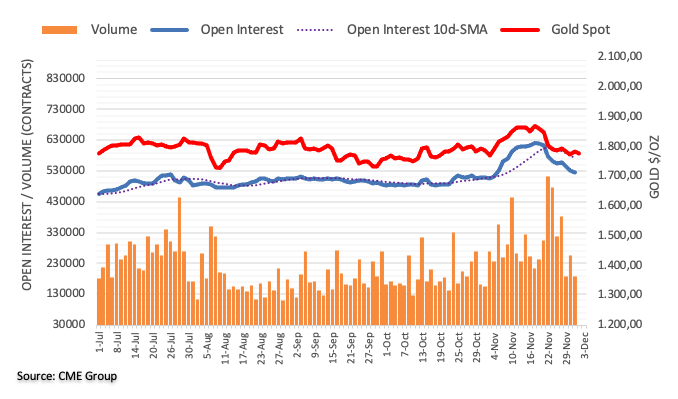
The US-based global rating agency, Fitch Ratings, offers its downbeat view on the Chinese property sector for the first of the next year.
Key takeaways
“Tight liquidity and credit polarisation persist for China property.”
“Expects an increase in credit polarisation of Chinese developers & sector consolidation to expedite a decline in annual property sales volumes.”
“Operating environment for Chinese developers likely to remain challenging, with a meaningful recovery of funding likely to take place towards H2 2022. “
“Expect 10%-15% year-on-year decline in China property annual sales volumes, with an average selling price decline of around 5%.”
Read: China property market to keep cooling into H1 2022 on tight curbs – Reuters poll
- USD/INR stays pressured around intraday low, up for snapping three-week advances on weekly basis.
- India Manufacturing PMI grew at the fastest pace in 10 months, trade deficit refresh all-time high.
- Fedspeak, Omicron news keep markets on the sidelines ahead of Friday’s US jobs report.
USD/INR remains on the back foot around 74.95, down 0.12% intraday during early Thursday morning in Europe. The Indian rupee (INR) buyers seem to ignore the broad US dollar rebound, backed by yields, amid varied catalysts at home.
That said, India’s factory activity growth jumped to a 10-month top in November, per the latest PMI figures, up 57.6 versus 55.9 prior. However, the trade deficit widened the most on record during the last month, $23.3 billion from $19.9 billion in November.
Elsewhere, India reports a sustained increase in the daily covid infections, by 9,765 at the latest versus 8,954 yesterday. On the same line were the virus-led death tolls that rose past 267 prior to 477 per the latest data shared by Reuters.
It should be noted that India joined the global leaders, unfortunately, to mark the arrival of the South African coronavirus variant at home and tightened border checks.
On a broader front, the first Omicron case in the US pushed President Joe Biden’s administration to extend the rules for wearing a mask in public transit, the same seems to put a floor under the US 10-year Treasury yields around 1.42%.
Further, Fed Chair Jerome Powell stepped back from conveying his inflation woes during the second day of testimony whereas Fed New York President John C. Williams and Cleveland Fed President Loretta Mester were more hawkish of late. Additionally, China hints at more bond issuance and easy money, which in turn helps Asia-Pacific shares to trade mixed even as the market sentiment sours.
Given the USD/INR pair’s latest weakness contrasting the yield and USD’s latest performances, traders will seek more clues to consolidate the moves. In doing so, weekly US Initial Jobless Claims and a slew of Fed policymakers’ speeches may entertain traders but major attention will be given to the coronavirus news and Friday’s US Nonfarm Payrolls (NFP).
Technical analysis
Triple-top around 75.20 makes it the tough nut to crack for USD/INR buyers. For now, a pullback towards October’s low near 74.70 becomes imminent.
In opinion of FX Strategists at UOB Group, the upside bias in EUR/USD could reach the 1.1410 level in the next weeks.
Key Quotes
24-hour view: “EUR traded sideways between 1.1301 and 1.1359 yesterday, narrower than our expected range of 1.1260/1.1380. Further sideway-trading appears likely, expected to be within a range of 1.1290/1.1370.”
Next 1-3 weeks: “Our update from yesterday (01 Dec, spot at 1.1335) still stands. As highlighted, EUR is likely to trade with an upward bias towards 1.1410. At this stage, a sustained rise above this level is unlikely. On the downside, a breach of 1.1240 (‘strong support’ level was at 1.1220 yesterday) would indicate that EUR is not ready to head towards 1.1410.”
According to the latest Reuters poll of 14 analysts and economists surveyed, China's property downturn is expected to continue into the first half of 2022.
Key findings
Home prices are expected to drop 1.0% in H1 2022.
For 2021, home prices are now expected to rise 2.6%, down from a forecast of 3.5% in the last poll and following a gain of around 4.9% in 2020.
Property investment in H1 2022 to slump 3.0%.
Policymakers to largely stick with tough property curbs but make some tweaks.
Property tax pilot scheme to introduce in 2022.
USD/CNY was last seen trading at 6.3706, up 0.06% on the day.
- AUD/USD refreshes intraday low as sellers attack round figure within bearish chart pattern.
- Sellers stay hopeful as MACD teases bears, RSI retreats.
- Key SMAs, Fibonacci retracements add to the upside filters.
AUD/USD remains on the back foot around an intraday low of 0.7094, reversing early Asian gains ahead of Thursday’s European session.
In doing so, the Aussie stays within a one-month-old descending trend channel bearish formation. Also adding strength to the downside bias is the MACD line’s recent bear cross and the RSI retreat.
However, the lower line of the stated channel and the yearly low flashed at the end of November, around 0.7060, becomes a tough nut to crack for the AUD/USD sellers.
During the quote weakness past 0.7060, the 0.7000-6990 region comprising multiple levels marked since June 2020 will be the key to watch.
On the flip side, 50-SMA and 23.6% Fibonacci retracement (Fibo.) of late October to November downside, around 0.7175-80, challenge short-term buyers.
Even if the AUD/USD prices rally beyond 0.7180, the stated channel’s resistance line near 0.7190 and the 0.7200 threshold can challenge the bulls before directing them to 200-SMA and 61.8% Fibo., close to 0.7355 and 0.7370 in that order.
AUD/USD: Four-hour chart
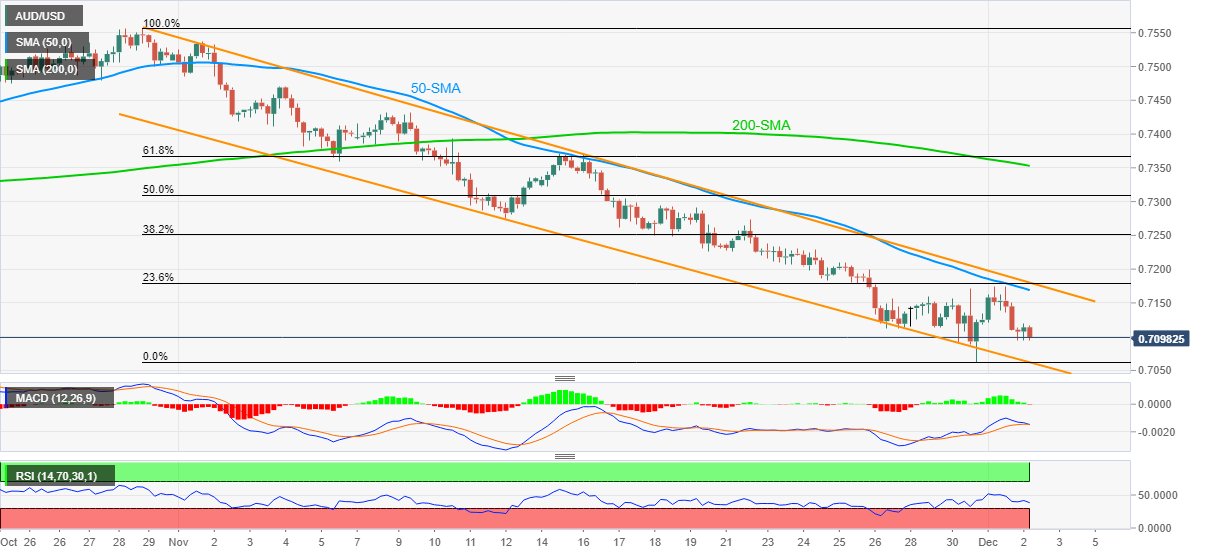
Trend: Further weakness expected
- EUR/USD pares intraday gains during the second positive week since early November.
- Fedspeak shifts gears over inflation, ECB pushes for extended PEPP.
- US data stays firmer but Eurozone economics dwindle, yields lick wounds at 10-week low.
- Fedspeak, US Jobless Claims, Eurozone Unemployment Rate and Omicron news are the key ahead of Friday’s US NFP.
EUR/USD retreats from intraday high to 1.1325, consolidating daily gains to 0.12% ahead of Thursday’s European session.
Even so, the currency major pair stays on the recovery mode for the second consecutive week as the monetary policy battle between the European Central Bank (ECB) and the US Federal Reserve (Fed) seems to ease. Though, headlines concerning the South African covid variant and Friday’s US jobs report for November will be the key to a clear direction.
While Fed Chair Jerome Powell stepped back from conveying his inflation woes during the second day of testimony, ECB policymakers conveyed, per Reuters, worries over the likely monetary policy tightening in December. On the contrary, Federal Reserve Bank of New York President John C. Williams said, per New York Times, that Omicron could prolong supply and demand mismatches, causing some inflation pressures to last. Further, Cleveland Fed President Loretta Mester hints at speeding up the taper and likely rates in the next year, per Bloomberg.
It should be observed that the receding inflation fears and a two-month low print of the US inflation expectations, as measured by the 10-year breakeven inflation rate per the St. Louis Federal Reserve (FRED) data, weigh on the US Treasury yields. The same joins cautious optimism from China to help the stock futures and Asian stocks to lick their wounds.
However, the first Omicron case in the US pushed President Joe Biden’s administration to extend the rules for wearing a mask in public transit, the same seems to put a floor under the US 10-year Treasury yields around 1.42%.
Looking forward, weekly Initial Jobless Claims and a slew of Fed and ECB policymakers’ speeches may entertain EUR/USD traders but major attention will be given to the coronavirus news and Friday’s US Nonfarm Payrolls (NFP).
Technical analysis
Unless crossing a double-top figure surrounding 1.1385, comprising highs marked on November 16 and 30, EUR/USD bears stay hopeful to refresh the yearly low.
- Markets in Asia grinds lower ahead of the key US NFP.
- Mixed Fedspeak, Omicron in the US weigh on risks but China, WHO favor bulls.
- OECD cuts global growth forecasts, VIX rallies to yearly peak.
- Aussie trade, housing data came in mixed but softer yields favor Antipodeans, commodities.
Asian shares trade mixed as virus-linked fears join Fed’s measured response over inflation and chatters surrounding China. That said, MSCI’s index of Asia-Pacific shares outside Japan holds onto the bounce-off yearly low, up 0.30% intraday, whereas Japan’s Nikkei 225 marks 0.35% daily loss heading into Thursday’s European session.
Fed Chair’s Jerome Powell’s step back from the previously hawkish testimony while believing, per Reuters, that inflation will come down “meaningfully” in the second half of 2022, during testimony against a Senate Commission. On the contrary, Federal Reserve Bank of New York President John C. Williams said, per New York Times, that Omicron could prolong supply and demand mismatches, causing some inflation pressures to last. Further, Cleveland Fed President Loretta Mester hints at speeding up the taper and likely rates in the next year, per Bloomberg.
Further, the first Omicron case in the US pushed President Joe Biden’s administration to extend the rules for wearing a mask in public transit. Adding to the risk-aversion could be the latest economic forecast from the Organisation for Economic Co-operation and Development (OECD), suggesting the world GDP growing by 5.6% (previous 5.7%) in 2021, 4.5% in 2022, 3.2% in 2023, per Reuters.
On the contrary, Reuters’ story citing more Chinese developers’ raising bond issues marks the evidence that Beijing is marginally easing liquidity strains on the cash-strapped sector, which in turn favored stocks in China, although marginally. The same, however, can’t help equities in Australia and New Zealand (NZ) as mixed trade and housing data from Canberra joined firmer NZ Terms of Trade Index for Q3. Alternatively, traders from Indonesia, India and South Korea manage to track China-linked gains.
It’s worth noting that the US US 10-year Treasury yields lick their wounds at the lowest levels since early October, around 1.42% after refreshing the multi-day bottom with a 1.40% level the previous day. Alternatively, S&P 500 Futures print rises 0.35% to 4,523.
Above all, DBC’s Volatility Index (VIX) stays firmer around the yearly top, around 7.13 at the latest, whereas Goldman Sachs cites a measure of industry risk appetite to post the strongest risk-off conditions in the market during 2021. “Net leverage, a measure of industry risk appetite that takes into account long versus short positions, fell to a one-year low this week, according to data compiled by Goldman Sachs Group Inc.’s prime brokerage,” said Bloomberg.
Moving on, investors are likely witnessing a dull day amid a lack of major data/events ahead of Friday’s US jobs report. However, virus updates and second-tier data from the US may entertain traders.
Read: Yields stay pressured at 10-week low, S&P 500 Futures print mild gains amid sluggish markets
- GBP/JPY keeps rebound from two-month low, consolidates weekly losses.
- Weekly resistance line, 200-DMA restricts recovery moves below six-week-long resistance line.
- Bearish MACD signals add to the downside bias, 148.50 in focus.
GBP/JPY stays firmer around 150.30 during the first positive day in three. In doing so, the cross-currency pair holds onto the bounce off an ascending support line from July to pare weekly losses around the lowest levels in two months.
Even so, a one-week-old resistance line joins bearish MACD signals to keep sellers hopeful until the quote crosses the 150.75 level.
Although the GBP/JPY manages to pierce the 150.75 hurdle, 200-DMA and a descending resistance from late October, respectively around 152.50 and 153.15, will be the tough nuts to crack for the bulls.
Alternatively, the 150.00 threshold will precede the aforementioned five-month-long support line, at 149.50 by the press time, to limit short-term declines of the pair.
In a case where the GBP/JPY prices drop past 149.50, September’s low near 148.95 may offer an intermediate halt during the fall to the 148.50-45 area comprising lows marked in July and March.
It’s worth mentioning that the pair’s declines below 148.50 will make it vulnerable to test early 2021 high near 142.50.
GBP/JPY: Daily chart
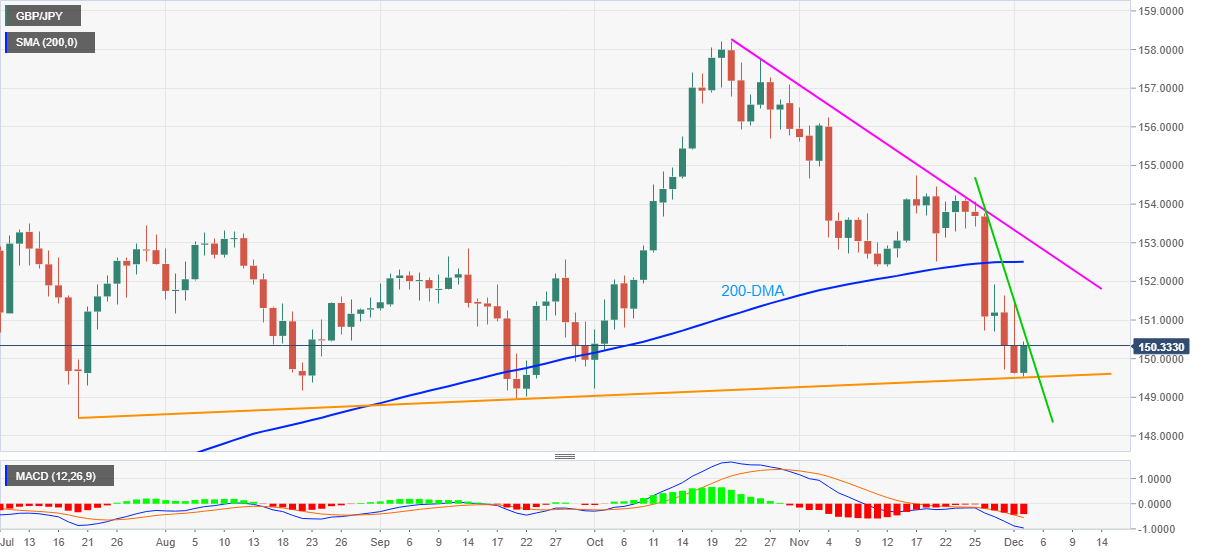
Trend: Bearish
- Gold price corrects from four-week lows but upside appears bumpy.
- Renewed Omicron covid variant fears spark safe-haven demand for gold.
- Gold Price Forecast: Still depressed despite the better market mood.
Gold price is building on Wednesday’s rebound, as bulls remain hopeful amid renewed fears over the Omicron covid variant after the US detected one case of the new strain and remains poised to extend the mask mandate. Investors remain wary about Fed Chair Jerome Powell’s latest hawkish tilt and its implications on the global markets, especially in the face of the Omicron covid variant-led uncertainty. Meanwhile, traders look past the upbeat US ADP and ISM Manufacturing PMI, as the Fed sentiment dominates ahead of the all-important US Nonfarm payrolls due on Friday.
Read: Gold analysis: Passes below support zone
Gold Price: Key levels to watch
The Technical Confluences Detector shows that the gold price is struggling to extend its recovery momentum above $1,782, as of writing, as that level is the SMA5 one-day.
The next significant resistance awaits at $1,787, which is the Fibonacci 23.6% one-month.
The critical $1,792 is the level to beat for gold bulls to extend the renewed upside. The SMA50, 100 and 200 one-day coincide with the pivot point one-day R1 at that level.
Further up, the previous day’s high at $1,795 will challenge the bullish potential, above which the buyers will target the $1,800 psychological level.
On the flip side, the previous week’s low of $1,779 offers an immediate cushion to gold bulls, below which the multi-week lows at $1,770 could get tested.
Floors will open up towards November lows of $1,759 should the downside pressure mount.
Here is how it looks on the tool
About Technical Confluences Detector
The TCD (Technical Confluences Detector) is a tool to locate and point out those price levels where there is a congestion of indicators, moving averages, Fibonacci levels, Pivot Points, etc. If you are a short-term trader, you will find entry points for counter-trend strategies and hunt a few points at a time. If you are a medium-to-long-term trader, this tool will allow you to know in advance the price levels where a medium-to-long-term trend may stop and rest, where to unwind positions, or where to increase your position size.
Anthony Fauci, Director at the US National Institute of Allergy and Infectious Disease said on Thursday, the US doesn’t’ need to alter travel plans, in the face of the Omicron covid variant detected in the country.
He added that he hopes the US can end Omicron travel restrictions soon.
This comes after Reuters reported, citing sources, “US President Joe Biden's administration will extend requirements for travelers to wear masks on airplanes, trains and buses and at airports and train stations through mid-March to address ongoing COVID-19 risks.”
Market reaction
The Asian stocks trade mixed while the S&P 500 futures add 0.56% on the day, pointing to some optimism.
The US dollar index drops 0.08% so far, tracking the yields lower.
- WTI rebounds, snapping two-day downtrend ahead of OPEC+ meet.
- 200-DMA at $69.83 is the level to beat on the road to recovery.
- Oversold RSI conditions caution bears but OPEC+ outcome holds the key.
WTI (NYMEX futures) is looking to find its feet in the Asian trades this Thursday, trying another recovery attempt from three-month lows of $64.31.
In doing so, the US oil is posting modest gains on the day, trading at $65.72, having faced rejection just below the $67 mark.
The market mood remains mixed amid the recent hawkish comments from Fed Chair Jerome Powell while he presents a cautious tone on persistent inflationary pressures. Growing uncertainty over the Omicron covid variant also keeps the investors away from higher-yielding currencies such as oil.
However, oil markets may be looking to reposition ahead of the critical OPEC and its allies (OPEC+) meeting, in which the alliance could pause the planned oil output increase.
Meanwhile, US Deputy Energy Secretary David Turk said on Wednesday that the timing of the strategic crude oil stockpile release could be adjusted if prices drop, per Reuters.
Looking ahead, the OPEC+ decision will be crucial for the next direction in oil. In the meantime, the broader market sentiment will continue to play its part in a potential oil-price recovery.
WTI: Technical outlook
Oversold Relative Strength Index (RSI) conditions on the daily chart suggest that a rebound could likely extend towards the 200-Daily Moving Average (DMA) at $69.83.
Ahead of that, strong offers near the $68 barrier need to be cleared on a sustained basis.
If sellers return at higher levels, then WTI could retest multi-month troughs on the $64 level, below which the additional downside will open up towards the horizontal trendline support at $62.32.
That level will be the line in the sand for WTI optimists.
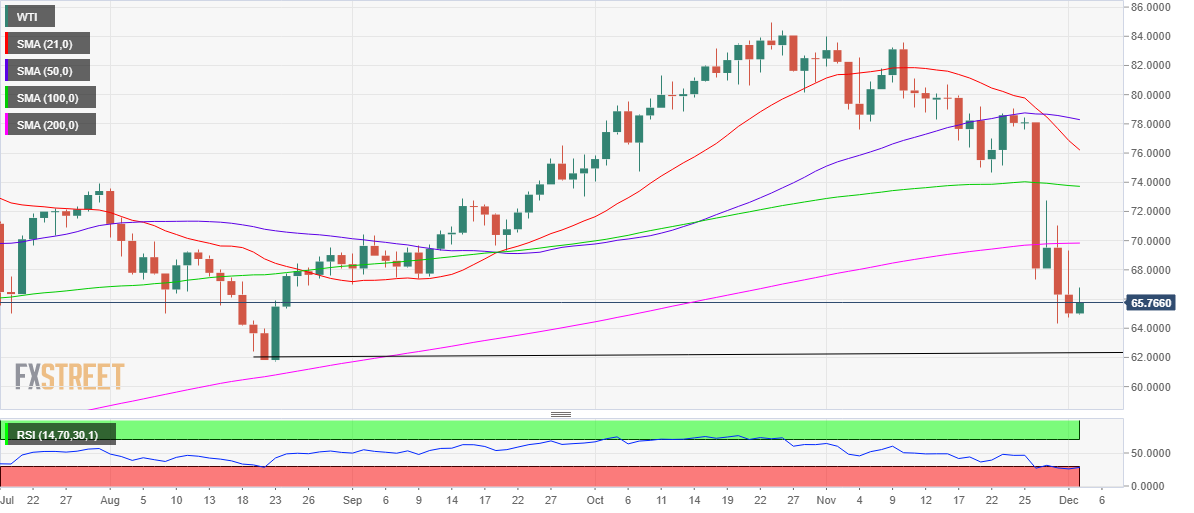
WTI: Daily chart
WTI: Additional levels to watch
- USD/CHF remains pressured below 200-SMA, refreshes intraday low.
- RSI retreat adds to the bearish bias targeting monthly support.
- Weekly resistance line also challenges buyers before the double tops around 0.9370.
USD/CHF takes offers to refresh intraday low to 0.9193, down 0.16% on a day, during early Thursday. In doing so, the Swiss currency (CHF) pair stays depressed below 200-SMA.
Given the RSI retreat and multiple failures to cross the key SMA, not to forget crossing the weekly resistance line, USD/CHF is ready for further declines towards an upward sloping support line from early November, around 0.9150.
On an immediate basis, a horizontal area from November 05, near 0.9170-75, restricts short-term sellers.
Meanwhile, recovery moves need to cross not only the 200-SMA level of 0.9210 but also the stated resistance line, close to 0.9225, to convince buyers.
Even so, double tops marked during September and November around 0.9370 will be a crucial hurdle to watch.
USD/CHF: Four-hour chart
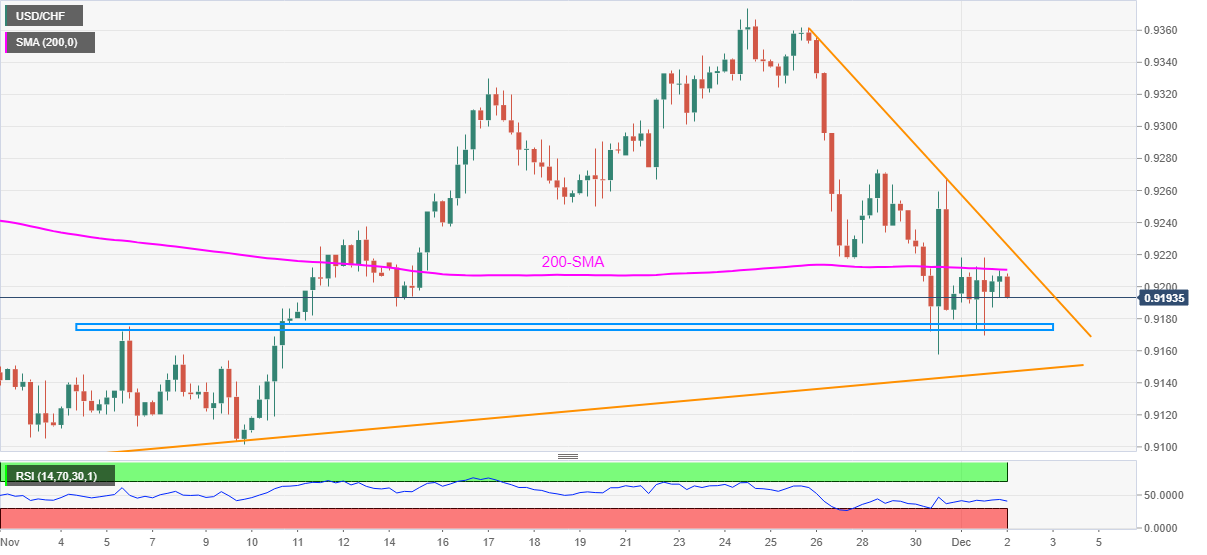
Trend: Further weakness expected
- US 10-year Treasury yields struggle to defend the bounce off multi-day low, S&P 500 Futures rebound from six-week bottom.
- VIX at yearly high as Omicron fears escalates, Fed flashes mixed signals.
- Friday’s jobs report, virus updates are the key for fresh impulse.
With a lack of clarity over the Fed’s next move and the fears of the South African variant of covid, market players remain divided during early Thursday.
While portraying the mood, the US 10-year Treasury yields lick their wounds at the lowest levels since early October, around 1.42% after refreshing multi-day bottom with 1.40% level the previous day. Alternatively, S&P 500 Futures print rises 0.35% to 4,523. Above all, DBC’s Volatility Index (VIX) stays firmer around the yearly top, around 7.13 at the latest.
Looking at the catalysts, Fed Chair’s Jerome Powell’s step back from the previously hawkish testimony could top all. Federal Reserve (Fed) Chairman Jerome Powell reiterated his inflation fears but also said he still believes inflation will come down “meaningfully” in the second half of 2022, during testimony against a Senate Commission. On the contrary, Federal Reserve Bank of New York President John C. Williams said, per New York Times, that Omicron could prolong supply and demand mismatches, causing some inflation pressures to last. Further, Cleveland Fed President Loretta Mester hints at speeding up the taper and likely rates in the next year, per Bloomberg.
Elsewhere, the first Omicron case in the US pushed President Joe Biden’s administration to extend the rules for wearing a mask in public transit.
It’s worth noting that Reuters recently ran a story citing more Chinese developers’ raising bond issues to mark the evidence Beijing is marginally easing liquidity strains on the cash-strapped sector.
Amid all these plays, the Organisation for Economic Co-operation and Development (OECD), suggesting the world GDP growing by 5.6% (previous 5.7%) in 2021, 4.5% in 2022, 3.2% in 2023, per Reuters.
Looking forward, a lack of major data/events may keep restricting the market moves but the yields and the US dollar may witness further pains should Friday’s US Nonfarm Payrolls (NFP) disappoint. That said, US ADP Employment Change and ISM Manufacturing PMI details for November ticked above market consensus of 525K and 61.0 respectively to 534K and 61.1 in that order.
Read: US nonfarm payrolls take center stage after Powell’s hawkishness
Analysts at Citi Group remain optimistic on the USD/JPY price outlook, despite the latest Omicron covid variant-led fears, suggesting that the ‘buy the dips’ strategy will remain in play.
Key quotes
“We don't think the downside for USDJPY will expand beyond the 100-day moving average (around 111.6) in this phase, while still seeing the risk that the pair will bounce back to the recent high of around 115.5 over the next few weeks.”
“Buy-on-dip will be the valid tactic in this adjustment period triggered by the Omicron variant.”
-
USD/JPY looks to regain 113.00 amid softer yields, Omicron fears
Bank of Japan board member Hitoshi Suzuki said on Thursday the central bank would continue to seek ways to further improve its monetary policy framework with an eye on the benefits and costs of its stimulus measures.
In a speech, he said the BoJ must be vigilant to the accumulating side-effects of prolonged easing because maintaining a stable financial system is crucial for monetary policy steps to be effective.
Economic Activity, Prices, and Monetary Policy in Japan
Overseas economies have recovered on the whole, albeit with variation across countries and regions. Specifically, the United States and Europe, where vaccinations against the novel coronavirus (COVID-19) moved ahead of other countries and regions, keep seeing economic improvement as the resumption of economic activity continues to progress.
The Chinese economy is still recovering as a trend, although the pace of improvement has decelerated, partly due to the resurgence of COVID-19 and power supply issues, for example, exerting downward pressure on domestic demand and production. Regarding emerging and commodity-exporting economies other than China, domestic demand and production in some countries and regions were under downward pressure due to the spread of COVID-19 in summer 2021, but these economies have picked up on the whole as the effects of the spread have been waning recently. Against this background, Japan's economy has picked up as a trend, although it remains in a severe situation due to the impact of COVID-19 at home and abroad.''
“Global stocks will shake off recent weakness and rise over the next 12 months but at a more tempered pace than this year’s rally,” per the latest Reuters poll of 150 equity analysts, published early Thursday. The findings also suggest that a correction was likely in the next six months.
Key quotes
When asked if a correction in their local equity market was likely, about three-quarters of respondents - 79 of 106 - in a global poll covering major indexes from over a dozen countries said Yes.
The broader poll of over 150 equity analysts around the world taken Nov. 15 to Dec. 1 showed most indexes bouncing back from the current downtrend and touching new highs by the end-2022.
Driven by earnings and economic growth, the benchmark S&P 500 index will extend this year’s rally and gain 7.5% between now and end-2022 to finish at 4,910.
The pan-European STOXX 600 is forecast to rise 7% and reach 500 points by July, 10 points above its lifetime peak hit on Nov. 17.
India’s BSE Sensex was expected to falter in the near-term but recoup its current losses and hit a high of 63,000 by the end of next year.
Underpinned by a solid corporate outlook, Japan’s Nikkei share average index was expected to reach 31,000 by June 2022, around an 11% gain from Tuesday’s close.
Read: US nonfarm payrolls take center stage after Powell’s hawkishness
- GBP/USD bears seeking a downside continuation as forex volatility remains sky-high.
- The bulls are attempting to break a key level of resistance on the hourly chart.
GBP/USD bulls are climbing towards a 23.6% Fibonacci retracement of the lastest bearish hourly impulse. The following illustrates the prospects, however, of a downside continuation and a break below 1.32 the figure for the days ahead.
GBP/USD daily chart
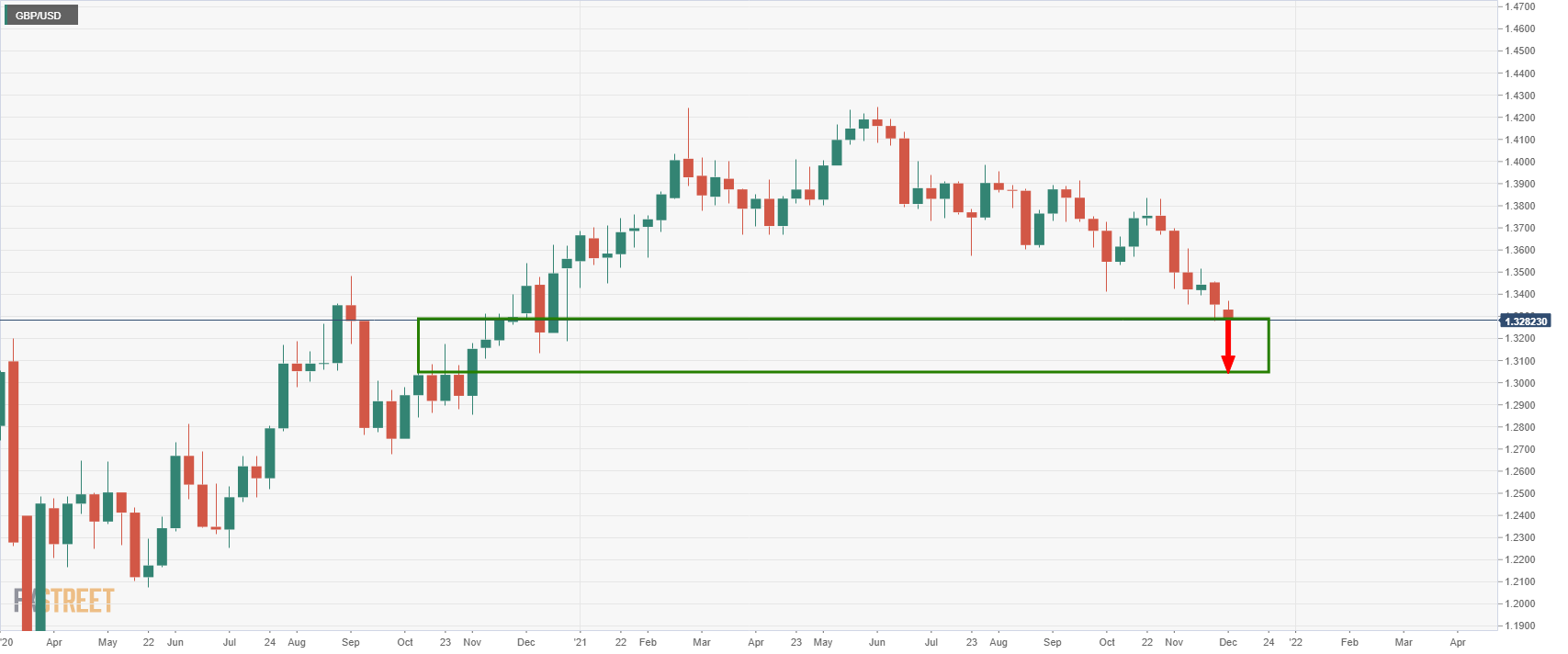
The chart above illustrates a scenario whereby the price could fall as deep as 1.3050 in the coming days. However, 1.3200 will be the first major challenge.
GBP/USD H1 chart

The price is meeting a meanwhile resistance that could see the correction phase-out and lead to a downside continuation. The resistance area is reinforced by a 23.6% Fibonacci level as well. However, a break of here could see a deeper correction, potentially to as far as the 61.8% golden ratio. With that being said, the bias is with the bears at this juncture with both the VIX and forex volatility sky-high:
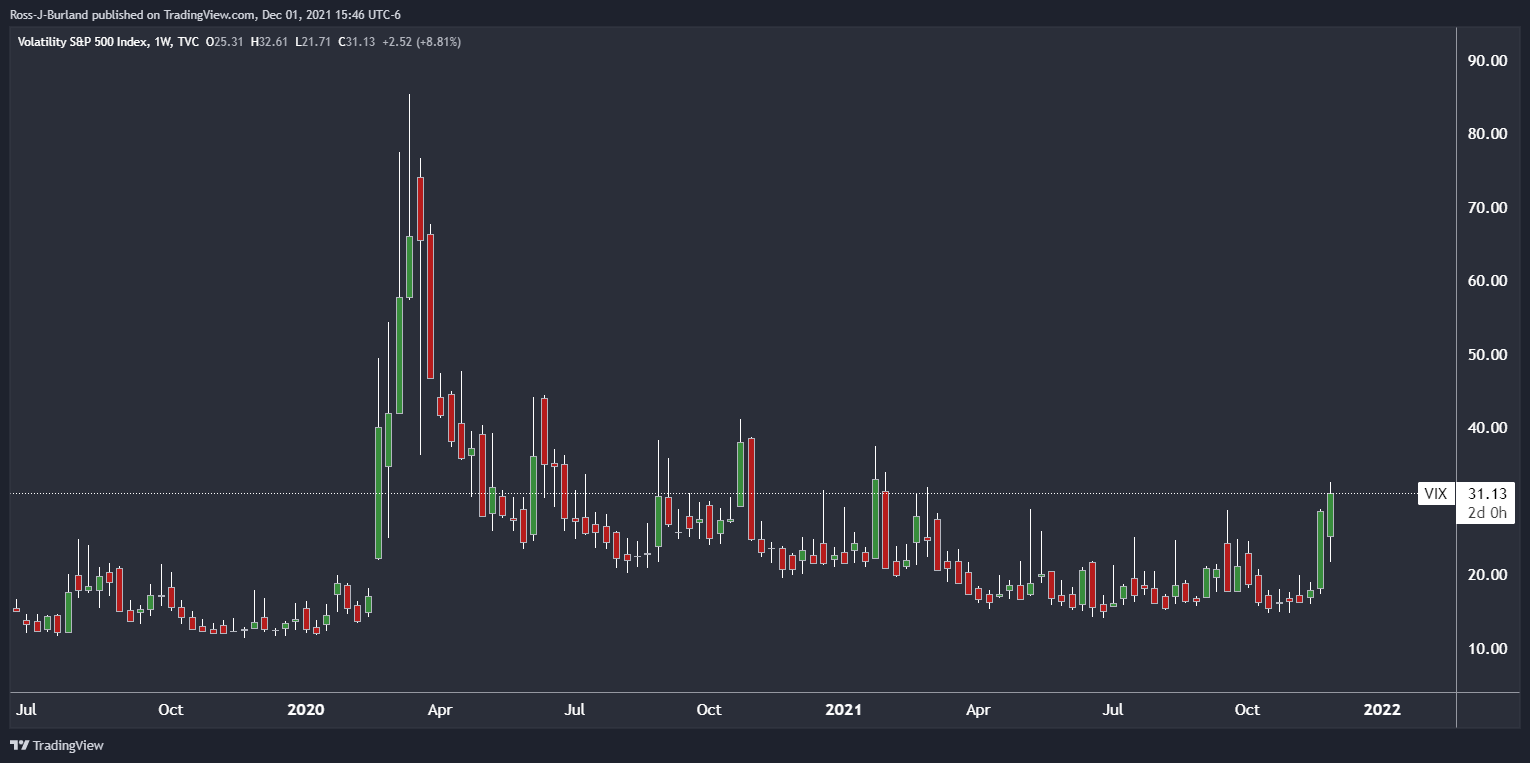
-637739919150088109.jpeg)
- DXY struggles to extend the previous day’s rebound, eases from intraday top.
- Sustained trading below previous support from mid-November, weekly descending trend line keep sellers hopeful.
- 100-SMA, firmer Momentum tests further downside towards five-week-old support line.
US Dollar Index (DXY) seesaws around 96.00, following the first daily positive in five, during early Thursday. The greenback gauge fails to stretch the previous day's bounce off 100-SMA.
Adding to the bearish bias is the DXY’s sustained trading below the weekly resistance line and the previous support from November 15.
However, a clear downside break of the 100-SMA level of 95.80 becomes necessary for the quote to recall the bears targeting an upward sloping trend line from late October near 95.20.
Meanwhile, a one-week-old falling trend line surrounding 96.30 guards immediate upside of the US Dollar Index, a break of which will direct bull to the support-turned-resistance line near 96.85.
It’s worth noting that the recently flashed multi-month high near 96.95 and the 97.00 threshold act as extra filters to the north.
DXY: Four-hour chart
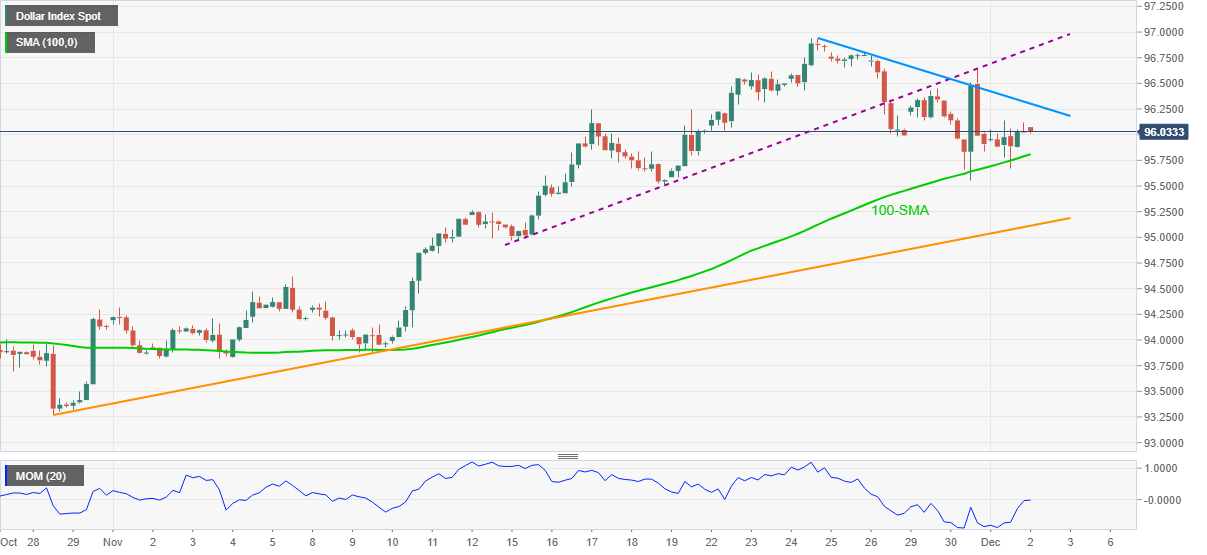
Trend: Further weakness expected
In an interservice with Bloomberg, Cleveland Fed President Loretta Mester made some hawkish comments on speeding up the taper and likely rates in the next year.
Key quotes
A quicker taper gives the Fed room to hike earlier if needed
Open to the idea of a quicker pace of tapering.
Momentum in the economy is apparent, as shown by rising inflation rates.
The Omicron variant is a new risk, but further research is needed.
The economy has learned to deal with waves of covid waves during the pandemic.
Fed should be capable of hiking rates a couple of time next year if necessary.
Related reads
- US Dollar Index Price Analysis: DXY fades bounce off 100-SMA
- US inflation expectations drop to two-month low
| Time | Country | Event | Period | Previous value | Forecast |
|---|---|---|---|---|---|
| 00:30 (GMT) | Australia | Trade Balance | October | 11.824 | 11 |
| 00:30 (GMT) | Australia | Retail Sales, M/M | October | 1.3% | 4.9% |
| 05:00 (GMT) | Japan | Consumer Confidence | November | 39.2 | |
| 07:30 (GMT) | Switzerland | Retail Sales (MoM) | October | 0.1% | |
| 07:30 (GMT) | Switzerland | Retail Sales Y/Y | October | 2.5% | |
| 10:00 (GMT) | Eurozone | Producer Price Index, MoM | October | 2.7% | 3.5% |
| 10:00 (GMT) | Eurozone | Producer Price Index (YoY) | October | 16% | 19% |
| 10:00 (GMT) | Eurozone | Unemployment Rate | October | 7.4% | 7.3% |
| 12:00 (GMT) | OPEC | OPEC-JMMC Meetings | |||
| 13:30 (GMT) | U.S. | Continuing Jobless Claims | November | 2049 | 2000 |
| 13:30 (GMT) | U.S. | Initial Jobless Claims | November | 199 | 240 |
| 16:30 (GMT) | U.S. | FOMC Member Bostic Speaks | |||
| 16:30 (GMT) | U.S. | FOMC Member Daly Speaks | |||
| 21:30 (GMT) | Australia | AiG Performance of Construction Index | November | 57.6 |
In recent trade today, the People’s Bank of China (PBOC) set the yuan (CNY) at 6.3719 vs the estimate of 6.3648 and the previous 6.3693.
About the fix
China maintains strict control of the yuan’s rate on the mainland.
The onshore yuan (CNY) differs from the offshore one (CNH) in trading restrictions, this last one is not as tightly controlled.
Each morning, the People’s Bank of China (PBOC) sets a so-called daily midpoint fix, based on the yuan’s previous day closing level and quotations taken from the inter-bank dealer.
- USD/JPY pokes intraday high, snaps two-day downtrend near two-month low.
- Markets turn sluggish during the pre-NFP trading lulls, mixed signals from Fed add to the indecision.
- US eyes extension of mask mandate after marking first Omicron case.
- OECD cuts global growth outlook, expects Japan 2021 GDP of 1.8% versus 2.5% previous forecast.
USD/JPY struggles to defend the first daily gains in three, taking rounds to 113.00 during the initial Tokyo open on Thursday.
The yen pair seems to take clues from the USD rebound and a jump in the global market volatility to portray the latest moves. However, the rush to risk safety amid mixed concerns over the Fed’s next move and the Omicron crisis keep the Japanese currency on the top of the safe-haven list and probe the bulls.
That said, the DBC’s Volatility Index (VIX) stays firmer around the yearly top as investors stay divided over the Fed’s next moves. Federal Reserve (Fed) Chairman Jerome Powell reiterated his inflation fears but also said he still believes inflation will come down “meaningfully” in the second half of 2022, during testimony against a Senate Commission. On the contrary, Federal Reserve Bank of New York President John C. Williams said, per New York Times, that Omicron could prolong supply and demand mismatches, causing some inflation pressures to last.
The same weigh on the US 10-year Treasury yields to stay pressured near a two-month low, surrounding 1.42% by the press time, whereas the S&P 500 Futures print 0.30% intraday gains after the Wall Street benchmarks marked second consecutive daily loss.
However, the rush to risk-safety gets support from the latest South African covid variant news. As the first Omicron case in the US pushed President Joe Biden’s administration to extend the rules for wearing a mask in public transit. “US President Joe Biden's administration will extend requirements for travelers to wear masks on airplanes, trains and buses and at airports and train stations through mid-March to address ongoing COVID-19 risks,” said Reuters quoting anonymous sources.
Adding to the risk-aversion could be the latest economic forecast from the Organisation for Economic Co-operation and Development (OECD), suggesting the world GDP growing by 5.6% (previous 5.7%) in 2021, 4.5% in 2022, 3.2% in 2023, per Reuters.
That said, the pre-NFP trading lull seems to allow USD/JPY traders to consolidate recent losses. However, the US jobless claims and virus updates will be important for clear direction before the monthly jobs report, up for publishing on Friday.
Technical analysis
The resistance-turned-support line from March, around 112.70, restricts short-term USD/JPY declines. However, buyers may not return until the quote stays below the 50-DMA level of 113.35.
- AUD/USD stays mildly bid, consolidates recent losses around yearly low.
- Australia Trade Balance, Exports improve in October but Imports contract further.
- Market sentiment dwindles as mixed Fed signals confront Omicron woes ahead of pre-Fed trading lull.
- US Weekly Jobless Claims, virus updates can entertain intraday traders.
AUD/USD prints mild gains around 0.7110, snapping a six-day downtrend near 2021 bottom during Thursday’s Asian session. The Aussie pair’s latest consolidation could be linked to the softer Treasury yields and mixed trade numbers from home.
Australia Trade Balance grew past 11000M forecast to 11220M in October, versus 12243M prior. The details suggest that the Imports shrank more than -2.0% previous release to -3.0% whereas Exports improved to -3.0% from -6.0% prior. Additionally, Home Loans dropped below -1.0% market consensus and -2.7% previous reading to -4.1% whereas Investment Lending for Homes eased to 1.1% versus 1.4% printed the last.
Read: Aussie Trade Balance Oct: A$11.22B vs est A$11.150B; Aussie firm
Following the data, AUD/USD prices remain mildly bid around the intraday high as traders await Friday’s US Nonfarm Payrolls (NFP) after recently mixed signals from the Fed Chair Jerome Powell weighed down the Treasury yields.
That said, the US 10-year Treasury yields stay pressured near a two-month low surrounding 1.40% by the press time whereas the S&P 500 Futures print 0.40% intraday gains after the Wall Street benchmarks marked second consecutive daily loss.
Federal Reserve (Fed) Chairman Jerome Powell reiterated his inflation fears but also said he still believes inflation will come down “meaningfully” in the second half of 2022, during testimony against a Senate Commission. On the contrary, Federal Reserve Bank of New York President John C. Williams said, per New York Times, that Omicron could prolong supply and demand mismatches, causing some inflation pressures to last.
The virus woes recently spread into the US after the first Omicron case pushed President Joe Biden’s administration to extend the rules for wearing a mask in public transit. “US President Joe Biden's administration will extend requirements for travelers to wear masks on airplanes, trains and buses and at airports and train stations through mid-March to address ongoing COVID-19 risks,” said Reuters quoting anonymous sources.
Given the mixed concerns over inflation and a 10-week low of the US inflation expectations, per the 10-year breakeven inflation rate per the St. Louis Federal Reserve (FRED) data, risk appetite is likely to rely on the virus update for fresh impulse. However, the AUD/USD prices are expected to portray a sluggish move amid a lack of major data and the generally observed pre-NFP trading lull.
Read: US nonfarm payrolls take center stage after Powell’s hawkishness
Technical analysis
AUD/USD remains bearish until defying a downward sloping trend channel from late October, between 0.7190 and 0.7075 at the latest. Adding to the upside filter is the 50-SMA and 23.6% Fibonacci retracement (Fibo.) of late October to November downside, around 0.7175-80.
The Australian Trade Balance released by the Australian Bureau of Statistics has arrived as follows:
Australia Trade Balance Oct A$11.22B (est A$11.150B; prev A$12.243B) - Australia Exports (MoM) Oct -3% (est -1%; prev -6%) - Australia Imports (MoM) Oct -3% (est 2%; prev -2%).
The Australian dollar is so far unchanged on the release, trading at 0.7110, up from a session low of 0.7100 and 0.1% higher on the day so far. From an H1 perspective, the bulls could be headed for a test of the 38.2% Fibonacci retracement level as follows:
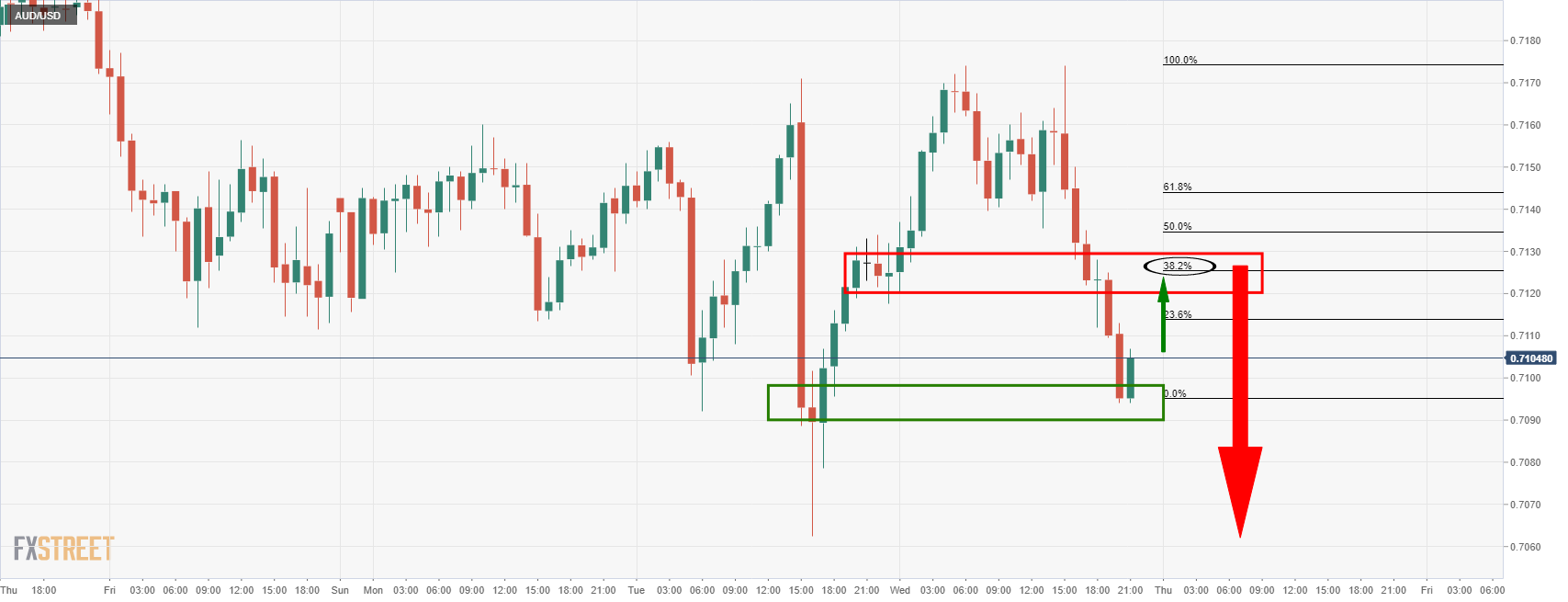
AUD/USD Price Analysis: High forex vol points to continuation to weekly support
About the Aussie Trade Balance
The trade balance released by the Australian Bureau of Statistics is the difference in the value of its imports and exports of Australian goods. Export data can give an important reflection of Australian growth, while imports provide an indication of domestic demand. Trade Balance gives an early indication of the net export performance. If a steady demand in exchange for Australian exports is seen, that would turn into a positive growth in the trade balance, and that should be positive for the AUD.
Review Alex Nekritin's Article - Trading the Aussie with Australia Trade Balance
- Gold stays mildly bid above two-month-old support, extends the latest rebound.
- US Treasury yields, inflation expectations fall amid mixed signals from Fed, pre-NFP trading lull.
- Omicron sneaks into the US, Biden administration weighs on extending mask mandate.
- Gold Price Forecast: Still depressed despite the better market mood
Gold (XAU/USD) defends short-term key support despite multiple failures to cross the 200-DMA, easing to $1,780 during Thursday’s Asian session.
The yellow metal snapped a two-day downtrend the previous day amid the US dollar pullback and softer yields. However, fears emanating from the South African variant of the coronavirus seem to challenge the bold buyers of late.
That said, global markets cheered mixed comments from Fed Chair Jerome Powell and World Health Organization’s (WHO) cautious optimism to portray risk-on mood the previous day.
The World Health Organization (WHO) tried calming the virus woes with statements defending the current vaccines and marking less severe impacts of the COVID-19 strain. On the other hand, Federal Reserve (Fed) Chairman Jerome Powell reiterated his inflation fears but also said he still believes inflation will come down “meaningfully” in the second half of 2022, during testimony against a Senate Commission. Recently, Federal Reserve Bank of New York President John C. Williams said, per New York Times, that Omicron could prolong supply and demand mismatches, causing some inflation pressures to last.
It should be noted that the first Omicron case in the US pushed President Joe Biden’s administration to extend the rules for wearing a mask in public transit. “US President Joe Biden's administration will extend requirements for travelers to wear masks on airplanes, trains and buses and at airports and train stations through mid-March to address ongoing COVID-19 risks,” said Reuters quoting anonymous sources.
Talking about data, US ADP Employment Change and ISM Manufacturing PMI details for November ticked above market consensus of 525K and 61.0 respectively to 534K and 61.1 in that order.
Against this backdrop, Wall Street benchmarks and the US Treasury yields dropped, weighing down the US inflation expectations measured by the 10-year breakeven inflation rate per the St. Louis Federal Reserve (FRED) data. However, the S&P 500 Futures print mild gains by the press time.
Given the mixed concerns and the market’s wait for Friday’s key US jobs report, gold prices are likely to trade range-bound. Though, virus updates and second-tier US data may entertain the traders.
Read: US nonfarm payrolls take center stage after Powell’s hawkishness
Technical analysis
With a bounce off an ascending trend line from October contrasting the lower lows of the RSI, gold buyers brace for further upside past the 200-DMA while relying on the technical formation called hidden bullish divergence.
In doing so, tops marked during late October and the last week, around $1,814-16, gain major attention before the key $1,834 hurdle comprising July and September highs.
During the quote’s run-up past $1,834, the $1,850 level may offer an intermediate halt before driving the gold bulls to November’s peak of $1,877.
On the flip side, the stated support line near $1,771 precedes an upward sloping trend line from September close to $1,760 to challenge the short-term downside of the metal.
However, a clear break of the $1,760 level will not hesitate to challenge September’s low of $1,721 and the $1,700 threshold before the gold bears run out of steam around the yearly bottom of $1,687.
Gold: Daily chart
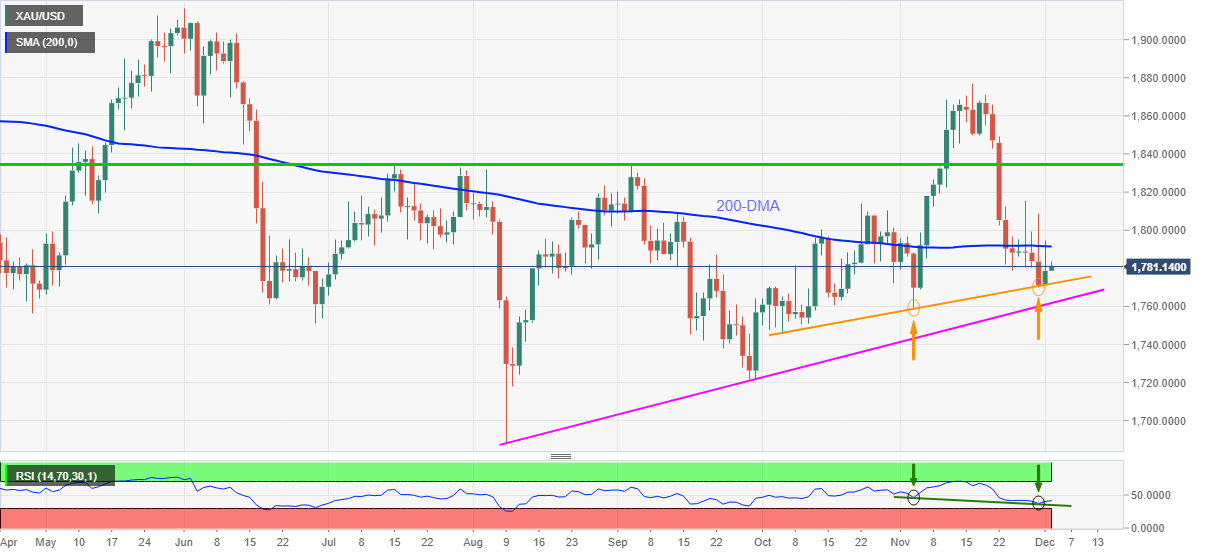
Trend: Further recovery expected
- USD/CAD is on the verge of a 38.2% Fibonacci correciton.
- Bulls are looking for a discount as the market remains risk-off bias.
USD/CAD has been in the hands of the bulls in a sharp recovery in the US dollar. The market's risk profile is something that is weighing on both the commodities sector, especially oil, and the Canadian dollar.
However, the following is an analysis of the daily and hourly charts that arrived at a meanwhile bearish conclusion as the price deteriorates in daily resistance.
USD/CAD daily chart
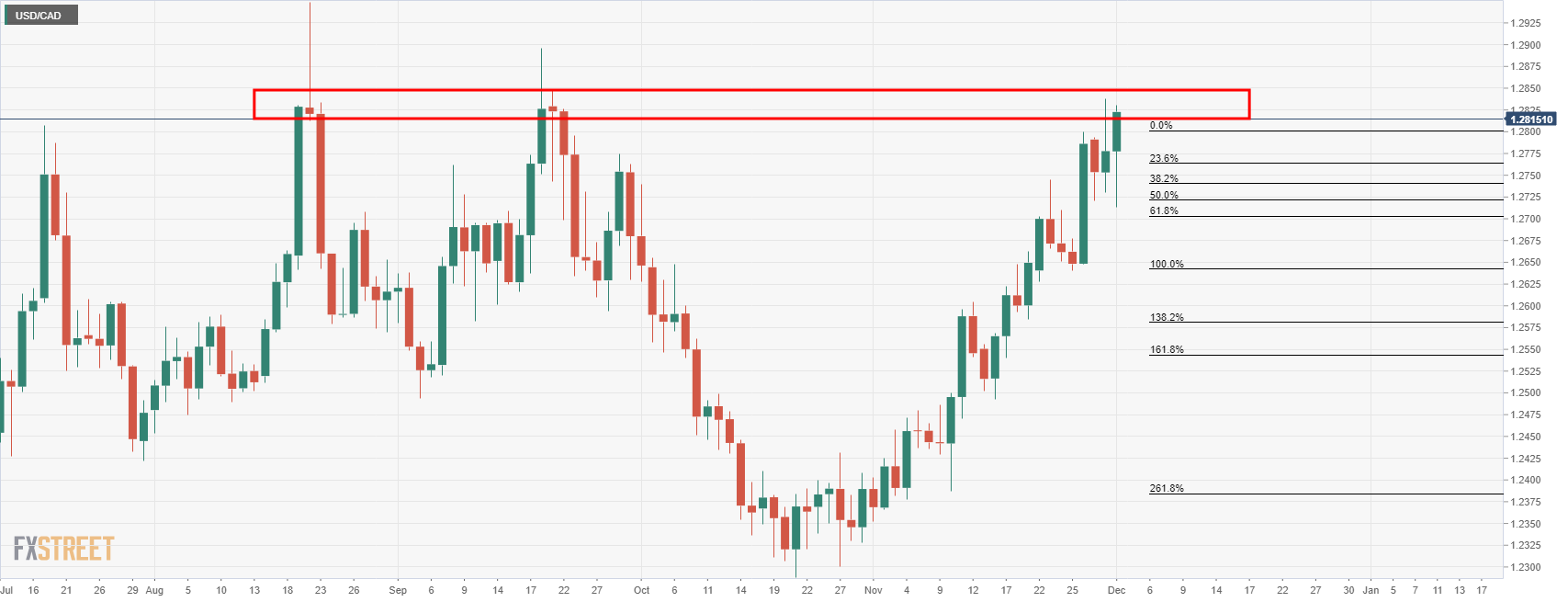
The daily chart is showing the price had retraced 50% of the prior bullish impose in a correction and then continued to print a higher high. It has run int a wall of resistance and would be expected to pull back on the lower time frames before extending higher.
USD/CAD hourly chart
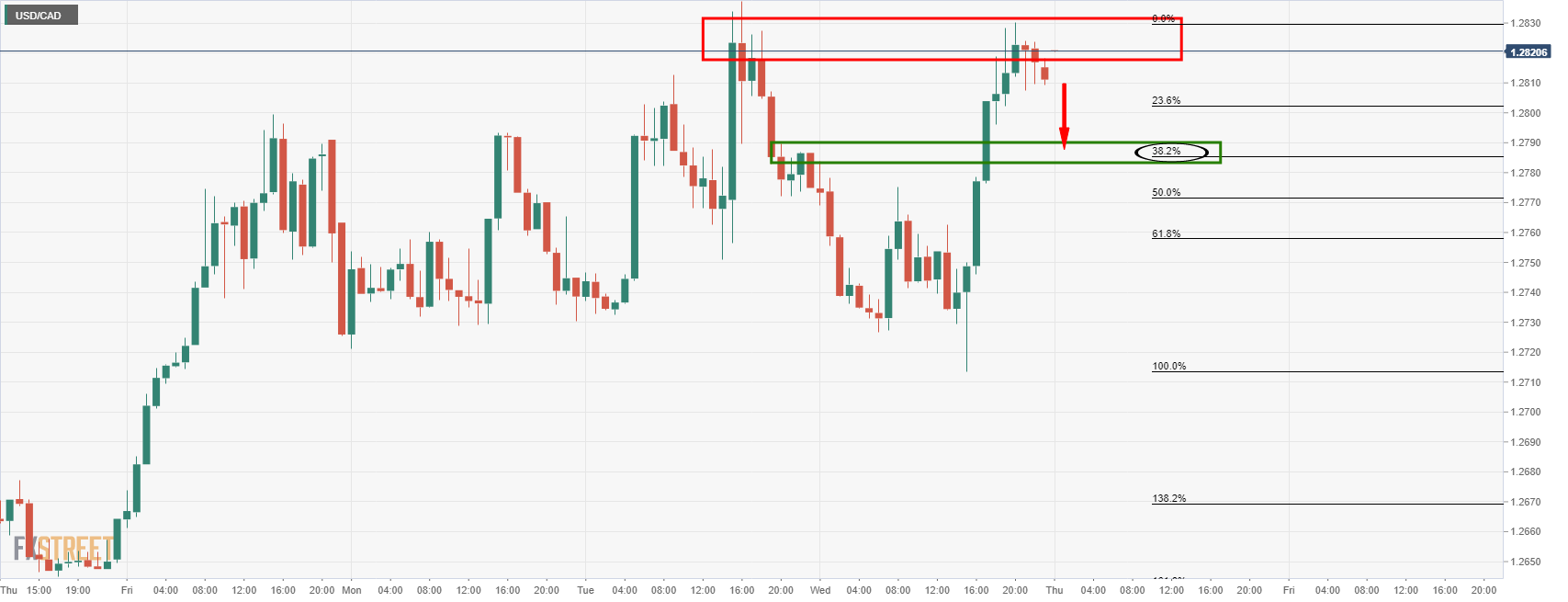
The price could be on the verge of a 38.2% Fibonacci retracement which meets the 1.2780s which can be a focus for the sessions ahead.







© 2000-2026. Sva prava zaštićena.
Sajt je vlasništvo kompanije Teletrade D.J. LLC 2351 LLC 2022 (Euro House, Richmond Hill Road, Kingstown, VC0100, St. Vincent and the Grenadines).
Svi podaci koji se nalaze na sajtu ne predstavljaju osnovu za donošenje investicionih odluka, već su informativnog karaktera.
The company does not serve or provide services to customers who are residents of the US, Canada, Iran, The Democratic People's Republic of Korea, Yemen and FATF blacklisted countries.
Izvršenje trgovinskih operacija sa finansijskim instrumentima upotrebom marginalne trgovine pruža velike mogućnosti i omogućava investitorima ostvarivanje visokih prihoda. Međutim, takav vid trgovine povezan je sa potencijalno visokim nivoom rizika od gubitka sredstava. Проведение торговых операций на финанcовых рынках c маржинальными финанcовыми инcтрументами открывает широкие возможноcти, и позволяет инвеcторам, готовым пойти на риcк, получать выcокую прибыль, но при этом неcет в cебе потенциально выcокий уровень риcка получения убытков. Iz tog razloga je pre započinjanja trgovine potrebno odlučiti o izboru odgovarajuće investicione strategije, uzimajući u obzir raspoložive resurse.
Upotreba informacija: U slučaju potpunog ili delimičnog preuzimanja i daljeg korišćenja materijala koji se nalazi na sajtu, potrebno je navesti link odgovarajuće stranice na sajtu kompanije TeleTrade-a kao izvora informacija. Upotreba materijala na internetu mora biti praćena hiper linkom do web stranice teletrade.org. Automatski uvoz materijala i informacija sa stranice je zabranjen.
Ako imate bilo kakvih pitanja, obratite nam se pr@teletrade.global.


 Банковни
 транcфери


