- Analiza
- Novosti i instrumenti
- Vesti sa tržišta
Forex-novosti i prognoze od 03-12-2021
- The shared currency advances against the greenback, up some 0.10%.
- The US Dollar Index, which measures the buck’s performance against six rivals, is flat at 96.16.
- EUR/USD: Mild bearish, but it needs a break below the 50-SMA to resume the downward move.
After seesawing before the Wall Street open on US macroeconomic data, the EUR/USD advances modestly, up some 0.10%, trading at 1.1309 during the New York session at the time of writing. The market sentiment is downbeat, as portrayed by US equity indices falling, between 0.77% and 2.61%. Furthermore, in the bond market, US bond yields aim downward. Contrarily the greenback is flat during the day, with the US Dollar Index sitting at 96.16, unchanged.
The EUR/USD remained subdued during the overnight session, in a narrow range between 1.1280-1.1307 range, ahead of the US Nonfarm Payrolls release. However, once the NFP crossed the wires, the pair seesawed around 1.1332-1.265, settling at 1.1300.
EUR/USD Price Forecast: Technical outlook
The EUR/USD 4-hour chart shows that the pair has a downward bias. While the 50-simple moving average (SMA) is below the spot price, the 100 and the 200-SMA reside above the spot price, confirming the abovementioned. The pair has been range-bound between the 50 and the 100-SMA, each lying at 1.1280-1.1315, with no clear direction, and as the New York session winds down, it seems the EUR/USD would remain trapped at it.
In the outcome of a break above the 100-SMA, the first supply zone would be the November 30 high at 1.1382. The breach of the latter would open the way for further upside, with 1.1400 as the next resistance, followed by the confluence of the 200-SMA and the November 15 high at around the 1.1450-70 range.
On the other hand, a break under the 50-SMA would expose the 1.1200 figure, followed by the year-to-date low at the November 24 low at 1.1186.
-637741629343428844.png)
- USD/JPY fell back to weekly lows in the 112.50 region on Friday though has since bounced as volumes fade.
- The pair reversed from as high as the 113.50s as risk appetite deteriorated and drove long-term US yields lower.
Risk-off is the driving force as the US session draws to a close. US stocks are substantially lower, as are other risk assets like crude oil and the likes of AUD, NZD, NOK and SEK in foreign exchange markets. Safe-haven US bonds, meanwhile, have caught a bid and this has pushed yields significantly lower and further flattened the US curve. This has put downwards pressure on US/Japan rate differentials and, as a result, is weighing heavily on USD/JPY.
Back to bonds; the 10-year yield is down 10bps on the day to under 1.35%, while the 2-year is down about 3bps to just under 0.60%. The latter remains elevated given this week’s hawkish Fed shift, which has been to an extent endorsed by a string of strong US macro data releases culminating in Friday’s mixed but broadly interpreted as solid, labour market report. On the week, 2-year yields are up nearly 10bps.
Meanwhile, longer-duration US yields are down sharply on the week as traders worry that the emergence of Omicron at a time when the Fed is set to start withdrawing stimulus will result in weaker growth/inflation down the line. 10-year yields are down about 15bps on the week. The divergence has seen the 2s/10s spread narrow to its lowest point in 2021 at around 75bps, a near 25bps drop on the week.
Looking more closely at USD/JPY then; the pair has bounced in recent trade after probing earlier weekly lows in the 112.50 area earlier in the session. The pair currently trades around 112.75, marking a sharp, risk-off fuelled turnaround from earlier session highs to the north of 113.50.
Forgetting about Omicron for a second, fears are growing that the US will soon follow in the footsteps of the sharp spike in Covid-19 infections seen in Europe over the last few weeks. The emergence of Omicron makes such a spike in infections more likely and another spike in cases risks a sporadic reimposition of lockdown restrictions in various states.
These are all factors being fretted over by market participants and risks that seem unlikely to fade any time soon. If risk-off rather than central bank policy divergence remains in the driving seat for bond and FX markets in the coming weeks as a result, USD/JPY could well break lower towards 112.00.
- The British pound falls for the fourth time in the week,, looks for a weekly close below 1.3300.
- A dampened market sentiment hurts the prospects of the GBP as investors seek to safe-haven assets.
- GBP/USD: In the 4-hour chart, the 50-SMA has acted as resistance, and rallies toward the moving average have been faded.
The British pound pares Thursday’s gains and some more, is down some 0.50%, trading at 1.3232 during the New York session at the time of writing. A risk-off market mood prompted investors to drop anything with the word “risk” attached to it, benefitting safe-haven assets. In the FX market, the USD, the JPY, and the CHF are the most aided of the abovementioned and are the stronger currencies as we approach the Wall Street close.
In the last three hours, the pound bounced off Friday’s daily low around 1.3210s, towards 1.3240s, on a steady move that could have been prompted by USD profit-taking. Also, USD bulls failed to break the 1.3200 figure on the back of the not-so-bad November’s Nonfarm Payrolls report, which in the case of have been in line with estimations or better, the GBP/USD would indeed be trading at new YTD lows.
As reported earlier, the US economy added 210K new jobs, shorter than the 550K estimated by experts. The headline showed a worse than expected report, but the Unemployment Rate dropping from 4.5% to 4.2% reinforced that the labor market is improving but not at the pace required. Additionally, the Fed seems to pivot from the maximum employment goal towards tackling inflation, as Fed Chief Jerome Powell said on the week that inflation is no longer “transitory” and should be no longer used when speaking of elevated prices.
Therefore, as the Fed pivoted towards inflation, the US Consumer Price Index (CPI) for October on Friday of next week would be the primary driver for GBP/USD traders, followed by the University of Michigan Consumer Sentiment for November on its preliminary read.
In the UK economic docket, BoE’s speaking, Retail Sales, Manufacturing Production and GDP, would entertain GBP/USD traders.
GBP/USD Price Forecast: Technical outlook
In the 4-hour chart, the GBP/USD has a downward bias, as shown by the 4-hour simple moving averages (SMA’s), which have a downslope and reside above the spot price. Also, the 50-SMA has undergone three tests, and in each of those, the GBP has failed to break above it, leaving that level as a strong resistance level.
In the outcome of extending the downward move, the first support would be 1.3200. The breach of the latter would expose the November 30 low at 1.3194, followed by the 1.3100 figure.
Contrarily on the upside, the first resistance would be 1.3300. A break above that level would expose the 50-SMA at 1.3318, followed by the 100-SMA at 1.3374.
-637741598184291593.png)
Managing Director (MD) of the IMF Kristalina Georgieva said on Friday that she had already been concerned that the global economic recovery had been losing steam before the emergence of the Omicron variant. There would now likely be some downgrade to global growth forecasts as a result, she added, saying that the rapid spread of the new variant can dent confidence.
Georgieva added that the good performance of the US economy is having positive spillovers to other countries, but that US action to control inflation has to happen. She added that tariff reductions could also help global growth and said she was encouraged by the US Trade Representative looking into possible reductions.
Market Reaction
The comments have not directly had an effect on market, but do fit into the broader Omicron worries that are causing US equity market sentiment to continue to deteriorate as the final close of the week approaches.
- USD/CHF has been choppy on Friday, but slipped back to session lows around 0.9170 in recent trade.
- The pair is being weighed as risk appetite ends the week on the back foot, favouring haven like CHF.
It's been a choppy session but USD/CHF ultimately looks set to end the day lower by about 30 pips or just over 0.3%. The pair is currently trading at session lows in the 0.9170 area, having started the day to the north of the 0.9200 level, and is eyeing a test of this week’s lows at 0.9150. Unless USD/CHF can break below support before the NY close, which seems unlikely as volumes decline into the weekend, it seems the pair will be consigned to enter next week within the same 0.9150-0.9220ish range that has prevailed all week.
A deterioration in risk appetite over the last few hours that has seen US equities, commodities and most risk-sensitive commodities come under pressure is benefitting traditional safe-haven assets. Long-term US yields are substantially lower reflecting a bond bid that is also helping the likes of the yen and Swiss franc. Friday’s US November labour market report was mixed, with the headline NFP number missing expectations by a big margin but other aspects of the report, such as the unemployment rate, suggest the labour market continues to progress and remains tight. That, taken with more hawkish rhetoric from FOMC member James Bullard, has helped keep Fed tightening expectations for 2022 intact, so the moves being seen in bonds and FX are more to do with risk appetite.
- USD/CAD has bounced from earlier lows under 1.2750 and is back to multi-month highs around 1.2830.
- The move higher comes amid a broad deterioration in risk appetite.
- But a strong Canadian jobs report is helping the loonie outperform its risk-sensitive G10 peers.
USD/CAD spiked lower in the aftermath of the simultaneous US and Canadian labour market data release at 1330GMT, with the pair briefly dipping below the 1.2750 level, but has since reversed sharply higher. The pair is now trading back at multi-month highs in the 1.2830 area, having nearly hit 1.2850, with gains of around 0.2% on the day. The loonie continues to trade within the confines of a bullish trend channel, which suggests the path of least resistance remains to the upside.
-637741560914491953.png)
Risk appetite deteriorates
The retracement higher from early session lows comes amid a broad downturn in risk appetite since the US open that has seen both stocks and oil markets sell-off in unison. No one theme is weighing on risk appetite, but traders are citing continued uncertainty regarding Omicron and further hawkish rhetoric from Fed members (this time from FOMC’s James Bullard) in wake of the US jobs report. For reference, the headline November NFP number was much weaker than expected, but the household survey showed the unemployment rate dropping more than expected to 4.2% and the participation rate ticking higher. Most analysts interpreted the report as in fitting with the theme of an already tight and still improving US labour market.
But CAD holds up well
The risk appetite downturn has done the most damage to risk-sensitive AUD, NZD, NOK, and SEK, which are between 0.8-1.2% lower on the session. The loonie is doing comparatively better likely because the November Canadian jobs report was much stronger than expected. The economy added more than 150K jobs, nearly 80K of which were in full-time employment, on the month, well above expectations for a 35K gain. Meanwhile, the unemployment rate sank to 6.0% versus expectations for a much more modest drop to 6.6% from 6.7% in October. The report will boost expectations for the BoC to turn more hawkish in the coming weeks and stay decisively ahead of the Fed in terms of monetary tightening.
- The shared currency finishes in the green the week, contrary to the risk-sensitive cable.
- The EUR/GBP rallied almost 50-pips as the US Nonfarm Payrolls report headline crossed the wires.
- In the EUR/GBP daily chart, the break of the 200-DMA would expose 0.8657.
The EUR/GBP rallies during the New York session, up some %, trading at 0.8542 at the time of writing. Market sentiment is pessimistic after a mixed US Nonfarm Payrolls report, as the US central bank looks forward to increasing the pace of the bond taper. Also, in the last couple of hours, an increment of COVID-19 infections with the Omicron variant appears to weigh investors’ moods as safe-haven currencies rise.
On Friday, during the overnight session, the EUR/GBP pair remained subdued, within December 2 low at 0.8488, and the daily central pivot at 0.8501. However, volatility shot through the roof as the American session began, and the EUR/GBP rose towards 0.8547. At press time, it appears the pair might consolidate around the 0.8500, also benefitted from the “safe-haven” status gained lately, on the low-yield EUR.
EUR/GBP Price Forecast: Technical outlook
The EUR/GBP daily chart shows that the cross-currency pair is approaching the 200-day moving average (DMA), sitting at 0.8557, which would see a level that GBP bulls would lean-to in their attempt to push the EUR/GBP pair lower. However, in breaking the latter, the first resistance would be the November 5 swing high at 0.8594, followed by the September 29 high at 0.8657.
Conversely, if the EUR/GBP upward move is faded at the 200-DMA, the first support would be the 100-DMA at 0.8514. A breach of that level could send the pair tumbling down to the 50-DMA at 0.8484, followed by the psychological 0.8400 support.
-637741524569502028.png)
Next week, on Wednesday, the Bank of Canada (BoC) will have its monetary policy meeting. Analysts at TD Securities, expect a relatively quiet meeting. They consider the BoC will maintain the view that the outlook is evolving as expected and that inflation is transitory.
Key Quotes:
“We look for a relatively quiet BoC meeting, with limited scope for a meaningful change in tone. The BoC will maintain that the outlook is evolving as expected and that inflation strength is largely transitory. We do not expect any change to guidance, as the statement balances rising uncertainty over COVID & supply chain disruptions from BC floods against labour market strength.”
“A quiet BoC meeting shifts CAD drivers to the world at large. In turn, COVID uncertainty, heightened risk aversion, and a relatively poor local growth and mobility backdrop should keep USDCAD hanging around 1.28 for a bit longer. While we see too much pessimism priced into markets, it could a bit of time for things to settle down. Even so, we think the risk pullback will offer attractive entry levels for CAD against the likes of JPY and CHF in early 2022.”
“We expect a neutral BoC meeting, but note that Canada remains cheap to the US. It is important to recognize that we have moved from a divergence narrative with the US to a convergence narrative now; as such we want to maintain our long Canada bias.”
The November employment report showed an increase in payrolls of 210K, significantly below the 550K expected. According to analysts at Wells Fargo, this report was a clear disappointment in that nonfarm payrolls were well-below consensus expectations. They add that a slower pace of wage growth may slightly ease some concerns about a wage-price inflation spiral.
Key Quotes:
“With just one final employment report left in 2021, nonfarm payrolls are roughly four million jobs below their pre-pandemic level. Job growth is still easily outpacing the slow pace that the U.S. labor market experienced during the recovery from the 2008-2009 financial crisis.”
“In our view, this morning's employment report leaves the FOMC in a bit of a gray zone. Key Fed officials have been talking up the prospect of a faster taper in recent weeks, with a possible policy shift occurring as soon as the December 15 FOMC meeting. This morning's report was a clear disappointment in that nonfarm payrolls were well-below consensus expectations. In addition, a slower pace of wage growth may slightly ease some concerns about a wage-price inflation spiral.”
“The FOMC will clearly be discussing a faster taper at its next meeting, but this morning's report gives the Fed an out if it would like to wait an extra six weeks until its following meeting in late January 2022.”
“The Omicron variants adds additional uncertainty to whether job growth can rebound to a more robust pace through the winter as health concerns flare up again. With still so little known about the severity of the new variant at this stage, we continue to expect hiring to remain solid.”
- The AUD/USD declines sharply amid a not-so-bad US Nonfarm Payrolls report.
- Downbear market sentiment hurts the prospect of risk-sensitive currencies in the FX market, the AUD weakens.
- In the weekly chart, the AUD/USD broke under the 100 and the 200-week SMA’s, AUD bears eye 0.6776.
During the New York session, after a not-so-bad US Nonfarm payrolls report, the AUD/USD is plummeting to fresh year-to-date lows, trading at 0.7005, down 1.23% at the time of writing. As portrayed by US equity indices falling, market sentiment is downbeat after the US Bureau of Labor Statistics (BLS) unveiled that the Nonfarm Payrolls for November grew less than expected. However, the Unemployment Rate fell three tenths from 4.5% to 4.2%.
In tone with the risk-off mood, in the FX market, risk-sensitive currencies like the AUD, the NZD, and the GBP, are the main losers of the day, contrary to the greenback, which takes advantage of its safe-haven status.
Contradictory Nonfarm Payrolls report boosts the greenback, and the AUD/USD plunges to new YTD lows
In the meantime, an hour previous to the Wall Street open, the US Nonfarm payrolls for November showed that the US economy added 210K jobs to the economy, less than the 550K estimated. However, the positive from the jobs report was the Unemployment Rate, dropping from 4.5% to 4.2%, and it is crucial because that is the labor market gauge for the Federal Reserve.
The reaction to the headline was immediate, sending the AUD/USD upwards to 0.7090. Nevertheless, as investors dissected the NFP report, the AUD/USD upward move was faded, plummeting 80-pips, down to a new year-to-date low at 0.7012, then rebounding towards 0.7020s.
Amid those plays, the St. Louis Fed President James Bullard crossed the wires, where he said the US economy has recovered and is poised to grow. Noted that in the following meetings, the Fed would need to consider a faster bond taper reduction, citing that a 4.2% jobless rate “as a good case to remove Fed support.” Bullard also commented that the US central bank could consider increasing rates before finishing the bond taper.
AUD/USD Price Forecast: Technical outlook
The AUD/USD weekly chart depicts that as of the present week, the pair broke below the 100 and the 200-week simple moving averages (SMA’s), signaling a downward bias in the pair. Furthermore, as depicted by the chart, the Relative Strength Index (RSI), a momentum indicator, is at 33 with enough room to support another leg-down.
Also, it is imperative to notice the central bank divergence between the Federal Reserve and the Reserve Bank of Australia, which has struggled to push back hiking rates until 2024. In contrast, the US central bank is looking to accelerate the QE’s reduction as inflation has overshot the bank’s target.
Therefore, USD bulls have the upper hand against the AUD, and as the pair is printing new year-to-date lows, the downward move would possibly extend further.
In that outcome, the first support level would be June 2020 swing lows at 0.6776, followed by the previous resistance level now turned support at 0.6570.
-637741480715129463.png)
The announcement from the OPEC+ surprised the market by following through on their plan to increase production by 400kb/d in January, potentially leading to a modestly oversupplied oil market early next year, explained analyst Rabobank. They see the bullish reaction in prices to the bearish announcement, as a sign of a potential bottom.
Key Quotes:
“The oil market got more bearish news on Thursday when OPEC+ decided to follow through on their plan to increase production by 400kb/d in January, potentially leading to a modestly oversupplied oil market next year. Nonetheless, the oil market rallied following the bearish announcement which could be an important signal that oil prices are putting in a bottom.”
“Not much has changed in our views despite the sharp correction in prices and we still expect sideways and choppy markets through year-end as we said last week before the oil rally begins in earnest again early next year. While the OPEC+ supply decision was a surprise to us, it does signal that the group is expecting robust demand next year. That's not to say we expect oil prices to rally straight up from here, but perhaps the lows are in the rear view mirror.”
“As for market volatility, we expect it to remain elevated, as these bigger trading ranges become the new normal and with that, there is both more risk and more trading opportunities ahead.”
- Despite at one point trading above 4600, the S&P 500 has slipped lower to probe the 4500 level.
- A break below this could trigger a move as low as 4300.
It shouldn’t come as too much of a surprise that the US equity market rollercoaster ride that has been running since news of Omicron first broke last Friday continued through to NFP day (this Friday). The S&P 500 currently trades roughly 1.7% lower on the day and has dropped all the way back to just above 4500, despite at one point trading above 4600 earlier in the session. Thursday’s gains have thus been all but relinquished and the index is now trading within a whisker of the week low at 4504.70 and on course to close the week down roughly 1.9%. A break below 4500 could see a fast move down to the next area of resistance around 4300 (the September lows) over the course of next week.
Conditions have been choppy all week, with the index moving at least 1.0% in either direction every single day. In fact, (at this rate) the smallest intra-day move is set to be Wednesday’s 1.2% drop. The pick-up in volatility comes as market participants struggle to assess the outlook for the US and global economy as the Omicron Covid-19 variant spreads and as the Fed signals it is intent on pressing ahead with withdrawing monetary stimulus.
The US macro data this week has been very strong. Both ISM surveys pointed at strong expansion of manufacturing and service sector activity in November and, aside from the headline NFP number in Friday’s official labour market report, all other indicators point to a tight, strong labour market. Further evidence of underlying economic strength underpins the Fed’s hawkish shift this week. Recall that Chair Jerome Powell, after sounding very bullish on the economy but worries about inflation, said earlier in the week it would be appropriate to discuss accelerating the QE taper at this month’s FOMC meeting. St Louis Fed President, who is a 2022 policy voter, went further on Friday and was banging the drum about rate hikes as soon as Q1.
Up until Omicron came on the scene, equities were not bothered by increasingly hawkish Fed vibes. But Fed members did not use the new variant as an excuse to dial back on hawkishness as many had been hoping they would and at this point do not seem to deem it a significant economic threat. Equity investors, judging by the price action, disagree. They are, at least, assigning an elevated probability that the new variant does damage the growth outlook.
It looks as though Omicron is going to be super transmissible and is going to easily infect the vaccinate/naturally immune, so the equity market's best hope at this point is that the symptoms associated with infection are mild. If they are as bad as, say, delta, then lockdowns seem likely to “flatten the curve” of hospitalisations. If the symptoms are significantly milder, then stocks could come roaring back – a mild variant would be allowed to spread by health authorities as a means of achieving herd immunity and protecting against nastier Covid-19 variants. In this case, lockdowns would be off the table.
The Canadian employment report released on Friday showed significant better-than-expected numbers with a net increase in jobs of 153.700. According to National Bank of Canada’s analysts, the full recovery in the labor market suggest the normalization of the Bank of Canada policy should be initiated during the first quarter of next year.
Key Quotes:
“After an astounding sequence, the labour market surprised once again with bewildering strength in November. Indeed, there was reason to believe that after recovering all the jobs lost during the recession, the progression of the labour market would be slower thereafter. This has not been the case.”
“The details of the November report are also impressive. Most gains were full-time, and the private sector was the driving force, gaining 107K jobs. Over the past 6 months, private headcounts increased by a whopping 725K, the largest gain on record if we exclude the period of reopening following the lockdown last year.”
“All in all, the labor market has fully recovered, something which suggests that the normalization of monetary policy should be initiated in the first quarter of the year as current monetary stance is simply no longer appropriate to the current context.”
Analysts at MUFG Bank, forecast the USD/JPY pair will move gradually to the downside during the next year. They see the pair at 111.00 by the end of the first quarter at 110.00 by the second and at 108.00 by year-end.
Key Quotes:
Strong dollar expectations remain deep seated in the market, but we see a high hurdle for sustained dollar strength for the two reasons: dollar is overvalued and the downtrend in dollar rates. “The dollar could continue to strengthen for some time, but we expect it to gradually soften toward the end of 2022.”
“We think the dollar will remain firm for now amid expectations that the Fed will continue to normalize monetary policy. However, we expect global inflation expectations to cool as the uptrend in oil prices eases. The Fed may start raising rates in June, but this has been largely factored in and we doubt the policy rate will rise far in any event. We therefore expect the dollar to gradually turn lower due to a sense of being overvalued. Meanwhile, we see a strong possibility that the yen will recover. The USD/JPY is likely to gradually decline, and we expect it to fall below 110 by the end of 2022.”
On Friday, employment data from the Caandian labour market surpassed expectations. The Bank of Canada (BoC) looks positioned to hike rates in the first half of 2022, although the impact of omicron is of course still creating a significant degree of uncertainty about the near term for any such forecasts, explained analyst at CIBC.
Key Quotes:
“The random number generator that is the Canadian Labour Force Survey spit out a huge number for November. With the gains looking broad based and building on past progress, the Bank of Canada now looks positioned to hike rates in the first half of 2022, although the impact of omicron is of course still creating a significant degree of uncertainty about the near term for any such forecasts.”
“Today's data is enough to say that the Bank of Canada is positioned to hike rates in April. Although, with that being said, the impact of omicron is creating very wide uncertainty bands around base case forecasts for the next few months.”
“With US payroll data for November revealing a much weaker labour market than anticipated south of the border, the strong print in Canada is seeing the Canadian dollar gain ground and rates across the Government of Canada yield curve rise, particularly at the short end.”
Data released this week in Turkey showed consumer prices increased by 3.51% in November, resulting in annual inflation of 21.31% up from 19.89%. Analysts at BBVE, expect consumer inflation to surprise on the upside in the coming months with levels likely getting close to 30% towards the end of the first quarter of 2022.
Key Quotes:
“Consumer prices increased by 3.51% in November, being realized above expectations (BBVA Research 3.25%, Consensus 3.0%) and resulting in an annual inflation of 21.31% up from 19.89% the month before. Our main deviation was this time due to core prices inflation, which reflected faster than expected pass-thru from cost factors.”
“Looking ahead, accelerating exchange rate pass-thru, continuing very high volatility in the currency, strengthening cost-push factors, high food inflation and growing pressures from imported inflation reinforce upside risks and uncertainty for the inflation outlook. Besides, domestic demand is accelerating on mainly consumption and inflation expectations keep significantly deteriorating. We expect consumer inflation to surprise on the upside in the coming months with levels likely getting close to 30% towards the end of 1Q22, which will be very challenging to keep the current loose stance.”
“Given the increased volatility, inflation will likely experience levels close to 30% in next months, becoming challenging to keep loose policies when the global yields are rising. The CBRT still signals to deliver a rate cut in December but then to wait in order to see the cumulative effects of the current rate cuts in the first half of 2022.”
- Greenback gains momentum amid risk version but lower US yields limit upside.
- EUR/USD heads for a modest weekly loss, without reaching fresh YTD lows.
The EUR/USD weakened during the American session and fell to 1.1266, reaching the lowest level since Tuesday. It then rebounded toward 1.1300 trimming losses. The decline took place amid a rally of the US dollar across the board, but the decline in US yields limited the upside of the greenback.
US economic data and Fed’s monetary policy expectations boosted the greenback on Friday. The US Employment report showed mixed data and later, service sector numbers (ISM And PMI) came in above expectations.
“The FOMC will clearly be discussing a faster taper at its upcoming December 15 meeting, but this morning's payroll number and lighter read on average hourly earnings growth gives the Committee an out to perhaps punt to its January meeting”, mentioned analysts at Wells Fargo.
The EUR/USD is about to end the week with a modest decline. The positive for the euro is that it did not reach new YTD lows for the first time after four weeks in arrow. Price continues to consolidate around 1.1300, still in a downtrend but showing signs of consolidation in the short-term.
Technical levels
US President Joe Biden said on Friday that price pressures would ease as the global economy improves. Gasoline price drops are beginning to reach Americans and this should pick up, he added, saying that China might also decide to release more oil, though it has not done so just yet.
- US Nonfarm payrolls report, not as bad as expected, as Unemployment Rate dips to 4.2%
- Fed’s Bullard commented on the need of the Fed for a faster taper, considering the 4.2% unemployment rate “as a good case to remove Fed support.”
- XAU/USD: A death cross looms, as the 50-DMA is about to cross under the 200-DMA.
Gold (XAU/ÜSD) edges higher during the New York session, up 0.15%, trading at $1,770.35 at the time of writing. Market sentiment is downbeat due partly to a not-so-bad US Nonfarm payrolls report, amid US Bond yields rising, led by 2s up two and a half basis points at 0.646%, 5s higher one basis point at 1.239%, while the 10s are steady at 1.45%.
At press time, the US Dollar Index, which measures the greenback’s value against a basket of its peers, advances 0.13%, sitting at 96.28, a headwind for the yellow metal, which has been struggling in the week, so far down 1.21%.
US Nonfarm payrolls increased lower than foreseen, but Unemployment Rate falls
Apart from that, on Friday, the US Bureau of Labor Statistics (BLS) reported that in November, the US economy added 210K new jobs, versus the 550K expected. Although the headline miss is substantial, it seems to ease investors’ reaction, as the Unemployment Rate for November fell three tenths from 4.5% in October to 4.2%.
The yellow metal whipsawed once the news crossed the wires, reaching a daily high at $1,778, then retreating to $1,766, followed by a consolidation around current levels.
In the meantime, St. Louis Federal Reserve President James Bullard, who has a hawkish stance and would be a voter in 2022, is crossing the wires. Bullard said that the US economy has recovered and is poised to grow. Noted that in the following meetings, the Fed would need to consider a faster QE’s reduction, citing that a 4.2% jobless rate “as a good case to remove Fed support.” Bullard also commented that the US central bank could consider increasing rates before finishing the bond taper.
XAU/USD Price Forecast: Technical outlook
-637741437690686792.png)
Gold in its daily chart shows some “indecision” and sideways trading. However, it is essential to notice that the 200, 50, and 100-day moving averages (DMA’s) reside above the spot price, lying at $1791.01, $1791.41, and $1,790.63, respectively. The scenario of a death-cross, which means when the 50-DMA crosses below the 200-DMA, usually a bearish signal, could become a reality, thus changing gold bias from a technical analysis point of view.
In the abovementioned outcome, the first support would be the December 3 cycle low at $1,761.99. The breach of the latter would expose crucial support levels, as the October 6 low at $1,745.72, followed by the September 29 low at $1,721.52.
- Japanese yen gains momentum amid risk aversion.
- USD/JPY peaked at 113.60 and then turned to the downside.
- Pair remains in recent range, flat for the week.
The USD/JPY climbed to 113.60 during the American session, boosted by a stronger US dollar and then pulled back, affected by risk aversion. It is hovering around 113.15/20, flat for the week. The pair continues to move in the recent range, unable to break the 113.60/80 area and supported around 112.70.
The dollar weakened and then rose following the release of the US employment report. The headline showed an increase in payrolls of 210K below the 550K expected. However, the report contained upbeat detail like a decline in the unemployment rate to 4.2%. Data from the service sector released later surpassed expectations.
The greenback gained more strength after Fed’s Bullard mentioned that the central bank could raise interest rates before completing the taper. Stock prices turned south in Wall Street and weighed on USD/JPY.
The pair continues to trade in a range without a clear direction, holding onto last week losses. A break under 112.70 should increase the bearish pressure, while above 113.85 the dollar could test 114.00.
Technical levels
UK Brexit Minister Lord David Frost said on Friday that the gap between the UK and EU regarding the implementation of the Northern Ireland Protocol (NIP) remains significant and progress on many issues has been quite limited. There have been some quite constructive talks on subsidy control but the issues remains unresolved, he added, as does the wider issue of governance.
Frost said that he would speak again with Vice President Sefcovic next week and our teams will have intensified talks in the coming days. Frost reiterated that the UK's position remains that the threshold has been met to use the safeguards provided by Article 16 in order to protect the Belfast agreement if solutions cannot be found.
Market Reaction
Sterling has not seen any reaction to the latest comments. No one had really been expecting Brexit talks to resolve before the year's end.
St Louis Fed President James Bullard said on Friday he expects an upwards revision to the November NFP number, as this is a tight labour market. The US economy will be below 4% unemployment by Q1 2022, he added.
Additional Comments:
"Sticking with forecast for two rate hikes in 2022."
"Faster taper would create optionality to do more rate hikes if inflation doesn't dissipate."
"Labor market participation is not the thing to look at when deciding if have reached max employment."
"Want to get soon to 'live meetings' on rate hike possibility."
"With rapid changes in data, fed may need to respond meeting by meeting."
"Growth will slow next year, but will still be 'super rapid' amid productivity gains, better pandemic control."
"Economy's adaptation so far to Covid-19 suggests 'we'll be able to handle' Omicron variant."
"Inflation is partly from supply shock, partly increase in demand."
Gold registered heavy losses for the third straight week. As FXstret’s Eren Sengezer notes, sellers eye $1,750 as the Federal Reserve stays on tightening path.
Fed looks to accelerate taper
“As long as investors remain confident that Omicron will not put major pressure on the health care system even if vaccines need to be adjusted, the Fed is likely to remain on its tightening path and limit gold’s recovery attempts.”
“On Friday, the US Bureau of Labor Statistics will release Consumer Price Index (CPI) figures for November. When the October CPI print surpassed the market expectation, XAU/USD shot higher with the initial reaction. We could see a similar reaction in case the report reveals that the CPI continued to increase in November. A hot inflation reading, however, would also provide a boost to the dollar, not allowing gold to capitalize on the data.”
“On the downside, interim support seems to have formed at $1,760 (December 2 low) ahead of $1,750 (static level). A daily close below the latter could open the door for additional losses toward $1,740.”
“$1,780 (Fibonacci 61.8% retracement of the latest uptrend) aligns as first resistance before $1,790 (100-day SMA, 200-day SMA) and $1,800 (psychological level, Fibonacci 50% retracement).”
St Louis Fed President James Bullard said on Friday that the Fed could look at raising interest rates before completing its QE taper.
Additional Comments:
"We should end taper by March."
"Ending taper by March would give us optionality to raise rates if needed."
"We don't want to be too slow to react."
"We want to pull back in a way that's not too disruptive."
"A lot of fed policymakers have said they are comfortable speeding taper."
"There's more agreement we have to change the picture, given inflation."
"We could also look at allowing balance sheet to shrink."
According to US Census Bureau data, US Factory Order rose 1.0% MoM in October. This was above the expected 0.5% gain and marked an acceleration on the 0.5% MoM gain seen back in September. Excluding transportation, orders were up 1.6% on the month also marking an acceleration on September's MoM growth rate of 0.7%.
- Headline ISM Service PMI rose to 69.1 in November.
- That marked a record-high going back to 1997 when the survey began.
The Institute of Supply Management's headline Services PMI index rose to a fresh record high at 69.1 in November versus forecasts for a modest fall to 65.0 from 61.9 in October.
Subindices
- The Business Activity index rose to 74.6 from 69.8 in October.
- The Prices Paid index fell to 82.3 from 82.9 in October.
- The New Orders index held steady at 69.7 in November.
- The Employment index rose to 56.5 from 51.6 in October.
Market Reaction
The US dollar got further tailwinds in wake of the strong ISM report, with the DXY pushing to fresh session highs in the 96.30s.
Reducing the Fed's balance sheet before raising rates doesn't seem to be on the table, said St Louis Fed President James Bullard on Friday.
US Nonfarm Payrolls rose at a much slower pace than expected in November. However, an underwhelming print did little to undermine the USD. Economists at TD Securities think it will be very difficult to sell the USD as a thematic strategy given the global monetary policy setup.
Fed's hawkishness to be a significant offset to a USD retreat
“Payrolls were +210K, well below expectations, and revisions added a relatively modest 82K. Hourly earnings were also not as strong as expected: +0.3% MoM and 4.8% YoY. In contrast, the household survey data were extremely strong, with unemployment down 0.4pt to 4.2%, even with a 0.2pt rise in the participation rate.”
“With a hawkish Fed profile in place (faster taper and likely hawkish SEP forecasts), USD dips should be shallow (especially vs. funding currencies).”
“We expect 1.12/14 in EUR/USD, dips faded sub-113 in USD/JPY and USD/CAD fatigue in 1.28/29.”
St Louis Fed President and FOMC voting member in 2022 James Bullard said on Friday that the US economy has been very good at adapting to the pandemic and that he thinks that will continue, according to Reuters. Moreover, the danger is that we will get too much inflation, he added, and that is not the intent of the Fed's new framework. I think we will continue to see a dramatic improvement in the US labour market ahead, he said, adding that he did not think a lower participation rate is a threat to the economy.
According to IHS Markit, final November Services PMI for the US was 58.0. That marked an upwards revision from the flash estimate of 57.0, though was still marginally below October's 58.7 reading.
- NZD/USD has erased a kneejerk move higher following the weaker than expected headline NFP number.
- The pair is now probing annual lows around 0.6770.
- The latest jobs report signals underlying strength in the US economy and the US dollar looks in a good position.
NZD/USD saw kneejerk upside in response to the latest US labour market report, which on the face of its was much weaker than expectations. The pair nearly hit session highs in the 0.6810s but has since reversed back to below pre-data levels. It recently broke out to fresh annual lows under 0.6770, where it now trades with on the day losses of about 0.75%.
The Bureau of Labour Statistics (BLS) headline NFP number was weaker than expected a just 210K (the median forecast was for 550K). Moreover, Average Hourly Earnings growth was a tad weaker than forecast. But the separate Household survey also compiled by the BLS showed the unemployment rate falling to 4.2%, much larger than the expected drop to 4.5% from 4.6% and also showed the participation rate rising to a fresh post-pandemic high at 61.8%. That meant, according to the Household survey, there were over 1M more employed persons in the US economy in November versus October.
In sum then, the data was mixed but broadly still supports the idea that the US labour market is in good shape and continues to recover. As a result, Fed rate hike expectations for 2022 have actually risen. The implied yield on the December 2022 three-month eurodollar future (a proxy for market expectations as the where the Fed funds rate) rose to 1.05%, more than 25bps above earlier weekly lows and only a few bps below recent pre-Omicron highs at 1.08%.
Further hawkish Fed commentary, this time from St Louis Fed President James Bullard, who will be a voter in 2022, is likely adding tailwinds for the US dollar also. The 0.6800 area was a key support zone for NZD/USD, so a weekly close to the south of this level might be taken as a bearish signal by technicians heading into next week. Should technical selling momentum pile up, NZD/USD could tumble all the way down to the 0.6500s, the next area of major support.
- DXY gathers steam following November’s Payrolls.
- The US economy added fewer jobs than expected last month.
- The ISM Non-Manufacturing, Factory Orders come next in the docket.
The greenback, in terms of the US Dollar Index (DXY), gathers some pace and retests the daily highs around 96.30 at the end of the week.
US Dollar Index bid post-NFP
The index now advances for the third session in a row on Friday and looks to consolidate the rebound above the 96.00 barrier following the release of November’s US labour market report.
In fact, US yields and the dollar edge higher despite the US economy added “just” 210K jobs in November (vs. 550K estimated), although the jobless rate ticked lower and Average Hourly Earnings surprised to the downside at 0.3% MoM and 4.8% YoY.
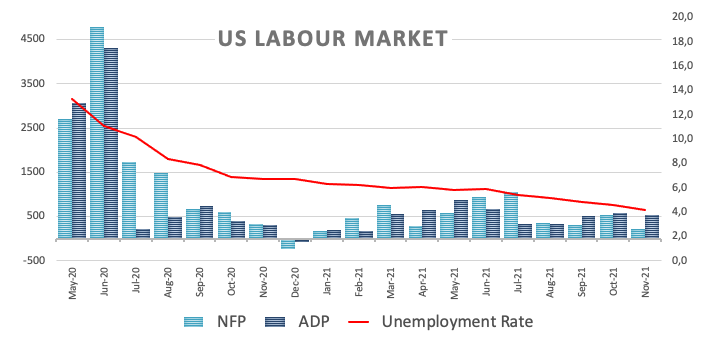
In the meantime, yields across the curve add to gains seen in the second half of the week, with the 2y note flirting with tops around 0.65%, the belly advances past 1.45% and the long end approaches 1.80%.
The dollar remains on track to close the sixth consecutive week with gains, always underpinned by the uptrend in US yields, auspicious results from US fundamentals – which in turn support the idea of a strong recovery – a pick-up of risk aversion on omicron fears and lately by the hawkish twist in Powell’s testimony after he suggested the Fed will discuss adopting a quicker tapering pace at the December meeting, all pointing to a rates lift-off at some point in mid-2022.
Closing the weekly calendar, Markit will publish the final Services PMI seconded by the ISM Non-Manufacturing.
US Dollar Index relevant levels
Now, the index is gaining 0.10% at 96.22 and a break above 96.93 (2021 high Nov.24) would open the door to 97.00 (round level) and then 97.80 (high Jun.30 2020). On the flip side, the next down barrier emerges at 95.51 (weekly low Nov.30) followed by 94.96 (weekly low Nov.15) and finally 94.44 (low Nov.18).
Senior E3 (France, Germany, UK) diplomats said on Friday that Iran has backtracked on the diplomatic progress made in recent nuclear talks, according to Reuters. The diplomats expressed disappointment and concern after analysing Iranian proposals for changes to the text negotiated during the prior six rounds of talks in Vienna. Iran has demanded major changes, they said, adding that it is now unclear how these new gaps can be closed in a realistic timeframe given these drafts.
Market Reaction
The news has added tailwinds for crude oil, with WTI at session highs and testing the $69.00 level. A WSJ report framed the comments as the closest E3 diplomats have yet come to admitting that a return to the old JCPOA nuclear pact agreed back in 2015 is impossible. At present, the US has placed severe sanctions to prevent Iran from exporting crude oil, which would only be lifted upon both sides agreeing on a return to the old nuclear pact.
- US Nonfarm payrolls report rose by 210K, lower than the 550K estimated.
- Canadian Employment Change increased 5-times of estimations while the Unemployment Rate falls.
- USD/CAD threatens to break the 200-hour SMA, that once breached, would send the pair tumbling towards 1.2700.
During the New York session, the USD/CAD plunges on a dismal US Nonfarm payrolls report, down 0.46%, trading at 1.2746 at the time of writing. In the last hour, US and Canada reported employment figures.
US Nonfarm payrolls disappoint, while Canadian Employment Change smash expectations
On Friday, the US Bureau of Labor Statistics (BLS) reported that in November, the US economy added just 210K new jobs, versus the 550K expected. Although the headline miss is substantial, it seems to ease investors’ reaction, as the Unemployment Rate for November fell three tenths from 4.5% in October to 4.2%.
Apart from the US, the Canadian economic docket, the Employment Change for November, showed that the Canadian economy added 153.7K new jobs, crushing economists’ expectations of 35K. Further, the pace of the labor market accelerated versus the previous month’s figures of just 35K. Worth noting of the employment report, 79.9K of the total jobs are full-time. Another positive from November’s data is that Unemployment Rate dropped from 6.7% to 6.0%.
Market’s reaction
That said, the USD/CAD pair reaction plummeted from 1.2819 down to 1.2760, bouncing off those lows towards 1.2786. However, at the time of writing, USD/CAD is extending its losses severely, as it is testing the S2 daily pivot point at 1.2747.
USD/CAD Price Forecast: Technical outlook
The USD/CAD in the 1-hour chart has a downward bias after printing a 72-pip bearish candle, breaking essential support levels, like the 50 and the 100-hour simple moving averages (SMA’s).
Furthermore, at press time, the 200-hour SMA is under pressure at 1.2742, which, if it gives way, would extend USD losses against the Loonie, which could witness the USD/CAD pair tumbling down to the S3 daily pivot at 1.2717, followed by a test of the 1.2700 figure.
Canadian employment surprised well to the upside with job growth of 154K in November, smashing the market consensus for 37.5K. A much stronger jobs number alongside a disappointment in US payrolls leaves the CAD in a decent position to outperform into next week's Bank of Canada (BoC) meeting, according to economists at TD Securities.
A lot of bad news looks to be in the price
“The November employment report crushed expectations with job growth of 154K, over 4x the market consensus for a 37.5k print. Full and part-time employment both saw large gains while unemployment fell to 6.0%, hours worked rose by 0.7% MoM, and wage growth accelerated to 3.0% YoY.”
“A strong jobs print alongside a well-priced hawkish Fed suggest that USD/CAD could be forming a short-term top in 1.28/29.”
“As for the BoC, they are likely to take a pass at announcing anything major next week but given CAD price action in recent weeks, we suspect a lot of bad news is in the price and risk/reward looks more favorable on betting on a hawkish surprise.”
Cable slides in a continued GBP downtrend. Economists at Scotiabank expect the GBP/USD to restest the 1.3200 level if 1.3250 gives way.
Resistance above 1.33 region is seen around 1.3335
“The pound’s failed push above 1.33 leaves the short-term charts looking a touch more negative and the broad downtrend points to losses extending to a re-test of 1.32 if the mid-figure area gives way.”
“After the 1.33 area, resistance is ~1.3335 and 1.3350/70.”
St Louis Fed President and FOMC voting member in 2022 James Bullard said on Friday that the Fed should remove monetary policy accommodation.
Additional Takeaways:
“The Fed may want to consider removing accommodation at a faster pace in upcoming meetings.”
“The US economy had inflation shock in 2021.”
“Asset price inflation has been substantial as well.”
“US GDP recovered and is poised to grow further, the labor market is very tight and likely to get stronger.”
“It remains too soon to assess the impact of the new Covid-19 variant on US economy.”
The EUR is leading the major currencies against the dollar with a minor 0.1% gain that has pushed EUR/USD back above 1.13. European Central Bank (ECB) President Christine Lagarde said earlir on Friday "when conditions of the forward guidance are satisfied, we will not hesitate to act." This stance may avoid a EUR/USD drop to 1.10, in the opinion of economists at Scotiabank.
Lagarde affirmed that the PEPP will end in March 2022
“Lagarde said that the ECB ‘will not hesitate to act’ if the conditions of its forward guidance (sustained expectations of inflation over 2%) are met, but she also noted that they still expect inflation to ease from current elevated levels over 2022 – which makes a hike next year very unlikely. She also affirmed that the PEPP will end in March 2022. Her comments signal a higher willingness to act from the ECB that may give the EUR a hand to prevent a marked drop under 1.10.”
“The intraday low of 1.1282 will act as support ahead of the mid figure zone and then the low 1.12s.”
“Resistance is ~1.1315 followed by firmer at ~1.1350.”
According to a report released by the US Treasury Department, no major US trading partners were labeled as FX manipulators.
Key Takeaways:
"Currency report concludes that Vietnam and Taiwan continue to meet all three manipulation criteria for enhanced engagement under 2015 law."
"Reached agreement with Vietnam in July to address treasury's concerns, is satisfied with the progress made to date."
"Will continue enhanced engagement with Taiwan that was launched in May."
"Urging Taiwan to develop a specific action plan to address causes of currency undervaluation and external imbalances."
"Switzerland no longer meets all three criteria for enhanced analysis."
"Will continue to conduct in-depth analysis of Switzerland until it no longer meets all three criteria under 2015 law for at least two consecutive reports."
"Will continue enhanced bilateral engagement with Switzerland to discuss policy options to address underlying causes of external imbalances."
"Put 12 economies on the 'monitoring list' for currency practices - China, Japan, Korea, Germany, Ireland, Italy, India, Malaysia, Singapore, Thailand, Mexico and Switzerland."
"China's failure to publish foreign exchange intervention data, lack of transparency make it an 'outlier' among major economies, will closely monitor activities of state-owned banks."
"The Treasury has raised concerns about China's practices with Chinese counterparts."
"Closely monitoring China's data and policies, concerned about persistent 'very large and persistent' bilateral trade surplus."
"Particularly focused on increased intervention in currency markets by china's state-owned banks over last 1-1/2 years."
"Adjusting thresholds for three major manipulation criteria under 2015 law."
"Trade surplus threshold shifted to $15 bln goods and services surplus from $20 bln goods surplus."
"Current account surplus threshold shifted to 3% of GDP or estimated current account gap of 1%, from previous 2% of GDP surplus."
"Now measuring the persistence of net foreign exchange purchases over 8 of 12 months vs 6 of 12 months previously."
"5 countries - Singapore, Taiwan, Vietnam, India and Switzerland - intervened in forex market in 'sustained, asymmetric manner' to weaken currencies over the 4 quarters through June 2021."
Lee Sue Ann, Economist at UOB Group, suggests the Federal Reserve would refrain from moving on rates at this month’s event.
Key Quotes
“The November FOMC minutes showed an increasing number of Fed officials willing to accelerate the asset purchase program (QE) tapering and consider earlier rates lift-off, if high inflation persists.”
“We now expect the Fed to announce at this coming meeting, a faster pace of QE reduction for 1Q 2022 and the tapering completion timeline will likely be brought forward to April 2022.”
- EUR/USD advances to the 1.1330 region on Friday, drops afterwards.
- US Nonfarm Payrolls missed estimates at 210K in November.
- The US jobless rate ticked lower to 4.2%, more than expected.
The single currency keeps the volatile mood unchanged and now prompts EUR/USD to return to the 1.1300 neighbourhood after hitting tops past 1.1330 in the wake of the US Nonfarm Payrolls.
EUR/USD stays capped by 1.1382
The absence of a clear direction in the price action around EUR/USD stays well and sound at the end of the week.
In fact, EUR/USD rapidly climbed to highs in the 1.1330 region after the US Nonfarm Payrolls came in short of forecasts in November. Indeed, the US economy added 210K jobs during last month (vs. expectations of a 550K gain), although the unemployment rate surprise to the upside after dropping to 4.2%.
Additional data saw the Average Hourly Earnings – a proxy for wage inflation – rising 0.3% MoM and 4.8% from a year earlier. The Participation Rate rose a tad to 61.8%.
Next in the US docket comes the ISM Non-Manufacturing, Markit’s final Services PMI and Factory Orders.
EUR/USD levels to watch
So far, spot is gaining 0.10% at 1.1310 and faces the next up barrier at 1.1382 (weekly high November 30) followed by 1.1464 (weekly high Nov.15) and finally 1.1519 (55-day SMA). On the other hand, a break below 1.1186 (2021 low Nov.24) would target 1.1185 (monthly low Jul.1 2020) en route to 1.1168 (low Jun.19 2020).
- GBP/USD attracted some dip-buying near mid-1.3200s and shot to a fresh daily high in the last hour.
- Disappointing headline NFP print prompted some USD selling and provided a modest lift to the pair.
- Brexit uncertainties, hawkish Fed expectations helped limit the USD losses and capped the upside.
The GBP/USD pair shot to a fresh daily high in reaction to dismal US jobs data, albeit struggled to capitalize on the move or find acceptance above the 1.3300 mark.
Having dropped to a three-day low earlier this Friday, the GBP/USD pair attracted some dip-buying in the vicinity of mid-1.3200s and got an additional boost during the early North American session. The latest leg of a sudden spike over the past hour or so followed the release of the closely-watched US NFP report, which showed that the economy added 210K jobs in November. This was well below consensus estimates pointing to a reading of 550K and the previous month's upwardly revised reading of 546K.
Additional details revealed that Average Hourly Earnings fell short of market expectations and led to a modest US dollar weakness, which, in turn, provided a goodish lift to the GBP/USD pair. However, the disappointment, to a larger extent, was offset by a larger than expected drop in the unemployment rate, which fell to 4.2% from 4.6% in October. Adding to this, the fact that the Fed has acknowledged a sufficient labor market recovery to permit higher interest rates helped limit any deeper losses.
On the other hand, persistent Brexit-related uncertainties continued acting as a headwind for the British pound. This was seen as another factor that kept a lid on any meaningful upside for the GBP/USD pair. This makes it prudent to wait for a strong follow-through buying beyond the 200-hour SMA, currently around the 1.3320-25 region, before positioning for any further appreciating move. Next on tap will be the release of the US ISM Services PMI, which might provide some impetus to the pair.
Technical levels to watch
- Canada's economy added 153.7K jobs in November, more than the 35K expected.
- USD/CAD fell 50 pips to the 1.2270s as a result, as weighed by weaker than expected US data.
The Canadian economy added 153.7K jobs in the month of November, well above expectations for a 35K gain and a marked acceleration from the 31.2K jobs added in October. 79.9K of these job gains were in full-time employment. Meanwhile, the unemployment rate dropped to 6.0% from 6.7% in October, a significantly larger decline than the expected drop to 6.6%.
Market Reaction
USD/CAD has seen a substantial drop, in part due to the strong Canadian data that will bring forward BoC tightening expectations, but also due to a weaker than expected US labour market report that was released at the same time. The pair was trading above 1.2820 prior to the data but has dipped about 50 pips to trade in the 1.2770s.
- The US economy added 210K jobs in November, below the 550K expected.
- The dollar weakened in a kneejerk reaction to the data.
Nonfarm Payrolls (NFP) rose by 210K in November versus the median forecast for a 550K rise, data published by the US Bureau of Labor Statistics showed on Friday. That marked a substantial decline versus the 546K jobs added to the US economy in October.
The unemployment rate saw a substantially larger than expected drop to 4.2% from 4.6% in October, versus expectations for a drop to 4.5%. Meanwhile, the MoM gain in Average Hourly Earnings came in at 0.3%, below expectations for it to hold at October's 0.4% MoM level. That meant that the YoY rate of Average Hourly Earnings growth remained at 4.8% in November versus median forecasts for a rise to 5.0%.
Market Reaction
The Dollar Index saw kneejerk weakness in the immediate aftermath of the not as strong as hoped for labour market report, dropping back to test the 96.00 level from previously above 96.20. Analysts may now question whether the data was strong enough for the Fed to justify an acceleration of its QE taper in January when it meets to decide on policy later in the month.
USD/JPY continues to hold the key 55-day moving average (DMA) now at 113.10 on a closing basis. Economists at Credit Suisse still look for a floor here with a break above 113.70/96 needed to clear the way for a move back to the 115.42/52 highs.
Key 55-DMA support at 113.10 continues to hold
“Whilst we continue to look for an attempt to find a floor at the 113.10 55-day average, above 113.70/96 remains needed to reassert an upward bias with resistance then seen next at 114.78 and eventually back at 115.42/52.”
“Big picture with a major base in place, we continue to look for a move above 115.42/52 in due course for a test of the long-term downtrend from April 1990 at 116.96.”
“A close below 113.10 though would warn of a more protracted, but still corrective fall with support seen next at the recent low and the 38.2% retracement of the rally from April at 112.53/45, with more important support seen starting at the ‘neckline’ to the major base at 111.84 ahead of the July high at 111.66.”
AUD/USD finally closed below important support at 0.7106 on Thursday, which analysts at Credit Suisse look to be sustained into the weekly close to confirm a major long-term top. They see scope for a fall to 0.6758 if the top is confirmed.
Ongoing deterioration in the trend-following setup
“AUD/USD has finally closed below major support at 0.7106, which we look to be sustained into the weekly close given that the trend picture remains strongly negative. This would confirm a much larger long-term top, which would turn the long-term risks lower and suggest that aggressive further weakness is likely.”
“We look for a move to 0.6991, with the size of the top suggesting a move to 0.6758 is easily achievable over the medium-term and potentially even beyond.”
“Near-term resistance is seen at the ‘neckline’ to the top at 0.7146, which the market continues to hold below into the close. Above here and then 0.7169/74 would suggest a corrective recovery.”
- WTI is about $1.0 higher on the day in the $68.00s, about $6.0 above Thursday’s lows.
- Analysts framed OPEC+’s decision to press ahead with output hikes as a “vote of confidence in the near-term demand outlook”.
Oil prices continue to trade with an upside bias, with front-month WTI futures having now recovered roughly $6.0 (nearly 10%) to the $68.00s from Thursday’s lows in the $62.00s. On the day, that translates to gains of about $1.0 or 1.5%. Oil prices tumbled on Thursday in the immediate aftermath of OPEC+’s surprise decision to press ahead with 400K barrel per day output hike in January, going against analyst expectations for the group to halt output amid Omicron-related uncertainty.
But market participants deemed the knee-jerk reaction to be excessive. Some analysts framed OPEC+’s decision as a “vote of confidence in the near-term demand outlook” and interpreted the decision as OPEC+ signaling that it does not expect Omicron to have a lasting impact on demand. Other analysts pointed out that the cartel did caveat that it was prepared to meet again ahead of its next scheduled 4 January meeting if there was a marked change in market conditions. In other words, a halt to/reversal of output hikes remains on the table if needed.
With OPEC+ in the rear-view mirror, oil traders will on Friday be focused on US macro data in the form of the November labour market report and, more importantly, any new information/headlines about Omicron. A strong labour market report should confirm that the Fed will accelerate the pace of their QE taper in January, which should have a very limited impact on oil prices.
- USD/JPY added to the previous day’s gains and edged higher for the second straight day.
- Improving global risk sentiment undermined the safe-haven JPY and remained supportive.
- Retreating US bond yields capped gains for the USD and the pair ahead of the NFP report.
The USD/JPY pair maintained its bid tone heading into the North American session and was last seen trading just a few pips below the daily high, around the 113.35-40 region.
The pair gained some positive traction for the second successive day on Friday and built on the overnight bounce from the vicinity of mid-112.00s, or the lowest level since October 11. A generally positive tone around the equity markets undermined the safe-haven Japanese yen and was seen as a key factor that acted as a tailwind for the USD/JPY pair.
The global risk sentiment stabilized a bit on the back of easing fears about the potential economic fallout from the recently discovered, possibly vaccine-resistant Omicron variant of the coronavirus. Adding to this, the passage of a bill to fund the US government through mid-February further contributed to the upbeat market mood on Friday.
On the other hand, the US dollar drew some support from firming expectations that the Fed will adopt a more aggressive policy response to contain stubbornly high inflation. However, retreating US Treasury bond yields held back the USD bulls from placing aggressive bets and kept a lid on any further gains for the USD/JPY pair, at least for the time being.
Investors also seemed reluctant and preferred to wait for a fresh catalyst from Friday's release of the closely-watched US monthly employment details. The popularly known NFP report will play a key role in influencing the USD price dynamics. Apart from this, the US ISM Services PMI will also be looked upon for some meaningful trading opportunities around the USD/JPY pair.
Technical levels to watch
- AUD/USD is trading with a downside bias pre-NFP and recently bounced at 0.7050.
- A strong report would endorse the Fed’s hawkishness and could push AUD/USD lower towards the key 0.7000 level.
AUD/USD continues to trade with a negative bias as the key US jobs report approaches. The pair recently bounced at the 0.7050 level, which was its lowest in over 12 months, and currently trades around 0.7060 with on the day losses of about 0.4%. Uncertainty about how the new Omicron Covid-19 variant is going to impact short-term global economic outlook continues to weigh on risk assets and seems to be weighing slightly on the Aussie on Friday.
On the week, AUD/USD’s losses now stand at about 0.7%. This is not as bad as many traders might have thought in light of this week’s hawkish pivot for Fed Chair Jerome Powell and a string of strong US macro releases. Wednesday’s smaller than expected decline in Australia GDP in Q3 has probably helped stem the tide against the Aussie, as it keeps the prospect alive that the RBA may also do a hawkish pivot to signal potential hikes in 2023. But that is not the main focus of the market this Friday. The main focus is on the US November jobs report.
The median bank forecast is for the headline NFP number to come in at 550K, which would mark a slight improvement from October’s 531K reading. The unemployment rate is seen falling to 4.5% from 4.6%. The YoY pace of growth in Average Hourly Earnings is seen rising slightly to 5.0% from 4.9% last month. Alternative labour market data from November/the official jobs report survey period has for the most part been strong; ADP’s estimate of employment change came in at 534K on Wednesday, the employment components of the ISM and Markit PMI surveys (not including the ISM service PMI, which is yet released) all showed slight improvement versus October, weekly initial jobless claims in the November survey week was lower versus the October survey week and Challenger job cuts fell to a fresh low since 1993.
A strong report, though expected, would endorse the Fed’s more hawkish view and likely support the US dollar. AUD/USD bears would likely then look for a continuation of the recent bear trend and perhaps a test of the Q3/Q4 2020 lows at 0.7000.
-637741314441807354.png)
Canadian employment details overview
Statistics Canada is scheduled to publish the monthly jobs report for November later this Friday at 13:30 GMT. The Canadian economy is expected to have added 35,000 jobs during the reported month, up from 31,200 reported in October. The unemployment rate is seen ticking lower to 6.6% from 6.7% previous.
Meanwhile, analysts at CIBC sounded downbeat about the report and wrote: “We are only pencilling in an addition of 10K jobs for the month, which would likely see the unemployment rate rise at least a tick to 6.8%.”
How could the data affect USD/CAD?
Ahead of the key release, the prevalent US dollar bullish sentiment pushed the USD/CAD pair to the highest level since September 21. However, a strong follow-through recovery in crude oil prices acted as a tailwind for the commodity-linked loonie and capped gains for the major.
Meanwhile, the data is likely to be overshadowed by the simultaneous release of the US monthly jobs report (NFP), suggesting that any immediate market reaction is more likely to be short-lived. Nevertheless, any significant divergence from the expected readings would influence the Canadian dollar and infuse some volatility around the major.
From a technical perspective, the intraday move up struggled to find bullish acceptance above the 1.2830-35 resistance zone. This makes it prudent to wait for a strong follow-through buying before positioning for any further appreciating move towards the September monthly swing high, around the 1.2900 round-figure mark.
On the flip side, any meaningful corrective pullback below the 1.2800 mark might continue to attract some buying near the 1.2740-35 horizontal support. This is followed by the weekly low, around the 1.2715-10 region, which if broken decisively might prompt some technical selling. The pair might then turn vulnerable and accelerate the fall towards the next relevant support near the 1.2640 region.
Key Notes
• Canadian Jobs Preview: Forecasts from five major banks, labour market to keep pressuring the BoC
• Investors eye NFP, Canadian job data
• USD/CAD: Upward momentum prevails, August high at 1.3020 in the crosshairs – SocGen
About the Employment Change
The employment Change released by Statistics Canada is a measure of the change in the number of employed people in Canada. Generally speaking, a rise in this indicator has positive implications for consumer spending which stimulates economic growth. Therefore, a high reading is seen as positive, or bullish for the CAD, while a low reading is seen as negative or bearish.
About the Unemployment Rate
The Unemployment Rate released by Statistics Canada is the number of unemployed workers divided by the total civilian labour force. It is a leading indicator for the Canadian Economy. If the rate is up, it indicates a lack of expansion within the Canadian labour market. As a result, a rise leads to weaken the Canadian economy. Normally, a decrease of the figure is seen as positive (or bullish) for the CAD, while an increase is seen as negative or bearish.
- EUR/USD looks to leave behind two consecutive sessions with losses.
- If sellers regain control, the initial support comes at 1.1235.
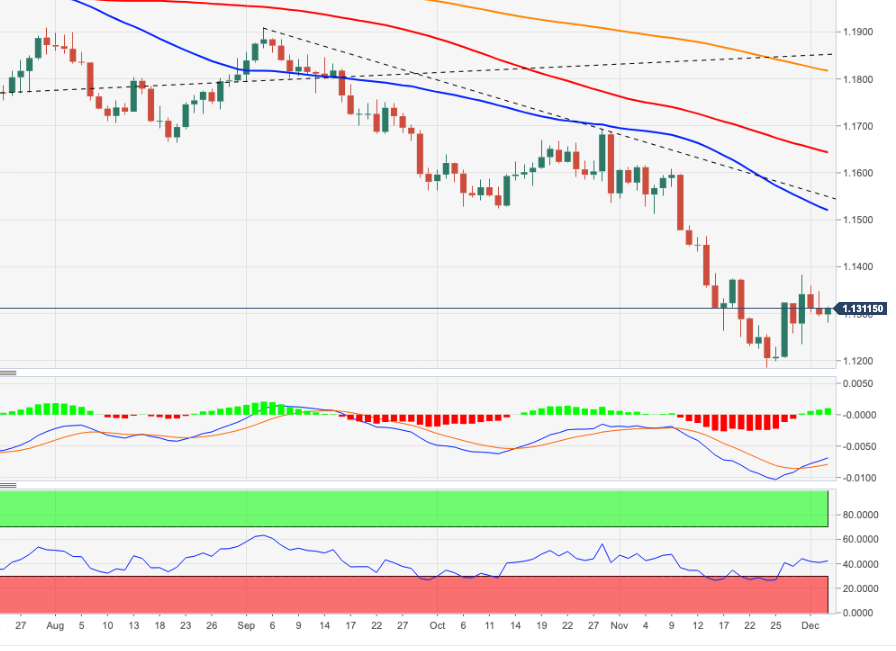
EUR/USD manages to bounce off the daily low in the 1.1280 region on Friday.
Further downside is expected to meet initial contention around 1.1230 (November 30), which is the last defence for another assault to the 2021 low at 1.1186 (November 24).
The probability of further losses remains unchanged as long as EUR/USD trades below the 2-month resistance line (off September’s peak) near 1.1550. In the longer run, the offered stance in spot is expected to persist while below the 200-day SMA at 1.1815.
EUR/USD daily chart
- DXY inches higher and extends the break above 96.00.
- Further up is located the YTD peak near 97.00.
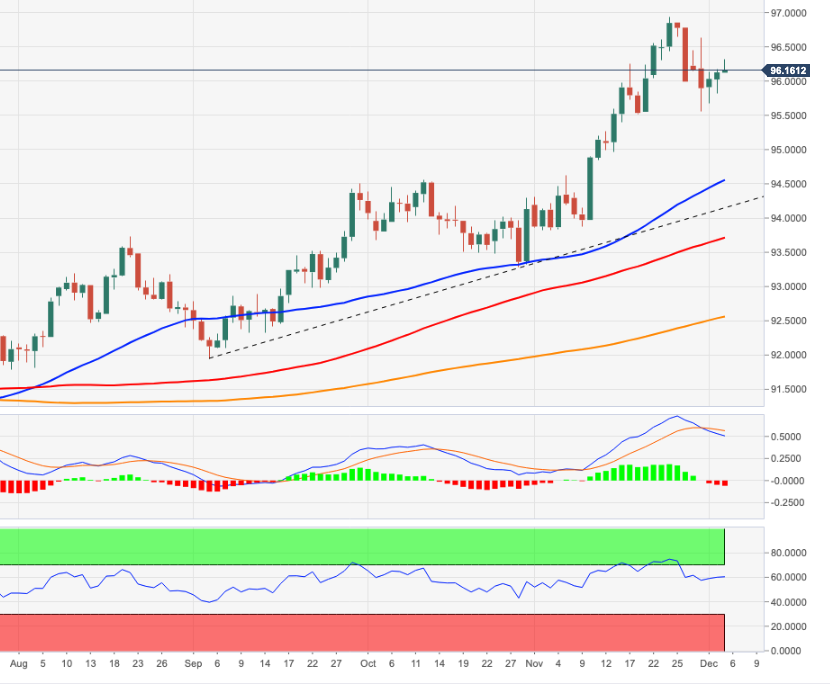
DXY adds to the gradual rebound from weekly lows in the mid-95.00s (November 30), with gains so far capped near 96.30.
The continuation of the upside momentum targets the 2021 highs in levels just shy of the 97.00 barrier (November 24) ahead of the round level at 97.00 and 97.80 (high June 30 2020).
In the meantime, while above the 2-month support line (off September’s low) near 94.20, extra gains in DXY remain well on the table. In addition, the broader constructive stance remains underpinned by the 200-day SMA at 92.56.
DXY daily chart
- EUR/JPY reclaims the 128.00 mark and above on Friday.
- Immediately to the upside comes the monthly high at 128.78.
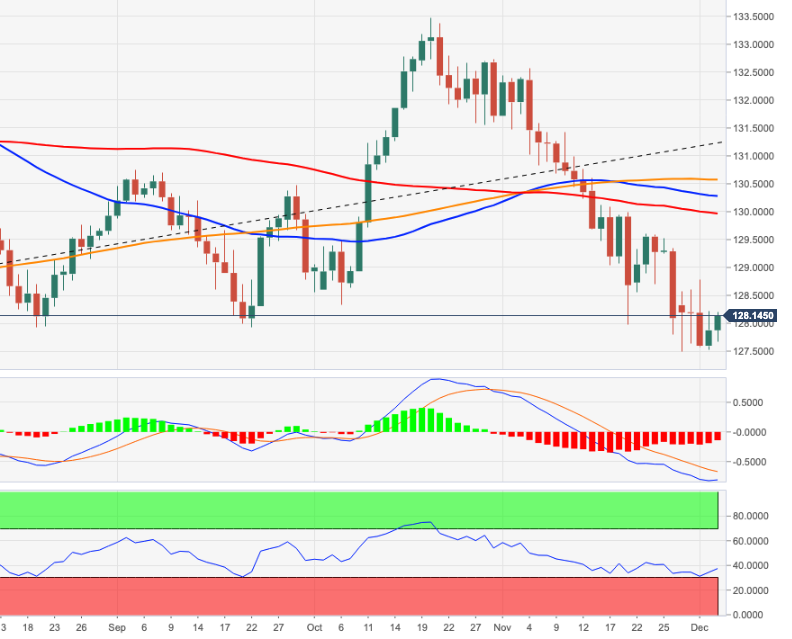
EUR/JPY manages to clinch the second session with gains above the 128.00 yardstick at the end of the week.
If the rebound gathers extra pace, then the cross should face a minor hurdle at the 10-day SMA at 128.53 ahead of the more relevant monthly peak at 128.78 (December 1). Further up is located the interim hurdle at the 20-day SMA (129.31) prior to the weekly high at 129.60 (November 23). Above the latter, the downside pressure is expected to mitigate somewhat.
Looking at the broader picture, the outlook for the cross is expected to remain negative while below the 200-day SMA, today at 130.53.
EUR/JPY daily chhart
US monthly jobs report overview
Friday's US economic docket highlights the release of the closely-watched US monthly jobs data. The popularly known NFP report is scheduled for release at 13:30 GMT and is expected to show that the economy added 550K new jobs in November, up from 531K in the previous month. The unemployment rate is expected to edge lower to 4.5% from 4.6% in October. Given Wednesday's stronger US ADP report on private-sector employment, market participants have turned more optimistic about the official figures.
According to Joseph Trevisani, Senior Analyst at FXStreet: “The November payroll report stands a good chance of performing better than forecast. Signs from the labor market and consumer economy point to a continued recovery in the United States.”
How could the data affect EUR/USD?
Against the backdrop of stubbornly high inflation, a stronger than expected headline NFP would further fuel speculations about a more aggressive policy tightening by the Fed. This would result in higher US Treasury bond yields and a stronger US dollar. Conversely, a weaker print – though seems unlikely – is likely to offset by the fact that the Fed has acknowledged a sufficient labor market recovery to permit higher interest rates. This, in turn, suggests that the path of least resistance for the USD is to the upside and down for the EUR/USD pair.
Meanwhile, Eren Sengezer, Editor at FXStreet, offered a brief technical outlook for the major: “The Relative Strength Index (RSI) indicator on the four-hour chart retreated below 50, suggesting that sellers look to retain control of EUR/USD.”
Eren also outlined important technical levels to trade the EUR/USD pair: “At the time of press, the pair was testing 1.1290 (Fibonacci 23.6% retracement of November downtrend). The 50-period SMA aligns as the next support at 1.1280 and additional losses could be witnessed toward 1.1235 (Tuesday low) in case that level turns into resistance.”
“The bearish pressure could weaken if bulls reclaim 1.1320 (100-period SMA, 20-period SMA). 1.1350/60 area (static level, Fibonacci 38.2% retracement) could be seen as the next resistance,” Eren added further.
Key Notes
• Nonfarm Payrolls Preview: Jobs’ headline could be a make it or break it in tapering’s decision
• US Nonfarm Payrolls November Preview: Can we agree the labor market is healing?
• EUR/USD Forecast: Euro to continue to weaken as long as 1.1320 resistance holds
About the US monthly jobs report
The nonfarm payrolls released by the US Department of Labor presents the number of new jobs created during the previous month, in all non-agricultural business. The monthly changes in payrolls can be extremely volatile, due to its high relation with economic policy decisions made by the Central Bank. The number is also subject to strong reviews in the upcoming months, and those reviews also tend to trigger volatility in the forex board. Generally speaking, a high reading is seen as positive (or bullish) for the USD, while a low reading is seen as negative (or bearish), although previous months reviews and the unemployment rate are as relevant as the headline figure.
Economist at UOB Group Ho Woei Chen, CFA, comments on the latest release of inflation figures in South Korea.
Key Takeaways
“Inflation rose unexpectedly in November. Headline inflation accelerated to 3.7% y/y, 0.4% m/m (Bloomberg est: 3.1% y/y, -0.2% m/m), up from October’s 3.2% y/y, 0.1% m/m. This is a fresh decade high and marks the 8th consecutive month that the inflation rate is above Bank of Korea’s (BOK) 2% target.”
“The core CPI (excluding agricultural products & oils) moderated to 2.3% y/y from 2.8% in October but was also a surprise increase against Bloomberg’s consensus of 2.2%. Compared to the previous month, core CPI rose 0.1% vs. 0.3% gain in October.”
“With year-to-date inflation at 2.3% y/y, the average full-year inflation is likely to be 2.4% this year, slightly exceeding BOK’s revised forecast. The BOK raised its inflation forecast in November to 2.3% for 2021 (from 2.1%) and 2.0% for 2022 (from 1.5%). We expect headline inflation to stay above the BOK’s target in 1H22 before moderating in the later part of the year, partly due to the high comparison base.”
“Given the surge in November inflation as well as sustained strength in its macroeconomic data, we continue to project the next BOK rate hike in 1Q22, likely at the February meeting.”
Bank of England (BOE) policymaker Michael Saunders said on Friday that a key consideration for him at the December policy meeting will be the possible economic effects of the new Omicron variant, as reported by Reuters.
Additional takeaways
"It is likely that any rise in bank rate will be limited given that the neutral level of interest rates remains low."
"Provided we do not delay too long, it should be a case of easing off the accelerator rather than applying the brakes."
"Will need to consider the potential costs and benefits of waiting to see more data on this before – if necessary – adjusting policy."
"Assumptions are uncertain, especially in light of the new Omicron variant."
"It is within the range of possibilities that the new Omicron variant will significantly affect the economic outlook."
"If the economy develops in line with the MPR central forecast or my expectations, the direction of travel for bank rate during the next few quarters is clearly likely to be upward."
"Aggregate demand and supply could also both be affected by increased precautionary behaviour."
"If easing is required, the MPC has options to support the economy if needed – but this is not my central expectation."
"In considering if and when to adjust rates, there is always a case to wait and see more data."
"Given Omicron has only been detected quite recently, there could be particular advantages in waiting to see more evidence."
"Continued delay also could be costly."
"Not convinced by the view that it would be possible to lift labour supply (or significantly lift overall potential output) by aiming to run the economy hot."
"Delay on raising rates could require a more abrupt and painful policy tightening later. For me, the balance between these considerations is likely to be a key factor at the December meeting."
Market reaction
The GBP/USD pair extended its daily decline following these comments and was last seen losing 0.32% on the day at 1.3264.
Considering the view of FX Strategists at UOB Group, a near-term drop to 6.3525 in USD/CNH now seems to be losing traction.
Key Quotes
24-hour view: “USD traded between 6.3687 and 6.3773 yesterday, narrower than our expected sideway-trading range of 6.3650/6.3800. The quiet price actions offer no fresh clues and further sideway-trading would not be surprising. Expected range for today, 6.3660/6.3810.”
Next 1-3 weeks: “On Wednesday (01 Dec, spot at 6.3650), we held the view that USD could weaken to 6.3525. However, USD has not been able to make any headway on the downside as it traded in a quiet manner the past couple of days. Downward momentum has eased and the odds for USD to move lower to 6.3525 have diminished. On the upside, a break of 6.3880 (no change in ‘strong resistance’ level) would indicate that the downside risk has dissipated.”
- USD/TRY fades an initial spike to the vicinity of 13.9000.
- Turkey’s inflation rose more than expected in November.
- The CBRT intervened once again in the FX markets.
USD/TRY advances further and records a new all-time high in the vicinity of 13.90 on Friday.
USD//TRY looks to CBRT, intervention
Following the record tops, the Turkish central bank (CBRT) announced it directly intervened in the FX markets, always citing the “unhealthy price formations in exchange rates” as some sort of justification. Following the CBRT move, spot dropped to the 13.30 region as the lira (apparently) regained attraction.
The lira, in the meantime, continues to suffer the lack of credibility in the CBRT, which keeps undermining the prospects for the currency in the longer run. That’s not even considering the persistent interference of politics in the design of the monetary policy by the CBRT.
In addition, inflation figures in Turkey showed the CPI rose more than expected in November, this time 21.31% YoY and 3.51%, surpassing initial forecasts. Additionally, Producer Prices rose 9.99% inter-month and 54.62% over the last twelve months.
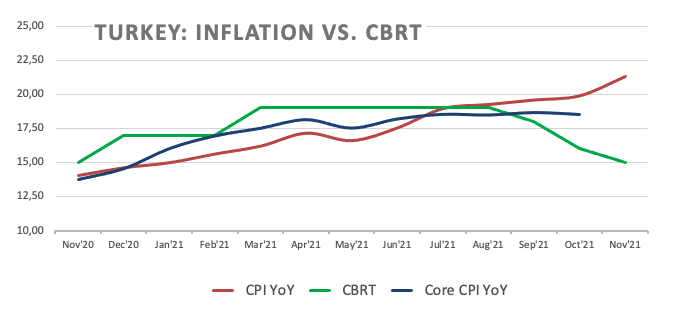
USD/TRY key levels
So far, the pair is losing 0.11% at 13.6106 and a drop below 12.3585 (low Dec.1) would open the door to 11.5451 (low November 24) and finally 11.4583 (20-day SMA). On the other hand, the next up barrier lines up at 13.8746 (all-time high Dec.1) followed by 14.0000 (round level).
while speaking at an event organized by Reuters on Friday, BioNTech CEO Ugur Sahin said the new variant might be able to infect vaccinated people and people with high exposure to COVID-19.
Additional takeaways
"It's not clear if vaccinated people have sufficient protection to avoid severe disease from new variant, we anticipate vaccinated people will be protected from severe disease."
"This new variant came earlier than I expected, I expected it sometime next year."
"We have the ability to adapt COVID-19 vaccine relatively quickly."
"We are confident that vaccinated people and those with booster shots will have sufficient protection against severe disease and may be any type of disease; we will know in a few weeks."
"The higher rate of immune people, the better we are protected against COVID-19 having the ability to mutate."
"I think we will need a new vaccine against COVID-19, it's a question of when we will need it."
Market reaction
These comments seem to be weighing on market sentiment. As of writing, US stock index futures were down between 0.3% and 0.4%.
The yuan has recently been very strong against the dollar even as the US Dollar Index has been rising. However, economists at ING expect the CNY to depreciate against the USD through next year. Here are their three calls for China in 2022.
State-Owned Enterprises to return as the core of investment entity
“As intense policy actions are expected to be toned down, the pattern of economic growth should start to return to normal. But this will involve more reliance on State-Owned Enterprises (SOEs) to invest in infrastructure for renewable energy and technology. Private-owned enterprises (POEs) will play a role to facilitate these projects when SOEs contract out work to the private sector.”
No change to the slight easing of monetary policy
“Monetary policy is not likely to be relaxed unless it looks like economic growth is at serious risk, and the probability of this is low as the government can control the pace of investment growth. We believe that the likelihood that the People's Bank of China (PBoC) cuts policy rates or the Reserve Rate Requirement (RRR) is small.”
Portfolio inflows via opening-up of the capital account
“The opening-up of China’s capital account has attracted portfolio inflows. These inflows will slow if further opening in 2022 starts to look less likely. In this event, there will be more two-way portfolio flows depending on relative asset prices onshore versus offshore. This means the yuan could be volatile. And the tendency towards yuan depreciation in the face of an increasingly hawkish Fed will be significant. This should end up with a weaker yuan against the dollar by the end of 2022.”
Economists at Barclays see limited scope for the pound to rally in the near-term and targets GBP/USD around 1.33 by year-end.
Rising inflation into Q1 22 to undercut real rate support for the pound
“Rising UK inflation is undercutting the positive impact of Bank of England rate hike expectations. The front-end of the UK OIS curve now looks reasonably priced to us. However, rising inflation into Q1 22 should undercut real rate support for the pound."
"Slowing growth and ongoing concerns about the EU-UK post-Brexit trading relationships will limit the ability for GBP to rally near-term. Further out, elevated levels of foreign acquisition and investment in UK assets should provide an undercurrent of support for GBP."
“We expect the GBP/USD to hover around the 1.33 level by end-2021.”
From fiscal reforms to wage growth to inflation; these are three significant challenges for the eurozone in 2022, according to economists at ING.
Still no fiscal reforms but silent power shift towards Brussels
“We do not expect changes to the numerical fiscal rules but a shift towards a more pragmatic country-specific approach, balancing between debt sustainability and the need for investments. In the meantime, the frontloading of investments planned by the new German government will find many eurozone followers, postponing any austerity to 2023.”
Expect a rebound in wage growth for 2022
“Labour shortages have returned far quicker than expected, improving workers’ bargaining power. The soaring inflation rate has already and will continue to result in higher wage demands from unions, while countries with inflation indexation will automatically see wages rise. Finally, strong profits give corporates room to increase salaries. We expect an increase to 3-3.5% in 2022, which is above the peak seen in 2019.”
Inflation will fall below 2%, but the ECB’s medium-term target will be met
“We agree with the ECB that the disappearing effect from the German VAT increase in 2021, an improvement of supply chain disruptions and a more favourable base effect for energy prices are likely to push inflation towards 2% in the second half of 2022. However, the output gap in the eurozone will turn positive next year and will be significantly marked in 2023 and beyond. The ECB’s staff forecasts from December 2022 are likely to show an inflation rate of around 2% over the forecasting horizon, a backdrop that would justify an initial rate hike in the first half of 2023.”
- EUR/GBP gained some positive traction on Friday and snapped two days of the losing streak.
- Brexit-related uncertainties turned out to be a key factor behind the GBP’s underperformance.
- Divergent BoE-ECB monetary policy outlooks warrants caution for aggressive bullish traders.
The EUR/GBP cross maintained its bid tone through the first half of the European session and was last seen trading just above the 0.8500 round-figure mark.
Having touched a three-day low earlier this Friday, the EUR/GBP cross managed to gain some positive traction and recovered a part of the previous day's losses. Persistent Brexit-related uncertainties turned out to be a key factor behind the British pound's relative underperformance. This, in turn, assisted the cross to snap two consecutive days of the losing streak and stall this week's corrective pullback from the 0.8535-40 region.
On the economic data front, a downward revision of the Eurozone Services PMI was offset by a rather unimpressive final UK Services PMI and did little to provide any meaningful impetus. That said, the divergent Bank of England and the European Central Bank monetary policy outlooks could hold back bullish traders from placing aggressive bets and cap gains for the EUR/GBP cross. This, in turn, warrants some caution for bullish traders.
The BoE is widely expected to hike interest rates at its upcoming monetary policy meeting on December 16. Conversely, the ECB officials have been pushing back against market bets for tighter policy and talked down the need for any action to counter inflation. In fact, the ECB President Christine Lagarde said this Friday that it is very unlikely to see rate hikes next year and sees inflation moving back towards the target in course of 2022.
Hence, it will be prudent to wait for some follow-through buying before positioning for an extension of the recent strong recovery move from the 0.8380 region, or the lowest level since February 2020 touched in November. However, the downside seems cushioned, at least for the time being, as investors assess the impact of the new and possible vaccine-resistant Omicron variant of the coronavirus on economic recoveries.
Technical levels to watch
GBP/USD has dropped below 1.3300 on renewed dollar strength. As FXStreet’s Eren Sengezer notes, technicals turn bearish as buyers fail to lift cable above key hurdles ahead of US jobs report.
Near-term technical outlook turns bearish
“Investors forecast Nonfarm Payrolls (NFP) to rise by 550K. However, market participants will pay close attention to wage inflation. A stronger-than-anticipated print could trigger another leg higher in the US Dollar Index as it would reaffirm the Fed's tightening prospects.”
“Even if a disappointing jobs report weighs on the greenback, the dollar sell-off is likely to remain short-lived as Fed policymakers won't have enough time to adjust their commentary ahead of the blackout period that starts on Saturday.”
“On the four-hour chart, GBP/USD trades below the 20-period and the 50-period SMAs. Additionally, the Relative Strength Index (RSI) indicator stays below 50, suggesting that sellers are starting to dominate the pair's action in the near-term.”
“GBP/USD is testing 1.3280 static support. In case this level turns into resistance, the next target on the downside aligns at 1.3240 (static level) before 1.3200/1.3195 (psychological level/ November 30 low).”
“Resistances are located at 1.3300 (psychological level, 20-period SMA), 1.3320 (50-period SMA) and 1.3360 (static level).”
See – NFP Preview: Forecasts from 10 major banks, strong print to reinforce Fed's recent hawkish pivot
- Eurozone Retail Sales rose by 0.2% MoM in October vs. 0.2% expected.
- Retail Sales in the bloc stood at 1.4% YoY in October vs. 1.2% expected.
Eurozone’s Retail Sales rose by 0.2% MoM in October versus 0.2% expected and -0.4% last, the official figures released by Eurostat showed on Friday.
On an annualized basis, the bloc’s Retail Sales came in at 1.4% in October versus 2.6% recorded in September and 1.2% estimated.
FX implications
The euro is holding onto its renewed upside on the mixed Eurozone Retail Sales data.
At the time of writing, the major trades at 1.1300, modestly flat on the day.
About Eurozone Retail Sales
The Retail Sales released by Eurostat are a measure of changes in sales of the Eurozone retail sector. It shows the performance of the retail sector in the short term. Percent changes reflect the rate of changes of such sales. The changes are widely followed as an indicator of consumer spending. Usually, the positive economic growth anticipates "Bullish" for the EUR, while a low reading is seen as negative, or bearish, for the EUR.
Prospects of further decline in USD/JPY are expected to meet support in the mid-112.00s in the next weeks, suggested FX Strategists at UOB Group.
Key Quotes
24-hour view: “We highlighted yesterday that USD ‘could drift lower but a break of the major support at 112.50 is unlikely’. We added, ‘there is a minor support is at 112.65’. USD subsequently dipped to 112.64 before rebounding. Momentum indicators are turning neutral and USD is likely to trade sideways for today, expected to be within a range of 112.80/113.40.”
Next 1-3 weeks: “There is not much to add to our update from Wednesday (01 Dec, spot at 113.40). We continue to hold the same view that USD could weaken further but 112.50 is expected to offer solid support. On the upside, a breach of the ‘strong resistance’ level at 113.80 (level was at 114.00 yesterday) would indicate that USD is not ready to move below 112.50. Looking ahead, a clear break of 112.50 would shift the focus to 112.00.”
- UK Final Services PMI downwardly revised to 58.5 in November.
- GBP/USD’s rebound remains capped below 1.33 on the UK data.
- Eyes on US NFP, ISM Services PMI ahead of the December Fed decision.
The UK services sector activity expanded less than expected in November, the final report from IHS Markit confirmed this Friday.
The seasonally adjusted IHS Markit/CIPS UK Services Purchasing Managers’ Index (PMI) was revised lower to 58.5 in November versus 58.6 expected and a 58.6 – last month’s flash reading.
Key points
Strongest increase in new work since June.
Output growth eases slightly from October's three-month high.
Input costs and prices charged rise at record rates in November.
Tim Moore, Economics Director at IHS Markit, which compiles the survey
“Surging price pressures have done little to dent business and consumer spending across the UK economy, according to the latest PMI data. New order growth hit a five-month high in November, job creation remained strong, and backlogs of work built up due to supply issues.”
"The overall speed of recovery looks to have accelerated in comparison to the third quarter of 2021, with output growth mostly driven by services as manufacturers struggle with severe shortages of raw materials and critical components.”
FX implications
GBP/USD is fading its rebound on the downbeat UK data. The spot is trading at 1.3283, down 0.18% on the day.
- USD/CAD edged higher on Friday amid a modest pickup in the USD demand.
- A further recovery in oil prices could underpin the loonie and cap the upside.
- Traders now eye US/Canadian monthly jobs reports for some opportunities.
The USD/CAD pair was seen trading near the highest level since September, with bulls still awaiting a sustained move beyond the 1.2830-35 region.
Following the previous day's modest downtick, the USD/CAD pair caught fresh bids on the last day of a new week and was supported by the emergence of some US dollar buying. Growing market acceptance that the Fed would adopt a more aggressive policy response to contain stubbornly high inflation remained supportive of the prevalent bullish sentiment surrounding the greenback.
In fact, investors started pricing in an eventual liftoff in June 2022 after Fed Chair Jerome Powell's hawkish comments during the congressional testimony earlier this week. Powell said the Fed needs to be ready to respond to the possibility that inflation may not recede in the second half of 2022. He added that the Fed is likely to speed up the tapering of its asset purchases.
However, a generally positive risk tone held back traders from placing aggressive bullish bets around the safe-haven USD. On the other hand, a further recovery in crude oil prices, from the lowest level since August 23 touched in the previous day, underpinned the commodity-linked Canadian dollar. This, in turn, could act as a headwind for the USD/CAD pair and cap the upside.
Investors might also prefer to move on the sidelines and wait for a fresh catalyst from Friday's key releases of monthly employment details from the US and Canada. The US economic docket also features the ISM Services PMI and influence the USD demand. Apart from this, traders will take cues from oil price dynamics for some short-term opportunities around the USD/CAD pair.
Technical levels to watch
Commodities, in general, are on course for their best annual performance in twenty years. But change is coming. Supply in many commodities is increasing and any economic slowdown, covid-related or not, will weigh on prices. A higher US dollar and more tightening in monetary policy will also play a part, strategists at ING report.
Oil market to return to surplus
“We believe that we will see oil prices easing in 2022. Our expectation is that strong non-OPEC supply growth combined with a further easing in OPEC+ supply cuts will tip the global oil market back into surplus next year. As a result, we see ICE Brent averaging $76/bbl over the full year of 2022. The Omicron variant is a clear downside risk.”
European gas tightness to persist
“Concerns over low gas storage levels in Europe have not eased and this is likely to be a concern through the winter. These worries over tightness should mean that prices remain elevated, yet volatile for the remainder of this year and into early next year. We expect that European gas prices will start to ease once we are past the peak of winter demand, although we still believe that prices will remain seasonally high over much of 2022.”
Aluminium to stand out in metals
“Most metal markets should be better supplied in 2022 which suggests that prices will trend lower. Monetary tightening and a stronger US dollar should provide some further headwinds. However, aluminium is likely to be the outlier. While we will see some smelters bringing back capacity over the course of 2022, it will not be enough to alleviate the tightness in the market. As a result, we expect prices to average close to $3,000/t in 2022.”
USD/CAD is trading above the 1.2800 level. The pair is set to extend its advance towards the 1.2950/1.3020 neighborhood, in the view of economists at Société Générale.
USD/CAD points higher while above 1.2600
“Daily MACD has entered positive territory which points towards further upside.”
“The pair is expected to revisit the graphical hurdle of 1.2950/1.3020 consisting of August peak. If this is overcome, an extended up-move could take shape.”
“Defending 1.2600 will be crucial for continuation in rebound.”
See:
-
NFP Preview: Forecasts from 10 major banks, strong print to reinforce Fed's recent hawkish pivot
-
Canadian Jobs Preview: Forecasts from five major banks, labour market to keep pressuring the BoC
While expressing his take on the Japanese economy, OECD Secretary-General Mathias Cormann said that he believes Japan’s stimulus package will boost the strength of the economic recovery, but design and implementation will be important.
Additional takeaways
Japan is in a comparatively challenging position when it comes to the debt-to-GDP ratio.
Japan’s debt-to-GDP ratio is too high.
Important to boost economic growth to increase govt revenue, improve public service productivity to address fiscal consolidation.
The best way to reduce the debt-to-GDP ratio is to strengthen the growth of the economy.
-
USD/JPY Price Analysis: Makes another attempt to recapture 50-DMA ahead of NFP
10-year US Treasury yields struggled to overcome October peak of 1.70% resulting in retraction of recent gains. It broke below a multi-month ascending trend line and is now at projections of 1.40% after rising nearly 3% on Thursday. A break below here would up 1.29%, economists at Société Générale report.
US 10-year Treasury yields to alleviate downside pressure above 1.60%
“As long as recent bearish gap at 1.60% is not crossed, a short-term down move could persist.”
“A break below 1.40% can lead to a deeper pullback towards revisit of August high near 1.37% and 1.29%.”
European Central Bank (ECB) President Christine Lagarde said at the Reuters event that it is “very unlikely to see rate hikes in 2022.”
"We stand ready in both directions," she added.
Read: Lagarde Speech: When conditions of forward guidance are met, we will not hesitate to act
EUR/USD reaction
The euro is losing ground against the US dollar on the dovish comments from Lagarde, with EUR/USD currently heading towards the daily lows near 1.1280. The spot is down 0.09% on the day.
All eyes are on the participation rate of the November jobs report from the US as this will help the Federal Reserve to assess wage inflation pressures. In any case, economists at MUFG Bank expect the US dollar to strengthen following the release of Nonfarm Payrolls data.
Wage inflation risks are key for the Fed and the US dollar
“The pandemic has basically seen 3M people leave the labour market. If and/or when these missing 3M people return to the market will be key in determining wage inflation pressures and will be important for the Fed’s view on medium-term inflation risks.”
“Whatever the outcome in today’s report is, the Fed has been left surprised and will likely push on with confirming a faster taper which we expect will result in USD crosses reverting back to pre-Omicron levels close to 97.00 on DXY. EUR/USD is likely to grind lower toward the 1.1000 level.”
See – NFP Preview: Forecasts from 10 major banks, strong print to reinforce Fed's recent hawkish pivot
"When conditions of the forward guidance are satisfied, we will not hesitate to act," European Central Bank (ECB) President Christine Lagarde said in an interview titled "Financing the Covid recovery with new economic headwinds" at the Reuters Next online conference.
Further comments
We cannot be riveted to short term, have to look at the direction of travel.
Under current circumstances confident PEPP to stop.
PEPP reinvestment and other tools in the box mean ECB in the market.
Confident about PEPP ending in March.
In December we need to give some clarity to markets .
We need in dec to determine our policy.
Related reads
- Lagarde Speech: We see inflation going towards target in course of 2022
- EUR/USD remains directionless around 1.1300, focus on Payrolls
- A combination of factors assisted USD/CHF to regain positive traction on Friday.
- A positive risk tone undermined the safe-haven CHF and extended some support.
- Sustained USD buying remained supportive ahead of the US monthly jobs report.
The USD/CHF pair traded with a positive bias, around the 0.9215-20 region through the early European session, though the uptick lacked bullish conviction.
The global risk sentiment stabilized a bit amid easing fears about the potential economic fallout from the new and possible vaccine-resistant Omicron variant of the coronavirus. Adding to this, the passage of a bill to fund the US government through mid-February further boosted investors' confidence. This was evident from a positive tone around the equity markets, which undermined the safe-haven Swiss franc and assisted the USD/CHF pair to attract some buying on the last day of the week.
On the other hand, the US dollar remained well supported by firming expectations that the Fed will tighten its monetary policy sooner rather than later to contain stubbornly high inflation. Investors started pricing in the possibility of liftoff in June 2022 in reaction to Fed Chair Jerome Powell's hawkish comments. In his congressional testimony earlier this week, Powell said the Fed needs to be ready to respond to the possibility that inflation may not recede in the second half of 2022.
Powell also added that the US central bank would consider a faster tapering of its bond purchases at the upcoming two-day meeting starting on December 14. Several FOMC members backed the case for speeding up the pace of withdrawing the pandemic-era stimulus. This was seen as a key factor that continued acting as a tailwind for the greenback. Bulls, however, seemed reluctant, rather preferred to wait on the sidelines ahead of Friday's release of the closely-watched US monthly jobs data.
The popularly known NFP report will play a key role in influencing the near-term USD price dynamics and provide a fresh directional impetus to the USD/CHF pair. This makes it prudent to wait for a strong follow-through buying before confirming that the recent corrective pullback from a multi-month peak touched in November has run its course. Heading into the key data risk, any subsequent move up is more likely to confront stiff resistance near the weekly swing high, around the 0.9270-75 region.
Technical levels to watch
Economists at HSBC have changed their view on the Fed’s likely policy path. They expect faster tapering and earlier rate hikes.
Dollar to benefit from the rate differential vs most other major currencies
“We expect the tapering of bond purchases to go faster, which also allows earlier rate hikes. We believe the Fed will hike policy rates by 0.25% in June 2022, September 2022, March 2023 and September 2023.”
“We note that the market has already priced in 2 hikes in 2022, and our 2023 assumptions are also close to the market’s expectations. Hence, we do not change our investment strategy, but think volatility will help quality stocks, the US dollar and hedge funds.”
“The US dollar should continue to see mild upside. Even though the rate hikes are already expected, we think the dollar will benefit from the rate differential vs most other major currencies. Within EM FX, CNY should remain relatively resilient.”
The European Central Bank (ECB) continues to believe inflation is a largely temporary phenomenon, the central bank policymaker Klaas Knot said on Friday.
more to come ...
- EUR/USD alternates gains with losses around the 1.1300 zone.
- Daily support emerges near 1.1280 so far on Friday.
- November’s Payrolls is expected at 550K and jobless rate at 4.5%.
The European currency trades without a clear direction and motivates EUR/USD to gyrate around the 1.1300 neighbourhood so far at the end of the week.
EUR/USD looks to US docket
EUR/USD remains under some tepid downside pressure after hitting weekly tops in the 1.1380/85 band on November 30.
The gradual recovery in the greenback coupled with fresh omicron concerns have put the pair under pressure in past sessions, all against the backdrop of persisting risk aversion mood among market participants.
On the ECB front, Chairwoman Lagarde said there is uncertainty about how fast the new variant of the coronavirus could spread in the euro area, adding that another wave of the pandemic is already factored in in the ECB’s adverse scenario. Lagarde also noted the central bank sees inflation declining in 2022, while she expects energy prices to be substantially lower by end of the next year. Earlier, Board member Knot do not rule out an interest rate hike in 2023 in case inflation surpasses expectations next year.
In the euro calendar, final November Services PMIs are due seconded by Retail Sales in the euro area. In the NA session, November’s Nonfarm Payrolls and the Unemployment Rate will be in the centre of the debate seconded by Factory Orders, the ISM Non-Manufacturing and the final Services PMI tracked by Markit.
What to look for around EUR
EUR/USD manages well to keep the trade above the 1.1300 mark amidst an erratic week so far. The corrective downside in the greenback propped up the recent move higher in spot, although this is regarded as temporary. Fresh coronavirus concerns sparked after the new variant omicron was discovered last week is likely to keep the demand for the safe haven on the raise at least in the very near term. In the meantime, the outlook for the European currency remains well into the bearish territory on the back of the ECB-Fed policy divergence, increasing COVID-19 cases in Europe as well as some loss of momentum in the economic recovery in the euro area, as per some weakness observed in key fundamentals.
Key events in the euro area this week: EMU/Germany Final Services PMIs, ECB’s Lagarde (Friday).
Eminent issues on the back boiler: Asymmetric economic recovery post-pandemic in the region. Increasing likelihood that elevated inflation could last longer. Pick-up in the political effervescence around the EU Recovery Fund in light of the rising conflict between the EU, Poland and Hungary on the rule of law. ECB tapering speculations.
EUR/USD levels to watch
So far, spot is losing 0.08% at 1.1292 and faces the next up barrier at 1.1382 (weekly high November 30) followed by 1.1464 (weekly high Nov.15) and finally 1.1519 (55-day SMA). On the other hand, a break below 1.1186 (2021 low Nov.24) would target 1.1185 (monthly low Jul.1 2020) en route to 1.1168 (low Jun.19 2020).
European Central Bank (ECB) President Christine Lagarde is making some comments on inflation outlook while speaking in an interview titled "Financing the Covid recovery with new economic headwinds" at the Reuters Next online conference.
Additional comments
The euro area is different from the US if you look at inflation, labour market, slack.
Inflation profile looks like hump.
We see inflation going towards target in course of 2022.
We're at high level of hump.
We have reason to believe energy prices by end of 2022 will have declined significantly.
We're seeing more companies saying bottlenecks taking until mid-2022 or end 2022.
We're seeing in November numbers slight decrease in bottlenecks impact.
Euro area unemployment much higher than the US, which means there's slack.
We're not observing big resignation here.
We have observed some wage increases in latter part of 2021, but mostly bonuses or catch-up.
We're not there yet in terms of 2nd round effects.
Read: Lagarde speech: Don't know if current vaccines resistant to Omicron
The TWD strengthened by around 0.4% against the US dollar in November. However, as Taiwan’s growth of export orders is set to decline, economists at MUFG Bank expect the USD/TWD pair to advance nicely through the next year.
Depreciation bias for TWD against USD till end of 2022
“For the medium term, we expect Taiwan’s exports growth to be on a trend decline till the end of 2022. Further decline in semi-conductor prices would add pressure on the nominal value of exports as well.”
“China, one of Taiwan’s major exports destination, will experience a sizable GDP growth deceleration from this year’s around 8% YoY growth to about 5-5.5% YoY in 2022, which would imply a much weaker incremental demand for Taiwan goods in 2022.”
“Other factors, including higher US rates, stronger Taiwan capital outflow as more of Taiwan’s insurance allocate to US assets, would also add pressure on TWD.”
“We don't know if current vaccines resistant to Omicron”, European Central Bank (ECB) President Christine Lagarde said in an interview titled "Financing the Covid recovery with new economic headwinds" at the Reuters Next online conference.
Additional quotes
We don't know how fast Omicron will propagate in euro area.
Economic impact will depend on measures.
I don't see any reason why we would not draw from learnings to live with variant.
We should be on alert, take confidence from past.
Another wave was included in ECB's adverse scenario, we're still in range.
Market reaction
EUR/USD is little changed on the above comments, keeping a mild offered tone around 1.1295, as of writing.
EUR/CHF has been declining since mid-September, with the cross currently trading at the lowest level since 2015. Economists at Danske Bank think there is room for further decline as relative CPI diverges further.
The risks are FX intervention by the SNB and global yield curve steepening
“We believe there is still room left for further declines as 1) price levels diverge further, 2) SNB will let CHF appreciate on fundamentals, and 3) we see a low risk of a duration shock to the long end of global yields.”
“The key risk is an FX intervention from the SNB in order to avoid EUR/CHF from declining too much. Additionally, the safe-haven currency could face headwinds if global yield curves steepen amid a shift in the global investment environment with global inflation pressures fading and/or renewed surge in global industry.”
According to UOB Group’s FX Strategists, further retracements in AUD/USD are likely to meet a solid support around 0.7050 in the short term.
Key Quotes
24-hour view: “We highlighted yesterday that ‘downward momentum has improved a tad’ and we expected AUD to ‘to trade with a downward bias towards 0.7075’. Our expectations did not materialize as AUD edged to a low of 0.7084. The downward bias appears to be intact and a breach of 0.7075 would not be surprising. However, the major support at 0.7050 is likely out of reach. Resistance is at 0.7115 followed by 0.7130.”
Next 1-3 weeks: “There is no change in our view from Wednesday (01 Dec, spot at 0.7135). As highlighted, the downside risk in AUD is still intact but any further weakness is likely limited to a test of 0.7050. On the upside, a breach of 0.7165 (‘strong resistance’ level was at 0.7205 yesterday) would indicate that AUD weakness from early last week has run its course.”
Canadian employment figures are due out on Friday. Labour market is set to keep pressuring the Bank of Canada, as a sharp uptick in wages is expected, proving persistent inflation. In the view of economists at ING, the USDC/AD pair could drop to 1.26 by year-end.
Labour market gains in November with another 30K jobs added
“The pace of hiring was understandably slower in October following the very strong summer gains, and markets are likely expecting another read around +30K. A greater focus is being put on wage growth: more indications of upward pressure on wages will easily fit the narrative that inflation in Canada should prove quite persistent.”
“The BoC is set to continue facing the pressure from domestic data although the developments on the virus side naturally hold the key for the policy response in the near-term.”
“Given the high beta to sentiment and commodities, any view on CAD is strictly dependent on incoming news about the danger associated with the new variant, but if we exclude a return to draconian measures in highly-vaccinated communities, we think USD/CAD can gradually decline towards 1.2600 into year-end.”
See – Canadian Jobs Preview: Forecasts from five major banks, labour market to keep pressuring the BoC
EUR/USD spent most of the time rising with the post-covid recovery in 2020. This has reversed during 2021 and economists at Danske Bank expect such reversal to continue playing out in 2022.
2022 is likely to bring more of the most recent history
“European institutions are conducting a EUR-negative policy in their fight against COVID-19, which will have negative ramifications beyond the Covid-19 crisis itself. Furthermore, global growth expectations are most likely to be revised lower and equities will probably continue to show a high preference for strong fundamentals via ‘quality’ – this is USD-positive.”
“Irrespective of the large move seen in EUR/USD during H2 2021, we see more to come as liquidity tightens, global growth expectations increasingly peak and the market sees more asymmetry between EUR and USD across factors such as economic dynamism, predictability, relative equities, political stability, and many more areas.”
“The key risk is a scenario where global yield curves steepen amid outperformance in European and EM equities alike would probably also be consistent with upside risk in EUR/USD. Such could come if inflation fades, central banks add economic support, and global demand rises from its current high levels as supply limitations disappear.”
- The emergence of some USD buying prompted fresh selling around NZD/USD on Friday.
- Hawkish Fed expectations turned out to be a key factor that acted as a tailwind for the USD.
- Investors look forward to the latest US monthly jobs report for some meaningful impetus.
The NZD/USD pair edged lower during the early European session and dropped back closer to the YTD low, around the 0.6780-75 region in the last hour.
Following some two-way price moves since the beginning of this week, the NZD/USD pair met with a fresh supply on Friday and now seems all set to prolong a one-month-old bearish trend. The US dollar gained some positive traction for the third successive day and remained well supported by hawkish Fed expectations. This, in turn, was seen as a key factor that dragged the pair lower on the last day of the week.
Investors now seem convinced that the Fed would adopt a more aggressive policy response to contain stubbornly high inflation. In fact, the money markets indicate that the Fed could begin liftoff in June and hike rates thrice in 2022. The bets increased further after Fed Chair Jerome Powell said that it's time to retire the word transitory and consider wrapping up the taper of our asset purchases, perhaps a few months sooner.
Apart from the prevalent bullish sentiment surrounding the USD, the disappointing release of Chinese Caixin Services PMI further undermined antipodean currencies, including the kiwi. That said, signs of stability in the equity markets could help limit deeper losses for the NZD/USD pair. Traders might also refrain from placing aggressive bets ahead of Friday's release of the closely-watched US monthly employment details.
The popularly known US NFP report is expected to show that the economy added 550K new jobs in November and that the unemployment rate dipped to 4.5% from 4.6%. The data will play a key role in influencing the USD and provide some impetus to the NZD/USD pair. Traders will further take cues from developments surrounding the coronavirus saga and the broader market risk sentiment to grab some short-term opportunities around the major.
Technical levels to watch
Statistics Canada will publish the Canadian November labour market data at 13:30 GMT and as we get closer to the release time, here are forecasts from economists and researchers at five major banks regarding the upcoming employment data. The Unemployment Rate in Canada is expected to remain drop to 6.6% from 6.7% at 6.9% with the Net Change in Employment coming in at 35K.
TDS
“We look for another modest (30K) performance, pulling the UE rate lower to 6.6%, but expect a more substantial pickup in wage growth.”
RBC Economics
“We expect a 40K increase in Canadian employment in October, lowering the unemployment rate to 6.6%. The improvement was likely supported by the ongoing recovery of close-contact service sector industries, where employment is still weaker than pre-pandemic but demand continues to resume.”
NBF
“Hiring should have continued at a strong pace in the month, as the epidemiological situation allowed the economic re-opening to continue. Our call is for a 30K increase in employment, a gain that would keep the unemployment rate unchanged, assuming the participation rate gained a tick at 65.4%.”
CIBC
“We are only penciling in an addition of 10K jobs for the month, which would likely see the unemployment rate rise at least a tick to 6.8%.”
Citibank
“Canada Net Change in Employment – Citi: 85K, median: 40K, prior: 31.2K; Unemployment Rate – Citi: 6.4%, median: 6.6%, prior: 6.7%; Hourly Wage Rate Permanent Employees – Citi: 3.0%, median: NA, prior: 2.1% – We expect a return of stronger job growth in Canada though with downside risks if anecdotes of labor shortages materialize. In particular, a pick-up in wage growth, likely over the next 4-5 months of data, would be a convincing sign of a tighter labor market that supports a hike by the BoC in April.”
Economists at Danske Bank think markets are pricing in too many rate hikes from the Bank of England (BoE) short-term. Furthermore, a hit to overall risk sentiment and rising Brexit uncertainties may also weigh on GBP/USD.
The key risk is a shift in the global investment themes
“We believe the current USD-positive investment environment will continue in 2022. Global growth is slowing, liquidity and monetary conditions are tightening, and there is a higher preference for USD assets, which (among other things) are supporting USD. This is usually also an environment where GBP benefits but we think it will benefit USD more than GBP.”
“Both the Fed and the BoE are on track tightening monetary policy. We believe, however, that market pricing is too aggressive on the BoE and too soft on the Fed. We are having a hard time seeing why the BoE should outpace the Fed, as the US economy is in better shape and underlying inflation pressure in the US is higher. Hence, we expect relative rates to weigh on GBP/USD.”
“GBP/USD is likely to move lower if markets are hit by a risk sell-off. Another factor to look out for is the EU-UK negotiations on the implementation of the Northern Ireland protocol. While we expect neither the EU nor the UK to use the nuclear options, we will not be surprised if tensions rise, which may weigh on GBP/USD.”
“If high inflation fades faster than we expect, if central banks get more accommodative (or stop tightening as fast as currently expected) and if we see a turn in the manufacturing cycle, we could see GBP/USD moving higher. The same goes if the BoE is forced to step on the brake to stop high inflation.”
EUR/USD is sitting exactly in the middle of what could prove a multi-week 1.1180-1.1380 trading range – bordered by Omicron and Fed news. In the view of economists at ING, the November US jobs release could drag the pair down to the lower end of the range on a strong report.
EUR/NOK unlikely to hold above 10.30 for long
“While a strong NFP report today could see the lower end of the 1.1180-1.1380 range tested, investors may be reluctant to chase the move too much lower for fear of some more damaging Omicron news or uncertainty about the European Central Bank's attitude to inflation and ending emerging QE schemes when it meets on Thursday, December 16. That certainly is going to be a big meeting.”
“News of further lockdowns across continental Europe hardly proffers the euro as a safe haven currency of choice and one suspects that EUR/JPY stays under pressure. And while it is not a very fashionable view, we doubt EUR/NOK holds above these 10.30+ levels for long. We forecast Brent averaging close to $75/bl next year, which should keep the undervalued NOK in demand on any near-term weakness.”
See – NFP Preview: Forecasts from 10 major banks, strong print to reinforce Fed's recent hawkish pivot
The US Bureau of Labor Statistics (BLS) will release the November jobs report on Friday, December 3 at 13:30 GMT and as we get closer to the release time, here are the forecasts by the economists and researchers of 10 major banks regarding the upcoming employment data. Following an increase of 531,000 in October, investors expect Nonfarm Payrolls to rise by 550,000 in November.
Westpac
“A gain of around 550K is expected, and there is again the possibility of further upward revisions. Gains around this level on an ongoing basis are more than enough to see maximum employment attained by end-2022, all the more so if participation holds well below its pre-pandemic level. This brings us to the policy outlook. The potential wage and inflation impact of a robust unemployment downtrend and constrained labour supply are likely to see the FOMC speed up the taper at their December meeting.”
ING
“Nonfarm Payrolls are expected to post another sizeable increase of over 500K – we expect 550K – given that we know there is unsatiated demand out there for workers and we are hopeful that the supply of potential staff is increasing.”
TDS
“Along with our +650K forecast for payrolls, we forecast a 0.2pt decline in the unemployment rate and a 0.4% MoM (5.0% YoY) rise in hourly earnings.”
NBF
“Hiring should have continued at a strong pace in the month, as the epidemiological situation allowed the economic re-opening to continue. Layoffs, meanwhile, could have gone down a bit, judging from a decrease in initial jobless claims between the October and November reference periods. All told, payrolls may have increased 475K in the eleventh month of the year.”
CIBC
“With job vacancies still close to record highs, the US labor market likely created 550K jobs in October. The unemployment rate likely fell by a tick, to 4.5%, leaving it a few ticks below the Fed’s projection for the end of the year, and only 0.7%-pts away from its end of 2022 projection. We likely are not far enough above the consensus to see a sustained market reaction.”
SocGen
“NFP are likely to add another half-million workers (515K) in November. We expect strong gains in many service sector categories, particularly in entertainment and travel. The unemployment rate can drop further. We expect a decline to 4.3% in November on the basis of strong job gains. The risk is that more people are returning to the workforce because they are spending their enhanced unemployment benefits. Such a phenomenon captures some workers but we do not see that as the key factor behind low labor participation rates.”
Wells Fargo
“In terms of the November employment report, we look for a 600K gain, which is above consensus expectations.”
Citibank
“US November Nonfarm Payrolls – Citi: 450K, median: 500K, prior: 531K; Private Payrolls – Citi: 480K, median: 525K, prior: 604K; Average Hourly Earnings MoM – Citi: 0.4%, median: 0.4%, prior: 0.4%; Average Hourly Earnings YoY – Citi: 5.0%, median: 5.0%, prior: 4.9%; Unemployment Rate – Citi: 4.4%, median: 4.5%, prior: 4.6% – We expect a somewhat softer increase in jobs than the 531K gained in October but with substantial 2-sided risks. Average hourly earnings should rise with upside risks and the team also expects the unemployment rate to fall to 4.4% with labor force participation expected to return only slowly.”
Danske Bank
“We expect around 500K new jobs were created in line with the consensus estimate of 550K. More than that will increase the probability that the Fed will increase the tapering pace. Also worth keeping an eye on will be wage growth and whether people are returning to the jobs market, which will give new indications on what we can expect of inflation going forward.”
Deutsche Bank
“We are looking for NFP to grow by +600K, which would be the fastest pace of job growth since July, and that in turn would take the unemployment rate down to a post-pandemic low of 4.4%.”
The Singapore dollar was among the Asian currencies that underperformed against the US dollar in November. USD/SGD closed at 1.3694 at the end of November, up from October’s close at 1.3488. Some volatility is expected for the SGD into year-end, amid a strengthening bias, but several factors are supportive against further SGD weakness in 2022, economists at MUFG Bank report.
Inflationary pressures fuel expectations towards tighter monetary policy
“We forecast USD/SGD at 1.3700 at end-2021, with some potential volatility.”
“Singapore’s economic recovery is gathering steam, as it continues to reopen its economy and as activity levels normalize. However, the Omicron variant is an immediate concern and Singapore may have to take some steps back before moving forward again.”
“We now expect the MAS to further tighten monetary policy in April 2022, by appreciating the SGD NEER policy band by an estimated 1% p.a. then. This is likely due to broad inflationary pressures, which was a factor in MAS’ move in October. The appreciation policy bias of the SGD NEER should be supportive for the SGD.”
“We forecast USD/SGD moving lower to 1.3400 at end-2022.”
- GBP/USD witnessed some selling on Friday amid the emergence of fresh USD buying.
- Rising Fed rate hike bets was seen as a key factor that acted as a tailwind for the USD.
- Investors look forward to the US monthly jobs report for a fresh directional impetus.
The GBP/USD pair edged lower during the early European session and dropped to a fresh daily low, around the 1.3275 region in the last hour.
The pair struggled to capitalize on this week's recovery from sub-1.3200 levels or the YTD low set on Tuesday and has been oscillating in a narrow trading band over the past three trading sessions. The UK-EU impasse over the Northern Ireland Protocol and the worsening row over the post-Brexit fishing rights between France and Britain turned out to be a key factor that acted as a headwind for the British pound. This, along with the emergence of some US dollar buying, prompted some selling around the GBP/USD pair on the last day of the week.
The greenback continues to draw support from firming expectations that the Fed would tighten its monetary policy sooner rather than later to contain stubbornly high inflation. In fact, the money markets started pricing in the possibility of liftoff in June 2022 in reaction to Fed Chair Jerome Powell's hawkish comments earlier this week. In his congressional testimony, Powell said that the Fed is likely to speed up the tapering of its asset purchases. Several FOMC members also backed the case for a faster pace of rolling back the pandemic-era stimulus.
That said, mixed performance in the equity markets could hold back traders from placing aggressive bullish bets around the safe-haven greenback. The market risk sentiment stabilized a bit amid easing fears about the economic impact of the new and possible vaccine-resistant Omicron variant of the coronavirus. This, along with the passage of a bill to fund the US government through mid-February, further boosted investors' confidence. Traders might also prefer to move on the sidelines ahead of Friday's release of the closely-watched US monthly jobs data.
The popularly known NFP report will play a key role in influencing the USD price dynamics and provide some meaningful impetus to the GBP/USD pair later during the early North American session. Apart from this, trades will further take cues from developments surrounding the coronavirus saga and Brexit-related headlines to grab some short-term opportunities around the major.
Technical levels to watch
How effective covid vaccines are against the new Omicron variant will be known in a few days, as urgent studies to understand that have already begun, Ana-Maria Henao-Restrepo, World Health Organization’s (WHO) scientist, said late Wednesday.
Key quotes
Some 450 researchers around the world have begun work to isolate the highly mutated variant from patient specimens, grow it in the lab, verify its genomic sequence, and establish methods to test it in blood-plasma samples,
“They hope that this will happen within days, but I think we should not put pressure that it should happen within three days -- we should say it will happen within the next two weeks.”
Related reads
- Forex Today: Dollar creeps higher as focus shifts to November Nonfarm Payrolls
- Omicron Covid Update: Risk takes a hit as new variant grips the US
Gold slumped to its weakest level in a year at $1,761 on Thursday but recovered above $1,770 early Friday. Will XAU/USD break critical $1,760 support on US NFP? A robust report will weigh on the yellow metal, FXSTreet’s Dhwani Mehta reports.
Strong NFP figures to embolden Fed’s tightening calls despite Omicron woes
“Friday’s critical US Nonfarm Payrolls data could cement an increased pace of tapering at the December FOMC decision, which may trigger a brief US dollar rally. As a result, gold could breach the key support of around $1,760 to test the next psychological cushion at $1,750.”
“If the market sentiment worsens on intensifying Omicron covid concerns, then the yellow metal could find some support from the risk-off flows-driven renewed weakness in the yields.”
“On the upside, the confluence of the 50, 100 and 200-DMAs at $1,792 needs to be cracked to initiate a meaningful recovery from monthly lows. The next upside target is seen at the $1,800 mark. The further recovery could call for a retest of Wednesday’s high at $1,809, above which the previous month’s high at $1,814 will be put to test.”
“On the downside, a sustained break below the falling trendline support at $1,763, will seek a test of the November 3 low of $1,759. Further south, the $1,750 psychological level will challenge the bullish commitments.”
- USD/ZAR picks up bids to pare intraday losses.
- South African Health Minister Phaahla says fourth wave can be managed, Top Epidemiologist Groome sounds worrisome.
- Yields stay pressured amid-NFP caution, contrasting catalysts and a light calendar in Asia.
USD/ZAR traders struggle for a clear direction below $16.00, consolidating the previous day’s losses around $15.95 during early Friday morning in Europe.
The South African currency (ZAR) pair dropped the previous day amid hopes of finding a cure to the native variant of the coronavirus, backed by the UK’s approval to SOTOVIMAB trials. However, the recent comments from Health Minister Joseph Phaahla and Top Epidemiologist Michelle Groome add to the market’s confusion during the generally observed pre-NFP trading lull.
Earlier in the day, South African Health Minister Phaahla said, per Reuters, “on Friday the country was entering its fourth wave of COVID-19 infections due to the Omicron variant, but hospitals were not under threat at this stage.” “Infections with the new variant were now present in seven out of the country's nine provinces, and hoped that the variant could be managed without causing too many deaths,” added Phaahla.
Alternatively, the nation’s top scientist Groome said, “We are seeing an unprecedented rise in new cases in a short time.” Adding to the worrisome comments, the South African Epidemiologist said, “Reproductive number associated with omicron is very high in Gauteng province at over 2, highest ever since start of pandemic.”
On the other hand, US Treasury yields bounced off a 10-week low the previous day on hawkish Fedspeak and firmer job-linked data. However, the Senate’s ability to avoid the government shutdown and rising numbers of COVID-19 strain in the US seems to weigh on the bond coupons, as well as the US Dollar Index (DXY), of late.
Moving on, USD/ZAR traders will pay close attention to the Omicron updates and the US jobs report for fresh impulse. However, the bulls are likely to remain hopeful considering increasing odds of the Fed rate hike and South African virus woes.
Technical analysis
USD/ZAR moves are likely restricted between a three-week-old rising support line and a descending resistance trend line from November 26, respectively around $15.85 and $16.10.
- AUD/USD witnessed some selling for the fourth successive day and retested YTD low on Friday.
- Disappointing Chinese PMI, concerns about US-China tensions exerted pressure on the aussie.
- A positive risk tone could help limit losses amid a subdued USD demand and ahead of the NFP.
The AUD/USD pair remained depressed heading into the European session and was last seen flirting with the YTD low, around the 0.7065 region.
The pair witnessed some selling for the fourth successive day and dropped to retest the lowest level since November 2020 during the early part of the trading action on Friday. A slight disappointment from the Caixin Chinese Services PMI, along with renewing concern about US-China tensions turned out to be a key factor that exerted pressure on the China-proxy Australian dollar.
A private survey showed that activity in China's services sector expanded at a slower pace in November amid rising inflationary pressures and continuing small-scale COVID-19 outbreaks. Adding to this, news that China's ride-hailing giant Didi has begun preparations to withdraw from US stock exchanges gave some jitters over the uncertainty as to how this will impact the broader US-China relations.
However, a generally positive risk tone could help limit any deeper losses for the AUD/USD pair, at least for the time being, amid a subdued US dollar price action. The market sentiment stabilized a bit on the back of easing fears about the potential economic fallout from the new and possible vaccine-resistant Omicron variant of the coronavirus first detected in South Africa.
Adding to this, the passage of a bill to fund the US government through mid-February further boosted investors' confidence. That said, growing market acceptance that the Fed would adopt a more aggressive policy response to contain stubbornly high inflation might continue to act as a tailwind for the USD. This, in turn, warrants some caution before confirming that the AUD/USD pair has bottomed out.
Investors might also prefer to move on the sidelines and wait for a fresh catalyst from Friday's release of the closely-watched US monthly jobs data. The popularly known NFP report will play a key role in influencing the USD price dynamics and provide some impetus to the AUD/USD pair. Traders will further take cues from the broader market risk sentiment to grab some short-term opportunities.
Technical levels to watch
In opinion of FX Strategists at UOB Group, Cable remains poised to extend the decline in the near term.
Key Quotes
24-hour view: “Yesterday, we highlighted that GBP ‘could dip to 1.3240 before the risk of a rebound would increase’. Our expectations did not materialize as GBP traded in a relatively quiet manner between 1.3265 and 1.3333. Momentum indicators are turning neutral and GBP is likely to trade sideways for today, expected to be between 1.3270 and 1.3350.”
Next 1-3 weeks: “There is not much to add to our update from Wednesday (01 Dec, spot at 1.3295). We continue to hold the same view that while further GBP weakness is not ruled out, 1.3195 is a solid support and may not be easy to crack. On the upside, a break of 1.3390 (no change in ‘strong resistance’ level from yesterday) would indicate that the weakness in GBP from early last week has run its course.”
- USD/JPY regains 113.00 and beyond amid a recovery in Treasury yields.
- US dollar remains lacklustre in pre-NFP trading amid looming Omicron risks.
- 50-DMA is the level to beat for the bulls to initiate a sustained recovery.
USD/JPY is trading better bid above 113.00, having caught a fresh bid below the latter over the last hours.
The recovery in the risk sentiment has weighed on the demand for the safe-havens such as the yen, Treasury bonds etc, triggering a fresh rebound in the yields across the curve. The renewed uptick in the US rates has underpinned the pair’s bounce.
The spot looks to build on Thursday’s upswing from near monthly lows of 112.53, as the Fed’s hawkish tilt and upbeat NFP expectations keep the downside cushioned in the Treasury yields, as well as, the US dollar.
Meanwhile, investors ignore Japan’s pledge to deploy necessary fiscal spending next year, as all eyes remain on the US payrolls and ISM Services PMI due later this Friday.
USD/JPY’s daily chart shows that the price continues to face stiff resistance at the upward-sloping 50-Daily Moving Average (DMA), currently at 113.41.
With the renewed upside, the spot looks to recapture the latter. Although a daily closing above the 50-DMA is needed to initiate a meaningful recovery towards the mildly bearish 100-DMA at 113.92.
USD/JPY: Daily chart
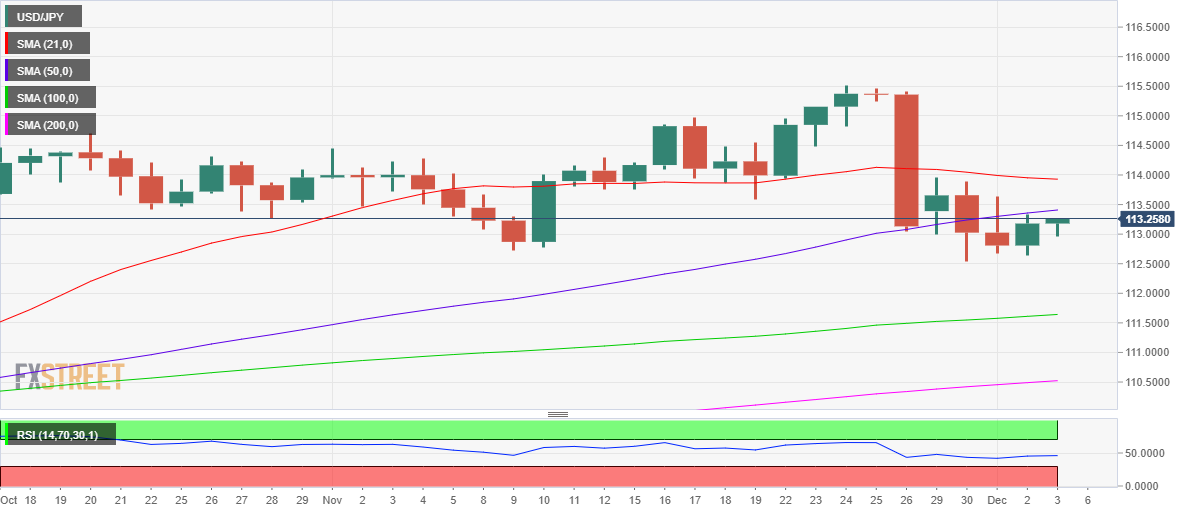
The 14-day Relative Strength Index (RSI), however, remains below the midline, threatening the bullish attempts.
The rejection once again at the 50-DMA hurdle could expose the monthly lows once again, below which a sell-off towards the ascending 100-DMA at 111.64 cannot be ruled out.
USD/JPY: Additional levels to consider
- DXY trades within a tight range in the low-96.00s.
- US yields trade in a mixed note on Friday.
- All the attention will be on the Nonfarm Payrolls.
The US Dollar Index (DXY), which gauges the greenback vs. a bundle of its main competitors, trades on a steady fashion just above the 96.00 yardstick on Friday.
US Dollar Index looks to data
The index looks to extend the weekly recovery amidst the persistent cautiousness among market participants ahead of the key release of the monthly US labour market report.
Further support for the dollar came after several Fed-speakers (Bostic, Daly, Mester, Quarles, Barkin) reinforced on Thursday the idea of a faster tapering pace as well as a sooner-than-anticipated rates lift-off.
Friday’s price action in the dollar so far comes amidst the mixed performance in the US cash markets, where yields of the 2y note climb past 0.62%, while yields of the 10y and 30y notes trade within a mild downside pressure.
Later in the session, the November’s Nonfarm Payrolls will take centre stage seconded by the Unemployment Rate, Factory Orders, the ISM Non-Manufacturing and Markit’s final Services PMI.
What to look for around USD
The dollar reclaimed the 96.00 mark and looks to extend the weekly recovery albeit at a glacial pace. The re-emergence of the risk aversion in response to omicron concerns, Fedspeak supportive of a quicker tapering pace and the likeliness of a Fed’s move on rates earlier than estimated continue to lend support to the buck against the backdrop of an inconclusive performance in US yields across the curve and the “higher-for-longer” narrative around current elevated inflation pressures.
Key events in the US this week: Nonfarm Payrolls, Unemployment Rate, Factory Orders, ISM Non-Manufacturing (Friday).
Eminent issues on the back boiler: US-China trade conflict under the Biden’s administration. Debt ceiling issue. Geopolitical risks stemming from Afghanistan.
US Dollar Index relevant levels
Now, the index is gaining 0.05% at 96.18 and a break above 96.93 (2021 high Nov.24) would open the door to 97.00 (round level) and then 97.80 (high Jun.30 2020). On the flip side, the next down barrier emerges at 95.51 (weekly low Nov.30) followed by 94.96 (weekly low Nov.15) and finally 94.44 (low Nov.18).
Here is what you need to know on Friday, December 3:
The US Dollar Index closed the second straight day modestly higher on Thursday and holds its ground early Friday as investors gear up for the November jobs report from the US. Investors expect Nonfarm Payrolls to rise by 550,000 following October's increase of 531,000. October Retail Sales data for the euro area, Canadian employment figures and the ISM Services PMI survey from the US will be featured in the economic docket as well.
Risk flows dominated the financial markets on Thursday and Wall Street's main indexes managed to register impressive gains. The US Senate has voted to approve the bill to avert a government shutdown over the weekend. Meanwhile, Bloomberg reported that a recently conducted research in the UK found that most of the booster shots were able to increase the antibodies against the Omicron variant. Moreover, GlaxoSmithKline said Its COVID-19 antibody drug, Sotrovimab, was likely effective against the new variant.
US stocks futures are trading flat in the early European session and the 10-year US Treasury bond yield is moving sideways near 1.44% after rising nearly 3% on Thursday. In an interview with the Financial Times, Cleveland Fed President Loretta Mester noted that the economy was better at dealing with new coronavirus variants.
EUR/USD has retreated to 1.1300 area with the greenback preserving its strength ahead of the weekend.
GBP/USD managed to close in the positive territory on Thursday but seems to be having a difficult time pulling away from 1.3300 early Friday.
USD/JPY continues to edge higher above 113.00 on improving market sentiment but the pair's upside remains limited with US T-bond yields losing traction.
USD/CAD is edging lower toward 1.2800 as crude oil prices stage a rebound following a sharp decline witnessed on OPEC+ decision to go ahead with their original plan to increase the oil output by 400,000 barrels per day in January.
Gold slumped to its weakest level in a year at $1,761 on Thursday but recovered above $1,770 early Friday. The yellow metal continues to have a hard time finding demand when risk flows dominate the financial markets.
Cryptocurrencies: Bitcoin is moving up and down in a narrow channel above $55,000. Ethereum closed the previous two trading days in the negative territory and seems to have gone into a consolidation phase around $4,500.
One-month risk reversal on Palladium (XPD/USD), a measure of the spread between call and put prices, not only drops for the second consecutive day but marked the steepest fall in the number since early June, according to data source Reuters.
A call option gives the holder the right but not obligation to buy the underlying asset at a predetermined price on or before a specific date. A put option represents a right to sell. That said, the daily difference between them slumped to -1.004 for Thursday.
The moves couldn’t be linked to the XPD/USD price performance as the precious metal rebounded from the monthly low the previous day, up 0.86% on a day around $1,780 heading into Friday’s European session.
Even as the options market signal favors the palladium bears, the recent risk-on mood and multi-day low hints at the commodity’s extension of the corrective pullback.
- EUR/GBP consolidates the biggest daily loss in two weeks.
- Weekly support break, sustained trading below nine-week-old resistance line hint at the further downside.
- 200-SMA offers immediate support, upside momentum needs validation from November’s top.
EUR/GBP retreats towards intraday low surrounding 0.8493, up 0.03% around 0.8497 heading into Friday’s European session.
The cross-currency pair dropped the most in two weeks after breaking a one-week-long ascending trend line. The bearish impulse got favored by downbeat MACD signals and the quote’s moves below a descending resistance line from October 29.
That said, 38.2% Fibonacci retracement (Fibo.) of the late September-November downturn, near 0.8487, offers immediate support to the pair ahead of the 200-SMA, around 0.8470 at the latest.
In a case where the EUR/GBP sellers conquer the 0.8470 support, a seven-week-old horizontal area close to 0.8420 will be in focus before the last month’s bottom of 0.8380.
Alternatively, a confluence of the previous support line and a medium-term resistance line, near 0.8530, becomes crucial for the pair buyers to watch for entries.
Adding to the upside filters is the 61.8% Fibo. level of 0.8552 and November’s high of 0.8595, not to forget the 0.8600 threshold.
To sum up, EUR/GBP bears keep controls until the quote prices remain below 0.8600.
EUR/GBP: Four-hour chart
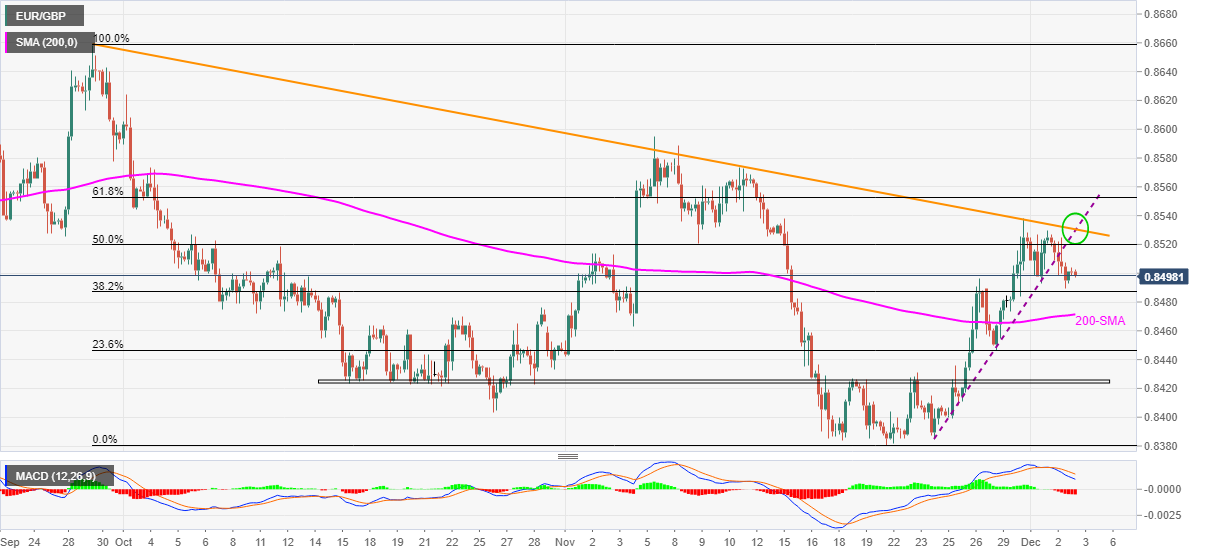
Trend: Further weakness expected
FX Strategists at UOB Group remain of the view that EUR/USD could advance past the 1.1400 barrier in the next weeks.
Key Quotes
24-hour view: “EUR traded between 1.1293 and 1.1347 yesterday, narrower than our expected sideway-trading range of 1.1290/1.1370. The underlying tone appears to have weakened somewhat and EUR is likely to drift to 1.1280. For today, a clear break of this level is unlikely and the strong support at 1.1240 is not expected to come under threat. On the upside, a breach of 1.1350 (minor resistance is at 1.1330) would indicate that the current mild downward pressure has eased.”
Next 1-3 weeks: “Our view from Wednesday (01 Dec, spot at 1.1335) still stands. As highlighted, EUR is likely to trade with an upward bias towards 1.1410. As upward momentum has not improved by much, a sustained rise above 1.1410 is unlikely. On the downside, a breach of 1.1240 (no change in ‘strong support’ level from yesterday) would indicate that EUR is not ready to head towards 1.1410.”
- USD/CAD retreats after poking 10-week top, grinds higher of late.
- Oil prices cheer softer yields, doubts over OPEC+ verdict.
- Risk appetite sours but yields fail to improve ahead of US NFP.
- ISM Services PMI, Canada jobs report for November are important too.
USD/CAD pares intraday gains with the latest declines to 1.2810 during early Friday morning in Asia. The Loonie pair’s weakness could be linked to the run-up in the prices of Canada’s main export item WTI crude oil. However, cautious mood ahead of important data probes the traders of late.
WTI crude oil prices rise 1.2%, around $67.55 by the press time, as oil traders seem to be of double minds after the global oil producers announced output hike following the previous plans. However, the OPEC+ verdict to consider production adjustments in January might have helped the black gold buyers.
Adding strength to the commodity prices is the recent pullback in the US Dollar Index (DXY) and Treasury yields amid risk-off mood in the markets, coupled with indecision over the Fed’s next move.
Also confusing USD/CAD traders are the mixed updates over the South African variant of the coronavirus, dubbed as Omicron. While the covid variant cases are on the spike in the West and China, adding more countries recently, expectations that the UK is near to finding a cure keep the market players hopeful.
Elsewhere, US policymakers’ ability to avoid a government shutdown and the Sino-American jitters battle the hawkish Fedspeak and firmer US data.
Against this backdrop, US 10-year Treasury yields reverse the previous day’s bounce off a 10-week low while stock futures improve after marking losses in early Asia.
Looking forward, Canada’s Change In Employment and Unemployment Rate, expected 35K and 6.6% versus 31.2K and 6.7% previous readouts in that order, will join the US jobs report to entertain the USD/CAD traders. Among the US employment data, Nonfarm Payrolls, likely to rise from 531K prior to 550K, will be crucial to watch. Additionally, US ISM Services PMI for November, expected 65 against 66.7 prior, will also be important and so does oil price moves.
Read: US Nonfarm Payrolls November Preview: Can we agree the labor market is healing?
Technical analysis
Although the 1.2840-50 area comprising multiple hurdles marked during last three-months challenge USD/CAD buyers, sustained break of previous resistance line from August, around 1.2770, precedes a three-week-long rising trend line near 1.2750 to challenge pair’s downside.
Japanese Prime Minister Fumio Kishida said on Friday, he will submit new laws to boost supply chains and secure core infrastructure during the parliamentary session next year.
This comes after the country’s government pledged to deploy necessary fiscal spending without hesitation in response to the covid crisis, the government's draft guidelines for the fiscal 2022 budget showed on Friday.
Market reaction
USD/JPY is catching a fresh bid amid a recovery in the risk sentiment as well as in the Treasury yields.
The pair is trading at 113.23, adding 0.08% on the day, as of writing.
Analysts at Goldman Sachs offer a sneak peek at what to expect from Friday’s US Nonfarm Payrolls data due for release at 1330 GMT.
Key quotes
“Looking for a headline +575k and the unemployment rate to 4.5%.”
“Big Data employment indicators were mixed in the month, and we also see some chance that labor supply constraints weighed on pre-holiday hiring in the retail industry.”
A drop in the jobless rate reflects “a strong household employment gain but a likely rebound in the labor force participation rate.”
Read: Nonfarm Payrolls Preview: Jobs’ headline could be a make it or break it in tapering’s decision
In an interview with the Financial Times (FT), Cleveland Fed President Loretta Mester delivers hawkish comments on likely rates next year while cautioning about the risks from the Omicron covid variant.
Key quotes
Omicron threatens to stoke US inflation.
Variant could exacerbate supply chain crunch and worker shortages.
The fear of the virus is still one of the factors holding people back from re-entering the labor force.
Have to entertain the risk that those persistently high numbers of inflation could become more embedded.
The economy is better at dealing with these variants.
The demand side effects have been lessened, but we’ve seen these supply-side effects, which are related to the virus.
Would support at least one rate increase next year, and that two might be “appropriate”.
Market reaction
These above comments had little to no impact on the US dollar, as it trades flat at 96.16 against its major rivals, at the time of writing. Markets await the US NFP for a fresh trading direction.
- USD/INR bounces off intraday low inside a bullish chart pattern.
- Fortnight-old support line, 200-HMA joins firmer RSI to keep buyers hopeful.
- Multiple hurdles around 75.20 act as a tough nut to crack for bulls.
USD/INR stays indecisive around 75.00, even as weekly moves contrast the one-month rebound during early Friday. The Indian rupee (INR) is up for snapping three-day advances but a bullish pennant on the hourly play favor buyers on a key day.
That said, a firmer RSI line and the quote’s successful trading beyond a two-week-old support line and 200-HMA offer extra support to the pair bulls.
Though, sustained trading beyond the 75.00 immediate hurdle will need validation from the multiple tops marked since October 20 near 75.19-20. Following that, the USD/INR rally towards the yearly top of 75.65 can’t be ruled out.
On the contrary, a downside break of the stated pennant’s support line, around 74.90, will drag the quote towards the stated short-term support line near 74.83 and then to the 200-HMA level of 74.78.
It should be noted, however, that the bearish impulse past 74.78 will aim for a 61.8% Fibonacci retracement level of November 18-30, near 74.45.
To sum up, USD/INR bulls are bracing for another battle with the 75.20 resistance.
USD/INR: Hourly chart
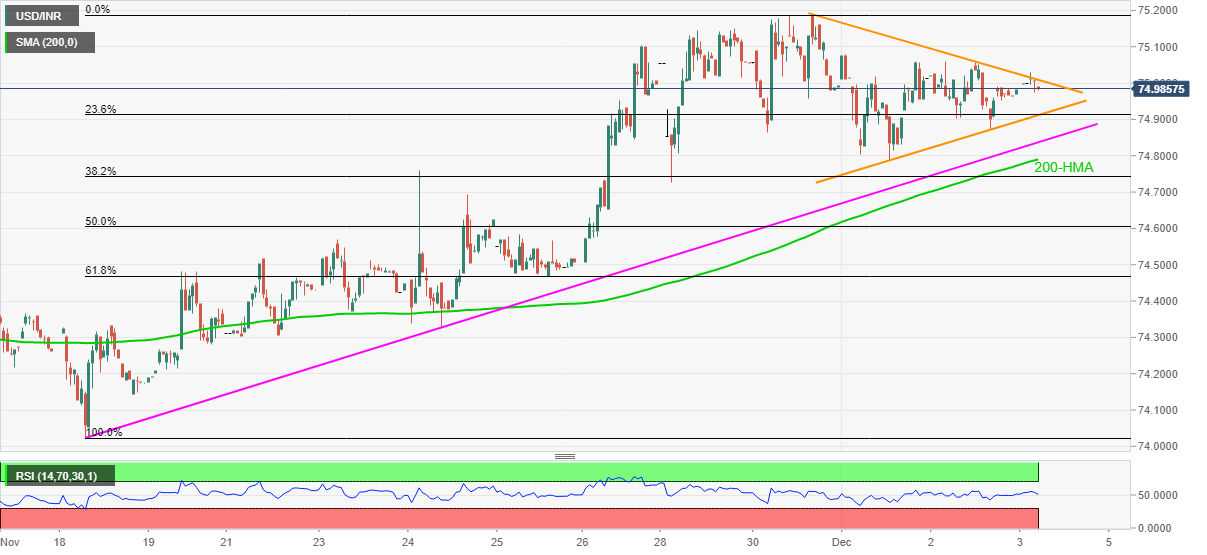
Trend: Further upside expected
- EUR/USD pauses two-day downtrend, remains sidelined on the key day.
- US Treasury yields remain pressured as markets brace for faster Fed tapering, extended PEPP at ECB.
- Virus woes escalate but with hopes of a cure, China, Russia portray geopolitical fears.
- ECB’s Lagarde, Eurozone Retail Sales and US ISM Services PMI are important too.
EUR/USD grinds lower around 1.1300, indecisive ahead of Friday’s European session. The major currency pair struggles for clear direction after two consecutive days of a downside as traders await important catalysts scheduled for the day amid mixed macros and indecision over the major central bank’s next moves.
Among the positives are hopes that the coronavirus variant from South Africa, dubbed as Omicron, will soon have its cure from the UK. On the same line were talks of the covid strain’s less lethal symptoms than initially feared. Furthermore, the US policymakers finally avoided the government shutdown, at least till February, while adding bars for the market’s preference for the US dollar.
Alternatively, hawkish Fedspeak, led by including Federal Reserve (Fed) Bank of San Francisco President Mary Daly and Richmond President Thomas Barkin, fuelled US Treasury yields the previous day. Also helping the bond sellers were softer-than-expected prints of the US Initial and Continuing Jobless Claims for the week, as well as downbeat Challenger Job Cuts for November.
It’s worth noting that the Eurozone Unemployment Rate eased in November and favored the European Central Bank (ECB) hawks. However, the regional central bank signaled less hawkish performance during December’s meeting, per the latest updates from Reuters.
Additionally, the European Union (EU) and the US criticism of China’s moves in the South China Strait and Taiwanafter Thursday’s talks in Washington join Beijing’s calls for the US to cut the tariffs on their goods to weigh on the market sentiment.
Amid these plays, the US 10-year Treasury yields fade bounce off 10-week low, marked the previous day, but the S&P 500 Futures also print 0.12% intraday downside by the press time. Furthermore, the US Dollar Index (DXY) rises 0.05%, up for the third consecutive day around 96.17 at the latest.
Moving on, ECB’s President Christine Lagarde and Eurozone Retail Sales for November may entertain EUR/USD traders but major attention will be given to the US jobs report and ISM Services PMI for the last month.
Technical analysis
EUR/USD dropped for the last two days following its failures to cross the 100-SMA, around 1.1320 at the latest. Also favoring the sellers is the MACD line that flashed bear cross.
However, a clear downside break of the one-week-long ascending support line, around 1.1255 at the latest, becomes necessary for the pair sellers to aim for the yearly low of 1.1186. Following that, 61.8% Fibonacci Expansion (FE) of November 09-30 moves, near 1.1120, will gain the market’s attention.
- Gold bounces off four-month-old support line, key Fibonacci retracement level.
- Yields reverse corrective pullback from 10-week low, stock futures dwinde on mixed concerns.
- Omicron tightens the grip but UK braces for a cure, US policymakers avoid government shutdown.
- Gold Price Forecast: Pressure persists November low at risk of giving up
Gold (XAU/USD) portrays a corrective pullback from a monthly low, bouncing off key supports to print a $1,773 level during early Friday. The yellow metal’s recent gains could be linked to the market's cautious sentiment ahead of the all-important US Nonfarm Payrolls (NFP) release and softer yields.
That said, the US 10-year Treasury yields fade bounce off 10-week low, marked the previous day, but the S&P 500 Futures also print 0.16% intraday downside by the press time. The reason could be linked to the market’s indecision amid contrasting headlines and a lack of conviction over the key central bank’s future moves, not to forger headlines concerning Omicron, China and the US.
After days of haggling, the US policymakers finally avoided the government shutdown, at least till February. Though fears of the faster Fed tapering keep bond bears hopeful. Among the key promoters of faster rolling back of easy money, also conveying reflation fears, were Federal Reserve (Fed) Bank of San Francisco President Mary Daly and Richmond President Thomas Barkin.
Elsewhere, cases of the South African coronavirus variant, dubbed as Omicron, rise in the US and China, as well as the UK. However, Britain approves medical treatment that’s likely a cure for the worries COVID-19 strain.
On a different page, the European Union (EU) and the US criticized China after Thursday’s talks in Washington while Beijing calls for the US to cut the tariffs on their goods. Further, Beijing-based IT firm Didi is up for leaving the US stock exchange and joining Hong Kong’s Hang Seng.
It’s worth noting that even if the global policymakers do signal to dial back the easy money policies, backed by the inflation fears, a fresh covid wave challenges the further monetary policy tightening. This in turn helps the investors to jump back towards the traditional safe-havens like US government bonds and gold.
Though, today’s US employment data and PMI numbers will be important for near-term direction as the Fed policymakers slip into the no-talk periods from this Saturday.
Read: US Nonfarm Payrolls November Preview: Can we agree the labor market is healing?
Technical analysis
Having been defeated by a wall of resistance around $1,792, comprising 50, 100 and 200-DMA, gold bounces off an ascending support line from August around $1,762, not to forget staying above 61.8% Fibonacci retracement (Fibo.) of March-June upside.
Although softer yields and recovery from short-term key supports favor bulls to aim for another battle with the DMA convergence near $1,792, bearish MACD signals and an absence of oversold RSI keep the commodity sellers hopeful.
That said, fresh selling awaits a clear downside break of the stated 61.8% Fibo. level of $1,768, which in turn will direct gold towards an ascending support line from August around $1,762.
However, a nine-month-old horizontal area surrounding $1,750-47, will be a tough nut to crack for the gold sellers afterward.
Meanwhile, gold buyers have a tough task on hand of crossing the $1,792 SMA convergence if they aim for re-entry.
Following that, the $1,800 threshold and October’s peak near $1,813 will be on their radars before confronting another important resistance level close to $1,834 that includes highs marked during July and September.
Overall, gold sellers have an upper hand, at least technically, than their bull friends. Though, US jobs report becomes crucial to watch.
Gold: Daily chart
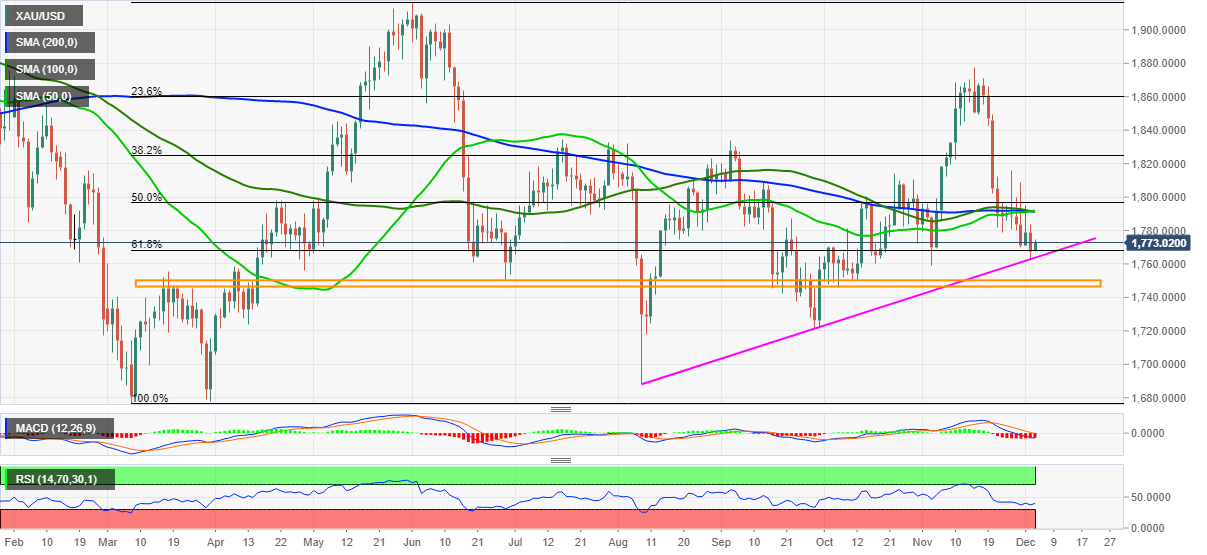
Trend: Further weakness expected
- Asian shares grind higher as softer yields jostle with Omicron headlines.
- South African covid variant tightens grips in China, US but UK hints at a solution.
- China’s Didi prepares for US delisting, Hong Kong joining, US Senate avoids government shutdown.
- Japan shows readiness for more stimulus, Australian data came in mixed.
Asian equities stay mostly firmer amid softer US Treasury yields and hopes of finding a cure to the South African strain of the coronavirus, dubbed as Omicron. However, chatters surrounding China and worsening COVID-19 conditions in the developed countries join the pre-Fed caution to challenges optimists.
Amid these plays, MSCI’s index of Asia-Pacific shares outside Japan drops 0.63% whereas Japan’s Nikkei 225 rises 0.40% on firmer Jibun Bank Services PMI for November and Tokyo’s statement to not hesitate from suing more fiscal measures if needed.
On the other hand, the European Union (EU) and the US criticized China after Thursday’s talks in Washington while Beijing calls for the US to cut the tariffs on their goods. Elsewhere, Omicron cases rise in the US and China while Beijing-based IT firm Didi is up for leaving the US stock exchange and joining Hong Kong’s Hang Seng. Against this backdrop, Shares in Hong Kong dropped a bit but those from China remain mildly bid at the last.
Markets in Australia and New Zealand joined those from China but not Indonesia amid virus woes. It should be noted that South Korea’s KOSPI and India’s BSE Sensex print mild gains at the latest.
On a broader front, the US 10-year Treasury yields fade bounce off 10-week low, marked the previous day, but the S&P 500 Futures also print 0.16% intraday downside by the press time.
That said, Fed policymakers, including Federal Reserve (Fed) Bank of San Francisco President Mary Daly and Richmond President Thomas Barkin, were the most hawkish and fuelled US Treasury yields the previous day. Also helping the bond sellers were softer-than-expected prints of the US Initial and Continuing Jobless Claims for the week, as well as downbeat Challenger Job Cuts for November.
Moving on, the US Nonfarm Payrolls (NFP) and ISM Services PMI for November will be crucial for the near-term market direction.
Read: US Nonfarm Payrolls November Preview: Can we agree the labor market is healing?
- AUD/USD drops in tandem with S&P 500 futures, as risk sentiment sours.
- Omicron covid woes escalate, China’s Caixin Services PMI disappoint.
- Focus shifts to US NFP, as the aussie shrugs off early RBA rate hike calls.
AUD/USD is consolidating at yearly lows near 0.7070, heavily weighed down by the prevailing risk-on market profile.
The market sentiment soured in Asia this Friday after investors reacted negatively to the news of the new Omicron covid variant spreading in the US, with new cases reported in Hawaii, New York and Los Angeles. Reflecting risk-off mood, the S&P 500 futures drop 0.20% so far.
Further, renewed US-China tussle, as Didi Global Inc. prepares delisting from the US bourses, added to the damp mood while exacerbating the pain in the higher-yielding aussie.
The aussie bears also cheered the drop in the Chinese Caixin Services PMI, with the index arriving at 52.1 in November vs. 53.8 previous.
Collaborating with the downside in the spot, the US-Sino trade woes are back in play, especially after China’s ambassador to the US called for the abolition of tariffs on Chinese goods.
Attention now turns towards the US Nonfarm Payrolls release, which could further strengthen the Fed’s hawkish view. Meanwhile, the aussie appears to ignore the earlier calls for an RBA rate hike, as investors remain unnerved.
AUD/USD: Technical levels
“The 4-hour chart also hints at further declines, as the pair remained below bearish moving averages, while technical indicators hold within negative levels with uneven strength. Support levels: 0.7060 0.7015 0.6970. Resistance levels: 0.7140 0.7175 0.7210,” FXStreet’s Chief Analyst Valeria Bednarik notes.
AUD/USD: Additional levels to consider
- USD/CHF stays mildly offered following the previous day’s bearish candlestick formation.
- 200-DMA challenges the sellers, key Fibonacci retracement levels add to the upside filters.
- Firmer Momentum line sustained trading beyond the key SMA, trend line favor buyers.
USD/CHF justifies Thursday’s bearish Doji while printing a 0.08% intraday loss around 0.9200 heading into Friday’s European session. Even so, the 200-DMA challenges the Swiss currency (CHF) pair sellers.
In addition to the stated key moving average near 0.9180, 50% and 61.8% Fibonacci retracement levels of August-November upside, respectively around 0.9197 and 0.9155, also challenge the sellers.
It’s worth noting that the firmer Momentum line and a four-month-old ascending trend line, near 0.9115, keeps USD/CHF bulls hopeful.
Meanwhile, an upside break of the 38.2% Fibonacci retracement level of 0.9240 will reject the bearish candlestick performance. However, USD/CHF buyers may wait for a clear run-up past 0.9250, comprising early November lows, to retake controls.
Overall, USD/CHF remains sidelined with eyes on the US Nonfarm Payrolls (NFP).
USD/CHF: Daily chart
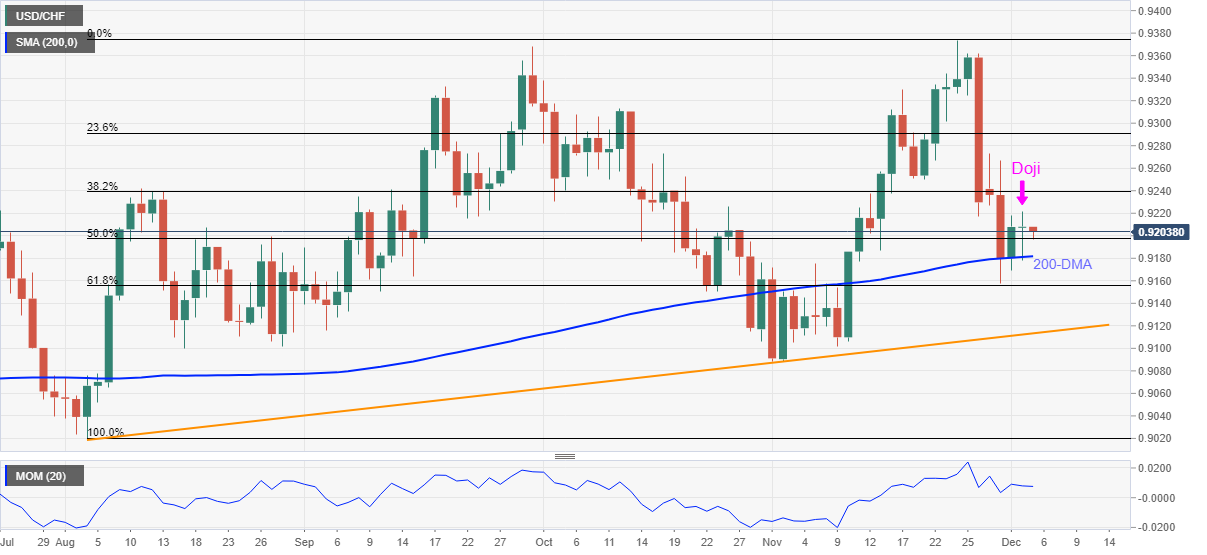
Trend: Further weakness expected
In the face of the new Omicron covid variant and Fed Chair Jerome Powell’s hawkish view, the US dollar is poised for new upside risks in the coming weeks.
Key quotes
"Recent developments have introduced new upside risks to our broad Dollar forecasts.”
“First, following public comments from Fed officials, our economists now expect the FOMC to accelerate the pace of QE tapering and to wrap up the process in mid-March. They also now anticipate three 25bp rate hikes next year instead of two (in June, September, and December, vs July and November previously), and a two-per-year pace thereafter.”
“Second, the new covid variant already roiling South Africa may introduce new downside risks to global growth, and therefore upside risks to the safe haven Dollar.”
“We have not revised our broad USD forecast today but will be considering an upgrade over the coming week."
Japan's government vows to deploy necessary fiscal spending without hesitation in response to the crisis, Reuters reports, citing the government's draft guidelines for the fiscal 2022 budget.
Key takeaways
“Japan must restore economy first and then tackle fiscal reform.”
“Japan must prioritize efforts to shore up the economy over fixing its tattered public finances.”
“The guidelines dropped a reference to the need for "reviewing spending without sanctuary", which had been inserted in recent years as a pledge to stick to fiscal discipline.”
USD/JPY reaction
USD/JPY is treading water around 113.00, on a cautious footing amid falling yields and risk-off trading ahead of the key US NFP release.
Reuters is reporting that the US Senate has voted to approve the bill to avert a government shutdown over the weekend.
The US government funding bill was passed in the Senate by 68-29 votes.
Early Asia, the funding bill was passed in the House of Representatives, which will keep the government afloat until February 18. The bill will now be sent to US President Biden for signing.
Market reaction
The US dollar index remains unfazed by the above comments, currently trading flat at 96.20. Traders await the US NFP for fresh impetus.
US inflation expectations, as measured by the 10-year breakeven inflation rate per the St. Louis Federal Reserve (FRED) data, snapped a six-day downtrend by the end of Thursday’s North American session, per the data source Reuters.
In doing so, the inflation gauge bounced off the 10-week low flashed the previous day to print 2.47% at the latest.
The uptick in the US inflation expectations could be linked to the hawkish Fedspeak and optimism over the US policymakers’ ability to avoid a government shutdown, which has a deadline of Saturday.
Adding strength to the momentum were firmer US job-related data and recent optimism over Omicron treatment after the UK approves clinical trials for the drug that is a likely solution.
However, spreading cases of the South African covid variant in the US and cautious mood ahead of the US Nonfarm Payrolls (NFP), as well as US ISM Services PMI, challenges the market optimism.
Read: Yields retreat, S&P 500 Futures consolidate gains with eyes on US NFP
| Raw materials | Closed | Change, % |
|---|---|---|
| Brent | 70.72 | 1.38 |
| Silver | 22.37 | 0.34 |
| Gold | 1768.108 | -0.73 |
| Palladium | 1769.61 | 1.35 |
- US 10-year Treasury yields fade bounce off 10-week low.
- S&P 500 Futures pare the week’s heaviest daily gains, Asia-Pacific stocks trade mixed.
- Hawkish Fedspeak weigh on sentiment but hopes over Omicron treatment, US bill to avoid shutdown probe bond bears.
- China-linked headlines add to the negative catalysts but nothing more important than the US NFP.
Market players stay divided during early Friday as the Fed hawks confront reflation and geopolitical concerns. Adding to the filters is the cautious mood ahead of the US Nonfarm Payrolls (NFP).
To portray the sentiment, the US 10-year Treasury yields drop 2.3 basis points (bps) to 1.426% whereas the S&P 500 Futures drop 0.50% at the latest. That said, the US bond yields recovered from the latest October levels the previous day while the Wall Street benchmarks posted the biggest daily jump in the current week.
Fed policymakers, including Federal Reserve (Fed) Bank of San Francisco President Mary Daly and Richmond President Thomas Barkin, were the most hawkish and fuelled US Treasury yields the previous day. Also helping the bond sellers were softer-than-expected prints of the US Initial and Continuing Jobless Claims for the week, as well as downbeat Challenger Job Cuts for November.
The recent optimism over finding the cure of the South African variant of the coronavirus, dubbed as Omicron, seemed to have underpinned the US stocks on Thursday.
Recently, the EU-US dislike for China and comments by Beijing’s Ambassador to the US, over phase one deal and tariffs, seem to challenge the risk appetite. Furthermore, the US policymakers’ struggle to avoid a government shutdown on Saturday probes the optimists of late. Additionally, the five Omicron cases in the US and spreading virus woes in the rest of the world also weigh on the risk appetite.
Talking about data, China’s Caixin Services PMI for November came in below 53.8 figures to 52.1 while the Composite PMI also dropped from 51.5 to 51.2 during the stated month. Before that, Australia’s PMIs were mixed for November while Japan’s Jibun Bank Manufacturing PMI came in better than previous for the stated month.
Looking forward, markets expect 550K of NFP print and an easy 4.5% Unemployment Rate, an absence of which can extend the latest weakness of the US Treasury yields and favor equities amid hopes of further easing.
Read: US Nonfarm Payrolls November Preview: Can we agree the labor market is healing?
Asia witnesses a turnaround in the market sentiment, as risk trades take a hit from the growing spread of the highly contagious Omicron covid variant in the US.
After a case of the new strain detected in California a day ago, Los Angeles reported its first case in the last hour.
Earlier on, Hawaii confirmed a single Omicron covid strain case while New York State registered five cases. Although all fives cases reported are said to be mild.
In light of escalating concerns over the new variant, the US has announced a mandatory COVID-19 test a day prior to departure for travelers inbound to the country from December 6.
To soothe these discouraging headlines, investors remain hopeful that vaccines will remain effective or can be adjusted.
According to Bloomberg, “A UK study testing seven different COVID-19 vaccines as booster doses found most of them increased antibodies, with shots from Moderna Inc. and the Pfizer Inc.-BioNTech SE partnership performing best.”
Meanwhile, GlaxoSmithKline said Its COVID-19 antibody drug, Sotrovimab, is likely effective against the Omicron variant.
Market reaction
As of writing, the Asian stocks are trading mixed, weighed by the negative momentum in the Japanese and Australian indices.
Meanwhile, the S&P 500 futures are down 0.40% on the day. The high beta AUD/USD is losing 0.30% on the day to trade near yearly lows sub-0.7100.
- NZD/USD braces for the biggest daily loss of the week, stays pressured around the yearly low.
- China Caixin Services PMI, Composite PMI ease in November.
- Risk appetite sours as US-China tussles regain market attention, Fedspeak favors faster tapering.
- US jobs report will be the key ahead of the Fed blackout period.
NZD/USD remains depressed around the intraday low of 0.6786 following the release of China’s Caixin PMI data during early Friday. In doing so, the kiwi pair portrays the market’s sour sentiment, as well as reacts to the softer data, ahead of the key US Nonfarm Payrolls (NFP).
China’s Caixin Services PMI for November came in below 53.8 figures to 52.1 while the Composite PMI also dropped from 51.5 to 51.2 during the stated month. In doing so, the private activity gauges differ from the official readings published earlier in the week.
Read: Chinese Caixin Services PMIs expand at a slower pace
Mostly adding to the bearish bias is the broad US dollar strength amid hopes of faster Federal Reserve (Fed) tapering after the policymakers sound hawkish in their latest appearances, before the silent period starts from this Saturday. Among the key promoters of faster rolling back of easy money, also conveying reflation fears, were Federal Reserve (Fed) Bank of San Francisco President Mary Daly and Richmond President Thomas Barkin.
Not only the hawkish Fedspeak but the softer-than-expected prints of the US Initial and Continuing Jobless Claims for the week, as well as downbeat Challenger Job Cuts for November, also underpinned the hopes of faster Fed tapering and favored the yields and USD.
It should be observed that the Wall Street benchmarks also consolidated weekly losses the previous day but the S&P 500 Futures and Asia-Pacific stocks dwindle during early Friday.
The reason could be linked to the hopes of the US policymakers to avoid a government shutdown, which is looming for Saturday. Also positive for the kiwi prices could be the recent optimism over finding the cure of the South African variant of the coronavirus, dubbed as Omicron.
Alternatively, the recent EU-US dislike for China and comments by Beijing’s Ambassador to the US, over phase one deal and tariffs, seem to challenge the risk appetite. On the same line were cautious sentiment ahead of the US jobs report.
Read: US Nonfarm Payrolls November Preview: Can we agree the labor market is healing?
Technical analysis
In addition to a clear downside break of a 14-month-old rising support line around 0.6900, as sustained trading below 61.8% Fibonacci retracement (Fibo.) level of August 2020 to February 2021 upside, near 0.6860, also keeps NZD/USD bears hopeful. That said, the yearly low of around 0.6770 may act as immediate support to watch during the quote’s weakness. However, major attention will be given to a convergence of the descending support line from late August and 78.6% Fibo. level near 0.6710.
Chinese ambassador to the US Qin Gang urges America for early abolition of additional tariffs on the country’s goods.
Additional comments
China is reducing the time needed for approval of travel by US business executives to no more than 10 days
China to make COVID-19 testing more convenient, will allow work during quarantine.
more to come ...
Activity in China's services sector expanded at a slower pace in November amid rising inflationary pressures and continuing small-scale COVID-19 outbreaks, a private survey showed on Friday as reported by Reuters.
''The Caixin/Markit services Purchasing Managers' Index (PMI) fell to 52.1 in November from 53.8 in October, but remained above the 50-point mark that separates growth from contraction on a monthly basis.''
''Caixin's November composite PMI, which includes both manufacturing and services activity, fell to 51.2 from 51.5 the previous month.''
Reuters reported that ''analysts say the services sector, which has been slower to recover from the pandemic than manufacturing, is more vulnerable to sporadic COVID-19 outbreaks and anti-virus measures, clouding the outlook for a much anticipated rebound in consumption in the months to come.''
"Policymakers should still focus on supporting small and midsize enterprises. They should also pay attention to problems including deteriorating job prospects, limited household income growth and weak consumer purchasing power," said Wang Zhe, senior economist at Caixin Insight Group.
"Enterprises are still facing high cost pressures. Policymakers should take inflation seriously."
AUD/USD remains steady regardless
AUD/USD has been on the move to the downside in Asia, reestablishing the move that was interrupted by a bullish start on Wall Street on Thursday.
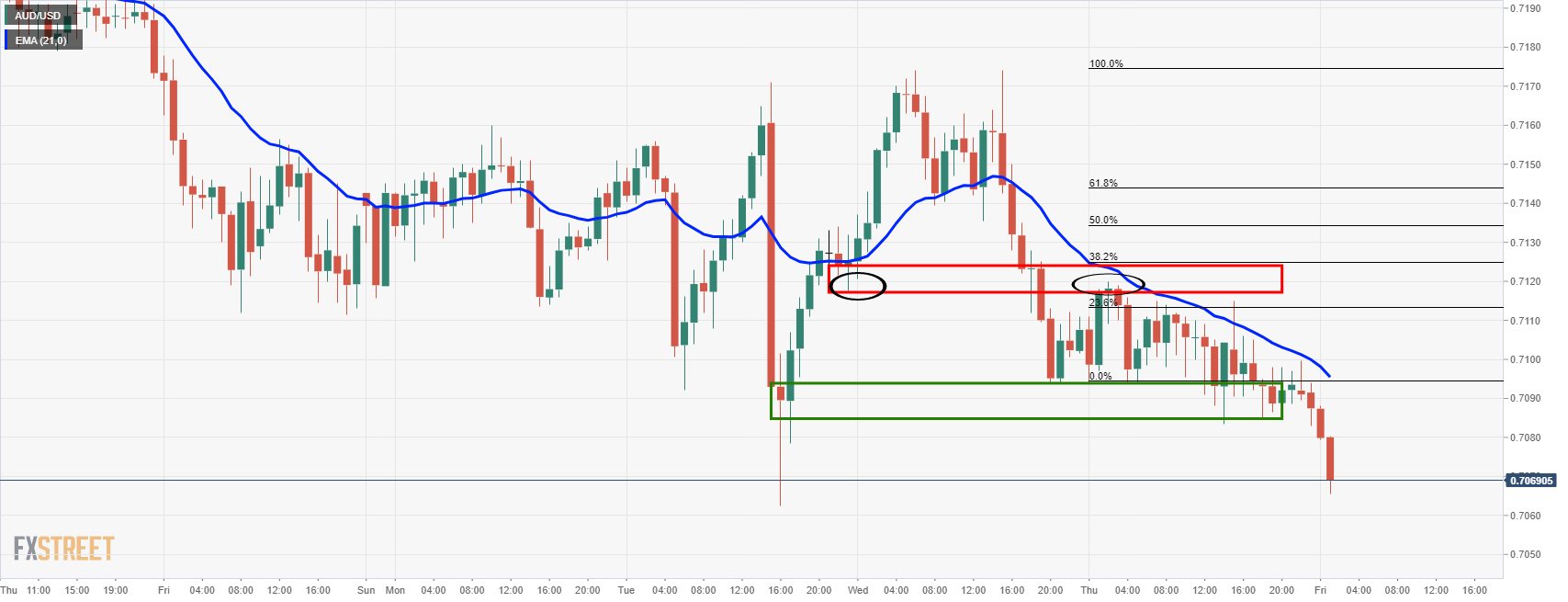
It had broken the hourly support ahead of the data as illustrated above. However, the data has failed to move the needle so far despite expanding at a slower clip in services.
About the China Caixin Services PMI
A monthly questionnaire issued to purchasing executives in over 400 private service sector organizations yielded responses that formed the basis of the Caixin China General Services PMI (Purchasing Managers' Index). Sales, employment, inventories, and pricing are some of the variables tracked by the index.
A rating of greater than 50 suggests that the services sector is generally increasing, while a reading of less than 50 indicates that it is generally contracting.
A higher than expected figure should be seen as positive (bullish) for the CNY while a lower than expected figure should be seen as negative (bearish) for the CNY.
- DXY prints three-day uptrend towards 10-DMA immediate resistance.
- Weekly falling trend line, 2021 peak also probes buyers before 61.8% FE level.
- 20-DMA, five-week-old support line adds to the downside filters.
- Sustained trading above key supports, firmer RSI favor buyers.
US Dollar Index (DXY) holds onto the three-day recovery moves, up 0.06% around 96.18 during early Friday.
In doing so, the greenback gauge stays above the 20-DMA and an ascending support line from October 29 amid a firmer RSI line, not overbought, which in turn suggests the quote’s further advances.
However, the 10-DMA level of 96.30 precedes a weekly resistance line near $96.45, to restrict the immediate upside of the DXY.
Should the quote manage to cross the 96.45 hurdle on a daily closing basis, the latest run-up can challenge the yearly peak of 96.94 with eyes on the 61.8% Fibonacci Expansion (FE) of November’s moves, around 97.55.
Meanwhile, pullback moves remain less worrisome until staying beyond 20-DMA and the aforementioned support line, respectively around 95.75 and 95.30.
It’s worth noting that the US Dollar Index becomes vulnerable to visit 94.60 level, surrounding early November’s top, on the break of 95.30 support line.
Read: Nonfarm Payrolls Preview: Jobs’ headline could be a make it or break it in tapering’s decision
DXY: Daily chart
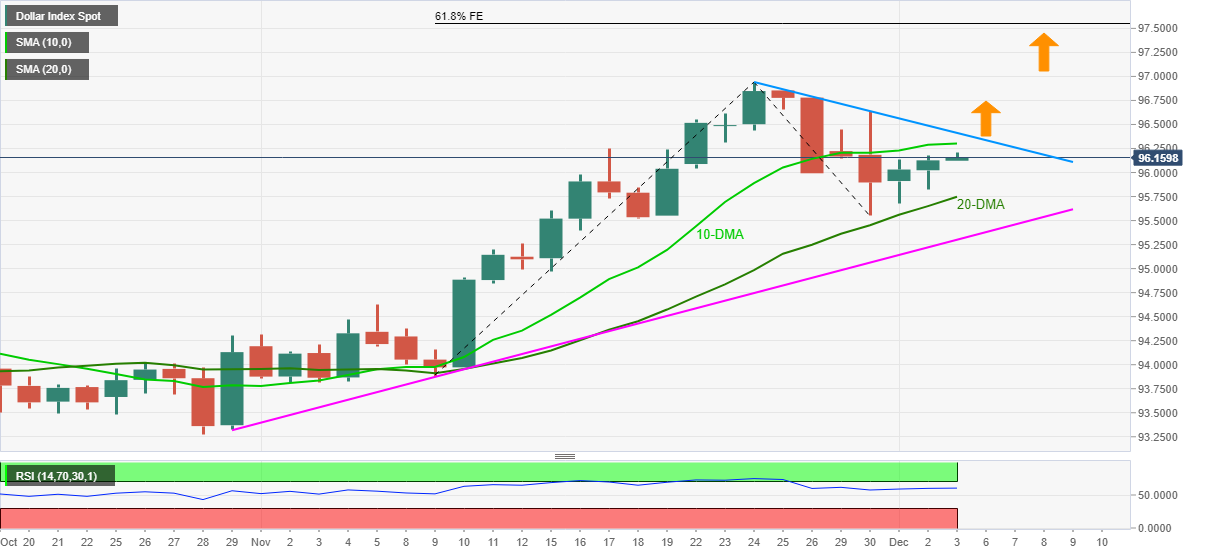
Trend: Further upside expected
| Time | Country | Event | Period | Previous value | Forecast |
|---|---|---|---|---|---|
| 01:45 (GMT) | China | Markit/Caixin Services PMI | November | 53.8 | |
| 07:45 (GMT) | France | Industrial Production, m/m | October | -1.3% | 0.5% |
| 08:30 (GMT) | Eurozone | ECB President Lagarde Speaks | |||
| 08:50 (GMT) | France | Services PMI | November | 56.6 | 58.2 |
| 08:55 (GMT) | Germany | Services PMI | November | 52.4 | 53.4 |
| 09:00 (GMT) | Eurozone | Services PMI | November | 54.6 | 56.6 |
| 09:30 (GMT) | United Kingdom | Purchasing Manager Index Services | November | 59.1 | 58.6 |
| 10:00 (GMT) | Eurozone | Retail Sales (MoM) | October | -0.3% | 0.2% |
| 10:00 (GMT) | Eurozone | Retail Sales (YoY) | October | 2.5% | 1.2% |
| 11:00 (GMT) | United Kingdom | MPC Member Saunders Speaks | |||
| 13:30 (GMT) | Canada | Labor Productivity | Quarter III | 0.6% | -0.8% |
| 13:30 (GMT) | U.S. | Government Payrolls | November | -73 | |
| 13:30 (GMT) | U.S. | Average workweek | November | 34.7 | 34.7 |
| 13:30 (GMT) | U.S. | Manufacturing Payrolls | November | 60 | 45 |
| 13:30 (GMT) | U.S. | Average hourly earnings | November | 0.4% | 0.4% |
| 13:30 (GMT) | U.S. | Private Nonfarm Payrolls | November | 604 | 530 |
| 13:30 (GMT) | U.S. | Labor Force Participation Rate | November | 61.6% | |
| 13:30 (GMT) | Canada | Employment | November | 31.2 | 35 |
| 13:30 (GMT) | Canada | Unemployment rate | November | 6.7% | 6.6% |
| 13:30 (GMT) | U.S. | Nonfarm Payrolls | November | 531 | 550 |
| 13:30 (GMT) | U.S. | Unemployment Rate | November | 4.6% | 4.5% |
| 14:45 (GMT) | U.S. | Services PMI | November | 58.7 | 57 |
| 15:00 (GMT) | U.S. | Factory Orders | October | 0.2% | 0.5% |
| 15:00 (GMT) | U.S. | ISM Non-Manufacturing | November | 66.7 | 65 |
| 18:00 (GMT) | U.S. | Baker Hughes Oil Rig Count | December | 467 |
In recent trade today, the People’s Bank of China (PBOC) set the yuan (CNY) at 6.3738 vs the estimate of 6.3739 and the previous 6.3719.
About the fix
China maintains strict control of the yuan’s rate on the mainland.
The onshore yuan (CNY) differs from the offshore one (CNH) in trading restrictions, this last one is not as tightly controlled.
Each morning, the People’s Bank of China (PBOC) sets a so-called daily midpoint fix, based on the yuan’s previous day closing level and quotations taken from the inter-bank dealer.
- AUD/USD bears seeking a downside extension with critical data coming up.
- Chinese data and the US Nonfarm Payrolls will be key events for the pair on Friday.
As per the prior analysis, AUD/USD Price Analysis: High forex vol points to continuation to weekly support, the price remains on a bearish trajectory as follows:
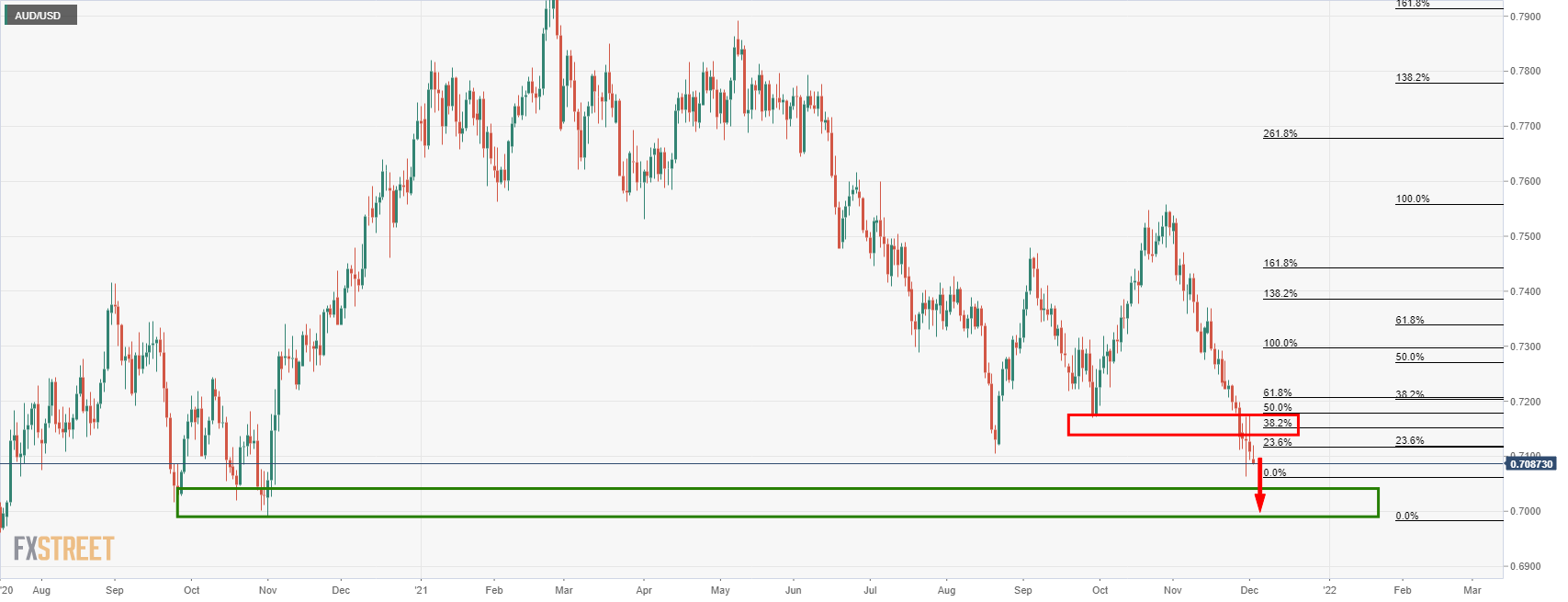
In the daily chart above, the weekly lows are illustrated with 0.6990 eyed as a potential target on a break of 0.7030. For the day ahead, the bears need to break the hourly support as follows:
AUD/USD H1 chart
The bears are taking control below the 0.7120 key level with the price staying below the 21-EMA:
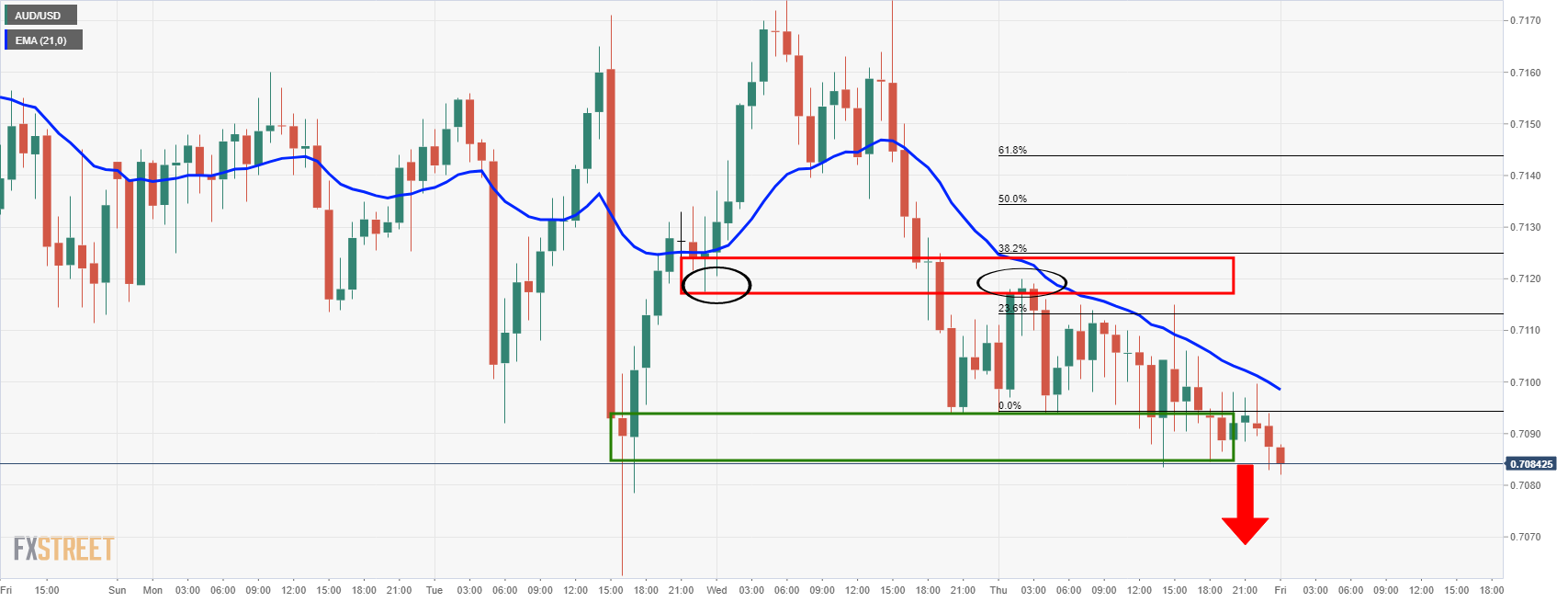
Bears will want to see a break of the 0.7080 support before fully engaging, but the Chinese data could be the catalyst. With that being said, there are prospects of a trapped market into the NFP data today if the price fails to break lower on disappointing Chinese data.
- USD/JPY picks up bids after snapping two-day downtrend.
- Market sentiment dwindles amid Fed rate hike bets, Omicron concerns and US funding bill news.
- Hawkish Fedspeak couldn’t stop Wall Street from positing gains but Asia-Pacific equities trade mixed of late.
- Japan Jibun Bank Services PMI improved in November, US jobs report in focus.
USD/JPY reverses the day-start losses to regain 113.15, following the first positive day in three, during the early hours of Tokyo open on Friday.
The risk barometer pair tracked from the firmer US Treasury yields the previous day to recover while hopes of finding a solution to the South African covid variant, as well as avoiding the US government shutdown seem to recently favor the buyers. However, cautious sentiment ahead of the US Nonfarm Payrolls (NFP) data for November, expected 550K, tests the USD/JPY upside.
US 10-year Treasury Treasury yields bounced off a 10-week low to regain 1.45% level the previous day, down two basis points (bps) to retest the 1.43% mark at the latest.
Fedspeak pushed for a sooner tapering in the last-ditched efforts before the silent period starting from this Saturday, which in turn propelled the bond yields and the US Dollar Index (DXY). Among the key promoters of faster rolling back of easy money, also conveying reflation fears, were Federal Reserve (Fed) Bank of San Francisco President Mary Daly and Richmond President Thomas Barkin.
Also adding to the DXY strength could be softer-than-expected prints of the US Initial and Continuing Jobless Claims for the week, as well as downbeat Challenger Job Cuts for November. That said, the final reading of Japan’s Jibun Bank Services PMI for November rose past 50.7 prior to 53.00.
Furthermore, optimism concerning Omicron’s cure, spread by the UK, joins the recovery in the US inflation expectations, as measured by the 10-year breakeven inflation rate per the St. Louis Federal Reserve (FRED) data, to favor the USD/JPY prices.
On the contrary, fears of a negative surprise from the US jobs report and virus woes join geopolitical tension surrounding Russia, Iran and China to test the market sentiment and the USD/JPY prices.
Amid these plays, the US 10-year Treasury yields struggle to extend the previous day’s rebound while the Asia-Pacific equities and the S&P 500 Futures trade mixed by the press time.
Moving on, the virus updates and the geopolitical chatters could offer intermediate direction to the USD/JPY traders ahead of the US NFP.
Read: US Nonfarm Payrolls November Preview: Can we agree the labor market is healing?
Technical analysis
USD/JPY holds onto the previous resistance line from March, around 112.75 by the press time. However, the 50-DMA level of 113.40 restricts immediate upside.
- WTI fades bounce off 15-week low, grinds higher during the second positive day in four.
- Oversold RSI conditions favor rebound, 61.8% Fibonacci retracement guards immediate upside.
- Bears await a clear break of ascending support line from March.
WTI crude oil prices struggle to keep the previous day's recovery moves from late August around $67.00 during Friday’s Asian session.
The black gold’s stated rebound portrays the importance of an upward sloping trend line from March 23 with the oversold RSI conditions suggesting further recovery.
However, 61.8% Fibonacci retracement level of March-October upside, around $68.00, probes the oil buyers before directing them to the key 200-DMA hurdle of $69.85.
Also acting as an upside filter is the $70.00 threshold and 50% Fibo. near $71.20.
Alternatively, a daily closing below the multiday-old support line near $64.75 will redirect the WTI bears to attack August month’s low of $61.73.
Following that, the $60.00 round figure may probe the commodity sellers before directing them to March’s low of $57.27.
WTI: Daily chart
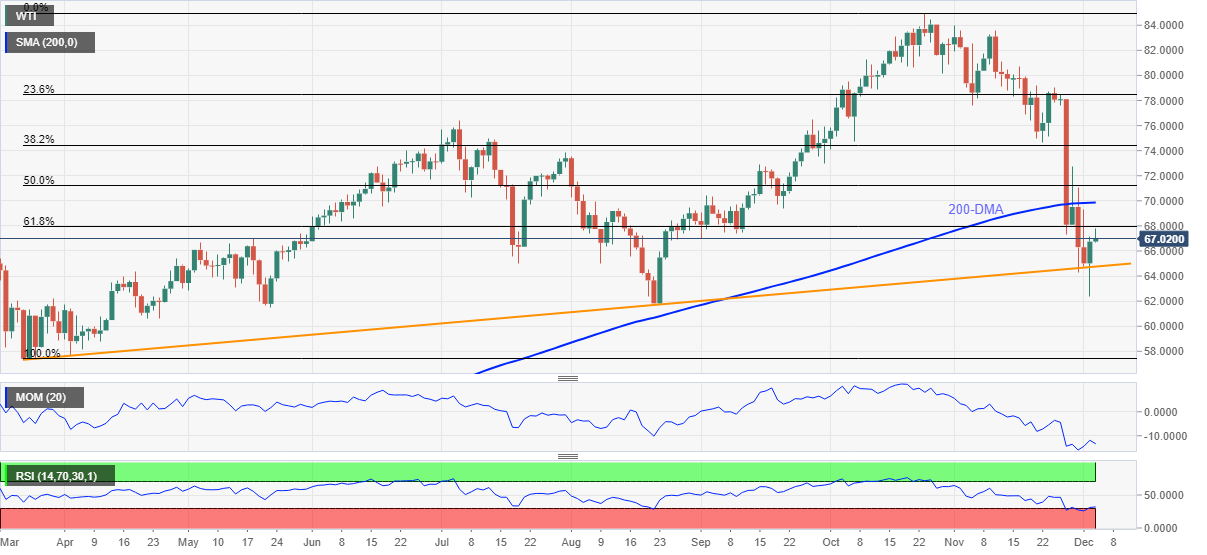
Trend: Further recovery expected
- USD/CAD is making tracks to the upside with the 1.30s are in sight.
- The month and weekly targets are clear and Fridays Nonfarm payrolls could be the deciding factor.
USD/CAD is on the move and the bulls are in control from a longer-term perspective. The following illustrates the prospects of a run all the way into test the 1,30's in the coming days. However, US Nonfarm Payrolls will be critical in this regard.
The greenback earlier gained after US data showing initial claims for state unemployment benefits rose 28,000 to a seasonally adjusted 222,000 for the week ended Nov. 27, lower than the forecast of 240,000. Today, Payrolls probably surged again, according to analysts at TD Securities.
''A strong trend continues to be signaled by surveys and claims, but our forecast also reflects the latest Homebase data—with a decline in the Homebase series more than accounted for by seasonality. Along with our +650k forecast for payrolls, we forecast a 0.2pt decline in the unemployment rate and a 0.4%m/m (5.0% y/y) rise in hourly earnings.''
USD/CAD monthly chart
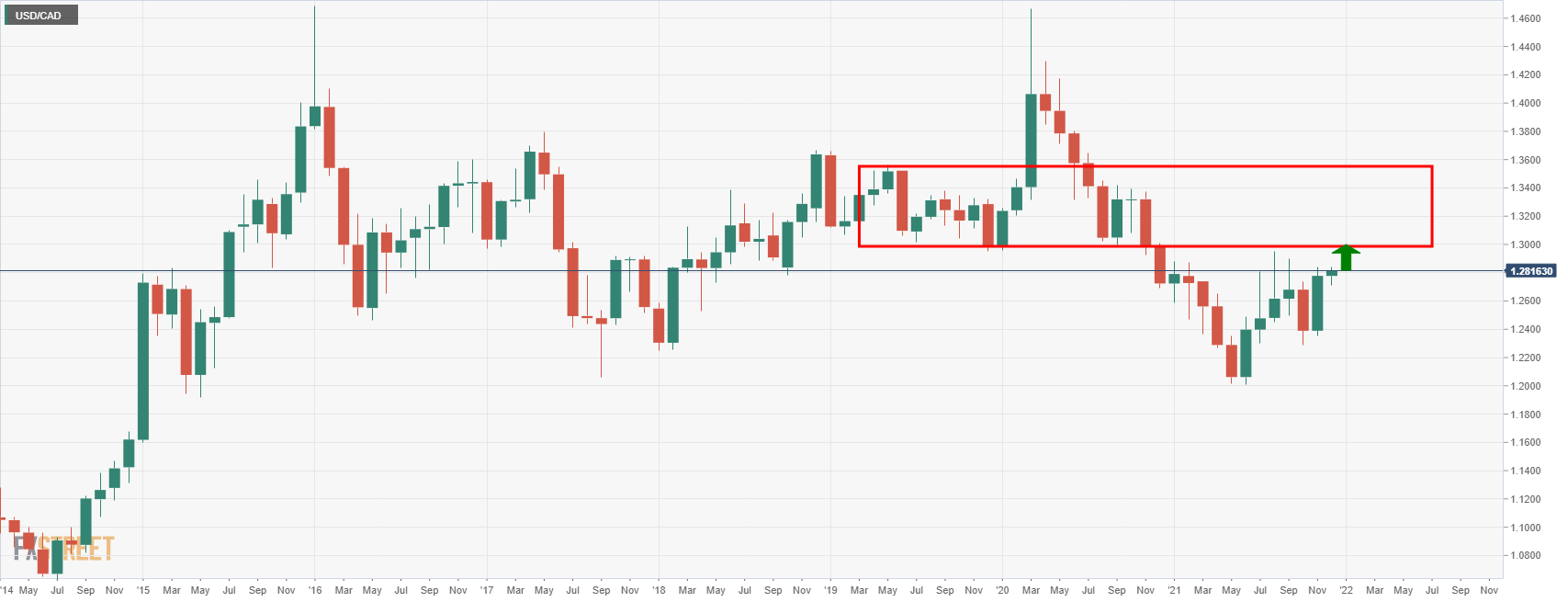
The bulls are in charge and there is overhead resistance that could be tested in the coming days near 1.2995.
USD/CAD weekly chart
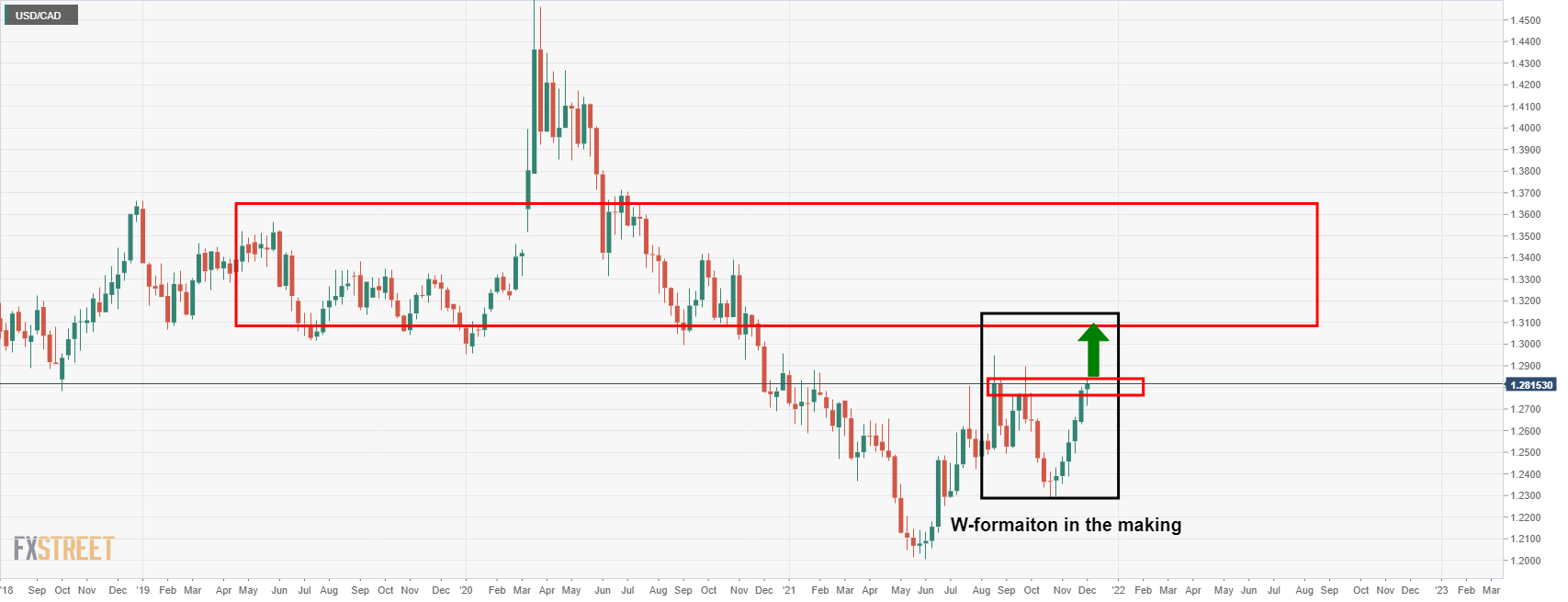
The weekly outlook has the price on the verge of making a W-formation. There needs to be some more upside, however. The bulls can target the key monthly resistance at 1.3050 once 1.30 is cleared. On the flip side, the W-formation would be expected to attract bears in to test the neck line near 1.2770.
Reuters came out with its optimistic survey results for the market expectations of the Reserve Bank of Australia’s (RBA) next move.
“Against a backdrop of rising inflation in Australia and around the world, the RBA is now predicted to lift its cash rate from a record low 0.10% in the first quarter of 2023,” per November 29-December 2 poll of 35 respondents were published during Friday’s Asian session.
“That's sooner than the second quarter of 2023 forecast in a poll taken almost a month ago, while in a survey taken only two months ago there was no consensus for any rate rise in 2023,” adds Reuters.
Key quotes
A small majority, 16 of 25 economists, expected at least one rate hike by the end of the first quarter of 2023, compared with 11 of 25 economists in the previous poll.
Economists in the Nov. 29-Dec. 2 poll expect a second rate hike in the second quarter of 2023 of 25 basis points to 0.50%. The cash rate is then projected to rise to 0.75% in the final quarter of 2023.
All 34 economists expected the cash rate to stay at 0.10% at the Dec. 7 meeting.
Market reaction
Despite the upbeat Reuters poll on RBA rate hike calls, the AUD/USD refreshes intraday low to 0.7085 as markets brace for the Fed rate hike and awaits Friday’s US jobs report.
Read: AUD/USD bears look to 0.7000 on firmer yields ahead of US NFP
- Silver fades bounce off two-month low, stays below fortnight-old resistance line.
- Oversold RSI probes sellers but bulls need to cross 200-SMA for conviction.
Silver (XAG/USD) remains pressured, paring the previous day’s corrective pullback from a multiday low during Friday’s Asian session.
In doing so, the bright metal seesaws around 78.6% Fibonacci retracement level of an upside from late September to mid-November. Adding to the bearish bias is the descending trend line from November 22.
However, oversold RSI conditions challenge the XAG/USD sellers, which in turn question the bears and raises hopes of a bounce towards the short-term resistance line, near $22.65 at the latest.
Should silver buyers conquer the $22.65 hurdle, the $23.00 threshold and 50% Fibo. near $23.40 can test the upside before driving the prices towards the 200-SMA level of $24.06.
On the flip side, a clear downside break of the stated 78.6% Fibonacci retracement level of $22.20 may respect the $22.00 round figure as an intermediate halt during the fall to the yearly bottom of $21.42.
Overall, silver prices are likely to remain bearish until crossing the 200-SMA hurdle but corrective pullbacks can’t be ruled out.
Silver: Four-hour chart
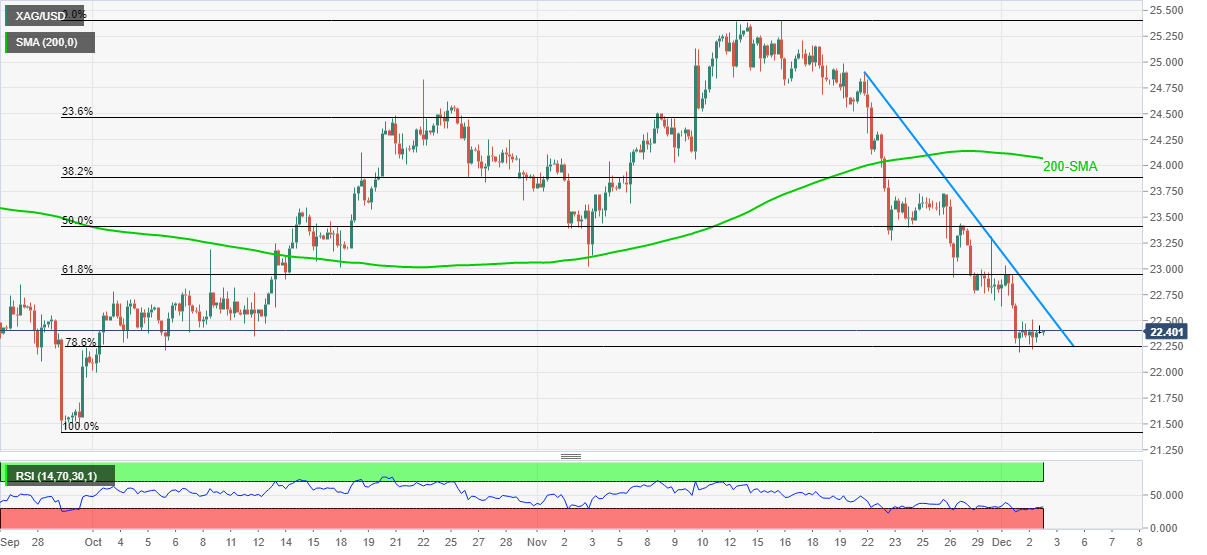
Trend: Further weakness expected
| Pare | Closed | Change, % |
|---|---|---|
| AUDUSD | 0.70912 | -0.16 |
| EURJPY | 127.887 | 0.3 |
| EURUSD | 1.12992 | -0.16 |
| GBPJPY | 150.514 | 0.63 |
| GBPUSD | 1.32974 | 0.21 |
| NZDUSD | 0.68163 | 0.17 |
| USDCAD | 1.2803 | -0.09 |
| USDCHF | 0.92027 | 0.13 |
| USDJPY | 113.179 | 0.44 |
- GBP/USD holds onto the previous day’s rebound within a choppy range.
- EU-UK Brexit deal remains less likely in 2021, London-Washington jostle over post-Brexit trade terms.
- UK raises hopes to curb Omicron spread as daily infections jump over 50,000.
- Final reading of UK Services PMI may offer intermediate moves but nothing more important than US NFP.
Having snapped a three-day downtrend, GBP/USD wobbles around 1.3300 during the initial Asian session trading on the key Friday comprising the US jobs report for November.
The cable pair’s improvement could be linked to the market chatters that the UK steps forward to finding the cure to the South African covid variant. However, firmer US dollar ahead of the US Nonfarm Payrolls (NFP) joins Brexit woes to weigh on the quote.
In a landmark achievement for the British scientists, the UK Medicines and Healthcare products Regulatory Agency (MHRA) approved an antibody treatment that it expects to overcome the coronavirus variant such as Omicron. Sotrovimab is a single monoclonal antibody drug joined developed by GSK and Vir Biotechnology that gets the UK MHRA approval.
On the other hand, Irish Foreign Minister Simon Coveney crossed wires while signaling no Brexit deal between the European Union (EU) and the UK over the Northern Ireland (NI) protocol during 2021. However, Northern Ireland Secretary Brandon Lewis said he is optimistic to reach a deal but also cited the odds of triggering Article 16.
While the EU-UK Brexit deal is in limbo, the US-UK post-Brexit trade talks are also fragile as both the nations recently jostled over Washington’s failure to remove tariffs on UK steel and aluminum.
It’s worth noting that the final reading of the UK Manufacturing PMI for November came in softer than initial estimates, adding to the expectations that the Bank of England (BOE) will refrain from a rate hike during the December meeting. Even so, market chatters are on the spike that the “Old Lady” will supersede the Fed to announce the rate hikes.
Talking about the US, the benchmark US 10-year Treasury yields bounced off a 10-week low to regain 1.45% level, up five basis points (bps), on Thursday as Fedspeak pushed for sooner tapering in the last-ditched efforts before the silent-period starting from this Saturday. Among the key promoters of faster rolling back of easy money, also conveying reflation fears, were Federal Reserve (Fed) Bank of San Francisco President Mary Daly and Richmond President Thomas Barkin.
It should be observed that softer-than-expected prints of the US Initial and Continuing Jobless Claims for the week, as well as downbeat Challenger Job Cuts for November, add to the Fed rate hike concerns and favored the GBP/USD bears.
However, it all depends upon the US jobs report for November as the Fed policymakers brace for the crucial decision.
Technical analysis
A downward sloping trend line from late October, around 1.3325, guards the immediate upside of the GBP/USD prices ahead of early November’s low near 1.3355. Alternatively, the yearly bottom of 1.3194 stays on the bear’s radar.







© 2000-2026. Sva prava zaštićena.
Sajt je vlasništvo kompanije Teletrade D.J. LLC 2351 LLC 2022 (Euro House, Richmond Hill Road, Kingstown, VC0100, St. Vincent and the Grenadines).
Svi podaci koji se nalaze na sajtu ne predstavljaju osnovu za donošenje investicionih odluka, već su informativnog karaktera.
The company does not serve or provide services to customers who are residents of the US, Canada, Iran, The Democratic People's Republic of Korea, Yemen and FATF blacklisted countries.
Izvršenje trgovinskih operacija sa finansijskim instrumentima upotrebom marginalne trgovine pruža velike mogućnosti i omogućava investitorima ostvarivanje visokih prihoda. Međutim, takav vid trgovine povezan je sa potencijalno visokim nivoom rizika od gubitka sredstava. Проведение торговых операций на финанcовых рынках c маржинальными финанcовыми инcтрументами открывает широкие возможноcти, и позволяет инвеcторам, готовым пойти на риcк, получать выcокую прибыль, но при этом неcет в cебе потенциально выcокий уровень риcка получения убытков. Iz tog razloga je pre započinjanja trgovine potrebno odlučiti o izboru odgovarajuće investicione strategije, uzimajući u obzir raspoložive resurse.
Upotreba informacija: U slučaju potpunog ili delimičnog preuzimanja i daljeg korišćenja materijala koji se nalazi na sajtu, potrebno je navesti link odgovarajuće stranice na sajtu kompanije TeleTrade-a kao izvora informacija. Upotreba materijala na internetu mora biti praćena hiper linkom do web stranice teletrade.org. Automatski uvoz materijala i informacija sa stranice je zabranjen.
Ako imate bilo kakvih pitanja, obratite nam se pr@teletrade.global.


 Банковни
 транcфери


