- Analiza
- Novosti i instrumenti
- Vesti sa tržišta
Forex-novosti i prognoze od 15-12-2021
November month employment statistics from the Australian Bureau of Statistics, up for publishing at 00:30 GMT on Thursday, will be the immediate catalyst for the AUD/USD pair traders.
The jobs figures become more important after the Reserve Bank of Australia (RBA) expected the economy to return to its pre-Delta path in the first half of 2022 versus H2 2022 in the November forecasts. Also, recent comments from RBA Governor Philip Lowe highlights today’s employment data as he said, “QE outlook depends on inflation data, labor market, the strength of consumer spending.” Adding to the importance were the receding virus-led activity controls during the October-November period.
Market consensus favors Employment Change to jump from -46.3K previous readouts to +200K on a seasonally adjusted basis whereas the Unemployment Rate is likely to drop to 5.0% from 5.2%. Further, the Participation Rate may also rise from 64.7% to 65.5%.
Ahead of the event, analysts at Westpac said,
Solid momentum through October, as indicated by the lift in payrolls, suggests a robust gain for employment in November (Westpac f/c: 220k, market 200k); but higher participation may see a lift in the unemployment rate (Westpac f/c: 5.3%).
How could the data affect AUD/USD?
AUD/USD seesaws around 0.7170 after positing the biggest daily gains in over a week. The Aussie pair’s previous gains could be linked to the market’s ‘buy the rumors, sell the fact’ action following the US Federal Reserve (Fed) meeting. However, recently downbeat comments from RBA Governor Lowe challenge the pair buyers ahead of the event.
It’s worth noting that the RBA’s optimism has recently waned due to the virus resurgence and the latest comments from Governor Lowe seem to weigh on the data’s importance. Even so, firmer jobs report will help the AUD/USD prices to keep the upside momentum targeting a confirmation of the inverse head-and-shoulders bullish chart pattern with successful trading above 0.7170.
On the contrary, downbeat data will asset recently dovish comments from RBA’s Lowe and can drag the quote back to the monthly horizontal support near 0.7090.
Key Notes
AUD/USD bulls stampeed despite hawkish Fed, Aussie jobs eyed
Australian Employment Preview: Rebound from Delta lockdowns may not be enough for the aussie
About the Employment Change
The Employment Change released by the Australian Bureau of Statistics is a measure of the change in the number of employed people in Australia. Generally speaking, a rise in this indicator has positive implications for consumer spending which stimulates economic growth. Therefore, a high reading is seen as positive (or bullish) for the AUD, while a low reading is seen as negative (or bearish).
About the Unemployment Rate
The Unemployment Rate released by the Australian Bureau of Statistics is the number of unemployed workers divided by the total civilian labor force. If the rate hikes, indicates a lack of expansion within the Australian labor market. As a result, a rise leads to weaken the Australian economy. A decrease of the figure is seen as positive (or bullish) for the AUD, while an increase is seen as negative (or bearish).
Reserve Bank of Australia Governor, Phillip Lowe, is speaking and addressing the CPA Australia Riverina Business Conference.
The title of the speech is, ‘the RBA and the Australian Economy.’
Key comments
He has said the conditions for a rate hike will not be met next year.
Lowe expects conditions for rate hike will not be met next year.
Lowe says "still a fair way" from a hike, board is prepared to be patient.
Lowe says board discussed tapering bond-buying from Feb and ending in May.
Lowe says could end bond buying in Feb if economic progress better than expected.
Lowe says could review bond-buying again in may if data disappoint.
QE outlook depends on inflation data, labour market, strength of consumer spending.
Lowe says will consider actions of other central banks, effects of the omicron variant.
Lowe says the omicron outbreak represents a downside risk.
Lowe expects positive momentum in economy to be maintained through the summer.
Underlying inflation expected to rise to 2.5% over 2023.
Lowe says inflation outlook in Australia very different than in US.
Lowe estimates total extra savings by households during pandemic at more than A$200 bln.
Lowe says additional savings will support strong growth in consumption.
Lowe notes sharp rise in job ads, reports firms finding it difficult to find workers.
Lowe says it is not our mandate to target house prices, higher rates not the solution.
AUD/USD impact
AUD/USD is stable and has not reacted to the comments.
Early Thursday morning in Asia, Reuters quoted anonymous sources to confirm the Chinese government’s rush to control the firms holding key data.
“The Chinese government has been expanding its practice of taking minority stakes in private companies beyond those specializing in online news and content to firms possessing large amounts of key data,” said the news.
The news also said that the government has already made a de facto special management stake or "golden share" arrangement with Full Truck Alliance Co Ltd, a Chinese platform arranging trucking services.
Reuters also mentioned that a third source with direct knowledge of the matter said, “Didi Global Inc has also been in talks about a golden share for its core ride-hailing business.”
Key quotes
Seeking influence, Beijing began taking golden shares in private online media companies - usually about 1% of a firm - some five years ago.
The stakes are bought by government-backed funds or companies which gain a board seat and/or veto rights for key business decisions.
A separate source said a golden share had been taken in a data-rich company very recently but declined to disclose which one.
Reuters was not able to ascertain how many other data-rich firms authorities were seeking to take a golden share in.
Fx implications
The news is negative for the market’s risk appetite but failed to stop the S&P 500 Futures from tracking the Wall Street benchmarks, up 0.20% intraday around 4,720 by the press time.
Read: Forex Today: Fed delivered as expected, stocks rallied on relief
- As the Asian session begins, silver advances some 0.14%.
- Fed announces a faster bond taper, and its policymakers project three interest rates hikes by 2022.
- The US central bank projects a 4.0% growth next year, up from September’s 3.8% projections.
- XAG/USD Technical Outlook: Has an upward bias, but faces strong resistance at the 200-hour SMA.
Silver (XAG/USD) advances sharply during the day as the New York session winds down, up some %, trading at $22.02 at the time of writing. On Wednesday, the Federal Reserve announced a faster bond-taper beginning in January of 2022 and, according to the dot-plot, could hike three times in 2022, fulfilling the market’s expectations.
The Federal Reserve revealed an increase in the pace of reducing its bond purchasing program by $30 Billion, double the amount initially agreed at the November meeting. Additionally, it dropped the word “transitory” from its monetary policy statement, referring to inflation as exceeding the bank’s 2% target “for some time.”
Fed’s Chair Jerome Powell press conference remarks
Jerome Powell held his traditional press conference after the Fed released its monetary policy statement. He said that “the economy no longer needs increasing amounts of policy support.” He commented that the pace of inflation is “uncomfortably high” and expressed that the Fed is making fast progress towards achieving maximum employment in his point of view.
The Summary of Economic Projections (SEP) was released in addition to the monetary policy statement. Fed policymakers expect inflation to run at a 2.6% pace in 2022, an increase over 2.2%, projected in September, but then fall to 2.3% in 2023 and 2.1% in 2024. Concerning the labor market, the Unemployment Rate is projected to fall to 3.5% in 2022.
Regarding the Federal Fund Rate (FFR), the Federal Reserve Board members expect it to end at 0.90% in 2022, meaning the US central bank would hike three times. By 2023, they expect the FFR at 1.6%, and in 2024 at 2.1%.
Concerning the US economic Outlook, Fed policymakers projected a 4% growth in 2022, up from the 3.8% in September.
Market reaction
XAG/USD initially reacted downwards, reaching a daily low at $21.40. However, the move was faded, bouncing off and rallying towards the 100-hourly simple moving average (SMA) at $22.00, a jump of $0.66 despite the hawkish pivot by the Fed.
XAG/USD Price Forecast: Technical outlook
At press time, silver is trading above the 50 and 100-hour simple moving averages (SMAs). In the near term, the bias is bullish, but a break above the 200-hour SMA at $22.21 might clear the way for an upward move towards the December 13 high at $22.40, followed by the December 6 high at $22.59.
On the flip side, failure at the 200-hour SMA could lead to further losses. The first support would be the 50-hour SMA at $21.98, followed by the daily pivot point at $21.64 and the S1 daily pivot at $21.58.
-637752072736938220.png)
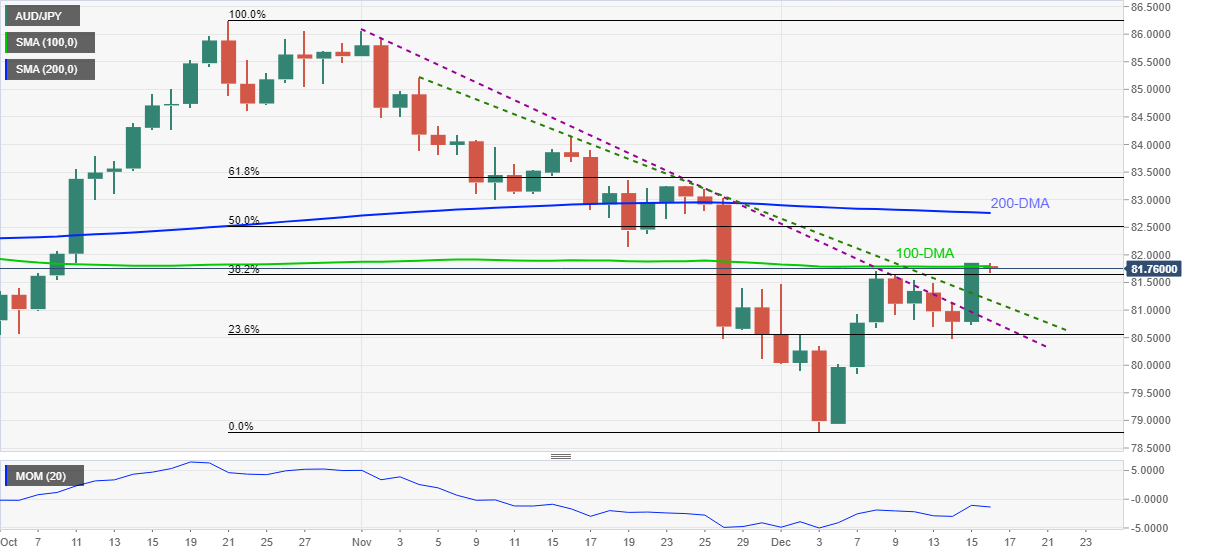
- AUD/JPY seesaws around monthly top after rising the most in over a week.
- Firmer Momentum line, sustained break of previous resistance lines keep buyers hopeful.
- 200-DMA adds to the upside filters, 50% Fibonacci retracement level limits immediate declines.
AUD/JPY takes rounds to 81.75 following the break of a descending resistance line from early November, now support.
The cross-currency pair’s recently sidelined performance could be linked to traders’ wait for November’s Australia jobs report, as well as failures to cross the 100-DMA.
Read: Australian Employment Preview: Rebound from Delta lockdowns may not be enough for the aussie
It should be noted, however, that a successful break of the previous resistance lines from November and firmer Momentum line favor the AUD/JPY pair’s further upside.
Even so, November 19 swing low around 82.15 and the 200-DMA level of 82.75 challenge the pair buyers.
Also acting as an upside filter is the 61.8% Fibonacci retracement (Fibo.) of AUD/JPY downside from late October to December 03, at 83.40 by the press time.
Alternatively, a U-turn from the 100-DMA level near 81.80 will retest the resistance-turned-support lines around 81.15 and 80.80 before directing AUD/JPY sellers towards the 23.6% Fibonacci retracement level of 80.55.
In a case where AUD/JPY prices remain weak past 80.55, the 80.00 threshold and the monthly low near 78.80 will lure the pair sellers.
AUD/JPY: Daily chart
Trend: Further upside expected
- EUR/USD grinds higher around short-term key hurdle after reversing Fed-inspired losses.
- Fed announced faster tapering, hints three rate hikes in 2022 as expected.
- Powell accepted Omicron fears, backing the ‘buy the rumor sell the fact’ market move.
- ECB is likely signaling the end of PEPP but virus woes keep the case interesting.
Following a quick response to the hawkish Fed, EUR/USD bulls retake controls to poke the 1.1300 threshold during early Thursday morning in Asia.
The currency major pair dropped to 1.1221 after the US Federal Reserve (Fed) matched market forecasts for faster tapering and signaling rate hikes in 2022. However, comments from Fed Chair Jerome Powell seemed to have trigged the recent rally ahead of the key European Central Bank (ECB) monetary policy meeting.
Fed doubled monthly bond tapering to $30 billion and the dot-plot also mentioned three rate hikes in 2022, matching wide market expectations. However, Powell’s comments like “the Omicron variant poses risks to the outlook”, as well as refrain from rate hikes until the tapering is completed, recalled the EUR/USD pair buyers.
It’s worth noting that stimulus hopes from the US and a run-up in the equities, weighing down the US Treasury yields, also underpinned the currency pair’s advances.
In addition to the Fed-inspired move, the year-end consolidation and the pre-ECB preparations are likely extra arguments that support the latest EUR/USD run-up.
Moving on, the pair traders are likely to witness lackluster trading heading into the ECB meeting. However, preliminary readings of December month’s PMIs for Germany and the Eurozone may offer intermediate moves.
That said, the regional central bank is up for closing the Pandemic Emergency Purchase Program (PEPP) but questions over Asset Purchase Program (APP) and economic forecasts will be crucial for the pair traders to watch for fresh impulse.
“The ECB has made it clear that it is “very unlikely” that they would hike rates in 2022, insisting that higher inflation will likely be temporary. Nevertheless, market participants are expecting an upward revision to inflation projections, for this year and the next ones. Growth, on the other hand, can suffer a downward revision as the region is currently struggling with restrictions due to the rapid spread of Omicron. The scenario should be overall bearish for the shared currency,” said FXStreet’s Valeria Bednarik ahead of the meeting.
Read: European Central Bank Preview: More recalibration or actual tightening?
Technical analysis
Although an ascending support line from November 24 defends intraday bulls around 1.1260, EUR/USD needs to cross a seven-week-old descending resistance line, close to 1.1325 at the latest, to convince the buyers. Even so, the monthly horizontal resistance near 1.1380-85 and 100-DMA level surrounding 1.1445 will challenge the upside momentum.
Alternatively, a yearly low of 1.1186 offers an additional downside filter. Following that, the 61.8% Fibonacci Expansion (FE) level of October 28 to November moves, near 1.1120, will be in focus.
- AUD/USD bulls take charge despite hawkish Fed.
- AUD/USD traders await the Aussie jobs data for more volatility.
AUD/USD at 0.7173, is ending the day around 0.95% higher after travelling from 0.7092 and 0.7177 over the build-up and around the Federal Reserve event.
The AUD ended a choppy session firm despite an uber hawkish Fed. Treasury yields rose across the curve after the Fed announced an acceleration of tapering and a dot plot showing a more aggressive rate hike outlook. ''Expect this selling pressure to flow through to local rates markets at open before attention turns to RBA’s Lowe later this morning,'' analysts at ANZ Bank explained.
The hawkish message from a faster taper was amplified by significant upward revisions to the dot plot. However, much of what was announced had already been priced in and the US dollar turned on a dime and ended the day lower. For instance, the removal of “transitory” and the doubling of the taper had already been fully expected. What was unexpected, the dots were particularly striking. The median dot signals that there is expected to be three hikes next year, one more than previously indicated.
Meanwhile, investors moved back over toward risk-on assets after the Fed announcement, with US stocks reversing earlier losses to touch a session high. This supported the Aussie, setting it up for a positive start for what could be another busy day. Markets have become more optimistic that Omicron will not impede the global economic recovery.
Additionally, analysts at ANZ bank explained that ''pledges from China to support economic growth also helped alleviate some of the fears. Markets now expect further monetary policy easing in China after the People’s Bank of China said it will reduce bank reserve requirements.''
Meanwhile, traders are waiting for the Reserve Bank of Australia, Governor Phillip Lowe, will speak. Also, we will have the Aussie jobs data. A big gain in employment seems inevitable in November, analysts at ANZ bank said.
''Just how big is the question.''
''We expect a rise of 240k but the range of forecasts is wide. The impact on the unemployment rate will depend on how quickly participation picks up compared with employment. Our pick is 5.0%, down from 5.2% in October, but it could go either way.''
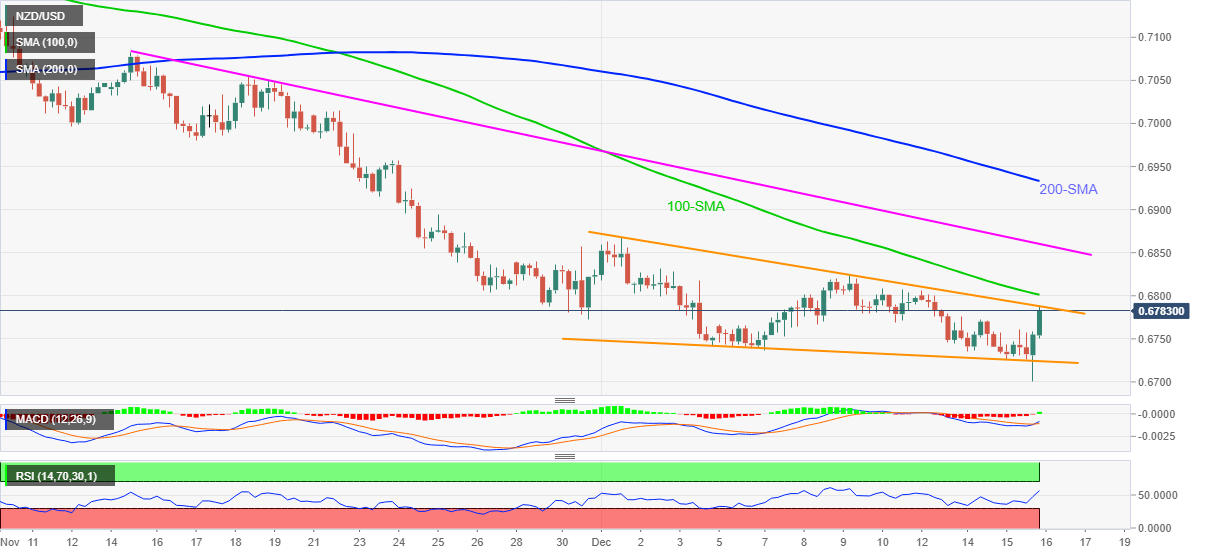
- NZD/USD is on the verge of confirming a bullish chart pattern after New Zealand GDP.
- NZ GDP contracted, but below expectations, in Q3.
- MACD turns most bullish in a week, favoring the bulls to aim for the key SMAs.
- Descending trend line from March acts as important support.
NZD/USD cheers softer-than-expected fall in New Zealand (NZ) Q3 GDP as bulls knock on the door around 0.6780 during early Thursday morning in Asia. In doing so, the kiwi pair is about to confirm a bullish chart pattern named falling wedge, backed by upbeat MACD signals and RSI line.
Read: New Zealand GDP Q3: Better than expected data could keep the bird flying high
The 100-SMA level of 0.6800 will act as an additional upside filter, other than the immediate 0.6790 hurdle, before welcoming the NZD/USD buyers. Following that, a run-up towards the 200-SMA level of 0.6933 can’t be ruled out.
It’s worth noting that a month-old descending trend line, around 0.6860, will precede the late November swing high close to 0.6960 to act as additional upside filters.
Meanwhile, pullback moves will be tested by the lower line of the stated wedge formation, near 0.6725, a break of which will recall the 0.6700 threshold on the chart, which also comprises a descending support line from March.
In a case where NZD/USD bears keep the reins past 0.6700, a downward trajectory towards late 2020 bottom near 0.6590 can’t be ruled out.
NZD/USD: Four-hour chart
Trend: Further upside expected
The Gross Domestic Product (GDP), released by Statistics New Zealand, has been released as follows:
New Zealand GDP SA (QoQ) Q3: -3.7% (exp -4.1%; prev 2.8%) - GDP (YoY) Q3: -0.3% (exp -1.4%; prev 17.4%).
NZD/USD implicaitons
The US dollar was pressured in the aftermath of the hawkish Federal reserve outcome, potentially due to irregular flows in holiday market conditions as traders square up for the year.
The kiwi, as a consequence, flew to a high of 0.6787. The better than expected GDP should help to underpin the kiwi for the day ahead. However, it has failed to move the needle so far as traders are only just coming through the door in Asia and the spreads are unreliable at this time of the day.
Why it matters to traders?
The Gross Domestic Product (GDP), released by Statistics New Zealand, highlights the overall economic performance on a quarterly basis. The gauge has a significant influence on the Reserve Bank of New Zealand’s (RBNZ) monetary policy decision, in turn affecting the New Zealand dollar. A rise in the GDP rate signifies improvement in the economic conditions, which calls for tighter monetary policy, while a drop suggests deterioration in the activity. An above-forecast GDP reading is seen as NZD bullish.
- NZD/USD reached a year-to-date low at 0.6700, as the Fed decided to increase the speed of the bond taper.
- The Federal Reserve Board members eye three rate hikes in 2022 and three in 2023.
- NZD/USD Technical Outlook: Bullish in the short-term, but downside risks remain.
After reaching a new year-to-date low once the Fed announced a faster bond taper and the dot-plot showed that the median of the Fed policymakers eye three interest rates hikes in 2023, the NZD/USD recovers during the New York session, trading at 0.6782 at the time of writing.
Further, the Fed’s last Summary of Economic Projections (SEP) showed that the median of the Federal Reserve Board members view the Fed Fund Rates at 0.9% by the end of 2022, 1.6% in 2023, and 2.1% by the end 0f 2024.
US bond yields are rising in the bond market, with the US 10-year Treasury yield advancing two basis points, sitting at 1.46%, while the US Dollar Index rises some 0.11%, at 96.68.
Key summaries of the Federal Reserve monetary policy statement
On Wednesday, in their last monetary policy meeting of the year, the Fed decided the bond-taper based on “inflation developments and the further improvement in the labor market.” Moreover, it announced the adjustment of its bond purchasing program, kicking in by January, with purchases of $40 Billion in US Treasuries and $20 Billion in mortgage-backed securities (MBS).
Despite the adjustment to the bond taper, the Fed left the door open for further adjustments as needed to the QE’s reduction pace. Concerning the Omicron newly discovered strain, the Fed said that “risks to the economic outlook remain, including from new variants of the virus.”
NZD/USD Price Forecast: Technical outlook
The New Zealand dollar advances sharply against the buck, despite the hawkish rhetoric of the Fed. At press time, the pair pierced the December 14 high at 0.6770, and it is closing fast towards the December 13 swing high at 0.6800.
In the event of a clear break above the latter, it would expose key resistance levels. The first resistance would be the December 9 high at 0.6823, followed by the December 1 pivot high at 0.6867, and then the figure at 0.6900.
-637751991804932262.png)
What you need to know on Thursday, December 16:
Markets participants held their breath ahead of the US Federal Reserve monetary policy decision, with the greenback firming up but without breaking any relevant level. The US central bank confirmed it will accelerate the pace of tapering, starting in January 2022. As expected, the central bank decided to leave rates on hold, and trim bond-buying by $30 billion per month.
US Federal Reserve Chair Jerome Powell noted that economic activity is on tact to expand at a robust pace this year, adding, however, that the Omicron variant poses risks to the outlook. On employment, he said that all officials think the labor market will reach maximum employment next year. About inflation, the focus remains on bottlenecks and supply constraints, although it is expected to decline closer to 2% by the end of 2022. As the presser developed, stocks found the strength to turn green, pushing the dollar back down.
The American dollar initially rallied with the headline, but turned south within Chair Powell’s press conference, ending the day lower against most of its major rivals. Powell noted that it would not hike rates before ending up tapering, cooling down speculative expectations. Stocks rallied on relief, pressuring the American currency.
The EUR/USD approached the 1.1300 level but remains below it ahead of the ECB. The European Central Bank will announce its decision on monetary policy and is widely anticipated to maintain its current policy on hold. In the previous week, there were market talks pointing out a possible extension of the financial support, despite President Christine Lagarde having repeated the Pandemic Emergency Purchase Program will end in March 2022.
The GBP/USD peaked at 1.3282 and currently trades at 1.3260. The high was reached following the release of UK inflation data, which jumped to a record of 5.1% YoY in November.
The Australian dollar appreciated the most, now trading around 0.7170 vs the dollar, and heading into the release of Australian employment data. USD/CAD retreated to 1.2840.
Gold posted a fresh multi-month low of 1,752, recovering afterwards to settle at around 1,778. Crude oil prices advanced alongside stocks, with WTI now trading at around $71.50 a barrel.
Cardano could more than double if ADA holds support
Like this article? Help us with some feedback by answering this survey:
- The S&P 500 surged back above 4700 despite the Fed signalling that it expects to hike three times in 2022.
- Stocks enjoyed a “sell the rumour, buy the fact” reaction to the policy announcement and the Fed’s bullish 2022 outlook.
- Some said with the last major US risk event of the year concluded the “Santa rally” could start.
US equities rallied in wake of the latest Fed policy announcement and post-meeting press conference with Fed Chair Jerome Powell. The S&P 500 gained more than 1.6% to close back above 4700, only a whisker away from record closing levels. Meanwhile, the Nasdaq 100 index was up more than 2.0% and pushed easily back above the 16K level to near 16.3K, while the Dow gained over 1.0% and nearly recovered back to the 36K level. The VIX dropped nearly three points to just above 19.0.
On balance, Wednesday’s Fed meeting was a hawkish affair. While the bank left rates unchanged at 0.0-0.25%, it doubled the pace of QE taper in January to $30B per month as expected and its dot-plot showed that the median expectation amongst Fed policymakers is for three rate hikes in 2022. This was at the hawkish end of expectations (some had expected the dot-plot to indicate two hikes next year). In the press conference, Powell talked about how the economy was very strong and how rate hikes would be appropriate to maintain price stability, which would prolong the expansion and ensure a more durable return to pre-pandemic labour market conditions.
Despite the Fed’s hawkishness, stocks rallied, with the driver of this rally unclear. Some cited a sell the rumour, buy the fact reaction. That is to say, traders were positioning themselves cautiously in the run-up to the Fed meeting and, once the risk event was out of the way (even though it was a tad more hawkish than anticipated), markets got the green light to rally. Some said that, with the final major US risk event now out of the way for 2021, the typical December “Santa rally” can properly kick into gear.
Another factor that could have been bullish for markets was the Fed maintaining its stance that, despite the risks posed by Omicron, the Fed remains very bullish on the US economy for 2021 (instilling confidence in forecasts for earnings growth). Meanwhile, Powell noted how if growth did slow, the pace of rate hikes could also be slowed as the Fed responds to changing economic conditions. That was a comforting message to investors, some of whom have become fearful that the Fed would not be there to support a weakening economy if inflation remained elevated.
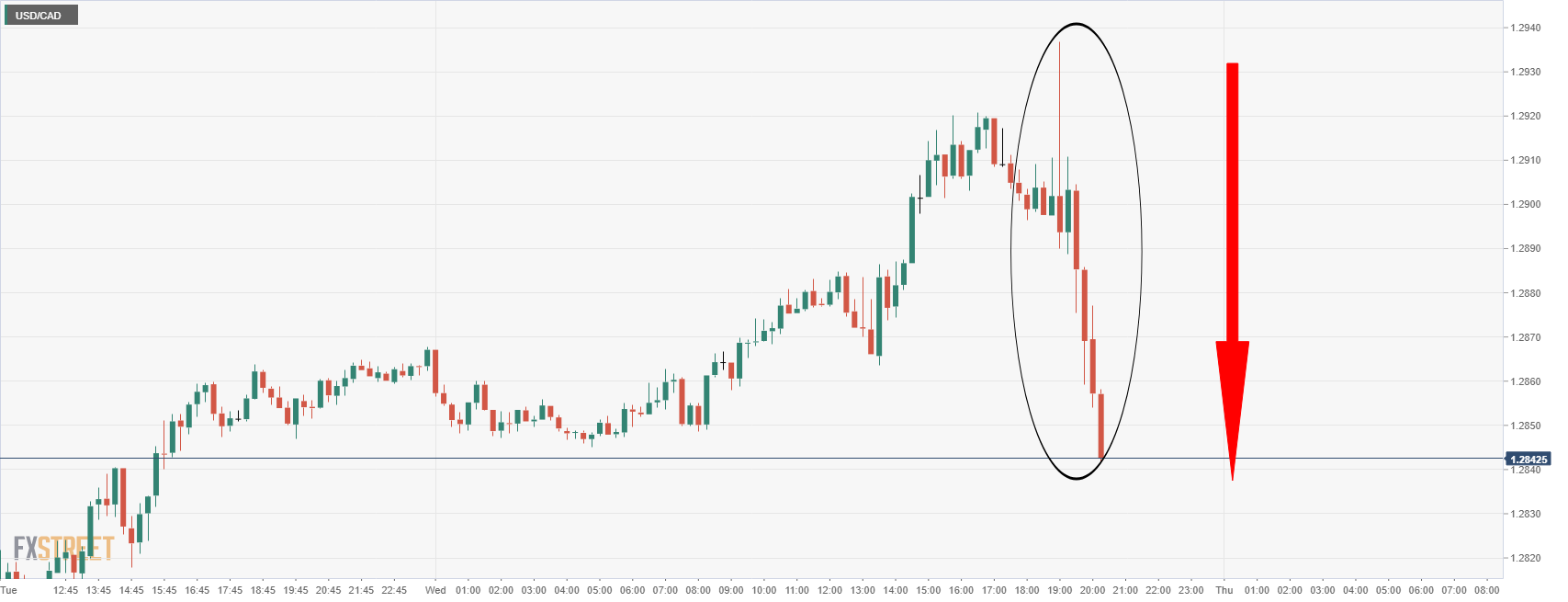
- Despite the hawkish Fed, USD/CAD drops into the abyss.
- Commodities turning around and FX follows the weaker US dollar.
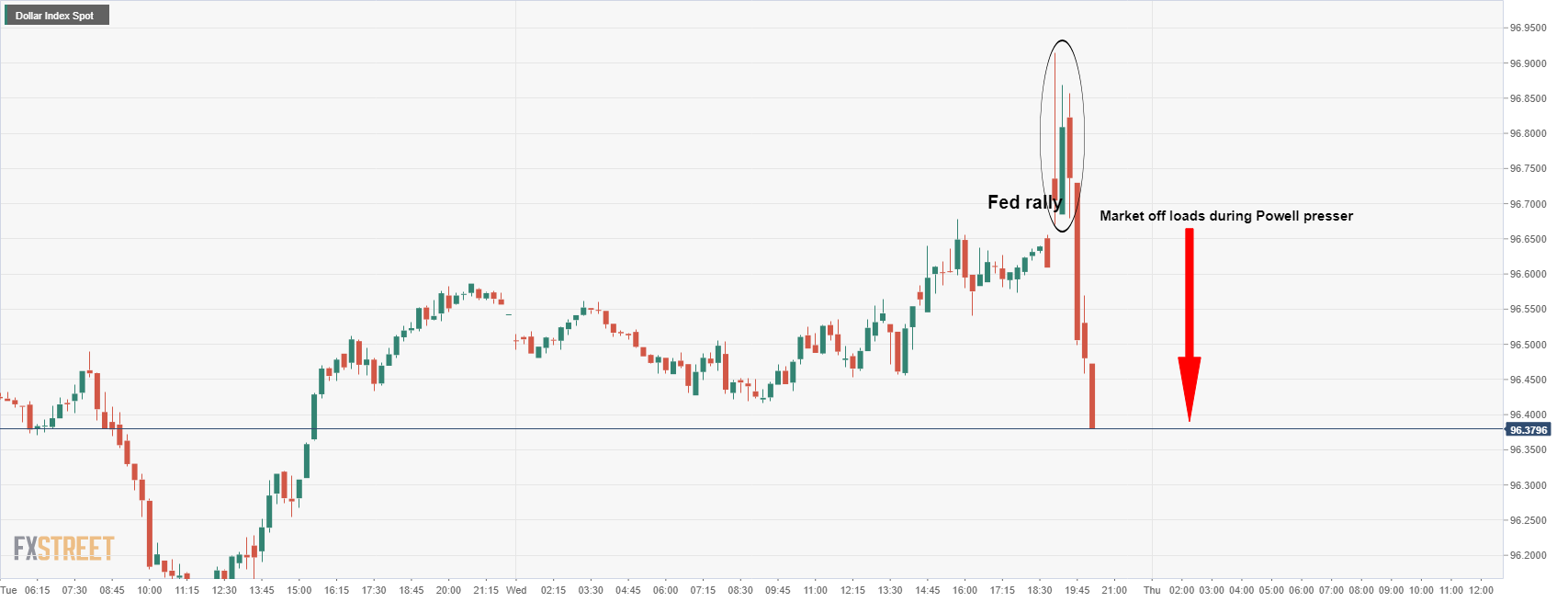
Despite a seismic shift in the Federal Reserve's dot plot and language with regards to inflation, the US dollar was unable to capitalise on the hawkish outcome. Instead, the greenback is worse off since the release of the statement and has sunk to the lowest levels since the start of the New York session.
However, the commodity complex remains on the backfoot, as measured by the Thomson CRB index that reads -0.23% at the time of writing. Nevertheless, USD/CAD is now in the red for the first time this session and trades at 1.2857 following a post-Fed low of 1.2845.
Fed key takeaways
- FOMC monthly taper pace $30 billion vs $15 billion prior.
- ''In assessing monetary policy, will continue to monitor incoming information for the economic outlook.''
- ''Prepared to adjust stance of monetary policy as appropriate if risks emerge that impede its goals.''
- ''Job gains have been solid in recent months, and the Unemployment Rate has declined substantially.''
- The median forecast is now showing three hikes in 2022 and 2023. In the September Dots, the median saw only one hike by end-2022 (0.375%).
See also: Summary of Economic Projections
ECB in focus
Meanwhile, the outcome of the Fed was hawkish, more than expected when taking into account the dot plot, much of the market's thinking may have already been priced in. The US dollar has rallied by almost 4% since the start of November on the back of the Fed's tapering communications. However, the risk now comes with the European Central Bank and traders may not wish to be too long of the greenback going into Thursday's meeting. Reports suggest the upcoming ECB forecasts will show inflation remaining below the 2% target in both 2023 and 2024 and that should underpin the greenback.
US dollar sinks
USD/CAD drops 100 pips
Fed Chair Jerome Powell said in his post-Fed meeting press conference that it will be appropriate for interest rate hikes in this economy.
Additional Takeaways:
"I don't think Fed is behind the curve."
"We can now take steps in a thoughtful manner to address issues including too high inflation."
"We are in a highly accommodative stance."
"The extent to which end of the taper, rate hikes will be separated in time will be discussed in coming meetings."
"We are very, very well placed for interest rates with inflation and a strong economy."
"Not at all likely that there will be the same length of time between the end of taper and rate hikes as in the last cycle."
"It will be appropriate for interest rate hikes in this economy."
"Had the first discussion of balance sheet issues today; did not make any decisions today."
"Have not made any decisions on when balance sheet would shrink."
"Will turn to those discussions in coming meetings."
Fed Chair Jerome Powell said in his post-Fed meeting press conference that with inflation so far above the Fed's 2.0% target, we can't wait too long to get back to maximum employment.
Additional Takeaways:
"Inflation that we've got is not at all what we were looking for in our framework."
"This is not the inflation we were looking for."
"Wages are one thing to look at when assessing full employment."
"Quits rate is also a good signal of full employment goal."
"High quits rate suggests a very tight labor market."
"We have to make policy in real-time."
"The labor market is hotter than it ever ran in last expansion."
"The labor market is so many measures hotter than it was in the last expansion."
"Shock to labor force participation is not unwinding as quickly as had been expected."
"For so many reasons, labor force participation shock is not unwinding as many expected and much of it is voluntary."
"In some cases, it will abate once the pandemic recedes from view and participation rate will rise."
"The economy does not lack stimulus."
"The problem is a supply-side problem on labor and that will take time to work itself out."
"If the pandemic were under control, then we'd fully know what labor market can really look like, but that's not coming any time soon."
"We can only try and create conditions for a tight but stable labor market."
"High inflation is a threat to full employment as we need to maintain a long expansion."
- USD/JPY edges higher after the Fed announced a faster QE reduction.
- Per dot-plot, Fed members eye three-rate hikes in 2022.
- On his press conference, Fed’s Powell said that the Fed could raise rates despite not achieving the full-employment goal.
The USD/JPY reclaims the 114.00 figure as the Fed decided to keep rates at the 0 to 0.25% range while increasing the bond-taper speed. Additionally, according to the dot-plot, the median estimates at least three hikes in 2022, in line with market expectations.
According to the Summary of Economic Projections (SEP), the Federal Reserve Board members, the median view of the Federal Fund Rates in 2022 is at 0.9%, in 2023 at 1.6%, and by 2024 at 2.1%.
US bond yields are rising in the bond market, with the US 10-year Treasury yield advancing two basis points, sitting at 1.46%, while the US Dollar Index rises some 0.11%, at 96.68.
Key summaries of the Federal Reserve monetary policy statement
Adding to the abovementioned, the Federal Reserve decided the bond-taper based on “inflation developments and the further improvement in the labor market.” Also announced that the reduction will begin by January, with purchases of $40 Billion in US Treasuries and $20 Billion in mortgage-backed securities (MBS). Moreover, in line with the November FOMC monetary policy statement, it left the door open for further adjustments at the QE’s reduction pace.
Regarding the Omicron newly discovered strain, the Fed said that “risks to the economic outlook remain, including from new variants of the virus.”
At press time, Federal Reserve Chairman Jerome Powell is crossing the wires. He said that “Balancing of our goals means we could possibly raise interest rates before full employment is met, due to high inflation.”
Markets reaction
The USD/JPY reached a daily high near the 114.30s. However, the upward move was faded, as Federal Reserve Chairman Jerome Powell is crossing the wires.
To the upside, the next resistance would be the October 20 high at 114.70, followed by 115.00.
On the downside, the first support would be 50-DMA at 113.75, followed by the December 10 low at 113.21.
Fed Chair Jerome Powell said in his post-Fed meeting press conference that if the economy were to slow, that would slow the pace of rate increases.
Additional Takeaways:
"We've been adapting our policy."
"I did wonder if we should increase our taper at the november meeting."
"I decided in last month that we needed to look at speeding up the taper."
"Higher inflation and much faster progress on jobs is what made me decide on speeding taper."
"Unemployment rate seems to be catching up with other readings of a tight labor market."
"My thoughts were widely supported by the committee."
"If real wages were persistently above productivity growth that puts pressure on firms."
"Recent hot labor market readings mean we are watching this carefully; rents are another thing."
"If economy turns out not to be as strong, we will adapt policy accordingly."
"If economy were to slow, then that would slow rate increases."
Fed Chair Jerome Powell said in his post-Fed meeting press conference that the US economy is strong enough for the Fed to press ahead with its bond taper plans even amid the spread of Omicron.
Additional Takeaways:
"A lot of uncertainty on Omicron."
"Effect of omicron on the economy will depend on its effect on demand and supply."
"People are learning to live with variants."
"As more people are vaccinated, the less the economic effect."
"Delta hurt global supply chains getting worked out."
"We'll know a whole lot more about omicron in a few weeks."
"Given the strength of demand in the economy, it's appropriate to move forward the taper. Omicron doesn't have much to do with that."
Fed Chair Jerome Powell said in his post-Fed meeting press conference that it feels likely that a return to a higher participation rate is going to take longer and that the Fed needs to focus on making policy for current economic conditions.
Additional Takeaways:
"We are not going back to the pre-pandemic economy."
"Post-pandemic labor market will be different as will full employment."
"Unemployment rate consistent with max employment evolves over time."
"Labor force participation rate has been disappointing."
"I had thought that rate would significantly surge."
"We have to make policy now and inflation is well above target."
"Reality is we don't have a strong labor force participation yet and may not have for some time; inflation well above target and we need to make policy now."
"Balancing of our goals means we could possibly raise interest rates before full employment is met due to high inflation."
"We are making rapid progress on full employment; may not have to invoke the need to raise rates before that test is met."
Fed Chair Jerome Powell said in his post-Fed meeting press conference that its not appropriate to raise rates while taper is ongoing.
Additional takeaways:
"We have learned regards balance sheet is best to adjust methodically due to market sensitivity."
"We talked today about the balance sheet
"Have not taken a position on whether should pause between the end of the taper and first rate hike."
"We discussed the sequence of events regarding balance sheet runoff last time."
Fed Chair Jerome Powell said in his post-Fed meeting press conference that in my view, we are making rapid progress to maximum employment.
Additional Takeaways:
"Maximum employment is something we assess through broad range of indicators."
"Those include labor force participation rate and demographic groups assessments."
"Maximum employment is a judgment call."
Fed Chair Jerome Powell said in his post-Fed meeting press conference that inflation will run above the Fed's 2.0% goal well into next year.
Additional Takeaways:
"Bottlenecks, supply constraints have been larger, longer-lasting than anticipated."
"Price increases are now broader."
"Wage growth thus far not a major contributor to elevated inflation."
"Expect inflation to decline closer to 2% by end of 2022."
"We continue to expect inflation closer to the 2% goal by end of next year."
"We understand high inflation is a hardship."
"We are committed to our price stability goal."
"We will use our tools to support labor market, and prevent higher inflation from becoming entrenched."
"We will watch carefully to see if economy moving in line with expectations."
"We think full employment will be met next year."
"Expect to leave rates at zero until reach maximum employment."
"Expect a gradual pace of policy firming."
- The British pound dipped to 1.3170s, then bounced back near 1.3200.
- Fed’s dot plot is far more hawkish, with three rate hikes in 2022 and 2023.
The GBP/USD edged lower during the New York session after the Fed decided to keep interest rates unchanged at the 0-0.25% range. Further, it decided that a faster bond taper is needed, reducing its bond purchases by $30 Billion, in line with the market’s expectations. Also, the dot-plot witnessed that most of the board members feel comfortable hiking at least three times in 2022, followed by three times in 2023 and three times in 2024.
According to the Summary of Economic Projections (SEP), the Federal Reserve Board members, the median view of the Federal Fund Rates in 2022 is at 0.9%, in 2023 at 1.6%, and by 2024 at 2.1%.
Summarize the Federal Reserve monetary policy statement.
Adding to the abovementioned, the Federal Reserve decided the bond-taper based on “inflation developments and the further improvement in the labor market.” Also announced that the reduction will begin by January, with purchases of $40 Billion in US Treasuries and $20 Billion in mortgage-backed securities (MBS). Moreover, in line with the November FOMC monetary policy statement, it left the door open for further adjustments at the QE’s reduction pace.
Markets reaction
The British pound plunged towards 1.3176 and found strong support around that area, and it is threatening to reclaim the 1.3200 figure. It appears that it was a “buy the rumor-sell the fact” event, as it came in line with expectations.
- Fed is hawkish and that is a bearish factor for AUD/USD.
- Fed's Powell is speaking and maintains the hawkish language that could impact the US dollar to the upside.
Federal Reserve's chair, Jerome Powell, has noted that inflation will run above goal well into 2022 in the presser. This leaves the downside in play for AUD/USD as follows:
AUD/USD daily chart
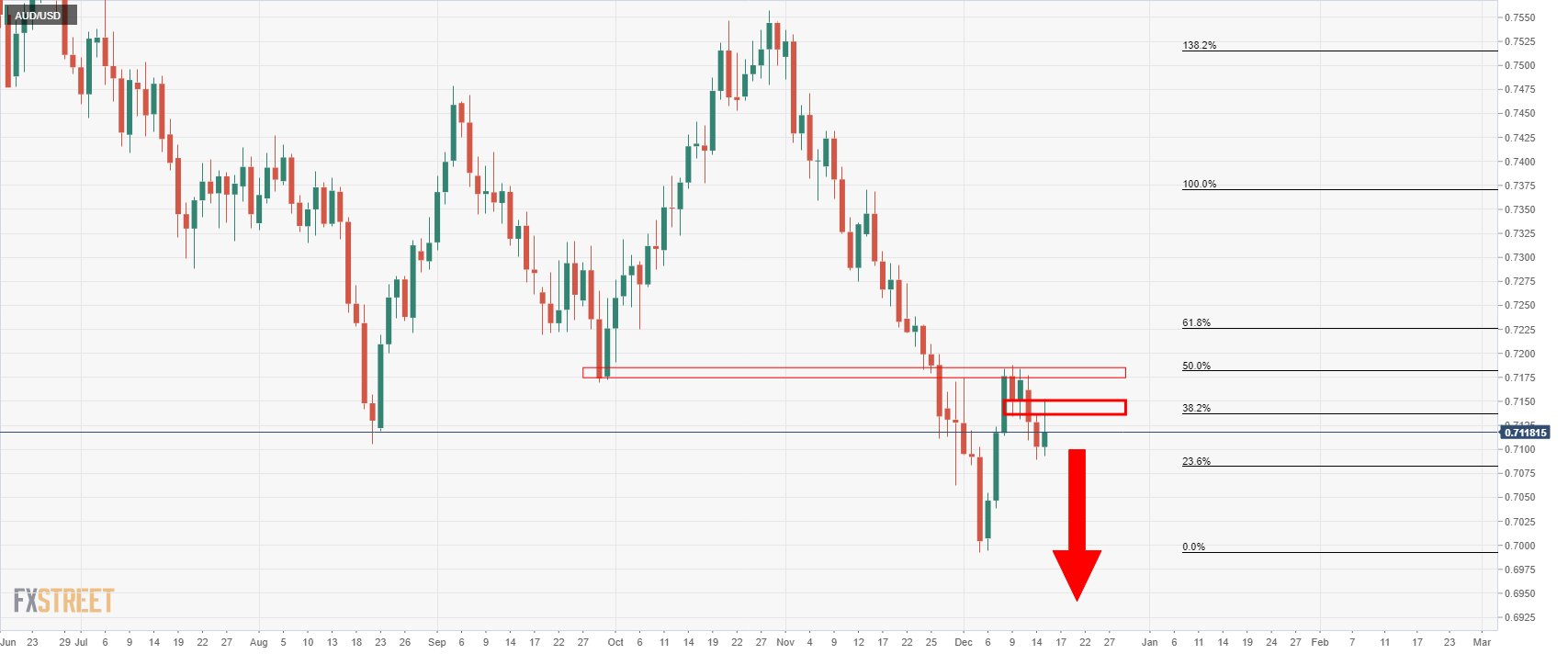
The daily chart is bearish while below 0.7150.
AUD/USD H1 chart
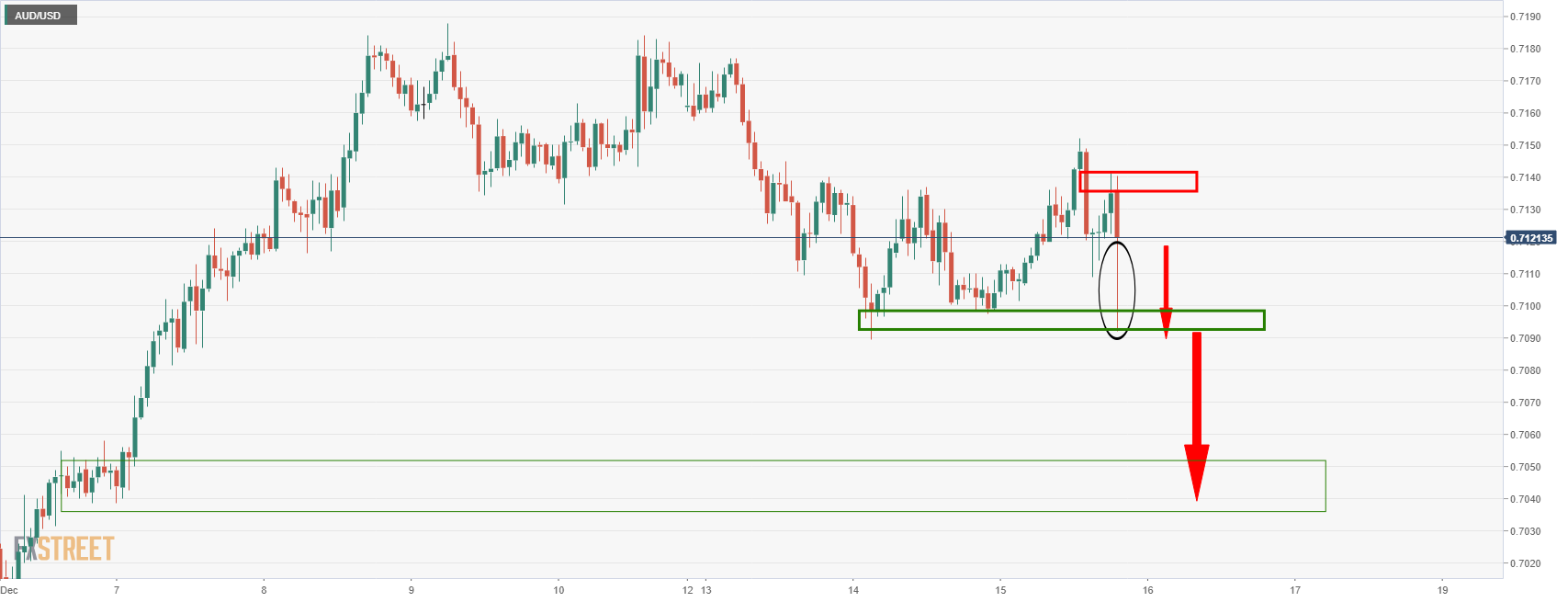
The bear wick could be targetted on a hawkish and bullish Fed's Powell. The US dollar would be expected to strengthen and this will expose the downside below 0.7090 towards 0.7050 and then 0.7030 as per the prior structure.
AUD/USD M15 chart
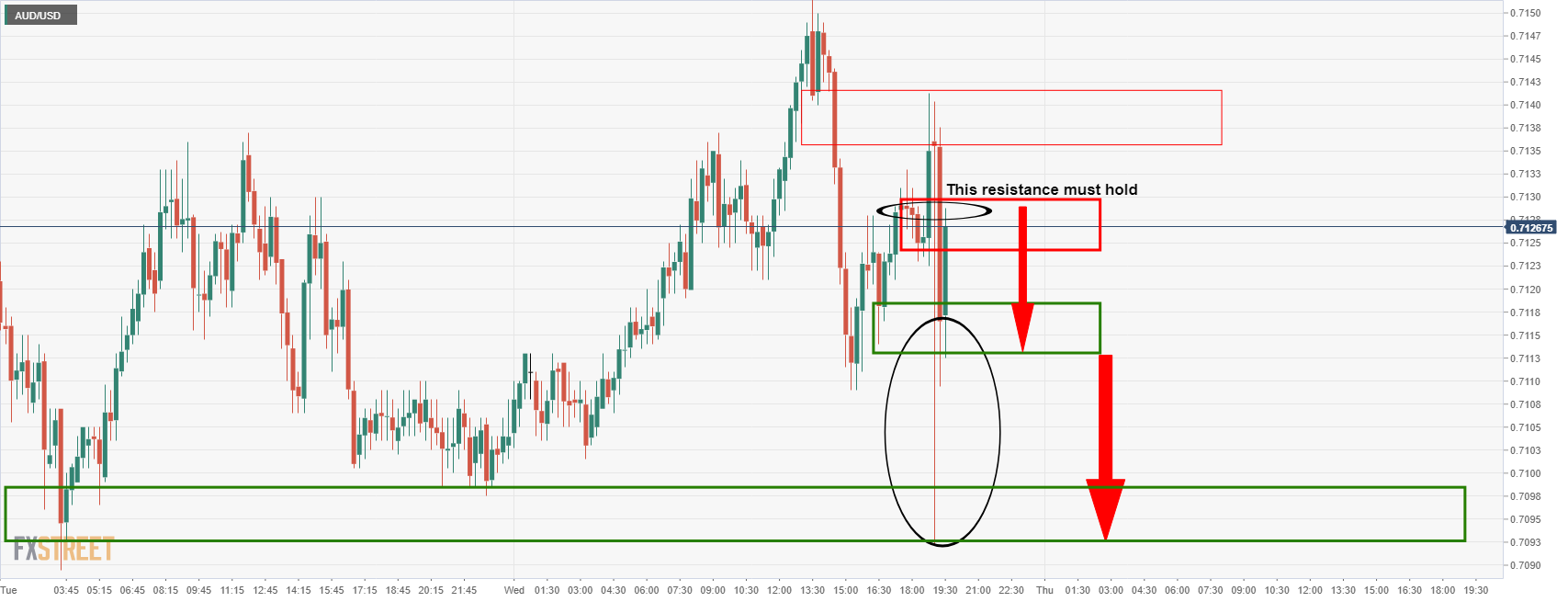
From a lower-term time frame, the 15-min chart shows that the price is mitigating the imbalance of the initial sell-off. However, should the key resistance hold, near 0.7130/40, now that the majority of the imbalance has been mitigated, then the prospects of the downside will intensify and leave 0.71 the figure vulnerable again.
Update: AUD/USD bulls step in
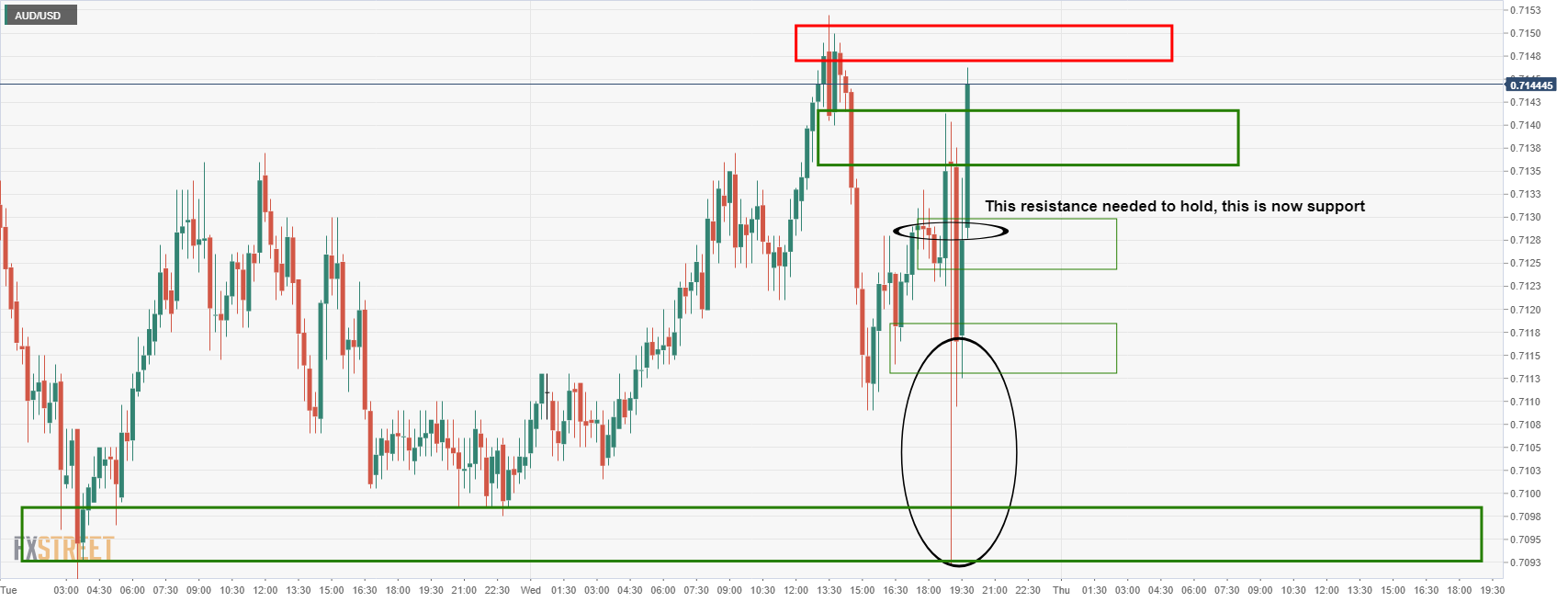
The spike to the upside has invalidated the downside case, for now. The old resistance would now be expected to act as support. However, the daily outlook for the sessions ahead remains intact while the price is below 0.7150. However, a break of 0.7180 would be the nail in the coffin for the bears.
Fed Chair Jerome Powell, speaking in his usual post-Fed meeting press conference, said that economic developments and the outlook warranted a faster pace of bond taper.
Additional Takeaways:
"Economic activity on track to expand at a robust pace this year."
"Demand remains very strong."
"Rising covid cases in recent weeks and omicron pose risks to the outlook."
"Omicron variant poses risks to outlook."
"We still see rapid economic growth."
"Amid improving jobs market conditions, the economy has been making rapid progress to jobs goal."
"Recent improvement in the labor market has narrowed difference across economic and racial groups."
"Some who would otherwise be seeking work are still out of labor force due to pandemic."
"Employers are having difficulties filling jobs, and wages rising at the fastest pace in many years."
"Employers having difficulty filling jobs, wages rising at the fastest pace in years."
"We think the labor market will continue to improve."
EUR/USD broke below a key uptrend that has been in play since November and fell to fresh one-month lows in the 1.1220s in response to the latest Fed policy announcement. The dollar was bought across the board in response to the Fed’s new dot plot showing that the median expectation of policymakers is for three interest rate hikes in 2022, a more hawkish showing than some had anticipated. The hawkish dot plot was the main surprise.
Otherwise, the Fed left rates at 0.0-0.25%, doubled the pace of its QE taper to $30B a month from January (though maintaining flexibility to adjust at a later date) and lifted its 2022 inflation forecast all as expected. Markets will now be watching what Fed Chair Jerome Powell has to say at his usual post-meeting press conference, which kicks off at 1930GMT.
Back to EUR/USD; now that the pair has broken to the south of the aforementioned key downtrend and prior monthly lows, the door is open for an extension of the downside towards the November lows under 1.1200. Powell will need to maintain a hawkish tone in the press conference for this to happen. One theme to watch might be his rhetoric on what constitutes the greater threat to the Fed’s mandate for full employment. In the past the Fed has emphasised the need to keep policy accommodative to reach this goal, but Fed rhetoric has recently shifted recently to noting that high inflation is the greater threat.
- Gold is feeling the pressure on a much more hawkish Fed, but much was priced in already.
- US dollar has rallied 30 points in the DXY on an uber hawkish Fed but is stalling.
- Fed's dot plot is far more hawkish with 3 rate hikes in 2022 and 2023. The taper has been doubled.
Gold, XAU/USD has extended the day's losses on an uber hawkish Federal Reserve statement and announcements of a doubling of its tapering of QE and a seismic shift in the dot plot. The median forecast is now showing three hikes in 2022 and 2023.
The Federal Reserve statement acknowledges that job gains have been solid and it has dropped the transitory language with respect to upside inflation pressures.
Fed futures printing in a 100% chance of a Fed hike as soon as May and 50% for a March rise, with 90% for April.
Key takeaways from the Fed statement
- FOMC monthly taper pace $30 billion vs $15 billion prior.
- ''In assessing monetary policy, will continue to monitor incoming information for the economic outlook.''
- ''Prepared to adjust stance of monetary policy as appropriate if risks emerge that impede its goals.''
- ''Job gains have been solid in recent months, and the Unemployment Rate has declined substantially.''
See also: Summary of Economic Projections
Watch live: Fed's Powell coming up, top of hour
Federal Reserve Chairman Jerome Powell holds a news conference after Federal Open Market Committee concluded its two-day meeting.
This shift to three rate hikes in 2022 will very much support the notion of the Fed moving into tightening mode. Therefore, there will be plenty of interest as to how the Fed now refers to inflation - after Powell said its description as transitory should be 'retired. This will be the key theme during the presser and the price of gold will be determined by it.
''Certainly, while the above suggests a hawkish tone from the Fed, the market is already pricing an aggressive tapering and the first hike in May 2022,'' analysts at TD Securities argued.
''This leaves a balance of risks tilted towards the upside for the near-term precious metals outlook, particularly as our macro strategists expect enough slowing in inflation and growth to delay rate the start of the hiking cycle.''
Gold technical analysis
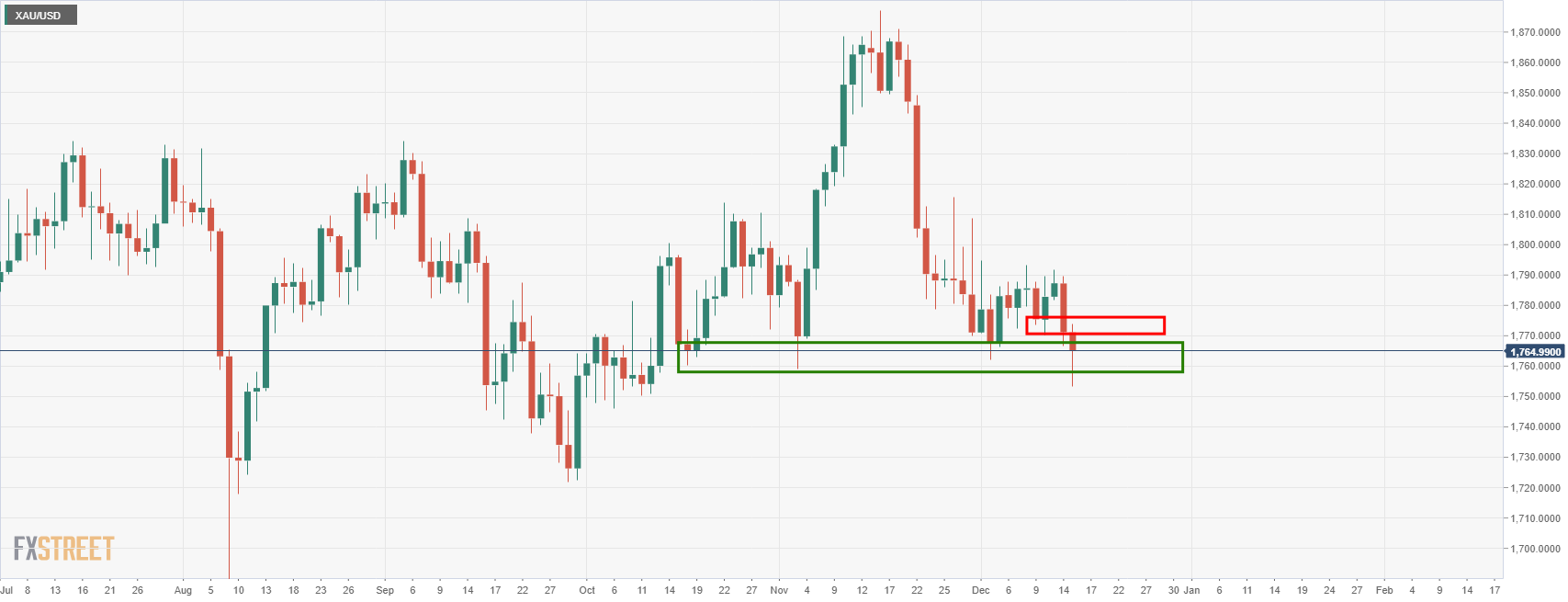
However, from a technical perspective, while the price is being supported, the wick is going to be a target for the bears for the sessions ahead. A break of $1,750 will open the risk of a far deeper move to the downside and $1,700 could come under pressure over the coming weeks.
This will depend on the US dollar's trajectory. The initial move was a strong bid but it has since settled as follows:

- The Fed left interest rates unchanged at 0.0-0.25% and doubled the pace of QE taper in January, as expected.
- The bank's new dot plot showed Fed members expect three rate hikes in 2022, more hawkish than some had expected.
- As a result, the US dollar was supported and the DXY lurched towards 97.00.
The US Federal Reserve announced on Wednesday that the FOMC had agreed to leave the Federal Funds target range unchanged at 0.0-0.25%, in line with expectations. Moreover, the pace of the taper of the bank’s bond-buying programme will be doubled from mid-January to $30B per month, with a similar pace of taper likely appropriate in the months thereafter, though the pace of taper could be adjusted if warranted by a change in economic conditions. If the Fed does reduce its bond-buying by $30B per month until the programme is fully unwound, net asset purchases will fall to zero before the end of March 2022.
According to the new dot plot, the median view of the Fed Funds rate at the end of 2022 was lifted to 0.9% (indicating three rate hikes are expected in 2022) from 0.3%. The median view of the Fed Funds rate at the end of 2023 and was lifted to 1.6% from 1.0% and at the end of 2024 was lifted to 2.1% from 1.8%. The Fed’s view of where interest rates will sit in the long-run was left unchanged at 2.5%. Five of the 18 Fed members see the policy rate at or above 2.5% by the end of 2024.
In its statement on monetary policy, the Fed said that, with inflation having exceeded 2.0% for some time, its expects it to be appropriate to keep interest rates at the current level until labour market conditions hit levels consistent with full employment. The Fed added that supply and demand imbalances related to the pandemic and economic reopening continue to contribute to elevated levels of inflation and that risks to the economic outlook remains, including new variants of Covid-19. Job gains have been solid in recent months, the Fed said, and the unemployment rate has declined substantially, though sectors most adversely affected by the pandemic have improved in recent months, though continue to be affected by the pandemic.
The Fed also released new economic forecasts, where it sees Core PCE averaging 2.7% in 2022, up from 2.3% in the last forecast, before falling back to 2.3% in 2023 and then to 2.1% in 2024. The GDP growth forecast for 2022 was revised slightly higher to 4.0% from 3.8%, and was left unchanged at 2.2% for 2023 and 2.0% for 2024. The long-run expectation for growth was left unchanged at 1.8%.
Market Reaction
The DXY initially spiked higher from the 96.60s to as high as 96.90 in response to the Fed's policy announcement but has since retraced lower to the 96.70 area. USD/JPY broke above 1.1400, taking it to fresh one-month highs. EUR/USD fell sharply under 1.1250 and to fresh one-month lows in the 1.1220s.
The dot plot seems to have been a little more hawkish than expected, with three rate hikes indicated in 2022 (some market participants had expected the Fed to signal two hikes in 2022). As traders continue to digest the announcement, FX market focus now turns to the post meeting press conference with Fed Chair Jerome Powell, which kicks off at 1930GMT.
The Canadian government on Wednesday said that there is community transmission of the Omicron Covid-19 variant all over the country. As a result, the government will be sending booster doses and rapid tests to provinces so that they can ramp up vaccinations in response to the outbreak of the new variant. The government pledged to increase testing capacity at the border and urged people to avoid non-essential international travel.
Market Reaction
The loonie has not reacted to the latest government warnings, with FX markets focused on the imminent monetary policy announcement from the Fed (at 1900GMT).
- The USD/CHF edges up during the New York session, gaining 0.26%.
- USD/CHF Technical Outlook: It has a bullish bias; if the Fed maintains its hawkish rhetoric, it could challenge the 78.6% Fibonacci at 0.9326
The USD/CHF continues its rally in the week, up for the third day in a row, trading at 0.9268 during the New York session at the time of writing. The market sentiment is calm as market participants wait for the Federal Reserve’s last 2021 monetary policy decision.
Market participants seem to have fully priced at least two interest rate hikes, by the US central bank in 2022, with the possibility of three. Further, in the bond purchasing program, investors expect an increase of the reduction of purchases at least by $30 Billion.
In the overnight session, the USD/CHF remained subdued. However, as shown by the hourly chart, the pair bounced off the confluence of the 50, 100, and 200-hourly simple moving averages (SMAs), breaking the December 14 pivot high at 0.9245, peaking around 0.9270, some 30 minutes away of the Federal Reserve, decision.
That said, the bias of the USD/CHF is tilted to the upside and would challenge the 0.9300 figure if the Fed’s hawkish rhetoric remains.
In the meantime, US bond yields are almost flat. The US 10-year Treasury yield sits at 1.446%, unchanged, while the US Dollar Index edges up 0.03%, at 96.60.
USD/CHF Price Forecast: Technical outlook
Fed evens usually carry much volatility in the markets. At press time, the USD/CHF is trading near the 50% Fibonacci retracement from the November 24 swing high to the November 30 swing low.
That said, to the upside, the first resistance would be the December 7 high at 0.9274, followed by the 61.8% Fibonacci retracement at 0.9291 and then the 78.6% Fibonacci retracement at 0.9326
On the other hand, the key support levels would be the 38.2% Fibonacci retracement at 0.9239, the 50-DMA at 0.9217, and the figure at 0.9200.
-637751905109490323.png)
- GBP/JPy bulls are taking control and eye a breakout.
- The daily and weekly market structures offer prospects for 152.20 and then 153.20
GBP/JPY is moving higher in a phase of accumulation. The bulls can target the 61.8% ratio near 152.50 to mitigate the imbalance of the prior bearish impulse ahead of weekly resistance near 153.20.
GBP/JPY weekly chart
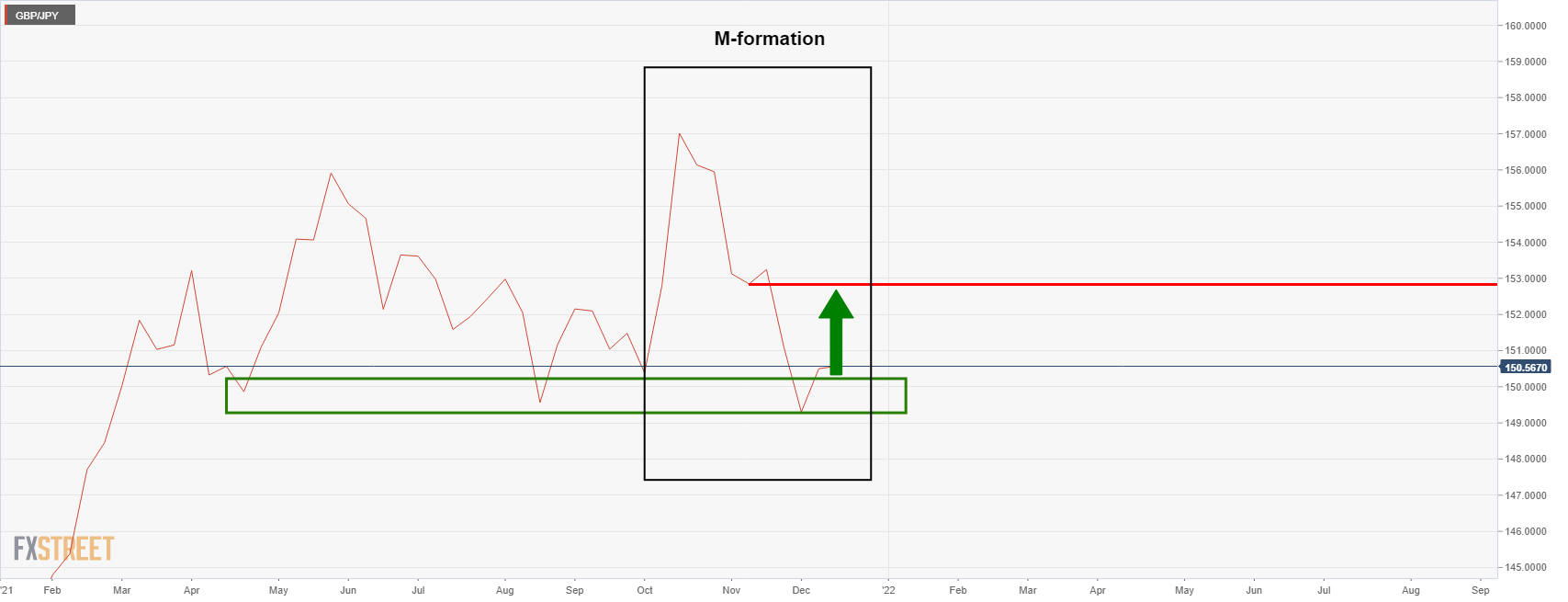
The M-formation on the weekly chart is a reversion pattern that would be expected to pull in the bulls to the neckline located near 153.20. However, there is some work to do on the daily chart first with levels to break as follows.
GBP/JPY daily chart
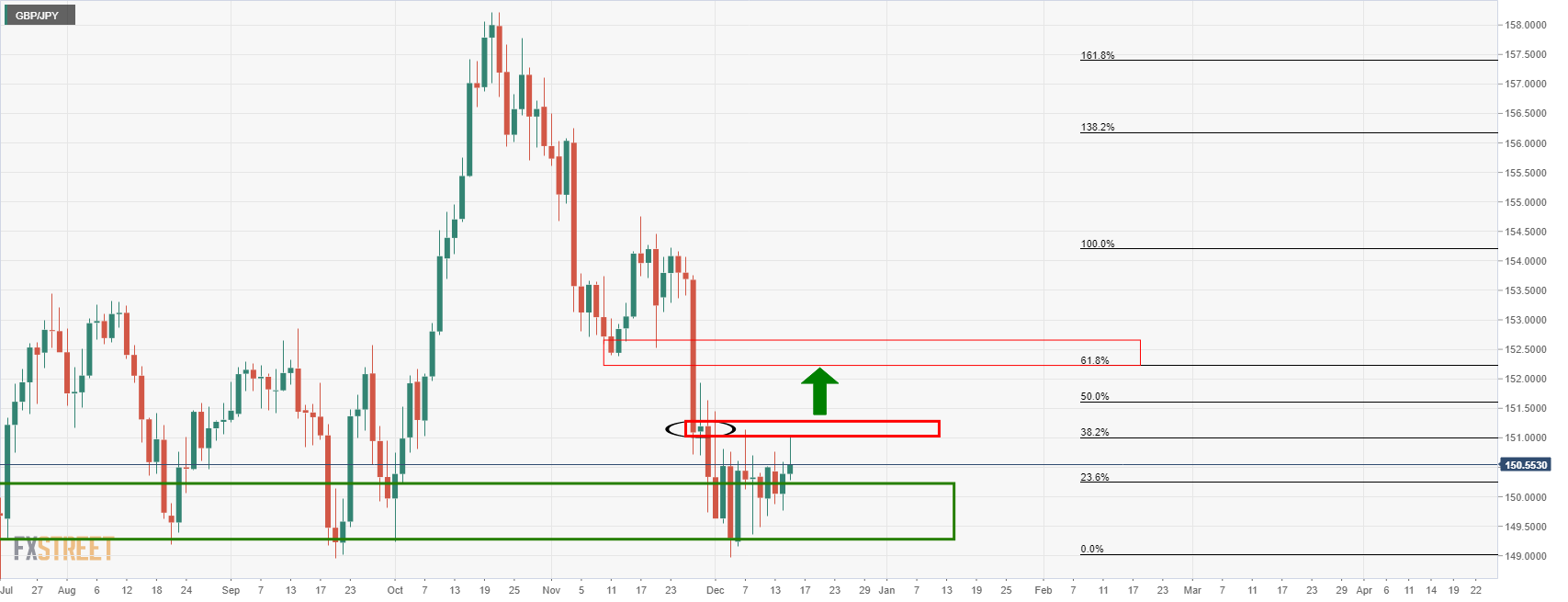
From a daily perspective, support has been held and the bulls can home in on the 151.20s as per the order block eclipsed in the chart. A move towards the 61.8% golden ratio aligns particularly with the old support near 152.50. A break there opens risk to the M-formation's neckline, as illustrated in the weekly chart above.
A break of the daily support, however, opens the risk of a considerable move to the downside. 140/142.50 would be earmarked targets for the bears positioning for the downside in such a scenario, as per the following weekly chart:
- USD/CAD has pushed above 1.2900 in advance of the Fed and is eyeing a test of the 1.2950 annual high.
- CPI cooled in Canada in November and confirmation of this seemed to weigh on the loonie, which is underperforming currently.
USD/CAD has pushed above the psychologically important 1.2900 level on Tuesday and looks likely to stay there in the run-up to the Fed’s policy announcement (at 1900GMT). That means the pair is currently trading with gains of about 0.3%, having started the session closer to 1.2850.
The annual pace of Canadian Core Consumer Price Inflation in November saw a slight drop versus October's levels, which, though expected, cuts in the opposite direction to the building price pressures seen most recently out of the US, UK and EU. Thus, the data appeared to weigh on the loonie at the time as it eases (somewhat) the pressure on the BoC to tighten monetary policy settings.
Hawkish leaning commentary from BoC Governor Tiff Macklem more recently has not been enough to lift the loonie from near the bottom of Wednesday’s G10 performance table. For reference, Macklem said that the significant amount of slack that was in the Canadian economy is now substantially diminished, before adding that the time is coming closer when the bank will move away from its exceptional forward guidance. As a result, the loonie is one of the worst-performing G10 currencies ahead of the Fed meeting, though if the Fed does deliver some sort of surprise that alters risk appetite, the G10 rankings could quickly switch up.
In the case of a hawkish surprise (say the Fed hints at ending QE earlier than expected, or indicated sooner and faster than expected rate hikes), USD/CAD would likely continue Wednesday’s rally and test August highs around 1.2950. A more dovish outturn could see the pair drop back towards support around 1.2850.
Jerome Powell, Chairman of the Federal Reserve System, will be delivering his remarks on the monetary policy outlook at a press conference following the meeting of the Board of Governors. Powell's speech will start at 19:30 GMT.
Follow our live coverage of the Fed's policy announcements and the market reaction.
Related articles
Fed Preview: Dollar hinges on 2022 rate hike dots, guide to trading the grand finale of 2021.
Fed Interest Rate Decision Preview: Can the FOMC satisfy and mollify the markets?
About Jerome Powell (via Federalreserve.gov)
Jerome H. Powell took office as Chairman of the Board of Governors of the Federal Reserve System on February 5, 2018, for a four-year term. Mr. Powell also serves as Chairman of the Federal Open Market Committee, the System's principal monetary policymaking body. Mr. Powell has served as a member of the Board of Governors since taking office on May 25, 2012, to fill an unexpired term. He was reappointed to the Board and sworn in on June 16, 2014, for a term ending January 31, 2028.
Bank of Canada Governor Tiff Macklem said on Wednesday that the significant amount of slack that was in the Canadian economy is now substantially diminished, according to Reuters. Earlier in the session, Macklem spoke about the longer-term outlook for BoC policy.
He said that lower neutral interest rates mean we are likely going to need exceptional forward guidance and QE more often and, with interest rates lower across the globe, the bank is likely to lower its policy rate to the effective lower bound (i.e. just above zero) more frequently in response to shocks.
Market Reaction
CAD has not seen a reaction to Macklem's latest remarks.
- The shared currency recovered some of its Tuesday’s losses, is up some 0.05%
- The EUR/USD is range-bound in familiar levels, waiting for the Fed.
- EUR/USD Technical Outlook: Bearish bias with the YTD low is at risk of being broken.
The EUR/USD barely advances during the New York session, trading at 1.1260 at the time of writing. A risk-off market mood spurred by Wednesday’s Federal Reserve monetary policy decision looms the financial markets. US equities are down in the day, while US bond yields rise, while the greenback is slightly up.
The EUR/USD pair remained subdued through the overnight session, in a familiar fashion, ahead of the Fed and could not break above the 50-hour simple moving average (SMA) around 1.1280. In fact, it dropped near the December 14 swing low at 1.1252, fading the downward move, settling at current levels.
Before the Wall Street opened, the US Commerce Department reported that Retail Sales for November rose by 0.3%, lower than the 0.8% foreseen. Meanwhile, excluding Autos, sales increased by 0.2%. The aforementioned was mainly ignored by investors, which in turn, on Tuesday’s witnessed the highest increase in 10-year of prices paid by producers, adding fuel to expectations of a faster Fed bond taper process, so expected by the markets.
What’s priced in?
The market expects that the Fed would accelerate the reduction of its QE, at least by double of the $15 Billion announced on November’s meeting. Additionally, the Summary of Economic Projections (SEP) with its “dot-plot” would be scrutinized, as market participants look for signals of rate hikes, how many, and in which time frame.
Money market futures expect at least two rate hikes by 2022, three in 2023, and two more in 2024, each one of 25 basis points, with rates closing almost to 2%.
In the meantime, US bond yields are almost flat. The US 10-year Treasury yield sits at 1.446%, unchanged, while the US Dollar Index edges up 0.03%, at 96.60.
EUR/USD Price Forecast: Technical outlook
The EUR/USD daily chart shows the pair has a downward bias, further confirmed by a descending triangle in a downtrend called a “pennant.” Additionally, the daily moving averages (DMAs) remain above the spot price, with the 50, 100, and 200-DMAs located at 1.1447, 1.1600, and 1.1788, respectively.
On the downside, a break below the December 7 pivot low at 1.1227 would expose the YTD low at 1.1186. The breach of the latter would push the pair towards the figure at 1.1100, followed by the pennant’s target at 1.1041.
To the upside, the first resistance would be 1.1300. In the event of the figure giving way for EUR bulls, that would expose the December 8 high at 1.1354, followed by a test of 1.1400.
-637751885505248747.png)
- AUD/USD traders await the Fed for clues with regards to the divergence between the RBA and Fed.
- Bearish head & shoulders taking shape could leave 0.70 vulnerable to a test in the coming sessions.
AUD/USD started out the New York day better bid until an avalanche of demand came in for the greenback ahead of the Federal Open Market Committee event today. At the time of writing, AUD/UD is licking its wounds near 0.7125 and up by some 0.3% still. The price has traded between a range of 0.7097 and a high of 0.7151 where it peaked just ahead of the North American session.
AUD/USD dropped 40 pips in the Wall Street open when US stocks fell, with the Nasdaq Composite leading the charge, as investors expected the Federal Reserve to unveil in the next few hours an unwinding of its highly accommodative, pandemic era policies.
''A faster taper, a higher dot-plot and more hawkish forecasts should be the hallmarks of this meeting,'' analysts at TD Securities said. ''That should cast a long shadow over the other key central bank decisions this week, leaving the USD likely in firm standing overall.''
Fed/RBA divergence to pummle AUD/USD
The commodity complex and high beta FX will be put under pressure should we get the most hawkish of outcomes from the meeting with the Fed seeking to battle stickier inflation risks. The divergence between the Reserve Bank of Australia, especially, leaves the Aussie vulnerable as a consequence.
''We expect the monthly pace to be doubled to $30bn from $15bn, consistent with QE ending in mid-March instead of mid-June,'' the analysts at TDS said. ''Officials will likely also convey a more hawkish tone through changes to the statement, the economic projections, and the dot plot. We expect the median dot to show a 50bp increase in the funds rate in 2022.''
By contrast, while inflation is increasing globally, according to the RBA, in Australia it is of a different order. The RBA has stated that the labour market scarcity and “significant” wage growth have yet to emerge before higher inflation is considered sustainable. The RBA has also argued that there is still significant slack in the Australian labour market.
''We believe it will take at least a year before the required condition of “significant” wage growth set by the RBA is met,'' analysts at Rabobank argued. The analysts note that current levels of wage growth are still well below the historic average and have much catching up to do.
AUD/USD technical analysis
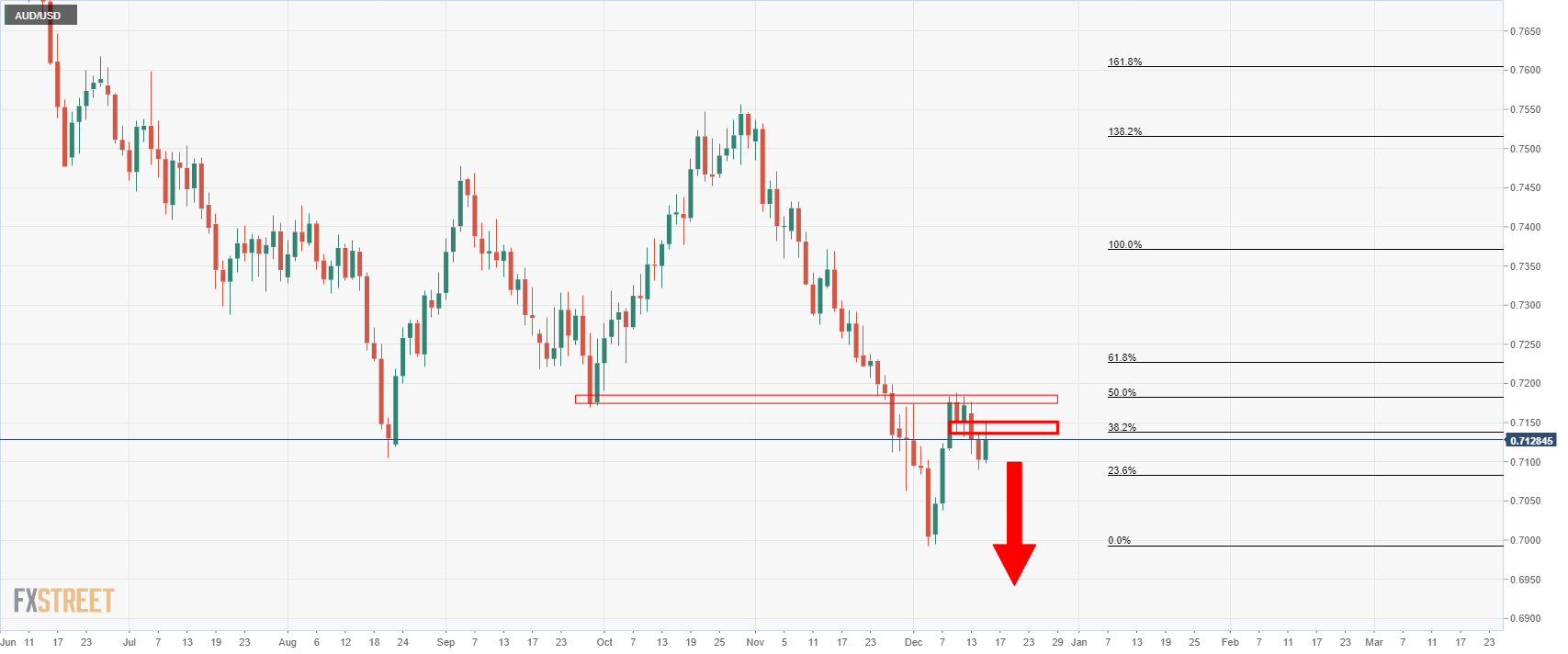
The daily chart is a compelling case for the downside following the recent correction that has met a 50% mean reversion of the prior bearish run from the 0.7370s to the 0.6990s. Should the market break those lows, then the next feasible target comes near to 0.6940.
We are also seeing a 50% mean reversion of the hourly chart as follows:
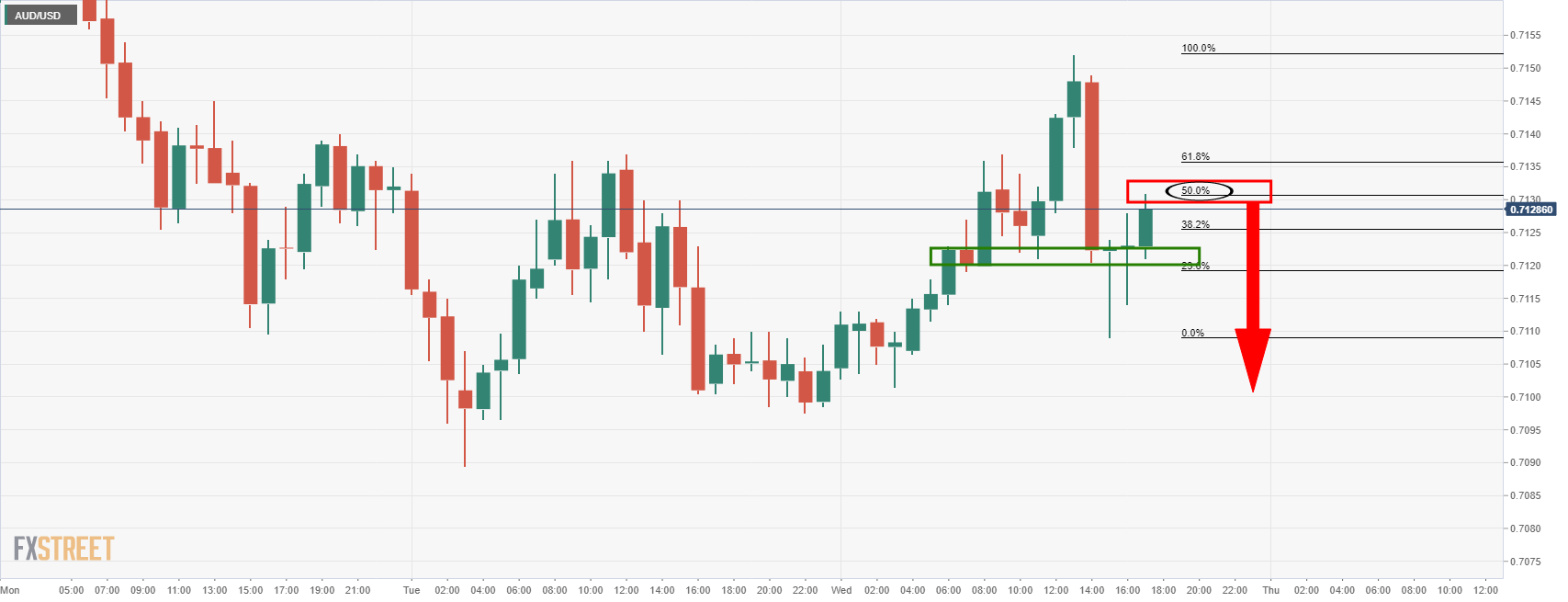
A rejection here would lead to the prospects of a bearish head & shoulders and leave 0.70 vulnerable to a test on the downside in the coming sessions.
- The New Zealand dollar extends its slide for three consecutive days, falling 0.14%.
- The market sentiment is mixed as investors prepare for the Fed.
- Market participants expect a faster bond taper and at least two rate hikes by 2022.
- NZD/USD Technical Outlook: It has a downward bias, though it could be an event of “buy the rumor, sell the fact.”
The NZD/USD slides for the third day in a row, trading at 0.6730 during the New York session at the time of writing. The market sentiment is mixed, as shown by European and US equities. In Europe, most indices fluctuate between gainers and losers, while in the US, all are in the red, ahead of the Fed.
As shown by the recent price action in the NZD/USD, investors are preparing for the Fed, except for Monday, when the pair dropped below the 0.6800 figure. In the last two days, the FX market has been calm, with the NZD/USD trading within familiar ranges, within 0.6700-0.6750.
In the overnight session, the NZD/USD pair peaked at around 0.6760, then fell towards the December 14 low at 0.6734, courtesy of greenback demand. However, the downward move was short-lived, bouncing back towards 0.6750s, though faced robust resistance, pushing the price towards the S1 daily pivot at 0.6726.
What’s priced in?
Market participants expect that the Fed would increase the pace of the bond taper to $30 Billion so that the US central bank could finish its stimulus by the end of March 2022. In addition, money market futures expect at least two hike rates by 2022, three in 2023, and two more in 2024, each one of 25 basis points, with rates closing almost to 2%.
In the meantime, US bond yields are almost flat. The US 10-year Treasury yield sits at 1.444%, while the US Dollar Index edges up 0.01%, at 96.58.
The US Economic docket featured Retail Sales for November, which rose by 0.3% on a monthly reading, lower than the 0.8% expected. However, market participants mainly ignored them, as they remained tuned into the Federal Reserve monetary policy decision.
NZD/USD Price Forecast: Technical outlook
The New Zealand dollar is under downward pressure as market participants prepare for the Fed. The pair is tilted to the downside, as shown by the daily moving averages (DMAs) residing above the spot price, with shorter time-frames below the longer ones. Further, the first line of defense for NZD bulls would be the psychological 0.6700, which, once broken, could give way for USD bulls towards October 2020 cycle lows, around 0.6550.
On the downside, the key levels to watch are 0.6700, followed by support provided by a downslope support trendline lying around 0.6680s, followed by 0.6650.
To the upside, the first resistance would be 0.6760, followed by December 14 high at 0.6770. A breach of the latter would expose the December 9 cycle high at 0.6822.
-637751838470850175.png)
- USD/JPY is trading subdued close to the 113.80 mark, but has been gradually ebbing higher all week into the Fed.
- The pair appears to have formed an ascending triangle and could soon see a bullish breakout.
USD/JPY continues to trade in subdued fashion, as has been the case for most of the week, if not with a slight positive bias, as the US dollar picks up in the run-up to the Fed’s policy announcement. The US data already released this week has by and large been dollar supportive, with Tuesday’s Producer Price Inflation report much hotter than expected and Wednesday’s Retail Sales not quite as strong as forecast but still at healthy levels, while the NY Fed Manufacturing survey indicated a strong start to the month for US industry.
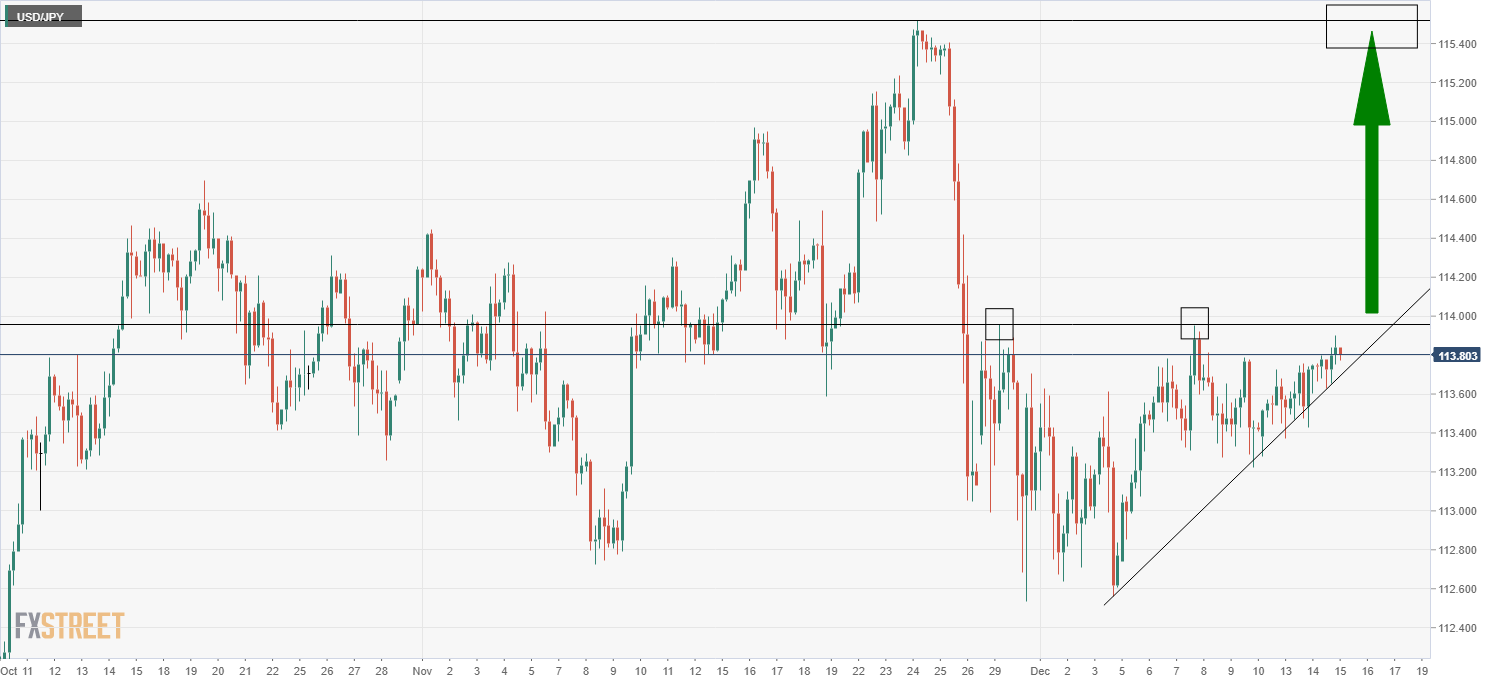
Since bottoming out in the 113.20s at the start of the week, USD/JPY has gradually pushed higher, sticking fairly close to its 50-day moving average along the way, and now trades in the 113.80s. That translates into modest on-the-week gains of about 0.4%, with the price action for now being capped by the 21DMA (currently at 113.875). Last week’s near-114.00 highs are also providing some resistance, though it looks increasingly likely that USD/JPY is going to break out to the upside.
The pair appears to have formed an ascending triangle over the last few sessions, which technicians will note is typically indicative of a bullish breakout. A more hawkish than expected Fed could be just the catalyst that USD/JPY would need to break higher, so long as it spurred upside in long-term US government bond yields, to which the pair is most sensitive. From a technical perspective, a bullish breakout could open the door for USD/JPY to push on towards recent highs around 115.50.
The annual inflation rate in Canada remains at 4.7% in November. Analysts at RBC Capital Markets point out that inflation pressure continues to broaden; that combined with a stronger labour market will prompt a rate hike from the Bank of Canada during the second quarter of next year.
Key Quotes:
“Canada’s headline inflation rate was unchanged in November, at 4.7% year over year. Energy price growth inched higher again, backed by still elevated gasoline prices, which were 43.6% above levels in November 2020 and accounted for just under a quarter of the headline inflation rate. Growth in food prices also strengthened, to 4.4% or the highest since 2015.”
“Excluding food and energy products, CPI ticked slightly lower to 3.1% from year ago in November, or 2.7% on an annualized seasonally adjusted basis relative to the pre-shock February 2020 level.”
“Further disruptions to supply chains and energy markets from Omicron and the BC flood later in November are expected to add to price uncertainties in the near-term. But very firm demand growth means inflation rates will likely remain above pre-pandemic levels over the next year. And with labour markets also growing increasingly tight, we expect the bank of Canada to start hiking rates around the second quarter of 2022.”
Data released on Wednesday showed retail sales rose in the US below expectations in November, at the slowest pace in four months. Analysts at Wells Fargo point out that despite those numbers, holiday sales are still on track to post a record for the year, but with spending slowing in the final months, “it is not the finish retailers were hoping for.”
Key Quotes:
“Retail sales rose just 0.3% in November, which was less than half the consensus estimate that was calling for a 0.8% gain. The main story in the November is that higher prices for non-discretionary items, like food and gas, are forcing hard choices for consumers in other areas this holiday season. There is also reason to believe holiday sales were pulled forward to get ahead of supply chain snarls that left retailers worried and consumers frantic to secure their gifts in time for the holidays.”
“We would not rule out some giveback in December. With well-publicized supply-chain issues and aggressive messaging from retailers, shoppers have largely heeded the advice to shop early. The risk is that all that early shopping pulled forward trips that in other years would have happened in December, setting us up for a decline. It is not just pulled-forward demand either. If stores are out of key merchandise, holiday gift cards might take the place of gifts; since those get counted for retail sales when they are redeemed, that could push some spending into January.”
“The one thing everyone is getting this holiday season is inflation, our measure of real holiday sales showed a decline of 0.5% in November—which puts real holiday sales on track to rise roughly 10%. However once things shake out, the nominal year-over-year gain will likely be four to five percentage points higher thanks to inflation.”
The UK reported a record number of Covid-19 infections on Wednesday of 78.61K, a near 20K jump from Tuesday's 59.6K number. That was the highest daily count since the start of the pandemic, although it is worth noting that tests are more widespread and accessible in the UK than at any point in the pandemic thus far, and are much more accessible than most other developed countries.
There is particular attention on UK Covid-19 infection rates at the moment with the government warning that Omicron is spreading at a rapid pace in the country and in wake of the recent imposition of fresh Covid-19 curbs. Health officials have warned that Omicron's doubling time could now be under two days and there is speculation that the UK government might toughen restrictions even further in the weeks ahead in an attempt to prevent hospitals from being overwhelmed in the new year.
Infection rates will continue to surge, with the Omicron variant as much as four times more transmissible than the delta variant according to a study released by Japanese scientists last week. The key thing to watch will be the degree to which a surge in infections translates into a surge in hospitalisations (and sadly also mortality).
Market Reaction
Sterling did not react to the latest news, though will remain twitchy on Omicron headlines in the days/weeks ahead.
- Pound erases UK CPI gains, turns negative versus US dollar.
- GBP/USD key levels seen at 1.3300 and 1.3180.
- Traders await the FOMC statement, its projections and Powell.
The US Dollar gained momentum during the American session amid a decline in equity prices and also ahead of the FOMC statement. GBP/USD dropped from weekly highs near 1.3285 to 1.3205, turning negative for the day.
The pound lost momentum and erased the gains that followed the release of higher-than-expected UK inflation data on European hours. Now, market participants have their attention set on the Fed.
The GBP/USD is moving sideways facing a strong resistance below 1.3300 while on the downside support is seen around 1.3180. Those two levels will likely be challenged during the next sessions.
Fed today, BoE tomorrow
The Federal Reserve will announce its decision at 19:00 GMT. The central bank will issue the statement and economic projections. Thirty minutes later Jerome Powell will deliver a press conference.
What the FOMC decides, its projections and Powell’s comments will likely rock markets, including the US dollar.
On Thursday, market participants will learn about the decision of the Bank of England. Market consensus sees no change in rates but some speculate with a rate hike amid rising inflation and an improvement in the labor market in the UK, offset by the surge of COVID cases. “We expect the BoE to leave policy on hold, with a message of COVID uncertainty and data dependency providing few clues to a February hike either, though they likely keep the option on the table. QE will conclude as expected this month”, said analysts at TD Securities.
Technical levels
- Spot silver prices are on the back foot in advance of Wednesday’s key Fed meeting, recently dropping into the $21.50s.
- XAG/USD is at risk of further downside should the Fed surprise hawkishly, with a move towards $21.00 on the cards.
Spot silver prices (XAG/USD) have continued their downwards trajectory on Wednesday in the run up to Wednesday’s pivotal Fed policy announcement, with spot prices recently dropping into the $21.50s for the first time since the end of September. Broader market sentiment is subdued pre-Fed, as is typically the case, with a softer than expected US November Retail Sales report versus a stronger than expected December NY Fed survey having been ignored. But this hasn’t been enough to stop the rot in silver markets, with spot prices now down a further 1.7% on the day despite a flat US dollar and US yields curve. That takes the precious metal’s weekly losses to about 2.7%.
As such, silver bears will be eyeing the September lows in the $21.40s and XAG/USD may well get there in advance of 1900GMT (when the Fed’s rate decision and statement is announced). If the Fed is as hawkish as many strategists suspect they will be in doubling the pace of the QE taper and indicating multiple hikes in 2022, this could further add to silver’s woes. A break below $21.40 brings in sight the next key support in the form of the June highs around $21.15. If that level goes, it’s a clean run lower to the early September high just above $19.50.
- Gold is moving sideways with a bearish bias ahead of the FOMC.
- Volatility likely to jump around Fed’s statement.
- XAU/USD looking at December lows, all can change dramatically.
Gold is falling on Wednesday, before the decision of the Federal Reserve. Recently it bottomed at $1763m the lowest since December 3 and then rebounded toward $1770. Price is moving sideways with a bearish bias.
The US November retail sales report came in below expectations and boosted gold for a few minutes. After reaching $1774, it turned to the downside amid a stronger US dollar during the American session.
The risk aversion environment kept US yields under control and offered some support to gold. What the Fed decides and what Powell says will have a large impact on the Treasury market, hence in gold prices. The statement will be released at 19:00 GMT, including the projections of FOMC members.
Levels to look for after Fed
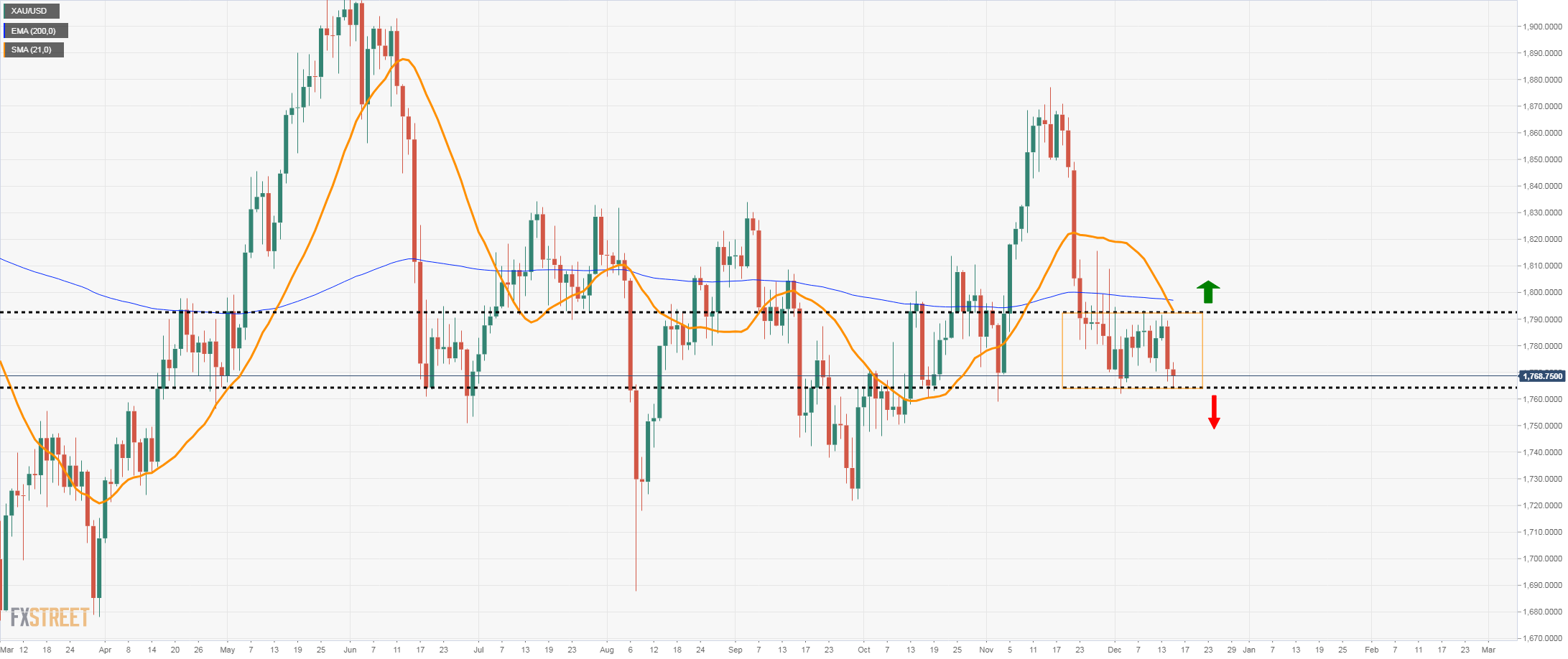
Gold had been moving sideways since December and is has established to critical levels. On the upside is the area around $1790/95, a horizontal line, and also near the 20 and 200-day moving averages. A firm break above and a confirmation should clear the way to more gains above $1800.
On the flip side, $1765 is a key level that should lead to more losses if broken on a sustained basis, targeting $1745/50. Below the next support stands at $1730.
Volatility and exaggerated moves are likely during the FOMC announcement and later during Powell’s press conference.
Technical levels
There were big moves in oil prices in 2021 as economic reopening and geopolitical pressures played out. Oversupply points to lower oil prices in 2022, with West Texas Intermediate (WTI) potentially trading below the $60 level, strategists at Deutsche Bank report.
Likely continued strong demand for oil
“We forecast WTI falling and potentially breaking $60/barrel next year on the back of a material rise in oil surpluses.”
“In supply, OPEC is set to add at least 2.1 mmb/d, slightly more than non-OPEC supply addition of +1.9 mmb/d dominated by the US (+900 kb/d) and the Former Soviet Union (+400 kb/d), all in Q4-22 over Q4-21 terms.”
“On the demand side, we forecast healthy growth (+3.4 mmb/d YoY) with oil demand back to pre-Covid 2019 levels by the end of next year, but we see downside risks, especially to jet fuel demand, on the back of new variant risks.”
“With OPEC adhering to its scheduled January supply increase, the risks to the $60/bbl WTI and $64/bbl Brent forecasts (Q2 to Q4-22) are skewed to the downside.”
Gold is historically problematic in periods of rising interest rates and had a rather mixed 2021. Strategists at Deutsche Bank expect the yellow metal to continue struggling throughout the next year and forecast XAU/USD at $1,750 by end-2022.
Gold still not responding to continuing inflation fears
“It was notable how higher inflation did not translate into higher gold prices, with gold perhaps no longer the obvious safe-haven for some investors.”
“Despite still high inflation, gold seems unlikely to have a good 2022: we forecast a price of $1,750/oz at end-December 2022.”
See – Gold Price Forecast: XAU/USD at risk of tanking to $1,561 on a breach of $1,691/77 – Credit Suisse
- The Turkish lira extends its slide as analysts prepare for another 100 bps rate cut on Thursday.
- CBRT’s current interest rate lies at 14%, as Turkey’s inflation rises by 20%.
- Turkey’s lira value has dropped almost half of its value since the beginning of 2021.
At the time of writing, as Wall Street opens, the USD/TRY prints a new year-to-date high at 14.8157. The market sentiment is mixed ahead of the Federal Reserve monetary policy decision. That, alongside unorthodox economic policies of Turkish President Recep Tayyip Erdoğan, keeps the lira at the risk of continuing its free fall amid the expectations of a 100 basis point rate cut by the CBRT that would leave rates at 13.00% by the end of the year.
Since the last month, the Turkish lira shed its value almost 30% -- half of its value in a year-- as policymakers linked to President Erdogan keeps slashing borrowing costs, despite soaring inflation levels, at 20%.
Turkey’s President Recep Tayyip Erdogan self-declares an “economic war of independence,” defying conventional economics by tackling inflations through a reduction of interest rates.
In the meantime, central banks worldwide are cutting their pandemic stimulus and preparing to raise rates, aiming to combat elevated prices. Furthermore, last week, the Standard & Poor’s rating agency switched Turkey’s credit outlook to negative.
On Thursday, the Turkish central bank monetary policy would host its last monetary policy meeting of the year. Analysts at Credit Suisses expect a rate cut of 100 basis points. They said, “We think the lira will remain subject to depreciation pressure if the central bank cuts the policy rate by 100bps tomorrow, even though that would be in line with the consensus forecast.”
Late in the year, worries about US inflation – and the possible consequences of it through bringing forward Fed rate rises – has helped drive EUR/USD down. What happens in 2022? USD could remain underpinned in the first half of the year but economists at Deutsche Bank see the EUR/USD pair climbing to 1.20 by the end of 2022.
Many valuation measures suggest that the USD is overvalued
“Relative interest rates are not the only factor and other fundamentals could work against the USD. The growth differential between the US and Europe may decline slightly in 2022 (although remaining high) – implying less capital flow into the US.”
“Many valuation measures (e.g. NEER, REER, OECD-PPP and GDP per capita-adjusted PPP) also suggest that the USD is overvalued, and investors’ big long positions in the currency could be run down.”
“We think that USD strength could be maintained into the first half of 2022. But later in the year, we think that the EUR will strengthen, taking EUR vs. USD to 1.20 by end-December 2022.”
- WTI currently trades close to $70.00, a little lower on the day with upside capped by the 200DMA.
- The major drivers of crude oil on Wednesday will be official US inventory numbers and the Fed policy announcement.
Oil prices have been ebbing lower on Wednesday and front-month WTI futures currently trade close to the $70.00 per barrel, up from earlier session lows in the $69.30s, but still a few cents lower on the day. The upside is currently being capped by the presence of the 200-day moving average at $70.39 and amid a broadly subdued market tone ahead of Wednesday’s crucial Fed policy announcement that will likely set the macro tone for the rest of the week.
Just as the 200DMA above $70.00 is likely to continue to cap the price action in the coming hours, WTI seems to have carved out a floor in the mid-$69.00s, an area that coincides with early December highs, for now. But crude oil traders would do well to keep an eye on the latest weekly official US inventory report at 1530GMT. Private weekly API inventory data released on Tuesday pointed to a smaller than expected 0.815M barrel draw in crude oil stocks, which seemed to pressure oil prices at the time, despite a surprise draw in distillate inventories and a smaller than expected rise in gasoline stocks.
In terms of the major themes driving crude oil markets right now; uncertainty regarding the hit to demand from the spread of Omicron remains elevated and traders have suggested this means volatility may remain elevated as well. Some highlighted the disparity between the recently published monthly OPEC oil market report versus the comparatively bearish IEA monthly report.
According to analysts at ANZ, "the IEA's bearish view on the market was in stark contrast to OPEC's more positive view when it released its monthly outlook earlier this week… (which) suggests volatility is likely to remain high in the short term”. Oil prices are thus likely to remain skittish on Omicron lockdown headlines in the coming weeks, with the WHO warning the peak of the global outbreak remains a way off.
Cable managed to close on Tuesday as the only major to advance against the USD. Today, GBP/USD outperforms modestly as UK CPI rises above 5%. However, economists at Scotiabank expect the pair to dive below 1.30 as political risks loom and the Bank of England may disappoint the market.
Weakening support for PM Boris Johnson
“While we don’t think the strong CPI data (5.1% YoY) will motivate the BoE to hike this week, it does solidify February hike odds and may see the bank accelerate its tightening push toward its terminal rate (1% most likely).”
“A cautious tone and/or a unanimous hold that would check February rate hike expectations could see the GBP aim for a test of 1.30 in the weeks ahead.”
“PM Johnson faced the biggest Conservative rebellion since 2019 yesterday as 101 MPs of his own party voted against his proposal for vaccine passports for nightclubs and large venues. A defeat for the Tories in a tight by-election on Thursday in the usually safe Tory seat of North Shropshire would spell further trouble for the PM toward a possible vote of confidence.”
“Political risks may soon become a strong drag on the GBP and it is not improbable that the pound trades under 1.30 in Q1 if monetary policy failing to meet market expectations, surging contagions, and a PM confidence vote align.”
EUR/USD is little changed ahead of the Federal Reserve. The Fed is widely expected to accelerate the tapering of its bond purchases, which should drag the pair down towards 1.10, economists at Scotiabank report.
Weak inflation outlook set to weigh on the euro
“With inflation set to miss the 2% goal over the latter part of the forecast horizon, it then seems highly unlikely that the ECB will increase rates sooner than late-2023/early-2024 and this would require sustained inflation expectations around 2%.”
“Market pricing that sees 10bps in hikes by end-2022 and another 20bps in rate hikes by end-2023 is too optimistic and we think that near-term rate differentials will continue to act as a major determinant of EUR underperformance over the next two years.”
“Today’s confirmation of accelerated tapering by the Fed, to likely be followed by a hike in Q2, will act to pull the EUR toward 1.10 in the coming months – if not sooner, in tandem with energy and virus worries in the Eurozone.”
- Weaker oil prices undermined the loonie and pushed USD/CAD to a fresh multi-month high.
- Disappointing US Retail Sales was offset by softer Canadian CPI and failed to provide impetus.
- The market focus remains glued to the outcome of a two-day FOMC monetary policy meeting.
The USD/CAD pair had a rather muted reaction to the US/Canadian macro data and held steady near a multi-month high, around the 1.2880 region through the early North American session.
According to the data published by the US Census Bureau revealed, the headline US Retail Sales recorded a modest 0.3% growth in November as against 0.8% expected and 1.8% previous. Adding to this, sales excluding autos also fell short of consensus estimates and rose 0.3% during the reported month. This, in turn, held back the US dollar bulls on the defensive and acted as a headwind for the USD/CAD pair.
The downside, however, remains cushioned amid weaker crude oil prices, which tend to undermine the commodity-linked loonie. Apart from this, a slight disappointment from the Bank of Canada's Core CPI, which remain flat in November, extended some support to the USD/CAD pair. Investors also seemed reluctant to place aggressive bets, rather preferred to wait on the sidelines ahead of the crucial FOMC decision.
The Fed is scheduled to announce the outcome of a two-day monetary policy meeting later during the US session, which will influence the USD demand in the near term. Apart from this, oil price dynamics would be looked upon for some meaningful trading opportunities around the USD/CAD pair. Nevertheless, bulls, so far, have managed to retain control and might now be eying to test September swing high, around the 1.2900 mark.
Technical levels to watch
- Annual CPI in Canada remained at 4.7% in November as expected, whilst the BoC's Core measure eased.
- The loonie was weaker as a result, with USD/CAD pushing back to multi-month highs in the 1.2880s.
Annual inflation in Canada, as measured by the Consumer Price Index (CPI), advanced to 4.7% in November, unchanged from the 4.7% annual pace of price gain observed in October, data published by Statistics Canada revealed on Wednesday. This reading was in line with expectations. The MoM pace of headline consumer price growth was 0.2%, also in line with expectations, though down from last month's 0.7% reading.
The BoC's Core measure of CPI stagnated on a MoM basis in November (i.e. came in at 0.0%), versus forecasts for a gain of 0.1%. YoY, BoC Core CPI decelerated to 3.6% in November, as expected, from 3.8% the month prior.
Market Reaction
USD/CAD saw upside in response to the largely cooler than expected Canadian inflation readings, with the pair marginally surpassing earlier session highs at 1.28846 to print fresh multi-month highs at 1.28861. The pair has since dipped back slightly to 1.2880 again and will likely remain rangebound ahead of remarks from BoC Governor Tiff Macklem at 1700GMT and then the Fed policy announcement at 1900GMT.
- The NY Fed Manufacturing Index rose unexpectedly to 31.90 in December.
- The strong report was ignored due to a simultaneous release of weaker than expected US retail sales numbers.
- FX markets are focused on the Fed policy announcement later in the session.
The headline General Business Conditions Index of the NY Fed's Empire State Manufacturing Survey surprisingly rose to 31.90 in December, up from 30.90 in November. That was a beat on the market's median forecast for a decline to 25.00.
Additional Takeaways as per the NY Fed's report:
"Business activity continued to grow strongly in New York State."
"The new orders index and shipments indexes were both little changed at 27.1, pointing to another month of strong growth in both areas."
"The index for number of employees came in at 21.4, indicating a solid increase in employment, and the average workweek index fell to 12.1, suggesting a modest increase in hours worked."
"The prices paid index edged down three points to 80.2, and the prices received index fell six points to 44.6, signaling ongoing substantial increases in both input prices and selling prices, though at a slightly slower pace than in November."
"Firms were generally optimistic about the six-month outlook, though optimism remained below levels seen in September and October. The index for future business conditions held steady at 36.4."
Market Reaction
The strong NY Fed survey result was largely negated, as far as FX markets are concerned anyway, by a weaker than expected November Retail Sales report. The DXY saw a slight dip as a result but remains close to session/recent highs in the 96.50 area as the Fed policy announcement looms.
- US Retail Sales rose by 0.3% MoM in November, below expectations.
- The DXY saw a very slight dip, but remains close to recent highs with focus on the Fed policy announcement.
US Retail Sales rose by 0.3% MoM in November, according to data published by the US Census Bureau revealed on Tuesday. That was below market expectations for a MoM rise of 0.8% and marked a substantial deceleration from last month's (upwardly revised from 1.7%) 1.8% MoM gain. That took the YoY rate of headline Retail Sales growth to 18.21% in November.
As with the headline, the MoM pace of Core Retail Sales growth in November also missed expectations, coming in at 0.3% versus forecasts for a growth rate of 1.0%. That also marked a substantial deceleration from October's 1.8% MoM gain. The Retail Control, which correlates more closely to the retail spending component of GDP, was down 0.1% MoM in November versus expectations for a 0.7% rise.
Market Reaction
The DXY saw a very slight dip on the weaker than expected numbers, though has remained close to recent highs in the 96.50 area with focus firmly on the Fed policy announcement later in the session.
- AUD/USD gained strong positive traction on Wednesday and climbed back closer to mid-0.7100s.
- Mixed technical indicators warrant some caution for bulls ahead of the key FOMC policy decision.
- Acceptance below the 0.7100 round figure would shift the bias back in favour of bearish traders.
The AUD/USD pair climbed to a fresh daily top, around the 0.7145 area heading into the North American session and has now recovered a major part of its weekly lows.
The momentum pushed the AUD/USD pair beyond a resistance marked by the top boundary of a near one-week-old descending channel. This comes on the back of the overnight bounce from the 50% Fibonacci level of the 0.6993-0.7188 recent move up and supports prospects for additional near-term gains.
Bulls are now looking to build on the momentum beyond a confluence barrier comprising of 100-hour SMA and the 23.6% Fibo. level. Sustained strength beyond will reaffirm the intraday positive bias and push the AUD/USD further towards last week's swing high, around the 0.7180 resistance zone.
Some follow-through buying would set the stage for an extension of the recent recovery move from sub-0.7000 levels, or the lowest level since November 2020 touched earlier this December. That said, mixed technical indicators on hourly/daily charts warrant some caution before placing fresh bullish bets.
Traders might also be reluctant to place aggressive bets, rather prefer to wait on the sidelines heading into the key central bank event risk – the outcome of a two-day FOMC meeting. The announcement will influence the USD price dynamics and provide a fresh directional impetus to the AUD/USD pair.
Meanwhile, on the downside, the 38.2% Fibo. level, around the 0.7115-10 region, closely followed by the 0.7100 mark and the 50% Fibo. level should act as immediate support levels. A convincing break below will negate the positive bias and shift the bias back in favour of bearish traders.
The AUD/USD pair would then accelerate the slide towards challenging the key 0.7000 psychological mark. The downward trajectory could further get extended towards the next relevant support, around the 0.6930 region, before the pair eventually drops to the 0.6900 round-figure mark.
AUD/USD 1-hour chart
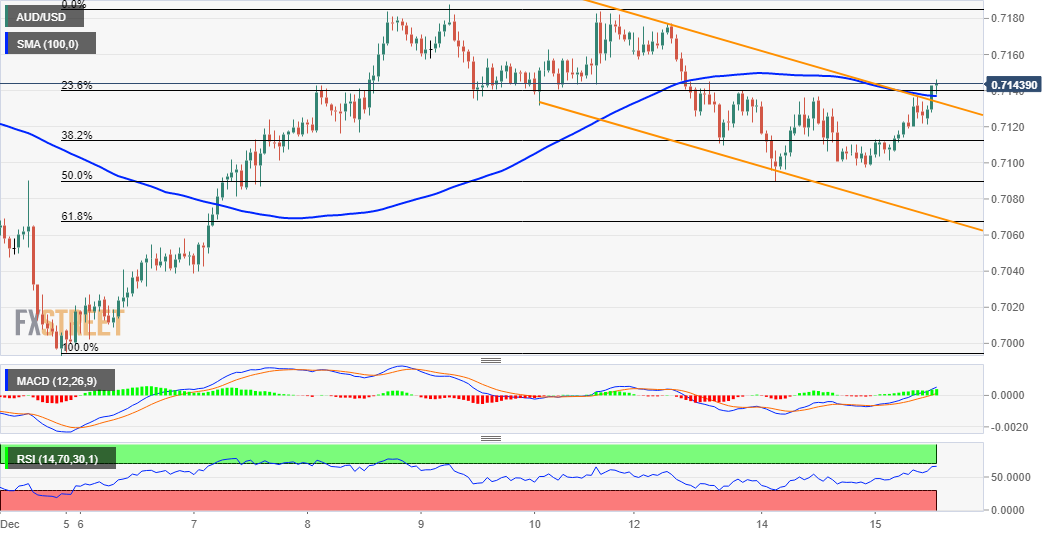
Technical levels to watch
- Spot gold has stabilised in the $1770 area ahead of Wednesday’s key Fed meeting.
- The bank is expected to be hawkish and this could send the precious metal underneath recent $1760 lows.
Since Tuesday’s hot US Producer Price Inflation (PPI) report-induced drop from the upper $1780s to current levels around $1770, spot gold (XAU/USD) has stabilised and is trading within thin ranges. That isn't too surprising and is in fitting with the broader market’s cautious tone, ahead of key events stateside, with the main event of the day being the Fed policy announcement at 1900GMT and Fed Chair Jerome Powell’s press conference at 1930GMT.
The Fed is widely expected to pivot hawkishly by speeding the pace of its QE taper, pointing to a sooner start to its rate hiking cycle and upgrading its inflation forecasts. Strategists are split over whether markets have adequately priced in all of this hawkish risk. If they haven't, gold would be at risk of seeing a further tumble and XAU/USD would be vulnerable to a drop under recent lows in the $1760s. In the case of a dovish outturn from the bank later in the session, gold prices would likely see a retracement higher to challenge monthly peaks and the 21 and 50-day moving average in the $1790s.
Ahead of the Fed, gold traders will also be keeping an eye on a few important US data releases, including the November Retail Sales report and the NY Fed Manufacturing survey. Both reports will be released at 1330GMT and, unless there is a big miss/beat on expectations, are unlikely to stimulate too much volatility, as traders keep their powder dry ahead of the Fed. That implies for the next few hours, spot prices are likely to stick within intra-day $1765-$1775ish ranges.
The USD is the best performing G10 currency in the year to date with a large part of those gains being made since June. Rabobank’s EUR/USD 1.12 target was hit, albeit briefly, at the end of last month. Economists at the bank expect the pair to hit the 1.10 level but do not expect more weakness.
The Fed tightening cycle could be short-lived
“Over the next few months, we expect that the USD will perform well vs the EUR. That said, if the current predictions of the US yield curve are maintained and the outlook for the pace of Fed rate hikes is restrained over the whole of the cycle, this will likely limit the ability of the USD to pursue further broad-based gains throughout the whole of next year.”
“While the likelihood of move to EUR/USD 1.10 has increased for the first part of next year, the recent flattening of the yield curve does suggest that the USD may not be able to maintain momentum through the whole of next year.”
Gold is especially seen at risk if real yields rise. Strategists at Credit Suisse are on high alert for the potential formation of an important top also, although this would only be seen confirmed below $1,691/77.
The risk of a potential large top is growing
“With US Real Yields still seen in the process of basing and with the USD expected to strengthen further, XAU/USD stays seen under pressure in its range and below support at $1,759/58 can see a retest of long-term pivotal support at $1,691/77.
“Beneath the $1,691/77area at any stage would mark a major top with just initial support then seen next at $1,561.”
“Resistance at $1,877 ideally continues to cap.”
Canada CPI Overview
Statistics Canada will release the latest consumer inflation figures for November later during the early North American session on Wednesday, at 13:30 GMT. The headline CPI is expected to decelerate sharply to 0.2% during the reported month from the 0.7% rise recorded in October. Meanwhile, the yearly rate is anticipated to hold steady and come in at 4.7% for November – the largest rise since February 2003.
More importantly, the Bank of Canada's Core CPI, which excludes volatile food and energy prices, is anticipated to fall from 0.6% in October to 0.1% during the reported month. The yearly rate, however, is expected to ease from 3.8% to 3.6% in November, still well above the central bank's upper target.
How Could it Affect USD/CAD?
Ahead of the key macro data, weaker crude oil prices undermined the commodity-linked loonie and pushed the USD/CAD pair to a nearly three-month high on Wednesday. A softer CPI print would be enough to weigh further on the Canadian dollar and allow the pair to capitalize on the ongoing positive momentum. Conversely, a stronger reading might prompt some long-unwinding around the major. That said, the immediate market reaction is more likely to be short-lived and overshadowed by the upcoming central bank event risk – the FOMC policy decision due later during the US session.
Hence, any subsequent move up might confront some resistance near the September monthly swing high, just ahead of the 1.2900 mark. That said, a sustained strength beyond should allow bulls to aim back to challenge the YTD top, around mid-1.2900s touched on August 20. On the flip side, the previous daily closing high level, around the 1.2840 region now seems to protect the immediate downside. Some follow-through selling could accelerate the corrective pullback towards the 1.2800 mark. Failure to defend the mentioned support levels might prompt aggressive long-unwinding trade and negate the prospects for any further gains.
Key Notes
• USD/CAD Outlook: Bulls have the upper hand ahead of Canadian CPI, US Retail Sales, FOMC
• USD/CAD seesaws around September's high amid soft oil prices, Canada CPI, Fed in focus
• Elliott Wave view: USD/CAD opens bullish extension
About Canadian CPI
The Consumer Price Index (CPI) released by the Statistics Canada is a measure of price movements by the comparison between the retail prices of a representative shopping basket of goods and services. The purchase power of CAD is dragged down by inflation. The Bank of Canada aims at an inflation range (1%-3%). Generally speaking, a high reading is seen as anticipatory of a rate hike and is positive (or bullish) for the CAD.
- EUR/USD is subdued in a 1.1250-1.1275ish range in the run-up to US retail sales data and the Fed.
- The pair has formed a pennant over the last few weeks and could be close to a bearish breakout.
EUR/USD is trading with its typical pre-Fed policy announcement, having for the most part spent Wednesday’s session thus far trading within this 1.1250-1.1275ish ranges. Tuesday’s hotter than expected Producer Price Inflation (PPI) report ensured that the pair was not able to hold above the 1.1300 level or its 21-day moving average at 1.1290, as it was seen strengthening the case for a significant hawkish shift at the coming Fed policy meeting.
Indeed, hawkish risk heading into this Fed policy announcement has been a key market talking point. The bank is expected to announce plans to speed the pace of its QE taper, while guidance on the path for future rate hikes will be closely scrutinised. This guidance will come in the form of written guidance in the statement, verbal guidance in Chair Powell’s press conference, and via the new dot plot.
The consensus in markets at present is broadly for somewhere between two to three rate hikes in 2022, but thereafter things are less clear. According to analysts at MUFG, “we can’t recall going into an FOMC meeting with the consensus so strongly favouring a hawkish outcome… (Fed Chair Jerome) Powell may emphasise the uncertainty of the guidance to such an extent this evening that it dampens the response... The scope for a big move for the US dollar this evening may be limited.”
In the run-up to the Fed meeting, FX markets participants will also need to ingest the latest US Retail Sales report (for November), out at 1330GMT. Significant volatility is unlikely this close to the Fed meeting, but EUR/USD does appear primed for a potential bearish break.
Since the end of November, EUR/USD appears to have formed a pennant formation and is currently hovering just above the lower bounds of this pattern, an uptrend linking the 24 November, 7 and 14 December lows. Should this level go, the door would be open for a swift move lower towards 1.1200 again.
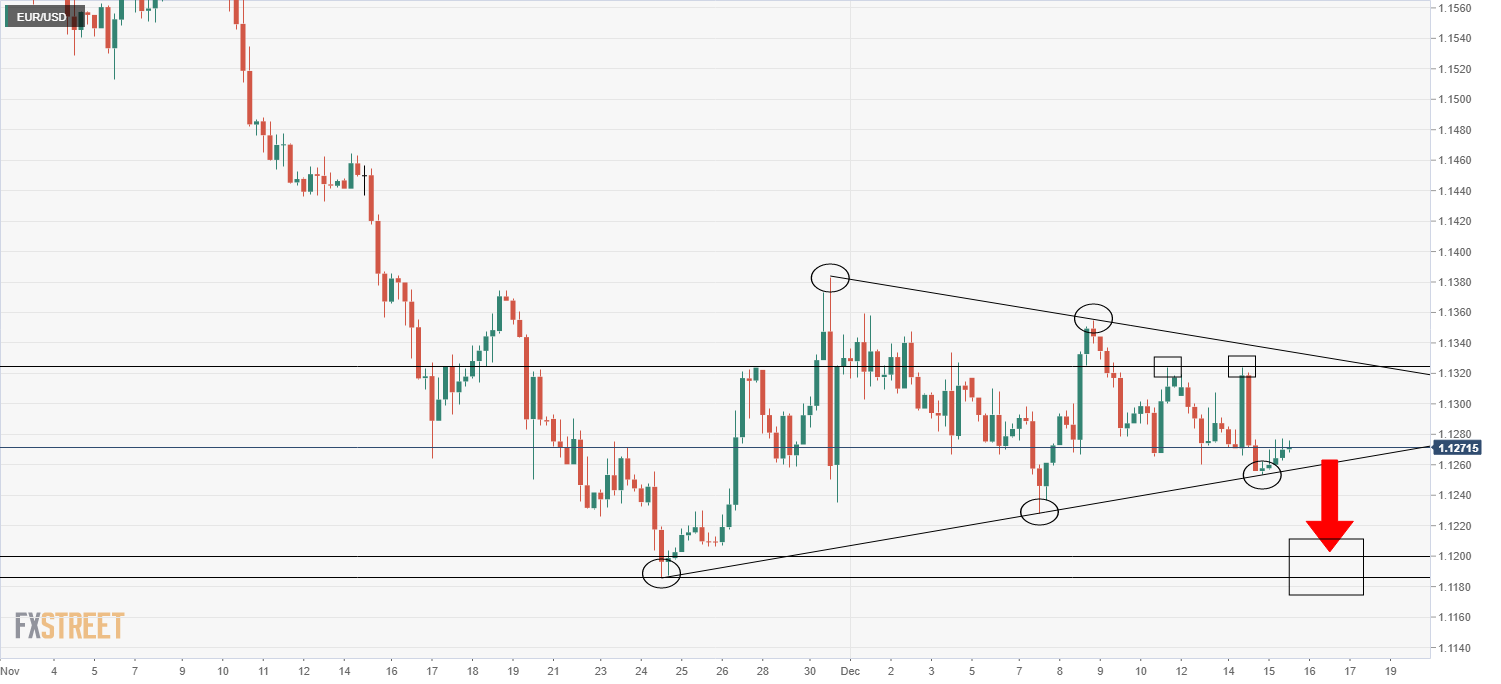
US Monthly Retail Sales Overview
Wednesday's US economic docket highlights the release of monthly retail sales figures for November, scheduled later during the early North American session at 13:30 GMT. The headline sales are estimated to have risen by a seasonally adjusted 0.8% during the reported month as against 1.7% growth recorded in October. Excluding autos, core retail sales probably climbed by 1% in November from the previous month.
How Could it Affect EUR/USD?
Ahead of the consumer spending data, the US dollar remained well supported by growing market acceptance that the Fed would tighten its monetary policy sooner rather than later. A stronger print will reaffirm hawkish Fed expectations and trigger a fresh leg up for the greenback. Conversely, a softer reading could weigh on the greenback. That said, any immediate market reaction is more likely to be short-lived as investors might refrain from placing aggressive bets ahead of the crucial FOMC monetary policy decision.
Meanwhile, Eren Sengezer, Editor at FXStreet, outlined important technical levels to trade the EUR/USD pair: “Initial resistance aligns at 1.1280 (100-period SMA on the four-hour chart) ahead of 1.1300 (psychological level, 50-period SMA). Although the pair managed to rise above those hurdles on Tuesday, it made a sharp U-turn at 1.1320, suggesting that near-term resistance formed near that level.”
“On the downside, 1.1240 (static level) is the first support level followed by 1.1220 (static level) and 1.1200 (psychological level). A daily close below the latter with a hawkish Fed outcome could open the door for fresh 2021-lows at 1.1185,” Eren added further.
Key Notes
• US Retail Sales November Preview: The Fed looks to the consumer
• EUR/USD Forecast: Euro bears await hawkish Fed policy outlook
• EUR/USD: Close below 1.1180/70 on hawkish Fed to open up the 1.10 level – ING
About US Retail Sales
The Retail Sales released by the US Census Bureau measures the total receipts of retail stores. Monthly per cent changes reflect the rate of changes in such sales. Changes in Retail Sales are widely followed as an indicator of consumer spending. Generally speaking, a high reading is seen as positive (or bullish) for the USD, while a low reading is seen as negative (or bearish).
- GBP/USD shot to over a one-week high in reaction to hotter-than-expected UK CPI.
- Omicron fears, reduced BoE rate hike bets held back bulls from placing fresh bets.
- Hawkish Fed expectations underpinned the USD and capped the upside for the pair.
The GBP/USD pair maintained its bid tone through the mid-European session, albeit has retreated a few pips from over one-week high touched earlier this Wednesday. The pair was last seen trading around mid-1.3200s, up only 0.10% for the day.
The pair gained strong positive traction following the release of hotter-than-expected UK consumer inflation figures and built on the previous day's modest bounce from sub-1.3200 levels. In fact, the headline CPI climbed 0.7% MoM in November and accelerated to 5.1% YoY from 4.2% previous. This was well above consensus estimates and the fastest rise since September 2008. Adding to this, core CPI also surpassed expectations and jumped 4% YoY and provided a goodish lift to the British pound.
Investors, however, remain uncertain about the economic recovery in the short term amid the rapid spread of the Omicron variant of the coronavirus. This, along with the imposition of fresh COVID-19 restrictions, did little to revive hopes for an imminent interest rate hike by the Bank of England and acted as a headwind for the British pound. Apart from this, the underlying bullish tone around the US dollar kept a lid on any further gains for the GBP/USD pair, at least for the time being.
The greenback continued drawing some support from growing market acceptance that the Fed would be forced to adopt a more aggressive policy response to contain stubbornly high inflation. The money markets have been pricing in the possibility for an eventual liftoff by June 2022 and another rate hike as early as November. Apart from this, the prevalent cautious market mood further benefitted the greenback's safe-haven status and led to the GBP/USD pair's intraday pullback of around 30 pips.
Market participants now look forward to the November US monthly Retail Sales data for some short-term trading impetus. The key focus, however, will be on the outcome of a two-day FOMC monetary policy meeting, due to be announced later during the US session. The Fed's strategy on interest rate hikes will influence the near-term USD price dynamics. This, along with the BoE monetary policy decision on Thursday will determine the next leg of a directional move for the GBP/USD pair.
Technical levels to watch
In the view of economist at ANZ, the S$NEER will rise towards the top of the policy band as the Singdollar appreciates on the back of MAS tightening. They expect USD/SGD to end the next year at 1.31.
MAS expected to tighten further and push the slope to 1.5% per annum
“We see USD strength eventually waning in 2022, as it has in the past when actual Fed rate hikes draw near. With the MAS expected to tighten further and push the slope to 1.5% per annum, we see the S$NEER eventually climbing towards the upper bound of the policy band, which could happen as the next MAS policy review in April approaches.”
“With the policy stance now back on an appreciation path, we forecast SGD to advance towards 1.31 by the end of 2022.”
The US Federal Reserve will announce monetary policy decisions and release the updated Summary of Projections on Wednesday, December 15 at 19:00 GMT. As we get closer to the release time, here are the expectations as forecast by analysts and researchers of 16 major banks.
The Federal Reserve is set to accelerate its tapering program in its last decision of 2021. The Fed will also release the Summary of Economic Projections, the so-called dot plot, and reveal how policymakers see the timing of the first-rate increase.
A hawkish policy outlook could lift yields and provide a boost to the greenback in the second half of the day.
ANZ
“We expect the Fed to announce a doubling of its asset-purchase reductions from USD15 B to USD30 B per month, effective mid-January. This will result in tapering being completed by March. The Fed needs to be in a position to raise rates earlier than key voting members currently anticipate if inflation continues to run hot into 2022. Fed members are likely to significantly upward revise their inflation forecasts for 2021 and 2022; the question is how much is not from base effects. The dot plot is likely to shift up and potentially steeper. We expect the first Fed rate hike to occur by mid-2022.”
Westpac
“The pace of the taper is now expected to be doubled at the December meeting such that it will end in March instead of mid-2022. To our mind, and consistent with comments made by numerous FOMC members, this decision is to provide optionality in 2022 to combat inflation risks as and when necessary. When we changed our call to expect the accelerated taper, we also forecast three rate hikes in 2022, beginning in June. Come 2023 and 2024, three additional hikes six months apart are seen, leaving the federal funds rate at 1.625% by June 2024. It will be interesting to see the degree to which the FOMC’s dots are revised in December.”
ING
“We expect a USD30 B reduction for January (to USD60 B of purchases) and a further USD30 B reduction in February with no further purchases in March onwards. As for interest rates the Fed is likely to also indicate earlier action. As recently as March the FOMC dot plot of individual member forecasts suggested that interest rates were unlikely to increase until 2024. The June update moved this to 2023 and then in September the median expectation was for a 2022 move. Next week’s update from the Fed is set to show them shifting to a two-hike view for next year.”
TDS
“The taper pace will likely be doubled to USD30 B per month, consistent with QE ending in March. Officials will likely also convey a more hawkish tone through the statement, the economic projections, and the dot plot. The median dot will probably show a 50bp increase in 2022. We expect enough slowing in inflation and growth to delay rate hikes until 2023, but, for now, strong data are encouraging hawkishness. Scope for USD upside is capped given how much is priced in the front-end.”
NBF
“More hawkish Fed communications in recent weeks are likely to lead to the committee announcing an accelerated pace of tapering that will see net asset purchases wrapped up sooner than previously communicated. We’ll also take receipt of updated Summary of Economic Projections which is likely to show more participants move their federal funds rate projections from 2023 into 2022, as well as a higher median rate next year.”
Rabobank
“We think that doubling the pace of tapering to USD30 B per month would make most sense, because it creates the option of a first hike on March 16. Given Powell’s apparent shift to inflation-fighting, demonstrated in Congress last week, and based on the assumption that the negative impact of Omicron on the US economy remains limited, we now expect two rate hikes in 2022: in the spring (June) and the second half of the year (December).”
Deutsche Bank
“We anticipate a doubling in the pace of tapering, which would bring the monthly drawdown of Treasury and MBS to USD20 B and USD10 B per month respectively. That would see the process of tapering conclude in March, giving them greater optionality for an earlier liftoff. Bear in mind that this meeting will also see the release of the latest dot plot, as well as the projections for inflation, growth and unemployment. On that, we see the median dot in 2022 likely showing two rate hikes, with risks of more, up from September when only half the dots saw any hikes by the end of 2022.”
RBC Economics
“No change in the fed funds target range is expected, but we’ll be watching for any change in the expected timing and pace of future rate hikes.”
BBH
“We expect the pace of tapering to be doubled to USD30 B per month (USD20 B UST and USD10 B MBS). While the Fed has taken pains to try and decouple tapering from lift-off, the market is not having any of that. In the September Dots, 1 policymaker saw a longer-term Fed Funds rates of 2.0%, 4 saw 2.25%, 1 saw 2.375%, 9 saw 2.5%, and 2 saw 3.0%. How can markets reconcile this with a 1.5% terminal rate? They can’t, and when markets realize this, that should give the dollar another leg higher. We can come up with any number of situations where the median for end-2022 shifts to two hikes from one currently, but think it is highly unlikely for the median to shift all the way to three hikes. We do not think it would be hard to get a shift in the end-2023 median to four or five hikes from three currently. In light of recent data, we expect core PCE forecasts to be revised higher and unemployment forecasts to be revised lower. We do not expect significant revisions to the growth forecasts.”
SocGen
“We assume a majority of Fed participants expect to hike rates in 2022. We expect the median to show at least two hikes and think a large number of officials will endorse three hikes. We expect the Fed to hike three times in 2022. If it starts hiking in June as we predict, it has two more quarterly opportunities, at the September and December FOMC meetings, to hike again. Further hikes in 2023 and 2024 are likely in the Fed predictions. More hikes earlier should tend to raise odds that the Fed can raise even further. We expect the Fed to rapidly wind down its Treasury and agency-MBS purchases. By the end of March 2023, the Fed should stop purchasing these long-term assets. We assume the Fed can reduce its monthly purchases by USD30 B per month, twice the USD15 per month pace offered at the November FOMC meeting. The Fed might opt to make the change in more than one step, but we don’t see a need to.”
CIBC
“It’s been highly telegraphed that the central bankers will opt to speed up their planned tapering, in order to be ready to hike rates by spring should that prove necessary. The market’s expectation for a first hike before mid-year, and a total of 75 basis points of tightening in 2022, looks quite reasonable. It would be hard to foresee the Fed’s logic in deciding that it needed to speed up the timetable for the first hike, but at the same point feel that rates could still be so stimulative all the way through 2023, and to some extent through 2024. An announcement of faster tapering won’t move the bond market on its own. But keep an eye on the ‘dots’. If they move up significantly, that could have the bond market begin to rethink its dovish view on rates beyond 2022.”
BMO
“FOMC is likely to see a doubling in the pace of tapering, ending in March, and thereby setting the stage for rate hikes by around mid-year. At this point, we would look for a series of quarter-point hikes per calendar quarter until we are back above 2% by mid-2024. The risks to this call are faster and ultimately higher, depending on precisely how the inflation dynamics unfold in coming months.”
Citibank
“We expect the Fed dots to drift higher. The team’s base case is for a first-rate hike in June – which is roughly priced by the market, followed by quarterly rate hikes at least until rates reach around 2%, whereas markets price a shallower path to a lower terminal rate (around 1.25-1.5%). The risks to this view are to the upside, implying markets are underpricing the distribution of outcomes. We anticipate a median for two rate hikes in 2022 with three more in 2023 and a median for rates reaching around 2.5% (the Fed’s estimate of terminal) in 2024. It wouldn’t be too surprising to see as many as three hikes in 2022 and as many as four in 2023. However, markets will likely be most reactive to 2022 median that looks likely to come in somewhere around or below market expectations. Close to three 2022 rate hikes priced and a widely expected acceleration of tapering from USD15 B/month to USD30 B/month limits remaining hawkish risks – but with asset purchases concluded in March, Chair Powell might use the press conference to signal that the March meeting is ‘live’ for a rate hike – a scenario markets currently put a low probability on. More hawkish, but less likely, would be any discussion of an earlier than expected move toward balance sheet reduction.”
Nordea
“Our base case is that the Fed’s dot plot will shake out in a 2-hike median in 2022, followed by 3 hikes in 2023 and 4 hikes in 2024 making up a total of 9 hikes (vs. 0.5; 3; 3 and a total of 6.5 in September). Three hikes will slowly but surely be baked into 2022, but market pricing on terminal rates remains low and could be a driver for a lower EUR/USD going into H1 2022. Turning to the balance sheet, we expect the FOMC to increase the monthly tapering speed from USD15 B to USD30 B starting in January, which means that Fed’s tapering process will conclude by mid-March and begin its reinvestment phase. The faster tapering this Wednesday will result in less liquidity to the street, relatively to the former plan, but lifting the debt ceiling will be the driving factor on more expensive USD liquidity.”
BofA
"We expect the Fed to double the pace of taper. Dots should show 2 hikes in 22, 3 hikes in 23 and 24. Chair Powell would likely highlight inflation risks but be noncommittal about the timing of rate hikes amid virus uncertainty. Markets would likely view Fed communication as hawkish on balance, exerting flattening pressure on curve and tailwinds to USD.”
OCBC
“The balance of risks leans towards a more hawkish than expected Fed, rather than a placid, inactive one. The risk on the USD is a sharper, front-loaded USD gains, preceding an equally steep decline as the market react to what may be deemed as a policy mistake. This results in a sharper, more compressed gain/loss cycle for the USD.”
- USD/JPY prolonged its range-bound price move witnessed over the past one week or so.
- Investors seem to have moved on the sidelines ahead of the FOMC/BoJ policy meetings.
- The Fed will announce its decision this Wednesday and the BoJ is scheduled on Friday.
The USD/JPY pair lacked any firm directional bias and remained confined in a range, just above mid-113.00s through the early European session.
The pair, so far, has struggled to gain any meaningful traction and prolonged its subdued/range-bound price move witnessed over the past one week or so. Investors preferred to move on the sidelines and wait for a fresh catalyst from the outcome of this week's key central bank meetings – the FOMC decision on Wednesday and the Bank of Japan on Friday.
In the meantime, a combination of diverging forces failed to provide any meaningful impetus or assist the USD/JPY pair to capitalize on its gains recorded over the past two trading sessions. A generally positive tone around the equity markets acted as a headwind for the traditional safe-haven Japanese yen and extended some support to the USD/JPY pair.
On the other hand, the US dollar struggled to capitalize on the overnight positive move to a one-week high, instead witnessed some intraday selling. This, in turn, failed to impress bulls or provide any additional boost to the USD/JPY pair. That said, hawkish Fed expectations and an uptick in the US Treasury bond yields helped limit any meaningful USD losses.
Meanwhile, worries about the potential economic fallout from the spread of the Omicron variant and the imposition of fresh restrictions in Europe and Asia kept a lid on any optimistic move in the markets. Heading into the central bank event risk, the combination of diverging forces held back traders from placing aggressive bets around the USD/JPY pair.
Even from a technical perspective, the recent range-bound price action constitutes the formation of a rectangle on short-term charts. This points to indecision among traders and further makes it will be prudent to wait for a convincing break through the trading range before positioning for the next leg of a directional move.
Technical levels to watch
Since late July, the Chinese yuan has resumed another round of appreciation. USD/CNY reached a low of 6.3430 last Thursday and currently is at a strong level of 6.3625. Although economists at MUFG Bank see no sizable depreciation of CNY in near-term, they expect the USD/CNY pair to eventually turn higher in the months ahead.
The People's Bank of China sends out signals to cool down CNY
“We don’t think the appreciation trend of CNY will remain intact ahead, considering the two-month long range bound behaviour of USD/CNY after the mid-June Forex RRR increase, Thursday’s Forex RRR increase will likely alleviate some degree of appreciation pressure on CNY in near-term as well, as it makes USD liquidity relatively scarce, compared with before, and market participants can see Chinese government’s intention of cooling the strength of CNY.”
“Although the PBoC has an intention to limit CNY’s strength or weaken CNY, it is still unlikely for the PBoC to aggressively intervene in foreign exchange market directly to weaken CNY in near-term, we only expect a mild depreciation bias for CNY against USD for the month ahead, considering also that CNY will likely be supported by exports and portfolio flows as well (maybe not as strong though).”
The EUR has continued to weaken against the USD over the past month, and hit a fresh year to date low of 1.1186. Economists at MUFG Bank are maintaining their bearish bias for EUR/USD but the balance of risks is no longer as heavily weighted to the downside.
ECB and Fed to react differently to the Omicron risks
“We still believe there is scope for the EUR to weaken further against the USD in the near-term but a large part of the adjustment lower has already played out now. Further ownside is more likely to prove more of a hard grind from here as the pair finds stronger support closer to the 1.1000-level.”
“We expect the Omicron variant to reinforce the fundamental argument for a stronger USD relative to the EUR. There is higher risk of tighter restrictions being re-imposed in Europe compared to in the US.”
“The Fed has signalled that it is now putting more weight on upside inflation risks and plans to speed up tightening plans. It could take a more significant negative shock to the US economy to materially alter the Fed’s plans. In contrast, we expect the ECB to continue to display more caution over tightening policy. Overall, the ECB will remain one of the more dovish G10 central banks as it continues to carry out QE through most if not all of next year.”
- USD/CHF edged higher for the third successive day and inched back closer to the weekly high.
- A generally positive tone undermined the safe-haven CHF and remained supportive of the move.
- A modest USD weakness kept a lid on any further gains ahead of the crucial FOMC policy decision.
The USD/CHF pair climbed closer to the top end of its weekly trading range during the early European session, albeit struggled to capitalize on the move beyond mid-0.9200s.
The pair built on the previous day's goodish rebound from sub-0.9200 levels, or over one-week low, and gained some follow-through traction through the first half of the trading on Wednesday. A generally positive tone around the equity markets undermined the safe-haven Swiss franc and pushed the USD/CHF pair higher for the third successive day.
On the other hand, the US dollar struggled to capitalize on the overnight positive move to a one-week high, instead witnessed some intraday selling. This, in turn, failed to impress bulls or provide any additional boost to the USD/CHF pair. That said, a combination of factors should limit the USD downtick and act as a tailwind for the major.
Investors seem convinced that the Fed would be forced to tighten its monetary policy sooner rather than later to contain stubbornly high inflation. The market bets were reaffirmed by Tuesday's release of the US Producer Price Index on Tuesday, which recorded the largest annual advance since November 2010 and accelerated to 9.6% YoY in November.
Apart from this, a modest uptick around the US Treasury bond yields should help revive the USD demand and continue lending some support to the USD/CHF pair. Traders, however, might refrain from placing aggressive bets, rather prefer to move on the sidelines ahead of the highly-anticipated FOMC monetary policy decision due later during the US session.
In the meantime, traders are likely to take cues from the US monthly Retail Sales figures. This, along with the US bond yields, will influence the USD price dynamics. Apart from this, the broader market risk sentiment would further contribute to producing some short-term trading opportunities around the USD/CHF pair.
Technical levels to watch
Morgan Stanley strategists say the easy returns are over for US equities, credits and Treasuries, but see value in European and Japanese stocks in 2022. Here are five highlights of the 2022 global investment outlook.
Time to lighten up on US stocks?
“The S&P 500 index could decline 5% in 2022 while other developed markets could end the year higher. We recommend underweighting US stocks to account for high valuations and more catch-up potential and less volatility elsewhere in the world.”
European and Japanese stocks are calling
“In Japan, equities continue to deliver improving returns on equity, while economic stimulus, business reopenings and strong global capex all suggest that Japan’s stock market could appreciate 12% next year. Meanwhile, the MSCI Europe index has enjoyed its best period of relative outperformance in 20 years compared to the rest of the world, and that pattern should continue thanks to increased mergers and acquisitions, buyback activity and changes in investor positioning since many global portfolios had been underexposed to the region.”
Stock selection could matter more than style and sector
“We believe health care, financials and secular technology companies could see upside in the year ahead. Consumer goods and cyclical technology stocks could lag as supply and demand dynamics settle into a more normal pattern.”
Government bonds are all over the map
“We recommend underweighting US Treasuries in expectation of the 10-year Treasury moving past 2% by the end of 2022. Local emerging market debt is starting to look interesting but investors should be patient. With expectations that the US dollar and real yields rise to start the year, investors will get a better entry point later in the year.”
In commodities, oil springs ahead
“Metals may lose their luster as high real yields weigh on gold, while copper and zinc soften with better supply. Aluminum remains a top pick for the strategists, who point to cyclical and structural factors. Within commodities, oil offers the best combination of valuations and fundamentals. We believe oil could top $90 a barrel in 2022 as rising demand meets relatively spare capacity.”
- Gold price sticks to two-week lows ahead of the Fed rate decision.
- Fed’s pace of tapering and Dot plot graph to rock the markets.
- Gold at the mercy of the Fed, ascending triangle pattern in play.
The hawkish Fed expectations are undermining gold price heading into the policy announcements this Wednesday. Gold price is hovering near its two-week lows, with its fate hinging on the Fed’s pace of tapering, which will likely hint at potential rate hikes next year. Investors have turned cautious and refrain from placing any directional bets on the bright metal.
Read: Gold Price Forecast: Will XAU/USD defend critical $1,765 support on the Fed decision?
Gold Price: Key levels to watch
The Technical Confluences Detector shows that the gold price tested the key support near $1,765 amid the latest leg down. That level is the convergence of the previous day’s low and the previous low four-hour.
Gold bears now target the pivot point one-day S1 at $1,762 on selling resurgence. Powerful support at $1,760 will then challenge the bullish commitments. At that point, the previous month’s low coincides with the pivot point one-week S2.
Alternatively, the recovery is likely to face stiff resistance around the $1,770-$1,772 region, where Fibonacci 23.6% one-day, SMA5 four-hour and pivot point one-week S1 converge.
Further up, the intersection of the Fibonacci 38.2% one-day and Fibonacci 23.6% one-week at $1,776 will come into play.
The next bullish target is envisioned at $1,781, the confluence of the SMA5 one-day, Fibonacci 61.8% one-day and Fibonacci 38.2% one-week.
Here is how it looks on the tool
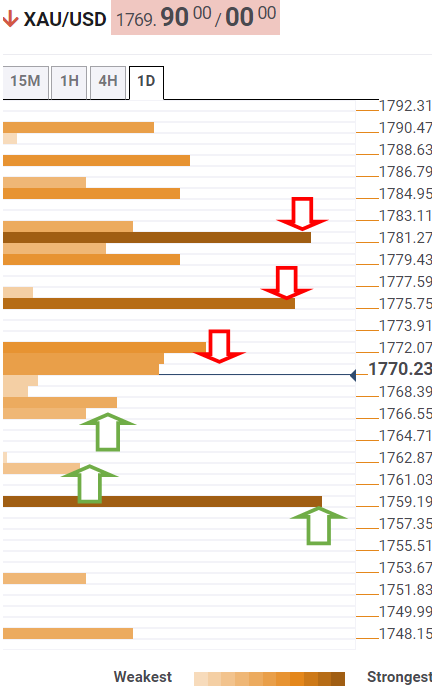
About Technical Confluences Detector
The TCD (Technical Confluences Detector) is a tool to locate and point out those price levels where there is a congestion of indicators, moving averages, Fibonacci levels, Pivot Points, etc. If you are a short-term trader, you will find entry points for counter-trend strategies and hunt a few points at a time. If you are a medium-to-long-term trader, this tool will allow you to know in advance the price levels where a medium-to-long-term trend may stop and rest, where to unwind positions, or where to increase your position size.
Economists at ANZ Bank have been constructive on the Indonesian rupiah as strong trade surplus support IDR. They forecast USD/IDR at 14,000 by end-2022.
The outlook for IDR will hinge on the new Omicron variant
“Looking into 2022, commodity prices will likely remain strong, underpinning the export driver. However, with the reopening of Indonesia’s economy, import growth may rebound, leading to an easing in the trade surplus.”
“If Omicron turns out to be a deadly strain, it will hurt risk sentiment and bond flows into Indonesia, at a time when the US Fed is unwinding accommodation. Hence, it will be less supportive to risk taking. However, if Omicron turns out to be mild and assuming an orderly withdrawal of monetary accommodation in the US, IDR will likely weather the Fed’s policy normalisation.”
“We forecast IDR to appreciate towards 14,000 by end-2022.”
Palladium is already falling sharply. Strategists at Credit Suisse expect XPD/USD to plummet towards the 50% retracement of the 2015/2021 bull trend at $1,432.
Palladium already holds a major top
“Palladium already holds a major top from earlier this year below $2,203, with support from the long-term uptrend from 2015 and 200-week average also broken.”
“We maintain our core bearish outlook and look for further weakness to the $1,495 2020 low next, then the 50% retracement of the 2015/2021 bull trend at $1,432.”
EUR/USD picks up bids around 1.1270. The pair needs to surpass the 1.1380 mark to sustain its bounce, economists at Société Générale report.
Failure at 1.1380 to put the multiyear trend line at 1.1160 back in sight
“EUR/USD has formed a base in the form of an Inverse H&S. This denotes possibility of a bounce however a break above the neckline at 1.1380 is essential to confirm this move.”
“Failure to erode 1.1380 can result in persistence of downtrend towards a multiyear trend line at 1.1160.”
The S&P 500 Index looks likely to see a lengthier consolidation before resuming its core uptrend towards 4830, economists at Credit Suisse report.
Weekly close below the 63-day average at 4546 to warn of a more damaging correction
“We suspect 4744/50 continues to cap for now for a lengthier phase of consolidation. Post this phase though we continue to look for a break to new highs in due course, with resistance then seen next at 4800 and with trend resistance from April now at 4830.”
“A close below the price gap from early last week at 4592/88 would add weight to the scenario for a lengthier consolidation and a fall back to the 63-day average at 4546.”
“Only a weekly close below the 63-day average at 4546 would warn of a more damaging correction and ‘risk-off’ phase, with support seen next at 4448/38 and then more importantly at the 200-day average at 4330.”
- NZD/USD staged a modest recovery from a fresh YTD low touched earlier this Wednesday.
- A modest USD weakness, a positive risk tone extended support to the perceived riskier kiwi.
- The upside is likely to remain capped ahead of the highly-anticipated FOMC policy decision.
The NZD/USD pair built on its steady intraday recovery move from a fresh YTD low touched earlier this Wednesday and moved back above mid-0.6700s during the early European session.
The US dollar struggled to capitalize on the previous day's positive move to a one-week high and edged lower through the early part of the trading on Wednesday. This, in turn, was seen as a key factor that assisted the NZD/USD pair to reverse an intraday dip to the 0.6725 region, or the lowest level since November 2020.
Apart from this, a mildly positive tone around the equity markets further benefitted the perceived riskier kiwi, though any meaningful upside for the NZD/USD pair still seems elusive. Concerns about the economic fallout from the spread of the new Omicron variant of the coronavirus should keep a lid on any optimism.
Moreover, growing acceptance that the Fed would adopt a more aggressive policy response to contain stubbornly high inflation should act as a tailwind for the greenback. Hence, the market focus will remain glued to the outcome of a two-day FOMC monetary policy meeting, scheduled to be announced later this Wednesday.
Heading into the key event risk, traders might be reluctant to place aggressive bullish bets around the NZD/USD pair. This further warrants some caution before confirming that the pair has bottomed out in the near term. Traders now look forward to the US Retail Sales data for some impetus during the early North American session.
Technical levels to watch
Analysts at JPMorgan raised their forecast for the fourth quarter and full-year 2022 China GDP on Wednesday.
Key quotes
“Expect fourth-quarter growth to come in at 4.9% quarter-on-quarter compared to a previous forecast of 4.0%.”
“Full-year 2021 prediction unchanged at 7.8% year-on-year.”
“Raised its full-year forecast for next year, expecting now 4.9% year-on-year expansion compared to previously 4.7%.”
"Economic activity data in November was overall mixed: with a positive surprise on the trade front, disappointment in retail sales, while IP and fixed investment were roughly tracking our forecasts,"
"Combining the November activity data with the solid October figures, we have revised up our 4Q GDP growth forecast moderately."
Related reads
- China data dump mixed and fails to move the needle ahead of the Fed
- China’s NBS: Economy has continued to improve
The US Dollar Index (DXY) uptrend has paused after facing resistance near 97.00. Nonetheless, economists at Société Générale expect the DXY to resume its advance.
Pullback to extend on a break below 95.85
“Interestingly, the index has closed at similar levels to the opening price in last three weeks forming Doji candlesticks; this denotes lack of directional clarity.”
“Daily MACD has dipped below its trigger but remains anchored within positive territory, thus, the pause appears to be transitory.”
“Last week's low of 95.85 is first layer of support. Only if this gets violated would the pullback extend towards projections and a multi-month trend line at 95.10/94.50. This would be a pivotal level.”
USD/HKD has risen in 2021, despite a fall in USD/CNY, amid broad US dollar strength. In 2022, economists at Credit Suisse expect USD/HKD to trend higher within its band and move from around 7.80 towards 7.85.
Upward momentum to continue on hawkish Fed
“Although the HKMA has been slowly withdrawing liquidity, we think upward momentum in USD/HKD will continue due to hawkish Fed signalling and positive carry in long USD/HKD positions.”
“We think USD/HKD will continue trading higher within the upper end of the band (7.80-7.85), but the pace of upward momentum in USD/HKD will slow.”
The UK Transport Minister Grant Shapps made some comments on the hotter inflation and the latest Omicron covid variant-triggered restrictions.
Key quotes
“One reason for high inflation is the labor market is tight.”
"With some confidence" people will be able to enjoy their Christmas in England without more restrictions being imposed.”
more to come ...
Germany’s new Chancellor Olaf Scholz said on Wednesday, the country faces the biggest economic transformation in a century to tackle climate change.
Additional comments
“Our quality of life depends on us achieving modernization of the economy.”
“There are no red lines for the government on tackling coronavirus.”
“Germany is a strong country today, but we need a new start and must not rest on laurels.”
more to come ....
USD/JPY continues to have a difficult time making a decisive move in either direction and stays relatively quiet above 113.50. In the view of analysts at Credit Suisse, this consolidation stays seen as temporary prior to the core uptrend resuming.
Initial support seen at 112.53/45
“USD/JPY extends its consolidation and with a major base in place this pause stays seen as temporary ahead of the core uptrend eventually resuming.”
“Above 113.96 remains needed to mark a near-term base to add weight to our view for strength back to 115.52/62 and eventually the longterm downtrend from 1990 at 116.90/117.00.”
“Support stays seen at 112.53/45 initially, then more importantly at the ‘neckline’ to the major base at 111.84, potentially even 110.58 – the 38.2% retracement of the 2021 rally.”
Most investors seem to think the Turkish central bank’s monetary policy committee will cut its policy rate by 100bps at its meeting on Thursday, December 16. Still, economists at Credit Suisse think depreciation pressure on the lira is likely to prevail in this scenario.
The risk is weighted towards more lira weakness
“We think the lira will remain subject to depreciation pressure if the central bank cuts the policy rate by 100bps tomorrow, even though that would be in line with the consensus forecast.”
“Our logic is that for as long as real rates are far into negative territory, investors will want to see a central bank pause in its cutting cycle as a minimum condition for the lira to stabilize. From this perspective a 100bps policy rate cut, although priced in, is likely to keep USD/TRY subject to an upward pressure.
“A decision to remain on hold tomorrow would probably suffice to keep USD/TRY below its record high of 14.75-14.76 in the coming days without a need for the central bank to sell dollars.”
“In a third scenario, downward pressure on USD/TRY could emerge if the central bank guides markets towards expecting policy rate hikes. But this scenario does not seem likely.”
- EUR/GBP witnessed some selling for the second successive day on Wednesday.
- Stronger UK CPI print boosted the sterling and exerted some downward pressure.
- The downside seems cushioned ahead of the BoE/ECB meetings on Thursday.
The EUR/GBP cross dropped to over a one-week low during the early European session, with bears still awaiting a sustained break below the key 0.8500 psychological mark.
The cross edged lower for the second successive day on Wednesday and is now looking to extend the overnight rejection slide from the very important 200-day SMA. The British pound strengthened a bit following the release of hotter-than-expected UK consumer inflation figures and exerted some pressure on the EUR/GBP cross.
The UK Office for National Statistics reported that the headline CPI rose 0.7% MoM in November and accelerated to 5.1% YoY, well above consensus estimates. Adding to this, core CPI jumped 4% YoY from 3.4% previous, again surpassing market expectations. This, in turn, was seen as a key factor that underpinned the sterling.
The data, however, did little to revive hopes for an imminent interest rate hike by the Bank of England amid the imposition of fresh COVID-19 restrictions in the UK. On the other hand, the shared currency drew some support from a modest US dollar pullback from a one-week high and might help limit the downside for the EUR/GBP cross.
Investors might also be reluctant to place aggressive bets, rather prefer to wait on the sidelines ahead of the key central bank event risks. Both the European Central Bank and the BoE are scheduled to announce their respective policy decisions on Thursday. This, in turn, warrants some caution before positioning for any further downfall.
Technical levels to watch
AUD/USD has recently confirmed a major long-term top following the weekly close below 0.7106. As the Credit Suisse analyst team notes, the aussie could fall as low as 0.6758, the 50% retracement of the 2020/21 upmove.
Break above 0.7274/7303 needed to negate the large top
“AUD/USD recently posted a weekly close below key medium term support at 0.7106, which confirmed a major long-term top. Next support is seen at 0.6992/91 and eventually we would see scope for a move back to 0.6758, which is the 50% retracement of the 2020/21 upmove.”
“Only a break above 0.7274/7303 would negate the large top.”
The FOMC statement and new economic projections will be released at 19:00 GMT, followed by a press conference from Chair Jay Powell at 19:30 GMT. Economists at ING expect the Fed to signal a faster pace of tapering and show more concern over the path of inflation. This favours continued dollar strength against the EUR and JPY.
Dollar to stay supported as Fed shifts to the exit
“While short-term USD money markets seem to have quite a lot priced in for the next 12 months (nearly three 25bp hikes priced), the Fed cycle is still conservatively priced around the 1.35/40% area over the next two to three years. We think this pricing can shift closer to the 1.80% area and that should continue to be supportive for the dollar against the low yielders such as the euro and the yen.”
“Three weeks of consolidation should have been enough for the dollar to correct overbought technical conditions and today's Fed meeting should be the catalyst for an upside breakout.”
“We think DXY could be ending today's US session above 97.”
USD/JPY could certainly come back into play too given that our debt strategy team favours a steeper US yield curve in 1Q22 with longer-dated US Treasury yields pushing ahead. Expect 115 in USD/JPY to be pressed again.”
“If tonight's Fed is as hawkish as we expect, EUR/USD should press the 1.1170/80 area later today, with a close below opening the door to 1.10.”
Canadian CPI report is expected to show early signs of stabilization in November with inflation edging just 0.1pp higher to 4.8% YoY and prices up 0.3% MoM from October, in the view of analysts at TD Securities. As the analysts note, the loonie is CAD contained given CPI data will be released ahead of several key central bank decisions. But a drift higher in the core measures could anchor USD/CAD temporarily sub-1.28,
Big upside surprise to get the market excited about a January rate hike from the BoC
“We look for CPI to rise by 0.3% MoM in November despite seasonal headwinds, pushing year-ago inflation higher by 0.1 p.p. to 4.8%. We look for material contributions from the shelter, transportation, and food components. We also see upside risk to the BoC's core inflation metrics.”
“This CPI release is likely to be overshadowed by the flurry of central bank decisions, including the Fed on the same day. That said, a stronger read on the core measures could help anchor USD/CAD below 1.28.”
“With the Fed likely to sound very hawkish later in the day, dips should be supported into 1.2750.”
“Beyond the event risks, we think CAD could fare better in the new year, especially if additional data point to a risk of a January BoC hike.”
The Norwegian krone is searching for direction as Omicron continues to affect markets with good/bad news appearing daily. Overall, the risk is once more to the upside for both EUR/NOK and USD/NOK in the short-term, economists at Nordea report.
Norges Bank’s rate meeting could impact the NOK
“We know that the Omicron variant is more contagious but the judgment is still not out on how severe the new strain is and how effective vaccines are. The latest news suggests that vaccines are still effective against severe disease and that booster shots also improves resistance towards getting infected. If this is proven to be the case, sentiment in financial markets could improve and NOK could strengthen somewhat. Conversely, if Omicron is proven to be worse and/or vaccines to be less ineffective, things could worsen a bit more and NOK could weaken in tandem.”
“The spread of the Omicron variant in Norway does increase uncertainty for the economy and Norges Bank’s plans for a December hike. Uncertainty is high and markets have taken down the probability for a hike to some 40%. The risk is that Norges Bank stays put in which case we could see a somewhat weaker NOK short-term.”
“The Fed is expected to announce faster reduction of it asset purchases and sooner rate hikes. Any more hawkish signals than markets currently expect should be good news for the USD.”
The Swiss National Bank (SNB) will announce its policy rate decision on Thursday, December 16 at 8:30 GMT, followed by a press conference at 9:00 GMT. Economists at Credit Suisse do not expect the SNB to deliver any significant policy changes. Combined with a still dovish outlook for the European Central Bank (ECB), they stick to their EUR/CHF 1.0250 target.
No big policy changes expected from the SNB
“In our base-case scenario, in which the SNB leaves its policy rate and FX language unchanged, we do not believe that such an outcome will be a significant game-changer to the downward trend in EUR/CHF.”
“The main driver of the downtrend is still the ECB’s loose monetary policy. We do not see this stance changing anytime soon. We do not see the medium-term downward pressure on EUR/CHF abating.”
“In a dovish scenario, the SNB considers the Swiss franc as ‘overvalued’ instead of ‘highly valued’, sounds overly cautious on the growth outlook, highlights downside risks to the inflation forecast and lowers its exemption threshold. In this case, we can envisage a knee-jerk reaction higher in EUR/CHF but would be inclined to fade such a move, as we don't believe that the SNB will intervene aggressively on a sustained basis.”
“In a hawkish scenario, there is also the possibility, albeit relatively small, that the SNB raises its long-term inflation forecast materially, in which case the Swiss franc will most likely appreciate even more.”
“In sum, we stick to our 1.0250 target for now and would consider our view incorrect at levels above 1.0720.”
- AUD/USD regained positive traction on Wednesday and reversed the overnight losses.
- A modest USD pullback from a one-week high was seen behind the intraday move up.
- The upside is likely to remain capped ahead of the highly-anticipated FOMC decision.
The AUD/USD pair maintained its bid tone through the early European session and was last seen trading near the daily high, around the 0.7120-25 region.
Having defended the 0.7100 mark on a daily closing basis, the AUD/USD pair regained positive traction on Wednesday and has now reversed a major part of the overnight slide to a one-week low. The uptick seemed unaffected by softer Chinese/Australian macro data and was sponsored by a modest US dollar weakness from a one-week high.
Chinese Retail Sales grew 3.9% YoY in November as against 4.6% estimates and 4.9% previous. Further, China's Fixed Asset Investments rose 5.2% YTD as against 5.4% expected. Separately, the unemployment rate in China edged up to 5.0% from 4.9% and overshadowed slightly better-than-expected Industrial Production data.
This comes on the back of the disappointing release of the Westpac Consumer Confidence from Australia, which dropped to -1.0% in December from +0.6 in the previous month. This, however, was largely offset by some intraday USD selling bias, which was seen as the only factor that contributed to the AUD/USD pair's steady intraday ascent.
That said, the upside potential seems limited, at least for the time being, as investors might refrain from placing aggressive bets heading into the key central bank event risk. The Fed is scheduled to announce its policy decision later during the US session, which will drive the USD and provide a fresh directional impetus to the AUD/USD pair.
In the meantime, traders might take cues from the release of the US monthly Retail Sales figures. The data could influence the USD price dynamics and produce some trading opportunities during the early North American session, though the immediate market reaction is more likely to be short-lived.
Technical levels to watch
Copper (LME) essentially remains unchanged and continues to hover close to the previously highlighted crucial 200-day average average (DMA) at $9,497. Strategists at Credit Suisse expect the metal to eventually grind higher towards the $11,000 level.
Below 200-DMA at $9,497, $8,878 and $8,810/7740 align as next supports
“Although a further consolidation around the 200-DMA at $9,497 should be allowed for, our slight bias is still for a turn back higher from here and an eventual sustained closing break in due course above the previous record high at $10,748, with resistance then seen next at the psychological $11,000 level.”
“Below the 200-day average at $9,497, we would then identify supports next at $8,878/77, before more important $8,810/740.
- GBP/USD caught some bids following the release of hotter-than-expected UK CPI figures.
- The USD bulls remained on the defensive and further contributed to the strong move up.
- Investors, however, refrained from placing fresh bets ahead of the central bank meeting.
The GBP/USD pair shot to a fresh weekly high, around the 1.3260-65 region in reaction to hotter-than-expected UK inflation figures, albeit quickly retreated a few pips thereafter. The pair was last seen trading with only modest intraday gains, just below mid-1.3200s.
The pair attracted some buying for the second successive day on Wednesday and is now looking to build on the previous day's bounce from sub-1.3200 levels. A softer tone surrounding the US Treasury bond yields kept the US dollar bulls on the defensive through the early European session. This, in turn, was seen as a key factor that extended some support to the GBP/USD pair.
The intraday buying picked up pace after data released from the UK showed that the headline CPI rose 0.7% MoM in November and accelerated to 5.1% YoY. Adding to this, core CPI jumped 4% YoY from 3.4% previous. The readings were well above consensus estimates and provided a strong boost to the British pound, though bulls once again struggled to find acceptance above 200-hour SMA.
Given the imposition of fresh COVID-19 restrictions in the UK, the data did little to revive hopes for an imminent interest rate hike by the Bank of England at its upcoming meeting on Thursday. This, in turn, acted as a headwind for the British pound and kept a lid on any meaningful upside for the GBP/USD pair amid persistent Brexit-related uncertainties.
Investors also seemed reluctant to place aggressive bets, rather preferred to wait on the sidelines heading into the key central bank event risks. The Fed is scheduled to announce its monetary policy decision later during the US session. This will be followed by the BoE meeting on Thursday, which will play a key role in determining the near-term trajectory for the GBP/USD pair.
Technical levels to watch
Here is what you need to know on Wednesday, December 15:
The greenback regathered its strength after the data from the US showed on Tuesday that producer prices rose by 9.6% on a yearly basis in November, marking the largest increase in more than a decade. As investors get ready for the Federal Reserve to announce its policy decision following the two-day meeting, markets stay relatively quiet early Wednesday. November Retail Sales data will also be featured in the American economic docket alongside the Consumer Price Index (CPI) figures from Canada.
US Retail Sales November Preview: The Fed looks to the consumer.
The Fed is widely expected to accelerate the tapering of its bond purchases amid heightened concerns over inflation remaining persistently high in the US. The Fed will also release the Summary of Economic Projections, the so-called dot plot, and reveal how policymakers see the timing of the first rate increase.
The benchmark 10-year US Treasury bond yield, which fell more than 4% on Monday, closed in the positive territory on Tuesday but stays below 1.5% early Wednesday. Wall Street's main indexes fell sharply for the second straight day to reflect a cautious market mood. A hawkish policy outlook could lift yields and provide a boost to the greenback in the second half of the day. In the meantime, the US House voted 221-209 to pass a $2.5 trillion increase in federal debt limit but this development doesn't seem to be having a significant impact on risk perception for the time being.
Fed Preview: Dollar hinges on 2022 rate hike dots, guide to trading the grand finale of 2021.
EUR/USD staged a rebound and rose above 1.1300 in the first half of the day on Tuesday but lost its traction in the American session with the dollar capitalizing on risk-off flows and hawkish Fed expectations. The pair is consolidating its losses around 1.1270 and is likely to extend its sideways grind ahead of the Fed's policy announcements.
Gold suffered heavy losses and dropped toward $1,770, the lower limit of its two-week-old trading range, amid rising US T-bond yields. XAU/USD seems to have gone into a consolidation phase around that level.
Fed December Preview: Gold stays vulnerable as Fed looks to battle inflation.
GBP/USD is clinging to small daily gains around 1.3250. The UK's Office for National Statistics reported on Wednesday that annual inflation, as measured by the Consumer Price Index (CPI), jumped to 5.1% in November from 4.2% in October.
USD/JPY continues to have a difficult time making a decisive move in either direction and stays relatively quiet above 113.50.
Bitcoin gained more than 3% on Tuesday but seems to have lost its bullish momentum before testing $50,000. Ethereum trades flat below $4,000 after staging a modest rebound on Tuesday.
Heading into the Fed showdown on Wednesday, gold is licking its wounds around $1,770. Will XAU/USD defend critical $1,765 support following Fed's decision? As FXStreet’s Dhwani Mehta notes, If the decision disappoints the hawks, gold could bounce off from this support.
Gold in bearish consolidation phase amid cautious market mood
“Investors prefer to remain on the sidelines and refrain from creating any fresh positions in XAU/USD, as they await the announcement on the pace of Fed’s tapering, which may pave the way for a mid-2022 rate hike. In the meantime, the Omicron covid updates, dynamics of the yields and the greenback will be closely followed for gold’s price action.”
“Gold sellers now look to take out the strong rising trendline support at $1,765 on a hawkish Fed outcome. The December lows of $1,762 will be next on the sellers’ radars, with deeper declines eyed towards the November lows of $1,759.”
“If the decision disappoints the hawks, then XAU/USD could bounce off from the $1,765 demand area once again, bringing the 100-DMA barrier at $1,790 back into play.”
“Acceptance above the 100-DMA on a daily closing basis is needed to challenge the 21, 50 and 200-DMAs confluence around $1,795. The next bullish target is seen at the $1,800 mark, above which a rally towards the November 30 highs of $1,808 will be on the cards.”
- UK CPI rises by 5.1% YoY in November vs. +4.7% expected.
- Monthly UK CPI arrives at +0.7% in November vs. +0.4% expected.
- GBP/USD pops and drops on upbeat UK CPIs.
The UK Consumer Prices Index (CPI) 12-month rate came in at 5.1% in November when compared to +4.2% registered in October while beating expectations of a +4.7% print, the UK Office for National Statistics (ONS) reported on Wednesday.
Meanwhile, the core inflation gauge (excluding volatile food and energy items) rose by 4.0% YoY last month versus +3.4% booked in October, outpacing the consensus forecast of +3.7%.
The monthly figures showed that the UK consumer prices arrived at +0.7% in November vs. +0.4% expectations and +1.1% prior.
Main points (via ONS):
The largest upward contributions to the November 2021 CPIH 12-month inflation rate came from transport (1.34 percentage points, principally from motor fuels and second-hand cars) and housing and household services (1.28 percentage points).
On a monthly basis, CPIH increased by 0.6% in November 2021, compared with a fall of 0.1% in November 2020.
The upward contributions to the change in the CPIH 12-month inflation rate between October and November 2021 were broad-based, with the largest coming from transport (particularly motor fuels), and clothing and footwear.
These were partially offset by a large downward contribution from restaurants and hotels.
FX implications:
In an initial reaction to the upbeat UK CPI numbers, the GBP/USD pair spiked to daily highs of 1.3264 before reversing quickly to 1.3249, where it now wavers. The spot is up 0.08% on the day. The focus now remains on the Fed decision.
- USD/CAD fades bounce off from intraday low around three-month high.
- Omicron fears, mixed signals over US inflation join debt ceiling solution to test bulls.
- Hawkish expectations from Fed, escalating US-China tussles favor upside momentum.
- November’s US Retail Sales, Canada CPI will offer additional clues, FOMC is the key.
USD/CAD remains sidelined near the highest levels since September, recently picking up bids to 1.2855 as traders brace for Wednesday’s bell in Brussels.
The Loonie pair’s latest gains could be linked to the weakness in Canada’s main export item, WTI Crude oil, as well as the market’s cautious sentiment ahead of the US Federal Reserve (Fed) monetary policy meeting. On the contrary, mixed signals concerning the US inflation and the recent pullback of the US Dollar Index (DXY) challenge the bulls.
That said, WTI crude oil refreshes intraday low, near to the weekly bottom of $69.33, by the press time. Further, a drop in the US inflation expectations, as measured by the 10-year breakeven inflation rate per the St. Louis Federal Reserve (FRED) data, to 11-week low contrast with a record high Producer Price Index (PPI) for November to test Fed hawks.
It’s worth noting that news that the US House passed a bill to raise the debt limit, as well as President Joe Biden’s optimism over getting his Build Back Better (BBB) plan through the House in 2021 seem to weigh on the DXY of late. Alternatively, concerns about the US House passage of the Uyghur Bill aimed at China and the US-Iran tussles are extra geopolitical catalysts that challenge the risk appetite and underpin the US dollar’s safe-haven demand.
While portraying the market’s indecision, the US 10-year Treasury yields fail to extend the previous day’s rebound from a weekly low whereas stock futures in the US and Europe print mild gains at the latest.
Moving on, the US Retail Sales for November and Canadian Consumer Price Index (CPI) for the said month are likely additional catalysts, other than the Fed, which can direct short-term USD/CAD moves. Given the hawkish hopes from the Federal Open Market Committee (FOMC), contrasting to the Omicron fears, a surprise will have higher repercussions and hence the event should be traded with ultimate caution.
Technical analysis
Overbought RSI conditions challenge USD/CAD bulls. Adding to the upside filter is the 61.8% Fibonacci retracement (FIbo.) level of September 2020 to June 2021 downside, around 1.2880. Alternatively, the 10-DMA level of 1.2767 restricts immediate losses ahead of the 50% retracement close to 1.2710.
- EUR/USD picks up bids to refresh intraday top, snaps two-day declines to bounce off weekly low.
- More reasons for ECB than Fed to disappoint hawks, Omicron, is the key.
- US Retail Sales, stimulus hopes and geopolitics add to the watcher’s list.
EUR/USD consolidates weekly losses around 1.1270, up 0.15% on a day heading into Wednesday’s European session.
The major currency pair dropped during the previous two days before bouncing off a short-term ascending triangle’s support as markets await the US Federal Reserve’s (Fed) verdict, also the European Central Bank (ECB) monetary policy decision.
Indecision ahead of the Fed’s anticipated action seems to underpin the latest consolidation of the EUR/USD prices. On the same line was news that the US House passed a bill to raise the debt limit, as well as President Joe Biden’s optimism over getting his Build Back Better (BBB) plan through the House in 2021.
Fed v/s ECB
Although markets seem loud and clear over the Fed’s tapering and rate hike expectations, a hidden bullish consensus for the ECB makes the case interesting for the EUR/USD pair traders.
A drop in the US inflation expectations, as measured by the 10-year breakeven inflation rate per the St. Louis Federal Reserve (FRED) data, to 11-week low contrast with a record high Producer Price Index (PPI) for November to test Fed hawks. On the same line is the return of the virus-linked activity restrictions, mainly due to the Omicron spread. However, a four-decade high US Consumer Price Index (CPI) and record top of the Producers Price Index (PPI) propels the US central bank to tame the price pressure.
On the other hand, a virus outbreak is up for replacing the Pandemic Emergency Purchase Program (PEPP). Currently, the ECB’s quantitative easing program buys around €80 billion per month of bonds, out of which €20 billion are via the Asset Purchase Programme (APP). Market speculations increase that the APP will be extended beyond the March 2021 likely expiry of the PEPP.
Behind moves are the multiple comments from the ECB policymakers, including President Christine Lagarde, who sees lower inflation going forward. Additionally, comparatively worse covid conditions in Europe than the US joins Brexit fears to stop the regional bank from monetary policy tightening.
That said, the Fed is up for doubling the monthly bond purchase and could end it soon to announce a rate hike in 2022.
Read: Fed Interest Rate Decision Preview: Can the FOMC satisfy and mollify the markets?
Ahead of the Federal Open Market Committee (FOMC), the US Retail Sales for November, expected 0.8% YoY versus 1.7% prior, will act as the last catalyst for the Fed policymakers to consider before heading into the end of bond purchases and rate hikes.
“Because the Federal Open Market Committee (FOMC) announcement is less than six hours later, the sales figures are not likely to excite trading. Markets will want to see what the governors do before committing to action, but the complexion of sales could add or detract from the market reaction to the expected taper. A good retail report will provide confidence that the economy can tolerate higher rates and a weak report bringing that idea into question,” said FXStreet’s Joseph Trevisani.
Also read: US Retail Sales November Preview: The Fed looks to the consumer
Technical analysis
The bearish MACD signals and the major currency pair’s double top formation around 1.1330, not to forget the lower highs portrayed since November 30, favor the EUR/USD bears to conquer the 1.1250 immediate support, also the lowest line of a short-term ascending triangle. Following that, the 1.1200 threshold and the yearly low of 1.1186 may become imminent for the pair sellers before targeting the 61.8% Fibonacci Expansion (FE) level of October 28 to November moves, near 1.1120. Meanwhile, an upside clearance of the 1.1330 immediate hurdle will direct EUR/USD prices towards the 1.1375-87 region comprising 200-SMA, also the upper-end of the stated triangle.
- WTI remains pressured around weekly low during three-day downtrend.
- Five-week-old resistance line adds to the upside filters.
- Downbeat Momentum line adds to the bearish bias directing sellers to nine-month-old ascending trend line.
WTI refreshes intraday low, near to the weekly bottom of $69.33, while taking offers near $69.45 during early Wednesday morning in Europe.
In doing so, the black gold portrays a three-day pullback from a downward sloping trend line from early November to drop back below the 200-DMA level. Also supporting the quote is the Momentum line that dribbles inside the negative territory.
That said, seven-month-old horizontal support near $67.10 is likely nearby support to watch during the WTI crude oil’s further declines.
However, an upward sloping support line from March, near $65.00, will challenge the oil sellers afterward.
Meanwhile, a daily closing beyond the 200-DMA level of $70.20 will need validation from the aforementioned resistance line near $72.00 to convince energy buyers to take entries.
In a case where WTI bulls cross the $72.00 hurdle, the monthly high near $73.20 will act as an upside filter before directing oil prices towards late July’s swing high near $73.90.
WTI: Daily chart
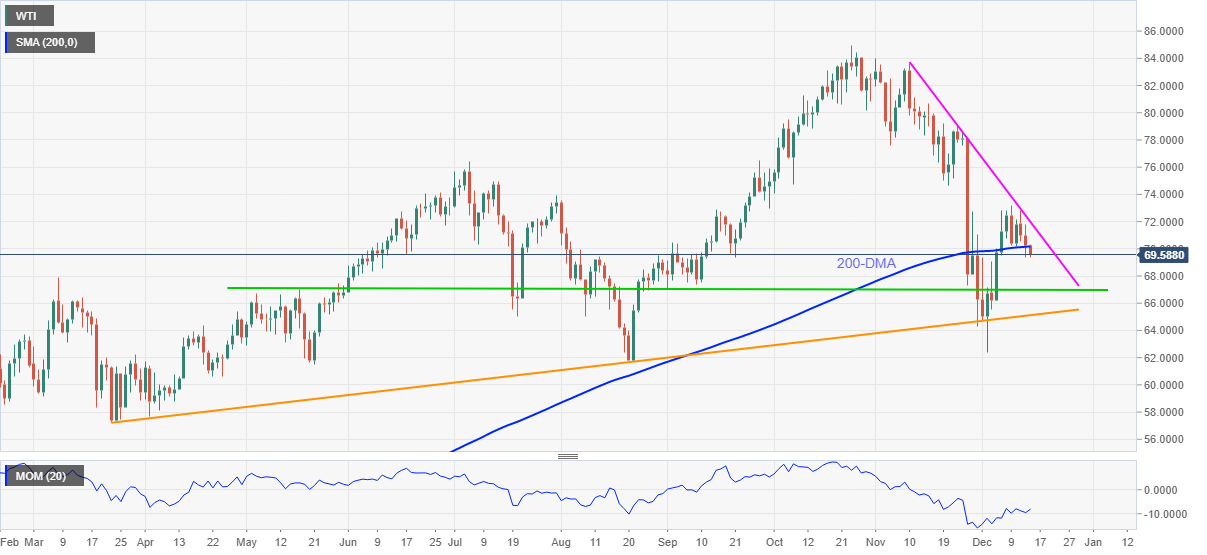
Trend: Further weakness expected
- Asia-Pacific shares drift lower amid a sluggish session.
- Hopes of faster tapering, Fed rate hike battles Omicron woes to challenge momentum traders.
- China Retail Sales, Industrial Production flashed mixed signals, Beijing-linked financial risks loom.
- Yields fade bounce off weekly low, US stock futures remain sidelined.
Asian equities remain lackluster, mostly downbeat, during early Wednesday morning in Europe as markets brace for the key Federal Open Market Committee (FOMC).
That said, the MSCI’s index of Asia ex-Japan drops 0.11% whereas Japan’s Nikkei 225 prints 0.05% intraday gains by the press time.
Fears of the Fed’s end to bond purchase, followed by a rate hike, join the Omicron woes to challenge the equity buyers. However, the US passage of a bill to raise the debt limits and President Joe Biden’s push for getting his Build Back Better (BBB) plan through the House in 2021 keep buyers hopeful. Additionally, Pfizer’s announcements concerning the efficacy of its vaccines and medicines over the South African covid variant, dubbed as Omicron, also defend the bulls.
It’s worth noting that escalating fears over China’s financial markets and mixed data at home, weigh on the stocks from Beijing. On the same line is the news that the US House passes Uyghur Bill aimed at China.
Drowning with Chinese securities are stocks from Australia, New Zealand and Hong Kong. On the same line is India’s BSE Sensex and South Korea’s KOSPI. It should be observed that the record covid cases in South Korea, per Reuters, offer additional downside pressure on the KOSPI.
On the contrary, markets in Indonesia print mild gains amid receding trade balance whereas the Bank of Japan’s liquidity infusion and a lack of major negatives concerning the virus seem to help stocks from Tokyo to remain firm.
On a broader front, the US Treasury yields and the S&P 500 Futures remain sluggish while the Wall Street benchmarks closed negative the previous day.
Moving on, the Fed’s action will be crucial for near-term market directions as equity bears have high hopes from the Fed hawks.
Read: Three ways to trade Fed rate decision
On Wednesday, a majority of the US house of Representatives backed the federal debt limit increase to $31.4 trillion from current $28.9 trillion.
US House voted 221-209 to pass $2.5 trillion increase in federal debt limit.
developing story ....
The UK CPIs Overview
The cost of living in the UK as represented by the Consumer Price Index (CPI) for November month is due early on Wednesday at 07:00 GMT. Given the recently strong employment data, coupled with the International Monetary Fund’s (MF) push to the Bank of England (BOE) for a rate hike, not to forget the Omicron crisis, today’s inflation numbers will be watched closely by the GBP/USD traders.
The headline CPI inflation is expected to rise to 4.7% YoY versus 4.2% prior while the Core CPI, which excludes volatile food and energy items, is likely to improve to 3.7% from 3.4% in November. Talking about the monthly figures, the CPI could ease to 0.4% MoM from 1.0% marked in October.
It’s worth noting that the supply crunch also highlights the Producer Price Index (PPI) for immediate GBP/USD direction. That being said, the PPI Core Output YoY may jump from 6.5% to 7.1% on a non-seasonally adjusted basis whereas the monthly prints can decline from 0.7% to 0.4%. Furthermore, the Retail Price Index (RPI) is also on the table for release, expected 6.7% YoY versus 6.0% prior.
In this regard, analysts at TD Securities said,
Headline inflation likely continued to increase in November to reach 4.8% y/y (market forecast: 4.7%). Energy prices will continue to be a significant driver of headline inflation through 2022, but we also expect core prices to be an integral driver, as we look for core inflation to reach 3.8% y/y (expecations: 3.7%)—its highest reading since 1992. However, we expect that the BoE will not hike rates in December even if inflation turns out to surprise to the upside, as the Omicron variant has introduced significant levels of uncertainty to the economic outlook.
Deviation impact on GBP/USD
Readers can find FXStreet's proprietary deviation impact map of the event below. As observed the reaction is likely to remain confined around 20-pips in deviations up to + or -2, although in some cases, if notable enough, a deviation can fuel movements over 60-70 pips.
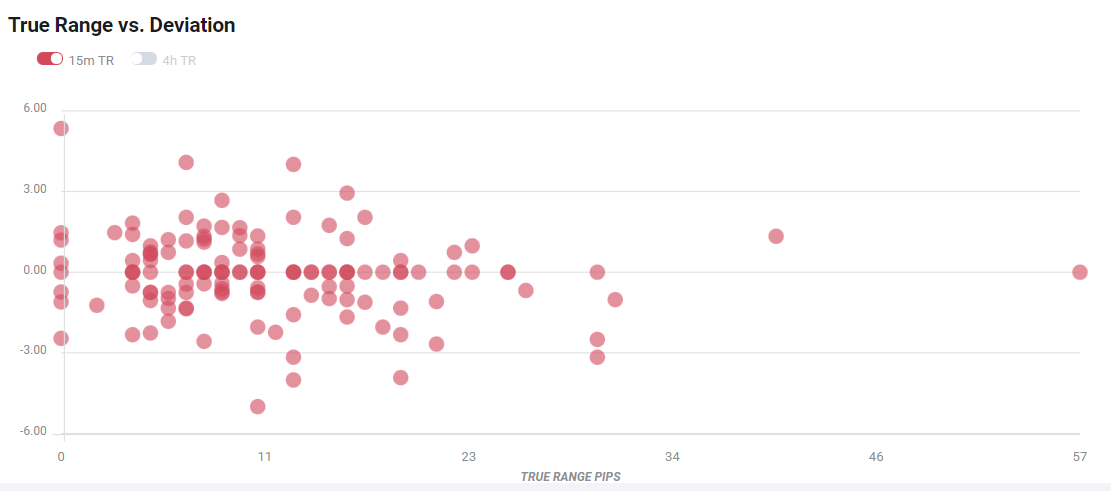
How could it affect GBP/USD?
GBP/USD extends the previous day’s rebound from weekly low, staying around 2021 bottom, heading into Wednesday’s London open.
The cable pair recently benefited from the increasing odds of the Bank of England’s (BOE) rate hike, backed by strong UK employment data and comments from the IMF. Also helping the intraday GBP/USD buyers is the US dollar pullback ahead of the key Federal Open Market Committee (FOMC) meeting.
It should, however, be noted that fears that the British hospital will soon be flooded with covid cases and the Brexit deadlock keeps the cable pair sellers hopeful.
That said, today’s inflation numbers will add to the hawkish hopes from the “Old Lady” should the outcome matches upbeat expectations. On the contrary, disappointment from the data will have additional arguments, relating to Omicron and Fed, to favor the bears.
Hence, a firmer CPI print should recall the GBP/USD buyers but a daily close past the 10-DMA level near 1.3245 becomes necessary for the pair to ignore odds of visiting the yearly low surrounding 1.3160.
Key notes
GBP/USD Price Forecast 2022: Brexit and the BOE set to pull in different directions
GBP/USD Price Analysis: 1.3250 is important for the day ahead
GBP/USD retreats towards 1.3200 on coronavirus, Brexit fears, UK inflation, Fed in focus
About the UK CPIs
The Consumer Price Index released by the Office for National Statistics is a measure of price movements by the comparison between the retail prices of a representative shopping basket of goods and services. The purchasing power of GBP is dragged down by inflation. The CPI is a key indicator to measure inflation and changes in purchasing trends. Generally, a high reading is seen as positive (or bullish) for the GBP, while a low reading is seen as negative (or Bearish).
- USD/IDR fades bounce off weekly low, pressured inside immediate range.
- Indonesia trade surplus shrinks as imports jump more in November.
- Indecision ahead of FOMC adds filters to the sluggish trading.
USD/IDR remains pressured around intraday low, down 0.05% on a day near $14,320 amid early Wednesday morning in Europe. The Indonesian rupiah pair refreshed weekly low the previous day but stayed sidelined afterward.
In doing so, the pair pays a little heed to November’s foreign trade data for Indonesia. That said, Indonesia’s Trade Balance eased from $5.74B prior and $4.45B expected to $3.51B in November. Further details suggest that the Imports rallied to 52.62% versus 37.55% market consensus and 51.06% whereas Exports grew 49.7% versus 44% forecast and 53.35% prior.
Other than the data, mixed concerns over today’s Federal Open Market Committee (FOMC) also challenge USD/IDR prices.
A contrast between the downbeat US inflation expectations, as measured by the 10-year breakeven inflation rate per the St. Louis Federal Reserve (FRED) data, versus a record high Producer Price Index (PPI) for November test Fed hawks of late. On the same line is the covid-linked anxiety as virus updates from the West battle vaccine hopes and expectations of stimulus.
Against this backdrop, Asia-Pacific shares trade mixed whereas the US 10-year Treasury yields and the S&P 500 Futures remain sluggish by the press time.
Moving on, Fed’s verdict is the key for USD/IDR traders amid higher hopes of faster tapering and signals for rate hike in 2022.
Read: Fed Interest Rate Decision Preview: Can the FOMC satisfy and mollify the markets?
Technical analysis
A daily closing below a two-month-old support line near $14,300 becomes the key support before directing USD/IDR bears to the $14,170 support.
- USD/INR bulls take a breather around 20-month top, sidelined of late.
- India’s WPI inflation jumped to 12-year high, active covid cases fall to seven-month low.
- Pre-Fed anxiety grips markets, Omicron, geopolitics offer intermediate moves.
- FOMC is the key event as hawkish hopes battle virus woes.
USD/INR treads water around the highest levels since June 2020, defending the 76.00 threshold heading into Wednesday’s European session.
While hawkish hopes from the US Federal Reserve (Fed) seem to have helped the USD/INR bulls to refresh multi-month high the previous day, recently mixed catalysts and anxiety ahead of the key Federal Open Market Committee (FOMC) tests the upside momentum.
A drop in the US inflation expectations, as measured by the 10-year breakeven inflation rate per the St. Louis Federal Reserve (FRED) data, to 11-week low contrast with a record high Producer Price Index (PPI) for November to test Fed hawks.
Additionally challenging the USD/INR run-up is the recent easing of the covid infections in Indian and firmer inflation data suggesting the Reserve Bank of India’s (RBI) rate hike. On Tuesday, India’s WPI inflation for November jumped past 12.54% prior and 11.90% expected to 14.23% actual release. It’s worth noting that India’s active covid infections drop to the lowest since May per the latest official data published on Wednesday.
Even so, virus woes and the US-China tussles, as well as the Washington-Iran tension, keep the USD/INR buyers.
That said, the US Treasury yields and the S&P 500 Futures remain sluggish while portraying the pre-Fed market sentiment. On the same line is a mixed performance by the Asia-Pacific stocks.
Moving on, Fed’s action will be the key to watch for near-term USD/INR direction as the US central bank is up for faster tapering and signals to rate hike. However, Omicron stands ready to offer surprises.
Read: Fed Interest Rate Decision Preview: Can the FOMC satisfy and mollify the markets?
Technical analysis
Overbought RSI seems to challenge USD/INR bulls targeting an ascending resistance line from March, around 76.50. However, pullback moves remain less worrisome until breaking 75.65 support, surrounding tops marked in April and October.
- EUR/USD is under pressure on the daily time frame as traders position for the Fed.
- Super Thursday will be a critical day for the euro with the ECB meeting.
- Central bank divergence themes will be a driving force for EUR/USD.
EUR/USD is trading flat on the day so far as the markets pause for the Federal Open Market Committee's two-day meeting outcome. The single currency is trading near 1.1260 within the 1.1253/69 range on the day so far. The US dollar was a little firmer against most G10 on Tuesday while EUR/USD rallied in London trade to 1.1320, only to slide down to 1.1260 in NY as data revealed a shocking truth about the path of the US inflation.
The US Producer-Price index climbed 0.8% in November, signalling that US inflation is likely to remain high well into 2022. Then, with the shocking +9.6Y YoY, US yields bounced with the report easily exceeding expectations and marking the biggest advance since a major change in the index in 2009. The 2-year government bond yields rose from 0.64% to 0.66%, and the 10-year government bond yields rose from 1.42% to 1.44%.
Fed policymakers are anticipated to announce they will accelerate a winddown of monthly bond purchases in response to inflation that continues to run hot. The statement and quarterly forecasts will be followed 30 minutes later by Chair Powell’s press conference.
''The taper pace will likely be doubled to $30bn per month, consistent with QE ending in March,'' analysts at TD Securities expect. ''Officials will likely also convey a more hawkish tone through the statement, the economic projections, and the dot plot. The median dot will probably show a 50bp increase in 2022.''
As for rates, ''the market is priced for an earlier end to QE,'' the analysts said. ''The front-end and curve will be sensitive to messaging around hikes and tolerance for high inflation.''
In Forex, the analysts said, ''while a lot is in the price, as a practical matter, there is very little to offset USD firmness as other central bank decisions this week will pale in comparison to a hawkish Fed.''
EUR/USD technical analysis
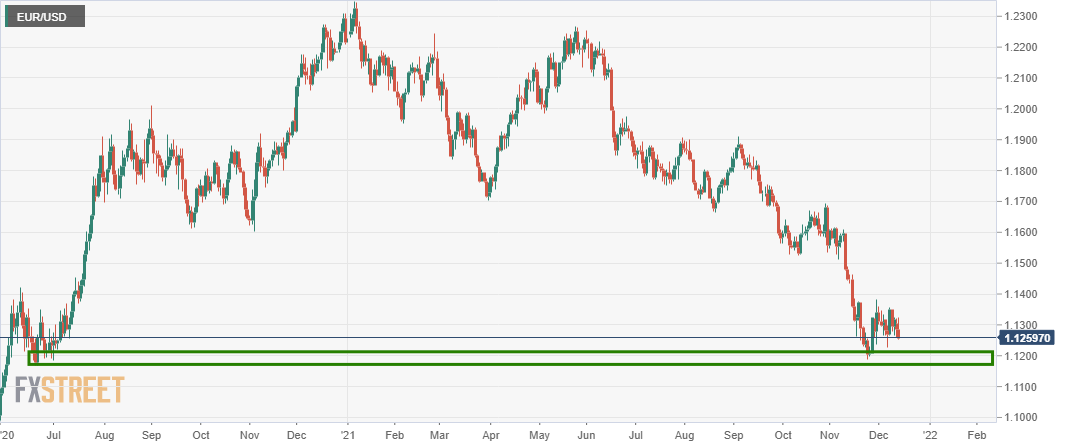
The price is finding a path below 1.1200 a tough task, although the outcome of this week's central bank meetings could result in a significant catalyst for a strong US dollar.
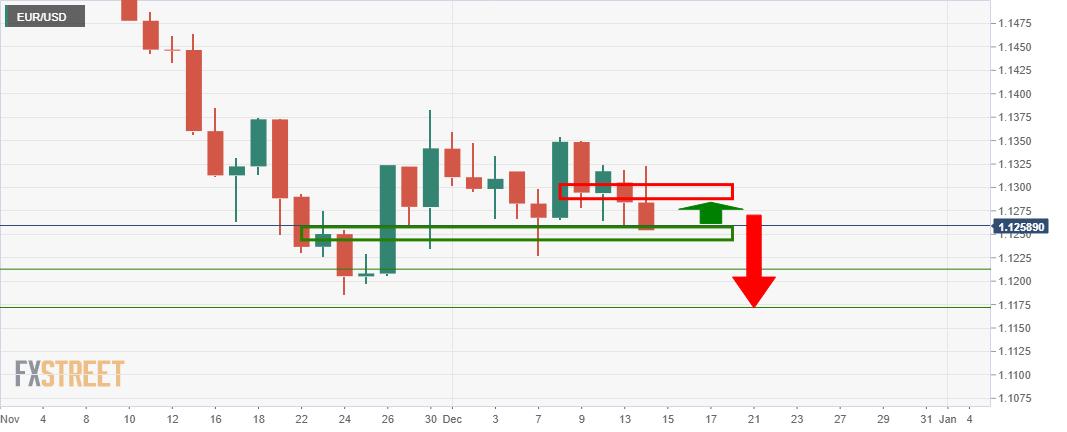
The price is currently testing support. If it holds, then a restest of the prior support would be expected to act as resistance, at least in initial tests. Should the resistance hold, however, then the downside will be vulnerable and a retest of 1.1200 inevitable.
US yields are going to be the main focus in markets this week with the Federal Reserve a host of other central banks including the European Central Bank, Bank of England and Bank of Japan, which are holding policy meetings this week.
We had a glimpse of what might come on a hawkish outcome from the Fed today in data released Tuesday. The producer-price index climbed 0.8% in November, signalling that US inflation is likely to remain high well into 2022. Then, with the shocking +9.6Y YoY, US yields bounced with the report easily exceeding expectations and marking the biggest advance since a major change in the index in 2009.
US Nov PPI helped USD/JPY to move higher along with the two and 10-year Treasury yields posting their biggest gains in about a week. The 2-year government bond yields rose from 0.64% to 0.66%, and the 10-year government bond yields rose from 1.42% to 1.44%.
Fed policymakers are expected on Wednesday to announce they will accelerate a winddown of monthly bond purchases in response to inflation that continues to run hot.
The statement and quarterly forecasts will be followed 30 minutes later by Chair Powell’s press conference.
''The Fed is expected to keep the funds rate at 0-0.25% but to double the pace of the reduction in the pace of bond purchases to finish the process in March 2022 i.e. reducing it by $30bn per month,'' analysts at Westpac explained. ''In the quarterly projections, the 2022 funds rate is likely to indicate at least 2 rate hikes, while inflation forecasts will be raised once again, GDP lowered but unemployment should also be seen a little lower.''
US 2-year yield, daily chart
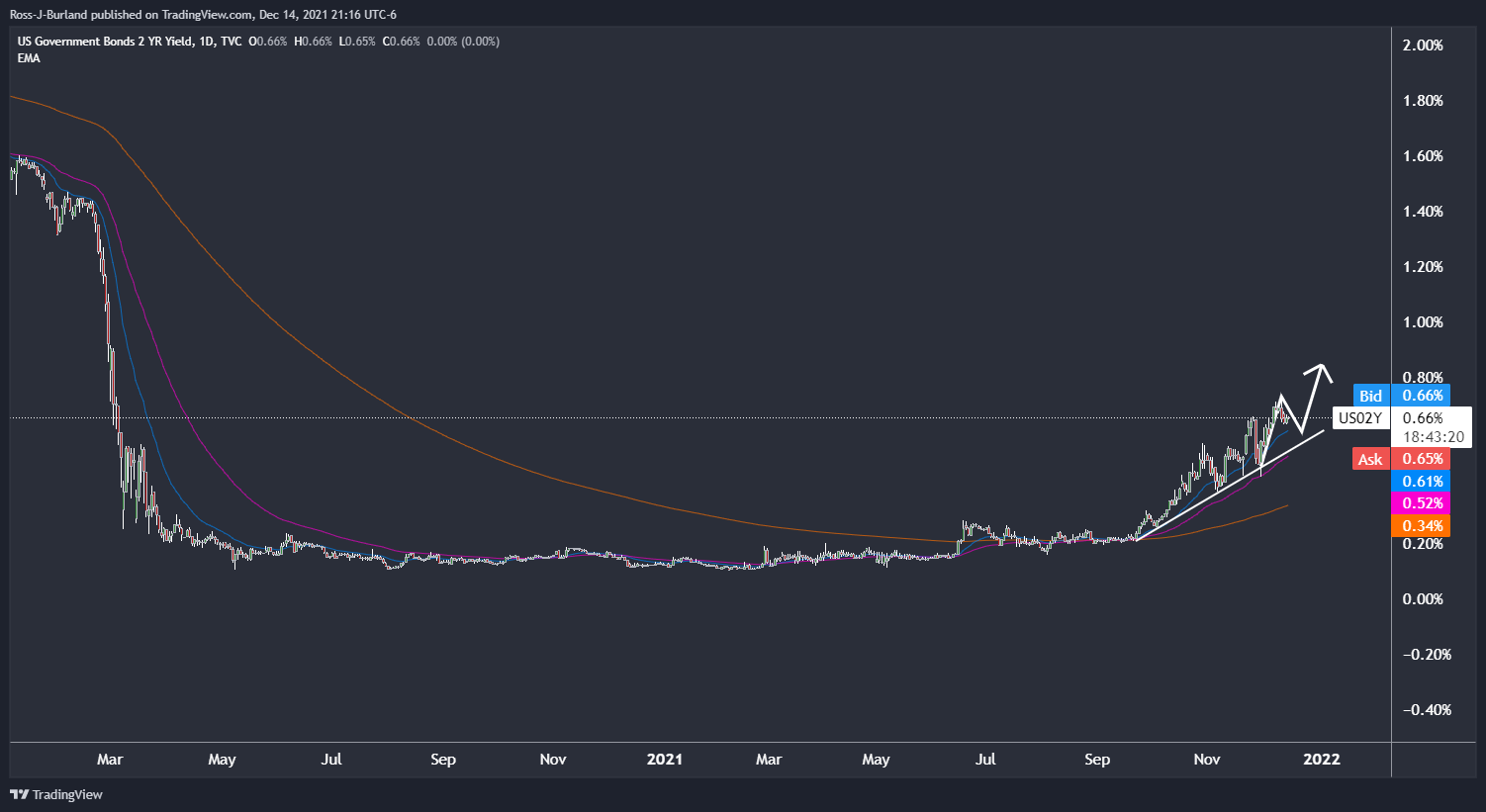
The 2-year yield is making its way higher towards 1.00% on hawkish outlook for the Fed.
- Gold portrays corrective pullback from weekly low after the biggest daily fall since November 22.
- Cautious mood ahead of Fed, mixed concerns over Inflation, Omicron tests traders.
- Tapering, hints of rate hike are on the plate but virus woes can throw a wild card.
- Fed December Preview: Gold stays vulnerable as Fed looks to battle inflation
Gold (XAU/USD) stays steady at around $1,772, keeping the bounce off four-month-old support during early Wednesday.
The bullion prices dropped in the last two days amid escalating fears of the South Africa covid variant, dubbed as Omicron, as well as hawkish hope from the US Federal Reserve (Fed). However, vaccine news challenges the virus woes while a sustained fall in the US inflation expectations and a jump in the coronavirus infections may stop the Fed hawks during today’s Federal Open Market Committee (FOMC).
Australia’s most populous state New South Wales will have 25k new covid cases daily, per a model shared by ABC News, whereas the UK is likely to witness further Omicron-linked hospitalizations and a lack of rapid testing kits. Elsewhere, China and Europe seem struggling with the COVID-19 variant but Japan tries to be optimistic. Furthermore, Pfizer report 70% efficacy of its vaccine’s three shots versus Omicron hospitalization and 33% safety against infection. The drugmaker also reported that its experimental COVID-19 pill, Paxlovid, is effective to tame all covid variants, including Omicron.
On the other hand, a drop in the US inflation expectations, as measured by the 10-year breakeven inflation rate per the St. Louis Federal Reserve (FRED) data, to 11-week low contrast with a record high Producer Price Index (PPI) for November to test Fed hawks. “We expect the monthly pace to be doubled to $30bn from $15bn, consistent with QE ending in mid-March instead of mid-June. Officials will likely also convey a more hawkish tone through changes to the statement, the economic projections, and the dot plot. We expect the median dot to show a 50bp increase in the fund's rate in 2022,” said TD Securities.
Elsewhere, geopolitical and trade tensions between the US and China, as well as America-Iran, also weigh on the market sentiment but gain a little response pre-Fed.
Amid these plays, the US Treasury yields and the S&P 500 Futures remain sluggish while portraying the pre-Fed market sentiment. On the same line is a mixed performance by the Asia-Pacific stocks.
Looking forward, the gold prices are likely to remain vulnerable as Fed is up for a big battle with inflation. However, Omicron stays ready to throw a wild card.
Technical analysis
After multiple pullbacks from 200-DMA and a fortnight-long sideways performance, gold bears flex muscles while bounding off an upward sloping support line from August, around $1,770.
Given the downside MACD signals and RSI conditions, sellers are likely keeping the controls should the quote mark a decisive break of the $1,770 support.
Following that, 61.8% Fibonacci retracement of August-November upside near $1,760 and the $1,738 may act as a buffer before directing the quote towards September’s low near $1,721.
Meanwhile, an upside clearance of the 200-DMA level surrounding $1,793-94 won’t be an open invitation to the gold buyer as multiple levels from October 22 will test the upside momentum near $1,814-15.
Even if the gold prices cross the $1,815 resistance, tops marked in July and September around $1,834 will precede the $1,850 level to test the advances targeting November’s peak of $1,877.
Gold: Daily chart
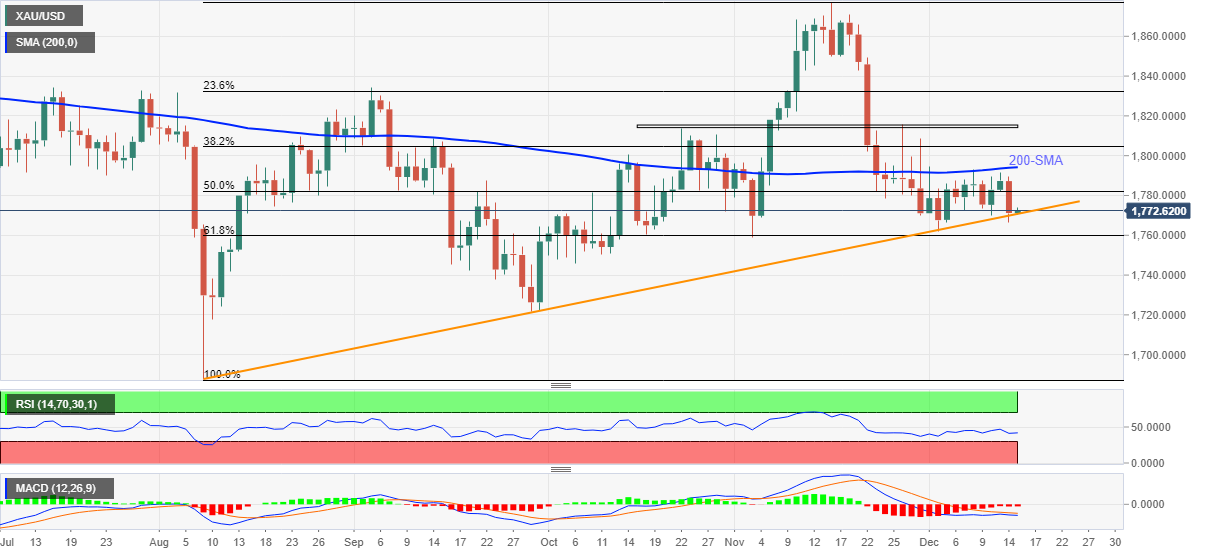
Trend: Further weakness expected
- NZD/USD consolidates and awaits the outcome of major data and events.
- The Fed and NZ GDP Q3 will be eyed as potential catalysts.
NZD/USD is trading in a tight range ahead of the Federal Reserve today and was unmoved by the Chinese data dump that featured s the main scheduled event for Asia on Wednesday. At the time of writing, NZD/USD is trading between 0.6732 and 0.6742, flat on the day.
The markets are going through today's New Zealand’s Half-Year Economic and Fiscal Update for 2021.
An extract of the document explained that the ''combination of supply chain disruptions and strong demand has seen capacity pressures intensify, contributing to higher inflation. Consumers Price Index (CPI) inflation is forecast to peak at 5.6% in the March 2022 quarter, significantly higher than the peak expected in the 2021 Budget Economic and Fiscal Update (Budget Update), before trending down.
As a result, interest rates are expected to rise faster and to a higher level than forecast in the Budget Update. Higher inflation is a major contributor to higher nominal GDP over the forecast period compared to the Budget Update.''
As for the labour market, it states that '' the outlook has continued to improve since the Budget Update. The unemployment rate is expected to fall to 3.1% in the March 2022 quarter before slowly increasing to 4.1% by the end of the forecast period. This continued tightness in the labour market, together with higher CPI inflation is expected to maintain wage inflation above 4.0% throughout the forecast period.''
Meanwhile, the Kiwi is consolidating ahead of the FOMC decision and third-quarter Gross Domestic Product. ''Volatility feels more likely than a genuine shift in any trend, with markets seemingly more sensitive now to swings in generalised risk appetite than specific data, and GDP data in particularly likely to be as much noise as signal,'' analysts at ANZ bank explained. ''Nonetheless, for now there does seem to be some support below 0.6750; let’s see if that lasts.''
- USD/TRY prints mild losses as bulls take a breather around record top.
- Bearish chart pattern, RSI pullback from overbought territory favor short-term sellers.
- 50-SMA adds strength to the wedge’s support line.
USD/TRY prices drop 0.15% intraday to $14.37 during early Tuesday, after refreshing the all-time high with $14.64 level the previous day. In doing so, the Turkish lira (TRY) pair tracks RSI pullback from oversold territory.
The latest weakness, or consolidation of the gains, is likely to stretch towards the $14.00 threshold. However, any further weakness will be challenged by the $13.84 key support confluence, including 50-SMA and the lower line of a three-week-old rising wedge.
Should the quote drops below $13.84, it confirms a theoretical downward trajectory towards the late November lows around $11.57.
During the anticipated fall, $12.40 and the $12.00 threshold may offer an intermediate halt.
Meanwhile, further upside needs to cross the stated wedge’s resistance line, near $14.77 at the latest, before directing the USD/TRY bulls towards the $15.00 threshold.
USD/TRY: Four-hour chart
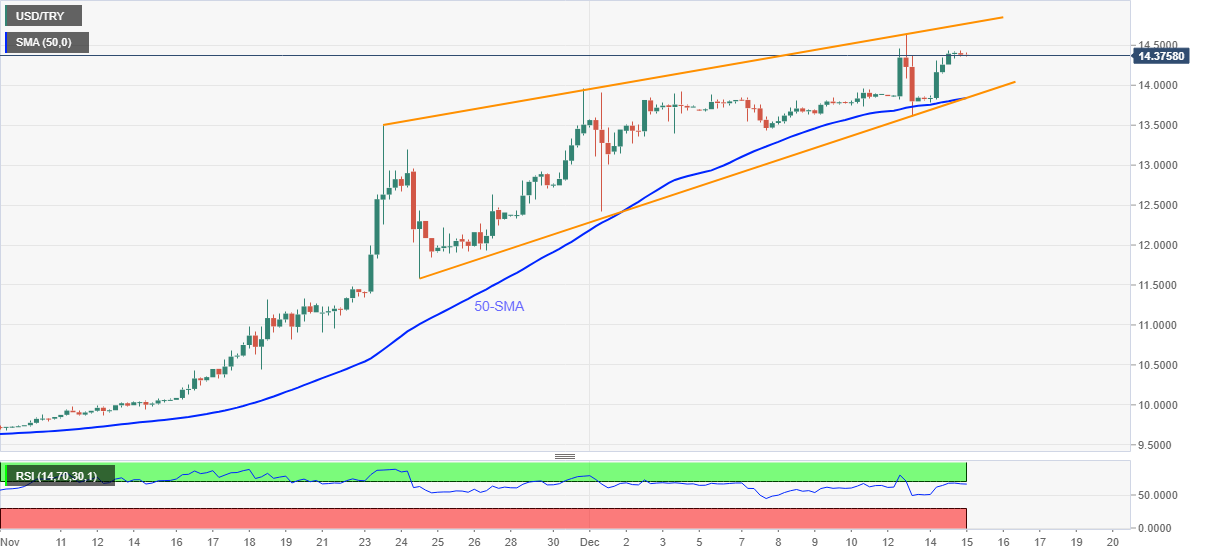
Trend: Pullback expected
The US House of Representatives voted to pass a bill on Wednesday that would ban goods produced by the forced laborers from China’s Xinjiang region, per Bloomberg.
The measure is aimed at punishing China for the alleged oppression of the Uyghur Muslims unless companies can prove that they have not been made with forced labor.
The bill now goes to the Senate for passage, where it already has bipartisan support.
White House press secretary Jen Psaki said in a statement, “The Administration will work closely with Congress to implement this bill to ensure global supply chains are free of forced labor, while simultaneously working to on-shore and third-shore key supply chains, including semiconductors and clean energy.”
Market reaction
The US dollar index is consolidating near weekly highs of 96.59, down 0.06% on the day. Traders look forward to the Fed decision for fresh trading impetus.
Following the release of the November activity numbers, China’s National Bureau of Statistics (NBS) released a statement, via Reuters, expressing their take on the economy.
Key headlines
Economic recovery is facing many constraints.
November indicators are in a reasonable range.
China's economy continued to improve.
Semiconductor shortage for the auto sector has eased a little.
Market reaction
AUD/USD was last seen trading at 0.7109, up 0.10% on the day.
| Raw materials | Closed | Change, % |
|---|---|---|
| Brent | 73.16 | -1.69 |
| Silver | 21.944 | -1.72 |
| Gold | 1770.433 | -0.88 |
| Palladium | 1612.51 | -3.58 |
Bank of Japan Governor Haruhiko Kuroda remains optimistic on the inflation outlook, as he says on Wednesday that the country's consumer inflation may approach his 2% target, as rising raw material costs push up wholesale prices.
Additional quotes
“The central bank would maintain its ultra-loose monetary policy to ensure any rise in prices would be accompanied by higher wages and a recovery in the economy.”
"It's true there's a chance consumer inflation will approach 2per cent through various channels.”
"But what's desirable is for the economy to recover steadily and push up corporate profits, thereby leading to higher wages and inflation. We'll patiently maintain an ultra-easy policy to achieve this at the earliest date possible.”
"I don't think Japan's economy is in a state of stagflation.”
- AUD/USD consolidates weekly losses, snaps two-day downtrend.
- China Retail Sales eased below 4.6% YoY forecast, Industrial Production crossed prior and expected figures in November.
- Market sentiment dwindles amid mixed concerns over Omicron, stimulus and inflation.
- Fed is expected to faster tapering, signal rate hikes but virus woes test policy hawks.
AUD/USD remains sidelined, recently picking up bids to 0.7110 during early Wednesday. The Aussie pair trader’s latest indecision could be linked to the mixed data from the biggest customer China and anxiety ahead of the key Federal Reserve (Fed) monetary policy meeting.
China’s Retail Sales dropped below 4.6% forecast and 4.9% prior to 3.9% YoY in November whereas Fixed Asset Investments (YTD) eased to 5.2% from 5.4% expected and 6.1% previous readouts. Further, Industrial Production (IP) data jumped past 3.6% market consensus and 3.5% prior to 3.8% during the stated month. Earlier in the day, Australia’s Westpac Consumer Confidence for December slumped to -1.0% versus +0.6% previous readouts.
That said, the US Treasury yields and the S&P 500 Futures remain sluggish while portraying the pre-Fed market sentiment. On the same line is a mixed performance by the Asia-Pacific stocks.
Fears that Australia’s most populous state New South Wales will have 25k new covid cases daily, per a model shared by ABC News, battles the hopes of the vaccines to overcome the virus variant. On the other hand, the UK is likely to witness further Omicron-linked hardships while the COVID-19 strain also spreads in the West faster and challenges the policy hawks of late.
Additionally testing the Fed bulls and optimists is a drop in the US inflation expectations, as measured by the 10-year breakeven inflation rate per the St. Louis Federal Reserve (FRED) data, to an 11-week low versus a record high Producer Price Index (PPI) for November.
Looking forward, today’s Federal Open Market Committee (FOMC) decision is crucial for markets ahead of tomorrow’s Aussie jobs report.
Read: Fed Interest Rate Decision Preview: Can the FOMC satisfy and mollify the markets?
Technical analysis
A 15-day-old horizontal line near 0.7090 restricts short-term declines of the AUD/USD prices. Meanwhile, the 100-SMA level of 0.7135 and September’s low surrounding 0.7175 become the key hurdles to the north.
A series of Chinese data has been released for the month of November. This includes Industrial Production (power outages and supply issues remain as headwinds) and Retail Sales as the most-watched features of the data dump.
The results come as follows:
- China November Retail Sales +3.9 pct YoY (Reuters poll +4.6 pct).
- China Nov. Industrial Output up 3.8% YoY (Reuters poll +3.6 %).
FX implications
The data was mixed and has had no impact on the forex market with the Aussie stationary near 0.7110 around the release.
Meanwhile, the softer-than-expected fixings continue as the central bank attempts to slow CNY rise, (USD/CNY fix: 6.3716 vs the prev fix of 6.3675).
The Federal Reserve meeting will be the next key catalyst for the yuan and Aussie:
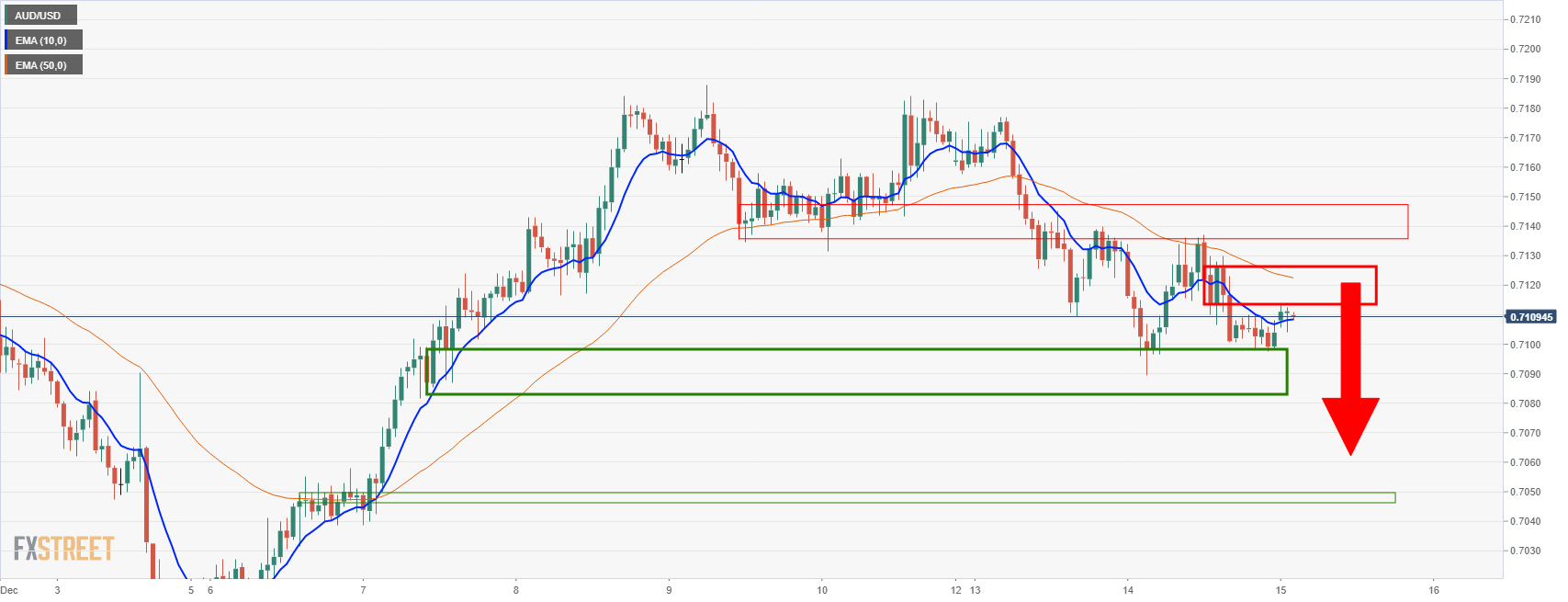
The chart above is an hourly analysis of AUD/USD which illustrates a bias to the downside while below 0.7150.
About the Chinese data
Industrial output is released by the National Bureau of Statistics of China. It shows the volume of production of Chinese Industries such as factories and manufacturing facilities. A surge in output is regarded as inflationary which would prompt the People’s Bank of China would tighten monetary policy and fiscal policy risk. Generally speaking, if high industrial production growth comes out, this may generate a positive sentiment (or bullish) for the CNY, whereas a low reading is seen as negative (or Bearish) for the CNY.
The Retail Sales report released by the National Bureau of Statistics of China measures the total receipts of the retailed consumer goods. It reflects the total consumer goods that the various industries supply to the households and social groups through various channels. It is an important indicator to study the changes in the Chinese retail market and reflecting the degree of economic prosperity. In general, A high reading is seen as positive (or bullish) CNY, while a low reading is seen as negative (or bearish) for the CNY.
- DXY retreats from weekly top, snaps two-day uptrend.
- Bearish MACD signals, three-week-old horizontal area challenges bullish chart pattern’s confirmation.
- 10-DMA, 20-DMA guards immediate downside, yearly top adds to the upside filters.
US Dollar Index (DXY) eases from a weekly high to 96.48 during early Wednesday, despite confirming a bullish pennant the previous day.
Market’s anxiety ahead of the key Federal Open Market Committee (FOMC) meeting and bearish MACD joins the horizontal area from November 23 to challenge the greenback bulls of late.
However, sellers are less likely to take risk of entry until the quote drops back below the previous resistance line of the said pennant, around 96.35 at the latest.
Adding to the downside filters is the convergence of the 10-DMA and 21-DMA followed by the pennant’s support line, respectively around 96.25 and 96.05.
Even if the DXY declines below 96.05, the 96.00 threshold and an ascending support line from October 28, near 95.77, will be important to watch for the bears.
Alternatively, an upside clearance of the 96.65 hurdle will direct the US Dollar Index bulls towards the yearly top of 96.94 and then to 97.00.
However, any further upside past 97.00 won’t hesitate to challenge the June 2020 peak of 97.80.
Read: Fed Interest Rate Decision Preview: Can the FOMC satisfy and mollify the markets?
DXY: Daily chart
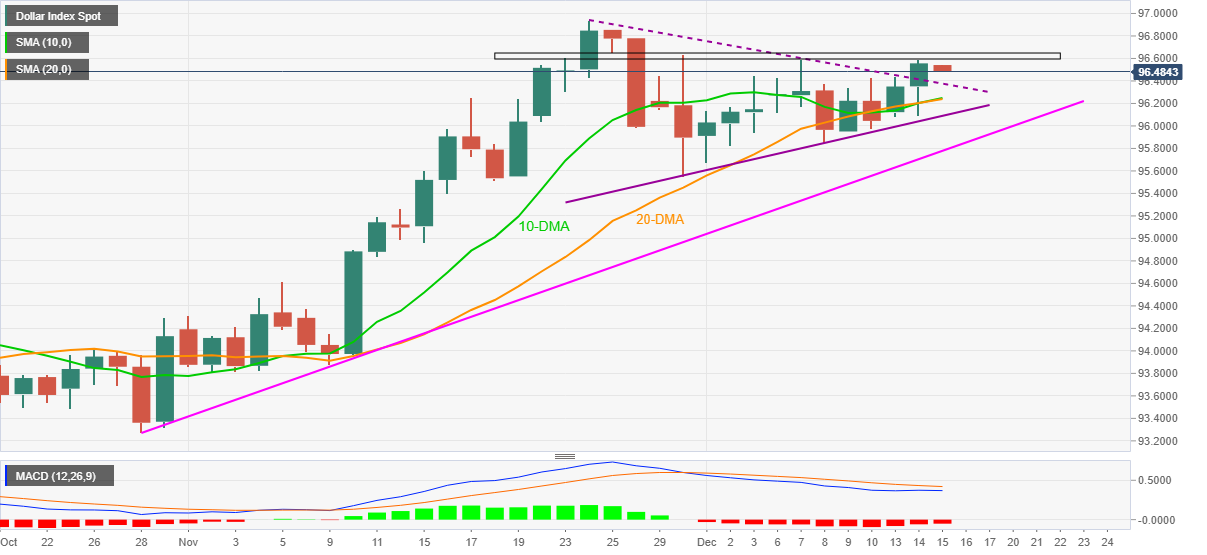
Trend: Further upside expected
The Bank of Japan (BOJ) remains concerned about the spiking short-term interest rates and, therefore, injects cash into markets for the third day in a row.
The Japanese central bank offered JPY2 trillion (circa $17.6bn) via bond buys.
On Tuesday, the central bank made two offers, including one to buy bonds worth 2 trillion yen for immediate fund provision. Under another offer, it would buy 7 trillion yen to inject funds for a period between Dec. 15-16.”
Market reaction
USD/JPY is trading in a narrow range so far this Wednesday, virtually unchanged on the day at 113.70. Investors remain in a wait-and-see mode ahead of the critical Fed decision.
- USD/CHF snaps two-day uptrend, mildly offered around intraday low of late.
- Economists push SNB to create $1.0 trillion sovereign wealth fund.
- Market sentiment dwindles ahead of the Fed as Omicron and inflation fears battle stimulus hopes.
USD/CHF grinds higher after a two-day uptrend, teases intraday low around 0.9235 during Wednesday’s Asian session.
The Swiss currency pair’s latest declines could be linked to the market chatters over the push for the Swiss National Bank (SNB) to create a sovereign wealth fund. Also weighing on the quote could be the cautious mood ahead of today’s Federal Open Market Committee (FOMC).
“The Swiss National Bank should convert its massive pile of foreign stocks and bonds into a sovereign wealth fund like Norway's to support government spending, a group of economists said,” per Reuters.
On the other hand, a drop in the US inflation expectations, as measured by the 10-year breakeven inflation rate per the St. Louis Federal Reserve (FRED) data, to an 11-week low contradicts record high Producer Price Index (PPI) for November. The same propel the market’s anxiety ahead of the key Fed meeting.
While portraying the market mood, the US 10-year Treasury yields fade the previous day’s rebound from weekly low whereas the S&P 500 Futures print mild gains at the latest.
That said, USD/CHF traders will wait for the Fed’s action amid hopes of faster tapering and rate hike hints. However, the Omicron woes challenge the hawks.
Read: Fed Interest Rate Decision Preview: Can the FOMC satisfy and mollify the markets?
Technical analysis
An ascending triangle formation restricts short-term USD/CHF moves between 0.9280 and 0.9190 as MACD and RSI tease bulls.
- GBP/JPY bears lining up for a break of daily support.
- Bulls are looking for a break of near term resistance to open the 61.8% golden ratio target.
The bulls are accumulating the price from a daily basis between 149 and 151 in a relatively wide range with no directional bias at this juncture.
GBP/JPY daily chart
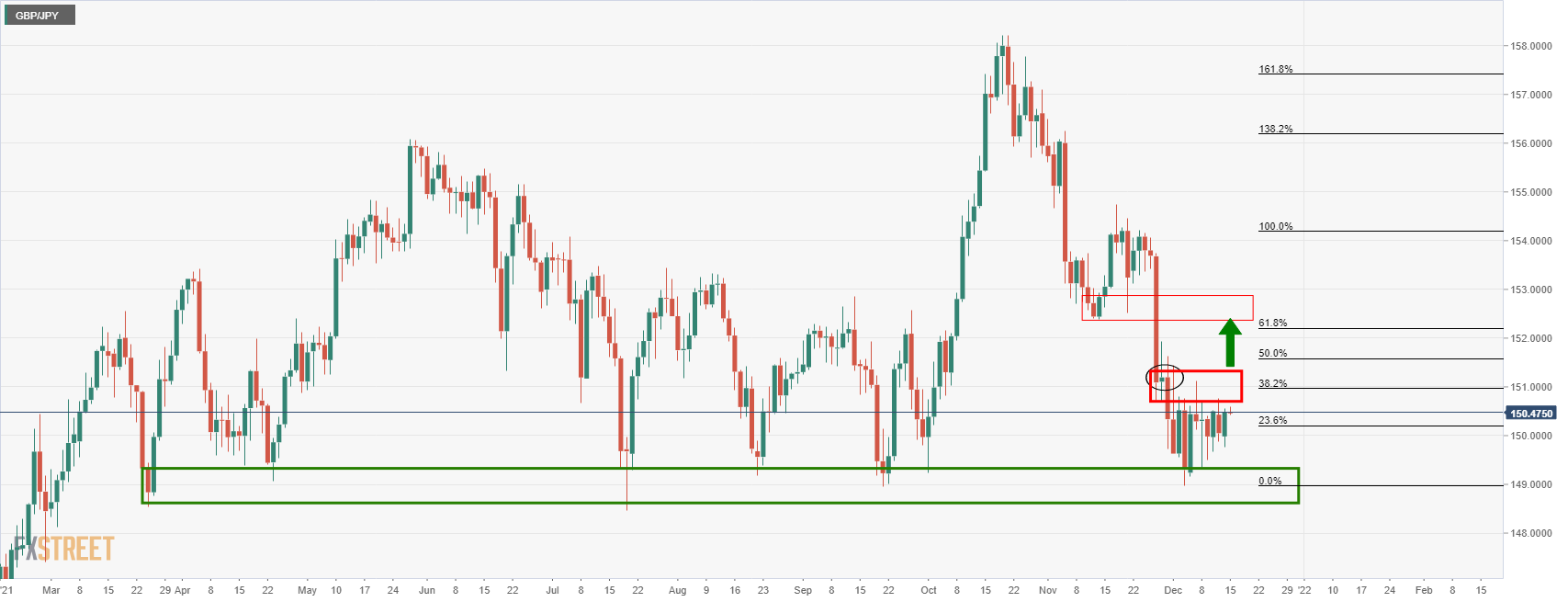
The daily support has held up time and time again and that leaves the upside exposed on a break of the 151.20s as per the order block eclipsed in the chart. A move towards the 61.8% golden ratio aligns particularly with the old support near 152.50.
A break of the daily support, however, opens the risk of a considerable move to the downside. 140/142.50 would be earmarked targets for the bears positioning for the downside in such a scenario, as per the following weekly chart:
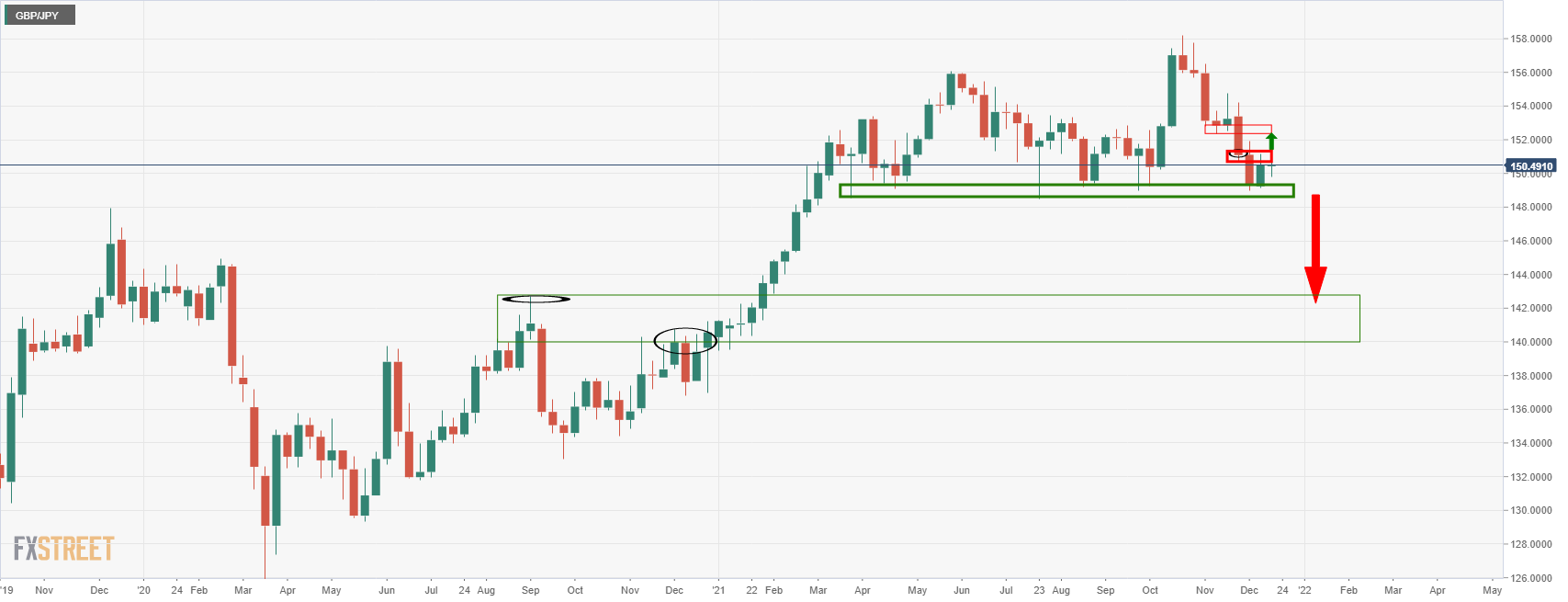
The People’s Bank of China (PBOC) infused CNY500 billion via one-year medium-term lending (MLF) facility on Wednesday.
The Chinese central bank kept the rate for one-year MLF operation rate unchanged at 2.95%.
Separately, the PBOC injected 10 billion yuan through seven-day reverse repos.
Market reaction
USD/CNY is trading modestly flat on the latest PBOC operation. The spot trades at 6.3632, stuck in a tight range over the past three trading sessions.
Meanwhile, the AUD/USD pair is defending 0.7090 support, as of writing, adding 0.08% on the day.
| Time | Country | Event | Period | Previous value | Forecast |
|---|---|---|---|---|---|
| 02:00 (GMT) | China | Industrial Production y/y | November | 3.5% | 3.6% |
| 02:00 (GMT) | China | Retail Sales y/y | November | 4.9% | 4.6% |
| 02:00 (GMT) | China | Fixed Asset Investment | November | 6.1% | 5.4% |
| 04:30 (GMT) | Japan | Tertiary Industry Index | October | 0.5% | |
| 07:00 (GMT) | United Kingdom | Producer Price Index - Input (MoM) | November | 1.4% | 0.5% |
| 07:00 (GMT) | United Kingdom | Producer Price Index - Input (YoY) | November | 13% | |
| 07:00 (GMT) | United Kingdom | Producer Price Index - Output (YoY) | November | 8% | 8.3% |
| 07:00 (GMT) | United Kingdom | Producer Price Index - Output (MoM) | November | 1.1% | 0.8% |
| 07:00 (GMT) | United Kingdom | Retail Price Index, m/m | November | 1.1% | 0.4% |
| 07:00 (GMT) | United Kingdom | HICP ex EFAT, Y/Y | November | 3.4% | |
| 07:00 (GMT) | United Kingdom | Retail prices, Y/Y | November | 6% | 6.7% |
| 07:00 (GMT) | United Kingdom | HICP, m/m | November | 1.1% | 0.4% |
| 07:00 (GMT) | United Kingdom | HICP, Y/Y | November | 4.2% | 4.7% |
| 07:45 (GMT) | France | CPI, y/y | November | 2.6% | 2.8% |
| 07:45 (GMT) | France | CPI, m/m | November | 0.4% | 0.4% |
| 13:15 (GMT) | Canada | Housing Starts | November | 236.6 | 234.3 |
| 13:30 (GMT) | Canada | Manufacturing Shipments (MoM) | October | -3% | 4.1% |
| 13:30 (GMT) | U.S. | NY Fed Empire State manufacturing index | December | 30.9 | 25 |
| 13:30 (GMT) | U.S. | Import Price Index | November | 1.2% | |
| 13:30 (GMT) | U.S. | Retail sales | November | 1.7% | 0.8% |
| 13:30 (GMT) | U.S. | Retail Sales YoY | November | 16.3% | |
| 13:30 (GMT) | U.S. | Retail sales excluding auto | November | 1.7% | 0.9% |
| 13:30 (GMT) | Canada | Consumer Price Index m / m | November | 0.7% | 0.2% |
| 13:30 (GMT) | Canada | Bank of Canada Consumer Price Index Core, y/y | November | 3.8% | 3.6% |
| 13:30 (GMT) | Canada | Consumer price index, y/y | November | 4.7% | 4.7% |
| 15:00 (GMT) | U.S. | NAHB Housing Market Index | December | 83 | 83 |
| 15:00 (GMT) | U.S. | Business inventories | October | 0.7% | 1.1% |
| 15:30 (GMT) | U.S. | Crude Oil Inventories | December | -0.24 | -2.082 |
| 17:00 (GMT) | Canada | BOC Gov Tiff Macklem Speaks | |||
| 19:00 (GMT) | U.S. | FOMC Economic Projections | |||
| 19:00 (GMT) | U.S. | Fed Interest Rate Decision | 0.25% | 0.25% | |
| 19:30 (GMT) | U.S. | Federal Reserve Press Conference | |||
| 21:00 (GMT) | U.S. | Net Long-term TIC Flows | October | 26.3 | |
| 21:00 (GMT) | U.S. | Total Net TIC Flows | October | -26.8 | |
| 21:45 (GMT) | New Zealand | GDP y/y | Quarter III | 17.4% | -1.6% |
| 21:45 (GMT) | New Zealand | GDP q/q | Quarter III | 2.8% | -4.5% |
| 23:30 (GMT) | Australia | RBA's Governor Philip Lowe Speaks | |||
| 23:50 (GMT) | Japan | Trade Balance Total, bln | November | -67.4 | -675 |
- USD/JPY grinds higher around weekly top, extending two-day advances.
- Yields fail to extend the latest rebound, S&P 500 Futures print mild gains.
- Japan train bookings rally over 80% for year-end holidays, PM Kishida, BOJ Governor Kuroda struggle to placate market fears.
- Vaccine optimism joins stimulus hopes but Omicron fears, Fed-linked cautious stay on the table.
USD/JPY takes a U-turn from intraday high to challenge the previous two-day uptrend, down 0.03% on a day around 113.70 during the initial Tokyo trading on Wednesday.
The risk barometer pair’s latest weakness could be linked to the Omicron fears and the market’s anxiety ahead of today’s US Federal Reserve (Fed) monetary policy meeting.
Although a leap in Japan’s train reservations for holidays hints at receding virus fear, the fears of a flood in the UK’s Omicron-linked hospitalizations and recently rising covid variant cases in the Asia-Pacific portray the COVID-19 woes.
Elsewhere, Japan PM Fumio Kishida accepts mistakes in the Construction Orders data but turns down any impact of the mistakes on GDP for FY 2020 and 2021. On the other hand, Bank of Japan (BOJ) Governor Haruhiko Kuroda said, per Reuters, that Inflation may approach 2% through 'various channels'. Earlier in Asia BOJ shows readiness to purchase two trillion yen of the bonds via repurchase auctions.
It’s worth noting that a drop in the US inflation expectations, as measured by the 10-year breakeven inflation rate per the St. Louis Federal Reserve (FRED) data, to an 11-week low contradicts record high Producer Price Index (PPI) for November. The same propel the market’s anxiety ahead of the key Fed meeting. The policymakers are expected to fasten the tapering and hint at rate hikes but the Omicron woes challenge the hawks.
Read: Fed Preview: Dollar hinges on 2022 rate hike dots, guide to trading the grand finale of 2021
Alternatively, the US Senate approved a bill to raise the debt ceiling by $2.5 trillion whereas President Joe Biden also sounds hopeful of getting his Build Back Better (BBB) plan through the House in 2021.
Amid these plays, the US 10-year Treasury yields fade the previous day’s rebound from weekly low whereas the S&P 500 Futures and Japan’s Nikkei 225 prints mild gains by the press time.
Moving on, cautious sentiment ahead of the Fed’s verdict may keep USD/JPY prices ground but hopes of the hawkish outcome favor buyers.
Technical analysis
While the 21-DMA level near 113.85 guards short-term USD/JPY advances, multiple hurdles surrounding 114.45-50 becomes the key for buyers to watch. Meanwhile, the pair’s downside remains elusive until breaking an ascending support line, previous resistance, from March around 112.55.
In recent trade today, the People’s Bank of China (PBOC) set the yuan (CNY) at 6.3716 vs the previous fix of 6.3675 and the prior close of 6.3670.
About the fix
China maintains strict control of the yuan’s rate on the mainland.
The onshore yuan (CNY) differs from the offshore one (CNH) in trading restrictions, this last one is not as tightly controlled.
Each morning, the People’s Bank of China (PBOC) sets a so-called daily midpoint fix, based on the yuan’s previous day closing level and quotations taken from the inter-bank dealer.
- GBP/USD bulls are in play and eye a run to test the dynamic trendline resistance.
- The price is accumulating following a significant correction in the hourly time frame.
GBP/USD bulls are stepping in during a phase of an accumulation from hourly support. The following illustrates the prospects of a bulling impulse to take on the bearish commitments near the prior highs and trendline resistance.
GBP/USD H1 chart
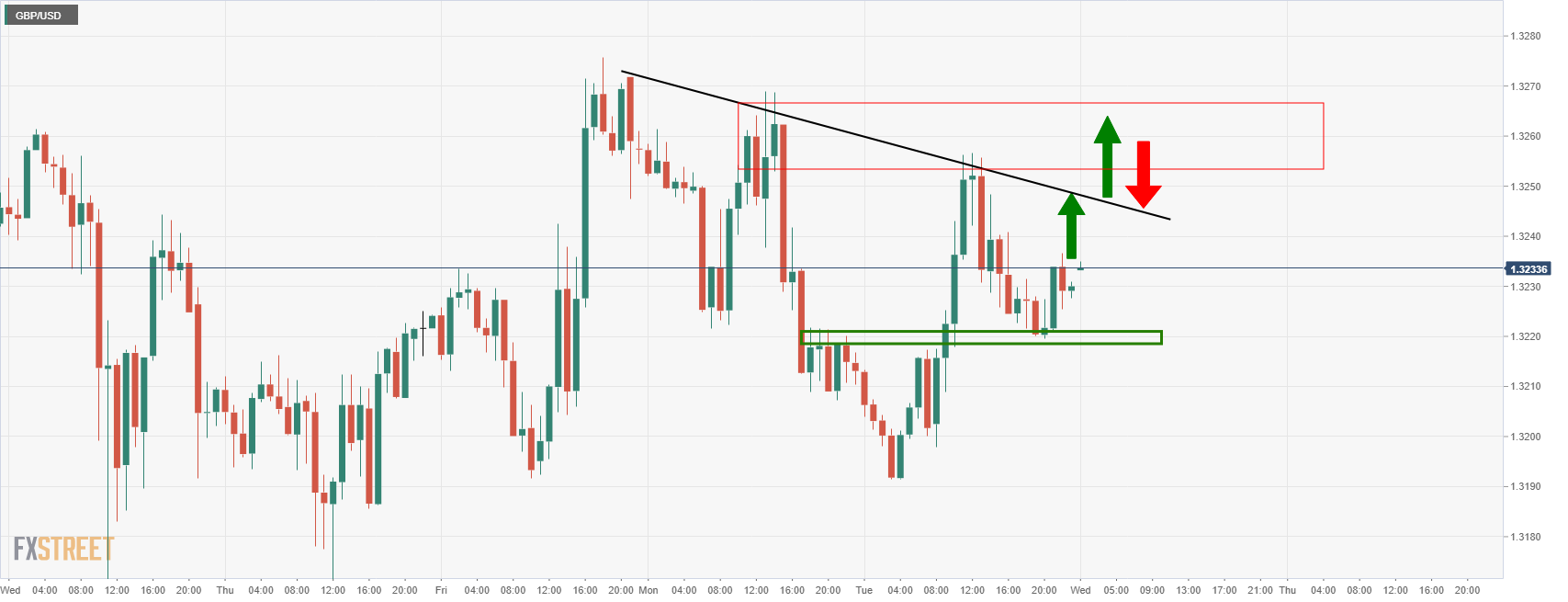
The hourly chart sees the price correcting from support and on a break of the 1.3230s, the bulls will be on track for a test of the descending trendline resistance and the upper half of the 1.32 area.
This would be expected to result in some profit-taking and a potential retreat of the counter trendline with bulls leaning on 1.3250 for support.
- NZD/USD holds lower ground after ticking down to the yearly low during three-day fall.
- Descending trend line from March can test bears amid oversold RSI trend.
- 10-DMA, five-week-old resistance line to restrict corrective pullback.
NZD/USD bounces off an intraday low of 0.6732, also the yearly bottom, to consolidate the daily losses around 0.6745 during Wednesday’s Asian session.
The kiwi pair remains on the back foot ever since it failed to overcome the 10-DMA hurdle the last Thursday. Also portraying the bearish bias is the descending trend line from early November, as well as sluggish MACD signals.
It should be noted, however, that a nine-month-old support line near 0.6700 will challenge the NZD/USD bears as the RSI line tests oversold territory.
If not, then a downward trajectory towards late 2020 bottom near 0.6590 can’t be ruled out.
Alternatively, a successful run-up beyond the stated resistance line and 10-DMA joint surrounding 0.6785 will direct the Kiwi pair buyers to a horizontal area from late September near 0.6860-70 and then to multiple levels marked in the last 11 weeks, close to 0.6980.
Adding to the upside filters is the 0.7000 threshold that acts as a validation point for the NZD/USD bull’s return.
NZD/USD: Daily chart
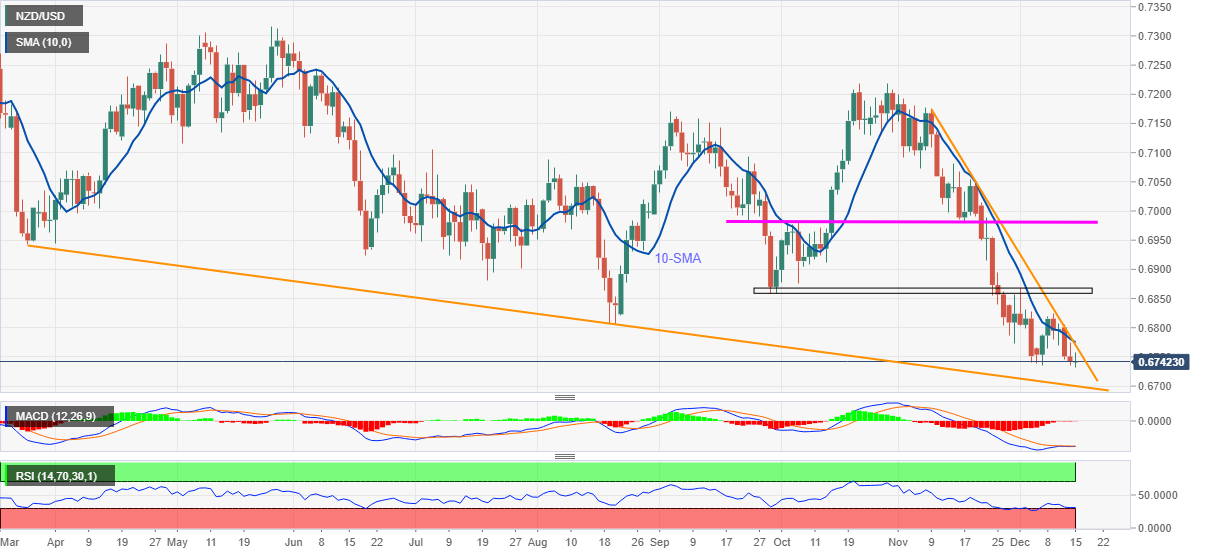
Trend: Further weakness expected
The Securities Times has published a report that states that The People's Bank of China could cut its LPR in the coming days.
This will follow last week's cut of the reserve requirement ratio in an attempt to free up the jam in money flow and add support for the nation’s economy as a property-market downturn threatens to hamper growth into next year.
The People’s Bank of China reduced most banks’ reserve requirement ratio by 0.5 percentage points, releasing 1.2 trillion yuan ($188 billion) of liquidity. This was to avoid a liquidity crunch among developers that’s roiled the nation’s bond market.
In doing so, this can weaken the yuan and add further demand for the US dollar and weigh on the Aussie which at times tracks the direction of CNH.
- AUD/USD bears have been in play this week and a downside continuation could be on the cards.
- The Federal Reserve is the main risk event, but Chinese data could create some volatility.
Chinse data is coming up later today, although the Federal Reserve will take the spotlight. From a technical point of view, there are compelling price actions and structures taking place across the time frames.
The price is leaving a bearish wick on this month's candle so far that could be filled next month, if not love the remaining days of the holiday season. This leaves scope to the downside for a test of 0.70 the figure.
AUD/USD monthly chart
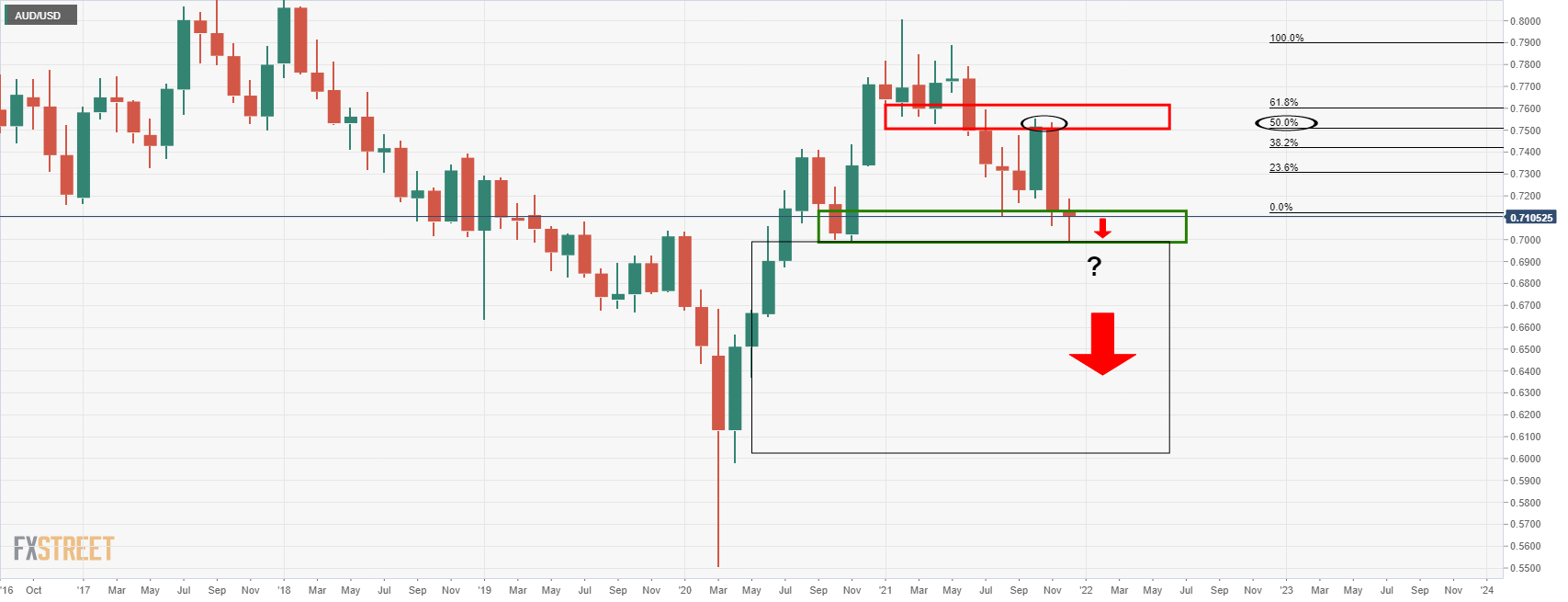
However, the jury is out on whether the price can then exploit all of the space from 0.60s. But, if it does break below 0.7000, then there is plenty of downside opportunity.
AUD/USD daily chart
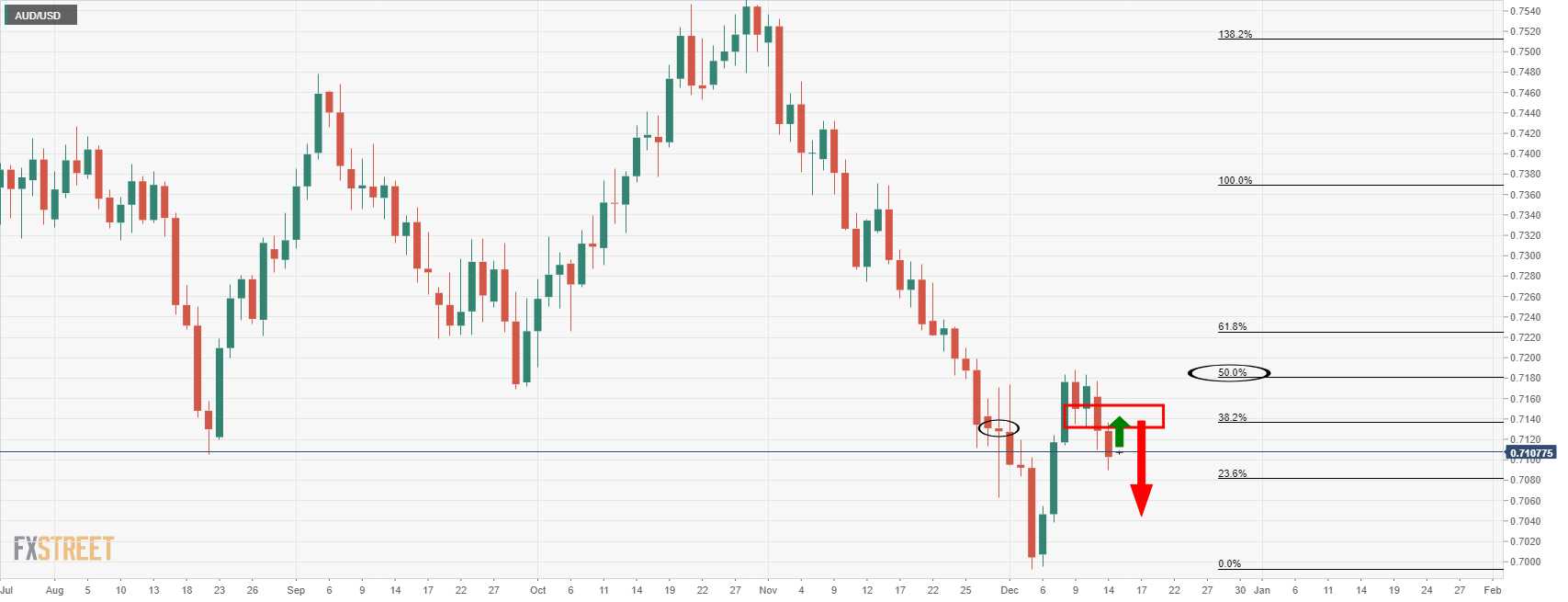
The daily chart has corrected 50% of the prior downside move from mid-Nov. This has resulted in the price breaking back to the downside and below a prior support structure, as eclipsed in the chart above. in doing so, the focus is back on the downside, in line with the monthly chart.
However, a retest of the old support is on the card between 0.7120/50. If this holds, then the bears will be encouraged to sell at a discount likely resulting in a downside continuation.
AUD/USD H1 chart
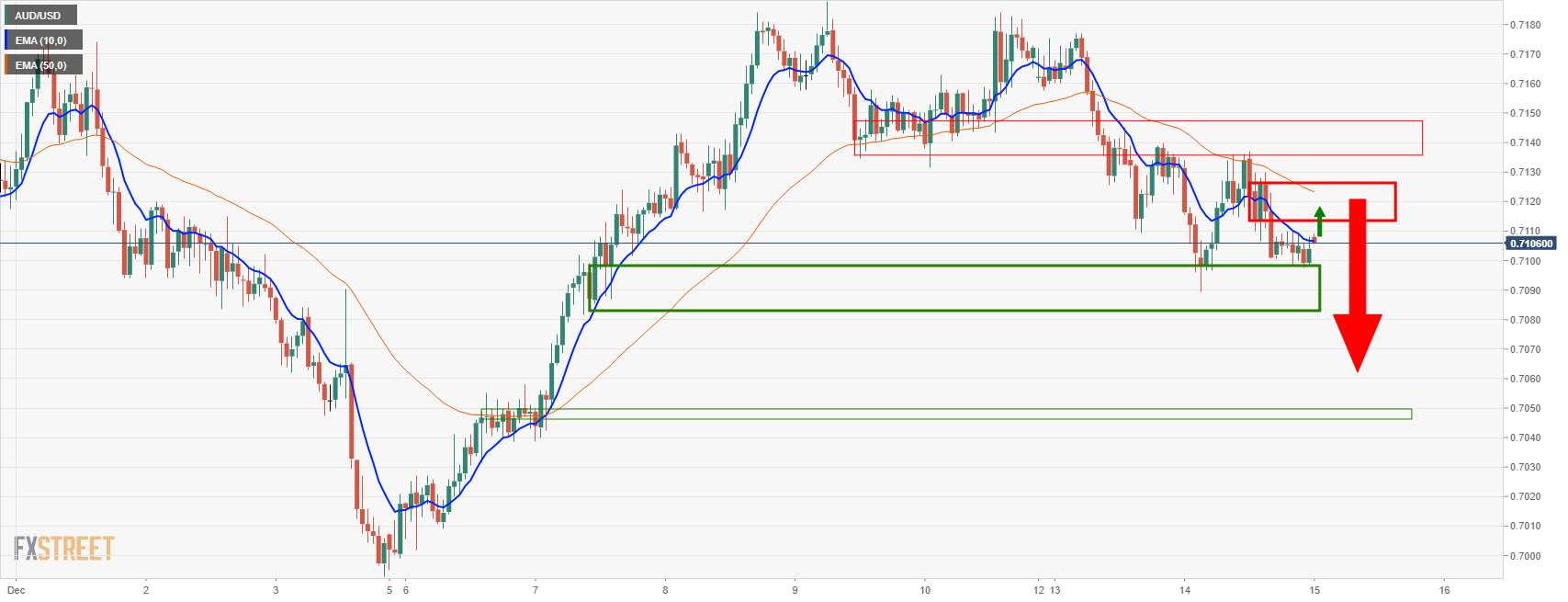
From an hourly perspective, the bias is also to the downside while below the 50 EMA. The price could still find some buyers here banking on the double bottom holding up and resulting in the upside. However, failure to move beyond 0.7150 should encourage sellers and potentially result in a downside continuation with 0.7050 eyed as the next downside target.
US inflation expectations, as measured by the 10-year breakeven inflation rate per the St. Louis Federal Reserve (FRED) data, printed a four-day fall with Tuesday’s reading of 2.37%, per the data source Reuters.
In doing so, the inflation indicator declines to the lowest levels since September 30 as the US Federal Reserve (Fed) officials brace for the monetary policy actions amid the Omicron woes.
It’s worth noting that the US Producer Price Index (PPI) for November refreshed the record top to 9.6% YoY, versus the previous 8.6%, which in turn kept inflation fears on the table.
Given the mixed concerns over the inflation and the fears of South Africa-linked coronavirus, variant, dubbed as Omicron, the Fed has the key role to play during today’s monetary policy meeting. That said, market players expect faster tapering and rate hike clues during today’s Fed meeting.
Read: Fed Interest Rate Decision Preview: Can the FOMC satisfy and mollify the markets?
- USD/CAD eases from three-month high, after five-day uptrend.
- 61.8% Fibonacci retracement level, RSI conditions challenge buyers.
- Tops marked during December 2020, August 2021 lures bulls past 1.2880.
- 10-DMA restricts immediate downside, two-month-old support line becomes the key.
USD/CAD bulls take a breather around the highest levels since late September, easing to 1.2857 during Wednesday’s Asian session.
In doing so, the Loonie pair retreats below 61.8% Fibonacci retracement (FIbo.) level of September 2020 to June 2021 downside, around 1.2880, amid nearly overbought RSI conditions.
Even so, the 10-DMA level of 1.2767 restricts immediate losses ahead of the 50% retracement close to 1.2710.
Also acting as strong support is an upward sloping trend line from late October, surrounding 1.2650 at the latest.
Alternatively, a clear upside break of the 1.2880 hurdle will serve as a trigger to the further advances targeting tops marked during late 2020 and 2021, around 1.2950-60.
Furthermore, a descending trend line from September 2020 near 1.2980 and the 1.3000 threshold will become additional challenges for the USD/CAD bulls to cross past 1.2960.
USD/CAD: Daily chart
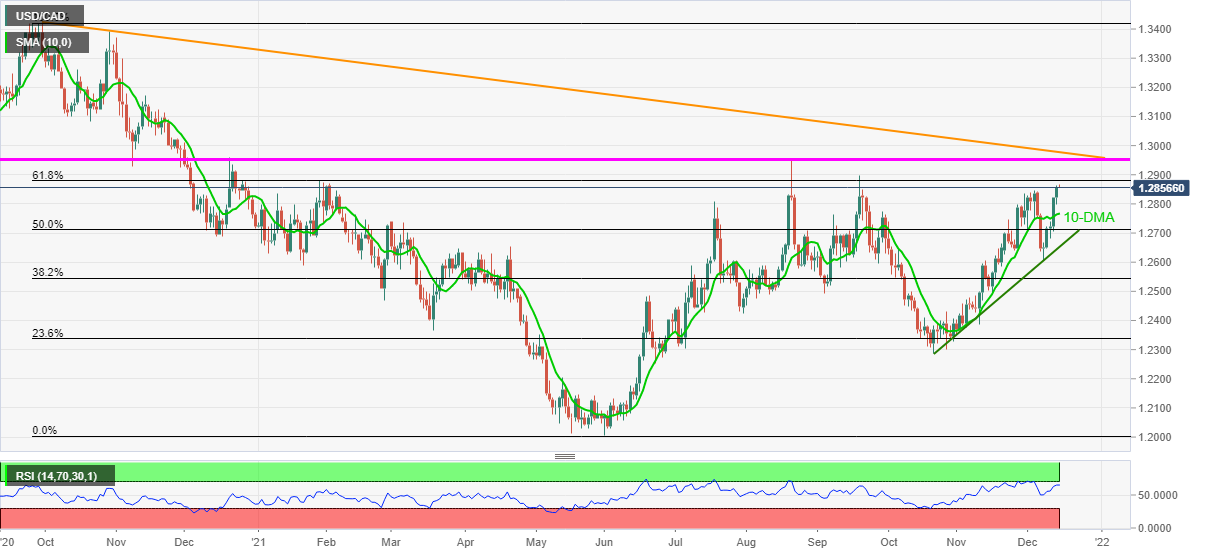
Trend: Pullback expected
| Pare | Closed | Change, % |
|---|---|---|
| AUDUSD | 0.7106 | -0.28 |
| EURJPY | 128.045 | -0.03 |
| EURUSD | 1.12563 | -0.22 |
| GBPJPY | 150.443 | 0.28 |
| GBPUSD | 1.32255 | 0.1 |
| NZDUSD | 0.67419 | -0.18 |
| USDCAD | 1.28632 | 0.47 |
| USDCHF | 0.92419 | 0.18 |
| USDJPY | 113.75 | 0.18 |







© 2000-2026. Sva prava zaštićena.
Sajt je vlasništvo kompanije Teletrade D.J. LLC 2351 LLC 2022 (Euro House, Richmond Hill Road, Kingstown, VC0100, St. Vincent and the Grenadines).
Svi podaci koji se nalaze na sajtu ne predstavljaju osnovu za donošenje investicionih odluka, već su informativnog karaktera.
The company does not serve or provide services to customers who are residents of the US, Canada, Iran, The Democratic People's Republic of Korea, Yemen and FATF blacklisted countries.
Izvršenje trgovinskih operacija sa finansijskim instrumentima upotrebom marginalne trgovine pruža velike mogućnosti i omogućava investitorima ostvarivanje visokih prihoda. Međutim, takav vid trgovine povezan je sa potencijalno visokim nivoom rizika od gubitka sredstava. Проведение торговых операций на финанcовых рынках c маржинальными финанcовыми инcтрументами открывает широкие возможноcти, и позволяет инвеcторам, готовым пойти на риcк, получать выcокую прибыль, но при этом неcет в cебе потенциально выcокий уровень риcка получения убытков. Iz tog razloga je pre započinjanja trgovine potrebno odlučiti o izboru odgovarajuće investicione strategije, uzimajući u obzir raspoložive resurse.
Upotreba informacija: U slučaju potpunog ili delimičnog preuzimanja i daljeg korišćenja materijala koji se nalazi na sajtu, potrebno je navesti link odgovarajuće stranice na sajtu kompanije TeleTrade-a kao izvora informacija. Upotreba materijala na internetu mora biti praćena hiper linkom do web stranice teletrade.org. Automatski uvoz materijala i informacija sa stranice je zabranjen.
Ako imate bilo kakvih pitanja, obratite nam se pr@teletrade.global.


 Банковни
 транcфери


