- Analytics
- News and Tools
- Market News
Analytics, News, and Forecasts for CFD Markets: currency news — 02-04-2012.
The yen rose against all of its 16 most-traded counterparts amid investor concern that Chinese manufacturing was weaker as official government data conflicted with a private-sector purchasing-manager index. The Chinese purchasing manager’s index released yesterday by the country’s logistics federation and National Bureau of Statistics for March rose to a one-year high of 53.1. In contrast, a PMI from HSBC Holdings Plc and Markit Economics showed manufacturing contracting and export orders declining. The index fell to 48.3 in March from 49.6 the previous month. The Tankan index for Japan’s largest manufacturers was unchanged last quarter from minus 4 in December, the BOJ said today in Tokyo. A negative number means pessimists outnumber optimists.
Currencies of commodity-producing nations rallied against the dollar after a report showed manufacturing in the U.S. increased last month. Australia’s dollar had its biggest intraday gain versus the greenback in two months. The figures compare with a gain in the Institute for Supply Management’s U.S. factory index to 53.4 from 52.4 in February. Economists forecast an increase to 53. Fifty is the dividing line between growth and contraction. The Reserve Bank of Australia will hold a policy meeting tomorrow.
The euro may weaken to match the lowest level since September 2010 against the pound after failing to rise above 84 pence, Karen Jones, a technical strategist in London, wrote in an e-mailed note. Europe’s shared currency slipped against the dollar after euro-region unemployment rose to the highest level in more than 14 years and manufacturing contracted.
We take "all necessary measures" to achieve the target level of 2% inflation over the medium term
Net exports will be limited to a weak external demand, a stable Canadian dollar strength
Significant external obstacles "somewhat weak"
Canada loses its share of world markets due to excessive dependence on the United States, lack of presence in emerging markets
Sustained export strategy can not rely on expectations of more favorable exchange rate
Investment companies will be a key source of growth
The companies of Canada "extremely healthy" balance
It is expected that commodity prices remain elevated
The U.S. economy remains on the path of moderate growth
The problems in Europe are still far from being resolved, but moved from the "acute" to "chronic"
EUR/USD $1.3200, $1.3220, $1.3350, $1.3400, $1.3475
USD/JPY Y81.55, Y82.00, Y82.15, Y82.20, Y83.25, Y83.75
GBP/USD $1.5900
Data:
07:15 Switzerland Retail Sales Y/Y February +4.4% +3.2% +0.8%
07:30 Switzerland Manufacturing PMI March 49.0 49.5 51.1
07:50 France Manufacturing PMI (finally) March 50.0 47.6 46.7
07:55 Germany Manufacturing PMI (finally) March 50.2 48.1 48.4
08:00 Eurozone Manufacturing PMI (finally) March 49.0 47.7 47.7
08:30 United Kingdom Purchasing Manager Index Manufacturing March 51.2 50.5 52.1
09:00 Eurozone Unemployment Rate February 10.7% 10.7% 10.8%
The dollar weakened before a report that economists said will show U.S. manufacturing picked up in March, undermining demand for the safest assets.
The greenback depreciated toward the lowest level in a month versus the euro after a report showed German manufacturing output unexpectedly improved. Australia’s dollar rose after a Chinese manufacturing gauge released yesterday advanced, easing concern the world’s second-largest economy is slowing.
The Institute for Supply Management’s factory index for the U.S. probably rose to 53 last month from 52.4 in February, according to the median estimate of economists.
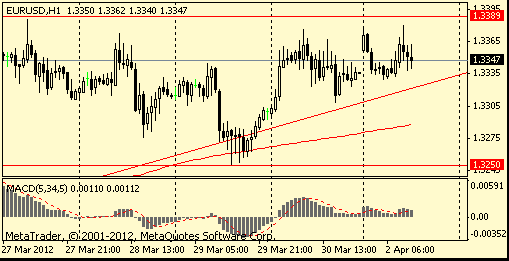
EUR/USD: the most part of the European session the pair was limited $1,3330-$ 1,3380.
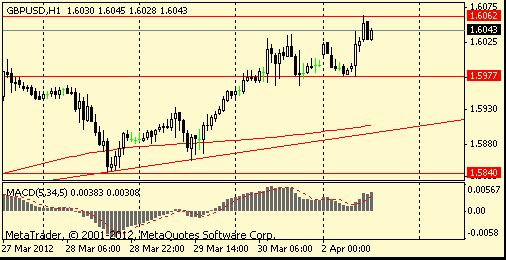
GBP/USD: the pair showed high in area $1,6030, but receded later.
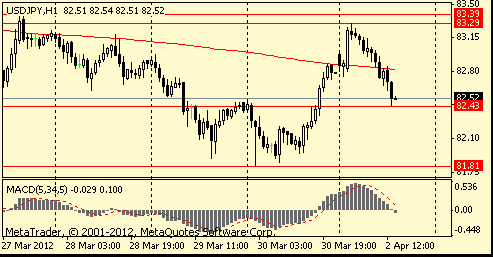
USD/JPY: the pair receded from high in Y83,30 area Y82,50.
At 1400GMT, the ISM manufacturing index is expected to rise to a reading of 53.0 in March after the surprise February decline. At 1430GMT, the weekly MNI Retail Trade Index is also due. At 1635GMT, Cleveland Federal Reserve Bank President Sandra Pianalto speaks to the Economic Roundtable of the Ohio Valley and will take questions from the audience, in Marietta, Ohio.
EUR/USD
Offers $1.3500, $1.3470, $1.3450, $1.3415/25, $1.3400
Bids $1.3310/00, $1.3250/40
GBP/USD
Offers $1.6090/100, $1.6070/80, $1.6065
Bids $1.5965/50, $1.5925/20, $1.5900/890, $1.5860, $1.5825/20, $1.5805/00
AUD/USD
Offers $1.0555/60, $1.0515/20, $1.0490/00, $1.0435/40, $1.0410/20
Bids $1.0375/70, $1.0360/50, $1.0300
EUR/JPY
Offers Y111.40/50, Y111.25/30, Y110.90/00, Y110.60/65
Bids Y110.10/00, Y109.90/80, Y109.45/40, Y109.10/00, Y108.80/75
USD/JPY
Offers Y84.00, Y83.75/80, Y83.50/55, Y83.30/40, Y82.90/95
Bids Y82.55/50, Y82.25/20, Y82.05/00, Y81.80
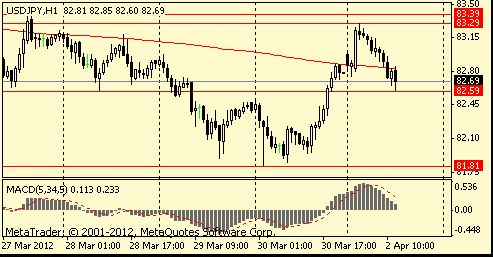
Resistance 3: Y84.20 (area of March highs)
Resistance 2: Y83.30/40 (area of session high and Mar 27 high)
Resistance 1: Y82.80 (hourly high, МА (200) for Н1)
Current price: Y82.69
Support 1: Y82.60 (session low)
Support 2: Y81.80 (Mar 30 low)
Support 3: Y81.10 (38,2 % FIBO Y76,00-Y84,20)
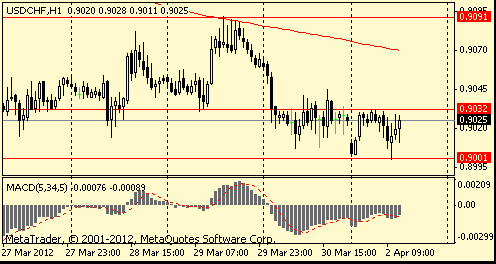
Resistance 3: Chf0.9090 (Mar 29 high)
Resistance 2: Chf0.9070 (МА (200) for Н1)
Resistance 1: Chf0.9030 (session high)
Current price: Chf0.9025
Support 1: Chf0.9000 (session low, psychological level)
Support 2: Chf0.8930 (high of February)
Support 3: Chf0.8850 (МА (200) for D1)
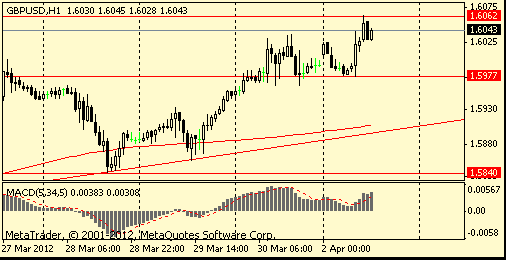
Resistance 3 : $1.6130 (high of November)
Resistance 2 : $1.6090 (Nov 14 high)
Resistance 1 : $1.6060 (session high)
Current price: $1.6043
Support 1 : $1.5980 (area of session low)
Support 2 : $1.5910/00 (area of МА (200) for Н1 and support line from Mar 12)
Support 3 : $1.5840 (Mar 28 low)
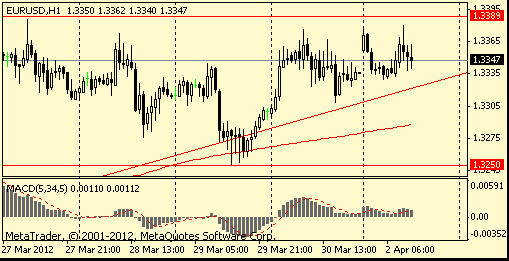
Resistance 3 : $1.3550 (high of December)
Resistance 2 : $1.3490 (high of February)
Resistance 1 : $1.3390 (area of Mar 27 high and session high)
Current price: $1.3347
Support 1 : $1.3330 (area of session low and support line from Mar 15)
Support 2 : $1.3290 (МА (200) for Н1)
Support 3 : $1.3250 (Mar 29 low)
EUR/USD $1.3200, $1.3220, $1.3350, $1.3400, $1.3475
USD/JPY Y81.55, Y82.00, Y82.15, Y82.20, Y83.25, Y83.75
GBP/USD $1.5900
01:30 Australia Building Permits, m/m February +0.9% +0.6% -7.8%
01:30 Australia Building Permits, y/y February -14.6% -5.3% -15.2%
The yen weakened versus all of its major counterparts after a Bank of Japan report showed that sentiment failed to improve at the nation’s largest companies, stoking prospects the central bank will boost monetary stimulus. The Tankan index for Japan’s largest manufacturers was unchanged last quarter from minus 4 in December, the BOJ said today in Tokyo. That was less than the median estimate of minus 1 in a Bloomberg News survey of economists. A negative number means pessimists outnumber optimists. Japan’s currency slid against the dollar and euro as signs that manufacturing is improving in the U.S. and China, the world’s two biggest economies, undermined demand for haven assets. The Institute for Supply Management’s factory index for the U.S. probably rose to 53 last month from 52.4 in February, according to the median estimate of economists surveyed by Bloomberg before the report is released today.
The euro maintained a quarterly gain versus the greenback as European governments called for a bigger global financial emergency fund after engineering a firewall to fight the region’s debt crisis.
The Australian dollar climbed versus all of its major counterparts as signs of an improvement in China’s economy supported the South Pacific nation’s export outlook. China is Australia’s largest trading partner.
An index of Chinese manufacturing climbed to 53.1 last month, the highest since March 2011, the logistics federation and the National Bureau of Statistics said yesterday. The measure has a pattern of rising each March.
EUR/USD: during the Asian session the pair receded from last week’s high.
GBP/USD: during the Asian session the pair decreased, lowered below $1.6000.
USD/JPY: during the Asian session the pair gain above Y83.00.
European data for Monday starts at 0700GMT with France car registrations data. This morning also sees the release of the final manufacturing PMIs for March, including France at 0748GMT, Germany at 0753GMT and EMU data at 0758GMT. Core-European data rounds off with EMU unemployment at 0900GMT, although at 0930GMT, ECB Governing Council member Yves Mersch is due to present the Central Bank of Luxembourg 2011 Annual Report. UK data at 0830GMT sees Housing Equity Withdrawal data from the Bank of England as well as Home Grown Food Prices and the Markit/CIPS Manufacturing PMI data. US data starts at 1400GMT, the St. Louis Federal Reserve Bank releases the March 28 remarks of President James Bullard to a monetary policy conference at Tsinghua University in Beijing that was closed to the press. At 1400GMT, the ISM manufacturing index is expected to rise to a reading of 53.0 in March after the surprise February decline. At 1430GMT, the weekly MNI Retail Trade Index is also due. At 1635GMT, Cleveland Federal Reserve Bank President Sandra Pianalto speaks to the Economic Roundtable of the Ohio Valley and will take questions from the audience, in Marietta, Ohio.
On Monday the dollar fell against its higher- yielding counterparts as Federal Reserve Chairman Ben S. Bernanke said accommodative monetary policy is still needed to reduce U.S. unemployment. The euro strengthened against the U.S. currency as Germany said it may back plans to increase the debt-crisis rescue funds before the region’s finance ministers meet March 30.
On Tuesday the dollar rose against the euro and the yen as U.S. economic data indicated a strengthening recovery, undermining the case for more stimulus from the Federal Reserve.
The U.S. currency gained from the lowest level this month against its 17-nation European counterpart as reports showed home-prices declines slowed and consumer confidence this month stayed close to the highest level in a year. The yen has depreciated 10.8 percent this year, the worst performance among the 10 developed-nation currencies tracked by Bloomberg Correlation-Weighted Indexes. The dollar has fallen 2.7 percent, and the euro has gained 0.4 percent.
On Wednesday the dollar gained against the majority of its 16 most-traded peers amid concern the rate of global growth is slowing spurred demand for the haven of the U.S. currency. The greenback strengthened after a report showed U.S. factory orders trailed forecasts and the United Kingdom revised first-quarter growth downward. The 17-nation euro pared losses after a draft statement from European finance ministers showed governments are preparing to increase rescue funds. The yen strengthened amid speculation Japanese companies will repatriate overseas earnings before the end of the fiscal year on March 31. Britain’s pound fell after a report showed the economy shrank more than first estimated in the fourth quarter, strengthening the case for the central bank to maintain asset purchases.
On Thursday the yen rose against all of its 16 major counterparts as concern increased that Europe’s sovereign- debt crisis threatens global economic growth and stocks dropped amid safety demand. The 17-nation currency euro fell from almost a one-month high versus the dollar after economic confidence in the region unexpectedly declined in March. An index of executive and consumer sentiment in the 17- nation euro area fell to 94.4 from a revised 94.5 in February, the European Commission said. Economists had forecast a gain to 94.5 from a previously reported 94.4, the median of 29 estimates showed. The pound rose the most in two weeks against the euro after a European report showed consumer confidence fell, boosting the appeal of U.K. assets as a haven.
On Friday the euro rose versus the dollar, heading for its biggest quarterly gain in a year, after European finance ministers agreed to boost an anti-debt-crisis firewall, adding confidence the region’s financial problems are abating. The dollar fell against most of its major counterparts as stocks and commodities advanced, boosting demand for higher- yielding assets. The yen erased gains after touching a three- week high against the dollar amid speculation companies are bringing home overseas earnings before the fiscal year ends.
Asian stocks swung between gains and losses as the region’s benchmark equity index headed toward its biggest quarterly gain since 2010. Japanese manufacturers slid after the nation’s industrial production unexpectedly fell and investors waited for U.S. data on income and spending.
Nikkei 225 10,083.56 -31.23 -0.31%
Hang Seng 20,555.58 -53.81 -0.26%
S&P/ASX 200 4,335.24 -2.66 -0.06%
Shanghai Composite 2,262.79 +10.63 +0.47%
Industrial & Commercial Bank of China Ltd., the world’s most profitable lender, climbed 1.6 percent after posting earnings that exceeded estimates.
Fanuc Corp., Japan’s biggest maker of factory robots, fell 2.3 percent.
Sun Hung Kai Properties Ltd., the world No. 2 real estate company, plunged 12 percent in Hong Kong after the firm’s co-chairmen were arrested in a corruption probe.
European stocks rose, capping the best first-quarter rally for the Stoxx Europe 600 Index since 2006, as euro-area finance ministers set the overall ceiling for the rescue of the region’s indebted nations at $1.1 trillion.
Euro-area ministers, meeting in Copenhagen today, set the maximum lending volume of the proposed European Stability Mechanism at 500 billion euros ($667 billion) and the combined lending ceiling of the ESM and the temporary fund -- the European Financial Stability Facility -- at 700 billion euros.
This, in addition to the 102 billion euros already paid to support current rescue programs, takes the total size of the firewall to 800 billion euros, the Eurogroup said.
National benchmark indexes rose in all of the 18 western European markets, except Greece. Germany’s DAX Index gained 1 percent. The U.K.’s FTSE 100 added 0.5 percent and France’s CAC 40 advanced 1.3 percent.
Daimler rose 2.1 percent to 45.21 euros as a gauge of carmakers was the best-performing group in the Stoxx 600. Bank of America recommended buying Daimler’s shares, saying the company “is finally cutting out costs, reducing complexity, simplifying engineering and refreshing the product portfolio.”
Bayerische Motoren Werke AG (BMW) advanced 2.4 percent to 67.43 euros. Preferred shares of Volkswagen, Europe’s largest maker of automobiles, gained 1.5 percent to 131.55 euros.
Michelin & Cie., the world’s second-largest tiremaker, climbed 2.4 percent to 55.83 euros and Continental AG rallied 3.1 percent to 70.77 euros.
BHP Billiton, the world’s biggest mining company, added 1.6 percent to 1,907.5 pence as a gauge of basic-materials shares rose 2.6 percent. Rio Tinto Group, the third-largest mining company, gained 2.1 percent to 3,446 pence.
U.S. stocks rose, extending the biggest first-quarter advance since 1998 for the Standard & Poor’s 500 Index, as stronger-than-forecast growth in consumer sentiment and spending bolstered optimism in the economy.
Stocks rose today as Americans increased their spending by the most in seven months, Commerce Department data showed. Another report showed that the Thomson Reuters/University of Michigan’s final index of consumer sentiment climbed to 76.2, the highest since February 2011, from 75.3 last month. European governments capped fresh rescue lending at 500 billion euros ($666 billion), after a Germany-led coalition opposed a further expansion of the firewall.
Dow 13,212.04 +66.22 +0.50%, Nasdaq 3,091.57 -3.79 -0.12%, S&P 500 1,408.47 +5.19 +0.37%
Walt Disney (DIS) added 1.8 percent, the biggest advance in the Dow, to $43.78 after Lazard raised its recommendation for the shares to buy from neutral.
Research In Motion Ltd. jumped 7.1 percent to $14.70. The maker of BlackBerry smartphones said it plans to refocus on the business market and review strategic options after struggling to compete against Android devices and Apple Inc.’s iPhone.
Apple, the most valuable technology company, lost 1.7 percent to $599.55. An audit of Foxconn Technology Group, the biggest maker of Apple devices, found “serious and pressing” violations of Chinese labor laws, prompting the company to pledge to cut working hours and give employees more oversight.
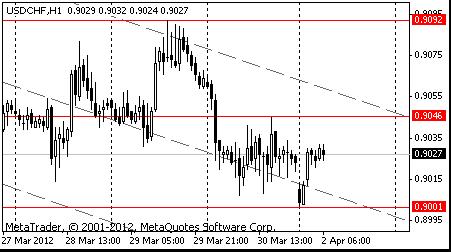
Resistance 3: Chf0.9135 (Mar 26 high)
Resistance 2: Chf0.9090 (Mar 29 high)
Resistance 1: Chf0.9045 (high of the American session on Mar 30)
The current price: Chf0.9027
Support 1: Chf0.9000 (session low)
Support 2: Chf0.8980 (138.2% FIBO Chf0.9335-Chf0.9075)
Support 3: Chf0.8930/35 (area of Feb 24-29 lows)
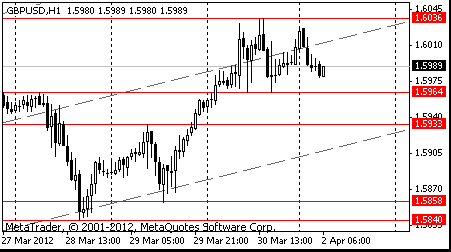
Resistance 3 : $1.6130 (Nov 8 high)
Resistance 2 : $1.6090 (Nov 14 high)
Resistance 1 : $1.6035 (Mar 30 high)
The current price: $1.5989
Support 1 : $1.5965 (low of the European session on Mar 30)
Support 2 : $1.5935 (high of the European session on Mar 29)
Support 3 : $1.5860 (Mar 29 low)
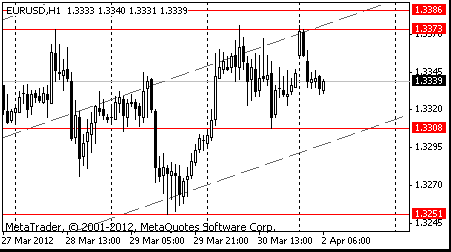
Resistance 3 : $1.3485 (Feb 24-29 high)
Resistance 2 : $1.3415 (high of the American session on Feb 27)
Resistance 1 : $1.3375/85 (area of Mar 27-30 highs)
The current price: $1.3339
Support 1 : $1.3310 (low of the American session on Mar 30)
Support 2 : $1.3250 (Mar 29 low)
Support 3 : $1.3190 (Mar 26 low)
01:30 Australia Building Permits, m/m February +0.9% +0.6%
01:30 Australia Building Permits, y/y February -14.6% -5.3%
06:30 Australia RBA Commodity prices, y/y March +3.5%
07:00 United Kingdom Halifax house price index March -0.5% -0.3%
07:00 United Kingdom Halifax house price index 3m Y/Y March -1.9% -1.7%
07:15 Switzerland Retail Sales Y/Y February +4.4% +3.2%
07:30 Switzerland Manufacturing PMI March 49.0 49.5
07:50 France Manufacturing PMI (finally) March 50.0 47.6
07:55 Germany Manufacturing PMI (finally) March 50.2 48.1
08:00 Eurozone Manufacturing PMI (finally) March 49.0 47.7
08:30 United Kingdom Purchasing Manager Index Manufacturing March 51.2 50.5
09:00 Eurozone Unemployment Rate February 10.7% 10.7%
14:00 U.S. ISM Manufacturing March 52.4 53.3
16:30 Canada BOC Gov Carney Speaks 0
16:35 U.S. FOMC Member Pianalto Speaks 0







© 2000-2026. All rights reserved.
This site is managed by Teletrade D.J. LLC 2351 LLC 2022 (Euro House, Richmond Hill Road, Kingstown, VC0100, St. Vincent and the Grenadines).
The information on this website is for informational purposes only and does not constitute any investment advice.
The company does not serve or provide services to customers who are residents of the US, Canada, Iran, The Democratic People's Republic of Korea, Yemen and FATF blacklisted countries.
Making transactions on financial markets with marginal financial instruments opens up wide possibilities and allows investors who are willing to take risks to earn high profits, carrying a potentially high risk of losses at the same time. Therefore you should responsibly approach the issue of choosing the appropriate investment strategy, taking the available resources into account, before starting trading.
Use of the information: full or partial use of materials from this website must always be referenced to TeleTrade as the source of information. Use of the materials on the Internet must be accompanied by a hyperlink to teletrade.org. Automatic import of materials and information from this website is prohibited.
Please contact our PR department if you have any questions or need assistance at pr@teletrade.global.


 Bank
Bank transfers


