- Analytics
- News and Tools
- Market News
CFD Markets News and Forecasts — 23-04-2020
| Time | Country | Event | Period | Previous value | Forecast |
|---|---|---|---|---|---|
| 04:30 | Japan | All Industry Activity Index, m/m | February | 0.8% | |
| 06:00 | United Kingdom | Retail Sales (MoM) | March | -0.3% | -4% |
| 06:00 | United Kingdom | Retail Sales (YoY) | March | 0% | -4.7% |
| 08:00 | Germany | IFO - Current Assessment | April | 93 | |
| 08:00 | Germany | IFO - Expectations | April | 79.7 | |
| 08:00 | Germany | IFO - Business Climate | April | 86.1 | |
| 12:30 | U.S. | Durable Goods Orders | March | 1.2% | -11.9% |
| 12:30 | U.S. | Durable goods orders ex defense | March | 0.1% | |
| 12:30 | U.S. | Durable Goods Orders ex Transportation | March | -0.6% | -5.8% |
| 13:00 | Belgium | Business Climate | April | -10.9 | -21 |
| 14:00 | U.S. | Reuters/Michigan Consumer Sentiment Index | April | 89.1 | 68 |
| 17:00 | U.S. | Baker Hughes Oil Rig Count | April | 438 |
- Warns EU leaders about the risk of doing too little and too late to shield the economy from the effects of the coronavirus pandemic
- Says that in a severe downturn scenario, Eurozone GDP can shrink as much as 15% this year, and that contraction can be 9% in middle scenario
FXStreet reports that Jennifer Lee from the Royal Bank of Montreal (BMO) notes that the number of Americans filing for UI for the first time slipped for the third week in a row but the numbers are still terrible.
“Although polls show that the overwhelming majority of Americans support staying at home and are against re-opening too soon, the pressure on governors to do so is high, particularly when they look at the weekly unemployment numbers.”
“For the week of April 18, initial claims came in at 4,427k, down 810k from the prior week. Still, that is an astonishing 26,453k over the past five weeks! Over 26 million Americans filed for UI this month!”
“Brace for April's payroll report to be uglier than March's, with the jobless rate poised to hit a record high.”
The U.S. Commerce Department announced on Thursday that the sales of new single-family homes tumbled 15.4 percent m-o-m to a seasonally adjusted annual rate of 627, 000 units in March. That was the lowest reading since May 2019.
Economists had forecast the sales pace of 645,000 last month.
February's sales pace was revised down to 741,000 units (-4.6 percent m-o-m) from the originally reported 765,000 units (-4.4 percent m-o-m).
According to the report, new home sales in the South, the largest area, decreased 0.8 percent m-o-m in March. Meanwhile, sales of new homes in the Northeast tumbled 41.5 percent m-o-m, sales in the West plunged 38.5 percent m-o-m and sales in the Midwest declined 8.1 percent m-o-m.
In y-o-y terms, new home sales recorded a 9.5 percent drop in March.
Preliminary data released by IHS Markit on Thursday pointed to an unprecedented decline in the U.S. business activity in April amid COVID19 pandemic.
According to the report, the Markit flash manufacturing purchasing manager's index (PMI) came in at 36.9 in April, down from 48.5 in March. That pointed to the sharpest contraction in manufacturing activity in 11 years. Economists had expected the reading to decrease to 38. A reading above 50 signals an expansion in activity, while a reading below this level signals a contraction. According to the report, the headline index reading was buoyed slightly by a further marked deterioration in suppliers' delivery times, while manufacturing production recorded the strongest contraction since the series began in May 2007, with new orders reducing at the steepest rate since the depths of the financial crisis in early-2009.
Meanwhile, the Markit flash services purchasing manager's index (PMI) tumbled to 27.0 this month, from 39.8 in the prior month. The latest reading pointed to the fastest contraction in services activity since the series began in October 2009 as the coronavirus-related slowdown intensified. Economists had expected the reading to drop to 31.5. According to the report, the contraction in the headline index was driven by a substantial fall in new business, which decreased the most in the series history, as demand weakened due to lockdowns and emergency public health measures to limit the spread of the virus. In addition, employment fell at the steeper pace amid lower new business.
Overall, IHS Markit Flash U.S. Composite PMI Output Index came in at 27.4 in April, down from 40.9 in March, pointing to the steepest contraction in the private sector output since the series began in late-2009.
Commenting on the flash PMI data, Chris Williamson, Chief Business Economist at HIS Markit, noted: "The scale of the fall in the PMI adds to signs that the second quarter will see a historically dramatic contraction of the economy, and will add to worries about the ultimate cost of the fight against the pandemic."
FXStreet reports that one of the key aspects to have a bearish EUR/JPY view for analysts at TD Securities is that the broad USD will remain firm over the coming months.
“The current account composition (which will get worse for the EU and makes the EUR very much exposed to a deterioration in trade and impaired supply chians) and our bullish USD view are the reasons to have a bearish bias on EUR/JPY.”
“The 115.87/116.03 area has marked critical support for the EUR/JPY pair.”
“As long as US real yields remain suppressed, then the path of least resistance for EUR/JPY is lower. We think a return to the 2016 lows towards 110/112 is likely.”
- BoJ will discuss unlimited bond-buying at next meeting
U.S. stock-index futures rose moderately on Thursday, as investors digested the weekly jobless claims and a rally in the oil market. Grim PMI data out of the eurozone and a mixed batch of earnings reports also kept sentiment in check.
Global Stocks:
| Index/commodity | Last | Today's Change, points | Today's Change, % |
| Nikkei | 19,429.44 | +291.49 | +1.52% |
| Hang Seng | 23,977.32 | +83.96 | +0.35% |
| Shanghai | 2,838.50 | -5.48 | -0.19% |
| S&P/ASX | 5,217.10 | -4.10 | -0.08% |
| FTSE | 5,780.77 | +10.14 | +0.18% |
| CAC | 4,431.18 | +19.38 | +0.44% |
| DAX | 10,400.31 | -14.72 | -0.14% |
| Crude oil | $16.74 | | +21.48% |
| Gold | $1,748.80 | | +0.60% |
(company / ticker / price / change ($/%) / volume)
| Amazon.com Inc., NASDAQ | AMZN | 2,400.00 | 36.51(1.54%) | 85287 |
| AT&T Inc | T | 29.6 | 0.13(0.44%) | 91580 |
| Boeing Co | BA | 136.25 | 1.28(0.95%) | 167751 |
| Citigroup Inc., NYSE | C | 42.69 | 0.45(1.07%) | 27564 |
| Exxon Mobil Corp | XOM | 42.94 | 0.81(1.93%) | 123775 |
| Facebook, Inc. | FB | 184 | 1.72(0.94%) | 94193 |
| Ford Motor Co. | F | 4.8 | 0.03(0.63%) | 186422 |
| Freeport-McMoRan Copper & Gold Inc., NYSE | FCX | 7.81 | 0.17(2.23%) | 23507 |
| General Electric Co | GE | 6.44 | 0.01(0.16%) | 480799 |
| Intel Corp | INTC | 59.98 | -0.12(-0.20%) | 242571 |
| JPMorgan Chase and Co | JPM | 89.98 | 0.64(0.72%) | 65847 |
| Microsoft Corp | MSFT | 174.2 | 0.68(0.39%) | 116055 |
| Pfizer Inc | PFE | 36.4 | 0.15(0.41%) | 56702 |
| Starbucks Corporation, NASDAQ | SBUX | 77.6 | 0.15(0.19%) | 11169 |
| Tesla Motors, Inc., NASDAQ | TSLA | 733 | 0.89(0.12%) | 147232 |
| Twitter, Inc., NYSE | TWTR | 28.65 | 0.21(0.74%) | 70949 |
| Visa | V | 167.01 | 0.42(0.25%) | 54302 |
| Yandex N.V., NASDAQ | YNDX | 35.66 | 0.71(2.03%) | 9529 |
Amazon (AMZN) target raised to $2900 from $2600 at Goldman
General Electric (GE) target lowered to $9 from $11 at Citigroup
Apple (AAPL) downgraded to Outperform from Buy at Daiwa Securities; target lowered to $297
Walt Disney (DIS) removed from US 1 List at BofA/Merrill
The data from the Labor Department revealed on Thursday the number of applications for unemployment drop last week from the previous three weeks, but still remained huge, showing that the coronavirus' damage to the U.S. labor market remains profound.
According to the report, the initial claims for unemployment benefits totaled 4,427,000 for the week ended April 18. This brings the number of job losses over the past five weeks to 26.45 million. That number exceeds the 22.44 million jobs gained since November 2009, when the U.S. economy began to add jobs back after the Great Recession.
Economists had expected 4,200,000 new claims last week.
Claims for the prior week were revised downwardly to 5,237,000 from the initial estimate of 5,245,000.
Meanwhile, the four-week moving average of claims jumped to 5,786,500 from a revised 5,506,500 in the previous week, the highest level on the record.
| Time | Country | Event | Period | Previous value | Forecast | Actual |
|---|---|---|---|---|---|---|
| 06:00 | Germany | Gfk Consumer Confidence Survey | May | 2.3 | -1.8 | -23.4 |
| 06:00 | United Kingdom | PSNB, bln | March | 0.39 | -2.3 | -2.33 |
| 07:15 | France | Manufacturing PMI | April | 43.2 | 37.5 | 31.5 |
| 07:15 | France | Services PMI | April | 27.4 | 25 | 10.4 |
| 07:30 | Germany | Services PMI | April | 31.7 | 28.5 | 15.9 |
| 07:30 | Germany | Manufacturing PMI | April | 45.4 | 39 | 34.4 |
| 08:00 | Eurozone | Manufacturing PMI | April | 44.5 | 39.2 | 33.6 |
| 08:00 | Eurozone | Services PMI | April | 26.4 | 23.8 | 11.7 |
| 08:30 | United Kingdom | Purchasing Manager Index Manufacturing | April | 47.8 | 42 | 32.9 |
| 08:30 | United Kingdom | Purchasing Manager Index Services | April | 34.5 | 29 | 12.3 |
| 10:00 | United Kingdom | CBI industrial order books balance | April | -29 | -53 | -56 |
EUR fell against other major currencies in the European session on Thursday as the latest euro-area PMIs revealed the devastating consequences of the coronavirus lockdowns.
The flash data from IHS Markit showed an unprecedented collapse of the Eurozone economy in April, resulting from efforts to contain the virus outbreak across the continent. According to the report, the flash IHS Markit Eurozone Composite PMI tumbled to an all-time low of 13.5 this month, down from a prior record low of 29.7 in March. Economists had expected the index to fall to 25.7 in April. The Eurozone's service sector bore the brunt of the impact from the lockdown measures, with the business activity index dropping from 26.4 in March to just 11.7 in April, well below economists' forecast of 23.8. The region's manufacturing also saw a sharp decline in business activity, with the PMI dropping from 44.5 in March to 33.6 in April, also below economists' estimate of 39.2.
The IHS Markit noted that the unprecedented scale of the collapse was broad-based, with composite flash PMI output indices hitting all-time lows of 17.1 and 11.2, respectively, in Germany and France (down from 35.0 and 28.9 in March), while the rest of the region saw the composite PMI drop from 25.0 to 11.5.
Elsewhere, the European Central Bank (ECB) announced it would begin accepting some junk-rated bonds as collateral for its loans, in-line with speculation from yesterday.
Market participants are also awaiting Thursday's virtual meeting of the European leaders, at which they are to discuss the funding of the economic recovery in the EU.
FXStreet reports that analysts at Nordea note that the euro-area PMIs for April tell the full effect of the coronavirus shutdowns and show a record collapse in business activity across services and manufacturing.
“The PMIs for April crashed, beyond the dramatic drop saw in March. The composite index dropped to 13.5 from 29.7 last month, the steepest fall ever.”
“The decline remained biggest in the service sector PMI, which fell to 11.7 from the already very low level of 26.4 in March.”
“The impact of the lockdowns has caught up with the manufacturing sector as well. The manufacturing PMI fell to 33.6 from 44.5 in March.”
EUR/USD: Remaining range-bound – Danske Bank
FXStreet reports that economists at Danske Bank believe EUR/USD will remain range-bound over the coming 12M despite US inflation risks as this is balanced by a weak Eurozone political and economic backdrop.
“Despite extreme fiscal and monetary policy action across countries, we deem that it will be hard to find much confidence in the EUR. This is especially so as the recent turmoil again exposed the institutional set-up in Europe as the root cause of permanent and growing EUR weakness.”
“We forecast EUR/USD at 1.09 on a 1-3M horizon in line with improving risk sentiment and corona numbers. However, we stick to our long-term forecast of 1.07 and thus that USD should remain ‘strong’ by historical standards.”
USD/CHF: Pushing higher – Credit Suisse
FXStreet reports that analysts at Credit Suisse apprise that USD/CHF maintains its break above the 55-day average and is pushing constructively higher.
“Resistance is seen initially at 0.9732/34, above which would see a move back to0 .9744. Removal here would trigger a large bull ‘triangle’ pattern for a move to the 0.9793/97 recent highs and 200-day average, with fresh sellers expected here initially.”
“Support moves to 0.9690, then 0.9669, ahead of 0.9656/45, which ideally holds.”
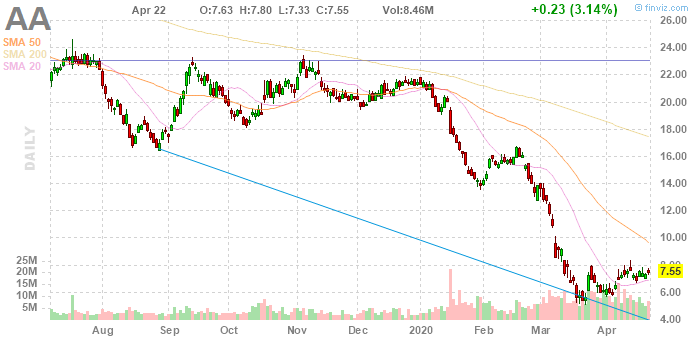
Alcoa (AA) reported Q1 FY 2020 loss of $0.23 per share (versus -$0.23 per share in Q1 FY 2019), worse than analysts' consensus estimate of -$0.17 per share.
The company's quarterly revenues amounted to $2.381 bln (-12.4% y/y), generally in line with analysts' consensus estimate of $2.372 bln.
AA rose to $7.93 (+5.03%) in pre-market trading.
EUR/USD: Major pivot at 1.0770 – TDS
FXStreet reports that economists at TD Securities note that an abysmal set of Eurozone PMIs has returned EUR weakness to the front burner.
“EU leaders meet to discuss plans to help countries hardest hit by the COVID-19 crisis. We look for little progress to be made.”
“The manufacturing PMI for the Eurozone overall fell from 44.5 to 33.6 in April (mkt 38.0), while services absolutely plunged from an already record-low level of 26.4 to only 11.7 in April (mkt 22.8). This raises the risk of another round of growth downgrades for the Eurozone.”
“Our focus in EUR/USD is the major pivot at 1.0770. A close below this would signal the return of a new, lower trading range in spot that could see a test of the March low at 1.0636.”
- We are experiencing the biggest economic contraction in a century
- Central banks using balance sheets does not detract from independence
- Not a simple supply shock, consequently far more scope for active policy response
- Once pandemic is over, UK economy should return approx. to pre-virus trajectory
The latest survey by the Confederation of British Industry (CBI) revealed on Thursday the UK manufacturers' order books dropped sharply in April.
According to the report, the CBI's monthly factory order book balance fell to -56 in April from -29 in the previous month. Economists had forecast the reading to come in at -53. That was the lowest reading since July 2009.
The CBI reported that output in the quarter to April (-21 from -8 in March) fell at their fastest pace since August 2009 and is expected to fall at a considerably faster pace in the next quarter (-67), marking the weakest expectations for future output on record. Total new orders are anticipated to decrease at a noticeably quicker rate in the next quarter (-78, the weakest expectations on record). In addition, investment spending plans for the next year tumbled to a survey-record low for buildings (-65) and plant and machinery (-74). The share of firms citing uncertainty about demand (73), internal finance shortages (43), and an inability to raise external finance (20) as factors likely to limit capital expenditure in the next year climbed to their survey-record highs. Elsewhere, headcount in the three months to April (-14) dropped at a similar pace to January (-16), but manufacturers expect to reduce headcount (-61) at the fastest pace since October 1980 over the next quarter.
Rain Newton-Smith, CBI Chief Economist, noted: "Manufacturers have taken a sharp hit during the shutdown in response to COVID-19, with this survey revealing some record lows. Despite the already-quick fall in output and orders in the quarter to April, expectations point to a faster decline in the next three months. Given the uncertainty over how long the shutdown may have to last, it's little surprise to see businesses putting investment plans on ice as they work hard to get through this intact."
Reuters reports that China will step up investment in various sectors including 5G, artificial intelligence, transport and energy and boost employment, President Xi Jinping said on Thursday, as the world's second-largest economy reels from the coronavirus epidemic.
The official Xinhua news agency reported that Xi, speaking during a visit to northwestern Shaanxi province, said the long-term trend of improvement in the Chinese economy has not changed but said Beijing will take steps to boost the real economy, especially the manufacturing sector.
Xi said Beijing will focus on the employment of college graduates, migrant workers and retired veterans and boost employment and entrepreneurship via multiple channels.
CNBC reports that one strategist told that markets, especially developed ones, could still hit new lows despite showing resilience and making gains amid the ongoing coronavirus crisis.
U.S. stocks surged in early April as authorities announced policies to support the economy, while European markets have also lifted off March lows.
But Mark Jolley of CCB International Securities said he's "not sure how long it can last," and warned that stocks could still fall some 15% below their lows for the year.
He attributed the resilience to confidence in measures taken by central banks and governments, but said he doesn't see how the S&P 500 can be "sitting on a record forward (price-to-earnings ratios)" at a time when earnings are falling.
"My view would be that the rally that we've seen is a bear market rally," Jolley, a strategist, told CNBC.
"The problem is central banks can't stop the weakness we're seeing in growth, they can't stop the severe earnings decline that we still are going to get and they can't stop corporate bond defaults," he added.
How markets perform going forward could depend on how "elevated" they are, said Jolley.
FXStreet reports that in past recessions, the US dollar has always appreciated significantly against all currencies. But today, this is the case against emerging countries' currencies, but not against the euro, as economists at Natixis note.
"The dollar is appreciating against emerging currencies due to large capital outflows from emerging countries."
"The dollar is not, as is usually the case, playing a safe-haven role with respect to the euro in this crisis because of the fact that the ECB has reacted much faster than in the past, the mutualisation of part of the euro zone's fiscal deficits and the expectations of a severe crisis in the United States due to the consequences of the very sharp rise in unemployment."
FXStreet reports that the unprecedented demand destruction due to the Covid-19 crisis should be keeping the market oversupplied in the near-term, according to strategists at ANZ Bank.
"We estimate a demand loss of 20mb/d in Q2 and even higher, as travel restrictions persist across many countries. Duration of lockdown remains the key oil price stabiliser."
"Storage capacities across the world are filling fast. US capacity reached 81% and is likely to reach capacity next month."
"Such a backdrop will keep the oil price low a little longer."
According to the flash report from IHS Markit / CIPS, widespread business shutdowns at home and abroad in response to the coronavirus disease 2019 (COVID-19) pandemic unsurprisingly resulted in a rapid reduction in UK private sector output during April.
The latest IHS Markit/ CIPS Flash UK Composite PMI was compiled between 7-21 April 2020 and the response rate from members of the survey panel was not affected by shutdowns in place due to the COVID-19 outbreak.
At 12.9 in April, down from 36.0 in March, the seasonally adjusted UK Composite Output Index - which is based on approximately 85% of usual monthly replies - indicated that the combined monthly decline in manufacturing and services activity exceeded the downturn seen at the height of the global financial crisis by a wide margin. Prior to March, the survey-record low was 38.1 in November 2008.
Around 81% of UK service providers and 75% of manufacturing companies reported a fall in business activity during April, which was overwhelming attributed to the COVID-19 pandemic. The small minority of manufacturers reporting output growth were mostly involved in medical supply chains or producers of food & drink.
Flash UK Manufacturing PMI
At 32.9 in April, down from 47.8 in March, the seasonally adjusted UK Manufacturing PMI - a composite single-figure indicator of manufacturing performance - was the lowest since this survey began in January 1992. The Manufacturing PMI is a weighted average of five indices, with the production, new orders and employment components all exerting severely negative influences in April.
UK Services PMI
The seasonally adjusted UK Services PMI Business Activity Index plummeted to 12.3 in April, from 34.5 in March, to signal by far the sharpest reduction in service sector activity since the survey began in July 1996.
According to the flash report from IHS Markit, the eurozone economy suffered the steepest falls in business activity and employment ever recorded during April as a result of measures taken to contain the coronavirus outbreak.
The Eurozone Composite PMI plummeted to an all-time low of 13.5 in April, down from a prior record low of 29.7 in March, to indicate by far the largest monthly collapse in output recorded in over two decades of survey data collection. By comparison, the lowest reading seen during the global financial crisis was 36.2, reached in February 2009.
The COVID-19 pandemic was widely blamed for the deterioration, with April having seen an intensification of efforts to contain the virus outbreak across the continent. Lockdown measures included widespread temporary business closures and draconian restrictions on citizens' movement.
The service sector bore the brunt of the impact from the lockdown measures, with the business activity index sliding from 26.4 in March to just 11.7 in April. Manufacturing also saw a record fall in production, the output index slumping from 38.5 in March to 18.4, with many non-essential businesses having closed and others reporting either dramatically reduced demand or being constrained by shortages of staff and inputs.
Overall inflows of new business fell at the steepest rates yet recorded in both manufacturing and services, resulting in a record depletion of overall backlogs of work. An unprecedented fall in service sector backlogs was accompanied by a near alltime record reduction in manufacturing.
Expectations of output in the coming 12 months dropped marginally below the previous nadir seen in March thanks to a new record degree of pessimism in manufacturing.
According to the report from IHS Markit, the decline in business activity across Germany deepened in April, with both services and manufacturing seeing record decreases in output as a result of the COVID-19 pandemic and subsequent lockdown.
The headline Flash Germany Composite PMI Output Index registered 17.1 in April, down sharply from 35.0 in March and by far its lowest reading since comparable data were first compiled more than 22 years ago. The preliminary data were based on responses collected between April 7-22. The survey response rate was not affected by shutdowns caused by the COVID-19 outbreak.
The biggest impact of the pandemic and associated containment measures continued to be seen across the service sector, where business activity fell at the fastest rate in more than two decades of data collection as around three-quarters of firms reported a fall.
Businesses reported a collapse in demand from clients both at home and abroad in April. The rate of decline in overall inflows of new work far exceeded the previous record seen in March, with new business received from abroad falling at a similarly sharp pace. In both cases, the decline was led by the service sector.
Employment unsurprisingly fell for the second month in a row in April. Moreover, unprecedented job losses across the service sector saw the overall rate of decline surpass the previous record set in April 2009. The decline in manufacturing workforce numbers also gathered pace, reaching the fastest in almost 11 years.
Firms' expectations towards activity over the next 12 months remained deep in negative territory in April, recovering only marginally from March's series record low (since July 2012).
FXStreet reports that the Canadian headline inflation numbers in March were below consensus expectations on both a monthly and annual basis by Kyle Dahms from the National Bank of Canada.
"Canada's consumer price index dropped 0.6% in March (not seasonally adjusted), bringing the year-on-year inflation rate down to 0.9%."
"In seasonally adjusted terms, headline prices fell 0.9% as declines for transportation (-4.2%), recreation (-0.4%), clothing (-0.1%), alcohol/tobacco/cannabis (-0.1%) and shelter (-0.1%) more than offset increases in household operations (+0.2%) and food (+0.1%)."
"A depreciated currency (via higher imported inflation) and shuttering of certain supply chains could lead to higher prices although a wholesale drop in demand should offset the latter. There appears to be an overall downward pressure on prices due to the COVID-19 shock."
| Time | Country | Event | Period | Previous value | Forecast | Actual |
|---|---|---|---|---|---|---|
| 00:30 | Japan | Manufacturing PMI | April | 44.2 | 43.7 | |
| 00:30 | Japan | Nikkei Services PMI | April | 33.8 | 22.8 | |
| 05:00 | Japan | Leading Economic Index | February | 90.7 | 92.1 | 91.7 |
| 06:00 | Germany | Gfk Consumer Confidence Survey | May | 2.3 | -1.8 | -23.4 |
| 06:00 | United Kingdom | PSNB, bln | March | 0.39 | -2.3 | -2.33 |
During today's Asian trading, the value of the US dollar was almost unchanged against the euro and the yen, while the pound rose against the dollar and the euro.
Traders are monitoring the situation in the oil market after another collapse in oil prices.
Oil futures prices continue to grow steadily today after US President Donald Trump ordered the Navy to strike Iran's military boats if they interfere with the actions of American ships.
The ICE Dollar index, which shows the value of the dollar against six major world currencies, fell by 0.09% compared to the previous day.
European Union leaders will try to overcome differences over the EU's role in dealing with the consequences of the coronavirus pandemic at a video conference on Thursday. The key issue will be the creation of the European recovery Fund, on which there remain sharp differences between the conditional "North" and "South" of the EU.
The President of the European Council, Charles Michel, said yesterday that the European Union, despite all the difficulties of the situation due to the pandemic and the remote prospects of overcoming the crisis, should prepare for the gradual rejection of restrictions. According to him, it is necessary to closely monitor the situation and ensure the maximum possible coordination to solve problems related to the lifting of restrictions, especially with regard to the upcoming summer season.
eFXdata reports that Danske Research discusses USD/JPY outlook and maintains a neutral bias in the near-term.
"USD/JPY have been thrown back and forth by moves in global risk aversion, commodities and domestic fiscal response on the one side (stronger JPY), but also a very weak domestic economy and recently a global stabilisation in risk sentiment (weaker JPY). Looking ahead, H2 20 continues to be the time when USD/JPY could move slightly higher as we expect an economic rebound in Q4," Danske notes.
"We continue to expect 112 in 6M and 12M (unchanged), which still reflects our view of a strong USD. EUR/JPY has started to struggle in recent month(s), driven primarily on the back of a declining EUR. This may indeed continue to be the case in the coming months. Near term, we see USD/JPY as trading in 107-110 range," Danske adds.
According to the report from Insee, in April 2020, the business climate has lost more than 30 points, linked to the lockdown of a large part of the population. It is the largest drop in a month since the start of the series (1980). The composite indicator, compiled from the answers of business managers in the main market sectors, has fallen to 62: this level is the lowest since the start of the series; the previous lowest level was 69 and was reached in March 2009.
In April 2020, the employment climate has lost 25 points, after losing 11 in March. At 70, it stands at its lowest level since the start of the series (1991); the previous lowest level was 71 and was reached in March and May 2009.
According to the report from GfK Group, the coronavirus pandemic and the measures introduced to contain the virus hit consumer sentiment hard in April. Income expectations and propensity to buy are in freefall, while economic expectation suffered albeit moderate losses. As a result, GfK has forecast a historic low of -23.4 points for May 2020, 25.7 points lower than in April of this year (revised to 2.3 points).
Data were collected during the first two weeks of April. At this time, consumers were feeling the full impact of containment measures such as closures of schools and businesses, production shutdowns and restrictions on going out for the first time. The consumer climate is currently in freefall. A value of -23.4 points is unprecedented in the history of the consumer climate to date.
"Given that the economy is largely frozen, this unprecedented cliff dive is hardly surprising. Retailers, manufacturers and service providers must prepare for a tough recession in the immediate future," explains Rolf Bürkl, GfK Consumer Expert. "Since it now seems evident that the easing of the COVID-19 containment measures will be very slow in order to take a cautious approach, the consumer climate can expect to face tough times in the coming months too."
The decline in the consumer climate is also being worsened by a large jump in propensity to save in April. The subject of the ECB zero interest rate policy is fading into the background in light of the uncertainty caused by the coronavirus crisis. This uncertainty has caused propensity to save to increase by more than 51 points in April, which puts a significant strain on the consumer climate.
-
CNBC said that China reported just 10 new cases as of April 22, according to its National Health Commission (NHC) - a decline from the 30 new cases reported the day before.
-
Italy's daily new cases jumped even as more people left intensive care and fewer died.
-
The number of confirmed cases in Mexico soared past 10,000, according to its health ministry.
-
Global cases: 2,623,415
-
Global deaths: 183,027
-
Most cases reported: United States (839,675), Spain (208,389), Italy (187,327), France (157,125), and Germany (150,648).
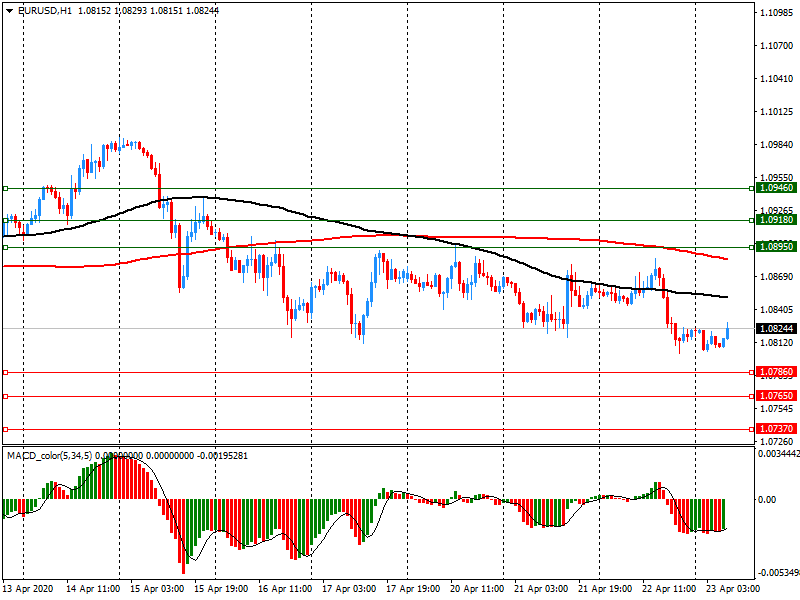
EUR/USD
Resistance levels (open interest**, contracts)
$1.0946 (709)
$1.0918 (444)
$1.0895 (530)
Price at time of writing this review: $1.0824
Support levels (open interest**, contracts):
$1.0786 (1765)
$1.0765 (1698)
$1.0737 (1755)
Comments:
- Overall open interest on the CALL options and PUT options with the expiration date May, 8 is 69058 contracts (according to data from April, 22) with the maximum number of contracts with strike price $1,1200 (3489);
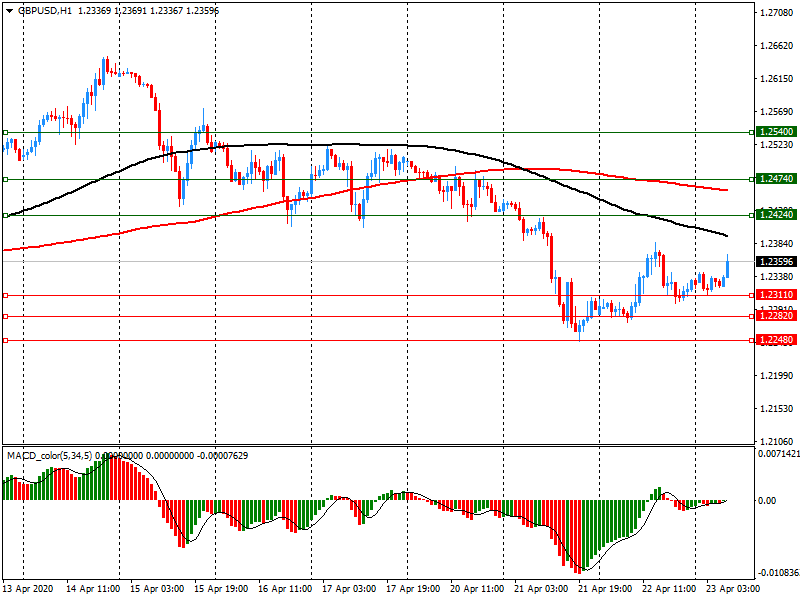
GBP/USD
Resistance levels (open interest**, contracts)
$1.2540 (698)
$1.2474 (187)
$1.2424 (332)
Price at time of writing this review: $1.2360
Support levels (open interest**, contracts):
$1.2311 (679)
$1.2282 (344)
$1.2248 (676)
Comments:
- Overall open interest on the CALL options with the expiration date May, 8 is 16453 contracts, with the maximum number of contracts with strike price $1,2700 (1714);
- Overall open interest on the PUT options with the expiration date May, 8 is 17422 contracts, with the maximum number of contracts with strike price $1,2850 (1073);
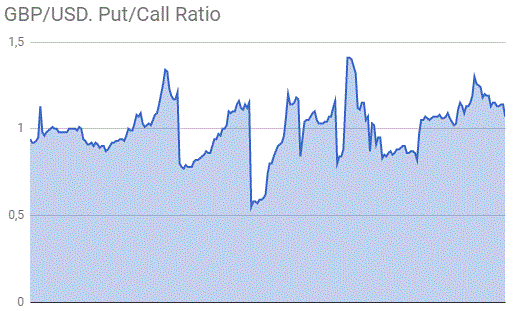
- The ratio of PUT/CALL was 1.06 versus 1.03 from the previous trading day according to data from April, 22
* - The Chicago Mercantile Exchange bulletin (CME) is used for the calculation.
** - Open interest takes into account the total number of option contracts that are open at the moment.
| Raw materials | Closed | Change, % |
|---|---|---|
| Silver | 15.07 | 1.48 |
| Gold | 1714.48 | 1.86 |
| Palladium | 1930.61 | 0.25 |
| Index | Change, points | Closed | Change, % |
|---|---|---|---|
| NIKKEI 225 | -142.83 | 19137.95 | -0.74 |
| Hang Seng | 99.81 | 23893.36 | 0.42 |
| KOSPI | 16.77 | 1896.15 | 0.89 |
| ASX 200 | -0.1 | 5221.2 | -0 |
| FTSE 100 | 129.6 | 5770.63 | 2.3 |
| DAX | 165.18 | 10415.03 | 1.61 |
| CAC 40 | 54.34 | 4411.8 | 1.25 |
| Dow Jones | 456.94 | 23475.82 | 1.99 |
| S&P 500 | 62.75 | 2799.31 | 2.29 |
| NASDAQ Composite | 232.15 | 8495.38 | 2.81 |
| Time | Country | Event | Period | Previous value | Forecast |
|---|---|---|---|---|---|
| 00:30 | Japan | Manufacturing PMI | April | 44.2 | |
| 00:30 | Japan | Nikkei Services PMI | April | 33.8 | |
| 05:00 | Japan | Leading Economic Index | February | 90.5 | 92.1 |
| 05:00 | Japan | Coincident Index | February | 95.2 | 95.8 |
| 06:00 | Germany | Gfk Consumer Confidence Survey | May | 2.7 | -1.8 |
| 06:00 | United Kingdom | PSNB, bln | March | 0.39 | -2.3 |
| 07:15 | France | Services PMI | April | 27.4 | 25 |
| 07:15 | France | Manufacturing PMI | April | 43.2 | 37.5 |
| 07:30 | Germany | Services PMI | April | 31.7 | 28.5 |
| 07:30 | Germany | Manufacturing PMI | April | 45.4 | 39 |
| 08:00 | Switzerland | Credit Suisse ZEW Survey (Expectations) | April | -45.8 | |
| 08:00 | Eurozone | Manufacturing PMI | April | 44.5 | 39.2 |
| 08:00 | Eurozone | Services PMI | April | 26.4 | 23.8 |
| 08:30 | United Kingdom | Purchasing Manager Index Manufacturing | April | 47.8 | 42 |
| 08:30 | United Kingdom | Purchasing Manager Index Services | April | 34.5 | 29 |
| 10:00 | United Kingdom | CBI industrial order books balance | April | -29 | -53 |
| 12:30 | U.S. | Continuing Jobless Claims | April | 11976 | 16476 |
| 12:30 | U.S. | Initial Jobless Claims | April | 5245 | 4150 |
| 13:45 | U.S. | Manufacturing PMI | April | 48.5 | 37 |
| 13:45 | U.S. | Services PMI | April | 39.8 | 32.5 |
| 14:00 | U.S. | New Home Sales | March | 0.765 | 0.645 |
| 23:01 | United Kingdom | Gfk Consumer Confidence | April | -34 | -40 |
| 23:30 | Japan | National CPI Ex-Fresh Food, y/y | March | 0.6% | 0.4% |
| 23:30 | Japan | National Consumer Price Index, y/y | March | 0.4% |
| Pare | Closed | Change, % |
|---|---|---|
| AUDUSD | 0.63186 | 0.54 |
| EURJPY | 116.571 | -0.37 |
| EURUSD | 1.08209 | -0.32 |
| GBPJPY | 132.735 | 0.21 |
| GBPUSD | 1.2321 | 0.22 |
| NZDUSD | 0.59501 | -0.2 |
| USDCAD | 1.41624 | -0.2 |
| USDCHF | 0.97122 | 0.24 |
| USDJPY | 107.723 | -0.02 |







© 2000-2026. All rights reserved.
This site is managed by Teletrade D.J. LLC 2351 LLC 2022 (Euro House, Richmond Hill Road, Kingstown, VC0100, St. Vincent and the Grenadines).
The information on this website is for informational purposes only and does not constitute any investment advice.
The company does not serve or provide services to customers who are residents of the US, Canada, Iran, The Democratic People's Republic of Korea, Yemen and FATF blacklisted countries.
Making transactions on financial markets with marginal financial instruments opens up wide possibilities and allows investors who are willing to take risks to earn high profits, carrying a potentially high risk of losses at the same time. Therefore you should responsibly approach the issue of choosing the appropriate investment strategy, taking the available resources into account, before starting trading.
Use of the information: full or partial use of materials from this website must always be referenced to TeleTrade as the source of information. Use of the materials on the Internet must be accompanied by a hyperlink to teletrade.org. Automatic import of materials and information from this website is prohibited.
Please contact our PR department if you have any questions or need assistance at pr@teletrade.global.


 Bank
Bank transfers


