- Analytics
- News and Tools
- Market News
CFD Markets News and Forecasts — 24-04-2020
On Monday, at 23:30 GMT, Japan will announce the change in the unemployment rate for March.
On Tuesday. at 03:00 GMT in Japan, the Bank of Japan's interest rate decision will be announced, and at 06:30 GMT, the Bank of Japan will hold a press conference. At 10:00 GMT, UK will present the retail sales index according to the Confederation of British Industrialists for April. At 12:30 GMT, the US will announce a change in the balance of foreign trade in goods for March, and 13:00 GMT will publish the S&P/Case-Shiller housing price index for February. At 14:00 GMT, the US will release the consumer confidence indicator and the Fed-Richmond manufacturing index for April. At 22:45 GMT, New Zealand will announce a change in the foreign trade balance for March.
Om wednesday, at 01:30 GMT, Australia will present the consumer price index for the 1st quarter. At 08: 00 GMT, the eurozone will report changes in the aggregate M3 of money supply and the volume of lending to the private sector for March. At 10: 00 GMT, the eurozone will present the consumer confidence index, the index of economic sentiment, the index of business optimism in industry and the index of business sentiment for April. At 12:00 GMT, Germany will present the consumer price index for April. At 12: 30 GMT, the US will announce changes in GDP and publish the GDP price index for the 1st quarter. At 14:00 GMT, the US will report changes in pending home sales for March. At 14:30 GMT, the US Ministry of Energy will report on changes in oil reserves. At 18:00 GMT in the US, the FOMC's interest rate decision will be announced and the FOMC statement will be released. At 18:30 GMT, the FOMC will hold a press conference. At 23:50 GMT, Japan will announce changes in industrial production and retail trade volume for March.
On Thursday, at 01:00 GMT, China will present the PMI for the manufacturing sector and the index of activity in the service sector for April. Also at this time, New Zealand will publish the ANZ business confidence index for April. At 01:30 GMT, Australia will release the import price index for the 1st quarter and announce changes in private sector lending for March. At 05:00 GMT, Japan will publish the consumer confidence indicator for April and report changes in the laying of new foundations for March. At 05:30 GMT, France will announce changes in GDP for the 1st quarter. At 06:00 GMT, Germany will announce a change in retail sales for March. At 06:30 GMT, Switzerland will announce changes in retail sales for March. At 06:45 GMT, France will report changes in consumer spending for March and release the consumer price index for April. At 07:00 GMT, Switzerland will publish the KOF index of leading economic indicators for April. At 07:55 GMT, Germany will announce changes in the unemployment rate and the number of unemployed for April. At 09:00 GMT, the eurozone will release the consumer price index for April, as well as report changes in GDP for the 1st quarter and the unemployment rate for March. At 11:45 GMT, the eurozone, the ECB interest rate decision will be announced, and at 12:30 GMT, the ECB will hold a press conference. Also at 12:30 GMT, Canada will report changes in GDP for February and release the producer price index for March. At the same time, the US will publish the main index of personal consumption expenditures for March and the index of labor costs for the 1st quarter, as well as report changes in the level of personal spending and personal income for March and the number of initial applications for unemployment benefits. At 13:45 GMT, the US will present the Chicago purchasing managers ' index for April. At 22:30 GMT, Australia will release the AIG manufacturing sector activity index for April. At 23:30 GMT, Japan will publish the Tokyo consumer price index for April.
On Friday. at 01:30 GMT, Australia will release the producer price index for the 1st quarter. At 07:30 GMT, Switzerland will publish the index of business activity in the manufacturing sector for April. At 08:30 GMT, UK will present the PMI for the manufacturing sector for April, as well as announce changes in the volume of net loans to individuals, the volume of the M4 aggregate of the money supply and the number of approved applications for a mortgage loan for March. At 13:45 GMT, the US will release the PMI for the manufacturing sector from Markit for April, and at 14:00 GMT - the ISM manufacturing index for April. Also at 14: 00 GMT, the US will report a change in the volume of spending in the construction sector for March. At 17:00 GMT the US will release a Baker Hughes report on the number of active oil rigs.
FXStreet reports that economists at TD Securities apprise that a dovish Fed meeting and a reminder that the FOMC will take firm action to support the economy and financial system appear well in the price.
“Lending programs are the main focus now and will probably be modified further in the weeks ahead, but we are not expecting any major announcements at the upcoming meeting. The tone will almost certainly remain dovish, however.”
“The USD is likely to take its cue from risk assets, where US markets remain a flow magnet and have largely outperformed its peers on a stock-to-bond ratio basis.”
“With the ECB meeting a day later and EUR tactically vulnerable, the USD's safe-haven properties should be reinforced.”
FXStreet reports that economists at Rabobank do not expect the ECB to follow up with new stimulus at Thursday’s meeting but the ECB probably cannot escape more action later in the year.
“We identify two key risks that could force the ECB to undertake more monetary stimulus. Firstly, a further worsening of the Eurozone economy could require a stronger policy response. Secondly, the previously announced measures have not fully alleviated market stress.”
“The ECB’s recent decision to implement asset purchases and discounted (T)LTROs over a rate cut has lowered our conviction of further deposit rate cuts.”
“With the heightened threshold for new rate cuts, we expect two more deposit rate cuts, bringing it to -0.70%. This is one cut less than we previously expected as the ECB’s concerns about side-effects appear bigger than we thought.”
- 638 coronavirus-related deaths were reported yesterday
- Confirmed cases rose by 5,386 to 143,464

FXStreet reports that analysts at Nordea note that next week’s FOMC meeting will be centred on whether the liquidity and credit facilities implemented in response to the corona virus have been suitable and whether more is on its way.
“The Fed will undoubtedly stress that the negative economic consequences of the coronavirus will be severe. We are expecting an unemployment rate around 17-20% in April and, along with former Fed Chairs Bernanke and Yellen, do not expect a V-shaped recovery, but rather a U-shaped one.”
“We are particular interested in how the Fed will address the critique of buying junk bonds and thereby potentially creating long-term moral hazard issues, partly whether we get some more firm evaluation/guidelines on the asset purchases.”
“We find likely that they will soon implement yield curve control. A formal implementation of this already next week is perhaps too soon, but we would be surprised if it was not at least discussed at the meeting.”
The final reading for the April Reuters/Michigan index of consumer sentiment came in at 71.8 compared to a preliminary reading of 71.0 and the March final reading of 89.1. That was the lowest reading since December 2011.
Economists had forecast the index to be revised down to 68.0.
According to the report, the index of the current economic conditions tumbled 28.4 percent m-o-m to 74.3 from March's final reading of 103.7.
Meanwhile, the index of consumer expectations plunged 12.0 percent m-o-m to 70.1 from March's final reading of 79.7.
Richard Curtin, the Surveys of Consumers chief economist, noted: "In the weeks ahead, as several states reopen their economies, more information will reach consumers about how reopening could cause a resurgence in coronavirus infections. Consumers' reactions to relaxing restrictions will be critical, either putting further pressure on states to reopen their economies, or exerting added pressure to extend the restrictions even if it has negative consequences for economic prospects."
FXStreet notes that Japan is scheduled to release March employment data and the Bank of Japan (BoJ) is set to announce its monetary policy decision on 28 April. Economists at Standard Chartered Bank shared their forecast.
“We expect job market data to have worsened as coronavirus measures likely impacted the services and tourism sectors. However, we believe Japan has not yet seen the worst.”
We expect BoJ to maintain the policy balance rate at -0.1%. We see limited room for a base rate cut; however, the central bank will likely continue to expand QE to inject liquidity into the market even as the government has announced a JPY 117tn emergency stimulus package.”
“We think the BoJ will undertake further monetary easing if fiscal policy requires a further QE boost.”
U.S. stock-index futures rose on Friday, as market participants tried to end a tumultuous week on a positive note.
Global Stocks:
| Index/commodity | Last | Today's Change, points | Today's Change, % |
| Nikkei | 19,262.00 | -167.44 | -0.86% |
| Hang Seng | 23,831.33 | -145.99 | -0.61% |
| Shanghai | 2,808.53 | -29.97 | -1.06% |
| S&P/ASX | 5,242.60 | +25.50 | +0.49% |
| FTSE | 5,807.71 | -18.90 | -0.32% |
| CAC | 4,445.52 | -5.48 | -0.12% |
| DAX | 10,478.33 | -35.46 | -0.34% |
| Crude oil | $17.17 | | +4.06% |
| Gold | $1,751.80 | | +0.37% |
FXStreet notes that following a heightened bid in the flight to safety, the greenback has given back some ground that it picked up in late March. Economists at CIBC Capital Markets see the US dollar weakening in the medium-term.
“The dollar is starting from stronger levels, reflecting a flight to safety value, but we expect the currency to slowly give back some of that strength when we expect economies to begin to recover alongside progress on the virus frontier.”
“Looking beyond the coronavirus, we still see the USD to be in an overvalued position in terms of the country’s current account balance. As such, we’re maintaining our medium to longer-term view, wherein the greenback should weaken against many other major currencies come next year.”
(company / ticker / price / change ($/%) / volume)
| ALCOA INC. | AA | 7.39 | 0.10(1.37%) | 47498 |
| ALTRIA GROUP INC. | MO | 38.64 | 0.19(0.49%) | 1421 |
| Amazon.com Inc., NASDAQ | AMZN | 2,418.00 | 18.55(0.77%) | 45898 |
| American Express Co | AXP | 83.62 | 1.16(1.41%) | 96055 |
| AMERICAN INTERNATIONAL GROUP | AIG | 23.17 | 0.51(2.25%) | 2566 |
| Apple Inc. | AAPL | 276.85 | 1.82(0.66%) | 193773 |
| AT&T Inc | T | 29.59 | 0.09(0.31%) | 77853 |
| Boeing Co | BA | 138.08 | 0.34(0.25%) | 165108 |
| Caterpillar Inc | CAT | 113.65 | 0.74(0.66%) | 111045 |
| Chevron Corp | CVX | 88.25 | 1.45(1.67%) | 60553 |
| Cisco Systems Inc | CSCO | 41.81 | 0.19(0.46%) | 72279 |
| Citigroup Inc., NYSE | C | 43.06 | 0.60(1.41%) | 37328 |
| Exxon Mobil Corp | XOM | 44.42 | 0.97(2.23%) | 88577 |
| Facebook, Inc. | FB | 184.75 | -0.38(-0.21%) | 81492 |
| FedEx Corporation, NYSE | FDX | 121 | 0.12(0.10%) | 1653 |
| Ford Motor Co. | F | 4.93 | 0.04(0.82%) | 207481 |
| Freeport-McMoRan Copper & Gold Inc., NYSE | FCX | 8.15 | 0.34(4.35%) | 236066 |
| General Electric Co | GE | 6.58 | 0.06(0.92%) | 483110 |
| General Motors Company, NYSE | GM | 21.65 | 0.13(0.60%) | 9461 |
| Goldman Sachs | GS | 176.68 | 1.63(0.93%) | 5351 |
| Google Inc. | GOOG | 1,264.00 | -12.31(-0.96%) | 11950 |
| Hewlett-Packard Co. | HPQ | 14.68 | 0.06(0.41%) | 512 |
| Home Depot Inc | HD | 203.12 | 0.80(0.40%) | 2528 |
| Intel Corp | INTC | 56.27 | -2.77(-4.68%) | 764482 |
| International Business Machines Co... | IBM | 122.27 | 0.92(0.76%) | 14384 |
| International Paper Company | IP | 30.8 | 0.26(0.85%) | 1367 |
| Johnson & Johnson | JNJ | 155.8 | 0.29(0.19%) | 102319 |
| JPMorgan Chase and Co | JPM | 90.31 | 0.92(1.03%) | 69541 |
| McDonald's Corp | MCD | 182.68 | 0.64(0.35%) | 11232 |
| Merck & Co Inc | MRK | 80.92 | 0.04(0.05%) | 13590 |
| Microsoft Corp | MSFT | 172.77 | 1.35(0.79%) | 133664 |
| Nike | NKE | 88.1 | 0.75(0.86%) | 43780 |
| Pfizer Inc | PFE | 36.8 | 0.11(0.30%) | 49522 |
| Starbucks Corporation, NASDAQ | SBUX | 75.55 | 0.40(0.53%) | 14078 |
| Tesla Motors, Inc., NASDAQ | TSLA | 714.5 | 8.87(1.26%) | 189077 |
| The Coca-Cola Co | KO | 45.3 | 0.23(0.51%) | 18781 |
| Travelers Companies Inc | TRV | 100 | -0.45(-0.45%) | 2798 |
| Twitter, Inc., NYSE | TWTR | 28.06 | 0.20(0.72%) | 56390 |
| UnitedHealth Group Inc | UNH | 287.5 | 2.17(0.76%) | 1613 |
| Verizon Communications Inc | VZ | 57.39 | -0.20(-0.35%) | 231865 |
| Visa | V | 167.99 | 1.61(0.97%) | 12603 |
| Wal-Mart Stores Inc | WMT | 129.15 | 0.62(0.48%) | 9925 |
| Walt Disney Co | DIS | 101.99 | 0.99(0.98%) | 66844 |
| Yandex N.V., NASDAQ | YNDX | 35.05 | -0.20(-0.57%) | 331 |
AT&T (T) downgraded to Sell from Hold at DZ Bank; target $26
Travelers (TRV) downgraded to Underperform from Mkt Perform at Raymond James
The U.S. Commerce Department reported on Friday that the durable goods orders tumbled 14.4 percent m-o-m in March, following a revised 1.1 percent m-o-m increase in February (originally a 1.2 percent m-o-m surge).
Economists had forecast an 11.9 percent m-o-m decline.
According to the report, orders for durable goods excluding transportation fell 0.2 percent m-o-m in March, following a revised 0.7 percent m-o-m increase in February (originally a drop of 0.6 percent m-o-m), much better than the market forecast of 5.8 percent m-o-m drop.
Meanwhile, orders for non-defense capital goods excluding aircraft, a closely watched proxy for business spending plans, rose 0.1 percent m-o-m in March after a revised 0.8 percent fall m-o-m in February (originally a 0.9 percent m-o-m decrease). Economists had called for a 6.0 percent m-o-m plunge in core capital goods orders in March.
| Time | Country | Event | Period | Previous value | Forecast | Actual |
|---|---|---|---|---|---|---|
| 06:00 | United Kingdom | Retail Sales (MoM) | March | -0.3% | -4% | -5.1% |
| 06:00 | United Kingdom | Retail Sales (YoY) | March | 0% | -4.7% | -5.8% |
| 08:00 | Germany | IFO - Current Assessment | April | 93 | 79.5 | |
| 08:00 | Germany | IFO - Expectations | April | 79.7 | 69.4 | |
| 08:00 | Germany | IFO - Business Climate | April | 86.1 | 74.3 | |
| 12:30 | U.S. | Durable Goods Orders | March | 1.1% | -11.9% | -14.4% |
| 12:30 | U.S. | Durable goods orders ex defense | March | -0.2% | -15.8% | |
| 12:30 | U.S. | Durable Goods Orders ex Transportation | March | -0.7% | -5.8% | -0.2% |
GBP traded mixed against other major currencies in the European session on Friday as market participants assessed the latest UK's retail sales data and the EU chief Brexit negotiator Barnier's comments on post-Brexit trade negotiations. The pound was little changed against USD, JPY and NZD, but fell slightly against EUR, CAD, CHF and AUD.
The Office for National Statistics (ONS) reported the UK's retail sales plunged 5.1 percent m/m in March, following a 0.3 percent drop m/m in February. That was the biggest monthly decrease on record as many stores ceased trading from late March following official government guidance for lockdown during the coronavirus pandemic. Economists had forecast a 4.0 percent drop. Food stores (+10.4 percent m/m) and non-store retailing (+5.1 percent m/m) were the only sectors to show growth in March, while clothing store sales posted a steep decline in sales (-34.8 percent m/m). In y/y terms, the UK's retail sales fell 5.8 percent, also the biggest decline ever.
Investors also digested the latest comments of the EU chief Brexit negotiator Michel Barnier, who said that a decision needs to be taken by the end of June on whether or not to extend the Brexit transition period. He noted that Britain has consistently rejected the idea of the transition extension, but "the clock is ticking". Barnier also added that the UK failed to engage substantially on some topics and the EU cannot accept selective progress on a limited selection of Brexit issues. The sides need to find solutions on most difficult topics, he said.
It should be also noted that the UK's Prime Minister Boris Johnson is to resume his full duties on Monday.
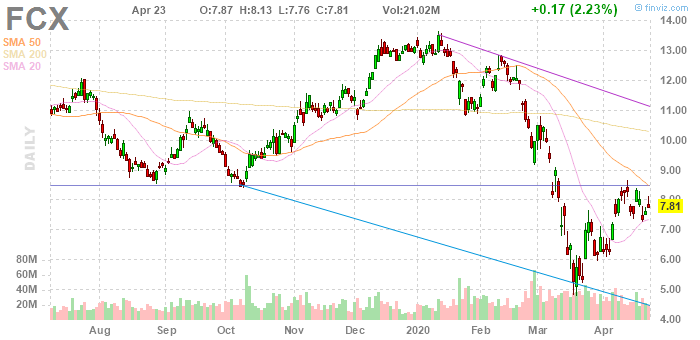
Freeport-McMoRan (FCX) reported Q1 FY 2020 loss of $0.18 per share (versus earnings of $0.05 per share in Q1 FY 2019), worse than analysts' consensus estimate of -$0.17 per share.
The company's quarterly revenues amounted to $2.798 bln (-26.2% y/y), missing analysts' consensus estimate of $2.982 bln.
FCX rose to $7.95 (+1.79%) in pre-market trading.
- Decision needs to be taken by June on whether to extend Brexit transition
- "More than before, the clock is ticking"
- UK has consistently rejected the idea of an extension to transition
- UK expressed desire to make tangible progress by the end of June
- UK argued positions which are too far apart on some topics
- There will be no trade deal without open, fair competition
- There was no progress on fisheries, UK did not put forward legal text on that
- EU won't agree to any partnership without fisheries deal
FXStreet reports that according to economists at Nordea, the ECB is likely to send a strong signal of its readiness to act as needed at next week’s monetary policy meeting.
“With just around 10% of the PEPP utilised at the end of week 16, it may be a bit early to ponder an expansion. However, we do see some risk of exactly that happening at next week’s meeting. If for nothing else, then to signal full readiness to act.”
“Rate cuts, taking interest rates deeper into negative territory, seems out of fashion these days and will probably not be high on the agenda. In any case, President Lagarde is likely to promise to do whatever it takes. If not now, then later.”
“We could see modest PEPP purchases in the weeks ahead despite a continued orderly widening of Italian spreads, while the ECB will act as a decisive backstop to prevent disorderly moves.”
Verizon (VZ) reported Q1 FY 2020 earnings of $1.26 per share (versus $1.20 per share in Q1 FY 2019), beating analysts' consensus estimate of $1.22 per share.
The company's quarterly revenues amounted to $31.810 bln (-1.0% y/y), missing analysts' consensus estimate of $32.366 bln.
The company also issued in-line guidance for FY 2020, projecting EPS of -2%-2%, down from +2-4% prior, to $4.71-4.91 versus analysts' consensus estimate of $4.85.
VZ rose to $57.99 (+0.69%) in pre-market trading.

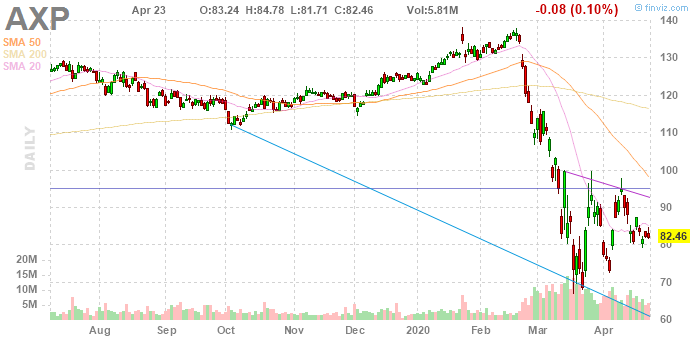
American Express (AXP) reported Q1 FY 2020 earnings of $1.98 per share (versus $2.01 per share in Q1 FY 2019), beating analysts' consensus estimate of $1.67 per share.
The company's quarterly revenues amounted to $10.310 bln (-0.5% y/y), missing analysts' consensus estimate of $10.671 bln.
AXP rose to $84.47 (2.44%) in pre-market trading.
- Sees next year's growth at pace of a little over 5%
FXStreet reports that in the opinion of analysts at Charles Schwab, the Energy sector’s high sensitivity to the overall market provides a macroeconomic tailwind if the rally from the March lows continues.
“While we expect high volatility to continue, we think that the S&P 500 Energy sector may have put in at least an intermediate low, particularly as short-term relative strength has been positive.”
“We don’t suggest overweighting the sector at this point. The value characteristics are questionable because of the uncertainty around future earnings revisions, which is weighing on the fundamentals of the sector.”
“Energy sector has already rallied significantly from recent lows, and it is far from clear how long it will take for the oil market to rebalance supply and demand. Therefore, we are maintaining a marketperform rating on the sector for the time being.”
FXStreet reports that economists at ANZ Bank hold a neutral stance on the AUD/USD pair while the risks are skewed to the downside.
“Improving news and some suggestions that the COVID19 pandemic may have reached its peak have seen the AUD outperform.”
“The medium-term prospects for the AUD are likely to hinge on how fast activity can resume and how well economies cope with instances of the virus resurgence.”
“Spot: 0.64 ANZ Fair value: 0.64.”
FXStreet reports that FX Strategists at UOB Group keep the neutral stance on USD/JPY for yet another session.
24-hour view: “We held the view yesterday that if USD ‘’punches’ above 108.00, it could rise swiftly to 108.40’. The anticipation for a break-out did not materialize as USD eased off to 107.33 before rebounding to briefly touch a high 108.03. The price action has resulted in a mixed outlook. For today, USD could trade between 107.25 and 108.00.”
Next 1-3 weeks: “After USD rebounded from a low of 106.96, we highlighted last Thursday (16 Apr, spot at 107.70) that ‘the recovery in USD could extend higher but any advance is viewed as part of a 107.00/109.00 range’. Since then, USD has traded in a quiet manner and within narrow ranges. The underlying tone still appears to be on the positive side but for overall, USD could continue to trade between 107.00 and 109.00 for now.”
- Reiterates that it will continue to monitor market conditions and take further action if needed
- It will allot zero funds to banks in contingent term repo operation for one-month sterling funds
Intel (INTC) reported Q1 FY 2020 earnings of $1.45 per share (versus $0.89 per share in Q1 FY 2019), beating analysts' consensus estimate of $1.27 per share.
The company's quarterly revenues amounted to $19.828 bln (+23.5% y/y), beating analysts' consensus estimate of $18.653 bln.
The company issued mixed guidance for Q2 FY 2020, projecting EPS of approx $1.10 versus analysts' consensus estimate of $1.17 and revenues of approx. $18.50 bln versus analysts' consensus estimate of $17.86 bln. It also did not provide FY 2020 guidance due to significant economic uncertainty.
INTC fell to $56.25 (-4.73%) in pre-market trading.

FXStreet reports that analysts at CIBC Capital Markets project the USD/CAD pair trading at 1.35 by mid-year and a slight recovery for the Canadian dollar next year.
"We expect the Canadian dollar to return to its recent trough, with USD/CAD at 1.45 by mid-year."
"Longer-term, while we look for see modest strengthening in the loonie next year as the market looks ahead to better levels of global activity in 2022, assuming that we are seeing progress towards a vaccine, we still anticipate the need for a weaker C$ further out."
"Seeing the rotation away from consumption and housing and towards exports, should see USD/CAD push higher to 1.41 by the end of 2021."
CNBC reports that according to analyst from Fitch Solutions, with the U.S. and several European countries still reporting thousands of new coronavirus cases every day, questions remain on whether they can safely ease restrictions aimed at curbing the pandemic anytime soon.
Those restrictions, which include travel bans and temporarily shutting down businesses and schools, have brought much of global economic activity to a standstill. With some signs that the spread of the virus is slowing down, many governments are eager to restart their economies.
But Cedric Chehab, head of country risk and global strategy at Fitch Solutions, said China's experience of rolling back those restrictions showed that there could be a new wave of infections.
"China is reopening its economy in stages, but we've already seen some incipient risk of a second wave coming out of the city of Harbin," he told CNBC, pointing out that there was "upward pressure" on daily new cases reported when China started relaxing its measures.
"If you think about other countries such as the U.S., Spain and Italy, although the numbers of new cases have peaked, they're still extremely high relative to what we saw in South Korea and China," he said. "So the question is can they actually start to ease restrictions and open up the economies when they have such high number of new cases still."
The recovery in the global economy depends on how quickly countries can get activity going again, said Chehab, who predicted that economies will feel most of the pain in the second quarter.
FXStreet reports that Economists at Natixis expect a fairly damaging shift in the structure of demand after the crisis.
"It is reasonable to think that the coronavirus crisis will leave behind a legacy of high risk aversion and higher borrowing costs, leading to deleveraging; a fall in international mass tourism and more stringent climate and environmental regulations."
"After the coronavirus crisis, a permanent fall in demand for durable goods is expected in the broad sense: housing investment, corporate investment, purchases of cars, aircraft and large household capital goods."
"Lower demand for durable goods will penalise those countries specialised in the production of these products, oil and metal producers and workers in construction, capital goods, transport equipment and intermediate goods."
eFXdata reports that NAB Research sees a scope for AUD/NZD to extend higher towards 1.0850.
"We see the recovery in AUD/NZD over the past few weeks as justified, post the overshoot to parity. NZ's government-imposed has bee more restrictive than Australia's which could impart a more preeminent scar on the NZ economy as businesses fold.
Importantly, the RBNZ's likely QE path is much greater than the RBA's, a positive fore for AUD/NZD," NAB notes.
"Based on these macro factors, the rise in the cross could have a lot further to run. ST and LT valuation metrics are higher than current spot. Key technical resistance is at 1.0850," NAB adds.
FXStreet reports that EU summit did not become an all-nighter, which already suggests the heated discussions on matters that most divide the member countries were left for another time, economists at Nordea report.
"Discussions on the so-called Recovery Fund to support the recovery were started, but remain in very early stages and plenty of disagreements remain."
"The ECB's support should be sufficient to prevent another market meltdown. However, the ECB is not happy about what the governments are doing, and Lagarde was reported to have told the EU leaders that they are doing too little too late."
"More common decisions will be needed for the Euro-area to come out of the corona crisis in one piece. These decisions will need to include added solidarity in one way or another, and will not be easy."
-
We expect to hit 100,000 coronavirus tests per day next week
According to the report from ifo Institute, German Business Climate Index came in at 74.3 in April, weaker than last month's 85.9 and missing the consensus estimates (80.0). The Current Economic Assessment arrived at 79.5 points in the reported month as compared to last month's 92.9 and 81.0 anticipated. On the other hand, the IFO Expectations Index - indicating firms' projections for the next six months, came in at 69.4 for April, down from the previous month's 79.5 reading and worse than the expectations of 75.0.
The institute's economist said that the economy is in the toughest time since reunification. "Sentiment at German companies is catastrophic. There will likely be no v-shaped recovery. There will be signs of economic recovery from mid-year at earliest", - economist added.
FXStreet reports that the US Dollar Index can't seem to trade sustainably below 100 for a hot minute, even though volatility has eased in multiple markets, strategists at Westpac Institutional Bank apprise.
"The Fed's quick deployment of a comprehensive array of crisis backstop programs has promoted some healing in formerly dysfunctional credit and funding markets, trimming USD upside safe-haven potential. But ongoing fragility elsewhere likely sees DXY strength linger for some time yet."
"The oil shock is admittedly a net negative for the US given the sharp lift in oil/gas investment and extraction in recent years, but energy production and exports account for much larger shares of GDP for a number of EM/commodity economies."
"The oil shock and simmering EU tensions surely accentuate the COVID-19 global growth shock. Against that backdrop the USD likely sees ongoing structural demand, though near term event risks may be a challenge."
"Advance Q1 GDP next week likely falls shy of expectations in line with serial negative surprises of late, while the FOMC statement and Powell press conference likely underscore ongoing readiness to deploy more accommodation and support for smooth market functioning."
| Time | Country | Event | Period | Previous value | Forecast | Actual |
|---|---|---|---|---|---|---|
| 04:30 | Japan | All Industry Activity Index, m/m | February | 0.6% | -0.6% | |
| 06:00 | United Kingdom | Retail Sales (MoM) | March | -0.3% | -4% | -5.1% |
| 06:00 | United Kingdom | Retail Sales (YoY) | March | 0% | -4.7% | -5.8% |
During today's Asian trading, the US dollar rose slightly against the euro and the yen.
The ICE index, which tracks the dollar's performance against six currencies (the euro, swiss franc, yen, canadian dollar, pound sterling and swedish krona), rose 0.5%.
Analysts note that the fall in the euro should have been more serious, given the lack of progress of European leaders in terms of taking measures to support the economy after the crisis due to the consequences of the COVID-19 coronavirus pandemic.
On the eve of the EU heads of state and government approved the "road map" of the EU's economic recovery after the crisis, which provides, in particular, the launch of three programs to support the economy for a total of 540 billion euros.
French President Emmanuel Macron said that the post-crisis economic support program approved by the EU summit will not be enough.
Data released on Thursday indicated a sharp weakening in business activity in the Euro zone's services sector. The purchasing managers ' index (PMI) in the services sector, calculated by IHS Markit, collapsed in April to a record low of 11.7 points from March's 26.4 points. Experts expected a decrease to 22.8 points.
FXStreet reports that cable's outlook remains neutral and the probability of a move lower seems to be losing momentum, suggested FX Strategists at UOB Group.
24-hour view: "We highlighted yesterday that GBP 'is likely to consolidate and trade between 1.2280 and 1.2380'. Aside from a brief pop to a high of 1.2415, GBP traded in a relatively quiet manner before ending the day little change at 1.2343 (+0.09%). Momentum indicators are mostly neutral and for today GBP could continue to consolidate, likely between 1.2300 and 1.2410."
Next 1-3 weeks: "After dropping sharply to a low of 1.2248 on Tuesday (21 Apr), the lack of a follow-through on the downside for GBP came as a surprise. The brief pop higher in GBP yesterday touched 1.2415, just a few pips below of 'strong resistance' level of 1.2420. While downward momentum has eased, we are holding on to our view that GBP "could weaken further to the month-to-date low near 1.2165". That said, the odds for a lower GBP have diminished. From here, GBP has to move and stay below 1.2300 within these 1 to 2 days or a breach of 1.2420 (no change in 'strong resistance') would not be surprising."
eFXdata reports that Bank of America Global Research discusses EUR/USD outlook and now targets a move towards 1.02 in Q2 and Q3.
"As most Eurozone economies remain in various forms of lockdown to contain COVID-19, the economy is collapsing. We expect real GDP in the Eurozone to drop by 7.6% this year, with risks to the downside, compared with a drop of 6% in the US. Macro policy support, although necessary, cannot change the dynamics of an economy that has shut down. In any case, the fiscal stimulus policies in the Eurozone have not been as strong as in the US: 2% of GDP vs. 9% of GDP, respectively.
The proposed Recovery Fund could help, but a lot will depend on its size, conditions and debt mutualization. COVID-19 infection rates have dropped, but at a very slow pace and remain high. Plans in a number of countries to open up their economies are too gradual and their end-game is far from normalization to the previous regime," BofA notes.
"We expect EURUSD to weaken to 1.02 in 2Q and 3Q, recovering gradually to 1.05 by end-2020," BofA adds.
According to the report from Office for National Statistics, in March 2020, the monthly retail sales volume fell sharply by 5.1%; the largest fall since the series began as many stores ceased trading from 23 March following official government guidance during the coronavirus (COVID-19) pandemic. Economists had expected a 4.0% decrease.
In March 2020, clothing store sales saw a sharp fall when compared with the previous month, at negative 34.8%.
Food stores and non-store retailing were the only sectors to show growth in the monthly volume series in March 2020, with food stores seeing the strongest growth on record, at 10.4%.
In the three months to March 2020, retail sales volume fell by 1.6% when compared with the previous three months, with strong declines in non-food stores and fuel.
Online sales as a proportion of all retailing reached a record high of 22.3% in March 2020 as consumers switched to online purchasing following the pandemic.
-
Japan confirmed 43 more coronavirus cases on the Italian cruise ship Costa Atlantica currently docked in the western city of Nagasaki for repairs, broadcaster NHK reported.
-
Billionaire philanthropist Bill Gates said the world must advance its treatments, vaccines, testing and contact tracing.
-
Global cases: More than 2.7 million
-
Global deaths: At least 190,490
-
Most cases reported: United States (866,646), Spain (213,024), Italy (189,973), France (159,460), and Germany (153,129).
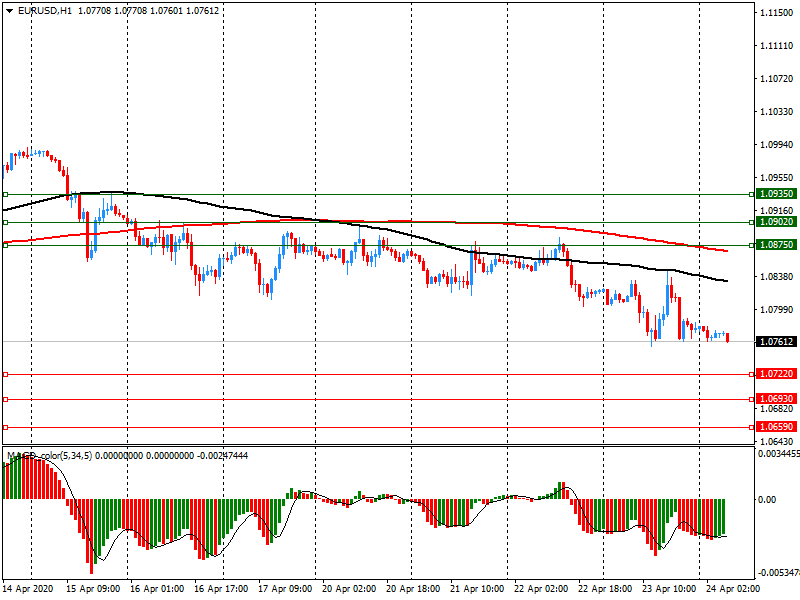
EUR/USD
Resistance levels (open interest**, contracts)
$1.0935 (855)
$1.0902 (478)
$1.0875 (621)
Price at time of writing this review: $1.0761
Support levels (open interest**, contracts):
$1.0722 (1909)
$1.0693 (1383)
$1.0659 (1836)
Comments:
- Overall open interest on the CALL options and PUT options with the expiration date May, 8 is 69424 contracts (according to data from April, 23) with the maximum number of contracts with strike price $1,1200 (3485);
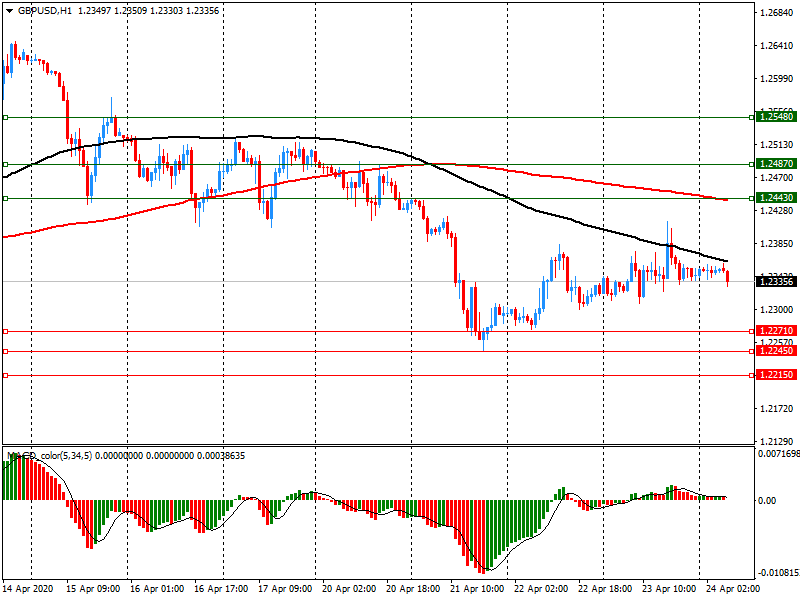
GBP/USD
Resistance levels (open interest**, contracts)
$1.2548 (698)
$1.2487 (187)
$1.2443 (332)
Price at time of writing this review: $1.2336
Support levels (open interest**, contracts):
$1.2271 (676)
$1.2245 (492)
$1.2215 (603)
Comments:
- Overall open interest on the CALL options with the expiration date May, 8 is 16472 contracts, with the maximum number of contracts with strike price $1,2700 (1714);
- Overall open interest on the PUT options with the expiration date May, 8 is 17520 contracts, with the maximum number of contracts with strike price $1,2850 (1073);
- The ratio of PUT/CALL was 1.06 versus 1.06 from the previous trading day according to data from April, 23
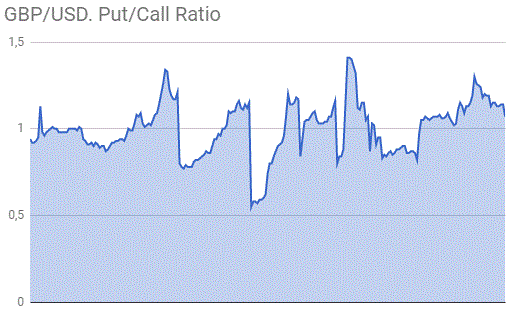
* - The Chicago Mercantile Exchange bulletin (CME) is used for the calculation.
** - Open interest takes into account the total number of option contracts that are open at the moment.
| Raw materials | Closed | Change, % |
|---|---|---|
| Silver | 15.2 | 0.93 |
| Gold | 1729.554 | 0.9 |
| Palladium | 1973.06 | 2.37 |
| Index | Change, points | Closed | Change, % |
|---|---|---|---|
| NIKKEI 225 | 291.49 | 19429.44 | 1.52 |
| Hang Seng | 83.96 | 23977.32 | 0.35 |
| KOSPI | 18.58 | 1914.73 | 0.98 |
| ASX 200 | -4.1 | 5217.1 | -0.08 |
| FTSE 100 | 55.98 | 5826.61 | 0.97 |
| DAX | 98.76 | 10513.79 | 0.95 |
| CAC 40 | 39.2 | 4451 | 0.89 |
| Dow Jones | 39.44 | 23515.26 | 0.17 |
| S&P 500 | -1.51 | 2797.8 | -0.05 |
| NASDAQ Composite | -0.63 | 8494.75 | -0.01 |
| Time | Country | Event | Period | Previous value | Forecast |
|---|---|---|---|---|---|
| 04:30 | Japan | All Industry Activity Index, m/m | February | 0.8% | |
| 06:00 | United Kingdom | Retail Sales (MoM) | March | -0.3% | -4% |
| 06:00 | United Kingdom | Retail Sales (YoY) | March | 0% | -4.7% |
| 08:00 | Germany | IFO - Current Assessment | April | 93 | |
| 08:00 | Germany | IFO - Expectations | April | 79.7 | |
| 08:00 | Germany | IFO - Business Climate | April | 86.1 | |
| 12:30 | U.S. | Durable Goods Orders | March | 1.2% | -11.9% |
| 12:30 | U.S. | Durable goods orders ex defense | March | 0.1% | |
| 12:30 | U.S. | Durable Goods Orders ex Transportation | March | -0.6% | -5.8% |
| 13:00 | Belgium | Business Climate | April | -10.9 | -21 |
| 14:00 | U.S. | Reuters/Michigan Consumer Sentiment Index | April | 89.1 | 68 |
| 17:00 | U.S. | Baker Hughes Oil Rig Count | April | 438 |
| Pare | Closed | Change, % |
|---|---|---|
| AUDUSD | 0.63706 | 0.82 |
| EURJPY | 115.943 | -0.54 |
| EURUSD | 1.07768 | -0.41 |
| GBPJPY | 132.773 | 0.02 |
| GBPUSD | 1.23441 | 0.19 |
| NZDUSD | 0.60072 | 0.96 |
| USDCAD | 1.4077 | -0.6 |
| USDCHF | 0.97539 | 0.43 |
| USDJPY | 107.53 | -0.18 |







© 2000-2026. All rights reserved.
This site is managed by Teletrade D.J. LLC 2351 LLC 2022 (Euro House, Richmond Hill Road, Kingstown, VC0100, St. Vincent and the Grenadines).
The information on this website is for informational purposes only and does not constitute any investment advice.
The company does not serve or provide services to customers who are residents of the US, Canada, Iran, The Democratic People's Republic of Korea, Yemen and FATF blacklisted countries.
Making transactions on financial markets with marginal financial instruments opens up wide possibilities and allows investors who are willing to take risks to earn high profits, carrying a potentially high risk of losses at the same time. Therefore you should responsibly approach the issue of choosing the appropriate investment strategy, taking the available resources into account, before starting trading.
Use of the information: full or partial use of materials from this website must always be referenced to TeleTrade as the source of information. Use of the materials on the Internet must be accompanied by a hyperlink to teletrade.org. Automatic import of materials and information from this website is prohibited.
Please contact our PR department if you have any questions or need assistance at pr@teletrade.global.


 Bank
Bank transfers


