- Analytics
- News and Tools
- Market News
CFD Markets News and Forecasts — 27-04-2020
| Time | Country | Event | Period | Previous value | Forecast |
|---|---|---|---|---|---|
| 06:45 | France | Consumer confidence | April | 103 | 83 |
| 10:00 | United Kingdom | CBI retail sales volume balance | April | -3 | -40 |
| 12:30 | U.S. | Goods Trade Balance, $ bln. | March | -59.89 | |
| 13:00 | U.S. | S&P/Case-Shiller Home Price Indices, y/y | February | 3.1% | 3.3% |
| 14:00 | U.S. | Richmond Fed Manufacturing Index | April | 2 | |
| 14:00 | U.S. | Consumer confidence | April | 120 | 88 |
| 22:45 | New Zealand | Trade Balance, mln | March | 594 |
The Federal Reserve Bank of Dallas reported its general business activity index for manufacturing in Texas tumbled to -73.7 in April from an unrevised - 70.0 in March, hitting a new historical low.
According to the report, the production index, a key measure of state manufacturing conditions fell from -35.3 to -55.3, suggesting the contraction in output has steepened since last month. The new orders index dropped 26 points to -67.0, its lowest reading since the survey began in 2004. Elsewhere, the orders index, capacity utilization and shipments indexes fell to -62.2, -54.5 and -56.6, respectively, recording their historical lows. At the same time, the employment index held steady at -21.2, while the company outlook index remained near an all-time low but inched up from -65.6 to -62.6.
- Says over 4 million jobs have been furloughed
- Over 20,000 coronavirus business interruption loans have now been approved
- Announces new micro loan scheme for small businesses
- Says businesses can borrow up to 25% of turnover up to GBP50,000
- Loans will not be tested against business future viability
- Government will guarantee hundred percent of small business loan
- Government will pay interest on small business loans for first 12 months
FXStreet reports that Carsten Brzeski, Chief Economist at ING, thinks that for this week's meeting, strong communication to do 'whatever it takes' by reiterating that the ECB stands ready to increase and extend the Pandemic Emergency Purchase Programme (PEPP) at any time could be sufficient to bridge the gap until the June meeting.
"However, remember that particularly regarding communication, the March meeting did not really stand out."
"Christine Lagarde's faux pas on yield spreads and the (no personal) need for 'whatever it takes' added some bruises to the ECB's reputation as almighty crisis manager. The measures taken since the March meeting have restored this reputation."
"A strong and convincing message from Lagarde on Thursday could therefore save the ECB from taking even bolder steps, at least for now."
FXStreet reports that analysts at Rabobank note that shutdowns look set to undo years of work by both the Bank of Japan (BoJ) and the government to push back on the issues of low growth and disinflationary pressures.
“Today, the BoJ offered to pay a positive 0.1% interest rate to financial institutions that tap its new loan programme. The BoJ has also announced that it was revising its loose annual limit on bond purchases of Y80 trn, in addition to scaling up the amount of corporate bonds and commercial paper it will purchase.”
“The BoJ today estimated that domestic growth will plunge by -5% in FY 2020 and that any hope of gathering momentum on inflation has been lost in the face of the drop in oil prices and on the fall in consumer confidence.”
“We expect USD/JPY to hold close to current levels on a 3-month view. While the USD has proved itself to be the ‘go-to’ safe haven of many investors over the past couple of months, the JPY is set to remain particularly sensitive to regional news and currently to rumours regarding the health of N. Korea leader Kim Jong Un.”
FXStreet reports that analysts at TD Securities suggest that while rising equities could be translating into less safe-haven demand for the yellow metal, ultimately the monetary impulse should be the primary driver of investment demand.
“The focus will shift towards central banks this week, with the BoJ kicking off the week largely in line with expectations.”
“We expect the FOMC on Wednesday to hold off on specificity with regard to the open-ended QE, and with the Fed's lending programs just getting started, we suspect the Fed will stick to their dovish tone.”
“CTAs remain well-positioned to benefit from upside momentum in gold, with little risk of further financial deleveraging considering the clean positioning slate.”
U.S. stock-index futures rose on Monday, as investors digested reports that more states set to begin lifting coronavirus restrictions and awaited earnings reports from a number of marquee companies due this week.
Global Stocks:
| Index/commodity | Last | Today's Change, points | Today's Change, % |
| Nikkei | 19,783.22 | +521.22 | +2.71% |
| Hang Seng | 24,280.14 | +448.81 | +1.88% |
| Shanghai | 2,815.49 | +6.97 | +0.25% |
| S&P/ASX | 5,321.40 | +78.80 | +1.50% |
| FTSE | 5,838.89 | +86.66 | +1.51% |
| CAC | 4,474.82 | +81.50 | +1.86% |
| DAX | 10,615.96 | +279.87 | +2.71% |
| Crude oil | $12.65 | | -25.32% |
| Gold | $1,737.10 | | +0.09% |
(company / ticker / price / change ($/%) / volume)
| 3M Co | MMM | 148.15 | 1.15(0.78%) | 12059 |
| ALCOA INC. | AA | 7.31 | 0.16(2.24%) | 39562 |
| ALTRIA GROUP INC. | MO | 39.75 | 0.33(0.84%) | 10702 |
| Amazon.com Inc., NASDAQ | AMZN | 2,442.00 | 31.78(1.32%) | 87596 |
| American Express Co | AXP | 84.5 | 1.33(1.59%) | 15579 |
| AMERICAN INTERNATIONAL GROUP | AIG | 23.65 | 0.30(1.28%) | 2155 |
| Apple Inc. | AAPL | 283.15 | 0.18(0.06%) | 525716 |
| AT&T Inc | T | 30 | 0.29(0.98%) | 126950 |
| Boeing Co | BA | 130.99 | 2.01(1.56%) | 529421 |
| Caterpillar Inc | CAT | 111.66 | -2.38(-2.09%) | 145053 |
| Chevron Corp | CVX | 87.15 | 0.14(0.16%) | 28130 |
| Cisco Systems Inc | CSCO | 42.75 | 0.23(0.54%) | 46182 |
| Citigroup Inc., NYSE | C | 44.36 | 1.26(2.92%) | 118565 |
| Deere & Company, NYSE | DE | 138.99 | 0.36(0.26%) | 152 |
| E. I. du Pont de Nemours and Co | DD | 42.4 | 0.50(1.19%) | 2530 |
| Exxon Mobil Corp | XOM | 43.5 | -0.23(-0.53%) | 192419 |
| Facebook, Inc. | FB | 194.23 | 4.16(2.19%) | 291571 |
| FedEx Corporation, NYSE | FDX | 123.81 | 0.75(0.61%) | 2094 |
| Ford Motor Co. | F | 4.94 | 0.07(1.44%) | 382810 |
| Freeport-McMoRan Copper & Gold Inc., NYSE | FCX | 8.83 | 0.35(4.13%) | 83267 |
| General Electric Co | GE | 6.39 | 0.13(2.08%) | 1131648 |
| General Motors Company, NYSE | GM | 21.5 | -0.45(-2.05%) | 155246 |
| Goldman Sachs | GS | 179.91 | 2.91(1.64%) | 10696 |
| Google Inc. | GOOG | 1,293.00 | 13.69(1.07%) | 4381 |
| Hewlett-Packard Co. | HPQ | 15.3 | 0.30(2.00%) | 5482 |
| Home Depot Inc | HD | 215.75 | 3.57(1.68%) | 7846 |
| HONEYWELL INTERNATIONAL INC. | HON | 137.07 | 1.55(1.14%) | 1691 |
| Intel Corp | INTC | 59.58 | 0.32(0.54%) | 80341 |
| International Business Machines Co... | IBM | 126.3 | 1.58(1.27%) | 12171 |
| International Paper Company | IP | 31.34 | 0.21(0.67%) | 104 |
| Johnson & Johnson | JNJ | 155.14 | 0.28(0.18%) | 86357 |
| JPMorgan Chase and Co | JPM | 92.45 | 1.74(1.92%) | 80896 |
| McDonald's Corp | MCD | 185.2 | 1.18(0.64%) | 6749 |
| Merck & Co Inc | MRK | 81.15 | -0.28(-0.34%) | 38917 |
| Microsoft Corp | MSFT | 176.8 | 2.25(1.29%) | 236625 |
| Nike | NKE | 89.5 | 1.13(1.28%) | 62745 |
| Pfizer Inc | PFE | 37.57 | 0.19(0.51%) | 57912 |
| Procter & Gamble Co | PG | 118.81 | 0.03(0.03%) | 5999 |
| Starbucks Corporation, NASDAQ | SBUX | 76.6 | 1.02(1.35%) | 37244 |
| Tesla Motors, Inc., NASDAQ | TSLA | 735.69 | 10.54(1.45%) | 137263 |
| The Coca-Cola Co | KO | 45.95 | 0.52(1.14%) | 31059 |
| Travelers Companies Inc | TRV | 101 | 0.18(0.18%) | 434 |
| Twitter, Inc., NYSE | TWTR | 29.28 | 0.54(1.88%) | 203445 |
| UnitedHealth Group Inc | UNH | 294.05 | 2.76(0.95%) | 1558 |
| Verizon Communications Inc | VZ | 58.03 | 0.10(0.17%) | 17339 |
| Visa | V | 169.6 | 2.28(1.36%) | 35553 |
| Wal-Mart Stores Inc | WMT | 129.75 | 0.31(0.24%) | 13396 |
| Walt Disney Co | DIS | 102.35 | 1.16(1.15%) | 72817 |
| Yandex N.V., NASDAQ | YNDX | 35.89 | -0.11(-0.31%) | 13771 |
Caterpillar (CAT) downgraded to Underweight from Equal-Weight at Morgan Stanley; target $93
Freeport-McMoRan (FCX) upgraded to Sector Outperform from Sector Perform at Scotiabank; target $12.50
Twitter (TWTR) upgraded to Neutral from Underperform at Mizuho; target lowered to $28
- Says unemployment levels could reach levels of Great Depression
- Unemployment for April jobs report could be 16-17%
- Q1 GDP is likely to be negative
- Q2 GDP could be negative 20-30%
- Q3 GDP will likely be positive
USD fell against other major currencies in the European session on Monday as market sentiment was boosted by reports that Italy will begin removing its coronavirus lockdown measures next week. At the moment, the U.S. Dollar Index (DXY) is trading lower by 0.43% at 99.95.
The Italian Prime Minister Giuseppe Conte announced that a gradual easing of the lockdown restrictions in Italy, the longest in Europe, will begin on May 4. All public works considered strategic and some key export-oriented firms are resuming their work today.
France's Prime Minister Edouard Philippe is set to present the government's plan to unwind the country's lockdown measures to the French parliament on Tuesday, and the UK's Prime Minister Boris Johnson is expected to announce a similar plan for his country this week.
JPY rose against USD, EUR and CHF supported by the BoJ's latest decision to expand its stimulus to support the companies hit by the coronavirus crisis. The Japanese central bank did not change its interest rate but increased its purchases of corporate bonds and commercial paper, as it was speculated last week. The BoJ also said it expects Japan's economy to contract between 3.0% and 5.0% this year, and the core CPI to return to deflation.
Market participants are now awaiting the policy decisions by the Federal Reserve and European Central Bank (ECB), which will be announced on Wednesday and Thursday, respectively.
FXStreet reports that economist at UOB Group Lee Sue Ann ruled out the likelihood that the Federal Reserve could reduce rates below zero at this week's event.
"The Fed has demonstrated it will do whatever it takes to restore financial market stability, smooth out US dollar funding conditions and safe-guard the economy."
"So more measures (including unscheduled ones) can be expected. That said, we do not think the Fed will want to push rates beyond zero, into negative territory."
United Micro (UMC) reported Q1 FY 2020 earnings of NT$0.19 per share (versus NT$0.02 per share in Q1 FY 2019), missing analysts' consensus estimate of NT$0.20 per share.
The company's quarterly revenues amounted to NT$42.268 bln (+29.7% y/y), beating analysts' consensus estimate of NT$41.703 bln.
NT$ - the New Taiwan dollar, the official currency used in Taiwan
UMC rose to $2.64 (+2.72%) in pre-market trading.

- Says screening workers is among protocols administration is looking into
FXStreet reports that Lee Sue Ann, economist at UOB Group, assessed the latest retail sales figures and PMI results in the UK.
“UK retail sales came in at -5.1% m/m in March versus -5.0% m/m expected, and -0.3% m/m in February. Core retail sales, stripping auto motor fuel sales, stood at -3.7% m/m versus -4.0% m/m expected, and -0.5% m/m previously.”
“In a further worrying sign for UK retailers, a separate report earlier today showed UK consumer confidence held at the lowest levels in more than a decade. The GfK said its measure of sentiment came in at -34 in April. This is close to the troughs seen during the Global Financial Crisis (GFC) in 2008.”
“In fact, the COVID-19 pandemic has hit Britain’s economy in April with more force than even the most pessimistic forecasters had feared as businesses reported an historic collapse in demand during a nationwide lockdown.”
“… the IHS Markit/CIPS Flash UK composite Purchasing Managers’ Index (PMI) fell to a new record low of 12.9 in April from 36.0 in March, not even close to the expected reading of 29.5. The services measure fell to 12.3 from 34.5 previously. The manufacturing PMI held up better, dropping to 32.9 from 47.8…”
“The scale of the collapse all but guarantees a huge contraction for the UK economy and will add to doubts about whether financial help from the government has reached businesses quickly enough. For now, we expect the UK economy to contract by nearly 5% in 2020. But with the bleak outlook, the risks to our growth forecasts are to the downside, reflecting also the government's decision to extend the lockdown.”
FXStreet notes that, as the early earnings results show, while many sectors are clearly suffering, there are few pockets out there that are thriving. The S&P 500 dipped 1.3% last week, Robert Kavcic from the Bank of Montreal reports.
“Earnings results continue to roll out, and the overall tone is downbeat, as you'd expect, with S&P 500 profits on track to fall about 20% y/y in Q1.”
“The consensus bottom-up expectation is for S&P 500 earnings to drop roughly 13% y/y. Indeed, according to Bloomberg’s current tally, with about a quarter of the S&P 500 reporting, aggregate earnings are actually tracking down 16% y/y. A total of 68% have topped expectations, which is running lower than normal (typically in the mid-70s range).”
“Expectations for Q2 continue to get ratcheted down. What was thought to be 7% y/y growth at the start of the year has now been scaled down to nearly -30% y/y for Q2.”
“The point is that traditional valuation metrics can lose much of their value when we’re in the pit of an earnings recession, and that’s just about where we are.”
FXStreet reports that analysts at Credit Suisse have turned their short-term bias higher as the EUR/CHF daily MACD turned higher again.
“EUR/CHF saw a strong reversal higher on Friday and in early trading today, in line with daily MACD turning higher again, which suggests a more significant near-term correction higher within an overall intact medium-term downtrend.”
“We turn our very short-term bias higher and see resistance initially at 1.0560/68, then back at 1.0582/87, which includes the 55-day average, which should then cap any potential further strength to turn the short and medium term risks back lower.”
“Support is seen initially at 1.0541, then 1.0532, ahead of 1.0523/20.”
FXStreet reports that analysts at TD Securities note that the Bank of Japan (BoJ) policy announcements were largely in line with expectations and leaks in the Japanese press. USD/JPY remains heavy in its wake, trading at 107.173.
“BoJ maintained the policy balance rate at -0.1% and 10y yield target at 0%. Changes to policy include enabling unlimited JGB buying, raising the ceiling for buying of corporate bonds and commercial paper, and removing price momentum from forward guidance.”
“We remain focused on a test of key support at 106.92. In addition, we note the top of the Ichimoku cloud comes in just above this mark at 107.03. The cloud is quite narrow right now and spans down merely to 106.71.”
FXStreet reports that FX Strategists at UOB Group do not rule out USD/CNH slipping back to the 7.0370 level in the next weeks.
24-hour view: “USD traded between 7.0836 and 7.0983 last Friday, narrower than our expected range of 7.0850/7.1050 before ending the day little changed at 7.0891 (-0.07%). The underlying tone has weakened somewhat and the risk from here is for USD to drift lower to 7.0730. For today, the next support at 7.0650 is unlikely to come into the picture. On the upside, 7.0980 is likely strong enough to cap any intraday recovery (minor resistance is at 7.0910).”
Next 1-3 weeks: “The rebound in USD from a low of 7.0370 (Apr 10) touched 7.1087 on 21 Apr and since then, it has not been able to make much headway on the upside. The price action is not out of line from our expectation from 16 Apr (spot at 7.0770) wherein USD “has likely moved into a consolidation phase” and “is likely to trade between 7.0450 and 7.1250 for a period”. That said, the underlying tone has weakened, and the downside risk is beginning to increase. From here, unless USD can move above 7.1030 within these few days, a break of 7.0650 would improve the prospect of USD moving below 7.0370.”
- Proposes allowing banks to opt into relief from bad loan provisioning rule
FXStreet reports that USD/JPY is back under pressure again after being capped at 108.08 and analysts at Credit Suisse look for a fresh challenge on the twin lows of April at 106.92.
“USD/JPY is back under pressure again after being capped at price resistance at 108.08, with the market also remaining capped at its 13-day average, currently seen at 107.73, and the broader risk is still seen on balance lower.”
“We look for a fresh challenge on the twin lows of April at 106.92. A break below here remains needed to mark a bearish continuation pattern and more important turn lower, with support seen next at 106.45, the 50% retracement of the March rise.”
“Near-term resistance moves to 107.35/40, with 107.66/76 now ideally capping to keep the immediate risk lower. Above 108.08 though remains needed to turn the risks higher within the broader range, with the next resistance seen at the 200-day and 55-day averages at 108.31/42, with fresh sellers expected here.”
April 27
Before the Open:
United Micro (UMC). Consensus EPS $.0.20, Consensus Revenues $41702.87 mln
April 28
Before the Open:
3M (MMM). Consensus EPS $2.01, Consensus Revenues $7855.45 mln
Caterpillar (CAT). Consensus EPS $1.67, Consensus Revenues $10978.64 mln
Merck (MRK). Consensus EPS $1.34, Consensus Revenues $11458.26 mln
Pfizer (PFE). Consensus EPS $0.71, Consensus Revenues $11354.93 mln
Yandex N.V. (YNDX). Consensus EPS RUB20.55, Consensus Revenues RUB47281.51 mln
After the Close:
Advanced Micro (AMD). Consensus EPS $0.18, Consensus Revenues $1791.64 mln
Alphabet (GOOG). Consensus EPS $10.75, Consensus Revenues $40336.52 mln
Ford Motor (F). Consensus EPS -$0.06, Consensus Revenues $31725.81 mln
Starbucks (SBUX). Consensus EPS $0.32, Consensus Revenues $5854.46 mln
April 29
Before the Open:
Boeing (BA). Consensus EPS -$1.46, Consensus Revenues $16904.43 mln
General Electric (GE). Consensus EPS $0.08, Consensus Revenues $20344.69 mln
MasterCard (MA). Consensus EPS $1.75, Consensus Revenues $4005.60 mln
After the Close:
eBay (EBAY). Consensus EPS $0.73, Consensus Revenues $2316.73 mln
Facebook (FB). Consensus EPS $1.76, Consensus Revenues $17537.02 mln
Microsoft (MSFT). Consensus EPS $1.25, Consensus Revenues $33740.56 mln
Qualcomm (QCOM). Consensus EPS $0.80, Consensus Revenues $5085.02 mln
Tesla (TSLA). Consensus EPS -$0.22, Consensus Revenues $5852.60 mln
April 30
Before the Open:
Altria (MO). Consensus EPS $0.99, Consensus Revenues $4513.78 mln
American Airlines (AAL). Consensus EPS -$2.28, Consensus Revenues $9011.45 mln
Dow (DOW). Consensus EPS $0.58, Consensus Revenues $9687.34 mln
Int'l Paper (IP). Consensus EPS $0.46, Consensus Revenues $5305.08 mln
McDonald's (MCD). Consensus EPS $1.57, Consensus Revenues $4686.47 mln
Twitter (TWTR). Consensus EPS $0.10, Consensus Revenues $772.77 mln
After the Close:
Amazon (AMZN). Consensus EPS $6.37, Consensus Revenues $73033.78 mln
Apple (AAPL). Consensus EPS $2.30, Consensus Revenues $55210.05 mln
United Airlines (UAL). Consensus EPS -$3.04, Consensus Revenues $8210.37 mln
Visa (V). Consensus EPS $1.35, Consensus Revenues $5754.45 mln
May 1
Before the Open:
Chevron (CVX). Consensus EPS $0.67, Consensus Revenues $30463.67 mln
Exxon Mobil (XOM). Consensus EPS $0.05, Consensus Revenues $58254.07 mln
Honeywell (HON). Consensus EPS $1.95, Consensus Revenues $8555.18 mln
One Bernstein analyst told CNBC that earnings from China's oil firms are going to "look pretty ugly" in the short-term.
"We're expecting very significant losses in the first quarter for PetroChina and Sinopec as a result of the low oil prices," Neil Beveridge, senior oil and gas analyst at Bernstein, told CNBC.
Both PetroChina and Sinopec are expected to post their quarterly earnings later this week, according to Refinitiv.
It comes after recent volatility in oil prices which saw U.S. crude prices go into negative territory for the first time in history. Fears are mounting over slowing demand as a result of the economic fallout from the global coronavirus pandemic.
Beveridge said onshore production in China is on "the high end of the cost curve," with break-even levels at about $50 to $60 per barrel.
"The problem with some of the Chinese producers, I've heard, is that it's very difficult, given that these are state-owned enterprises, to cut costs as aggressively as private sector companies," the Bernstein analyst said. This has led the firms to be slow in their reaction, from cutting costs to reducing capital expenditure, he added.
"As a result, you'll see very significant losses I think, as they report (first quarter) numbers," Beveridge said, with the second quarter set to be "even worse."
FXStreet reports that Thomas Harr, PhD, Global Head of FI&C Research at Danske bank, discusses risk sharing and fiscal dominance in the Eurozone, the embracement of Modern Monetary Theory (MMT) and the next euro crisis.
"The skyrocketing government debt in several Eurozone countries in the coming years and the lack of risk sharing require monetary financing. Luckily, the ECB is delivering just that."
"We have shifted to fiscal dominance in the Eurozone from monetary dominance. Fiscal dominance and monetary financing are closely related to the concept of MMT, the idea that countries, which have their own currency, may just print money to finance deficits. The COVID-19 crisis is a real world experiment of MMT in the Eurozone and elsewhere."
"In the long run, monetary financing and MMT would lead to high inflation. However, I do not think we will reach that point, as the ECB would likely scale down its monetary financing before inflation gets out of control. The end of monetary financing in the Eurozone could kick-start the next euro crisis."
Daily Express reports that a former Bank of England rate-setter has issued a stark warning of the catastrophic, long-lasting effects the coronavirus crisis will have in the UK's economy.
According to to expert, the nation's recovery from the pandemic will be slower and shallower than initially anticipated. He warned that Britons will be paying off the debt from the rescue packages for the next two decades.
Ian McCafferty - who sat on the Bank's Monetary Policy Committee (MPC) for six years until August 2018 - said if the lockdown is eased gradually in different stages as expected, the economy could take at least six months to recover.
He added that the improvement will be less abrupt than the sudden recession. It would mean previous expectations of a 'V' shaped sharp bounce back in growth, or even a 'U' shape, may be too optimistic.
Mr McCafferty said the measures taken by the Bank and Government were "exactly what's needed" to lift up the economy, but said there will be "fiscal consequences".
Mr McCafferty said that family economies and businesses will face tax increases and austerity to reduce Britain's expanding public deficit once the emergency is over.
He said: "We will have to pay for the fiscal action that's been required - over the next 10 to 20 years, fiscal policy will have to adapt,
FXStreet reports that economists at Standard Chartered Bank think that no big policy decisions are likely to be made at the 28-29 April meeting, given the policies already implemented but some adjustments will likely be made to existing policies.
"The FOMC will probably want to use the six weeks between this meeting and the 9- 10 June meeting to assess the effectiveness of already announced policies and the likely recovery path of the economy."
"The FOMC will be circumspect in discussing larger structural issues both at the meeting and the press conference. Ensuring that the Federal government's path remains sustainable as it uses fiscal policy to stabilise activity will likely become a key Fed priority."
"We expect Fed Chair Powell to stress the Fed's ability and willingness to support activity and asset markets without providing specifics. On balance, he is likely to provide an asset-market-friendly message, because there is no benefit in doing otherwise."
Reuters reports that Germany's economy minister urged the country's 16 federal states to go slowly in lifting coronavirus restrictions to avoid the outbreak spreading further and being forced to backtrack later.
Under Germany's decentralised political system, the states have the power to implement and rescind the social distancing measures on which Berlin is relying to slow the virus's spread, and Chancellor Angela Merkel is resisting pressure from some to further ease restrictions.
Germany has had around 150,000 diagnosed cases of coronavirus, according to official figures published on Monday, but has only had 5,750 deaths, a far lower proportion of fatalities than neighbouring Italy, Spain, France and Britain.
"As a person who believes in fact-based decisions, I recommend to all of us to proceed very carefully in order not to be forced into eventually rescinding easing measures," Peter Altmaier told Deutschlandfunk radio.
Germany's low death rate is attributed in part to it having imposed a strict lockdown earlier than other countries relative to the first case being detected.
FXStreet reports that April's negative prices were a result of the market being caught unaware on both the fund flows and physical buying fronts, both of which are unlikely to happen simultaneously again, in the opinion of Howie Lee from OCBC Bank.
"The probability to see negative prices rear its head again this month is much lower than what we had witnessed in April. The USO now has the mandate to spread its holdings from mostly holding front-month contracts to front, second and third-month contracts in the proportion 55%- 45%-5%, which should greatly reduce rollover pressures."
"Physical buyers should be much more aware of the storage issues in Cushing after last month's fiasco and are likely to attempt any rollover much earlier."
"Prices are highly likely to remain suppressed and face selling pressure in the short-term, especially with the storage issues still persisting."
-
We cannot say when changes to restrictions will be made
-
We will be transparent
-
We will rely on the science to inform us, but will reach out for consensus
-
Preparations are underway to allow for second phase of the fight
CNBC reports that an economist from Moody's Analytics said, within Asia, the Japanese and Singaporean economies could struggle the most in the coronavirus pandemic.
Both economies were already weak before the outbreak worsened over the past month - and stricter lockdown measures imposed to contain the virus spread will likely exacerbate their respective economic troubles, said Steve Cochrane, the firm's chief Asia Pacific economist.
Latest official data in Japan showed the economy shrinking by 6.3% year over year in the three months to December, while preliminary estimates in Singapore indicated that the economy contracted by 2.2% in the quarter that ended in March.
"Japan already was in recession coming into this; the first quarter for Singapore was very weak, I think this quarter will be even tougher for Singapore given the lockdown," Cochrane told CNBC.
"And then there is potential that in Japan, if the coronavirus spreads further, there could be more of a real lockdown rather than the kind of a soft lockdown that's in Japan right now," he added.
FXStreet reports that while the easing of panic in the market has taken the USD index off its recent highs, economists at Rabobank believe the USD cannot be expected to weaken decidedly until investors feel confident enough to move back into the emerging market.
"Even though USD strength will emphasize downward pressure on GDP, investment and credit flow in emerging market economies, the greenback is now a necessary part of the economic infrastructure for many."
"When the market is again prepared to re-invest heavily in EM, we would expect the tide to turn against the USD. That may be some time. In the meantime, we expect continued broad-based strength in the USD."
"While we see scope for a dip back towards EUR/USD 1.05, USD strength is likely to be more marked in other currency pairs. Amongst the G10 currencies the NOK, AUD, NZD and CAD could continue to be more volatile given their association with commodities and their resultant sensitivity to fears about global growth."
| Time | Country | Event | Period | Previous value | Forecast | Actual |
|---|---|---|---|---|---|---|
| 03:00 | Japan | BoJ Interest Rate Decision | -0.1% | -0.1% | -0.1% | |
| 03:00 | Japan | BOJ Outlook Report | ||||
| 06:30 | Japan | BOJ Press Conference |
The yen rose against the dollar and euro after the Bank of Japan meeting. The dollar declined against the euro and the pound.
Following the results of the meeting on Monday, the Central Bank of Japan did not change the key parameters of monetary policy, keeping the interest rate on deposits of commercial banks at -0.1% per annum, and the target yield of ten-year government bonds of Japan - about zero. The Bank of Japan lifted the limit on government bond repurchases under the quantitative easing (QE) program, which was previously limited to 80 trillion yen a year, thus increasing the scale of incentives in response to the negative effects of the coronavirus pandemic on the economy.
This week, investors are waiting for the results of the meeting of the US Federal reserve system (Fed) and the European Central Bank (ECB). In March, the Fed urgently lowered its benchmark interest rate to zero. Since the last meeting, the Fed has also announced that it will buy back government bonds on a virtually unlimited scale and announced a temporary easing of reserve capital requirements for major US banks.
Some investors expect that the Fed will strengthen its support for the municipal bond market, while others believe that the Fed needs to support credit markets more actively.
The ECB in March began buying bonds as part of an emergency program of 750 billion euros, designed to support the euro zone economy in the context of the crisis caused by the coronavirus. Economists expect the program to expand and possibly include high-yield bonds.
FXStreet reports that EUR/USD is to further bounce off its one month low at 1.0728, in the opinion of Axel Rudolph, Senior FICC Technical Analyst at Commerzbank.
"EUR/USD is expected to recover from last week's low at 1.0728 and still targets the 1.0885 April 22 high."
"Once bettered the 55-day moving average at 1.0947 and April 15 high at 1.0994 will be back in the frame."
"Currently, an unexpected failure at 1.0728 on a daily chart closing basis would target the 1.0636 March low and then1.0340, the 2017 low."
-
BOJ will ease further without hesitation if needed
-
Expects impact of the virus outbreak to weaken in 2H 2020
-
Risks are tilted to the downside
-
Once the virus is contained, the economy will start recovering
-
Uncertainty is high with regards to the timing on when the virus outbreak will end
-
There is no change in the BOJ's stance to achieve 2% price target
-
Price momentum has been lost for now
-
Prices are unlikely to meet 2% target during forecast period
-
Expects monetary easing to have synergy with government's fiscal policy
Reuters reports that the Bank of Japan expanded monetary stimulus on Monday and pledged to buy unlimited amount of bonds to keep borrowing costs low as the government tries to spend its way out of the deepening economic pain from the coronavirus pandemic.
The move puts the BOJ in line with other major central banks that have unleashed unprecedented amounts of monetary support as the health crisis stokes fears of a deep global recession.
The central bank also sharply cut its economic forecast and projected inflation would fall well short of its 2% target for three more years, suggesting its near-term focus will be to battle the crisis.
To ease corporate funding strains, the BOJ said, it will boost by three-fold the maximum amount of corporate bonds and commercial debt it buys to 20 trillion yen ($186 billion).
The central bank also clarified its commitment to buy unlimited amounts of government bonds by scrapping loose guidance to buy them at an annual pace of 80 trillion yen.
At the meeting on Monday, cut short by a day as a precaution against the spread of the pandemic, the BOJ kept its interest rate targets unchanged, as had been widely expected.
The central bank, however, offered to pay a 0.1% interest to financial institutions that tap its new loan programme to combat the pandemic - a move aimed at encouraging commercial banks to boost lending to cash-strapped firms.
RTTNews reports that according to the report from National Bureau of Statistics, China's industrial profit declined sharply in March but at a slightly slower pace than seen in the first two months of 2020 amid firms struggling to resume their operation after coronavirus outbreak.
Industrial profits declined 34.9 percent year-on-year in March following a 38.3 percent slump in January to February period. Profits totaled CNY 370.6 billion in March.
In the first quarter, industrial profits declined 36.7 percent from the same period last year.
Although profit conditions of industrial enterprises namely electronics, manufacturing, agricultural and food processing improved, situation is still not optimistic, Zhang Weihua, an official at the NBS said.
The continued deep fall in industrial profits shows that China has faced a continued fall in demand for goods from foreign economies due to Covid-19's impact on those economies' job markets and wages growth, Iris Pang, an ING economist said.
The economist expects a combination of fiscal and monetary policy to keep SMEs and jobs stable.
eFXdata reports that Credit Agricole CIB Research discusses GBP outlook and adopts a tactical bearish bias in the near-term.
"The positive seasonality effect that has been propping up the GBP so far in April is running out of steam. Moreover, the UK economy is continuing to slow down precipitously and the still-elevated number of Covid-19 cases is seemingly making Boris Johnson's government reticent to consider measures to ease the lockdown.
The GBP also seems disadvantaged by the fact that big multinational commodity producers are listed in the UK and thus render the FTSE (and the GBP) more highly correlated with swings in global commodity prices and risk sentiment. In addition, investors could start worrying about Brexit all over again in the coming weeks, as the June deadline to extend the Brexit transition period draws into view. In all, Brexit uncertainty could rear its ugly head again and weigh on the GBP before long," CACIB notes.
"Next week's data calendar is relatively empty, leaving markets to focus on the evolution of the Covid-19 pandemic and the looming clash over the Brexit transition period," CACIB adds.
-
CNBC reports that total number of coronavirus infection cases around the world was more than 2.96 million and at least 206,265 people have died, according to data from Johns Hopkins University.
-
The United States has the most number of reported infections, with more than 963,379 cases in the country and over 54,800 deaths, Hopkins data showed.
-
Singapore now has at least 13,624 confirmed cases to-date; most of the patients are said to be in isolation facilities while just over 1,300 people are still in hospitals, and 12 people have died so far.
-
Most cases reported: United States (963,379), Spain (226,629), Italy (197,675), France (162,220), and Germany (157,495).
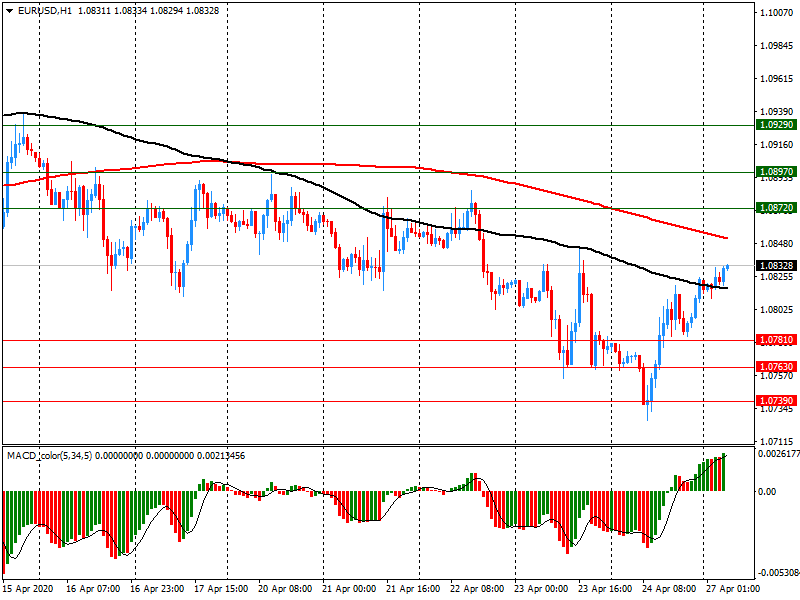
EUR/USD
Resistance levels (open interest**, contracts)
$1.0929 (860)
$1.0897 (485)
$1.0872 (623)
Price at time of writing this review: $1.0833
Support levels (open interest**, contracts):
$1.0781 (1764)
$1.0763 (1729)
$1.0739 (1865)
Comments:
- Overall open interest on the CALL options and PUT options with the expiration date May, 8 is 69289 contracts (according to data from April, 24) with the maximum number of contracts with strike price $1,1200 (3483);
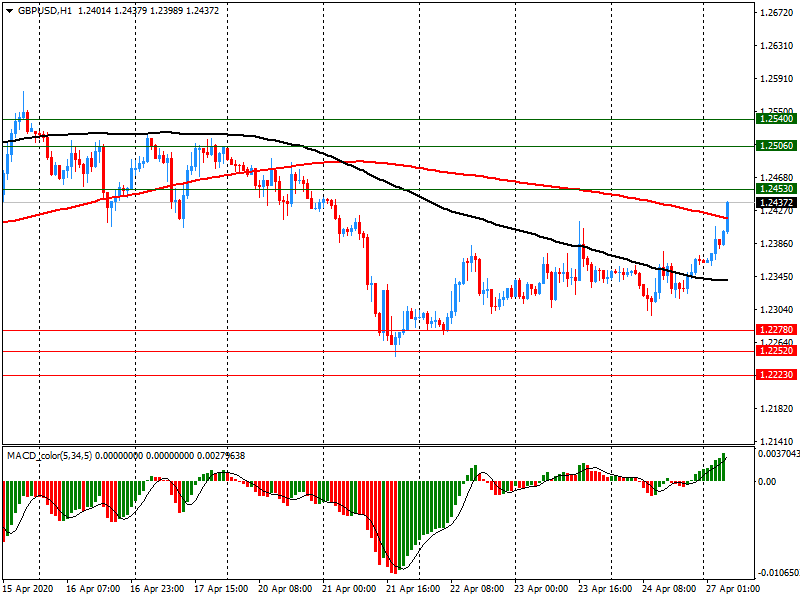
GBP/USD
Resistance levels (open interest**, contracts)
$1.2540 (694)
$1.2506 (507)
$1.2453 (272)
Price at time of writing this review: $1.2437
Support levels (open interest**, contracts):
$1.2278 (676)
$1.2252 (499)
$1.2223 (604)
Comments:
- Overall open interest on the CALL options with the expiration date May, 8 is 16467 contracts, with the maximum number of contracts with strike price $1,2700 (1714);
- Overall open interest on the PUT options with the expiration date May, 8 is 17687 contracts, with the maximum number of contracts with strike price $1,2850 (1073);
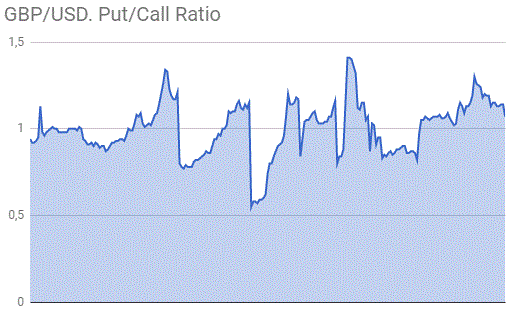
- The ratio of PUT/CALL was 1.07 versus 1.06 from the previous trading day according to data from April, 24
* - The Chicago Mercantile Exchange bulletin (CME) is used for the calculation.
** - Open interest takes into account the total number of option contracts that are open at the moment.
| Raw materials | Closed | Change, % |
|---|---|---|
| Brent | 22 | 0.82 |
| Silver | 15.21 | 0.07 |
| Gold | 1726 | -0.2 |
| Palladium | 2012.89 | 2.14 |
| Index | Change, points | Closed | Change, % |
|---|---|---|---|
| NIKKEI 225 | -167.44 | 19262 | -0.86 |
| Hang Seng | -145.99 | 23831.33 | -0.61 |
| KOSPI | -25.72 | 1889.01 | -1.34 |
| ASX 200 | 25.5 | 5242.6 | 0.49 |
| FTSE 100 | -74.38 | 5752.23 | -1.28 |
| DAX | -177.7 | 10336.09 | -1.69 |
| CAC 40 | -57.68 | 4393.32 | -1.3 |
| Dow Jones | 260.01 | 23775.27 | 1.11 |
| S&P 500 | 38.94 | 2836.74 | 1.39 |
| NASDAQ Composite | 139.77 | 8634.52 | 1.65 |
| Time | Country | Event | Period | Previous value | Forecast |
|---|---|---|---|---|---|
| 23:30 | Japan | Unemployment Rate | March | 2.4% | 2.5% |
| Pare | Closed | Change, % |
|---|---|---|
| AUDUSD | 0.63944 | 0.37 |
| EURJPY | 116.34 | 0.34 |
| EURUSD | 1.08235 | 0.43 |
| GBPJPY | 132.896 | 0.09 |
| GBPUSD | 1.23654 | 0.17 |
| NZDUSD | 0.60162 | 0.15 |
| USDCAD | 1.4094 | 0.12 |
| USDCHF | 0.97286 | -0.26 |
| USDJPY | 107.476 | -0.05 |







© 2000-2026. All rights reserved.
This site is managed by Teletrade D.J. LLC 2351 LLC 2022 (Euro House, Richmond Hill Road, Kingstown, VC0100, St. Vincent and the Grenadines).
The information on this website is for informational purposes only and does not constitute any investment advice.
The company does not serve or provide services to customers who are residents of the US, Canada, Iran, The Democratic People's Republic of Korea, Yemen and FATF blacklisted countries.
Making transactions on financial markets with marginal financial instruments opens up wide possibilities and allows investors who are willing to take risks to earn high profits, carrying a potentially high risk of losses at the same time. Therefore you should responsibly approach the issue of choosing the appropriate investment strategy, taking the available resources into account, before starting trading.
Use of the information: full or partial use of materials from this website must always be referenced to TeleTrade as the source of information. Use of the materials on the Internet must be accompanied by a hyperlink to teletrade.org. Automatic import of materials and information from this website is prohibited.
Please contact our PR department if you have any questions or need assistance at pr@teletrade.global.


 Bank
Bank transfers


