- Phân tích
- Tin tức và các công cụ
- Tin tức thị trường
- EUR/CHF hits fresh 18-month lows under 1.0550, eyes post-pandemic lows at 1.0500
EUR/CHF hits fresh 18-month lows under 1.0550, eyes post-pandemic lows at 1.0500
- EUR/CHF has picked up where it left things off in October and has continued to decline to fresh multi-month lows.
- Technicians will be eyeing a test of the post-pandemic lows around 1.0500.
- Recent CHF strength has perplexed some analysts and traders.
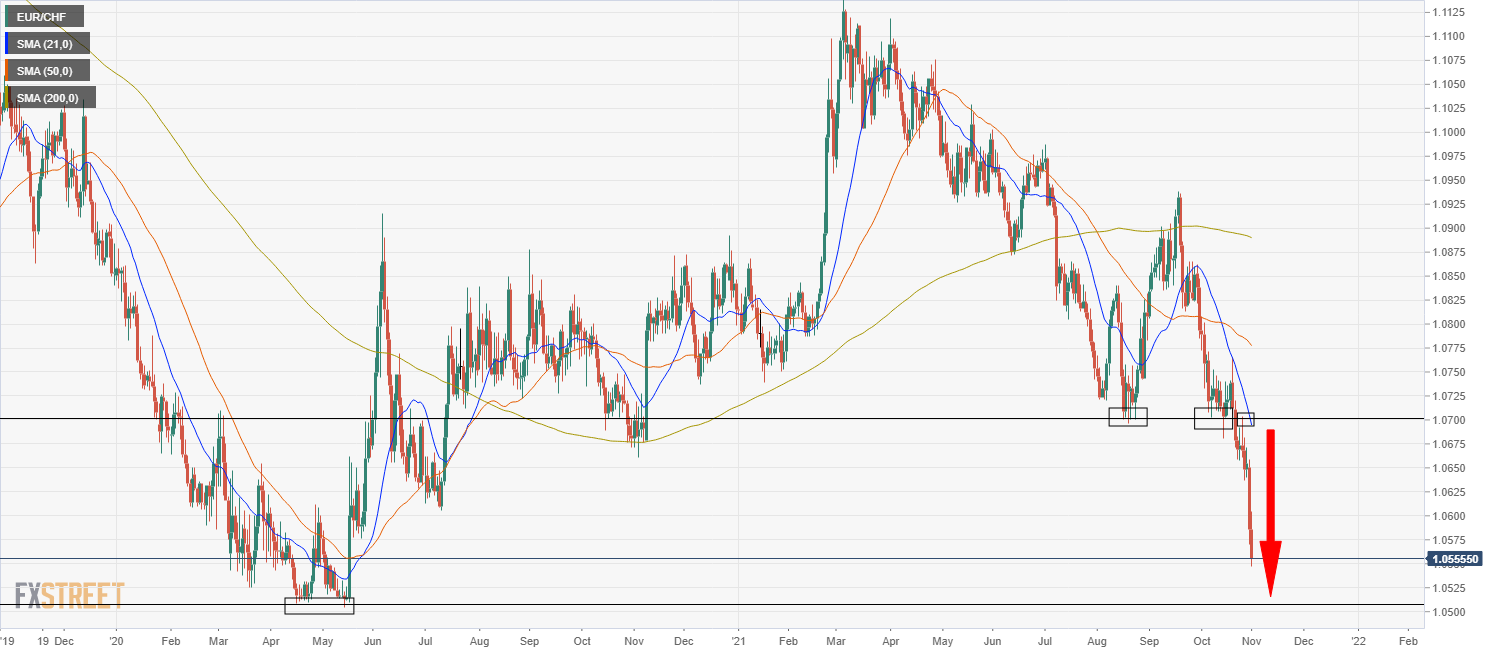
After falling 1.9% over the course of October from close to 1.0800 to under 1.0600, negative momentum in EUR/CHF has carried over into the first trading day of November. The pair printed fresh 18-month lows when it briefly slipped below the 1.0550 level in earlier trade. Bearish momentum has gathered pace since EUR/CHF saw a significant break below what had been a solid area of support at 1.0700 on 21 October and then failed to break back above this level on the retest. Technicians and bears will have multi-year lows at the 1.0500 level, set last May, in their sights.
CHF strength catches many off guard
Recent strength in the swiss franc has caught many an analyst and trader off guard, given that it seems not to reflect recent fundamental developments. These fundamental developments can pretty much be summed up as 1) a spike in global inflationary pressures (though not really in Switzerland) leading to a hawkish repricing of interest rate expectations for most major G10 central banks (again, though not really for Switzerland) and 2) a risk-on environment for stocks that has seen major US and European equity bourses surge back to record levels after September’s sell-off. The former suggests that CHF should have weakened as a result of a dwindling yield appeal and the latter suggests CHF weakness as a result of dwindling safe-haven demand.
The fact that the drop in EUR/CHF has accelerated in wake of what was largely viewed as a hawkish showing from the ECB and its President Lagarde last Thursday is doubly perplexing; markets have brought their ECB rate hike bets even further forward since last week’s ECB meeting, now seeing a 10bps hike in July and a 20bps hike in October, in anticipation (one would assume) that the ECB loses its nerve with regards to inflation, drops its “inflation is transitory stance” and starts hiking by the middle of the year. Perhaps the view of FX market participants buying CHF is that all of these pro-inflationary developments in Europe (driven primarily by the spike in energy costs), and the associated more hawkish ECB stance, will be a negative for long-term Eurozone growth prospects, capping the ECB’s terminal interest rate, thus actually, in the end, being a positive for EUR vs CHF yield/carry differentials.
What to watch this week
A modest MoM slowdown in Swiss Manufacturing output growth, as indicated by modest fall in October Manufacturing PMI to 65.4 from last month’s 68.1 reading, and a hefty jump in Swiss Sight Deposits (indicating that the SNB has been intervening to try to slow the CHF rally) weren’t enough to significantly slow the swiss franc’s ascent. EUR/CHF traders will now switch their focus to the release of Final October Eurozone Manufacturing PMI data, Swiss October CPI and Swiss September Retail Sales, all out on Tuesday in the European morning. Thereafter, focus is likely to switch to broader macro themes, like the Fed and BoE rate decisions and the US jobs report.







© 2000-2026. Bản quyền Teletrade.
Trang web này được quản lý bởi Teletrade D.J. LLC 2351 LLC 2022 (Euro House, Richmond Hill Road, Kingstown, VC0100, St. Vincent and the Grenadines).
Thông tin trên trang web không phải là cơ sở để đưa ra quyết định đầu tư và chỉ được cung cấp cho mục đích làm quen.
Giao dịch trên thị trường tài chính (đặc biệt là giao dịch sử dụng các công cụ biên) mở ra những cơ hội lớn và tạo điều kiện cho các nhà đầu tư sẵn sàng mạo hiểm để thu lợi nhuận, tuy nhiên nó mang trong mình nguy cơ rủi ro khá cao. Chính vì vậy trước khi tiến hành giao dịch cần phải xem xét mọi mặt vấn đề chấp nhận tiến hành giao dịch cụ thể xét theo quan điểm của nguồn lực tài chính sẵn có và mức độ am hiểu thị trường tài chính.
Sử dụng thông tin: sử dụng toàn bộ hay riêng biệt các dữ liệu trên trang web của công ty TeleTrade như một nguồn cung cấp thông tin nhất định. Việc sử dụng tư liệu từ trang web cần kèm theo liên kết đến trang teletrade.vn. Việc tự động thu thập số liệu cũng như thông tin từ trang web TeleTrade đều không được phép.
Xin vui lòng liên hệ với pr@teletrade.global nếu có câu hỏi.


 Chuyển khoản
 ngân hàng


