- Phân tích
- Tin tức và các công cụ
- Tin tức thị trường
- EUR/USD slumps below 1.1400 for first time since July 2020
EUR/USD slumps below 1.1400 for first time since July 2020
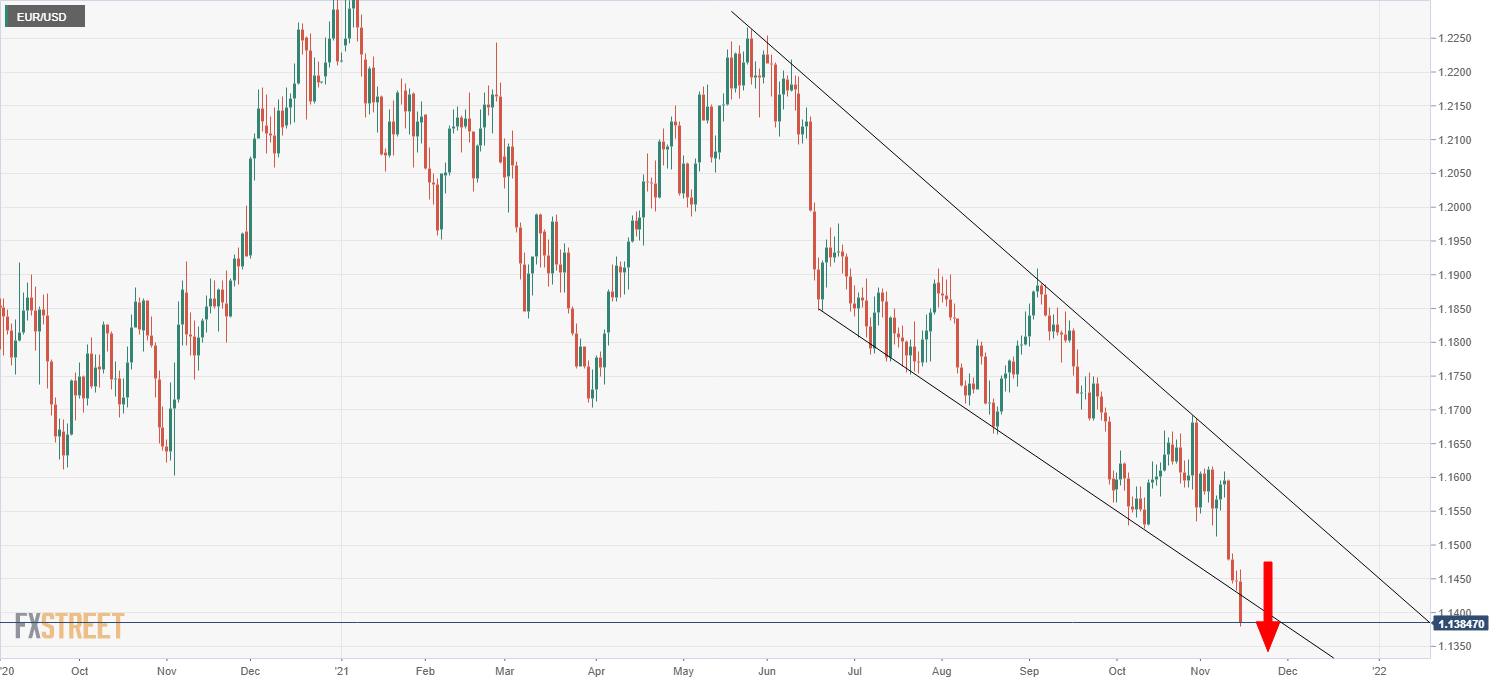
- EUR/USD has slumped under the 1.1400 level for the first time since July 2020 and is now over 0.5% lower.
- The pair has also broken to the south of a long-term downtrend, signaling a near-term acceleration of the bear-run.
EUR/USD has slumped under the 1.1400 level for the first time since July 2020. The pair trades lower by about 0.5% on Monday and has broken below a few key areas of support on its way down, including at around 1.1420 and then the psychologically important 1.1400 level just below it. The bears will now look to push the pair lower towards the next area of support at 1.1350. If that breaks, it’s a clean run lower to the late June/early July 2020 lows under 1.1200. Notably, EUR/USD broke to the downside of a long-term downtrend that had been supporting the price action going all the way back to August, signaling a near-term acceleration of the pair’s bear run.
Market commentators are citing a few fundamental reasons for EUR/USD’s drop. Firstly, US bond yields have reversed early losses and now the yield curve is predominantly higher, as well as steeper. US 30-year yields are up around 6bps on the day and flirting with the 2.0% level again, while German 30-year yields are up a more modest 3bps. Meanwhile, the US 2s10s spread has widened by about 3bps, while the German 2s10s spread has narrowed by just under 1bps. A steepening of the yield curve suggests improved optimism about future economic growth and inflationary outcomes that hasn’t also exacerbated fears about near-term monetary policy tightening.
The steepening of the US curve is a result of a better than expected US regional Fed manufacturing survey released earlier in the session. To recap, the NY Fed Manufacturing survey for November rose to 30.9 from 19.8 in October, well above the expected rise to 21.6. This is a good sign that the solid start the US economy enjoyed to Q4 continued into the second month of the quarter and this will be boosting USD directly, not just indirectly via yields.
Note that as the data points to the US picking up economic momentum, the Eurozone economy is expected to slow in the coming months amid surging Covid-19 infection rates that threaten hurting consumer confidence and the reimposition of restrictions (the Netherlands has already implemented a full lockdown). This is also touted as bearish for EUR/USD.
Finally, dovish remarks from ECB members may also have highlighted fundamentals divergences between the euro and dollar; the general message was to emphasise that the bank still view the current spike in inflation as transitory and that cost-push inflation (higher energy/fuel bills) is hurting the economy, thus the ECB should keep financing conditions accommodative.
Looking ahead to the rest of the week, more ECB speak is also likely to be (mostly) dovish and there is no tier one Eurozone data. Focus will be on stateside events. Fed speakers come out in force and will need to comment on inflation after last week’s surprise and markets await US President Joe Biden’s Fed Chair appointment decision. There is also a decent dose of data for traders to sink their teeth into, starting with the October US Retail Sales report out on Tuesday.







© 2000-2026. Bản quyền Teletrade.
Trang web này được quản lý bởi Teletrade D.J. LLC 2351 LLC 2022 (Euro House, Richmond Hill Road, Kingstown, VC0100, St. Vincent and the Grenadines).
Thông tin trên trang web không phải là cơ sở để đưa ra quyết định đầu tư và chỉ được cung cấp cho mục đích làm quen.
Giao dịch trên thị trường tài chính (đặc biệt là giao dịch sử dụng các công cụ biên) mở ra những cơ hội lớn và tạo điều kiện cho các nhà đầu tư sẵn sàng mạo hiểm để thu lợi nhuận, tuy nhiên nó mang trong mình nguy cơ rủi ro khá cao. Chính vì vậy trước khi tiến hành giao dịch cần phải xem xét mọi mặt vấn đề chấp nhận tiến hành giao dịch cụ thể xét theo quan điểm của nguồn lực tài chính sẵn có và mức độ am hiểu thị trường tài chính.
Sử dụng thông tin: sử dụng toàn bộ hay riêng biệt các dữ liệu trên trang web của công ty TeleTrade như một nguồn cung cấp thông tin nhất định. Việc sử dụng tư liệu từ trang web cần kèm theo liên kết đến trang teletrade.vn. Việc tự động thu thập số liệu cũng như thông tin từ trang web TeleTrade đều không được phép.
Xin vui lòng liên hệ với pr@teletrade.global nếu có câu hỏi.


 Chuyển khoản
 ngân hàng


