- Phân tích
- Tin tức và các công cụ
- Tin tức thị trường
- GBP/USD plunges to fresh YTD Lows at 1.3117 as traders eye 1.3100
GBP/USD plunges to fresh YTD Lows at 1.3117 as traders eye 1.3100
- The British pound extends its monthly losses, down close to 2%.
- A dampened market mood spurred demand for safe-haven assets, where the dollar is “king.”
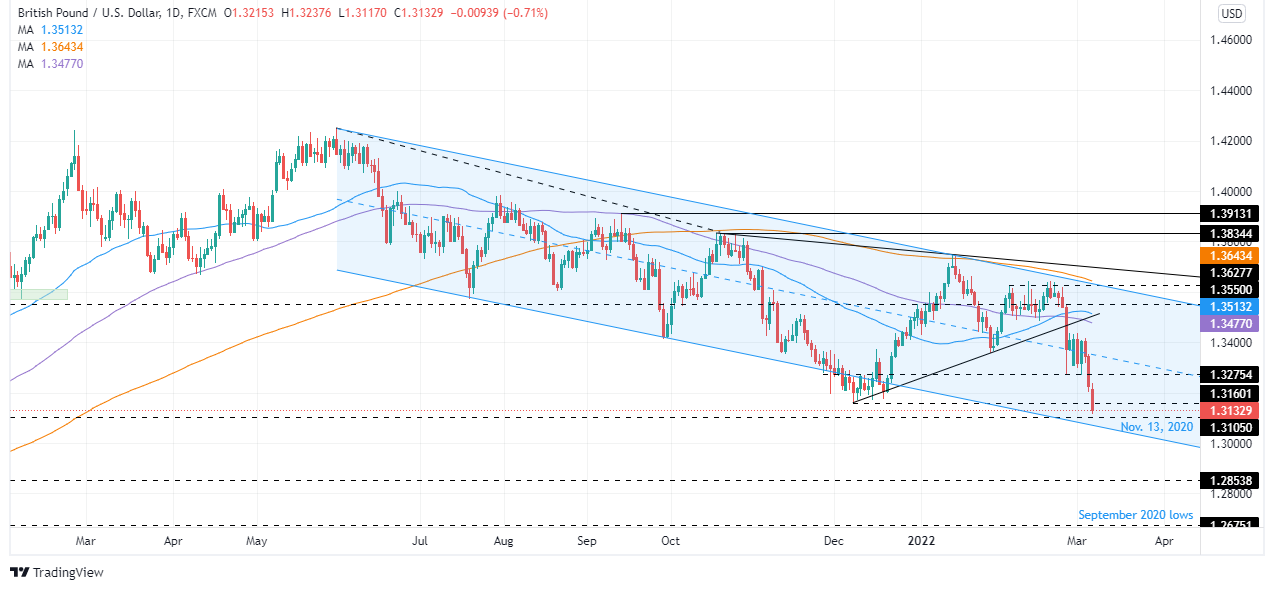
- GBP/USD Technical Outlook: Breach of 1.3100 would expose November 2, 2020, lows at 1.2853.
Update:
UK’s Prime Minister Boris Johnson is crossing the wires; he said that the UK “Can not simply close down the use of oil and gas overnight, even from Russia.”
The GBP/USD reacted, plummeting from 1.3170, the original price of the article, towards the 1.3110s area.
End of Update
GBP/USD grinds lower at the beginning of the week for the third consecutive trading day amid a mixed mood in financial markets. Around 1.3170s, the British pound reflects the appetite for safe-haven peers like the US dollar, blamed on the escalation of the Russia-Ukraine conflict and the possibility of the US weighing on banning oil imports from Russia.
During the weekend, the US Secretary of State Blinken said the US and allies are in active discussions regarding a Russian oil import ban, and reports later stated the “US is weighing acting without allies on a ban of Russian oil imports, although the timing and scope of any ban is still fluid,” according to Bloomverg.
Meanwhile, at Monday’s Asia Pacific open, oil futures reacted to the headlines, as Brent oil crude surged above $139 a barrel, while US Crude oil rose to near $130. Furthermore, gold rose above $2,000 for the first time since August 2020, while Asian equity indices ended with losses. At press time, the market sentiment shifted to risk-off, as European stock indexes remained in the red, while US equity indices opened with losses.
In the FX space, the story is different. The buck remains king, gaining against most G8 currencies. The US Dollar Index (DXY) reached a new YTD high at 99.42, though it retreated to near 98.92, up 0.28% at the time of writing. Safe-haven peers like the CHF and the JPY are getting hammered, losing between 0.94% and 0.51%.
Apart from this, US upbeat employment figures on Friday and the advance of US Treasury yields underpinned the US dollar.
An absent economic docket from the UK and the US cut GBP/USD adrift to pure market sentiment plays. In this context, the GBP/USD would extend its fall due to its risk-sensitive nature.
GBP/USD Price Forecast: Technical outlook
The GBP/USD is downward biased and stays within a descending channel, approaching its bottom-trendline, located around the 1.3080-1.3100 area. It is worth noting that the 50-day Moving Average (DMA) is about to cross below the 100-DMA, located each at 1.3513/1.3477, respectively, which could exacerbate a further leg-down towards September 2020 lows around 1.2675.
The GBP/USD's first support would be November 13, 2020, with lows at 1.3105. A breach of the latter would expose the 1.3000 figure, followed by November 2, 2020, lows at 1.2853.







© 2000-2026. Bản quyền Teletrade.
Trang web này được quản lý bởi Teletrade D.J. LLC 2351 LLC 2022 (Euro House, Richmond Hill Road, Kingstown, VC0100, St. Vincent and the Grenadines).
Thông tin trên trang web không phải là cơ sở để đưa ra quyết định đầu tư và chỉ được cung cấp cho mục đích làm quen.
Giao dịch trên thị trường tài chính (đặc biệt là giao dịch sử dụng các công cụ biên) mở ra những cơ hội lớn và tạo điều kiện cho các nhà đầu tư sẵn sàng mạo hiểm để thu lợi nhuận, tuy nhiên nó mang trong mình nguy cơ rủi ro khá cao. Chính vì vậy trước khi tiến hành giao dịch cần phải xem xét mọi mặt vấn đề chấp nhận tiến hành giao dịch cụ thể xét theo quan điểm của nguồn lực tài chính sẵn có và mức độ am hiểu thị trường tài chính.
Sử dụng thông tin: sử dụng toàn bộ hay riêng biệt các dữ liệu trên trang web của công ty TeleTrade như một nguồn cung cấp thông tin nhất định. Việc sử dụng tư liệu từ trang web cần kèm theo liên kết đến trang teletrade.vn. Việc tự động thu thập số liệu cũng như thông tin từ trang web TeleTrade đều không được phép.
Xin vui lòng liên hệ với pr@teletrade.global nếu có câu hỏi.


 Chuyển khoản
 ngân hàng


