- Phân tích
- Tin tức và các công cụ
- Tin tức thị trường
- US Dollar Index (DXY) reached a two-year-high at 101.851 amid risk aversion
US Dollar Index (DXY) reached a two-year-high at 101.851 amid risk aversion
- The US Dollar Index hits a fresh 25-month courtesy of dismal market mood and expectations of an aggressive Federal Reserve tightening cycle.
- Most Fed officials aligned to hike 50-bps at the May 4-5 meeting.
- US Dollar Index Price Forecast (DXY): Bull’s target remains the January 2017 highs near 103.82.
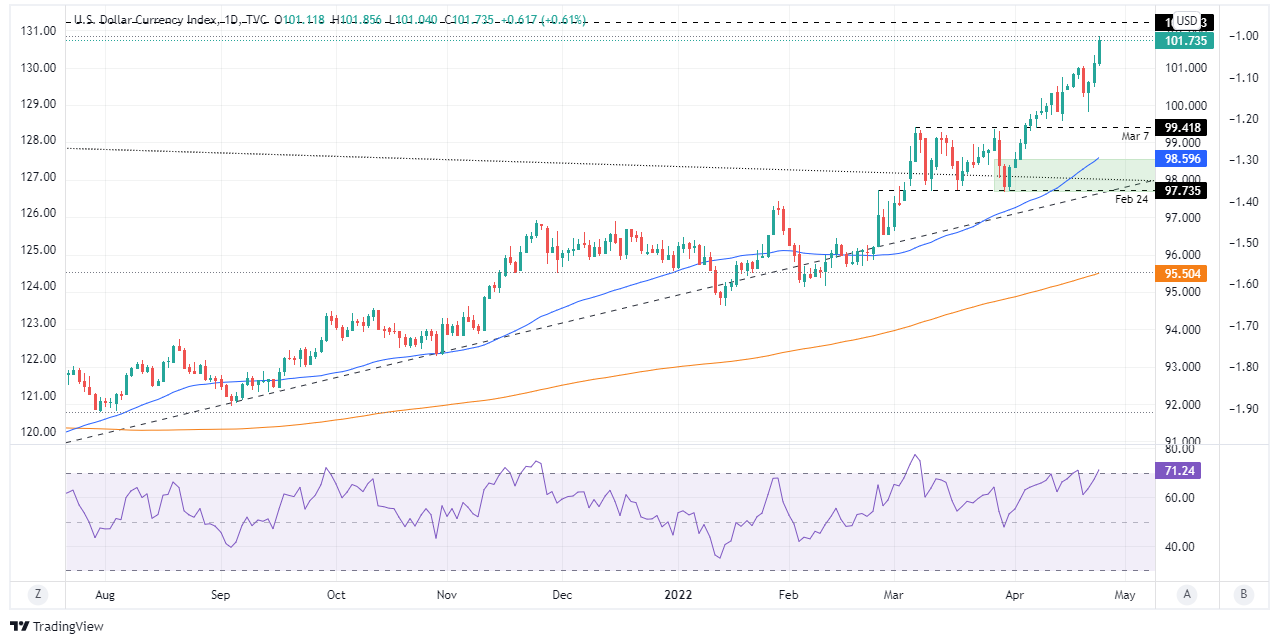
The US Dollar Index, a measurement of the greenback’s value against a basket of six currencies, finished with gains of 0.62% and, at the time of writing, is at 101.735, shy of the 2-year high reached during the day at 101.851.
The market mood remains downbeat, as portrayed by Asian equity futures falling. Growing concerns about China’s coronavirus outbreak In Shanghai extended to some Beijing districts, keeping traders on their toes. Fears of wider curbs in Beijing are spooking investors already worried about the risk of a global slowdown as the Fed raises rates to tame inflation.
Additionally, last week’s Fed speaking increased the appetite for the greenback. Money market futures shows that investors have fully priced in a 100% chance of a 0.50% rate hike in the May meeting, while for June, the odds are at 80%, as shown by the CME FedWatch Tool.
In the meantime, the 10-year US Treasury yield, the benchmark note, retreated from last week’s highs around 2.981%, is down ten basis points, at 2.818%.
Last week’s Fed speaking summary
On Thursday of last week, Fed Chair Jerome Powell blessed a half-point interest rate increase by the May 4-5 reunion. Furthermore, San Francisco Fed President Mary Daly noted that the Fed “will likely” raise rates by 50 bps at a couple of meetings. Daly reiterated that the Fed needs to take a measured pace on rate hikes and get interest rates up to 2.5% by the end of the year.
Elsewhere, St. Louis Fed President James Bullard admitted that the Fed is behind the curve but not as everybody thinks, while adding that the Fed has hiked 75 bps before without the world coming to an end.
Last Friday, Cleveland’s Fed President Loretta Mester commented that she would like to get neutral to 2.5% by the end of the year. When asked about 75-bps increases, Mester added that “we don’t need to go there.” Furthermore, she supported a 50-bps increase in May and a few more after.
The economic calendar for the US would feature March’s Durable Goods Orders, the US Gross Domestic Product for the Q1, and the Core Personal Consumption Expenditure (PCE) for March on annual and monthly readings, alongside the Chicago PMI.
Analysts at ING expect Q1 data to show the US economy expanded at a 1-1.5% annualized rate, which would be below Q4 of 2021 at 6.9%, reflecting the Omicron wave of the pandemic that impacted mobility considerably.
US Dollar Index Price Forecast (DXY): Technical outlook
The US Dollar Index (DXY) retains its upward bias, as depicted by the daily chart. The 50 and the 200-day moving averages (DMAs) at 98.596 and 95.504, respectively, are well located under the DXY value, further cementing the upside bias. The Relative Strength Index (RSI) at 71.24 is in overbought territory, so a deceleration in the DXY trend is on the cards.
The DXY first resistance would be 102.00. A break above would expose March’s 24 daily high at 102.21, followed by March’s 20 2020 daily high at 102.99 and then the aforementioned 103.82 swing high.







© 2000-2026. Bản quyền Teletrade.
Trang web này được quản lý bởi Teletrade D.J. LLC 2351 LLC 2022 (Euro House, Richmond Hill Road, Kingstown, VC0100, St. Vincent and the Grenadines).
Thông tin trên trang web không phải là cơ sở để đưa ra quyết định đầu tư và chỉ được cung cấp cho mục đích làm quen.
Giao dịch trên thị trường tài chính (đặc biệt là giao dịch sử dụng các công cụ biên) mở ra những cơ hội lớn và tạo điều kiện cho các nhà đầu tư sẵn sàng mạo hiểm để thu lợi nhuận, tuy nhiên nó mang trong mình nguy cơ rủi ro khá cao. Chính vì vậy trước khi tiến hành giao dịch cần phải xem xét mọi mặt vấn đề chấp nhận tiến hành giao dịch cụ thể xét theo quan điểm của nguồn lực tài chính sẵn có và mức độ am hiểu thị trường tài chính.
Sử dụng thông tin: sử dụng toàn bộ hay riêng biệt các dữ liệu trên trang web của công ty TeleTrade như một nguồn cung cấp thông tin nhất định. Việc sử dụng tư liệu từ trang web cần kèm theo liên kết đến trang teletrade.vn. Việc tự động thu thập số liệu cũng như thông tin từ trang web TeleTrade đều không được phép.
Xin vui lòng liên hệ với pr@teletrade.global nếu có câu hỏi.


 Chuyển khoản
 ngân hàng


