- Phân tích
- Tin tức và các công cụ
- Tin tức thị trường
- AUD/USD struggles around 0.7200 and nosedived below 0.7100 as bears eye 0.7000
AUD/USD struggles around 0.7200 and nosedived below 0.7100 as bears eye 0.7000
- The AUD/USD is aiming lower in the month and would record its most significant loss since March 2020., down 5.57%.
- A risk-off market mood dragged the AUD/USD lower as late position trading favors the greenback.
- US Treasury yields jumped late in the session, led by the 10-year up ten basis points, at 2.936%.
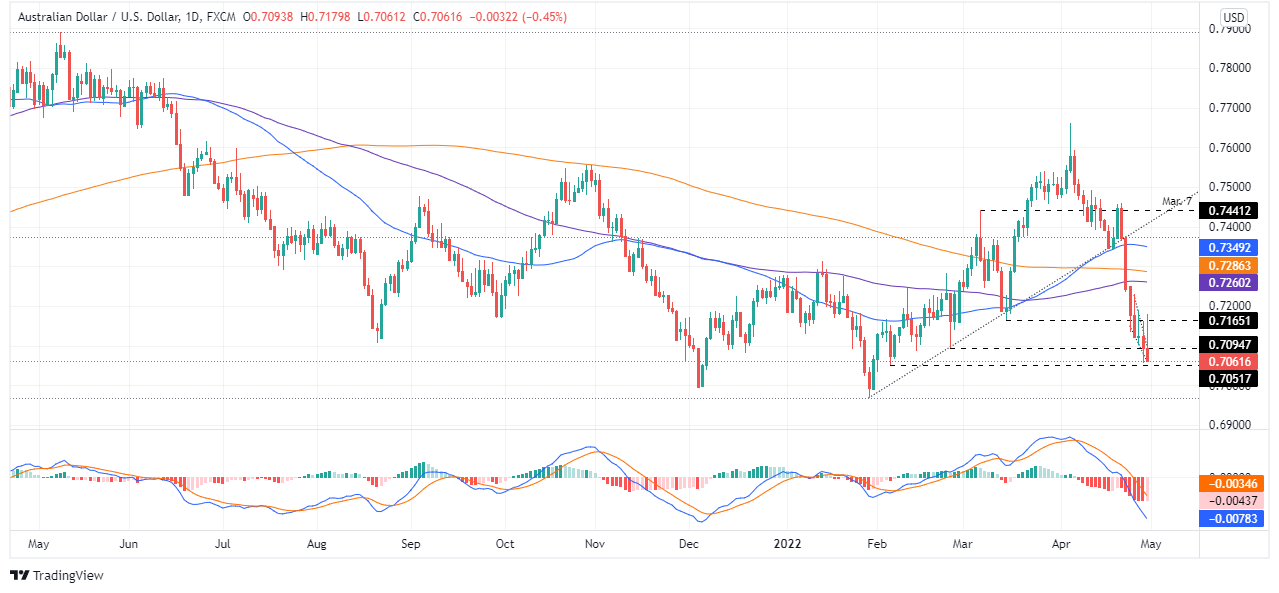
- AUD/USD Price Forecast: Bears prepare an assault of 0.7000.
The AUD/USD plummets from daily highs near 0.7200 and tanked below 0.7100 as market sentiment turned sour, ahead of a busy week for the Australian and US economic dockets, as both countries’ central banks would have monetary policy meetings. At the time of writing, the AUD/USD is trading at 0.7069.
Market sentiment weakens the risk-sensitive AUD
Risk-aversion rules April’s last trading day, as portrayed by US equities set to record losses between 2.32% and 4.09%. Factors like China’s covid outbreak, Federal Reserve tightening, and the Russia-Ukraine war developments weighed on market sentiment.
On Friday, the Fed’s favorite inflation gauge, the core Personal Consumption Expenditures (PCE), rose to 5.2% y/y, lower than the 5.3% estimations. However, headline inflation expanded by 6.6% y/y, from 6.3% in the previous month. The data further strengthens the case for a Federal Reserve rate hike in the next week, as the US central bank chief Jerome Powell expressed during the month that a 50-bps increase is “on the table.”
Hotter than expected inflationary readings reported during the week on the Australian front paint a problematic scenario for the Reserve Bank of Australia (RBA) as a federal election looms on May 16th. Money market futures odds of a 0.25 bps increase by the RBA sit at an 85% chance, though some analysts were expecting a 40-bps rate hike.
The consensus amongst economists is that the board would stay put and hold rates unchanged. However, according to Bloomberg, Goldman Sachs Group, Inc. sees the RBA delivering a 40-bps move in June.
Therefore, the AUD/USD scenario favors the greenback. But, a higher-than-expected RBA rate increase or a “dovish” Federal Reserve would boost the prospects of the AUD, though it’s unlikely to happen.
AUD/USD Price Forecast: Technical outlook
The AUD/USD remains downward biased, accelerating its downward trend as shown by the daily chart. The MACD remains bearish, as the MACD/signal lines aim lower while the histogram expands downwards. Additionally, the daily moving averages (DMAs) above the spot price confirm the aforementioned, though it’s worth noting that the 50-DMA remains on top of the 200 and the 100-DMA.
That said, the AUD/USD’s first support would be February’s 4 cycle low around 0.7051. A break below would expose February’s 1 daily low at 0.7033, followed by the S3 daily pivot at the triple-zero figure at 0.7000.







© 2000-2026. Bản quyền Teletrade.
Trang web này được quản lý bởi Teletrade D.J. LLC 2351 LLC 2022 (Euro House, Richmond Hill Road, Kingstown, VC0100, St. Vincent and the Grenadines).
Thông tin trên trang web không phải là cơ sở để đưa ra quyết định đầu tư và chỉ được cung cấp cho mục đích làm quen.
Giao dịch trên thị trường tài chính (đặc biệt là giao dịch sử dụng các công cụ biên) mở ra những cơ hội lớn và tạo điều kiện cho các nhà đầu tư sẵn sàng mạo hiểm để thu lợi nhuận, tuy nhiên nó mang trong mình nguy cơ rủi ro khá cao. Chính vì vậy trước khi tiến hành giao dịch cần phải xem xét mọi mặt vấn đề chấp nhận tiến hành giao dịch cụ thể xét theo quan điểm của nguồn lực tài chính sẵn có và mức độ am hiểu thị trường tài chính.
Sử dụng thông tin: sử dụng toàn bộ hay riêng biệt các dữ liệu trên trang web của công ty TeleTrade như một nguồn cung cấp thông tin nhất định. Việc sử dụng tư liệu từ trang web cần kèm theo liên kết đến trang teletrade.vn. Việc tự động thu thập số liệu cũng như thông tin từ trang web TeleTrade đều không được phép.
Xin vui lòng liên hệ với pr@teletrade.global nếu có câu hỏi.


 Chuyển khoản
 ngân hàng


