- Phân tích
- Tin tức và các công cụ
- Tin tức thị trường
- GBP/USD grinds lower but stays around 1.2350s after upbeat US NFP report
GBP/USD grinds lower but stays around 1.2350s after upbeat US NFP report
- The GBP/USD will finish the week with hefty losses of 1.74%.
- Positive US employment figures and BoE’s speaking keeps the GBP downward pressured.
- GBP/USD Price Forecast: To remain downward biased unless GBP bulls reclaim 1.2600.
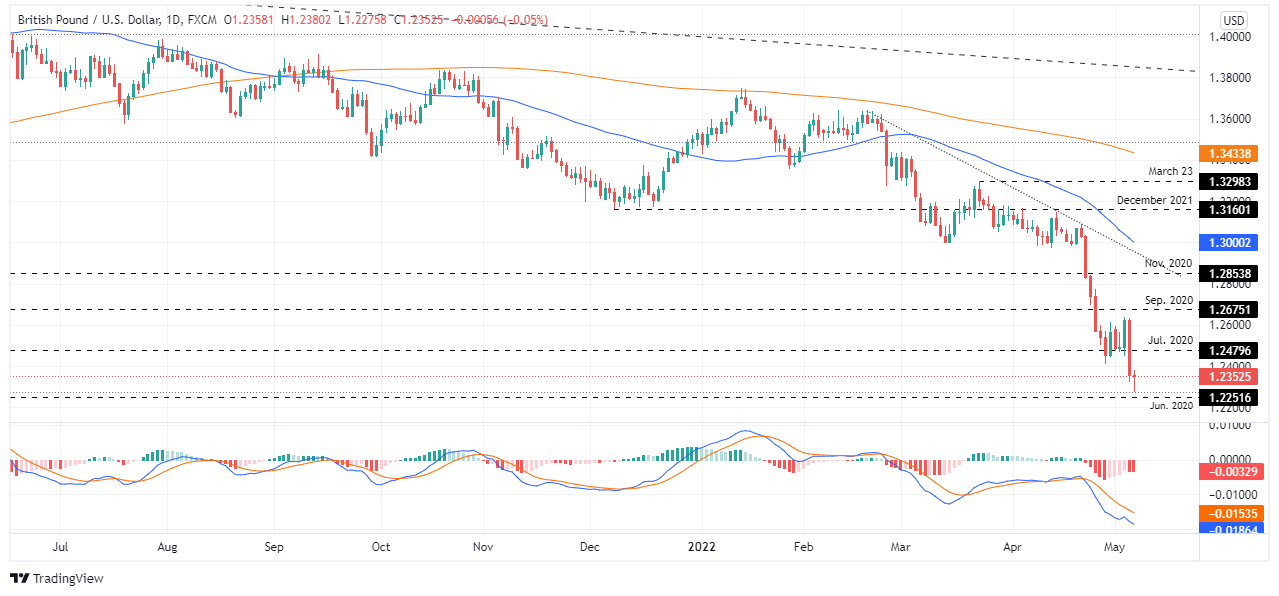
The British pound appears to regain composture but remains losing in the day, down 0.06%, after the Bank of England hiked rates by 25-bps on Thursday. At the time of writing, the GBP/USD is trading at 1.2352.
US employment figures came positive, and the BoE expects inflation to reach 10%
Global equities remain down during the North American session, while the US 10-year Treasury yield rose to a YTD high of around 3.131%. Albeit higher US yields, the greenback is giving back some earlier weekly gains, as portrayed by the US Dollar Index, a gauge of the buck’s value against a basket of six currencies, down 0.18%, sitting at 103.370.
The US Department of Labour reported April’s Nonfarm Payrolls figures, showing that the economy added 428K new jobs, higher than the 391K, though the Unemployment Rate remained unchanged. Also, the Average Hourly Earnings rose by 5.5%, slightly lower than expected, and would not deter the Federal Reserve from continuing its tightening cycle.
Analysts at ING perceived the report as mixed. They added in a written note that “the unemployment rate held steady at 3.6% rather than dropping to 3.5% as expected, which in combination with a softer average hourly earnings figure of 0.3% month-on-month rather than the 0.4% consensus forecast (and slower than the 0.5% gain in March) may been taken as a signal of less inflationary pressures in the jobs market.”
Elsewhere, the Bank of England (BoE) Chief Economist Huw Pill crossed the wires in the mid-European session. He said that inflation in the UK is becoming more persistent, added that inflation is going up to 10%, and expects growth to stagnate in Q2.
Next week, the UK economic docket will reveal the Gross Domestic Product (GDP) for March, alongside the Balance of Trade and Manufacturing Production. Across the pond, a raft of Fed speaking throughout the week would dominate the headlines, alongside the Consumer Price Index (CPI) and Producer Price Index (PPI) for April.
GBP/USD Price Forecast: Technical outlook
The GBP/USD is still downward biased, though it faced solid support at June’s 2020 lows around 1.2251. Also, the MACD, as the histogram shows, is “forming” a positive divergence, which is usually a signal that the trend is about to shift. However, unless the MACD-line crosses above the signal line, GBP/USD traders should refrain from opening fresh long bets in the pair.
To the upside, the first resistance would be the figure at 1.2400. Break above would expose crucial resistance areas like July 2020 swing low-turned-resistance at 1.2479, followed by 1.2500. On the other hand, the GBP/USD first support would be 1.2300. A breach of the latter would expose the YTD low at 1.2275, closely followed by June’s 2020 swing low at 1.2251.







© 2000-2026. Bản quyền Teletrade.
Trang web này được quản lý bởi Teletrade D.J. LLC 2351 LLC 2022 (Euro House, Richmond Hill Road, Kingstown, VC0100, St. Vincent and the Grenadines).
Thông tin trên trang web không phải là cơ sở để đưa ra quyết định đầu tư và chỉ được cung cấp cho mục đích làm quen.
Giao dịch trên thị trường tài chính (đặc biệt là giao dịch sử dụng các công cụ biên) mở ra những cơ hội lớn và tạo điều kiện cho các nhà đầu tư sẵn sàng mạo hiểm để thu lợi nhuận, tuy nhiên nó mang trong mình nguy cơ rủi ro khá cao. Chính vì vậy trước khi tiến hành giao dịch cần phải xem xét mọi mặt vấn đề chấp nhận tiến hành giao dịch cụ thể xét theo quan điểm của nguồn lực tài chính sẵn có và mức độ am hiểu thị trường tài chính.
Sử dụng thông tin: sử dụng toàn bộ hay riêng biệt các dữ liệu trên trang web của công ty TeleTrade như một nguồn cung cấp thông tin nhất định. Việc sử dụng tư liệu từ trang web cần kèm theo liên kết đến trang teletrade.vn. Việc tự động thu thập số liệu cũng như thông tin từ trang web TeleTrade đều không được phép.
Xin vui lòng liên hệ với pr@teletrade.global nếu có câu hỏi.


 Chuyển khoản
 ngân hàng


