- Phân tích
- Tin tức và các công cụ
- Tin tức thị trường
- EUR/USD surges towards 1.0580 as bulls ignore a risk-off mood, post-ECB minutes
EUR/USD surges towards 1.0580 as bulls ignore a risk-off mood, post-ECB minutes
- The shared currency regained some composture vs. the greenback, recording gains of almost 1%.
- Risk-aversion was not an excuse for the euro to rally as the US dollar weakened throughout the day.
- EUR/USD Price Forecast: In the near term, it could challenge the 1.0700 figure, but the broad trend remains downwards, so rallies could be opportunities for EUR bears.
The shared currency is rallying on Thursday due to a weaker US dollar, despite a risk-aversion environment that usually benefits the greenback, but not this time, as the EUR/USD rose more than 1%. At 1.0585, the EUR/USD portrays the abovementioned and weighed on the greenback, the weakest currency in the session.
Despite a downbeat sentiment, the euro rose while the greenback tumbled
Sentiment remained downbeat throughout the whole session. US equities later attempted to record gains but failed and extended their losses for the second-straight day. The US dollar remained defensive for the third day out of four in the week, recorded a considerable loss of almost 1%, and finished at 102.881.
During the North American session, US economic data came mixed, though do not dent the Federal Reserve’s prospects of hiking rates by 50-bps in the June meeting. US Initial Jobless Claims for the last week increased to 218K, 18K more than the foreseen by analysts while Continuing Claims hit its lowest level since 1969. May’s Philadelphia Fed Manufacturing Index rose by just 2.6, worst than the 16 estimated, and Fed speaking continued dominating the headlines.
On Thursday, the Kansas City Fed President Esther George said that the “rough week in the equity markets” does not alter her support of 50-bps hikes to cool inflation. She added, “right now, inflation is too high, and we will need to make a series of rate adjustments to bring that down.”
During the overnight session, in the European one, the ECB unveiled its last monetary policy minutes, in which, according to ING analysts, ECB hawks are calling the shots. They noted that “all in all, the minutes confirmed the increasingly hawkish tone of many ECB members since the April meeting. There seems to be an eerie feeling that the ECB is acting too late and quickly needs to join the bandwagon of monetary policy normalisation. This means that the question is no longer whether the ECB should hike interest rates in July but by how much.”
In the meantime, according to STIRs published by Nordea, 34.6 bps are priced in by the July meeting, and 107.4 bps for December of 2022.
EUR/USD Price Forecast: Technical outlook
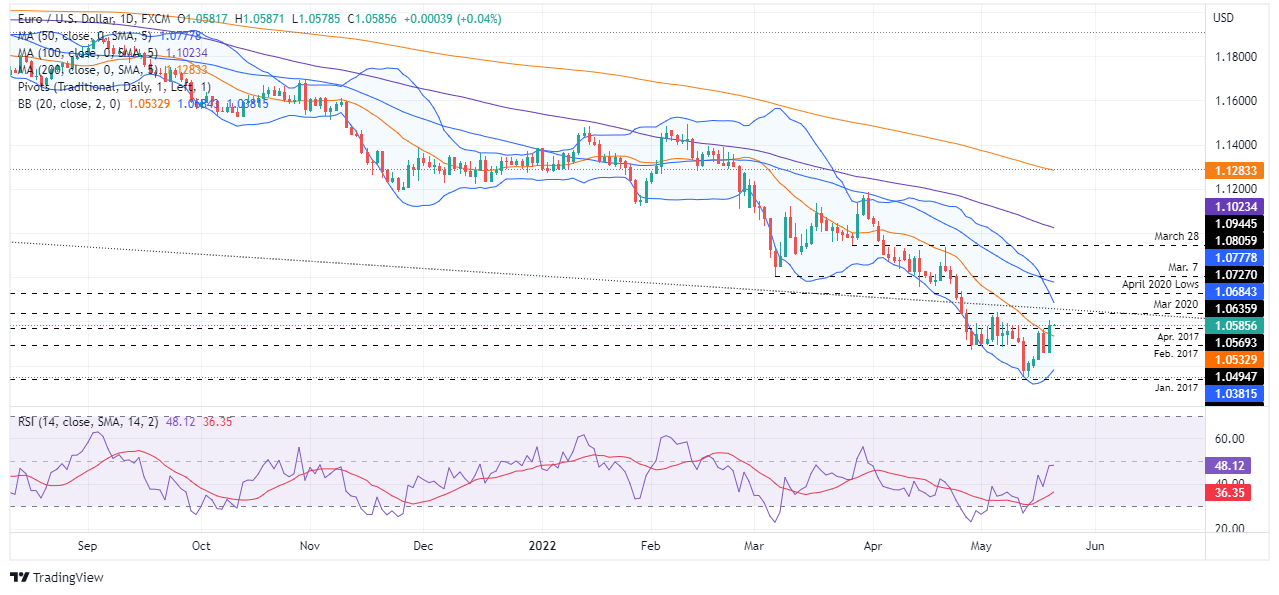
The EUR/USD finally reclaimed the 20-day moving average (DMA), a level last conquered at the beginning of April. However, the shared currency is not out of the woods yet. The Relative Strength Index (RSI), albeit aiming higher, the reading at 48 indicates stills in bearish territory, meaning that the EUR/USD could be subject to a mean reversion move. That said, the EUR/USD bias is still downwards.
If EUR/USD bulls reclaim May 5 daily high at 1.0641, that will open the door for further gains. Once that level gives way to the spot price, the top of the Bollinger band at 1.0684 would be the next resistance, immediately followed by 1.0700.
On the flip side, a slide of the EUR/USD below the 20-DMA at 1.0532 would see the 1.0500 figure as the first support. A break below might send the shared currency tumbling towards the bottom of the Bollinger bands at 1.0381, followed by the YTD low at 1.0348.







© 2000-2026. Bản quyền Teletrade.
Trang web này được quản lý bởi Teletrade D.J. LLC 2351 LLC 2022 (Euro House, Richmond Hill Road, Kingstown, VC0100, St. Vincent and the Grenadines).
Thông tin trên trang web không phải là cơ sở để đưa ra quyết định đầu tư và chỉ được cung cấp cho mục đích làm quen.
Giao dịch trên thị trường tài chính (đặc biệt là giao dịch sử dụng các công cụ biên) mở ra những cơ hội lớn và tạo điều kiện cho các nhà đầu tư sẵn sàng mạo hiểm để thu lợi nhuận, tuy nhiên nó mang trong mình nguy cơ rủi ro khá cao. Chính vì vậy trước khi tiến hành giao dịch cần phải xem xét mọi mặt vấn đề chấp nhận tiến hành giao dịch cụ thể xét theo quan điểm của nguồn lực tài chính sẵn có và mức độ am hiểu thị trường tài chính.
Sử dụng thông tin: sử dụng toàn bộ hay riêng biệt các dữ liệu trên trang web của công ty TeleTrade như một nguồn cung cấp thông tin nhất định. Việc sử dụng tư liệu từ trang web cần kèm theo liên kết đến trang teletrade.vn. Việc tự động thu thập số liệu cũng như thông tin từ trang web TeleTrade đều không được phép.
Xin vui lòng liên hệ với pr@teletrade.global nếu có câu hỏi.


 Chuyển khoản
 ngân hàng


