- Phân tích
- Tin tức và các công cụ
- Tin tức thị trường
- AUD/USD battles around 0.7200 and dips towards 0.7170s ahead of Aussie GDP/China’s PMIs
AUD/USD battles around 0.7200 and dips towards 0.7170s ahead of Aussie GDP/China’s PMIs
- The Australian dollar slides from weekly highs above 0.7200 amidst a sour trading day.
- Sentiment shifted negatively as month-end flows boosted the greenback, and US Treasury yields rose.
- AUD/USD Price Forecast: A daily close below 0.7200 to open the door for further losses.
AUD/USD slumps in the North American session, dropping from weekly highs above 0.7200, spurred by a risk-off market mood, on May’s last trading day. At 0.7178, the AUD/USD reflects the greenback’s strength, benefitted by month-end flows and higher US Treasury yields.
US equities remain trading with losses, between 0.46% and 1.80%. Sentiment shifted sour as the Eurozone reported inflation for May, which increased by 8.1% YoY, higher than the 7.8% foreseen, triggering worries about elevated prices and a global stagflation scenario.
In the Asian session, positive news from China showed that May PMIs came better than expected. The Manufacturing PMI printed a solid 49.6, higher than the 49.0 expected. The Non-Manufacturing PMI index rose by 47.8 vs. 45.5 estimations. The previously mentioned, alongside some restrictions lifted in Beijing and Shanghai, paint a hopeful scenario for the second-largest economy and Australia’s largest trading partner.
Chinese data boosted the AUD/USD, which was suffering under some selling pressure, though in the end, it failed to cling to the 0.7200 mark.
On Monday, Fed’s Governor Christopher Waller said he wants to keep hiking rates in 50 bps size until inflation is moving back towards the 2% target. Specifically, he said, “I support tightening policy by another 50 bps for several meetings. In particular, I am not taking 50 bps hikes off the table until I see inflation coming down closer to our 2% target.”
In the day ahead, the Australian economic docket would feature the GDP for Q1. Along with China’s Caixin Manufacturing PMI for May, that data could influence the AUD/USD direction. On the US front, the US economic calendar would feature the US ISM Manufacturing and Non-Manufacturing PMIs, US employment data, led by the Nonfarm Payrolls, and the ADP and JOLTs openings report.
AUD/USD Price Forecast: Technical outlook
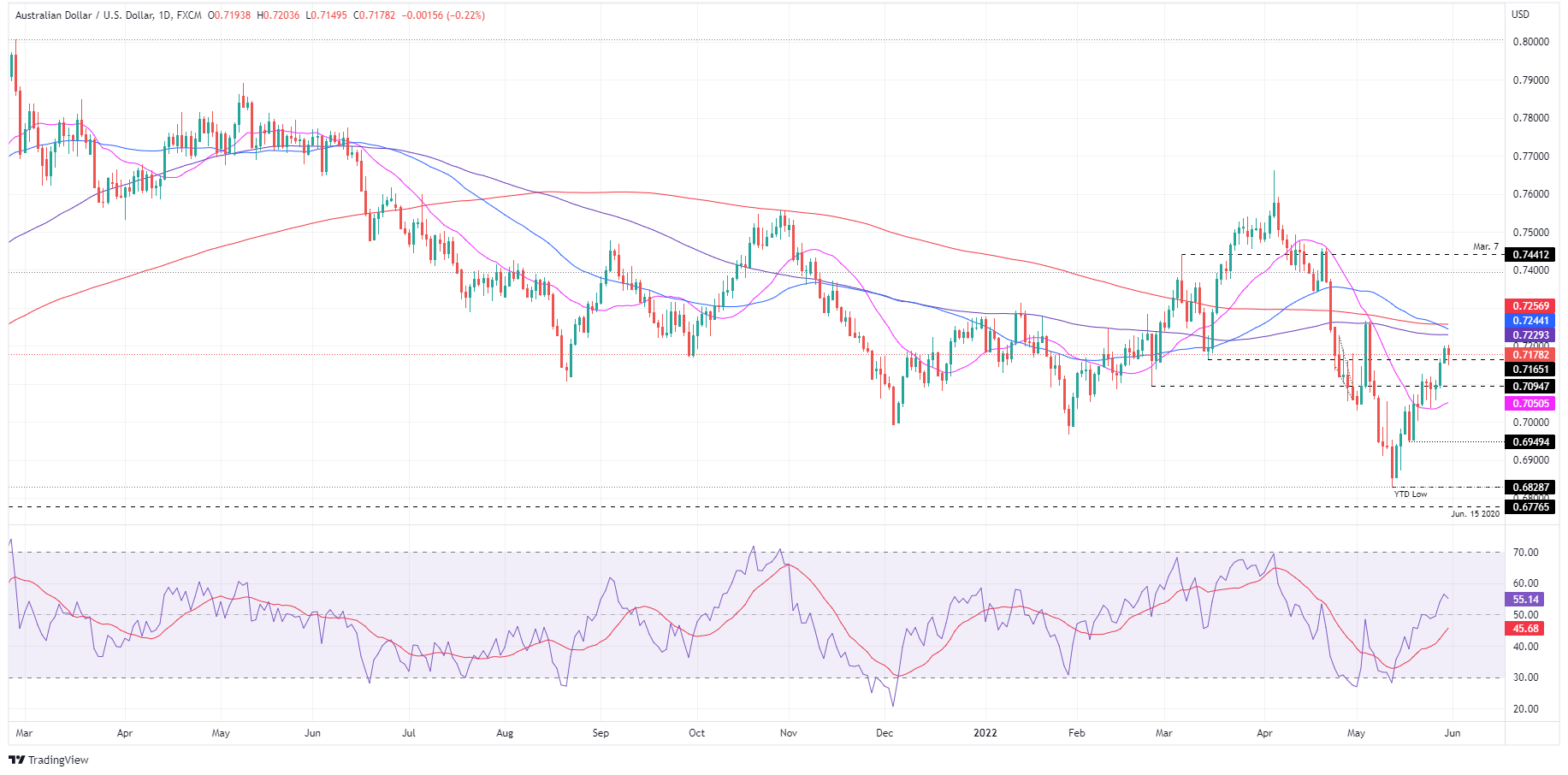
The AUD/USD daily chart depicts the pair as neutral-downward biased. Above the 0.7200 mark, AUD/USD buyers would face a firm supply area in the 0.7229-56 region, the confluence of the 50, 100, and the 200-day moving averages (DMAs), a reason for the pair’s dip below 0.7200, as AUD/USD bears stepped in.
If the AUD/USD records a daily close below the 0.7200 mark, that will open the door for further weakness. That said, the AUD/USD first support would be the May 30 low at 0.7152. Once that hurdle cleared, the AUD/USD would tumble towards 0.7100, followed by the 50-day moving average (DMA) at 0.7050.
On the other hand, the AUD/USD first resistance would be 0.7200. A breach of the latter would expose the major to the 0.7229.56 area, the confluence of the above-mentioned DMAs.







© 2000-2026. Bản quyền Teletrade.
Trang web này được quản lý bởi Teletrade D.J. LLC 2351 LLC 2022 (Euro House, Richmond Hill Road, Kingstown, VC0100, St. Vincent and the Grenadines).
Thông tin trên trang web không phải là cơ sở để đưa ra quyết định đầu tư và chỉ được cung cấp cho mục đích làm quen.
Giao dịch trên thị trường tài chính (đặc biệt là giao dịch sử dụng các công cụ biên) mở ra những cơ hội lớn và tạo điều kiện cho các nhà đầu tư sẵn sàng mạo hiểm để thu lợi nhuận, tuy nhiên nó mang trong mình nguy cơ rủi ro khá cao. Chính vì vậy trước khi tiến hành giao dịch cần phải xem xét mọi mặt vấn đề chấp nhận tiến hành giao dịch cụ thể xét theo quan điểm của nguồn lực tài chính sẵn có và mức độ am hiểu thị trường tài chính.
Sử dụng thông tin: sử dụng toàn bộ hay riêng biệt các dữ liệu trên trang web của công ty TeleTrade như một nguồn cung cấp thông tin nhất định. Việc sử dụng tư liệu từ trang web cần kèm theo liên kết đến trang teletrade.vn. Việc tự động thu thập số liệu cũng như thông tin từ trang web TeleTrade đều không được phép.
Xin vui lòng liên hệ với pr@teletrade.global nếu có câu hỏi.


 Chuyển khoản
 ngân hàng


