- Phân tích
- Tin tức và các công cụ
- Tin tức thị trường
- USD/CAD falls to two-month lows but recovers, firm near 1.2570s on a light calendar
USD/CAD falls to two-month lows but recovers, firm near 1.2570s on a light calendar
- The USD/CAD begins the week on a lower note, down by 0.13%.
- The Canadian 10-year bond yield reached a 52-week high, a headwind for the USD/CAD.
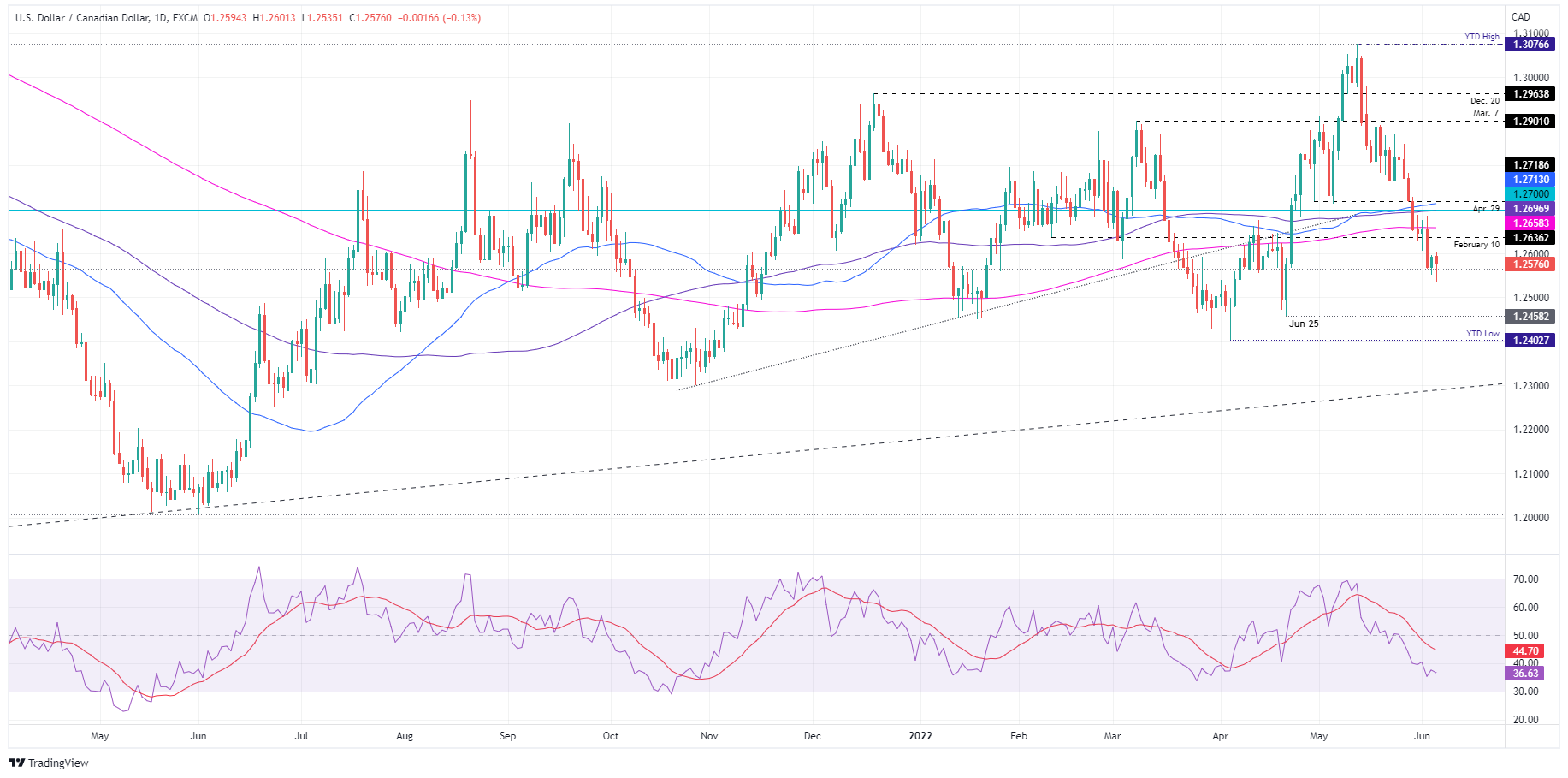
- USD/CAD Price Forecast: To further extend its losses if it remains below 1.2700.
The USD/CAD slid to fresh two-month lows near 1.2535 in the North American session as sellers target a challenge to the YTD lows, while the 10-year Canadian bond rate rises to a 52-week high at 3.171%. However, at 1.2576, the USD/CAD recovers some ground, though stills reflects the market’s appetite for riskier assets while safe-haven peers fall.
Risk-on mood and a soft USD headwind for the USD/CAD
The sentiment is positive due to China’s easing of coronavirus restrictions and after an upbeat US employment report on Friday, as reflected by global equities registering gains. Furthermore, China’s Caixin Services and Composite PMIs, were better than expected, though they remain and contractionary territory but easied worries of the second-largest economy’s further slowdown. The Loonie rises as a consequence, despite WTI’s fall, by 0.05%, exchanging hands at $118.78 per barrel.
In the meantime, the US Dollar Index, a gauge of the buck’s value, remains above 102.000 but erases some of Friday’s gains, down 0.04%, sitting at 102.123. Contrarily to the aforementioned, US Treasury yields climb to a four-week-high, at 3.025%, as investors assess the Federal Reserve’s pace of tightening.
In the previously-mentioned, the San Francisco Fed President Mary Daly said that “I’m going to come into that September meeting and if I don’t see compelling evidence (of lower inflation), then I could easily be a 50 bp in that meeting as well. There’s no reason we have to make that decision today, but my starting point will be do we need to do another 50 or not.”
Last week, the Bank of Canada delivered a 50 bps rate hike as widely expected, lifting rates to the 1.50% threshold. Also, the statement was more hawkish than anticipated, according to TD Securities analysts on a note, as the central bank said it was “prepared to act more forcefully if needed.”
Data-wise, an absent Canadian and US economic docket keeps investors assessing last week’s data. On the Canadian front, Q1 GDP surprised to the downside, in part due to weaker exports. However, the S&P Global PMIs rose in the manufacturing index.
In the case of the US, ISM PMIs were mixed but stayed above the 50-midline, displaying that the economy is cooling but not in recessionary territory. Additionally, May’s Nonfarm Payrolls report was better than foreseen, further cementing the case for the Federal Reserve hike in the June meeting.
USD/CAD Price Forecast: Technical outlook
The USD/CAD tumbled below the 1.2540 mark, but in the last minutes, it bounced off two-month lows and trades above the June 2 lows at 1.2564. Despite the major’s uptick, USD/CAD traders need to be aware that the major’s bias is tilted to the downside, as the daily moving averages (DMAs) remain above the exchange rate, albeit directionless, and the RSI’s remain in negative territory, pushing lower.
Therefore, the USD/CAD first support would be June’s 6 low at 1.2535. Break below would expose the June 25 low at 1.2458, followed by the YTD low at 1.2402.







© 2000-2026. Bản quyền Teletrade.
Trang web này được quản lý bởi Teletrade D.J. LLC 2351 LLC 2022 (Euro House, Richmond Hill Road, Kingstown, VC0100, St. Vincent and the Grenadines).
Thông tin trên trang web không phải là cơ sở để đưa ra quyết định đầu tư và chỉ được cung cấp cho mục đích làm quen.
Giao dịch trên thị trường tài chính (đặc biệt là giao dịch sử dụng các công cụ biên) mở ra những cơ hội lớn và tạo điều kiện cho các nhà đầu tư sẵn sàng mạo hiểm để thu lợi nhuận, tuy nhiên nó mang trong mình nguy cơ rủi ro khá cao. Chính vì vậy trước khi tiến hành giao dịch cần phải xem xét mọi mặt vấn đề chấp nhận tiến hành giao dịch cụ thể xét theo quan điểm của nguồn lực tài chính sẵn có và mức độ am hiểu thị trường tài chính.
Sử dụng thông tin: sử dụng toàn bộ hay riêng biệt các dữ liệu trên trang web của công ty TeleTrade như một nguồn cung cấp thông tin nhất định. Việc sử dụng tư liệu từ trang web cần kèm theo liên kết đến trang teletrade.vn. Việc tự động thu thập số liệu cũng như thông tin từ trang web TeleTrade đều không được phép.
Xin vui lòng liên hệ với pr@teletrade.global nếu có câu hỏi.


 Chuyển khoản
 ngân hàng


