- Phân tích
- Tin tức và các công cụ
- Tin tức thị trường
- Euro broadly higher on Monday, but holds steady against holiday-stricken Greenback
Euro broadly higher on Monday, but holds steady against holiday-stricken Greenback
- The Euro is seeing gains across the major currency board amidst US market holiday.
- European Industrial Production declined in November, but it was still highest print in three months.
- ECB President Lagarde due to appear several times at Davos World Economic Forum.
The Euro (EUR) is in the green against its major currency pairs, taking top spot as one of the best-performing currencies in Monday trading. Despite broad-base recovery momentum behind the Euro, the US Dollar (USD) is giving only slim ground up to the EUR on Monday, with US markets shuttered in observance of Martin Luther King Day.
European Industrial Production declined again in November, but no less than market forecasts were expecting, and this week’s major data threat for EUR traders will be a smattering of appearances by European Central Bank (ECB) President Christine Lagarde at the World Economic Forum hosted in Davos, Switzerland.
Daily digest market movers: Euro wins the Monday market as it turns green across the board
- Euro is broadly higher against the rest of the major currencies for Monday trading.
- European Industrial Production in November declined as much as expected, hitting a three-month high of -0.3% compared to the previous month’s -0.7%.
- The unadjusted euro area Trade Balance rose to an eight-month high of €20.3 billion in November compared to the previous month’s €11.4 billion as declines in Imports outpace shrinking Exports.
- Intra-euro area trade also fell in November by 9.4% YoY.
- Final Harmonized Index of Consumer Prices (HICP) figures due on Wednesday.
- US Retail Sales data due in the mid-week, markets hoping for an uptick from 0.3% to 0.4% MoM in December.
- ECB President Lagarde due to make several appearances at the World Economic Forum in Davos.
- ECB President Lagarde will participate in a town hall titled “How to Trust Economics” on Wednesday, followed by Thursday’s "Uniting Europe's Markets" panel discussion.
- Friday rounds out President Lagarde’s appearances with her participation in another panel discussion titled “The Global Economic Outlook”.
Euro price today
The table below shows the percentage change of Euro (EUR) against listed major currencies today. Euro was the strongest against the New Zealand Dollar.
| USD | EUR | GBP | CAD | AUD | JPY | NZD | CHF | |
| USD | -0.04% | 0.06% | 0.21% | 0.44% | 0.44% | 0.51% | 0.30% | |
| EUR | 0.06% | 0.12% | 0.27% | 0.48% | 0.50% | 0.58% | 0.34% | |
| GBP | -0.08% | -0.11% | 0.14% | 0.37% | 0.37% | 0.45% | 0.23% | |
| CAD | -0.21% | -0.24% | -0.13% | 0.23% | 0.24% | 0.31% | 0.08% | |
| AUD | -0.44% | -0.47% | -0.36% | -0.22% | 0.01% | 0.09% | -0.13% | |
| JPY | -0.44% | -0.48% | -0.50% | -0.23% | 0.00% | 0.08% | -0.16% | |
| NZD | -0.51% | -0.56% | -0.46% | -0.31% | -0.08% | -0.08% | -0.24% | |
| CHF | -0.30% | -0.33% | -0.24% | -0.09% | 0.14% | 0.14% | 0.22% |
The heat map shows percentage changes of major currencies against each other. The base currency is picked from the left column, while the quote currency is picked from the top row. For example, if you pick the Euro from the left column and move along the horizontal line to the Japanese Yen, the percentage change displayed in the box will represent EUR (base)/JPY (quote).
Technical Analysis: Euro gains across the board, but EUR/USD remains tepid on Monday
The Euro (EUR) is in the green across the major currency bloc, gaining around six-tenths of a percent against the New Zealand Dollar (NZD) and half a percent against the Japanese Yen (JPY) and the Australian Dollar (AUD).
Momentum is notably thin for the Euro against the US Dollar, with the EUR/USD pair up a scant 0.05% on Monday.
The EUR/USD has consolidated firmly into the 200-hour Simple Moving Average (SMA) near 1.0950, keeping the pair trapped below the 50-day SMA near 1.0960 as the pair slumps into the midrange. The EUR/USD remains capped by the 1.1000 major handle in the near-term as 2024 develops into a sideways grind.
Daily candlesticks suggest that downside may be limited moving forward, with the pair sticking to chart territory north of the 200-day SMA at 1.0850, with a rising 50-day SMA putting technical pressure on the EUR/USD from below. The 50-day SMA has confirmed a bullish cross of the 200-day SMA and is pressing into the 1.0900 handle, propping up prices as the pair holds to a pattern of higher lows from October’s bottom bids near 1.0450.
EUR/USD Hourly Chart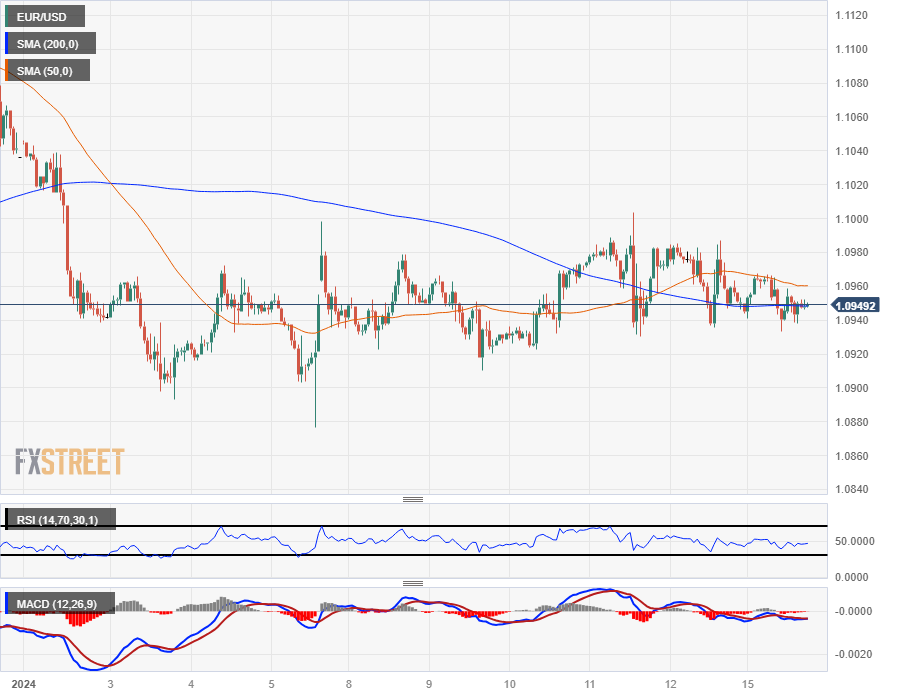
EUR/USD Daily Chart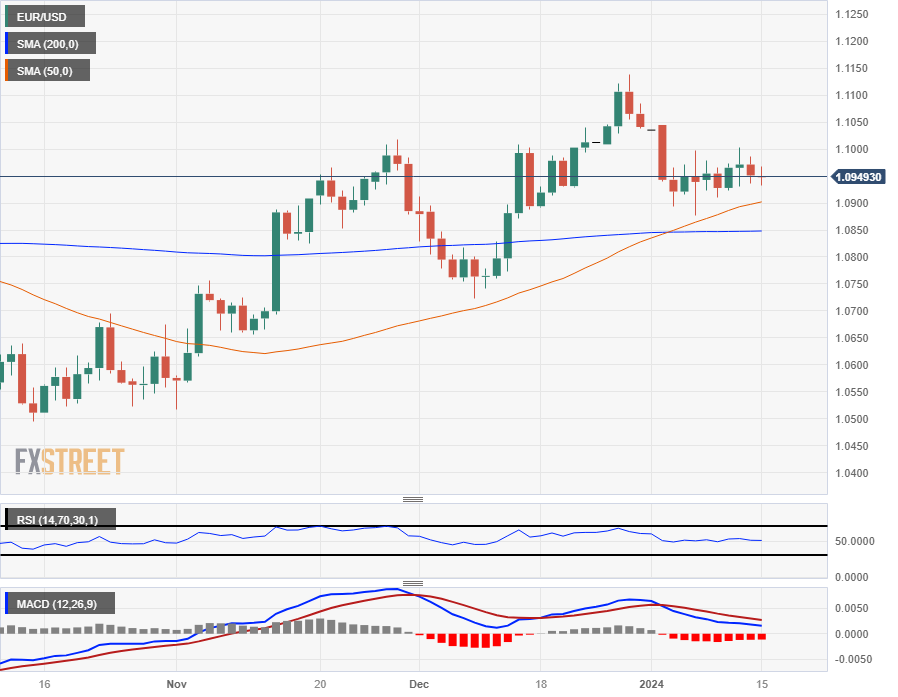
Euro FAQs
What is the Euro?
The Euro is the currency for the 20 European Union countries that belong to the Eurozone. It is the second most heavily traded currency in the world behind the US Dollar. In 2022, it accounted for 31% of all foreign exchange transactions, with an average daily turnover of over $2.2 trillion a day.
EUR/USD is the most heavily traded currency pair in the world, accounting for an estimated 30% off all transactions, followed by EUR/JPY (4%), EUR/GBP (3%) and EUR/AUD (2%).
What is the ECB and how does it impact the Euro?
The European Central Bank (ECB) in Frankfurt, Germany, is the reserve bank for the Eurozone. The ECB sets interest rates and manages monetary policy.
The ECB’s primary mandate is to maintain price stability, which means either controlling inflation or stimulating growth. Its primary tool is the raising or lowering of interest rates. Relatively high interest rates – or the expectation of higher rates – will usually benefit the Euro and vice versa.
The ECB Governing Council makes monetary policy decisions at meetings held eight times a year. Decisions are made by heads of the Eurozone national banks and six permanent members, including the President of the ECB, Christine Lagarde.
How does inflation data impact the value of the Euro?
Eurozone inflation data, measured by the Harmonized Index of Consumer Prices (HICP), is an important econometric for the Euro. If inflation rises more than expected, especially if above the ECB’s 2% target, it obliges the ECB to raise interest rates to bring it back under control.
Relatively high interest rates compared to its counterparts will usually benefit the Euro, as it makes the region more attractive as a place for global investors to park their money.
How does economic data influence the value of the Euro?
Data releases gauge the health of the economy and can impact on the Euro. Indicators such as GDP, Manufacturing and Services PMIs, employment, and consumer sentiment surveys can all influence the direction of the single currency.
A strong economy is good for the Euro. Not only does it attract more foreign investment but it may encourage the ECB to put up interest rates, which will directly strengthen the Euro. Otherwise, if economic data is weak, the Euro is likely to fall.
Economic data for the four largest economies in the euro area (Germany, France, Italy and Spain) are especially significant, as they account for 75% of the Eurozone’s economy.
How does the Trade Balance impact the Euro?
Another significant data release for the Euro is the Trade Balance. This indicator measures the difference between what a country earns from its exports and what it spends on imports over a given period.
If a country produces highly sought after exports then its currency will gain in value purely from the extra demand created from foreign buyers seeking to purchase these goods. Therefore, a positive net Trade Balance strengthens a currency and vice versa for a negative balance.







© 2000-2026. Bản quyền Teletrade.
Trang web này được quản lý bởi Teletrade D.J. LLC 2351 LLC 2022 (Euro House, Richmond Hill Road, Kingstown, VC0100, St. Vincent and the Grenadines).
Thông tin trên trang web không phải là cơ sở để đưa ra quyết định đầu tư và chỉ được cung cấp cho mục đích làm quen.
Giao dịch trên thị trường tài chính (đặc biệt là giao dịch sử dụng các công cụ biên) mở ra những cơ hội lớn và tạo điều kiện cho các nhà đầu tư sẵn sàng mạo hiểm để thu lợi nhuận, tuy nhiên nó mang trong mình nguy cơ rủi ro khá cao. Chính vì vậy trước khi tiến hành giao dịch cần phải xem xét mọi mặt vấn đề chấp nhận tiến hành giao dịch cụ thể xét theo quan điểm của nguồn lực tài chính sẵn có và mức độ am hiểu thị trường tài chính.
Sử dụng thông tin: sử dụng toàn bộ hay riêng biệt các dữ liệu trên trang web của công ty TeleTrade như một nguồn cung cấp thông tin nhất định. Việc sử dụng tư liệu từ trang web cần kèm theo liên kết đến trang teletrade.vn. Việc tự động thu thập số liệu cũng như thông tin từ trang web TeleTrade đều không được phép.
Xin vui lòng liên hệ với pr@teletrade.global nếu có câu hỏi.


 Chuyển khoản
 ngân hàng


