- Phân tích
- Tin tức và các công cụ
- Tin tức thị trường
- USD/INR trades flat as Fed signals fewer rate cuts ahead
USD/INR trades flat as Fed signals fewer rate cuts ahead
- The Indian Rupee holds steady in Thursday’s Asian session.
- Persistent demand for USD and a cautious outlook from Fed officials might add further pressure on the INR.
- The US weekly Initial Jobless Claims, Existing Home Sales and final reading of Q3 GDP data will be released later on Thursday.
The Indian Rupee (INR) flat lines on Thursday. The renewed US dollar (USD) demand from importers, foreign banks, foreign fund outflows and a muted trend in domestic equities further undermine the local currency. Furthermore, the US Federal Reserve (Fed) lowered its key interest rate by a quarter percentage point at its December meeting on Wednesday and also projected a slower pace of cuts in 2025. This, in turn, boosts the Greenback against the INR.
Nonetheless, the downside of the INR might be limited as the Reserve Bank of India (RBI) is likely to intervene in the market to prevent excess volatility. Traders will keep an eye on the US weekly Initial Jobless Claims, Existing Home Sales and final reading of Gross Domestic Product Annualized for the third quarter (Q3), which are due later on Thursday.
Indian Rupee consolidates after the Fed rate decision
- A rise in gold imports that widened India's trade deficit to a record in November and pushed the INR to a record low was due to an error in calculation, Bloomberg News reported on Wednesday, citing people with knowledge of the matter.
- “There is pressure on the rupee due to the demand for dollars from foreign clients. However, the rupee is performing better than other currencies. The depreciation is gradual. Now it is expected to trade in a narrow range and 85 per dollar level will be protected,” said the treasury head at a state-owned bank.
- On Wednesday, the Fed reduced the Federal Funds Rate by 25 basis points (bps) to a target range of 4.25%-4.50%, back to the level where it was in December 2022.
- The Fed expects to continue cutting rates next year, although it is now penciling in two rate cuts, down from the four it had forecast in September, according to the Summary of Economic Projections, or “dot plot”.
- The dot plot saw the committee lower its expected unemployment rate this year to 4.2% and raise its projection for 2024 Gross Domestic Product growth to 2.5%.
USD/INR’s broader trend remains constructive
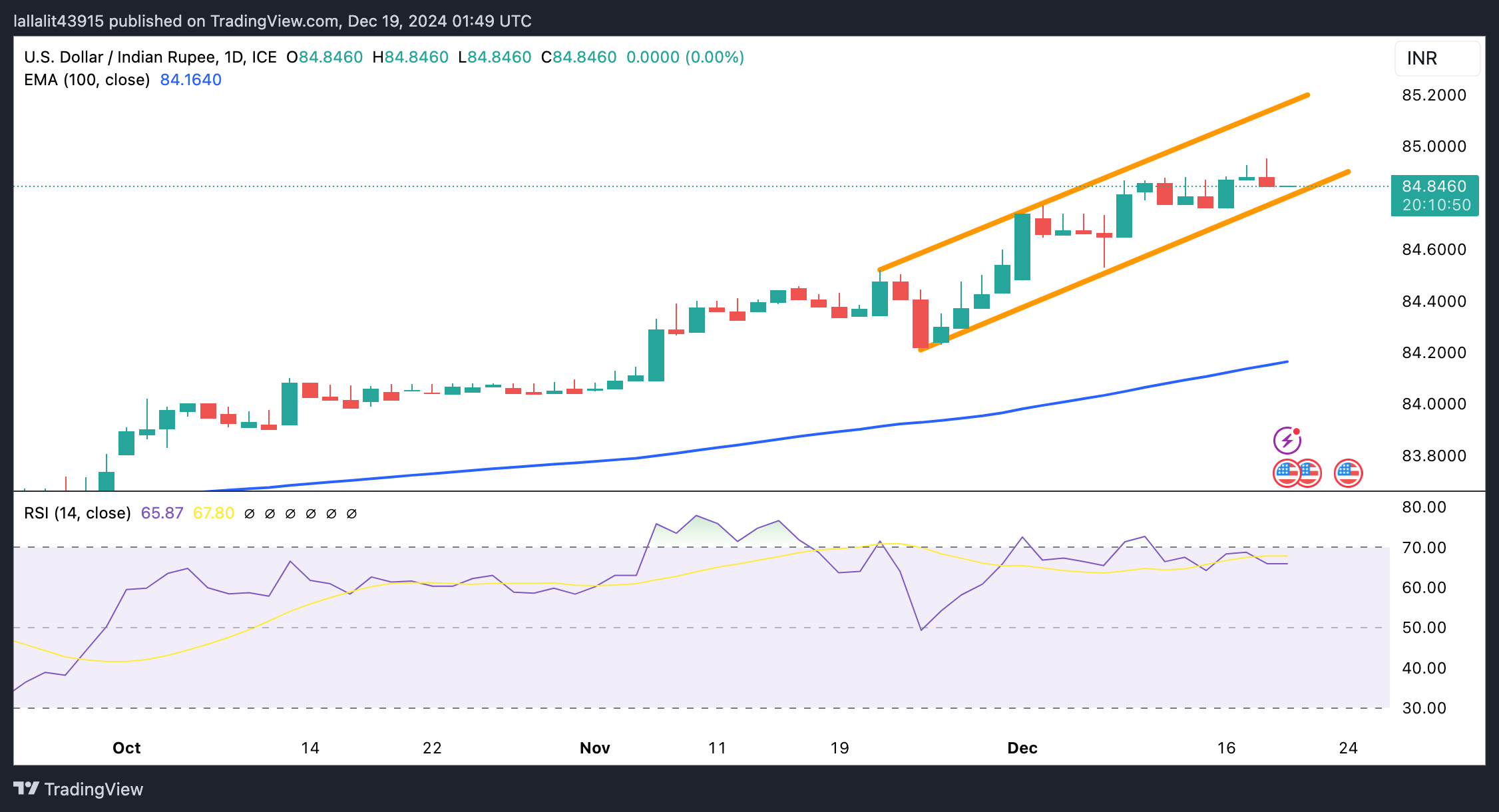
The Indian Rupee trades on a flat note on the day. The USD/INR pair maintains a strong uptrend on the daily chart, with the price holding above the key 100-day Exponential Moving Average (EMA). The path of least resistance is to the upside as the 14-day Relative Strength Index (RSI) is above the midline near 65.85, suggesting bullish pressure is present.
The ascending trend channel and the psychological level of 85.00 appear to be a tough nut to crack for bulls. The breakout above this level could see a rally to the next upside target at 85.50.
On the other hand, the initial support level emerges at 84.82, the lower boundary of the trend channel. A breach of the mentioned level could expose 84.22, the low of November 25. Bearish candlesticks could see a drop to 84.16, the 100-day EMA.
Indian Rupee FAQs
The Indian Rupee (INR) is one of the most sensitive currencies to external factors. The price of Crude Oil (the country is highly dependent on imported Oil), the value of the US Dollar – most trade is conducted in USD – and the level of foreign investment, are all influential. Direct intervention by the Reserve Bank of India (RBI) in FX markets to keep the exchange rate stable, as well as the level of interest rates set by the RBI, are further major influencing factors on the Rupee.
The Reserve Bank of India (RBI) actively intervenes in forex markets to maintain a stable exchange rate, to help facilitate trade. In addition, the RBI tries to maintain the inflation rate at its 4% target by adjusting interest rates. Higher interest rates usually strengthen the Rupee. This is due to the role of the ‘carry trade’ in which investors borrow in countries with lower interest rates so as to place their money in countries’ offering relatively higher interest rates and profit from the difference.
Macroeconomic factors that influence the value of the Rupee include inflation, interest rates, the economic growth rate (GDP), the balance of trade, and inflows from foreign investment. A higher growth rate can lead to more overseas investment, pushing up demand for the Rupee. A less negative balance of trade will eventually lead to a stronger Rupee. Higher interest rates, especially real rates (interest rates less inflation) are also positive for the Rupee. A risk-on environment can lead to greater inflows of Foreign Direct and Indirect Investment (FDI and FII), which also benefit the Rupee.
Higher inflation, particularly, if it is comparatively higher than India’s peers, is generally negative for the currency as it reflects devaluation through oversupply. Inflation also increases the cost of exports, leading to more Rupees being sold to purchase foreign imports, which is Rupee-negative. At the same time, higher inflation usually leads to the Reserve Bank of India (RBI) raising interest rates and this can be positive for the Rupee, due to increased demand from international investors. The opposite effect is true of lower inflation.







© 2000-2026. Bản quyền Teletrade.
Trang web này được quản lý bởi Teletrade D.J. LLC 2351 LLC 2022 (Euro House, Richmond Hill Road, Kingstown, VC0100, St. Vincent and the Grenadines).
Thông tin trên trang web không phải là cơ sở để đưa ra quyết định đầu tư và chỉ được cung cấp cho mục đích làm quen.
Giao dịch trên thị trường tài chính (đặc biệt là giao dịch sử dụng các công cụ biên) mở ra những cơ hội lớn và tạo điều kiện cho các nhà đầu tư sẵn sàng mạo hiểm để thu lợi nhuận, tuy nhiên nó mang trong mình nguy cơ rủi ro khá cao. Chính vì vậy trước khi tiến hành giao dịch cần phải xem xét mọi mặt vấn đề chấp nhận tiến hành giao dịch cụ thể xét theo quan điểm của nguồn lực tài chính sẵn có và mức độ am hiểu thị trường tài chính.
Sử dụng thông tin: sử dụng toàn bộ hay riêng biệt các dữ liệu trên trang web của công ty TeleTrade như một nguồn cung cấp thông tin nhất định. Việc sử dụng tư liệu từ trang web cần kèm theo liên kết đến trang teletrade.vn. Việc tự động thu thập số liệu cũng như thông tin từ trang web TeleTrade đều không được phép.
Xin vui lòng liên hệ với pr@teletrade.global nếu có câu hỏi.


 Chuyển khoản
 ngân hàng


