- Phân tích
- Tin tức và các công cụ
- Tin tức thị trường
- Silver Price Forecast: XAG/USD extends recovery near $30 despite Fed supports fewer rate cuts
Silver Price Forecast: XAG/USD extends recovery near $30 despite Fed supports fewer rate cuts
- Silver price recovers further to near $29.90 even though US bond yields rise as Fed officials support fewer interest rate cuts in 2025.
- Soft monthly US PCE inflation raised uncertainty over the Fed's shallow rate-cut path.
- Silver price is expected to struggle in an attempt to extend the upward-sloping trendline above $30.00.
Silver price (XAG/USD) extends Friday’s recovery move to near $29.90 in Monday’s European session. The white metal rebounded strongly on Friday from a more than three-month low of $28.75 after the release of the United States (US) Personal Consumption Expenditure Price Index (PCE) data for November, which showed that price pressures grew at a slower pace than expectations.
Core PCE inflation, the Federal Reserve’s (Fed) preferred inflation gauge, rose steadily by 2.8% but slower than estimates of 2.9%. The month-on-month headline and core PCE inflation grew marginally by 0.1%, raising uncertainty over whether the Fed will follow a shallow rate-cut path in 2025, as projected in the Fed’s dot plot from the December policy meeting.
The recent Fed dot plot showed that officials collectively see Federal Fund rates heading to 3.9% by the end of 2025.
Silver prices advanced on Monday even though US Treasury yields remain higher as Federal Reserve (Fed) policymakers support fewer interest rate cuts next year. 10-year US Treasury yields moved higher to near 4.54%. Generally, higher yields on interest-bearing assets weigh on non-yielding assets, such as Silver, as they result in higher opportunity costs for them. The US Dollar Index (DXY), which tracks the Greenback’s value against six major currencies, ticked higher to near 108.00.
On Friday, a string of Fed officials backed a shallow policy-easing approach amid a slowdown in the disinflation trend, better labor market conditions than previously anticipated, and uncertainty over President-elect Donald Trump's incoming policies.
Silver technical analysis
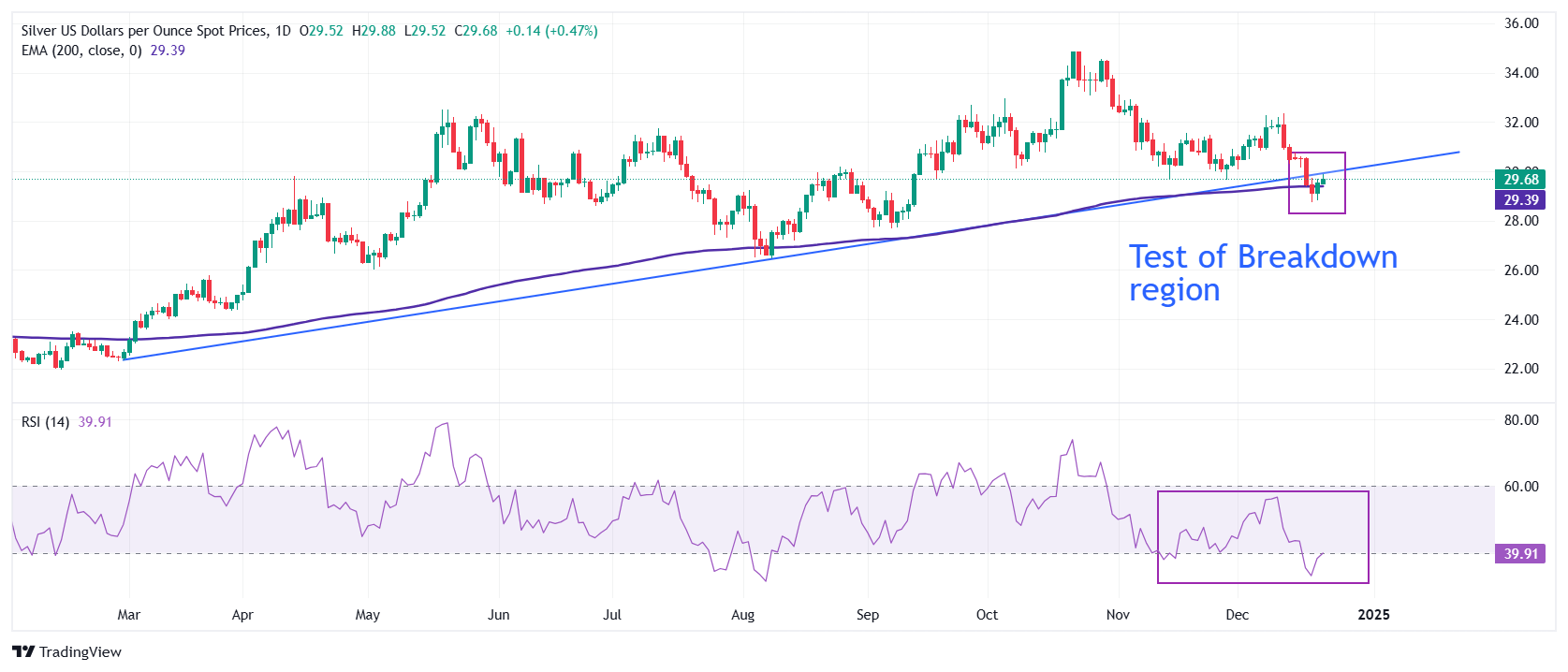
Silver price recovers to test the breakdown of the upward-sloping trendline near $30.00, which is plotted from the February 29 low of $22.30 on a daily timeframe. The white metal wobbles around the 200-day Exponential Moving Average (EMA), suggesting that the longer-term outlook is uncertain.
The 14-day Relative Strength Index (RSI) rebounds to near 40.00. A fresh bearish momentum would trigger if it fails to break above that level.
Looking down, the September low of $27.75 would act as key support for the Silver price. On the upside, the 50-day EMA around $30.90 would be the barrier.
Silver daily chart
Silver FAQs
Silver is a precious metal highly traded among investors. It has been historically used as a store of value and a medium of exchange. Although less popular than Gold, traders may turn to Silver to diversify their investment portfolio, for its intrinsic value or as a potential hedge during high-inflation periods. Investors can buy physical Silver, in coins or in bars, or trade it through vehicles such as Exchange Traded Funds, which track its price on international markets.
Silver prices can move due to a wide range of factors. Geopolitical instability or fears of a deep recession can make Silver price escalate due to its safe-haven status, although to a lesser extent than Gold's. As a yieldless asset, Silver tends to rise with lower interest rates. Its moves also depend on how the US Dollar (USD) behaves as the asset is priced in dollars (XAG/USD). A strong Dollar tends to keep the price of Silver at bay, whereas a weaker Dollar is likely to propel prices up. Other factors such as investment demand, mining supply – Silver is much more abundant than Gold – and recycling rates can also affect prices.
Silver is widely used in industry, particularly in sectors such as electronics or solar energy, as it has one of the highest electric conductivity of all metals – more than Copper and Gold. A surge in demand can increase prices, while a decline tends to lower them. Dynamics in the US, Chinese and Indian economies can also contribute to price swings: for the US and particularly China, their big industrial sectors use Silver in various processes; in India, consumers’ demand for the precious metal for jewellery also plays a key role in setting prices.
Silver prices tend to follow Gold's moves. When Gold prices rise, Silver typically follows suit, as their status as safe-haven assets is similar. The Gold/Silver ratio, which shows the number of ounces of Silver needed to equal the value of one ounce of Gold, may help to determine the relative valuation between both metals. Some investors may consider a high ratio as an indicator that Silver is undervalued, or Gold is overvalued. On the contrary, a low ratio might suggest that Gold is undervalued relative to Silver.







© 2000-2026. Bản quyền Teletrade.
Trang web này được quản lý bởi Teletrade D.J. LLC 2351 LLC 2022 (Euro House, Richmond Hill Road, Kingstown, VC0100, St. Vincent and the Grenadines).
Thông tin trên trang web không phải là cơ sở để đưa ra quyết định đầu tư và chỉ được cung cấp cho mục đích làm quen.
Giao dịch trên thị trường tài chính (đặc biệt là giao dịch sử dụng các công cụ biên) mở ra những cơ hội lớn và tạo điều kiện cho các nhà đầu tư sẵn sàng mạo hiểm để thu lợi nhuận, tuy nhiên nó mang trong mình nguy cơ rủi ro khá cao. Chính vì vậy trước khi tiến hành giao dịch cần phải xem xét mọi mặt vấn đề chấp nhận tiến hành giao dịch cụ thể xét theo quan điểm của nguồn lực tài chính sẵn có và mức độ am hiểu thị trường tài chính.
Sử dụng thông tin: sử dụng toàn bộ hay riêng biệt các dữ liệu trên trang web của công ty TeleTrade như một nguồn cung cấp thông tin nhất định. Việc sử dụng tư liệu từ trang web cần kèm theo liên kết đến trang teletrade.vn. Việc tự động thu thập số liệu cũng như thông tin từ trang web TeleTrade đều không được phép.
Xin vui lòng liên hệ với pr@teletrade.global nếu có câu hỏi.


 Chuyển khoản
 ngân hàng


