- Phân tích
- Tin tức và các công cụ
- Tin tức thị trường
- USD/CNH Price Forecast: The bullish tone remains in play above 7.3150
USD/CNH Price Forecast: The bullish tone remains in play above 7.3150
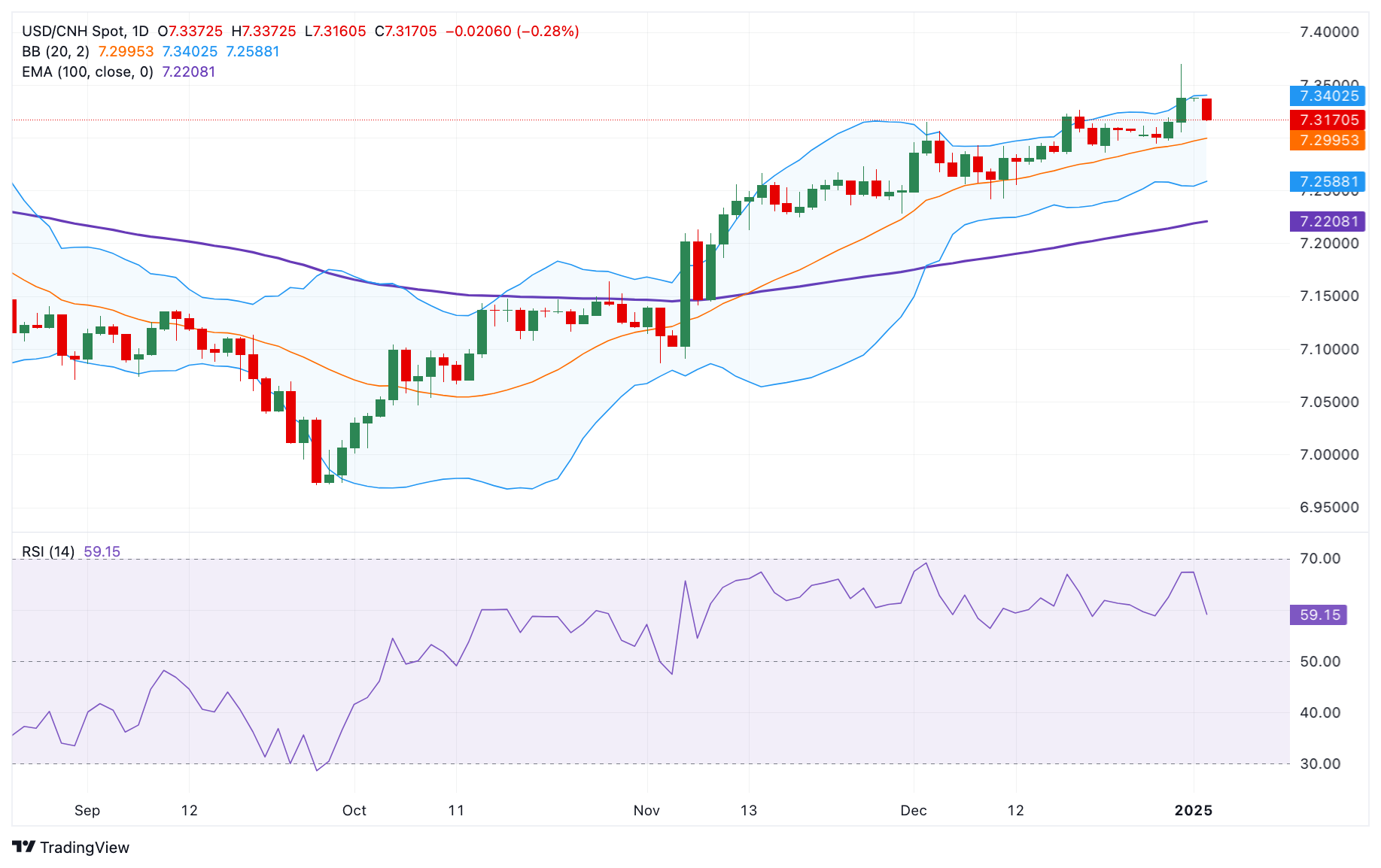
- USD/CNH weakens to around 7.3170 in Thursday’s early European session, down 0.29% on the day.
- The positive view of the pair prevails above the key 100-day EMA with the bullish RSI indicator.
- The first upside barrier is seen in the 7.3400-7.3405 zone; the initial support level is located at 7.2974.
The USD/CNH pair attracts some sellers to near 7.3170 during the early European trading hours on Thursday. However, the downside for the pair might be limited amid the prospect of slower US interest rate cuts in 2025 and the potential protectionist policies under incoming President Donald Trump.
The latest Chinese Caixin Manufacturing Purchasing Managers Index (PMI) showed that the country’s manufacturing sector came in weaker than expected in December. This reading raised concerns over a slowing economic recovery in the world's second-largest economy and might create a headwind for the Chinese Yuan.
According to the daily chart, the bullish outlook of USD/CNH remains intact, characterised by the price holding above the key 100-period Exponential Moving Average (EMA). The upward momentum is supported by the Relative Strength Index (RSI), which stands above the midline near 59.30, suggesting the path of least resistance is to the upside.
The confluence of the upper boundary of the Bollinger Band and the psychological level at the 7.3400-7.3405 region acts as an immediate resistance level for the pair. A decisive break above this level could pave the way to 7.3697, the high of December 31.
On the downside, the initial support level for USD/CNH emerges at 7.2974, the low of December 30. Extended losses could see a drop to 7.2745, the low of December 13. The additional downside filter to watch is 7.2588, the lower limit of the Bollinger Band.
USD/CNH daily chart
Fed FAQs
Monetary policy in the US is shaped by the Federal Reserve (Fed). The Fed has two mandates: to achieve price stability and foster full employment. Its primary tool to achieve these goals is by adjusting interest rates. When prices are rising too quickly and inflation is above the Fed’s 2% target, it raises interest rates, increasing borrowing costs throughout the economy. This results in a stronger US Dollar (USD) as it makes the US a more attractive place for international investors to park their money. When inflation falls below 2% or the Unemployment Rate is too high, the Fed may lower interest rates to encourage borrowing, which weighs on the Greenback.
The Federal Reserve (Fed) holds eight policy meetings a year, where the Federal Open Market Committee (FOMC) assesses economic conditions and makes monetary policy decisions. The FOMC is attended by twelve Fed officials – the seven members of the Board of Governors, the president of the Federal Reserve Bank of New York, and four of the remaining eleven regional Reserve Bank presidents, who serve one-year terms on a rotating basis.
In extreme situations, the Federal Reserve may resort to a policy named Quantitative Easing (QE). QE is the process by which the Fed substantially increases the flow of credit in a stuck financial system. It is a non-standard policy measure used during crises or when inflation is extremely low. It was the Fed’s weapon of choice during the Great Financial Crisis in 2008. It involves the Fed printing more Dollars and using them to buy high grade bonds from financial institutions. QE usually weakens the US Dollar.
Quantitative tightening (QT) is the reverse process of QE, whereby the Federal Reserve stops buying bonds from financial institutions and does not reinvest the principal from the bonds it holds maturing, to purchase new bonds. It is usually positive for the value of the US Dollar.







© 2000-2026. Bản quyền Teletrade.
Trang web này được quản lý bởi Teletrade D.J. LLC 2351 LLC 2022 (Euro House, Richmond Hill Road, Kingstown, VC0100, St. Vincent and the Grenadines).
Thông tin trên trang web không phải là cơ sở để đưa ra quyết định đầu tư và chỉ được cung cấp cho mục đích làm quen.
Giao dịch trên thị trường tài chính (đặc biệt là giao dịch sử dụng các công cụ biên) mở ra những cơ hội lớn và tạo điều kiện cho các nhà đầu tư sẵn sàng mạo hiểm để thu lợi nhuận, tuy nhiên nó mang trong mình nguy cơ rủi ro khá cao. Chính vì vậy trước khi tiến hành giao dịch cần phải xem xét mọi mặt vấn đề chấp nhận tiến hành giao dịch cụ thể xét theo quan điểm của nguồn lực tài chính sẵn có và mức độ am hiểu thị trường tài chính.
Sử dụng thông tin: sử dụng toàn bộ hay riêng biệt các dữ liệu trên trang web của công ty TeleTrade như một nguồn cung cấp thông tin nhất định. Việc sử dụng tư liệu từ trang web cần kèm theo liên kết đến trang teletrade.vn. Việc tự động thu thập số liệu cũng như thông tin từ trang web TeleTrade đều không được phép.
Xin vui lòng liên hệ với pr@teletrade.global nếu có câu hỏi.


 Chuyển khoản
 ngân hàng


