- Phân tích
- Tin tức và các công cụ
- Tin tức thị trường
- Japanese Yen remains on the front foot against USD; upside potential seems limited
Japanese Yen remains on the front foot against USD; upside potential seems limited
- The Japanese Yen attracts safe-haven flows and strengthens for the third straight day.
- The BoJ rate hike uncertainty might hold back the JPY bulls from placing fresh bets.
- Hawkish Fed expectations underpin the USD and lend support to the USD/JPY pair.
The Japanese Yen (JPY) ticks higher against its American counterpart for the third successive day on Monday and moves away from a multi-month low touched last week. The risk-off impulse – as depicted by a weaker tone around the equity markets – turns out to be a key factor underpinning the safe-haven JPY. However, doubts over the BoJ's rate hike plans should cap gains for the JPY.
The broadening inflationary pressure in Japan keeps the door open for another BoJ rate hike in January or March. That said, some investors are betting that the BoJ may wait until April to seek confirmation that strong wage momentum will carry over into the spring negotiations. Furthermore, the recent widening of the US-Japan yield differential could also contribute to capping the JPY.
Apart from this, the underlying bullish sentiment surrounding the US Dollar (USD), bolstered by expectations that the Federal Reserve (Fed) will pause its rate-cutting cycle, should act as a tailwind for the USD/JPY pair. In the absence of any relevant economic releases, the mixed fundamental backdrop warrants caution before positioning for any further JPY appreciating move.
Japanese Yen draws support from the global flight to safety mode; lacks bullish conviction
- A mix of geopolitical tensions and rate jitters temper investors' appetite for riskier assets, which, in turn, benefits traditional safe-haven assets and drives flows towards the Japanese Yen for the third straight day on Monday.
- The Office of Foreign Assets Control (OFAC) said on Friday that the US and the UK administration imposed tougher sanctions against Russia's oil industry, targeting nearly 200 vessels of the so-called shadow fleet.
- The Russian Defence Ministry said on Sunday that Russian forces have carried out strikes on Ukrainian military airfields, personnel and vehicles in 139 locations using its air force, drones, missiles and artillery.
- In an apparent violation of the ceasefire agreement between Israel and Hezbollah, more Israeli strikes have been reported in Lebanon. Moreover, Israeli strikes continued across Gaza amid renewed ceasefire talks.
- The US Bureau of Labor Statistics (BLS) reported on Friday that Nonfarm Payrolls rose by 256,000 in December compared to 212,000 in the previous month and market expectations for a reading of 160,000.
- Other details showed that the Unemployment Rate unexpectedly edged lower to 4.1% from 4.2%, while annual wage inflation, as measured by the change in the Average Hourly Earnings, declined to 3.9%.
- The upbeat US jobs report reinforced market expectations that the Federal Reserve will pause its rate-cutting cycle at its upcoming policy meeting later this month amid lingering inflation and political uncertainty.
- This, in turn, pushed the US Dollar to over a two-year peak and the US Treasury yields to the highest in over a year, widening the US-Japan yield differential, which should cap the upside for the lower-yielding JPY.
- The market focus now shifts to the release of the US Producer Price Index (PPI) and the US Consumer Price Index (CPI) on Tuesday and Wednesday, respectively, which will play a key role in influencing the USD/JPY pair.
USD/JPY might continue to attract some dip-buyers; 156.00 holds the key for bulls
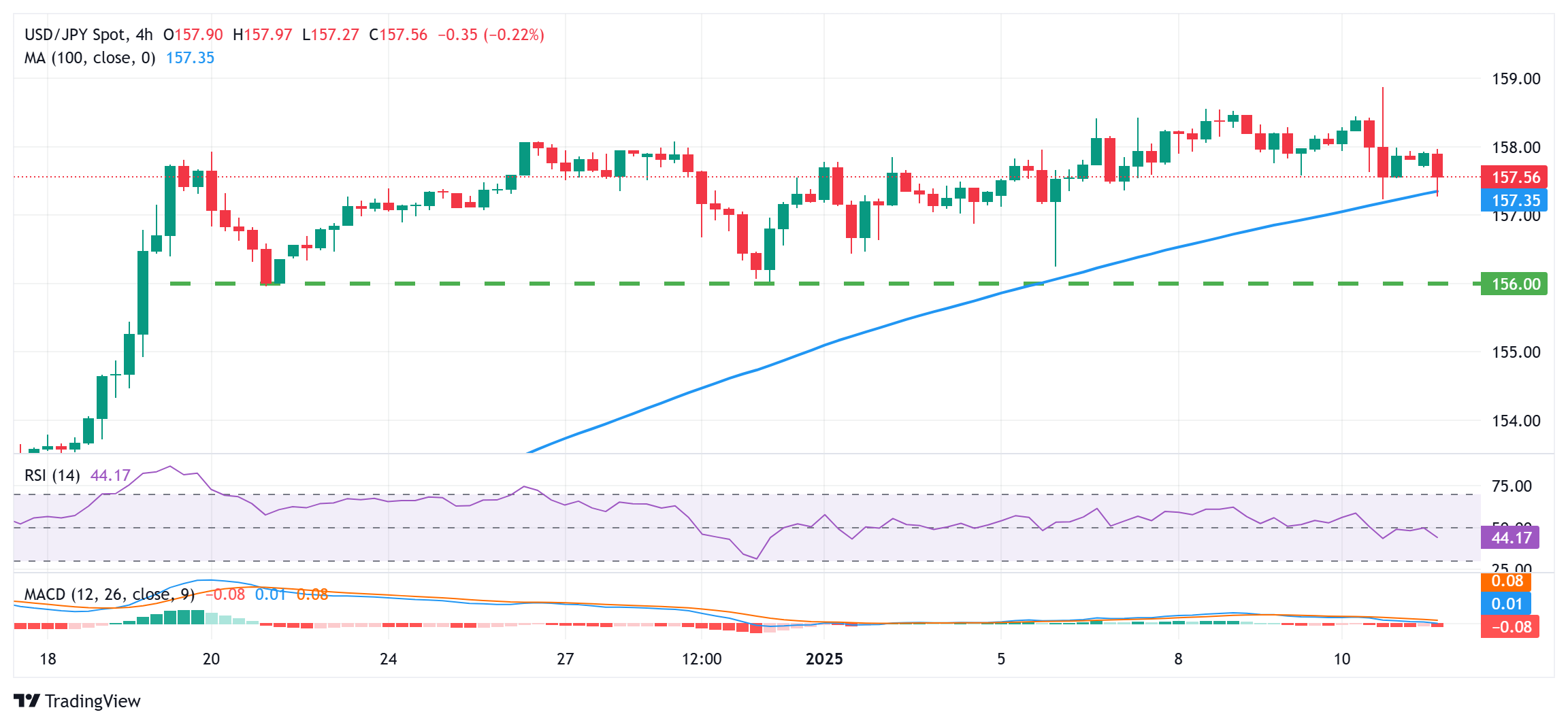
From a technical perspective, Friday's low, around the 157.20-157.20 region, could offer immediate support ahead of the 157.00 mark and the 156.80-156.75 support zone. Any further weakness could be seen as a buying opportunity near last week's swing low, around the 156.25-156.20 area. This should help limit the downside for the USD/JPY pair near the 156.00 mark, which if broken decisively might shift the near-term bias in favor of bearish traders and pave the way for deeper losses.
On the flip side, the Asian session high, around the 158.00 neighborhood, now seems to act as an immediate hurdle ahead of the 158.45-158.50 region and the 158.85-158.90 zone, or the multi-month peak touched on Friday. Some follow-through buying beyond the 159.00 mark will be seen as a fresh trigger for bulls and lift the USD/JPY pair towards the next relevant hurdle near mid-159.00s en route to the 160.00 psychological mark.
Japanese Yen FAQs
The Japanese Yen (JPY) is one of the world’s most traded currencies. Its value is broadly determined by the performance of the Japanese economy, but more specifically by the Bank of Japan’s policy, the differential between Japanese and US bond yields, or risk sentiment among traders, among other factors.
One of the Bank of Japan’s mandates is currency control, so its moves are key for the Yen. The BoJ has directly intervened in currency markets sometimes, generally to lower the value of the Yen, although it refrains from doing it often due to political concerns of its main trading partners. The BoJ ultra-loose monetary policy between 2013 and 2024 caused the Yen to depreciate against its main currency peers due to an increasing policy divergence between the Bank of Japan and other main central banks. More recently, the gradually unwinding of this ultra-loose policy has given some support to the Yen.
Over the last decade, the BoJ’s stance of sticking to ultra-loose monetary policy has led to a widening policy divergence with other central banks, particularly with the US Federal Reserve. This supported a widening of the differential between the 10-year US and Japanese bonds, which favored the US Dollar against the Japanese Yen. The BoJ decision in 2024 to gradually abandon the ultra-loose policy, coupled with interest-rate cuts in other major central banks, is narrowing this differential.
The Japanese Yen is often seen as a safe-haven investment. This means that in times of market stress, investors are more likely to put their money in the Japanese currency due to its supposed reliability and stability. Turbulent times are likely to strengthen the Yen’s value against other currencies seen as more risky to invest in.







© 2000-2026. Bản quyền Teletrade.
Trang web này được quản lý bởi Teletrade D.J. LLC 2351 LLC 2022 (Euro House, Richmond Hill Road, Kingstown, VC0100, St. Vincent and the Grenadines).
Thông tin trên trang web không phải là cơ sở để đưa ra quyết định đầu tư và chỉ được cung cấp cho mục đích làm quen.
Giao dịch trên thị trường tài chính (đặc biệt là giao dịch sử dụng các công cụ biên) mở ra những cơ hội lớn và tạo điều kiện cho các nhà đầu tư sẵn sàng mạo hiểm để thu lợi nhuận, tuy nhiên nó mang trong mình nguy cơ rủi ro khá cao. Chính vì vậy trước khi tiến hành giao dịch cần phải xem xét mọi mặt vấn đề chấp nhận tiến hành giao dịch cụ thể xét theo quan điểm của nguồn lực tài chính sẵn có và mức độ am hiểu thị trường tài chính.
Sử dụng thông tin: sử dụng toàn bộ hay riêng biệt các dữ liệu trên trang web của công ty TeleTrade như một nguồn cung cấp thông tin nhất định. Việc sử dụng tư liệu từ trang web cần kèm theo liên kết đến trang teletrade.vn. Việc tự động thu thập số liệu cũng như thông tin từ trang web TeleTrade đều không được phép.
Xin vui lòng liên hệ với pr@teletrade.global nếu có câu hỏi.


 Chuyển khoản
 ngân hàng


