- Phân tích
- Tin tức và các công cụ
- Tin tức thị trường
- US Dollar flat ahead of US NFP data
US Dollar flat ahead of US NFP data
- The US Dollar trades mixed this Friday ahead of the US Nonfarm Payrolls release.
- Markets expect weaker Nonfarm Payrolls data to spark more interest rate cut expectations from the Fed.
- The US Dollar Index (DXY) is back near pivotal support at 107.35 and could rip through it on a weaker NFP print.
The US Dollar Index (DXY), which tracks the performance of the US Dollar against six major currencies, trades at 107.65 at the time of writing on Friday, slightly lower in the runup to the US Nonfarm Payrolls (NFP) report for January. Consensus is for a substantially weaker print, taking into account the recent economic US numbers pointing to a slowdown or consolidation in the jobs market. A much weaker Nonfarm Payrolls number could spark hopes for more than two interest rate cuts from the Federal Reserve (Fed) in 2025.
Expectations for the Nonfarm Payrolls data are for 170,000 new workers in the month compared to 256,000 in December. The estimated range is between 105,000 at the lowest estimate and 240,000 at the high end of the range. Any print below 105,000 will spark substantial US Dollar (USD) weakness and might see the DXY break below 107.00.
Daily digest market movers: US NFP report and nothing else
- At 13:30 GMT, the US Nonfarm Payrolls report for January will be released:
- Nonfarm Payrolls data is expected to come in at 170,000, from 256,000 in December.
- Monthly Average Hourly Wages are expected to remain unchanged at 0.3%.
- The Unemployment Rate should remain stable at 4.1%.
- At 14:25 GMT, Fed Governor Michelle Bowman delivers a speech on bank regulation at the 2025 Wisconsin Bankers Association Bank Executives Conference.
- At 17:00 GMT, Fed Governor Adriana Kugler speaks on "Entrepreneurship and Aggregate Productivity" at the 2025 Miami Economic Forum in Miami, Florida.
- Equities are looking for direction on Friday, with minor gains and losses in the European markets. US futures are roughly flat on the day.
- The CME FedWatch tool projects an 85.5% chance that the Fed will keep interest rates unchanged at its next meeting on March 19.
- The US 10-year yield is trading around 4.43%, recovering from its fresh yearly low at 4.40% printed on Wednesday.
US Dollar Index Technical Analysis: No help in sight
The US Dollar Index (DXY) is in a tough spot at the moment. The current tariff implementations from US President Donald Trump are not clearly having the same impact on the Greenback as back in March of 2018, when the first tariffs on China were implemented. Markets are instead rather looking at US yields gapping lower and US economic data starting to open room for more than two interest rate cuts from the Federal Reserve this year. If the NFP print this Friday comes in substantially softer, expect markets to price in three interest rate cuts by the Fed for 2025 and the DXY fall to 106.00.
On the upside, the first barrier at 109.30 (July 14, 2022, high and rising trendline) was briefly surpassed but did not hold on Monday. Once that level is reclaimed, the next level to hit before advancing further remains at 110.79 (September 7, 2022, high).
On the downside, the October 3, 2023, high at 107.35 is still acting as support while the Relative Strength Index (RSI) has used the rather calm last three days to catch a breather and now has more downside room to pull the DXY lower. Hence, look for 106.52 (April 16, 2024, high) or even 105.98 (resistance in June 2024 and 100-day Simple Moving Average) as better support levels.
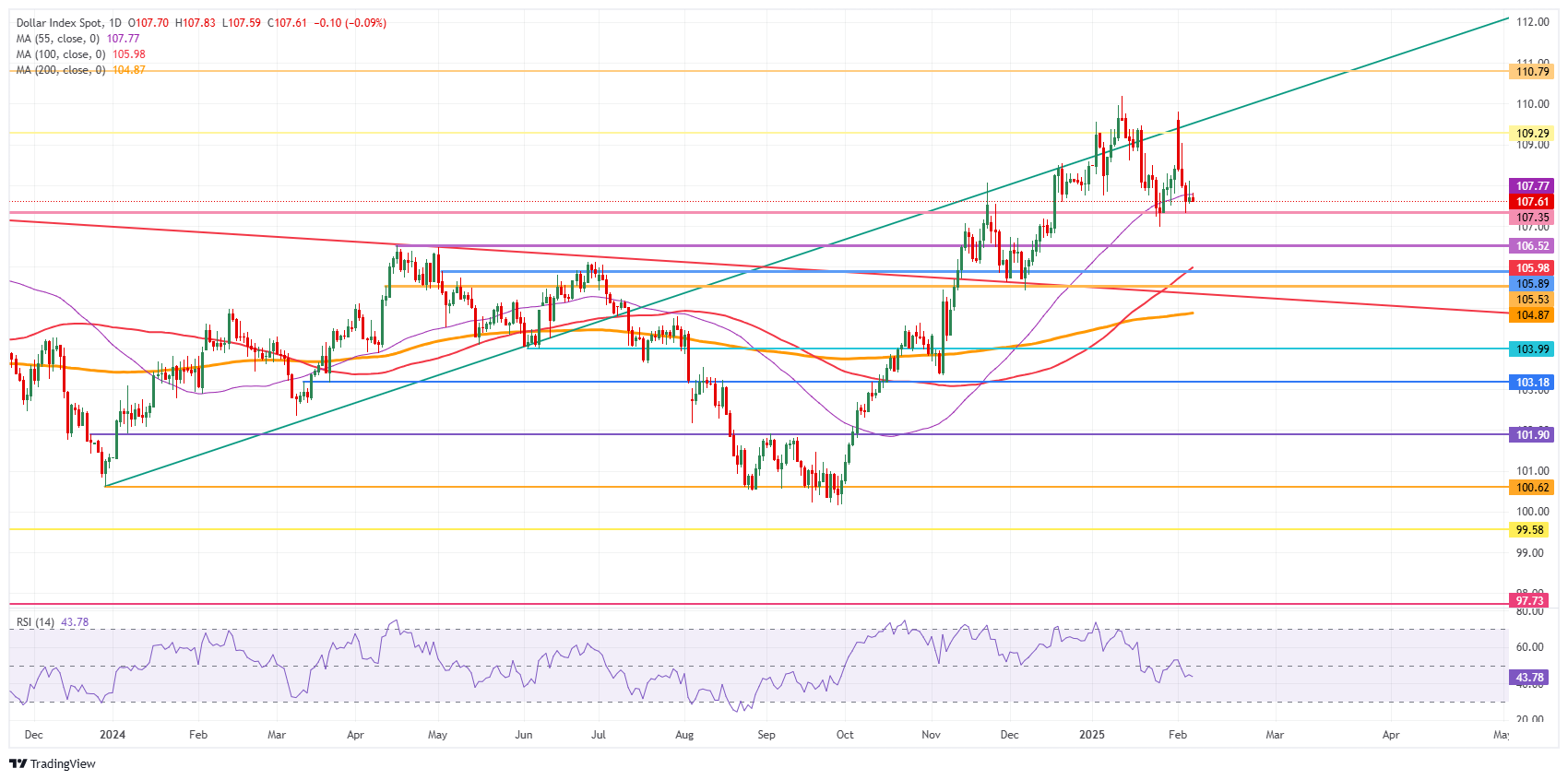
US Dollar Index: Daily Chart
US Dollar FAQs
The US Dollar (USD) is the official currency of the United States of America, and the ‘de facto’ currency of a significant number of other countries where it is found in circulation alongside local notes. It is the most heavily traded currency in the world, accounting for over 88% of all global foreign exchange turnover, or an average of $6.6 trillion in transactions per day, according to data from 2022. Following the second world war, the USD took over from the British Pound as the world’s reserve currency. For most of its history, the US Dollar was backed by Gold, until the Bretton Woods Agreement in 1971 when the Gold Standard went away.
The most important single factor impacting on the value of the US Dollar is monetary policy, which is shaped by the Federal Reserve (Fed). The Fed has two mandates: to achieve price stability (control inflation) and foster full employment. Its primary tool to achieve these two goals is by adjusting interest rates. When prices are rising too quickly and inflation is above the Fed’s 2% target, the Fed will raise rates, which helps the USD value. When inflation falls below 2% or the Unemployment Rate is too high, the Fed may lower interest rates, which weighs on the Greenback.
In extreme situations, the Federal Reserve can also print more Dollars and enact quantitative easing (QE). QE is the process by which the Fed substantially increases the flow of credit in a stuck financial system. It is a non-standard policy measure used when credit has dried up because banks will not lend to each other (out of the fear of counterparty default). It is a last resort when simply lowering interest rates is unlikely to achieve the necessary result. It was the Fed’s weapon of choice to combat the credit crunch that occurred during the Great Financial Crisis in 2008. It involves the Fed printing more Dollars and using them to buy US government bonds predominantly from financial institutions. QE usually leads to a weaker US Dollar.
Quantitative tightening (QT) is the reverse process whereby the Federal Reserve stops buying bonds from financial institutions and does not reinvest the principal from the bonds it holds maturing in new purchases. It is usually positive for the US Dollar.







© 2000-2026. Bản quyền Teletrade.
Trang web này được quản lý bởi Teletrade D.J. LLC 2351 LLC 2022 (Euro House, Richmond Hill Road, Kingstown, VC0100, St. Vincent and the Grenadines).
Thông tin trên trang web không phải là cơ sở để đưa ra quyết định đầu tư và chỉ được cung cấp cho mục đích làm quen.
Giao dịch trên thị trường tài chính (đặc biệt là giao dịch sử dụng các công cụ biên) mở ra những cơ hội lớn và tạo điều kiện cho các nhà đầu tư sẵn sàng mạo hiểm để thu lợi nhuận, tuy nhiên nó mang trong mình nguy cơ rủi ro khá cao. Chính vì vậy trước khi tiến hành giao dịch cần phải xem xét mọi mặt vấn đề chấp nhận tiến hành giao dịch cụ thể xét theo quan điểm của nguồn lực tài chính sẵn có và mức độ am hiểu thị trường tài chính.
Sử dụng thông tin: sử dụng toàn bộ hay riêng biệt các dữ liệu trên trang web của công ty TeleTrade như một nguồn cung cấp thông tin nhất định. Việc sử dụng tư liệu từ trang web cần kèm theo liên kết đến trang teletrade.vn. Việc tự động thu thập số liệu cũng như thông tin từ trang web TeleTrade đều không được phép.
Xin vui lòng liên hệ với pr@teletrade.global nếu có câu hỏi.


 Chuyển khoản
 ngân hàng


