- Phân tích
- Tin tức và các công cụ
- Tin tức thị trường
- Japanese Yen buying remains unabated; USD/JPY dives to mid-150.00s
Japanese Yen buying remains unabated; USD/JPY dives to mid-150.00s
- The Japanese Yen continues to strengthen amid rising bets for additional BoJ rate hikes.
- Trump’s tariff threats weigh on investors’ sentiment but also benefit the safe-haven JPY.
- The Fed's hawkish outlook fails to impress the USD bulls or lend support to USD/JPY.
The Japanese Yen (JPY) gained strong follow-through traction on Thursday and dragged the USD/JPY pair to its lowest level since December 9, around mid-150.00s during the Asian session. Firming expectations that the Bank of Japan (BoJ) would increase interest rates further push the Japanese government bond (JGB) yields to their highest levels in more than a decade. The resultant narrowing of the rate differential between Japan and other countries turns out to be a key factor that continues to drive flows toward the lower-yielding JPY.
Meanwhile, US President Donald Trump's fresh tariff threats dampen investors' appetite for riskier assets. This is evident from a fresh leg down in the equity markets and further underpins demand for the safe-haven JPY. The US Dollar (USD), on the other hand, struggles to lure buyers despite hawkish FOMC meeting minutes released on Wednesday, which further contributes to the USD/JPY pair's decline. With the latest leg down, the currency pair confirms a breakdown below the 151.00 mark and seems vulnerable to weaken further.
Japanese Yen continues to draw support from hawkish BoJ-inspired rise in JGB yields
- Bank of Japan board member Hajime Takata said on Wednesday that Japan's real interest rates remain deeply negative and the central bank must adjust the degree of monetary support further if the economy moves in line with forecasts.
- This comes on top of Japan's upbeat Q4 Gross Domestic Product (GDP) on Monday and cements expectations that the BoJ would hike interest rates further, which continues to push the Japanese government bond (JGB) yields higher.
- The yield on the benchmark 10-year JGB hits its highest since November 2009, which, in turn, provides a strong boost to the Japanese Yen during the Asian session on Thursday amid a fresh wave of the global risk aversion trade.
- US President Donald Trump said on Wednesday that he will announce tariffs on a number of products next month or even sooner, fueling concerns about a global trade war and tempering investors' appetite for riskier assets.
- The Asahi newspaper reported this Thursday that Japan's Trade Minister, Yoji Muto, is planning a trip to the US in March to request that the Trump administration exempt Japan from upcoming tariffs on steel and automobiles.
- Minutes from the January FOMC meeting released on Wednesday revealed that officials noted a high degree of uncertainty that requires the central bank to take a careful approach in considering any further interest rate cuts.
- Fed Vice Chairman Philip Jefferson noted that the US economic performance has been quite strong, the US labor market is solid, inflation has eased but is still elevated, and the path back to 2% inflation could be bumpy.
- Separately, Chicago Fed President Austan Goolsbee said that inflation has decreased but it is still excessive and once inflation falls, rates can fall more. This, however, does little to provide any meaningful impetus to the US Dollar.
- Thursday's US economic docket features the release of Weekly Initial Jobless Claims and the Philly Fed Manufacturing Index. Apart from this, speeches by influential FOMC members will drive the USD and the USD/JPY pair.
USD/JPY seems vulnerable to slide further; 151.00-150.90 support breakdown in play
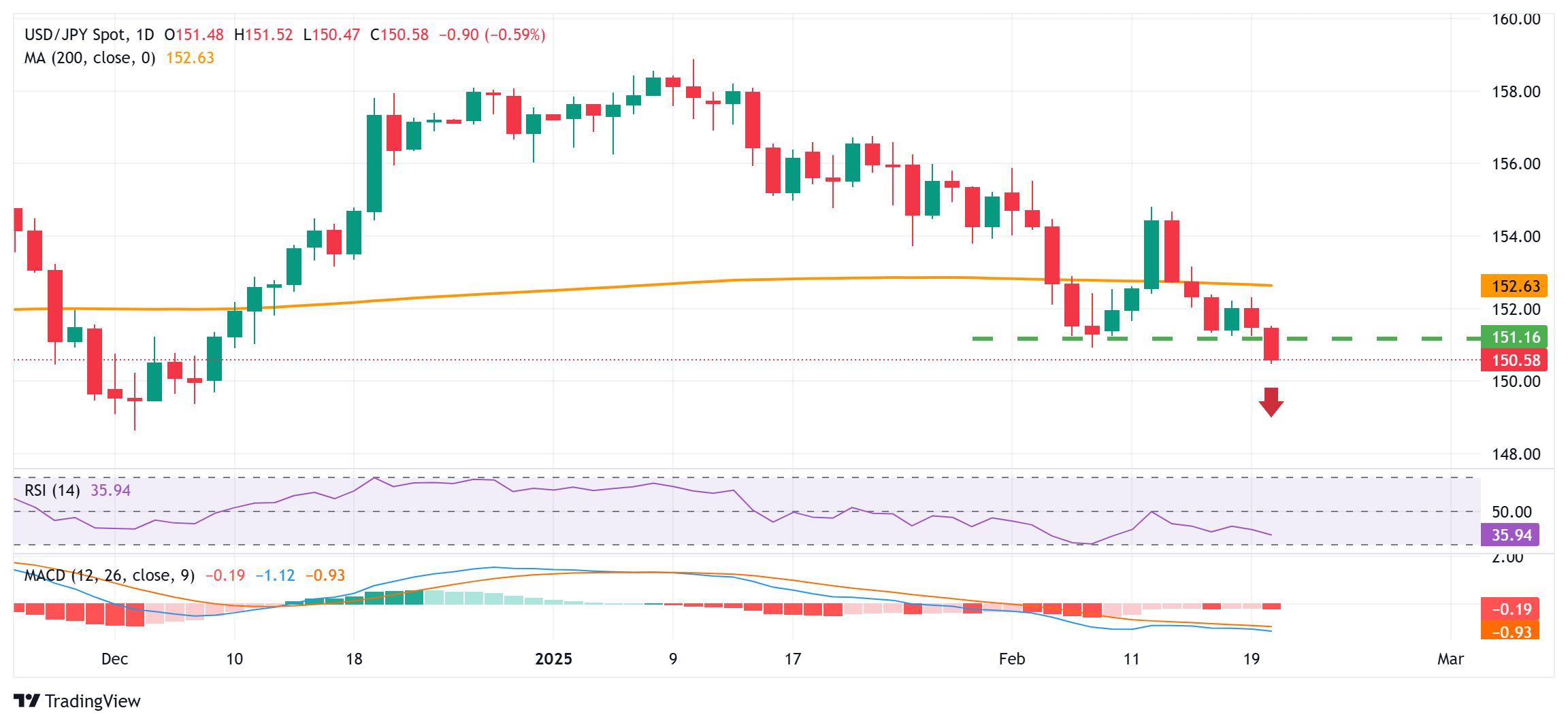
From a technical perspective, a sustained break and acceptance below the 151.00 mark could be seen as a fresh trigger for bearish traders. Moreover, oscillators on the daily chart are holding deep in negative territory and are still away from being in the oversold zone. This, in turn, suggests that the path of least resistance for the USD/JPY pair is to the downside and supports prospects for a slide toward the 150.00 psychological mark. The downward trajectory could extend further towards the 149.60-149.55 region en route to the 149.00 mark and the December 2024 low, around the 148.65 region.
On the flip side, the 150.90-151.00 horizontal support breakpoint now seems to act as an immediate hurdle, above which a bout of a short-covering could lift the USD/JPY pair to the 151.40 hurdle. Any further move up could be seen as a selling opportunity around the 152.00 round-figure mark and runs the risk of fizzling out rather quickly near the 152.65 area. The latter represents the very important 200-day Simple Moving Average (SMA) and should act as a key pivotal point for short-term traders.
Japanese Yen FAQs
The Japanese Yen (JPY) is one of the world’s most traded currencies. Its value is broadly determined by the performance of the Japanese economy, but more specifically by the Bank of Japan’s policy, the differential between Japanese and US bond yields, or risk sentiment among traders, among other factors.
One of the Bank of Japan’s mandates is currency control, so its moves are key for the Yen. The BoJ has directly intervened in currency markets sometimes, generally to lower the value of the Yen, although it refrains from doing it often due to political concerns of its main trading partners. The BoJ ultra-loose monetary policy between 2013 and 2024 caused the Yen to depreciate against its main currency peers due to an increasing policy divergence between the Bank of Japan and other main central banks. More recently, the gradually unwinding of this ultra-loose policy has given some support to the Yen.
Over the last decade, the BoJ’s stance of sticking to ultra-loose monetary policy has led to a widening policy divergence with other central banks, particularly with the US Federal Reserve. This supported a widening of the differential between the 10-year US and Japanese bonds, which favored the US Dollar against the Japanese Yen. The BoJ decision in 2024 to gradually abandon the ultra-loose policy, coupled with interest-rate cuts in other major central banks, is narrowing this differential.
The Japanese Yen is often seen as a safe-haven investment. This means that in times of market stress, investors are more likely to put their money in the Japanese currency due to its supposed reliability and stability. Turbulent times are likely to strengthen the Yen’s value against other currencies seen as more risky to invest in.







© 2000-2026. Bản quyền Teletrade.
Trang web này được quản lý bởi Teletrade D.J. LLC 2351 LLC 2022 (Euro House, Richmond Hill Road, Kingstown, VC0100, St. Vincent and the Grenadines).
Thông tin trên trang web không phải là cơ sở để đưa ra quyết định đầu tư và chỉ được cung cấp cho mục đích làm quen.
Giao dịch trên thị trường tài chính (đặc biệt là giao dịch sử dụng các công cụ biên) mở ra những cơ hội lớn và tạo điều kiện cho các nhà đầu tư sẵn sàng mạo hiểm để thu lợi nhuận, tuy nhiên nó mang trong mình nguy cơ rủi ro khá cao. Chính vì vậy trước khi tiến hành giao dịch cần phải xem xét mọi mặt vấn đề chấp nhận tiến hành giao dịch cụ thể xét theo quan điểm của nguồn lực tài chính sẵn có và mức độ am hiểu thị trường tài chính.
Sử dụng thông tin: sử dụng toàn bộ hay riêng biệt các dữ liệu trên trang web của công ty TeleTrade như một nguồn cung cấp thông tin nhất định. Việc sử dụng tư liệu từ trang web cần kèm theo liên kết đến trang teletrade.vn. Việc tự động thu thập số liệu cũng như thông tin từ trang web TeleTrade đều không được phép.
Xin vui lòng liên hệ với pr@teletrade.global nếu có câu hỏi.


 Chuyển khoản
 ngân hàng


