- Phân tích
- Tin tức và các công cụ
- Tin tức thị trường
- EUR/USD Price Forecast: Crucial resistance level emerges above 1.0500
EUR/USD Price Forecast: Crucial resistance level emerges above 1.0500
- EUR/USD gains traction to around 1.0470 in Tuesday’s Asian session.
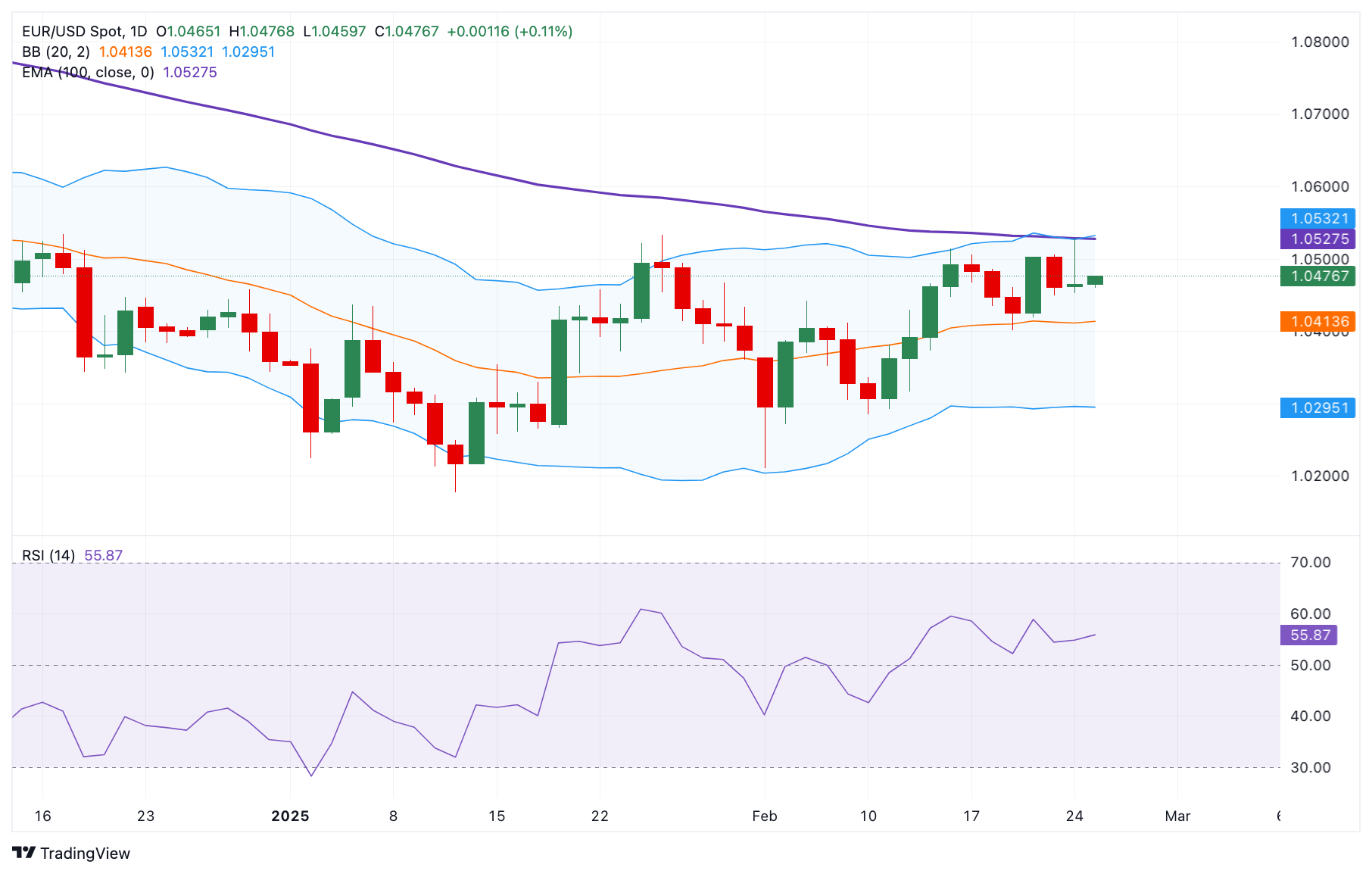
- The pair keeps the negative outlook below the 100-period EMA with a bearish RSI indicator.
- The initial support emerges at 1.0400; the first upside barrier is in the 1.0525-1.0530 zone.
The EUR/USD pair gathers strength to near 1.0470 during the Asian trading hours on Tuesday. The Euro (EUR) gains ground after the conservative alliance made up by the Christian Democratic Union (CDU) and its allies the Christian Social Union (CSU) is set to lead Germany again following the federal election on Sunday, bringing an end to a period of political instability that has dogged Berlin for months.
Technically, the bearish outlook of EUR/USD remains in play, with the major pair remaining capped below the key 100-period Exponential Moving Average (EMA) on the daily chart. However, further upside cannot be ruled out as the 14-day Relative Strength Index (RSI) stands above the midline around 55.50.
The first downside target for the major pair emerges at 1.0400, representing the psychological mark and the low of February 19. Extended losses could see a drop to the lower limit of the Bollinger Band at 1.0295. A decisive break below the mentioned level could pave the way to 1.0210, the low of February 3.
On the bright side, the key resistance level for the major pair is located at 1.0525-1.0530, portraying the 100-day EMA and the upper boundary of the Bollinger Band. Sustained trading above this level could attract some buyers to 1.0630, the high of December 6, 2024. Further north, the next hurdle is seen at 1.0777, the low of August 1, 2024.
EUR/USD daily chart
ECB FAQs
The European Central Bank (ECB) in Frankfurt, Germany, is the reserve bank for the Eurozone. The ECB sets interest rates and manages monetary policy for the region. The ECB primary mandate is to maintain price stability, which means keeping inflation at around 2%. Its primary tool for achieving this is by raising or lowering interest rates. Relatively high interest rates will usually result in a stronger Euro and vice versa. The ECB Governing Council makes monetary policy decisions at meetings held eight times a year. Decisions are made by heads of the Eurozone national banks and six permanent members, including the President of the ECB, Christine Lagarde.
In extreme situations, the European Central Bank can enact a policy tool called Quantitative Easing. QE is the process by which the ECB prints Euros and uses them to buy assets – usually government or corporate bonds – from banks and other financial institutions. QE usually results in a weaker Euro. QE is a last resort when simply lowering interest rates is unlikely to achieve the objective of price stability. The ECB used it during the Great Financial Crisis in 2009-11, in 2015 when inflation remained stubbornly low, as well as during the covid pandemic.
Quantitative tightening (QT) is the reverse of QE. It is undertaken after QE when an economic recovery is underway and inflation starts rising. Whilst in QE the European Central Bank (ECB) purchases government and corporate bonds from financial institutions to provide them with liquidity, in QT the ECB stops buying more bonds, and stops reinvesting the principal maturing on the bonds it already holds. It is usually positive (or bullish) for the Euro.







© 2000-2026. Bản quyền Teletrade.
Trang web này được quản lý bởi Teletrade D.J. LLC 2351 LLC 2022 (Euro House, Richmond Hill Road, Kingstown, VC0100, St. Vincent and the Grenadines).
Thông tin trên trang web không phải là cơ sở để đưa ra quyết định đầu tư và chỉ được cung cấp cho mục đích làm quen.
Giao dịch trên thị trường tài chính (đặc biệt là giao dịch sử dụng các công cụ biên) mở ra những cơ hội lớn và tạo điều kiện cho các nhà đầu tư sẵn sàng mạo hiểm để thu lợi nhuận, tuy nhiên nó mang trong mình nguy cơ rủi ro khá cao. Chính vì vậy trước khi tiến hành giao dịch cần phải xem xét mọi mặt vấn đề chấp nhận tiến hành giao dịch cụ thể xét theo quan điểm của nguồn lực tài chính sẵn có và mức độ am hiểu thị trường tài chính.
Sử dụng thông tin: sử dụng toàn bộ hay riêng biệt các dữ liệu trên trang web của công ty TeleTrade như một nguồn cung cấp thông tin nhất định. Việc sử dụng tư liệu từ trang web cần kèm theo liên kết đến trang teletrade.vn. Việc tự động thu thập số liệu cũng như thông tin từ trang web TeleTrade đều không được phép.
Xin vui lòng liên hệ với pr@teletrade.global nếu có câu hỏi.


 Chuyển khoản
 ngân hàng


