- Phân tích
- Tin tức và các công cụ
- Tin tức thị trường
- Australian Dollar appreciates despite a disappointing Q4 Private Capital Expenditure
Australian Dollar appreciates despite a disappointing Q4 Private Capital Expenditure
- The Australian Dollar holds gains after the release of a weaker-than-expected Private Capital Expenditure on Thursday.
- Australia’s Private Capital Expenditure unexpectedly contracted by 0.2% QoQ in Q4 2024, falling short of market expectations for 0.8% growth.
- The US Dollar continues to strengthen as traders evaluate the economy’s performance and the outlook on tariffs.
The Australian Dollar (AUD) holds gains against the US Dollar (USD) on Wednesday. The AUD/USD pair gains ground despite the release of disappointing Australia’s Private Capital Expenditure, which unexpectedly shrank by 0.2% quarter-on-quarter in the fourth quarter of 2024, missing market expectations of 0.8% growth and after an upwardly revised 1.6% expansion in the previous quarter.
Reserve Bank of Australia (RBA) Deputy Governor Andrew Hauser said he expects more positive news on inflation but emphasized the importance of seeing this progress materialize first. He noted that the tightness in Australia’s labor market remains a challenge for controlling inflation.
The AUD also faced challenges on Wednesday following Australia’s monthly Consumer Price Index (CPI), which rose by 2.5% year-over-year in January, compared to a 2.5% increase seen in December. The market forecast was for 2.6% growth in the reported period.
The AUD/USD pair faces challenges due to rising risk sentiment as US President Donald Trump said late Monday that sweeping US tariffs on imports from Canada and Mexico “will go forward” when a month-long delay on their implementation expires next week. Moreover, the Trump administration is aiming to tighten chip export controls on China, Australia’s close trading partner.
However, the downside of the AUD/USD pair could be limited as the People’s Bank of China (PBOC) injected CNY300 billion on Tuesday via the one-year Medium-term Lending Facility (MLF), maintaining the rate at 2%. Additionally, the PBOC injected CNY318.5 billion through seven-day reverse repos at 1.50%, consistent with the prior rate.
Australian Dollar could depreciate due to increased risk aversion
- The US Dollar Index (DXY), which measures the USD against six major currencies, gains ground as traders assess the strength of the economy and tariff outlook. The DXY extends its gains to near 106.50 at the time of writing.
- Federal Reserve Bank of Atlanta President Raphael Bostic said late Wednesday that the Fed should hold interest rates where they are, at a level that continues to put downward pressure on inflation, per Bloomberg.
- The White House said late Wednesday that US President Donald Trump issued an executive order aimed at implementing the Department of Government Efficiency's (DOGE) cost-cutting drive, per Reuters. The executive order requires agencies to justify spending, limit travel, and identify surplus federal properties that can be sold.
- President Trump signed a memorandum on Friday instructing the Committee on Foreign Investment in the United States (CFIUS) to limit Chinese investments in strategic sectors. Reuters cited a White House official saying that the national security memorandum seeks to encourage foreign investment while safeguarding US national security interests from potential threats posed by foreign adversaries like China.
- The Reserve Bank of Australia (RBA) lowered its Official Cash Rate (OCR) by 25 basis points to 4.10% last week—the first rate cut in four years. Reserve Bank of Australia (RBA) Governor Michele Bullock acknowledged the impact of high interest rates but cautioned that it was too soon to declare victory over inflation. She also emphasized the labor market's strength and clarified that future rate cuts are not guaranteed, despite market expectations.
Australian Dollar tests 0.6300 support as a bearish bias emerges
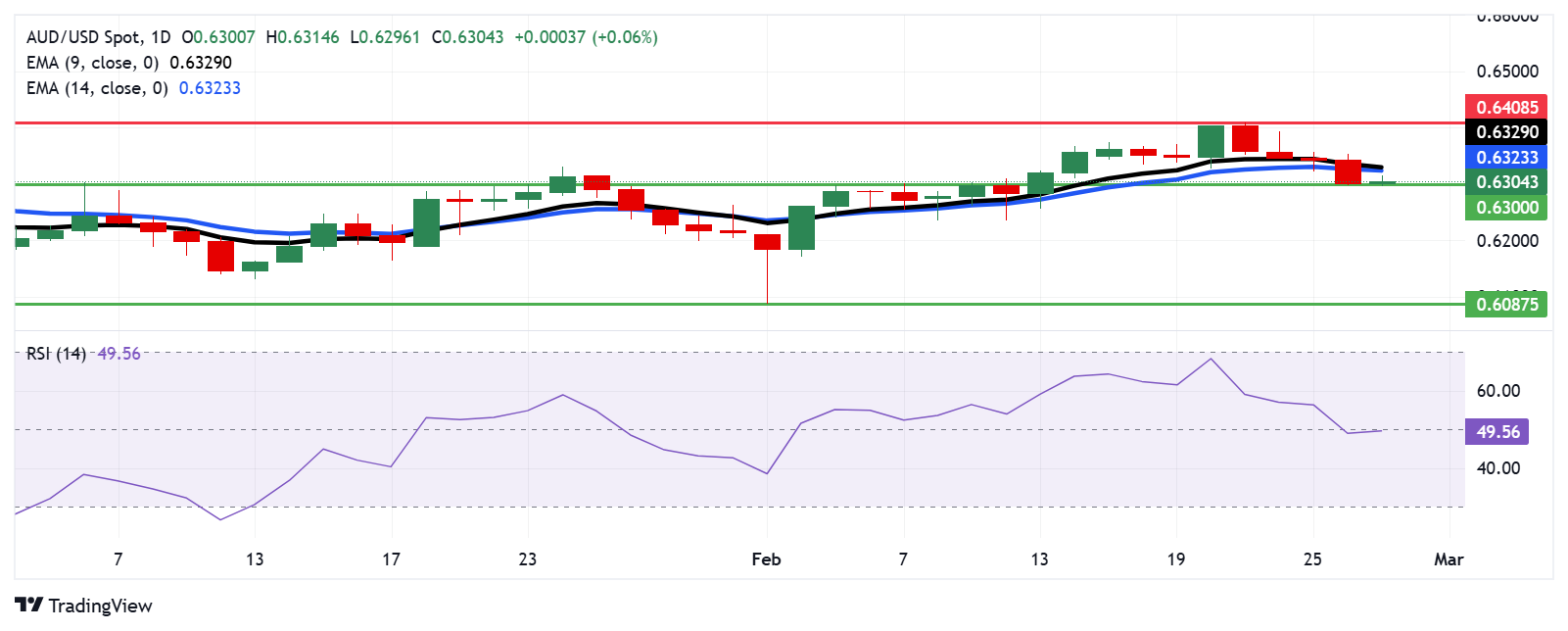
The AUD/USD pair hovers around 0.6300 on Thursday. Analysis of the daily chart indicates that the pair stays below the nine- and 14-day Exponential Moving Averages (EMAs), signaling weakening short-term price momentum. Moreover, the 14-day Relative Strength Index (RSI) remains below 50, reinforcing the prevailing bearish outlook.
The AUD/USD pair tests immediate support at the psychological level of 0.6300. A break below this threshold could push the pair toward the 0.6087 region, its lowest level since April 2020, recorded on February 3.
On the upside, the AUD/USD pair may face immediate resistance at the 14-day EMA of 0.6323, followed by the nine-day EMA at 0.6329. A decisive break above these levels could strengthen short-term price momentum, paving the way for the pair to challenge the two-month high of 0.6408, reached on February 21.
AUD/USD: Daily Chart
Australian Dollar PRICE Today
The table below shows the percentage change of Australian Dollar (AUD) against listed major currencies today. Australian Dollar was the strongest against the Swiss Franc.
| USD | EUR | GBP | JPY | CAD | AUD | NZD | CHF | |
|---|---|---|---|---|---|---|---|---|
| USD | 0.05% | 0.04% | 0.07% | 0.00% | -0.15% | -0.06% | 0.10% | |
| EUR | -0.05% | -0.00% | 0.03% | -0.04% | -0.19% | -0.10% | 0.05% | |
| GBP | -0.04% | 0.00% | 0.06% | -0.04% | -0.19% | -0.10% | 0.05% | |
| JPY | -0.07% | -0.03% | -0.06% | -0.09% | -0.24% | -0.18% | 0.00% | |
| CAD | -0.00% | 0.04% | 0.04% | 0.09% | -0.14% | -0.06% | 0.09% | |
| AUD | 0.15% | 0.19% | 0.19% | 0.24% | 0.14% | 0.09% | 0.24% | |
| NZD | 0.06% | 0.10% | 0.10% | 0.18% | 0.06% | -0.09% | 0.16% | |
| CHF | -0.10% | -0.05% | -0.05% | -0.00% | -0.09% | -0.24% | -0.16% |
The heat map shows percentage changes of major currencies against each other. The base currency is picked from the left column, while the quote currency is picked from the top row. For example, if you pick the Australian Dollar from the left column and move along the horizontal line to the US Dollar, the percentage change displayed in the box will represent AUD (base)/USD (quote).
Economic Indicator
Private Capital Expenditure
The Private Capital Expenditure released by the Australian Bureau of Statistics measures current and future capital expenditure intentions of the private sector. It is considered as an indicator for inflationary pressures. A high reading is seen as positive (or bullish) for the AUD, while a low reading is seen as negative (or bearish).
Read more.Last release: Thu Feb 27, 2025 00:30
Frequency: Quarterly
Actual: -0.2%
Consensus: 0.8%
Previous: 1.1%
Source: Australian Bureau of Statistics







© 2000-2026. Bản quyền Teletrade.
Trang web này được quản lý bởi Teletrade D.J. LLC 2351 LLC 2022 (Euro House, Richmond Hill Road, Kingstown, VC0100, St. Vincent and the Grenadines).
Thông tin trên trang web không phải là cơ sở để đưa ra quyết định đầu tư và chỉ được cung cấp cho mục đích làm quen.
Giao dịch trên thị trường tài chính (đặc biệt là giao dịch sử dụng các công cụ biên) mở ra những cơ hội lớn và tạo điều kiện cho các nhà đầu tư sẵn sàng mạo hiểm để thu lợi nhuận, tuy nhiên nó mang trong mình nguy cơ rủi ro khá cao. Chính vì vậy trước khi tiến hành giao dịch cần phải xem xét mọi mặt vấn đề chấp nhận tiến hành giao dịch cụ thể xét theo quan điểm của nguồn lực tài chính sẵn có và mức độ am hiểu thị trường tài chính.
Sử dụng thông tin: sử dụng toàn bộ hay riêng biệt các dữ liệu trên trang web của công ty TeleTrade như một nguồn cung cấp thông tin nhất định. Việc sử dụng tư liệu từ trang web cần kèm theo liên kết đến trang teletrade.vn. Việc tự động thu thập số liệu cũng như thông tin từ trang web TeleTrade đều không được phép.
Xin vui lòng liên hệ với pr@teletrade.global nếu có câu hỏi.


 Chuyển khoản
 ngân hàng


