- Phân tích
- Tin tức và các công cụ
- Tin tức thị trường
- Gold price trades with negative bias below $2,900 amid some USD dip-buying
Gold price trades with negative bias below $2,900 amid some USD dip-buying
- Gold price drifts lower on Tuesday amid bets that the Fed could keep rates higher for longer.
- The emergence of some USD buying contributes to driving flows away from the XAU/USD pair.
- Tariffs jitters and global trade war fears could lend support to the safe-haven precious metal.
Gold price (XAU/USD) struggles to capitalize on the previous day's positive move closer to the $2,900 mark and attracts some sellers during the Asian session on Tuesday, stalling its recovery from a three-week trough touched last Friday. Expectations that US President Donald Trump's trade tariffs would reignite inflation and force the Federal Reserve (Fed) to keep rates higher for longer undermine the non-yielding yellow metal. Apart from this, the emergence of some US Dollar (USD) buying turns out to be another factor weighing on the bullion.
Meanwhile, worries about the potential economic fallout from Trump's protectionist policies, which might trigger a global trade war, temper investors' appetite for riskier assets. This is evident from a generally weaker tone around the equity markets and could offer some support to the safe-haven Gold price. Apart from this, geopolitical risks might contribute to limiting any further losses for the bullion. Traders might also refrain from placing aggressive bets and opt to wait for the release of the US Nonfarm Payrolls (NFP) report on Friday.
Daily Digest Market Movers: Gold price struggles to lure buyers despite supporting factors
- Investors remain worried that US President Donald Trump's trade tariffs would increase price pressures and allow the Federal Reserve to stick to its hawkish stance, prompting some selling around the Gold price on Tuesday.
- Trump's tariffs on Mexico and Canada are taking effect this Tuesday, along with a new 10% levy on Chinese goods. Trump also said that reciprocal tariffs would take effect on April 2 on countries that impose duties on US products.
- The Canadian prime minister's office confirmed that Canada will impose retaliatory tariffs on US imports. China’s Commerce Ministry vowed to take necessary countermeasures to safeguard legitimate rights and interests.
- This raises the risk of a global trade war and weighs on investors' sentiment, which should act as a tailwind for the safe-haven precious metal and help limit any deeper losses amid a bearish tone surrounding the US Dollar.
- The Institute for Supply Management's (ISM) Manufacturing PMI slipped to 50.3 in February from 50.9 in the previous month, while the Prices Paid Index jumped to a nearly three-year high amid worries about duties on imports.
- This comes on top of worries that Trump's trade tariffs would undermine consumer spending and fuel concerns about the outlook for the world’s largest economy. This could further lend support to the XAU/USD pair.
- Ukrainian President Volodymyr Zelenskiy's meeting with Trump ended in disaster on Friday. Furthermore, a White House official confirmed that the US has paused military aid to Ukraine, adding to the uncertainty in markets.
- The market focus will remain glued to the release of the US monthly employment details – popularly known as the Nonfarm Payrolls (NFP) report on Friday. The crucial data would influence the USD and the yellow metal.
Gold price needs to find acceptance above the $2,900 mark for bulls to regain control
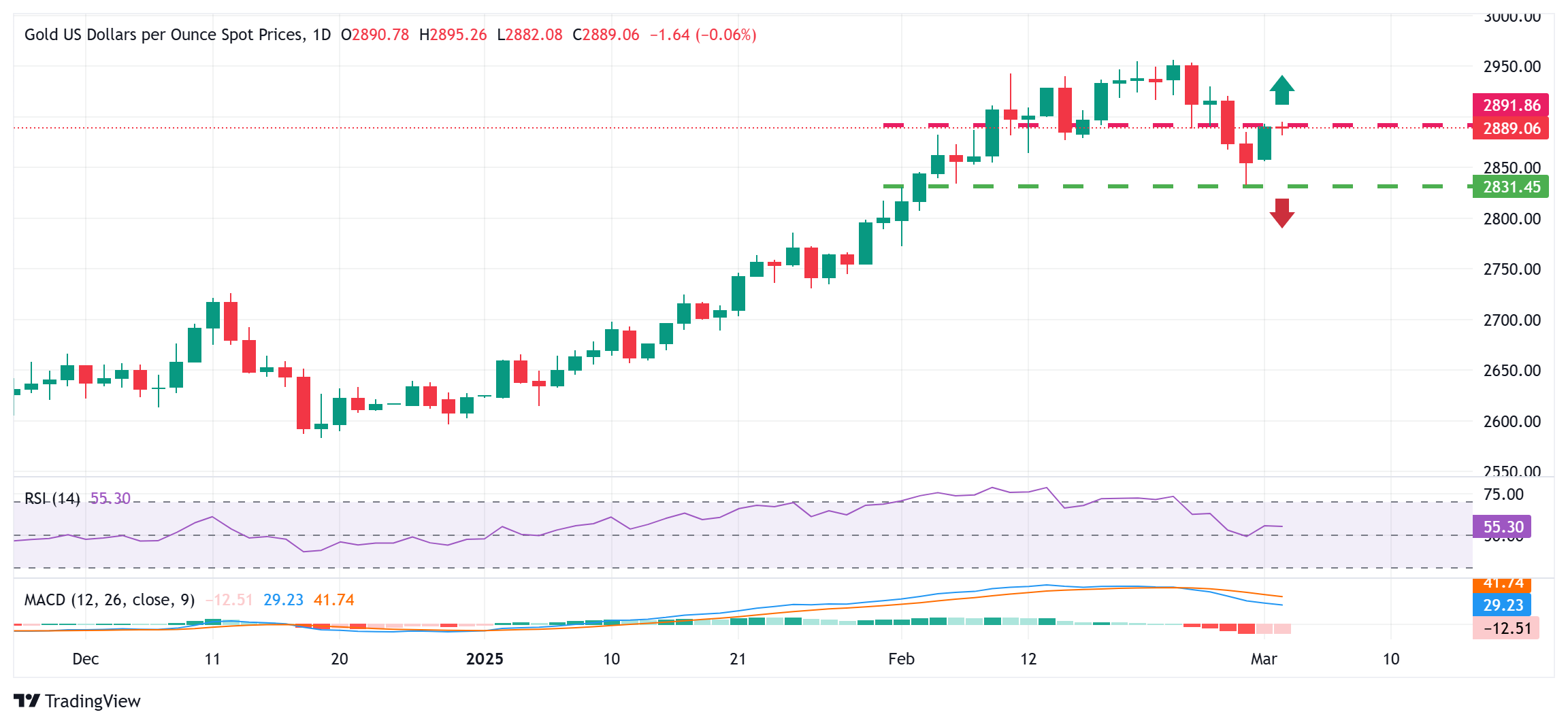
From a technical perspective, failure ahead of the $2,900 mark warrants some caution for bullish traders. That said, oscillators on the daily chart – though they have been losing traction – are holding in positive territory and support prospects for the emergence of some dip-buyers near the $2,860 immediate support. This is followed by the multi-week low, around the $2,833-2,832 region touched last Friday, below which the Gold price could accelerate the fall further towards the $2,800 round figure.
On the flip side, bulls might wait for sustained strength and acceptance back above the $2,900 mark before placing fresh bets. The subsequent move up could lift the Gold price to the $2,934 intermediate hurdle en route to the record high, around the $2,956 region touched last Monday.
Gold FAQs
Gold has played a key role in human’s history as it has been widely used as a store of value and medium of exchange. Currently, apart from its shine and usage for jewelry, the precious metal is widely seen as a safe-haven asset, meaning that it is considered a good investment during turbulent times. Gold is also widely seen as a hedge against inflation and against depreciating currencies as it doesn’t rely on any specific issuer or government.
Central banks are the biggest Gold holders. In their aim to support their currencies in turbulent times, central banks tend to diversify their reserves and buy Gold to improve the perceived strength of the economy and the currency. High Gold reserves can be a source of trust for a country’s solvency. Central banks added 1,136 tonnes of Gold worth around $70 billion to their reserves in 2022, according to data from the World Gold Council. This is the highest yearly purchase since records began. Central banks from emerging economies such as China, India and Turkey are quickly increasing their Gold reserves.
Gold has an inverse correlation with the US Dollar and US Treasuries, which are both major reserve and safe-haven assets. When the Dollar depreciates, Gold tends to rise, enabling investors and central banks to diversify their assets in turbulent times. Gold is also inversely correlated with risk assets. A rally in the stock market tends to weaken Gold price, while sell-offs in riskier markets tend to favor the precious metal.
The price can move due to a wide range of factors. Geopolitical instability or fears of a deep recession can quickly make Gold price escalate due to its safe-haven status. As a yield-less asset, Gold tends to rise with lower interest rates, while higher cost of money usually weighs down on the yellow metal. Still, most moves depend on how the US Dollar (USD) behaves as the asset is priced in dollars (XAU/USD). A strong Dollar tends to keep the price of Gold controlled, whereas a weaker Dollar is likely to push Gold prices up.







© 2000-2026. Bản quyền Teletrade.
Trang web này được quản lý bởi Teletrade D.J. LLC 2351 LLC 2022 (Euro House, Richmond Hill Road, Kingstown, VC0100, St. Vincent and the Grenadines).
Thông tin trên trang web không phải là cơ sở để đưa ra quyết định đầu tư và chỉ được cung cấp cho mục đích làm quen.
Giao dịch trên thị trường tài chính (đặc biệt là giao dịch sử dụng các công cụ biên) mở ra những cơ hội lớn và tạo điều kiện cho các nhà đầu tư sẵn sàng mạo hiểm để thu lợi nhuận, tuy nhiên nó mang trong mình nguy cơ rủi ro khá cao. Chính vì vậy trước khi tiến hành giao dịch cần phải xem xét mọi mặt vấn đề chấp nhận tiến hành giao dịch cụ thể xét theo quan điểm của nguồn lực tài chính sẵn có và mức độ am hiểu thị trường tài chính.
Sử dụng thông tin: sử dụng toàn bộ hay riêng biệt các dữ liệu trên trang web của công ty TeleTrade như một nguồn cung cấp thông tin nhất định. Việc sử dụng tư liệu từ trang web cần kèm theo liên kết đến trang teletrade.vn. Việc tự động thu thập số liệu cũng như thông tin từ trang web TeleTrade đều không được phép.
Xin vui lòng liên hệ với pr@teletrade.global nếu có câu hỏi.


 Chuyển khoản
 ngân hàng


